Menopausal status, hormonal therapy, and elevated lipoprotein(a): Implications for prevalent coronary artery disease in U.S. Women Veterans

Shriram Nallamshetty
1,2,*

,
Steven Cogill
1
,
Kent Heberer
1
,
Ana I. Maldonado
1
,
Anika Seshadri
3
,
Ying Q. Chen
1,4,5
,
Adam Bress
6,7
,
Julie A. Lynch
6,7
,
Mei-Chiung Shih
1,4,8
,
Jennifer S. Lee
1,4,9,10
,
on behalf of VA LEAP Data Initiative
*Correspondence to:
Shriram Nallamshetty, VA Palo Alto Healthcare System, Palo Alto, California 94304, USA; Division of Cardiovascular Medicine, Stanford School of Medicine, Stanford, California 94305, USA.
E-mail: shriram.nallamshetty@va.gov
Adv Lipoprotein(a) Res. 2026;1:202610. 10.70401/alr.2026.0012
Received: May 27, 2026Accepted: October 23, 2026Published: October 27, 2026
Abstract
Aims: To determine whether menopausal status, menopausal hormone therapy (MHT), or oral contraceptive (OCP) use modifies the association between elevated Lp(a) and prevalent coronary artery disease (CAD).
Methods: We conducted a cross-sectional study of 6,314 U.S. Women Veterans with Lp(a) testing from 1999-2025 to evaluate whether menopausal status, MHT use, or OCP use modify the association between elevated Lp(a) (≥ 125 nmol/L) and prevalent CAD. Logistic regression was used to estimate adjusted odds ratios (aOR), with interaction terms evaluated by likelihood ratio tests. Restricted cubic splines were used to model the continuous association between Lp(a) and prevalent CAD.
Results: Elevated Lp(a) was present in 31.6% of Women Veterans and was independently associated with increased odds of prevalent CAD (aOR 1.24, 95% confidence interval 1.06-1.44, p = 0.0079). We observed a continuous increase in prevalent CAD with rising Lp(a) levels (aOR 1.023 per 25 nmol/L increase, 95% confidence interval 1.010-1.040, p = 0.0033). No effect modification was detected for menopausal status (p-value for interaction = 1.0), MHT use in postmenopausal women (p-value for interaction = 0.20), or OCP use in premenopausal women (p-value for interaction = 0.32).
Conclusion: Elevated Lp(a) is common and associated with prevalent CAD in Women Veterans. We did not detect modification of the association between elevated Lp(a) and prevalent CAD based on menopausal status or hormonal therapy. These findings support systematic Lp(a) screening across the full female reproductive spectrum.
Keywords
Lipoprotein(a), menopausal status, hormonal therapy, coronary artery disease
1. Introduction
Mendelian randomization studies and large-scale population data demonstrate that lipoprotein(a) [Lp(a)] is a potent genetically determined, independent risk factor for atherosclerotic cardiovascular disease (ASCVD)[1,2]. Women have higher Lp(a) levels than men, with further increases following the menopausal transition[3,4]. This sex-specific elevation in Lp(a) is of particular clinical relevance as women navigate discrete reproductive stages across their lifespan. Menopausal hormone therapy (MHT) has been shown to lower Lp(a) levels by up to 30%[5,6], yet prior longitudinal studies have reported conflicting results regarding whether MHT modifies Lp(a)-associated CAD risk. In over 88,000 postmenopausal women, MHT was associated with incident CAD risk among hormone therapy users but not among never-users[7]. In contrast, a prior analysis in approximately 28,000 older women suggested that MHT may attenuate Lp(a)-related cardiovascular risk[8]. Neither of these pivotal studies examined the impact of menopausal status or oral contraceptive (OCP) use in premenopausal women on Lp(a)-related CAD risk. To address these critical gaps, we performed a cross-sectional analysis of the association between elevated Lp(a) and prevalent CAD in a national cohort of U.S. Women Veterans and evaluated whether this association differs based on menopausal status or hormonal therapies.
2. Methods
The study cohort was derived from the VA Corporate Data Warehouse (CDW), which contains longitudinal electronic health record (EHR) data for all patients receiving care through Veterans Healthcare Administration (VHA) facilities. All Women Veterans with at least one Lp(a) test reported in nmol/L between October 1999 and May 2025 were included (n = 6,314); women with Lp(a) reported in mg/dL (12%) were excluded, as mass-based and molar measurements are not interchangeable and no valid conversion factor exists given interindividual variation in apolipoprotein(a) isoform size. The cross-sectional index date was the date of the first reported Lp(a) test. Prevalent CAD was determined from diagnosis and procedure codes. Menopausal status, comorbidities, medications, and laboratory values were ascertained at the date of first Lp(a) reported in nmol/L (index date).
Menopausal status was classified using a novel, rules-based phenotyping algorithm adapted from a prior validated classification scheme[9]. Women ≥ 60 years without evidence of recent pregnancy, OCP use, or intrauterine device (IUD) placement within 2 years of the index date were classified as menopausal. Women < 60 years were classified as menopausal if there was a history of bilateral oophorectomy and positive supporting evidence was present, including menopause-related diagnosis codes, follicle-stimulating hormone (FSH) > 50 mIU/mL, or recent MHT prescriptions. Women were classified as pre-menopausal if aged < 48 years with active evidence of pre-menopausal activity (e.g., menstrual-related codes, OCP prescriptions, or IUD placement) and no evidence of menopause criteria. Women with insufficient or conflicting data were classified as unknown (n = 955) or excluded from the analysis (n = 234), respectively. The algorithm was evaluated against manual chart review with adjudication in a random subsample of 52 women, demonstrating 84.6% agreement with chart-adjudicated status (kappa 0.75); sensitivity and specificity were 95.5% and 90% for menopause and 80% and 100% for classification of premenopausal status. Hormonal therapy exposure was defined by outpatient prescription fills within one year of the index date: MHT (estrogen-only or estrogen plus progestin) in menopausal women and OCPs in pre-menopausal women.
Elevated Lp(a) was defined as ≥ 125 nmol/L, the threshold identified for consideration as a risk-enhancing factor in the ACC/AHA cholesterol guidelines. Multivariable logistic regression estimated the adjusted odds ratio (aOR) for prevalent CAD associated with elevated Lp(a), adjusting for age, menopausal status, race/ethnicity, tobacco use, diabetes, hypertension, dyslipidemia, statin use, and aspirin use. Lp(a) was also examined as a continuous variable by determining aOR per 25 nmol/L increase in Lp(a). In addition, CAD prevalence was determined by quintile, and adjusted odds across the continuous range was modeled by restricted cubic splines using the same covariates. Interaction terms between elevated Lp(a) and prespecified covariates (age, menopausal status, race/ethnicity, MHT use in menopause, OCP use in pre-menopause) were entered individually and evaluated by likelihood ratio tests. An α of 0.10 was prespecified for interaction testing only given the reduced power of tests for effect modification; all other inference used an α = 0.05 threshold. Interaction tests were adjusted for multiplicity (Bonferroni correction) and are exploratory. Formal multicollinearity diagnostics were not performed. Analyses were performed in Python version 3.12 using statsmodels for logistic regression and likelihood ratio tests, scipy for spline interpolation, and matplotlib for data handling and visualization. The study was approved by the VA Central IRB (protocol 17-24), which granted a waiver of informed consent and a waiver of HIPAA authorization based on minimal risk given retrospective analysis of existing data. All analyses were performed within the secure VA computing environment, and results are reported only in aggregate.
3. Results
The cohort had a median age of 55 years (IQR 45-63); 32% were Black and 7% were Hispanic. Elevated Lp(a) was present in 31.6% of women. Black women had a 3.6-fold higher median Lp(a) than White women (114 vs. 32 nmol/L, p < 0.005). Overall, 1,190 women (18.8%) had prevalent CAD. After full adjustment, elevated Lp(a) was independently associated with prevalent CAD (aOR 1.24, 95% CI 1.06-1.44, p = 0.0079). Across quintiles of plasma Lp(a) (median 11, 24, 56, 133, and 246 nmol/L), CAD prevalence was similar in the three lowest quintiles (17.1%, 16.3%, and 16.8%) and higher in the fourth and fifth quintiles (19.6% and 24.6%; Figure 1a). In a continuous model, adjusted odds of prevalent CAD increased in a graded fashion above approximately 50 nmol/L with a 2% higher likelihood of prevalent CAD for every 25 nmol/L increase in Lp(a) level (aOR 1.023, 95% CI 1.010-1.040; Figure 1b).
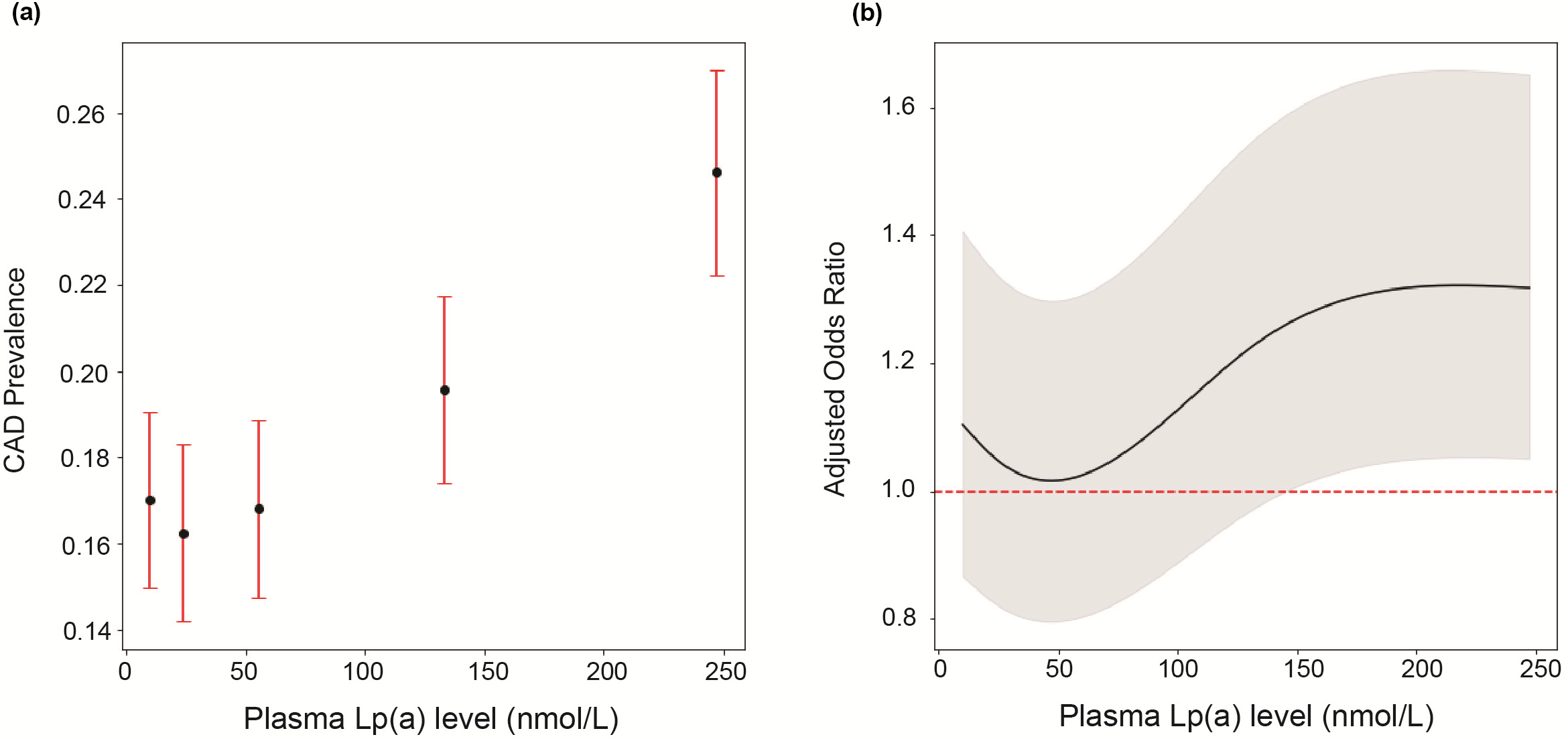
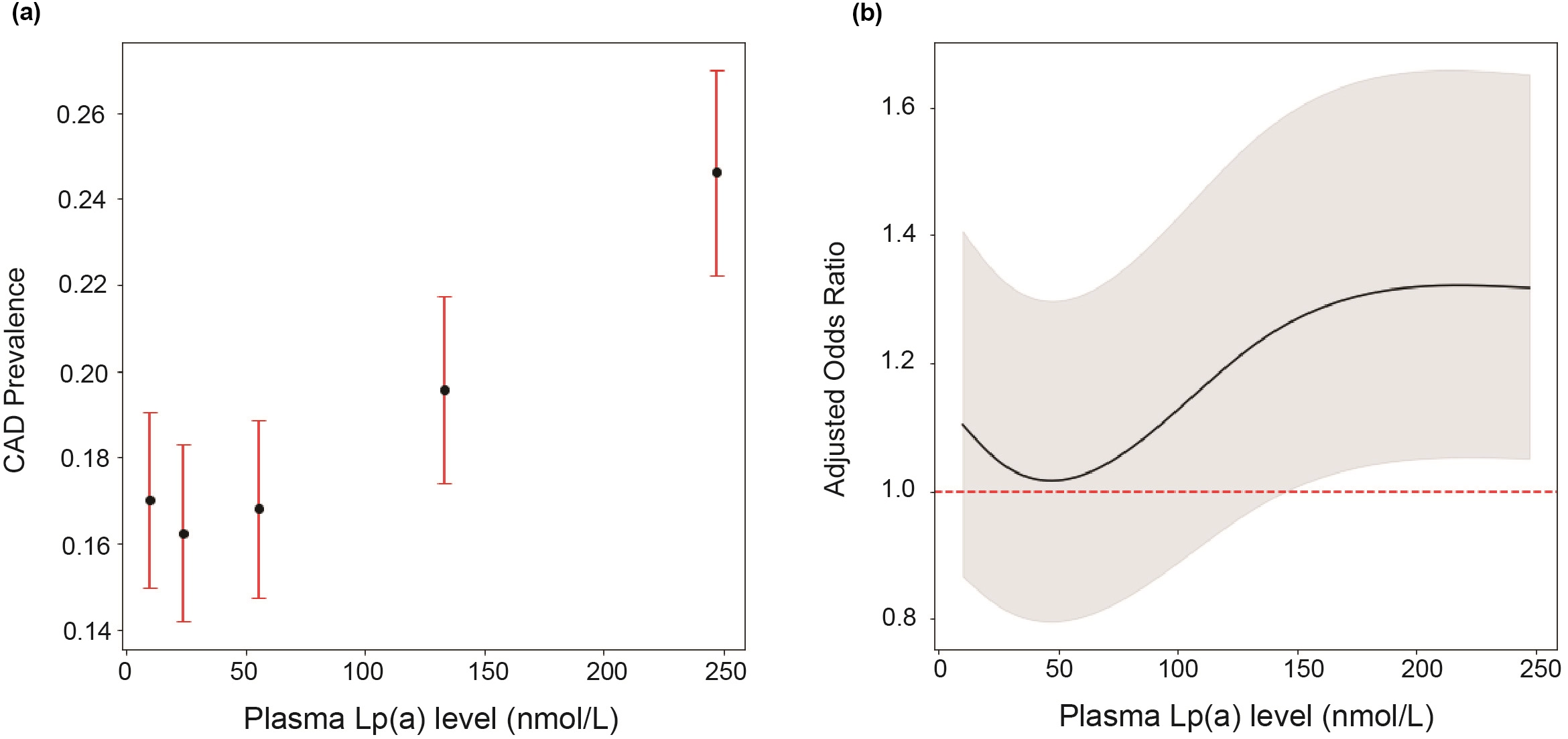
Figure 1. Association between plasma Lp(a) concentration and prevalent CAD across the continuous range of Lp(a) in U.S. Women Veterans (n = 6,314). (a) Observed prevalence of CAD by quintile of plasma Lp(a). Points are plotted at the median Lp(a) concentration within each quintile (11, 24, 56, 133, and 246 nmol/L) and error bars denote 95% confidence intervals. CAD prevalence was similar across the three lowest quintiles (17.1%, 16.3%, and 16.8%) and increased across the fourth and fifth quintiles (19.6% and 24.6%); (b) Adjusted odds ratio for prevalent CAD as a continuous function of plasma Lp(a), modeled by restricted cubic spline. The solid line denotes the point estimate and the shaded band the 95% confidence interval; the dashed line indicates an odds ratio of 1.0. The model was adjusted for age, menopausal status, race/ethnicity, tobacco use, diabetes, hypertension, dyslipidemia, statin use, and aspirin use. Estimates are displayed to 250 nmol/L owing to sparse data above this concentration. Lp(a): lipoprotein(a); CAD: coronary artery disease.
No differences in the Lp(a)-CAD association were detected based on menopausal status (interaction p = 1.0), with similar point estimates across premenopausal and postmenopausal subgroups (Table 1). Likewise, we detected no interaction with MHT use in postmenopausal women or OCP use in premenopausal individuals (interaction p = 0.20 and p = 0.32, respectively). In exploratory analyses, the association between elevated Lp(a) and prevalent CAD varied by age (interaction p = 0.081), with the strongest association in women ≥ 65 years (aOR 1.50, 95% CI 1.13-1.98), and by race/ethnicity (interaction p = 0.016); adjusted odds were numerically highest in women of Hispanic origin (aOR 1.69, 95% CI 0.84-3.39) and other or unknown race/ethnicity (aOR 2.21, 95% CI 1.34-3.63).
Table 1. Adjusted association between elevated Lp(a) (≥ 125 nmol/L) and prevalent coronary artery disease in U.S. Women Veterans, overall and within prespecified subgroups, with interaction tests for effect modification
| Cohort | Total (N) | Prevalent CAD (N) | aOR | 95% CI | p-value | p-value for Interaction |
| Overall cohort | 6,314 | 1,190 | - | - | - | - |
| Elevated Lp(a) (≥ 125 nmol/L) | 1,995 | 458 | 1.24 | 1.06, 1.44 | 0.0079 | - |
| Menopausal status | 1.00 | |||||
| Premenopause | 2,179 | 180 | 1.14 | 0.78, 1.65 | ||
| Menopause | 3,180 | 833 | 1.25 | 1.03, 1.51 | ||
| Unknown | 955 | 177 | 1.37 | 0.92, 2.04 | ||
| Hormonal therapies | ||||||
| OCP | 315 | 21 | 1.79 | 0.52, 6.11 | 0.32 | |
| MHT | 668 | 150 | 1.50 | 0.97, 2.31 | 0.20 | |
| Age (yrs) | 0.081 | |||||
| 19-42 | 1,300 | 53 | 1.04 | 0.53, 2.05 | ||
| 43-51 | 1,269 | 159 | 1.20 | 0.81, 1.80 | ||
| 52-58 | 1,322 | 251 | 1.21 | 0.87,1.68 | ||
| 59-64 | 1,181 | 298 | 1.04 | 0.76, 1.43 | ||
| 65-105 | 1,242 | 429 | 1.50 | 1.13, 1.98 | ||
| Race/Ethnicity | 0.016 | |||||
| White | 3,011 | 584 | 1.11 | 0.87, 1.41 | ||
| Black | 2,056 | 438 | 1.13 | 0.89, 1.43 | ||
| Hispanic or Latino | 455 | 61 | 1.69 | 0.84, 3.39 | ||
| Unknown/Other | 792 | 107 | 2.21 | 1.34, 3.63 |
Adjusted odds ratios were estimated by multivariable logistic regression adjusting for age, menopausal status, race/ethnicity, tobacco use, diabetes, hypertension, dyslipidemia, statin use, and aspirin use. Subgroup estimates represent the adjusted odds of prevalent CAD associated with elevated Lp(a) within each stratum. P-values for interaction were obtained by likelihood ratio test comparing models with and without each interaction term, entered individually; α = 0.10 was prespecified for interaction testing given the reduced power of tests for effect modification, and interaction findings are considered exploratory. Adjustments were made for multiple interaction tests through Bonferroni correction. aOR: adjusted odds ratio; CAD: coronary artery disease; CI: confidence interval; Lp(a): lipoprotein(a); MHT: menopausal hormone therapy; OCP: oral contraceptive.
4. Discussion
Our analysis demonstrates that elevated Lp(a) is independently associated with prevalent CAD in a large, racially diverse cohort of U.S. Women Veterans. The prevalence of elevated Lp(a) in Women Veterans (31.6%) in the study exceeds the ~20% reported in the general population, likely reflecting both indication bias in Lp(a) testing and the high proportion of Black individuals in the cohort, in whom median Lp(a) levels were 3.6-fold higher than in White women. Although MHT reduces Lp(a) levels by approximately 30%, prior studies have reported conflicting effects on Lp(a)-associated cardiovascular outcomes[7,8]. We did not detect any significant effect modification by MHT in postmenopausal women. Prior studies examining Lp(a) and hormonal exposures have been confined to postmenopausal or older women in predominantly white cohorts; to our knowledge, this study represents the first investigation of the Lp(a)-prevalent CAD association across different menopausal strata or in relation to OCP use in premenopausal women. Interaction terms for both menopausal status and OCP use were not significant, although confidence intervals in these strata were wide and do not fully exclude clinically significant differences. The data presented add real-world evidence in a more racially diverse population than prior studies that the association between elevated Lp(a) and prevalent CAD was not detectably different based on menopausal status or hormonal therapy use.
Prior studies differ from ours in population, design, and outcome. Honigberg et al. followed 88,266 postmenopausal UK Biobank participants (> 95% white) for a median of 11.1 years and found Lp(a) was associated with incident CAD among current and previous hormone users (hazard ratio of 1.56 for top quartile of Lp(a) levels) but not among never-users (HR 1.00; p-values for interaction of 0.040 and 0.046)[7]. Suk Danik et al. studied approximately 28,000 initially healthy older women and found that MHT may attenuate Lp(a)-related risk[8]. Our cross-sectional analysis of prevalent CAD in a younger and more racially diverse cohort detected no such modification. This divergence may reflect our use of prevalent vs. incident disease, hormonal therapy ascertained by pharmacy fill without formulation or duration, and a smaller MHT stratum with limited power to detect interaction.
In exploratory analyses, the Lp(a)-CAD association varied by age and race/ethnicity. The age-related interaction is consistent with a lifetime exposure model, where cumulative Lp(a) burden and vascular aging together amplify cardiovascular risk over time[1]. The race/ethnicity interaction is less interpretable given that adjusted odds were numerically highest in Hispanic women, but the confidence intervals included 1. Furthermore, the only stratum reaching conventional significance was the other or unknown race and ethnicity category, a heterogeneous administrative group. Both interactions were adjusted for multiplicity but require replication in larger cohorts.
Our study has limitations to consider. The cross-sectional design limits temporality and causation, as Lp(a) was measured at or near the time CAD was ascertained; however, given that an adult’s Lp(a) levels are determined early in life, it is probable that elevated Lp(a) was present prior to onset of CAD. In addition, potential indication bias exists as Lp(a) testing in VA care is more likely in individuals with existing cardiovascular disease or a strong family history of ASCVD. This indication bias, along with the greater cardiometabolic comorbidity in Veterans relative to community-dwelling women, limits generalizability of our findings. Residual confounding also cannot be fully excluded. Physical activity, socioeconomic status, and diabetes duration were not readily available in structured EHR data. In addition, body mass index and chronic kidney disease were not included in the model. Chronic kidney disease is particularly relevant to confounding given its direct effects on Lp(a) clearance and its independent association with prevalent CAD. Several variables are also potentially correlated with one another, and covariate coefficients should not be interpreted as independent causal estimates. Statin and aspirin use function both as treatments and as markers of established CAD in this cross-sectional design, and their inclusion as covariates may have led to model overadjustment. We also could not account for MHT formulation, route, or duration, each of which influences the degree of Lp(a) lowering[5,6]. We did not exclude women with conditions known to influence Lp(a), including malignancy, infection, recent surgery, recent acute coronary syndrome, and autoimmune disease. Furthermore, the consolidation of natural and surgically induced menopause into a single category due to insufficient numbers in the surgical subgroup is a limitation given emerging evidence that surgical menopause may confer greater cardiometabolic risk than natural menopause[10-13].
5. Conclusion
Elevated Lp(a) is independently associated with prevalent CAD in a diverse cohort of Women Veterans. Our analysis did not detect effect modification based on menopausal status or hormonal therapy, implying that women across the full reproductive spectrum may benefit from Lp(a) screening and eventual targeted therapy. Given that nearly one in three women in this cohort carried elevated Lp(a), these findings provide a strong rationale for ensuring adequate representation of women across the menopausal spectrum in ongoing Lp(a) intervention trials.
Acknowledgements
An earlier version of this analysis was presented in abstract format at the American Heart Association EPI Lifestyle Scientific Sessions meeting in March, 2025 (Abstract 053: “Menopausal Status and Race/Ethnicity and the Association of Lipoprotein(a) with CAD;” Circulation. 2025; 151 [Suppl 1]: A053). The present manuscript expands significantly on that preliminary report with an updated cohort, additional analyses of hormonal therapy exposures, continuous modeling of the Lp(a)-CAD association using restricted cubic splines and formal tests of effect modification across prespecified subgroups. Additional resources were provided by the Department of Veterans Affairs (VA) Informatics and Computing Infrastructure (VINCI), including manuscript preparation by Kathryn Pridgen, who is funded under the research priority to Put VA Data to Work for Veterans (VA ORD 24-D4V-02). The views expressed in this article are those of the authors and do not necessarily reflect the position or policy of the Department of Veterans Affairs or the United States government.
Authors contribution
Nallamshetty S, Lee J: Conceptualization, methodology, formal analysis, writing-original draft, writing-review & editing.
Cogill S, Heberer K: Methodology, investigation, formal analysis, software, writing-original draft, writing-review & editing.
Maldonado AI, Chen YQ, Shih MC: Methodology, formal analysis.
Seshadri A: Conceptualization, writing-original draft, writing-review & editing.
Bress A, Lynch JA: Methodology, formal analysis, writing-original draft, writing-review & editing.
Conflicts of interest
JAL reports grants from Alnylam Pharmaceuticals, Inc., AstraZeneca Pharmaceuticals LP, Biodesix, Inc., Janssen Pharmaceuticals, Inc., Novartis International AG, and Parexel International Corporation through the University of Utah or Western Institute for Veteran Research outside the submitted work. SN reports receiving research funding from Novartis Pharmaceuticals and Cleerly, Inc. outside the submitted work.
Ethical approval
The study was approved by the VA Central IRB (protocol 17-24), which granted a waiver of informed consent and a waiver of HIPAA authorization on the basis of minimal risk and retrospective analysis of existing data. The study was conducted in accordance with the Declaration of Helsinki.
Consent to participate
Not applicable.
Consent for publication
Not applicable.
Availability of data and materials
Data is not available publicly due to privacy concerns. Data is available to all VA researchers with appropriate IRB approvals.
Funding
This work was supported using funding provided by the US Department of Veterans Affairs (VA), Veterans Health Administration, Cooperative Studies Program (Project No. CSP #2012).
Copyright
© The Author(s) 2026.
References
Copyright
© The Author(s) 2026. This is an Open Access article licensed under a Creative Commons Attribution 4.0 International License (https://creativecommons.org/licenses/by/4.0/), which permits unrestricted use, sharing, adaptation, distribution and reproduction in any medium or format, for any purpose, even commercially, as long as you give appropriate credit to the original author(s) and the source, provide a link to the Creative Commons license, and indicate if changes were made.
Publisher’s Note
Science Exploration remains a neutral stance on jurisdictional claims in published
maps
and institutional affiliations. The views expressed in this article are solely those
of
the author(s) and do not reflect the opinions of the Editors or the publisher.
Share And Cite


Science Exploration Style
Nallamshetty S, Cogill S, Heberer K, Maldonado AI, Seshadri A, Chen YQ, et al. Menopausal status, hormonal therapy, and elevated lipoprotein(a): Implications for prevalent coronary artery disease in U.S. Women Veterans. Adv Lipoprotein(a) Res. 2026;1:202610. https://doi.org/10.70401/alr.2026.0012
Tips
Copy completed.
Submit a Manuscript
Author Instructions
Cite this Article
Article Metrics
0
View
0
Download
Cited
Article Updates

 Get citation
Science Exploration Style

Nallamshetty S, Cogill S, Heberer K, Maldonado AI, Seshadri A, Chen YQ, et al. Menopausal status, hormonal therapy, and elevated lipoprotein(a): Implications for prevalent coronary artery disease in U.S. Women Veterans. Adv Lipoprotein(a) Res. 2026;1:202610. https://doi.org/10.70401/alr.2026.0012
copy
Share Link
copy