-
Thermo-X (TX, Online ISSN 3106-8014) is a peer-reviewed, open-access journal published quarterly and owned by Science Exploration Press. The journal has a comprehensive scope, ranging from theoretical insights into the physics of heat, heat conduction, and quantum heat engines, to applied research on thermal energy storage, heat exchangers, thermal management, and sustainable heat-driven processes. Our mission is to provide a platform for scientists and researchers to share their experimental and theoretical advancements in a detailed, open-access format, thereby fostering innovation and collaboration in the thermal sciences. more >
Articles
Anatomically porous-media heat transfer modeling for multi-organ supercooling perfusion cryopreservation
-
Supercooling perfusion extends organ-preservation time by maintaining grafts ice-free below 0 °C, but thermal non-uniformity and limited intra-organ temperature observability hinder protocol design, especially at large-organ scales. We developed ...
MoreSupercooling perfusion extends organ-preservation time by maintaining grafts ice-free below 0 °C, but thermal non-uniformity and limited intra-organ temperature observability hinder protocol design, especially at large-organ scales. We developed an anatomically based thermo-fluidic modeling framework for supercooled perfusion of the liver, heart, and kidney in a recirculating multi-organ configuration and validated the model experimentally. Three-dimensional organ geometries from the BodyParts3D repository were combined with a porous-media tissue representation and realistic perfusion boundary conditions to resolve transient intra-parenchymal temperature fields. A self-developed variable-frequency supercooled machine perfusion (MP) platform was used to measure temperatures in porcine livers, hearts, and kidneys using multiple thermocouples placed at anatomically corresponding locations. Simulated temperature trajectories agreed with measurements across organs, with mean absolute errors of 0.24 °C for the liver, 2.63 °C for the heart, and 0.4 °C for the kidney, and reproduced initial cooling followed by progressive approach to the perfusate temperature and stabilization. Spatial temperature maps captured organ-specific gradients consistent with convective heat extraction by perfusate delivery and conductive transport within tissue. Using the validated model, we performed parametric sweeps of the inlet perfusion parameter, perfusate thermophysical properties, and external convective heat-transfer coefficient to quantify their effects on cooling rate and temperature uniformity. Based on quantitative metrics, these parameters were found to influence cooling rate and intra-organ temperature uniformity to different degrees, while the magnitude of improvement differed among organs due to size and vascular characteristics. This study provides a validated, under the tested conditions, tool to predict intra-organ temperature evolution and a guide for thermodynamically optimizing supercooled MP protocols in multi-organ preservation.
Less -
Zaize Liu, ... Wei Rao
-
DOI: https://doi.org/10.70401/tx.2026.0018 - April 20, 2026
-
This article belongs to the Special Issue Recent Advances in Bio-thermophysics: Innovations and Development at the Intersection of Biology and Thermal Science
Anomalous cooling and Mpemba effect in an oscillatory inductor-resistor-capacitor thermoelectric network and its inverse
-
Anomalous cooling or heating implies attractive underlying thermal physics, and the Mpemba effect and its inverse are typical examples. Most existing explanations for such phenomena are based on microscopic Markovian models that quantify relaxation using ...
MoreAnomalous cooling or heating implies attractive underlying thermal physics, and the Mpemba effect and its inverse are typical examples. Most existing explanations for such phenomena are based on microscopic Markovian models that quantify relaxation using distance measures such as total variation distance or Kullback‑Leibler divergence. Here, we propose a macroscopic network system to observe and analyze the Mpemba effect and its inverse by connecting a thermoelectric module with a body and a reservoir at different initial temperatures. Normal cooling and anomalous cooling can be switched in such a setup, and oscillatory behaviors of temperature, current, and heat flow are found to be the key for achieving the Mpemba effect and its inverse. With an unambiguous definition of the criteria, the occurrence domain of the Mpemba effect is sketched in terms of initial temperature, thermoelectric Figure-of-Merit, and the inductance. This work provides a macroscopic network system to understand the Mpemba effect, and offers a more flexible and dynamic way for thermal management and energy conversion.
Less -
Zhaochen Wang, ... Run Hu
-
DOI: https://doi.org/10.70401/tx.2026.0019 - April 17, 2026
Thermal conductivity hydrogen sensor: From fundamental principles to smart gas sensing applications
-
Hydrogen is widely recognized as the leading green energy carrier of the 21st century, owing to its diverse production pathways, high combustion energy density, and environmentally benign byproduct: water. However, its wide flammability range (4-75 vol.% ...
MoreHydrogen is widely recognized as the leading green energy carrier of the 21st century, owing to its diverse production pathways, high combustion energy density, and environmentally benign byproduct: water. However, its wide flammability range (4-75 vol.% in air) and extremely low minimum ignition energy (0.02 mJ) pose significant safety risks across the entire lifecycle of production, storage, transportation, and utilization, necessitating real-time monitoring through highly reliable sensing technologies. Among various hydrogen detection methods, thermal conductivity sensors have attracted considerable attention due to their oxygen-independent operation, broad measuring range, mechanical robustness, and long service lifespan. Despite growing research interest, there remains a notable lack of comprehensive review articles specifically dedicated to thermal conductivity hydrogen sensors (TCHSs) that consolidate the current state of knowledge and guide future research directions. This paper presents a systematic analysis of the working principles and operating modes of TCHSs, introduces key performance parameters, and reviews theoretical models describing the effective thermal conductivity of gas mixtures. The discussion covers representative sensor architectures, gas inlet configurations, and critical environmental factors influencing sensor performance. Furthermore, recent advances and emerging trends are examined, with particular emphasis on smart gas sensing technologies enabled by sensor integration and advanced machine learning algorithms. This study aims to serve as a comprehensive academic reference, offering a clear and structured framework for researchers, particularly those newly entering the field of hydrogen sensing.
Less -
Fanfan Ke, ... Minggang Xia
-
DOI: https://doi.org/10.70401/tx.2026.0017 - March 25, 2026
Research progress on thermal Hall effect
-
Thermal Hall effect (THE) refers to the phenomenon whereby, in a magnetic field, when a longitudinal heat current flows through a material, the heat carriers are deflected, thereby generating a transverse temperature difference between the two lateral edges. ...
MoreThermal Hall effect (THE) refers to the phenomenon whereby, in a magnetic field, when a longitudinal heat current flows through a material, the heat carriers are deflected, thereby generating a transverse temperature difference between the two lateral edges. The transition from electrical to thermal transport enables this effect to involve a wide range of carriers, thereby providing a unique perspective for investigating complex quantum states in condensed matter physics. THE is increasingly becoming a powerful probe of neutral excitations in materials and is used to explore multifield control phenomena in magneto-thermal-electrical coupled systems. Advances in the field of THE have significantly advanced the study of condensed matter systems under extreme conditions (low temperatures and strong magnetic fields) and have laid the groundwork for exploring novel magneto-thermal-electrical effects in quantum materials. This review systematically reviews recent theoretical and experimental progress on THE, with particular attention to the underlying heat carriers. Through an in-depth analysis of the transport mechanisms of different carriers, quantum material systems that can be used to investigate multicarrier coupled transport are identified, which will significantly facilitate the synergistic control of magneto-thermal-electrical transport in complex interacting systems. Finally, we propose a novel in situ, multiparameter integrated characterization method that enables simultaneous and precise measurement of magnetic, thermal, and electrical parameters on the same micro/nanoscale samples. This approach not only overcomes the limitations of bulk materials but also serves as a key experimental platform for revealing the mechanisms of multicarrier coupled transport in micro/nano samples.
Less -
Zewen Song, ... Ting Zhang
-
DOI: https://doi.org/10.70401/tx.2026.0016 - March 16, 2026
Unleashing high-flux evaporative cooling via 3D interconnected fiber membranes
-
Haosheng Lin, ... Wei Wu
-
DOI: https://doi.org/10.70401/tx.2026.0015 - March 12, 2026
High-performance electrocaloric cooling devices for efficient and compact solid-state refrigeration
-
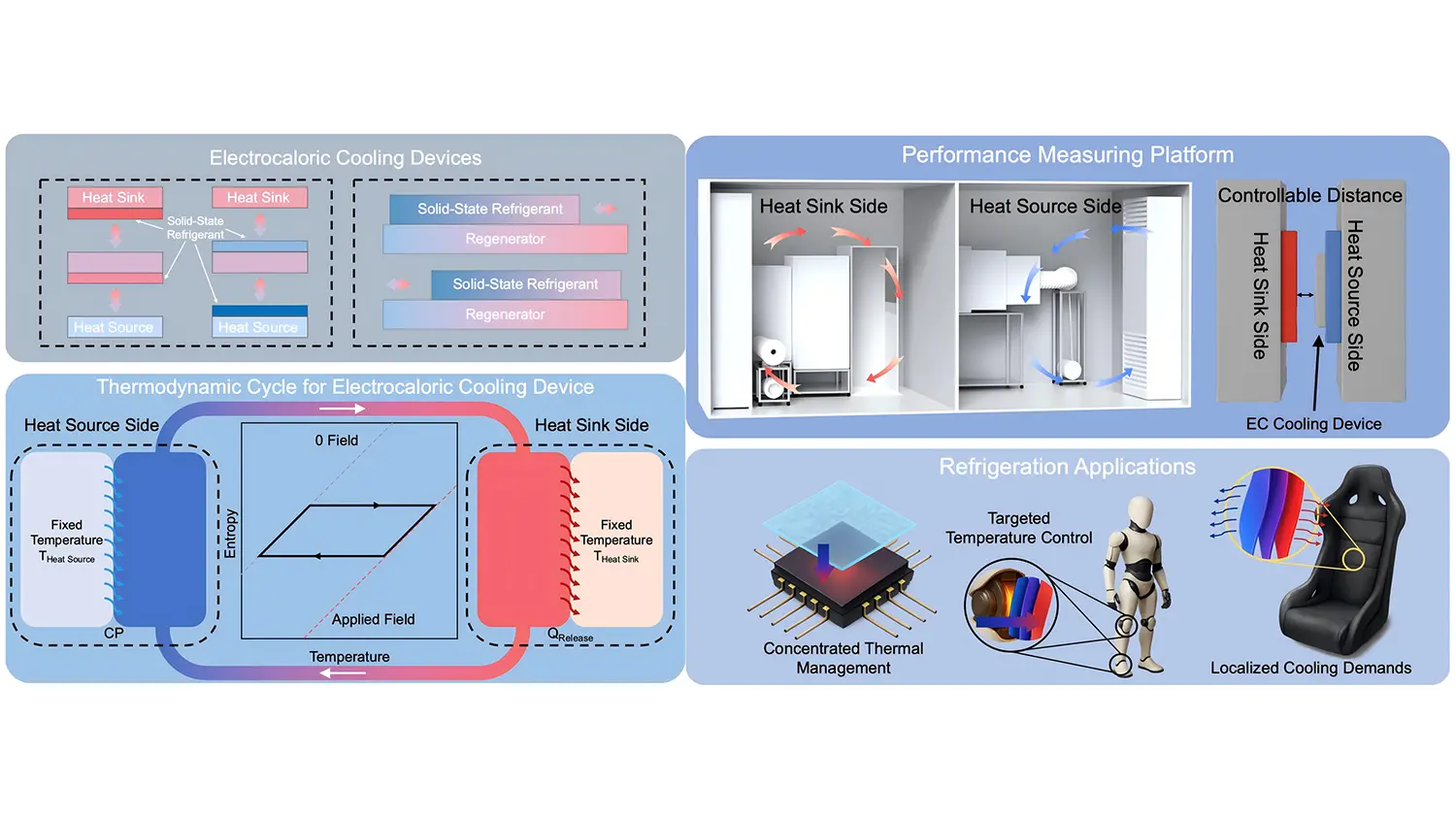
The electrocaloric (EC) effect represents the changes of polarization entropy and/or temperature of dielectrics when an external electric field is applied and removed. An efficient EC effect relies on a highly reversible conversion between electrical energy ...
MoreThe electrocaloric (EC) effect represents the changes of polarization entropy and/or temperature of dielectrics when an external electric field is applied and removed. An efficient EC effect relies on a highly reversible conversion between electrical energy and thermal energy. Based on this effect, EC refrigeration has demonstrated advantages in terms of high energy efficiency, zero direct carbon emissions, and high specific volumetric cooling power densities. Consequently, EC refrigeration is recognized as one of the promising alternative technologies for next-generation refrigeration and heat pump. Over the past two decades, EC cooling devices have been extensively developed, driven by advances in EC materials and working bodies. In this review, we summarize recent progress in EC cooling devices, focusing on the mechanisms of solid-state refrigerants and thermodynamic cycles within these systems, and highlighting the characteristics of devices operating on different working principles.
Less -
Donglin Han, ... Xiaoshi Qian
-
DOI: https://doi.org/10.70401/tx.2025.0004 - September 26, 2025
Transient electro-thermal technique for measuring the thermal diffusivity/conductivity of 1D/2D materials: from mm down to atomic scale thickness
-
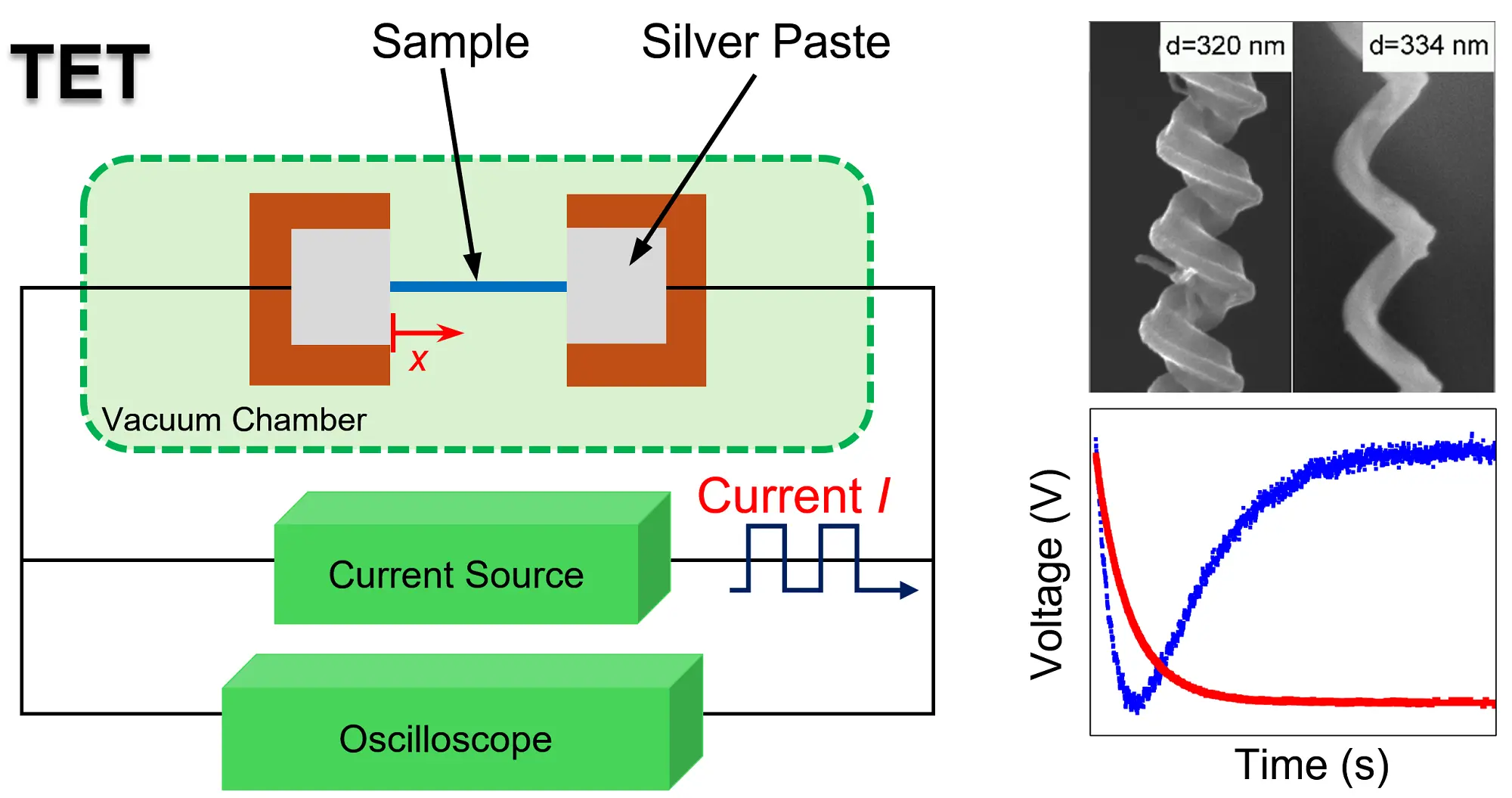
With the continuous miniaturization of micro-devices and the rapid advancement of novel nanomaterials, thermal characterization techniques tailored for two-dimensional (2D) structures (films and coatings) and one-dimensional (1D) architectures (wires ...
MoreWith the continuous miniaturization of micro-devices and the rapid advancement of novel nanomaterials, thermal characterization techniques tailored for two-dimensional (2D) structures (films and coatings) and one-dimensional (1D) architectures (wires and fibers) have become essential for elucidating structure-property relationships and optimizing material performance. This review provides an in-depth analysis of the Transient Electro-Thermal (TET) technique, a recently developed method for measuring the thermal diffusivity and conductivity of 1D and 2D materials, including dielectric, metallic, and semiconductive films, coatings, and wires/fibers. We discuss the fundamental principles of TET operation, the associated physical and mathematical models for data reduction, and critical methodologies for data fitting, uncertainty analysis, and stray heat transfer mitigation to ensure high repeatability and accuracy. In addition, the latest developments and applications of TET are highlighted, including its extension to atomic-scale thickness, in-situ dynamic thermal property measurements during structural evolution, and the zero-temperature-rise limit method. The outstanding agreement (within ~0.6%) between the measured and reference thermal diffusivity of a Pt wire, validated through extensive experiments and zero-temperature-rise extrapolation, demonstrates the robustness and reliability of the TET technique. Owing to its simplicity in principles, experimental implementation, and data analysis, TET offers significant advantages in uncertainty control, measurement accuracy, and throughput.
Less -
Yangsu Xie, ... Xinwei Wang
-
DOI: https://doi.org/10.70401/tx.2025.0002 - July 31, 2025
An ITO thermochromic hydrogel-based smart window for balancing indoor daylight comfort and energy regulation
-
Enhancing indoor visual comfort is crucial for the practical deployment of thermochromic smart windows. However, their application is often hindered by the low visible light transmittance (Tlum) in the activated state. In this study, we propose ...
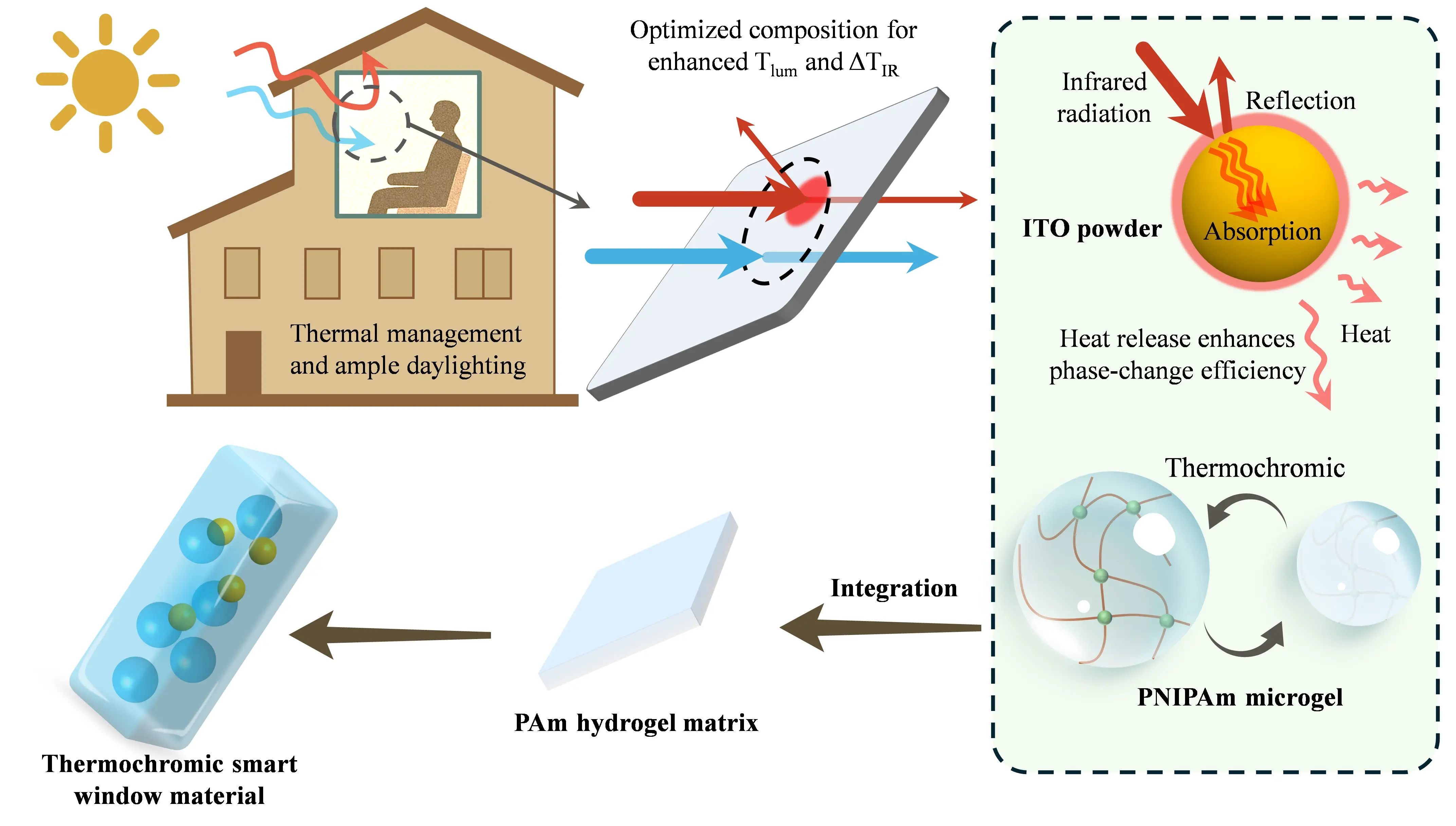
MoreEnhancing indoor visual comfort is crucial for the practical deployment of thermochromic smart windows. However, their application is often hindered by the low visible light transmittance (Tlum) in the activated state. In this study, we propose a thermally and optically dual-responsive smart window that improves both building energy efficiency and Tlum in the activated state. The design is based on a polyacrylamide (PAm)/poly(N-isopropylacrylamide) (PNIPAm)/indium tin oxide (ITO) composite film (PPI). Within this structure, PAm provides a hydrophilic matrix, PNIPAm microgels enable thermoresponsive optical modulation through reversible transmittance changes across the response temperature, and ITO particles act as light-to-heat transducers due to their photothermal and infrared reflective properties. Compared with the PNIPAm hydrogel film, the PPI composite film increases Tlum in the activated state from 9.7% to 50.0% and enhances infrared modulation capability from 39.2% to 50.4%. Under an illumination intensity of 95 mW·cm-2, the PPI composite film lowers the indoor temperature of simulated buildings by up to 7 °C. This dual-responsive thermochromic window provides improved indoor visual comfort along with effective temperature regulation, offering a promising strategy for advancing the practical use of smart windows.
Less -
Zhucheng Jiang, ... Wei Feng
-
DOI: https://doi.org/10.70401/tx.2025.0003 - September 22, 2025
A review of thermal switches and diodes for energy and information technologies
-
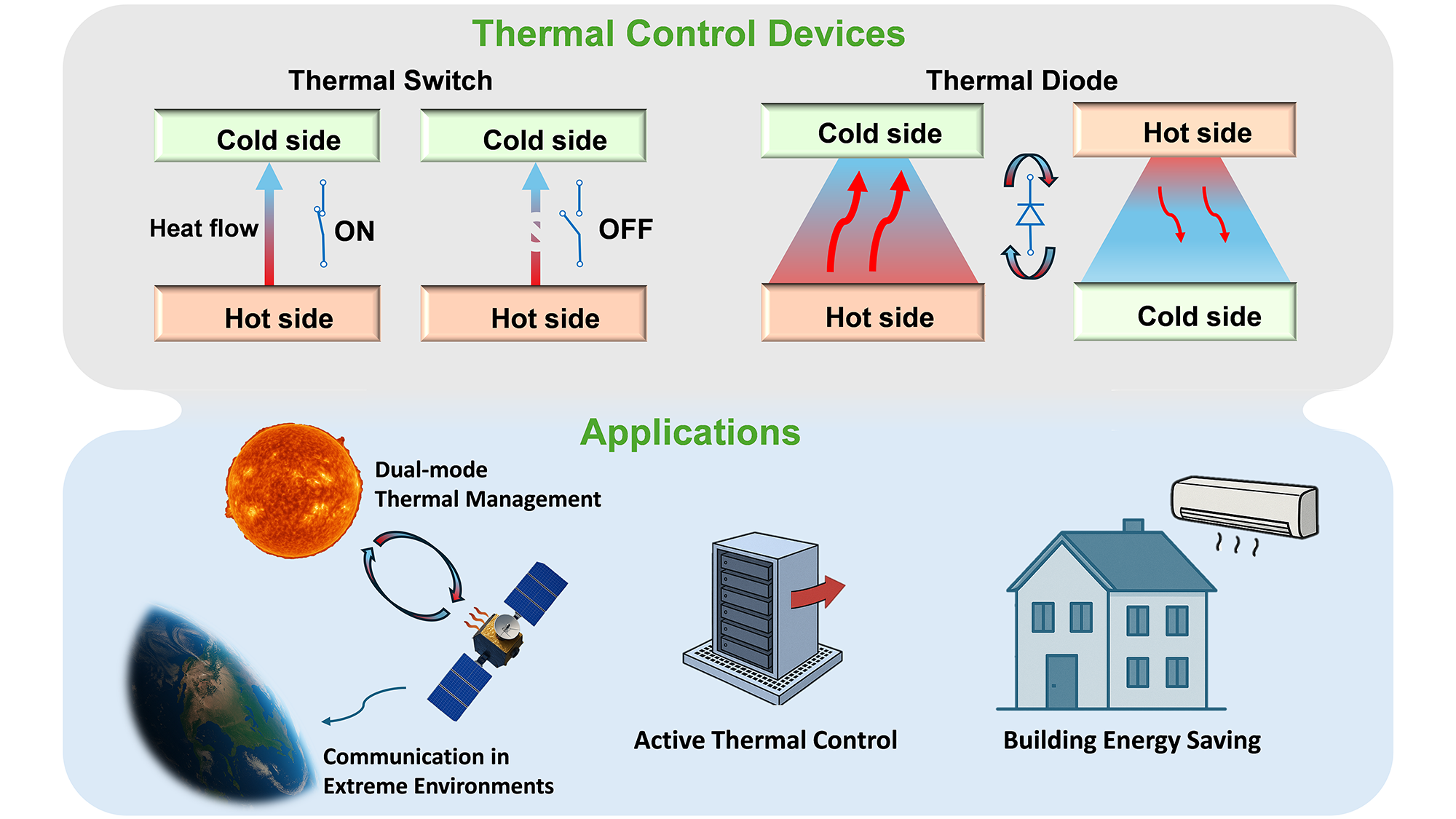
The high integration density of modern energy and information devices often results in high power density and intense heat flux. Depending on the operating and optimal temperature range of the device, heat must be either effectively dissipated or retained. ...
MoreThe high integration density of modern energy and information devices often results in high power density and intense heat flux. Depending on the operating and optimal temperature range of the device, heat must be either effectively dissipated or retained. Precise regulation of heat flow is essential for the advancement of next-generation energy and information technologies. Dynamic heat flow control and nonlinear thermal transport open new avenues for developing smart battery thermal management systems, solid-state refrigeration devices, and thermal logic elements analogous to electronic circuits. Due to their unique capability to actively modulate heat transfer and exhibit thermal rectification behavior, thermal switches and thermal diodes have shown great potential in managing heat and/or maintaining thermal stability beyond the limits of conventional passive thermal materials and devices. Here, we review recent progress in the design principles, fundamental mechanisms, and applications of thermal switches and thermal diodes for energy and information technologies, and evaluate their potential for practical deployment. Furthermore, we discuss the emerging demands in these sectors and provide future perspectives to inspire applied research toward solving real engineering challenges.
Less -
Zhuo Chen, ... Yuqiang Zeng
-
DOI: https://doi.org/10.70401/tx.2026.0010 - January 20, 2026
Strong lattice anharmonicity and glass-like lattice thermal conductivity in nitrohalide double antiperovskites: A case study based on machine-learning potentials
-
Antiperovskites have attracted significant interest in the field of energy conversion in recent years. While extensive research has focused on the magnetism, ionic conductivity and superconductivity of antiperovskites, their thermal properties including ...
MoreAntiperovskites have attracted significant interest in the field of energy conversion in recent years. While extensive research has focused on the magnetism, ionic conductivity and superconductivity of antiperovskites, their thermal properties including lattice anharmonicity and thermal transport remain less explored compared to their well-studied perovskite counterparts. Recently, nitrohalide double antiperovskites have been successfully synthesized. In this work, we investigate the thermal transport properties of nitrohalide double antiperovskites
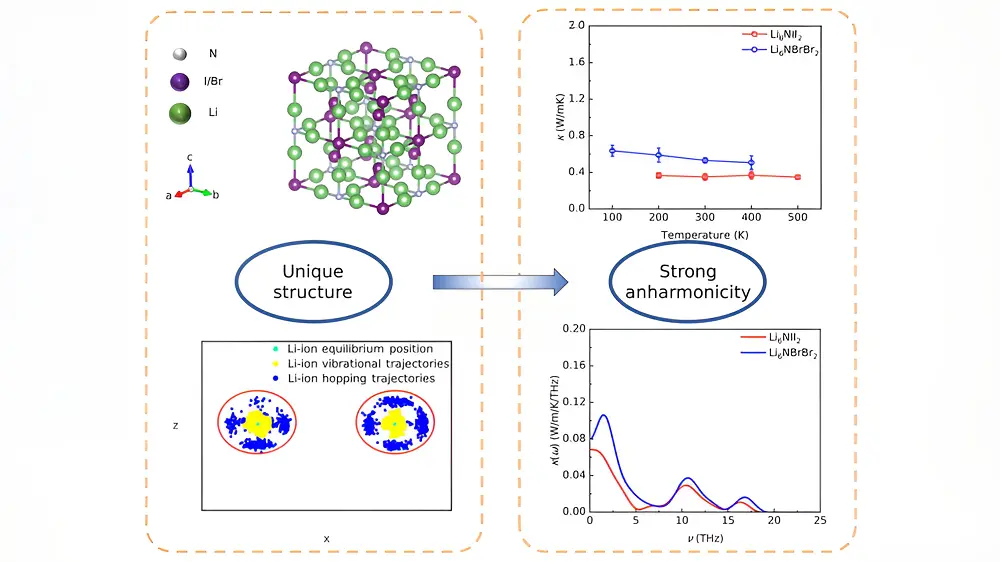
LessLi6NII2 and Li6NBrBr2 using first-principles machine-learning potentials. Our results reveal that within the perturbation theory framework, imaginary phonons appear throughout the entire Brillouin zone in both the harmonic regime and at elevated temperatures. Atomic vibrational analysis indicates that stochastic Li-ion movements confined within a single conventional unit cell are responsible for the presence of these imaginary phonons. Furthermore, homogeneous nonequilibrium molecular dynamics and equilibrium molecular dynamics simulations demonstrate that Li6NII2 and Li6NBrBr2 exhibit ultralow glass-like lattice thermal conductivities. Spectral thermal conductivity analysis shows that the dominant contributions arise from phonons with frequencies below 5 THz and around 11 THz. The substantial phonon contribution near 11 THz is attributed to the confined stochastic motions of Li ions. This work uncovers the unconventional microscopic cation dynamics and strong lattice anharmonicity in double antiperovskites Li6NII2 and Li6NBrBr2, thereby advancing the understanding of phonon transport in these materials. -
Yuan Li, ... Jian-Hua Jiang
-
DOI: https://doi.org/10.70401/tx.2025.0001 - July 10, 2025
Transient electro-thermal technique for measuring the thermal diffusivity/conductivity of 1D/2D materials: from mm down to atomic scale thickness
-
With the continuous miniaturization of micro-devices and the rapid advancement of novel nanomaterials, thermal characterization techniques tailored for two-dimensional (2D) structures (films and coatings) and one-dimensional (1D) architectures (wires ...
MoreWith the continuous miniaturization of micro-devices and the rapid advancement of novel nanomaterials, thermal characterization techniques tailored for two-dimensional (2D) structures (films and coatings) and one-dimensional (1D) architectures (wires and fibers) have become essential for elucidating structure-property relationships and optimizing material performance. This review provides an in-depth analysis of the Transient Electro-Thermal (TET) technique, a recently developed method for measuring the thermal diffusivity and conductivity of 1D and 2D materials, including dielectric, metallic, and semiconductive films, coatings, and wires/fibers. We discuss the fundamental principles of TET operation, the associated physical and mathematical models for data reduction, and critical methodologies for data fitting, uncertainty analysis, and stray heat transfer mitigation to ensure high repeatability and accuracy. In addition, the latest developments and applications of TET are highlighted, including its extension to atomic-scale thickness, in-situ dynamic thermal property measurements during structural evolution, and the zero-temperature-rise limit method. The outstanding agreement (within ~0.6%) between the measured and reference thermal diffusivity of a Pt wire, validated through extensive experiments and zero-temperature-rise extrapolation, demonstrates the robustness and reliability of the TET technique. Owing to its simplicity in principles, experimental implementation, and data analysis, TET offers significant advantages in uncertainty control, measurement accuracy, and throughput.
Less -
Yangsu Xie, ... Xinwei Wang
-
DOI: https://doi.org/10.70401/tx.2025.0002 - July 31, 2025
High-performance electrocaloric cooling devices for efficient and compact solid-state refrigeration
-
The electrocaloric (EC) effect represents the changes of polarization entropy and/or temperature of dielectrics when an external electric field is applied and removed. An efficient EC effect relies on a highly reversible conversion between electrical energy ...
MoreThe electrocaloric (EC) effect represents the changes of polarization entropy and/or temperature of dielectrics when an external electric field is applied and removed. An efficient EC effect relies on a highly reversible conversion between electrical energy and thermal energy. Based on this effect, EC refrigeration has demonstrated advantages in terms of high energy efficiency, zero direct carbon emissions, and high specific volumetric cooling power densities. Consequently, EC refrigeration is recognized as one of the promising alternative technologies for next-generation refrigeration and heat pump. Over the past two decades, EC cooling devices have been extensively developed, driven by advances in EC materials and working bodies. In this review, we summarize recent progress in EC cooling devices, focusing on the mechanisms of solid-state refrigerants and thermodynamic cycles within these systems, and highlighting the characteristics of devices operating on different working principles.
Less -
Donglin Han, ... Xiaoshi Qian
-
DOI: https://doi.org/10.70401/tx.2025.0004 - September 26, 2025
A review of thermal switches and diodes for energy and information technologies
-
The high integration density of modern energy and information devices often results in high power density and intense heat flux. Depending on the operating and optimal temperature range of the device, heat must be either effectively dissipated or retained. ...
MoreThe high integration density of modern energy and information devices often results in high power density and intense heat flux. Depending on the operating and optimal temperature range of the device, heat must be either effectively dissipated or retained. Precise regulation of heat flow is essential for the advancement of next-generation energy and information technologies. Dynamic heat flow control and nonlinear thermal transport open new avenues for developing smart battery thermal management systems, solid-state refrigeration devices, and thermal logic elements analogous to electronic circuits. Due to their unique capability to actively modulate heat transfer and exhibit thermal rectification behavior, thermal switches and thermal diodes have shown great potential in managing heat and/or maintaining thermal stability beyond the limits of conventional passive thermal materials and devices. Here, we review recent progress in the design principles, fundamental mechanisms, and applications of thermal switches and thermal diodes for energy and information technologies, and evaluate their potential for practical deployment. Furthermore, we discuss the emerging demands in these sectors and provide future perspectives to inspire applied research toward solving real engineering challenges.
Less -
Zhuo Chen, ... Yuqiang Zeng
-
DOI: https://doi.org/10.70401/tx.2026.0010 - January 20, 2026
An ITO thermochromic hydrogel-based smart window for balancing indoor daylight comfort and energy regulation
-
Enhancing indoor visual comfort is crucial for the practical deployment of thermochromic smart windows. However, their application is often hindered by the low visible light transmittance (Tlum) in the activated state. In this study, we propose ...
MoreEnhancing indoor visual comfort is crucial for the practical deployment of thermochromic smart windows. However, their application is often hindered by the low visible light transmittance (Tlum) in the activated state. In this study, we propose a thermally and optically dual-responsive smart window that improves both building energy efficiency and Tlum in the activated state. The design is based on a polyacrylamide (PAm)/poly(N-isopropylacrylamide) (PNIPAm)/indium tin oxide (ITO) composite film (PPI). Within this structure, PAm provides a hydrophilic matrix, PNIPAm microgels enable thermoresponsive optical modulation through reversible transmittance changes across the response temperature, and ITO particles act as light-to-heat transducers due to their photothermal and infrared reflective properties. Compared with the PNIPAm hydrogel film, the PPI composite film increases Tlum in the activated state from 9.7% to 50.0% and enhances infrared modulation capability from 39.2% to 50.4%. Under an illumination intensity of 95 mW·cm-2, the PPI composite film lowers the indoor temperature of simulated buildings by up to 7 °C. This dual-responsive thermochromic window provides improved indoor visual comfort along with effective temperature regulation, offering a promising strategy for advancing the practical use of smart windows.
Less -
Zhucheng Jiang, ... Wei Feng
-
DOI: https://doi.org/10.70401/tx.2025.0003 - September 22, 2025
Strong lattice anharmonicity and glass-like lattice thermal conductivity in nitrohalide double antiperovskites: A case study based on machine-learning potentials
-
Antiperovskites have attracted significant interest in the field of energy conversion in recent years. While extensive research has focused on the magnetism, ionic conductivity and superconductivity of antiperovskites, their thermal properties including ...
MoreAntiperovskites have attracted significant interest in the field of energy conversion in recent years. While extensive research has focused on the magnetism, ionic conductivity and superconductivity of antiperovskites, their thermal properties including lattice anharmonicity and thermal transport remain less explored compared to their well-studied perovskite counterparts. Recently, nitrohalide double antiperovskites have been successfully synthesized. In this work, we investigate the thermal transport properties of nitrohalide double antiperovskites
LessLi6NII2 and Li6NBrBr2 using first-principles machine-learning potentials. Our results reveal that within the perturbation theory framework, imaginary phonons appear throughout the entire Brillouin zone in both the harmonic regime and at elevated temperatures. Atomic vibrational analysis indicates that stochastic Li-ion movements confined within a single conventional unit cell are responsible for the presence of these imaginary phonons. Furthermore, homogeneous nonequilibrium molecular dynamics and equilibrium molecular dynamics simulations demonstrate that Li6NII2 and Li6NBrBr2 exhibit ultralow glass-like lattice thermal conductivities. Spectral thermal conductivity analysis shows that the dominant contributions arise from phonons with frequencies below 5 THz and around 11 THz. The substantial phonon contribution near 11 THz is attributed to the confined stochastic motions of Li ions. This work uncovers the unconventional microscopic cation dynamics and strong lattice anharmonicity in double antiperovskites Li6NII2 and Li6NBrBr2, thereby advancing the understanding of phonon transport in these materials. -
Yuan Li, ... Jian-Hua Jiang
-
DOI: https://doi.org/10.70401/tx.2025.0001 - July 10, 2025
Special Issues
Recent Advances in Bio-thermophysics: Innovations and Development at the Intersection of Biology and Thermal Science
-
Submission Deadline: 30 Jun 2026
-
Published articles: 1