-
Computational Biomedicine is a peer-reviewed, open access journal published quarterly and owned by Science Exploration Press. The journal covers a wide range of topics, including molecular medicine, simulation, modeling techniques, imaging methods, and information technology. Our mission is to encourage scientists to publish their experimental and theoretical findings in a detailed open-access format. We invite submissions across various article types, including Research Articles, Review Articles, Editorials, Case Reports, Letters to the Editor, Perspectives, and Commentaries. more >
Articles
Computational approach to pulmonary delivery of therapeutical RNAs
-
Targeted delivery of RNA-based therapeutics to the lungs remains a substantial challenge due to the unique anatomy of lung tissue and its complex immune barriers. In recent years, the convergence of physiologically based pharmacokinetic (PBPK) models, quantitative ...
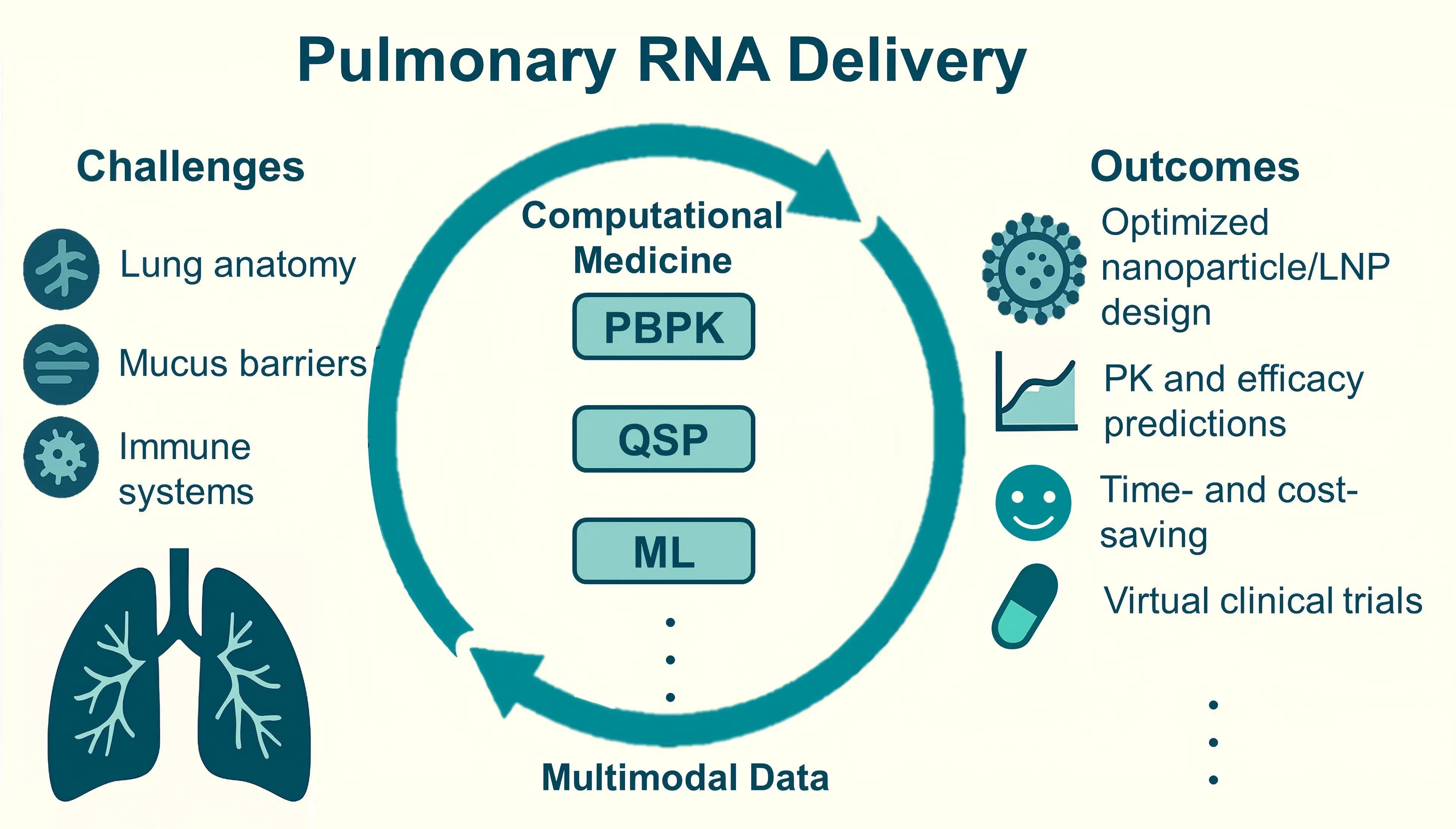
MoreTargeted delivery of RNA-based therapeutics to the lungs remains a substantial challenge due to the unique anatomy of lung tissue and its complex immune barriers. In recent years, the convergence of physiologically based pharmacokinetic (PBPK) models, quantitative systems pharmacology approaches, and machine learning algorithms has led to the development of computational medicine frameworks, providing intelligent tools for addressing the aforementioned challenges in efficient pulmonary delivery. By integrating experimental data with predictive computational models, these approaches have advanced the development of RNA therapies for pulmonary diseases. The deep integration of multimodal data is expected to further accelerate drug discovery and clinical translation. In this review, we systematically summarize these computational approaches in designing and optimizing pulmonary RNA delivery systems. We particularly highlight the mechanism-based rational design of RNA therapies through simulations and predictions of biodistribution, cellular targeting, and intracellular transport processes.
Less -
Xianan Li, ... Pu Chen
-
DOI: https://doi.org/10.70401/cbm.2025.0004 - November 28, 2025
MediHerb: A multi-modal enhanced framework for disease inference via herbal knowledge
-
Aims: Development of robust and effective methods for uncovering herb interactions and constructing herb–disease associations requires the integration of diverse biological and medical information. A key challenge in Traditional Chinese Medicine ...
MoreAims: Development of robust and effective methods for uncovering herb interactions and constructing herb–disease associations requires the integration of diverse biological and medical information. A key challenge in Traditional Chinese Medicine (TCM) research is to robustly uncover herb interactions and construct reliable herb–disease associations. This task requires handling the inherently high-dimensional, multi-label, and cross-domain nature of prescription data. Existing approaches provide limited representation capacity and insufficient integration of biomedical knowledge, restricting their ability to capture the complex semantics underlying the relationships between herbs and diseases.
Methods: To address the limitations of existing approaches, we propose MediHerb, a multi-modal enhanced framework for disease inference via herbal knowledge. MediHerb unifies five complementary modalities: molecular sequences, fingerprints, physicochemical properties, graphical prescription representations, and the description of TCM prescriptions into a shared latent space. An attention-based fusion mechanism aligns the semantics across molecular, herbal, and diagnostic levels, enabling multi-granularity reasoning. To further promote accessibility, a lightweight graphical interface has been developed to support interaction with both the model and open datasets.
Results: Experimental results on benchmark datasets demonstrate that MediHerb substantially outperforms existing baselines in herb–disease inference. Beyond predictive accuracy, the learned embeddings and model attention patterns reveal meaningful biological and pharmacological insights, confirming that MediHerb captures the mechanistic underpinnings of herb–disease associations.
Conclusion: MediHerb highlights the potential of knowledge-enhanced multi-modal fusion to bridge molecular, herbal, and clinical semantics, offering a more interpretable and holistic approach to understanding TCM prescriptions.
Less -
Xiaoyi Liu, ... Jijun Tang
-
DOI: https://doi.org/10.70401/cbm.2025.0003 - November 25, 2025
Inaugural Editorial for Computational Biomedicine
-
De-Shuang Huang
-
DOI: https://doi.org/10.70401/cbm.2025.0002 - November 20, 2025
A comprehensive review on neuropeptides: databases and computational tools
-
Neuropeptides are crucial signaling molecules that regulate diverse physiological processes spanning growth, social behavior, learning, memory, metabolism, homeostasis, reproduction, and neural differentiation across both nervous and peripheral ...
MoreNeuropeptides are crucial signaling molecules that regulate diverse physiological processes spanning growth, social behavior, learning, memory, metabolism, homeostasis, reproduction, and neural differentiation across both nervous and peripheral systems. Dysregulation of neuropeptides signaling is closely linked to various pathological conditions, such as neurological disorders, metabolic diseases, cardiovascular conditions, and even cancer, positioning them as potential therapeutic agents or targets for intervention. In recent years, research into neuropeptides has accelerated, with vast amounts of data continuously accumulating in multiple databases. However, the study of neuropeptides is often impeded by the need for extensive and time-consuming experimental investigations. As a result, computational tools have become essential for the rapid, large-scale identification of neuropeptides. This review systematically discusses neuropeptide-related databases and computational tools. These databases organize extensive data on neuropeptide sequences, structures, and functions. Among these, NeuroPep2.0, with 11,417 neuropeptide entries, is currently the most widely used dataset for neuropeptide prediction. Additionally, this review explores the application of computational approaches in neuropeptide prediction. While early methods predominantly relied on homologous sequence alignment and biochemical feature statistics, recent advances in machine learning have significantly enhanced prediction accuracy and efficiency. Tools such as NeuroPred-PLM and DeepNeuropePred, developed by our research group using protein language models, have substantially improved prediction performance. In conclusion, this review provides a comprehensive overview of current neuropeptide databases and computational tools, offering researchers a thorough survey of available resources and analytical methods, and emphasizing the necessity of continuous optimization to advance neuropeptide research and its therapeutic applications.
Less -
Wei Xu, ... Yan Wang
-
DOI: https://doi.org/10.70401/cbm.2025.0001 - April 10, 2025
A comprehensive review on neuropeptides: databases and computational tools
-
Neuropeptides are crucial signaling molecules that regulate diverse physiological processes spanning growth, social behavior, learning, memory, metabolism, homeostasis, reproduction, and neural differentiation across both nervous and peripheral ...
MoreNeuropeptides are crucial signaling molecules that regulate diverse physiological processes spanning growth, social behavior, learning, memory, metabolism, homeostasis, reproduction, and neural differentiation across both nervous and peripheral systems. Dysregulation of neuropeptides signaling is closely linked to various pathological conditions, such as neurological disorders, metabolic diseases, cardiovascular conditions, and even cancer, positioning them as potential therapeutic agents or targets for intervention. In recent years, research into neuropeptides has accelerated, with vast amounts of data continuously accumulating in multiple databases. However, the study of neuropeptides is often impeded by the need for extensive and time-consuming experimental investigations. As a result, computational tools have become essential for the rapid, large-scale identification of neuropeptides. This review systematically discusses neuropeptide-related databases and computational tools. These databases organize extensive data on neuropeptide sequences, structures, and functions. Among these, NeuroPep2.0, with 11,417 neuropeptide entries, is currently the most widely used dataset for neuropeptide prediction. Additionally, this review explores the application of computational approaches in neuropeptide prediction. While early methods predominantly relied on homologous sequence alignment and biochemical feature statistics, recent advances in machine learning have significantly enhanced prediction accuracy and efficiency. Tools such as NeuroPred-PLM and DeepNeuropePred, developed by our research group using protein language models, have substantially improved prediction performance. In conclusion, this review provides a comprehensive overview of current neuropeptide databases and computational tools, offering researchers a thorough survey of available resources and analytical methods, and emphasizing the necessity of continuous optimization to advance neuropeptide research and its therapeutic applications.
Less -
Wei Xu, ... Yan Wang
-
DOI: https://doi.org/10.70401/cbm.2025.0001 - April 10, 2025
MediHerb: A multi-modal enhanced framework for disease inference via herbal knowledge
-
Aims: Development of robust and effective methods for uncovering herb interactions and constructing herb–disease associations requires the integration of diverse biological and medical information. A key challenge in Traditional Chinese Medicine ...
MoreAims: Development of robust and effective methods for uncovering herb interactions and constructing herb–disease associations requires the integration of diverse biological and medical information. A key challenge in Traditional Chinese Medicine (TCM) research is to robustly uncover herb interactions and construct reliable herb–disease associations. This task requires handling the inherently high-dimensional, multi-label, and cross-domain nature of prescription data. Existing approaches provide limited representation capacity and insufficient integration of biomedical knowledge, restricting their ability to capture the complex semantics underlying the relationships between herbs and diseases.
Methods: To address the limitations of existing approaches, we propose MediHerb, a multi-modal enhanced framework for disease inference via herbal knowledge. MediHerb unifies five complementary modalities: molecular sequences, fingerprints, physicochemical properties, graphical prescription representations, and the description of TCM prescriptions into a shared latent space. An attention-based fusion mechanism aligns the semantics across molecular, herbal, and diagnostic levels, enabling multi-granularity reasoning. To further promote accessibility, a lightweight graphical interface has been developed to support interaction with both the model and open datasets.
Results: Experimental results on benchmark datasets demonstrate that MediHerb substantially outperforms existing baselines in herb–disease inference. Beyond predictive accuracy, the learned embeddings and model attention patterns reveal meaningful biological and pharmacological insights, confirming that MediHerb captures the mechanistic underpinnings of herb–disease associations.
Conclusion: MediHerb highlights the potential of knowledge-enhanced multi-modal fusion to bridge molecular, herbal, and clinical semantics, offering a more interpretable and holistic approach to understanding TCM prescriptions.
Less -
Xiaoyi Liu, ... Jijun Tang
-
DOI: https://doi.org/10.70401/cbm.2025.0003 - November 25, 2025
Computational approach to pulmonary delivery of therapeutical RNAs
-
Targeted delivery of RNA-based therapeutics to the lungs remains a substantial challenge due to the unique anatomy of lung tissue and its complex immune barriers. In recent years, the convergence of physiologically based pharmacokinetic (PBPK) models, quantitative ...
MoreTargeted delivery of RNA-based therapeutics to the lungs remains a substantial challenge due to the unique anatomy of lung tissue and its complex immune barriers. In recent years, the convergence of physiologically based pharmacokinetic (PBPK) models, quantitative systems pharmacology approaches, and machine learning algorithms has led to the development of computational medicine frameworks, providing intelligent tools for addressing the aforementioned challenges in efficient pulmonary delivery. By integrating experimental data with predictive computational models, these approaches have advanced the development of RNA therapies for pulmonary diseases. The deep integration of multimodal data is expected to further accelerate drug discovery and clinical translation. In this review, we systematically summarize these computational approaches in designing and optimizing pulmonary RNA delivery systems. We particularly highlight the mechanism-based rational design of RNA therapies through simulations and predictions of biodistribution, cellular targeting, and intracellular transport processes.
Less -
Xianan Li, ... Pu Chen
-
DOI: https://doi.org/10.70401/cbm.2025.0004 - November 28, 2025
Inaugural Editorial for Computational Biomedicine
-
De-Shuang Huang
-
DOI: https://doi.org/10.70401/cbm.2025.0002 - November 20, 2025
A comprehensive review on neuropeptides: databases and computational tools
-
Neuropeptides are crucial signaling molecules that regulate diverse physiological processes spanning growth, social behavior, learning, memory, metabolism, homeostasis, reproduction, and neural differentiation across both nervous and peripheral ...
MoreNeuropeptides are crucial signaling molecules that regulate diverse physiological processes spanning growth, social behavior, learning, memory, metabolism, homeostasis, reproduction, and neural differentiation across both nervous and peripheral systems. Dysregulation of neuropeptides signaling is closely linked to various pathological conditions, such as neurological disorders, metabolic diseases, cardiovascular conditions, and even cancer, positioning them as potential therapeutic agents or targets for intervention. In recent years, research into neuropeptides has accelerated, with vast amounts of data continuously accumulating in multiple databases. However, the study of neuropeptides is often impeded by the need for extensive and time-consuming experimental investigations. As a result, computational tools have become essential for the rapid, large-scale identification of neuropeptides. This review systematically discusses neuropeptide-related databases and computational tools. These databases organize extensive data on neuropeptide sequences, structures, and functions. Among these, NeuroPep2.0, with 11,417 neuropeptide entries, is currently the most widely used dataset for neuropeptide prediction. Additionally, this review explores the application of computational approaches in neuropeptide prediction. While early methods predominantly relied on homologous sequence alignment and biochemical feature statistics, recent advances in machine learning have significantly enhanced prediction accuracy and efficiency. Tools such as NeuroPred-PLM and DeepNeuropePred, developed by our research group using protein language models, have substantially improved prediction performance. In conclusion, this review provides a comprehensive overview of current neuropeptide databases and computational tools, offering researchers a thorough survey of available resources and analytical methods, and emphasizing the necessity of continuous optimization to advance neuropeptide research and its therapeutic applications.
Less -
Wei Xu, ... Yan Wang
-
DOI: https://doi.org/10.70401/cbm.2025.0001 - April 10, 2025
MediHerb: A multi-modal enhanced framework for disease inference via herbal knowledge
-
Aims: Development of robust and effective methods for uncovering herb interactions and constructing herb–disease associations requires the integration of diverse biological and medical information. A key challenge in Traditional Chinese Medicine ...
MoreAims: Development of robust and effective methods for uncovering herb interactions and constructing herb–disease associations requires the integration of diverse biological and medical information. A key challenge in Traditional Chinese Medicine (TCM) research is to robustly uncover herb interactions and construct reliable herb–disease associations. This task requires handling the inherently high-dimensional, multi-label, and cross-domain nature of prescription data. Existing approaches provide limited representation capacity and insufficient integration of biomedical knowledge, restricting their ability to capture the complex semantics underlying the relationships between herbs and diseases.
Methods: To address the limitations of existing approaches, we propose MediHerb, a multi-modal enhanced framework for disease inference via herbal knowledge. MediHerb unifies five complementary modalities: molecular sequences, fingerprints, physicochemical properties, graphical prescription representations, and the description of TCM prescriptions into a shared latent space. An attention-based fusion mechanism aligns the semantics across molecular, herbal, and diagnostic levels, enabling multi-granularity reasoning. To further promote accessibility, a lightweight graphical interface has been developed to support interaction with both the model and open datasets.
Results: Experimental results on benchmark datasets demonstrate that MediHerb substantially outperforms existing baselines in herb–disease inference. Beyond predictive accuracy, the learned embeddings and model attention patterns reveal meaningful biological and pharmacological insights, confirming that MediHerb captures the mechanistic underpinnings of herb–disease associations.
Conclusion: MediHerb highlights the potential of knowledge-enhanced multi-modal fusion to bridge molecular, herbal, and clinical semantics, offering a more interpretable and holistic approach to understanding TCM prescriptions.
Less -
Xiaoyi Liu, ... Jijun Tang
-
DOI: https://doi.org/10.70401/cbm.2025.0003 - November 25, 2025
Inaugural Editorial for Computational Biomedicine
-
De-Shuang Huang
-
DOI: https://doi.org/10.70401/cbm.2025.0002 - November 20, 2025
Computational approach to pulmonary delivery of therapeutical RNAs
-
Targeted delivery of RNA-based therapeutics to the lungs remains a substantial challenge due to the unique anatomy of lung tissue and its complex immune barriers. In recent years, the convergence of physiologically based pharmacokinetic (PBPK) models, quantitative ...
MoreTargeted delivery of RNA-based therapeutics to the lungs remains a substantial challenge due to the unique anatomy of lung tissue and its complex immune barriers. In recent years, the convergence of physiologically based pharmacokinetic (PBPK) models, quantitative systems pharmacology approaches, and machine learning algorithms has led to the development of computational medicine frameworks, providing intelligent tools for addressing the aforementioned challenges in efficient pulmonary delivery. By integrating experimental data with predictive computational models, these approaches have advanced the development of RNA therapies for pulmonary diseases. The deep integration of multimodal data is expected to further accelerate drug discovery and clinical translation. In this review, we systematically summarize these computational approaches in designing and optimizing pulmonary RNA delivery systems. We particularly highlight the mechanism-based rational design of RNA therapies through simulations and predictions of biodistribution, cellular targeting, and intracellular transport processes.
Less -
Xianan Li, ... Pu Chen
-
DOI: https://doi.org/10.70401/cbm.2025.0004 - November 28, 2025
Special Issues
AI for Biomedicine: Models, Applications, and Challenges
-
Submission Deadline: 31 Dec 2025
-
Published articles: 0