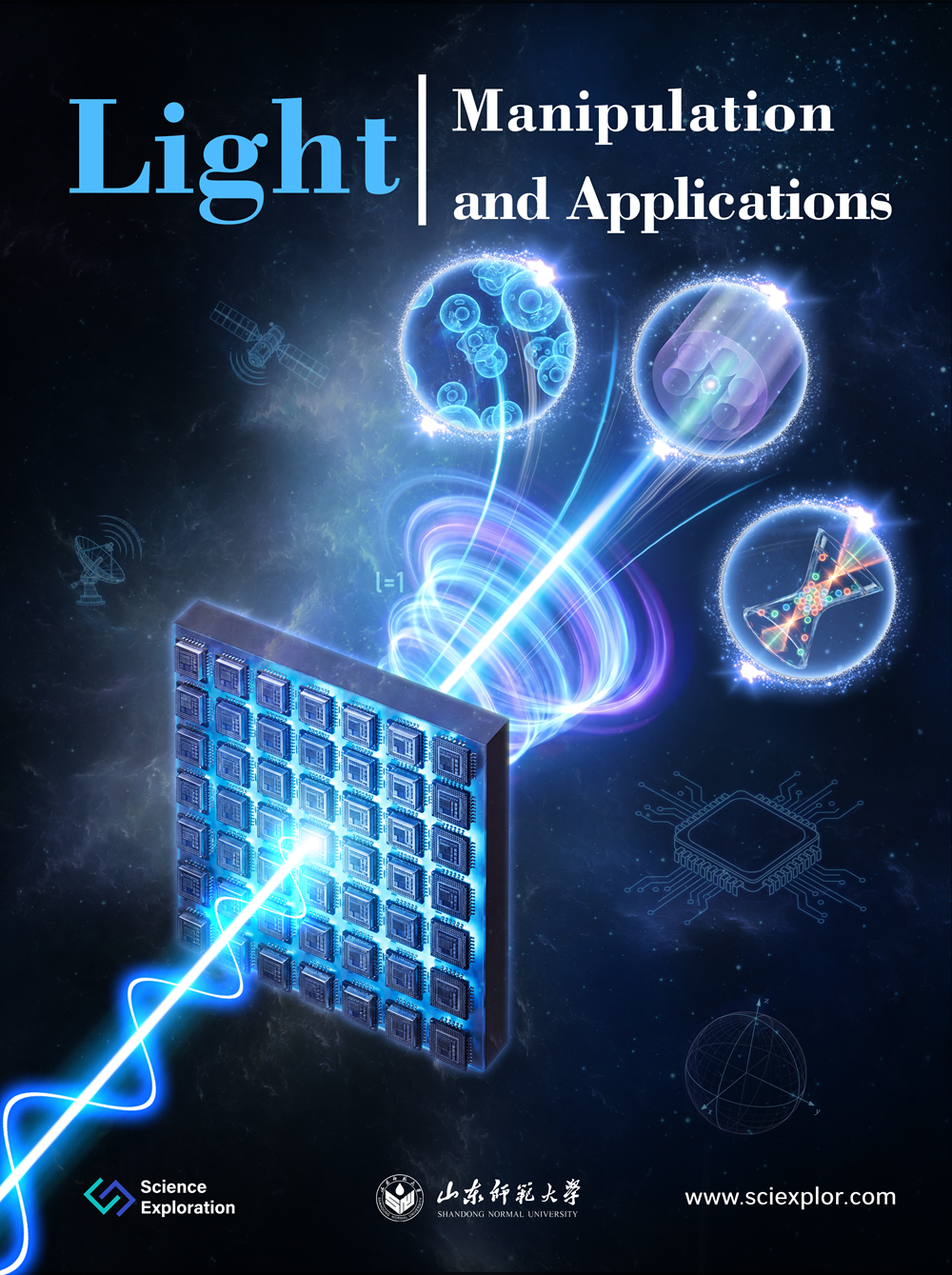
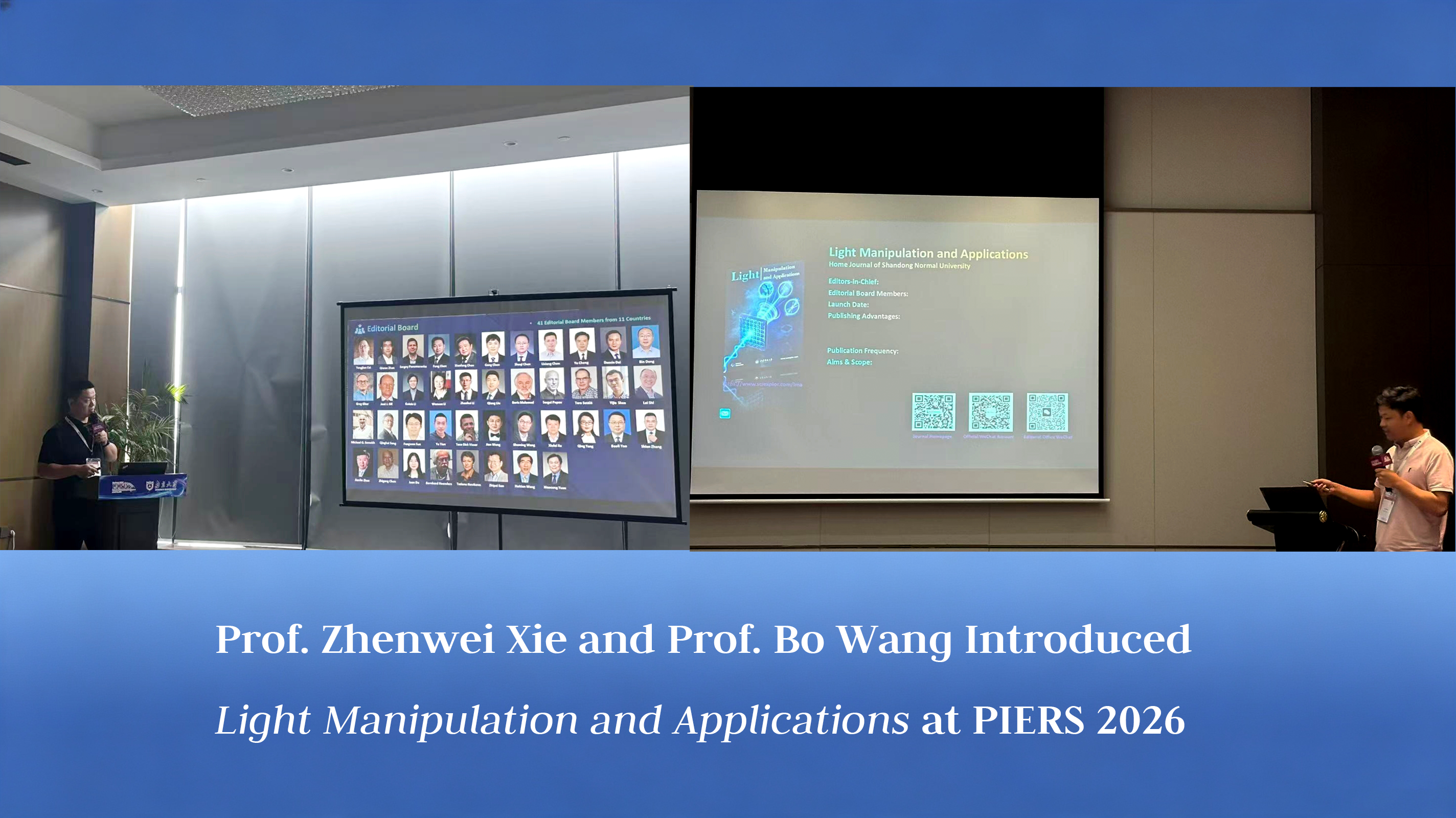
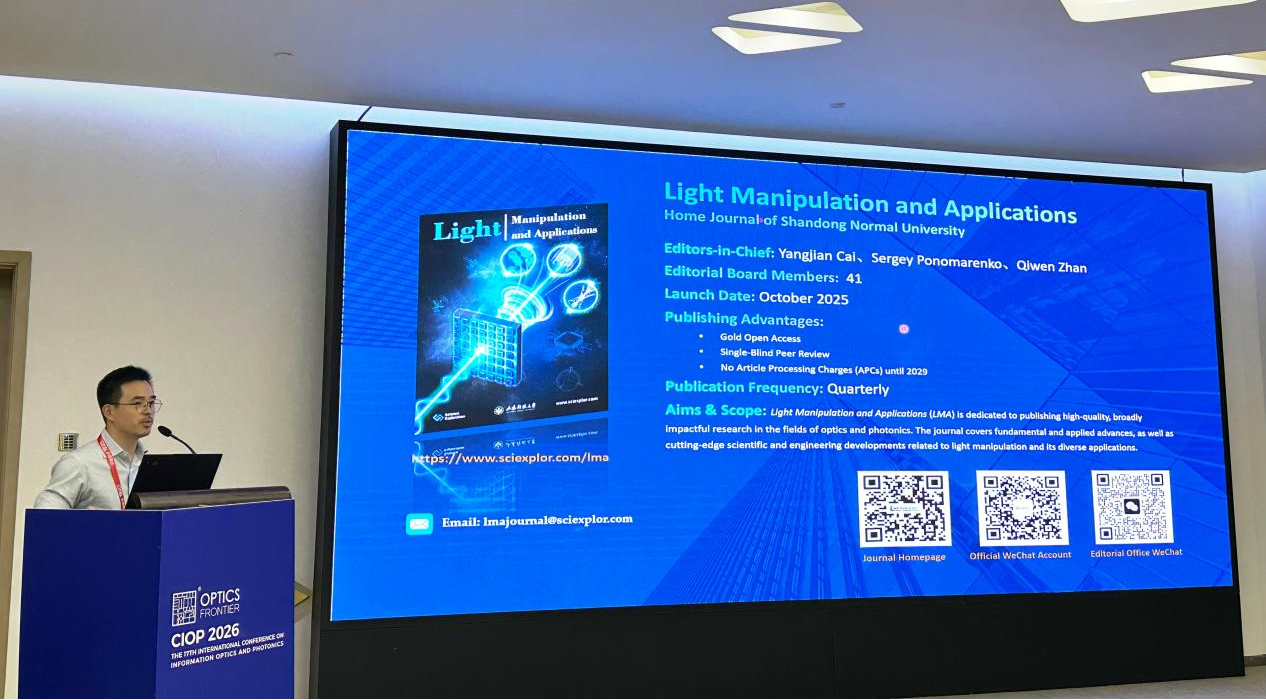
Light Manipulation and Applications (LMA) is a highly selective, peer-reviewed, open-access journal dedicated to publishing top-quality, impactful research in all areas of optics and photonics. The journal covers fundamental, applied, scientific, and engineering advancements related to the manipulation and application of light. LMA ensures rigorous yet accessible contributions, supported by a fast and professional peer-review process aimed at the rapid dissemination of transformative discoveries.
more
>
Light Manipulation and Applications (LMA) is a highly selective, peer-reviewed, open-access journal dedicated to publishing top-quality, impactful research in all areas of optics and photonics. The journal covers fundamental, applied, scientific, and engineering advancements related to the manipulation and application of light. LMA ensures rigorous yet accessible contributions, supported by a fast and professional peer-review process aimed at the rapid dissemination of transformative discoveries.
more >
We discover that a standard Fourier transformation intrinsically imparts a parity-dependent phase shift to optical vortices, yielding a phase difference of π between modes carrying odd and even topological charges. This phase shift, however, is ...
We discover that a standard Fourier transformation intrinsically imparts a parity-dependent phase shift to optical vortices, yielding a phase difference of π between modes carrying odd and even topological charges. This phase shift, however, is not directly observable from the intensity profile of the transformed beam. To render it measurable, we develop a spin-selective Fourier transformer by co-designing propagation-induced dynamic phase and Pancharatnam-Berry geometric phase in a pair of hybrid-lenses. This device converts the parity-dependent phase shift into orthogonal polarization states via spin-orbit interaction, enabling non-destructive separation of both individual and superimposed orbital angular momentum (OAM) modes without the need for an interferometer. Our work establishes Fourier transformation as a new mechanism for parity-resolved vortex manipulation, offering an integrable platform for high-dimensional photonic applications.
Compared with conventional intensity imaging, complex optical field imaging enables the recovery of both amplitude and phase information of the optical field, and has become an important tool in label-free microscopy, surface metrology, and crystal characterization. ...
Compared with conventional intensity imaging, complex optical field imaging enables the recovery of both amplitude and phase information of the optical field, and has become an important tool in label-free microscopy, surface metrology, and crystal characterization. However, because conventional detectors can only measure intensity and cannot directly record phase, complex field reconstruction is an ill-posed inverse problem that heavily relies on physical constraints and computational priors. Optical field modulation offers an effective solution by imposing known, controllable modulations into the illumination, propagation, reference, or detection path, improving the observability and recoverability of phase information. Optical field modulation increases the measurement diversity and improves the solvability of the inverse problem, reducing reconstruction ambiguity and improving robustness to noise and missing data. This review establishes a unified framework that classifies optical-field modulation according to the measurement mechanism and modulation location, and compares different strategies in terms of information diversity, identifiability, acquisition efficiency, calibration burden, and dynamic adaptability.
Quantum theory departs from classical physics in its treatment of correlations, most prominently through the phenomena of contextuality and nonlocality. Once regarded primarily as foundational curiosities, these effects are now understood as key operational ...
Quantum theory departs from classical physics in its treatment of correlations, most prominently through the phenomena of contextuality and nonlocality. Once regarded primarily as foundational curiosities, these effects are now understood as key operational resources for quantum computation, communication, and simulation. Although traditionally investigated in distinct settings, recent theoretical and experimental advances have revealed deep conceptual, mathematical, and operational connections between them. This review presents a unified perspective on these developments based on sheaf-theoretic and graph-theoretic frameworks, which provide theory-independent characterizations of statistical correlations. These approaches clarify the structural relationship between contextuality and nonlocality, facilitate the formulation of experimentally testable inequalities, and guide implementations in realistic physical platforms, with particular emphasis on photonic experiments using structured light and orbital-angular-momentum encoding for high-dimensional quantum states. By bridging abstract theoretical structures and concrete experimental realizations, this review sheds light on the nonclassical foundations of quantum correlations and their emerging role in quantum technologies.
Conventional complementary metal-oxide-semiconductor (CMOS) image sensors with Bayer color filter arrays face limitations in low-illumination color imaging. Color router (CR) aims to achieve absorption-loss-free spectral separation, providing an ...
Conventional complementary metal-oxide-semiconductor (CMOS) image sensors with Bayer color filter arrays face limitations in low-illumination color imaging. Color router (CR) aims to achieve absorption-loss-free spectral separation, providing an efficient way to sort and guide different color lights to the corresponding pixels. However, applying CR to imaging chips requires consideration of different incidence conditions and processing difficulties. In this study, we propose and fabricate a polarization-insensitive “red, green and blue + near-infrared (NIR)” CR based on a metasurface, operating within the wavelength range of 400-1,100 nm and exhibiting high light energy utilization efficiency. The structural parameters are optimized through an inverse design method. The device is fabricated by silicon-compatible processes, offering the advantage of high integration. Experimental results demonstrate that the measured energy utilization efficiency reaches over 90%, and the measured average correlation coefficient of spectral curves under different polarizations reaches 0.98. This device can efficiently route visible to NIR light, providing a novel approach for integrating metasurfaces into CMOS image sensors to enhance high-performance color imaging systems.
Metasurfaces, as a key platform for flat optics, enable advanced manipulation of light by harnessing rich local and nonlocal resonant modes at subwavelength-structured interfaces. Distinct from conventional local metasurfaces that primarily modulate ...
Metasurfaces, as a key platform for flat optics, enable advanced manipulation of light by harnessing rich local and nonlocal resonant modes at subwavelength-structured interfaces. Distinct from conventional local metasurfaces that primarily modulate optical wavefronts over broad spectral ranges, nonlocal metasurfaces based on collective resonances provide enhanced spectral and momentum selectivity together with strengthened light–matter interaction. This review surveys recent advances in optical-field information manipulation enabled by nonlocal metasurfaces, where “information manipulation” denotes the high-dimensional control of amplitude, phase, and polarization across spectral, temporal, spatial, and momentum domains, with a particular focus on integrating local and nonlocal resonances to enhance device performance and functionality. We first introduce the fundamental characteristics of nonlocal resonances and summarize representative progress in real- and momentum-space light control within passive nonlocal metasurfaces. We also discuss recent advances in active nonlocal metasurfaces, including applications in nonlinear harmonic generation, quantum-state control, and spatial information lasers. Finally, we highlight emerging trends in on-chip and tunable nonlocal metasurfaces and outline key challenges and future research directions for this rapidly evolving field.
Conventional complementary metal-oxide-semiconductor (CMOS) image sensors with Bayer color filter arrays face limitations in low-illumination color imaging. Color router (CR) aims to achieve absorption-loss-free spectral separation, providing an ...
Conventional complementary metal-oxide-semiconductor (CMOS) image sensors with Bayer color filter arrays face limitations in low-illumination color imaging. Color router (CR) aims to achieve absorption-loss-free spectral separation, providing an efficient way to sort and guide different color lights to the corresponding pixels. However, applying CR to imaging chips requires consideration of different incidence conditions and processing difficulties. In this study, we propose and fabricate a polarization-insensitive “red, green and blue + near-infrared (NIR)” CR based on a metasurface, operating within the wavelength range of 400-1,100 nm and exhibiting high light energy utilization efficiency. The structural parameters are optimized through an inverse design method. The device is fabricated by silicon-compatible processes, offering the advantage of high integration. Experimental results demonstrate that the measured energy utilization efficiency reaches over 90%, and the measured average correlation coefficient of spectral curves under different polarizations reaches 0.98. This device can efficiently route visible to NIR light, providing a novel approach for integrating metasurfaces into CMOS image sensors to enhance high-performance color imaging systems.
Optical vortices, characterized by their central singularities and spiral phase wavefront, have gained widespread attention in light manipulation and diverse applications. With their topological order being extended from integer to fraction, more unique ...
Optical vortices, characterized by their central singularities and spiral phase wavefront, have gained widespread attention in light manipulation and diverse applications. With their topological order being extended from integer to fraction, more unique properties have sprung out, such as continuous topological charges, fractional spiral-phase, expanded orbital angular momentum spectrum, and slit openings. These features have facilitated applications in areas such as optical tweezers, direction-selective edge enhancement imaging, robust rotational Doppler metrology, free-space communication, displacement sensing, and high-dimensional quantum entanglement. In recent years, advances in metasurface-based optical control, spatiotemporal pulse shaping, holographic imaging, and deep learning have spurred rapid innovation in the modeling, generation, and measurement of fractional vortex beams. This review begins with the fundamental theory of fractional vortex beams and surveys the latest developments in this rapidly evolving field. The scope of research has also expanded beyond optical vortices to include acoustic vortices. The growing interest in fractional vortex beams, coupled with ongoing technological innovations, is expected to pave the way for further advancements in this promising area of research.
Topology, a cornerstone of modern condensed matter physics, has in the past decade played a crucial role in diverse wave systems. As a powerful wave system, light can be sculpted into an even richer variety of topological structures, including vortices, skyrmions, ...
Topology, a cornerstone of modern condensed matter physics, has in the past decade played a crucial role in diverse wave systems. As a powerful wave system, light can be sculpted into an even richer variety of topological structures, including vortices, skyrmions, Möbius strips, etc., leading to advanced photonic technologies from optical trapping to imaging, across quantum and classical regimes. A recent breakthrough demonstrated that topologically structured water waves can manipulate particles with intricate spin-orbital motion, and similar principles have enabled topological control in acoustofluidics, opening new insights in wave-matter interactions. Therefore, we argue that topological light waves possess an analogous potential, offering a route beyond the scalar-field limitations of conventional optical tweezers and establishing a new paradigm of multidimensional, vectorial control over matter. This article starts with brief introductions to optical tweezer technologies and topological light waves, then focuses on their emerging combination: particle trapping and sorting. It follows with perspectives on how topologies can couple to new degrees of freedom for manipulating complex particle motions previously inaccessible, and finally discusses potential applications.
The development of surface-enhanced Raman scattering (SERS) technology is critically reliant on the effective modulation of the electromagnetic mechanism and chemical mechanism. In this paper, we conduct a systematic review of the recent advancements ...
The development of surface-enhanced Raman scattering (SERS) technology is critically reliant on the effective modulation of the electromagnetic mechanism and chemical mechanism. In this paper, we conduct a systematic review of the recent advancements in the modulation of SERS by multi-physical fields (light field, magnetic field, and electric field) and their cooperative modulation. Light field modulation enhances the intensity and area of hotspots by optimizing the matching between the local surface plasmon resonance of nanostructures and the parameters of incident light (wavelength, polarization, and pulse). Moreover, the photo-induced plasmonic thermal effect dynamically regulates the phase transition between the nanogap and the material, achieving the synergistic enhancement of SERS. Magnetic field modulation capitalizes on the magnetic induction of magnetic materials and the magnetic resonance behavior of non-magnetic structures. It enables an external magnetic field to control the aggregation and spatial organization of nanoparticles, thereby generating high-density hotspots and enhancing the detection sensitivity and selectivity. Electric field modulation can adjust the band structure, carrier density, and molecular orientation of the substrate through an external electric field or the spontaneous electric field of functional materials (such as piezoelectric, triboelectric, thermoelectric, and pyroelectric materials), thus enhancing the charge transfer efficiency and the local electromagnetic field strength. The multi-field cooperative modulation strategy overcomes the static limitations of traditional SERS substrates and further provides a crucial theoretical and technical approach for realizing a high-performance, intelligent, and reconfigurable SERS sensing platform.
Knots and links play a fundamental role across a wide range of physical fields, from classical to quantum physics. In optics, structured light fields with multiple controllable degrees of freedom provide a versatile experimental platform for investigating ...
Knots and links play a fundamental role across a wide range of physical fields, from classical to quantum physics. In optics, structured light fields with multiple controllable degrees of freedom provide a versatile experimental platform for investigating topological properties. Knot theory underpins the topological control of high-dimensional structured light, thereby giving rise to fundamental physical effects and applications. Furthermore, topologically structured light has attracted significant attention for light-matter interaction. Here we review the recent advances in topologically structured light from the perspective of knot theory. Starting from the basics of knots and related braids, we introduce the generation and manipulation of topologically structured light from the purely spatial domain across to the spatiotemporal domain. Moreover, we demonstrate that the particle-like structured light, such as photonic skyrmions and hopfions, can host the topologies of high dimensional space, followed by brief discussions on potential applications as well as an outlook and future trends and challenges in this field.
Optical vortices, characterized by their central singularities and spiral phase wavefront, have gained widespread attention in light manipulation and diverse applications. With their topological order being extended from integer to fraction, more unique ...
Optical vortices, characterized by their central singularities and spiral phase wavefront, have gained widespread attention in light manipulation and diverse applications. With their topological order being extended from integer to fraction, more unique properties have sprung out, such as continuous topological charges, fractional spiral-phase, expanded orbital angular momentum spectrum, and slit openings. These features have facilitated applications in areas such as optical tweezers, direction-selective edge enhancement imaging, robust rotational Doppler metrology, free-space communication, displacement sensing, and high-dimensional quantum entanglement. In recent years, advances in metasurface-based optical control, spatiotemporal pulse shaping, holographic imaging, and deep learning have spurred rapid innovation in the modeling, generation, and measurement of fractional vortex beams. This review begins with the fundamental theory of fractional vortex beams and surveys the latest developments in this rapidly evolving field. The scope of research has also expanded beyond optical vortices to include acoustic vortices. The growing interest in fractional vortex beams, coupled with ongoing technological innovations, is expected to pave the way for further advancements in this promising area of research.
Topology, a cornerstone of modern condensed matter physics, has in the past decade played a crucial role in diverse wave systems. As a powerful wave system, light can be sculpted into an even richer variety of topological structures, including vortices, skyrmions, ...
Topology, a cornerstone of modern condensed matter physics, has in the past decade played a crucial role in diverse wave systems. As a powerful wave system, light can be sculpted into an even richer variety of topological structures, including vortices, skyrmions, Möbius strips, etc., leading to advanced photonic technologies from optical trapping to imaging, across quantum and classical regimes. A recent breakthrough demonstrated that topologically structured water waves can manipulate particles with intricate spin-orbital motion, and similar principles have enabled topological control in acoustofluidics, opening new insights in wave-matter interactions. Therefore, we argue that topological light waves possess an analogous potential, offering a route beyond the scalar-field limitations of conventional optical tweezers and establishing a new paradigm of multidimensional, vectorial control over matter. This article starts with brief introductions to optical tweezer technologies and topological light waves, then focuses on their emerging combination: particle trapping and sorting. It follows with perspectives on how topologies can couple to new degrees of freedom for manipulating complex particle motions previously inaccessible, and finally discusses potential applications.
Knots and links play a fundamental role across a wide range of physical fields, from classical to quantum physics. In optics, structured light fields with multiple controllable degrees of freedom provide a versatile experimental platform for investigating ...
Knots and links play a fundamental role across a wide range of physical fields, from classical to quantum physics. In optics, structured light fields with multiple controllable degrees of freedom provide a versatile experimental platform for investigating topological properties. Knot theory underpins the topological control of high-dimensional structured light, thereby giving rise to fundamental physical effects and applications. Furthermore, topologically structured light has attracted significant attention for light-matter interaction. Here we review the recent advances in topologically structured light from the perspective of knot theory. Starting from the basics of knots and related braids, we introduce the generation and manipulation of topologically structured light from the purely spatial domain across to the spatiotemporal domain. Moreover, we demonstrate that the particle-like structured light, such as photonic skyrmions and hopfions, can host the topologies of high dimensional space, followed by brief discussions on potential applications as well as an outlook and future trends and challenges in this field.
Structured light fields are engineered through precise control of their amplitude, phase, polarization, and spatiotemporal properties, which are extensively studied for both scientific and applied purposes, and can offer novel pathways for information ...
Structured light fields are engineered through precise control of their amplitude, phase, polarization, and spatiotemporal properties, which are extensively studied for both scientific and applied purposes, and can offer novel pathways for information processing, quantum communication, and precision measurement. Although the linear manipulation of structured light is already very mature with the help of liquid crystal devices and planar optical elements, nonlinear manipulation remains nascent, despite demonstrating unique potential for critical functionalities such as optical field information exchange. Hence, critical challenges now lie in harnessing nonlinear interactions, between light fields themselves and between light and matter, to achieve on-demand multidimensional control of target optical fields, particularly for spatial modes of light. The advancing nonlinear optics theory, guided by structured light, reveals novel physical phenomena in various nonlinear interactions, and promotes the development of novel applications based on nonlinear light field control technologies. Accordingly, this review systematically summarizes recent advances across key areas, including the nonlinear manipulation of spatial structured light fields, optical information transfer, full-dimensional manipulation theory, field modulation and nonlinear topological frontiers, and three-dimensional (3D) light field manipulation theory, thereby providing a comprehensive perspective on the current state and the emerging trends in this rapidly evolving field.
The development of surface-enhanced Raman scattering (SERS) technology is critically reliant on the effective modulation of the electromagnetic mechanism and chemical mechanism. In this paper, we conduct a systematic review of the recent advancements ...
The development of surface-enhanced Raman scattering (SERS) technology is critically reliant on the effective modulation of the electromagnetic mechanism and chemical mechanism. In this paper, we conduct a systematic review of the recent advancements in the modulation of SERS by multi-physical fields (light field, magnetic field, and electric field) and their cooperative modulation. Light field modulation enhances the intensity and area of hotspots by optimizing the matching between the local surface plasmon resonance of nanostructures and the parameters of incident light (wavelength, polarization, and pulse). Moreover, the photo-induced plasmonic thermal effect dynamically regulates the phase transition between the nanogap and the material, achieving the synergistic enhancement of SERS. Magnetic field modulation capitalizes on the magnetic induction of magnetic materials and the magnetic resonance behavior of non-magnetic structures. It enables an external magnetic field to control the aggregation and spatial organization of nanoparticles, thereby generating high-density hotspots and enhancing the detection sensitivity and selectivity. Electric field modulation can adjust the band structure, carrier density, and molecular orientation of the substrate through an external electric field or the spontaneous electric field of functional materials (such as piezoelectric, triboelectric, thermoelectric, and pyroelectric materials), thus enhancing the charge transfer efficiency and the local electromagnetic field strength. The multi-field cooperative modulation strategy overcomes the static limitations of traditional SERS substrates and further provides a crucial theoretical and technical approach for realizing a high-performance, intelligent, and reconfigurable SERS sensing platform.