Advances in nonlinear manipulation of structured light fields: From fundamentals to applications

Chenghou Tu
1

,
Qiang Wang
2
,
Zhi-Cheng Ren
3
,
Xi-Lin Wang
3
,
Yongnan Li
1
,
Hui-Tian Wang
3,4,5,*
*Correspondence to:
Huitian Wang, National Laboratory of Solid State Microstructures and School of Physics, Nanjing University, Nanjing 210093, Jiangsu, China; Collaborative Innovation Center of Advanced Microstructures, Nanjing 210093, Jiangsu, China; Collaborative Innovation Center of Extreme Optics, Shanxi University, Taiyuan 030006, Shanxi, China.
E-mail: htwang@nju.edu.cn
Light Manip Appl. 2026;1:202506. 10.70401/lma.2026.0005
Received: December 10, 2025Accepted: February 26, 2026Published: March 12, 2026
Abstract
Structured light fields are engineered through precise control of their amplitude, phase, polarization, and spatiotemporal properties, which are extensively studied for both scientific and applied purposes, and can offer novel pathways for information processing, quantum communication, and precision measurement. Although the linear manipulation of structured light is already very mature with the help of liquid crystal devices and planar optical elements, nonlinear manipulation remains nascent, despite demonstrating unique potential for critical functionalities such as optical field information exchange. Hence, critical challenges now lie in harnessing nonlinear interactions, between light fields themselves and between light and matter, to achieve on-demand multidimensional control of target optical fields, particularly for spatial modes of light. The advancing nonlinear optics theory, guided by structured light, reveals novel physical phenomena in various nonlinear interactions, and promotes the development of novel applications based on nonlinear light field control technologies. Accordingly, this review systematically summarizes recent advances across key areas, including the nonlinear manipulation of spatial structured light fields, optical information transfer, full-dimensional manipulation theory, field modulation and nonlinear topological frontiers, and three-dimensional (3D) light field manipulation theory, thereby providing a comprehensive perspective on the current state and the emerging trends in this rapidly evolving field.
Keywords
Structured light, nonlinear manipulation, polarization, topological optical field, orbital angular momentum, mode conversion, beam shaping
1. Introduction
Structured light fields, characterized by their unique amplitude, polarization, or phase properties, have attracted significant attention from both academia and industry due to their comprehensive applications in quantum communication, high-resolution imaging, optical tweezers, and laser processing, etc. The maturation of liquid crystal devices and planar optical elements has spurred robust development in the manipulation and application of spatially structured light fields within the linear optics domain. For instance, amplitude modulation has enabled the generation of diverse transverse-mode optical fields, such as Gaussian, Hermite-Gaussian (HG)[1], and Laguerre-Gaussian (LG) beams[2], while phase modulation[3-6] and polarization modulation have yielded optical vortices and vector beams[7-9], respectively.
With the development of light field manipulation technology, manipulation is no longer limited to a single degree of freedom (DOF) but extends beyond it. Increasingly complex spatial structures are engineered through the joint modulation of multiple parameters[10-13]. For example, combined phase and polarization control produces vector vortex beams[14,15]. Simultaneous amplitude and polarization modulation generates vector LG beams, vector Bessel-Gaussian (BG) beams, and others[13,16]. Coordinated control of amplitude, phase, and polarization enables the synthesis of complex three-dimensional structured light fields, which include beams exhibiting propagation-dependent orbital angular momentum and polarization states[17-22], topological light featuring singularities with link- or knot-shaped trajectories[23-25], complex vector fields with sophisticated polarization evolution[22,26-28], optical Möbius strips[29,30], and optical skyrmions[31]. Deep exploration of these complex spatial optical structures not only enhances the fundamental understanding of the inherent properties and behaviors of light fields but also provides crucial theoretical support for innovations for photonics.
Apart from the linear manipulation of the light field, the nonlinear manipulation of the light field is particularly fascinating to researchers because it can lead to many novel phenomena. Nonlinear manipulation of light was first demonstrated based on second harmonic generation (SHG)[32], which reveals the nonlinear response of the medium polarization to strong light irradiation. Subsequently, third harmonic generation (THG)[33], SHG, and parametric down-conversion process carrying spin angular momentum and orbital angular momentum (OAM) were demonstrated[34-36]. The theoretical foundation for the nonlinear manipulation of spatially structured light fields is fundamentally rooted in the principles of nonlinear optics, considering the interactions between various types of matter and light with various spatial DOFs, such as the amplitude, phase, polarization, and orbital angular momentum, where the core lies in understanding the rich physical effects arising from the nonlinear polarization response of the medium when intense light fields propagate through nonlinear media. In recent years, remarkable progress in the cross-disciplinary research of nonlinear optics and structured light field have been witnessed[37]. Researchers have demonstrated various manipulations of structured light during nonlinear processes, achieving functionalities unattainable with only linear optics. For instance, the conservation and transformation of OAM in nonlinear processes can be observed[38,39], which specifically manifests as: under certain conditions (such as using crystals with spatially varying nonlinear coefficients, or combining other DOFs such as polarization), OAM can be increased, decreased, or mixed[40-43]; by combining the multi-state OAM with nonlinear processes, high-dimensional optical fields can be generated, which is of great significance for high-dimensional optical communication and quantum information processing[44-48]; by designing units of metasurfaces at the sub-wavelength scale, precise control over the polarization, phase, and amplitude of the light field can be achieved, thereby efficiently generating and manipulating structured light field as well as nonlinear processes (such as SHG, THG)[49-54]. Furthermore, the discovery of generalized nonlinear transformation laws for the structured light via processes such as nonlinear frequency conversion and transverse mode conversion of laser beams[55-58] enriches the connotation of nonlinear manipulation of light fields. Despite significant advances and the unique potential for novel functionalities, research on the nonlinear optical manipulation of structured light is still in its infancy.
This review provides a summary overview of the recent developments in the nonlinear manipulation of optical fields, encompassing both fundamental theoretical frameworks and prospective applications. We have summarized the key advances, including OAM multiplication/conservation in harmonic generation, vector-topology preservation in interferometric architectures, deterministic filamentation control via polarization structuring, and the topological harmonic generation (e.g., optical skyrmions). At the same time, we also predict promising future research directions and emerging challenges, addressing gaps in current knowledge and technological limitations. By analyzing the key enabling technologies and their future applications, this article aims to help readers learn about this rapidly developing field with both the conceptual and practical guidance.
This review is structured by adopting a DOF-centric framework to organize and synthesize progress in nonlinear structured light manipulation. We argue that the field's evolution can be mapped onto the progressive mastery over fundamental properties of light, OAM, spatial mode structure, polarization vector, and finally, its intense propagation dynamics. Accordingly, this review begins by establishing the theoretical foundations of nonlinear interactions with structured light, focusing on coupled-wave equations and phase-matching conditions (Section 2). Building on this groundwork, Section 3 systematically examines recent advances, organized according to the key degrees of freedom manipulated in these processes. We first explore the fundamental and expanding role of OAM in nonlinear frequency conversion (Section 3.1). The discussion then broadens to general spatial mode conversion and beam shaping, demonstrating control that extends beyond a single quantum number (Section 3.2). Next, we introduce the polarization degree of freedom, analyzing the distinctive nonlinear behavior and topological preservation of vectorial structured light (Section 3.3). Furthermore, we address the control of intense nonlinear propagation dynamics, such as self-focusing and filamentation, where engineered structured light is used to tame inherent instabilities (Section 3.4). Finally, the review concludes with a synthesis of these advances and an outlook on future developments in the field (Section 4). This framework allows us to highlight not only technological breakthroughs but also the underlying conceptual links between different sub-fields. This synthetic perspective enables a critical comparison of the maturity, challenges, and synergies across different DOF-manipulation platforms, from bulk crystals and interferometers to nonlinear photonic crystals and metasurfaces. We conclude by projecting this DOF-centric view onto future frontiers, providing a roadmap that identifies key cross-cutting challenges in efficiency, integration, and fidelity that must be overcome to transition these laboratory phenomena into transformative technologies for communication, quantum science, and sensing.
2. Theoretical Fundamental for Nonlinear Manipulation of Structured Light Fields
The nonlinear electric polarization of atoms or molecules within a nonlinear medium (such as χ(2) or χ(3) crystals) induced by incident intense light fields is a process rigorously governed by the laws of the conservation of energy and momentum, and the latter manifests as phase matching. This process encompasses critical nonlinear frequency conversion effects, such as SHG, THG, sum-frequency generation (SFG), difference-frequency generation (DFG), and optical parametric oscillation. These effects fundamentally involve the coherent conversion of the incident field to higher or lower frequencies via multi-photon interactions within the medium, specifically, to higher frequencies via harmonic generation and SFG, and to lower frequencies via DFG and parametric down-conversion. Consequently, nonlinear frequency conversion is inherently sensitive to the spatial structure of the input optical fields and can lead to the generation of novel spatial modes (e.g., complex vortex or vector modes). Therefore, it not only facilitates transformations in the frequency dimension but also serves as a versatile tool for joint manipulation of spatially structured light fields with multiple DOFs. The manipulation of light involves OAM (nonlinear conservation and spin-orbit coupling)[59-62] (Figure 1a,b,c), intensity (e.g., generating complex patterns or lattices)[63,64] (Figure 1d), phase (correcting the phase distortions in spatially structured light through a nonlinear process)[65], polarization (converting vectorial structures from fundamental wave to harmonic wave)[66-69] (Figure 1e), and complex topologies like nonlinear optical skyrmions[70] (Figure 1f), spatiotemporal optical vortices[71,72] (Figure 1g), as well as the demonstration of rotational doppler shift tripling[73] (Figure 1h). This versatile manipulation, exemplified in Figure 1, thereby provides indispensable physical support for diverse and advanced fields ranging from optical communications and advanced laser technologies (frequency-converted lasers based on structured light) to quantum information science (facilitating high-dimensional entangled state generation and quantum frequency conversion) and super-resolution microscopy (e.g., structured excitation in multiphoton excitation microscopy).
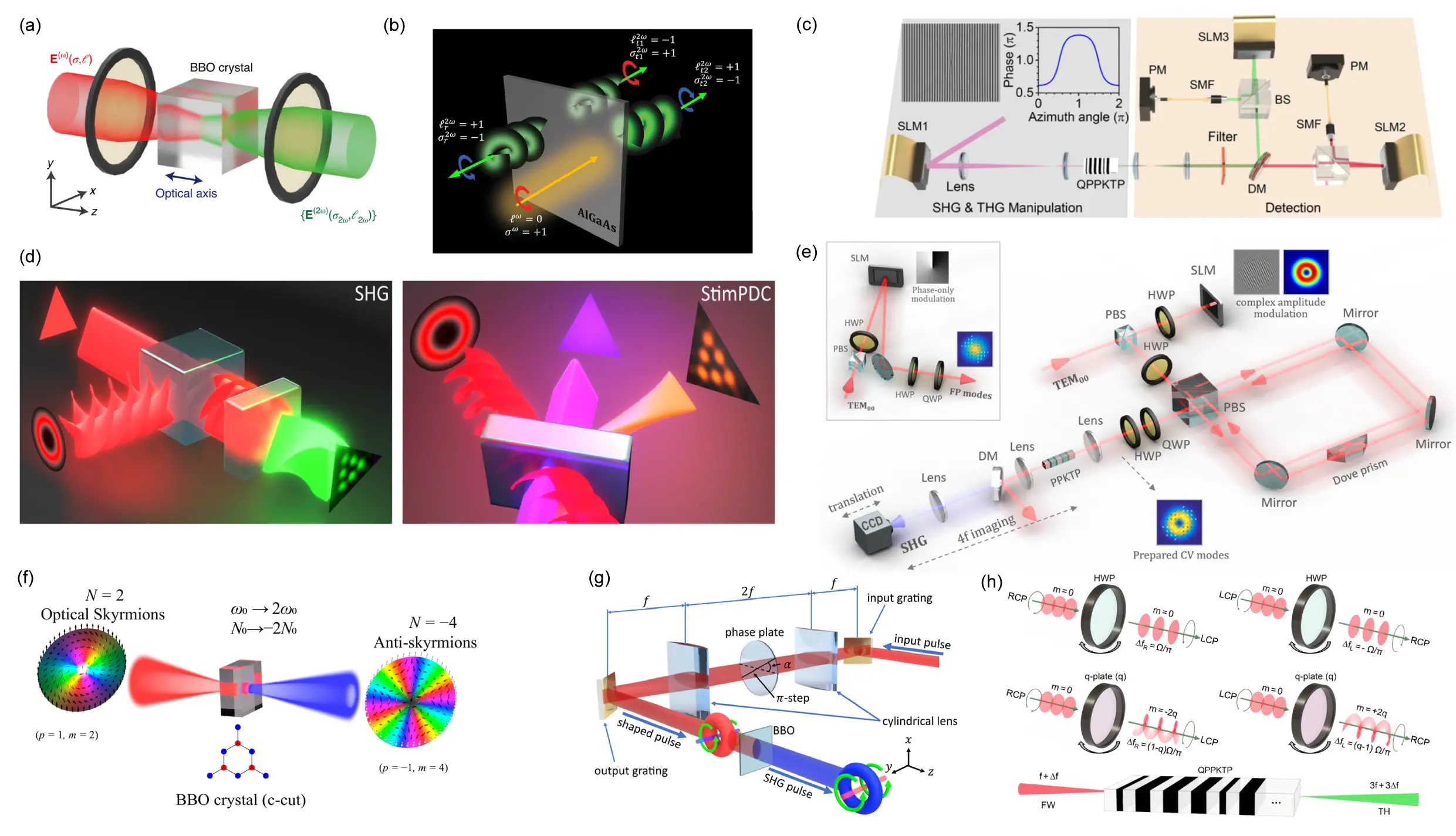
Figure 1. Nonlinear manipulation of structured light with different DOFs. (a) Nonlinear spin-orbit angular momentum cascade. Republished with permission from[59]; (b) The nonlinear spin-orbit coupling[60]; (c) Nonlinear manipulation of phase spectra based on a quasi-periodically poled crystal. Republished with permission from[61]; (d) Triangular-lattice patterns generated by nonlinear wave mixing of an optical vortex with a triangular aperture-shaped beam[63]; (e) SHG of vectorial optical field. Republished with permission from[66]; (f) Topological harmonic generation of nonlinear optical skyrmions[70]; (g) SHG and the conservation of spatiotemporal OAM of light[71]; (h) The nonlinear rotational doppler shift tripling. Republished with permission from[73]. DOFs: degree of freedom; SHG: second harmonic generation; OAM: orbital angular momentum.
The theoretical description of nonlinear interactions is provided by the coupled-wave equations, specifically the set of partial differential equations for three-wave mixing (governing χ(2) processes like SHG, SFG, DFG) or four-wave mixing (governing χ(3) processes like THG), which precisely model the spatial evolution dynamics of the amplitudes and phases of the fundamental wave and the generated harmonic, signal, or idler waves as they co-propagate through the medium, explicitly incorporating the nonlinear coupling coefficients, phase mismatch, and, crucially, the influence of the spatial field distributions (transverse modes)[74,75].
To provide a common theoretical foundation for the diverse nonlinear phenomena discussed hereafter, we begin with the fundamental wave equation governing light propagation in a nonlinear medium. Based on Maxwell's equations, it is easy to obtain the general form of the wave equation describing the propagation of electromagnetic waves in a medium:
where E is the electric field and P is the polarization of the medium,
where χ(n) is the nth-order susceptibility characterizing the nonlinearity of a medium. The linear term (χ(1)) governs refraction/absorption; the quadratic term (χ(2)) enables processes like SHG, SFG, and DFG; and the cubic term (χ(3)) drives THG, self-phase modulation, and four-wave mixing. This formalism quantitatively models the nonlinear frequency conversion effects critical for light field manipulation.
For the electric field vectors appearing in Eqs. (1) and (2), they encompass rich DOFs and complex spatial textures in the case of structured light fields. The general form of such fields can be described as:
where A(x, y) represents the transverse amplitude profile, ψ(x, y) encodes the spatial phase structure, k·r governs spatial propagation, and ωt describes temporal evolution. The polarization distribution [α(x, y)ex + β(x, y)ey] defines the spatially varying vectorial properties of the field[76,77]. Crucially, when structured optical fields drive the nonlinear polarization P in Eq. (2), the spatial DOFs of the structured fields determine the strength of the nonlinear interaction by governing the effective nonlinear coupling: the phase structure ψ(x, y) directly governs nonlinear phase-matching conditions by spatially tailoring local wavevectors, while the amplitude profile A(x, y) determines intensity-dependent interactions through |E|2-scaled nonlinear coefficients, and simultaneously the polarization distribution [α(x, y)ex + β(x, y)ey] selectively couples to anisotropic components of χ(2) and χ(3) tensors via directional field projections, collectively enabling spatial control over nonlinear light-matter interactions. For example, the azimuthal phase profile ψ(x, y) = lϕ represents optical vortices with a helical phase characterized by the term of exp(jlΦ), where Φ is the azimuthal angle and l is the topological charge, corresponding to an OAM of lħ per photon. When such fields undergo nonlinear processes governed by Eq. (2), the spatial structures interact with matter nonlinearly, e.g., OAM conservation/multiplication as linput→loutput = nlinput through χ(n) processes[38-40,42,78], generation and manipulation of vector optical fields in second-harmonic processes[66,67,69,79-83], and structured wave mixing for amplitude profiles A(x, y) in nonlinear interactions[84-87]. These structured nonlinear interactions enable precise manipulation of the spatial properties of light through OAM harmonics, vector conversions, and topological transformations.
Under the slowly varying envelope approximation and assuming lossless media, the dynamics of three-wave mixing (TWM) processes (e.g., SFG, DFG) are governed by a set of coupled differential equations:
Here, E1(2) denote the complex amplitudes of the incident fields with frequencies ω1(2), and E3 represents the generated field with frequency ω3. The subscripts i = x, y, z represent the three components of the light field along the x, y, and z directions. Furthermore, it should be highlighted that the conversion efficiency and selection rules for structured fields are governed by the transverse overlap integral derived from Eq. (4). The effective nonlinear coefficient deff = χ(2)/2 accounts for the tensor contraction in the specific crystal orientation. These equations embody quantum energy and momentum conservation:
with the phase mismatch Δk = k1 + k2 -k3 critically determining the efficiency of nonlinear processes. Perfect phase matching (Δk = 0) maximizes the power transfer by ensuring constructive interference throughout the medium. For SHG, a degenerate TWM case, ω1 = ω2 = ω and ω3 = 2ω.
Phase matching stands as the decisive condition for efficient nonlinear frequency conversion, requiring the wave vectors of all interacting waves to satisfy the momentum conservation relationship along the propagation direction (e.g., for SHG: 2kω = k2ω), as any wavevector mismatch (Δk ≠ 0) leads to the periodic oscillation of the conversion efficiency (coherence length effect) and a significant reduction. As spatially structured light fields often possess complex wavefronts and propagation properties, achieving phase matching for them poses enhanced challenges, frequently necessitating carefully engineered wavevector matching strategies such as birefringent phase matching (exploiting the crystal’s birefringence) and quasi-phase matching (utilizing periodic domain inversion structures).
For four-wave mixing (FWM) and other third-order nonlinear processes, the coupled equations extend to complex spatial dynamics, enabling unique structured light manipulation capabilities exemplified in Figure 2. For example, intense vector beams induce self-focusing balanced against diffraction to create stable filamentation[88-91] (Figure 2a), while polarization-structured beams can suppress the formation of optical rogue waves in nonlinear media[92] (Figure 2b). Concurrently, quasi-periodically poled crystals facilitate third-harmonic generation of spatially structured light[60,93] (Figure 2c), and transverse intensity profiles imprint spatially varying nonlinear phases through intensity-dependent refractive index modulation[94] (Figure 2d). These mechanisms collectively demonstrate three fundamental advances: (1) OAM conservation enables quantum state engineering via OAM-selective phase matching, (2) dynamic wavefront shaping (e.g., Gaussian-to-vortex conversion) arises from nonlinear phase gradients ΔΦNL(x, y)∝n2I(x, y)z, and (3) topological robustness in filamentation leverages vectorial field. These structured light manipulations are not limited to second-order interactions but also higher-order nonlinear interactions, providing versatile control for topological photonics and high-dimensional quantum optics through enhanced OAM combinatorics[95].
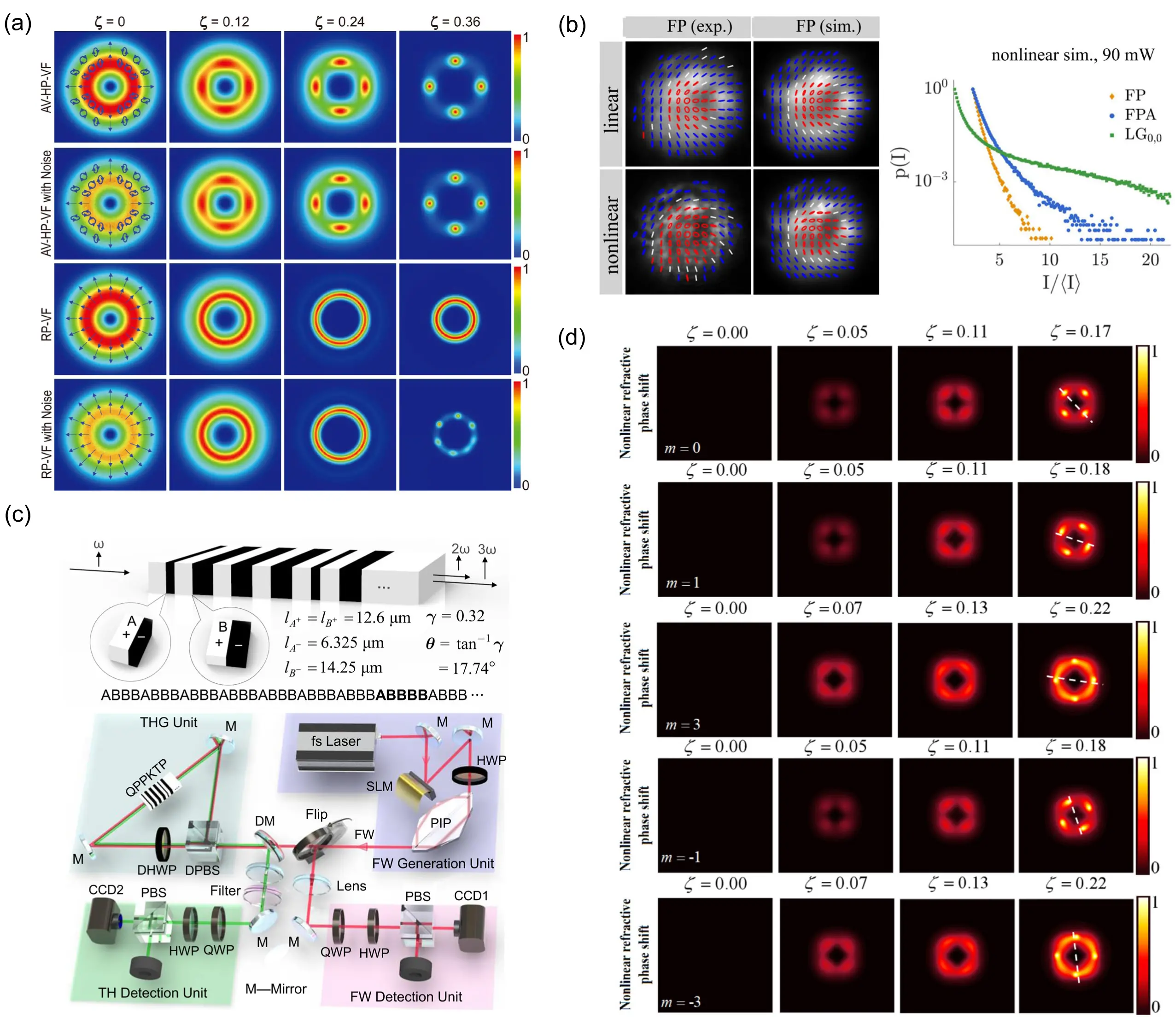
Figure 2. Representative of FWM or third-order nonlinear processes. (a) Taming the collapse of vector beams by engineering the distribution of hybrid states of polarization[88]; (b) Suppression of optical rogue wave formation using polarization-structured beams in nonlinear self-focusing medium. Republished with permission from[92]; (c) Third-harmonic generation of spatially structured light[93]; (d) The nonlinear refractive index (nonlinear phase) change induced by non-uniformly distributed light intensity. Republished with permission from[94]. FWM: four-wave mixing.
3. Progress on Nonlinear Manipulation of Structured Light
3.1 Nonlinear frequency conversion for beams with OAM
Having established the general framework for nonlinear interactions, we first examine its implications for a representative DOF in structured light: OAM. OAM serves as a critical DOF of light, enabling profound applications in classical and quantum optics and light-matter interactions. As a parameter within the phase structure ψ(x, y) in Eq. (3), its manipulation is a direct testbed for nonlinear conservation laws and engineering.
The initial demonstration of OAM conservation in SHG was reported by Basistiy et al.[96], who observed that a fundamental vortex beam with a topological charge l = 1 was transformed into a second-harmonic (SH) beam with l = 2. This phenomenon was initially interpreted classically via energy flow. Subsequent foundational work by Allen et al. systematically studied SHG of Laguerre-Gaussian beams, confirming the universal scaling laws of l2ω = 2lω and establishing the angular momentum conservation framework for OAM[38].
Quantum applications were proposed by Aloisi et al., who first generated OAM-entangled photon pairs via spontaneous parametric down-conversion (SPDC) (Figure 3a)[35]. This entanglement spans an infinite-dimensional Hilbert space, providing a robust platform for high-dimensional quantum information processing. Feng et al. further elucidated the roles of intrinsic OAM (from field helicity) and extrinsic OAM (from photon trajectory) in non-collinear type-II spontaneous parametric down-conversion (SPDC), highlighting that conventional measurements often overlook extrinsic contributions, leading to apparent non-conservation of the total OAM[97].
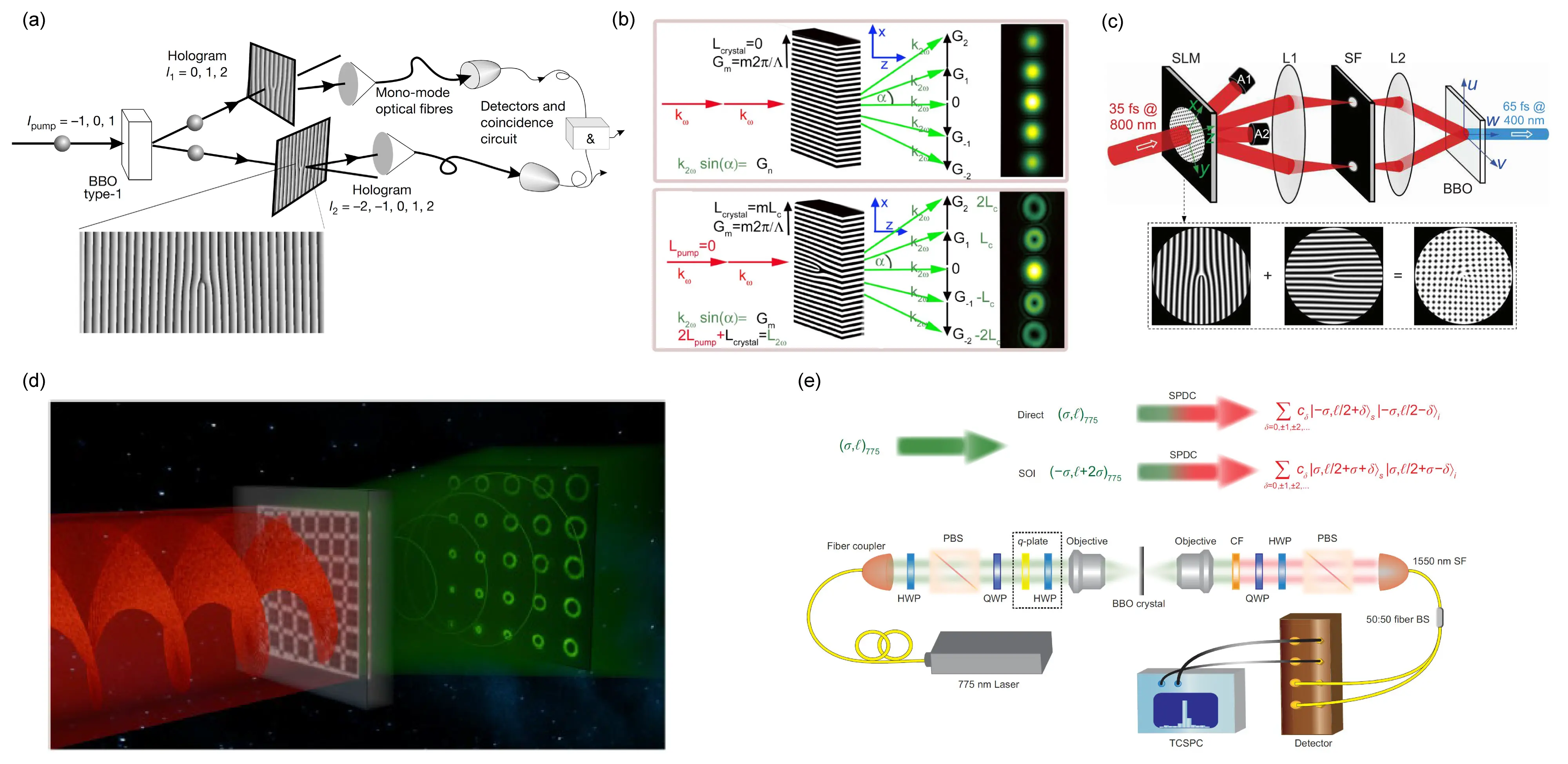
Figure 3. Nonlinear frequency conversion for beams with OAM. (a) Entanglement of the OAM states of photons in SPDC. Republished with permission from[35]; (b) Generation of harmonic frequency OAM by nonlinear photonic crystal. Republished with permission from[40]; (c) Universal OAM conservation laws for generation of frequency doubling light with arbitrary OAM. Republished with permission from[78]; (d) Schematic of equal-energy OAM array generation via nonlinear optics. Republished with permission from[48]; (e) Optical spin–orbit interaction in the SPDC process from a thick BBO crystal[99]. OAM: orbital angular momentum; SPDC: spontaneous parametric down-conversion; BBO: β-BaB2O4.
A further Intriguing aspect is the conservation condition of OAM in the frequency doubling process, such as l2ω = 2lω, where the topological charge of the frequency-doubled light field is always an even number, and the corresponding OAM is always an even multiple of the OAM of the fundamental light. Generating arbitrary OAM states requires overcoming the constraint that SHG produces only even topological charges. For example, by adding a helical structure to a nonlinear crystal[40], the conservation condition satisfied in the frequency-doubling process becomes l2ω = 2lω + lcrystal, where lcrystal is the quasi-OAM introduced by the nonlinear crystal (Figure 3b). For this type of twisted-photonic-crystal, by appropriately selecting lcrystal, the frequency-doubled photons can carry any number of OAM. However, helically structured crystals require complex micro-nano processing, therefore the manipulation flexibility of lcrystal is restricted[42,98]. Li et al. employed spatial light modulators (SLMs) to create tailored holographic gratings (Figure 3c), achieving non-collinear type-I phase matching. This enabled the generation of SH beams with fractional (e.g., l2ω = 0.5) and odd-integer OAM (e.g., l2ω = 1), demonstrating that the spatial structuring of the light field can supplant crystal engineering[78].
Scaling to OAM multiplexing, Guo et al. integrated a Dammann vortex grating (DVG) into the nonlinear process[48]. By controlling the spatial modes of two fundamental beams (OAM + DVG), they generated uniform 2D OAM arrays via type-II SHG in the Fourier domain (Figure 3d), facilitating high-capacity multiplexing and superposition state replication. This “nonlinear Dammann grating” approach leverages virtual structures within the crystal interaction volume, avoiding complex fabrication.
While these methods break the constraint, they introduce trade-offs. Helically poled crystals offer high efficiency but limited flexibility and fabrication complexity[40,42]. Virtual gratings via SLMs provide unparalleled reconfigurability but are often limited to lower peak powers and require precise alignment[78]. The choice of platform thus depends on the specific requirements for efficiency, power handling, or dynamic control.
Exploiting crystalline symmetry offers complementary control for complex OAM states and arrays. For instance, Wu et al. utilized the threefold rotational symmetry (C3) of a β-BaB2O4 (BBO) crystal during SPDC to demonstrate enhanced spin-orbit interaction (SOI)[99]. As illustrated in Figure 3e, pumping with circularly polarized light (σ = ±1) generated entangled photon pairs in states exhibiting specific OAM correlations (e.g., |l = ±1〉), where the crystal symmetry actively shaped the OAM spectrum and entanglement dimensionality. This established a direct link between crystalline symmetry and the generation of high-dimensional entangled states. Similarly, Tang et al. revealed a cascaded spin-orbit angular momentum interaction within BBO during SHG[59]. Their work showed that a focused circularly polarized pump beam could produce multiple distinct SHG pathways: a direct channel conserving spin and orbital angular momentum (|2σ, 2l〉), and an SOI channel where spin angular momentum couples to the orbital angular momentum (|σ, 2l ± σ〉). Remarkably, further cascaded interactions within the crystal could even yield hybrid states like |σ, 2l ± 2σ〉, enabling the simultaneous multiplexing of four distinct OAM modes from a single pump beam. These symmetry-enabled approaches demonstrate a powerful paradigm where the inherent properties of the nonlinear material itself become an active design element for controlling and multiplying OAM states[60], offering complementary pathways to structured virtual gratings for high-capacity optical communication and sophisticated quantum information processing protocols.
Recent advances have extended OAM into the spatiotemporal domain, particularly for generating and manipulating spatiotemporal optical vortices (STOVs) carrying a characteristic space–time spiral phase structure and transverse intrinsic OAM[71,72]. Crucially, experimental validations have confirmed fundamental conservation laws governing STOVs in nonlinear processes. Gui et al. uncovered the conservation of transverse OAM in a second-harmonic generation process, where the space–time topological charge of the fundamental field is doubled along with the optical frequency, i.e., the spatiotemporal topological charge doubles from l = 1 for the fundamental light to l = 2 for SHG when using a thin BBO crystal, which is analogous to the conventional longitudinal OAM scaling rules (Figure 4a)[72]. However, they also revealed that strong spatiotemporal astigmatism, induced by group velocity mismatch (GVM) and group velocity dispersion in thicker nonlinear crystals, can decompose a single l = 2 STOV into multiple l = 1 vortices separated in spacetime, highlighting the critical role of phase-matching conditions and material dispersion in STOV topology conservation. This finding was corroborated by Hancock et al. (Figure 4b), who experimentally observed the breakup of an l = 2 STOV (SHG) into two distinct vortices with l = 1 due to GVM in BBO, directly linking the effect to the nonlinear interaction dynamics within the dispersive medium[71].
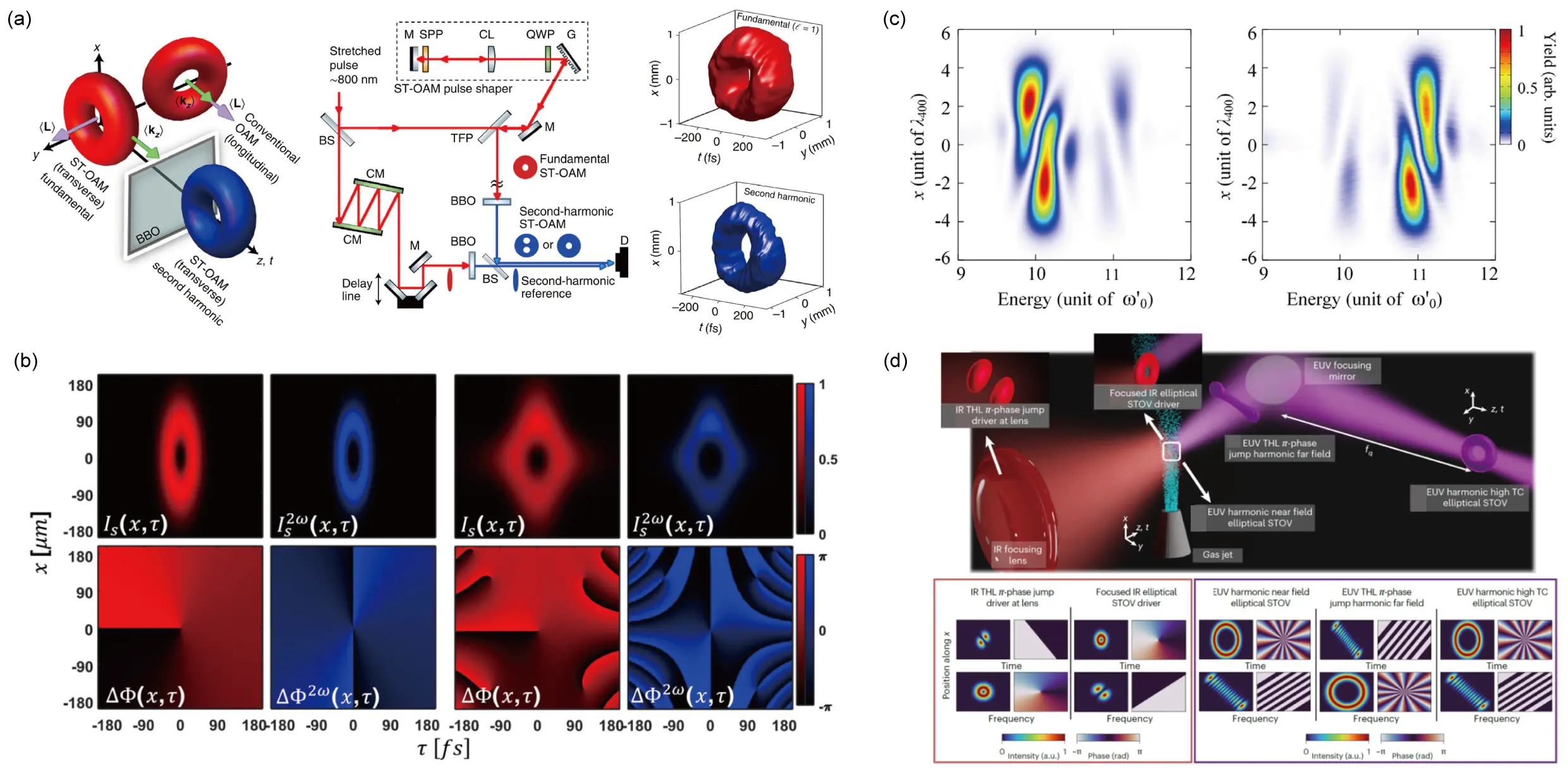
Figure 4. Nonlinear manipulation for STOVs. (a) Second-harmonic generation and the conservation of spatiotemporal orbital angular momentum of light. Republished with permission from[72]; (b) Idealized spatiotemporal intensity and phase[71]; (c) Spatial-resolved HHG spectrum driven by two-color counterspin and countervorticity STOVs at different intensity ratios. Republished with permission from[104]; (d) High-order spatiotemporal harmonic vortex generation. Republished with permission from[105]. STOVs: spatiotemporal optical vortices; HHG: high-harmonic generation.
Parallel to these efforts in bulk crystals, inverse design methodologies have been applied to nonlinear photonic crystals (NPCs) for the generation of tailored STOV. Liu et al. proposed and numerically validated a scheme using lithium niobate NPCs with spatially chirped χ(2) gratings to directly generate STOVs via the SHG process of a linearly chirped Gaussian pump pulse[100]. Their inverse design derived complex amplitude-phase-modulated grating functions capable of producing near ideal STOVs with l = ±1 and l = +2. Importantly, they identified a significant limitation of simplified binary-phase-modulated NPCs: the lack of amplitude control leads to distorted intensity profiles and, for higher charges like l = +2, can result in the generation of multiple offset vortices with l = +1 instead of a single structure with l = +2, echoing the vortex-splitting effects seen in bulk crystals under imperfect conditions. This underscores the necessity of full amplitude-phase engineering in nonlinear photonic crystals for high-fidelity STOV generation[101].
Collectively, these studies establish crystalline symmetry and engineered material nonlinearity (via bulk properties or metasurface design) as powerful, complementary frameworks for generating complex OAM states and arrays[101-103]. While intrinsic symmetries like C3 in BBO enable symmetry-protected OAM multiplexing and entanglement pathways, deliberate χ(2) modulation in NPCs offers precise spatiotemporal control over vortex topology. This synergy between fundamental symmetry exploitation and advanced material engineering paves the way for unprecedented multidimensional control of OAM in nonlinear optics, driving innovations in high-dimensional classical communication, quantum information processing with structured photons, and ultrafast spatiotemporal beam shaping. Future progress hinges on overcoming fabrication challenges for complex NPCs and the deeper exploration of symmetry-enabled interactions in emerging nonlinear materials.
Recent research has also extended STOV control into the non-perturbative regime of high-harmonic generation (HHG), revealing new conservation laws and topological dynamics[104,105]. Fang et al. studied the conversion and modulation of photon transverse OAM in HHG, and demonstrated that the conservation of photon transverse OAM obeys the rule: Ln = nlħ, where Ln is the transverse OAM per photon of the nth harmonic, confirming quantum conservation while observing unique interference fringes arising from microscopic electron dynamics near the spatiotemporal singularity (Figure 4c). Crucially, they identified that spatial chirp in the driving STOV induces harmonic spectral tilt scales linearly with order. To overcome spectral broadening and vortex instability at higher topological charges, they proposed a two-color counterspin and countervorticity scheme that isolates a single OAM mode per harmonic via spin-orbit selection rules, enabling robust control of extreme-ultraviolet (EUV) topology and spectral features[104].
Experimental breakthroughs were achieved by Martin-Hernández et al. generating EUV STOVs via HHG (Figure 4d). By focusing tilted Hermite-lobed pulses to create near-infrared STOVs in a gas jet, they upconverted transverse OAM to the EUV regime, achieving topological charges up to l = 60 at the 15th harmonic[105]. Their work highlighted the propagation duality of STOVs: near-field elliptical STOVs transform into far-field spatiospectral optical vortices (SSOVs) upon propagation, and vice versa under refocusing. Advanced macroscopic simulations, validated experimentally, showed that driver inhomogeneity distorts harmonic intensity profiles but preserves topological charge, while the bandwidth of harmonic SSOVs scales with l, providing a practical metric for characterizing high-charge EUV vortices despite current limitations in spatiotemporal phase retrieval.
3.2 Mode conversion and beam shaping for nonlinear manipulation
Beyond the conservation and manipulation of a specific quantum number like OAM, nonlinear processes offer a powerful platform for the comprehensive transformation of the spatial mode itself. This section moves beyond OAM to the holistic shaping of the spatial mode [amplitude A(x,y) and phase ψ(x,y)], enabled by advanced materials and fabrication.
Mode conversion aims to efficiently convert a specific mode of the fundamental frequency light into the target mode of the SH, a process primarily constrained by factors such as phase matching conditions and mode overlap. Beyond this, beam shaping focuses on precisely controlling the spatial distribution and phase characteristics of the second harmonic beam to meet specific application requirements. In recent years, with the development of new materials, micro-nano structures, and advanced manufacturing technologies, significant progress has been made in mode conversion and beam shaping in SHG, opening up new application prospects for nonlinear optics.
Significant progress in nonlinear mode conversion has been particularly evident in the study of nondiffracting structured beams. Specifically, theoretical work by Ding et al. demonstrated that the SH of the nth-order Bessel beam itself forms a nearly diffraction-free beam of order 2n in the radial direction, while its axial amplitude scales as the square root of the propagation distance. This result highlights the potential for preserving desirable propagation characteristics during harmonic generation[106]. Experimentally, Jarutis et al. explored SHG of higher-order Bessel beams generated via axicons, observing a critical phenomenon: the presence of an unavoidable coherent background (zeroth-order Bessel beam, J0) caused the SH vortex of topological charge 2n to split into 2n single-charged vortices, fundamentally altering the output mode structure from the ideal theoretical prediction[107]. This underscores the sensitivity of mode conversion fidelity to experimental conditions like pump beam purity and background fields. Beyond Bessel beams, more complex spatial modes are paid attention to and studied. For the parametric upconversion of Ince-Gaussian (IG) modes, the pump beam’s intensity profile can affect the process. It was shown that perfect unconversion can be obtained by the flattop-beam pump, while mode distortion occurred when using the most common Gaussian pump, as shown in Figure 5a[108]. This work emphasizes the crucial role of advanced pump beam shaping (e.g., using spatial light modulators) as a powerful strategy for achieving high-fidelity spatial mode conversion in nonlinear processes.
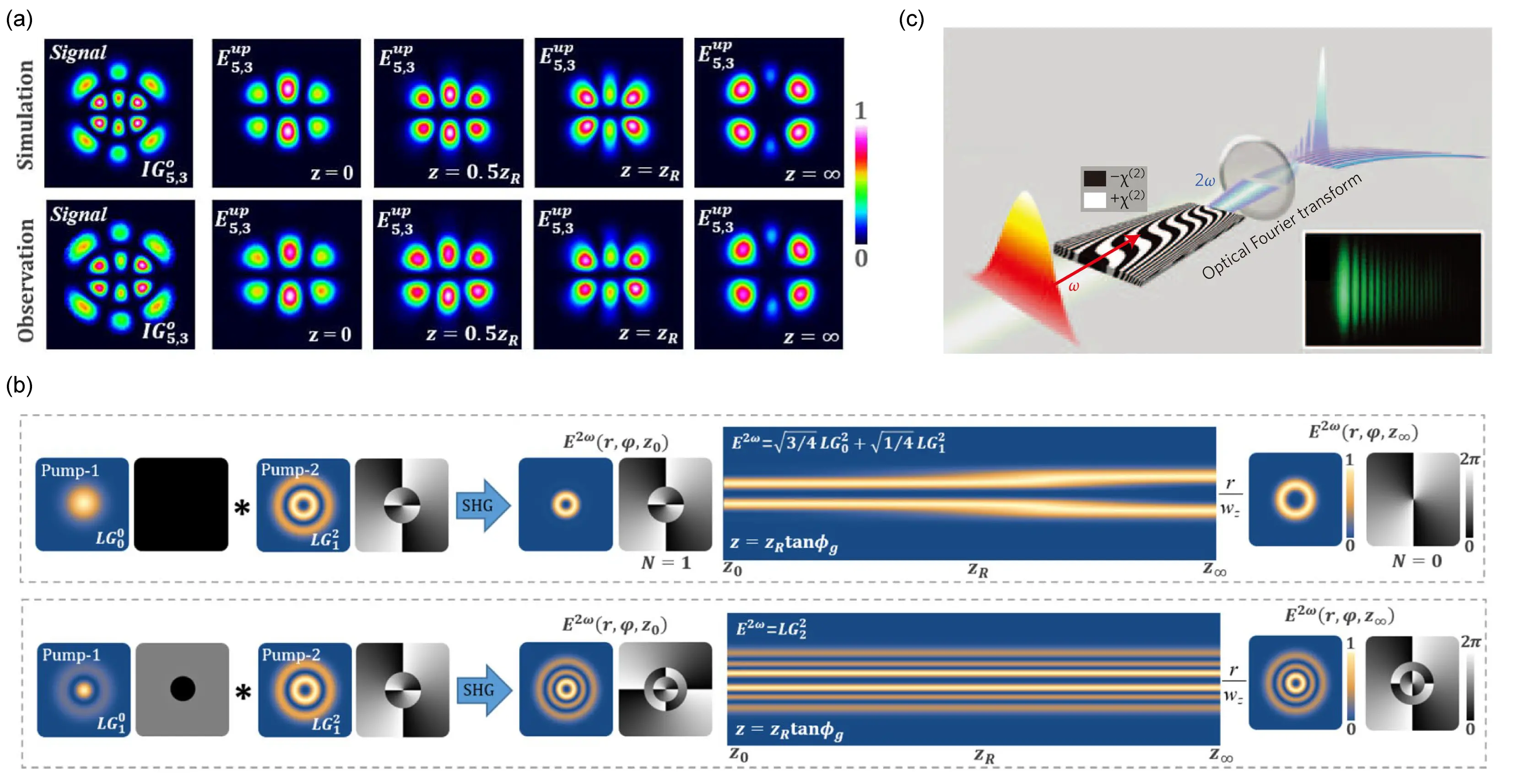
Figure 5. Nonlinear mode conversion. (a) The simulated and experimentally observed beam profiles of IG modes in the upconversion[108]; (b) Simulated spatial complex amplitudes of SHG fields of LG00LG21 and LG10LG21. Republished with permission from[109]; (c) Gaussian pump converted to second-harmonic Airy beam in an asymmetric nonlinear photonic crystal. Republished with permission from[84]. IG: Ince-Gaussian; LG: Laguerre-Gaussian.
Building upon the advancements in pump engineering for high-fidelity mode conversion, recent researchers have further explored complex spatial mode superpositions and intracavity generation techniques. Zhang et al. demonstrated intracavity SHG of transverse mode-locked (TML) beams within a microchip laser, where coherently locked HG or LG modes generate complex fundamental field patterns[57]. Crucially, the SHG output was not a simple intensity superposition but a coherent product governed by the relative phase and amplitude of the constituent modes, leading to far-field SH patterns that encode rich spatial information distinct from incoherent superpositions. Furthermore, the SHG patterns serve as sensitive probes to characterize the TML state of the fundamental beam, demonstrating a bidirectional link between the fundamental and harmonic spatial structures. Wu et al. provided a complete analytical solution for the SFG field pumped by arbitrary LG modes, enabling precise prediction of the radial and azimuthal mode evolution during propagation[109]. As Figure 5b shows, their work revealed that radial modal transitions are intrinsically coupled to azimuthal indices: for example, SFG pumped by conjugate LG modes (e.g., LGlp) generates far field single-charged vortices with N = 2p + |l|, where N is the number of phase dislocations (N) at the far field. This full-field selection rule, experimentally verified via propagation tomography and complex amplitude modulation, provides the fundamental basis for predicting and controlling complex structured light transformations in parametric processes beyond simple OAM conservation.
In parallel, major progress has been made in using quadratic nonlinear photonic crystals for nonlinear wave mixing to generate and manipulate non-diffracting beams such as Airy beams. As Figure 5c shows, a Gaussian pump is converted to a second-harmonic Airy beam in an asymmetric nonlinear photonic crystal, and this opens up new possibilities for all-optical switching and manipulation of mode for beams[84,110].
In the field of nonlinear beam shaping, Wang et al. proposed a binary phase modulation method based on patterned WS2 monolayer crystals and realized the nonlinear generation of Hermite−Gaussian beams at second-harmonic frequencies[111]. As a typical transition metal dichalcogenide, WS2 possesses atomic thickness and high nonlinear conversion efficiency, making it an ideal material for realizing nonlinear beam shaping at the nanoscale. This research not only demonstrated the implementation of nonlinear beam shaping at the atomic scale but also provided new ideas for integrated photonic devices. Additionally, precise control of the SHG beam is also possible by artificially designing the phase delays among the second harmonics generated in nonlinear optical elements. For instance, Li et al. fabricated a 3D nonlinear photonic crystal with four grating segments in a CBN crystal, and they experimentally found that the second harmonics generated via different orders of quasi-phase-matching (QPM) interaction vary from donut-like Laguerre–Gaussian modes to high-order depending on the wavelength of the fundamental beam[112].
Benefitting from the foundational advances in nonlinear beam shaping, numerous significant breakthroughs in efficiency enhancement and functional diversification through 3D NPCs have been achieved. Wei et al. demonstrated that 3D lithium niobate NPCs fabricated via femtosecond-laser engineering enable QPM simultaneous with complex wavefront control, overcoming the efficiency limitations of 2D structures[113-117]. Based on designed 3D χ(2) microstructures to meet the requirements of nonlinear wave-front shaping and quasi-phase-matching, efficient generation of second-harmonic vortex and Hermite-Gaussian beams has been achieved, and the conversion efficiency is enhanced up to two orders of magnitude in a 3D NPC in comparison to the 2D case. This efficiency surge, reaching up to two orders of magnitude improvement over 2D structures under optimal conditions, stems from harnessing the largest nonlinear coefficient (d33) and eliminating phase mismatch[116]. However, it comes at the cost of increased fabrication complexity using femtosecond laser writing, and the achieved absolute conversion efficiency (e.g., on the order of 10-3 %W-1[116]) remains a challenge for power-critical applications. Current research focuses on improving the writing throughput and fidelity to balance efficiency gains with scalability. Furthermore, recent work leverages 3D NPCs for dynamic nonlinear holography and multi-wavelength information processing. Chen et al. introduced χ(2)-super-pixel holograms with 25,000 pixels-per-inch resolution in lithium niobate, where each “super-pixel” comprises tailored nanodomains enabling full complex-amplitude control of nonlinear waves[118]. Unlike binary-phase modulation (0 or π), these subwavelength-engineered units dynamically manipulate amplitude and phase via parameter-tunable interference (Figure 6a). To address the inherent trade-off between conversion efficiency and channel density in bulk structures, Wang et al. introduced sequential 3D NPCs fabricated via femtosecond laser writing. By stacking functionally distinct subarrays (hexagonal lattice, Hermite-Gaussian grating, fork grating) along the propagation direction[119], they enabled wavelength-switchable SH beam shaping (Figure 6b). Notably, simultaneous dual-beam generation (vortex and hexagonal patterns) was achieved by aligning the QPM wavelengths of adjacent subarrays, showcasing spatial-beam multiplexing within a compact platform. In addition, Chen et al. pioneered QPM-division multiplexing holography by encoding multiple images onto distinct Ewald spheres within a single 3D LiNbO3 NPC[86]. By strategically distributing reciprocal vectors across wavelength-specific spheres, they achieved selective reconstruction of six high-fidelity holographic images at SH wavelengths spanning 746-875 nm (Figure 6c).
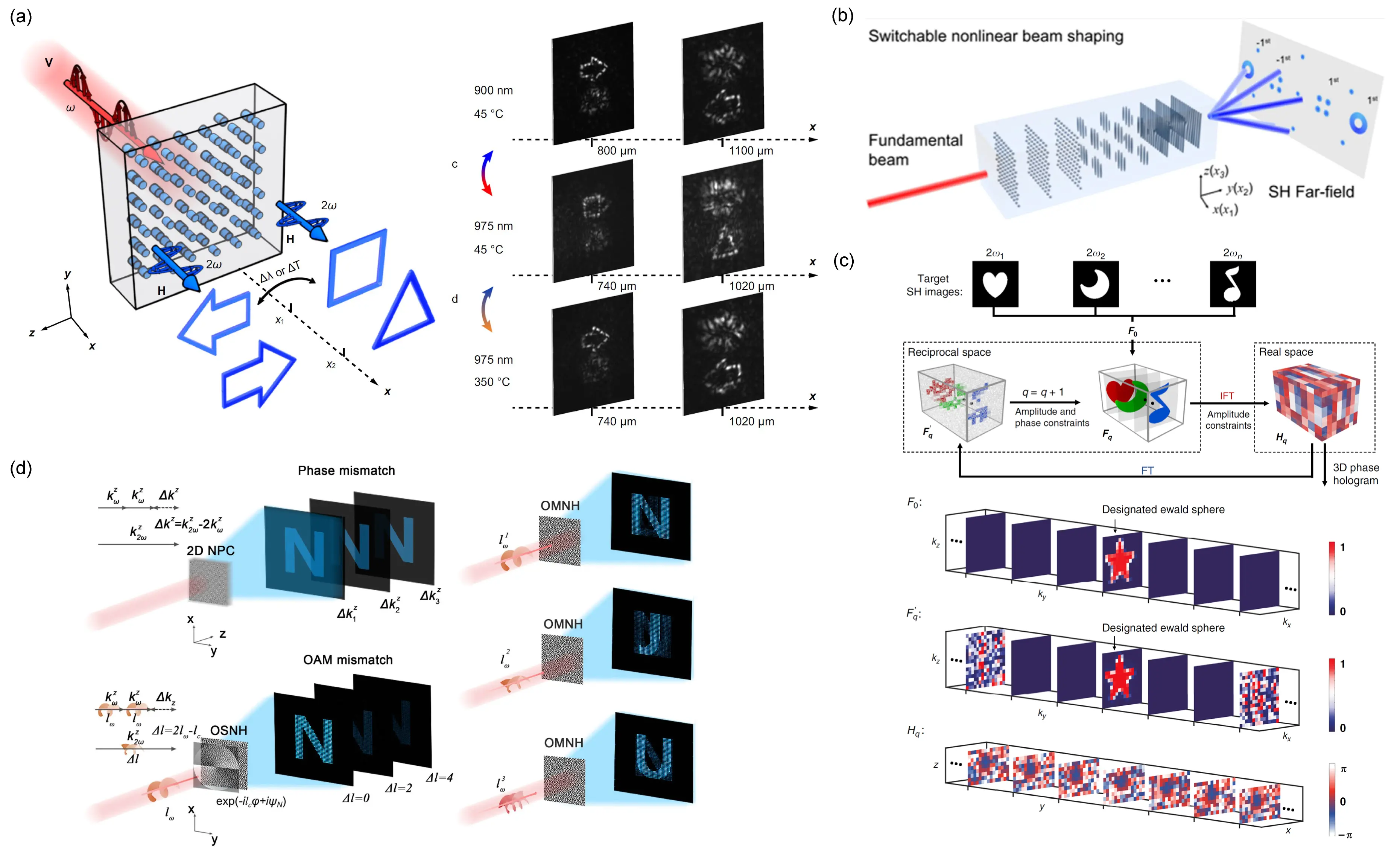
Figure 6. Nonlinear holography and beam shaping. (a) Dynamic 3D information reconstruction based on wavelength-temperature joint modulation[118]; (b) Three-dimensional nonlinear photonic structures for efficient and switchable nonlinear beam shaping. Republished with permission from[119]; (c) Quasi-phase-matching-division multiplexing holography in 3D NPC[86]; (d) Conceptual illustrations for Fourier-domain nonlinear OAM matching and multichannel nonlinear holography. Republished with permission from[120]. OAM: orbital angular momentum; NPC: nonlinear photonic crystal.
In order to further expand the control dimensionality, Fang et al. integrated OAM as an orthogonal multiplexing dimension in 2D LiTaO3 NPCs[120]. They encoded letters (“N”, “J”, “U”) with carrier OAM states and exploited the nonlinear OAM conservation law for channel selection. As a result, when mismatched inputs were used, the reconstruction of distinct SHG images with Gaussian-spot pixels produced only diffuse rings (Figure 6d). This OAM selectivity, together with binary phase coding, forms a robust high-security encryption framework. Decoding is only possible via nonlinear frequency conversion with a precise OAM input, ensuring exceptional security.
3.3 Nonlinear effect of vectorial structured light
Extending the control from scalar spatial modes to include the spatial patterning of polarization, we now turn to vectorial structured light. A vector optical field is characterized by its spatially structured distribution of the electric field vector, exhibiting engineered polarization states across its wavefront. Unlike scalar light fields with uniform polarization, vector fields have an additional polarization degree of freedom, which enables more complex light-matter interactions. When such fields interact with nonlinear media, their polarization, phase, and intensity profiles undergo intricate transformations. These dynamics depend critically on both the intrinsic properties of the vector beam (e.g., topological singularities, polarization symmetry) and the nonlinear response of the material (e.g., anisotropy, phase-matching conditions). Recent studies highlight the nontrivial behavior of vector structured light in nonlinear processes. For example, the SHG process converts vectoral optical beams into complex scalar patterns, erasing the original polarization structures[121]. Sandwiched nonlinear crystals can alter the vectoral topology of the generated harmonic beam, distorting its inhomogeneous states of polarization (SoPs)[79,80]. Conversely, a pivotal advancement emerged with the development of polarization-preserving interferometric architectures. Notably, Sagnac interferometers enable the coherent combination of the vector beam with a counter-propagating auxiliary beam during Type-II SHG. As Figure 7a shows, this approach successfully retains the inhomogeneous SoPs of the input beam and its intricate spin-orbit coupling state in the frequency-doubled beam[47,67]. Crucially, this spatial-polarization-independent parametric conversion transfers not only the polarization structure but also the full vector profile (intensity and polarization distribution) with high fidelity and can be used for high-dimensional quantum encoding[83,95,122]. Li et al. devised a system combining spiral phase plates, axicons, and orthogonally oriented nonlinear crystals to simultaneously produce “perfect vector” (PV) beams at fundamental and second-harmonic wavelengths[81]. Polarization tomography using a Glan-Taylor prism confirms retention of designed vectorial properties in both bands, with SH polarization states controllable via HWP rotation (Figure 7b). This approach extends PV beams from linear optics to nonlinear regimes. Beyond interferometric approaches, recent innovations focus on miniaturizing the polarization-preserving frequency conversion architecture while enhancing functional integration. A significant advancement is the development of microstructures, such as nonlinear fork gratings directly etched onto lithium niobate surfaces[82]. These gratings simultaneously impose spiral phase modulation and satisfy phase-matching conditions for Type-I SHG within a single element. As demonstrated experimentally by Yang et al., this design enables direct generation of SH vector vortex beams with arbitrary topological charges in a compact Sagnac loop, eliminating discrete optical elements for phase manipulation. These integrated approaches underscore a paradigm shift toward multifunctional, wavelength-flexible platforms.
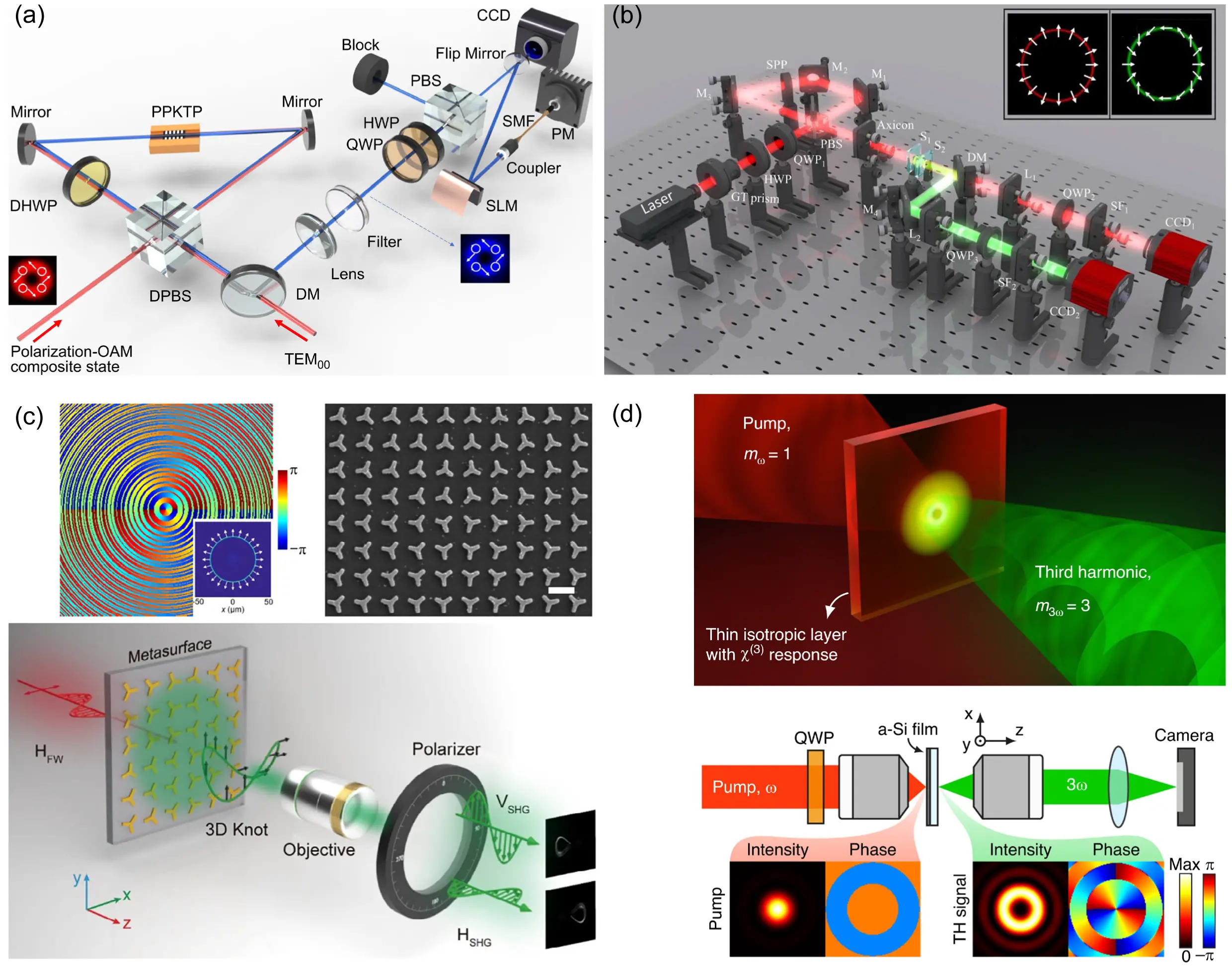
Figure 7. Nonlinear manipulation for vectorial structured light. (a) Optical frequency conversion with maintaining polarization and OAM in a nonlinear Sagnac interferometer. Republished with permission from[47]; (b) Dual waveband generation of perfect vector beams[81]; (c) Customizing 3D polarization structures at SH frequency[124]; (d) Generation of structured third-harmonic light under tight focusing[126]. OAM: orbital angular momentum; SH: second-harmonic.
Nonlinear dielectric and plasmonic metasurfaces represent a paradigm-shifting platform enabling subwavelength 3D control over harmonic polarization states[123-126]. As demonstrated in Figure 7c, arbitrarily structured second-harmonic polarization knots are generated by engineering gold meta-atoms with three-fold rotational symmetry (C3) on ITO substrates[124]. Their work realized dynamic polarization sculpting, i.e., the SH polarization distribution on a 3D knot can be modulated by rotating the polarization direction of the fundamental wave, and it reveals propagation-dependent polarization evolution in SH 3D knots through multiplane imaging. These advances facilitate novel functionalities for polarization-encrypted imaging by exploiting unique “dark gaps” in metasurface-generated SH knots, enabling steganography where hidden images appear exclusively at harmonic frequencies. Furthermore, experimental results demonstrate that tightly focused light in an isotropic silicon film can manipulate nonlinear structured beams. By exploiting the longitudinal field component, this approach offers a novel strategy for generating and detecting structured light[125,126]. As shown in Figure 7d, this enabled the generation of structured third-harmonic light under tight-focusing conditions[126].
Dielectric and plasmonic metasurfaces provide unprecedented subwavelength control over harmonic wavefronts. However, their nonlinear conversion efficiencies are typically several orders of magnitude lower than those of bulk nonlinear crystals due to the reduced interaction volume. Furthermore, damage thresholds can limit their use with high-intensity pulses. Ongoing material and design research aims to enhance the nonlinear response and robustness of these ultra-thin platforms.
With the progression of light field manipulation, significant progress has been made in overcoming traditional limitations of nonlinear optics for preserving complex light topologies[69,70,127,128]. As Figure 8a shows, Wu et al. demonstrated conformal frequency conversion of arbitrary vectorial structured light using a Sagnac nonlinear interferometer with type-0 QPM, maintaining the topological invariant structure during sum-frequency generation and enabling applications like quantum interfaces and polarization-resolved imaging[69]. Furthermore, topological harmonic generation by Stokes vector skyrmions in crystals with different symmetries was demonstrated. The topological structure of the generated harmonic is formed through the superposition of skyrmions with different topological states. Their work bridges the topology of light fields and the symmetry of crystals[70]. In addition, Luttmann et al. reported fractional-order topology by driving HHG in gases with a polarization Möbius strip carrying a half-integer generalized angular momentum (GAM)[127]. They confirmed the linear scaling of the GAM charge with harmonic order via novel XUV vortex interference and transverse mode conversion techniques, establishing GAM as a conserved quantum number in isotropic nonlinear processes and generating attosecond light springs with fermionic-like topology (Figure 8b). Most recently, Gao et al. introduced topology imprinting using nonlinear dielectric metasurfaces, a paradigm shift leveraging the nonlinear Raman-Nath regime and phase-locked harmonic components[128]. Their metasurface designs directly replicated intricate topologies (e.g., optical vortices, Hopf links) from the fundamental wavelength to the third harmonic (Figure 8c). Collectively, these advances (ranging from interferometric schemes for vectorial mode conservation, HHG for fractional topology transfer, to metasurface) demonstrate a clear trajectory toward robust, high-dimensional control of light’s topology for applications in quantum communication, high-dimensional encoding, and short-wavelength structured light.
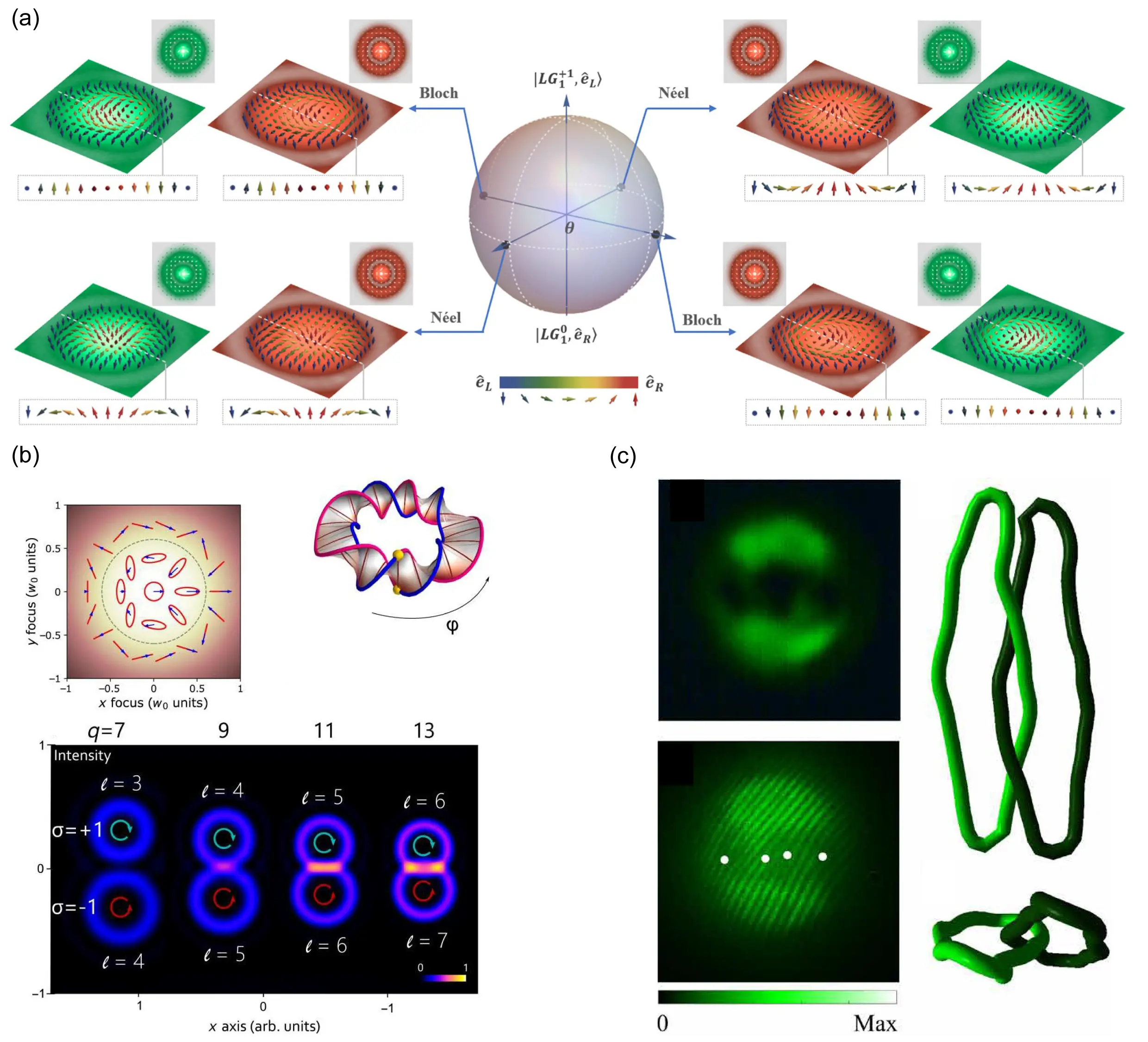
Figure 8. Nonlinear manipulation for polarization topology. (a) Conformal upconversion for paraxial optical skyrmions defined by Stokes vectors of vector modes[69]; (b) Möbius strip topology for noncollinear driving beams. Republished with permission from[127]; (c) Nonlinear characterization of topology-imprinting in nonlinear metasurfaces. Republished with permission from[128].
3.4 Self-focusing and filamentation phenomena of structured light
Having explored the nonlinear control for OAM, tailored intensity-phase profiles, and spatially structured polarization, we now examine how high intensities fundamentally alter beam propagation dynamics. This section focuses on harnessing engineered spatial and polarization structures to actively govern nonlinear self-focusing and optical filamentation, phenomena central to high-power laser physics and intense light–matter interactions.
Self-focusing refers to the phenomenon where a light beam automatically focuses due to the nonlinear effects during its propagation, while filamentation formation refers to the phenomenon where a light beam forms a slender optical filament in an optical medium. These phenomena are usually associated with the nonlinear effects such as self-phase modulation and plasma generation in the medium. In recent years, with the development of femtosecond laser technology, significant progress has been made in self-focusing and filamentation of structured light fields, especially vortex beams, vector beams, and other special structured beams.
When structured light interacts with optical media, it will exhibit behaviors distinct from traditional Gaussian beams due to its unique spatial distribution characteristics. For instance, it has been shown that the self-focusing critical power of vortex beams is closely related to the topological charge[129]. Vortex beams carrying OAM can transmit stably over longer distances, and vortex beams also exhibit filamentation phenomena after self-focusing[130]. Meanwhile, Vuong et al. demonstrated that an increase in the topological charge number and initial power of the vortex beam can lead to multiple-filamentation patterns[131]. Figure 9a simulates the collapse of the vortex with l = 1 when propagating in the nonlinear medium with different laser powers, which provides crucial clues for understanding the propagation behavior of vortex beams in various nonlinear media.
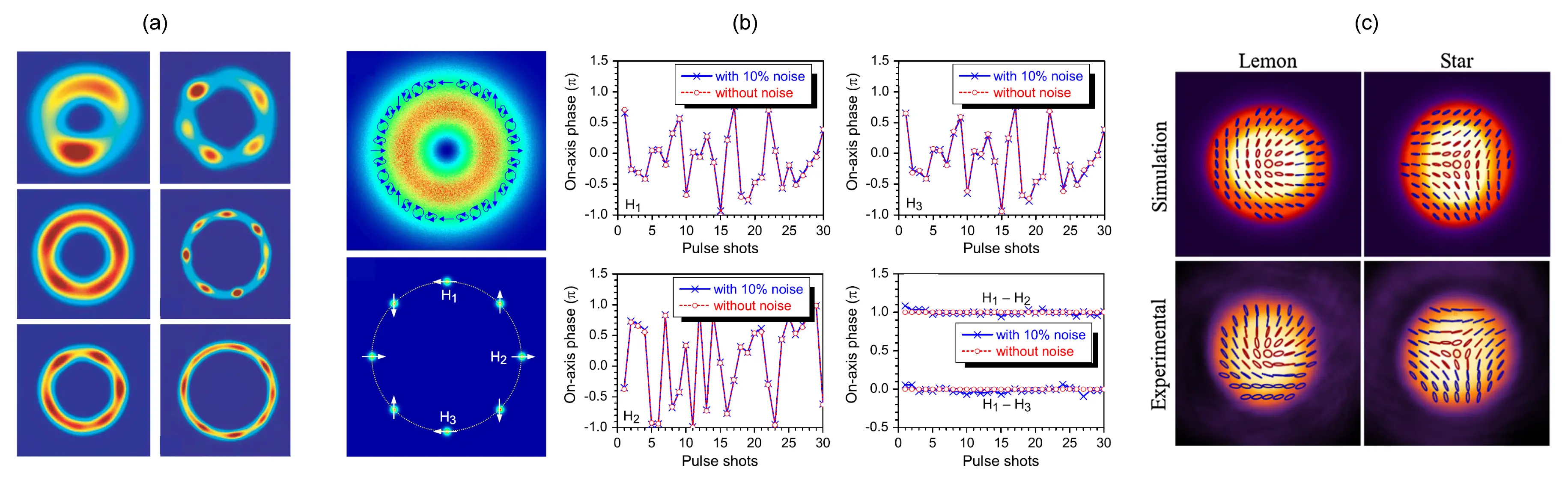
Figure 9. Nonlinear self-focusing for structured light. (a) Collapse of optical vortices. Republished with permission from[131]; (b) The stability of multiple filamentation caused by axial symmetry breaking of polarization[90]; (c) Topological stability of polarization in lemon and star topologies after propagation through the Rb cell. Republished with permission from[143].
When femtosecond lasers are transmitted in the atmosphere, random multi-filamentation usually occurs due to perturbations of air refractive index caused by the atmospheric turbulence and the non-uniform initial energy distribution of femtosecond lasers. This will seriously affect the energy distribution of the filaments, shorten their propagation distance, and reduce the spot quality, which consequently limits the practical application of the filaments. To overcome the randomness caused by multiple filamentation, researchers have proposed various control methods. These methods include adjusting the ellipticity of the incident beam[132-135], changing the gradient of the laser field intensity[136], and engineering the light’s phase[137-139], etc. To some extent, all these methods can eliminate the randomness of multiple filamentation, but there are still problems, such as low control accuracy of filament distribution, excessive laser energy loss, and insufficient laser transmission distance.
However, a fundamental breakthrough in deterministic filamentation control emerged with the strategic engineering of spatially structured polarization[88-90,140-142]. Unlike scalar approaches, vector optical fields with designed azimuthally variant hybrid-polarized vector fields (AV-HP-VFs) intrinsically break the axial symmetry in a controllable and noise-resistant manner. Li et al. pioneered this concept, demonstrating theoretically and experimentally that AV-HP-VFs propagating in isotropic Kerr media (e.g., CS2) collapse into a deterministic number (4 m) of filaments exhibiting robust C4m rotational symmetry, where m is the topological charge of the vector optical field[88]. Crucially, the filaments’ locations are pinned to specific azimuthal positions (ϕn = nπ/2m) corresponding to local linear polarization states, and the “taming” of collapse stems from the engineered polarization distribution inducing a deterministic azimuthal refractive index modulation (Δn), creating preferred self-focusing nucleation sites where ∂Δn/∂ϕ = 0 and ∂2Δn/∂ϕ2 < 0. Subsequent work unveiled the critical role of phase stability in this robustness[90], as shown in Figure 9b. While individual filaments in homogeneously polarized fields exhibit unpredictable “loss of phase” after collapse, AV-HP-VFs maintain locked relative phases between filaments despite individual phase uncertainties. This coherence, arising from the deterministic symmetry breaking initiated by the hybrid polarization structure rather than random noise, is essential for stable, controllable multiple filamentation patterns. Furthermore, Wang et al. introduced the optical anisotropy of the medium itself as a synergistic control dimension to control the filamentation[140,141]. By propagating azimuthally variant linearly polarized vector fields (AV-LP-VFs) through anisotropic crystals like x-cut MgO:LiNbO3, they achieved deterministic 2m-filament arrays with C2m symmetry, where filaments are localized at positions corresponding to the ordinary polarization component in the crystal. This synergy between tailored polarization structure and material anisotropy provides an additional, powerful knob for designing filamentation patterns, confirmed experimentally and through extended vector NLSE models incorporating both linear and nonlinear anisotropies. These breakthroughs demonstrate that actively engineered polarization structures, alone or combined with material anisotropy, offer a fundamentally distinct and highly effective pathway to overcoming the inherent randomness in nonlinear self-focusing and filamentation, enabling truly designable optical field collapse.
Building upon these deterministic control strategies, recent research has further demonstrated the robustness of polarization-structured beams against noise-induced instabilities and their ability to suppress nonlinear rogue wave formation. Black et al. demonstrated that Full-Poincaré (FP) beams can significantly suppress nonlinear caustic formation compared to uniformly polarized beams under random phase perturbations[92]. Furthermore, it was confirmed that despite dramatic changes in intensity structure during nonlinear propagation, the fundamental lemon type polarization topology of the FP beam remains remarkably stable. This stability arises from similar nonlinear phase shifts experienced by both polarization components, highlighting the resilience of the engineered polarization state itself under nonlinear conditions, as shown in Figure 9c. These advancements demonstrate that polarization structuring serves not only as a tool for deterministic pattern generation but also as a powerful mechanism for enhancing beam robustness against noise and suppressing detrimental nonlinear instabilities, such as the formation of catastrophic self-focusing and rogue waves. This paves the way for reliable high-power beam delivery and nonlinear signal propagation through turbulent media. Furthermore, the synergy between engineered polarization topologies and material platforms continues to provide a rich design space for tailoring nonlinear light-matter interactions.
The deterministic control of filamentation using vector beams represents a paradigm shift. However, its practical implementation requires precise generation of these complex input fields, which can be sensitive to propagation and optical aberrations. Extending this control to longer atmospheric paths and more turbulent environments remains an active challenge, where the synergy between adaptive optics and polarization structuring may provide a solution.
3.5 Comparative Analysis of Platforms for Nonlinear Structured Light Manipulation
The rapid development of diverse material platforms has been pivotal in advancing nonlinear structured light manipulation. Each platform offers a unique set of advantages and faces specific limitations, making a comparative analysis crucial for selecting the appropriate technology for a given application. Below, we discuss and compare the key characteristics of bulk nonlinear crystals, 3D NPCs, 2D materials, and metasurfaces, with a summary provided in Table 1.
Table 1. Comparison of key platforms for nonlinear structured light manipulation.
| Platform | Typical Materials/Structures | Conversion Efficiency | Spatial Control Resolution/Flexibility | Modal Purity & Topology Preservation | Primary Application Examples (References) |
| Bulk Nonlinear Crystals | BBO, LiNbO3, KTP | High | Low–Medium (requires external beam shaping) | Medium (depends on phase-matching; complex states need interferometric schemes) | High-power harmonic generation, quantum SPDC sources[35,38,74,75] |
| 3D Nonlinear Photonic Crystals | fs-laser-written LiNbO3 | Medium–High (enables d33 use) | High (3D χ(2) engineering) | High (designed for specific mode conversion/topology) | Nonlinear holography, 3D wavefront shaping, OAM array generation[86,113-119] |
| 2D Materials | WS2, MoS2 monolayers | Low | Medium (nanopatterning possible) | To be explored/Preliminary | On-chip nonlinear beam shaping, ultra-compact modulators[111] |
| Metasurfaces | Dielectric (Si, GaAs) or plasmonic nano-antennas | Low–Medium (resonance-dependent) | Very High (subwavelength pixelated control) | High (capable of topology imprinting) | Flat nonlinear optics, topological harmonic generation, polarization encryption[124,126,128] |
SPDC: spontaneous parametric down-conversion; OAM: orbital angular momentum; KTP: potassium titanyl phosphate.
Bulk Nonlinear Crystals (e.g., BBO, LiNbO3, KTP) represent the most mature platform. They typically offer high nonlinear conversion efficiencies and excellent power handling capabilities, making them the workhorse for high-power harmonic generation and quantum light sources[74,75]. However, their spatial control resolution is often limited by external beam-shaping elements (e.g., SLMs, phase plates). Modal purity preservation, especially for complex vectorial or topological states, is highly dependent on achieving specific phase-matching conditions and often requires auxiliary interferometric setups (e.g., Sagnac loops) to maintain polarization topology during conversion[47,67,69]. Fabrication complexity is relatively low, involving crystal growth and polishing.
3D Nonlinear Photonic Crystals fabricated via techniques like femtosecond laser writing in ferroelectrics (e.g., LiNbO3) have revolutionized nonlinear wavefront control[113-117]. They enable high spatial control resolution through 3D domain engineering, allowing for QPM and complex wavefront shaping simultaneously. This leads to superior capabilities for handling complex spatial topologies and high-fidelity mode conversion[86,116]. Conversion efficiencies can reach levels comparable to or surpassing optimized bulk QPM crystals due to access to the largest nonlinear coefficients (d33)[116]. Their primary drawback is their high fabrication complexity, requiring precise laser inscription. Power handling is generally moderate, suitable for many lab-scale applications.
2D Materials (e.g., WS2, MoS2) offer atomic-scale thickness and strong light-matter interaction, promising ultimate miniaturization for integrated photonics[111]. They provide a unique platform for nanoscale spatial control, as demonstrated in nonlinear beam shaping via patterned monolayers[111]. However, their nonlinear conversion efficiency and power handling capacity are inherently low due to the minimal interaction volume. Research on their ability to preserve modal purity and manipulate complex topologies is still in its infancy. Fabrication complexity involves material growth, transfer, and nanopatterning.
Metasurfaces, comprising subwavelength nanostructures of dielectrics or plasmonic materials, provide the highest spatial control resolution, enabling arbitrary polarization and phase manipulation at the wavelength scale[123-126,128]. They excel in generating and transforming complex topological states via nonlinear interactions, a concept known as "topology imprinting"[128]. Conversion efficiency, while improving with resonant designs, remains low to moderate, and power handling is low due to potential thermal damage. Fabrication complexity is high, demanding advanced nanolithography. Their key strength is the unparalleled ability to condense complex optical functions into a flat, compact element.
In summary, the choice of platform involves inherent trade-offs. Bulk crystals lead in power and efficiency, 3D NPCs offer unmatched integrated 3D wavefront control, 2D materials provide a path to atomically thin devices, and metasurfaces enable ultimate planar integration and topologically rich transformations. Future advancements may lie in hybrid approaches that combine the strengths of these platforms.
4. Conclusions and Outlooks
The rapid evolution of nonlinear structured light manipulation has been driven by synergistic advances in theory, technology and related applications. This review has highlighted key developments that underscore the progress of nonlinear manipulation of structured light fields. Various methods of OAM engineering stand out as a major achievement, enabling arbitrary OAM state generation, multiplexed arrays, and STOV manipulation. These innovations are significantly expanding the methods for high-dimensional quantum optics, as demonstrated in Figure 3 and Figure 4. Another breakthrough involves leveraging topological robustness in polarization-structured beams, such as lemon and star topologies, which suppress catastrophic self-focusing and optical rogue waves, thereby enhancing beam resilience in turbulent media (Figure 9c).
Similarly, structured light fields have experienced great advancements in vectorial control, where metasurfaces and interferometric systems preserve complex polarization topologies during nonlinear processes. This has enabled high-fidelity frequency conversion of vector vortex beams and 3D polarization knots, as illustrated in Figure 7 and Figure 8. Material platforms, such as 3D nonlinear photonic crystals and metasurfaces, have further enhanced wavefront shaping, holography, and OAM manipulation, paving the way for integrated nonlinear devices (Figure 5 and Figure 6). These collective advancements demonstrate that polarization structuring is not merely a tool for pattern generation but a fundamental strategy for multidimensional control, robustness, and instability suppression. The convergence of engineered structured light fields with tailored material platforms, such as atomic vapors, anisotropic crystals, and metasurfaces, has opened a rich design space for next-generation photonics.
The future of nonlinear structured light manipulation is poised to address several transformative directions. Firstly, extreme-scale photonics will extend OAM and STOV control to the attosecond and X-ray regimes through high-harmonic generation, enabling ultrafast quantum coherent control[144], as illustrated in Figure 4d. Secondly, machine learning will play a key role in the inverse design of metasurfaces and photonic crystals[145], optimizing their nonlinear responses for efficiency, bandwidth, and topological fidelity. Thirdly, the development of quantum nonlinear interfaces will focus on high-fidelity frequency converters for polarization- and OAM-encoded qubits, which are essential for quantum networks (Figure 3a and Figure 7a).
Exploring nonlinear light-matter interactions in topological insulators and moiré materials will also be a priority[146,147], potentially enabling the engineering of robust photonic edge states in topological photonics[148]. Additionally, the miniaturization of polarization-preserving architectures (e.g., on-chip Sagnac interferometers) represents a key requirement for scalable quantum photonic processors, while AI-driven wavefront correction will enhance adaptive robustness to maintain topological stability under dynamic conditions like atmospheric turbulence[149,150].
Overcoming these hurdles requires a convergent approach that combines expertise in light-field control, nanofabrication, and materials science. This integration is crucial for transforming structured light into a viable technology beyond the lab, unlocking its potential for applications like secure communications and advanced sensing. Ultimately, advances in nonlinear structured light manipulation are set to redefine the capabilities and tangible impact of photonics.
Authors contribution
Tu C: Conceptualization, methodology, formal analysis, investigation, writing-original draft, writing-review & editing.
Wang Q: Methodology, formal analysis, investigation, validation, writing-original draft.
Ren Z, Wang X, Li Y: Investigation, writing-review & editing.
Wang H: Conceptualization, supervision, writing-original draft, writing- review & editing.
Conflicts of interest
Huitian Wang is an Editorial Board of Light Manipulation and Applications. The other authors declare that they have no conflicts of interest.
Ethical approval
Not applicable.
Consent to participate
Not applicable.
Consent for publication
Not applicable.
Availability of data and materials
Not applicable.
Funding
This work was supported by the National Key R&D Program of China (Grant No. 2022YFA1404800), the National Natural Science Foundation of China (Grant Nos. 12374308, 12234009, 12474328, 12074196, and 12504353), the Natural Science Foundation of Guangdong Province (Grant No. 2025A1515010738), and the STU Scientific Research Initiation Grant (Grant No. NTF24020T).
Copyright
© The Author(s) 2026.
References
-
2. Allen L, Beijersbergen MW, Spreeuw RJC, Woerdman JP. Orbital angular momentum of light and the transformation of Laguerre-Gaussian laser modes. Phys Rev A. 1992;45(11):8185-8189.[DOI]
-
3. Coullet P, Gil L, Rocca F. Optical vortices. Opt Commun. 1989;73(5):403-408.[DOI]
-
5. Wang X, Nie Z, Liang Y, Wang J, Li T, Jia B. Recent advances on optical vortex generation. Nanophotonics. 2018;7(9):1533-1556.[DOI]
-
6. Shen Y, Wang X, Xie Z, Min C, Fu X, Liu Q, et al. Optical vortices 30 years on: OAM manipulation from topological charge to multiple singularities. Light Sci Appl. 2019;8:90.[DOI]
-
7. Zhan Q. Cylindrical vector beams: From mathematical concepts to applications. Adv Opt Photon. 2009;1(1):1.[DOI]
-
9. Rosales-Guzmán C, Ndagano B, Forbes A. A review of complex vector light fields and their applications. J Opt. 2018;20(12):123001.[DOI]
-
10. Rubinsztein-Dunlop H, Forbes A, Berry MV, Dennis MR, Andrews DL, Mansuripur M, et al. Roadmap on structured light. J Opt. 2017;19(1):013001.[DOI]
-
11. Forbes A. Structured light from lasers. Laser Photonics Rev. 2019;13(11):1900140.[DOI]
-
12. Angelsky OV, Bekshaev AY, Hanson SG, Zenkova CY, Mokhun II, Zheng J. Structured light: ideas and concepts. Front Phys. 2020;8:114.[DOI]
-
13. Forbes A, de Oliveira M, Dennis MR. Structured light. Nat Photonics. 2021;15(4):253-262.[DOI]
-
14. Bliokh KY, Rodríguez-Fortuño FJ, Nori F, Zayats AV. Spin–orbit interactions of light. Nature Photon. 2015;9(12):796-808.[DOI]
-
15. Fu S, Zhai Y, Wang T, Yin C, Gao C. Tailoring arbitrary hybrid Poincaré beams through a single hologram. Appl Phys Lett. 2017;111(21):211101.[DOI]
-
17. Dorrah AH, Zamboni-Rached M, Mojahedi M. Controlling the topological charge of twisted light beams with propagation. Phys Rev A. 2016;93(6):063864.[DOI]
-
21. Dorrah AH, Rubin NA, Zaidi A, Tamagnone M, Capasso F. Metasurface optics for on-demand polarization transformations along the optical path. Nat Photonics. 2021;15(4):287-296.[DOI]
-
23. Dennis MR, King RP, Jack B, O’Holleran K, Padgett MJ. Isolated optical vortex knots. Nature Phys. 2010;6(2):118-121.[DOI]
-
24. Larocque H, Sugic D, Mortimer D, Taylor AJ, Fickler R, Boyd RW, et al. Reconstructing the topology of optical polarization knots. Nature Phys. 2018;14(11):1079-1082.[DOI]
-
25. Pisanty E, Machado GJ, Vicuña-Hernández V, Picón A, Celi A, Torres JP, et al. Knotting fractional-order knots with the polarization state of light. Nat Photonics. 2019;13(8):569-574.[DOI]
-
28. Intaravanne Y, Wang R, Ahmed H, Ming Y, Zheng Y, Zhou ZK, et al. Color-selective three-dimensional polarization structures. Light Sci Appl. 2022;11:302.[DOI]
-
31. Shen Y, Zhang Q, Shi P, Du L, Yuan X, Zayats AV. Optical skyrmions and other topological quasiparticles of light. Nat Photon. 2024;18(1):15-25.[DOI]
-
32. Franken PA, Hill AE, Peters CW, Weinreich G. Generation of optical harmonics. Phys Rev Lett. 1961;7(4):118-119.[DOI]
-
33. New GHC, Ward JF. Optical third-harmonic generation in gases. Phys Rev Lett. 1967;19(10):556-559.[DOI]
-
34. Simon HJ, Bloembergen N. Second-harmonic light generation in crystals with natural optical activity. Phys Rev. 1968;171(3):1104-1114.[DOI]
-
35. Mair A, Vaziri A, Weihs G, Zeilinger A. Entanglement of the orbital angular momentum states of photons. Nature. 2001;412(6844):313-316.[DOI]
-
36. Arlt J, Dholakia K, Allen L, Padgett MJ. Parametric down-conversion for light beams possessing orbital angular momentum. Phys Rev A. 1999;59(5):3950-3952.[DOI]
-
37. Buono WT, Forbes A. Nonlinear optics with structured light. Opto Electron Adv. 2022;5(6):210174.[DOI]
-
38. Dholakia K, Simpson NB, Padgett MJ, Allen L. Second-harmonic generation and the orbital angular momentum of light. Phys Rev A. 1996;54(5):R3742-R3745.[DOI]
-
39. Courtial J, Dholakia K, Allen L, Padgett MJ. Second-harmonic generation and the conservation of orbital angular momentum with high-order Laguerre-Gaussian modes. Phys Rev A. 1997;56(5):4193-4196.[DOI]
-
40. Bloch NV, Shemer K, Shapira A, Shiloh R, Juwiler I, Arie A. Twisting light by nonlinear photonic crystals. Phys Rev Lett. 2012;108(23):233902.[DOI]
-
43. Zhang Y, Sheng Y, Zhu S, Xiao M, Krolikowski W. Nonlinear photonic crystals: From 2D to 3D. Optica. 2021;8(3):372-381.[DOI]
-
44. Zhu L, Wang J. Simultaneous generation of multiple orbital angular momentum (OAM) modes using a single phase-only element. Opt Express. 2015;23(20):26221-26233.[DOI]
-
45. Fu S, Zhai Y, Zhou H, Zhang J, Wang T, Liu X, et al. Experimental demonstration of free-space multi-state orbital angular momentum shift keying. Opt Express. 2019;27(23):33111-33119.[DOI]
-
46. Liu ZF, Ren ZC, Lou YC, Cheng ZM, Yang YX, Li Y, et al. Control of harmonic orbital angular momentum in second-harmonic generation of perfect vortices. Phys Rev A. 2022;105(6):063518.[DOI]
-
48. Guo H, Wang X, Xu C, Zhuang M, Ye Y, Xie X, et al. Tailoring a vortex array with equal energy distribution via nonlinear optics. Phys Rev Appl. 2024;22(4):044067.[DOI]
-
49. Mao N, Zhang G, Tang Y, Li Y, Hu Z, Zhang X, et al. Nonlinear vectorial holography with quad-atom metasurfaces. Proc Natl Acad Sci U S A. 2022;119(22):e2204418119.[DOI]
-
51. Jin M, Hu Z, Liu X, Li G. Nonlinear optical wavefront engineering with geometric phase controlled all-dielectric metadevice. Laser Photonics Rev. 2023;17(10):2300174.[DOI]
-
53. Qu L, Wu W, Zhang D, Wang C, Bai L, Li C, et al. Beam shaping by stacked nonlinear moiré metasurfaces. Nano Lett. 2025;25(12):4854-4861.[DOI]
-
55. Pan J, Wang H, Shi Z, Shen Y, Fu X, Liu Q. Frequency-astigmatism asymmetric nonlinear conversion of structured light lasers. Appl Phys Lett. 2024;125(9):091107.[DOI]
-
56. Zhang Z, He W, Zhao S, Gao Y, Wang X, Li X, et al. Spatial nonlinear conversion of structured light for machine learning based ultra-accurate information networks. Laser Photonics Rev. 2024;18(6):2301225.[DOI]
-
57. Zhang Z, Gao Y, Li X, Wang X, Zhao S, Liu Q, et al. Second harmonic generation of laser beams in transverse mode locking states. Adv Photon. 2022;4(2):026002.[DOI]
-
58. Ren ZC, Fan L, Cheng ZM, Liu ZF, Lou YC, Huang SY, et al. On-demand orbital angular momentum comb from a digital laser. Optica. 2024;11(7):951-961.
-
59. Tang Y, Li K, Zhang X, Deng J, Li G, Brasselet E. Harmonic spin–orbit angular momentum cascade in nonlinear optical crystals. Nat Photonics. 2020;14(11):658-662.[DOI]
-
61. Yang YX, Dong BW, Ren ZC, Li H, Lou YC, Cheng ZM, et al. Nonlinear manipulation of orbital angular momentum spectra with second- and third-harmonic generation. Appl Phys Lett. 2022;121(3):033502.[DOI]
-
63. da Silva BP, Santos GH, Oliveira AG, Silva NR, Buono WT, Gomes R, et al. Observation of a triangular-lattice pattern in nonlinear wave mixing with optical vortices. Optica. 2022;9(8):908-912.[DOI]
-
64. Liu H, Zhao X, Li H, Zheng Y, Chen X. Dynamic computer-generated nonlinear optical holograms in a non-collinear second-harmonic generation process. Opt Lett. 2018;43(14):3236-3239.[DOI]
-
65. Singh S, Sephton B, Tavares Buono W, D’Ambrosio V, Konrad T, Forbes A. Light correcting light with nonlinear optics. Adv Photon. 2024;6(2):026003.[DOI]
-
66. Wu HJ, Yang HR, Rosales-Guzmán C, Gao W, Shi BS, Zhu ZH. Vectorial nonlinear optics: Type-II second-harmonic generation driven by spin-orbit-coupled fields. Phys Rev A. 2019;100(5):053840.[DOI]
-
67. Wu HJ, Zhao B, Rosales-Guzmán C, Gao W, Shi BS, Zhu ZH. Spatial-polarization-independent parametric up-conversion of vectorially structured light. Phys Rev Appl. 2020;13(6):064041.[DOI]
-
68. Pinheiro da Silva B, Buono WT, Pereira LJ, Tasca DS, Dechoum K, Khoury AZ. Spin to orbital angular momentum transfer in frequency up-conversion. Nanophotonics. 2022;11(4):771-778.[DOI]
-
69. Wu HJ, Yu BS, Zhu ZH, Gao W, Ding DS, Zhou ZY, et al. Conformal frequency conversion for arbitrary vectorial structured light. Optica. 2022;9(2):187-196.[DOI]
-
70. Lyu Z, Li J, Li P, Fang Y, Liu Y. Topological harmonic generation of nonlinear optical skyrmions. Ultrafast Sci. 2025;5:104.[DOI]
-
71. Zahedpour S, Hancock SW, Milchberg HM. Second harmonic generation of spatiotemporal optical vortices (STOVs) and conservation of orbital angular momentum. arXiv:2012.10806 [Preprint]. 2021.[DOI]
-
72. Gui G, Brooks NJ, Kapteyn HC, Murnane MM, Liao CT. Second-harmonic generation and the conservation of spatiotemporal orbital angular momentum of light. Nat Photonics. 2021;15(8):608-613.[DOI]
-
73. Cheng ZM, Xue ST, Lou YC, et al. Rotational Doppler shift tripling via third-harmonic generation of spatially structured light in a quasi-periodically poled crystal. Optica. 2023;10(1):20.[DOI]
-
74. Boyd RW. Nonlinear Optics. 3rd ed. Oxford: Elsevier; 2008. Avaliable from: https://booksite.elsevier.com/samplechapters/9780123694706/Sample_Chapters/01~Front_Matter.pdf
-
75. Shen YR. The principles of nonlinear optics. New York: John Wiley & Sons; 1984. Available from: https://www.wiley.com/en-sg/The+Principles+of+Nonlinear+Optics-p-9780471430803
-
76. Wang XL, Chen J, Li Y, Ding J, Guo CS, Wang HT. Optical orbital angular momentum from the curl of polarization. Phys Rev Lett. 2010;105(25):253602.[DOI]
-
77. Wang Q, Zeng J, Xie X, Tu C. Redistributing the imaginary Poynting momentum based on radially varying polarization. Phys Rev A. 2025;111(3):L031501.[DOI]
-
78. Li SM, Kong LJ, Ren ZC, Li Y, Tu C, Wang HT. Managing orbital angular momentum in second-harmonic generation. Phys Rev A. 2013;88(3):035801.[DOI]
-
79. Liu H, Li H, Zheng Y, Chen X. Nonlinear frequency conversion and manipulation of vector beams. Opt Lett. 2018;43(24):5981-5984.[DOI]
-
80. Saripalli RK, Ghosh A, Chaitanya NA, Samanta GK. Frequency-conversion of vector vortex beams with space-variant polarization in single-pass geometry. Appl Phys Lett. 2019;115(5):051101.[DOI]
-
81. Li H, Liu H, Chen X. Dual waveband generator of perfect vector beams. Photon Res. 2019;7(11):1340-1344.[DOI]
-
82. Yang Q, Yang Y, Li H, Liu H, Chen X. Nonlinear generation of vector beams by using a compact nonlinear fork grating. Photon Res. 2024;12(5):1036-1043.[DOI]
-
83. Fan WQ, Jia SQ, Fan L, Ding J, Ren ZC, Wang XL, et al. Cavity-enhanced nonlinear frequency conversion and manipulation of vector fields. APL Photonics. 2025;10(3):036113.[DOI]
-
84. Ellenbogen T, Voloch-Bloch N, Ganany-Padowicz A, Arie A. Nonlinear generation and manipulation of Airy beams. Nature Photon. 2009;3(7):395-398.[DOI]
-
87. Liu S, Mazur LM, Krolikowski W, Sheng Y. Nonlinear volume holography in 3D nonlinear photonic crystals. Laser Photonics Rev. 2020;14(11):2000224.[DOI]
-
90. Li SM, Ren ZC, Kong LJ, Qian SX, Tu C, Li Y, et al. Unveiling stability of multiple filamentation caused by axial symmetry breaking of polarization. Photon Res. 2016;4(5):B29-B34.[DOI]
-
93. Lou YC, Cheng ZM, Liu ZH, Yang YX, Ren ZC, Ding J, et al. Third-harmonic generation of spatially structured light in a quasi-periodically poled crystal. Optica. 2022;9(2):183-186.[DOI]
-
94. Wang D, Zhang X, Li RW, Feng F, Lu L, Feng H, et al. Controllable helical collapse caused by a nonlinearity-related Gouy phase shift. Phys Rev A. 2024;110(2):023529.[DOI]
-
95. Yuan J, Wang X, Chen G, Wang L, Xiao L, Jia S. High-fidelity frequency converter in high-dimensional spaces. Laser Photonics Rev. 2024;18(11):2400368.[DOI]
-
96. Basistiy IV, Bazhenov VY, Soskin MS, Vasnetsov MV. Optics of light beams with screw dislocations. Opt Commun. 1993;103(5-6):422-428.[DOI]
-
98. Xu C, Huang S, Yu Q, Wei D, Chen P, Nie S, et al. Manipulating the orbital-angular-momentum correlation of entangled two-photon states in three-dimensional nonlinear photonic crystals. Phys Rev A. 2021;104(6):063716.[DOI]
-
99. Wu Y, Tang Y, Hu Z, Feng L, Guo G, Ren X, et al. Optical spin–orbit interaction in spontaneous parametric downconversion. Optica. 2023;10(5):538-543.[DOI]
-
101. Zhang X, Li H, Liu S, Chen Y, Zhu Z, Liu H, et al. Tailoring beam profile and OAM spectrum in domain-engineered nonlinear photonic crystals. APL Photonics. 2025;10:010802.[DOI]
-
102. Gao X, Chen W, Guo Y, Fan J, Chen W, Lu Y, et al. Space–time singularity dynamics for second harmonic spatiotemporal optical vortices. Adv Photon Nexus. 2025;4(3):036003.[DOI]
-
103. Litvinov DA, Isaeva SB, Kushchenko OM, Lazarenko PI, Kozyukhin SA, Sinelnik AD, et al. Free-space orbital angular momentum comb generation via second-harmonic generation. Nano Lett. 2025;25(32):12429-12435.[DOI]
-
104. Fang Y, Lu S, Liu Y. Controlling photon transverse orbital angular momentum in high harmonic generation. Phys Rev Lett. 2021;127(27):273901.[DOI]
-
105. Martín-Hernández R, Gui G, Plaja L, Kapteyn HC, Murnane MM, Liao CT, et al. Extreme-ultraviolet spatiotemporal vortices via high harmonic generation. Nat Photon. 2025;19(8):817-824.[DOI]
-
106. Ding D, Lu JY. Second-harmonic generation of the nth-order Bessel beam. Phys Rev E. 2000;61(2):2038-2041.[DOI]
-
107. Jarutis V, Matijošius A, Smilgevičius V, Stabinis A. Second harmonic generation of higher-order Bessel beams. Opt Commun. 2000;185(1-3):159-169.[DOI]
-
109. Wu HJ, Mao LW, Yang YJ, Rosales-Guzmán C, Gao W, Shi BS, et al. Radial modal transitions of Laguerre-Gauss modes during parametric up-conversion: Towards the full-field selection rule of spatial modes. Phys Rev A. 2020;101(6):063805.[DOI]
-
111. Dasgupta A, Yang X, Gao J. Nonlinear beam shaping with binary phase modulation on patterned WS2 monolayer. ACS Photonics. 2020;7(9):2506-2514.[DOI]
-
112. Wang YZ, Sheng Y, Liu S, Zhao RW, Xu TX, Xu TF, et al. Wavelength-dependent nonlinear wavefront shaping in 3D nonlinear photonic crystal. Chin Opt Lett. 2024;22(7):66-70. Chinese.[DOI]
-
113. Xu T, Switkowski K, Chen X, Liu S, Koynov K, Yu H, et al. Three-dimensional nonlinear photonic crystal in ferroelectric barium calcium titanate. Nat Photonics. 2018;12(10):591-595.[DOI]
-
114. Wei D, Wang C, Wang H, Hu X, Wei D, Fang X, et al. Experimental demonstration of a three-dimensional lithium niobate nonlinear photonic crystal. Nat Photonics. 2018;12(10):596-600.[DOI]
-
119. Wang C, Chen P, Wei D, Zhang L, Zhang Z, Xu L, et al. Sequential three-dimensional nonlinear photonic structures for efficient and switchable nonlinear beam shaping. ACS Photonics. 2023;10(2):456-463.[DOI]
-
120. Fang X, Wang H, Yang H, Ye Z, Wang Y, Zhang Y, et al. Multichannel nonlinear holography in a two-dimensional nonlinear photonic crystal. Phys Rev A. 2020;102(4):043506.[DOI]
-
121. Zhang L, Qiu X, Li F, Liu H, Chen X, Chen L. Second harmonic generation with full Poincaré beams. Opt Express. 2018;26(9):11678.[DOI]
-
124. Rong R, Li Y, Hu Z, Li K, Li G, Chen S, et al. Customizing 3D polarization structures at second harmonic frequency. Laser Photonics Rev. 2025;19(24):e01059.[DOI]
-
125. Yang L, Chen H, Zhang M, Liu G, Zhu W. Nonlinear spin-orbit coupling mediated by longitudinal electric fields in tightly focused light. Laser Photonics Rev. 2026;20(4):e01606.[DOI]
-
126. Menshikov E, Franceschini P, Frizyuk K, Fernandez-Corbaton I, Tognazzi A, Cino AC, et al. Light structuring via nonlinear total angular momentum addition with flat optics. Light Sci Appl. 2025;14:381.[DOI]
-
130. Feit MD, Fleck JA. Beam nonparaxiality, filament formation, and beam breakup in the self-focusing of optical beams. J Opt Soc Am B. 1988;5(3):633.[DOI]
-
131. Vuong LT, Grow TD, Ishaaya A, Gaeta AL, Hooft GW, Eliel ER, et al. Collapse of optical vortices. Phys Rev Lett. 2006;96(13):133901.[DOI]
-
134. Majus D, Jukna V, Valiulis G, Dubietis A. Generation of periodic filament arrays by self-focusing of highly elliptical ultrashort pulsed laser beams. Phys Rev A. 2009;79(3):033843.[DOI]
-
135. Majus D, Jukna V, Tamošauskas G, Valiulis G, Dubietis A. Three-dimensional mapping of multiple filament arrays. Phys Rev A. 2010;81(4):043811.[DOI]
-
137. Rohwetter P, Queißer M, Stelmaszczyk K, Fechner M, Wöste L. Laser multiple filamentation control in air using a smooth phase mask. Phys Rev A. 2008;77:013812.[DOI]
-
145. Rozenberg E, Karnieli A, Yesharim O, Foley-Comer J, Trajtenberg-Mills S, Freedman D, et al. Inverse design of spontaneous parametric downconversion for generation of high-dimensional qudits. Optica. 2022;9(6):602.[DOI]
-
146. Qu L, Wu W, Cai W, Ren M, Xu J. Second harmonic generation in lithium niobate on insulator. Laser Photonics Rev. 2025;19(11):2401928.[DOI]
-
148. Smirnova D, Leykam D, Chong Y, Kivshar Y. Nonlinear topological photonics. Appl Phys Rev. 2020;7(2):021306.[DOI]
-
149. Nape I, Singh K, Klug A, Buono W, Rosales-Guzman C, McWilliam A, et al. Revealing the invariance of vectorial structured light in complex media. Nat Photonics. 2022;16(7):538-546.[DOI]
Copyright
© The Author(s) 2026. This is an Open Access article licensed under a Creative Commons Attribution 4.0 International License (https://creativecommons.org/licenses/by/4.0/), which permits unrestricted use, sharing, adaptation, distribution and reproduction in any medium or format, for any purpose, even commercially, as long as you give appropriate credit to the original author(s) and the source, provide a link to the Creative Commons license, and indicate if changes were made.
Publisher’s Note
Science Exploration remains a neutral stance on jurisdictional claims in published
maps
and institutional affiliations. The views expressed in this article are solely those
of
the author(s) and do not reflect the opinions of the Editors or the publisher.
Share And Cite


Science Exploration Style
Tu C, Wang Q, Ren ZC, Wang XL, Li Y, Wang HT. Advances in nonlinear manipulation of structured light fields: From fundamentals to applications. Light Manip Appl. 2026;1:202506. https://doi.org/10.70401/lma.2026.0005
Tips
Copy completed.
Submit a Manuscript
Author Instructions
Cite this Article
Article Metrics
0
View
0
Download
Cited
Article Updates

- Abstract
- Keywords
- 1. Introduction
- 2. Theoretical Fundamental for Nonlinear Manipulation of Structured Light Fields
- 3. Progress on Nonlinear Manipulation of Structured Light
- 4. Conclusions and Outlooks
- Authors contribution
- Conflicts of interest
- Ethical approval
- Consent to participate
- Consent for publication
- Availability of data and materials
- Funding
- References
- Copyright
 Get citation
Science Exploration Style

Tu C, Wang Q, Ren ZC, Wang XL, Li Y, Wang HT. Advances in nonlinear manipulation of structured light fields: From fundamentals to applications. Light Manip Appl. 2026;1:202506. https://doi.org/10.70401/lma.2026.0005
copy
Share Link
copy
Subscribe