Topologically structured light with knot theory

Jinzhan Zhong
1,2,3
,
Sheng Liu
2
,
Jianlin Zhao
2,*
,
Qiwen Zhan
1,3,4,5,6,*

*Correspondence to:
Jianlin Zhao, Key Laboratory of Light Field Manipulation and Information Acquisition, Ministry of Industry and Information Technology, and Shaanxi Key Laboratory of Optical Information Technology, School of Physical Science and Technology, Northwestern Polytechnical University, Xi’an 710129, Shaanxi, China.
E-mail: jlzhao@nwpu.edu.cn
Qiwen Zhan, School of Optical-Electrical and Computer Engineering, University of Shanghai for Science and Technology, Shanghai 200093, China. E-mail: qwzhan@usst.edu.cn
Qiwen Zhan, School of Optical-Electrical and Computer Engineering, University of Shanghai for Science and Technology, Shanghai 200093, China. E-mail: qwzhan@usst.edu.cn
Light Manip Appl. 2026;1:202602. 10.70401/lma.2026.0010
Received: January 23, 2026Accepted: April 20, 2026Published: April 22, 2026
Abstract
Knots and links play a fundamental role across a wide range of physical fields, from classical to quantum physics. In optics, structured light fields with multiple controllable degrees of freedom provide a versatile experimental platform for investigating topological properties. Knot theory underpins the topological control of high-dimensional structured light, thereby giving rise to fundamental physical effects and applications. Furthermore, topologically structured light has attracted significant attention for light-matter interaction. Here we review the recent advances in topologically structured light from the perspective of knot theory. Starting from the basics of knots and related braids, we introduce the generation and manipulation of topologically structured light from the purely spatial domain across to the spatiotemporal domain. Moreover, we demonstrate that the particle-like structured light, such as photonic skyrmions and hopfions, can host the topologies of high dimensional space, followed by brief discussions on potential applications as well as an outlook and future trends and challenges in this field.
Keywords
Structured light, knot theory, optical vortex, topology
1. Introduction
Topology is a vibrant and essential branch of mathematics that provides a unique perspective to study geometric structures and invariant properties of systems. The fundamental benefit of topology for physics is to provide a general framework for invariant properties of physical systems. In the zoos of topologies, knot theory is an extremely important subject that studies the pure mathematical theory of non-trivial topological structures including knots, links, braids, Möbius strips, etc. With the recent exciting developments of modern physics, concepts of knotted topologies play fundamental roles across a wide range of physical systems[1], including classical and quantum field theories[2,3], soft matter, fluid mechanics[4-6], particle physics[7], materials science and optics[8-10], etc. More importantly, topology can offer distinct possibilities to connect very different systems. In other words, a system’s topological structures can be transferred to or used to manipulate another physical system[11]. This exciting prospect has been demonstrated between soft matter materials and light waves[12,13]. Nowadays, the ability to control the topological structures of physical systems is not only a subject of theoretical curiosity, but also drives the development of frontier technology such as data storage, optical communications[14-16], artificial material and bioscience[17-19].
Humankind’s fascination with knots stretches back through history. Beyond their everyday presence in shoelaces, tangled cords, and knotted ropes lies a deeper significance: knots have served not only practical ends but also spiritual needs, woven into cultures as potent symbols and intricate decorations[20]. A quintessential example is the Chinese knot, an ancient symbol embodying warmth and best wishes, passed down through thousands of years of Chinese tradition. When meeting structures or buildings shaped like a trefoil knot or Möbius strip, people are often captivated by their intricate forms and wonder how they are arranged in three-dimensional (3D) space. The same curiosity motivated physicists to discover and construct topological structures in various physical fields. As far back as the 19th century, Scottish physicist P. G. Tait was keenly interested in creating smoke rings[21]. The propagating smoke ring, known as vortex rings, constitutes a form of toroidal vortex structure. Tait marveled at the stability of smoke rings and showed W. Thomson (later Lord Kelvin) how to make smoke rings do tricks. In fact, the regularity of formation and motion of vortex rings is one of the most interesting subjects of modern fluid physics[6]. At that time, Lord Kelvin was grappling with the details of what atoms were made of. The smoke-rings experiment inspired him with the idea that knots of ether endowed with vortex motion could be the fundamental building blocks of matter[7]. They speculated various types of knots to match different chemical elements. The fundamental idea of Kelvin and Tait stimulated the development of the modern knot theory[22].
Studies in generalized structured light with multiple degrees of freedom (DoFs) have achieved several key milestones in harnessing the full potential of light’s properties[23-25]. Techniques for light modulation have expanded from the traditional two-dimensional (2D) transverse modes to the fully 3D space and the four-dimensional (4D) spatiotemporal control[26,27]. These developments in structured light provide enough DoFs to study the formation and evolution of knot-related topological structures in optics. In Lord Kelvin’s original idea, knotted topologies and vortices are closely linked. In the past three decades, the development of optical vortices and orbital angular momentum (OAM) has made great progress and found many applications[23]. The diversity of singularity structures further promotes the organic integration of topological structures and light fields[28]. Singularity lines (such as phase and polarization singularities) can form knotted topologies and serve as topological boundaries for light fields[29,30]. Moreover, the fields around singularity structures can exhibit rich topological structures[16,31]. Therefore, structured light with controllable DoFs provides an excellent and experimentally accessible platform for high-dimensional topologies. This facilitates the exploration of topological defect structures and topological light-matter interactions across multiple physical fields.
In this review, we give an overview of the developments in topologically structured light, from mathematics to physical realizations. This review focuses on the topological properties of structured light and aims to provide a new perspective for structured light using knot theory. In some sense, the topological property can be regarded as the fundamental characteristics of the structured light field that offers higher dimensional DoFs of the synthetic light field. We first introduce the basics of knot theory. Then the generation and manipulation of topologically structured light according to the fundamental DoFs of light from the spatial domain to the spatiotemporal domain are presented. Finally, we summarize our thoughts on the challenges and opportunities for further advancements.
2. Basics of Knots and Links
2.1 Mathematical definition of knots and links
Mathematically, a knot can be defined as a closed curve embedded in 3D real space (R3) that is homeomorphic to the 1-sphere (S1). Further consideration of multiple copies of S1 gives rise to links. More intuitively, a knot is a closed loop wrapped around itself in 3D space, while a link is a nest of loops. An important subclass of knots is the torus knots, which have been widely studied in multiple physical fields. We first parameterize the torus surface and then define torus knots as embedded curves on it. The surface is given by the following parametric equations:
where
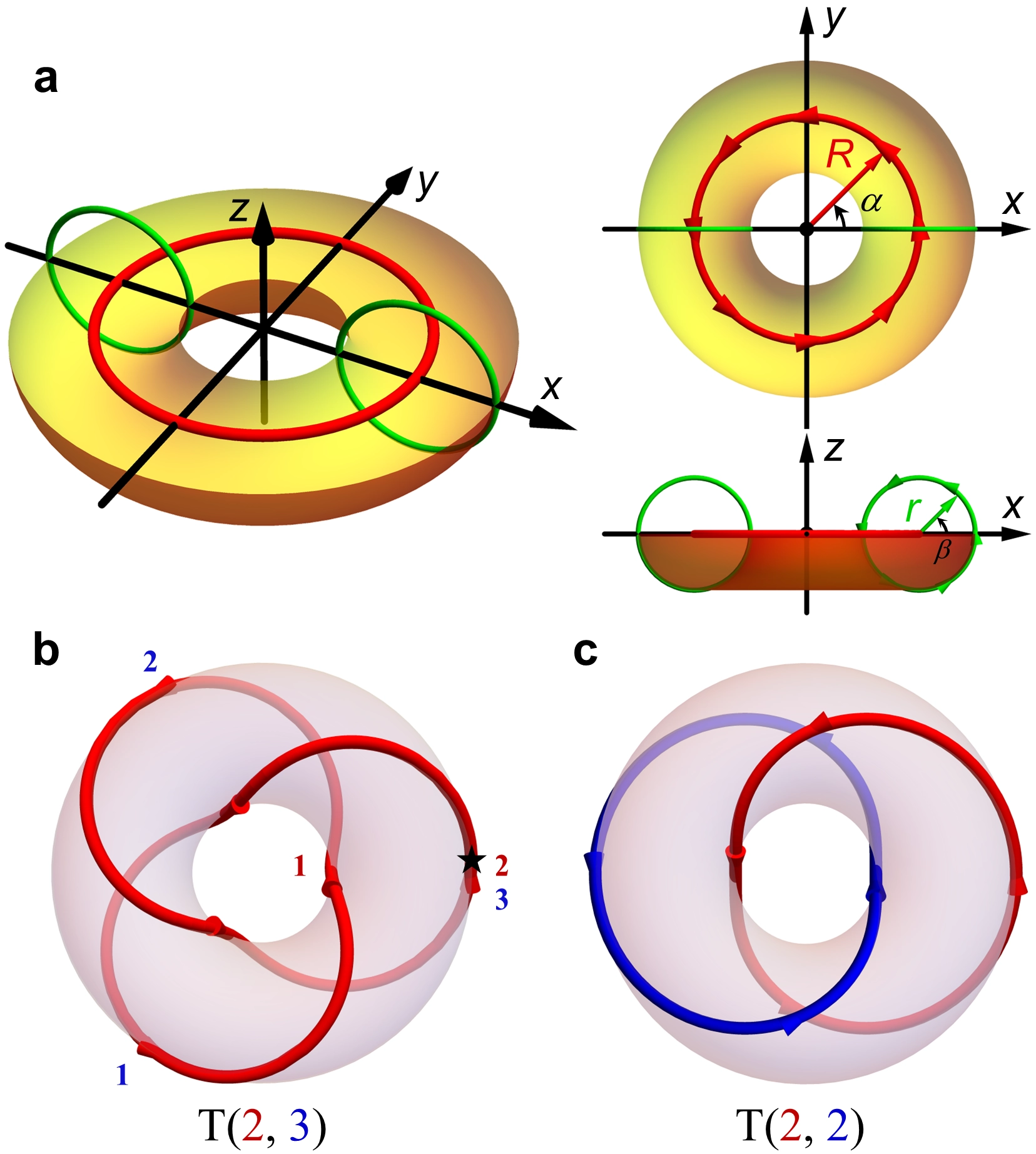
Figure 1. Schematic of the torus and torus topological structures. (a) Surface of the torus in different views. The core of the torus is represented by a red ring with radius R, which is a unknot. The x-y section of the torus shows the toroidal direction. The x-z section of the torus shows two green rings with radius r and the poloidal direction; (b) A trefoil knot T(2, 3) is shown as a single closed curve on the surface of a torus. Starting from the black dot and following the arrow, the curve winds two times in the toroidal direction (indicated by red numbers) and three times in the poloidal direction (indicated by blue numbers); (c) A Hopf link T(2, 2) with two components shown in red and blue. A collection of knots and links can be found at https://knotplot.com/.
Torus knots are defined as curves that lie on the surface of a torus. The parametric equation of torus knots T(m, n) can be determined by two winding numbers (m, n) and two angular coordinates
where m, n are positive integers,
2.2 Braided representation of knots
Topologically, any standard knot can be transformed into an equivalent braid-like structure without changing its crossings. The braided representation of a trefoil knot is shown in Figure 2a. One can imagine cutting the torus trefoil knot along the gray dashed line and then unwrapping the torus counterclockwise into a cylinder to obtain the corresponding braid (Figure 2b). Conversely, connecting an existing braided structure yields the corresponding knot (Figure 2c,d). This reversible transformation provides a key physical idea for designing optical knots[29,32]. The braid representation provides a powerful geometric and topological tool for describing knots. Mathematically, the braid group can be used to describe the geometric properties of braids with simple functions. Consider a braid with N strands, the braid group, denoted BN, is the group that involves N-1 generators
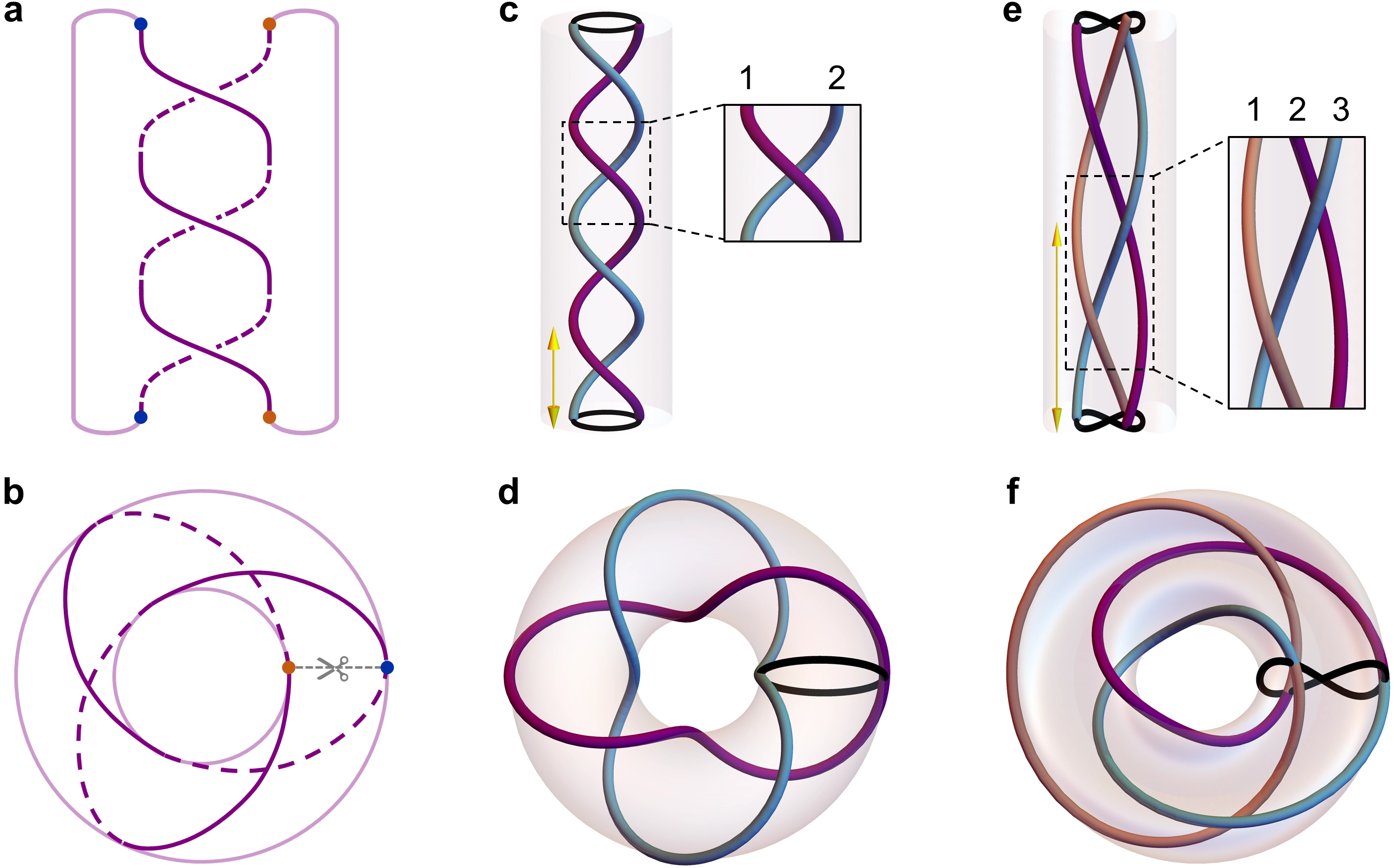
Figure 2. Braids drawn from knots. (a) Braided representation of a trefoil knot; (b) Corresponding knots with the same crossings in the top view, the solid lines indicate the curves are above the torus, and the dashed line indicate the curve are below the torus; (c) Braided representation of torus knots T(2, n) with circular projected trajectory; (d) A Solomon link formed by the closure of the braids shown in (c); (e) Braided representation of figure-eight knot family with lemniscate projection trajectory; (f) A figure-eight knot formed by the closure of the braids shown in (e).
In addition to the laconic braid words, the parametric equation of the braid is equally important. The torus knot T(m, n) can be unwrapped into an m-strand braid. In this representation, each strand traces a circular trajectory (Figure 2c), and the corresponding parametric equation can be given by:
where j = 0, 1, …, m-1. Another important family of knot is the figure-eight knot, compared with torus knots, the braid projection follows a lemniscate trajectory (a figure-eight or ∞-shaped curve), as shown in Figure 2e,f. The braid representation for the figure-eight knot family is obtained by modifying Eq. (3), specifically by including an additional factor in the y-component. The parametric equation is rewritten as
3. Knotted Spatial Light Fields
Embedding 3D topological structures into light extends beyond the modulation of the 2D profiles of light fields. The realization of topologically structured light often requires precise control of multiple DoFs of light fields, such as amplitude, phase, polarization, and frequency, etc. In recent years, many modulation methods have been developed for controlling structured light. Commonly used optical devices include liquid crystal spatial light modulators (LC-SLMs), digital micromirror devices (DMDs), photo-aligned liquid crystal devices, and recently developed metasurfaces, and others. These optical devices can also be used to generate topologically structured light, though with the requirement for more sophisticated modulation schemes. Due to their flexibility, tunability, and suitability for dynamic control, LC-SLMs and DMDs are more widely used in the experimental demonstration of topologically structured light. In comparison, processed LC devices and metasurfaces demonstrate advantages in high integration and in controlling more DoFs of the light field. In principle, the key to realizing topologically structured light lies in transforming mathematical topological structures into physical light fields and then mapping the latter onto the corresponding DoFs of light. Here we classify topologically structured light as amplitude-type, phase-type, and polarization-type according to the key property of light fields.
3.1 Amplitude-type optical knots
Amplitude-type optical knots are constructed by confining the amplitude or intensity to knotted 3D curves in real space. Conceptually, the bright spot of the light field acts as a pencil tip that traces out the underlying topological structure. Holographic beam shaping with a computer-generated hologram enables the engineering of complex light fields[33]. This design approach often requires iterative algorithms to solve complex inverse source problems of beam propagation. One of the non-iterative approaches, developed in coherent and monochromatic paraxial beams, allows designing the amplitude of the light to follow a 2D curve in the transverse plane[34,35]. This technique offers broad applicability, as it allows the amplitude trajectory to be defined by the parametric equations of the target topology. Further addition of a quadratic phase factor with a defocusing function can extend the method to 3D cases[35,36]. In Figure 3a, the intensity distribution of the beam is designed to follow a knotted curve, exhibiting different profiles in the focal and defocusing planes. Owing to its flexibility, this design method facilitates access to complex knots and links. Furthermore, by integrating it with advanced laser direct writing, one can store arrays of topological light fields carrying rich topological information in liquid crystal devices[15].
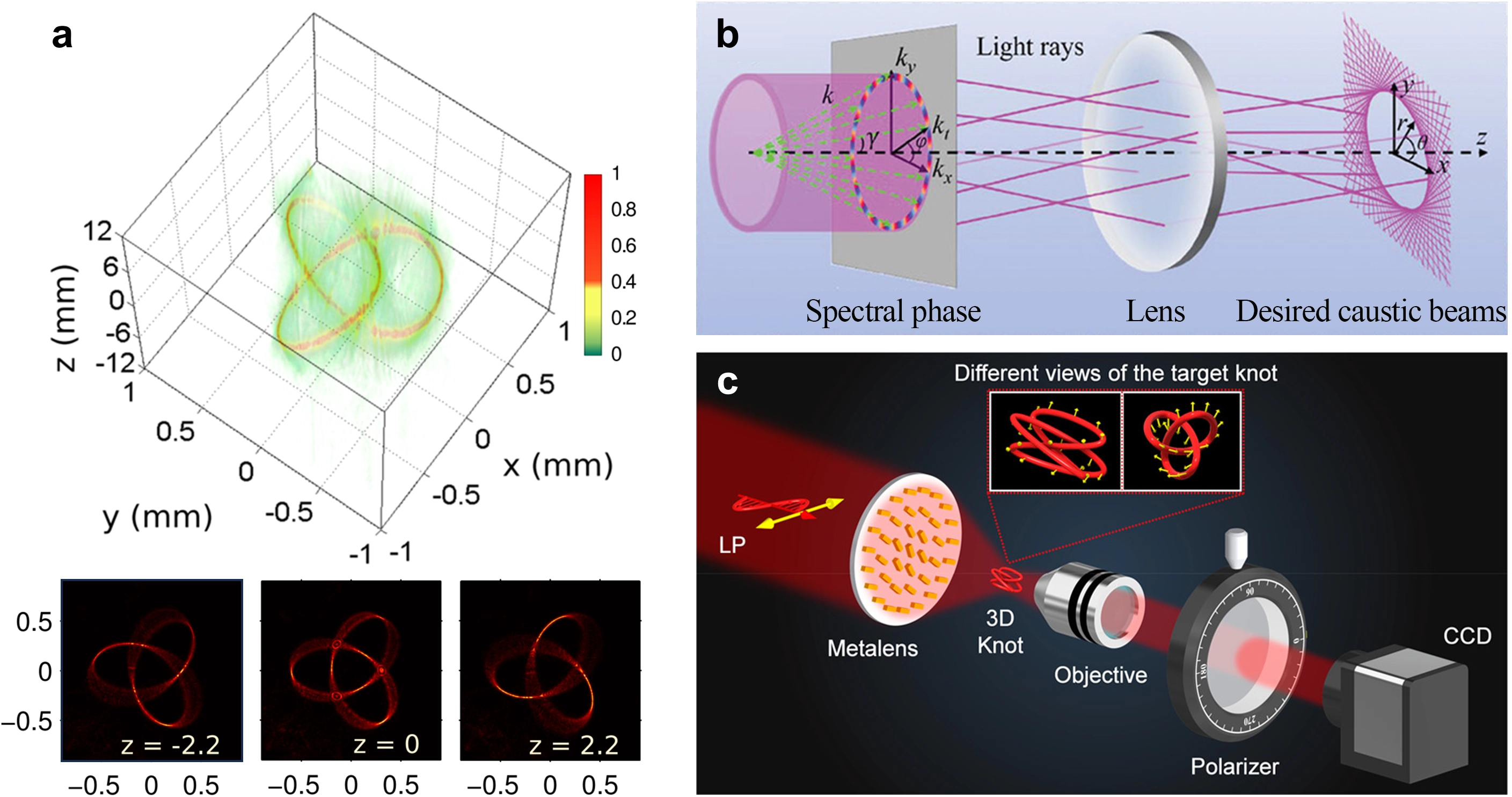
Figure 3. Knotted brightness in light. (a) An amplitude-type optical knot and the profiles in the focal and defocusing planes[35]; (b) Schematic diagram of the family of rays, showing the formation of circular bright rings by an annular phase in Fourier space. Republished with permission from[38]; (c) Controlling multiple focal points with a single metalens enables the creation of knotted bright lines in the vicinity of the focal plane. Republished with permission from[41]. LP: linearly polarized light; CCD: charge-coupled device.
In geometrical optics, light fields can be described by families of rays. The envelopes of these ray families correspond to optical caustics, where the light intensity diverges[37]. Consequently, optical caustics are also known as intensity singularities[38]. They manifest as bright points within the light field, offering a direct means to construct bright topological light fields. As shown in Figure 3b, an annular phase in Fourier space leads to a bright loop in the beam. An alternative approach uses metalenses for focal engineering[39]. These ultrathin, planar devices offer a compelling alternative to traditional bulky lenses. The designed metalens can focus incident linearly polarized light to distinct spatial focal points with predesigned polarization directions[40]. Figure 3c demonstrates a metalens that realizes a 3D knotted focal curve. This approach enables the generation of color-selective topological focal curves from a single metasurface by harnessing multispectral information[41,42]. It should be noted that the knotted focal curves are formed by discrete focal points, and the number of required focal points will increase with the complexity of the topological structures. Generally, the shaping of amplitude and phase with prescribed gradient of a beam in 3D volume is accompanied by active applications, especially in laser micro-machining and optical trapping[43,44].
3.2 Optical vortex knots and links
Over the past five decades, optical vortices carrying OAM have been extensively studied and have enabled diverse applications in various areas of advanced optics[23,45]. The optical vortex beam contains phase singularities, where the phase is mathematically undefined and typically associated with a helical wavefront. A 2π phase variation is observed along the azimuthal direction for the single vortex presented in Figure 4a. The vortex phase can be regarded as a topological structure defined by a quantized topological charge. This structure is analogous to the geometric paradox in M. C. Escher’s famous painting, which depicts stairs that appear to ascend or descend perpetually without end[46]. While such a structure cannot exist in real space, its geometry is nearly perfectly realized by the vortex phase. This is achieved by harnessing the intrinsic 2π periodicity of the phase, a property that is also fundamental for constructing optical vortex knots and links.
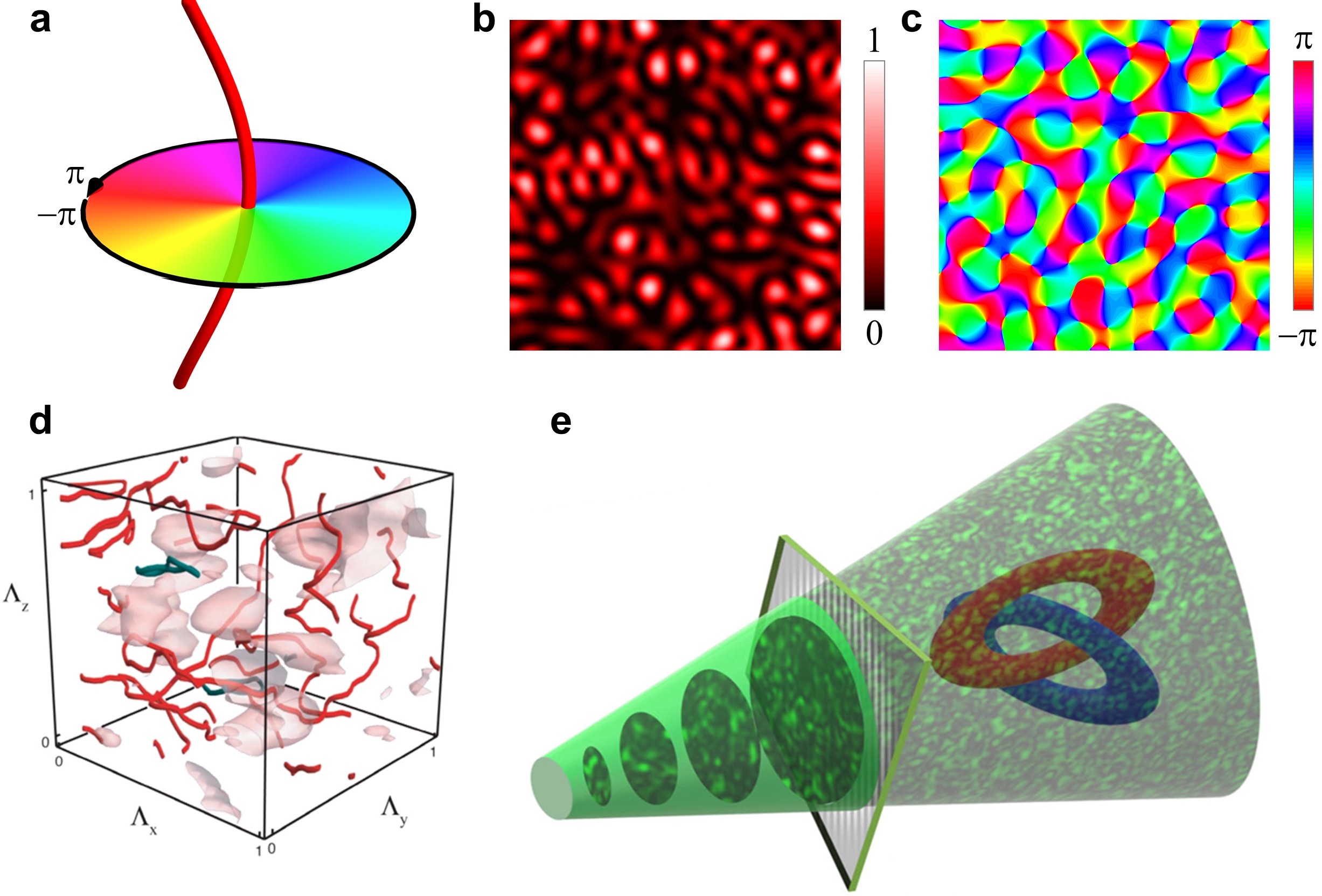
Figure 4. Knotted darkness in light. (a) 3D singularity line with vortex phase as cross section; (b) Intensity and (c) phase of a simulated random light field, computed by superposing 700 random plane waves; (d) 3D vortex structures in an experimental speckle field produced via ground-glass scattering. The open vortex lines are plotted in red and the closed vortex loops are plotted in green. Republished with permission from[49]; (e) Artificially controlled coherence singularities Hopf links in fluctuating speckled light[50,55].
Indeed, optical vortices are naturally observed in laser speckle[47]. They manifest as dark spots where the intensity vanishes, associated with phase singularities. Figure 4b,c show the amplitude and phase of a simulated random light field. For a 2D vortex, the phase singularity is a point. When extended into the full 3D space, the optical vortices will form singularity lines. As originally noted by J. F. Nye and M. V. Berry, optical vortices are natural curves embedded in 3D fields[48]. These optical vortices within the speckle fields can self-organize into topological structures by propagating in free space[49,50]. According to statistical properties, about 27% of vortex lines form closed loops, while the rest are infinite curves that percolate through the beam[49]. Figure 4d shows the 3D vortex structures within a speckle field, where closed vortex loops are plotted in green and separated vortex lines are plotted in red. These closed vortex loops can be threaded through by vortex lines or interconnect with other loops, giving rise to knotted or linked configurations[50]. These random behaviors exhibit universal parallels to fluid turbulence and cosmic strings[51,52]. The random light field possesses a well-defined complex amplitude distribution and is fully spatially coherent. It is worth noting that coherence is the fundamental property of a light field. In fluctuating speckled light, coherence singularities, defined as point pairs with zero degrees of coherence, can form stable topologies[53,54]. Unlike random topological structures, incoherent knots and links can be artificially controlled by manipulating the coherence structure of the light field (Figure 4e)[55].
Theoretical model. The construction of vortex topologies with prescribed spatial position and topological configuration has become an important topic in singular optics[28]. M. V. Berry and M. R. Dennis first proposed the question of whether wavefront dislocations (phase singularities) can be knotted or linked[56]. Theoretically, this translates into finding exact solutions of the Helmholtz equation that support knotted or linked phase singularities. As illustrated in Figure 1, torus knots and links are well defined in toroidal coordinates. To construct a torus vortex knot or link, the fundamental topological elements are toroidal vortices and axial vortex lines, which supply the required phase in the poloidal and toroidal direction, respectively (Figure 5a). The approach proposed by M. V. Berry and M. R. Dennis capitalizes on the instability of higher-order vortex structures. As illustrated in Figure 5b, the vortex topological structure consists of m-order toroidal vortices and n-order straight vortex line. Under perturbation, the higher-order structure decomposes into stable vortex loops that are threaded by n vortex lines. Such topological configurations were theoretically constructed in superpositions of Bessel beams[56]. Here, vortex rings and axial lines are coupled together, such that the knotted or linked vortex loops are not isolated.
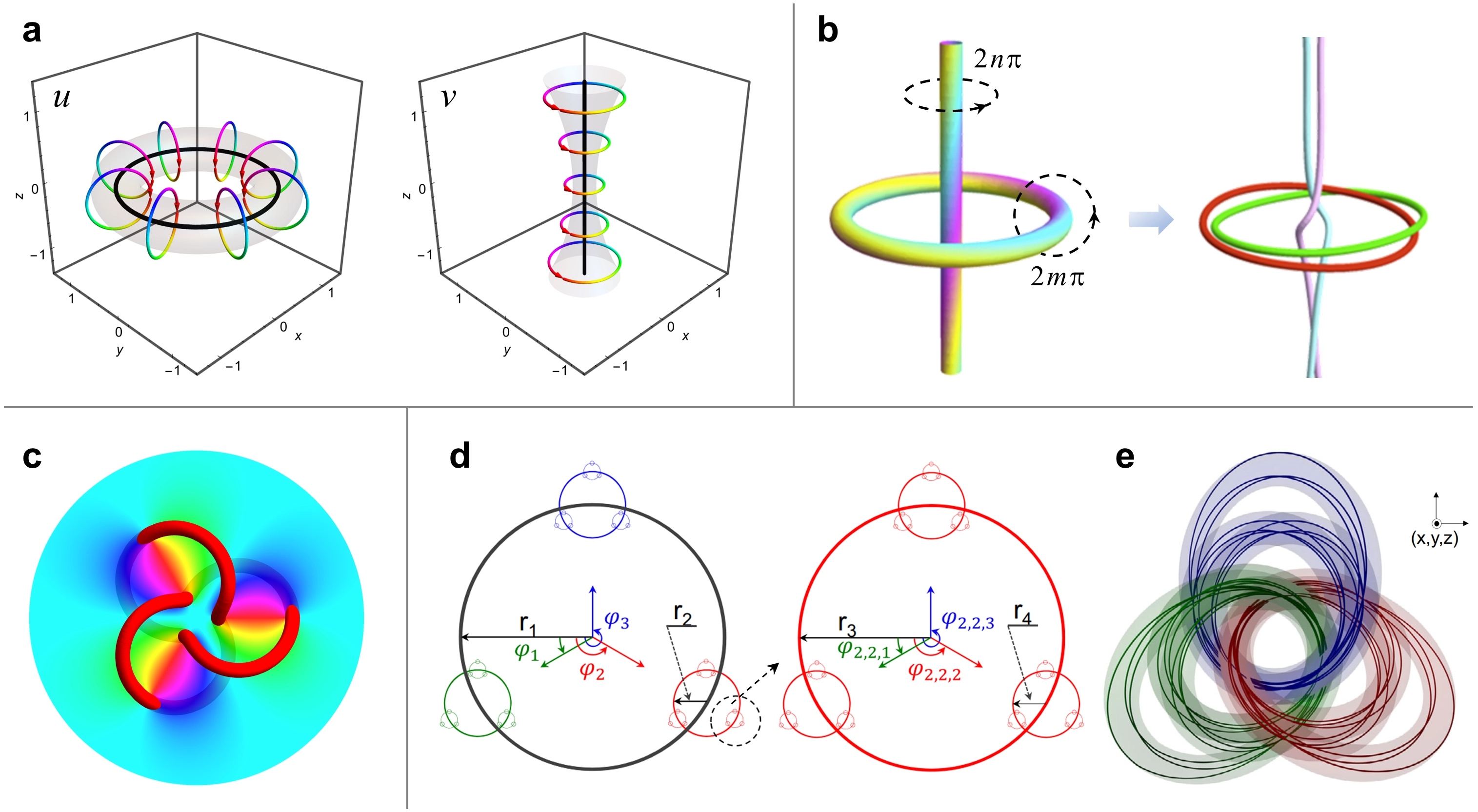
Figure 5. Theoretical model of vortex knots and links. (a) Topologies of stereographic projection: the complex function u contains a vortex ring, while v contains a vortex line[60]; (b) Unfolding higher-order vortex structures to a torus link threaded by two vortex lines. Republished with permission from[28]; (c) Isolated trefoil vortex knot arising from a 3D scalar complex field; (d) Fractal-like braids, each colored circle represents a sub-cylinder that itself contains braided zeros[58]; (e) Nested vortex knots arising from the fractal-like braids[58].
Isolated optical vortex knots can be constructed using algebraic topology, with stable single-charged vortices as the fundamental building blocks[29]. Based on the mapping relationship between knots and braids, vortex knots can be constructed by jointing the ends of vortex braids. This physical process can be perfectly realized using complex space and stereographic projection. As shown in Figure 2c,e, the periodic vortex braids correspond to the roots of a polynomial in the complex variable u. To differentiate the complex space from real space, the variable h specifies the distance between parallel planes in complex space. For an N-strand braid, it can be expressed as:
where sj(h) = x(h) + iy(h) represents distinct points in the complex plane, x(h) and y(h) are trigonometric parametric equations. Another key step is to use exponential functions v = eih to simplify the trigonometric functions, and the resulting polynomial may be rewritten as q(u, v) with complex variables u and v. The periodicity of v ensures that the two ends of the vortex braid are joined to form the corresponding vortex knots and links. For a torus knot T(2, n), the complex polynomials can be simplified to q(u, v) = u2 - vn[57], an example of a trefoil vortex knot with its phase profile at z = 0 is shown in Figure 5c. This model can be extended to more complex vortex topologies known as nested vortex knots, which incorporate hierarchical knot structures[58]. In Figure 2d, the colored tubes within the cylinder represent vortex lines. If each colored tube is replaced by a sub-cylinder that itself contains braided zeros, the resulting hierarchical structure forms fractal-like vortex braids and nested vortex knots, as shown in Figure 5d,e.
The complex function q(u, v) contains knotted and linked zeros, however, it is a mathematical solution that exists in complex space. The two complex variables parameterize a 4D real space. A stereographic projection is thus required to establish a connection with 3D physical space, while preserving the topological properties. In cylindrical coordinates, one type of projection can be defined as follows[59].
In fact, the projection functions have inherent topological structures. As shown in Figure 5a, the zero set of function u has a unit circle or vortex ring centered at the origin of the coordinate, while the complex function v has vortex phase along the z direction[60]. For arbitrary torus knots T(m, n), the zero set of polynomials
Experimental generation. To experimentally generate optical vortex knots, the mathematical solutions must be converted into physically realizable solutions that satisfy the wave equation. In M. V. Berry and M. R. Dennis’s model, the Bessel beam is chosen as the basis mode for constructing optical vortex knots[56]. However, the construction fails experimentally because the vortex knot is immersed in low-contrast darkness, making its topology difficult to detect and verify. Another important class of paraxial beams is the Laguerre-Gaussian (LG) beam, which has been used as a complete orthogonal basis for generating optical vortex knots[62]. To satisfy the paraxial equation, the Milnor polynomial (with its knotted zeros) needs to be modified by paraxial polynomials, which are a family of polynomial solutions to the paraxial equation[63]. For example, the term
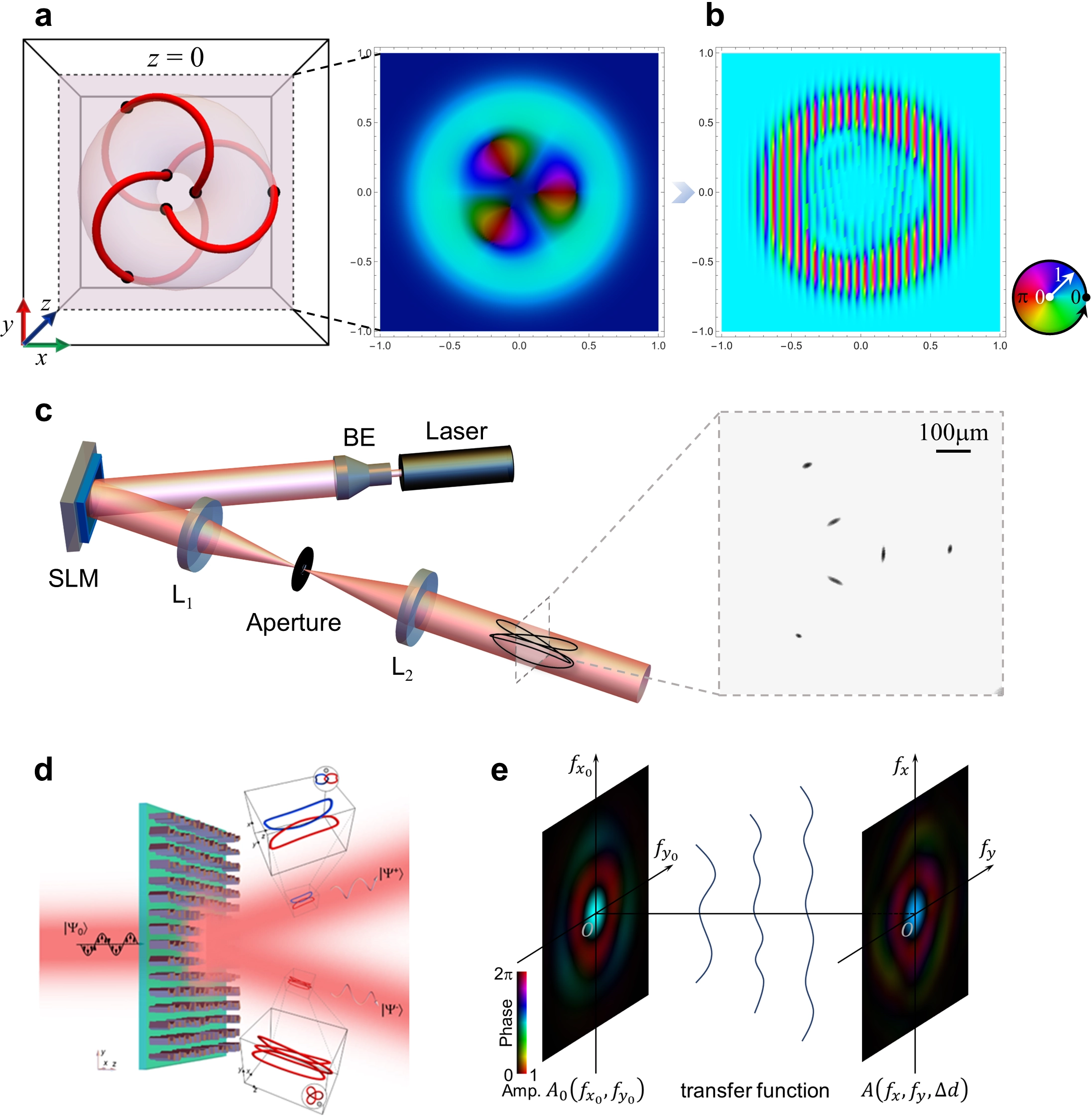
Figure 6. Experimental generation and observation of optical vortex knots. (a) Experimental scheme for generating an optical vortex knot: the 3D topology is flattened into a 2D complex amplitude profile; (b) Phase-only pattern for control amplitude and phase of light; (c) Experimental setup; (d) Polarization-switchable optical vortex knots via metasurface. Republished with permission from[74]; (e) 3D reconstruction scheme based on digital holography. Republished with permission from[80]. BE: beam expander.
The computer-controlled SLM is programmable and dynamically tunable, allowing for experimental parameter adjustment and, more importantly, enabling the experimental simulation of dynamic processes such as untying the knots[4,5]. In fluids, complex vortex knots evolve toward simpler vortex loops and ultimately dissipate, accompanied by the vortex reconnection[68,69]. The optical vortex knot can demonstrate an untying-like phenomenon, and exhibit the reconnection mechanisms related to the vortex topology[57]. From the source of the vortex, the linear superposition of an optical vortex knot can be divided into two components with non-zero and zero OAM, which established the mapping between the torus knots/links and the integer topological charge of the optical vortex. The intermediate state between the vortex knot and link is determined by the fractional topological charge[70]. In recent years, the rapid development of geometric phase elements and metasurfaces provided a new opportunity for topologically structured light fields[71]. Optical vortex knots can be generated by geometric phase liquid crystal plates and metasurfaces[72,73]. The latter can greatly compress the spatial scale of optical vortex knots, and have more than 60% efficiency within a broad spectral region. By combining geometric phase with propagation phase, different vortex topologies can be generated and switched in two polarization channels[74] (Figure 6d).
Experimental observation. Experimentally observing the topological properties of light fields relies fundamentally on techniques for imaging and reconstructing their 3D structure. For optical vortex knots, a widely used method is to detect the dark cores associated with phase singularities, allowing for rapid identification[64,73,75]. An example of the singularities profile obtained by an intensity supersaturation method is presented in Figure 6c. However, the method is ineffective for singularities in proximity due to non-uniform background intensity[76]. To improve the accuracy of singularity localization, methods based on off-axis interference have been proposed. Here, phase singularities are extracted from reconstructed, pixelated phase profiles[67,76,77]. In contrast to off-axis setups, common-path interferometric configurations offer greater measurement stability[78]. To reconstruct the topological structure in a 3D volume, it is necessary to obtain the full information of the light fields. One of the methods is to measure the singularity position of multiple transverse planes by tomographic-like spatial scanning[64,76]. Hundreds of measurements are typically required to resolve the details of the topology. This time-consuming process limits the measurement speed and hinders the study of dynamic phenomena[79]. Single-shot measurement and reconstruction via digital holography eliminates complex operations and enables dynamic measurements[80]. The profiles of the light field in different planes can be determined by angular spectrum theory[81,82] (Figure 6e). A digital hologram stores the complex amplitude information of the 3D light field, which can be fully reconstructed through a digital process.
3.3 Polarization knots and Möbius strips
Generally, the scalar light field is a particular instance of the vector light field[83]. Therefore, topological vortex light fields can be naturally extended to vector light fields. Analogous to vortex topologies in scalar speckle, polarization topologies also emerge within 3D random vector light fields[84]. Artificially, optical vortex knots can serve as a framework for constructing optical polarization knots[30]. For a beam propagating along the z direction, the electric field vector generally executes an elliptical trajectory in the transverse plane, and the polarization ellipse is fully governed by its ellipticity and orientation[28]. C-points are polarization singularities of circular polarization where the orientation of the polarization ellipse is undefined. Vector beams with embedded polarization singularities can be generated by superposing structured optical modes with orthogonal polarizations. The complex amplitude profiles of the polarization components determine the resulting polarization topologies. Knotted C-lines can be produced by superposing circularly polarized vortex knots with an oppositely polarized Gaussian beam, as shown in Figure 7a. This scheme works for other orthogonal bases such as linear polarization. Topology governs the global structure of a 3D light field. Beyond polarization singularity lines, surfaces of constant polarization orientation also contain topological information. The surface is a Seifert surface of genus (a topological invariant counting the surface’s holes), and its boundary forms the original knot[85]. This property offers a powerful means to observe the polarization topology.
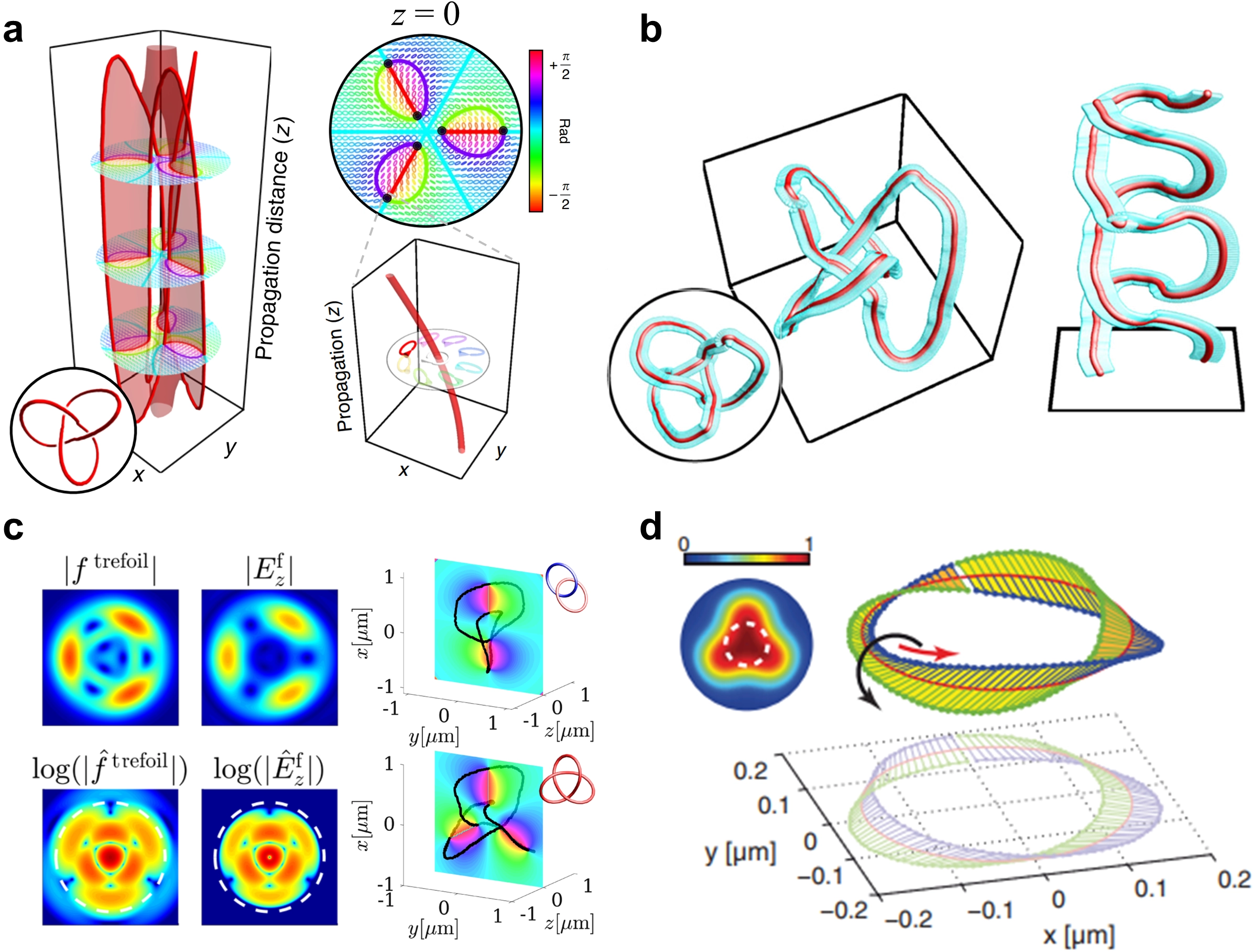
Figure 7. Polarization topological structures. (a) Schematic of optical polarization knots with polarization singularity in the transverse profile. Republished with permission from[30]; (b) Experimentally generated optical-framed knot and the unwrapped strip[16]; (c) Knotted and linked topologies sculptured in the longitudinal component of light. Republished with permission from[88]; (d) Optical polarization Möbius strip. Republished with permission from[31].
In addition to knotted singularity lines and polarization Seifert surfaces, the ribbon-like polarization structures can be woven into the global vector field[16]. Since the orientation of the polarization ellipse is undefined at a C-point, there are polarization ellipses with arbitrary orientation around it. Along the knotted C-lines, the orientation of the polarization is extracted by taking the cross product between the gradient of the knot’s coordinates and the normal vector of the C-line’s oscillation plane. The resulting topology is a knotted ribbon. Through inverse stereographic projection, the corresponding optical framed knot is converted into a braided strip (Figure 7b). The polarization-induced twisting angle, which encodes the knot’s topological invariant, is robust under experimental conditions. Consequently, it serves as a candidate for robust information encoding[16,58,86].
The vector light field possesses unique physical properties, such as the longitudinal polarization component, which typically arises in tightly focused beams[87]. The longitudinal component offers a DoF for independently controlling topological configurations. Fourier-domain synthesis enables the creation of longitudinal vortex knots and links in non-paraxial propagating subwavelength beams (Figure 7c)[88]. Nevertheless, their experimental realization remains challenging. Comparatively, experimental observation of vortex knots at the wavelength scale has been achieved within the transverse polarization of light fields[89,90]. As an alternative, the longitudinal field component under paraxial conditions can be customized and effectively utilized, even though it is weak[86]. Another notable polarization topology is the polarization Möbius strip[31]. Mathematically, the Möbius strip, named after August Ferdinand Möbius, is a 3D geometric structure with non-orientable properties. One can easily form such a structure by twisting and joining a strip of paper. The properties of the polarization Möbius strip are observed as a circular structure in the focal plane. Along this circle, the ellipse orientations trace a Möbius strip, corresponding to a continuous 180° rotation, as shown in Figure 7d. The twists number of polarization Möbius strip is controlled by the polarization topological charge of the incident beam[91].
3.4 Knotted topologies in polychromatic field
The topological light fields discussed above exist in monochromatic light, leaving aside the frequency degree of freedom. The superposition of multiple frequency components leads to an intricate vectorial behavior of light. However, if a polychromatic field is composed of only a few coherent components with commensurable frequencies and polarizations, the synthesized light field can exhibit topological properties. For example, the superposition of a right-handed circularly polarized beam with its second harmonic of left-handed circularly polarized light produces a trefoil-shaped polarization[92,93]. The tip of the electric field vector traces out a Lissajous figure, as shown in Figure 8a. By assigning different OAM to the two polarization components, the resulting light field produces Lissajous distributions. Analogous to polarization singularities, the Lissajous singularities here represent points where the orientation of the Lissajous figure is undefined[94] (Figure 8b). The polarization Lissajous figure possesses intrinsic rotational symmetry, and its orientation is determined by the relative phase between its two components. As shown in Figure 8c, the azimuthal rotation of polarization around a Lissajous singularity carries the topological information of the two components. To get the topology of the field, the planar polarization pattern is rearranged onto a 3D helical geometry. Connecting the two ends of this structure yields a closed topological structure where the tips of the trefoil-shaped polarization are synthesized into a torus knot[95], as shown in Figure 8d. While the paraxial trefoil-shaped polarization is a 2D structure, its 3D knotted counterpart is synthesized via the superposition of three frequency-distinct polarization components (Figure 8e)[96,97]. The experimental realization of 3D knotted polarizations remains a key challenge. Trefoil-polarized optical pulses have shown great potential for light-matter interactions and ultrafast processes[98]. Furthermore, their intrinsic symmetry and topological properties can directly influence material responses[99,100].
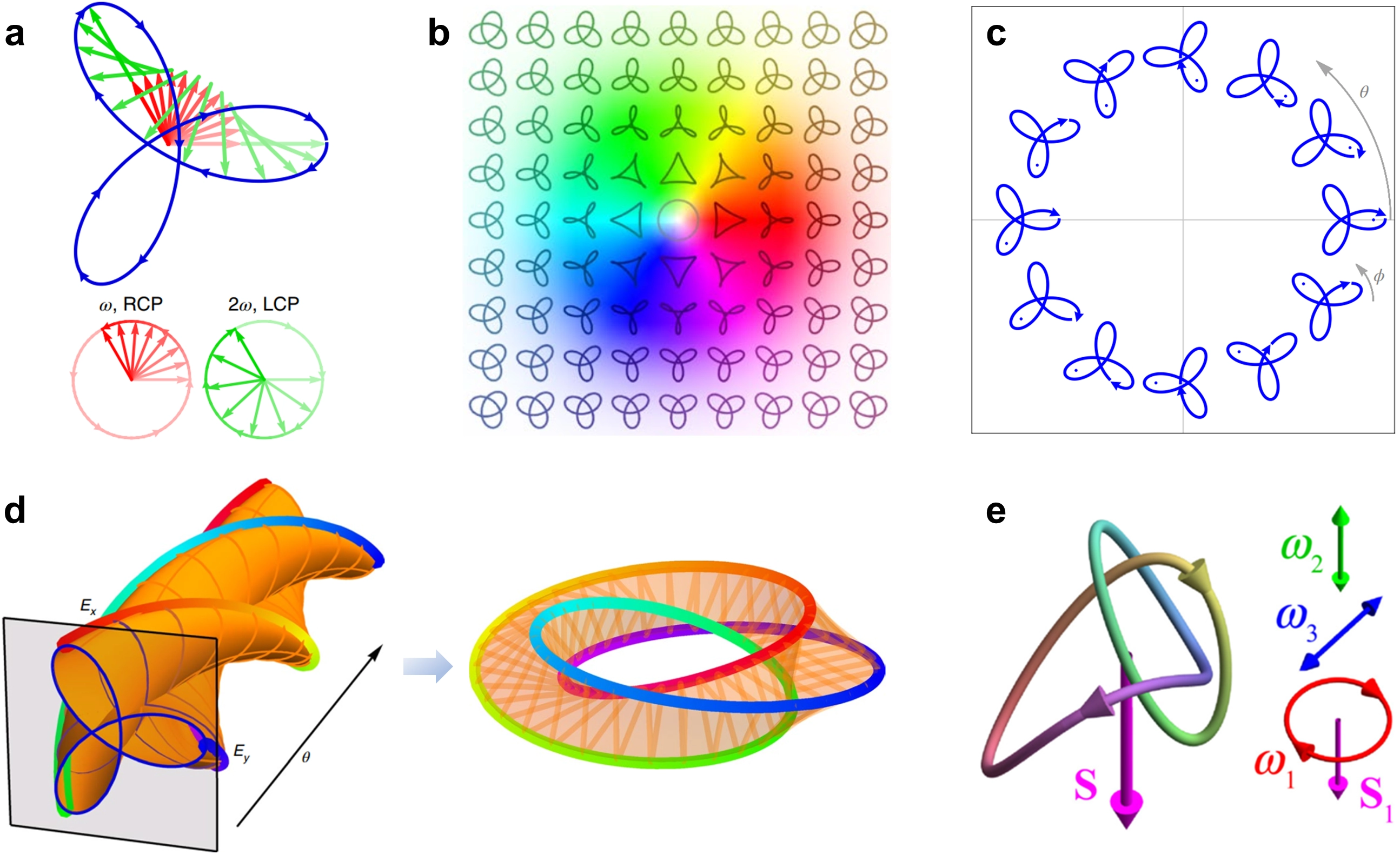
Figure 8. Polarization topologies of polychromatic field. (a) Bicircular trefoil-shaped Lissajous figure. Republished with permission from[95]; (b) Polarization profile constructed by the spin and orbital angular momentum of the two-color light. Republished with permission from[95]; (c) Polarization Lissajous figures exhibit azimuthal rotational symmetry. Republished with permission from[95]; (d) Topological structure synthesized by Lissajous polarization. Republished with permission from[95]; (e) 3D knotted polarization in the polychromatic field[96]. LCP: left-handed circularly polarized light; RCP: right-handed circularly polarized light.
4. Toroidal Spatiotemporal Light Fields
Spatiotemporal wavepackets represent a new class of optical pulses that feature a tailored coupling between spatial and temporal degrees of freedom[26,101]. The rich physical and topological properties arising from spatio-temporal coupling offer new opportunities to control light, making this a rapidly expanding frontier in optics[27,102]. The spatiotemporal optical vortex (STOV) is a typical example that exhibits unique physical properties. Conventional optical vortices are characterized by longitudinal OAM parallel to the wavevector, while the STOV features transverse OAM[103]. The experimental realization of controllable STOVs using a
In the construction of a spatial vortex knot, the complex vortex braids are closed to form vortex knots via the mathematical mapping function. This physical process can be realized with optical mapping and utilized to construct spatiotemporal toroidal vortices (vortex rings)[32]. As shown in Figure 9a, the vortex tube is continuously bent to form a toroidal geometry by conformal mapping. In optics, conformal mapping is essential for realizing sophisticated coordinate transformations, facilitating the design and analysis of complex optical geometries[112,113]. In OAM sorting, conformal mapping is used to transform the azimuthal phase of a vortex beam into a gradient phase, the latter maps each topological charge to a unique focus[114]. The spatiotemporal toroidal vortices are generated using the inverse process in the spatial domain (Figure 9b). By employing inverse spiral mapping[115], the symmetrical toroidal vortices are extended to photon conches with chirality[116]. Light pulses featuring toroidal topologies in their vector field lines (electric or magnetic) have likewise been demonstrated (Figure 9c). These pulses are propagating counterparts of localized toroidal dipole excitations in matter, exhibiting unique properties such as non-transversal, space-time non-separable, and single cycle[117-119]. Hybrid electromagnetic toroidal vortices generated by a compact coaxial horn emitter augmented with a radial metasurface integrate both scalar and vector toroidal vortices[120,121], as shown in Figure 9d. Toroidal light pulses can be generalized to higher-order cases to form supertoroidal light pulses with layers of nested vortex rings[122]. These electromagnetic fields have the topological properties of multiple singularity structure, fractal-like distributions of energy backflow[123]. The coupling of spatiotemporal toroidal vortices and spatial vortex can lead to other toroidal topologies as well as nontrivial dispersive dynamics. Inside the torus surface, toroidal vortices mediated by longitudinal vortices give rise to twisted phase strips, or even Möbius strips[124,125], as shown in Figure 9e,f. The propagation dynamics of these higher-order solutions involve vortex reconnection and regeneration, leading to the formation of robust toroidal vortices[126]. In addition to the toroidal topologies, braided structures may also be constructed in spatiotemporal coupled light[127], which have counterparts in spatial light[128]. These pulses of light could be the basis for more complex space-time structures.
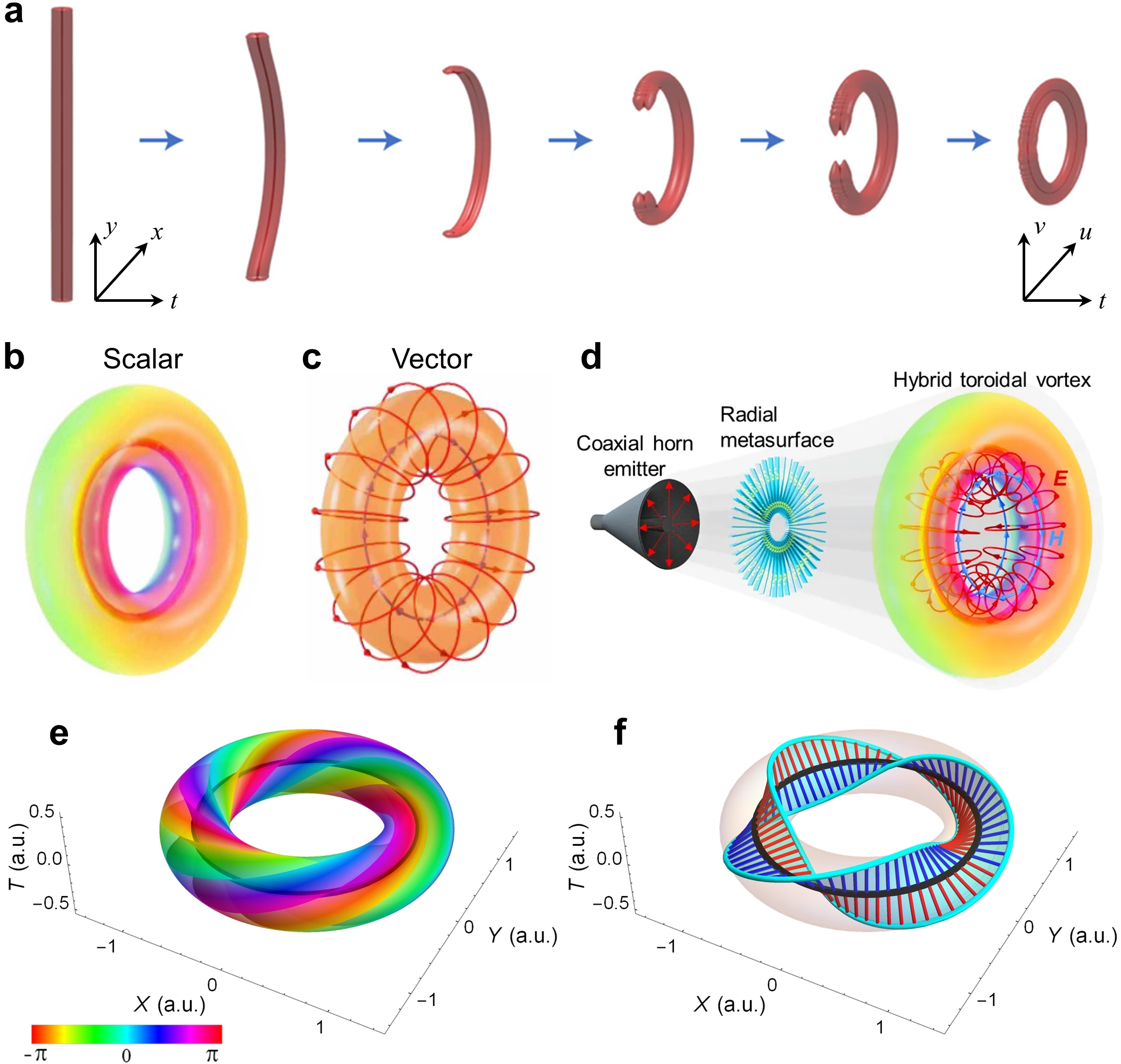
Figure 9. Toroidal spatiotemporal structures of light. (a) Conformal mapping transforms a spatiotemporal vortex tube to a vortex ring[32]; (b) Phase structure of scalar toroidal vortices[120]; (c) Vector vortex ring formed by the electromagnetic field vector[120]; (d) Radially polarized pulse is transformed to hybrid electromagnetic toroidal vortices[120]; (e) 3D equiphase surfaces within the torus surface of toroidal vortices. Republished with permission from[124]; (f) Isolated phase Möbius strips with knotted boundary. Republished with permission from[124].
5. Particle-Like Topologies in Propagating Light
Topologically, torus knot originates from the complex hypersphere[61], the latter is a unit sphere in 4D real space, also known as the 3-sphere (S3). To study the topology of S3, Heinz Hopf introduced a continuous mapping from S3 to S2, which is now named Hopf fibration[129]. The concept of the Hopf fibration can be explained by the rotation of a 3D unit vector. In fact, the rotation in 3D space can be specified by a quaternion[130]. A point on the 3-sphere (S3) corresponds to a unit quaternion
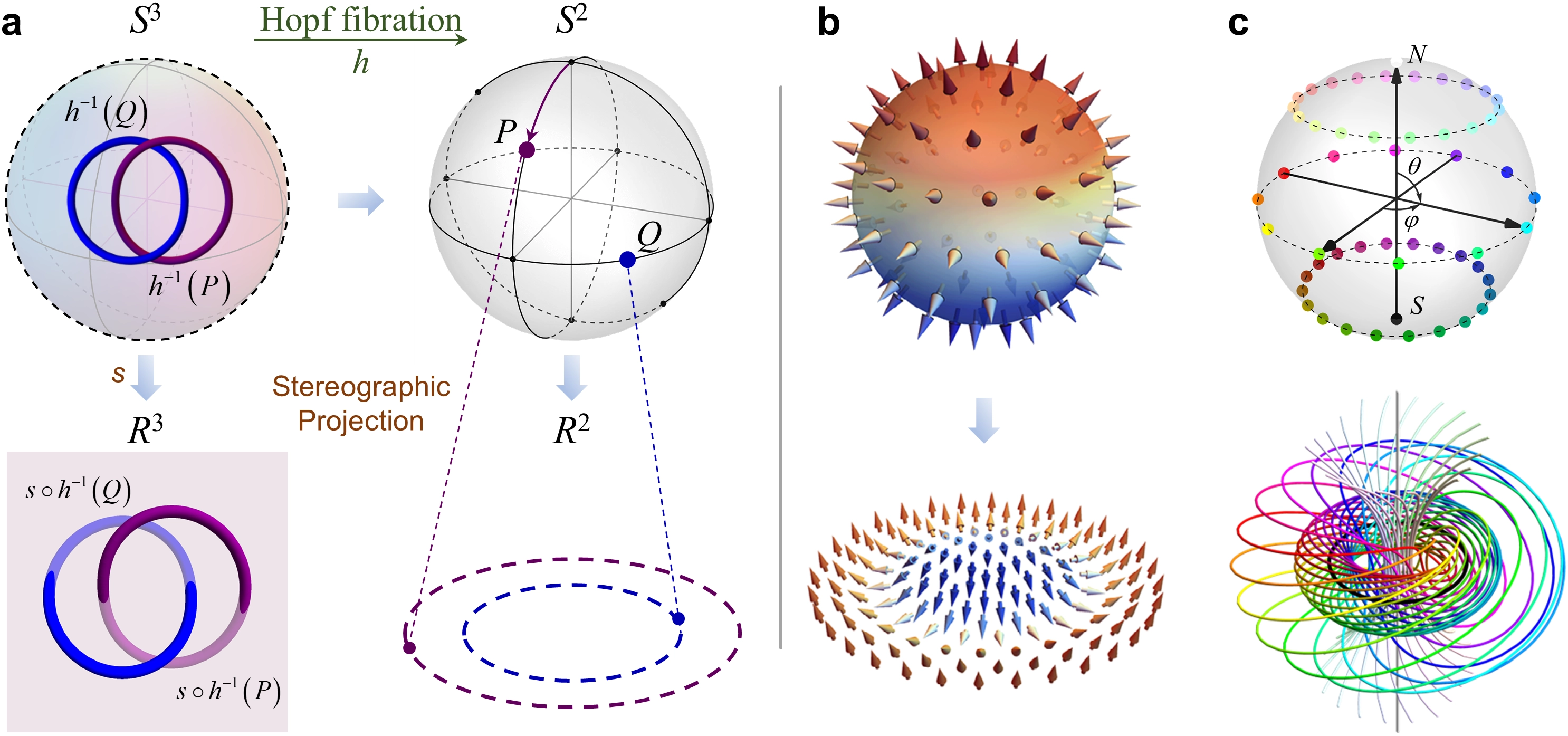
Figure 10. Hopf fibration and particle-like topological textures. (a) Hopf fibration connects the 3-sphere and the 2-sphere. The preimage of a point on S2 is a closed loop in S3. The stereographic projection maps the topology of a sphere to a lower-dimensional space for visualization; (b) Hedgehog-like vector textures are mapped to a skyrmionic texture[143]; (c) Visualization of Hopf fibration: the preimage of the north pole maps to an infinitely extending line (white), and the preimage of the south pole maps to a closed ring (black). The points with the same latitude but different longitude on the 2-sphere are mapped to a torus.
In the Hopf fibration, the 2-sphere (S2) plays a critical role. In optics, the Poincaré sphere is a canonical example of S2, on which each point corresponds to a specified polarization state. In a propagating vector beam, each polarization states can be described by a polarization ellipse or characterized by its normalized Stokes parameters S1, S2, S3[131]. The normalized Stokes parameters define a 3D unit vector. This results in a hedgehog-like configuration on the Poincaré sphere, with all vectors emanating radially from the center, as illustrated in Figure 10b. These unit vectors can be mapped onto a 2D plane via stereographic projection, yielding a skyrmionic texture (so-called baby skyrmions)[132]. Motivated by knotted vortex atom hypothesis[7], Tony Skyrme proposed a model of localized solitons to represent the topological structures of nucleons in 1961[133]. Now, particle-like continuous fields in 3D space with analogue of Skyrme solitons are called skyrmions. Skyrmionic topological textures have been studied in various systems, including magnetic systems[134], cold quantum matter[135,136] and liquid crystals[137]. Optical skyrmionic configurations can be realized with various 3D optical vectors, such as the electric field vector[138], Stokes vector[132], spin angular momentum[139], pseudospin and so on[140,141]. The research on the topology of photonic skyrmions opens a new chapter in modern optics[142,143].
The stereographic projection of S2 onto a 2D plane can be understood as unwrapping the sphere from a chosen point, and without loss of generality, we restrict the stereographic projection to S2\(0, 0, 1)→R2. The north pole (0, 0, 1) of the S2 is mapped to infinity, thus it can be considered as a singularity. For the stereographic projection S3→R3, we also focus on the mapping of the poles of S2. As shown in Figure 10c, the preimage of the north pole is mapped to an infinitely extending line
6. Conclusion and Outlook
Knotted topological structures have garnered considerable interest in the field of structured light. Topological structures embed invariant properties into light fields, governing their global behavior. Based on the key DoFs of structured light and knot theory, we provided a comprehensive review of the recent progress in topologically structured light. The inherent robustness of topological light fields makes them ideal candidates for applications in information encoding and storage[15,16,58]. Powered by neuromorphic vision, knotted vortex fields can serve as effective information carriers for high-throughput optical signal processing[151]. Topological invariants of structured light, as a medium for information, are applicable to both classical and quantum systems. Knotted vortices and optical skyrmions have been realized in quantum systems, offering a promising avenue for topologically protected quantum information[152,153]. More importantly, the universal topological properties and design frameworks can be applied and extended to other physical fields, such as sound waves and water waves[154-156]. Infused with new capabilities from spatiotemporally coupled fields, topological light fields demonstrate considerable potential in light-matter interactions[99,100,157,158]. Furthermore, spatiotemporal wavepackets demonstrate significant potential for applications in optical analog computation[159].
While topology provides novel perspectives and degrees of freedom for structured light, it is still an emerging research area with plenty of opportunities and challenges. The current model of paraxial optical vortex knots is applicable to any type of knots mathematically, but only a few can be realized experimentally. The generation of higher-order knotted topologies will expand the set of optical topological invariants, enriching the fundamental toolkit. The experimental solution of complex vortex knots incorporates numerous vortex lines, and it needs to be further optimized to prevent the interaction of singularities in spatial evolution[29,65]. The rapid development of artificial intelligence and its integration into physics, supported by powerful computational resources and algorithms, will facilitate the design and identification of higher-order knotted vortex topologies[160]. The need for generalized higher-order solutions also exists for optical hopfions. To address this, one promising approach is to synthesize them from existing vortex knots, beyond simply seeking higher-order vortex rings. Building on the framework of the Hopf fibration, topological light fields offer a platform for exploring the topology of higher-dimensional hyperspheres. In parallel, the spatiotemporal light field has enough controllable DoFs, thus theoretically it can support a zoo of topology. For example, the abundant topological properties of supertoroidal pulses have been predicted theoretically[122,123,161]. With the increasing maturity of on-demand spatiotemporal wave packets generation, the generalized supertoroidal vortices and the knotted spatiotemporal light fields may become readily accessible.
Topological protection and stability remain important topics for topologically structured light[162]. In addition to helping to explain fundamental properties, topological stability in complex environments is of great significance for applications such as optical communication and optical computing[159,163,164]. Optical vortex knots are robust against typical disturbances in optical experiments, such as misalignment, phase aberrations, and even local phase discontinuities[57,165]. In actual atmospheric turbulence, the topological invariant of optical vortex knots can be preserved in the weak turbulence regime but may not be conserved in the stronger turbulence conditions[79]. Moreover, the coherence of light should also be considered in the context of topological stability[55]. Beyond traditional strategies for extracting and calculating topological invariants, more generalized frameworks for handling complex perturbations need to be developed[163]. On the other hand, perturbations are not always negative and offer a valuable opportunity to investigate the topological evolution of knotted and linked light fields, including untying and cascading[5,166,167].
To apply topological light fields in light-matter interactions, the beam size is an important factor that must be considered. The larger aspect ratio of paraxial optical vortex topologies will affect its imprint into material systems[168]. Metasurface based light field generation scheme can compress the transverse scale of the beam, and the longitudinal transmission distance can be optimized by changing the mode coefficient in the paraxial case[169]. Non-paraxial tightly focused condition can be explored to localize the topologies near the wavelength scale[90]. While the spatiotemporal tightly focused property has been numerically considered[170], it has not been realized experimentally due to the complex spatiotemporal coupling, which poses challenges for experimental observation and modulation methods. It is urgent to develop new characterization methods capable of measuring these complex topological structures within the wavelength scale. Direct and full characterization is critical to explore more topological structured light fields and their properties.
As we emphasized, topological structures are ubiquitous among different physical fields. Thus, topologies may act as a bridging concept for light-matter interaction studies. Knotted and other topological structures are also found in different forms of matter, notably in liquid crystals[137,171], where a host of topological structures such as torons, hopfions, heliknotons are generated by structured light. Conversely, liquid crystal topological solitons and array structures may enable new ways to control the behavior of light and provide opportunities for engineering knots of light beams[172]. More importantly, interactions between optical and material topological solitons lead to novel effects and phenomena[13]. The interplay between the topologically structured light and topological matters may excite the exchange of their topological properties and enable further developments in innovative photonic technologies and new materials.
Authors contribution
Zhong J: Conceptualization, writing-original draft, writing-review & editing.
Liu S, Zhao J, Zhan Q: Writing-original draft, writing-review & editing.
Conflicts of interest
Jianlin Zhao is an Associate Editor, and Qiwen Zhan is the Advisory Editor-in-Chief of Light Manipulation and Applications. The other authors declare no conflicts of interest.
Ethical approval
Not applicable.
Consent to participate
Not applicable.
Consent for publication
Not applicable.
Availability of data and materials
Not applicable.
Funding
This work was supported by the National Key Research and Development Program of China (Grant Nos. 2025YFF0515101 and 2022YFA1404800), the National Natural Science Foundation of China (NSFC) (Grant Nos. 12434012, 62535013, 12304367 and 12474338), and the Shanghai Rising-Star Program (Grant No. 23YF1415800).
Copyright
© The Author(s) 2026.
References
-
1. Kauffman LH. Knots and physics. Singapore: World Scientific Publishing; 2001.[DOI]
-
2. Faddeev L, Niemi AJ. Stable knot-like structures in classical field theory. Nature. 1997;387(6628):58-61.[DOI]
-
3. Manton N, Sutcliffe P. Topological solitons. Cambridge: Cambridge University Press; 2004.[DOI]
-
4. Kleckner D, Irvine WTM. Creation and dynamics of knotted vortices. Nat Phys. 2013;9(4):253-258.[DOI]
-
5. Kleckner D, Kauffman LH, Irvine WTM. How superfluid vortex knots untie. Nat Phys. 2016;12(7):650-655.[DOI]
-
6. Akhmetov DG. Vortex rings. Berlin: Springer; 2009.[DOI]
-
7. Thomson W. On vortex atoms. Proc R Soc Edinb. 1869;6:94-105.[DOI]
-
8. Ni X, Yves S, Krasnok A, Alù A. Topological metamaterials. Chem Rev. 2023;123(12):7585-7654.[DOI]
-
9. Lu L, Joannopoulos JD, Soljačić M. Topological photonics. Nat Photonics. 2014;8(11):821-829.[DOI]
-
10. Ozawa T, Price HM, Amo A, Goldman N, Hafezi M, Lu L, et al. Topological photonics. Rev Mod Phys. 2019;91(1):015006.[DOI]
-
11. Mitra C, Madasu CS, Gabardos L, Kwong CC, Shen Y, Ruostekoski J, et al. Topological optical skyrmion transfer to matter. APL Photonics. 2025;10(4):046113.[DOI]
-
12. Smalyukh II, Lansac Y, Clark NA, Trivedi RP. Three-dimensional structure and multistable optical switching of triple-twisted particle-like excitations in anisotropic fluids. Nat Mater. 2010;9(2):139-145.[DOI]
-
13. Poy G, Hess AJ, Seracuse AJ, Paul M, Žumer S, Smalyukh II. Interaction and co-assembly of optical and topological solitons. Nat Photonics. 2022;16(6):454-461.[DOI]
-
14. Wang J, Yang JY, Fazal IM, Ahmed N, Yan Y, Huang H, et al. Terabit free-space data transmission employing orbital angular momentum multiplexing. Nat Photonics. 2012;6(7):488-496.[DOI]
-
15. Kong LJ, Zhang J, Zhang F, Zhang X. Topological holography and storage with optical knots and links. Laser Photon Rev. 2023;17(7):2300005.[DOI]
-
16. Larocque H, D’Errico A, Ferrer-Garcia MF, Carmi A, Cohen E, Karimi E. Optical framed knots as information carriers. Nat Commun. 2020;11:5119.[DOI]
-
17. Ackerman PJ, Smalyukh II. Static three-dimensional topological solitons in fluid chiral ferromagnets and colloids. Nat Mater. 2017;16(4):426-432.[DOI]
-
18. Han D, Pal S, Liu Y, Yan H. Folding and cutting DNA into reconfigurable topological nanostructures. Nat Nanotech. 2010;5(10):712-717.[DOI]
-
19. Bowick MJ, Fakhri N, Marchetti MC, Ramaswamy S. Symmetry, thermodynamics, and topology in active matter. Phys Rev X. 2022;12:010501.[DOI]
-
20. Turner JC, van de Griend P. History and science of knots. Singapore: World Scientific Publishing; 1996.[DOI]
-
21. Silver DS. Knot theory’s odd origins: The modern study of knots grew out an attempt by three 19th-century Scottish physicists to apply knot theory to fundamental questions about the universe. Am Sci. 2006;94(2):158-165.[DOI]
-
22. Crowell RH, Fox RH. Introduction to knot theory. Berlin: Springer Science & Business Media; 2012. Available from: https://www.scirp.org/reference/referencespapers?referenceid=1559069
-
23. Shen Y, Wang X, Xie Z, Min C, Fu X, Liu Q, et al. Optical vortices 30 years on: OAM manipulation from topological charge to multiple singularities. Light Sci Appl. 2019;8:90.[DOI]
-
24. Forbes A, de Oliveira M, Dennis MR. Structured light. Nat Photonics. 2021;15(4):253-262.[DOI]
-
25. He C, Shen Y, Forbes A. Towards higher-dimensional structured light. Light Sci Appl. 2022;11:205.[DOI]
-
26. Zhan Q, Laboratory Z. Spatiotemporal sculpturing of light: A tutorial. Adv Opt Photon. 2024;16(2):163.[DOI]
-
27. Shen Y, Zhan Q, Wright LG, Christodoulides DN, Wise FW, Willner AE, et al. Roadmap on spatiotemporal light fields. J Opt. 2023;25(9):093001.[DOI]
-
28. Dennis MR, O’holleran K, Padgett MJ. Singular optics: Optical vortices and polarization singularities. In: Progress in optics. Amsterdam: Elsevier; 2009. p. 293-363.[DOI]
-
29. Dennis MR, King RP, Jack B, O’Holleran K, Padgett MJ. Isolated optical vortex knots. Nat Phys. 2010;6(2):118-121.[DOI]
-
30. Larocque H, Sugic D, Mortimer D, Taylor AJ, Fickler R, Boyd RW, et al. Reconstructing the topology of optical polarization knots. Nat Phys. 2018;14(11):1079-1082.[DOI]
-
31. Bauer T, Banzer P, Karimi E, Orlov S, Rubano A, Marrucci L, et al. Observation of optical polarization Möbius strips. Science. 2015;347(6225):964-966.[DOI]
-
32. Wan C, Cao Q, Chen J, Chong A, Zhan Q. Toroidal vortices of light. Nat Photonics. 2022;16(7):519-522.[DOI]
-
33. Whyte G, Courtial J. Experimental demonstration of holographic three-dimensional light shaping using a Gerchberg–Saxton algorithm. New J Phys. 2005;7:117.[DOI]
-
34. Abramochkin EG, Volostnikov VG. Spiral light beams. Phys Usp. 2004;47(12):1177-1203.[DOI]
-
35. Rodrigo JA, Alieva T, Abramochkin E, Castro I. Shaping of light beams along curves in three dimensions. Opt Express. 2013;21(18):20544.[DOI]
-
36. Shanblatt ER, Grier DG. Extended and knotted optical traps in three dimensions. Opt Express. 2011;19(7):5833.[DOI]
-
37. Berry MV. The singularities of light: Intensity, phase, polarisation. Light Sci Appl. 2023;12:238.[DOI]
-
38. Hu J, Wei W, Li X, Shen Y, Zhan Q, Li G, et al. Orbital angular momentum of structured vortex beams induced by intensity singularity. Laser Photon Rev. 2025;19(6):2401064.[DOI]
-
39. Khorasaninejad M, Capasso F. Metalenses: Versatile multifunctional photonic components. Science. 2017;358(6367):eaam8100.[DOI]
-
40. Zang X, Ding H, Intaravanne Y, Chen L, Peng Y, Xie J, et al. A multi-foci metalens with polarization-rotated focal points. Laser Photon Rev. 2019;13(12):1900182.[DOI]
-
41. Wang R, Intaravanne Y, Li S, Han J, Chen S, Liu J, et al. Metalens for generating a customized vectorial focal curve. Nano Lett. 2021;21(5):2081-2087.[DOI]
-
42. Intaravanne Y, Wang R, Ahmed H, Ming Y, Zheng Y, Zhou ZK, et al. Color-selective three-dimensional polarization structures. Light Sci Appl. 2022;11:302.[DOI]
-
43. Woerdemann M, Alpmann C, Esseling M, Denz C. Advanced optical trapping by complex beam shaping. Laser Photon Rev. 2013;7(6):839-854.[DOI]
-
44. Rodrigo JA, Alieva T. Freestyle 3D laser traps: Tools for studying light-driven particle dynamics and beyond. Optica. 2015;2(9):812.[DOI]
-
45. Dennis MR, Bliokh KY. Wave vortices 50 years on. Newton. 2025;1(1):100005.[DOI]
-
46. Penrose LS, Penrose R. Impossible objects: A special type of visual illusion. Br J Psychol. 1958;49(1):31-33.[DOI]
-
47. Pascucci M, Tessier G, Emiliani V, Guillon M. Superresolution imaging of optical vortices in a speckle pattern. Phys Rev Lett. 2016;116(9):093904.[DOI]
-
48. Nye JF, Berry MV. Dislocations in wave trains. Proc R Soc A. 1974;336(1605):165-190.[DOI]
-
49. O’Holleran K, Dennis MR, Flossmann F, Padgett MJ. Fractality of light’s darkness. Phys Rev Lett. 2008;100(5):053902.[DOI]
-
50. O’Holleran K, Dennis MR, Padgett MJ. Topology of light’s darkness. Phys Rev Lett. 2009;102(14):143902.[DOI]
-
51. Shen W, Yao J, Yang Y. Designing turbulence with entangled vortices. Proc Natl Acad Sci U S A. 2024;121(35):e2405351121.[DOI]
-
52. Vachaspati T, Vilenkin A. Formation and evolution of cosmic strings. Phys Rev D. 1984;30(10):2036-2045.[DOI]
-
53. Palacios DM, Maleev ID, Marathay AS, Swartzlander GA. Spatial correlation singularity of a vortex field. Phys Rev Lett. 2004;92(14):143905.[DOI]
-
54. van Dijk T, Schouten HF, Visser TD. Coherence singularities in the field generated by partially coherent sources. Phys Rev A. 2009;79(3):033805.[DOI]
-
55. Wang Z, Lu X, Chen Z, Cai Y, Zhao C. Topological links and knots of speckled light mediated by coherence singularities. Light Sci Appl. 2025;14:175.[DOI]
-
56. Berry MV, Dennis MR. Knotted and linked phase singularities in monochromatic waves. Proc R Soc Lond A. 2001;457(2013):2251-2263.[DOI]
-
57. Zhong J, Liu S, Guo X, Li P, Wei B, Han L, et al. Observation of optical vortex knots and links associated with topological charge. Opt Express. 2021;29(23):38849.[DOI]
-
58. Kong LJ, Zhang W, Li P, Guo X, Zhang J, Zhang F, et al. High capacity topological coding based on nested vortex knots and links. Nat Commun. 2022;13:2705.[DOI]
-
59. Sutcliffe PM, Winfree AT. Stability of knots in excitable media. Phys Rev E. 2003;68:016218.[DOI]
-
60. Zhong J, Teng H, Zhan Q. Toroidal phase topologies within paraxial laser beams. Commun Phys. 2024;7:285.[DOI]
-
61. Milnor JW. Singular points of complex hypersurfaces. Princeton: Princeton University Press; 1968. Available from: https://press.princeton.edu/books/paperback/9780691080659
-
62. Leach J, Dennis MR, Courtial J, Padgett MJ. Knotted threads of darkness. Nature. 2004;432(7014):165.[DOI]
-
63. King RP. Knotting of optical vortices. Southampton: University of Southampton; 2010. Available from: https://eprints.soton.ac.uk/197297/
-
64. Leach J, Dennis MR, Courtial J, Padgett MJ. Vortex knots in light. New J Phys. 2005;7:55.[DOI]
-
65. Zhong J, Zhan Q. Generation of high-order optical vortex knots and links. ACS Photonics. 2025;12(3):1683-1688.[DOI]
-
66. Bolduc E, Bent N, Santamato E, Karimi E, Boyd RW. Exact solution to simultaneous intensity and phase encryption with a single phase-only hologram. Opt Lett. 2013;38(18):3546-3549.[DOI]
-
67. Tempone-Wiltshire SJ, Johnstone SP, Helmerson K. Optical vortex knots–one photon at a time. Sci Rep. 2016;6:24463.[DOI]
-
68. Alamri SZ, Youd AJ, Barenghi CF. Reconnection of superfluid vortex bundles. Phys Rev Lett. 2008;101(21):215302.[DOI]
-
69. Berry MV, Dennis MR. Reconnections of wave vortex lines. Eur J Phys. 2012;33(3):723-731.[DOI]
-
70. Alperin SN, Siemens ME. Angular momentum of topologically structured darkness. Phys Rev Lett. 2017;119(20):203902.[DOI]
-
71. Yu N, Capasso F. Flat optics with designer metasurfaces. Nat Mater. 2014;13(2):139-150.[DOI]
-
72. Guo X, Zhong J, Li P, Wei B, Liu S, Zhao J. Creation of topological vortices using Pancharatnam-Berry phase liquid crystal holographic plates. Chin Phys B. 2020;29(4):040305.[DOI]
-
73. Wang L, Zhang W, Yin H, Zhang X. Ultrasmall optical vortex knots generated by spin-selective metasurface holograms. Adv Opt Mater. 2019;7(10):1900263.[DOI]
-
74. Guo X, Li P, Zhong J, Liu S, Wei B, Zhu W, et al. Tying polarization-switchable optical vortex knots and links via holographic all-dielectric metasurfaces. Laser Photon Rev. 2020;14(3):1900366.[DOI]
-
75. Maucher F, Gardiner SA, Hughes IG. Excitation of knotted vortex lines in matter waves. New J Phys. 2016;18(6):063016.[DOI]
-
76. Zhong J, Qi S, Liu S, Li P, Wei B, Guo X, et al. Accurate and rapid measurement of optical vortex links and knots. Opt Lett. 2019;44(15):3849.[DOI]
-
77. O’Holleran K, Flossmann F, Dennis MR, Padgett MJ. Methodology for imaging the 3D structure of singularities in scalar and vector optical fields. J Opt A Pure Appl Opt. 2009;11(9):094020.[DOI]
-
78. Zhang J, Dai S, Ma C, Xi T, Di J, Zhao J. A review of common-path off-axis digital holography: Towards high stable optical instrument manufacturing. Light Adv Manuf. 2021;2(3):333-349.[DOI]
-
79. Pires DG, Tsvetkov D, Sedeh HB, Chandra N, Litchinitser NM. Stability of optical knots in atmospheric turbulence. Nat Commun. 2025;16:3001.[DOI]
-
80. Zhong J, Liu S, Guo X, Li P, Wei B, Qi S, et al. Reconstructing the topology of optical vortex lines with single-shot measurement. Appl Phys Lett. 2021;119(16):161102.[DOI]
-
81. Liu S, Han L, Li P, Zhang Y, Cheng H, Zhao J. A method for simultaneously measuring polarization and phase of arbitrarily polarized beams based on Pancharatnam-Berry phase. Appl Phys Lett. 2017;110(17):171112.[DOI]
-
82. Zhao M, Chen MK, Zhuang ZP, Zhang Y, Chen A, Chen Q, et al. Phase characterisation of metalenses. Light Sci Appl. 2021;10:52.[DOI]
-
83. Zhan Q. Cylindrical vector beams: From mathematical concepts to applications. Adv Opt Photon. 2009;1(1):1-57.[DOI]
-
84. Flossmann F, O‘Holleran K, Dennis MR, Padgett MJ. Polarization singularities in 2D and 3D speckle fields. Phys Rev Lett. 2008;100(20):203902.[DOI]
-
85. Dennis MR, Bode B. Constructing a polynomial whose nodal set is the three-twist knot 52. J Phys A: Math Theor. 2017;50(26):265204.[DOI]
-
86. Wang Q, Tu C, Zhang X, Li Y, Zhao JH, Wang MY, et al. Topological encryption enabled by longitudinal component of structured light field. Adv Photonics. 2026;8(1):016003.[DOI]
-
87. Wang H, Shi L, Lukyanchuk B, Sheppard C, Chong CT. Creation of a needle of longitudinally polarized light in vacuum using binary optics. Nat Photonics. 2008;2(8):501-505.[DOI]
-
88. Maucher F, Skupin S, Gardiner SA, Hughes IG. Creating complex optical longitudinal polarization structures. Phys Rev Lett. 2018;120(16):163903.[DOI]
-
89. Kuznetsov NY, Ryadchenko AE, Grigoriev KS, Makarov VA. Knots and links of polarization singularity lines of light under tight focusing with a parabolic mirror. Phys Rev A. 2023;107(6):063506.[DOI]
-
90. Herrera I, Mojica-Casique CA, Quinto-Su PA. Experimental realization of a wavelength-sized optical-vortex knot. Phys Rev Appl. 2022;17(6):064026.[DOI]
-
91. Bauer T, Neugebauer M, Leuchs G, Banzer P. Optical polarization möbius strips and points of purely transverse spin density. Phys Rev Lett. 2016;117:013601.[DOI]
-
92. Freund I. Bichromatic optical lissajous fields. Opt Commun. 2003;226:351-376.[DOI]
-
93. Fleischer A, Kfir O, Diskin T, Sidorenko P, Cohen O. Spin angular momentum and tunable polarization in high-harmonic generation. Nat Photonics. 2014;8(7):543-549.[DOI]
-
94. Kessler DA, Freund I. Lissajous singularities. Opt Lett. 2003;28(2):111-113.[DOI]
-
95. Pisanty E, Machado GJ, Vicuña-Hernández V, Picón A, Celi A, Torres JP, et al. Knotting fractional-order knots with the polarization state of light. Nat Photonics. 2019;13(8):569-574.[DOI]
-
96. Sugic D, Dennis MR, Nori F, Bliokh KY. Knotted polarizations and spin in three-dimensional polychromatic waves. Phys Rev Res. 2020;2(4):042045.[DOI]
-
97. Ferrer-Garcia MF, D’Errico A, Larocque H, Sit A, Karimi E. Polychromatic electric field knots. Phys Rev Res. 2021;3(3):033226.[DOI]
-
98. Milošević DB, Becker W, Kopold R. Generation of circularly polarized high-order harmonics by two-color coplanar field mixing. Phys Rev A. 2000;61(6):063403.[DOI]
-
99. Mitra S, Jiménez-Galán Á, Aulich M, Neuhaus M, Silva REF, Pervak V, et al. Light-wave-controlled Haldane model in monolayer hexagonal boron nitride. Nature. 2024;628(8009):752-757.[DOI]
-
100. Tyulnev I, Jiménez-Galán Á, Poborska J, Vamos L, Russell PSJ, Tani F, et al. Valleytronics in bulk MoS2 with a topologic optical field. Nature. 2024;628(8009):746-751.[DOI]
-
101. Liu X, Cao Q, Zhan Q. Spatiotemporal optical wavepackets: From concepts to applications. Photonics Insights. 2024;3(4):R08.[DOI]
-
102. Wan C, Chong A, Zhan Q. Optical spatiotemporal vortices. eLight. 2023;3:11.[DOI]
-
103. Sukhorukov AP, Yangirova VV. Spatio-temporal vortices: Properties, generation and recording. Nonlinear Opt Appl. 2005;5949:594906.[DOI]
-
104. Chong A, Wan C, Chen J, Zhan Q. Generation of spatiotemporal optical vortices with controllable transverse orbital angular momentum. Nat Photonics. 2020;14(6):350-354.[DOI]
-
105. Hancock SW, Zahedpour S, Goffin A, Milchberg HM. Free-space propagation of spatiotemporal optical vortices. Optica. 2019;6(12):1547.[DOI]
-
106. Liu X, Liang C, Cao Q, Cai Y, Zhan Q. Ultrafast bursts of tailored spatiotemporal vortex pulses. Light Sci Appl. 2025;14:361.[DOI]
-
107. Hancock S, Zahedpour S, Milchberg H. Second-harmonic generation of spatiotemporal optical vortices and conservation of orbital angular momentum. Optica. 2021;8(5):594-597.[DOI]
-
108. Gui G, Brooks NJ, Kapteyn HC, Murnane MM, Liao CT. Second-harmonic generation and the conservation of spatiotemporal orbital angular momentum of light. Nat Photonics. 2021;15(8):608-613.[DOI]
-
109. Fang Y, Lu S, Liu Y. Controlling photon transverse orbital angular momentum in high harmonic generation. Phys Rev Lett. 2021;127(27):273901.[DOI]
-
110. Cao Q, Zhang N, Chong A, Zhan Q. Spatiotemporal hologram. Nat Commun. 2024;15:7821.[DOI]
-
111. Liu X, Cao Q, Zhang N, Chong A, Cai Y, Zhan Q. Spatiotemporal optical vortices with controllable radial and azimuthal quantum numbers. Nat Commun. 2024;15:5435.[DOI]
-
112. Leonhardt U. Optical conformal mapping. Science. 2006;312(5781):1777-1780.[DOI]
-
113. Xu L, Chen H. Conformal transformation optics. Nature Photonics. 2015;9(1):15-23.[DOI]
-
114. Berkhout GCG, Lavery MPJ, Courtial J, Beijersbergen MW, Padgett MJ. Efficient sorting of orbital angular momentum states of light. Phys Rev Lett. 2010;105(15):153601.[DOI]
-
115. Wen Y, Chremmos I, Chen Y, Zhu J, Zhang Y, Yu S. Spiral transformation for high-resolution and efficient sorting of optical vortex modes. Phys Rev Lett. 2018;120(19):193904.[DOI]
-
116. Chen W, Liu Y, Yu AZ, Cao H, Hu W, Qiao W, et al. Observation of chiral symmetry breaking in toroidal vortices of light. Phys Rev Lett. 2024;132(15):153801.[DOI]
-
117. Hellwarth RW, Nouchi P. Focused one-cycle electromagnetic pulses. Phys Rev E. 1996;54(1):889-895.[DOI]
-
118. Zdagkas A, McDonnell C, Deng J, Shen Y, Li G, Ellenbogen T, et al. Observation of toroidal pulses of light. Nat Photonics. 2022;16(7):523-528.[DOI]
-
119. Niu L, Feng X, Zhang X, Yu W, Wang Q, Lang Y, et al. Electric-magnetic-switchable free-space skyrmions in toroidal light pulses via a nonlinear metasurface. Optica. 2026;13(2):203-210.[DOI]
-
120. Wang R, Ying B, Shi S, Wang J, Wang BZ, Liang M, et al. Hybrid electromagnetic toroidal vortices. Sci Adv. 2025;11(8):eads4797.[DOI]
-
121. Wang R, Bao PY, Hu ZQ, Shi S, Wang BZ, Zheludev NI, et al. Observation of resilient propagation and free-space skyrmions in toroidal electromagnetic pulses. Appl Phys Rev. 2024;11(3):031411.[DOI]
-
122. Shen Y, Hou Y, Papasimakis N, Zheludev NI. Supertoroidal light pulses as electromagnetic skyrmions propagating in free space. Nat Commun. 2021;12:5891.[DOI]
-
123. Shen Y, Papasimakis N, Zheludev NI. Nondiffracting supertoroidal pulses and optical “Kármán vortex streets”. Nat Commun. 2024;15:4863.[DOI]
-
124. Zhong J, Wan C, Zhan Q. Optical twisted phase strips. ACS Photonics. 2023;10(9):3384-3389.[DOI]
-
125. Li J, Lyu Z, Jiang Y, Liu Y. High harmonic generation with spatiotemporal optical möbius topology. ACS Photonics. 2026;13(1):303-310.[DOI]
-
126. Liu X, Zhang N, Cao Q, Liu J, Liang C, Zhan Q, et al. Dynamics of photonic toroidal vortices mediated by orbital angular momenta. Sci Adv. 2025;11(39):eadz0843.[DOI]
-
127. Pariente G, Quéré F. Spatio-temporal light springs: Extended encoding of orbital angular momentum in ultrashort pulses. Opt Lett. 2015;40(9):2037.[DOI]
-
128. Voitiv AA, Andersen JM, Siemens ME, Lusk MT. Optical vortex braiding with Bessel beams. Opt Lett. 2020;45(6):1321.[DOI]
-
129. Hopf H. Über die Abbildungen der dreidimensionalen Sphäre auf die Kugelfläche: Mathematische Analen 104 (1931). In: Selecta heinz Hopf. Berlin: Springer; 1964. p. 38-63. German.[DOI]
-
130. Lyons DW. An elementary introduction to the Hopf fibration. Math Mag. 2003;76(2):87-98.[DOI]
-
131. Beckley AM, Brown TG, Alonso MA. Full Poincaré beams. Opt Express. 2010;18(10):10777.[DOI]
-
132. Gao S, Speirits FC, Castellucci F, Franke-Arnold S, Barnett SM, Götte JB. Paraxial skyrmionic beams. Phys Rev A. 2020;102(5):053513.[DOI]
-
133. Skyrme THR. A non-linear field theory. Proc R Soc Lond A. 1961;260(1300):127-138.[DOI]
-
134. Fert A, Reyren N, Cros V. Magnetic skyrmions: Advances in physics and potential applications. Nat Rev Mater. 2017;2(7):17031.[DOI]
-
135. Hall DS, Ray MW, Tiurev K, Ruokokoski E, Gheorghe AH, Möttönen M. Tying quantum knots. Nat Phys. 2016;12(5):478-483.[DOI]
-
136. Lee W, Gheorghe AH, Tiurev K, Ollikainen T, Möttönen M, Hall DS. Synthetic electromagnetic knot in a three-dimensional skyrmion. Sci Adv. 2018;4(3):eaao3820.[DOI]
-
137. Smalyukh II. Review: Knots and other new topological effects in liquid crystals and colloids. Rep Prog Phys. 2020;83(10):106601.[DOI]
-
138. Tsesses S, Ostrovsky E, Cohen K, Gjonaj B, Lindner NH, Bartal G. Optical skyrmion lattice in evanescent electromagnetic fields. Science. 2018;361(6406):993-996.[DOI]
-
139. Du L, Yang A, Zayats AV, Yuan X. Deep-subwavelength features of photonic skyrmions in a confined electromagnetic field with orbital angular momentum. Nat Phys. 2019;15(7):650-654.[DOI]
-
140. Karnieli A, Tsesses S, Bartal G, Arie A. Emulating spin transport with nonlinear optics, from high-order skyrmions to the topological Hall effect. Nat Commun. 2021;12:1092.[DOI]
-
141. Teng H, Liu X, Zhang N, Fan H, Chen G, Cao Q, et al. Construction of optical spatiotemporal skyrmions. Light Sci Appl. 2025;14:324.[DOI]
-
142. Shen Y, Zhang Q, Shi P, Du L, Yuan X, Zayats AV. Optical skyrmions and other topological quasiparticles of light. Nat Photonics. 2024;18(1):15-25.[DOI]
-
143. Lei X, Zhan Q. Topological quasiparticles of light: From spin-orbit coupling to photonic skyrmions. Laser Photon Rev. 2025;19(24):e01427.[DOI]
-
144. Sugic D, Droop R, Otte E, Ehrmanntraut D, Nori F, Ruostekoski J, et al. Particle-like topologies in light. Nat Commun. 2021;12:6785.[DOI]
-
145. Shen Y, Yu B, Wu H, Li C, Zhu Z, Zayats AV. Topological transformation and free-space transport of photonic hopfions. Adv Photonics. 2023;5(1):015001.[DOI]
-
146. Ehrmanntraut D, Droop R, Sugic D, Otte E, Dennis MR, et al. Optical second-order skyrmionic hopfion. Optica. 2023;10(6):725-731.[DOI]
-
147. Wan C, Shen Y, Chong A, Zhan Q. Scalar optical hopfions. eLight. 2022;2:22.[DOI]
-
148. Li C, Wang S, Li X. Spatiotemporal pulse weaving scalar optical hopfions. Light Sci Appl. 2023;12:54.[DOI]
-
149. Lin W, Mata-Cervera N, Ota Y, Shen Y, Iwamoto S. Space-time optical hopfion crystals. Phys Rev Lett. 2025;135(8):083801.[DOI]
-
150. Wu H, Mata-Cervera N, Wang H, Zhu Z, Qiu C, Shen Y. Photonic torons with 3D topology transitions and tunable spin monopoles. Phys Rev Lett. 2025;135(6):063802.[DOI]
-
151. Weng Z, Zhao Y, Long X, Yan W, Ren ZC, Wang XL, et al. Neuromorphic vision of optical darkness for high-throughput topological knot signal processing. PhotoniX. 2026;7:20.[DOI]
-
152. Romero J, Leach J, Jack B, Dennis MR, Franke-Arnold S, Barnett SM, et al. Entangled optical vortex links. Phys Rev Lett. 2011;106(10):100407.[DOI]
-
153. Ornelas P, Nape I, de Mello Koch R, Forbes A. Non-local skyrmions as topologically resilient quantum entangled states of light. Nat Photonics. 2024;18(3):258-266.[DOI]
-
154. Zhang H, Zhang W, Liao Y, Zhou X, Li J, Hu G, et al. Creation of acoustic vortex knots. Nat Commun. 2020;11:3956.[DOI]
-
155. Smirnova DA, Nori F, Bliokh KY. Water-wave vortices and skyrmions. Phys Rev Lett. 2024;132(5):054003.[DOI]
-
156. Wang B, Che Z, Cheng C, Tong C, Shi L, Shen Y, et al. Topological water-wave structures manipulating particles. Nature. 2025;638(8050):394-400.[DOI]
-
157. Mayer N, Ayuso D, Decleva P, Khokhlova M, Pisanty E, Ivanov M, et al. Chiral topological light for detection of robust enantiosensitive observables. Nat Photonics. 2024;18(11):1155-1160.[DOI]
-
158. Fang Y, Lyu Z, Liu Y. Ultrafast physics with structured light. Nat Rev Phys. 2025;7(12):713-727.[DOI]
-
159. Huang J, Zhao D, Shi J, Zhang H, Wang H, Sun FW, et al. Experimental demonstration of spatiotemporal analog computation in ultrafast optics. Light Sci Appl. 2026;15:77.[DOI]
-
160. Zhang Z, Kong L, Zhang L, Pan X, Das T, Wang B, et al. Structured light meets machine intelligence. eLight. 2025;5:26.[DOI]
-
161. Shen Y, Papasimakis N, Zheludev NI. Space-time superoscillations. Nat Commun. 2026;17:2053.[DOI]
-
162. Guo Z, Peters C, Mata-Cervera N, Vetlugin AN, Guo R, Zhang P, et al. Topological robustness of classical and quantum optical skyrmions in atmospheric turbulence. Nat Commun. 2026;17:2085.[DOI]
-
163. Wang AA, Zhao Z, Ma Y, Cai Y, Zhang R, Shang X, et al. Topological protection of optical skyrmions through complex media. Light Sci Appl. 2024;13:314.[DOI]
-
164. Chen J, Forbes A, Qiu CW. More than just a name? From magnetic to optical skyrmions and the topology of light. Light Sci Appl. 2025;14:28.[DOI]
-
165. Dehghan N, D’Errico A, Jaouni T, Karimi E. Effects of aberrations on 3D optical topologies. Commun Phys. 2023;6:357.[DOI]
-
166. Guan H, Zuccher S, Liu X. Topological cascade of quantum Borromean rings. Phys Fluids. 2025;37(2):024126.[DOI]
-
167. Zhong J, Zhan Q. Optical borromean vortex rings. ACS Photonics. 2026;13(6):1727-1733.[DOI]
-
168. Sugic D, Dennis MR. Singular knot bundle in light. J Opt Soc Am A. 2018;35(12):1987-1999.[DOI]
-
169. Zhong J, Liu S, Wang K, Li P, Wei B, Guo X, et al. Poincaré sphere analogue for optical vortex knots. Opt Lett. 2022;47(2):313.[DOI]
-
170. Chen J, Yu L, Wan C, Zhan Q. Spin–orbit coupling within tightly focused circularly polarized spatiotemporal vortex wavepacket. ACS Photonics. 2022;9(3):793-799.[DOI]
-
171. Wu JS, Smalyukh II. Hopfions, heliknotons, skyrmions, torons and both abelian and nonabelian vortices in chiral liquid crystals. Liq Cryst Rev. 2022;10:34-68.[DOI]
-
172. Meng C, Wu JS, Smalyukh II. Topological steering of light by nematic vortices and analogy to cosmic strings. Nat Mater. 2023;22(1):64-72.[DOI]
Copyright
© The Author(s) 2026. This is an Open Access article licensed under a Creative Commons Attribution 4.0 International License (https://creativecommons.org/licenses/by/4.0/), which permits unrestricted use, sharing, adaptation, distribution and reproduction in any medium or format, for any purpose, even commercially, as long as you give appropriate credit to the original author(s) and the source, provide a link to the Creative Commons license, and indicate if changes were made.
Publisher’s Note
Science Exploration remains a neutral stance on jurisdictional claims in published
maps
and institutional affiliations. The views expressed in this article are solely those
of
the author(s) and do not reflect the opinions of the Editors or the publisher.
Share And Cite


Science Exploration Style
Zhong J, Liu S, Zhao J, Zhan Q. Topologically structured light with knot theory. Light Manip Appl. 2026;1:202602. https://doi.org/10.70401/lma.2026.0010
Tips
Copy completed.
Submit a Manuscript
Author Instructions
Cite this Article
Article Metrics
0
View
0
Download
Cited
Article Updates

- Abstract
- Keywords
- 1. Introduction
- 2. Basics of Knots and Links
- 3. Knotted Spatial Light Fields
- 4. Toroidal Spatiotemporal Light Fields
- 5. Particle-Like Topologies in Propagating Light
- 6. Conclusion and Outlook
- Authors contribution
- Conflicts of interest
- Ethical approval
- Consent to participate
- Consent for publication
- Availability of data and materials
- Funding
- References
- Copyright
 Get citation
Science Exploration Style

Zhong J, Liu S, Zhao J, Zhan Q. Topologically structured light with knot theory. Light Manip Appl. 2026;1:202602. https://doi.org/10.70401/lma.2026.0010
copy
Share Link
copy
Subscribe