
Table of Contents
Anchoring virtual cells on gene programs: From biological networks to patient digital twins
Predicting developmental trajectories and disease progression is a central goal of virtual biology. While conventional biological network models struggle with noise and computational complexity, black-box deep learning obscures mechanistic interpretability. ...
More.Predicting developmental trajectories and disease progression is a central goal of virtual biology. While conventional biological network models struggle with noise and computational complexity, black-box deep learning obscures mechanistic interpretability. In this Perspective, we introduce “gene programs” (GPs) as the essential intermediate layer to close this gap. Extracted from massive single-cell datasets, GPs provide relatively robust and interpretable modules that capture coherent biological functions. Supported by recent multi-modal and large-scale perturbation advances, GPs may reflect underlying cross-layer biophysical structures. We propose a framework where next-generation virtual cells encode GPs as latent variables in neural networks. By incorporating spatial multicellular contexts and multimodal GP extraction, this GP-centric framework will reduce data noise and allow direct perturbation-to-phenotype mapping, enabling high-fidelity simulations of complex tissue dynamics. Anchoring virtual models on GPs paves the way for highly personalized “Patient Digital Twins”, empowering predictive in silico clinical simulations and advancing mechanism-driven precision medicine.
Less.Tianhao Wang, ... Jie Liao
DOI:https://doi.org/10.70401/EXO.2026.0013 - June 11, 2026
Democratizing the spatial view: STAMP technology from an analytical perspective
Single-cell RNA sequencing (scRNA-seq) has transformed the profiling of cellular heterogeneity; however, tissue dissociation for scRNA-seq eliminates three critical classes of information that often define cell state: spatial organization, morphology, ...
More.Single-cell RNA sequencing (scRNA-seq) has transformed the profiling of cellular heterogeneity; however, tissue dissociation for scRNA-seq eliminates three critical classes of information that often define cell state: spatial organization, morphology, and protein localization. Spatial transcriptomics partially restores this context, yet many platforms are limited by cost, throughput, or experimental complexity. Single-cell transcriptomics analysis and multimodal profiling (STAMP) tackle these limitations by immobilizing cells or nuclei on a slide, enabling high-content imaging prior to molecular readout and consequently preserving each cell’s visual characteristics alongside high-plex transcript and/or protein measurements. This perspective focuses on the downstream analytical workflow for STAMP datasets using Python, illustrating how standard single-cell methods can be applied to image-derived cell-by-feature matrices enriched with per-cell covariates. The pooled MIX sub-STAMP serves as a working example to illustrate practical steps for quality control, normalization, dimensionality reduction, clustering or label transfer, and program-level interpretation. Morpho-transcriptomic coupling is highlighted as an exploratory strategy that links inferred gene programs to image-derived morphology. Collectively, these analyses establish STAMP as a practical bridge between single-cell transcriptomics and quantitative cell phenotype, enabling interpretable state inference that can be validated by imaging-derived measurements.
Less.Suresh Poudel, ... Douglas R. Green
DOI:https://doi.org/10.70401/EXO.2026.0012 - June 03, 2026
Ferroptosis spreading through propagative signals
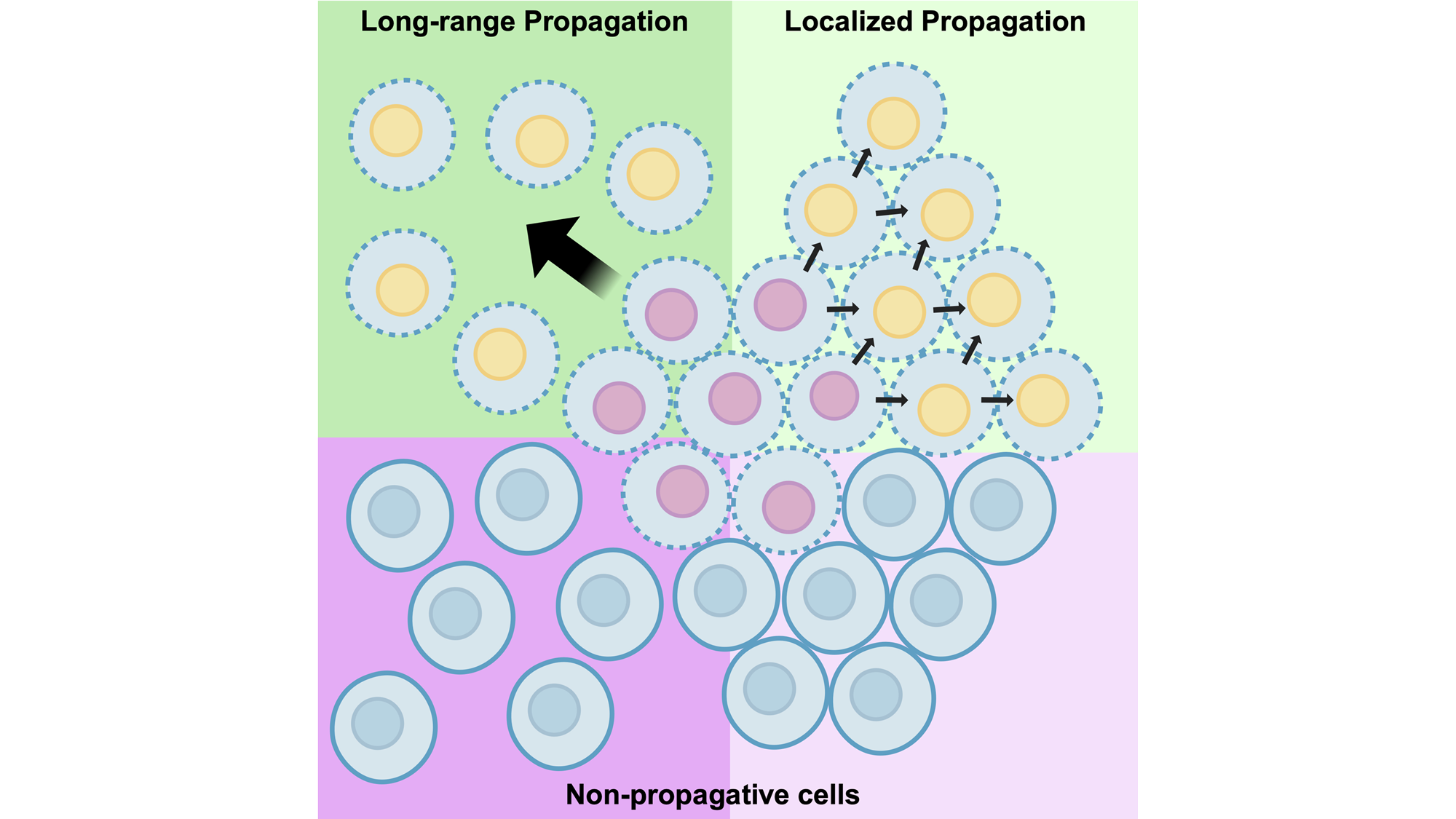
Ferroptosis is a regulated mechanism of cell death caused by the uncontrolled peroxidation of cellular lipids that has an unusual ability to propagate or spread between cells. Here, we review studies identifying regulators of ferroptosis propagation to consider ...
More.Ferroptosis is a regulated mechanism of cell death caused by the uncontrolled peroxidation of cellular lipids that has an unusual ability to propagate or spread between cells. Here, we review studies identifying regulators of ferroptosis propagation to consider a working model that might explain this unusual feature. Recent findings implicating the spread of lipid peroxides and iron suggest that these main catalysts of ferroptosis may also be primary vehicles that can spread death between cells. Experiments revealing localized versus long-range effects of propagation are discussed, as well as sensitizing factors that may expand the propagative potential of death induced by Class II ferroptosis-inducing compounds. As ferroptosis propagation may underlie the loss of large groups of cells in degenerative diseases and may also have a specialized role in normal development, consideration of how ferroptosis can spread through propagative signals may be important for understanding both normal tissue dynamics and disease.
Less.Saloni K. Hombalkar, ... Michael Overholtzer
DOI:https://doi.org/10.70401/EXO.2026.0011 - May 26, 2026
Computational workflows and data infrastructures for spatial omics analysis
Spatial omics is a broad term referring to technologies that allow for biomolecules to be observed within their native tissue context. These technologies have been used by biomedical researchers to gain a better understanding of cellular interactions, tumor ...
More.Spatial omics is a broad term referring to technologies that allow for biomolecules to be observed within their native tissue context. These technologies have been used by biomedical researchers to gain a better understanding of cellular interactions, tumor microenvironment dynamics, and immune cell infiltration. While the basic outputs, such as spatial coordinates, segmentation masks, and transcript/protein matrices, are provided by the instrument software, the true biological insights come from several downstream, specialized analysis steps. Since spatial omics remains a relatively new field, no unified analysis pipeline has yet been established to encompass all platforms. Most workflows are adapted from single-cell RNA sequencing analysis frameworks, while incorporating additional steps that are specific to spatial data, especially for imaging-based technologies. At the same time, the diversity of platforms, data modalities, and output formats has introduced substantial challenges for data representation, interoperability, and cross-platform integration, highlighting the need for flexible, spatially aware, and user-friendly data structures made specifically for imaging-based data, not merely adapted from other methods. This review summarizes the general analytical steps following spatial omics data acquisition, commonly used data infrastructures and tools, existing gaps, and future directions in the field.
Less.Margaret Alexander, ... Jasmine Plummer
DOI:https://doi.org/10.70401/EXO.2026.0010 - May 15, 2026
Nutrient-sensing and mTORC1 regulation in neuronal homeostasis: from metabolic signaling to neurodegeneration
Neurons rely on precise nutrient-sensing mechanisms to sustain proteostasis and stress resilience across a lifetime. Among these, mechanistic target of rapamycin complex 1 (mTORC1) functions as a central metabolic hub, integrating amino acid availability, ...
More.Neurons rely on precise nutrient-sensing mechanisms to sustain proteostasis and stress resilience across a lifetime. Among these, mechanistic target of rapamycin complex 1 (mTORC1) functions as a central metabolic hub, integrating amino acid availability, growth factor signals, and energetic status to coordinate protein synthesis, autophagy, and neuronal survival. Neuronal mTORC1 regulation is highly specialised, reflecting unique metabolic demands, axonal compartmentalisation, and dependence on long-term homeostatic control that is not shared by non-neuronal cell types. Beyond canonical PI3K–Akt and AMP-activated protein kinase (AMPK) signaling, emerging evidence highlights metabolic intermediates, most notably leucine-derived acetyl-coenzyme A (AcCoA), as critical upstream regulators that couple nutrient flux to mTORC1 activity via EP300-mediated Raptor acetylation. Chronic dysregulation of these pathways drives persistent mTORC1 hyperactivation, progressive autophagy impairment, and accumulation of proteotoxic species, collectively contributing to neurodegeneration. In Alzheimer’s disease, aberrant mTORC1 activity is linked to tau hyperphosphorylation and amyloid-β accumulation; in Parkinson’s disease, to α-synuclein aggregation and mitophagy failure; in Huntington’s disease, to impaired clearance of mutant huntingtin; and in amyotrophic lateral sclerosis (ALS), to dysregulated proteostasis in motor neurons. This mini review synthesizes current understanding of neuronal mTORC1 regulation, with an emphasis on the AcCoA–acetylation axis as an emerging metabolic control mechanism, its disease-specific implications across major neurodegenerative conditions, and the therapeutic opportunities these insights reveal upstream of mTORC1.
Less.Sung Min Son, ... David C. Rubinsztein
DOI:https://doi.org/10.70401/EXO.2026.0009 - May 15, 2026
Approaches to deorphanize secretome: Classical, computational, and next generation strategies to reveal ligand-receptor networks
Secreted proteins mediate intercellular and inter-organ communication and are essential for coordinating physiological processes across tissues. Advances in proteomics and proximity labeling have greatly expanded the catalog of circulating secreted ...
More.Secreted proteins mediate intercellular and inter-organ communication and are essential for coordinating physiological processes across tissues. Advances in proteomics and proximity labeling have greatly expanded the catalog of circulating secreted factors; however, for many of these molecules, their cognate receptors and mechanisms of action remain unknown. This lack of receptor annotation represents a major bottleneck in understanding systemic signaling networks and translating secretome discoveries into biological insights. In this review, we summarize and evaluate the strengths and limitations of current strategies for deorphanizing secreted proteins, including 1) biochemical approaches such as affinity purification–mass spectrometry and crosslinking-based receptor capture, 2) genetic screening strategies in both in vivo and in vitro systems, including RNA interference and Clustered Regularly-Interspaced Short Palindromic Repeats (CRISPR)-based perturbation and activation platforms, and 3) computational frameworks based on AI-driven protein structure modeling. Finally, we outline future directions aimed at accelerating ligand–receptor identification, including multiplexed screening platforms, approaches to improve sensitivity for low-affinity interactions, synthetic biology tools that convert transient binding events into stable readouts, and integration with single-cell and spatial transcriptomic technologies. Together, these advances provide a roadmap for transforming classical ligand deorphanization into a scalable, context-aware framework for decoding inter-organ communication.
Less.Myeonghoon Han, Norbert Perrimon
DOI:https://doi.org/10.70401/EXO.2026.0008 - May 11, 2026
The lymphatic endothelial-immune dialogue in cancer and immunotherapy
Lymphatic endothelial cells (LECs) and the lymphatic vasculature have evolved from being viewed as passive conduits for fluid drainage and metastatic dissemination to active, dynamic regulators of inflammation and tumor immunity. In solid tumors, both ...
More.Lymphatic endothelial cells (LECs) and the lymphatic vasculature have evolved from being viewed as passive conduits for fluid drainage and metastatic dissemination to active, dynamic regulators of inflammation and tumor immunity. In solid tumors, both tumor-associated and lymph node (LN)–resident LECs engage in complex interactions with their environment to orchestrate immune processes, including antigen transport and presentation to T cells, leukocyte recruitment and trafficking via chemokine gradients, and local immune modulation through the expression of co-inhibitory ligands such as programmed death-ligand 1 (PD-L1). These multifaceted roles enable LECs to either amplify effector responses or induce tolerance, profoundly influencing the efficacy of cancer immunotherapies depending on their activation state, tissue context, and molecular programming. This minireview synthesizes and discusses recent advances in tumor lymphangiogenesis, the role of LECs and their intensive crosstalk with the immune compartments, in the coordination of anti-tumor immune responses, with particular focus on LEC-autophagy as a lipid metabolic checkpoint controlling lymph node T cell egress, and its far-reaching implications for optimizing immunotherapy outcomes in solid tumors.
Less.Diede Houbaert, ... Patrizia Agostinis
DOI:https://doi.org/10.70401/EXO.2026.0007 - April 22, 2026