Old worms, new tricks: Dynamical instability explains late-life rejuvenation in C. elegans

Djakim Latumalea
1
,
Adrian Molière
2
,
Peter Fedichev
3
,
Collin Y. Ewald
2,*

,
Jan Gruber
1,*
*Correspondence to:
Collin Y. Ewald, Department of Health Sciences and Technology, ETH Zürich, Zürich 8092, Switzerland.
E-mail: collin-ewald@ethz.ch
Jan Gruber, Department of Biochemistry, Yong Loo Lin School of Medicine, National University of Singapore, Singapore 117596, Singapore. E-mail: bchjg@nus.edu.sg
Jan Gruber, Department of Biochemistry, Yong Loo Lin School of Medicine, National University of Singapore, Singapore 117596, Singapore. E-mail: bchjg@nus.edu.sg
Geromedicine. 2027;3:202626. 10.70401/Geromedicine.2026.0044
Received: April 14, 2026Accepted: October 13, 2026Published: November 05, 2026
This article belongs to the Special lssue Understudied Directions in Aging Biology, Quantitative and First-Principles Approaches
Abstract
How is it possible to double the lifespan of an organism already close to death? Many biological theories of aging fail to explain this phenomenon. At the Physics of Aging workshop, we used late-life lifespan extension in Caenorhabditis elegans to illustrate how a simple stochastic dynamical-systems model can naturally account for dramatic geriatric interventions. We build on a Langevin-type framework in which aging can occur in stable or unstable dynamical regimes, depending on whether slow, lifespan-determining modes are initially restoring or non-restoring. We argue that C. elegans operates in the unstable regime, a view supported independently by temporal scaling of survival curves, late-life mortality deceleration, and persistent lifespan effects following transient interventions. In the unstable regime, stochastic fluctuations are amplified over time until a failure threshold is reached as a first-passage event. The instability rate α sets the speed of this divergence, while the nonlinear feedback strength g, together with α, sets the failure boundary zmax = α/g. Auxin-induced degradation of DAF-2 in very old animals is interpreted as a late shift in dynamical parameters, and the model naturally accounts for the resulting lifespan extension without requiring reversal of accumulated structural damage. This reconciles persistent senescent pathologies with restored proteostasis and stress resilience, and suggests that altering regulatory instability, rather than reversing damage, can strongly reshape survival trajectories. More broadly, this work illustrates how low-dimensional, physics-inspired stochastic models can capture key features of aging and motivate new collaborations on late-life interventions.
Keywords
Physics of aging, Langevin model, rejuvenation, longevity, daf-2, temperature, proteohomeostasis
1. Introduction
An ancient dream is to age gracefully and then magically rejuvenate the body to continue living without the pathologies and diseases of aging. It is widely assumed that such rejuvenation of an old body is impossible. Although this appears to hold true for humans so far, it is not necessarily the case across all species. Indeed, we have shown that the nematode C. elegans is capable of something reminiscent of this phenomenon. The multicellular model organism C. elegans typically has a lifespan of around 15 to 25 days[1]. Remarkably, treatment in geriatric nematodes older than 20 days can still double their lifespan, yielding an additional 20 days of survival[2], a surprising finding that has been reproduced by other laboratories[3]. This was achieved using a novel genetically engineered protein degradation system, auxin-induced degradation, which enables precise, temporally controlled degradation of the insulin/IGF-1 receptor DAF-2 at any age[2].
Mutations in the insulin/IGF-1 receptor DAF-2, as well as knockdown of daf-2 by RNA interference (RNAi), can double the lifespan of C. elegans to more than 60 days[4,5]. However, daf-2 mutations alter insulin/IGF-1 receptor signaling from birth, and the latest age at which daf-2 knockdown by RNAi is able to extend lifespan is day 6 of adulthood, an age at which C. elegans is still reproducing[6]. Historically, this led to the conclusion that reducing insulin/IGF-1 receptor signaling during development and early adulthood can increase lifespan, but that this intervention loses its efficacy beyond the reproductive period[6].
This interpretation aligns with a damage-accumulation view of aging[7]. If aging were primarily driven by the progressive accumulation of irreversible molecular damage, then interventions that merely slow the formation of damage should show diminishing returns when initiated late in life. By the time treatment begins, a substantial fraction of critical lesions, including misfolded proteins, crosslinked extracellular matrix components, mitochondrial dysfunction, and genomic instability, would already be present. In such a framework, true rejuvenation would be at best partial, if not impossible, because it would require reversal of all forms of entropic damage. Even partial removal or repair of accumulated macromolecular damage would be energetically costly, mechanistically complex, and unlikely to occur rapidly or completely in a post-reproductive organism. One would therefore predict that late-life interventions could, at best, modestly slow further decline, but not produce large, immediate extensions of remaining lifespan. The reported decline in the efficacy of late-life daf-2 RNAi has therefore historically been interpreted as evidence that after about day 6 of life, aging in C. elegans progresses beyond a point at which modulating damage accumulation can meaningfully alter survival[6].
However, the expression of various RNAs that regulate the RNAi machinery also changes with age[8], suggesting that age-dependent variation in daf-2 RNAi knockdown efficiency, rather than diminished biological return from daf-2 knockdown itself, may be responsible. This distinction raises a critical question: does the reduced benefit truly indicate that accumulated damage has rendered late-life intervention ineffective, or does it instead reflect a decline in the efficacy of the RNAi method itself?
2. The DAF-2 Degron System
To address this question, we used a plant-derived genetic tool adapted for C. elegans: the auxin-induced degradation system[9]. We tagged the DAF-2 receptor with a small degron tag and introduced the plant F-box protein TIR1, a component of an SCF E3 ubiquitin ligase, into all C. elegans cells[2]. Under standard conditions, this degron-tagged DAF-2 is not degraded, functions normally, and animals appear wild-type. Upon auxin treatment, however, the degron-tagged DAF-2 is degraded within 30 minutes. Crucially, degradation is reversible: auxin withdrawal restores DAF-2 levels, enabling precise temporal control of the receptor at any age[2].
We used this system to test whether DAF-2 degradation initiated in geriatric animals, well beyond the window accessible to RNAi, could still extend lifespan. We showed that even well past the reproductive age, up to day 21 of adulthood, when 75% of the population had already died and when control-treated C. elegans only lived 4 additional days on average, auxin-mediated degradation of DAF-2 extended survival by an average of 26 days. In other words, total lifespan could still be doubled even when intervention was initiated near the end of life[2]. This remarkable finding has been reproduced by other laboratories, including the Gems Lab[3].
This finding raised the core question: how is it possible to double the lifespan of a multicellular organism so close to the end of its normal lifespan? In collaboration with several laboratories, we began to dissect which age-related pathologies are slowed, halted, or even rejuvenated when lifespan is extended at geriatric ages in C. elegans[3]. We found that, despite the robust lifespan extension, some age-related and morphological senescent pathologies (pharyngeal degeneration, gonadal atrophy, yolk pooling, and uterine tumors) are not restored or reversed[3], suggesting that these forms of “damage” are not primary determinants of late-life longevity in C. elegans. By contrast, age-related deterioration of the exoskeleton (cuticle), which is composed of collagen and extracellular matrix proteins, is halted[3]. The decline in healthspan, including motility, is slowed[3]. Interestingly, resilience to heat and osmotic stress is also significantly restored[3]. Furthermore, age-related endogenous protein aggregation is resolved following late-life longevity intervention[3].
Taken together, these observations are difficult to reconcile with the damage-accumulation view of aging. If late-life mortality were primarily determined by the burden of irreversible molecular and structural lesions, then interventions initiated after substantial deterioration should yield only modest gains, and certainly should not restore remaining lifespan to the same upper limit achievable when treatment begins in young animals. Notably, the late-life daf-2 degron intervention restores lifespan to the same maximal limit observed when the pathway is suppressed from early adulthood[2]. This occurs despite the persistence of extensive age-associated damage and structural pathology. The persistence of many age-associated pathologies despite dramatic lifespan extension further suggests that such lesions are not the principal determinants of survival risk and lifespan. This points to a fundamentally different determinant of late-life survival risk, one governed by the dynamical state of physiological regulation rather than the cumulative burden of structural damage.
3. Langevin Instability Model of Aging
We therefore asked what dynamical property of the organism could account for both the late-life efficacy of DAF-2 degradation and the selective reversibility of age-related pathologies. A natural candidate is intrinsic dynamical instability: the possibility that C. elegans, like other short-lived organisms, operates in a regime in which physiological trajectories diverge in the absence of restoring forces[10,11] (Figure 1).
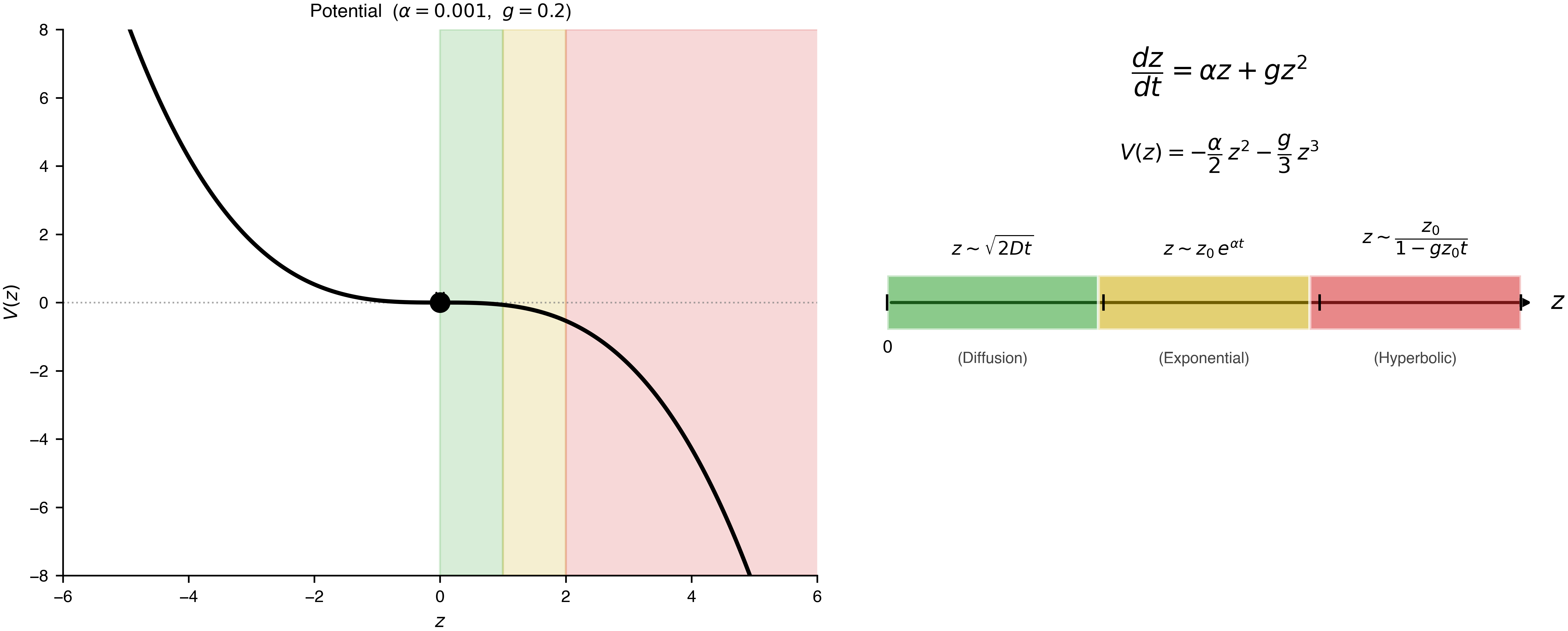
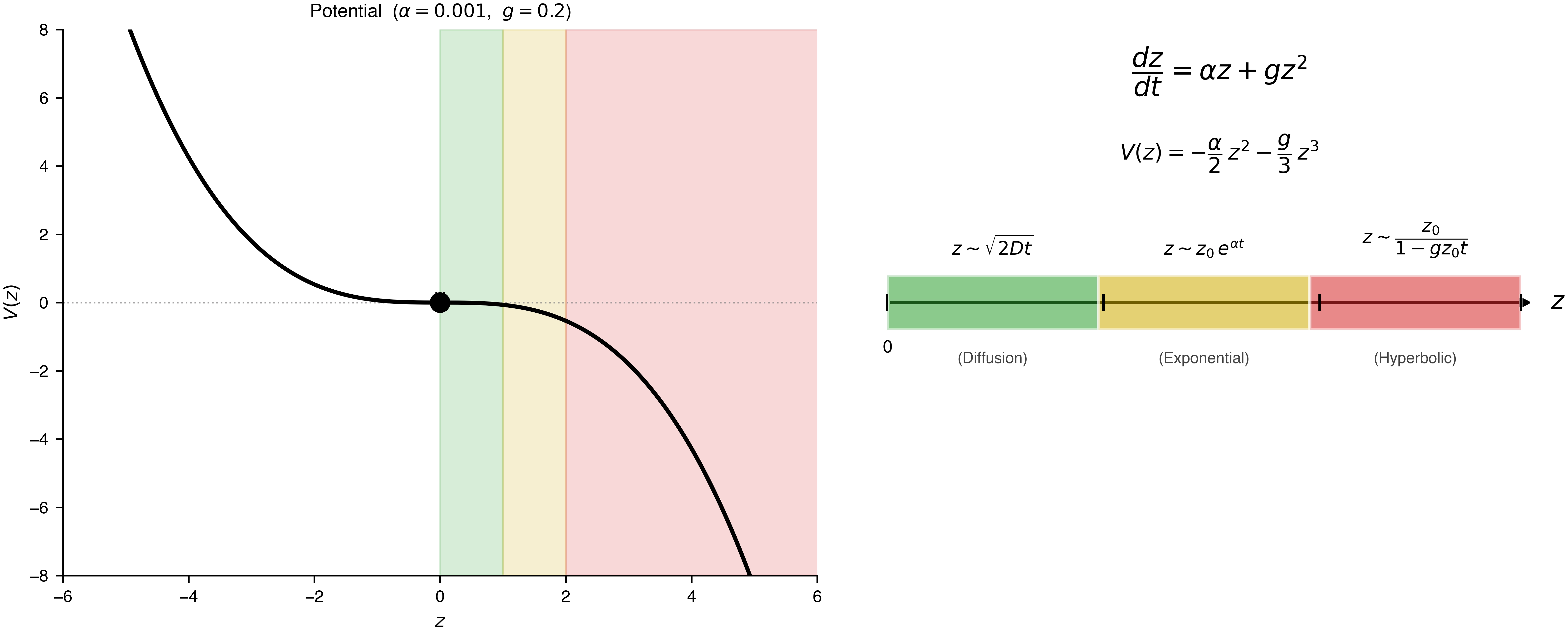
Figure 1. Instability dynamics of C. elegans. Left: Potential V(z) for the unstable case α > 0. Coloured regions are schematic and indicate diffusion-dominated dynamics near the origin (green,
The framework of Fedichev & Gruber[11] separates aging into two dynamical regimes governed by processes operating on different timescales. In the stable regime, the relevant slow physiological modes are initially restoring, and aging is driven primarily by the gradual accumulation of irreversible (entropic) damage, Z. As Z accumulates approximately linearly with age, it slowly erodes the functional and stability properties of key physiological systems until stability along at least one slow physiological mode is lost.
In the unstable regime, by contrast, at least one lifespan-limiting collective mode is intrinsically non-restoring. This unstable mode is represented by a single variable, z, summarizing a cluster of tightly correlated physiological features whose deviation from the youthful norm grows exponentially. In this regime, the slow accumulation of Z is not the dominant determinant of lifespan because the unstable mode diverges on a much faster timescale than entropic damage accumulates. The unstable regime is the eventual consequence of entropy-driven degradation of resilience for animals that begin life in the stable regime. However, some short-lived organisms, such as C. elegans, are proposed to operate in, or close to, this intrinsically unstable regime throughout adult life.
Here, “unstable” has a specific dynamical meaning and does not imply a global absence of homeostasis. C. elegans may contain many fast physiological modes with robust restoring dynamics. For an organism to be classified as “unstable”, the model requires only that at least one slow, lifespan-determining collective mode is effectively non-restoring over the adult lifespan. A marginally stable mode with a relaxation time much longer than the worm lifespan would be operationally difficult to distinguish from this limit. The molecular or phenotypic composition of the corresponding eigenvector need not be known.
We wish to emphasize that the assignment of C. elegans to the unstable regime predates the present DAF-2 degron experiments and was motivated by several independent properties of nematode survival[10,11]. Brief interventions can produce persistent effects on lifespan after the intervention itself has ended[12-14], whereas a strongly stable mode would be expected to relax toward its previous trajectory once the perturbation is removed. Nematode mortality also departs in characteristic ways from simple Gompertz behaviour at advanced ages, with mortality deceleration and late-life plateaus reported in classic demographic studies[15-17]. Such behaviour arises naturally in the unstable first-passage regime, whereas in the stable damage-driven regime of Fedichev & Gruber[11] accumulated entropic damage progressively erodes the stability margin and ultimately drives the system toward loss of stability. Finally, survival curves across diverse genetic and environmental interventions in C. elegans exhibit approximate temporal scaling[12], consistent with a dominant change in a common aging timescale.
Within the overall framework, the two regimes make different predictions for the effect of late-life intervention. In the stable regime, accumulated damage would already have reduced the stability margin by day 21, so an intervention initiated then is expected to show diminishing efficacy and should not restore the lifespan ceiling obtained with early treatment. However, in the unstable regime, the future evolution of the state z depends only on the current value of z and the applicable dynamical parameters rather than explicitly on chronological age. Animals surviving to day 21 are selected toward lower z, and changing the instability parameters at this age can still strongly alter their subsequent trajectories. The observation that late DAF-2 degradation restores remaining lifespan close to the early treatment ceiling, despite persistent structural pathology, is therefore consistent with the unstable regime.
The dynamics of z follow a stochastic Langevin equation with three parameters (Materials and Methods). The instability rate α sets how rapidly small deviations grow and, in the weak-nonlinearity regime considered here, approximately determines the Gompertz slope. The nonlinear feedback strength g accelerates divergence at large z, and the noise power D sets the magnitude of stochastic fluctuations, generating variation in lifespan among otherwise identical individuals. These parameters define two characteristic levels (Figure 1). Below the crossover level
An intervention in this model is represented exclusively as a change in α and g, with the noise intensity D assumed unchanged and no adjustment in the state z itself. The untreated and DAF-2-depleted parameter sets were estimated separately from the DMSO and auxin day-10 cohorts (Table 1). No parameters were fitted separately to the day-21 cohort. Instead, trajectories evolved under the untreated parameters until day 21 and under the DAF-2-depleted parameters thereafter, with z continuous across the switch. The day-21 survival curve is therefore an out-of-sample prediction with respect to intervention timing: it asks what happens when an aged animal, in its current dynamical state, is placed into the regulatory regime inferred from DAF-2-depleted animals. Within each parameter regime, the dynamics are Markovian by construction, so the future evolution depends only on the current state and parameter set rather than on chronological age or on the history by which that state was reached (Figure 2). In this model, no age-specific effect is introduced, and chronological age enters only through the evolution of z and the externally imposed intervention time.
Table 1. Fitted model parameters and derived characteristic levels. α, g, and D were estimated from the DMSO day-10 cohort, and α and g from the auxin day-10 cohort with D fixed. No parameters were fitted to the day-21 cohort, which uses the DMSO estimates before day 21 and the auxin day-10 estimates thereafter. The crossover level
| Condition | α | g(10-3) | zmax | D | zm |
| DMSO day 10 | 0.155 | 2.86 | 54.3 | 1.27 | 4.05 |
| Auxin day 10 | 0.104 | 1.84 | 56.3 | 1.27 | 4.96 |
| Auxin day 21, t < 21 | 0.155 | 2.86 | 54.3 | 1.27 | 4.05 |
| Auxin day 21, t ≥ 21 | 0.104 | 1.84 | 56.3 | 1.27 | 4.96 |
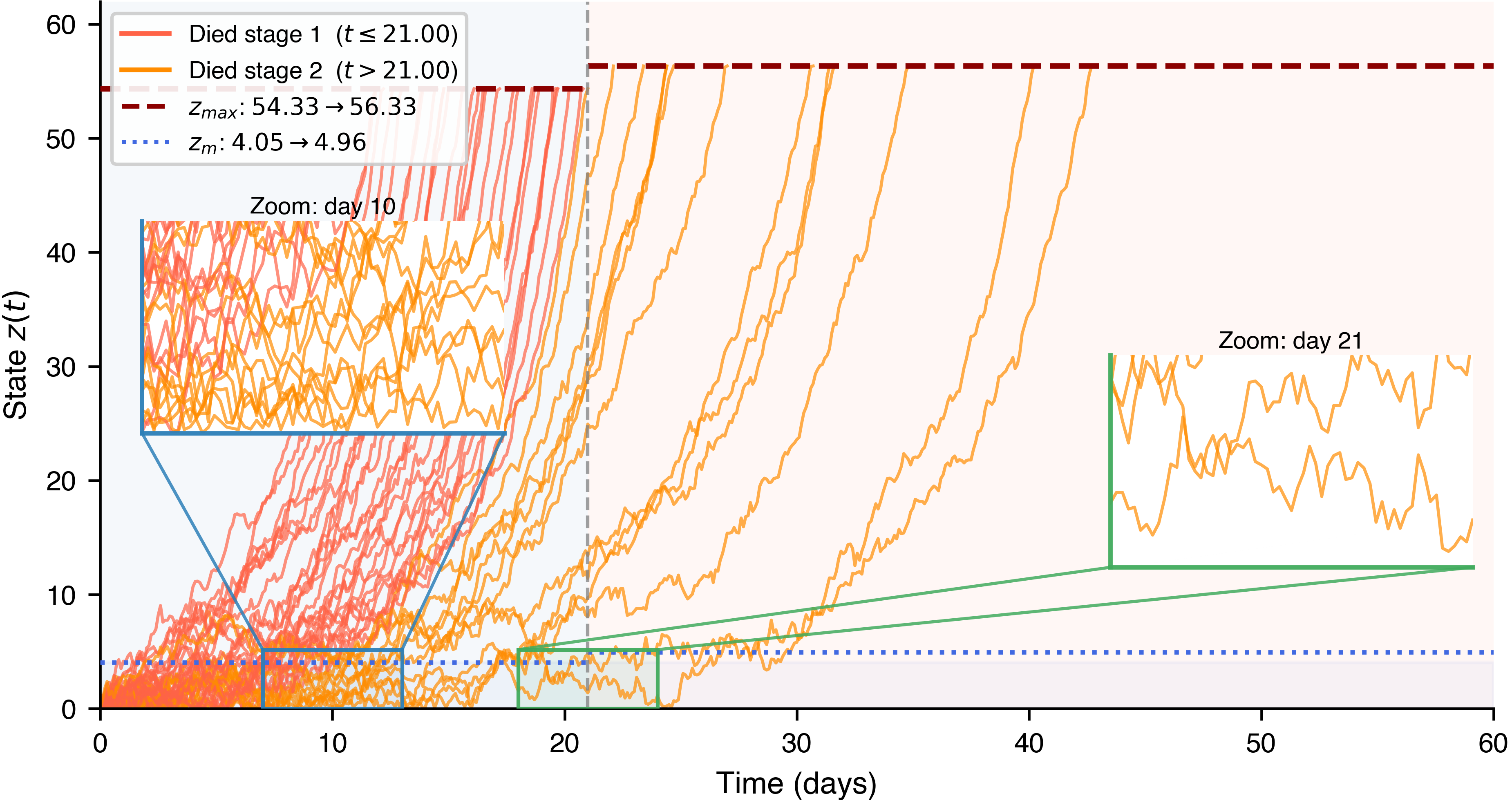
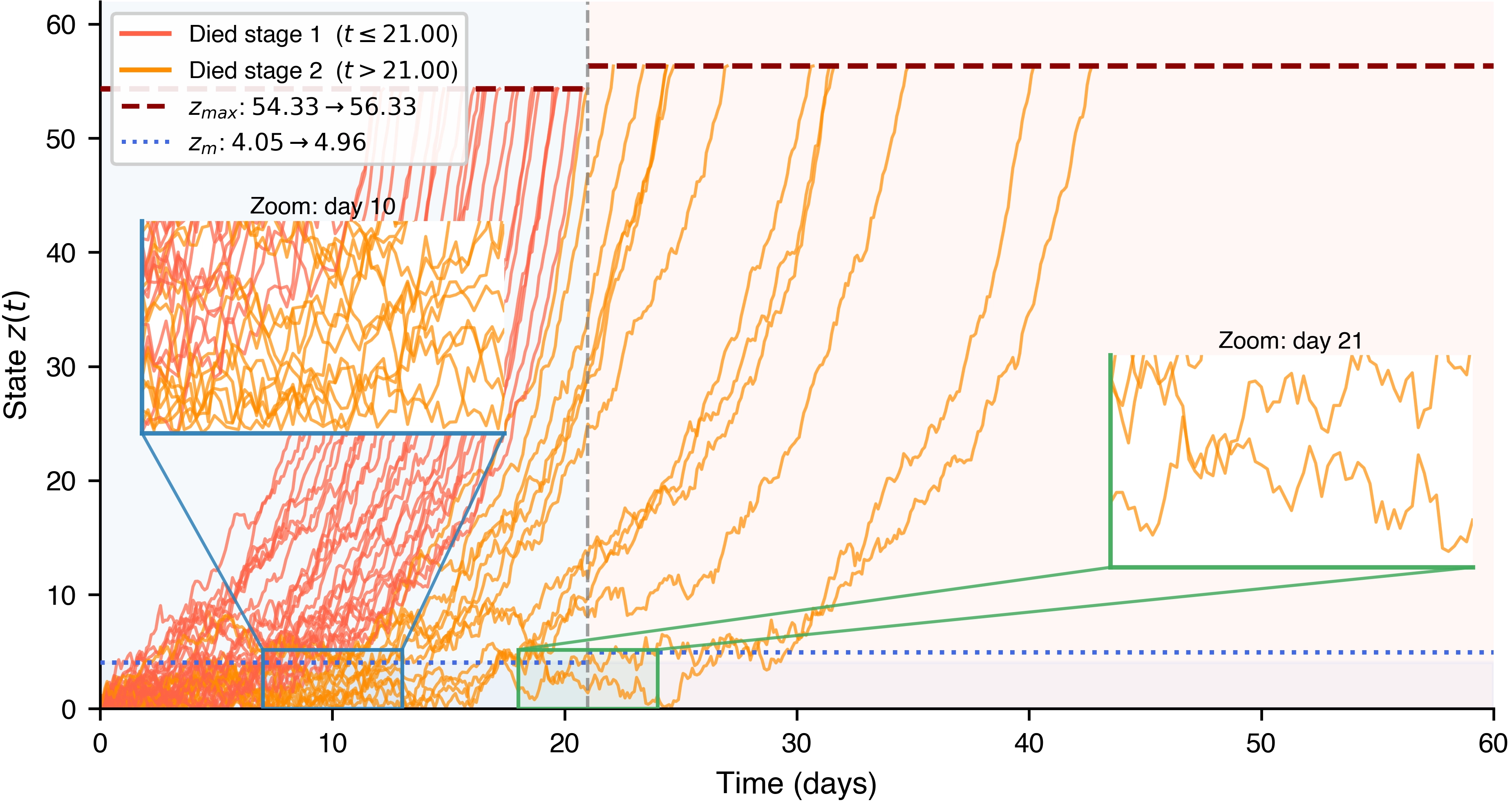
Figure 2. Illustration of the Markov assumption in the Langevin model. Representative simulated trajectories z(t) for animals dying before (tomato) or after (dark orange) the day-21 intervention (vertical dashed line). Dotted and dashed horizontal lines indicate zm and zmax, respectively. Insets show dynamics around day 10 and day 21; their similarity reflects the model’s assumption that, given the current state and parameter set, future evolution does not depend on elapsed time. The figure illustrates this assumption and is not evidence that the biological dynamics are memoryless.
The resulting post-day-21 prediction closely captured the late-life survival extension without refitting any parameters to the auxin day-21 cohort (Figure 3; goodness-of-fit measures are reported in Table S1). We next asked whether the same held-out response could be reproduced by a damage-driven model, as expected for animals operating in the stable regime, in which mortality risk is determined by accumulated age-dependent damage and the intervention slows subsequent damage accumulation. We represented this by a piecewise Gompertz hazard fitted to the same day-10 training conditions (Supplementary Note 1 and Figure S1). In this model, the intervention changes the post-intervention Gompertz slope, and hence the mortality-rate doubling time, but does not reset the mortality hazard already accumulated by day 21. The Gompertz model substantially underpredicted post-intervention survival, whereas the Langevin prediction was much closer to the observed trajectory. This discrepancy was particularly apparent in the late-life tail. Conditional on the 59 animals alive after day 21, the fitted Gompertz model predicted a probability of only 0.21% for an individual animal to reach day 30, corresponding to 0.13 expected survivors. In contrast, 26 animals in the day-21 DAF-2 degron cohort reached day 30. Under an exact one-sided binomial test using the Gompertz-predicted survival probability, the probability of observing 26 or more survivors was p = 1.3 × 10-53. The observed number of late survivors was therefore overwhelmingly incompatible with the stable-regime, no-rejuvenation Gompertz prediction, whereas it was compatible with the distribution generated by the unstable Langevin model. Consistent with this tail-specific result, an omnibus curve-distance test comparing the complete observed and predicted conditional post-day-21 survival trajectories showed a strong discrepancy for the Gompertz model (p < 0.001), whereas the corresponding discrepancy for the Langevin model did not reach the 0.05 significance threshold (p = 0.067). A direct paired comparison of predictive log scores likewise favored the Langevin model (mean per-animal Langevin-minus-Gompertz difference, 4.04; 95% CI, 2.60-5.59; Table S2). Together, these analyses indicate that the held-out response to late auxin exposure is poorly accounted for by a stable damage-accumulation model in which treatment merely slows subsequent mortality acceleration, but is substantially better captured by the unstable Langevin dynamics.
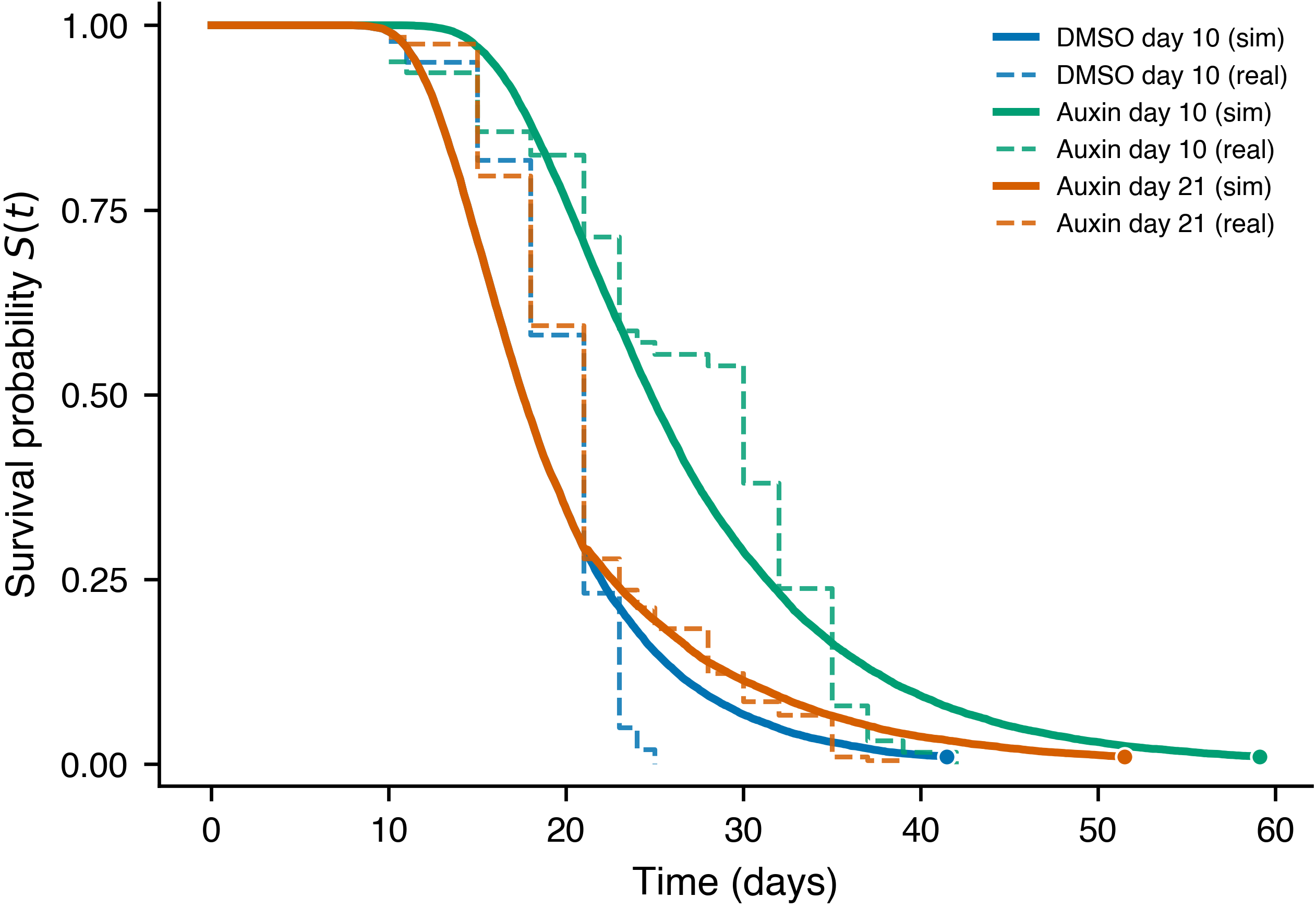
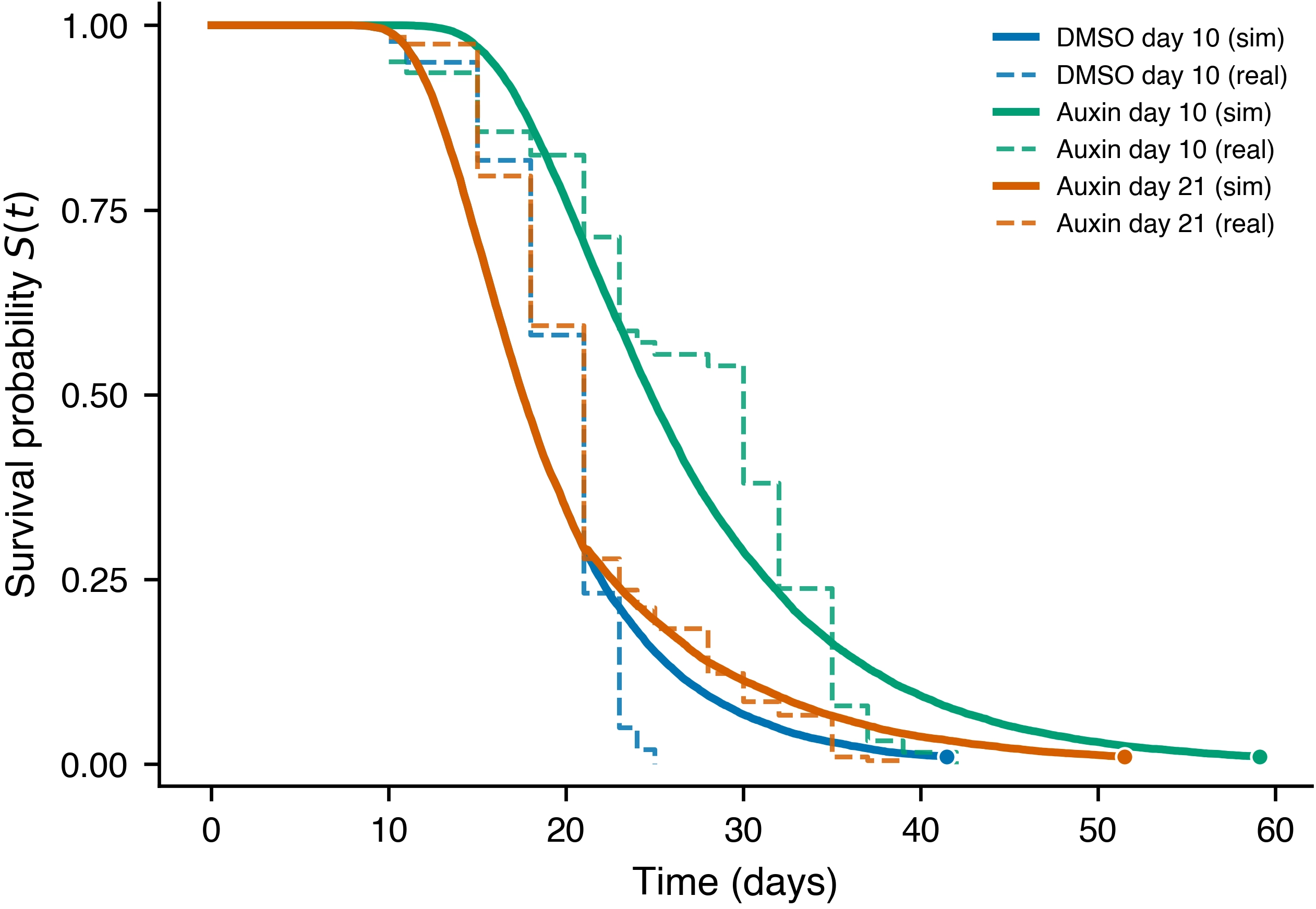
Figure 3. Simulated and experimental survival dynamics under early and late intervention. Survival curves from the Langevin model (solid) and experimental Kaplan-Meier estimates (dashed). DMSO and auxin day-10 curves are fitted; the day-21 curve is predicted without refitting (see main text). Simulated curves are truncated at 1% survival (dots). Experimental data are from Venz et al.[2].
We next examined how the fitted parameter changes contribute to the altered survival dynamics. In the DAF-2-depleted regime, α decreases from 0.155 to 0.104 and g from 2.86 × 10⁻³ to 1.84 × 10⁻³. One-at-a-time perturbations around the DMSO baseline show that the two changes contribute comparably to the gain in median survival (Supplementary Note 2 and Table S3), but they reshape the survival curve differently. The reduction in g shifts the curve to later ages with little change in its spread, whereas the reduction in α also slows the overall timescale of decline, widening the distribution of lifespans and lengthening the late-life tail (Figure S2). Because α and g are effective dynamical parameters, this decomposition does not establish a mapping between either parameter and specific components of the DAF-2 signaling network.
Overall, the held-out day-21 survival data are incompatible with the specific damage-driven Gompertz model considered here, in which intervention can slow subsequent mortality acceleration but cannot reduce the mortality risk already accumulated by the time of treatment. By contrast, the Langevin model, parameterized entirely from the day-10 DMSO and auxin cohorts and then applied to the day-21 intervention without further fitting, qualitatively reproduces the observed survival trajectory, including the approximate magnitude of the late-life survival extension. This provides strong predictive support for the unstable-regime interpretation over the corresponding stable, damage-driven alternative tested here. It does not, however, establish that the Langevin formulation is uniquely correct, because other mechanistic models with different state variables or intervention rules could potentially reproduce the same phenotype. The model’s value lies in showing how modifying effective regulatory dynamics can delay failure without requiring reversal of every age-associated lesion, consistent with the persistence of several structural pathologies alongside restored stress resistance and the resolution of some age-associated protein aggregates.
4. Evolutionary Context
To understand these observed phenomena, it is important to consider the life-history strategy of C. elegans in an evolutionary context. Two major variables governing the evolution of longevity are the age at sexual maturity and age-dependent fecundity schedules[18]. For reproduction to occur, an individual’s genome must be passed to the next generation; until then, selection pressure is maximal to keep the organism in optimal condition. With the onset of reproduction, the contribution of later age groups to the future gene pool diminishes, and thus the force of natural selection to maintain physiological integrity declines (Selection Shadow)[18]. Humans can and do reproduce for decades after reaching maturity, and therefore must have evolved mechanisms to ensure stability of their final body plan. This differs from animals that reproduce only once or within a very short window: systemic stability is no longer required, and the soma quickly becomes disposable. Aging driven by mechanisms that can be seen as a continuation of development, such as hyperfunction, would be expected to dominate in such unstable organisms[19,20]. This is especially true when the post-reproductive adult provides no benefit to their offspring’s survival, or may even be detrimental. In C. elegans, it has been hypothesized that the death of the post-reproductive adult may even be advantageous, with nematodes actively converting their biomass into yolk for their offspring before dying and thereby making all their nutrients available to the next generation[21,22]. In such a scenario, there may even be active pressure against the evolution of a stable post-reproductive system, which might explain why lifespan-extending interventions are so abundant in C. elegans[19]. Taken together, the evolved life history strategy of C. elegans is consistent with the idea that systemic instability is a core feature of C. elegans aging.
Importantly, this instability holds for C. elegans during normal development when resources are abundant. However, the dauer stage is an alternative developmental endpoint that has evolved to be stable over time, allowing survival through periods of scarcity until conditions are sufficient for reproduction. In that sense, C. elegans has both an unstable and a stable physiological mode. This explains why interventions acting through dauer signaling, like daf-2 knockdown, are particularly potent at extending lifespan: C. elegans has an inbuilt stability program that can enhance stability even when activated outside its usual activation window, for example, at old age[23].
This physics-based Langevin model of aging is well aligned with other theories and frameworks of aging. While the dynamical classification of a species as stable or unstable does not follow simply from the length of its lifespan or reproductive period, a short reproductive window and post-reproductive life history make the evolution of a weakly restoring or unstable adult regime more plausible. This is consistent with developmental theories that postulate aging as a quasi-programmatic continuation of development[24,25]. A lack of stability after maturity, manifested by continuing quasi-programs, can be interpreted dynamically as weak restoring forces and persistent physiological states. Consequently, the future state of the organism remains strongly dependent on its previous state, producing high temporal autocorrelation. The corresponding autocorrelation time becomes long relative to the observation timescale, as expected when restoring dynamics weaken. By contrast, theories of deleterious accumulation of damage[26] may apply more strongly to species that maintain a stable physiological regime following maturation. This suggests a continuum between stable and unstable dynamical regimes, with the underlying regime shaped by evolutionary optimization and its classification inferred empirically for each species from features such as mortality trajectories and responses to perturbations. Another interesting interaction with the Langevin stability model concerns the framework proposed by Pio-Lopez et al.[27], which posits that aging is primarily a result of a loss of cellular goal-directedness following the completion of the developmental program. Without an overarching goal, systems are inherently unstable and prone to deterioration. Through this lens, the restoration of stability following DAF-2 auxin-induced degradation could be seen as the reestablishment of a physiological goal, driving the system in a programmed manner towards a state closer to the stable dauer stage.
5. Reflections on the Core Questions Raised at the “Physics of Aging” Workshop
The central question of our presented work was “How is it possible to double the lifespan of a multicellular organism at the end of its lifespan?” Classical theories of aging, such as damage accumulation, antagonistic pleiotropy, and hyperfunction, fall short in explaining the magnitude of late-life increase in lifespan. Thus, a more suitable model was required to explain our experimental data. We examined a novel physical model of aging, a Langevin-inspired model based on non-equilibrium thermodynamics and statistical mechanics. We propose that in the model organism C. elegans, late-life mortality appears to be governed less by the cumulative burden of entropic damage and more by the dynamics of an intrinsically unstable physiological mode characterized by resilience, stochastic fluctuations, and proximity to a failure threshold. Thus, the survival risk is determined by the organism’s instantaneous dynamical state and stability parameters rather than by an irreversible record of accumulated damage.
In line with stochastic, physics-inspired models (e.g., Langevin-type descriptions with a noise power D), aging in short-lived, unstable animals can be formalized as a first-passage problem on an unstable landscape, where interventions that reduce instability or raise the barrier to failure “rescue” animals close to a death threshold without resetting prior damage. This framing explicitly connects our work to non-equilibrium statistical mechanics and complex systems theory. The model described here constitutes a limiting case within a broader class of dynamical systems that also includes “stable” organisms[11]. In early life, these systems (including humans) reside in a dynamically stable regime and this stability dominates for most of their lives. Progressive entropy-driven parameter drift, however, reduces stability over time, eventually bringing the system to a codimension-1 bifurcation, beyond which dynamics become intrinsically unstable. By contrast, short-lived organisms such as nematodes appear to operate in or rapidly transition into this unstable regime early in adulthood, possibly shortly after reproductive maturity[11].
This distinction carries a concrete clinical prediction: interventions that shift z dynamics (such as senolytics, anti-inflammatory agents, or proteostasis enhancers) will produce persistent effects in unstable animals like C. elegans, but only transient benefits in stable organisms like humans, where resilience mechanisms restore z toward equilibrium after the perturbation is removed. To extend the maximum lifespan of stable organisms requires slowing the rate of entropic damage accumulation or boosting the initial stability margin, targets that are mechanistically distinct from those optimal for short-lived model organisms.
Workshop Question 1: What under-appreciated or emerging direction are you highlighting, particularly one connected to your own work?
Recent physics-inspired frameworks for aging fall into two broad classes that yield mathematically similar stochastic descriptions but interpret the underlying variables differently. Dynamical-systems models proposed by Fedichev and colleagues[10,11,28] treat aging as the progressive loss of stability in organism-level regulatory dynamics, with state variables interpreted as emergent collective modes representing damage and stress responses. Saturation-removal (SR) models developed by Alon and colleagues[29,30] attribute Gompertzian mortality to the nonlinear production-removal kinetics of specific damage-associated biological variables (for example, senescent cells or aggregated proteins). The SR models describe a qualitatively different class of first-passage stochastic process in which mortality is driven by a damage variable subject to increasing production and saturating removal[29-31]. Unlike the unstable Langevin limit considered here, in which the dynamical parameters are time-independent within each regime, these SR models include explicit chronological-age dependence through the damage-production term. This distinction is central to the present argument: because chronological age does not enter explicitly into the unstable Langevin dynamics described here, changing the stability parameters late in life can alter the subsequent trajectory just as it can earlier in life, conditional on the organism’s current state. In the broader stability framework (that is, stable animals including humans), by contrast, accumulating entropic damage alters the linearised dynamics and thereby induces age dependence of the slowest stability eigenvalue. Whether the SR framework can reproduce the unusually large effect of DAF-2 degradation initiated at extreme old age therefore depends on how the intervention is mapped onto its damage-production or removal parameters and has, to our knowledge, not been tested.
Experiments such as the DAF-2 degron system provide a particularly stringent testbed for comparing such frameworks. Both classes of models can reproduce key features of aging trajectories, including early Gompertzian mortality, late-life deceleration of mortality increases, and apparent age-dependent intervention effects at the population level. The relevant question is therefore not whether a given phenomenon can be reproduced in principle, but which structural assumptions are required to do so, and how these map onto experimentally observable quantities.
A central observable in the degron system is the relationship between intervention timing, residual lifespan, and state-dependent outcomes. Intervention at late ages, after substantial mortality has already occurred, can restore remaining lifespan close to the maximum observed under early-life intervention[2,3]. Interpreting this result requires disentangling chronological age, state selection, and intervention-induced shifts in the underlying dynamical variables. Different model classes attribute these effects to distinct mechanisms such as explicit time dependence in production terms, state-dependent dynamics in unstable modes, or modifications of effective thresholds, leading to different predictions for conditional survival, hazard trajectories, and late-life survival tails.
A second discriminator is the selective persistence of age-related pathology. The degron extends lifespan while leaving pharyngeal degeneration, gonadal atrophy, yolk pooling, uterine tumors, and muscle PolyQ aggregates intact, yet simultaneously restoring proteostasis, stress resistance, and cuticle integrity[3]. The present model does not require an a priori assignment of these phenotypes to specific dynamical components. It is predicated only on the existence of at least one unstable mode, represented by the effective coordinate z; the molecular and phenotypic composition of the corresponding eigenvector need not be known in advance, and the model makes no mechanistic assumptions about its composition. Our interpretation of persistent versus responsive phenotypes is, therefore, post hoc and hypothesis-generating. Prospectively identifying which measured features project onto the unstable mode will require longitudinal, state-resolved measurements under perturbation.
In the context of our framework, this heterogeneity maps onto the two-variable structure of the instability framework[11]: irreversible entropic damage accumulates in structural pathologies that the intervention does not reset, while the dynamic resilience mode is modulated by the intervention and restores the features coupled to it. Whether and how this observation can be reproduced within the saturation-removal framework lies beyond the scope of the present work, but is an interesting question. More broadly, such experiments highlight the need for systematic, state-resolved comparisons between competing theoretical frameworks. More precise measurements that combine longitudinal state, high-resolution survival and mortality analysis, and perturbations at different points along the trajectory will provide a direct route to distinguishing between mechanisms that are otherwise difficult to separate at the level of aggregate survival curves alone.
Workshop Question 2: How does this direction relate to physics, through mathematical modeling, complex systems approaches, materials science, or other relevant modalities?
We connect aging to physics by modeling C. elegans decline as a stochastic, Langevin-type process evolving along an intrinsically unstable dynamical mode. The noise power captures the amplitude of physiological fluctuations, while deterministic drift amplifies them over time until a failure threshold is reached, resulting in death as a first-passage event. Within this stochastic dynamical framework, interventions such as late-life DAF-2 degradation are naturally interpreted as changes to the system’s instability parameters α and g: rather than restoring stability or reversing accumulated damage, the intervention reduces the growth rate of the unstable mode, delaying threshold crossing.
Workshop Question 3: How many research groups are currently active in this area?
Jan Gruber’s lab in Singapore is actively working on late-life auxin-induced degradation of DAF-2 in relation to the physical model proposed by Peter Fedichev. Previously, the labs of David Gems, Matt Kaeberlein, Clara Essmann, and Della David have collaborated with Collin Ewald’s lab on the late-life auxin-induced degradation of DAF-2[2,3]. Finally, the David Gems lab continues to experimentally investigate individual frailty with late-life DAF-2 degron interventions. Given that this is such an easy-to-use tool and an underexplored area of research, the aspiration is to inspire more C. elegans labs and physicists to work on late-life lifespan extension. The DAF-2 degron C. elegans are available at the Caenorhabditis Genetics Center[32].
Workshop Question 4: What key elements are still lacking, such as specialized workshops, improved instrumentation, additional measurements, or new modeling approaches?
We lack standardized longitudinal datasets explicitly designed to test dynamical models, including repeated measures of resilience, proteostasis capacity, and other putative control variables across the lifespan under defined perturbations. Also, no model is perfect. However, it is striking that this Langevin-type model captures late-life longevity dynamics without explicitly parameterizing damage or waste accumulation. Remarkably, this simple Langevin-type framework can explain why interventions such as late-life DAF-2 degradation extend lifespan even when applied to very old animals. In this model, the organism does not “know” its chronological age. The probability of death depends only on its position along the dynamical failure coordinate that governs the approach to the death threshold.
Animals occupying the same position along this coordinate are therefore equivalent with respect to mortality dynamics, regardless of when that state is reached. Genetic or environmental interventions act by changing the dynamical parameters that govern motion along this coordinate. Because the intervention modifies the dynamics themselves rather than reversing accumulated damage, it has the same effect in young and old animals that occupy comparable positions in this state space. This contrasts with damage-driven frameworks in which aging reflects the progressive accumulation of defects over time, making the response to intervention inherently age-dependent.
Although many senescent pathologies, such as pharyngeal degradation, gonadal atrophy, intestinal atrophy, increased yolk and uterine tumors, were neither repaired nor rejuvenated upon late-life DAF-2 degradation, these animals still experienced a doubling of their lifespan[3]. The decline in the structural integrity of their exoskeleton (cuticle) was markedly slowed, possibly by improving protein homeostasis[3]. Other pathologies, such as age-dependent protein aggregates inside and outside cells, were removed upon late-life DAF-2 degradation, suggesting functional rejuvenation through improved protein homeostasis[3]. However, not all protein aggregates were removed. For instance, the Huntington disease PolyQ that age-dependently aggregates in C. elegans muscles persisted even when the animal’s lifespan was doubled by late-life DAF-2 degradation[3]. This might suggest that it is not an organism-wide rejuvenation of proteostasis but rather is targeted to “life-threatening” damage or waste products. This suggests that longevity is governed by the state-space dynamics of a few critical “life-threatening” variables rather than a global reversal of all age-related damage. Future research must therefore focus on identifying the specific control variables that dictate the system’s proximity to the death threshold.
Workshop Question 5: What would be required to accelerate progress in this field (e.g., the level and structure of funding, duration, and whether support should come from academia or industry)?
Progress would be accelerated by physicists joining the aging field to build models, similar to this one here, that could explain the underlying molecular mechanisms of aging and how to connect these fast-acting processes, such as chemical reactions, with the decades of decline of physiological functions observed during aging. From patchy, imperfect longitudinal molecular data, can we determine tipping points into disease? Or would cross-sectional cohort data suffice, given that, during human aging, sharp tipping points have already been observed in several omics datasets[33-35]? Because this is basic, fundamental research, the funding should come from academia and foster more interdisciplinary collaboration between physicists and biologists. From governments, industry, and consortia, there needs to be more investment in large cohort data and open-access sharing to study human aging biology.
Workshop Question 6: What contributions could industry make, for example, developing better instruments or enabling large-scale data collection?
Industry should consider sharing large internal human clinical datasets in a joint, non-competitive space, as it has previously done for Alzheimer’s disease[36,37]. For instance, only the placebo-controlled arm of clinical trials could be shared (without infringing on intellectual property) to see whether it is possible to build a large synthetic aging cohort. Industry could provide expertise and infrastructure for large-scale data engineering and analysis, enabling the collection and integration of the dense longitudinal datasets needed to fit and validate dynamical models of aging.
Workshop Question 7: Are there regulatory barriers that should be reconsidered, and in which countries?
There are important regulatory and governance gaps around access to human clinical and cohort data. In some countries, restrictive rules limit the use and sharing of clinical trial data, while in others, there is still no clear framework mandating or enabling responsible open access to large cohort resources (such as the UK Biobank). Moreover, entrenched academic incentives often allow senior investigators to control access to cohorts for many years, prioritizing their own publication pipelines over broader community use.
Workshop Question 8: What potential “unknown unknowns” might exist: new interventions, model organisms, or methodological approaches that could fundamentally shift the field?
Beyond these questions, there are likely deeper “unknown unknowns” that only become apparent once we push our current models to their limits. For example, even if a simple Langevin-type instability can describe aging in short-lived, unstable organisms, we still do not know whether this is merely a convenient coarse-graining of a much higher-dimensional biochemical network or whether there really is a small set of effective variables that governs organismal decline across systems. Can we actually connect fast microscopic events, such as chemical reactions, protein misfolding, or turnover of damaged components, to the slow deterioration over years or decades, rather than just introducing ad hoc fitting parameters into our models to cover up what we do not yet understand in detail? In that light, what is aging: the emergence of an unstable dynamical mode, a slow entropy-driven drift of control parameters, or something more akin to an effective “force/gravity” in physiological state space that steadily pulls organisms away from health toward disintegration? And, if so, is it possible to redirect this force rather than only counteract its consequences? Cases such as the so-called “immortal” hydra[38], which exhibit negligible senescence at the organismal level, suggest that some life histories may operate in a regime in which the failure threshold is continually repaired or never reached, implying that a fixed death boundary may not be universal. This in turn raises a more radical possibility: are there interventions that do not primarily act on damage or single pathways, but instead change the shape or boundaries of the underlying regulatory landscape itself, and if such interventions exist, what kinds of model organisms, measurements, and theoretical tools would be needed to even recognize them when we encounter them?
6. Limitations and Outlook
The present analysis has several important limitations. Although the auxin day-21 cohort was not used for model fitting, the Langevin model provided a substantially better prediction of post-intervention survival than the specific age-dependent Gompertz model considered here (Supplementary Note 1). The Gompertz model substantially underpredicted remaining survival after day 21, whereas the observed survival trajectory was substantially more compatible with the Langevin prediction. These results therefore support the Langevin formulation as a better predictor of the held-out late-life intervention data than this particular explicitly age-dependent alternative. However, they do not establish that the underlying biological dynamics are themselves Markovian, nor do they exclude other forms of explicit age dependence. The latent state variable z is not directly observed. Stronger tests will require prospectively designed perturbation experiments and longitudinal measurements in individual animals. In particular, interventions applied at multiple ages could test whether a parameter shift inferred at one intervention time predicts responses at other ages without age-specific refitting, while longitudinal physiological measurements could test whether subsequent mortality and intervention response are determined primarily by the animal’s current state rather than chronological age. Emerging high-throughput longitudinal approaches in C. elegans, such as that developed by Vaudano et al.[39], may provide the individual-level, state-resolved measurements needed for such tests.
7. Materials and Methods
The C. elegans strains used and the experimental procedures have been described previously[2,3]. The DAF-2 degron C. elegans is available at https://cgc.umn.edu/strain/RAF2181.
Organismal deterioration was modeled as a one-dimensional stochastic process following the instability framework described by Podolskiy et al.[10]. All trajectories were initialized at z = 0, representing the baseline healthy state, with a reflecting boundary at z = 0 so that z measures a non-negative deviation from the youthful norm. We defined death as a first-passage event, occurring when the dynamical trajectory z(t) first reached a critical failure threshold zmax = α/g.
The system dynamics were governed by the Langevin equation
We integrated this equation using the Euler-Maruyama method with a fixed time step Δt = 0.1.
The day-10 DMSO and auxin cohorts were modeled as separate single-regime conditions. For the day-21 cohort, no parameters were estimated: trajectories evolved under the DMSO parameters until day 21, at which point α and g switched to the auxin day-10 estimates while z remained continuous. The diffusion coefficient was fixed at the DMSO-fitted value D = 1.27 in all auxin conditions.
Parameters were estimated by maximum likelihood from grouped survival data. For each condition, Euler-Maruyama simulations generated first-passage-time distributions. The DMSO parameters α, g and D were fitted jointly, after which D was fixed and α and g were estimated for the auxin day-10 cohort. Details are provided in the code repository (see Availability of Data and Materials).
Predictive performance in the held-out auxin day-21 cohort was additionally compared with an explicitly age-dependent Gompertz model fitted to the same day-10 training conditions. Post-day-21 calibration was assessed conditional on animals remaining alive and under observation after day 21 using a model-based parametric bootstrap omnibus test based on the distance between observed and predicted conditional survival curves. The two models were also compared directly using paired per-animal predictive log scores. Full details are provided in Supplementary Note 1.
Simulations were implemented in Python 3.12. Numerical computations were performed using NumPy and SciPy, Kaplan-Meier curves were computed with lifelines, and results were visualized using Matplotlib.
Supplementary materials
The supplementary material for this article is available at: Supplementary materials.
Acknowledgements
The authors declare that ChatGPT 5.6 Sol was used solely for language polishing during the manuscript preparation process. All research content, including study design, data analysis, interpretations, figures, and tables, is original and was not generated using AI tools. The authors reviewed, revised, and approved the final manuscript and take full responsibility for its content. We thank WormBase for providing curated gene and phenotype information.
Authors contribution
Latumalea D: Formal analysis, investigation, writing-original draft.
Molière A, Fedichev P: Formal analysis, writing-original draft.
Ewald CY, Gruber J: Formal analysis, methodology, conceptualization, writing-original draft.
Conflicts of interest
The authors declare that the research was conducted in the absence of any commercial or financial relationships that could be construed as a potential conflict of interest. With no relation to the present manuscript, Ewald CY declares to be a co-founder and shareholder of Avea Life AG and Lichi3 GmbH and is employed by Novartis. Molière A is employed by Novartis. Fedichev P is a shareholder and employee of Gero AI. Gruber J declares that he is co-founder and shareholder of Antikythera Laboratories Pte. Ltd.
Ethical approval
Not applicable.
Consent to participate
Not applicable.
Consent for publication
Not applicable.
Availability of data and materials
Data supporting the findings of this study are available in two locations. The original lifespan data analyzed here were obtained from Venz et al.[2], publicly available at https://elifesciences.org/articles/71335. All code used for model simulation, parameter fitting and figure generation, together with the processed data files used as direct inputs to that code, is openly available at https://github.com/GruberComputational/c_elegans_unstable.
Funding
We thank the Caenorhabditis Genetics Center (CGC), which is funded by NIH Office of Research Infrastructure Programs (Grant No. P40 OD010440), for storing and distributing the DAF-2 degron strain.
Copyright
© The Author(s) 2026.
References
-
10. Podolskiy D, Molodtcov I, Zenin A, Kogan V, Menshikov LI, Gladyshev VN, et al. Critical dynamics of gene networks is a mechanism behind ageing and Gompertz law. arXiv [Preprint]. 2015.[DOI]
-
11. Fedichev P, Gruber J. A minimal model explains aging regimes and guides intervention strategies. bioRxiv [Preprint]. 2025.[DOI]
-
20. Blagosklonny MV. Cell senescence, rapamycin and hyperfunction theory of aging. Cell Cycle. 2022;21(14):1456-1467.[DOI]
-
30. Alon U. Systems medicine: Physiological circuits and the dynamics of disease. New York: Chapman and Hall/CRC; 2023.[DOI]
-
32. Caenorhabditis Genetics Center, University of Minnesota, Strain RAF2181. Available from: https://cgc.umn.edu/strain/RAF2181
-
36. Stephenson D, Brumfield M, Romero K, Woodcock J, Zineh I, Reiman EM, et al. Alzheimer’s and Parkinson’s diseases face common challenges in therapeutic development: Role of the precompetitive consortium, coalition against major diseases. J Alzheimers Dis Parkinsonism. 2015;5:183.[DOI]
-
39. Vaudano AP, Pierron M, Stojkovíc L, Membrez M, Bourgeois M, Neal C, et al. MOSAIC: a longitudinal phenotypic clock to dissect organismal aging trajectories in C. elegans. bioRxiv [Preprint]. 2026.[DOI]
Copyright
© The Author(s) 2027. This is an Open Access article licensed under a Creative Commons Attribution 4.0 International License (https://creativecommons.org/licenses/by/4.0/), which permits unrestricted use, sharing, adaptation, distribution and reproduction in any medium or format, for any purpose, even commercially, as long as you give appropriate credit to the original author(s) and the source, provide a link to the Creative Commons license, and indicate if changes were made.
Publisher’s Note
Science Exploration remains a neutral stance on jurisdictional claims in published
maps
and institutional affiliations. The views expressed in this article are solely those
of
the author(s) and do not reflect the opinions of the Editors or the publisher.
Share And Cite


Science Exploration Style
Latumalea D, Molière A, Fedichev P, Ewald CY, Gruber J. Old worms, new tricks: Dynamical instability explains late-life rejuvenation in C. elegans. Geromedicine. 2027;3:202626. https://doi.org/10.70401/Geromedicine.2026.0044
Tips
Copy completed.
Submit a Manuscript
Author Instructions
Cite this Article
Article Metrics
0
View
0
Download
Cited
Article Updates

- Abstract
- Keywords
- 1. Introduction
- 2. The DAF-2 Degron System
- 3. Langevin Instability Model of Aging
- 4. Evolutionary Context
- 5. Reflections on the Core Questions Raised at the “Physics of Aging” Workshop
- 6. Limitations and Outlook
- 7. Materials and Methods
- Supplementary materials
- Acknowledgements
- Authors contribution
- Conflicts of interest
- Ethical approval
- Consent to participate
- Consent for publication
- Availability of data and materials
- Funding
- References
- Copyright
 Get citation
Science Exploration Style

Latumalea D, Molière A, Fedichev P, Ewald CY, Gruber J. Old worms, new tricks: Dynamical instability explains late-life rejuvenation in C. elegans. Geromedicine. 2027;3:202626. https://doi.org/10.70401/Geromedicine.2026.0044
copy
Share Link
copy