Optical sensing with sculpted light

Jian Wang
1,2,3,*

,
Ziyi Tang
1,2,3
,
Zhenyu Wan
1,2,3
*Correspondence to:
Jian Wang, Wuhan National Laboratory for Optoelectronics and School of Optical and Electronic Information, Huazhong University of Science and Technology, Wuhan 430074, Hubei, China.
E-mail: jwang@hust.edu.cn
Light Manip Appl. 2026;1:202606. 10.70401/lma.2026.0011
Received: March 07, 2026Accepted: May 18, 2026Published: May 19, 2026
Abstract
Sculpted light, or optical fields with specifically engineered spatial, modal, and vectorial degrees of freedom, has developed as a powerful paradigm for optical sensing, allowing for improved and multidimensional light-matter interactions that extend beyond typical Gaussian illumination. By exploiting degrees of freedom such as orbital and spin angular momentum, spatial mode, polarization, and topology, sculpted light fields provide additional channels through which physical parameters can be mapped onto measurable optical transformations. Rather than merely enhancing sensitivity, sculpted light expands the dimensionality of optical sensing. Recent studies show how tailored optical fields provide additional sensing channels for encoding physical information, enabling precise measurement of parameters such as strain, temperature, position, velocity, refractive index, and structural asymmetry. This article provides a unified viewpoint on the generation and sensing applications of sculpted light, including both fiber-based techniques that take advantage of specialty fibers supporting higher-order modes and free-space techniques. As photonic integration, quantum-state engineering, and machine learning converge with advanced beam shaping technologies, sculpted light is poised to become a foundational strategy for next-generation optical sensing.
Keywords
Sculpted light, optical sensing, light-matter interaction, fiber sensing, doppler effect
1. Introduction
The control of light has long underpinned advances in science and technology, from early optical instruments that extended human vision to lasers that enable modern communication and precision sensing. Yet, despite this progress, optical sensing has traditionally relied on a remarkably limited subset of light’s degrees of freedom. In most sensing architectures, light is treated as a spatially uniform probe whose role is defined primarily by its wavelength, intensity, and propagation direction, while its transverse structure is largely neglected. This reliance on the Gaussian beam paradigm fundamentally constrains the information that can be extracted from light–matter interactions, reducing inherently multidimensional physical processes to scalar observables.
Sculpted light represents a departure from this conventional method, with deliberately engineered optical degrees of freedom[1]. By actively shaping the spatial field, light is transformed from a passive illumination source into a structured information carrier whose interaction with matter can be designed rather than merely observed. In this sense, sculpting light means that information is no longer encoded solely in amplitude or frequency, but distributed across a high-dimensional optical state. The foundations of sculpted light fields are deeply rooted in Maxwell’s equations, which admit a vast family of solutions beyond the fundamental Gaussian mode. However, the practical exploitation of these solutions for sensing emerged largely with key conceptual and technological advances. The recognition that Laguerre–Gaussian beams carry quantized orbital angular momentum (OAM) established a new optical degree of freedom, complementary to wavelength and polarization[2]1]. Subsequent developments in vector beams demonstrated that spatially structured polarization enables access to non-separability and enhanced field confinement[3]. Non-diffracting Bessel beams[4-7], speckle fields, array fields, topological fields, and higher-dimensional modes further expanded the available optical basis. Together, these advances formed a versatile toolbox of sculpted fields that can be generated, combined, and tailored to encode information into the spatial structure of light.
The generation of sculpted light has followed two complementary trajectories. Free-space approaches, based on devices such as spatial light modulators (SLMs), digital micromirror devices (DMDs), and metasurfaces, provide exceptional programmability, allowing rapid generation of optical fields for adaptive and flexible sensing. Fiber-based approaches, by contrast, exploit the intrinsic modal diversity of specialty optical fibers, including few-mode, multicore, ring-core, and air-core fibers[8-10]. These waveguides support complex spatial modes that can be selectively excited and manipulated using photonic lanterns, long-period gratings, or mode-selective couplers[11,12]. Fiber-based sculpted-light systems offer compactness, environmental robustness, and long-distance delivery, making them particularly attractive for distributed and remote sensing in realistic environments. Hybrid architectures that combine switchable field generation with waveguide delivery will increasingly bridge these domains, enabling dynamic sculpting at the source while preserving structured propagation in long-distance or integrated systems. It is also worth noting that the landscape of sculpted light generation is expanding beyond conventional static beam-shaping platforms. In exciton–polariton systems, hybrid photon–exciton modes combine modified spectra with strong intrinsic nonlinearities while retaining many useful photonic characteristics[13]. Recent work on nonlinear fluids of light has further shown that structured and topological field states, such as time-periodic vortex clusters, can arise in these strongly interacting optical systems[14]. In parallel, highly birefringent liquid-crystal microcavities have recently been shown to support electrically tunable momentum-space polarization singularities, including C-points and optical skyrmions, pointing to a possible route toward reconfigurable vectorial sculpted light sources[15].
For optical sensing, the implications of sculpted light are profound. Conventional sensors typically measure averaged scalar parameters, such as intensity changes, phase delays, or polarization rotation. In contrast, sculpted light creates a multidimensional measurement system in which different spatial modes, polarization states, or topological charges probe the target in mutually independent and complementary ways. This diversity enables simultaneous access to multiple physical parameters and supports vectorial and distributed measurements. Sculpted light beams can also enhance sensitivity by selectively coupling to specific material properties or dynamical processes, thereby effectively controlling the interaction between light and matter.
These capabilities address several long-standing challenges in optical sensing. Modal diversity enables multi-parameter discrimination, as different modes or degrees of freedom respond differently to different physical parameters. Spin–orbit coupling and polarization topology allow vectorial measurements of velocity, force, or anisotropy that are inaccessible to scalar probes. Non-diffracting or self-focusing beams extend sensing range and robustness in scattering or obstructed environments[16-20]. Structured illumination further enables super-resolution and sensitivity to defects by encoding high spatial frequency information into measurable signals. Importantly, fiber-based implementations inherit common-path stability and environmental adaptability, making sculpted light sensing compatible with real-world deployment.
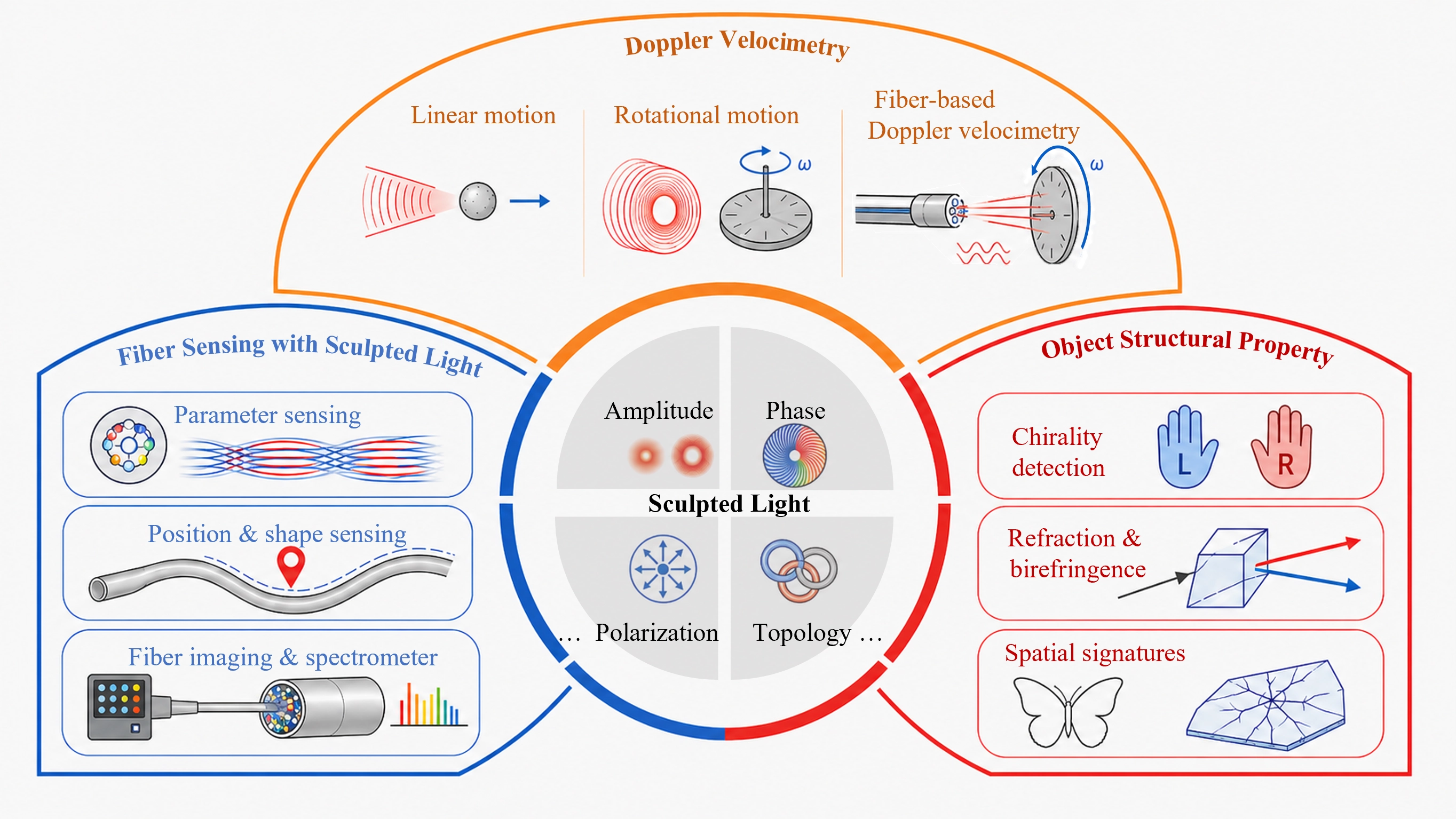
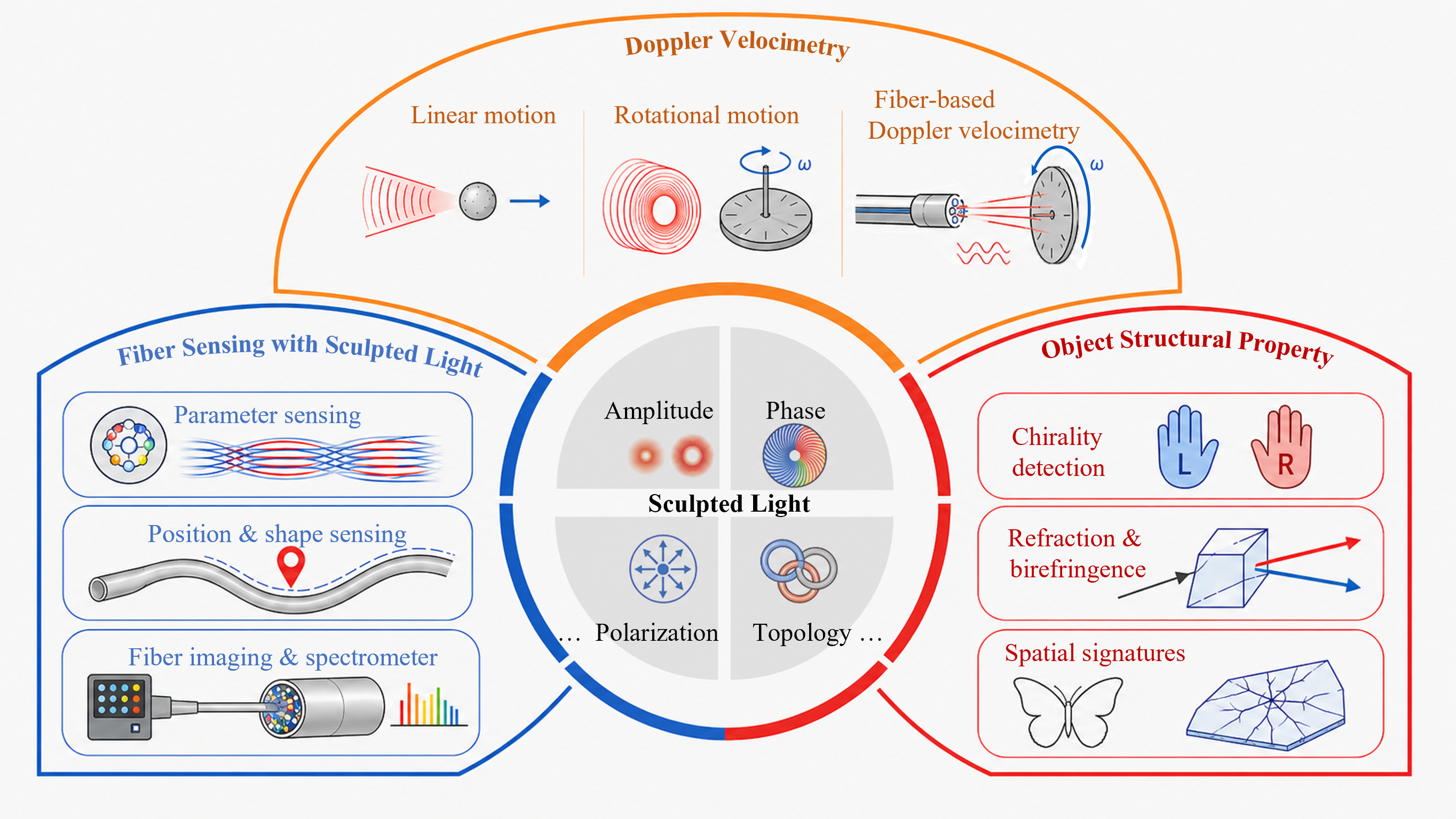
This review surveys these advances through three representative and interconnected application domains, covering fiber-based sensing (Section 2), Doppler velocimetry with sculpted light (Section 3), and the detection of object structural properties (Section 4). As shown in Figure 1, these developments illustrate that sculpted light constitutes not merely an incremental enhancement of existing sensing techniques, but a fundamentally new measurement philosophy. By recognizing the spatial structure of the electromagnetic field as a designable resource, sculpted-light sensing reframes how information is encoded, transmitted, and extracted. With the continuous advancement of specialty fibers, integrated photonics, and machine learning, this paradigm has the potential to enable compact, robust, and adaptive sensing systems that outperform traditional optical probes.
2. Fiber Sensing
Optical fibers provide a uniquely powerful platform for sculpted-light sensing, as they can be designed to support a rich set of spatial, modal, and vectorial degrees of freedom, while also offering mechanical flexibility, environmental robustness, and long-distance signal delivery. This intrinsic characteristic enables optical fibers to function simultaneously as light waveguides, interaction media, and sensing transducers, thus forming a unified platform for multidimensional optical sensing. The sculpted light in fiber does not merely refer to externally imposed light shaping, but rather to the designed excitation and manipulation of guided modes whose spatial properties are intrinsically defined by the geometry and material properties of the waveguide. Unlike sculpted light in free-space, whose spatial structure evolves continuously during propagation, sculpted light in fiber evolves through phase accumulation and mode coupling. External perturbations, such as strain, temperature, bending, pressure, or refractive index variations, alter the propagation constants and coupling conditions of guided modes in the fiber. This leads to a redistribution of energy or phase among different modes, which can be directly measured through modal interference or decomposition. In this way, optical fibers act as natural platforms for sculpted light manipulation, where sensing is governed by changes in mode structure rather than simple intensity jitter or wavelength shift. A key advantage of this mode evolution is that it provides multiple independent observables within a single fiber. Instead of relying on a single scalar response, different physical perturbations affect different aspects of the optical field. For example, axial strain primarily modifies the phase accumulation of guided modes, while bending and transverse pressure tend to induce mode coupling and redistribute power among modes or cores. By analyzing these responses, multiple parameters can be measured simultaneously or separated through appropriate signal processing.
As shown in Figure 2, fiber sculpted-light sensing architectures can be broadly categorized according to how spatial structure is generated and interrogated. In discrete-space approaches, such as multi-core fibers (MCFs), spatial structuring arises from the physical distribution of cores, enabling direct sampling of strain or refractive index fields across the fiber cross-section. In guided mode approaches, including few-mode fibers (FMFs) and multi-mode fibers (MMFs), sculpted light emerges from the coherent excitation and evolution of inherent modes, with modal interference and coupling serving as sensitive probes of external perturbations. Distributed approaches further extend sculpted-light concepts along the fiber length by exploiting intrinsic scattering processes, such as Rayleigh backscattering, to achieve quasi-continuous spatial resolution.
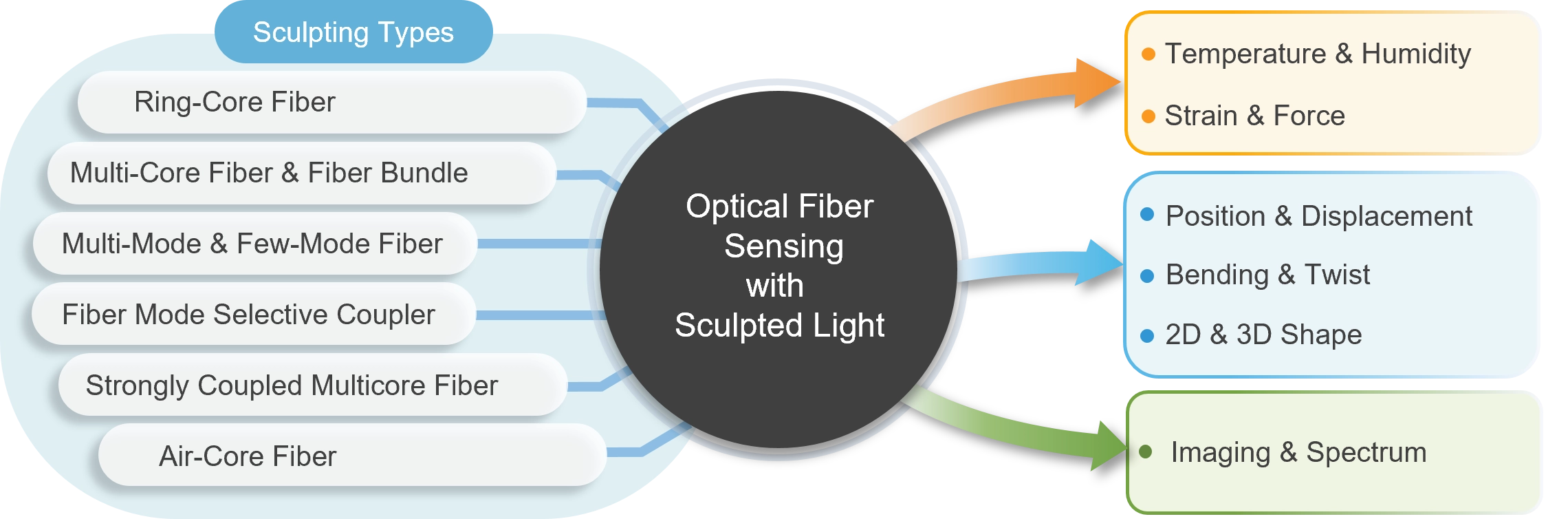
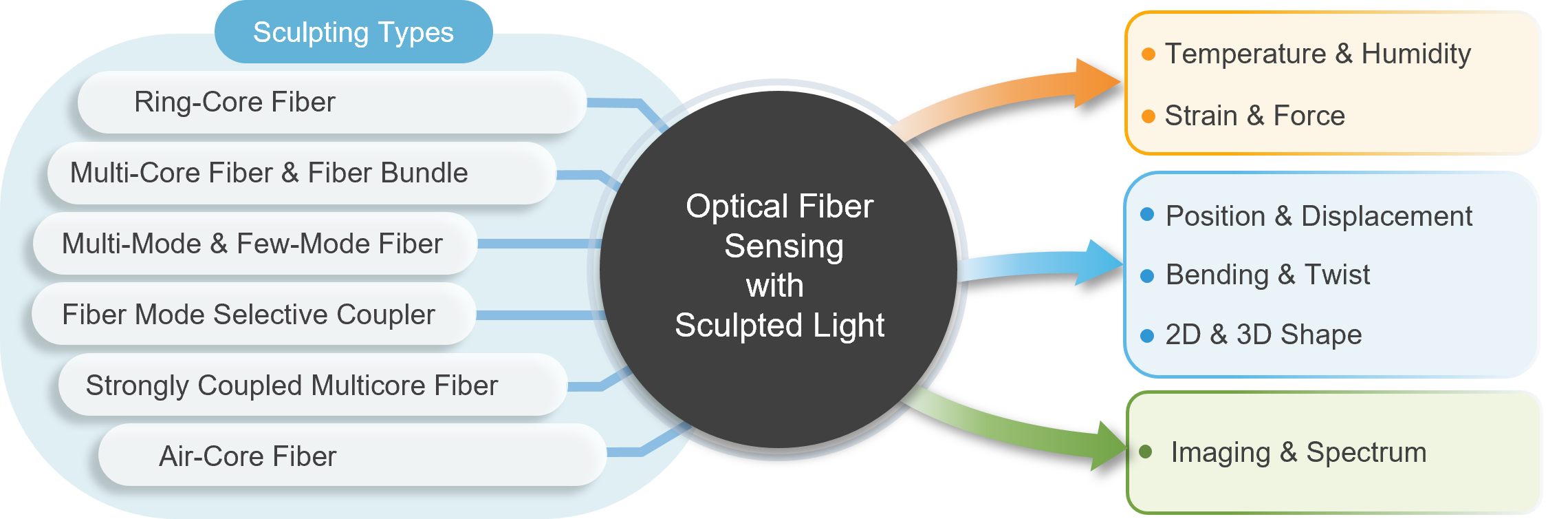
The breadth of physical quantities accessible through fiber sculpted-light sensing reflects the versatility of this framework. Scalar parameters such as temperature and strain, vector quantities such as force and velocity, distributed properties such as shape and curvature, and high-dimensional information such as images and spectra can all be encoded into sculpted light fields propagating within fibers. Importantly, these sensing modalities share a common physical foundation: the deliberate mapping of environmental perturbations onto changes in the spatial, mode, or vectorial structure of guided light.
2.1 Parameters sensing with fiber-sculpted mode
Optical parameter sensing, such as temperature, strain, and force, has traditionally relied on scalar observables in single-mode fibers, including wavelength shifts of fiber Bragg gratings or phase delays in interferometric configurations. While these approaches offer high sensitivity, they fundamentally limit the measurement space to one-dimensional responses, making multi-parameter discrimination and vectorial sensing challenging. Fiber-sculpted modes provide an alternative by exploiting the spatial and mode degrees of freedom of guided light, enabling external perturbations to be mapped onto differential mode responses rather than averaged scalar parameters[21,22].
In the OAM-based sensor by Huang et al., as shown in Figure 3a, a chiral long-period fiber grating (CLPFG) is used to excite and control the superposition between the fundamental mode (OAM0) and the first-order OAM mode (OAM1)[23]. The two modes coexist and interfere, forming a sculpted output field whose intensity pattern depends on their energy ratio. External perturbations, e.g., temperature, modify the grating’s refractive index and coupling condition, thereby changing the power transferred from OAM0 to OAM1. This directly alters the intensity profile of the superposed field, which can be quantified to achieve a linear temperature response. It shows that structured modes themselves can serve as the sensing signal. Compared to traditional interferometric OAM sensing, the method trades phase sensitivity for robustness and simplicity, demonstrating that sculpted light enables sensing even with purely intensity-based readout.
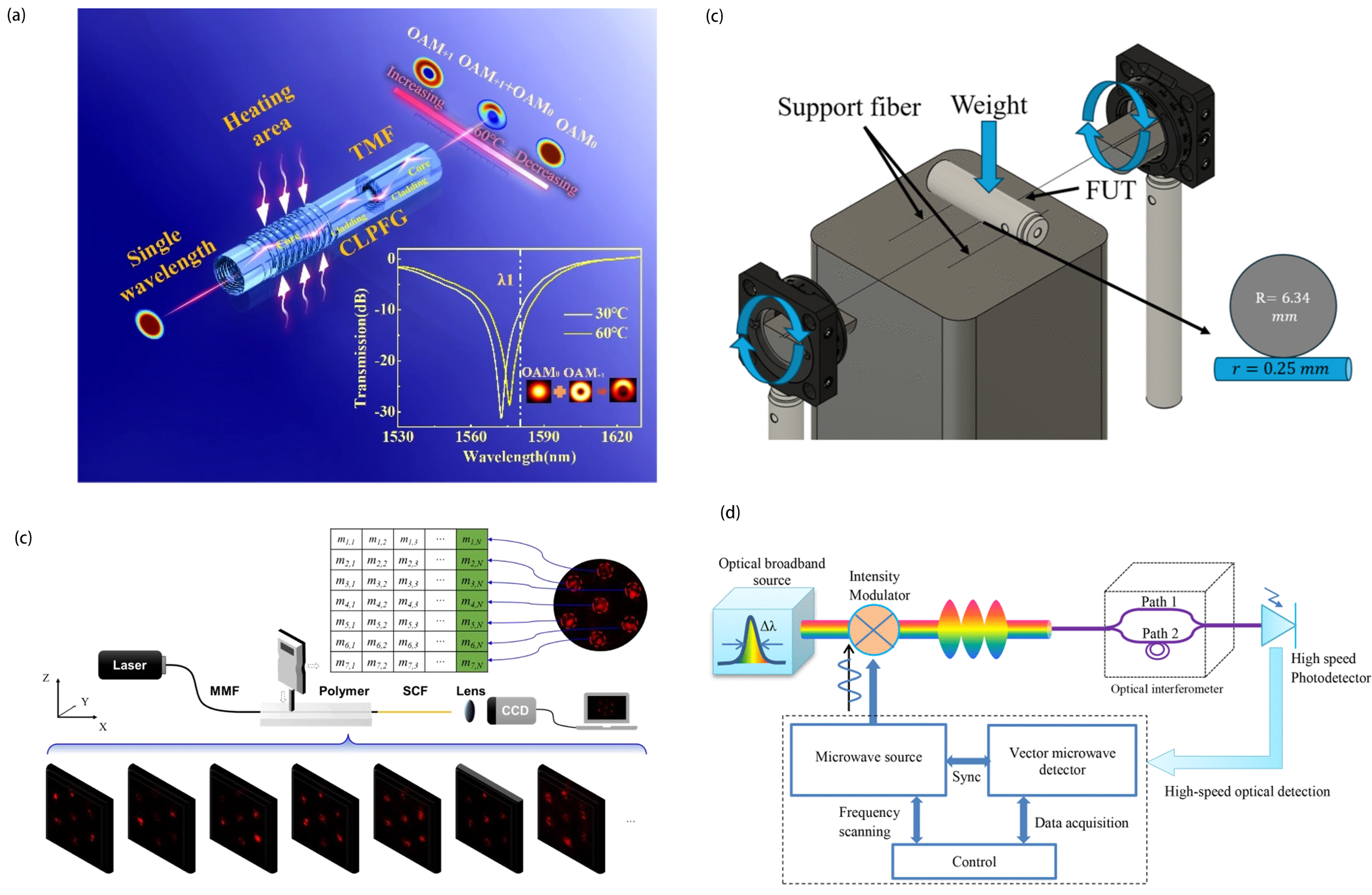
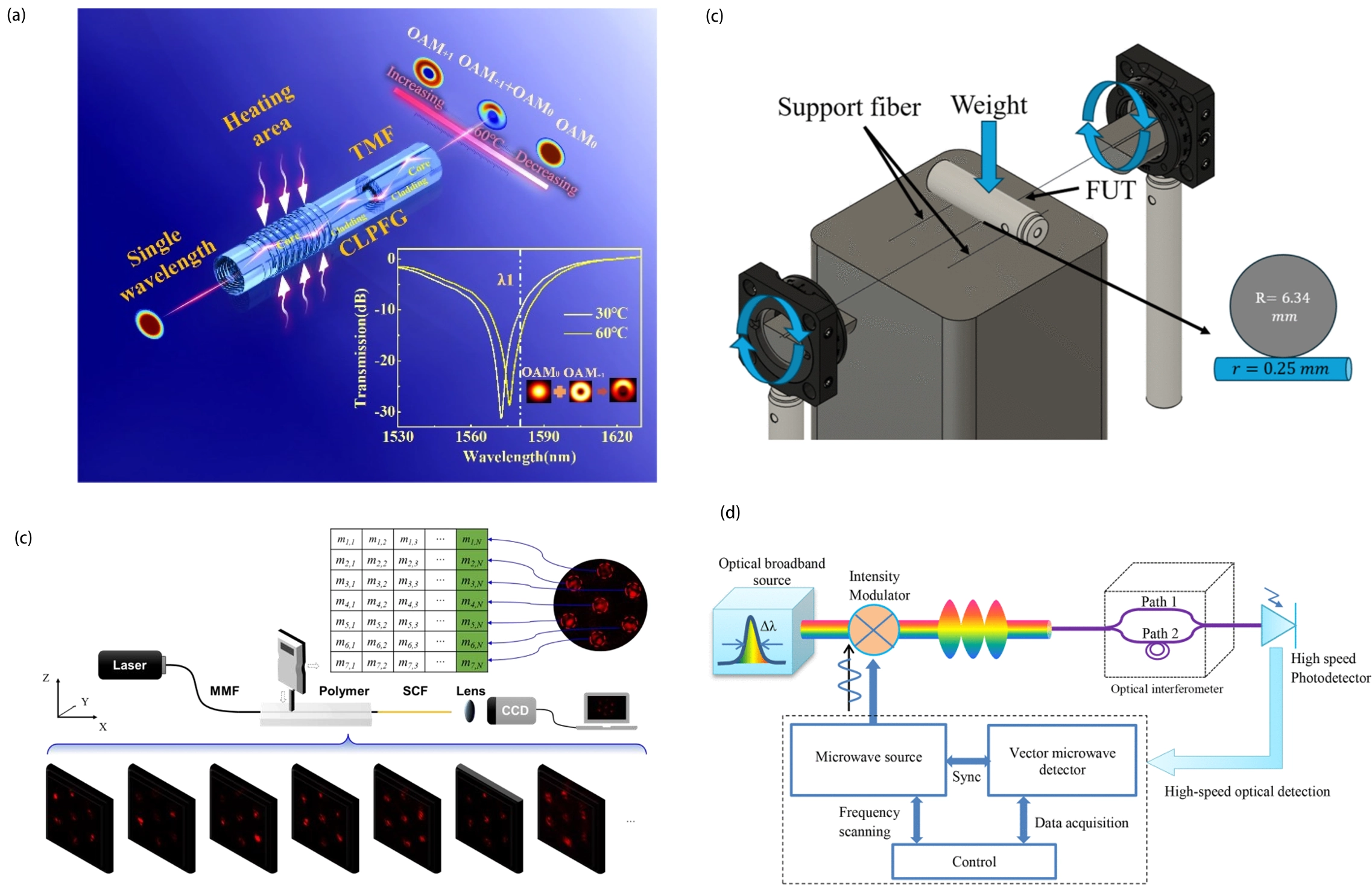
Figure 3. Parameters sensing with fiber-sculpted mode. (a) Orbital angular momentum mode temperature sensing technology based on intensity interrogation. Reproduced from[23]. CC BY 4.0; (b) Distributed directional force sensing in few-mode polarization-maintaining fibers via low-coherence interferometry. Reproduced from[24]. CC BY 4.0; (c) Machine learning enhanced smart tactile specklegram fiber sensor using spatial mode downsampling. Reproduced from[25]. CC BY 4.0; (d) High-precision and alignment-free all-fiber optical vortex interferometer. Reproduced from[28]. CC BY 4.0. FUT: fiber under test; SCF: seven-core fiber; SMF: single-mode fiber; FMF: few-mode fiber; OC: optical coupler; MSC: mode-selective coupler; Att.: attenuator; PC: polarization controller; Col.: fiber collimator; Pol.: polarizer; CLPFG: chiral long-period fiber grating; TMF: two-mode fiber.
A fundamentally different mechanism is used in few-mode polarization-maintaining fibers (FM-PMF), where sensing relies on perturbation-induced intermodal coupling and interference. In the work of Poiffaut et al., as shown in Figure 3b, light is launched primarily in the LP01 mode, and external transverse force locally induces coupling to higher-order modes LP11[24]. Here the perturbation is detected from the interference between modes with different effective indices. Because LP01 and LP11 accumulate different phase along the fiber, their coupling creates an interference signal whose frequency encodes the position of the perturbation via a Fourier relationship. More importantly, the use of polarization-maintaining fiber introduces an intrinsic asymmetry, so that the coupling strength depends on the direction of the force. This enables not only distributed sensing with a resolution of about 8 centimeters over tens of meters, but also directional force discrimination, which is not accessible in conventional scalar fiber sensors.
In MMFs, the number of supported modes becomes very large, and the output field forms a complex speckle pattern arising from coherent superposition of all modes. As shown in Figure 3c, the speckle pattern is used as a high-dimensional sensing signal for tactile and force detection[25]. The key point here is that the sensing is based on a deterministic but high-dimensional mapping between perturbation and speckle. Instead of tracking a specific mode, the system uses the entire modal ensemble as a detected object. The dimensionality is reduced by mapping the speckle image into power values of a seven-core fiber, effectively compressing millions of pixels into a small feature vector while preserving sensitivity. Machine learning is then used to invert this mapping and recover parameters such as force and position simultaneously with high accuracy. The sculpted light in speckle-based sensing methods is not simplified into a few modes, but instead fully exploited as a carrier of high-dimensional information.
Interferometric sensing schemes based on fiber-sculpted modes further enhance sensitivity and bandwidth by converting modal phase differences into measurable temporal or spectral signatures. In multimode fiber interferometers, environmental changes modify the optical path difference between modes, which traditionally leads to shifts in optical interference fringes. This process can be translated into the microwave domain using optical carrier-based microwave interferometry[26]. Instead of the directly measured optical interference, the modulated optical signal is converted into a microwave signal whose amplitude and phase encode the interferometric response. The broadband sources suppress optical domain coherence terms, allowing stable interference even in multimode systems. As a result, the system becomes less sensitive to polarization fluctuations and modal dispersion, while enabling high-speed sensing. The sculpted modes can be seamlessly interfaced with advanced signal-processing architectures, extending fiber sensing from optical to hybrid optical–RF measurement systems.
Beyond temperature and pressure, the fiber-sculpted mode sensing can be extensible to more physical parameters. Refractive index changes induced by chemical or biological interactions selectively perturb evanescent field components of higher-order modes, enabling label-free biochemical sensing. Acoustic waves and vibrations couple efficiently to specific modes, allowing distributed acoustic or ultrasound detection[27]. Magnetic and electric field sensing can be realized by integrating functional materials into fibers, where different modes experience distinct field overlap factors. As shown in Figure 3d, compared to free-space optical vortex interferometers (OVIs), the fiber-based OVI supports more measurable sensing parameters while eliminating intricate coaxial alignment procedures[28]. This all-fiber optical vortex interferometer requires neither costly broadband light sources nor high-resolution spectrometers, yet achieves improved polarization stability and 2-3 orders of magnitude higher sensitivity. In these cases, the key advantage lies in the ability to design or select sculpted modes whose spatial structure maximizes sensitivity to the parameter of interest[29].
Taken together, parameter sensing with fiber-sculpted modes shows a shift from scalar to multidimensional optical sensing. These approaches represent different ways of reading out how a sculpted light field evolves under perturbation. By choosing an appropriate modal basis and guided-wave platforms, the sensing process can be tailored to enable enhanced sensitivity, multi-parameter discrimination, and vectorial measurement capabilities[30-32]. As advances in specialty fiber design, mode-selective excitation, and coherent detection continue, fiber-sculpted mode sensing is expected to play a central role in next-generation optical sensors for environmental monitoring, smart materials, and human–machine interfaces.
2.2 Position & shape sensing
While parameter sensing focuses on extracting physical quantities from mode responses, position and shape sensing elevate sculpted-light sensing to an inverse geometric problem, where the spatial distribution of deformation is reconstructed from distributed or spatially multiplexed optical information. Spatially sculpted light fields enable direct access to vectorial and distributed deformation information, because geometric deformation does not affect all spatial channels equally. Unlike conventional point sensors that infer shape from sparse measurements, fiber-sculpted light sensing exploit spatial diversity to encode geometric deformation directly into the optical field, either through multiple cores, multiple modes, or distributed scattering[1]. In helically twisted photonic crystal fibers (PCFs), the relevant spatial mode is not a conventional linearly polarized (LP) mode. As shown in Figure 4a, a twisted solid-core PCF exhibits sharp transmission dips associated with OAM states in the micro-structured cladding, and these dip wavelengths shift linearly with both applied axial strain and mechanical twist[33]. The twist rate sets the orbital resonance condition, while axial strain changes both the photoelastic response and the effective twist rate of the helical structure. As a result, strain and torsion are converted into measurable wavelength shifts of the OAM-related resonances, allowing the twisted PCF to act as a torque–tension transducer, twist sensor or strain gauge. It shows that shape-related quantities in some fibers are not inferred from core strain differences, but directly from the evolution of a helical structured mode supported by the waveguide itself.
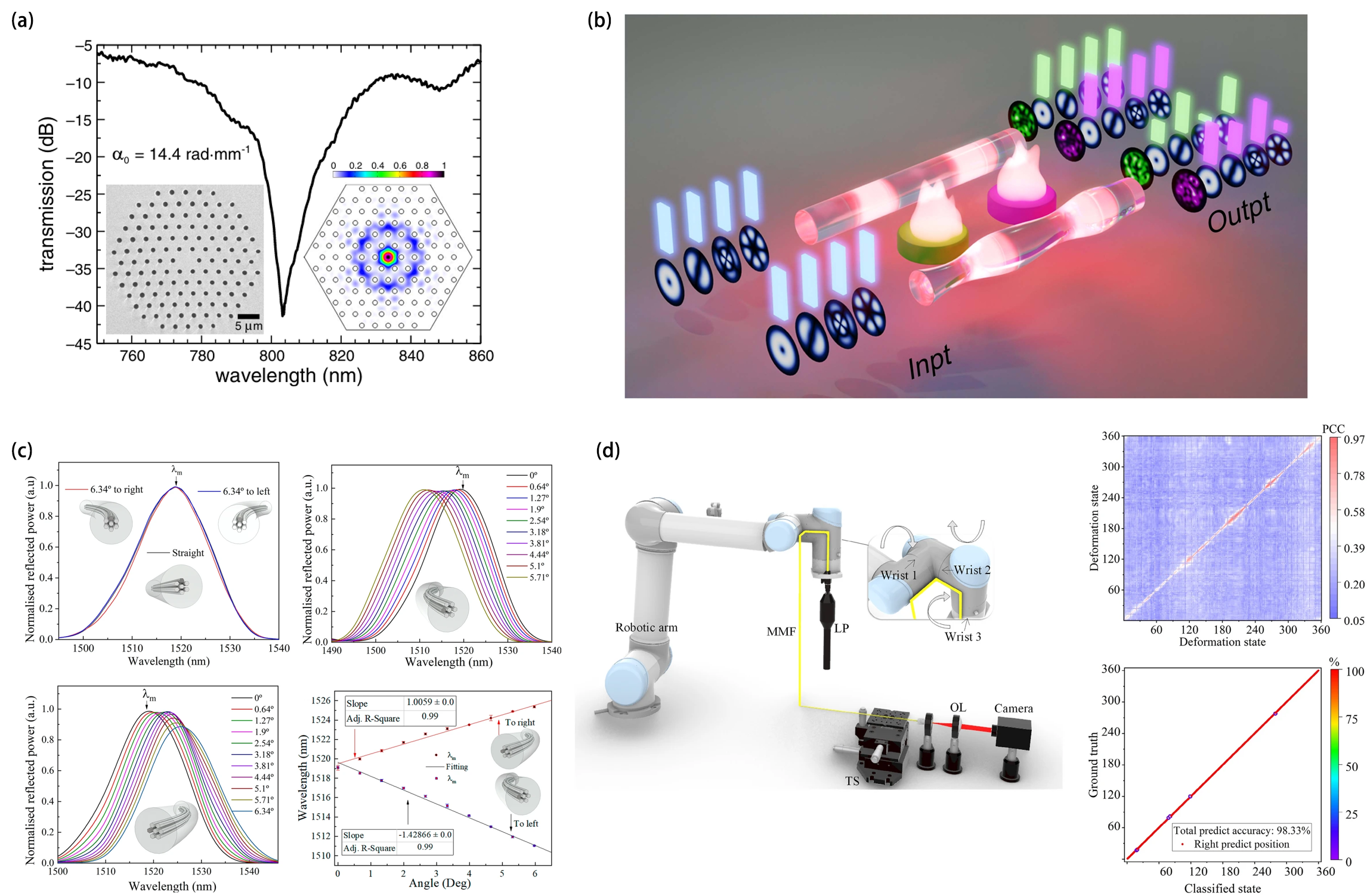
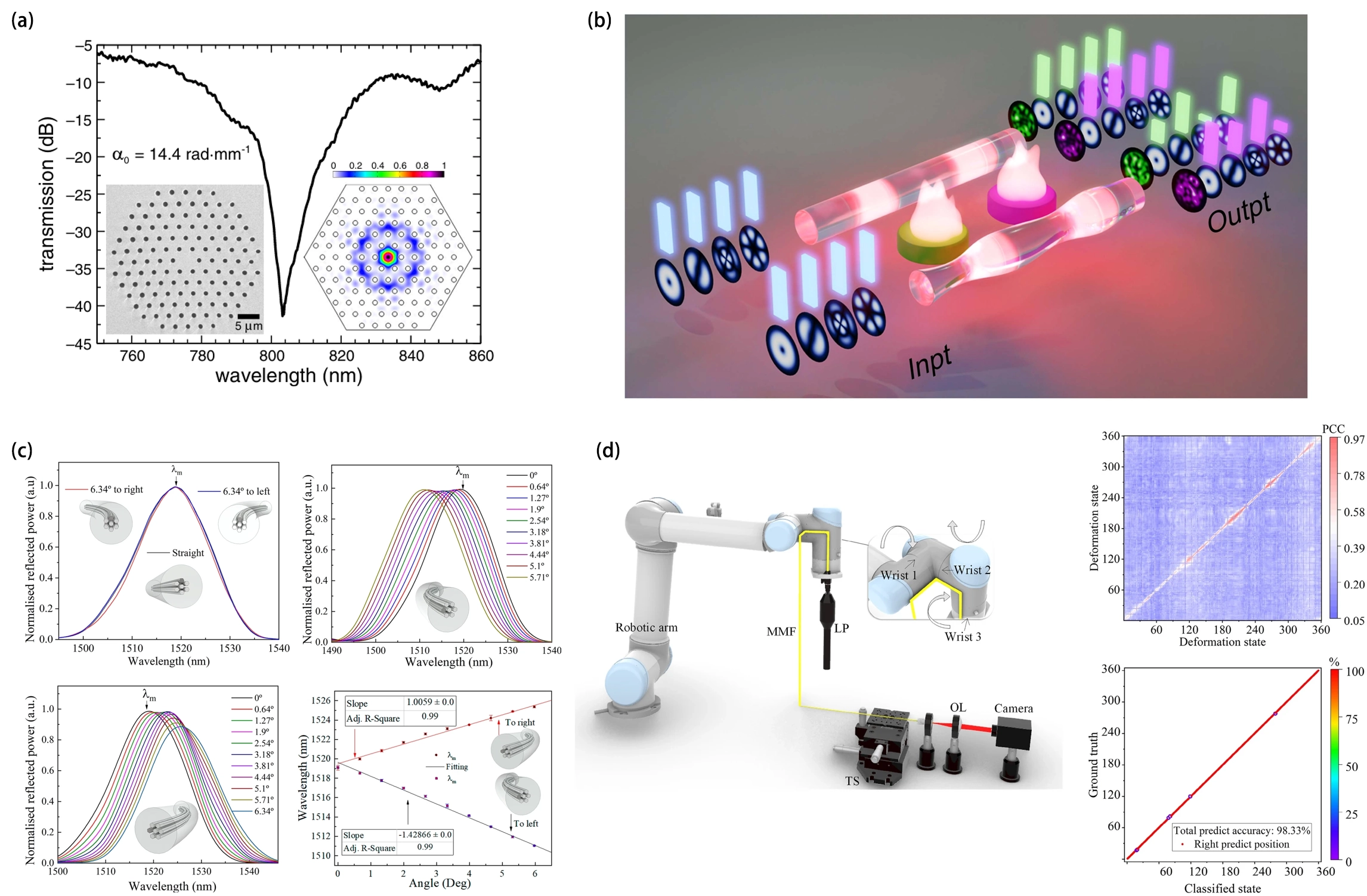
Figure 4. Position and shape sensing. (a) Measuring mechanical strain and twist using helical photonic crystal fiber. Reproduced with permission from reference[33]. Copyright © 2013 Optica Publishing Group; (b) Vector bending and orientation distinguishing curvature sensor based on asymmetric coupled multi-core fiber. Reprinted from reference[38]. CC BY 4.0; (c) Spatially resolved sensing based on complex light propagation in a multimode fiber. In an optical fiber with longitudinal variations, mode coupling leads to modal power redistribution, rendering the effect of optical path length changes position-dependent, hence allowing for longitudinally resolved sensing. Reprinted from reference[41]. CC BY 4.0; (d) Learning to sense three-dimensional shape deformation of a single multimode fiber. Reprinted from reference[49]. CC BY 4.0. MMF: multimode fiber; OL: objective lens; LP: laser pointer; TS: translation stage.
In multicore fibers, geometric information is encoded either by core-to-core differential strain or by supermode redistribution in coupled-core structures. In weakly coupled multicore fibers, each core samples a different transverse position, so bending produces different axial strain in different cores and the relative wavelength or phase response can be used to reconstruct curvature. This is the physical basis behind early two-axis and multipoint curvature sensing with multicore fibers[34-36]. In strongly coupled multicore fiber, both curvature magnitude and direction are encoded in the redistribution of structured supermodes[37-39]. The asymmetric strongly coupled multicore fiber demonstrated by Arrizabalaga et al., is shown in Figure 4b, where one outer core is modified by femtosecond laser inscription to intentionally break the symmetry of the seven-core structure[38]. In that case, bending does not merely stretch some cores more than others; it changes the excitation and beating of different supermodes, so that the transmission spectrum shifts differently for different bending directions. The deformation is encoded into direction-dependent supermode interference, rather than only into scalar strain, allowing the discrimination of both curvature magnitude and orientation. Recent work has further incorporated torsion sensitivity by exploiting asymmetries in core placement or strain-transfer mechanisms, enabling simultaneous measurement of bending and torsion through frequency domain signal analyzation[40].
Beyond discrete-core sampling, multimode fibers can be used as longitudinally distributed mode-mixing systems. The light within a multimode optical fiber consists of a superposition of eigenmodes, each carrying a portion of the total power propagating in the fiber. A perturbation on the fiber will induce mode-dependent phase changes, which will manifest as a change in the output of the fiber. As shown in Figure 4c, spatially resolved sensing with a single MMF is only possible if the fiber exhibits spatially dependent mode coupling[41]. In a perfectly longitudinally invariant MMF with no mode coupling, the output cannot distinguish where along the fiber a perturbation occurred, because the perturbation only adds phase to the same diagonal modal basis. Once longitudinal variations or distributed mode mixing are present, e.g., a fiber with diameter variations, the order of propagation matters, and the output becomes dependent on perturbation position. In other words, location information is created by distributed mode mixing along the fiber. Researchers further show experimentally that fibers with stronger longitudinal mode coupling encode spatially resolved sensing information more clearly and therefore allow better reconstruction accuracy. In this context, sculpted light arises from the excitation and evolution of multi-mode fields, transforming modal interference into a sensitive probe of spatial perturbations. While such approaches often rely on computational reconstruction or data-driven decoding, they highlight the power of mode diversity as a sensing resource complementary to multi-core architectures[42].
Distributed shape sensing based on Rayleigh- or OFDR-type interrogation in multicore fibers adds dense axial sampling to transverse spatial diversity. In such systems, the fiber provides both multiple transverse sensing channels and continuous longitudinal information, enabling full shape reconstruction under complex deformation[43-48]. Another method takes this idea one step further and treats the output speckle of a single MMF as a high-dimensional signature of the fiber’s own deformation. In the work of Wang et al., as shown in Figure 4d, the MMF output speckles are used to classify one-point bending location, one-point bending angle, two-dimensional multi-point deformation, and even three-dimensional deformation states of a robotic-arm-mounted fiber[49]. The deformation changes the relative mode phases and amplitudes, which changes the speckle, and the speckle pattern carries enough information for machine-learning-based reconstruction of the deformation state. High classification accuracy is achieved in several tasks, including 3D multi-point deformation sensing, in which only a standard MMF and a comparatively simple optical setup are used. Conceptually different from multicore shape sensors, this type of work uses the entire multimode interference field as a rich but implicit encoding way, instead of mapping geometry to a small number of calibrated channels.
Taken together, these studies show that position and shape sensing with sculpted light is not a single technique but a family of approaches that differ in how geometry is encoded: through OAM resonance shifts in helical fibers, supermode beating in asymmetric multicore fibers, spatially dependent mode mixing in MMFs, or distributed scattering along multicore waveguides. What unifies them is that spatially sculpted light fields encode geometric deformation through differential interaction with the fiber’s internal degrees of freedom. Whether realized through discrete cores, mode spectra, or distributed scattering, sculpted light enables direct access to curvature, torsion, displacement, and three-dimensional shape with high sensitivity and robustness.
2.3 Fiber imaging & spectrometer
In contrast to shape sensing, where the fiber itself acts as the sensing object, fiber-based imaging and spectrometry treat the fiber as an information encoder, mapping external spatial or spectral information into optical signatures. Fiber-based imaging and spectrometry represent a natural extension of sculpted-light sensing, where the goal shifts from measuring scalar or vectorial parameters to reconstructing high-dimensional spatial and spectral information. Unlike conventional fiber sensors that treat modal dispersion and coupling as sources of distortion, sculpted-light approaches deliberately exploit the complex propagation dynamics of sculpted light fields in specialty fibers as an information encoding mechanism. In this sense, the fiber functions as a reconfigurable and computational imaging element: by changing the launched modal state, calibration strategy, or reconstruction method, the same fiber platform can support different imaging and spectroscopic tasks.
In an MMF, a large number of modes can propagate simultaneously, and their interference at the output forms a complex but deterministic field. This has enabled both learning-based image transmission and calibrated wavefront-shaping imaging through disordered fibers[50-54]. As shown in Figure 5a, three-dimensional imaging through MMF has been demonstrated, where a 50-μm-core MMF was combined with transmission-matrix-based wavefront shaping, pulsed illumination, and time-resolved detection to achieve depth-resolved imaging through an ultrathin fiber probe[55]. The MMF is calibrated so that a focused spot can be raster-scanned at the distal side, while time-of-flight histograms of the returned pulses provide the third dimension. In this way, the MMF no longer serves merely as a flexible image conduit, but as an ultrathin lidar-like microendoscope that grants a single fiber access to both reflectance and depth. The work shows that mode scrambling in MMFs does not preclude imaging; once calibrated, it can support near–video-rate volumetric imaging through a sub-millimeter aperture. A more recent development has pushed MMF imaging further toward practical endoscopic deployment. As shown in Figure 5b, Wen et al., demonstrated single-MMF light-field-encoded endoscopic imaging, in which spatial-frequency tracking and adaptive beacon strategies were used to enable imaging through a single multimode fiber even under bending and twisting[56]. Unlike conventional MMF endoscopes that rely on a fixed calibration and are therefore highly sensitive to perturbation, this approach continuously updates the optical encoding relation and reconstructs the object from the light-field information carried by the transmitted field. The resulting system achieves in vivo imaging through a single multimode fiber with subcellular-level resolution. These studies show that MMF imaging is evolving from two-dimensional intensity reconstruction toward a broader class of depth-resolved, perturbation-tolerant, and biologically relevant computational imaging systems.
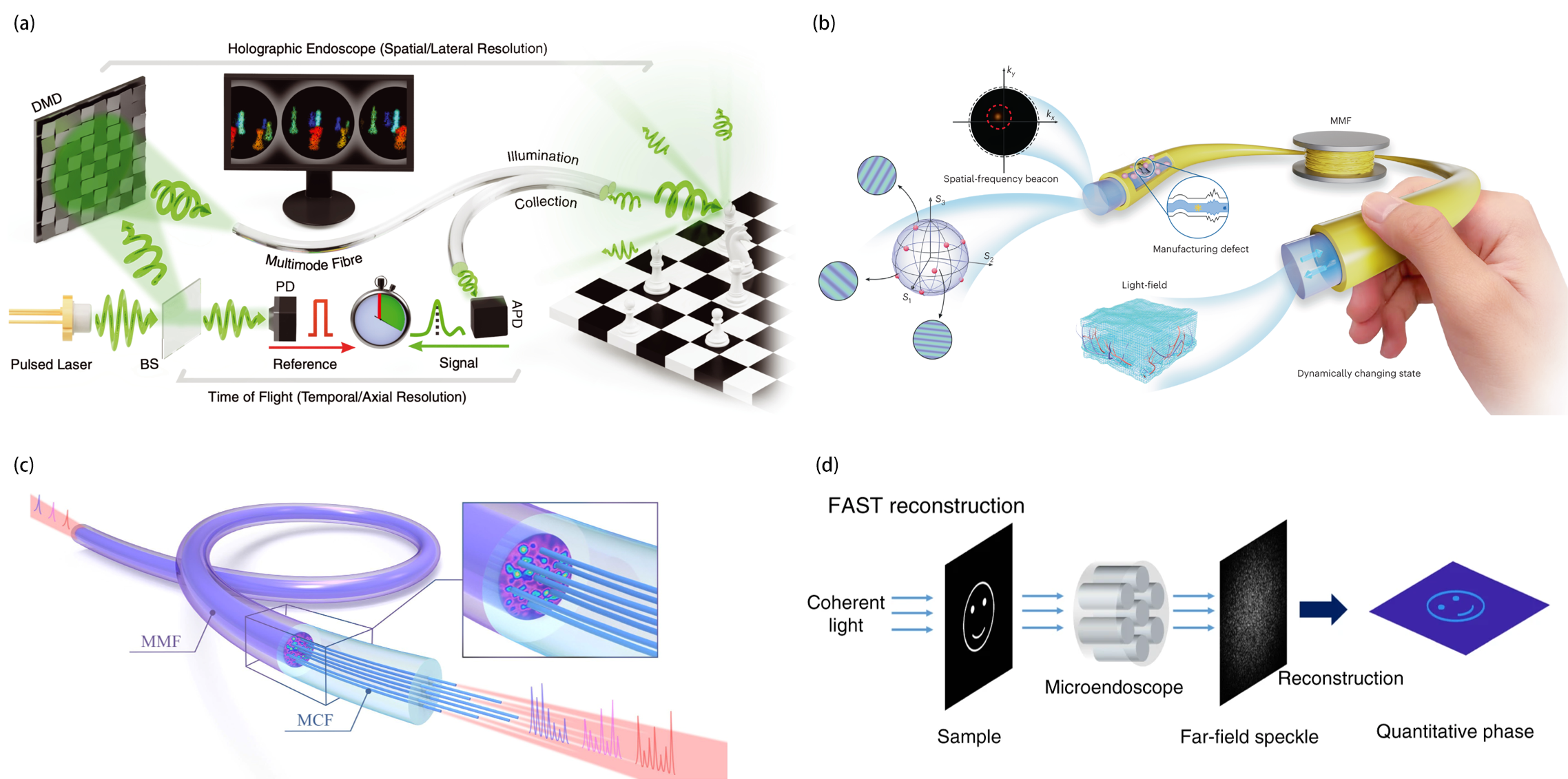
Figure 5. Fiber Imaging and Spectrometer. (a) Time-of-flight 3D imaging through multimode fibers. Reproduced with permission from reference[55]. Copyright © 2021 The American Association for the Advancement of Science; (b) Single multimode fiber for in vivo light-field-encoded endoscopic imaging. Reprinted from reference[56]. CC BY 4.0; (c) Fiber spectrometer with spectra-space-time mapping. Reprinted from reference[60]. CC BY 4.0; (d) The far-field amplitude-only speckle transfer method uses an ultra-thin bare MCF is used to encode the incident complex field into far-field speckles, which reconstructs the incident amplitude and phase field at the measurement side from speckles recorded at the detection side. Reprinted from reference[65]. CC BY 4.0. DMD: digital micromirror device; BS: beam splitter; PD: photodetector; MMF: few-mode fiber; MCF: multi-core fiber.
Wavefront shaping through structured fibers is another way to achieve sculpted-light imaging. Unlike MMFs, where light evolution is determined by dense mode mixing, an MCF provides a set of discrete single-mode channels whose relative phases can be individually controlled. For example, phase distortions accumulated across the cores were first compensated by digital optical phase conjugation, after which the MCF was treated as a spatially sampled wavefront shaper[57]. To address the strong sampling and aliasing imposed by the discrete core layout, the Core–Gerchberg–Saxton algorithm is introduced to explicitly incorporate the experimentally measured core distribution into the phase retrieval process. This allows the distal light intensity to be engineered with high fidelity, turning the MCF into a wavefront shaper embedded within a waveguide[58]. In this scheme, the MCF is not only a waveguide, but also a wavefront synthesis device, capable of delivering targeted light distributions for focusing, scanning, or inspection in endoscopic and lab-on-a-chip settings[59].
Sculpted light also enables compact and ultrafast fiber spectrometry, in which spectral information is encoded into a measurable spatial or temporal signature. In multimode or dispersive fiber systems, light of different wavelengths excites distinct modal distributions or arrival times, producing wavelength-dependent intensity patterns at the output. By utilizing spectral-spatial-temporal mapping, it becomes possible to measure rapidly varying spectra at speeds far exceeding those of conventional wavemeters, as shown in Figure 5c[60]. The system first uses an MMF to convert wavelength into a wavelength-dependent speckle pattern, then uses a seven-core MCF to sample that pattern and convert the spatial information into a delayed pulse sequence detected by a single fast photodiode. In other words, the MMF performs spectral-to-spatial mapping, and the MCF performs spatial-to-temporal mapping. This hybrid architecture removes the frame-rate limit of image sensors and enables wavelength estimation at 100 MHz with picometer-level precision. Such fiber spectrometers trade optical simplicity for computational decoding, leveraging the high dimensionality of sculpted light fields to achieve compactness, speed, and broad bandwidth[61-64].
Quantitative phase imaging through optical fibers further highlights the power of sculpted light for extracting information. Phase-sensitive measurements encode optical path length variations caused by refractive index or thickness changes in transparent samples, providing label-free contrast for biological and material imaging. As shown in Figure 5d[65], an ultra-thin bare MCF is used not just to transmit light, but to encode the incident complex field into far-field speckles. The computational approach, named the far-field amplitude-only speckle transfer method, reconstructs the incident field at the measurement side from intensity-only far-field speckles recorded at the detection side, allowing both amplitude and phase to be recovered without distal optics. The thin fiber bundle is turned into a computational phase micro-endoscope with digital refocusing capability. The physical basis is that the optical path length differences across the many cores of a static MCF impose a stable phase encoding, so the outgoing speckle contains recoverable information about the sample’s complex field. As a result, it has the potential to reconstruct transparent phase objects, multilayer targets, and flowing beads in three dimensions with microscale lateral resolution and nanoscale sensitivity to optical path length.
Fiber-based sculpted-light systems naturally integrate with computational sensing paradigms. The high-dimensional optical fields generated by structured fibers are well suited for compressive sensing, single-pixel detection, and learning-based reconstruction, enabling imaging and spectral analysis with minimal hardware complexity. As specialty fiber designs continue to evolve, incorporating tailored dispersion, mode selectivity, and hybrid free-space coupling, the waveguide optics and the computational imaging complement each other[66-69].
Taken together, these studies show that fiber imaging and spectrometry with sculpted light are built on a common principle: the fiber is used as a deterministic mode transformer that maps otherwise inaccessible information into a measurable optical signature. For example, modal interference and time-of-flight in MMF imaging; the core-sampled distal field in MCF wavefront shaping; wavelength-dependent spatial–temporal encoding in fiber spectrometry; and the far-field speckle generated by a complex incident field in quantitative phase imaging. What unites these approaches is not a single hardware platform, but a shared strategy of exploiting structured propagation as an encoding resource. This is why fiber-based sculpted light has become such a powerful foundation for compact imaging probes, computational spectrometers, and high-dimensional optical measurement systems.
3. Doppler Velocimetry
While the previous chapter examined how sculpted optical fields probe static or quasi-static physical parameters through modal perturbations, Doppler velocimetry addresses a fundamentally different question: how motion itself imprints dynamic signatures onto sculpted light. In conventional metrology, the Doppler effect is typically interpreted as a frequency shift arising from the projection of linear velocity onto the wave vector, observable in optics[70-72] and acoustics[73,74]. However, once the spatial structure of light is explicitly considered, this interpretation proves incomplete. Sculpted optical fields carry not only linear momentum but also orbital and spin angular momentum (SAM), as well as higher-order properties. Motion therefore couples to multiple physical quantities of the electromagnetic field, enabling Doppler sensing that is intrinsically multidimensional.
From a phase-based perspective, Doppler shifts originate from time-dependent optical phase accumulation. For spatially uniform beams, this temporal phase variation reflects longitudinal translation. For sculpted light beams with azimuthal phase gradients or polarization distribution, rotational or transverse motion also produces measurable frequency components. The evolution of sculpted-light Doppler sensing can therefore be understood as a progressive expansion of the accessible momentum space. Classical laser Doppler velocimetry probes linear momentum exchange and measures a single velocity component. The introduction of vortex beams extends this interaction to orbital angular momentum, enabling momentum exchange between optical topological charge and rotational motion[75,76].
Optical fibers provide a natural platform for implementing these concepts in practical systems. Guided modes in specialty fibers form discrete eigenchannels that can be selectively excited, coherently superposed, and robustly delivered over long distances[77]. Fiber-based sculpted-light systems thus enable compact, remote, and mechanically flexible Doppler velocimetry while preserving the multidimensional nature of sculpted light fields. This chapter first examines the fundamental physical mechanisms underlying Doppler effects with sculpted light, including phase-based, mode expansion, and conservation-law interpretations. Then, fiber-based implementations are discussed, using specialty fibers and modal engineering to realize remote rotational and vectorial velocimetry.
3.1 Doppler effect with sculpted light
The Doppler effect has long served as an important way of optical velocimetry, traditionally interpreted as a frequency shift arising from the relative motion between a light source and a scattering object. In laser Doppler velocimetry, this shift is determined solely by the projection of the object’s linear velocity onto the optical wave vector, reflecting conservation of linear momentum. However, this scalar description implicitly assumes spatially uniform optical fields and neglects the role of light’s internal spatial structure. In recent years, researchers' in-depth exploration of vortex beams has brought the rotational Doppler effect into public view. Unlike the classical linear Doppler effect, the rotational Doppler effect has been proven to be wavelength-independent[78]. As a novel physical phenomenon, it has been observed in various dynamic matters, including prisms[79], particles[80,81], fluids[82], atoms[83], and macro objects[84]. Moreover, it has driven progress across numerous interdisciplinary fields, such as metasurface[85,86], microwave[87], aerospace engineering[88], high-order lasers[89], nonlinear optics[90-93], and computational imaging[94]. This subsection will begin to summarize theoretical explanations of the rotational Doppler effect from different perspectives.
The classical optical Doppler effect measures motion through the time-varying phase accumulated along the propagation direction of light. In its conventional form, the detected frequency shift is tied to the velocity component parallel to the optical wavevector, which is why standard laser Doppler velocimetry is intrinsically most sensitive to longitudinal motion. The introduction of sculpted light changes this starting point. In the formulation by Belmonte and Torres, the detected phase of the returned signal is written as the sum of the usual longitudinal term and an additional phase term imposed by the transverse spatial structure of the illuminating beam[95]. For a beam with spatially varying phase Φ(r⟂), the temporal phase change becomes ∂ψ/∂t = 2kvz + ΔΦ∙v⟂, showing explicitly that motion in the transverse plane can also generate a Doppler shift when the beam carries a designed phase gradient. This formulation makes clear that rotational motion naturally contributes an additional Doppler term, even in the absence of longitudinal translation. Within this picture, the Doppler effect is no longer tied exclusively to the propagation direction of the beam but instead reflects how object motion modulates the spatial phase structure of the optical field.
A particularly important case of this general principle is the rotational Doppler effect, obtained when the incident field carries OAM. In this case, the transverse phase is helical, exp(iℓΦ), so rotation of the target changes the sampled azimuthal phase in time and produces a frequency shift proportional to the angular velocity. Subsequent theoretical analysis clarified that this effect can be derived from the classical linear Doppler effect by projecting along the direction of motion, as shown in Figure 6a. Just as a translating rough surface viewed at an angle produces a reduced linear Doppler shift, a rotating rough surface illuminated by a helically phased beam experiences a local azimuthal projection of the optical momentum, so that angular motion is converted into measurable frequency modulation[96]. Since the Poynting vector of the vortex beam possesses a projection component in the direction of rotational motion, the angle between the Poynting vector and the axis is α = ℓλ/2πr. Combining this with the theoretical formula for linear Doppler shift also yields an expression for the rotational Doppler shift:
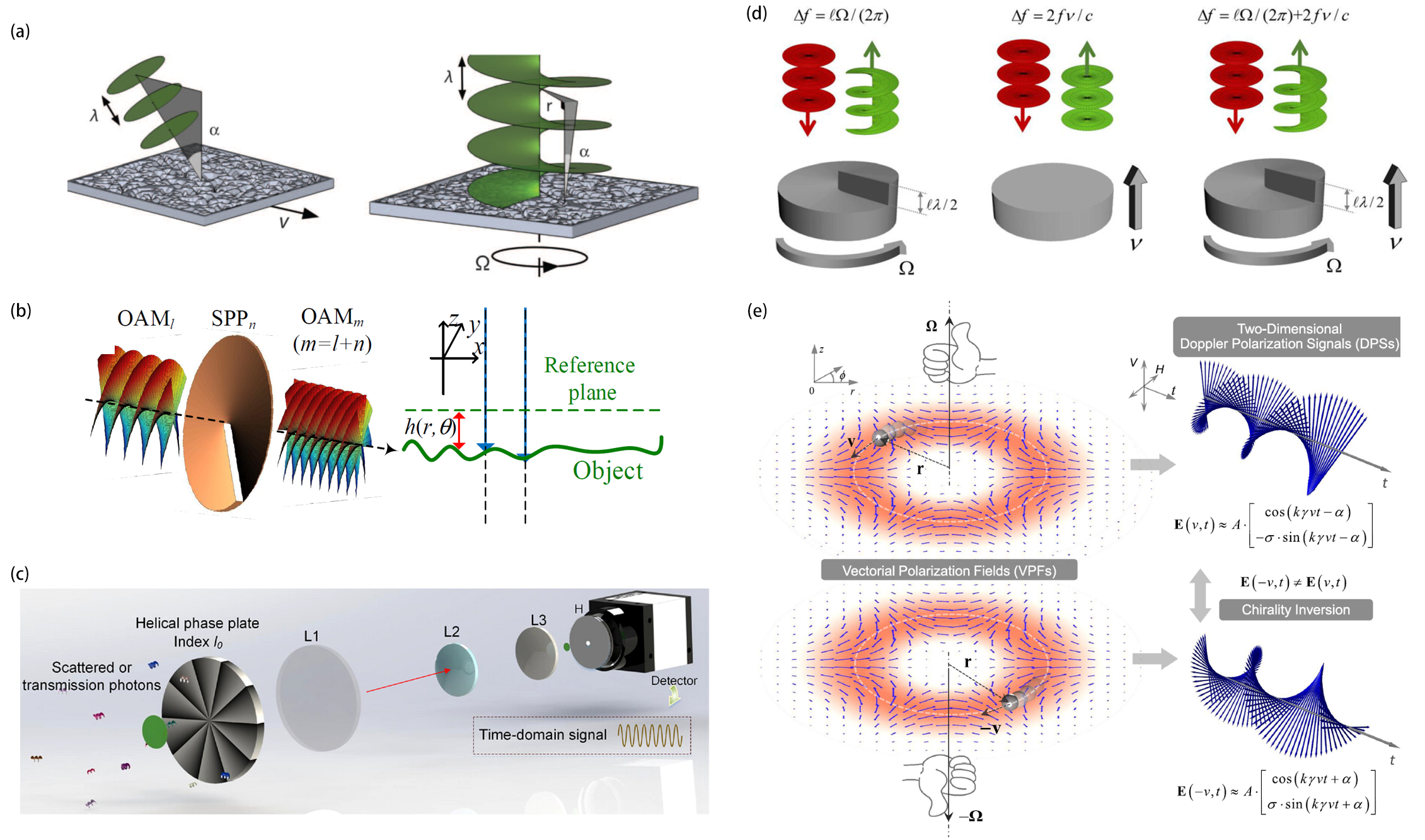
Figure 6. Doppler effect with sculpted light. (a) Detection of a spinning object using light’s orbital angular momentum. Reproduced with permission from reference[96]. Copyright © 2013 The American Association for the Advancement of Science; (b) Optical rotational Doppler effect with mode expansion. Reprinted from reference[97]. CC BY 4.0; (c) Doppler features are analyzed in scattered twisted photons carrying OAM with a common light source, and it is demonstrated that the rotational Doppler effect induced by a typical rotator can be extracted using a spiral phase spatial filter at the receiver. Reprinted from reference[98]. CC BY 4.0; (d) Sharing a common origin between the rotational and linear Doppler effects. Reproduced with permission from reference[99]. Copyright © 2019 John Wiley and Sons; (e) Vectorial Doppler metrology. Reprinted from reference[101]. CC BY 4.0. OAM: orbital angular momentum; SPP: spiral phase plate.
Additionally, once scattering from realistic rotating surfaces is considered, the rotational Doppler effect is better understood as a mode-conversion process. When an OAM-carrying beam illuminates a rotating rough surface, the scattered light carries different OAMs. As shown in Figure 6b, Zhou et al., developed this point explicitly through a mode-expansion method[97], showing that the frequency content of the scattered light is determined by the spiral phase distribution introduced by the rotating object and depends on the difference between the OAM indices of the incident and scattered fields, rather than on the incident mode alone. In this picture, the rotating surface acts as a mode converter to redistribute the incident field into different mode channels, and each converted component carries a frequency shift set by both the rotation speed and the change in mode index. This mode-expansion picture was further extended. As shown in Figure 6c, Zhai et al. analyzed the rotational Doppler effect of twisted photons in scattered fields and showed that the relevant Doppler features can be extracted directly from the scattered light field using a spiral phase spatial filter at the receiver, even without relying on a high-purity vortex source[98]. The rotating rough surface naturally scatters abundant twisted photons with different OAM values, and it is shown that the resulting OAM spectrum is modulated by the angular coherence and autocorrelation structure of the surface itself. In this way, the rotational Doppler effect is no longer only a means of measuring angular velocity, but also a probe of the spatial statistics of the scattering object. This work broadens the significance of rotational Doppler sensing, because it connects rotational motion measurement with OAM-spectrum analysis, rough-surface characterization, and computational detection, while also suggesting a more practical route in which scattered twisted photons are analyzed at the receiver side rather than generated solely by a sculpted light source.
As shown in Figure 6d, a unifying physical interpretation emerges when linear and rotational Doppler effects are viewed through the lens of momentum conservation[99]. In this framework, translational motion couples to the linear momentum of photons, while rotational motion couples to their orbital angular momentum, yielding a generalized Doppler shift that contains both contributions:
The key insight is that these are not unrelated effects. For example, a rotating helical surface can be interpreted as having an equivalent local linear motion along its helical height profile, so the rotational Doppler shift may be derived from the linear one, and vice versa. It is no longer just an exotic property of vortex beams, but part of a broader framework in which linear momentum and angular momentum provide routes in different dimensions for converting motion into frequency shift.
Beyond scalar phase-structured beams, vectorially structured light can be used to retrieve not only the magnitude but also the direction of motion. As shown in Figure 6e, Fang et al., introduced this idea as vectorial Doppler velocimetry, using spatially variant polarization fields whose local state of polarization changes across the beam[100-102]. When a moving particle samples such a field, the scattered signal is no longer described only by a time-varying phase or intensity, but by a time-varying polarization state, in other words, a two-dimensional Doppler polarization signal. By analyzing this signal with two polarizers, they showed that one can extract both the magnitude and the sign of the rotational velocity, overcoming a central limitation of conventional scalar Doppler methods, which often require extra heterodyne schemes or multiple beams to determine motion direction. Sculpted light expands Doppler velocimetry in the same way it expands other sensing modalities: not simply by increasing sensitivity, but by introducing additional optical degrees of freedom that can encode otherwise inaccessible components of motion.
Taken together, these works show that the rotational Doppler effect has gradually evolved into a significant paradigm for studying the interaction between light and matter. In recent years, the theoretical framework surrounding the rotational Doppler effect has been continuously refined, encompassing aspects such as misalignment of beams[103-106], acceleration analysis[107], compound motion detection[88,108,109], cascaded rotational Doppler effect[110,111], structure-shearing Doppler effect[112], and coherence of light[113,114]. Concurrently, expanding the application scenarios of the rotational Doppler effect has emerged as a new research direction, particularly in complex environments like atmospheric turbulence[115,116].
3.2 Fiber-based velocimetry with sculpted light
The transition from free-space Doppler velocimetry to fiber-based implementations has been applied in coherent Doppler lidar[117-119] and linear Doppler velocimetry[120-122], marking a critical step toward practical, compact, and remotely deployable sensing systems. While the physical principles of Doppler effects arise from the coupling between object motion and the linear or angular momentum of light, optical fibers provide a uniquely stable and scalable platform for generating, transporting, and coherently interrogating sculpted optical fields[77,123-125]. In this context, guided modes are not merely delivery channels but constitute degree of freedoms of the light field that interact with motion, forming the basis of Doppler velocimetry.
In fiber-based rotational Doppler velocimetry, the role of the specialty fiber is not simply to transport light, but to preserve the specific structured mode basis required for motion encoding. This requirement is particularly stringent for OAM or vector modes, because the sensing signal depends on the relative phase or polarization of the delivered field after long-distance propagation. Air-core fibers (ACFs) are especially suitable in this regard because their hollow-core geometry supports stable transmission of higher-order vector modes and suppresses severe intermodal crosstalk. As shown in Figure 7a, cylindrical vector modes can be remotely delivered through a 1-km air-core fiber for angular velocity vector measurement[126]. The key sensing observable in that system is not merely a Doppler frequency peak, but a pair of time-varying Doppler polarization signals produced when the rotating target scatters the spatially variant polarized field. After projection onto two different polarizer angles, the two detected intensity signals yield a common Doppler frequency shift Δf ∝ 2|ℓΩ|/2π, which gives the magnitude of angular velocity, and a relative phase difference ΔΦ = sign(Ω)2σΔθ, which directly reveals the rotation direction. Because the phase factor introduced by fiber perturbation enters both polarization channels in nearly the same way, the directional information remains robust even when the air-core fiber is bent or disturbed. Without considering vector velocity measurement, optical fibers that stably guide superposed vortex modes can be used for rotational Doppler detection based on beat-frequency extraction. As shown in Figure 7b, an 11.7-km ring-core fiber (RCF) is used to transmit OAM superposition states to a remote target, showing that fiber delivery can replace bulky free-space optics for remote rotational Doppler velocimetry[127]. The underlying sensing principle is the familiar fringe-type rotational Doppler scheme: a superposition of opposite-helicity OAM components forms a petal-like transverse pattern, and when this structured field illuminates a rotating rough surface, the scattered light contains two opposite rotational Doppler shifts whose difference appears as a directly measurable beat frequency.
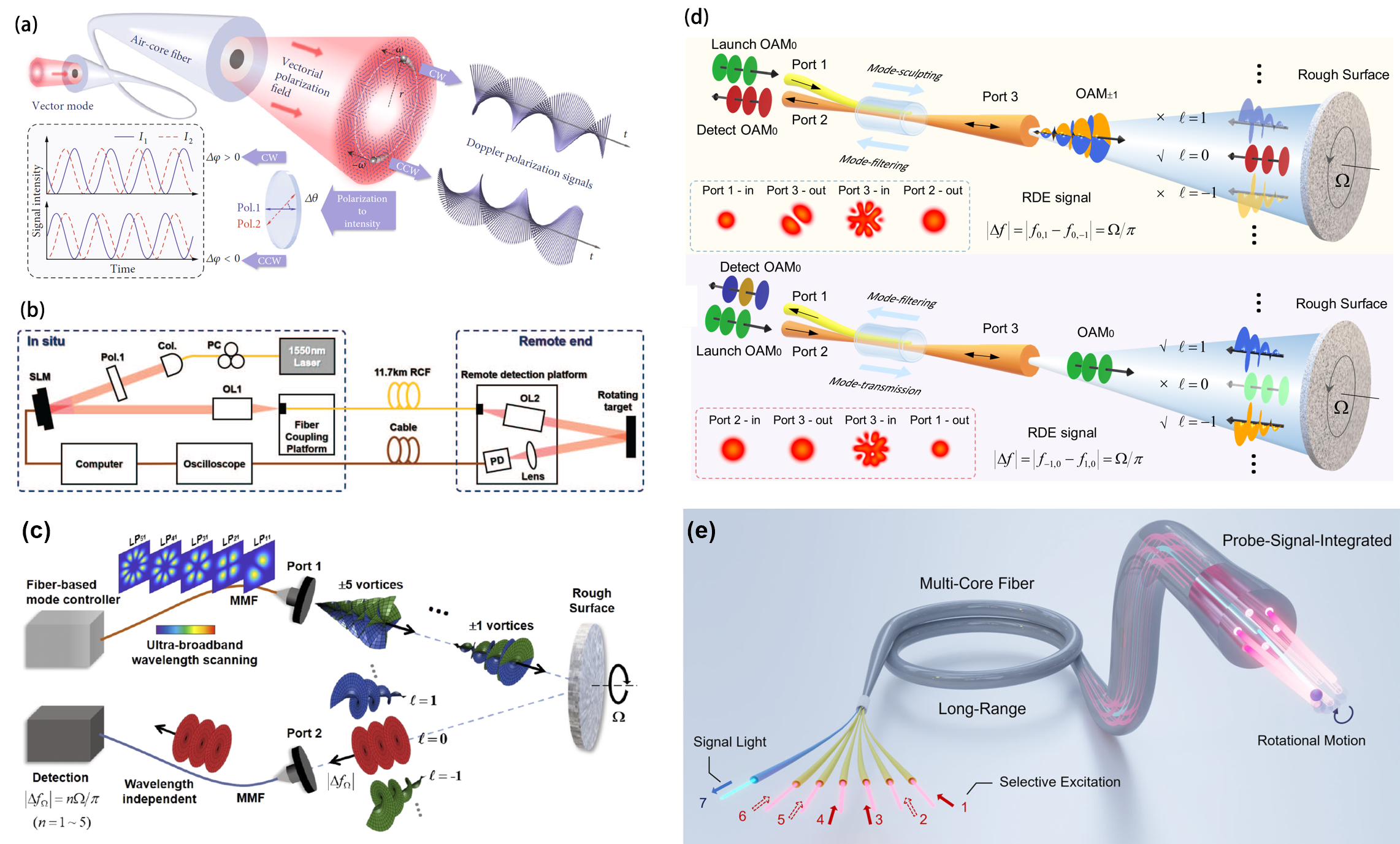
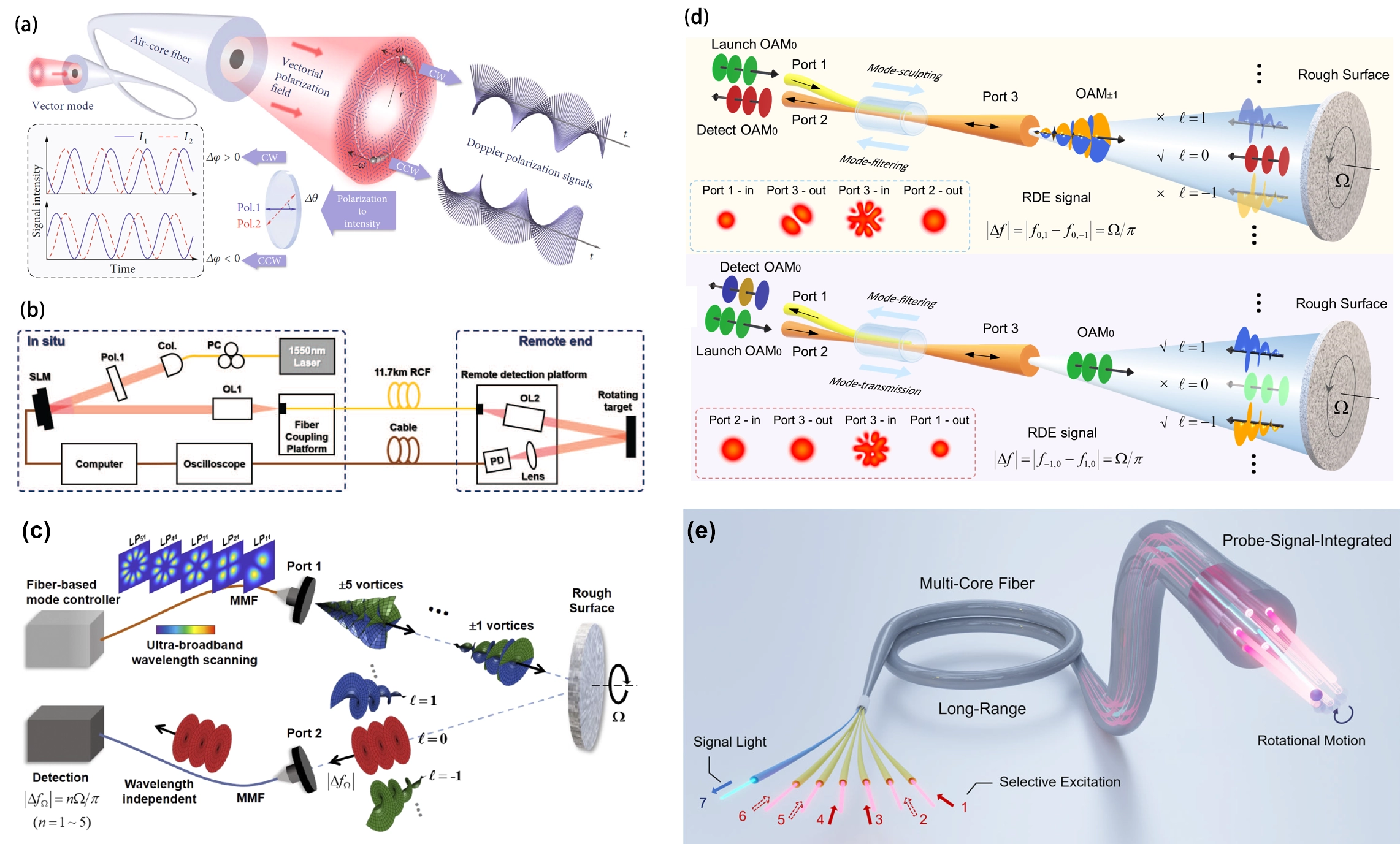
Figure 7. Fiber-based velocimetry with sculpted light. (a) Remote measurement of the angular velocity vector based on vectorial Doppler effect using air-core optical fiber. Reprinted from reference[126]. CC BY 4.0; (b) Flexible and robust detection of a remotely rotating target using fiber-guided orbital angular momentum superposed modes. Reproduced with permission from reference[127]. Copyright © 2019 Optica Publishing Group; (c) Fiber-based broadband detection of a rotational object with superposed vortices. Reprinted from reference[128]. CC BY 4.0; (d) Compact and reciprocal probe-signal-integrated rotational Doppler velocimetry with fiber-sculpted light. Reprinted from reference[129]. CC BY 4.0.; (e) Remote vector velocimetry with fiber-delivered scalar fields. Reproduced with permission from reference[131]. Copyright © 2024 John Wiley and Sons. OAM: orbital angular momentum.
The more recent broadband implementation by Tang et al., refined this idea by replacing free-space vortex generation with an ultra-broadband mode-selective coupler (MSC) that converts LPn1 fiber modes into superposed vortices, as shown in Figure 7c[128]. For a rotating rough surface, the rotational Doppler shift of each scattered component depends on the difference between the incident and scattered vortex helicities, and when opposite-helicity components carrying ±ℓ-order OAM are launched together, the detected beat frequency becomes Δfℓ,Ω = ℓΩ/π, or equivalently 2nΩ/2π for the LPn1-based implementation. In this work, fiber can act as a mode controller rather than a passive delivery link. The measurement remains achromatic, since the rotational Doppler beat frequency is independent of optical wavelength. Furthermore, the all-fiber architecture enables broadband wavelength scanning and much more practical remote velocimetry than conventional free-space arrangements.
As shown in Figure 7d, recent work has further integrated probe generation and signal detection within reciprocal fiber configurations[129]. By utilizing the bidirectional transmission capability of a mode-selective coupler, sculpted light generation, transmission, and mode filtering can be achieved in a common-path fiber optic system. By exploiting the inherent reciprocity of guided mode propagation, phase noise induced by fiber fluctuations can be largely canceled, enabling compact and low-cost rotational Doppler velocimeters. It is worth noting that the input light mode and the detected light mode can be interchanged in the reciprocal operation scheme. This echoes the previous description, which states that the Doppler effect is related to mode change, but not to the input light mode. These integrated designs demonstrate that sculpted light fiber systems can simultaneously achieve mechanical flexibility, long-distance delivery, and high measurement precision.
Importantly, the scope of fiber-based Doppler velocimetry now extends beyond pure OAM implementations[130]. As shown in Figure 7e, vectorial velocity measurement can also be realized using scalar sculpted fields delivered through fibers[131]. In this scheme, an MCF is employed for selective excitation of different cores to deliver the symmetric or asymmetric spatial amplitude light fields. The interaction between the amplitude light field and rotational motion can be interpreted by pattern expansion[132] or intensity sampling[133]. The correlation between the geometrically symmetric light field excited by the MCF and the rotational symmetry of the rotating target will be reflected in the echo signal[134,135]. On the other hand, the asymmetric field excited by the MCF is scalar, but it can distinguish the direction of rotational motion through signal analysis. Additionally, the MCF-based velocimetry system achieves a probe-signal-integrated configuration, using a single fiber for both illumination and signal collection, and can be further extended to the integration of sensing and communications[136].
4. Object Structural Property Detection
While the previous sections focused on measuring external physical quantities such as strain, temperature, and velocity, another important role of sculpted light is to probe the intrinsic optical and structural properties of a target itself. In this case, the goal is no longer to ask how the environment perturbs the light field during propagation, but rather how the internal characteristics of a material or object modify a carefully tailored optical field, such as molecular handedness, refractive response, birefringence, edges, or defects. This makes sculpted light especially attractive for structural characterization, because its spatial phase, polarization, and mode distribution can be designed to interact with specific features of the target in a more sensitive and selective way than conventional Gaussian beams.
Different kinds of structural information require different light field properties. For chiral targets, the relevant interaction is related to the handedness of the light field, so vortex beams, vector beams, and other chiral or topological light fields provide new routes beyond conventional circular dichroism. For refractive index and birefringence sensing, structured phase and polarization distributions make it possible to convert very small optical path or anisotropy changes into measurable intensity, interference, or correlation signals. For edge, defect, and object feature detection, the spatial structure of the beam can be designed to enhance discontinuities, redistribute angular momentum spectra, or highlight specific geometric features in the optical response. In this sense, sculpted light offers more controllable optical degrees of freedom for matching the measurement task.
From a practical point of view, once the incident light field is given a designed spatial or polarization distribution, the response of the target is no longer described only by a bulk intensity change. Instead, the target modifies the beam’s phase, polarization, mode spectrum, or scattering distribution in a way that reflects its own internal properties. A chiral sample may respond differently to light fields with opposite handedness. A birefringent medium may reshape the relative phase and polarization content of the beam. An edge or defect may redistribute spatial frequencies or change the scattered mode spectrum. The measurable signal therefore comes from how the sculpted light field is transformed after interacting with the target. The following sections discuss three representative classes of such measurements.
4.1 Chirality detection
Chirality, the absence of mirror symmetry, pervades molecular chemistry, biological structure, and nanoscale photonic systems[137,138]. Conventional chiroptical spectroscopy relies primarily on circular dichroism (CD), where the probe is usually left- or right-circularly polarized light, and the signal is obtained from the small difference in absorption or scattering between the two handedness states. However, this approach becomes weak when the chiral object is much smaller than the optical wavelength or when the structure to be measured spans multiple length scales. Sculpted light introduces additional spatial and angular momentum degrees of freedom that can dramatically enhance chiral light–matter interaction by tailoring the light field itself[139-142].
A fundamental step in this development was the recognition that optical fields can carry not only SAM associated with circular polarization, but also OAM associated with helical phase fronts, and the relevant handedness can also be the sign of the helical phase front. In particular, vortex beams exhibit well-defined OAM and spatial phase singularities, enabling interaction that depends on the sign and magnitude of topological charge. When such beams scatter from chiral dipolar particles, the coupling strength becomes dependent on both the molecular handedness and the orbital angular momentum state, producing helical dichroism in scattering intensity[1443-145]. This mechanism extends traditional circular dichroism from polarization into angular momentum, allowing enantiomer discrimination via OAM-resolved detection.
The light field with opposite topological charges can be sensitive to interact a chiral object. A particularly clear example is the vortical differential scattering (VDS). As shown in Figure 8a, Ni et al., demonstrated that intrinsically chiral microstructures illuminated by linearly polarized vortex beams exhibit a very large differential scattering signal between +ℓ and -ℓ, with reported VDS values reaching about 120%[146]. More importantly, the signal is obtained with monochromatic light, and its strength can be tuned by matching the size of the chiral structure to the beam waist and OAM order. Their analysis shows that the chiral response comes from the interaction between the spiral Poynting-vector flow of the vortex beam and the helical geometry of the target, rather than from conventional spin-based CD alone. It shows that OAM-based sensing is especially powerful for mesoscale chiral structures, where conventional CD is often inconvenient or too weak. At the nanoscale, metasurfaces further amplify these effects. In non-Hermitian gradient metasurfaces operating near exceptional points, engineered mode coalescence enhances helical dichroism through asymmetric mode coupling[147]. Here, chirality is encoded into differential transmission or scattering between opposite helical states in the sculpted light field. Such platforms illustrate how sculpted illumination and nanophotonic structures can be co-designed to maximize chiral sensitivity.
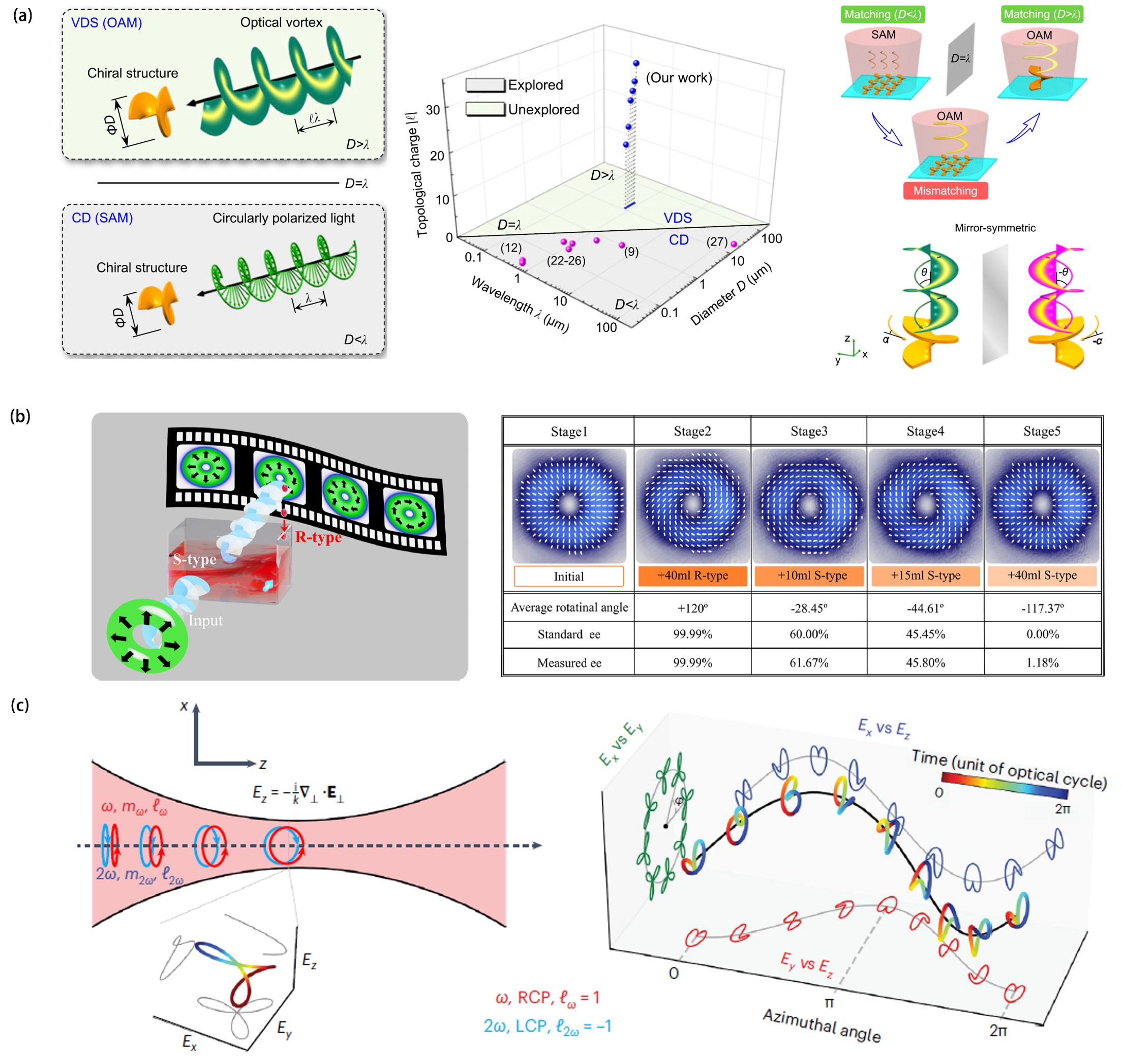
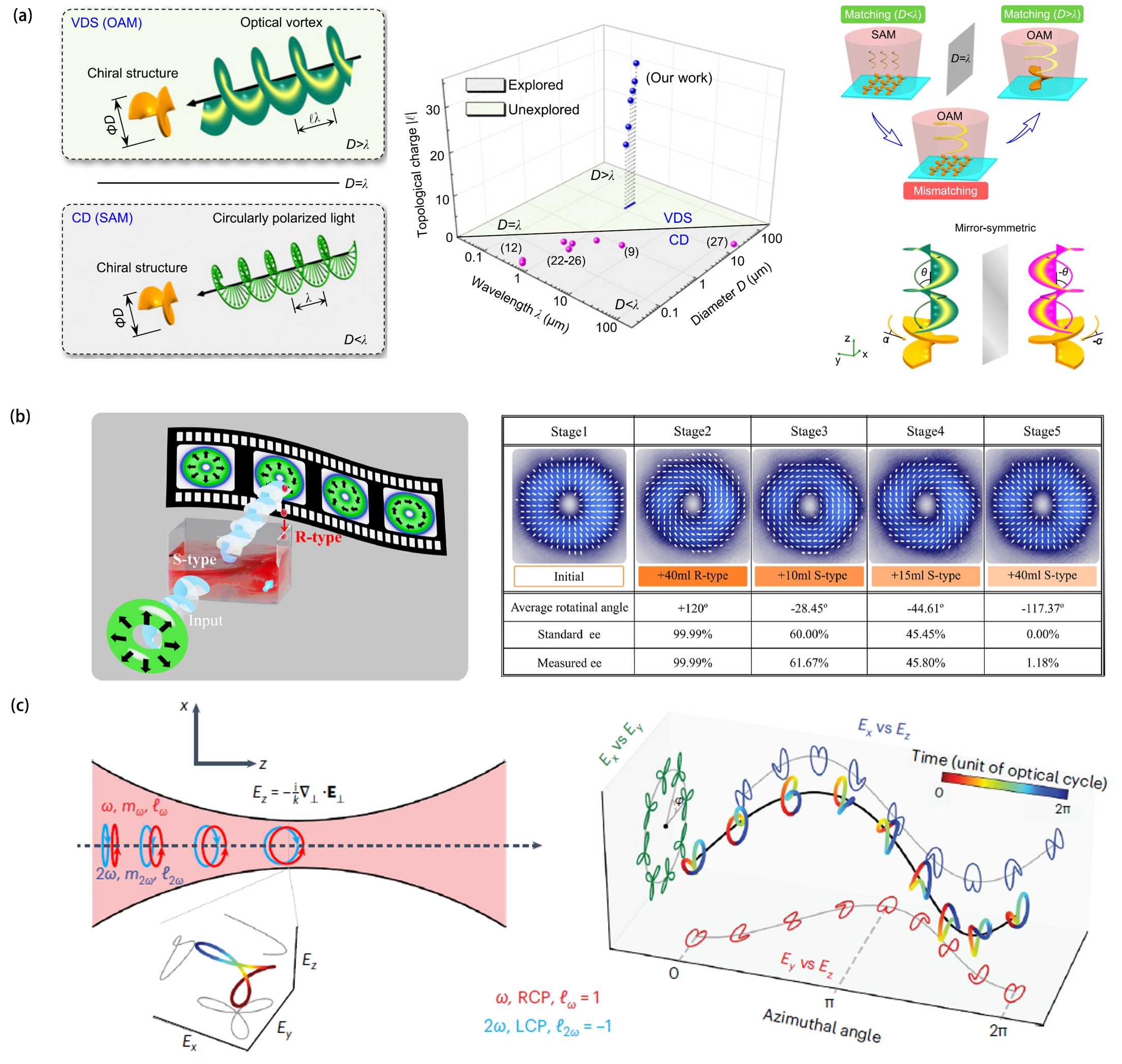
Figure 8. Chirality detection with sculpted light. (a) Gigantic vortical differential scattering as a monochromatic probe for multiscale chiral structures. Reprinted from reference[146]. CC BY 4.0; (b) Spatially resolved enantiomeric excess measurement leveraged by complex vector light beams. Reproduced with permission from reference[151]. Copyright © 2025 American Chemical Society; (c) Chiral topological light for detection of robust enantiosensitive observables. Reprinted from reference[153]. CC BY 4.0. CD: circular dichroism; OAM: orbital angular momentum; SAM: spin angular momentum.
Beyond static polarization and OAM beams, synthetic chiral light fields have been proposed and experimentally realized to achieve optimal enantiosensitive coupling. For example, Ayuso et al., proposed a synthetic chiral field in which the electric-field tip traces a three-dimensional chiral Lissajous curve in time at each point in space[148]. In their implementation, an elliptically polarized ω field is combined with an orthogonally polarized 2ω field, allowing the handedness of the local field to be controlled by the two-color phase. The enantio-sensitive optical response can be strongly enhanced, suppressed, or even directed by field design, because the chiral interaction already appears at the level of electric-dipole coupling. This shifts the logic of chirality sensing from a standard circularly polarized probe to the design of the local field geometry so that the molecule experiences a much stronger handed optical environment. In strong-field and nonlinear regimes, synthetic chiral light enables enantioselective photoelectron emission and unidirectional light bending, revealing chirality through asymmetric emission patterns rather than absorption contrast[149]. Nonlinear helical dichroism further extends detection into multiphoton interactions, where even achiral molecules can exhibit chiral response under twisted light illumination[150].
Once the field engineering is adopted, it becomes possible to use sculpted light not only to enhance chiral response, but also to measure it in space. As shown in Figure 8b, vector beams with spatially varying transverse polarization are used and enantiomeric excess can be retrieved from the local polarization evolution of the beam after passing through a chiral solution[151]. The beam is decomposed into spatially resolved Stokes parameters, so the local polarization rotation directly maps the local composition of the chiral mixture. Because the polarization distribution varies across the beam profile, the method is not limited to uniform samples, but can also resolve spatially inhomogeneous enantiomeric distributions with micrometer-level precision. Beyond conventional bulk optical rotation measurements, the beam is no longer just a probe of average chirality, but a tool for imaging chiral composition across space.
A recent development is to combine strong local chiral response with the global topological structure of vortex light. As illustrated in Figure 8c, Mayer et al., construct a field from two tightly focused OAM beams at frequencies ω and 2ω with opposite circular polarizations[152,153]. Near focus, a longitudinal field component appears, so the polarization vector traces a chiral Lissajous curve locally, while the handedness varies azimuthally with a well-defined topological charge C. This topological charge is transferred into the nonlinear optical response of the chiral medium as an azimuthal intensity pattern whose angular position depends on the molecular handedness. The angular offset between opposite enantiomers is set by π/C, and this spatial rotation remains robust against intensity fluctuations and imperfect polarization states. In other words, the information about chirality is no longer carried only by how strong the signal is, but also by where the signal appears in angle, which is often a more robust observable. In addition, at shorter wavelengths, orbital-angular-momentum-carrying X-ray pulses open pathways for probing molecular and solid-state chirality at atomic resolution, demonstrating helical dichroism in disordered media and crystalline systems[150,151]. These developments extend the reach of sculpted light from visible and infrared regimes into ultrafast and high-energy photonics.
Taken together, these works show that sculpted-light chirality detection has evolved along a clear line. OAM beams extend chiral probing from circular polarization to helical wavefronts and are particularly effective for micro-scale chiral structures. Synthetic chiral light then strengthens the local light–matter interaction by creating a truly three-dimensional chiral electric field at each point in space. Vector beams further enable spatially resolved measurements of enantiomeric excess, and chiral topological light offers a robust angular encoding of the chiral response. In these schemes, the light field is deliberately given a structure whose handedness, phase, or polarization varies in a controlled way, and the chiral target reveals itself through how it responds differently to that structure.
4.2 Refraction index detection
The refractive index and birefringence of a material represent its most fundamental optical descriptors, encoding microscopic electronic response, crystalline anisotropy, and stress distribution. Traditional approaches to refractometry rely on scalar phase accumulation in interferometers, while birefringence measurements exploit polarization-dependent phase retardation. High-frequency polarization modulation techniques and high-finesse cavity interferometry enable precision birefringence detection in bulk crystals, mirrors, and gravitational-wave test masses, reaching sensitivities limited by mechanical and thermal noise[154,155]. Precision interferometric studies of mirror birefringence and crystalline silicon test masses have demonstrated how minute polarization phase shifts can accumulate measurably in resonant systems[156,157], while dynamic control of birefringence via stimulated Brillouin processes further illustrates how optical anisotropy can be both induced and interrogated within guided platforms[158]. In these methods, refractive index variations manifest as phase retardation between orthogonal polarization or propagation eigenmodes.
Sculpted light extends this paradigm by introducing spatial phase gradients and angular momentum channels as additional sensing dimensions. Vortex beams carrying OAM exhibit azimuthally varying phase, making them intrinsically sensitive to perturbations that modify phase or mode purity. As shown in Figure 9a, OAM-based interferometry and twisted-light Michelson configurations convert refractive index variations into measurable shifts in modal interference patterns or fractional azimuthal index changes[159-161]. In such systems, the refractive index is not inferred solely from longitudinal phase delay but from redistribution within an OAM mode basis. As shown in Figure 9b, longitudinally sculpted light fields further enhance this effect by engineering axial phase evolution[162], enabling tunable refractometry where propagation-induced mode beating encodes refractive index changes into temporal or spectral signatures[163]. These approaches demonstrate that refractive index sensing can be recast as mode spectrum analysis rather than simple path length measurement.
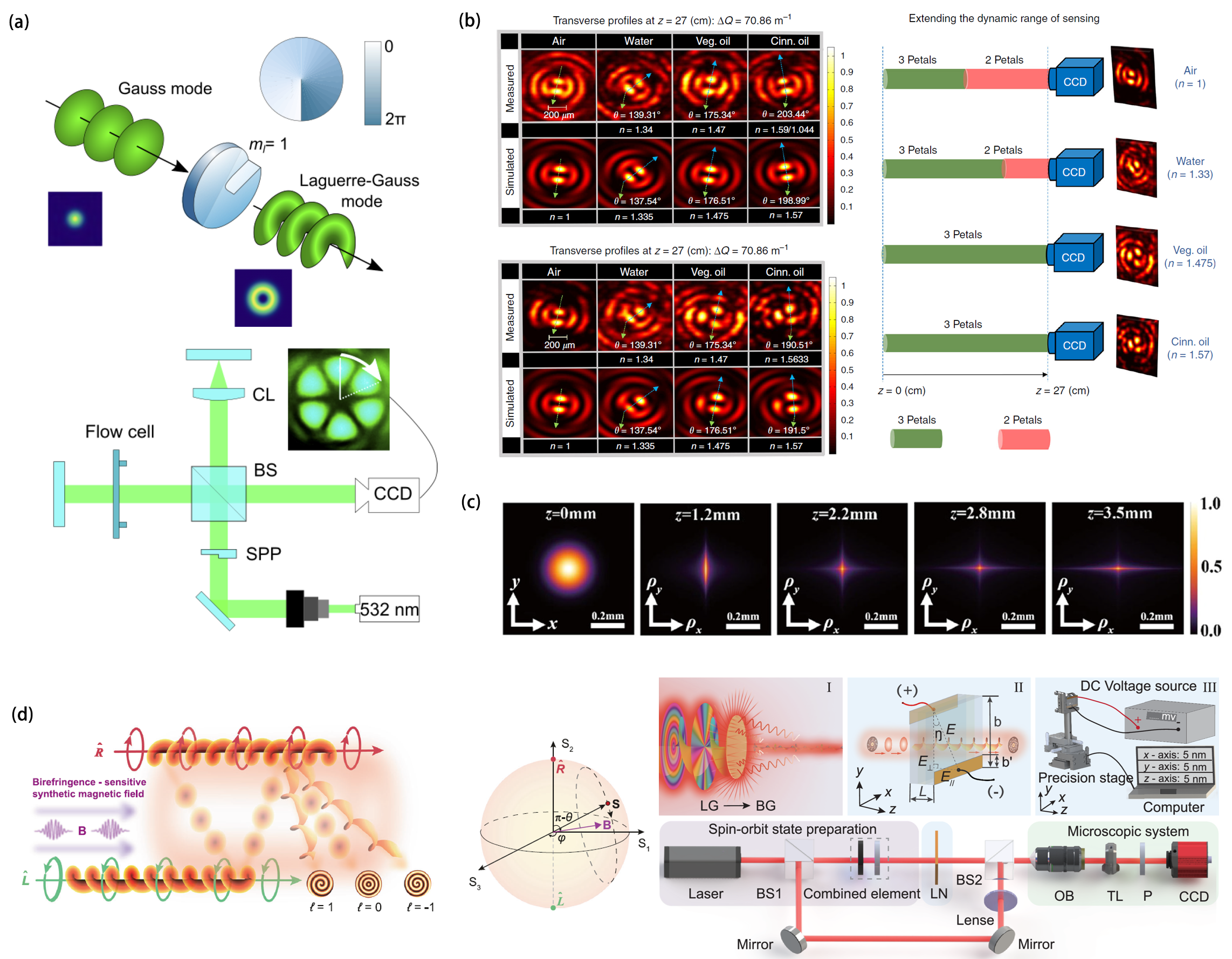
Figure 9. Refraction index detection. (a) Twisted light Michelson interferometer for high precision refractive index measurements. Reprinted from reference[160]. CC BY 4.0; (b) Experimental demonstration of tunable refractometer based on orbital angular momentum of longitudinally sculpted light. Reprinted from reference[165]. CC BY 4.0; (c) Measuring refractive indices of a uniaxial crystal by sculpted light with non-uniform correlation. Reproduced with permission from reference[165]. Copyright © 2021 Optica Publishing Group; (d) Precise detection of tiny birefringence with accuracy reaching 10-11 level. Reprinted from reference[166]. CC BY 4.0. CL: cylindrical lens; BS: beam splitter; SPP: spiral phase plate; CCD: charge-coupled device; LG: Laguerre-Gaussian; BG: Bessel–Gaussian; DC: direct current; OB: objective lens; TL: tube lens.
When anisotropy is present, birefringence introduces phase retardation that reshapes sculpted polarization and spin–orbit coupled beams. Weak-value amplification schemes exploit nearly orthogonal polarization pre- and post-selection to amplify extremely small stress-induced birefringence signals, converting sub-wavelength retardations into measurable intensity displacements[164]. As shown in Figure 9c, sculpted light probing of uniaxial crystals using non-uniform spatial correlations further illustrates that birefringence can be retrieved by analyzing how orthogonal polarization components distort the spatial coherence function of a beam[165]. The recent work shown in Figure 9d achieves 10-11-level birefringence resolution, demonstrating that sculpted polarization fields and differential interferometry suppress common-mode noise while isolating anisotropic phase contributions[166]. In this correlation-based framework, refractive index elements are reconstructed from spatially structured interference rather than global intensity contrast.
Structured illumination and wavefront engineering also enable refractive index tomography and scattering-based sensing. In coherent structured illumination (SI) tomography, the key idea is not to read out refractive index from a single phase delay, but to recover the full three-dimensional refractive index distribution of the sample[167]. Sinusoidal SI can be reinterpreted as a superposition of tilted plane-wave illuminations, so that a sequence of SI measurements can be decomposed into angle-dependent complex field maps and then reconstructed by diffraction tomography into a three-dimensional refractive-index volume. In this case, structured light is useful in providing a practical way to synthesize the multiple illumination angles needed for refractive index tomography within a single coherent imaging framework. A different strategy is to control how strongly the optical response changes when the surrounding refractive index changes. Manipulation of Mie scattering responses through tailored light fields further reveals that refractive index variations can be encoded into changes in scattering angular distribution and mode coupling efficiency[168]. Refractive-index sensing does not have to rely only on changing the particle geometry or material, but can also tune the sensitivity from the illumination side by preparing a suitable input field and tightly focusing it onto the scatterer. In fiber refractometry, the structured beam is used to improve coupling into modes with stronger evanescent interaction. For example, in the Airy-vortex beam sensor, the beam is designed to combine the helical phase of a vortex beam with the self-accelerating transverse profile of an Airy beam, and this hybrid field is used to excite higher-order modes in a decladded multimode fiber[169]. Because these higher-order modes have larger evanescent tails, more optical power interacts with the surrounding analyte, which increases the refractive index sensitivity of the sensor. In these cases, refractometry becomes an inverse problem in sculpted light field propagation and scattering.
Beyond passive detection, sculpted light can also interact with optically functional materials whose birefringence or refractive index is externally tunable. Magnetically controlled birefringent media, two-dimensional hexagonal boron nitride platforms, and large-birefringence functional crystals provide systems in which sculpted beams probe field-dependent anisotropy[170]. In magneto-optical iron garnets, optical vortex spin–orbit coupling has been shown to influence effective refractive index response, linking sculpted light to active material control[171]. At shorter wavelengths and in advanced crystalline systems, the combination of engineered optical modes and novel birefringent materials expands the operational bandwidth of structured refractometry into ultraviolet regimes[172].
Across these developments, refractive index and birefringence detection with sculpted light can be understood as measurement of how electromagnetic modes transform under anisotropic phase perturbation. Whether through OAM interferometry, longitudinal mode beating, polarization amplification, spatial correlation analysis, or scattering redistribution, the essential mechanism remains consistent, namely that refractive index variations reshape the spatial, mode spectrum, or polarization structure of the light field. By selecting an appropriate sculpted degree of freedom, one can tailor sensitivity to specific components of the material response while enhancing precision beyond conventional interferometry. Sculpted light thus elevates refractometry from phase-delay measurement to light field evolution analysis, providing a flexible way for high-resolution optical material characterization.
4.3 Spatial signatures detection
Spatial discontinuities such as edges, defects, roughness variations, and geometric asymmetries provide critical information for object identification and material inspection. Conventional imaging systems typically detect these features through numerical post-processing of intensity images. Sculpted light introduces an alternative approach in which spatial structure detection is performed directly in the optical domain. By tailoring the spatial phase, polarization, and angular momentum content of the illumination field, optical systems can selectively enhance specific spatial frequencies or geometric signatures during light–matter interaction, allowing edges and defects to be extracted before digital reconstruction.
One important class of approaches performs edge detection by inserting a phase-engineered optical element, such as a birefringent differentiator or a spiral phase filter, into the imaging system, so that spatial gradients of the object are directly converted into intensity contrast. Typical examples include uniaxial crystals, or spiral phase plates placed in the Fourier plane. The object to be imaged may be a phase object, namely a sample that changes mainly the phase of the optical field rather than its intensity, such as transparent biological cells, weakly absorbing thin films, or shallow surface-relief microstructures. For example, uniaxial crystals placed between two orthogonal polarizers can implement spatial differentiation through polarization-dependent phase retardation, enabling optical edge detection of phase objects[173]. The crystal splits the incident field into two orthogonally polarized components with a very small lateral shear, and after recombination by the analyzer the output becomes proportional to the difference between two slightly shifted copies of the field, which approximates a spatial derivative when the shear is small enough. As a result, both amplitude edges and phase gradients become visible in the output image. A closely related mechanism is spiral phase contrast imaging, where a spiral phase plate or vortex phase mask imposes a helical phase on the Fourier components of the image. In this case, low spatial frequencies are suppressed while sharp intensity or phase variations are enhanced, so edges and contours appear against a dark background[174]. This process can be implemented in a nonlinear way: instead of placing a physical vortex plate directly in the signal path, the vortex phase can be transferred to the Fourier components of the object during second-harmonic generation in a nonlinear crystal, enabling visible edge-enhanced imaging even when the object is illuminated by invisible infrared light[175]. A particularly important extension of this idea is the topological optical differentiator, where isotropic two-dimensional differentiation is achieved using a single unpatterned optical interface[176]. In this work, the differentiating response arises from a topological zero in the reflection transfer function, allowing edge enhancement to be implemented without a conventionally patterned differentiating element and with broad spectral bandwidth. As shown in Figure 10a, recent work has extended this concept to nonlinear vortex filtering and high-order topological differentiators operating in the mid-infrared regime, enabling photon number-sensitive edge enhancement imaging with micrometer-level resolution[177,178]. By modifying the Fourier spectrum of the image, phase gradients are converted into intensity contrast directly in the optical system, enabling real-time edge extraction.
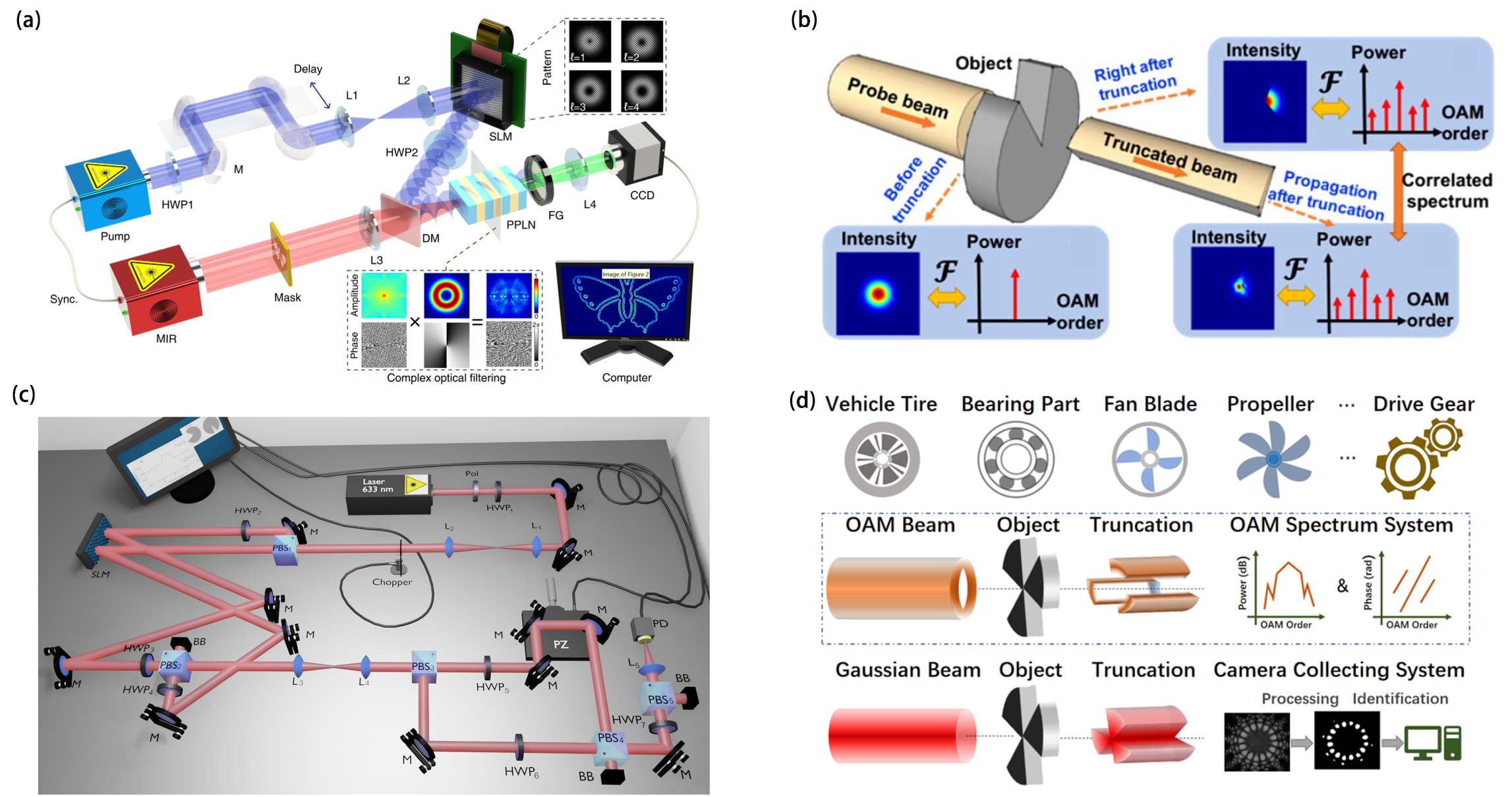
Figure 10. Spatial Signatures Detection. (a) High-order mid-infrared nonlinear topological differentiator. Reproduced with permission from reference[178]. Copyright © 2025 John Wiley and Sons; (b) Using a complex optical orbital-angular-momentum spectrum to measure object parameters. Reprinted from reference[185]. CC BY 4.0; (c) Quantum-inspired protocol for measuring the degree of similarity between spatial shapes. Reprinted from reference[190]. CC BY 4.0; (d) Wedge angle and orientation recognition of multi-opening objects using sculpted light and machine learning. Reprinted from reference[191]. CC BY 4.0. OAM: orbital angular momentum; CCD: charge-coupled device; HWP: half-wave plate; SLM: spatial light modulator; DM: dichroic mirror; PPLN: periodically poled lithium niobate; FG: filtering group; MIR: mid-infrared; PBS: polarization beam splitter; BB: beam blocker; PC: personal computer.
Vectorial and vortex beams also provide unique capabilities for dark-field and defect-sensitive imaging. Cylindrical vector beams, characterized by spatially varying polarization distributions, generate distinctive illumination patterns that enhance scattered light from surface irregularities while suppressing background reflections. Such beams have been shown to improve dark-field imaging contrast and enhance the visibility of subwavelength structures and micro-defects[179]. Similarly, vortex beams with phase singularities modify the illumination distribution in microscopic systems, allowing improved discrimination of scattering from edges or rough surfaces[180]. Near-field diffraction of vortex beams from surface micro-defects produces characteristic intensity patterns that can be used to identify defect size and morphology[181]. The spatial and polarization structures of sculpted light interact with local surface features to produce distinctive scattering signatures.
Beyond imaging contrast enhancement, structured illumination can be used for quantitative defect inspection in practical manufacturing, for example on reflective metal parts, glass substrates, optical components, and curved specular surfaces. Sculpted light projection techniques encode spatial information into modulated fringe patterns or micro-patterned illumination grids. When projected onto specular or transparent surfaces, defects and contaminations distort these patterns in a measurable manner[182]. Sculpted light modulation analysis methods have been developed to suppress dust interference while detecting defects on reflective surfaces[183]. Similar approaches have been extended to three-dimensional curved optical components, where micro-structured illumination combined with multi-parameter calibration enables accurate detection of surface defects and curvature deviations[184]. In such systems, defect detection is achieved by analyzing how the known projected pattern is locally altered, for example through changes in fringe phase, spacing, orientation, or continuity, which makes it possible to identify scratches, pits, contamination, and shape errors in a quantitative manner.
Another powerful framework for spatial-signature detection exploits the OAM-domain response of light after interaction with an object. When a structured target modulates a vortex beam, or when the transmitted/scattered field is analyzed in an OAM basis, geometric features in the azimuthal direction can be converted into identifiable modal signatures. As shown in Figure 10b, for a sector-shaped object, the dip positions in the OAM intensity spectrum are determined by the opening angle, whereas the slope of the OAM phase spectrum is determined by the object orientation, making the OAM-domain representation a useful tool for retrieving object parameters[185]. The role of symmetry is especially clear in OAM-correlation-based object identification with random light. Yang et al., demonstrated that objects with rotational symmetries imprint their Fourier components into the second-order OAM correlation matrix, so that fourfold- and sixfold-symmetric amplitude objects can be identified from characteristic signatures in the OAM domain[186]. For simple and symmetric objects, even a single line of the correlation matrix can provide sufficient information, whereas for more complicated objects lacking rotational symmetry, the full correlation matrix is generally required. This shows that discrete rotational symmetry is not a strict requirement for OAM-based recognition, but it does make the modal signature more structured and easier to interpret physically. Subsequent work has extended this method to object azimuth detection under tilted illumination and symmetry measurement of mechanical structures using OAM spectral analysis[187,188]. Surface roughness has also been shown to influence the distribution of scattered OAM modes, enabling roughness-dependent object identification[189].
For another structured-light recognition schemes, as shown in Figure 10c, a quantum-inspired protocol does not rely on rotational symmetry of the target. Instead, it compares the degree of similarity between two spatial shapes by embedding them in two orthogonally polarized components of a non-separable beam and retrieving their overlap from the measured degree of polarization, without reconstructing the full amplitude and phase of each beam[190]. By contrast, the deep-learning-based recognition method shown in Figure 10d is a data-driven classification scheme, and the network was trained specifically on rotationally symmetric multi-opening objects to identify the number of openings, wedge angle, and opening orientation from captured optical patterns[191]. These hybrid optical–computational approaches highlight how sculpted light and data-driven algorithms can jointly extract geometric information from complex optical fields.
Taken together, spatial signature detection with sculpted light encompasses a broad family of techniques in which object geometry is mapped onto structured transformations of the optical field. Whether through optical differentiation, structured illumination, polarization-dependent scattering, OAM spectrum, or machine-learning, the underlying principle remains consistent: spatial discontinuities and geometric asymmetries reshape the sculpted degrees of freedom of light in measurable ways. By designing the spatial structure of the probing field, one can enhance sensitivity to specific geometric features while suppressing uniform background responses, enabling efficient detection of edges, defects, and object parameters across microscopy, industrial inspection, and computational imaging applications.
5. Challenges
Despite the rapid progress of sculpted light sensing, the transition from laboratory demonstrations to robust real-world systems remains challenging. Many of the advances reviewed in this article rely on carefully prepared light fields, stable mode control and detection conditions. In practice, however, the performance of these systems is often limited by propagation stability, generation efficiency, environmental robustness, and computational burden. These issues become particularly important when sculpted light sensing is extended to long-distance fibers, outdoor free-space, or integrated devices.
A first major challenge lies in the efficiency and fidelity of sculpted-light generation. Spatial light modulators provide excellent flexibility for laboratory experiments, but their insertion loss, limited refresh rate, wavelength dependence, and bulkiness can restrict system efficiency and real-time operation. Metasurfaces offer compactness and the possibility of large-scale integration, yet they often face trade-offs in operating bandwidth, polarization dependence, and fabrication tolerance. Fiber-based generators, such as photonic lanterns, mode-selective couplers, long-period gratings, and specialty-fiber mode converters, improve robustness and alignment tolerance, but still face practical constraints in insertion loss, mode purity, channel scalability, and broadband operation. As a result, the performance of the sensing system is frequently determined not only by the physical interaction between sculpted light and the target, but also by how efficiently and reliably the desired structured field can be generated and maintained.
Another challenge is the robustness of sculpted light fields during propagation. In fiber-based systems, the intended modes can be degraded by modal crosstalk, modal dispersion, bending-induced coupling, and thermal or mechanical drift, especially in few-mode, multi-mode, and multi-core fiber links over long distances. Such effects are particularly problematic when the sensing mechanism depends on precise mode purity, intermodal phase, or stable transmission matrix. In free-space configurations, the situation is further complicated by atmospheric turbulence, scattering, and misalignment, which can distort the phase and polarization structure of vortex beams or vector beams and reduce the fidelity of the delivered field. For OAM-based sensing in particular, degradation of topological charge purity directly weakens the performance of rotational Doppler or spatial-spectrum measurements. Improving propagation robustness therefore remains a central requirement for practical deployment.
Another challenge lies in the efficiency and fidelity of sculpted-light generation. Spatial light modulators provide excellent flexibility for laboratory experiments, but their insertion loss, limited refresh rate, wavelength dependence, and bulkiness can restrict system efficiency and real-time operation. Metasurfaces offer compactness and the possibility of large-scale integration, yet they often face trade-offs in operating bandwidth, polarization dependence, fabrication tolerance, and post-fabrication tunability. Fiber-based generators, such as photonic lanterns, mode-selective couplers, long-period gratings, and specialty-fiber mode converters, improve robustness and alignment tolerance, but still face practical constraints in insertion loss, mode purity, channel scalability, and broadband operation. As a result, the performance of the sensing system is frequently determined not only by the physical interaction between sculpted light and the target, but also by how efficiently and reliably the desired structured field can be generated and maintained.
One potential challenge is the increasing reliance on computational algorithms. Some computation-based optical sensing systems cannot output results that can be directly explained by physical concepts. Instead, they require numerical reconstruction using methods such as transfer matrices, phase retrieval algorithms, diffraction tomography, speckle decoding, or machine learning-based inversion. While these methods significantly improve system performance, they also introduce problems such as computational latency, training dependencies, and calibration drift. For high-dimensional measurements, such as real-time decoding of multimode fiber speckle patterns, orbital angular momentum (OAM) spectra, or vector Doppler signals, computational cost can become a limiting factor for rapid sensing or field deployment. In addition, learning-based methods may suffer from reduced generalization when the operating environment changes, such as temperature drift or partial system misalignment. Practical systems will therefore need not only accurate algorithms, but also computational strategies that are stable, fast, and tolerant to environmental variation.
A further issue is the lack of unified system-level evaluation and application-oriented optimization. Many sculpted light sensors are demonstrated under highly controlled conditions and optimized for a single performance metric, such as sensitivity, resolution, or discrimination capability. However, practical sensing systems often require simultaneous consideration of multiple factors, including loss, robustness, bandwidth, dynamic range, packaging, calibration frequency, and real-time performance. In some cases, a sculpted light approach may offer superior selectivity or multiplexing capability, but at the cost of higher insertion loss or more demanding detection conditions. A clearer understanding of these trade-offs will be essential for comparison of sculpted light and conventional approaches, and for identifying where the additional complexity is justified.
Addressing these challenges will require coordinated progress in device engineering, propagation control, and computational methods. More robust mode-preserving fibers, lower-loss and broader-band sculpted light generators, and more efficient reconstruction algorithms will all be important. At the same time, specific design for application systems will be essential, for example, the optimal solution for a compact biomedical probe may differ substantially from that for remote sensing or industrial inspection. From this perspective, the next stage of development is likely to be defined by new concepts of sculpted light and how effectively they can be integrated into practically deployable sensing architectures. These practical bottlenecks and emerging development directions are summarized in Figure 11.
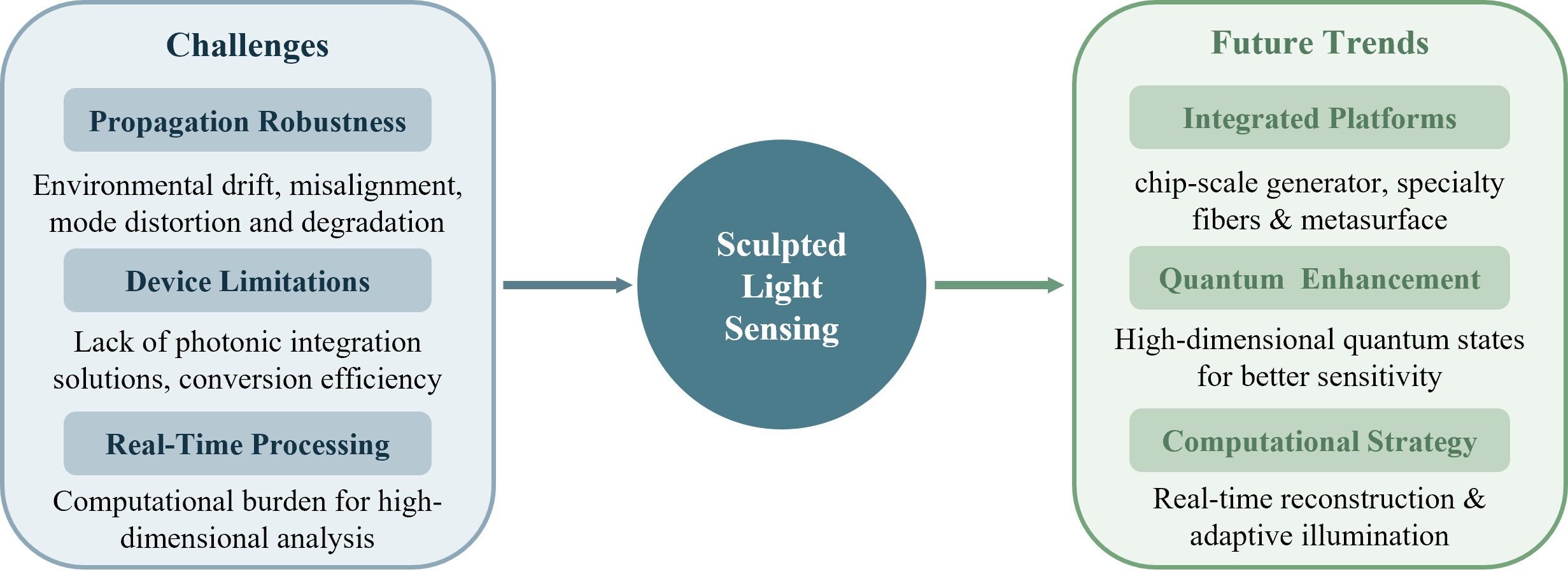
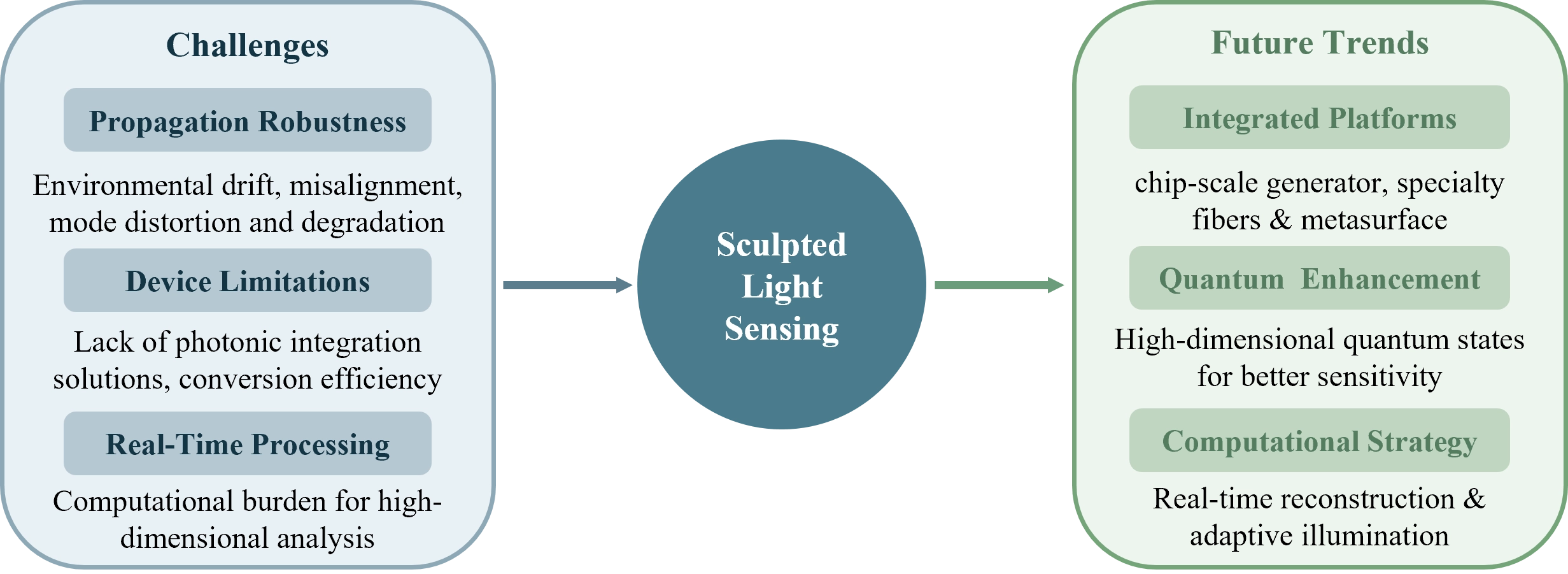
Figure 11. The challenges and future trends for practical deployment of sculpted light sensing.
6. Conclusion and Outlook
To provide a compact comparative overview of the field, Table 1 summarizes representative sculpted-light fields according to the type of structured optical field employed, together with their typical sensing applications, key technical characteristics, and practical considerations.
Table 1. Representative sculpted-light fields for optical sensing: applications, characteristics, and practical considerations.
| Sculpted-light field | Representative sensing applications | Key technical characteristics | Main practical considerations |
| OAM/Vortex beams | Rotational Doppler velocimetry[96-98]; chirality detection[146]; OAM-interferometric refractometry[159-161]; OAM-spectrum-based object analysis[185,186] | Helical phase front with azimuthal phase term exp(ilφ); natural basis for rotational motion and angular structure | Requires mode modulation and demodulation; performance can degrade under misalignment, turbulence, and low mode purity |
| Vector/Polarization-structured fields | Directional force sensing[24]; vectorial Doppler metrology[100-102]; enantiomeric-excess measurement[151] | Spatially varying polarization; provides vectorial channels | Requires polarization stability, accurate polarization analysis, and careful calibration of the generation/detection system |
| Bessel/Airy beams | Non-diffracting and self-healing imaging[7]; structure-shearing Doppler effect[112]; refractive-index sensing with Airy–vortex excitation[165] | Nondiffracting, self-healing, or self-accelerating behavior | Finite energy efficiency and finite nondiffracting/accelerating range should be considered |
| Speckle/Computational fields | Pressure sensing[25]; shape/position sensing[41,49]; fiber endoscopy[50-56]; fiber spectrometry[60-64] | High-dimensional optical encoding; strong compatibility with computational method, and learning-based reconstruction | Often depends on calibration, environmental stability, and computational decoding; reconstruction latency and drift can limit real-time deployment |
| Array light (spatial arrays or waveguide arrays) | Curvature and shape sensing[34-36,43-46]; wavefront shaping and imaging[57] | Discrete spatial channels provide parallelized probing and controllable spatial sampling | Sampling nonuniformity, aliasing, channel mismatch, and calibration complexity can affect the final sensing accuracy |
| Synthetic chiral light/chiral topological light | Enantio-sensitive unidirectional light bending[148,149]; robust enantiosensitive observables[153] | Three-dimensional handed or topology-rich field structure; provide stronger chiral observables | Experimental implementation is often demanding |
OAM: orbital angular momentum.
The development of sculpted light marks a decisive expansion of the measurement basis available in optical sensing. For decades, most sensing strategies relied on Gaussian beams and homogeneous polarization, extracting information primarily through intensity variation, phase delay, or frequency shift. The deliberate engineering of spatial phase, modal composition, and vectorial structure has introduced additional controllable degrees of freedom, allowing physical parameters to be mapped onto structured transformations of the optical field itself.
This principle takes different forms in different sensing scenarios. In fiber-based sensing, external perturbations are encoded into mode coupling, modal interference, polarization evolution, or distributed backscattering. In Doppler velocimetry, structured light extends the conventional Doppler framework beyond linear motion, enabling access to rotational and vectorial motion through phase gradients, OAM, and vector fields. In object structural property detection, sculpted light provides new ways to probe chirality, refractive response, birefringence, and spatial features such as edges or defects by converting material-dependent interactions into observable changes in the optical field.
Looking ahead, some directions appear especially important for the future development of the field, as shown in Figure 11. First, platform integration and miniaturization are likely to drive sculpted light sensing toward practical deployment. Compact mode generators, metasurface beam shapers, specialty fibers, and integrated photonic devices can reduce system size and improve stability, enabling application-specific probes such as fiber-based rotational velocimeters, ultrathin imaging endoscopes, chip-scale spectrometers, and portable surface inspection systems. Second, computationally assisted and adaptive sensing will become increasingly important as more systems rely on transmission-matrix inversion, phase retrieval, speckle decoding, and learning-based inference. In the future, these computational tools are likely to move from post-processing to the sensing loop itself, allowing real-time optimization of illumination and reconstruction in applications such as multimode-fiber imaging, defect inspection, and high-dimensional shape or flow sensing. In this context, passive or inference-oriented photonic artificial intelligence (AI) layers, as well as active AI-assisted feedback loops, may help accelerate or preprocess optical data and improve the overall efficiency of sculpted light sensing architectures[192]. Third, quantum and non-classical structured states may open new routes toward higher sensitivity and richer information encoding. High-dimensional OAM states, non-separable spatial–polarization fields, and quantum-inspired correlation measurements could support low-light imaging, more sensitive phase or birefringence metrology, and more robust remote sensing in noisy or weak-signal conditions. Together, these developments suggest that the future of sculpted light sensing lies not only in generating more complex fields, but in building more compact, adaptive, and task-specific sensing systems around them.
Overall, sculpted light should not be viewed simply as a more elaborate form of beam shaping. Its real significance lies in providing a flexible measurement framework in which the optical field can be matched to the sensing task. By expanding the set of controllable and measurable optical degrees of freedom, sculpted light sensing creates new opportunities for multiple parameter measurement, higher-dimensional information retrieval, and more specific system design. As field generation, propagation control, and computational strategies continue to mature, sculpted light is likely to become an increasingly important foundation for next-generation optical sensing systems.
Acknowledgements
The authors acknowledge the use of ChatGPT 5.4 in the preparation of Figure 1, which were only used to assist with the initial visual design and generation of some schematic graphic elements. The final figure layout, scientific content, categorization, labeling, and all subsequent modifications were completed and verified by the authors, who take full responsibility for the content.
Authors contribution
Wang J: Conceptualization, methodology, supervision, writing-review & editing.
Tang Z: Investigation, writing-original draft, writing-review & editing.
Wan Z: Conceptualization, writing-review & editing.
Conflicts of interest
Wang Jian is an Editorial Board Member of Light Manipulation and Applications. The other authors declare no conflicts of interest.
Ethical approval
Not applicable.
Consent to participate
Not applicable.
Consent for publication
Not applicable.
Availability of data and materials
Not applicable.
Funding
The study was supported by National Key R&D Program of China (Grant No. 2025YFE0102200); National Natural Science Foundation of China (NSFC) (Grant Nos. 62125503, 62261160388, and 624B2057); Natural Science Foundation of Hubei Province of China (Grant No. 2023AFA028); Hubei Optical Fundamental Research Center (Grant Nos. HBO2025TQ004 and HBO2026D014); and Fundamental Research Funds for the Central Universities (Grant No. YCJJ20252103).
Copyright
© The Author(s) 2026.
References
-
1. Rubinsztein-Dunlop H, Forbes A, Berry MV, Dennis MR, Andrews DL, Mansuripur M, et al. Roadmap on structured light. J Opt. 2017;19(1):013001.[DOI]
-
2. Shen Y, Wang X, Xie Z, Min C, Fu X, Liu Q, et al. Optical vortices 30 years on: OAM manipulation from topological charge to multiple singularities. Light Sci Appl. 2019;8:90.[DOI]
-
3. Liang Y, Cao S, Liu L, Liu F, Yin X, Lv P, et al. Coherent detector for the non-separability measurement of vectorial structured light. Light Sci Appl. 2025;14:343.[DOI]
-
4. Baliyan M, Nishchal NK. Generating scalar and vector modes of Bessel beams utilizing holographic axicon phase with spatial light modulator. J Opt. 2023;25(9):095702.[DOI]
-
5. Bowman R, Muller N, Zambrana-Puyalto X, Jedrkiewicz O, Di Trapani P, Padgett MJ. Efficient generation of Bessel beam arrays by means of an SLM. Eur Phys J Spec Top. 2011;199(1):159-166.[DOI]
-
6. McGloin D, Dholakia K. Bessel beams: Diffraction in a new light. Contemp Phys. 2005;46(1):15-28.[DOI]
-
7. Planchon TA, Gao L, Milkie DE, Davidson MW, Galbraith JA, Galbraith CG, et al. Rapid three-dimensional isotropic imaging of living cells using Bessel beam plane illumination. Nat Methods. 2011;8(5):417-423.[DOI]
-
8. Liang Y, Wang H, Zhang X, Ai J, Ma Z, Ramachandran S, et al. Reconfigurable structured light generation and its coupling to air–core fiber. Adv Photon Nexus. 2023;2(3):036015.[DOI]
-
9. Liang Y, Cai C, Wang K, Lian X, Wang J, Liu J, et al. Low-insertion-loss femtosecond laser-inscribed three-dimensional high-density mux/demux devices. Adv Photon Nexus. 2023;2(3):036002.[DOI]
-
11. Wang J, Cai C, Cui F, Yang M, Liang Y, Wang J. Tailoring light on three-dimensional photonic chips: A platform for versatile OAM mode optical interconnects. Adv Photon. 2023;5(3):036004.[DOI]
-
12. Li K, Zhang Y, Wang S, Wang J. Exceptional-point-encirclement emulation tailoring: Multidimensional asymmetric switching of all-fiber devices. Light Sci Appl. 2026;15:8.[DOI]
-
13. Sanvitto D, Kéna-Cohen S. The road towards polaritonic devices. Nature Mater. 2016;15(10):1061-1073.[DOI]
-
14. Sitnik KA, Alyatkin S, Töpfer JD, Gnusov I, Cookson T, Sigurdsson H, et al. Spontaneous formation of time-periodic vortex cluster in nonlinear fluids of light. Phys Rev Lett. 2022;128(23):237402.[DOI]
-
15. Oliwa P, Kapuściński P, Popławska M, Muszyński M, Król M, Morawiak P, et al. Electrically tunable momentum space polarization singularities in liquid crystal microcavities. Adv Sci. 2025;12(23):2500060.[DOI]
-
16. Hu N, Zhou H, Zhang R, Song H, Pang K, Zou K, et al. Experimental demonstration of a “pin-like” low-divergence beam in a 1-Gbit/s OOK FSO link using a limited-size receiver aperture at various propagation distances. Opt Lett. 2022;47(16):4215-4218.[DOI]
-
17. Li D, Bongiovanni D, Goutsoulas M, Xia S, Zhang Z, Hu Y, et al. Direct comparison of anti-diffracting optical pin beams and abruptly autofocusing beams. OSA Continuum. 2020;3(6):1525-1535.[DOI]
-
19. Zhang Z, Liang X, Goutsoulas M, Li D, Yang X, Yin S, et al. Robust propagation of pin-like optical beam through atmospheric turbulence. APL Photonics. 2019;4(7):076103.[DOI]
-
20. Li J, Liang H, Wu G, Peng P, Wang F, Cai Y. Generation of vector vortex pin-like beams and their propagation in turbulent atmosphere. APL Photonics. 2025;10:016117.[DOI]
-
21. Qiu LQ, Hu HF, Zhao Y, Li J, Wang Q. Fiber optic temperature sensor using the orbital angular momentum and Gaussian beams. Instrum Sci Technol. 2017;45(2):123-136.[DOI]
-
22. Xia F, Zhao Y, Hu HF, Zhang Y. Optical fiber sensing technology based on Mach-Zehnder interferometer and orbital angular momentum beam. Appl Phys Lett. 2018;112(22):221105.[DOI]
-
23. Huang C, Zhu G, Bai Z, Chen J, Huang Z, Liu R, et al. Orbital angular momentum mode sensing technology based on intensity interrogation. Sensors. 2022;22(5):1810.[DOI]
-
24. Poiffaut A, Bélanger O, Boisvert JS, De Sivry-Houle MP, Becerra-Deana RI, Boudoux C, et al. Distributed directional force sensing in few-mode polarization-maintaining fibers via low-coherence interferometry. J Lightwave Technol. 2025;43(24):11146-11151.[DOI]
-
26. Zhu C, Tian S, Ma L, Huang J. Multimode fiber-based interferometric sensors with microwave photonics. J Lightwave Technol. 2024;42(13):4706-4716.[DOI]
-
27. Gaiani S, Fasano M, Gatto A, Parolari P, Martelli P, Boffi P. Exploitation of FMF capabilities for joint communications and sensing. In: 2025 25th Anniversary International Conference on Transparent Optical Networks (ICTON); 2025 Jul 6-10; Barcelona, Spain. Piscataway: IEEE; 2025. p. 1-4.[DOI]
-
28. Gu L, Chen J, Guo H, Wang Z, Liu Y. High-precision and alignment-free all-fiber optical vortex interferometer. Photonics Res. 2026;14(1):256-266.[DOI]
-
29. Gruener-Nielsen L, Vandborg M, Irawati N, Rottwitt K, Lassen M. Simple few-mode sensor with temperature-strain discrimination. In: ECOC 2024; 50th European Conference on Optical Communication; 2024 Sep 22-26; Frankfurt, Germany. Piscataway: IEEE; 2024. p. 1683-1686. Available from: https://backend.orbit.dtu.dk/ws/files/382233835/ECOC_2024_Temp_Strain_submitted_1_.pdf
-
31. Villatoro J, Arrizabalaga O, Durana G, Sáez de Ocáriz I, Antonio-Lopez E, Zubia J, et al. Accurate strain sensing based on super-mode interference in strongly coupled multi-core optical fibres. Sci Rep. 2017;7:4451.[DOI]
-
32. Zhang H, Wu Z, Shum PP, Dinh XQ, Low CW, Xu Z, et al. Highly sensitive strain sensor based on helical structure combined with Mach-Zehnder interferometer in multicore fiber. Sci Rep. 2017;7:46633.[DOI]
-
33. Xi X, Wong GKL, Weiss T, Russell PSJ. Measuring mechanical strain and twist using helical photonic crystal fiber. Opt Lett. 2013;38(24):5401.[DOI]
-
34. Barrera D, Gasulla I, Sales S. Multipoint two-dimensional curvature optical fiber sensor based on a nontwisted homogeneous four-core fiber. J Light Technol. 2015;33(12):2445-2450.[DOI]
-
35. Flockhart GMH, MacPherson WN, Barton JS, Jones JDC, Zhang L, Bennion I. Two-axis bend measurement with Bragg gratings in multicore optical fiber. Opt Lett. 2003;28(6):387.[DOI]
-
37. Amorebieta J, Ortega-Gomez A, Durana G, Fernández R, Antonio-Lopez E, Schülzgen A, et al. Compact omnidirectional multicore fiber-based vector bending sensor. Sci Rep. 2021;11:5989.[DOI]
-
38. Arrizabalaga O, Sun Q, Beresna M, Lee T, Zubia J, Pascual JV, et al. Author Correction: High-performance vector bending and orientation distinguishing curvature sensor based on asymmetric coupled multi-core fibre. Sci Rep. 2021;11:1634.[DOI]
-
40. Yin G, Xu Z, Ma J, Zhu T. Simultaneous measurement of bending and torsion in optical fiber shape sensor. J Light Technol. 2023;41(6):1851-1857.[DOI]
-
41. Smith DL, Nguyen LV, Reja MI, Schartner EP, et al. Harnessing the power of complex light propagation in multimode fibers for spatially resolved sensing. Photon Res. 2024;12(3):411.[DOI]
-
43. Meng Y, Fu C, Du C, Chen L, Zhong H, Li P, et al. Shape sensing using two outer cores of multicore fiber and optical frequency domain reflectometer. J Lightwave Technol. 2021;39(20):6624-6630.[DOI]
-
45. Wang J, Tang R, Shang Q. Shape measurement using a multicore optical fiber sensor with asymmetric dual cores. Meas Sci Technol. 2025;36(1):015129.[DOI]
-
46. Macedo L, Frizera A, Nedoma J, Martinek R, Marques C, Leal-junior A. Rayleigh scattering-based distributed sensing in multicore optical fibers for shape reconstruction in multiplanar disturbance. Measurement. 2025;256:118101.[DOI]
-
47. Jia Q, Chang L, Qiang B, Zhang S, Xie W, Yang X, et al. Real-time 3D reconstruction method based on monocular vision. Sensors. 2021;21(17):5909.[DOI]
-
48. Manavi Roodsari S, Freund S, Angelmahr M, Seppi C, Rauter G, Schade W, et al. Deep learning-based approach for high spatial resolution fibre shape sensing. Commun Eng. 2024;3:19.[DOI]
-
49. Wang X, Wang Y, Zhang K, Althoefer K, Su L. Learning to sense three-dimensional shape deformation of a single multimode fiber. Sci Rep. 2022;12:12684.[DOI]
-
50. Fan P, Ruddlesden M, Wang Y, Zhao L, Lu C, Su L. Learning enabled continuous transmission of spatially distributed information through multimode fibers. Laser Photonics Rev. 2021;15(4):2000348.[DOI]
-
51. Hu G, Qin Y, Xu H, Tsang HK. High-speed multimode fiber imaging using binary-modulated silicon photonics optical phased array. Laser Photonics Rev. 2025;19(13):2402206.[DOI]
-
52. Liu Z, Wang L, Meng Y, He T, He S, Yang Y, et al. All-fiber high-speed image detection enabled by deep learning. Nat Commun. 2022;13:1433.[DOI]
-
53. Zheng Y, Wright T, Wen Z, Yang Q, Gordon GSD. Single-ended recovery of optical fiber transmission matrices using neural networks. Commun Phys. 2023;6:306.[DOI]
-
54. Zhu C, Chan EA, Wang Y, Peng W, Guo R, Zhang B, et al. Image reconstruction through a multimode fiber with a simple neural network architecture. Sci Rep. 2021;11:896.[DOI]
-
55. Stellinga D, Phillips DB, Mekhail SP, Selyem A, Turtaev S, Čižmár T, et al. Time-of-flight 3D imaging through multimode optical fibers. Science. 2021;374(6573):1395-1399.[DOI]
-
56. Wen Z, Dong Z, Deng Q, Pang C, Kaminski CF, Xu X, et al. Single multimode fibre for in vivo light-field-encoded endoscopic imaging. Nat Photon. 2023;17(8):679-687.[DOI]
-
57. Sun J, Koukourakis N, Czarske JW. Complex wavefront shaping through a multi-core fiber. Appl Sci. 2021;11(9):3949.[DOI]
-
58. Blochet B, Lebas N, Berto P, Papadopoulos D, Guillon M. Single-shot hyperspectral wavefront imaging. Nat Commun. 2026;17:137.[DOI]
-
59. Orth A, Ploschner M, Wilson ER, Maksymov IS, Gibson BC. Optical fiber bundles: Ultra-slim light field imaging probes. Sci Adv. 2019;5(4):eaav1555.[DOI]
-
60. Gao Z, Jiang T, Zhang M, Xiong Y, Wu H, Tang M. Breaking the speed limitation of wavemeter through spectra-space-time mapping. Light: Adv Manuf. 2024;4(2):1.[DOI]
-
62. Redding B, Popoff SM, Cao H. All-fiber spectrometer based on speckle pattern reconstruction. Opt Express. 2013;21(5):6584.[DOI]
-
63. Zhou Q, Wan Y, Fan X, He Z. All-fiber high-resolution computational spectropolarimeter based on speckle pattern. Chin Opt Lett. 2024;22(12):123001.[DOI]
-
64. Redding B, Alam M, Seifert M, Cao H. High-resolution and broadband all-fiber spectrometers. Optica. 2014;1(3):175-180.[DOI]
-
65. Sun J, Wu J, Wu S, Goswami R, Girardo S, Cao L, et al. Quantitative phase imaging through an ultra-thin lensless fiber endoscope. Light Sci Appl. 2022;11:204.[DOI]
-
66. Hu X, Zhao J, Antonio-Lopez JE, Correa RA, Schülzgen A. Unsupervised full-color cellular image reconstruction through disordered optical fiber. Light Sci Appl. 2023;12:125.[DOI]
-
67. Redding B, Fatt Liew S, Bromberg Y, Sarma R, Cao H. Evanescently coupled multimode spiral spectrometer. Optica. 2016;3(9):956.[DOI]
-
68. Zhang M, Tian W, Lu K, Chen H, Zhou W, Tong Y. A camera-free and picometer-scale resolution few-mode fiber spectrometer. APL Photonics. 2025;10(7):076109.[DOI]
-
69. Coluccelli N, Cassinerio M, Redding B, Cao H, Laporta P, Galzerano G. The optical frequency comb fibre spectrometer. Nat Commun. 2016;7:12995.[DOI]
-
70. Chu P, Kilic V, Foster MA, Wang Z. Time-lens photon Doppler velocimetry (TL-PDV). Rev Sci Instrum. 2021;92(4):044703.[DOI]
-
71. Kilic V, DiMarco CS, Diamond JM, Chu P, Ramesh KT, Wang Z, et al. Time lens photon Doppler velocimetry (TL-PDV) for extreme measurements. Nat Commun. 2024;15:7732.[DOI]
-
72. Mance JG, La Lone BM, Dolan DH, Payne SL, Ramsey DL, Veeser LR. Time-stretched photonic Doppler velocimetry. Opt Express. 2019;27(18):25022.[DOI]
-
73. Cromb M, Gibson GM, Toninelli E, Padgett MJ, Wright EM, Faccio D. Amplification of waves from a rotating body. Nat Phys. 2020;16(10):1069-1073.[DOI]
-
74. Gibson GM, Toninelli E, Horsley SAR, Spalding GC, Hendry E, Phillips DB, et al. Reversal of orbital angular momentum arising from an extreme Doppler shift. Proc Natl Acad Sci U S A. 2018;115(15):3800-3803.[DOI]
-
75. Yao AM, Padgett MJ. Orbital angular momentum: Origins, behavior and applications. Adv Opt Photonics. 2011;3(2):161-204.[DOI]
-
76. Anderson AQ, Strong EF, Heffernan BM, Siemens ME, Rieker GB, Gopinath JT. Detection technique effect on rotational Doppler measurements. Opt Lett. 2020;45(9):2636.[DOI]
-
78. Lavery MPJ, Barnett SM, Speirits FC, Padgett MJ. Observation of the rotational Doppler shift of a white-light, orbital-angular-momentum-carrying beam backscattered from a rotating body. Optica. 2014;1(1):1-4.[DOI]
-
79. Emile O, Emile J, Brousseau C. Rotational Doppler shift upon reflection from a right angle prism. Appl Phys Lett. 2020;116(22):221102.[DOI]
-
80. Rosales-Guzmán C, Hermosa N, Belmonte A, Torres JP. Experimental detection of transverse particle movement with structured light. Sci Rep. 2013;3:2815.[DOI]
-
81. Phillips DB, Lee MP, Speirits FC, Barnett SM, Simpson SH, Lavery MPJ, et al. Rotational Doppler velocimetry to probe the angular velocity of spinning microparticles. Phys Rev A. 2014;90:011801.[DOI]
-
82. Belmonte A, Rosales-Guzmán C, Torres JP. Measurement of flow vorticity with helical beams of light. Optica. 2015;2(11):1002-1005.[DOI]
-
83. Qiu S, Wang J, Yang X, Cao M, Zhang S, Gao H, et al. Observation of the rotational Doppler effect with structured beams in atomic vapor. Front Phys. 2022;9:771260.[DOI]
-
84. Ren Y, Qiu S, Liu T, Liu Z, Cai W. Non-contact ultralow rotational speed measurement of real objects based on rotational Doppler velocimetry. IEEE Trans Instrum Meas. 2022;71:8002108.[DOI]
-
85. Liu B, Chu H, Giddens H, Li R, Hao Y. Experimental observation of linear and rotational Doppler shifts from several designer surfaces. Sci Rep. 2019;9:8971.[DOI]
-
90. Cheng ZM, Xue ST, Lou YC, Wan P, Ren ZC, Ding J, et al. Rotational Doppler shift tripling via third-harmonic generation of spatially structured light in a quasi-periodically poled crystal. Optica. 2023;10(1):20-25.[DOI]
-
91. Guo H, Qiu X, Qiu S, Hong L, Lin F, Ren Y, et al. Frequency upconversion detection of rotational Doppler effect. Photon Res. 2022;10(1):183.[DOI]
-
92. Li G, Zentgraf T, Zhang S. Rotational Doppler effect in nonlinear optics. Nature Phys. 2016;12(8):736-740.[DOI]
-
93. Li KF, Deng JH, Liu X, Li G. Observation of rotational Doppler effect in second harmonic generation in reflection mode. Laser Photonics Rev. 2018;12(7):1700204.[DOI]
-
94. Lin F, Hong L, Ren Y, Qiu X, Chen L. Computational ghost rotational Doppler metrology. Phys Rev Appl. 2023;19(3):034042.[DOI]
-
95. Belmonte A, Torres JP. Optical Doppler shift with structured light. Opt Lett. 2011;36(22):4437.[DOI]
-
96. Lavery MPJ, Speirits FC, Barnett SM, Padgett MJ. Detection of a spinning object using light’s orbital angular momentum. Science. 2013;341(6145):537-540.[DOI]
-
98. Zhai Y, Fan J, Qiao H, Zhou T, Wu J, Dai Q. The rotational Doppler effect of twisted photons in scattered fields. Laser Photonics Rev. 2023;17(10):2201022.[DOI]
-
99. Fang L, Padgett MJ, Wang J. Sharing a common origin between the rotational and linear Doppler effects (laser photonics rev. 11(6)/2017). Laser Photonics Rev. 2017;11(6):1770064.[DOI]
-
101. Fang L, Wan Z, Forbes A, Wang J. Vectorial Doppler metrology. Nat Commun. 2021;12:4186.[DOI]
-
106. Qiu S, Zhu X, Tang R, et al. Noncoaxial RDE of circular asymmetry optical vortex for rotating axis detection. Photon Res. 2022;10(11):2541.[DOI]
-
108. Fang L, Wan Z, Wang J. Structured light interferometry. arXiv:1912.02446 [Preprint]. 2019.[DOI]
-
110. Deng J, Li KF, Liu W, Li G. Cascaded rotational Doppler effect. Opt Lett. 2019;44(9):2346.[DOI]
-
113. Anderson AQ, Strong EF, Heffernan BM, Siemens ME, Rieker GB, Gopinath JT. Rotation measurement using spatially incoherent light and the rotational doppler shift. In: 2021 Conference on Lasers and Electro-Optics (CLEO); 2021 May 9-14; San Jose, USA. Piscataway: IEEE; 2021. p. 1-2.[DOI]
-
116. Zhang Y, Li H, Ba D, Dong Y. Measuring angular velocity through atmospheric turbulence with rotational Doppler-shifted intervals. Opt Laser Technol. 2025;192:114124.[DOI]
-
121. Maru K, Watanabe K. Cross-sectional laser Doppler velocimetry with nonmechanical scanning of points spatially encoded by multichannel serrodyne frequency shifting. Opt Lett. 2014;39(1):135-138.[DOI]
-
122. Maru K, Watanabe K. Fiber optic laser Doppler velocimeter with non-mechanical scanning of spatially encoded points for cross-sectional velocity distribution measurement. SPIE Proc. 2014;9203:920314.[DOI]
-
123. Wang T, Wang F, Shi F, Pang F, Huang S, Wang T, et al. Generation of femtosecond optical vortex beams in all-fiber mode-locked fiber laser using mode selective coupler. J Lightwave Technol. 2017;35(11):2161-2166.[DOI]
-
125. Mao D, Zheng Y, Zeng C, Lu H, Wang C, Zhang H, et al. Generation of polarization and phase singular beams in fibers and fiber lasers. Adv Photon. 2021;3(1):014002.[DOI]
-
126. Wan Z, Liang Y, Zhang X, Tang Z, Fang L, Ma Z, et al. Remote measurement of the angular velocity vector based on vectorial Doppler effect using air-core optical fiber. Research. 2022;2022:2022/9839502.[DOI]
-
127. Wan Z, Liang Y, Fang L, Wang J. Flexible and robust detection of a remotely rotating target using fiber-guided orbital angular momentum superposed modes. In: 2020 Conference on Lasers and Electro-Optics (CLEO); 2020 May 10-15; San Jose, USA. Piscataway: IEEE; 2020. p. 1-2.[DOI]
-
128. Tang Z, Wan Z, Cao H, Liang Y, Zhou W, Zhang Y, et al. Fiber-based broadband detection of a rotational object with superposed vortices. APL Photonics. 2023;8(12):126101.[DOI]
-
129. Wan Z, Tang Z, Zhang X, Padgett MJ, Wang J. Compact and reciprocal probe-signal-integrated rotational Doppler velocimetry with fiber-sculpted light. Light Sci Appl. 2025;14:88.[DOI]
-
131. Tang Z, Wan Z, Zhang X, Liang Y, Wang J. Remote vector velocimetry with fiber-delivered scalar fields. Laser Photonics Rev. 2025;19(3):2401302.[DOI]
-
132. Liang Y, Li R, Zhao J, Lu X, Liu T, Liu Z, et al. Rotational Doppler effect of composite vortex beams with tailored OAM spectra. Photon Res. 2024;12(8):1665.[DOI]
-
134. Emile O, Emile J, Brousseau C, le Guennic T, Jian P, Labroille G. Rotational Doppler shift of the light transmitted behind a rotating object with rotational symmetries: Rotational Doppler shift of the transmitted light. Eur Phys J D. 2022;76(1):8.[DOI]
-
135. Han F, Wang W, Liu T, Ren Y, Liu Z, Qiu S. Symmetry detection of rotating patterns based on rotational Doppler effect of light. Chin Opt Lett. 2022;20(12):122601.[DOI]
-
136. Yan G, Tang Z, Han B, Shen L, Xu S, Zhang L, et al. Experimental demonstration of integrated remote sensing and SDM fiber-optic communications through a 50-km 4-core fiber. In: Optical Fiber Communication Conference; 2025 Mar 30-Apr 3; San Francisco, United States. Washington: Optica Publishing Group; 2025.[DOI]
-
137. Forbes KA. Twisted light and twisted matter: The photonic frontier of chirality. Photonics Res. 2026;14(1):B193-B208.[DOI]
-
138. Forbes KA, Jones GA. Measures of helicity and chirality of optical vortex beams. J Opt. 2021;23(11):115401.[DOI]
-
139. Woźniak P, De Leon I, Höflich K, Leuchs G, Banzer P. Interaction of light carrying orbital angular momentum with a chiral dipolar scatterer. Optica. 2019;6(8):961-965.[DOI]
-
140. Brullot W, Vanbel MK, Swusten T, Verbiest T. Resolving enantiomers using the optical angular momentum of twisted light. Sci Adv. 2016;2(3):e1501349.[DOI]
-
141. Rodríguez-Álvarez J, García-Martín A, Fraile Rodríguez A, Batlle X, Labarta A. Tunable circular dichroism through absorption in coupled optical modes of twisted triskelia nanostructures. Sci Rep. 2022;12:26.[DOI]
-
142. Habibović D, Hamilton KR, Neufeld O, Rego L. Emerging tailored light sources for studying chirality and symmetry. Nat Rev Phys. 2024;6(11):663-675.[DOI]
-
143. Ouyang X, Xu Y, Xian M, Feng Z, Zhu L, Cao Y, et al. Synthetic helical dichroism for six-dimensional optical orbital angular momentum multiplexing. Nat Photon. 2021;15(12):901-907.[DOI]
-
144. Ni J, Liu S, Hu G, Hu Y, Lao Z, Li J, et al. Giant helical dichroism of single chiral nanostructures with photonic orbital angular momentum. ACS Nano. 2021;15(2):2893-2900.[DOI]
-
145. Jain A, Bégin JL, Corkum P, Karimi E, Brabec T, Bhardwaj R. Intrinsic dichroism in amorphous and crystalline solids with helical light. Nat Commun. 2024;15:1350.[DOI]
-
146. Ni J, Liu S, Wu D, Lao Z, Wang Z, Huang K, et al. Gigantic vortical differential scattering as a monochromatic probe for multiscale chiral structures. Proc Natl Acad Sci U S A. 2021;118(2):e2020055118.[DOI]
-
147. Li X, Hu C, Tian Y, Liu Y, Chen H, Xu Y, et al. Maximum helical dichroism enabled by an exceptional point in non-Hermitian gradient metasurfaces. Sci Bull. 2023;68(21):2555-2563.[DOI]
-
148. Ayuso D, Neufeld O, Ordonez AF, Decleva P, Lerner G, Cohen O, et al. Synthetic chiral light for efficient control of chiral light–matter interaction. Nat Photonics. 2019;13(12):866-871.[DOI]
-
149. Ayuso D, Ordonez AF, Decleva P, Ivanov M, Smirnova O. Enantio-sensitive unidirectional light bending. Nat Commun. 2021;12:3951.[DOI]
-
150. Bégin JL, Jain A, Parks A, Hufnagel F, Corkum P, Karimi E, et al. Nonlinear helical dichroism in chiral and achiral molecules. Nat Photon. 2023;17(1):82-88.[DOI]
-
151. Liu CX, Hu XB, Yuan QY, He H, Chen RP, Wu FM, et al. Spatially resolved enantiomeric excess measurement leveraged by complex vector light beams. ACS Photonics. 2025;12(8):4251-4259.[DOI]
-
152. Smirnova D, Khanikaev AB. Twisted topological light illuminates molecular chirality. Nat Photon. 2024;18(11):1133-1134.[DOI]
-
153. Mayer N, Ayuso D, Decleva P, Khokhlova M, Pisanty E, Ivanov M, et al. Chiral topological light for detection of robust enantiosensitive observables. Nat Photon. 2024;18(11):1155-1160.[DOI]
-
155. Hamedan VJ, Adam A, Blair C, Ju L, Zhao C. Precision mapping of a silicon test mass birefringence. Appl Phys Lett. 2023;122(6):064101.[DOI]
-
156. Fleisher AJ, Long DA, Liu Q, Hodges JT. Precision interferometric measurements of mirror birefringence in high-finesse optical resonators. Phys Rev A. 2016;93:013833.[DOI]
-
157. Krüger C, Heinert D, Khalaidovski A, Steinlechner J, Nawrodt R, Schnabel R, et al. Birefringence measurements on crystalline silicon. Class Quantum Grav. 2016;33(1):015012.[DOI]
-
158. Samaniego D, Zoireff G, Vidal B. Brillouin-induced dynamic arbitrary birefringence. J Lightwave Technol. 2021;39(7):1961-1967.[DOI]
-
159. Na Y, Ko DK. High-resolution refractometry using phase shifting interferometry based on spatial light modulator and vortex probe. Opt Laser Technol. 2019;112:479-484.[DOI]
-
161. Perrella C, Punse AA, Zalogina A, Szydzik C, Lim M, Boes A, et al. Sensing with twisted light: Precision measurement of fractional azimuthal index to determine refractive index. arXiv:2508.19521 [Preprint]. 2025.[DOI]
-
163. Wu S, Ma F, Wang A. Detecting small variation rate of refractive index based on OAM interferometry and time–frequency analysis. Opt Laser Technol. 2024;174:110566.[DOI]
-
164. Wang Y, Chen S, Wen S, Luo H. Realization of ultra-small stress birefringence detection with weak-value amplification technique. Appl Phys Lett. 2021;118(16):161104.[DOI]
-
166. Zhang X, Hu Y, Zhou S, Zeng Z, Liu G, Lin H, et al. Precise detection of tiny birefringence with accuracy reaching 10–11 level. Nat Commun. 2025;16:6434.[DOI]
-
167. Chowdhury S, Eldridge WJ, Wax A, Izatt J. Refractive index tomography with structured illumination. Optica. 2017;4(5):537.[DOI]
-
168. Zeng J, Cai H, Liu J, Hu H. Controlling Mie scattering response to refractive index variations via light field manipulation. Sci Rep. 2025;15:11634.[DOI]
-
169. Indraja B, Datta A, Tupakula S, Samanta S. Structured-light-driven high-sensitivity optical refractive index sensing using the Airy-vortex beam excitation. Results Eng. 2026;29:108546.[DOI]
-
170. Tudi A, Han S, Yang Z, Pan S. Potential optical functional crystals with large birefringence: Recent advances and future prospects. Coord Chem Rev. 2022;459:214380.[DOI]
-
171. Nelson S, Yu C, Watson D, Ramtinfard S, Levy M. Optical vortex spin-orbit control of refractive index in iron garnets. Opt Mater Express. 2025;15(9):2132.[DOI]
-
172. Xu H, Ding B, Xu Y, Huang Z, Wei D, Chen S, et al. Magnetically tunable and stable deep-ultraviolet birefringent optics using two-dimensional hexagonal boron nitride. Nat Nanotechnol. 2022;17(10):1091-1096.[DOI]
-
173. Chen X, Huang P, Tang X, Yi X. Optical differentiation and edge detection based on birefringence of uniaxial crystals. Photonics. 2025;12(4):336.[DOI]
-
174. Qiu X, Li F, Zhang W, Zhu Z, Chen L. Spiral phase contrast imaging in nonlinear optics: Seeing phase objects using invisible illumination. Optica. 2018;5(2):208-212.[DOI]
-
175. Wang Y, Fang J, Zheng T, Liang Y, Hao Q, Wu E, et al. Mid-infrared single-photon edge enhanced imaging based on nonlinear vortex filtering. Laser Photonics Rev. 2021;15(10):2100189.[DOI]
-
176. Zhu T, Guo C, Huang J, Wang H, Orenstein M, Ruan Z, et al. Topological optical differentiator. Nat Commun. 2021;12:680.[DOI]
-
177. Zeng X, Wang C, Wang H, Lin Q, Chen Z, Lu X, et al. Tunable mid-infrared detail-enhanced imaging with micron-level spatial resolution and photon-number resolving sensitivity. Laser Photonics Rev. 2023;17(4):2200446.[DOI]
-
178. Zhang J, Huang K, Liao S, Wei Z, Fang J, Zeng H. High-order mid-infrared nonlinear topological differentiator. Laser Photonics Rev. 2026;20(6):e02431.[DOI]
-
179. Biss DP, Youngworth KS, Brown TG. Dark-field imaging with cylindrical-vector beams. Appl Opt. 2006;45(3):470.[DOI]
-
183. Huang Y, Wang J, Song Y, Yue H, Fang Y, Liu Y. A novel defect detection method with eliminating dust for specular surfaces based on structured-light modulation analysis technique. Opt Laser Technol. 2021;141:107089.[DOI]
-
184. Li M, Hou X, Zhao W, Zhang S, Meng Y, Hu X. A 3D curved optical surface defect detection method with micro structured-light based on Multi-Parameter calibration. Measurement. 2024;227:114313.[DOI]
-
186. Yang Z, Magaña-Loaiza OS, Mirhosseini M, Zhou Y, Gao B, Gao L, et al. Digital spiral object identification using random light. Light Sci Appl. 2017;6(7):e17013.[DOI]
-
187. Xu L, Lin Z, Ding Y, Liu Z, Chen L, Ren Y, et al. Object azimuth measurement based on optical orbital angular momentum phase spectrum under tilted irradiation condition. Opt Laser Technol. 2024;179:111314.[DOI]
-
188. Chen G, Wang H, Zhao D, Wu D, Zhang Z, Cui C, et al. Research on symmetry measurement of targets and impact of blade opening angle based on OAM spectrum. Laser Phys Lett. 2025;22(12):125206.[DOI]
-
189. Yu W, Li X, Yin L, Liu K, Chen L, Liu T, et al. Effect of roughness on object identification using OAM spectrum. Opt Commun. 2025;579:131534.[DOI]
-
190. Urrego DF, Torres JP. Quantum-inspired protocol for measuring the degree of similarity between spatial shapes. J Opt Soc Am A. 2022;39(12):C126-C132.[DOI]
-
192. Wetzstein G, Ozcan A, Gigan S, Fan S, Englund D, Soljačić M, et al. Inference in artificial intelligence with deep optics and photonics. Nature. 2020;588(7836):39-47.[DOI]
Copyright
© The Author(s) 2026. This is an Open Access article licensed under a Creative Commons Attribution 4.0 International License (https://creativecommons.org/licenses/by/4.0/), which permits unrestricted use, sharing, adaptation, distribution and reproduction in any medium or format, for any purpose, even commercially, as long as you give appropriate credit to the original author(s) and the source, provide a link to the Creative Commons license, and indicate if changes were made.
Publisher’s Note
Science Exploration remains a neutral stance on jurisdictional claims in published
maps
and institutional affiliations. The views expressed in this article are solely those
of
the author(s) and do not reflect the opinions of the Editors or the publisher.
Share And Cite


Science Exploration Style
Wang J, Tang Z, Wan Z. Optical sensing with sculpted light. Light Manip Appl. 2026;1:202606. https://doi.org/10.70401/lma.2026.0011
Tips
Copy completed.
Submit a Manuscript
Author Instructions
Cite this Article
Article Metrics
0
View
0
Download
Cited
Article Updates

- Abstract
- Keywords
- 1. Introduction
- 2. Fiber Sensing
- 3. Doppler Velocimetry
- 4. Object Structural Property Detection
- 5. Challenges
- 6. Conclusion and Outlook
- Acknowledgements
- Authors contribution
- Conflicts of interest
- Ethical approval
- Consent to participate
- Consent for publication
- Availability of data and materials
- Funding
- References
- Copyright
 Get citation
Science Exploration Style

Wang J, Tang Z, Wan Z. Optical sensing with sculpted light. Light Manip Appl. 2026;1:202606. https://doi.org/10.70401/lma.2026.0011
copy
Share Link
copy
Subscribe