Optical-field information manipulation based on nonlocal metasurfaces: From passive to active systems

Shiwang Yu
1,#
,
Jiaheng Ma
1,#
,
Zhancheng Li
1,*

,
Wenwei Liu
1
,
Hui Liu
1
,
Hua Cheng
1,*
,
Shuqi Chen
1,2,3,*
*Correspondence to:
Zhancheng Li, The Key Laboratory of Weak Light Nonlinear Photonics, Ministry of Education, School of Physics and TEDA Institute of Applied Physics, Nankai University, Tianjin 300071, China.
E-mail: zcli@nankai.edu.cn
Hua Cheng, The Key Laboratory of Weak Light Nonlinear Photonics, Ministry of Education, School of Physics and TEDA Institute of Applied Physics, Nankai University, Tianjin 300071, China. E-mail: hcheng@nankai.edu.cn
Shuqi Chen, The Key Laboratory of Weak Light Nonlinear Photonics, Ministry of Education, School of Physics and TEDA Institute of Applied Physics, Nankai University, Tianjin 300071, China; School of Materials Science and Engineering, Nankai University, Tianjin 300350, China; The Collaborative Innovation Center of Extreme Optics, Shanxi University, Taiyuan 030006, Shanxi, China. E-mail: schen@nankai.edu.cn
Hua Cheng, The Key Laboratory of Weak Light Nonlinear Photonics, Ministry of Education, School of Physics and TEDA Institute of Applied Physics, Nankai University, Tianjin 300071, China. E-mail: hcheng@nankai.edu.cn
Shuqi Chen, The Key Laboratory of Weak Light Nonlinear Photonics, Ministry of Education, School of Physics and TEDA Institute of Applied Physics, Nankai University, Tianjin 300071, China; School of Materials Science and Engineering, Nankai University, Tianjin 300350, China; The Collaborative Innovation Center of Extreme Optics, Shanxi University, Taiyuan 030006, Shanxi, China. E-mail: schen@nankai.edu.cn
Light Manip Appl. 2026;1:202612. 10.70401/lma.2026.0015
Received: March 29, 2026Accepted: June 16, 2026Published: June 16, 2026
Abstract
Metasurfaces, as a key platform for flat optics, enable advanced manipulation of light by harnessing rich local and nonlocal resonant modes at subwavelength-structured interfaces. Distinct from conventional local metasurfaces that primarily modulate optical wavefronts over broad spectral ranges, nonlocal metasurfaces based on collective resonances provide enhanced spectral and momentum selectivity together with strengthened light–matter interaction. This review surveys recent advances in optical-field information manipulation enabled by nonlocal metasurfaces, where “information manipulation” denotes the high-dimensional control of amplitude, phase, and polarization across spectral, temporal, spatial, and momentum domains, with a particular focus on integrating local and nonlocal resonances to enhance device performance and functionality. We first introduce the fundamental characteristics of nonlocal resonances and summarize representative progress in real- and momentum-space light control within passive nonlocal metasurfaces. We also discuss recent advances in active nonlocal metasurfaces, including applications in nonlinear harmonic generation, quantum-state control, and spatial information lasers. Finally, we highlight emerging trends in on-chip and tunable nonlocal metasurfaces and outline key challenges and future research directions for this rapidly evolving field.
Keywords
Nonlocal metasurfaces, bound states in the continuum, guided mode resonances, light–matter interaction, optical field manipulation
1. Introduction
Light intrinsically carries rich spectral, temporal, spatial, and momentum information, offering unprecedented opportunities to engineer structured optical fields in modern nanophotonics. Traditional optical systems typically operate as bulky components that rely on light propagation and refraction to control electromagnetic waves, thereby limiting their modulation capabilities and restricting the miniaturization and integration of optical devices. Over the past few decades, advances in micro- and nanofabrication technologies have enabled metamaterials and metasurfaces to localize light at subwavelength scales, significantly enhancing light–matter interactions and accelerating the development of flat optics[1-8]. By designing meta-atoms with tailored materials, geometries, and sizes, metasurface arrays can be engineered to exhibit a wide range of optical functionalities. Generally, metasurfaces can be broadly categorized into local metasurfaces, which operate through individual subwavelength scatterers, and nonlocal metasurfaces, which rely on the coupling of spatially extended modes over many unit cells[9]. Local metasurfaces typically exploit local resonant phases (e.g., arising from surface plasmon resonances in metals and Mie resonances in dielectric structures), geometric phases governed by unit-cell rotation, and propagation phases tuned via the effective refractive index to achieve broadband wavefront manipulation[10], thereby enabling advanced optical functionalities such as full-Stokes polarization imaging[11,12], broadband achromatic metalenses[13-17], and complex-amplitude holography[18-20]. In contrast, nonlocal metasurfaces based on collective interactions support high-quality (Q) resonances, in which the response of individual elements is inherently coupled. While this coupling constrains the generation of arbitrary wavefronts, it provides an opportunity for highly selective spectral engineering and precise tailoring of optical responses[9,21-24].
As shown in Figure 1a, unlike local resonances that exhibit deep subwavelength in-plane mode confinement and flat-band dispersion, typical nonlocal resonances feature near-field distributions that extend across multiple unit cells and therefore correspond to dispersive band structures. The band dispersion of nonlocal metasurfaces, corresponding to a wavevector-dependent optical response (spatial dispersion), extends the functional capabilities beyond those of local metasurfaces and enables new optical functionalities. For example, by engineering the angle-dependent reflection or transmission amplitude distribution from a nonlocal design perspective, various spatial-frequency filters can be implemented to perform analogue optical computing tasks such as spatial differentiation[25-27], edge detection[28-30], and solving integral equations[31]. This analog optical computing platform enabled by nonlocal metasurfaces is flat and ultracompact, eliminating the need for lenses to perform Fourier transformations in traditional Fourier optical systems. On the other hand, by engineering angle-dependent transmission phases while maintaining nearly constant transmission amplitudes, various nonlocal spaceplates can effectively compress the optical propagation distance, thereby reducing the thickness of optical devices[32,33]. Another notable feature of nonlocal metasurfaces is their ability to support multiple high-Q resonances with ultranarrow spectral linewidths[34], thereby enabling important applications in optical modulators[35,36], biosensing[37,38], and nonlinear signal enhancement[39,40]. These applications have been extensively developed in traditional nonlocal metasurface systems, such as photonic crystal slabs[41] and guided-mode-resonance (GMR) gratings[42,43]. Bloch modes in these structures represent a typical type of nonlocal mode arising from the coherent coupling of electromagnetic waves in periodically modulated dielectrics, enabling strong light confinement through their spatially extended and momentum-selective characteristics. In parallel to these dielectric platforms, the principles of collective electromagnetic responses have been widely explored in metamaterial arrays of discrete resonators, tracing from foundational macroscopic models of spatially dispersive media[44] and fundamental lattice scattering framework[45] to the development of resonant metalenses[46] and electromagnetically induced transparency[47]. Furthermore, strong cooperative interactions in these resonator arrays can induce sharp transparency resonances[48] and support macroscopically extended, many-body subradiant states[49]. Driven by these cumulative advances in collective scattering and subradiant mode engineering, emerging nonlocal metasurfaces now incorporate novel coupling mechanisms to reach the ultimate limit of light confinement. Most notably, bound states in the continuum (BICs)[50,51], which can be viewed as extreme cases of perfectly confined subradiant states, not only further enhance optical field confinement but also enable versatile and flexible wavefront control. First theorized by von Neumann and Wigner in 1929 within quantum mechanics, BICs represent perfectly localized states that coexist with a continuous spectrum[50]. Physically, BICs arise from perfect destructive interference among multiple radiation channels, which completely decouples the mode from the external environment to yield a theoretically infinite Q factor. Consequently, as shown in Figure 1b,c, by integrating nonlocal resonances such as BICs with the multidimensional optical-field manipulation capabilities of local resonances, nonlocal metasurfaces offer a pathway to maximizing the complementary advantages of both photonic crystals and local metasurfaces[52]. Recently, the control of light fields and information encoding based on nonlocal metasurfaces has expanded from passive to active systems[53]. Such rapid progress highlights the unique capabilities of nonlocal metasurfaces in realizing integrated, miniaturized platforms for information lasing and modulation, paving the way for novel photonic functionalities beyond the reach of conventional optics and local metasurfaces.
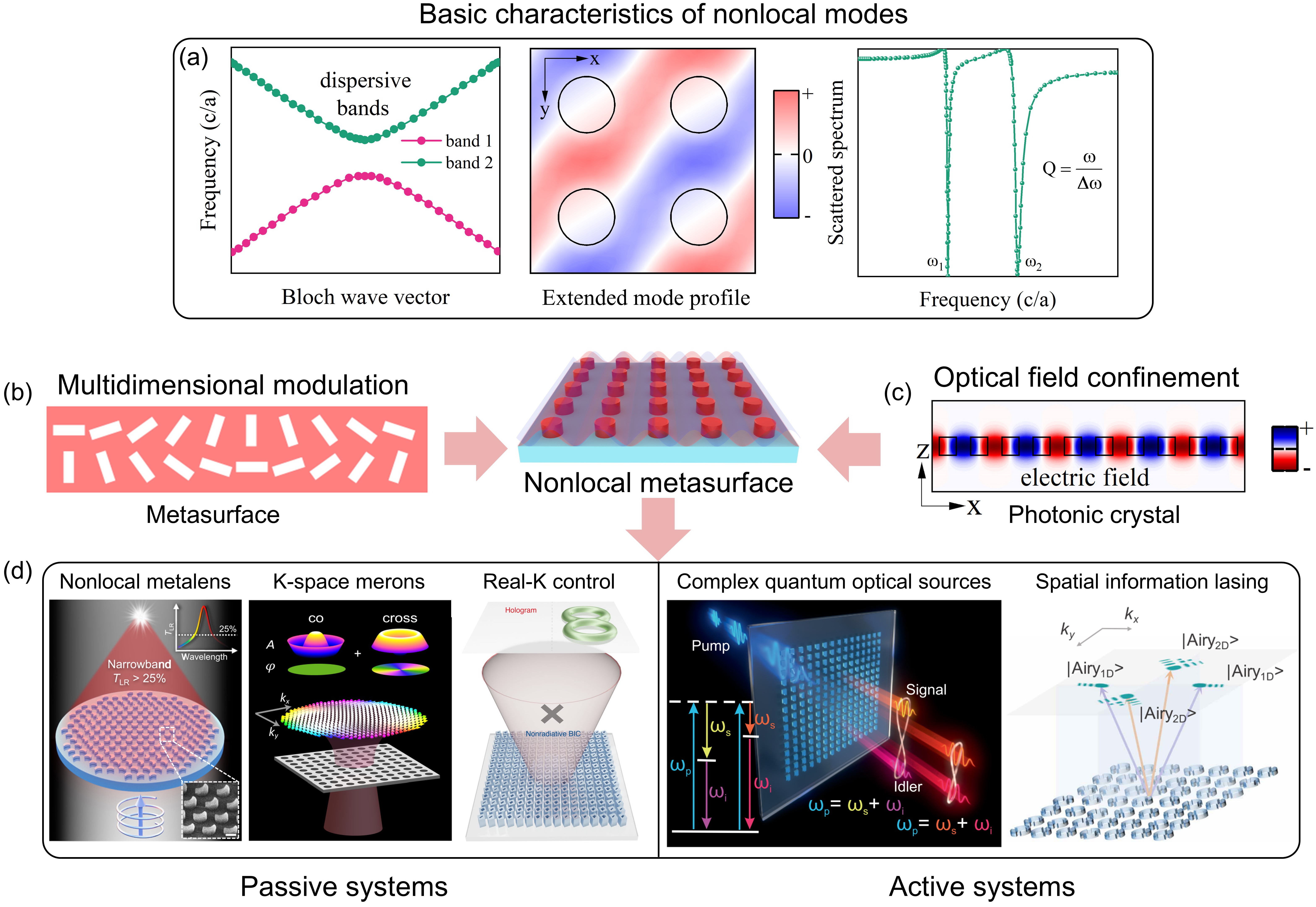
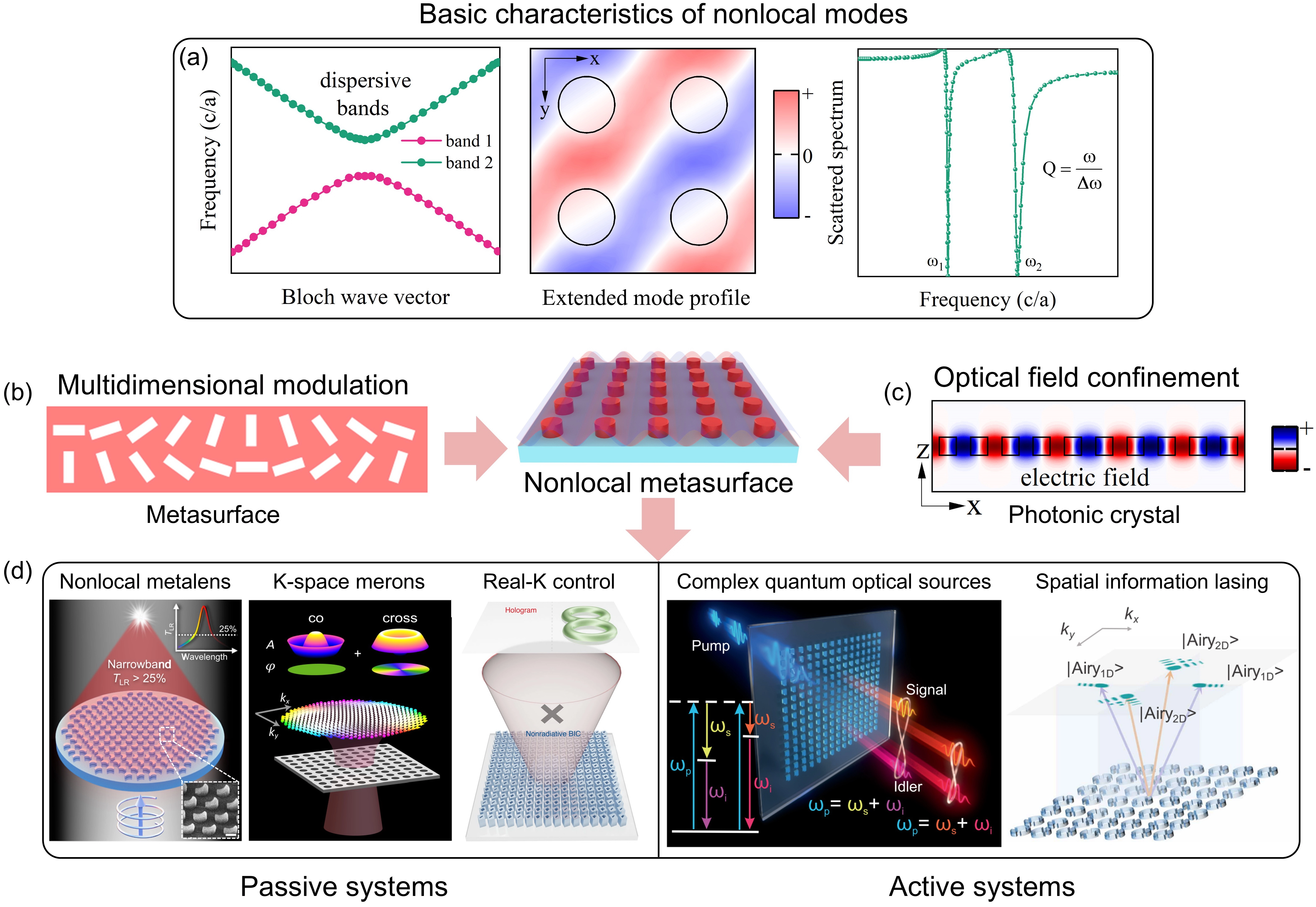
Figure 1. Schematic diagram of optical-field information manipulation based on nonlocal metasurfaces. (a) Nonlocal resonant modes in metasurfaces typically exhibit dispersive energy-band characteristics, spatially extended near-field distributions, and narrow resonance linewidths in their scattering spectra, corresponding to high Q factors. By combining (b) local multidimensional optical-field modulation mechanisms (middle left. Reproduced from reference[60]. CC BY 4.0.) with (c) the enhanced optical-field confinement (middle right) provided by nonlocal resonances, (d) various novel applications have been demonstrated in passive nonlocal-metasurface systems (bottom left, such as nonlocal metalenses (Reproduced from reference[82]. CC BY 4.0.), k-space merons (Reproduced with permission from reference[93]. Copyright © 2025 American Physical Society.) and real-k space multifunctional control (Reproduced from reference[103]. CC BY 4.0.) and in active nonlocal-metasurface platforms (bottom right, such as complex quantum light sources (Reproduced with permission from reference[108]. Copyright © 2022 American Association for the Advancement of Science.) and spatial information lasers (Reproduced from reference[153]. CC BY 4.0.)).
In this review, we summarize recent advances in the rapidly developing field of nonlocal metasurfaces for controlling optical-field information, encompassing both linear passive and active systems, as shown in Figure 1d. Previous reviews on nonlocal metamaterials and metasurfaces have mainly provided comprehensive overviews of the fundamental mechanisms of nonlocal effects and their applications in optics[9,21,24] and other wave systems[23]. Some works have further focused on specific aspects such as the manipulation of nonlinear optics processes[54] and diffraction fields[22], as well as particular classes of nonlocal resonant modes, including leaky modes in all-dielectric metasystems[55], optical BICs[53], and topological GMRs[56]. In contrast, this review emphasizes the role of nonlocal metasurfaces in encoding complex optical information across different passive and active systems, enabling flexible reconstruction and manipulation of optical fields. The structure of this article is as follows. Section 2 introduces the manipulation of optical-field information in linear passive nonlocal metasurfaces from the perspectives of real space and momentum space. We focus on how nonlocal resonances provide spectral and wavevector degrees of freedom for manipulating real-space optical information, as well as how nonlocal momentum-space polarization singularities, such as BICs, enable the construction of complex light fields in momentum space. Section 3 discusses recent advances of nonlocal metasurfaces in active systems, including the generation and control of nonlinear harmonic sources and quantum states, along with spatial information lasing featuring controllable wavefronts. Finally, Section 4 outlines the key challenges in optical-field information manipulation based on nonlocal metasurfaces and highlights promising research directions that are likely to attract future attention.
2. Manipulation of Optical-Field Information Based Nonlocal Metasurfaces in Passive Systems
Due to the negligible near-field coupling between meta-atoms in the local metasurfaces, the optical response at a given position on the output surface is determined solely by the design at the corresponding position on the input surface[21]. Consequently, such systems can flexibly manipulate multiple degrees of freedom of the light field, including amplitude, phase, and polarization across a broad spectral range[57-59]. In contrast, nonlocal resonances are characterized by spatial dispersion, narrow spectral linewidths, and extended leakage modes, which introduce additional degrees of design freedom such as the spectrum and wavevectors. However, these collective interactions couple individual unit cells, preventing independent phase control across the surface[60]. Emerging nonlocal metasurfaces can mitigate or eliminate phase drift between structural arrays induced by inter-element coupling through new physical mechanisms and design strategies, thereby enabling multidimensional control of optical information fields in the real and momentum spaces while preserving high-Q resonances.
2.1 Optical manipulation in real space
One significant advantage of nonlocal metasurfaces is their strong spectral selectivity, arising from the presence of rich high-Q resonances, which enables broad applicability in filtering[43,61], sensing[37,38,62], and modulating[35,36]. A representative example is dye-free structural coloration, which relies on well-defined resonances in the visible spectrum and enables high-resolution, fade-resistant color printing[63]. Previous dielectric metasurfaces relied on localized Mie resonances in multilayer dielectric structures to achieve highly saturated structural colors[64]; however, they still faced challenges in producing deeply saturated red hues, which are inherently rare in nature. By designing a silicon monolayer nanoantenna that supports the partial spectral overlap of two quasi-BIC modes at wavelengths above 600 nm, and by leveraging diffraction and absorption to suppress higher-order modes at shorter wavelengths, Dong et al. realized Schrödinger red pixels with both high saturation and high brightness[65]. Due to the nonlocal characteristic of quasi-BIC resonance, it is highly sensitive to the incident angle and polarization, enabling its use in information encryption[66,67]. Therefore, by integrating multiple degrees of freedom such as spectrum, polarization, and wavevector, nonlocal metasurfaces can achieve more diverse control of the optical-field information.
As shown in Figure 2a, by engineering the collective interference of nonlocal plasmonic GMRs in metal–insulator–metal diatomic metasurfaces, Cheng et al. achieved spectral- and spin-encoded information encryption[68]. By varying the relative spacing d between the two umbrella-shaped nanostructures A and B, the coupling between the metasurface and left-handed circularly polarized (LCP) and right-handed circularly polarized (RCP) light can be precisely controlled, enabling continuous tuning of the system’s circular dichroism at the resonant wavelength of GMRs and the realization of counterintuitive chirality reversal. By tailoring the spacing d and arc lengths of the nanostructures, the reflection amplitude at the resonant wavelengths of the local resonance and nonlocal GMRs can be independently controlled, thereby enabling the formation of coding elements for chiral optical encryption. Complete near-field grayscale imaging is achieved exclusively under LCP light excitation at a wavelength of 1,530 nm, providing an effective strategy for information encryption. In addition to regulating the amplitude and polarization at the resonant wavelength, nonlocal metasurfaces can simultaneously achieve spectral and angular control of the optical response[69-72]. As shown in Figure 2b, the researchers proposed a bilayer misaligned dielectric metagrating capable of supporting optically asymmetric radiation modes, which can be utilized to tailor the transmission and reflection characteristics of the structure[72]. Figure 2c presents the reflectance of the investigated mode as a function of wavelength and incident angle. It can be observed that high reflectance is achieved only within a limited range of resonant wavelengths and incident angles, thereby breaking the intrinsic dispersion locking associated with the continuous band structure of conventional nonlocal periodic systems. Figure 2d demonstrates the spatial–spectral selective imaging performance of the metagrating. The image transmission is suppressed within the range of ±4° and 1,342 ± 5 nm, whereas clear image transmission is realized outside this wavelength–angle window, enabling high-contrast wavelength–angle selective imaging. The spectral and angular selectivity of nonlocal resonances can be further extended to enable independent control of optical functionalities in different wavelength regions. For example, by utilizing superwavelength unit cells to suppress higher-order modes in the visible regime, broadband zeroth-order transparency can be achieved, while infrared light can be diffracted into the +1st order through nonlocal GMRs. Based on this mechanism, a high-performance wearable eye-tracking system has been successfully demonstrated[71]. A similar strategy can be applied to achieve high-Q beam deflection and focusing by introducing nanonotch defects into the perturbative metagrating[73,74]. However, because the periodicity along the grating-finger direction remains subwavelength and the defect sizes must be tightly controlled, this approach is still restricted to one-dimensional wavefront control and imposes more stringent requirements on nanofabrication.
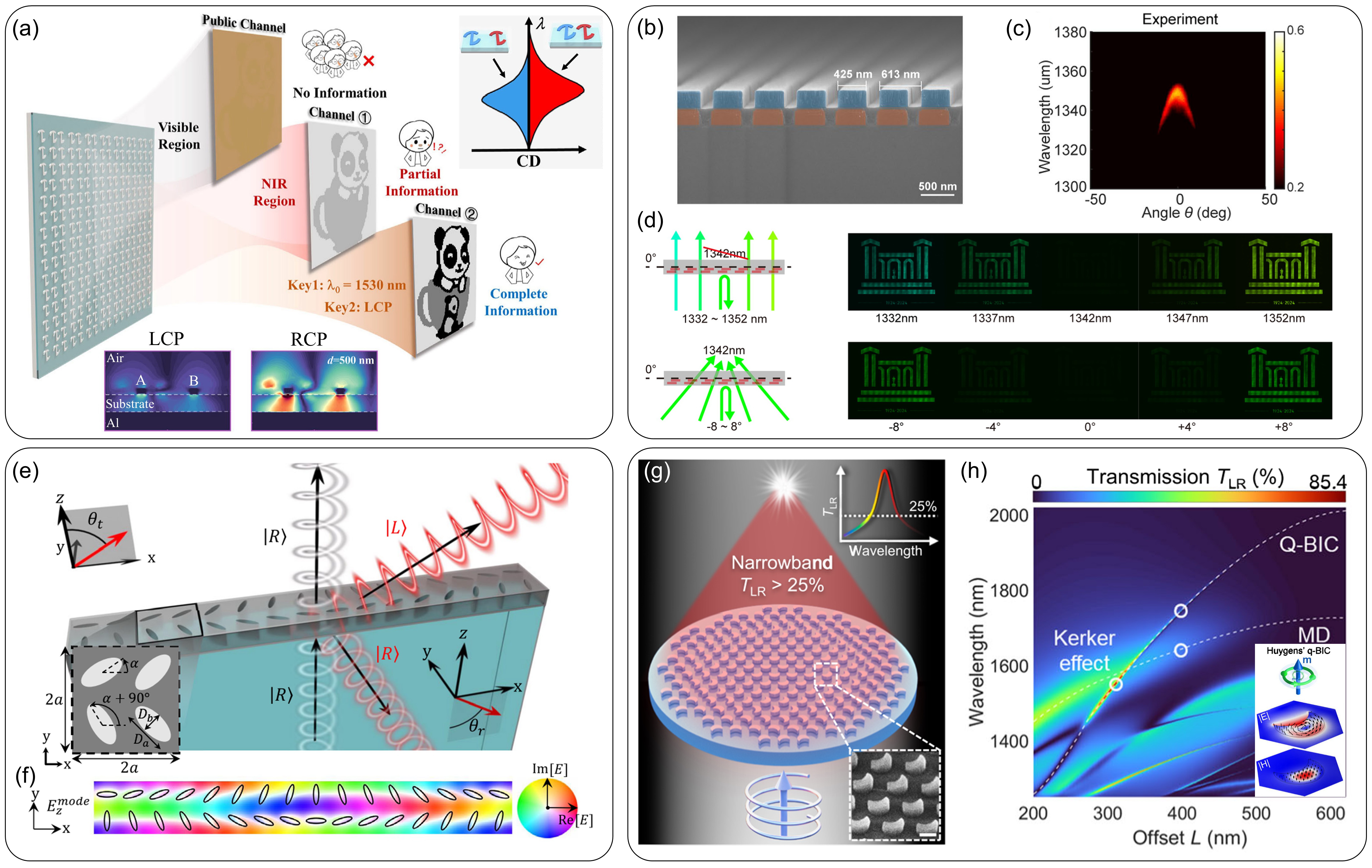
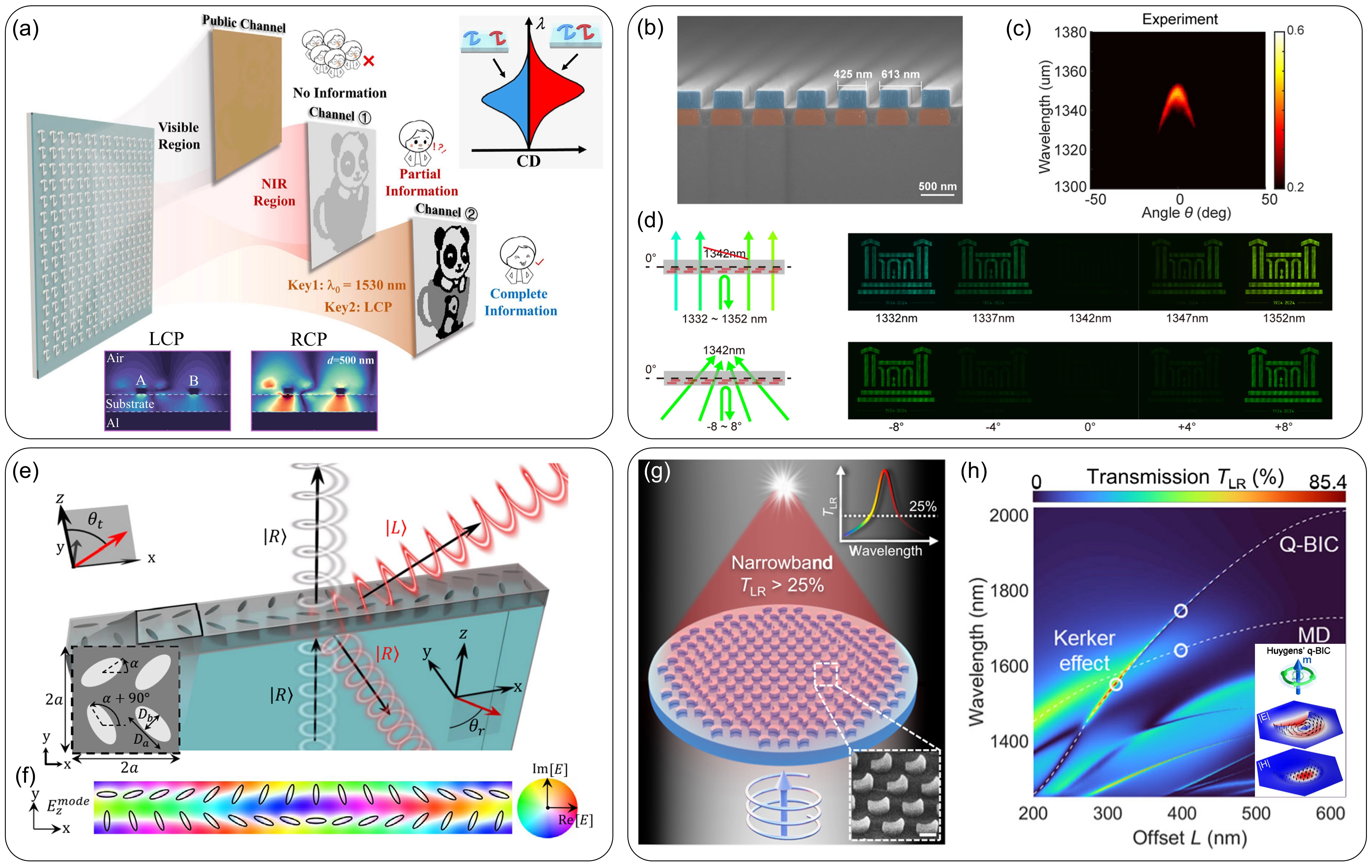
Figure 2. Real-space manipulation of optical-field information based on passive nonlocal metasurfaces. (a) Spin- and wavelength-selective optical encryption enabled by nonlocal plasmonic GMRs. The inset in the upper-right corner illustrates how the spacing d between the A and B nanostructures in the diatomic metasurface unit cell enables the reversal of CD. The lower inset presents the near-field |Ez| distributions of the chiral nonlocal GMRs when d = 500 nm under excitation with LCP and RCP, respectively. Reproduced with permission from reference[68]. Copyright © 2025 John Wiley & Sons; (b)-(d) Spatial–spectral selective light manipulation with bilayer misaligned metagratings; (b) SEM image of the fabricated metagrating sample; (c) Experimentally measured reflectance distribution under different incident angles and wavelengths; (d) Experimental transmission images obtained under normal incidence at different wavelengths (top panel) and under different incident angles at 1,342 nm (bottom panel). Reproduced from reference[72]. CC BY 4.0; (e)-(f) Narrow-band beam deflection leveraging a quasi-BIC resonance; (e) Schematic diagram of nonlocal phase gradient metasurface; (f) Ez field distribution of the nonlocal supermode in the simulated 16 × 2p supercell at the quasi-BIC resonant wavelength, showing a continuous gradient phase evolution induced by the rotation of the elliptical hole nanostructures. Reproduced with permission from reference[75]. Copyright © 2020 American Physical Society; (g)-(h) single-layer, high-efficiency nonlocal metalens based on Huygens’ quasi-BICs; (g) Schematic of a narrowband nonlocal metalens that surpasses the 25% efficiency limit of conventional nonlocal metalenses. The inset presents an SEM image of the fabricated sample composed of crescent-shaped meta-atoms; (h) Calculated circularly polarized transmission conversion efficiency TLR as a function of the structural parameter L. The two white dashed lines indicate the dispersions of the quasi-BIC and the MD resonance; their intersection corresponds to the generalized Kerker condition. The lower-right inset shows the simulated electromagnetic field distributions of the hybrid Huygens quasi-BIC mode. Reproduced from reference[82]. CC BY 4.0. GMRs: guided-mode-resonances; CD: circular dichroism; LCP: left-handed circularly polarized; RCP: right-handed circularly polarized; SEM: scanning electron microscopy; BIC: bound state in the continuum; MD: magnetic dipole.
Combining the tunable high-Q factors of quasi-BIC metasurfaces with local geometric-phase engineering provides a more flexible strategy for narrowband wavefront manipulation[60,66,75]. As shown in Figure 2e,f, Overvig et al. proposed a nonlocal phase-gradient metasurface based on quasi-BIC resonances that selectively deflects circularly co-polarized reflected light and circularly cross-polarized transmitted light at the resonant wavelength, while leaving off-resonant wavelengths largely unaffected[75]. The unit cell with p2 space group symmetry consists of 250-nm-thick silicon elliptical holes patterned on a quartz substrate. The hole dimensions, denoted by Da and Db, govern the resonant wavelength and Q factor of quasi-BICs, while the rotation angle α introduces a geometric phase of
2.2 Optical manipulation in momentum space
In addition to enabling control of light fields in real space, BICs in nonlocal metasurfaces give rise to polarization singularities in momentum space, facilitating the generation of novel structured light fields[50,87]. For a C4v-symmetric photonic crystal slab, a symmetry-protected BIC located at the Γ point exhibits a non-zero topological charge, and evolves into linearly polarized GMRs distributed along finite in-plane wavevectors k||[88]. Therefore, the GMR states at frequencies near the Γ-point BIC under different k|| can be regarded as an effective wave plate with an azimuth angle θ. When circularly polarized light with a certain k|| is incident, the transmitted cross-polarized circular component acquires a geometric phase of ±2θ, which corresponds to the solid angle enclosed by the polarization-state trajectory on the Poincaré sphere[89]. Owing to the presence of polarization vortices formed by the polarization states of GMRs at different k points on the isofrequency contour near the BIC, a slightly convergent laser beam containing multiple k components can be used to excite resonances at different k|| values in the photonic crystal slab. As a result, the transmitted cross-polarized circular component acquires a helical phase wavefront with a topological charge of l = ±2q. Based on the above mechanism, Shi and co-workers experimentally realized momentum-space BIC-associated vortex beams, which correspond to a high-order quasi-Bessel beam with diffraction-resistant characteristics[88]. Furthermore, because this vortex light generator relies on nonlocal effects in momentum space, its structure is spatially uniform and does not require precise alignment with the center of the incident beam. Similar to narrowband wavefront manipulation in real space, the efficiency of nonlocal vortex beam generators based on the geometric phase of circularly polarized light conversion is inherently limited. Nevertheless, recent studies demonstrate that employing a reflective mirror approach or dual-resonance design strategies can substantially enhance the conversion efficiency of nonlocal vortex beam generation[90-92]. As shown in Figure 3a, through the engineering of the relative magnitudes of the intrinsic material absorption loss γ0 and the scattering loss γs of the nonlocal GMRs in a hybrid metal–dielectric reflective nonlocal metasurface, the radiative loss rate can be effectively tailored. As illustrated in Figure 3b, coupled-mode theory calculations indicate that the reflected light can achieve a higher cross-polarization conversion efficiency when the scattering loss γs is much larger than γ0. This theoretical prediction was further verified by experimental results. Figure 3c presents the measured doughnut-shaped far-field intensity profiles of the cross-polarized light under LCP and RCP excitation, together with the corresponding interference patterns formed with a reference beam, each exhibiting two spiral arms. These observations confirm the generation of vortex beams with topological charges of l = ±2, for which the maximum conversion efficiency can reach up to 86%. The same design strategy can be further extended to generate more complex topological spin textures in momentum space, such as skyrmions and merons. As shown in Figure 3d,e, an operational wavelength of 782 nm was selected, corresponding to the isofrequency contour of the GMR states near the Γ-point BIC[93]. Under RCP illumination (
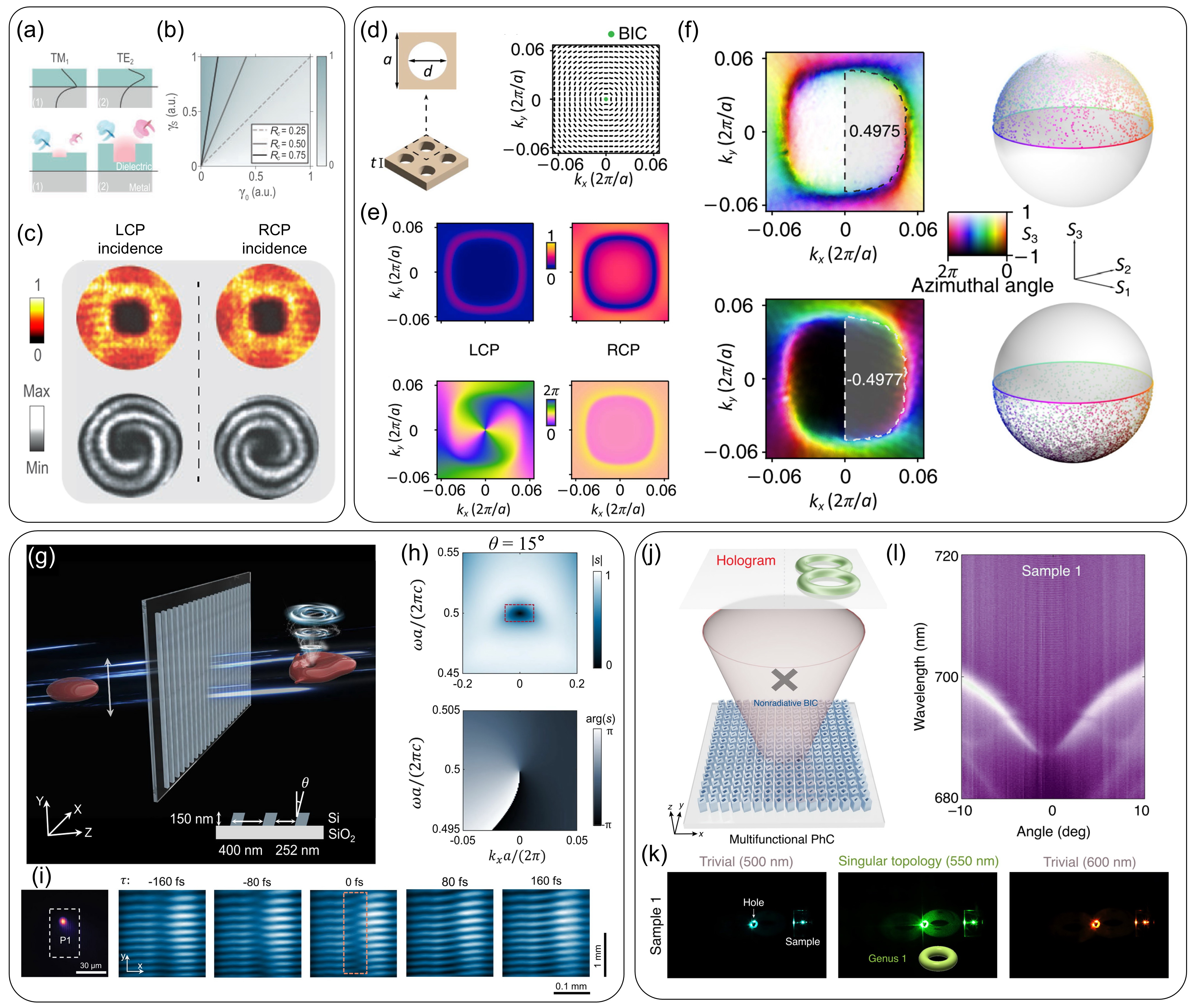
Figure 3. Momentum-space manipulation of optical-field information based on passive nonlocal metasurfaces. (a)-(c) Generation of high-efficiency nonlocal vortex beam via momentum-space polarization vortices; (a) Schematic of electric field distributions (top panel) and out-of-plane scattering rates (bottom panel) of the TM1 and TE2 bands in a hybrid metal–dielectric reflection-type metasurface; (b) Cross-polarization conversion efficiency map obtained from coupled-mode theory under different normalized intrinsic loss (γo) and scattering loss (γs); (c) Experimentally measured intensity profiles and interference fringes of the reflected cross-polarized light under LCP (left panel) and RCP (right panel) illumination. Reproduced from reference[91]. CC BY 4.0; (d)-(f) Generation of momentum-space meron spin textures by anisotropic GMRs near a BIC in a photonic-crystal slab; (d) Structural schematic of the designed photonic crystal slab (left) and the polarization distribution in k-space near the BIC (right); (e) Simulated amplitude (upper panel) and phase distributions (lower panel) in momentum space for the transmitted cross-polarized (left) and co-polarized (right) components under RCP illumination; (f) Experimentally measured spin texture (left) under RCP (upper panel) and LCP (lower panel) illumination, along with the corresponding meron projections onto the Poincaré sphere (right). Reproduced with permission from reference[93]. Copyright © 2025 American Physical Society; (g) A schematic diagram illustrating the generation of spatiotemporal optical vortices based on zero-transmission singularities in the momentum–frequency space. The inset represents the designed symmetry-breaking slanted silicon nanograting; (h) Simulated amplitude distribution (upper panel) of the transmission coefficient s and the corresponding phase distribution (lower panel) within the red rectangular region when θ = 15°; (i) Time-resolved interference fringe evolution at the P1 position under femtosecond pulse pumping (80 fs time interval). The orange dashed box highlights a phase singularity. Reproduced from reference[101]. CC BY 4.0; (j) A schematic diagram of a slotted metasurface that simultaneously supports nonlocal BIC in momentum space and local singularity-assisted topological phase for arbitrary meta-hologram generation in the real space; (k) The measured real-space holograms at wavelengths of 500 nm, 550 nm, and 600 nm, clear images are observed only around 550 nm, enabled by the singular topological phase. (l) Angle-dependent band structure measurement that confirms stable non-radiative BICs. Reproduced from reference[103]. CC BY 4.0. TM: transverse-magnetic; TE: transverse-electric; LCP: left-handed circularly polarized; RCP: right-handed circularly polarized; GMRs: guided-mode-resonances; BIC: bound state in the continuum.
Beyond spatial light-field control enabled by momentum-space polarization singularities, the deliberate construction of optical singularities in joint frequency–momentum space provides a powerful route to tailoring and reshaping light fields in the spatiotemporal domain, exemplified by spatiotemporal optical vortices (STOVs)[97-101]. Specifically, upon excitation by an incident pulse, the optical field g(ω, kx) in the frequency-momentum space can be transformed into the spatiotemporal pulse G(τ, x) via a Fourier transform, expressed as G(τ, x) = ℱ{g(ω, kx)}. Consequently, the prerequisite for generating a STOV is equivalent to locating zero-valued phase singularities within the (ω, kx) space. According to the two-resonance temporal coupled-mode theory, symmetry-protected BICs in metasurfaces with in-plane C2 rotational symmetry and out-of-plane σz mirror symmetry manifest as nodal lines, rather than isolated points, in the transmission spectrum of the (ω, kx) space. As a result, additional symmetries must be broken to successfully construct STOVs. As shown in Figure 3g, Huo et al. experimentally observed the space-time evolution of a STOV with transverse orbital angular momentum (OAM) carried by femtosecond pulses using a slanted silicon nanograting[101]. This grating structure simultaneously breaks both the in-plane and out-of-plane symmetries, thereby obtaining isolated zero-value transmission singularities in the ω-kx space, accompanied by a spiral phase distribution around it (Figure 3h). They further pumped the system with 80 fs ultrashort pulses and used a time-resolved interference setup to observe and characterize the generation of STOVs. As shown in Figure 3i, when the temporal delay approaches zero, the left and right interference fringes gradually bend in opposite directions, eventually forming a series of fork-like patterns along the central axis, indicating the presence of spatiotemporal phase vortices. By constructing phase vortices in the frequency-momentum domain, STOVs have been successively realized in reflective nonlocal metasurfaces and liquid surface wave platforms[98,99]. Recent progress in nonlocal metasurfaces has enabled the simultaneous manipulation of optical-field information in both real and momentum spaces[102,103]. As shown in Figure 3j, Lv et al. proposed a nonlocal metasurface that simultaneously supports the real-space local singularity-assisted topological phase for spatial information encoding and momentum-space nonlocal BICs[103]. The perturbed titanium dioxide (TiO2) slotted metasurface architecture enables the generation of a spectral-zero-assisted topological phase, providing efficient 2π phase coverage by tuning the width of the notch, while leaving the momentum-space topological properties of the underlying BIC resonance unchanged. Therefore, as shown in Figure 3k,l, the experiments reveal clear holographic images only near a wavelength of 550 nm, while the measured momentum-space band structure confirms the robust existence of a non-radiative BIC. This synergistic strategy can be further leveraged to simultaneously and independently exploit the real-space Pancharatnam–Berry phase for broadband wavefront shaping and momentum-space polarization vortices for vortex beam generation[102]. The flexible integration of real-space and momentum-space degrees of freedom in nonlocal metasurfaces enables enhanced information capacity and tunability in optical-field manipulation, thereby further advancing the development of flat optics.
3. Manipulation of Optical-Field Information Based on Nonlocal Metasurfaces in Active Systems
Nonlocal resonances such as quasi-BICs, GMRs, and surface lattice resonances[104] with high Q factors and strong optical-field confinement enable efficient enhancement of light–matter interactions. When combined with material gain and optical nonlinearities, nonlocal metasurfaces have enabled a range of active photonic applications, including nonlinear harmonic generation[39,40,105,106], quantum light sources[107,108], and nanolasers[109-111]. By integrating real-space and momentum-space optical field control enabled by nonlocal metasurfaces into micro- and nanoscale light-source generation, active optical information manipulation such as nonlinear optical-field scanning and spatial information lasing can be effectively achieved. These capabilities offer promising prospects for the development of miniaturized optical systems that integrate light sources with information transmission and modulation.
3.1 Manipulation of nonlinear sources
As shown in Figure 4a, the periodic gold split-ring resonators (SRRs) act as a perturbation that couples the guided modes in the lower TiO2 dielectric waveguide to free space, thereby forming narrowband radiative GMRs while preserving strong modal confinement in the waveguide layer[112]. Owing to the pronounced near-field enhancement in the vicinity of the waveguide layer and the increased nonlinear effective polarizability induced by the collective scattering of SRRs, an eightfold enhancement of second-harmonic generation (SHG) was experimentally achieved. As shown in Figure 4b, the colormap of the normalized SHG conversion efficiency under TE-polarized excitation at different incident angles and wavelengths is consistent with the dispersion of the TE GMRs, indicating that the nonlinear enhancement originates from the collective interaction of nonlocal GMRs. It is worth noting that, because SHG arises from the second-order nonlinear response at the gold surface, the maximum enhancement occurs at an incident angle of 22°, where optimal spectral and spatial overlap is achieved between the local surface plasmon resonance of SRRs and the waveguide mode. In addition to enabling efficient harmonic generation, nonlinear metasurfaces based on the local and nonlocal resonances can flexibly control the optical-field information of harmonic sources by tailoring nonlinear optical interactions. Through the exploitation of nonlinear selection rules to tailor the local phase and amplitude of the nonlinear coefficients[113], a variety of beam-shaping functionalities, including nonlinear holography[114,115], diffraction control[116,117], vortex beam generation[118,119], and nondiffracting beams[120], have been experimentally demonstrated. Very recently, the enhanced field confinement and abundant mode coupling provided by nonlocal metasurfaces have enabled the simultaneous improvement of harmonic generation efficiency and the encoding of richer information into the harmonic sources[121]. As shown in Figure 4c, a 125-nm-thick rectangular anisotropic silicon nanoarray on insulator is employed to achieve efficient third-harmonic generation (THG), owing to its large third-order susceptibility and negligible absorption loss at telecommunication wavelengths[122]. At an excitation wavelength of 1,554 nm, the local Mie resonance and the nonlocal quasi-BIC mode spectrally overlap, giving rise to a hybrid mode characterized by a redistribution of the electric field within the silicon nanoarray. Therefore, as shown in Figure 4d, when the incident angle of the collimated pump femtosecond pulse was changed from 0° to 22° experimentally, the generated THG diffraction switched from the (±1, 0) order to the (0, ±1) order. Moreover, owing to the local field enhancement induced by the nonlocal high-Q resonance under oblique incidence, a two-orders-of-magnitude enhancement of the THG intensity relative to normal incidence was experimentally achieved.
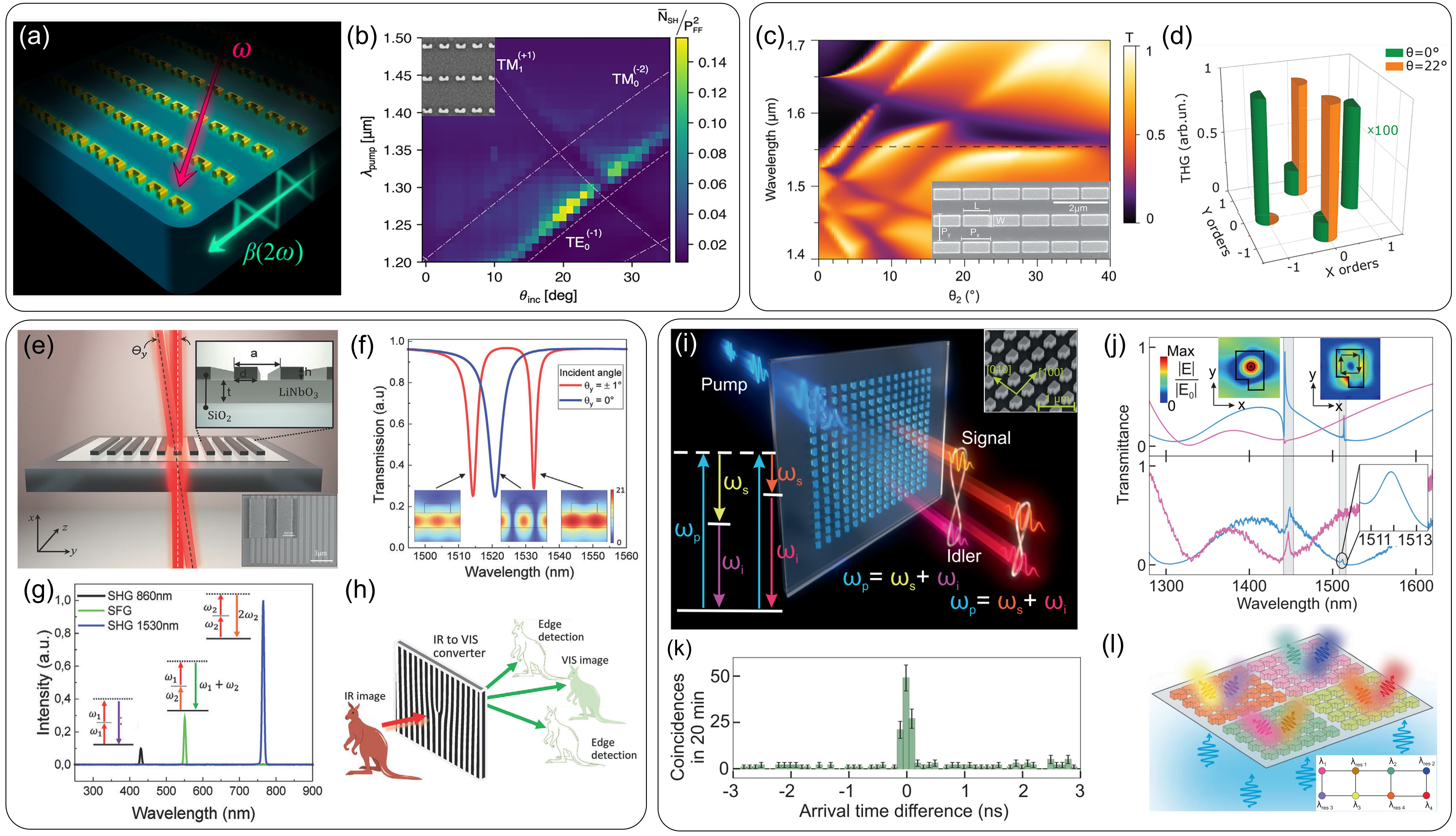
Figure 4. Generation and manipulation of nonlinear harmonic and quantum light sources based on active nonlocal metasurfaces. (a) Schematic illustration of collective-resonance-enhanced SHG in a gold-TiO2 hybrid waveguide nonlocal metasurface; (b) Measured forward normalized SHG efficiency as a function of pump incident angle and wavelength. The white dashed lines mark the dispersion of the GMRs. Reproduced from reference[112]. CC BY 4.0; (c) The calculated transmission spectra of a high-Q silicon nonlocal metasurface under TE-polarized illumination at different incident angles and wavelengths. The inset in the lower-right corner shows the SEM image of the fabricated metasurface. The dashed lines denote the excitation wavelength of 1,554 nm; (d) Experimentally measured power distribution of THG at different diffraction orders for incident angles of 0° and 22°. Reproduced with permission from reference[122]. Copyright © 2021 American Chemical Society; (e) Schematic diagram of an SiO2–LN nonlocal metasurface; (f) Calculated transmission spectra of the metasurface under normal and oblique incidences. The normalized electric-field distributions at the resonant wavelengths in the bottom insets exhibit nonlocal, spatially extended mode characteristics; (g) Measured nonlinear signal intensities of SHG and SFG under simultaneous excitation by two incident beams: an 860 nm pump beam and a 1,530 nm signal beam; (h) Schematic diagram of a spatially-variant nonlocal metasurface that simultaneously performs zero-order upconversion imaging of sum-frequency light and ±1-order diffraction edge detection. Reproduced from reference[127]. CC BY 4.0; (i) Schematic diagram of multiplexed entangled-photon generation in a multi-resonant quasi-BIC GaAs metasurface; (j) Simulated (top) and measured (bottom) linear transmission spectra of the multi-resonant metasurface under x- and y-polarized excitation. The inset shows the normalized electric-field distributions at the two quasi-BIC wavelengths; (k) Measured distribution of the photon arrival-time differences for two superconducting nanowire single-photon detectors, demonstrating photon-pair generation. Error bars represent the statistical uncertainties of all measured quantum metasurfaces; (l) Spatial multiplexing of four high-Q nonlocal metasurfaces to generate a complex, scalable quantum cluster state (inset in the lower-right corner) with a single multifrequency pump beam. Reproduced with permission from reference[108]. Copyright © 2022 American Association for the Advancement of Science. SHG: second-harmonic generation; GMRs: guided-mode-resonances; TE: transverse-electric; SEM: scanning electron microscopy; THG: third harmonic generation; LN: lithium niobate; SFG: sum-frequency generation; BIC: bound state in the continuum; GaAs: gallium arsenide.
In addition to efficient harmonic generation and wavefront shaping, nonlocal metasurfaces enable a broad range of complex nonlinear optical responses, including nonlinear imaging based on sum-frequency generation (SFG)[123], four-wave mixing[124,125], and high-harmonic generation[126], as well as generation of quantum light sources[107,108]. As shown in Figure 4e, a one-dimensional SiO2 grating deposited on a lithium niobate (LN) layer forms a nonlocal metasurface that is used to enhance infrared vision via nonlinear upconversion[127]. Figure 4f illustrates simulated transmitted spectra under normal and oblique incidences, which present the resonant splitting induced by the strong nonlocal properties of GMRs. Moreover, because the extended resonant modes are predominantly confined within the LN waveguide layer, the large second-order nonlinear susceptibility of LN can be effectively exploited to enhance the nonlinear conversion efficiency. As shown in Figure 4g, the high-Q nonlocal metasurface was simultaneously excited by an 860 nm pump beam and a 1,530 nm signal beam, corresponding to the resonant wavelengths that yield maximum SHG enhancement. As a result, SFG emission at 550 nm was experimentally obtained, exhibiting a record 458-fold enhancement compared with that from a bare LN film. Owing to the linear transfer function of the SFG process, the authors further achieved infrared imaging with record-high upconversion efficiency and image quality by employing appropriate Fourier imaging techniques in their experiments. By further designing spatially varying nonlocal metasurfaces, simultaneous upconversion imaging and image processing can be realized. As shown in Figure 4h, a topologically dislocated one-dimensional nonlocal metagrating enables upconversion imaging of the zeroth-order SFG signal, while simultaneously performing edge detection on the input infrared image in the first diffraction order. Based on the conjugate relationship between SFG and spontaneous parametric down-conversion, high-Q nonlocal metasurfaces can generate entangled photon pairs or more complex quantum states in the spatial or angular domains[107]. As shown in Figure 4i, the authors designed a gallium arsenide (GaAs) semiconductor metasurface supporting multiple symmetry-protected quasi-BIC resonances, enabling the generation of multiplexed entangled photon pairs under optical pumping[108]. Specifically, the quantum metasurface supports two high-Q quasi-BIC resonances in the near-infrared region, whose resonant wavelengths can be independently engineered, enabling the generation of two distinct types of entangled photon pairs with comparable efficiencies (Figure 4j). Figure 4k shows the coincidence counts measured by two single-photon detectors, thereby confirming the generation of photon pairs. Beyond entangled photon pairs, more complex quantum graph states can be generated by exciting the designed nonlocal metasurface with multiple coherent pump beams at different wavelengths, such as frequency combs and spectrally filtered supercontinuum sources. Analogous to the segmented design strategy employed in local multiplexed metasurfaces[58,59], spatially multiplexed quantum states under single-pump excitation can be realized by integrating multiple nonlocal metasurfaces within a single optical platform. As illustrated in Figure 4l, each metasurface supports nonlocal resonances at distinct wavelengths, enabling the simultaneous generation of multiple entangled photon pairs across separate wavelengths under excitation by a single multifrequency pump beam[108]. Overall, the presence of abundant high-Q resonances in nonlocal metasurfaces enables complex quantum state engineering from a single nanoscale quantum light source, offering promising prospects for the miniaturization of photonic quantum information processing. A paramount manifestation of this concept has been experimentally demonstrated in atom-array-based quantum metasurfaces. Specifically, a single monolayer of trapped atoms in an optical lattice can function as a cooperative subradiant mirror governed by long-range, nonlocal dipole-dipole interactions[128]. Crucially, the optical response of such atomically thin metasurfaces can be coherently switched and spatially controlled at the single-quantum level by manipulating a single Rydberg ancilla atom[129], unlocking new paradigms for deterministic light-matter entanglement.
3.2 Manipulation of information lasers
While nonlinear metasurfaces primarily address the frequency conversion of external excitation, the realization of miniaturized, multidimensional coherent light sources, referred to as information lasers, requires the integration of gain media with cavities that offer both high Q factors and precise modal control. Nonlocal metasurfaces emerge as ideal candidates for such cavity designs. In contrast to their local counterparts, these systems account for the coupling between individual structures, forming photonic bands analogous to energy band structures in solid-state physics. Through judicious lattice engineering and structural design, nonlocal metasurfaces realize on-demand band dispersion, yielding a high density of states at specific high-symmetry points in the Brillouin zone[130-132]. The inter-band coupling and interaction with the radiation continuum underpin emerging phenomena such as BICs[50,51,133-135], parity-time (PT) symmetry[136], and exceptional points (EPs)[137], establishing nonlocal metasurfaces as a premier platform for momentum-space engineering.
Leveraging flexible band engineering and improved fabrication capabilities, various high-Q resonant modes realized in nonlocal metasurfaces, such as BICs[109,138-140] and photonic topological insulators[141-144], have been applied to lasing. By combining these with extensive wavefront manipulation methods, multi-dimensional control of spatial information lasing has been achieved[145-148]. As shown in Figure 5a, Spägele et al. overcame the limitation that transmission and reflection amplitudes of local metasurfaces cannot locally exceed 1 by considering the coupling between supercell elements[149]. They demonstrated multiple independent optical functions (a Gaussian, a focused helical beam with OAM of 1 and a Bessel beam on separate diffraction orders) at different and large deflection angles with high efficiency. Compared to independent scatterers carrying phase and polarization information in a local metasurface unit cell, the larger supercell acts locally as a grating; thus, a supercell library satisfying the phase and amplitude of all local diffraction orders was compiled. This nonlocal supercell metasurface can be further integrated with a laser diode to realize a compact, wavelength-tunable external-cavity laser with arbitrary beam-shaping capabilities. As shown in Figure 5b, one diffraction order of the reflection from the supercell metasurface provides cavity feedback to achieve lasing, while other diffraction orders can be designed for collimated light output or a holographic output beam. Beyond utilizing the high reflectivity of a specific diffraction order for optical feedback, a more direct and compact approach involves using the gain medium as the material for the nonlocal metasurface itself. For example, based on the BIC-enabled optical field confinement mechanism, low-threshold vortex lasers with controllable topological charges have been demonstrated[109,150]. However, their topological features are strictly dictated by the intrinsic lattice symmetry of the real-space unit cell, imposing fundamental constraints on the deterministic tailoring of lasing topological charges. To break this symmetry-induced constraint, recent strategies have evolved towards local symmetry breaking in quasi-BICs[151]. As shown in Figure 5c, by reducing the symmetry of a triangular photonic crystal slab from C6 to C2, a Möbius-like correspondence between the geometric orientation of the structural perturbation and the intrinsic linear polarization of the quasi-BICs was unveiled[151]. By repeating photonic crystal slabs with three different azimuthal angles θ n times in real space, the emitted topological laser can carry a topological charge of q = ±n, where the sign depends on whether the angular arrangement is repeated in a clockwise or counterclockwise direction. As shown in Figure 5d, leveraging this unique topological mapping, compound cavities constructed by spatially splicing distinct quasi-BIC sectors enable the generation of designable vectorial topological lasing with highly flexible integer orders (for example, from -5 to +5).
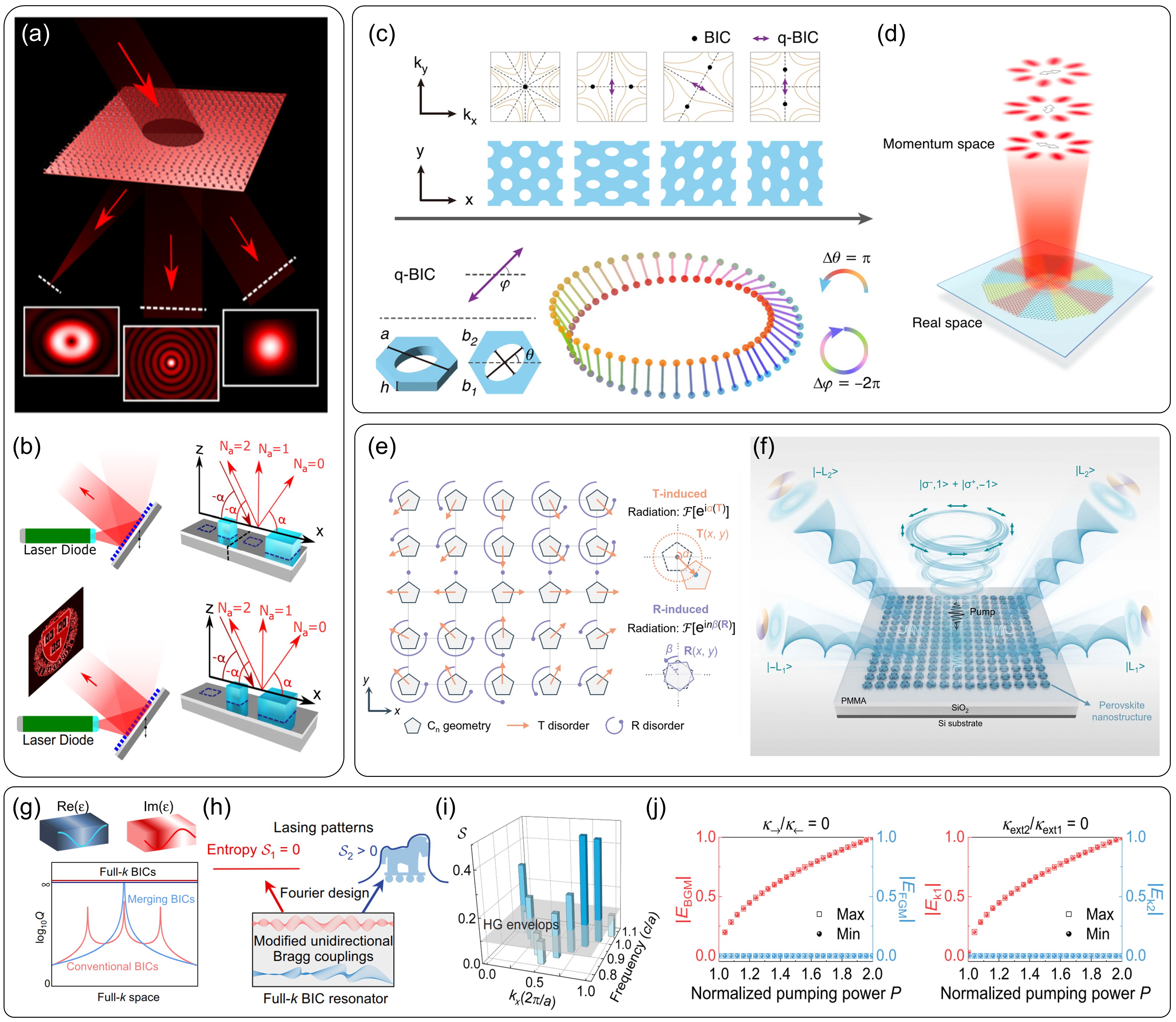
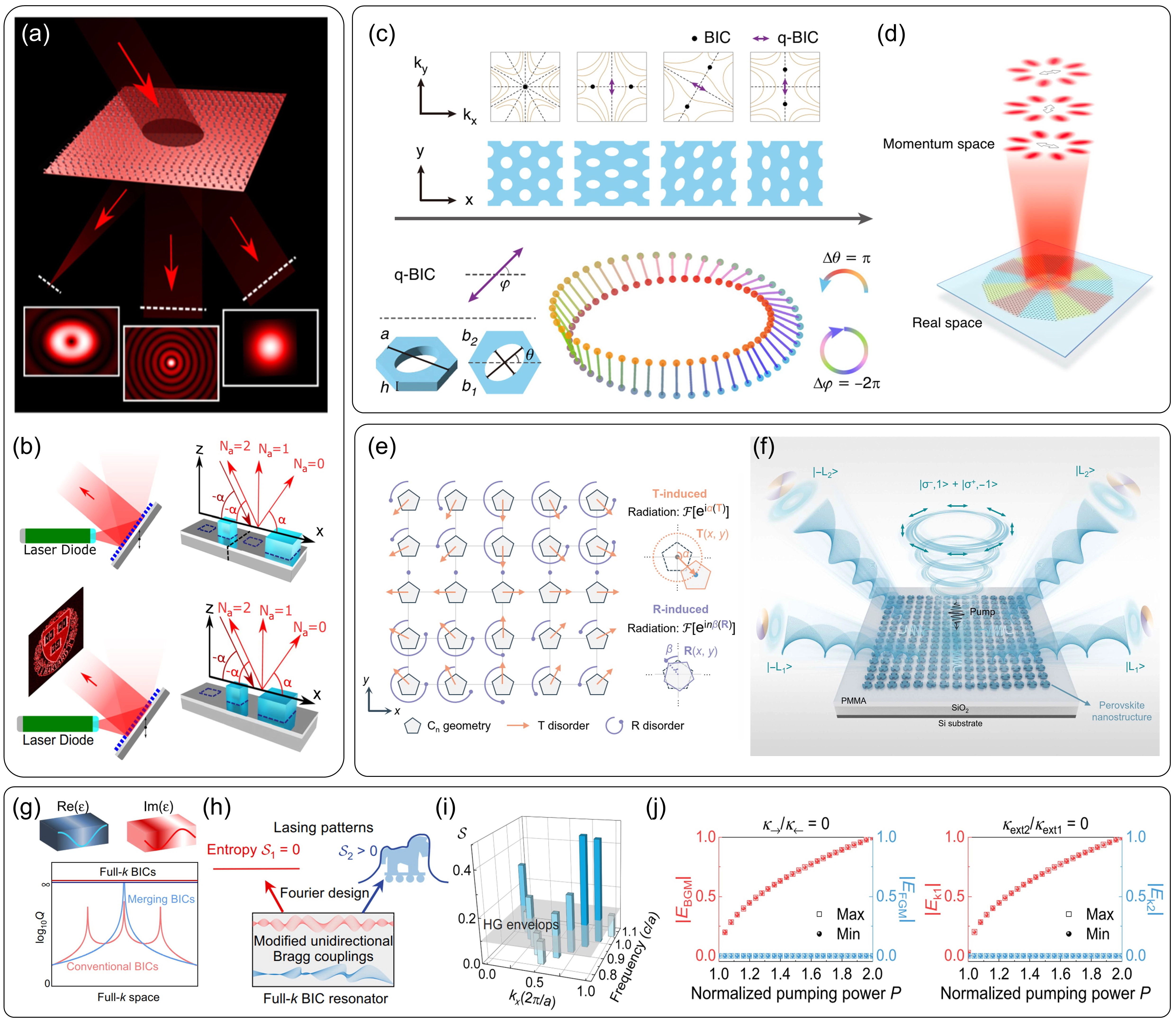
Figure 5. Spatial information lasing based on active nonlocal metasurfaces. (a)-(b) Real-space supercell engineering for multifunctional wavefront shaping; (a) Schematic of a supercell metasurface splitting an incident beam into multiple independent structured beams at distinct deflection angles; (b) Operational principle of the metasurface-based external cavity laser. One diffraction order (red arrow pointing back) provides optical feedback to the laser diode, while other orders (red arrows pointing out) generate independent output beams, such as collimated (top) or holographic (bottom) light. Reproduced from reference[149]. CC BY 4.0; (c)-(d) Vectorial topological lasing enabled by quasi-BIC compound cavities; (c) The Möbius-like correspondence between real-space symmetry breaking and eigen-polarizations of quasi-BICs from the triangular PhC slab induced by local symmetry breaking of the lattice from C6 down to C2; (d) The generation of a vectorial lasing with -4 topological charge via the spatial splicing of distinct quasi-BIC PhC sectors. Reproduced from reference[151]. CC BY 4.0; (e)-(f) Multidimensional control of structured light via a “DoD” meta-cavity; (e) Spatially decoupled symmetry-breaking mechanisms induced by translational (T) and rotational (R) disorders; (f) Schematic illustration of the multichannel structured lasing emission from a shared aperture. Reproduced from reference[153]. CC BY 4.0; (g)-(j) Spatial information lasing enabled by full-k-space BICs; (g) Profiles of the real and imaginary parts of the permittivity (top) and the resulting full-k-space BICs showing diverging Q factors across a continuous band (bottom); (h) Schematic illustration of spatial information lasing enabled by full-k-space BICs in a PTMM. The lasing information entropy (S) is controlled by engineering the complex Fourier components of the PTMMs; (i) Calculated lasing information entropy S of the considered energy band; (j) Bifurcation diagrams depicting the steady-state maximum and minimum of the amplitude |E| versus the normalized pumping power (P = 1 at the threshold), in the case of band mode competitions (left) and k-mode competitions.
This quasi-BIC-based Möbius-like correspondence approach enables arbitrary control over the orbital angular momentum of nanolasers, while manipulation of individual degrees of freedom of lasing emission, such as polarization and directionality, has also been successfully demonstrated. Nevertheless, achieving arbitrary manipulation of the laser wavefront remains challenging because tailoring the wavefront while preserving the nanolaser cavity mode is difficult. Recently, Zeng et al. suggested and realized a new type of laser, a metalaser, by using the interplay between local and nonlocal responses of dielectric resonant metasurfaces, providing a viable solution to the problem[152]. They identified a special quasi-BIC mode in which the geometric phase induced by rotational disorder can be locally applied to each pixelated meta-unit without destroying the high-Q nonlocality. As a result, the laser emission can exhibit an arbitrarily shaped wavefront, enabling unprecedented capabilities, such as speckle-free laser holographic displays. Beyond approaches that rely on geometric phases induced by isolated rotational disorder, the paradigm for generating structured light from a single aperture has evolved toward the intricate fusion of diverse perturbations, enabling spatially structured lasing with highly multiplexed channels and expanded physical degrees of freedom. As shown in Figure 5e, the advent of the “disorder-on-disorder” (DoD) meta-cavity exemplifies this paradigm by exploiting the spatially decoupled symmetry-breaking mechanisms of translational (T) and rotational (R) disorders[153]. By superimposing these geometrically decoupled disorders onto C3-symmetric perovskite nanostructures that exhibit robust wavelength stability against geometric perturbations, precise and independent phase modulation across multiple radiation channels is achieved without compromising the intrinsically high Q factors or low lasing thresholds. Consequently, this monolithic DoD platform enables the simultaneous generation of phase and polarization vortices, one-dimensional and two-dimensional Airy beams, as well as tailored Hermite–Gaussian and Laguerre–Gaussian modes from a shared aperture (Figure 5f), fundamentally transcending the symmetry constraints of conventional periodic lattices.
Beyond modulating the laser wavefront in real space via perturbations to robust modes (e.g., BICs), nonlocal metasurfaces offer extensive capabilities for achieving informational nanolasers by utilizing momentum-space design. Specifically, by exploiting degrees of freedom such as lattice symmetries[154,155], disorder[156], radiative couplings[157], and active gain–loss engineering[158], these strategies allow for the precise tailoring of emission characteristics. As shown in Figure 5h, Chai et al. proposed the concept of spatial information lasing enabled by precise control of each lasing Fourier component, demonstrating a paradigm of intracavity informational lasing where information modulations are realized inside the laser cavity[159]. Distinct from conventional BICs limited to zero-dimensional singularities, this work utilizes PT-modulated metasurfaces (PTMMs) to realize full-k-space BICs. By precisely balancing gain and loss, a continuous energy band possessing theoretically infinite Q factors is formed (Figure 5g). On this basis, by configuring the complex Fourier components of the permittivity, the researchers directly engineered the Bragg couplings. This configuration determines the energy distribution among different diffraction orders and achieves continuous control over the spatial information entropy (Figure 5i). To overcome potential instability from mode competition, the scheme exploits the intrinsic unidirectional scattering of non-Hermitian systems near EPs. Combined with external seeding, this mechanism locks a specific momentum mode, ensuring stable single-mode lasing (Figure 5j). In contrast to local phase modulation, this strategy allows the system to convey rich spatial information through global momentum-space control, offering a new physical framework for informational coherent amplification.
4. Conclusions and Outlook
In this review article, we have presented an overview of light-field information manipulation enabled by emerging nonlocal metasurfaces. While the progression from passive to active systems, and from real space to momentum space, serves as a logical framework for categorizing these advancements, the unifying perspective of this rapidly evolving field lies in the intentional, synergistic integration of local and nonlocal degrees of freedom. Conventional metasurface designs often force a choice between high spatial resolution (relying on localized, low Q resonances) and strong light-matter interaction (relying on delocalized, high Q resonances). Nonlocal metasurfaces bridge this divide. By combining tight optical-field confinement with the strong spatial dispersion and high Q factors inherent to collective scattering, they offer a transformative route to breaking fundamental performance trade-offs in optical information manipulation. Within this framework, we have reviewed how spectral and momentum degrees of freedom enable narrowband beam steering and spectrally decoupled diffraction, how topological singularities like BICs structure optical fields in momentum space, and how introducing nonlinearity and gain allows for spatial information lasing. Moving forward, to transition from phenomenological demonstrations to practical and scalable photonic technologies, several critical bottlenecks and controversies must be addressed. We envision the following strategic directions:
Tunable and on-chip applications based on nonlocal metasurfaces. Nonlocal resonances induced by symmetry and other global effects can significantly enhance light–matter interactions while exhibiting high sensitivity to parameters such as polarization and resonant wavelength, thereby enabling a wide range of tunable applications. For instance, inversion-symmetry-broken photonic cavities have been exploited to realize spin-controlled coherent emission at room temperature without external magnetic fields[160], while symmetry breaking in nonlinear polarization mediated by resonant metasurfaces has been demonstrated as a route to generating tunable quantum entanglement, allowing for the continuous transition from partially entangled states to a Bell state simply by adjusting the pump wavelength[161]. Crucially, these novel mechanisms can be seamlessly integrated into guided-wave photonic systems[162,163]. Harnessing high-Q collective resonances, on-chip nonlocal metasurfaces enable the spectrally selective extraction of guided waves. This capability is exemplified by an on-chip color router based on symmetry-broken quasi-BICs, which yields a significant improvement in energy utilization efficiency through spectral cascade multiplexing[164]. Looking forward, transferring the flexible wavefront shaping capabilities and high-Q characteristics of free-space nonlocal metasurfaces into guided-wave architectures remains a critical frontier. We anticipate that combining the multidimensional optical field manipulation capabilities of nonlocal metasurfaces with diverse dynamic tuning mechanisms, such as liquid crystals[165], phase-change materials[166,167], and LN[168], will pave the way for on-chip and tunable information lasers and information modulation in both classical and quantum systems.
Resolving fundamental trade-offs in device performance. While the combination of local and nonlocal effects enables wavefront manipulation with high Q factors, the resulting metadevices often face limitations in efficiency, bandwidth, numerical aperture, and information crosstalk. Specifically, although mode coupling and breaking of out-of-plane symmetry can enhance the efficiency of narrowband optical information manipulation, their experimentally achieved efficiencies remain inferior to those of conventional local devices[169-171]. Consequently, the experimental realization of more efficient nonlocal metalenses, momentum-space vector optical fields, and information lasers would be highly significant[172,173]. The limited operational angular bandwidth of nonlocal metadevices primarily arises from the spatial dispersion of their resonant modes. Leveraging diverse resonance-coupling mechanisms and twisted moiré structures to simultaneously realize high Q factors, flat-band dispersion, and controllable multidimensional optical field manipulation constitutes a promising strategy[174-179]. On the other hand, nonlinear harmonic sources based on nonlocal resonances can achieve high conversion efficiencies but still face challenges in controlling their nonlinear wavefront. Therefore, nonlinear light sources that simultaneously offer high efficiency and tailorable functionality are highly desirable. Additionally, for high-Q nonlocal metasurfaces, random disorder introduced during practical fabrication heavily degrades the coherence of long-range interactions, severely limiting experimentally achievable Q factors[34]. Overcoming this requires not just improved fabrication precision, but disorder-immune design strategies, such as integrating topological protection mechanisms[133] or the etching of low-refractive-index materials[180,181]. Encouragingly, recognizing this sensitivity has also led to new metrology applications, where phase-transition modulation based on nonlocal BICs and quasi-BICs can be utilized to improve nanoscale alignment accuracy in semiconductor lithography[182].
Reevaluating design paradigms through artificial intelligence (AI). A major theoretical bottleneck in the field is that conventional local-scattering models based on isolated meta-atoms cannot adequately describe the strong collective interactions inherent to nonlocal metasurfaces. AI-empowered inverse design represents a necessary paradigm shift rather than just an optimization tool. By exploiting a vastly expanded set of geometric and physical degrees of freedom, AI provides an effective route to engineer these long-range multipolar resonances directly, allowing for the realization of ordered phase distributions even within large-area, freeform metasurfaces[183-188]. For example, integrating coupled-mode theory with adjoint optimization critically reduces the computationally prohibitive costs of large-area full-wave simulations[189]. Recently, freeform topology optimization has enabled the precise decoupling and arbitrary control of near-field mode profiles, wavevectors, and complex amplitudes[190]. We anticipate that transitioning from purely data-driven models to physics-informed networks will resolve the current computational bottlenecks in simulating and designing complex nonlocal interactions.
Expanding nonlocal responses in emerging physical systems. Finally, advances in nanofabrication techniques have made it possible to control light localization and delocalization at the nanoscale in a wide range of emerging material platforms. By engineering strong light–matter coupling with anisotropic van der Waals materials, semiconductor excitons, and zero-index materials, it is possible not only to generate polaritons with exotic properties arising from diverse forms of spatial dispersion, but also to realize exciton–polariton condensates and polariton lasers[191-193]. For example, the nontrivial topological properties of BICs in photonic crystal waveguides can be exploited to construct a supersolid phase in exciton–polariton condensates[194]. Moreover, studies of nonlocal and local resonant states in non-Hermitian, nonreciprocal, and time-varying systems are expected to uncover new physical phenomena[24]. For instance, strong resonances in metasurfaces can be exploited to broaden the momentum bandgaps of photonic time crystals and to enhance spontaneous emission and lasing[195,196].
Overall, the true value of nonlocal metasurfaces lies not in replacing local designs, but in providing an expanded, multidimensional parameter space for the flexible tailoring of optical field confinement and spatial dispersion. By directly confronting the current limitations in efficiency, bandwidth, and computational design models, future research will undoubtedly drive the evolution of planar metadevices from passive wave-shapers to highly active, intelligent platforms for classical and quantum information processing.
Authors contribution
Yu S, Ma J: Conceptualization, methodology, formal analysis, investigation, writing-original draft, writing-review & editing.
Liu W, Liu H: Investigation, writing-review & editing.
Li Z, Cheng H, Chen S: Conceptualization, supervision, writing-original draft, writing-review & editing.
Conflicts of interest
Shuqi Chen is an Editorial Board Member of Light Manipulation and Applications. The other authors declare no conflicts of interest.
Ethical approval
Not applicable.
Consent to participate
Not applicable.
Consent for publication
Not applicable.
Availability of data and materials
Not applicable.
Funding
This work was supported by the National Key Research and Development Program of China (Grant Nos. 2021YFA1400601 and 2024YFA1409903), and the National Natural Science Foundation of China (Grant Nos. W2441005, 12192253, 12274237, 12274239, 12474331, 12534014, 12547181, and U22A20258).
Copyright
© The Author(s) 2026.
References
-
1. Yu N, Genevet P, Kats MA, Aieta F, Tetienne JP, Capasso F, et al. Light propagation with phase discontinuities: Generalized laws of reflection and refraction. Science. 2011;334(6054):333-337.[DOI]
-
2. Sun S, He Q, Xiao S, Xu Q, Li X, Zhou L. Gradient-index meta-surfaces as a bridge linking propagating waves and surface waves. Nature Mater. 2012;11(5):426-431.[DOI]
-
3. Chen WT, Capasso F. Will flat optics appear in everyday life anytime soon? Appl Phys Lett. 2021;118(10):100503.[DOI]
-
4. Schulz SA, Oulton RF, Kenney M, Alù A, Staude I, Bashiri A, et al. Roadmap on photonic metasurfaces. Appl Phys Lett. 2024;124(26):260701.[DOI]
-
5. Kuznetsov AI, Brongersma ML, Yao J, Chen MK, Levy U, Tsai DP, et al. Roadmap for optical metasurfaces. ACS Photonics. 2024;11(3):816-865.[DOI]
-
6. Gao Y, Ma Y. Fundamentals to emerging concepts and applications of metasurfaces for flat optics: A tutorial. Adv Opt Photon. 2025;17(4):789-1058.[DOI]
-
7. Yang Y, Lee E, Park Y, Seong J, Kim H, Kang H, et al. The road to commercializing optical metasurfaces: Current challenges and future directions. ACS Nano. 2025;19(3):3008-3018.[DOI]
-
8. Neshev DN, Miroshnichenko AE. Enabling smart vision with metasurfaces. Nat Photon. 2023;17(1):26-35.[DOI]
-
9. Chai R, Liu Q, Liu W, Li Z, Cheng H, Tian J, et al. Emerging planar nanostructures involving both local and nonlocal modes. ACS Photonics. 2023;10(7):2031-2044.[DOI]
-
10. Chen S, Li Z, Zhang Y, Cheng H, Tian J. Phase manipulation of electromagnetic waves with metasurfaces and its applications in nanophotonics. Adv Opt Mater. 2018;6(13):1800104.[DOI]
-
11. Arbabi E, Kamali SM, Arbabi A, Faraon A. Full-stokes imaging polarimetry using dielectric metasurfaces. ACS Photonics. 2018;5(8):3132-3140.[DOI]
-
12. Rubin NA, D’Aversa G, Chevalier P, Shi Z, Chen WT, Capasso F. Matrix Fourier optics enables a compact full-Stokes polarization camera. Science. 2019;365(6448):eaax1839.[DOI]
-
13. Wang S, Wu PC, Su VC, Lai YC, Chu CH, Chen JW, et al. Broadband achromatic optical metasurface devices. Nat Commun. 2017;8:187.[DOI]
-
14. Chen WT, Zhu AY, Sanjeev V, Khorasaninejad M, Shi Z, Lee E, et al. A broadband achromatic metalens for focusing and imaging in the visible. Nat Nanotechnol. 2018;13(3):220-226.[DOI]
-
15. Wang S, Wu PC, Su VC, Lai YC, Chen MK, Kuo HY, et al. A broadband achromatic metalens in the visible. Nat Nanotechnol. 2018;13(3):227-232.[DOI]
-
16. Ou K, Yu F, Li G, Wang W, Miroshnichenko AE, Huang L, et al. Mid-infrared polarization-controlled broadband achromatic metadevice. Sci Adv. 2020;6(37):eabc0711.[DOI]
-
17. Liu W, Ma D, Li Z, Cheng H, Choi DY, Tian J, et al. Aberration-corrected three-dimensional positioning with a single-shot metalens array. Optica. 2020;7(12):1706-1713.[DOI]
-
18. Ren H, Fang X, Jang J, Bürger J, Rho J, Maier SA. Complex-amplitude metasurface-based orbital angular momentum holography in momentum space. Nat Nanotechnol. 2020;15(11):948-955.[DOI]
-
19. Deng ZL, Deng J, Zhuang X, Wang S, Li K, Wang Y, et al. Diatomic metasurface for vectorial holography. Nano Lett. 2018;18(5):2885-2892.[DOI]
-
20. Georgi P, Wei Q, Sain B, Schlickriede C, Wang Y, Huang L, et al. Optical secret sharing with cascaded metasurface holography. Sci Adv. 2021;7(16):eabf9718.[DOI]
-
21. Shastri K, Monticone F. Nonlocal flat optics. Nat Photon. 2023;17(1):36-47.[DOI]
-
22. Overvig A, Alù A. Diffractive nonlocal metasurfaces. Laser Photonics Rev. 2022;16(8):2100633.[DOI]
-
23. Chen Y, Fleury R, Seppecher P, Hu G, Wegener M. Nonlocal metamaterials and metasurfaces. Nat Rev Phys. 2025;7(6):299-312.[DOI]
-
24. Monticone F, Mortensen NA, Fernández-Domínguez AI, Luo Y, Zheng X, Tserkezis C, et al. Nonlocality in photonic materials and metamaterials: Roadmap. Opt Mater Express. 2025;15(7):1544-1709.[DOI]
-
25. Zhou Y, Zheng H, Kravchenko II, Valentine J. Flat optics for image differentiation. Nat Photonics. 2020;14(5):316-323.[DOI]
-
26. Kwon H, Sounas D, Cordaro A, Polman A, Alù A. Nonlocal metasurfaces for optical signal processing. Phys Rev Lett. 2018;121(17):173004.[DOI]
-
27. Zhu T, Guo C, Huang J, Wang H, Orenstein M, Ruan Z, et al. Topological optical differentiator. Nat Commun. 2021;12:680.[DOI]
-
28. Cotrufo M, Singh S, Arora A, Majewski A, Alù A. Polarization imaging and edge detection with image-processing metasurfaces. Optica. 2023;10(10):1331-1338.[DOI]
-
29. Liu Y, Liu W, Liu Q, Xu Y, Yu B, Li Z, et al. Dual-polarized transmissive metasurfaces for near-unitary-NA analog spatial computing empowered by impedance matching and mismatching. Opt Lett. 2024;49(17):4926-4929.[DOI]
-
30. Liu T, Qiu J, Xu L, Qin M, Wan L, Yu T, et al. Edge detection imaging by quasi-bound states in the continuum. Nano Lett. 2024;24(45):14466-14474.[DOI]
-
31. Cordaro A, Edwards B, Nikkhah V, Alù A, Engheta N, Polman A. Solving integral equations in free space with inverse-designed ultrathin optical metagratings. Nat Nanotechnol. 2023;18(4):365-372.[DOI]
-
32. Miller DAB. Why optics needs thickness. Science. 2023;379(6627):41-45.[DOI]
-
33. Reshef O, DelMastro MP, Bearne KKM, Alhulaymi AH, Giner L, Boyd RW, et al. An optic to replace space and its application towards ultra-thin imaging systems. Nat Commun. 2021;12:3512.[DOI]
-
34. Yu J, Yao W, Qiu M, Li Q. Free-space high-Q nanophotonics. Light Sci Appl. 2025;14:174.[DOI]
-
35. Sun X, Sun J, Wang Z, Wang L, Qiu F, Wen L. Manipulating dual bound states in the continuum for efficient spatial light modulator. Nano Lett. 2022;22(24):9982-9989.[DOI]
-
36. Benea-Chelmus IC, Mason S, Meretska ML, Elder DL, Kazakov D, Shams-Ansari A, et al. Gigahertz free-space electro-optic modulators based on Mie resonances. Nat Commun. 2022;13:3170.[DOI]
-
37. Zhang Y, Liu W, Li Z, Li Z, Cheng H, Chen S, et al. High-quality-factor multiple Fano resonances for refractive index sensing. Opt Lett. 2018;43(8):1842-1845.[DOI]
-
38. Jahani Y, Arvelo ER, Yesilkoy F, Koshelev K, Cianciaruso C, De Palma M, et al. Imaging-based spectrometer-less optofluidic biosensors based on dielectric metasurfaces for detecting extracellular vesicles. Nat Commun. 2021;12:3246.[DOI]
-
39. Liu Z, Xu Y, Lin Y, Xiang J, Feng T, Cao Q, et al. High-Q quasibound states in the continuum for nonlinear metasurfaces. Phys Rev Lett. 2019;123(25):253901.[DOI]
-
40. Koshelev K, Kruk S, Melik-Gaykazyan E, Choi JH, Bogdanov A, Park HG, et al. Subwavelength dielectric resonators for nonlinear nanophotonics. Science. 2020;367(6475):288-292.[DOI]
-
41. Yin X, Li P, Zhang Z, Inoue T, Peng C, Noda S. Light confinement in photonic crystal slabs: From wave optics to topology. Photonics Insights. 2025;4(4):R13.[DOI]
-
42. Quaranta G, Basset G, Martin OJF, Gallinet B. Recent advances in resonant waveguide gratings. Laser Photonics Rev. 2018;12(9):1800017.[DOI]
-
43. Wang SS, Magnusson R. Theory and applications of guided-mode resonance filters. Appl Opt. 1993;32(14):2606-2613.[DOI]
-
44. Belov PA, Marqués R, Maslovski SI, Nefedov IS, Silveirinha M, Simovski CR, et al. Strong spatial dispersion in wire media in the very large wavelength limit. Phys Rev B. 2003;67(11):113103.[DOI]
-
45. García de Abajo FJ. Colloquium: Light scattering by particle and hole arrays. Rev Mod Phys. 2007;79(4):1267-1290.[DOI]
-
46. Lemoult F, Lerosey G, de Rosny J, Fink M. Resonant metalenses for breaking the diffraction barrier. Phys Rev Lett. 2010;104(20):203901.[DOI]
-
47. Papasimakis N, Fu YH, Fedotov VA, Prosvirnin SL, Tsai DP, Zheludev NI. Metamaterial with polarization and direction insensitive resonant transmission response mimicking electromagnetically induced transparency. Appl Phys Lett. 2009;94(21):211902.[DOI]
-
48. Jenkins SD, Ruostekoski J. Metamaterial transparency induced by cooperative electromagnetic interactions. Phys Rev Lett. 2013;111(14):147401.[DOI]
-
49. Jenkins SD, Ruostekoski J, Papasimakis N, Savo S, Zheludev NI. Many-body subradiant excitations in metamaterial arrays: Experiment and theory. Phys Rev Lett. 2017;119(5):053901.[DOI]
-
50. Hsu CW, Zhen B, Stone AD, Joannopoulos JD, Soljačić M. Bound states in the continuum. Nat Rev Mater. 2016;1(9):16048.[DOI]
-
51. Koshelev K, Lepeshov S, Liu M, Bogdanov A, Kivshar Y. Asymmetric metasurfaces with high-Q resonances governed by bound states in the continuum. Phys Rev Lett. 2018;121(19):193903.[DOI]
-
52. Rybin MV, Filonov DS, Samusev KB, Belov PA, Kivshar YS, Limonov MF. Phase diagram for the transition from photonic crystals to dielectric metamaterials. Nat Commun. 2015;6:10102.[DOI]
-
53. Zeng Y, Zhang X, Ouyang X, Li Y, Qiu CW, Song Q, et al. Manipulating light with bound states in the continuum: From passive to active systems. Adv Opt Mater. 2024;12(25):2400296.[DOI]
-
54. Kolkowski R, Hakala TK, Shevchenko A, Huttunen MJ. Nonlinear nonlocal metasurfaces. Appl Phys Lett. 2023;122(16):160502.[DOI]
-
55. Huang L, Xu L, Powell DA, Padilla WJ, Miroshnichenko AE. Resonant leaky modes in all-dielectric metasystems: Fundamentals and applications. Phys Rep. 2023;1008:1-66.[DOI]
-
56. Choi YS, Park CY, An SC, Pyo JH, Yoon JW. Topological guided-mode resonances: Basic theory, experiments, and applications. Nanophotonics. 2025;14(8):1069-1082.[DOI]
-
57. Chen S, Li Z, Liu W, Cheng H, Tian J. From single-dimensional to multidimensional manipulation of optical waves with metasurfaces. Adv Mater. 2019;31(16):1802458.[DOI]
-
58. Chen S, Liu W, Li Z, Cheng H, Tian J. Metasurface-empowered optical multiplexing and multifunction. Adv Mater. 2020;32(3):1805912.[DOI]
-
59. Liu W, Li Z, Ansari MA, Cheng H, Tian J, Chen X, et al. Design strategies and applications of dimensional optical field manipulation based on metasurfaces. Adv Mater. 2023;35(30):2208884.[DOI]
-
60. Malek SC, Overvig AC, Alù A, Yu N. Multifunctional resonant wavefront-shaping meta-optics based on multilayer and multi-perturbation nonlocal metasurfaces. Light Sci Appl. 2022;11:246.[DOI]
-
61. Yu S, Li Z, Liu W, Cheng H, Zhang Y, Xie B, et al. Tunable dual-band and high-quality-factor perfect absorption based on VO2-assisted metasurfaces. Opt Express. 2021;29(20):31488-31498.[DOI]
-
62. Chai R, Liu W, Li Z, Cheng H, Tian J, Chen S. Multiband quasibound states in the continuum engineered by space-group-invariant metasurfaces. Phys Rev B. 2021;104(7):075149.[DOI]
-
63. Yang B, Cheng H, Chen S, Tian J. Structural colors in metasurfaces: Principle, design and applications. Mater Chem Front. 2019;3(5):750-761.[DOI]
-
64. Yang B, Liu W, Li Z, Cheng H, Choi DY, Chen S, et al. Ultrahighly saturated structural colors enhanced by multipolar-modulated metasurfaces. Nano Lett. 2019;19(7):4221-4228.[DOI]
-
65. Dong Z, Jin L, Rezaei SD, Wang H, Chen Y, Tjiptoharsono F, et al. Schrödinger’s red pixel by quasi-bound-states-in-the-continuum. Sci Adv. 2022;8(8):eabm4512.[DOI]
-
66. Overvig AC, Malek SC, Carter MJ, Shrestha S, Yu N. Selection rules for quasibound states in the continuum. Phys Rev B. 2020;102(3):035434.[DOI]
-
67. Li Z, Geng G, Cheng J, Liu W, Yu S, Xie B, et al. Flexible confinement and manipulation of Mie resonances via nano rectangular hollow metasurfaces. Adv Opt Mater. 2022;10(13):2200185.[DOI]
-
68. Cheng J, Li Z, Choi DY, Liu W, Zhang Y, Yu S, et al. Counterintuitive reversal of circular dichroism via controllable plasmonic guided mode resonance in diatomic metasurfaces. Laser Photonics Rev. 2025;19(8):2401184.[DOI]
-
69. Zhang X, Li Q, Liu F, Qiu M, Sun S, He Q, et al. Controlling angular dispersions in optical metasurfaces. Light Sci Appl. 2020;9:76.[DOI]
-
70. Liu W, Li Z, Cheng H, Tang C, Li J, Zhang S, et al. Metasurface enabled wide-angle Fourier lens. Adv Mater. 2018;30(23):1706368.[DOI]
-
71. Song JH, van de Groep J, Kim SJ, Brongersma ML. Non-local metasurfaces for spectrally decoupled wavefront manipulation and eye tracking. Nat Nanotechnol. 2021;16(11):1224-1230.[DOI]
-
72. Zhuang ZP, Zhou X, Zeng HL, Li MY, Chen ZM, He XT, et al. Overcoming intrinsic dispersion locking for achieving spatio-spectral selectivity with misaligned bilayer metagratings. eLight. 2025;5:13.[DOI]
-
73. Lawrence M, Barton DR, Dixon J, Song JH, van de Groep J, Brongersma ML, et al. High quality factor phase gradient metasurfaces. Nat Nanotechnol. 2020;15(11):956-961.[DOI]
-
74. Klopfer E, Lawrence M, Barton DR, Dixon J, Dionne JA. Dynamic focusing with high-quality-factor metalenses. Nano Lett. 2020;20(7):5127-5132.[DOI]
-
75. Overvig AC, Malek SC, Yu N. Multifunctional nonlocal metasurfaces. Phys Rev Lett. 2020;125:017402.[DOI]
-
76. Overvig A, Yu N, Alù A. Chiral quasi-bound states in the continuum. Phys Rev Lett. 2021;126(7):073001.[DOI]
-
77. Liu W, Kivshar YS. Generalized Kerker effects in nanophotonics and meta-optics. Opt Express. 2018;26(10):13085.[DOI]
-
78. Hassanfiroozi A, Cheng YC, Huang SH, Lin YT, Huang PS, Shi Y, et al. Toroidal-assisted generalized Huygens’ sources for highly transmissive plasmonic metasurfaces. Laser Photonics Rev. 2022;16(6):2100525.[DOI]
-
79. Pfeiffer C, Grbic A. Metamaterial Huygens’ surfaces: Tailoring wave fronts with reflectionless sheets. Phys Rev Lett. 2013;110(19):197401.[DOI]
-
80. Monticone F, Estakhri NM, Alù A. Full control of nanoscale optical transmission with a composite metascreen. Phys Rev Lett. 2013;110(20):203903.[DOI]
-
81. Decker M, Staude I, Falkner M, Dominguez J, Neshev DN, Brener I, et al. High-efficiency dielectric Huygens’ surfaces. Adv Opt Mater. 2015;3(6):813-820.[DOI]
-
82. Yao J, Lai F, Fan Y, Wang Y, Huang SH, Leng B, et al. Nonlocal meta-lens with Huygens’ bound states in the continuum. Nat Commun. 2024;15:6543.[DOI]
-
83. Ra’di Y, Sounas DL, Alù A. Metagratings: Beyond the limits of graded metasurfaces for wave front control. Phys Rev Lett. 2017;119(6):067404.[DOI]
-
84. Díaz-Rubio A, Asadchy VS, Elsakka A, Tretyakov SA. From the generalized reflection law to the realization of perfect anomalous reflectors. Sci Adv. 2017;3(8):e1602714.[DOI]
-
85. Wong AMH, Eleftheriades GV. Perfect anomalous reflection with a bipartite Huygens’ metasurface. Phys Rev X. 2018;8:011036.[DOI]
-
86. He T, Liu T, Xiao S, Wei Z, Wang Z, Zhou L, et al. Perfect anomalous reflectors at optical frequencies. Sci Adv. 2022;8(9):eabk3381.[DOI]
-
87. Zhen B, Hsu CW, Lu L, Stone AD, Soljačić M. Topological nature of optical bound states in the continuum. Phys Rev Lett. 2014;113(25):257401.[DOI]
-
88. Wang B, Liu W, Zhao M, Wang J, Zhang Y, Chen A, et al. Generating optical vortex beams by momentum-space polarization vortices centred at bound states in the continuum. Nat Photonics. 2020;14(10):623-628.[DOI]
-
89. Bomzon Z, Biener G, Kleiner V, Hasman E. Space-variant Pancharatnam–Berry phase optical elements with computer-generated subwavelength gratings. Opt Lett. 2002;27(13):1141-1143.[DOI]
-
90. Liu W, Shi L, Zi J, Chan CT. Ways to achieve efficient non-local vortex beam generation. Nanophotonics. 2021;10(17):4297-4304.[DOI]
-
91. Li T, Wang J, Zhang W, Wang X, Liu W, Shi L, et al. High-efficiency nonlocal reflection-type vortex beam generation based on bound states in the continuum. Natl Sci Rev. 2023;10(5):nwac234.[DOI]
-
92. Xu H, Chen J, Wang B, Li H, Song C, Tan Q, et al. Non-local metasurface generates highly efficient transmission vortex by intrinsic singularity and generalized kerker effect. PhotoniX. 2025;6:8.[DOI]
-
93. Rao L, Wang J, Wang X, Wu S, Zhao X, Liu W, et al. Meron spin textures in momentum space spawning from bound states in the continuum. Phys Rev Lett. 2025;135(2):026203.[DOI]
-
94. Wang J, Zhao M, Liu W, Guan F, Liu X, Shi L, et al. Shifting beams at normal incidence via controlling momentum-space geometric phases. Nat Commun. 2021;12:6046.[DOI]
-
95. Wang J, Shi L, Zi J. Spin Hall effect of light via momentum-space topological vortices around bound states in the continuum. Phys Rev Lett. 2022;129(23):236101.[DOI]
-
96. Liu W, Chen J, Li T, Zhang Z, Guan F, Shi L, et al. Imaging with an ultrathin reciprocal lens. Phys Rev X. 2023;13(3):031039.[DOI]
-
97. Huang J, Zhang H, Wu B, Zhu T, Ruan Z. Topologically protected generation of spatiotemporal optical vortices with nonlocal spatial mirror symmetry breaking metasurface. Phys Rev B. 2023;108(10):104106.[DOI]
-
98. Liu W, Wang J, Tang Y, Wang X, Zhao X, Shi L, et al. Exploiting topological darkness in photonic crystal slabs for spatiotemporal vortex generation. Nano Lett. 2024;24(3):943-949.[DOI]
-
99. Che Z, Liu W, Ye J, Shi L, Chan CT, Zi J. Generation of spatiotemporal vortex pulses by resonant diffractive grating. Phys Rev Lett. 2024;132(4):044001.[DOI]
-
100. Ni X, Liu Y, Lou B, Zhang M, Hu EL, Fan S, et al. Three-dimensional reconfigurable optical singularities in bilayer photonic crystals. Phys Rev Lett. 2024;132(7):073804.[DOI]
-
101. Huo P, Chen W, Zhang Z, Zhang Y, Liu M, Lin P, et al. Observation of spatiotemporal optical vortices enabled by symmetry-breaking slanted nanograting. Nat Commun. 2024;15:3055.[DOI]
-
102. Qin H, Su Z, Zhang Z, Lv W, Yang Z, Chen W, et al. Disorder-assisted real–momentum topological photonic crystal. Nature. 2025;639(8055):602-608.[DOI]
-
103. Lv W, Qin H, Shi X, Shi F, Mu X, Zhou Z, et al. Local-nonlocal assisted multifunctional photonic crystals. Light Sci Appl. 2026;15:243.[DOI]
-
104. Kravets VG, Kabashin AV, Barnes WL, Grigorenko AN. Plasmonic surface lattice resonances: A review of properties and applications. Chem Rev. 2018;118(12):5912-5951.[DOI]
-
105. Zang Y, Chai R, Liu W, Li Z, Cheng H, Tian J, et al. Enhanced wide-angle third-harmonic generation in flat-band-engineered quasi-BIC metagratings. Sci China Phys Mech Astron. 2024;67(4):244212.[DOI]
-
106. Liu T, Qin M, Qiu J, Tu X, Qiu H, Wu F, et al. Polarization-independent enhancement of third-harmonic generation empowered by doubly degenerate quasi-bound states in the continuum. Nano Lett. 2025;25(9):3646-3652.[DOI]
-
107. Zhang J, Ma J, Parry M, Cai M, Camacho-Morales R, Xu L, et al. Spatially entangled photon pairs from lithium niobate nonlocal metasurfaces. Sci Adv. 2022;8(30):eabq4240.[DOI]
-
108. Santiago-Cruz T, Gennaro SD, Mitrofanov O, Addamane S, Reno J, Brener I, et al. Resonant metasurfaces for generating complex quantum states. Science. 2022;377(6609):991-995.[DOI]
-
109. Kodigala A, Lepetit T, Gu Q, Bahari B, Fainman Y, Kanté B. Lasing action from photonic bound states in continuum. Nature. 2017;541(7636):196-199.[DOI]
-
110. Fernandez-Bravo A, Wang D, Barnard ES, Teitelboim A, Tajon C, Guan J, et al. Ultralow-threshold, continuous-wave upconverting lasing from subwavelength plasmons. Nat Mater. 2019;18(11):1172-1176.[DOI]
-
111. Mylnikov V, Ha ST, Pan Z, Valuckas V, Paniagua-Domínguez R, Demir HV, et al. Lasing action in single subwavelength particles supporting supercavity modes. ACS Nano. 2020;14(6):7338-7346.[DOI]
-
112. Abir T, Tal M, Ellenbogen T. Second-harmonic enhancement from a nonlinear plasmonic metasurface coupled to an optical waveguide. Nano Lett. 2022;22(7):2712-2717.[DOI]
-
113. Chen S, Li G, Zeuner F, Wong WH, Pun EYB, Zentgraf T, et al. Symmetry-selective third-harmonic generation from plasmonic metacrystals. Phys Rev Lett. 2014;113(3):033901.[DOI]
-
114. Sun Y, Geng G, Wang Y, Zhang Y, Li Z, Liu W, et al. Multichannel linear and nonlinear information encryptions with Malus metasurfaces. Laser Photonics Rev. 2024;18(6):2300866.[DOI]
-
115. Gao Y, Fan Y, Wang Y, Yang W, Song Q, Xiao S. Nonlinear holographic all-dielectric metasurfaces. Nano Lett. 2018;18(12):8054-8061.[DOI]
-
116. Keren-Zur S, Avayu O, Michaeli L, Ellenbogen T. Nonlinear beam shaping with plasmonic metasurfaces. ACS Photonics. 2016;3(1):117-123.[DOI]
-
117. Wang L, Kruk S, Koshelev K, Kravchenko I, Luther-Davies B, Kivshar Y. Nonlinear wavefront control with all-dielectric metasurfaces. Nano Lett. 2018;18(6):3978-3984.[DOI]
-
118. Jiang Y, Liu W, Li Z, Choi DY, Zhang Y, Cheng H, et al. Linear and nonlinear optical field manipulations with multifunctional chiral coding metasurfaces. Adv Opt Mater. 2023;11(6):2202186.[DOI]
-
119. Li Z, Liu W, Li Z, Tang C, Cheng H, Li J, et al. Tripling the capacity of optical vortices by nonlinear metasurface. Laser Photonics Rev. 2018;12(11):1800164.[DOI]
-
120. Li Z, Liu W, Geng G, Li Z, Li J, Cheng H, et al. Multiplexed nondiffracting nonlinear metasurfaces. Adv Funct Mater. 2020;30(23):1910744.[DOI]
-
121. Zhou H, Ni X, Lou B, Fan S, Cao Y, Tang H. Control of chirality and directionality of nonlinear metasurface light source via moiré engineering. Phys Rev Lett. 2025;134(4):043801.[DOI]
-
122. Okhlopkov KI, Zilli A, Tognazzi A, Rocco D, Fagiani L, Mafakheri E, et al. Tailoring third-harmonic diffraction efficiency by hybrid modes in high-Q metasurfaces. Nano Lett. 2021;21(24):10438-10445.[DOI]
-
123. Camacho-Morales R, Xu L, Zhang H, Ha ST, Krivitsky L, Kuznetsov AI, et al. Sum-frequency generation in high-Q GaP metasurfaces driven by leaky-wave guided modes. Nano Lett. 2022;22(15):6141-6148.[DOI]
-
124. Malek SC, Norden T, Doiron CF, Santiago-Cruz T, Yu J, Cerjan A, et al. Giant enhancement of four-wave mixing by doubly zone-folded nonlocal metasurfaces. ACS Nano. 2025;19(40):35609-35617.[DOI]
-
125. Zheng Z, Smirnova D, Sanderson G, Ying C, Koutsogeorgis DC, Huang L, et al. Broadband infrared imaging governed by guided-mode resonance in dielectric metasurfaces. Light Sci Appl. 2024;13:249.[DOI]
-
126. Zalogina A, Carletti L, Rudenko A, Moloney JV, Tripathi A, Lee HC, et al. High-harmonic generation from a subwavelength dielectric resonator. Sci Adv. 2023;9(17):eadg2655.[DOI]
-
127. Valencia Molina L, Camacho Morales R, Zhang J, Schiek R, Staude I, Sukhorukov AA, et al. Enhanced infrared vision by nonlinear up-conversion in nonlocal metasurfaces. Adv Mater. 2024;36(31):2402777.[DOI]
-
128. Rui J, Wei D, Rubio-Abadal A, Hollerith S, Zeiher J, Stamper-Kurn DM, et al. A subradiant optical mirror formed by a single structured atomic layer. Nature. 2020;583(7816):369-374.[DOI]
-
129. Srakaew K, Weckesser P, Hollerith S, Wei D, Adler D, Bloch I, et al. A subwavelength atomic array switched by a single Rydberg atom. Nat Phys. 2023;19(5):714-719.[DOI]
-
130. Chua SL, Lu L, Bravo-Abad J, Joannopoulos JD, Soljačić M. Larger-area single-mode photonic crystal surface-emitting lasers enabled by an accidental Dirac point. Opt Lett. 2014;39(7):2072-2075.[DOI]
-
131. Contractor R, Noh W, Redjem W, Qarony W, Martin E, Dhuey S, et al. Scalable single-mode surface-emitting laser via open-Dirac singularities. Nature. 2022;608(7924):692-698.[DOI]
-
132. Nguyen HS, Dubois F, Deschamps T, Cueff S, Pardon A, Leclercq JL, et al. Symmetry breaking in photonic crystals: On-demand dispersion from flatband to Dirac cones. Phys Rev Lett. 2018;120(6):066102.[DOI]
-
133. Jin J, Yin X, Ni L, Soljačić M, Zhen B, Peng C. Topologically enabled ultrahigh-Q guided resonances robust to out-of-plane scattering. Nature. 2019;574(7779):501-504.[DOI]
-
134. Yu S, Li Z, Chai R, Liu W, Zhou W, Cheng H, et al. Merging bound states in the continuum in the geometrical parameter space. Phys Rev B. 2024;109(11):115109.[DOI]
-
135. Yu S, Sun Y, Choi DY, Li Z, Liu W, Zhou W, et al. Enhancing the quality factors of guided resonances via rational symmetry breaking. Laser Photonics Rev. 2026;20(5):e01799.[DOI]
-
136. Özdemir ŞK, Rotter S, Nori F, Yang L. Parity-time symmetry and exceptional points in photonics. Nat Mater. 2019;18(8):783-798.[DOI]
-
137. Miri MA, Alù A. Exceptional points in optics and photonics. Science. 2019;363(6422):eaar7709.[DOI]
-
138. Hwang MS, Lee HC, Kim KH, Jeong KY, Kwon SH, Koshelev K, et al. Ultralow-threshold laser using super-bound states in the continuum. Nat Commun. 2021;12:4135.[DOI]
-
139. Sang YG, Lu JY, Ouyang YH, Luan HY, Wu JH, Li JY, et al. Topological polarization singular lasing with highly efficient radiation channel. Nat Commun. 2022;13:6485.[DOI]
-
140. Wu M, Ha ST, Shendre S, Durmusoglu EG, Koh WK, Abujetas DR, et al. Room-temperature lasing in colloidal nanoplatelets via Mie-resonant bound states in the continuum. Nano Lett. 2020;20(8):6005-6011.[DOI]
-
141. Harari G, Bandres MA, Lumer Y, Rechtsman MC, Chong YD, Khajavikhan M, et al. Topological insulator laser: Theory. Science. 2018;359(6381):eaar4003.[DOI]
-
142. Bandres MA, Wittek S, Harari G, Parto M, Ren J, Segev M, et al. Topological insulator laser: Experiments. Science. 2018;359(6381):eaar4005.[DOI]
-
143. Shao ZK, Chen HZ, Wang S, Mao XR, Yang ZQ, Wang SL, et al. A high-performance topological bulk laser based on band-inversion-induced reflection. Nat Nanotechnol. 2020;15(1):67-72.[DOI]
-
144. Yang L, Li G, Gao X, Lu L. Topological-cavity surface-emitting laser. Nat Photon. 2022;16(4):279-283.[DOI]
-
145. Xie YY, Ni PN, Wang QH, Kan Q, Briere G, Chen PP, et al. Metasurface-integrated vertical cavity surface-emitting lasers for programmable directional lasing emissions. Nat Nanotechnol. 2020;15(2):125-130.[DOI]
-
146. Chen Y, Feng J, Huang Y, Chen W, Su R, Ghosh S, et al. Compact spin-valley-locked perovskite emission. Nat Mater. 2023;22(9):1065-1070.[DOI]
-
147. Rong K, Duan X, Wang B, Reichenberg D, Cohen A, Liu CL, et al. Spin-valley rashba monolayer laser. Nat Mater. 2023;22(9):1085-1093.[DOI]
-
148. Mermet-Lyaudoz R, Symonds C, Berry F, Drouard E, Chevalier C, Trippé-Allard G, et al. Taming Friedrich–Wintgen interference in a resonant metasurface: Vortex laser emitting at an on-demand tilted angle. Nano Lett. 2023;23(10):4152-4159.[DOI]
-
149. Spägele C, Tamagnone M, Kazakov D, Ossiander M, Piccardo M, Capasso F. Multifunctional wide-angle optics and lasing based on supercell metasurfaces. Nat Commun. 2021;12:3787.[DOI]
-
150. Ha ST, Fu YH, Emani NK, Pan Z, Bakker RM, Paniagua-Domínguez R, et al. Directional lasing in resonant semiconductor nanoantenna arrays. Nat Nanotechnol. 2018;13(11):1042-1047.[DOI]
-
151. Wang X, Wu Z, Wang J, Shi L, Zi J. Vectorial lasing with designable topological charges based on Möbius-like correspondence in quasi-BICs. Light Sci Appl. 2026;15:184.[DOI]
-
152. Zeng Y, Sha X, Zhang C, Zhang Y, Deng H, Lu H, et al. Metalasers with arbitrarily shaped wavefront. Nature. 2025;643(8074):1240-1245.[DOI]
-
153. Zhou Z, Wang S, Wen W, Qin J, Chen W, Tan J, et al. Structured lasing with disordered high-Q perovskite cavities. Sci Adv. 2026;12(20):eaef2717.[DOI]
-
154. Zhang X, Liu Y, Han J, Kivshar Y, Song Q. Chiral emission from resonant metasurfaces. Science. 2022;377(6611):1215-1218.[DOI]
-
155. Chen Y, Deng H, Sha X, Chen W, Wang R, Chen YH, et al. Observation of intrinsic chiral bound states in the continuum. Nature. 2023;613(7944):474-478.[DOI]
-
156. Qin H, Zhang W, Chen S, Zhang H, Pan R, Li J, et al. Quasi-bound flat bands in the continuum. Nat Commun. 2025;16:10835.[DOI]
-
157. Yuan X, Malgrey L, Sigurðsson H, Nguyen HS, Salerno G. Breakdown of bulk-radiation correspondence in radiative photonic lattices. Phys Rev Res. 2025;7(4):043141.[DOI]
-
158. Kim KH, Hwang MS, Kim HR, Choi JH, No YS, Park HG. Direct observation of exceptional points in coupled photonic-crystal lasers with asymmetric optical gains. Nat Commun. 2016;7:13893.[DOI]
-
159. Chai R, Liu W, Li Z, Zhang Y, Wang H, Cheng H, et al. Spatial information lasing enabled by full-k-space bound states in the continuum. Phys Rev Lett. 2024;132(18):183801.[DOI]
-
160. Duan X, Wang B, Rong K, Liu CL, Gorovoy V, Mukherjee S, et al. Valley-addressable monolayer lasing through spin-controlled Berry phase photonic cavities. Science. 2023;381(6665):1429-1432.[DOI]
-
161. Ma J, Fan T, Haggren T, Molina LV, Parry M, Shinde S, et al. Nonlinearity symmetry breaking for generating tunable quantum entanglement in semiconductor metasurfaces. Sci Adv. 2025;11(28):eadu4133.[DOI]
-
162. Huang H, Overvig AC, Xu Y, Malek SC, Tsai CC, Alù A, et al. Leaky-wave metasurfaces for integrated photonics. Nat Nanotechnol. 2023;18(6):580-588.[DOI]
-
163. Xu G, Overvig A, Kasahara Y, Martini E, Maci S, Alù A. Arbitrary aperture synthesis with nonlocal leaky-wave metasurface antennas. Nat Commun. 2023;14:4380.[DOI]
-
164. Shi Y, Wan S, Wang Z, Rao R, Li Z. On-chip nonlocal metasurface for color router: Conquering efficiency-loss from spatial-multiplexing. Light Sci Appl. 2026;15:66.[DOI]
-
165. Sharma M, Tal M, McDonnell C, Ellenbogen T. Electrically and all-optically switchable nonlocal nonlinear metasurfaces. Sci Adv. 2023;9(33):eadh2353.[DOI]
-
166. Sha X, Du K, Zeng Y, Lai F, Yin J, Zhang H, et al. Chirality tuning and reversing with resonant phase-change metasurfaces. Sci Adv. 2024;10(21):eadn9017.[DOI]
-
167. Chen X, Gu M, Tang J, Sang Y, Xiang B, Zhang K, et al. Ultra-compact beam switching nanolasers. Laser Photonics Rev. 2025;19(18):e00413.[DOI]
-
168. Di Francescantonio A, Sabatti A, Weigand H, Bailly-Rioufreyt E, Vincenti MA, Carletti L, et al. Efficient GHz electro-optical modulation with a nonlocal lithium niobate metasurface in the linear and nonlinear regime. Nat Commun. 2025;16:7000.[DOI]
-
169. Deng H, Jiang X, Zhang Y, Zeng Y, Barkaoui H, Xiao S, et al. Chiral lasing enabled by strong coupling. Sci Adv. 2025;11(15):eads9562.[DOI]
-
170. Liu Y, Qu G, Jiang X, Han J, Ji Z, Liu Z, et al. Slanted TiO2 metagratings for large-angle, high-efficiency anomalous refraction in the visible. Laser Photonics Rev. 2023;17(6):2200712.[DOI]
-
171. Li Z, Yu S, Geng G, Cheng J, Liu W, Zhang Y, et al. Chiral guided mode resonance with independently controllable quality factor and circular dichroism. Nano Lett. 2025;25(6):2519-2527.[DOI]
-
172. Kim D, Pelzman C, Guo C, Long O, Fan S, Cho SY. Generating topological nondiffracting beams using high-quality-factor nonlocal metasurfaces. ACS Photonics. 2026;13(5):1310-1318.[DOI]
-
173. Wang K, Sun K, Du J, Dai P, Zhou H, Huang L, et al. Cavity-assisted nonlocal metasurfaces for momentum-space broadband-operational optical vortice generation with maximum efficiency approaching 80%. Opto Electron Adv. 2026;9:250296.[DOI]
-
174. Cui J, Han S, Zhu B, Wang C, Chua Y, Wang Q, et al. Ultracompact multibound-state-assisted flat-band lasers. Nat Photon. 2025;19(6):643-649.[DOI]
-
175. Hoang TX, Leykam D, Kivshar Y. Photonic flatband resonances in multiple light scattering. Phys Rev Lett. 2024;132(4):043803.[DOI]
-
176. Luan HY, Ouyang YH, Zhao ZW, Mao WZ, Ma RM. Reconfigurable moiré nanolaser arrays with phase synchronization. Nature. 2023;624(7991):282-288.[DOI]
-
177. Qin H, Chen S, Zhang W, Zhang H, Pan R, Li J, et al. Optical moiré bound states in the continuum. Nat Commun. 2024;15:9080.[DOI]
-
178. Tang H, Wang Y, Ni X, Watanabe K, Taniguchi T, Jarillo-Herrero P, et al. On-chip multi-degree-of-freedom control of two-dimensional materials. Nature. 2024;632(8027):1038-1044.[DOI]
-
179. Nan L, Mancini A, Weber T, Seah GL, Cortés E, Tittl A, et al. Angular dispersion suppression in deeply subwavelength phonon polariton bound states in the continuum metasurfaces. Nat Photon. 2025;19(6):615-623.[DOI]
-
180. Huang L, Jin R, Zhou C, Li G, Xu L, Overvig A, et al. Ultrahigh-Q guided mode resonances in an All-dielectric metasurface. Nat Commun. 2023;14:3433.[DOI]
-
181. Fang J, Chen R, Sharp D, Renzi EM, Manna A, Kala A, et al. Million-Q free space meta-optical resonator at near-visible wavelengths. Nat Commun. 2024;15:10341.[DOI]
-
182. Zhang JC, Tsai DP, Pang SW. Non-local bound states in the continuum for nanoscale alignment. Nat Photon. 2026;20(3):296-300.[DOI]
-
183. Cai H, Srinivasan S, Czaplewski DA, Martinson ABF, Gosztola DJ, Stan L, et al. Inverse design of metasurfaces with non-local interactions. npj Comput Mater. 2020;6:116.[DOI]
-
184. Li Z, Pestourie R, Lin Z, Johnson SG, Capasso F. Empowering metasurfaces with inverse design: Principles and applications. ACS Photonics. 2022;9(7):2178-2192.[DOI]
-
185. Li Z, Liu W, Ma D, Yu S, Cheng H, Choi DY, et al. Inverse design of few-layer metasurfaces empowered by the matrix theory of multilayer optics. Phys Rev Appl. 2022;17(2):024008.[DOI]
-
186. Xu B, Shao J, Zhao X, Xu H, Tian Y, Chen N, et al. Deep-learning-enabled inverse design of large-scale metasurfaces with full-wave accuracy. Laser Photonics Rev. 2026;20(5):e03115.[DOI]
-
187. Xu M, He Q, Pu M, Zhang F, Li L, Sang D, et al. Emerging long-range order from a freeform disordered metasurface. Adv Mater. 2022;34(12):2108709.[DOI]
-
188. Zhou Y, Guo S, Overvig AC, Alù A. Multiresonant nonlocal metasurfaces. Nano Lett. 2023;23(14):6768-6775.[DOI]
-
189. Zhou M, Liu D, Belling SW, Cheng H, Kats MA, Fan S, et al. Inverse design of metasurfaces based on coupled-mode theory and adjoint optimization. ACS Photonics. 2021;8(8):2265-2273.[DOI]
-
190. Jiang Z, Dai T, Guo S, Sohag SH, Shao Y, Mao C, et al. Freeform mode-engineered metasurfaces. Nano Lett. 2026;26(11):3752-3759.[DOI]
-
191. Zhou Y, Guo Z, Tarazaga Martín-Luengo A, Lanza C, Álvarez-Pérez G, Yu C, et al. Fundamental optical phenomena of strongly anisotropic polaritons at the nanoscale. Nat Nanotechnol. 2026;21(1):23-38.[DOI]
-
192. Maggiolini E, Polimeno L, Todisco F, Di Renzo A, Han B, De Giorgi M, et al. Strongly enhanced light–matter coupling of monolayer WS2 from a bound state in the continuum. Nat Mater. 2023;22(8):964-969.[DOI]
-
193. Zhang RY, Cui X, Zeng YS, Chen J, Liu W, Wang M, et al. Bulk–spatiotemporal vortex correspondence in gyromagnetic zero-index media. Nature. 2025;641(8065):1142-1148.[DOI]
-
194. Trypogeorgos D, Gianfrate A, Landini M, Nigro D, Gerace D, Carusotto I, et al. Emerging supersolidity in photonic-crystal polariton condensates. Nature. 2025;639(8054):337-341.[DOI]
-
195. Wang X, Garg P, Mirmoosa MS, Lamprianidis AG, Rockstuhl C, Asadchy VS. Expanding momentum bandgaps in photonic time crystals through resonances. Nat Photon. 2025;19(2):149-155.[DOI]
-
196. Lyubarov M, Lumer Y, Dikopoltsev A, Lustig E, Sharabi Y, Segev M. Amplified emission and lasing in photonic time crystals. Science. 2022;377(6604):425-428.[DOI]
Copyright
© The Author(s) 2026. This is an Open Access article licensed under a Creative Commons Attribution 4.0 International License (https://creativecommons.org/licenses/by/4.0/), which permits unrestricted use, sharing, adaptation, distribution and reproduction in any medium or format, for any purpose, even commercially, as long as you give appropriate credit to the original author(s) and the source, provide a link to the Creative Commons license, and indicate if changes were made.
Publisher’s Note
Science Exploration remains a neutral stance on jurisdictional claims in published
maps
and institutional affiliations. The views expressed in this article are solely those
of
the author(s) and do not reflect the opinions of the Editors or the publisher.
Share And Cite


Science Exploration Style
Yu S, Ma J, Li Z, Liu W, Liu H, Cheng H, et al. Optical-field information manipulation based on nonlocal metasurfaces: From passive to active systems. Light Manip Appl. 2026;1:202612. https://doi.org/10.70401/lma.2026.0015
Tips
Copy completed.
Submit a Manuscript
Author Instructions
Cite this Article
Article Metrics
0
View
0
Download
Cited
Article Updates

- Abstract
- Keywords
- 1. Introduction
- 2. Manipulation of Optical-Field Information Based Nonlocal Metasurfaces in Passive Systems
- 3. Manipulation of Optical-Field Information Based on Nonlocal Metasurfaces in Active Systems
- 4. Conclusions and Outlook
- Authors contribution
- Conflicts of interest
- Ethical approval
- Consent to participate
- Consent for publication
- Availability of data and materials
- Funding
- References
- Copyright
 Get citation
Science Exploration Style

Yu S, Ma J, Li Z, Liu W, Liu H, Cheng H, et al. Optical-field information manipulation based on nonlocal metasurfaces: From passive to active systems. Light Manip Appl. 2026;1:202612. https://doi.org/10.70401/lma.2026.0015
copy
Share Link
copy
Subscribe