Flexible organic thermoelectric materials and devices

Wei Xiong
1
,
Jiashuai Wang
1
,
Bingyi Li
2
,
Yao Wang
3
,
Yifan Cui
4,*

,
Liang Huang
5,6,*
,
Xinyang He
2,*
*Correspondence to:
Yifan Cui, Xinjiang Production & Construction Corps Key Laboratory of Modern Textile Materials and Technology, College of Fashion and Textile, Tarim University, Alaer 843300, Xinjiang, China.
E-mail: yfcui@taru.edu.cn
Liang Huang, Research Center of Intelligent Equipment, Beijing Academy of Agriculture and Forestry Sciences, Beijing 100097, China. E-mail: huangl@nercita.org.cn
Xinyang He, National & Local Joint Engineering Research Center of Technical Fiber Composites for Safety and Healthy, School of Textile & Clothing, Nantong University, Nantong 226019, Jiangsu, China. E-mail: hexinyang@ntu.edu
Liang Huang, Research Center of Intelligent Equipment, Beijing Academy of Agriculture and Forestry Sciences, Beijing 100097, China. E-mail: huangl@nercita.org.cn
Xinyang He, National & Local Joint Engineering Research Center of Technical Fiber Composites for Safety and Healthy, School of Textile & Clothing, Nantong University, Nantong 226019, Jiangsu, China. E-mail: hexinyang@ntu.edu
Smart Mater Devices. 2026;2:202606. 10.70401/smd.2026.0030
Received: February 01, 2026Accepted: March 24, 2026Published: April 01, 2026
Abstract
The rapid expansion of wearable electronics and distributed sensing is sharpening the demand for sustainable, maintenance free power sources that can operate quietly over long periods. Thermoelectric conversion is attractive here because it can harvest low grade heat, especially body heat, and translate small temperature differences into usable electrical power. Organic thermoelectric materials have therefore drawn sustained interest. They combine mechanical flexibility, low density, solution processability, and generally favorable biocompatibility, which aligns naturally with soft, skin interfaced devices. Their intrinsically low thermal conductivity, together with charge transport tunability enabled by molecular design and doping control, supports efficient operation under modest temperature gradients and conformal integration with compliant substrates. Recent progress in molecular engineering, secondary doping, microstructural regulation, and flexible device architectures has pushed performance forward, with reported power factors exceeding 1,000 μW m-1 K-2 and figure of merit values approaching unity at room temperature in selected systems. However, turning these advances into practical wearable generators remains nontrivial. Key bottlenecks include incomplete decoupling of electrical and thermal transport, limited long term stability under mechanical deformation and environmental exposure, and the persistent gap between laboratory scale demonstrations and scalable fabrication. This review summarizes recent developments in organic thermoelectric materials and wearable devices, and distills design principles aimed at enabling robust, manufacturable, and truly self-powered wearable systems.
Keywords
Organic thermoelectrics, wearable energy harvesting, self-powered systems
1. Introduction
The rapid rise of wearable electronics, distributed sensing, and intelligent human-machine interfaces has reopened a basic but stubborn question: how do we power these systems sustainably, without turning the power source into the limiting factor? In many realistic use cases, from skin mounted health monitors to autonomous sensor nodes, the only dependable energy input is low grade heat, including body warmth and small ambient temperature fluctuations[1,2]. Lithium-ion batteries remain the default solution, yet their finite lifetime, recharging or replacement burden, rigid form factors, and safety constraints sit uneasily with long term, body compliant operation.
Thermoelectric technology offers a fundamentally different route. By converting heat directly into electricity via the Seebeck effect, thermoelectric devices provide an attractive route to continuous energy harvesting with minimal routine maintenance. At present, the highest conversion efficiencies are still dominated by inorganic semiconductors such as Bi2Te3, PbTe, and SnSe, especially under moderate to large temperature gradients[3-6]. Traditionally, these inorganic materials are perceived as dense and brittle, raising concerns regarding toxicity, sustainability, and their ability to withstand the bending, stretching, and cyclic deformation demanded by wearable systems. However, this limitation is no longer absolute. Recent advances enable flexible inorganic thermoelectrics: cold spraying creates bendable, high-performance Bi₂Te₃ bulks, while strategies like defect-induced superplasticity, flexible nanostructured films, and stretchable elastomers further ensure compatibility with wearable deformation. Thus, while toxicity concerns remain, mechanical incompatibility is being effectively overcome[7-11]. In practice, a persistent limitation is often not the intrinsic figure of merit, but interfacial heat transfer. Rigid thermoelectric legs couple poorly to compliant, curved tissue, which reduces the effective temperature difference ΔT across the device and, consequently, suppresses deliverable power even when bench top performance appears strong. This challenge has prompted a shift toward thermoelectric material platforms that can align energy conversion with mechanical softness, low mass, and biological compatibility, thereby improving thermal coupling under realistic, skin interfaced conditions. In practice, a persistent limitation is often not the intrinsic figure of merit, but interfacial heat transfer. Rigid thermoelectric legs couple poorly to compliant, curved tissue, which reduces the effective temperature difference ΔT across the device and, consequently, suppresses deliverable power even when bench top performance appears strong[12].
Organic thermoelectric materials, built largely from conjugated polymers and organic composites, have emerged over the past decade as a fast moving and conceptually distinct class. Their appeal is not only that they are flexible. Organic solids typically exhibit intrinsically low thermal conductivity and substantial chemical tunability. Soft molecular backbones and weak intermolecular interactions hinder lattice heat transport, so meaningful thermoelectric performance can be achieved even when electrical power factors are not yet competitive with the best inorganic crystals[13]. Processability is the second pillar. Organic thermoelectrics can be manufactured as ultrathin films, stretchable fibers, and breathable textile architectures using scalable, low temperature routes such as printing, coating, wet spinning, and vapor phase polymerization[14-17]. This versatility enables the fabrication and functionalization of flexible organic thermoelectric materials, including thin films, fibers, devices, and composites, and their multidimensional integration into applications such as temperature sensing, strain sensing, and energy harvesting (Figure 1)[18]. Consequently, they can be integrated intimately with flexible substrates, garments, and skin like platforms, which is precisely where thermal contact quality and mechanical comfort become decisive for wearable energy harvesting[19-21].
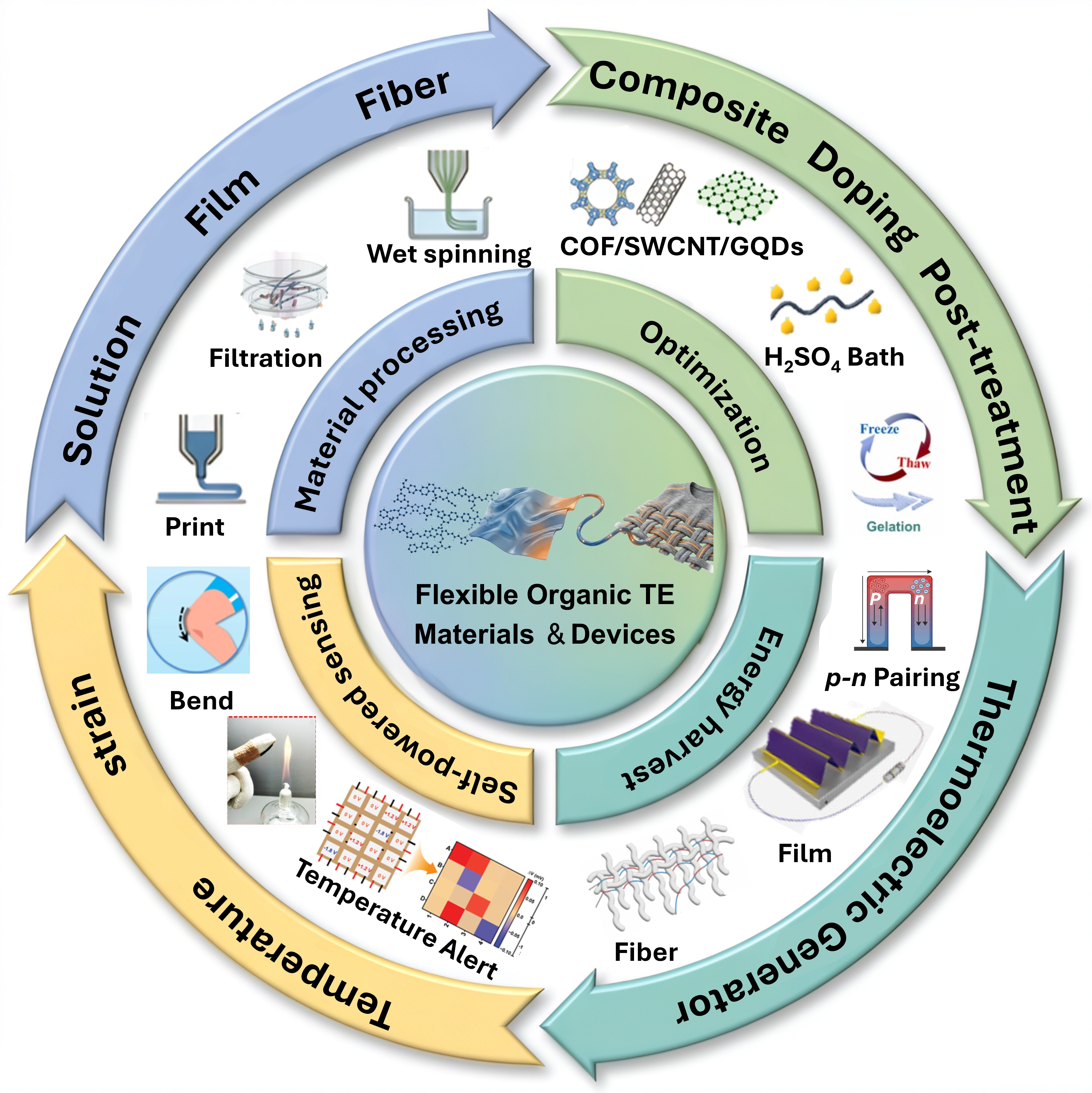
Figure 1. Fabrication and functionalization of flexible organic thermoelectric materials, and their multidimensional integration into applications. COF: covalent organic framework; SWCNT: single-walled carbon nanotube; GQDs: graphene quantum dots.
The harder problem is still performance. Organic thermoelectrics rarely allow independent tuning of S, σ, and κ, and this coupling makes straightforward optimization ineffective. When carrier concentration is increased by chemical or electrochemical doping, σ typically improves but S drops, so the power factor S2σ reaches a ceiling quickly. It is worth noting that transport in many organic semiconductors is dominated by hopping through localized states, which naturally constrains mobility relative to crystalline inorganics. In this context, progress has come from designing across length scales, combining molecular level doping state control with mesoscale ordering, phase morphology regulation, and careful interface engineering[22,23].
The pace of progress has been encouraging[24]. Advances in molecular doping chemistry, backbone planarization, side chain engineering, and secondary doping driven phase reorganization have strengthened charge transport in multiple polymer families. Strategies that impose alignment through strain or confinement have further improved carrier mobility[25,26]. Taken together, these developments have produced reports of power factors above 300 μW·m-1 K-2 and room temperature ZT values approaching unity in selected systems[27-31]. A particularly consequential milestone is the emergence of air stable n-type organic thermoelectric materials, including benzodifurandione based polymers, which addresses a long-standing bottleneck for fully organic p-n integration and enables more practical module and textile architectures[31-34].
Material advances alone, however, do not guarantee wearable performance. Under the small temperature gradients typical of on body conditions, often ΔT of around 1 to 5 K, device architecture and system level design largely determine how much of the available thermal resource is converted into electrical output. Recent concepts, including ultrathin conformable substrates, out of plane and spiral geometries, fiber based thermoelectric textiles, and metal free all organic junctions, aim to reduce thermal and electrical contact resistances while preserving mechanical compliance[35]. This challenge has prompted researchers to treat organic thermoelectric generators not only as power supplies but also as functional components in self-powered sensing[36-41]. Temperature and strain monitoring, human-machine interaction, and safety or health warning functions become plausible when the device can be worn comfortably and remain operational without external charging[42-46].
Several reviews have examined organic thermoelectrics from specific angles, including material chemistry, transport mechanisms, or representative device demonstrations[47]. By contrast, a unified perspective that explicitly connects thermoelectric parameters, material level metrics, fabrication strategies for flexible films and fibers, and application driven requirements for wearable and skin integrated systems is still developing. In particular, the growing emphasis on textiles and epidermal integration calls for evaluation frameworks that go beyond peak ZT[48]. Mechanical compliance, breathability, biocompatibility, and system level energy utilization efficiency often decide whether a promising material can become a practical technology[49,50].
In this review, we summarize organic thermoelectric materials and devices with a focus on their roles in flexible, wearable, and self-powered systems. We first outline the fundamental thermoelectric parameters and performance indicators most relevant to organic materials, emphasizing transport characteristics that distinguish them from inorganic counterparts. We then discuss fabrication strategies and structural design principles for flexible organic thermoelectric films and fiber-based architectures, highlighting how molecular engineering, doping control, and microstructural optimization interact to improve performance[51]. We conclude by surveying recent device level advances in wearable energy harvesting and self-powered sensing, and we discuss the remaining challenges and opportunities on the path toward scalable, reliable, and application oriented organic thermoelectric technologies[52].
2. Key Thermoelectric Parameters
2.1 Fundamental TE parameters
Thermoelectric materials convert a temperature gradient into an electrical potential through the Seebeck effect. Conversion efficiency is governed by three coupled transport parameters: the Seebeck coefficient (S), electrical conductivity (σ), and thermal conductivity (κ). These quantities are defined in the same formal way for inorganic and organic systems. However, their physical origins, the constraints linking them, and the levers available to tune them differ markedly in organic thermoelectrics (OTEs) because organic semiconductors are soft, structurally disordered, and molecular in nature.
The Seebeck coefficient is defined as:
and represents the open circuit voltage generated per unit temperature difference. In organic semiconductors, S is governed largely by energy dependent carrier transport near the Fermi level. As in inorganic thermoelectrics, an inverse relationship between S and carrier concentration (n) is commonly observed. Large Seebeck coefficients are typically obtained at relatively low doping levels, often around n ≈ 1019 to 1020 cm-3. Increasing carrier density is usually necessary to raise conductivity, however, it generally suppresses S. This trade off sits at the center of OTE optimization.
Electrical conductivity can be expressed as:
where e is the elementary charge and μ is the carrier mobility. In organic systems, mobility is often limited, typically spanning 10-4 to 10 cm2·V-1·s-1, reflecting localized electronic states, conformational disorder, and hopping dominated transport. As a result, improving σ cannot rely only on raising n via chemical, electrochemical, or ionic doping such as FeCl3, F4TCNQ, or ionic liquids. Molecular and microstructural control is equally important. Strategies such as backbone planarization, rational side chain design, and promotion of mesoscale ordering through strain induced alignment or solvent vapor annealing can strengthen intermolecular electronic coupling and increase charge delocalization. In practice, these approaches are often what allows σ to rise without an excessive penalty in S.
Thermal conductivity, which determines the extent of parasitic heat flow, consists of electronic (κe) and lattice (κL) contributions:
The electronic component is often related to electrical conductivity through the Wiedemann Franz relation:
where the Lorenz number L can deviate substantially from the ideal metallic value in disordered organic semiconductors, particularly when variable range hopping contributes to transport. The lattice term κL in organic materials is intrinsically low, typically around 0.1 to 0.3 W m-1 K-1. This suppression originates from weak van der Waals intermolecular interactions, abundant low frequency vibrational modes, and largely amorphous microstructures in many polymers. Compared with classical inorganic thermoelectrics such as Bi2Te3 with κ ≈ 1.5 W m-1 K-1, this low thermal conductivity is a decisive advantage. It helps preserve temperature gradients even when power factors are still moderate. Taken together, the development of high-performance organic thermoelectric materials requires a multiscale design philosophy. Electronic transport must be carefully balanced through coordinated control of S and σ, while the naturally suppressed κ helps preserve temperature gradients under small ΔT conditions, such as those provided by the human body (≈ 1-5 K). It is precisely this combination of tunable electronic properties and intrinsically low thermal conductivity that defines the physical foundation of organic thermoelectrics and underpins their relevance for flexible, biocompatible, and wearable energy harvesting technologies.
High performance OTEs therefore require a multiscale design philosophy. Electronic transport must be balanced through coordinated control of S and σ, while the naturally suppressed κ helps maintain the temperature gradient under small ΔT conditions, such as those provided by the human body, typically about 1 to 5 K. This combination of tunable electronic transport and intrinsically low thermal conductivity forms the physical foundation of organic thermoelectrics and underpins their relevance for flexible, biocompatible, wearable energy harvesting.
2.2 Material-level performance indicators
While S, σ, and κ clarify the underlying transport physics, practical assessment benefits from integrated metrics. The power factor (PF) and the dimensionless figure of merit (ZT) are therefore widely used.
The power factor is defined as:
and directly reflects the ability to generate electrical power under a temperature gradient. PF is especially useful for comparing organic systems such as poly(3,4-ethylenedioxythiophene):poly(styrene sulfonate) (PEDOT:PSS), polyaniline, and functionalized polythiophenes on a common basis. However, PF does not account for heat leakage and therefore cannot fully represent conversion efficiency.
A more comprehensive descriptor is
where T is the absolute temperature. In inorganic thermoelectrics, ZT > 1 is often viewed as a practical threshold. Organic thermoelectrics benefit from intrinsically low thermal conductivity, often around 0.1 to 0.5 W m-1 K-1, which partially compensates for more modest PF values. As a result, ZT values commonly fall in the range of 0.1 to 0.7 and can still be viable for low grade heat harvesting. Recent advances have pushed PF beyond 300 μW m-1 K-2, with selected systems reporting room temperature ZT approaching or even exceeding 0.8.
This progress has come from multiple, often synergistic, strategies. They include molecular doping using FeCl3, F4TCNQ, or ionic liquids, secondary doping to optimize phase separated morphologies, microstructural alignment via strain engineering or interfacial self-assembly, and the design of higher mobility conjugated backbones such as diketopyrrolopyrrole (DPP) based polymers and n-type naphthalene or perylene diimide derivatives (NDI and PDI). Despite these advances, organic semiconductors remain constrained by the interdependence among S, σ, and κ. Increasing carrier concentration raises conductivity but generally suppresses S. Meanwhile, κe tends to increase with σ through Wiedemann Franz behavior.
Mitigating this coupling remains a central challenge. Promising directions include energy dependent carrier filtering to raise the average carrier energy, backbone and side chain designs that further suppress κL through enhanced low frequency vibrational scattering, and organic inorganic hybrid architectures that selectively scatter phonons while preserving electronic transport. For wearables, numerical ZT alone does not capture practical merit. Ultralow κ and mechanical softness enable organic thermoelectrics to harvest energy from minute temperature differences around 1 to 5 K, while conformal skin contact can reduce interfacial thermal resistance. In this context, performance is best evaluated within a material, device, application framework that reflects real operating conditions rather than peak material metrics in isolation.
2.3 Wearable-specific considerations
As thermoelectric devices migrate from rigid, bulk inorganic modules to wearable form factors, maximizing ZT alone is no longer a sufficient design target, particularly for organic thermoelectrics. Relative to brittle benchmarks such as Bi2Te3, organic systems bring mechanical compliance, low density, and solution processability as inherent advantages, which makes them well suited for skin integrated energy harvesting. However, wearable relevance is defined by a wider operating envelope in which charge and heat transport must be balanced against mechanical reliability, comfort, and safety[53].
Mechanical flexibility and durability under cyclic deformation are often the first barriers encountered in practice. A wearable thermoelectric generator must survive continuous bending and twisting and, in many layouts, intermittent stretching, while avoiding progressive conductivity loss at interfaces or within the conducting network. Conjugated polymers such as PEDOT:PSS and polyaniline are intrinsically deformable conductors, and many formulations preserve over 90% of their initial conductivity after thousands of bending cycles at radii below 5 mm. Robustness can be further strengthened through side chain engineering and polymer blending, as well as the use of elastic binders such as polyurethane or SEBS, which help stabilize percolation pathways and reduce strain localization in stretchable thermoelectric films and fibers.
Comfort is equally decisive and is frequently underestimated until late-stage prototypes are worn for extended periods. Prolonged skin contact demands moisture and air transport without sacrificing soft mechanical behavior. The porous, largely amorphous microstructures common in organic conductors can support vapor permeability, and breathability can be improved through nanostructuring, electrospinning into fibrous networks, or patterning into open mesh architectures. Meanwhile, the relatively low Young’s modulus of many organic semiconductors, typically 0.1-100 MPa and approaching that of skin at the lower end, enables conformal contact without excessive pressure, improving both user compliance and thermal coupling stability during motion[54].
Biocompatibility and environmental safety are additional advantages, although they depend strongly on formulation and processing. Many high performing OTE systems are dominated by light elements such as carbon, hydrogen, oxygen, and sulfur, avoiding toxic heavy metals that complicate the use of some inorganic thermoelectrics. PEDOT:PSS has been widely adopted in bioelectronic devices and is often regarded as having low cytotoxicity and good biostability. However, residual dopants and acidic additives can still induce irritation under prolonged exposure. This challenge has prompted practical mitigation strategies, including base washing, secondary doping with more benign ions, and encapsulation using skin safe barrier layers such as medical grade silicones or parylene, with the goal of preserving performance while reducing exposure risk.
It is worth noting that wearable output is frequently limited by system level physics rather than bulk transport metrics. Under physiological temperature gradients, reported power densities for state-of-the-art organic thermoelectric generators remain modest, typically around 0.1-10 μW·cm-2 at an effective temperature difference of roughly 5 K. Consequently, progress depends as much on device stack engineering as on materials optimization. Reducing thermal contact resistance at the skin-device interface, introducing thermal insulation to sustain an effective temperature drop across the thermoelectric legs, and scaling through printing or textile compatible integration of multiple legs and interconnects often determine whether a concept can move beyond proof-of-concept demonstrations[55].
In this context, organic thermoelectrics should not be viewed as lower performing substitutes for inorganic materials. They define a wearable relevant platform in which adequate thermoelectric efficiency must be engineered alongside soft mechanics, breathability, and biocompatibility, within fabrication routes that can realistically scale. When these requirements are addressed together, organic thermoelectrics offer a credible path toward comfortable, unobtrusive, and sustainable human machine interfaces that rigid modules cannot readily deliver[56-58].
3. Fabrication and Design of Organic Thermoelectric Materials
Compared with conventional inorganic thermoelectric materials, most organic thermoelectric materials still exhibit relatively lower electrical conductivity and power factors. As summarized in Table 1, several recently reported systems such as IHP-TEP PDPPSe-12 and the PMHJ (PBTTT/PDPPSe-12) architecture achieve high power factors of 741 and 348.2 μW m-1 K-2 with zT values above 1, while conductive polymers including PEDOT:PSS and poly(benzodifurandione) (PBFDO) also show competitive conductivities and thermoelectric performance. However, their overall efficiency and stability remain generally inferior to inorganic benchmarks such as Bi2Te3 and Ag2Se, which can reach power factors close to or above 1,000 μW m-1 K-2. Despite this gap, organic materials possess unique advantages including low thermal conductivity, mechanical flexibility, lightweight characteristics, and solution processability, making them highly suitable for flexible and wearable thermoelectric applications.
Table 1. Comparison of key thermoelectric parameters of representative organic and inorganic thermoelectric materials.
| Material | σ [S cm-1] | PF [µW m-1 K-2] | zT max | Κ [W m-1 K-1] | Reference |
| IHP-TEP PDPPSe-12 | 476 | 741 | 1.64 | 0.17 | [59] |
| PMHJ (PBTTT and PDPPSe-12) | 128.7 | 348.2 | 1.26 | 0.159 | [60] |
| P3HT | 44.7 | 20.5 | 0.1 | 0.23 | [61] |
| PBTTT-C14 | 17.5 | 44.9 | / | / | [62] |
| PEDOT:PSS | 1,900 | 320 | 1.05 | 0.364 | [63] |
| PBFDO | 970 | 306 | 0.27 | 0.35 | [34] |
| PDPIN | 78.1 | 163 | 0.53 | 0.093 | [64] |
| DPP-BTz | 515 | 346 | 0.4 | 0.28 | [65] |
| Ag2Se | 497 | 987.4 | 0.6 | 0.478 | [66] |
| Bi2Te3 | 500 | 1,600 | 0.89 | 0.53 | [67] |
| Bi2Te2.7Se0.3 | 2,700 | 730 | 0.3 | 0.73 | [68] |
IHP-TEP: intrinsically highly conductive polymer thermoelectric polymer; PDPPSe-12: poly(diketopyrrolopyrrole-selenophene) with a 12-carbon side chain; PMHJ: polymer multi-heterojunction; PDPIN: poly(diketopyrrolopyrrole-isoindigo-based n-type polymer); DPP-BTz: diketopyrrolopyrrole-benzothiadiazole copolymer; PBTTT: poly[2,5-bis(3-tetradecylthiophen-2-yl)thieno[3,2-b]thiophene]; PEDOT: poly(3,4-ethylenedioxythiophene); PSS: poly(styrene sulfonate); PBFDO: poly(benzodifurandione); P3HT: poly(3-hexylthiophene).
Fabrication strategy and structural design often decide whether an OTE platform can raise electrical transport, thermoelectric performance, mechanical compliance, and device integrability together, rather than improving one metric at the expense of another. Organic conductors are solution-processable and tunable at the molecular level, so they can be constructed into flexible architectures that extend far beyond rigid bulk thermoelectrics. This is exactly what wearable and distributed heat harvesting requires. Two form factors have become especially representative and complementary. Thin films support printing, patterning, and multilayer integration on planar or gently curved substrates. Fiber-shaped thermoelectrics map naturally onto textile manufacturing routes such as weaving and knitting. In this section, we outline fabrication approaches and design principles for these two platforms, with emphasis on how processing choices and structural engineering translate into deployable performance[69].
3.1 Flexible organic thermoelectric film
Flexible OTE thin films are a practical platform for low-grade waste heat harvesting and self-powered sensing. They combine intrinsically low thermal conductivity with solution processability, mechanical flexibility, and compatibility with wearable and distributed electronics[70]. Conjugated polymers and their composites remain the workhorse materials. Their backbone chemistry and doping state can be engineered to regulate carrier density, energetic disorder, and transport pathways, which enables systematic optimization in flexible organic thermoelectric generators (OTEGs). However, the central challenge increasingly looks like a manufacturing constraint rather than a single-material limitation. High electrical conductivity and a large Seebeck coefficient must be achieved while preserving solution stability, printability, and device-level integrability that enable scalable fabrication[38,71,72].
In this context, stimuli-activated molecular dopants (SAMD) offer a clean way to ease the long-standing tension between doping efficiency and printability. In photoacid-generator (PAG)-based schemes, film formation is separated from the doping event. Polymer inks remain chemically stable and printable in solution. Efficient doping is activated only after deposition through light-induced acid generation (Figure 2a). This concept has been demonstrated in poly(3-hexylthiophene) (P3HT) and poly[2,5-bis(3-tetradecylthiophen-2-yl)thieno[3,2-b]thiophene] (PBTTT), which enables controlled carrier concentration while maintaining molecular ordering. Under optimized conditions, the thermoelectric performance of P3HT varied significantly with the TPS-TF doping ratio (expressed as mol% relative to the repeating units of the polymer). As the TPS-TF content increased, the electrical conductivity (σ) rose while the Seebeck coefficient (S) decreased. A maximum PF of 20.5 μW·m-1 K-2 was achieved at a doping level of 60 mol%, where σ = 16.9 ± 0.7 S·cm-1 and S = 110.1 ± 1.5 μV·K-1. The highest conductivity attained for P3HT was 17.5S·cm-1, and its PF value is comparable to that of P3HT doped with the triflimide anion (Figure 2b). PBTTT exhibited superior thermoelectric performance under the same conditions. Its power factor initially increased and then decreased with rising TPS-TF content, peaking at 44.9μW·m-1·K-2 at 80mol% doping. At this optimum ratio, σ = 44.7 ± 0.1 S·cm-1 and S = 100.2 ± 0.2 μV·K-1. PBTTT further achieved a maximum conductivity of 56.9 S·cm-1, significantly outperforming P3HT (Figure 2c). Importantly, the same SAMD strategy has been implemented in inkjet-printed flexible micro-OTEG modules, reinforcing compatibility with scalable printing workflows[62].
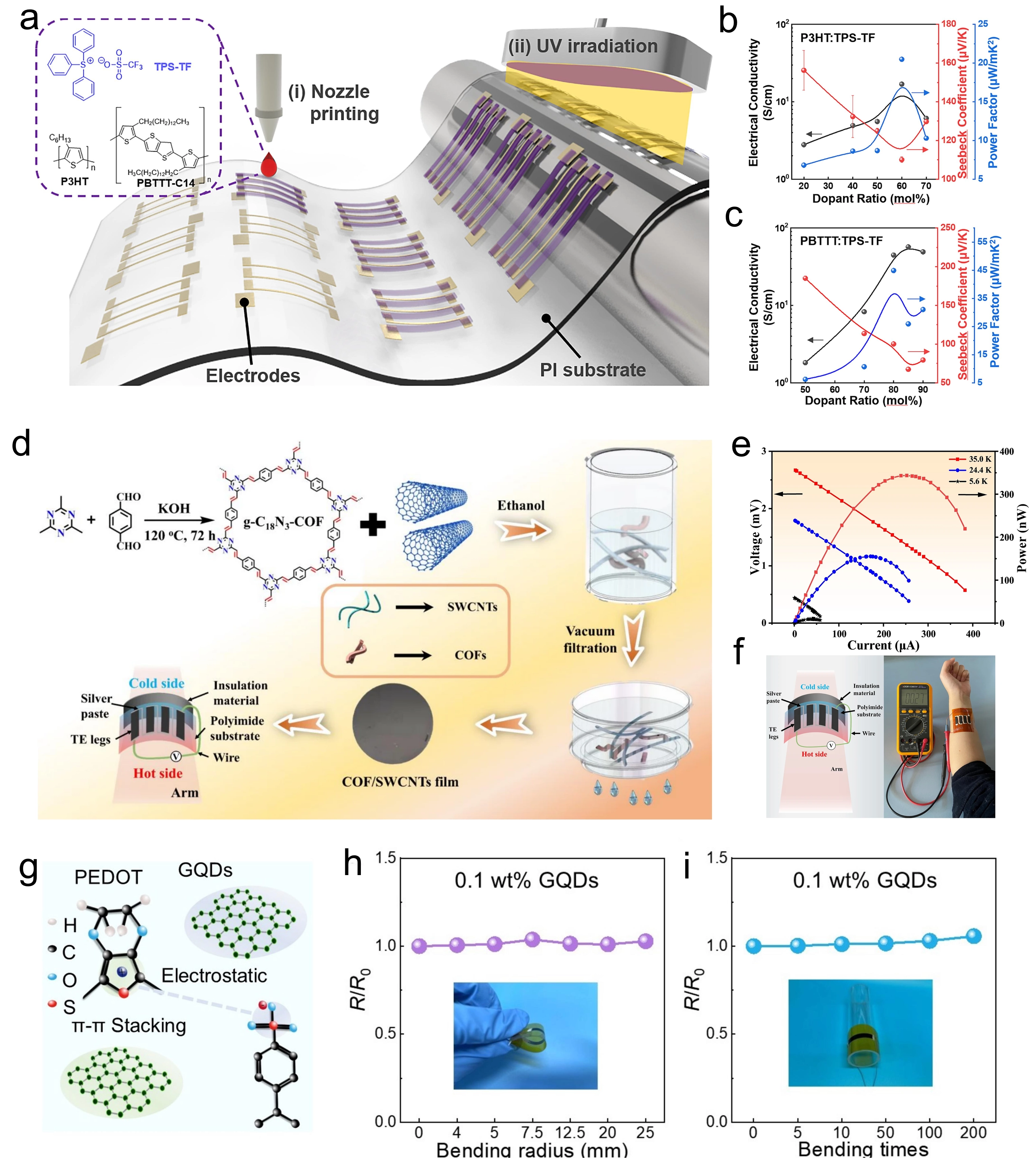
Figure 2. Flexible organic thermoelectric film material. (a) Schematic for the concepts of printed flexible OTEG module and chemical structures of the materials used; (b) Doped P3HT and (c) doped PBTTT films, as a function of the molar ratio of TPS-TF to polymer repeat unit (mol%). Republished with permission from[62]; (d) Schematic illustration of the preparation of g-C18N3-COF/SWCNTs composite films, and its corresponding f-TEGs; (e) Current dependence of the output voltage and power of g-C18N3-COF-30/SWCNTs f-TEG at different ΔT; (f) Schematic diagram and digital photo of the output performance for g-C18N3-COF-30/SWCNTs f-TEG. Republished with permission from[73]; (g)Structure diagram of PEDOT:PSS and GQDs; (h) Normalized resistance (R/R0) of 0.1 wt% GQDs-incorporated PEDOT: PSS film as a function of bending radius. The inset shows a photograph of the flexible film being bent; (i) R/R0 of the same film as a function of bending cycles. The inset displays a photograph of the film enduring repeated bending[74]. OTEG: organic thermoelectric generator; PBTTT: poly[2,5-bis(3-tetradecylthiophen-2-yl)thieno[3,2-b]thiophene]; SWCNTs: single-walled carbon nanotubes; PEDOT: poly(3,4-ethylenedioxythiophene); PSS: poly(styrene sulfonate); GQDs: graphene quantum dots; COFs: covalent organic frameworks; TEG: thermoelectric generators; P3HT: poly(3-hexylthiophene).
Doping-state regulation becomes more effective when paired with chain orientation and morphological control. High-temperature friction-induced alignment of P3HT and PBTTT introduces pronounced transport anisotropy. When this anisotropy is combined with localized inkjet doping, ultrathin label-like OTEGs can be fabricated and deployed on curved, non-planar surfaces[75]. It is worth noting that the impact here is not merely incremental. The work illustrates a recurring principle in organic thermoelectrics. Chemistry defines the accessible electronic landscape. Microstructure and device architecture often determine how much of that landscape can be translated into performance under realistic fabrication constraints.
Composite engineering and molecular design further expand the design space beyond single-component polymer films. Covalent organic frameworks (COFs) offer controllable frameworks and tunable nano- and micro-fiber morphologies. When combined with single-walled carbon nanotubes (SWCNTs), COF-based composites can build more effective percolation networks and improve mechanical robustness (Figure 2d). In a four-leg flexible thermoelectric generator, this strategy delivered a maximum output power of 343.5 nW and a peak power density of 0.32 W m-2 at ΔT = 35 K (Figure 2e). Figure 2f illustrates the schematic of the output performance testing setup alongside a digital photograph of a flexible g-C18N3-COF-30/SWCNTs film-based thermoelectric generator (f-TEG) mounted on a human forearm. When worn on the arm, the device generated an open-circuit voltage (Voc) of 0.27 mV by harvesting body heat, demonstrating its ability to convert low-grade waste heat into usable electrical power. This highlights the promising potential of such composite-film-based f-TEGs for powering next-generation wearable electronics. Durability tests involving cyclic bending revealed that the relative resistance change of the TE modules stayed within 5% after 1,000 cycles at a 15 mm radius along the strip length. This high level of stability, attributed to the excellent flexibility of the free-standing g-C18N3-COF-30/SWCNTs composite films, demonstrates the f-TEG’s strong resistance to mechanical stress and its potential for long-term wearable applications[73]. In conducting polymer systems, functional molecular additives provide a different lever to mitigate the classical trade-off between Seebeck coefficient and electrical conductivity. In graphene quantum dot (GQD)/PEDOT:PSS composites, strong π-π interactions between GQDs and PEDOT, together with electrostatic interactions with PSS, enhance carrier percolation and transport efficiency (Figure 2g). Without additional post-treatment, electrical conductivities exceeding 3,000 S cm-1 were achieved, alongside strong mechanical durability with negligible resistance change under varying bending radii (Figure 2h) and repeated bending (Figure 2i)[74]. By contrast, tetrathiafulvalene (TTF) treatment is proposed to induce polaron energy-level splitting through π-π interactions, enabling concurrent increases in Seebeck coefficient and conductivity[71]. PEDOT:PSS films treated with TTF reach a room-temperature power factor up to 1,285 μW m-1 K-2 and a ZT approaching unity, placing them among the highest-performing p-type OTE thin films reported—surpassing even the high-performance 4-(1,3-dimethyl-2,3-dihydro-1H-benzoimidazol-2-yl)phenyl)dimethylamine (N-DMBI)-treated films, which achieve a power factor of 765.1μW m-1 K-2 via partial dedoping and Fermi level modulation[76].
Despite these significant advances in device architectures and processing strategies, the development of high-performance n-type organic thermoelectric materials remains substantially behind that of their p-type counterparts. This performance gap originates from several intrinsic limitations related to molecular structure design, doping chemistry, and charge transport characteristics[77-79]. From a molecular design perspective, n-type conjugated polymers typically require electron-deficient backbones to stabilize negative polarons, which may compromise backbone planarity or intermolecular packing, and consequently limit carrier mobility. In addition, the realization of efficient and stable n-type doping remains challenging. Most strong molecular n-dopants, such as N-DMBI and tetrakis(dimethylamino)ethylene (TDAE), possess high electron density and are therefore susceptible to oxidative degradation in the presence of oxygen and moisture, leading to poor environmental stability and limited doping efficiency. Furthermore, the solubility mismatch between electron-rich dopants and the non-polar solvents commonly used for conjugated polymers often hinders effective molecular doping.
Another critical factor lies in the charge transport process in highly doped polymers. In n-type systems, the interaction between negatively charged polarons and counter cations can strongly influence carrier mobility. Strong polaron–counter-ion coupling may induce carrier trapping or scattering, thereby reducing electrical conductivity and limiting the attainable power factor. For instance, in PBFDO, negatively charged polarons are initially balanced by protons, whose small size and hydrogen-bonding ability may lead to strong polaron–cation interactions that hinder efficient charge transport. Therefore, regulating doping states and modulating polaron–counter-ion interactions represent important strategies for improving the thermoelectric performance of n-type conjugated polymers.
A solvent-mediated dedoping strategy addresses this limitation by using a FeCl3/dimethyl sulfoxide (DMSO) system to tune the n-type conjugated polymer PBFDO. The resulting films show a simultaneous enhancement of Seebeck coefficient and electrical conductivity, achieving power factors exceeding 300 μW m-1 K-2 and narrowing the gap with p-type counterparts[34]. Small-molecule and carbon nanomaterial composites offer an additional p-type design axis. Spiro-fluorene-xanthene molecules with three-dimensional cross-conjugated architectures can couple strongly with SWCNTs, improving charge-transport efficiency and yielding composite films with power factors as high as 218.6 μW m-1 K-2. These films have also been assembled into flexible multi-leg modules while maintaining strong mechanical robustness[80].
Overall, progress in flexible OTE thin films is increasingly driven by multilevel optimization that spans molecular design, doping-state regulation, morphology and orientation engineering, and device integration. These advances do more than improve headline metrics. They also clarify design principles and scalable processing pathways for flexible OTEGs aimed at wearable electronics, self-powered sensor networks, and low-temperature waste heat recovery.
3.2 Flexible organic fiber-based thermoelectrics
Flexible TE fibers have become a compelling direction in organic thermoelectrics because a one-dimensional geometry fits naturally with how wearable systems are fabricated and used. Compared with many thin-film devices that rely on substrates and tolerate only limited deformation, fiber-shaped TE materials are typically self-supporting and readily integrated into yarns and fabrics. Consequently, they can sustain stable output under bending and twisting, and in some architectures, under stretching as well, which is difficult to guarantee in planar formats. The core challenge remains practical: competitive thermoelectric performance must be achieved while maintaining mechanical robustness and retaining fabrication routes that can scale[81].
PEDOT:PSS-based fibers illustrate how processing and structure can be co-optimized to meet these constraints. One representative strategy combines freeze-thaw (FT) induced sol-gel transition with high-speed continuous wet spinning to improve spinnability and fiber quality (Figure 3a). By optimizing FT cycle number, extrusion speed, needle aspect ratio, and coagulation bath composition, the resulting fibers exhibit uniform one-dimensional morphologies and enhanced chain ordering. Electrical conductivities up to approximately 103 S cm-1 have been achieved, representing a 2-10-fold improvement over most previously reported wet-spun PEDOT:PSS TE fibers (Figure 3b)[82]. This enhancement is attributed to FT-driven rheological regulation, more effective charge transport under one-dimensional confinement, and partial removal of insulating PSS in the DMSO/IPA coagulation system. The process is also associated with a PEDOT conformational transition from benzoid to quinoid structures[84]. The electrical conductivity (σ) remains nearly unchanged after multiple rolling cycles (Figure 3c), while the Seebeck coefficient (S) shows negligible dependence on spinning speed (Figure 3d) and is essentially retained even after 200 repeated twisting cycles (Figure 3e). These results indicate that the fibers maintain stable σ and S under continuous mechanical deformation such as bending and twisting, achieving a maximum power factor of up to 34 μW·m-1 K-2, along with strong thermoelectric performance stability and mechanical reliability.
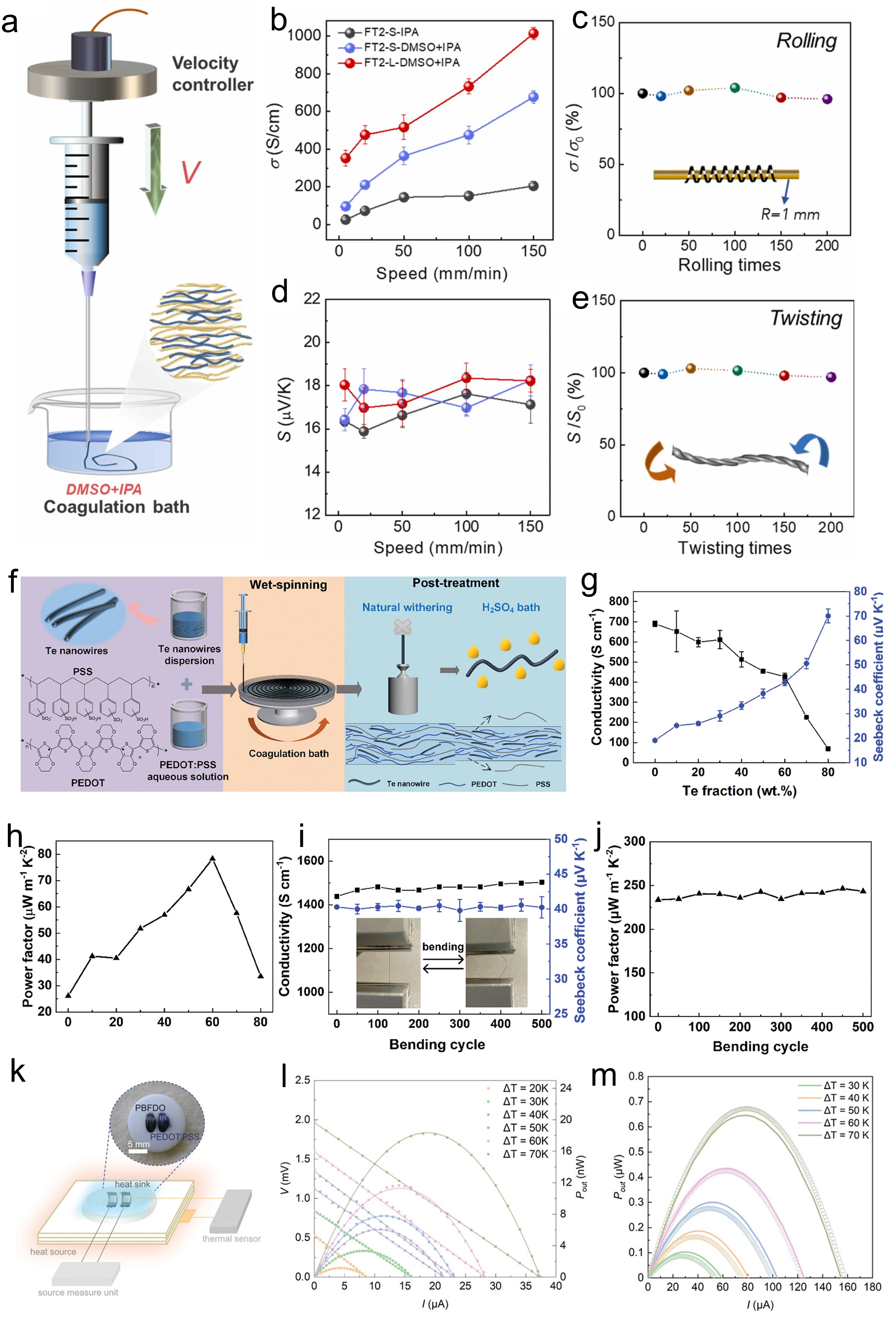
Figure 3. Flexible organic fiber-based thermoelectrics material. (a) Illustration of the wet-spinning PEDOT:PSS fibers process; (b) The σ of various PEDOT:PSS fibers; (c) The σ variation for the fibers (FT2-L-DMSO+IPA) after multiple rolling operations; (d) Effect of spinning speed on the S; (e) The S variation of the fibers after twisting up to 200 times. Republished with permission from[82]; (f) Chemical structure of PEDOT:PSS and schematic illustration of the wet-spinning set-up for producing PEDOT:PSS/Te composite fibers; (g) Dependences of electrical conductivity and Seebeck coefficient and (h) power factor on increasing Te fractions; (i) Electrical conductivity and Seebeck coefficient and (j) power factor upon 500 bending cycles. Inset of (i) shows that the composite fiber was subjected to cyclic bending from 0o to 90o. Republished with permission from[17]; (k) Schematic representation of the thermocouple fabricated by hand-stitching a button onto a wool fabric with the n-type leg composed of PBFDO coated yarn and the p-type leg of PEDOT:PSS coated yarn; (l) voltage V (left) and output power Pout (right) of the thermoelectric button as a function of current I for different temperature differences ΔT; (m) output power Pout of the thermopile as a function of current I for different temperature differences ΔT[83]. PBFDO: poly(benzodifurandione); PEDOT: poly(3,4-ethylenedioxythiophene); PSS: poly(styrene sulfonate); DMSO: dimethyl sulfoxide; IPA: isopropyl alcohol.
Organic/inorganic hybridization provides a direct route to higher performance while preserving the mechanical advantages of polymer matrices. A representative case is PEDOT:PSS/Te nanowire composite fibers, where Te nanowires with intrinsically high Seebeck coefficients couple with a highly conductive PEDOT:PSS network within a one-dimensional architecture. Continuous wet spinning followed by sulfuric acid or solvent post-treatments further optimizes electrical properties while maintaining sufficient mechanical strength (Figure 3f). With increasing Te content, the Seebeck coefficient rises from approximately 20 μV K-1 to 70 μV K-1, while electrical conductivity decreases from 690 to 68.5 S cm-1, reflecting the typical parameter trade-off (Figure 3g). The power factor peaks at about 78.3 μW m-1 K-2 at 60 wt% Te. Sulfuric acid post-treatment shifts the balance more favorably, yielding a power factor of 233.5 μW m-1 K-2, among the highest reported for PEDOT:PSS-based composite TE fibers (Figure 3h). After undergoing 1,000 bending cycles, a PEDOT:PSS/60 wt% Te composite fiber exhibited negligible changes in its electrical conductivity (Figure 3i), Seebeck coefficient (Figure 3j), and corresponding power factor, underscoring its excellent flexibility and robust mechanical durability, attributes largely attributed to its one-dimensional fiber architecture. Their elongation at break increases from roughly 3% to nearly 20%, underscoring the mechanical resilience enabled by the hybrid one-dimensional architecture[17].
At the device level, fiber-based thermoelectric generators assembled from high-performance PEDOT:PSS fibers or PEDOT:PSS/Te composite fibers have demonstrated clear application potential. Multiple p-type TE fibers can be integrated with n-type carbon nanotube fibers or other n-type fiber materials to form substrate-free devices composed of p-n fiber legs. These architectures deliver appreciable voltage and power density under relatively small temperature gradients, supporting the feasibility of fiber-based thermoelectrics for wearable energy harvesting[85].
Progress toward truly textile-integrated thermoelectric systems has long been constrained by the scarcity of high-performance n-type fibers. The emergence of air-stable n-type conjugated polymers such as PBFDO is beginning to change this landscape. PBFDO can be processed into free-standing films or applied as a coating on multifilament yarns while maintaining air stability, washability, and mechanical flexibility. PBFDO-coated yarns retain stable electrical conductivity after more than one year of air exposure and withstand repeated machine washing and cyclic stretching. In this context, researchers have developed various non-planar textile thermoelectric devices, such as thermoelectric buttons and multi-leg textile thermoelectric generators, using PBFDO (n-type) and PEDOT:PSS (p-type) coated yarns. Notably, the PBFDO-coated yarns exhibit robust electromechanical stability: during cyclic tensile deformation to 3% strain, their electrical resistance increased by less than 20% even after 200 cycles. Furthermore, these yarns can withstand more severe stretching conditions without fracture, enduring up to 60 cycles at 4% strain (with only a 10% resistance increase) and 30 cycles at 5% strain (with a 30% resistance increase). This exceptional durability under repeated mechanical stress underscores the suitability of PBFDO-coated yarns for practical textile manufacturing and wearable applications. These devices are fabricated by hand-stitching a conductive yarn button onto a three-layer felted wool fabric (Figure 3k) and are capable of delivering microwatt-level power under large temperature gradients, making them suitable for powering low-power sensors. Specifically, the thermoelectric button achieves a maximum output power of approximately 20 nW at a temperature difference (ΔT) of 70 K, corresponding to a power density of about 10 nW·cm-2 (Figure 3l). Furthermore, when eight such thermocouples are integrated into an out-of-plane textile thermoelectric generator (TEG), the device exhibits a significantly enhanced maximum output power of 0.67 μW under the same ΔT of 70 K. The experimental results show excellent agreement with numerical simulations (Figure 3m), confirming the effectiveness and scalability of the device architecture. These findings highlight the strong potential of such flexible, textile-based thermoelectric devices for wearable electronics, enabling efficient conversion of body or ambient waste heat into usable electrical power[83].
Flexible thermoelectric fibers are advancing through synergistic integration of solution gelation control, continuous wet spinning, organic/inorganic hybridization, solvent and acid post-treatments, and fiber-level structural design. These strategies progressively balance electrical conductivity, Seebeck coefficient, power factor, and mechanical performance, establishing a foundation for wearable thermoelectric textiles and distributed energy-harvesting systems[86-88].
4. Advanced application of Organic Thermoelectric Device
Organic thermoelectric devices are rapidly evolving beyond conventional energy conversion toward advanced functional applications that leverage their intrinsic coupling between thermal, electrical, and mechanical responses. This section highlights two transformative application paradigms: (1) energy harvesting, where flexible OTEGs convert low-grade waste heat, such as body heat or ambient thermal gradients, into usable electricity for wearables and distributed electronics; and (2) self-powered sensing, where the same thermoelectric effect enables autonomous detection of temperature, strain, pressure, or even human-machine interaction without external power sources. Together, these directions underscore how strategic integration of materials design, interfacial engineering, and device architecture is unlocking new roles for organic thermoelectrics in intelligent, maintenance-free, and human-centric systems.
4.1 Structural engineering of organic thermoelectric devices for wearable applications
In addition to material properties, device architecture plays a decisive role in determining the thermoelectric performance of OTEGs, particularly in terms of thermal resistance control, interfacial heat transfer, and mechanical compatibility.
Thin-film thermoelectric devices are among the most widely investigated architectures due to their compatibility with solution processing and large-area fabrication techniques. However, because the thickness of most OTE films is typically below 1 mm, generating a large temperature difference (ΔT) in the vertical configuration is challenging. As a result, vertical device geometries are not always suitable for many organic and solution-processable thermoelectric materials. In contrast, lateral configurations allow heat flux to flow parallel to the device plane, making it easier to generate a larger ΔT along the in-plane direction by controlling the film dimensions. This geometry also facilitates the integration of highly compact OTE devices on flexible substrates.
For lateral devices, the thermal conductivity of the substrate plays a critical role. Since both the substrate and the OTE film are exposed to the same temperature gradient, the substrate should ideally possess a lower thermal conductivity than the thermoelectric layer. Otherwise, heat may preferentially flow through the substrate, thereby reducing the effective temperature gradient across the active thermoelectric film and limiting device performance. In addition, the surface polarity or hydrophilicity/hydrophobicity of the substrate can be tuned through various treatments to regulate molecular aggregation and improve the morphology and electrical properties of the deposited OTE films. These lateral OTEG structures can be readily fabricated using scalable printing techniques such as spray coating, screen printing, inkjet printing, and roll-to-roll (R2R) printing.
Fiber-based thermoelectric devices provide superior mechanical flexibility and are particularly suitable for wearable applications. The one-dimensional geometry allows efficient integration into textiles while maintaining good mechanical durability under bending and stretching. However, challenges remain in controlling interfacial thermal resistance between the fiber core and the thermoelectric coating, as well as achieving uniform coating thickness and stable electrical contacts.
Textile-based thermoelectric devices further extend these advantages by enabling large-area integration and breathability, which are critical for wearable electronics. Nevertheless, the complex hierarchical structure of textiles often introduces significant interfacial thermal resistance and parasitic heat losses, which may limit thermoelectric output.
To address the thermal losses associated with lateral device configurations, origami-inspired folded structures have been proposed. In this design, p-type and n-type thermoelectric materials are patterned on a thin flexible substrate and subsequently folded into a serpentine geometry, forming a tilted thermoelectric generator structure. The overlap between p-type and n-type legs at the crossing points ensures robust electrical connections while reducing heat leakage. Moreover, the effective thermal conductance of the device can be tuned by adjusting the printed leg length, which helps maximize the temperature gradient and minimize parasitic heat loss.
Based on these considerations, several key design principles can be summarized for high-performance OTE devices: (i) optimizing device geometry to maximize the effective temperature gradient; (ii) minimizing contact and interfacial thermal resistance; (iii) selecting substrates with low thermal conductivity to maintain temperature gradients; and (iv) employing mechanically compliant architectures such as fibers or textiles for wearable applications.
4.2 Energy harvesting
Flexible organic thermoelectric materials are well suited for distributed micro-energy systems because they combine mechanical compliance, biocompatibility, and low-cost solution processability with efficient heat-to-electricity conversion under low-grade heat sources. In this context, OTEGs convert waste heat directly into electrical power and can operate in a sustainable, maintenance-free manner for wearable electronics, IoT sensor nodes, and miniaturized medical devices. This section highlights recent progress in OTEG-based energy harvesting, focusing on device architectures, material and interface optimization, and integration strategies that help convert laboratory-level performance into deployable output[89-91].
Two practical limitations often constrain conventional organic thermoelectric devices. High contact resistance at metal-organic interfaces can dominate the internal resistance budget and suppress power output. Mechanical instability under repeated deformation can also degrade performance, which is especially problematic for wearables. Recent work shows that architecture-driven design can mitigate both constraints while improving environmental adaptability. Zhang et al. reported an all-organic thermoelectric generator that eliminates metal electrodes by using carboxymethyl cellulose (CMC) as a compatibilizer to directly connect PEDOT:PSS and PBFDO solutions[92]. Because CMC is soluble in both water and DMSO, it can bridge the processing mismatch between the two polymers and stabilize the interfacial region. In this design, adding 5% v/v DMSO to commercial PEDOT:PSS aqueous solution serves as a common secondary-doping step to enhance conductivity, and introducing 0.12 wt% CMC further improves interfacial contact, reduces junction resistance, and increases overall device performance (Figure 4a). Geometry and heat-flow management provide another lever that can be as influential as the intrinsic properties of the thermoelectric legs. Zhou et al. developed flexible thermoelectric generators with tunable in-plane and out-of-plane architectures (Figure 4b), where leg length, width, and thickness were optimized to balance thermal resistance with thermocouple density[93]. Finite element analysis indicated that the out-of-plane TEG-10pn design reached an output power density of 337.4 μW cm-2, corresponding to a normalized value of 0.069 μW cm-2 K-2, at a temperature difference of 70 K. This out-of-plane configuration is particularly attractive for curved heat sources such as human joints and industrial pipelines, where conformal contact and stable heat flux are difficult to maintain with planar devices.
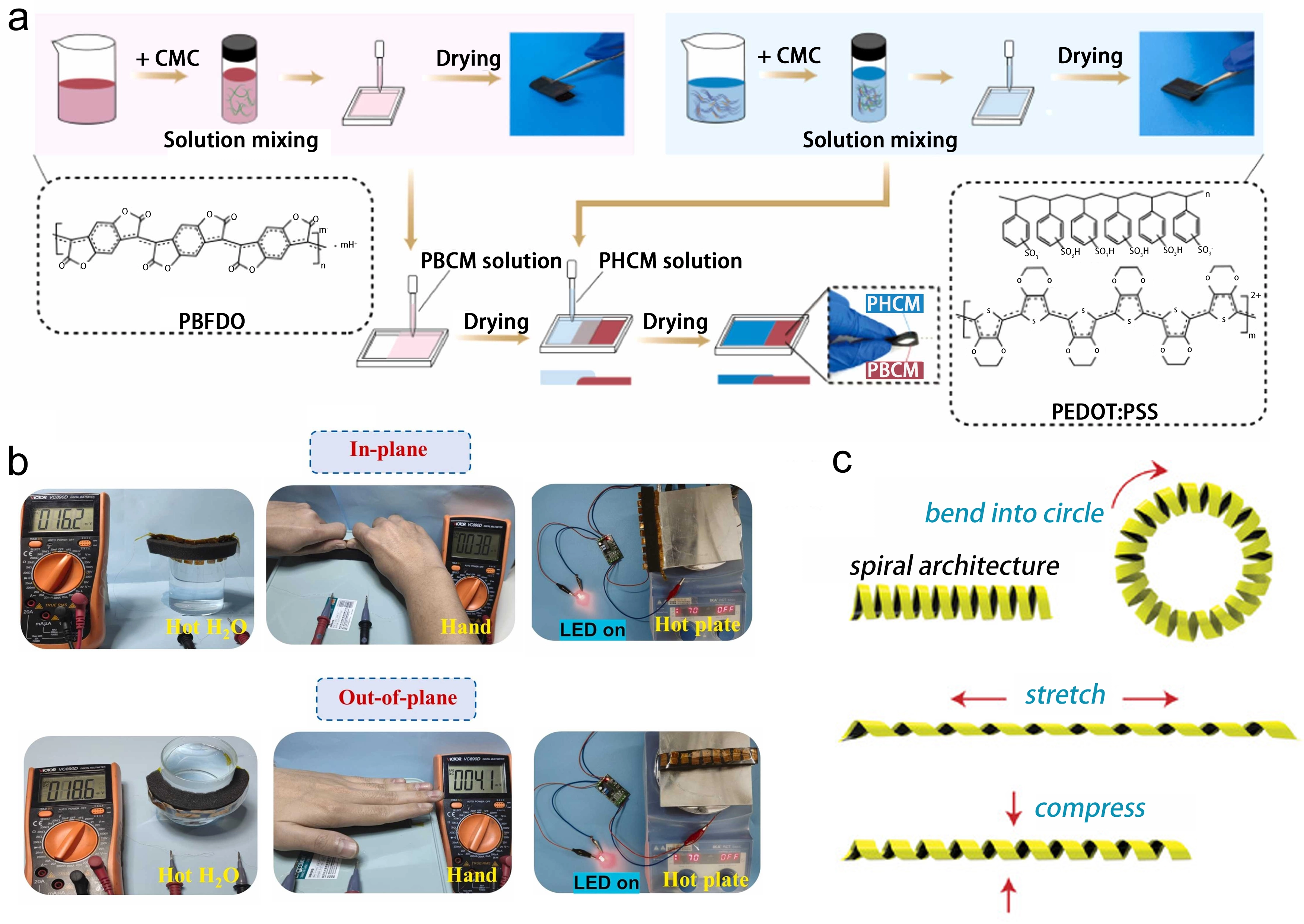
Figure 4. (a) The process flow of PEDOT:PSS, PBFDO and composite film. Republished with permission from[92]; (b) The potential applications for the TEG-10pn with tunable in-plane and out-of-plane architecture to utilize the temperature difference induced by hot water, human body or hot plate. Republished with permission from[93]; (c) The flexible TEGs that can be bent, stretched, and compressed. Republished with permission from[94]. PEDOT: poly(3,4-ethylenedioxythiophene); PSS: poly(styrene sulfonate); PBFDO: poly(benzodifurandione); TEG: thermoelectric generator; CMC: carboxymethyl cellulose.
For skin-mounted systems that must operate under large deformation, stretchable architectures become decisive. Liang et al. reported a stretchable and compressible thermoelectric generator based on a spiral architecture using PEDOT-Tos/Te/single-walled carbon nanotube ternary nanocomposite films[94]. The spiral geometry supports cross-plane heat flux while accommodating bending and compression. Under a temperature difference of 80 K, output powers of 7.04 and 9.59 µW were achieved for prototypes with 10 p-type legs and five pairs of p-n couples, respectively. It is worth noting that the design advantage extends beyond compliance. By increasing the effective leg length and reshaping the thermal flow path, the spiral layout stabilizes thermoelectric output during dynamic motion such as joint bending, providing a practical platform for wearable energy harvesting (Figure 4c).
High bulk performance does not necessarily translate into high device output. Interface control can be equally decisive because contact resistance and interfacial energy losses often erode the effective thermovoltage and suppress power. Petsagkourakis et al. showed that optimizing energy alignment between the active layer and electrodes can substantially reduce these losses. Interfacial effects play a critical role in the measurement of thermovoltage and the Seebeck coefficient. The figure provides a schematic illustration of how the energetic alignment at the polymer/metal interface influences the measured Seebeck coefficient of PEDOT:Tos: (Figure 5a) when it is in contact with a metal having a work function equal to that of PEDOT:Tos, (Figure 5b) when interfaced with a metal of lower work function, and (Figure 5c) when paired with a metal of higher work function[95]. At the metal-polymer interface, the conducting polymer undergoes local oxidation or reduction depending on how the metal Fermi level aligns with the electrochemical potential of the polymer π-electronic system. The resulting contact-induced thermovoltage can be comparable in magnitude to the intrinsic Seebeck voltage of the polymer itself, so it can contribute strongly to the measured thermoelectric response and, in turn, to overall device performance.
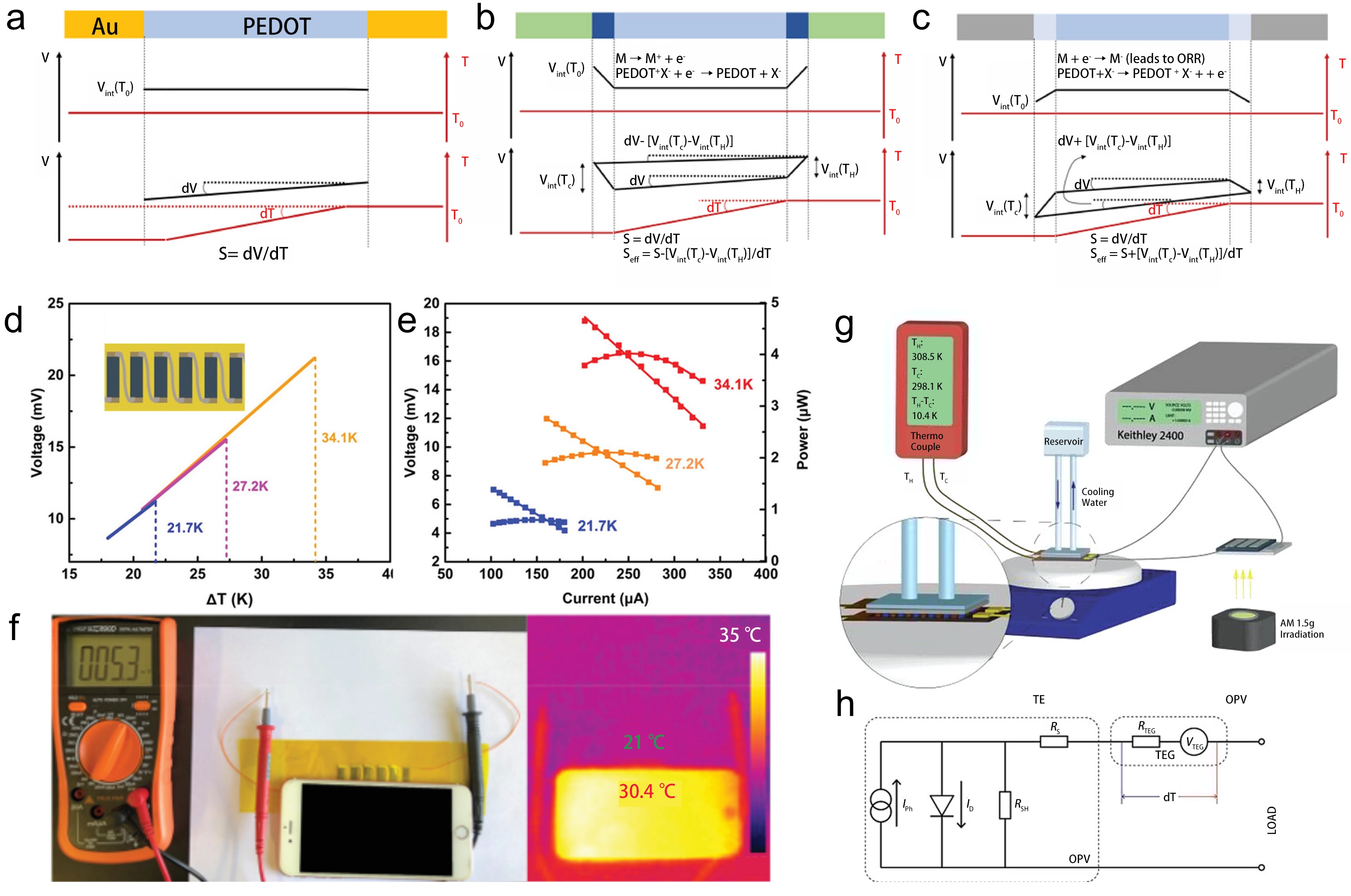
Figure 5. Interfacial effect in the measurement of thermovotlage and Seebeck coefficient. A schematic representation on the effect of polymer/metal energetics on the measured Seebeck coefficient. (a) When PEDOT is in contact with a metal with equal work function; (b) with a lower work function metal, and (c) with a higher work function metal. Performance of the six-leg f-TEG fabricated with the AP1[95]; (d) Open-circuit voltage at different temperature gradients (the inset is a diagrammatic sketch of the f-TEG); (e) The output voltage and power versus current at different ΔT; (f) A digital photo of 5.3 mV voltage created from the ΔT between a mobile phone that has just finished running a game program and the ambient (right side is the corresponding infrared thermal image). Republished with permission from[96]; (g) Illustration of the test platform for the integrated device; (h) Equivalent circuit for the integrated device. Republished with permission from[97]. PEDOT: poly(3,4-ethylenedioxythiophene); TEG: thermoelectric generator.
Enhancing the output power of OTEGs still starts with the materials, and in most device-relevant regimes the power factor (S2σ) remains the most direct lever. Li et al. offered a vivid example with Ag2Se/Se/polypyrrole (PPy) composite films, where interfacial band engineering was used to regulate carrier transport and deliver a power factor of 2,240 μW m-1 K-2[96]. The films were fabricated via a wet-chemical route that first generated Se nanowires, then used them as templates to form Ag2Se nanowires at room temperature, followed by vacuum filtration onto nylon membranes and hot pressing to produce flexible composites. An OTEG based on this film reached a power density of 37.6 W m-2 at ΔT = 34.1 K, ranking among the highest reported values for organic or organic-inorganic composite film generators at the time (Figure 5d). Figure 5e shows the output properties of the f-TEG by adjusting the load resistance and the ΔT, which show a linear negative correlation between the output voltage and the output current. Figure 5f shows that the f-TEG was put under a cell phone that just finished running a game program. An output voltage of 5.3 mV was created from the ΔT (≈ 9.4 K) between the cell phone and the ambient.
Body heat harvesting remains one of the most attractive applications for OTEGs, yet it imposes the tightest operating constraints. During real wear, the temperature difference between skin at roughly 37 °C and the ambient environment is often below 5 K, and performance becomes dominated by thermal management rather than by headline materials metrics. Sun et al. reviewed flexible thermoelectric devices for wearables and emphasized that an effective body-heat harvester must combine high flexibility, low thermal resistance, good skin compatibility, and meaningful efficiency under extremely small temperature gradients[98]. Heat sink design is pivotal in this regime. Conventional metal heat sinks exchange heat efficiently but lack compliance. Foam metals offer lower density and improved flexibility but can be limited in heat exchange capacity. Soft concepts such as hydrogel polymers, phase change materials, and radiative-cooled sinks broaden the design space. The same review highlights pragmatic strategies such as reducing substrate thickness and thermal conductivity and optimizing leg aspect ratio to increase the effective temperature drop across the device. For example, decreasing the substrate thickness from 200 μm to 10 μm can lower thermal conductivity from 0.2 W m-1 K-1 to 0.01 W m-1 K-1 and increase temperature-difference utilization by 300%. Device-level gains also depend on stabilizing thermal flow paths, improving skin-device conformity, and reducing thermal contact resistance, especially under motion and fluctuating ambient conditions.
To improve energy capture across diverse environments, hybrid systems that combine OTEGs with other harvesting modalities are attracting increasing attention. Liu et al. demonstrated an integrated architecture that pairs organic photovoltaics (OPV) with a thermoelectric generator, positioning the TEG module behind the OPV cell to recover waste heat generated during OPV operation as well as ambient heat. Figure 5g is the test platform for the integrated device, and Figure 5h is the equivalent circuit for the integrated device[97]. A key parameter for such systems is the critical temperature difference, dTc, because net power gain occurs only when the operating ΔT exceeds this threshold. dTc depends on device characteristics and application conditions, and a numerical simulation framework was established to reproduce dTc and identify optimal p-n leg density configurations for maximizing output at specific temperature gradients. Notably, OPV-TEG systems exhibit lower dTc than crystalline silicon PV-TEG systems, and this reduced threshold, together with the lower temperature coefficient of OPVs, suggests a practical advantage for organic photovoltaics in real-world settings where temperature gradients are limited.
In summary, progress in materials, interfaces, architectures, and system integration is pushing flexible OTEGs toward higher output power, improved mechanical adaptability, and stronger environmental suitability for wearable and distributed micro-energy applications. Future efforts will likely focus on improving ZT, developing self-healing and mechanically tolerant materials, refining biocompatible interfaces, and advancing multifunctional integration to accelerate translation from laboratory demonstrations to scalable devices and commercial deployment.
4.3 Self-powered sensing
The Seebeck effect gives organic thermoelectric materials an intrinsic sensing capability. A temperature gradient is converted directly into a voltage signal, enabling self-powered temperature sensing without an external power supply. This can simplify system architecture, reduce wiring and power-management overhead, and extend operating lifetime, which is attractive for long-term monitoring and remote or distributed sensing[99,100].
Wearable temperature monitoring has been one of the most visible application directions. Luo et al. reported a thermoelectric fabric woven from composite fibers of PEDOT:PSS, SWCNT, and polyurethane[2]. The fabric differentiates physiological temperature states in real time, spanning normal temperature and graded fever ranges from 37 to 40 °C (Figure 6a). The output voltage follows body-temperature variations promptly and agrees with theoretical expectations. In a warning demonstration, a 1 K increase to 37 °C triggered an alarm within about 5 s, underscoring the potential for rapid fever screening in wearable formats. To validate durability under realistic conditions, the device underwent rigorous stability tests simulating daily wearing scenarios, including stretching, bending, twisting, and friction cycles. Specifically, after 1,000 bending cycles, the relative change in internal resistance remained below 2%, while the open-circuit voltage retention exceeded 99% (with a slight increase observed), demonstrating exceptional mechanical robustness and signal stability, highlighting its unique practical merits.
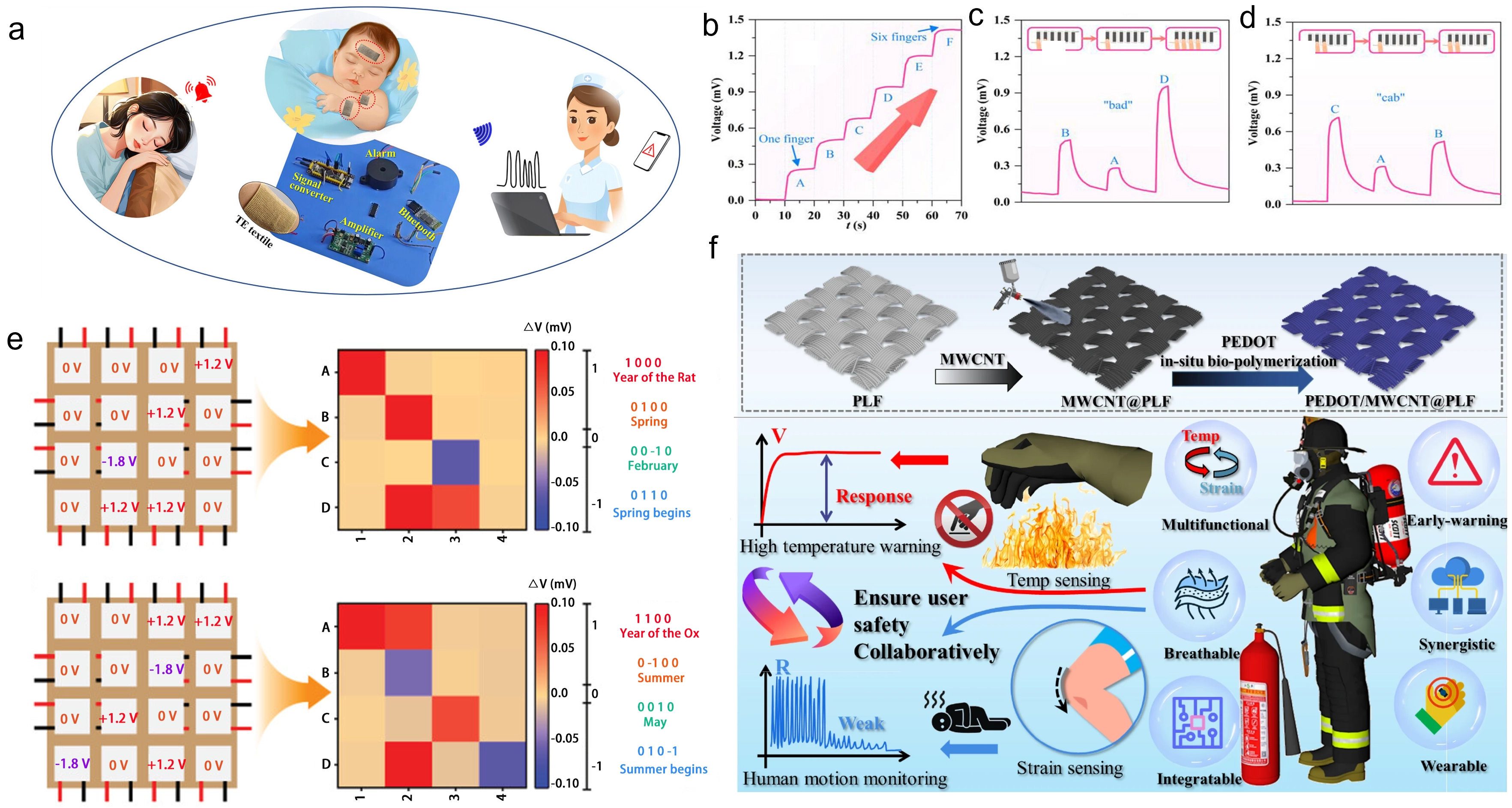
Figure 6. (a) TE fabric-based self-powered smart remote human body fever warning system. Schematic diagram of wearable TE fabric for intelligent monitoring and warning of children’s body temperature. Republished with permission from[2]; (b) V generated by touching one to six fingers corresponding to the self-powered temperature sensor. The self-powered temperature sensor converts the V generated by ΔT into words, taking (c) bad and (d) cad as examples. Republished with permission from[101]; (e) 2D voltage heat maps obtained by ΔV (the voltage difference between the 30th and 5ths) to demonstrate the decoded information. To avoid experimental errors, ΔV < -0.015, -0.015 to 0.015 mV, and > 0.015 mV are considered as -1, 0, 1, respectively. Republished with permission from[102]; (f) Preparation of the rapid response, stretchability, flexibility, and permeability thermoelectric fabric and its application in self-powered health anomaly and temperature threshold warning performance[50]. PLF: porous layered fabric; MWCNT: multi-walled carbon nanotube; PEDOT: poly(3,4-ethylenedioxythiophene); TE: thermoelectric.
Self-powered thermoelectric sensing can also move beyond simple readout and become an information interface. Liu et al. developed a hybrid flexible thermoelectric temperature sensor P@Bi2Se3 that leverages the temperature difference between the human body and external objects to generate touch-activated thermoelectric signals[101]. Distinct voltage outputs were assigned to different numbers of fingers in contact, mapping one to six fingers to the letters A through F (Figure 6b). Controlled touch order then enables construction and recognition of letter sequences such as bad (Figure 6c) and cab (Figure 6d). Beyond assistive communication, the system was specifically engineered for practical reliability in common sub-100 °C scenarios, such as detecting hot water or measuring food temperatures. This design illustrates a broader point that thermoelectric sensors can function as self-powered human-machine interfaces and may be useful for assistive communication scenarios.
Thermoelectric materials also support non-contact temperature sensing and information transfer through thermal radiation. Gao et al. demonstrated a multifunctional thermoelectric sensor array that converts radiative heating and cooling stimuli into polarity-defined voltage variations that resemble dots and dashes in a Morse-code-like scheme[102]. By tuning the polarity at the Peltier-element terminals, a sequence of voltage patterns can be generated and decoded, enabling real-time identification of messages such as food & water and yes & no. The platform extends to decoding pre-encrypted information and to higher-complexity encoding in a designed thermal field coupled with a conjugated polymer network (CPN) sensing array and customized stimulus sources. Specifically, the information is firstly pre-encrypted into the thermal field generated by the Peltier element array by applying specific voltages to each pixel in accordance with the encoding scheme. Upon positioning a customized stimulus source approximately 2.5 mm above the sensor array, a distinct series of voltage signals is captured from each sensor pixel. To reduce ambiguity, voltage differences ΔV defined between the 30th and 5th second were discretized into three levels, with thresholds at ±0.015 mV corresponding to -1, 0, and 1 (Figure 6e). Such non-contact information transfer expands the design space for thermoelectric sensors in constrained environments where conventional optical or RF links may be undesirable.
Safety monitoring provides another natural fit, since the sensed variable can change abruptly and power availability may be uncertain. Cui et al. reported a self-standing, self-powered temperature-strain sensor PEDOT/MWCNT@PLF based on PEDOT:PSS/carbon nanotube/waterborne polyurethane (WPU) composites[50]. Polyester-latex mesh fabric (PLF) served as a flexible, breathable, and stretchable substrate. A dual-layer conductive network was constructed by spray-coating multi-walled carbon nanotubes (MWCNTs) as the base layer, followed by in situ enzymatic polymerization of PEDOT as the sensing layer. This cross-entangled MWCNT/PEDOT structure imparts excellent conductivity and thermoelectric properties to the composite fabric. The fabricated PEDOT/MWCNT@PLF can be seamlessly integrated into garments and accessories via sewing, enabling the real-time monitoring of human physiological anomalies and environmental thermal thresholds. In fire-warning demonstrations, rapid ambient heating produces a pronounced increase in thermoelectric voltage, which can directly trigger alarms (Figure 6f). Related work by Li et al. further shows how fiber-level design can broaden wearable functionality. Using a controllable microfluidic wet-spinning process, they fabricated stretchable continuous p-n alternating thermoelectric fibers in which SWCNT/PEDOT:PSS/PU and polyethyleneimine (PEI)-doped SWCNT/PEDOT:PSS/PU served as p- and n-type segments, respectively. These fibers exhibit strong sensitivity and stability, supporting their use as multifunctional building blocks for flexible wearable electronics[90] (Table 2).
Table 2. Performance comparison and application scenarios of the mentioned systems.
| Material | σ[S cm-1] | PF[µW m-1 K -2] | Application scenarios | Reference |
| PEDOT:PSS/SWCNT@PU | 1,960 | 59.6 | rapid fever screening | [2] |
| P@Bi2Se3 | 402.2 | 154.7 | self-powered human-machine interfaces, assistive communication scenarios | [101] |
| PEDOT /MWCNT@PLF | 121 | 227.1 | non-contact temperature sensing and information transfer | [50] |
| WPU@ PEDOT:PSS-IL | 244.6 ± 23.4 | 4.2 | concurrent tracking of motion and temperature variation within a single soft platform | [54] |
PEDOT: poly(3,4-ethylenedioxythiophene); PSS: poly(styrene sulfonate); SWCNT: single-walled carbon nanotube; MWCNT: multi-walled carbon nanotube; PLF: polyester-latex mesh fabric; PU: polyurethane; WPU: waterborne polyurethane.
Organic thermoelectric temperature sensors are moving into a broad application space that spans medical health monitoring, human machine interaction, and safety warning systems[103]. The motivation is engineering driven. The sensing signal is self generated, the response can be rapid, and devices can be built in flexible, wearable-friendly formats. From here, progress will be judged by field performance rather than polished demonstrations, including higher sensitivity and lower detection limits, robustness under real wearing conditions, and multi-parameter readout with minimal cross-interference, which ultimately governs scalability and adoption.
In this context, extending organic thermoelectrics from temperature readout to mechanical sensing is a natural step. With strain-sensitive design, these materials can enable self-powered deformation sensing while retaining flexibility, stretchability, and skin-compatible interfaces. Mechanical deformation is converted into measurable electrical outputs without external power, which is attractive for continuous health monitoring and wearable electronics, where rigid sensors can be uncomfortable, fragile, or prone to signal instability. Strain sensitivity is commonly quantified by the gauge factor, defined as the ratio of relative resistance change to applied strain.
Zhang et al. reported a skin-like soft thermoelectric composite with a J-shaped stress-strain response that resembles human skin mechanics[54]. By integrating ionic liquid-modified PEDOT:PSS with WPU, the composite achieves high stretchability and mechanical recovery while maintaining stable thermoelectric behavior. Under stretching, it generates distinguishable voltage outputs across deformation states, enabling concurrent tracking of motion and temperature variation within a single soft platform.
A persistent complication is that strain and temperature often vary simultaneously in real use, which can couple signals and introduce ambiguity. Han et al. addressed this issue using a dual-functional pressure and temperature sensing system based on thermoelectric polymer aerogels[104]. Their porous network, constructed from PEDOT:PSS, (3-glycidyloxypropyl)trimethoxysilane, and nanofibrillated cellulose, shows strong elastic recovery under pressure while preserving responsive thermoelectric properties (Figure 7a). Their results highlight a key design insight. When temperature-dependent conductivity perturbs pressure-induced changes in the I-V slope, suppressing or removing the intrinsic temperature-resistance correlation of PEDOT:PSS becomes essential for reliable signal decoupling. This shifts multifunctional sensing closer to realistic operating conditions, where thermal and mechanical inputs rarely arrive in isolation.
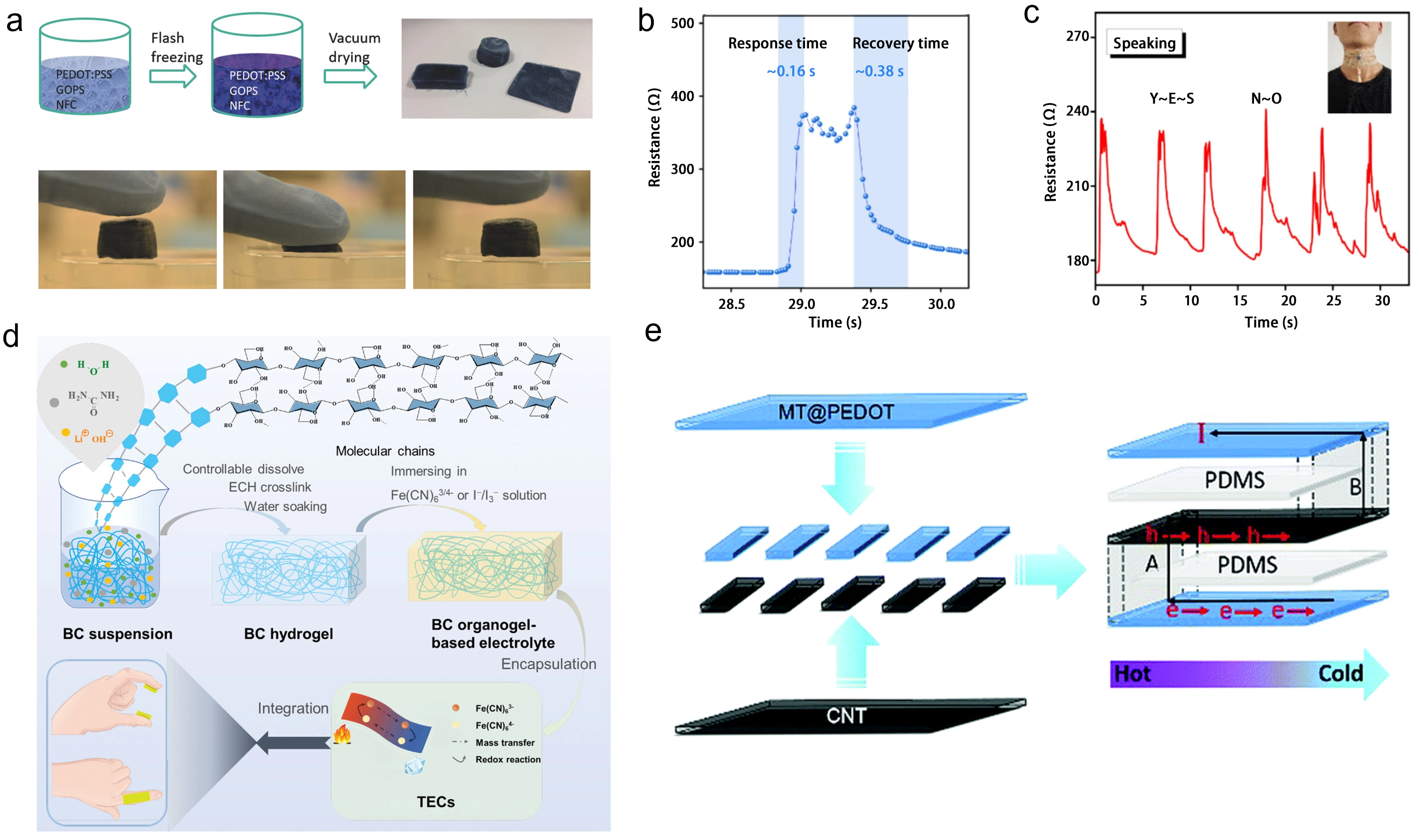
Figure 7. (a) Production process of PNG aerogel and different samples with different shapes, and PNG aerogel states before (left), under (middle), and after (right) finger pressing. Republished with permission from[104]; Resistive sensing signal changes induced by the bending of human joints; (b) Response time and recovery time of the fabric under bending of finger; (c) The influence of vocal cord vibration on resistive signals during speak “YES” and “NO”. Republished with permission from[15]; (d) Preparation diagram, TECs packaging, and conceptual application of BC organogel-based electrolyte. Republished with permission from[105]; (e) Schematic illustration for assembling a MT@PEDOT-based TE generator device. Republished with permission from[106]. PNG: polyaniline/graphene; MT@PEDOT: metal textile coated with poly(3,4-ethylenedioxythiophene); TE: thermoelectric; BC: bacterial cellulose; TECs: thermoelectrochemical cells.
Fabrication strategies are also expanding functionality while preserving textile compatibility. Cui et al. developed a dual-catalytic polymerization route that combines enzymatic and chemical polymerization to produce PEDOT-based thermoelectric fabrics[15]. Their strain sensors track resistance changes with bending amplitude and resolve not only large motions such as joint flexion (Figure 7b) but also subtle vibrations associated with speech, including vocal cord activity (Figure 7c). Similarly, Li et al. engineered bacterial cellulose organogel-based thermoelectrochemical cells with mechanical properties suited for wearables and configured them into self-powered strain sensors that detect motion under different tensions and pressures with high sensitivity and rapid response (Figure 7d)[105]. Jia et al. used vapor phase polymerization to coat commercial textiles with highly conductive PEDOT[106]. Their device produced 5.0 mV at ΔT = 25 K and reached a gauge factor of 54 at 1.5% strain, demonstrating that strong electromechanical sensitivity can be achieved within wearable-friendly processing and form factors (Figure 7e). A layer-by-layer self-assembly approach has also been employed to create breathable, stretchable thermoelectric fabrics with excellent durability and dual sensing capability for respiration and joint motion[107].
Key challenges for future research include improving sensor stability during long-term use, enhancing environmental adaptability, achieving precise multi-parameter decoupling, and reducing manufacturing costs. In particular, how to maintain high sensitivity while increasing strain range, and how to sustain consistent sensor performance under complex environmental conditions, are urgent problems to solve. Through material innovation, structural design, and system integration, organic thermoelectric strain sensing technology is expected to achieve broader applications in intelligent wearable devices, remote health monitoring, and human-machine integration systems[108].
5. Outlook
Organic thermoelectric materials have become a distinctive class of functional systems sitting at the intersection of energy conversion, soft mechanics, and wearable electronics. Their intrinsically low thermal conductivity, chemically tunable electronic structure, and solution processability make it possible to harvest energy and generate self-powered signals from small, ubiquitous temperature gradients. This is exactly the regime where conventional inorganic thermoelectrics often fail to remain conformal, lightweight, and comfortable in long term wear (Figure 8).
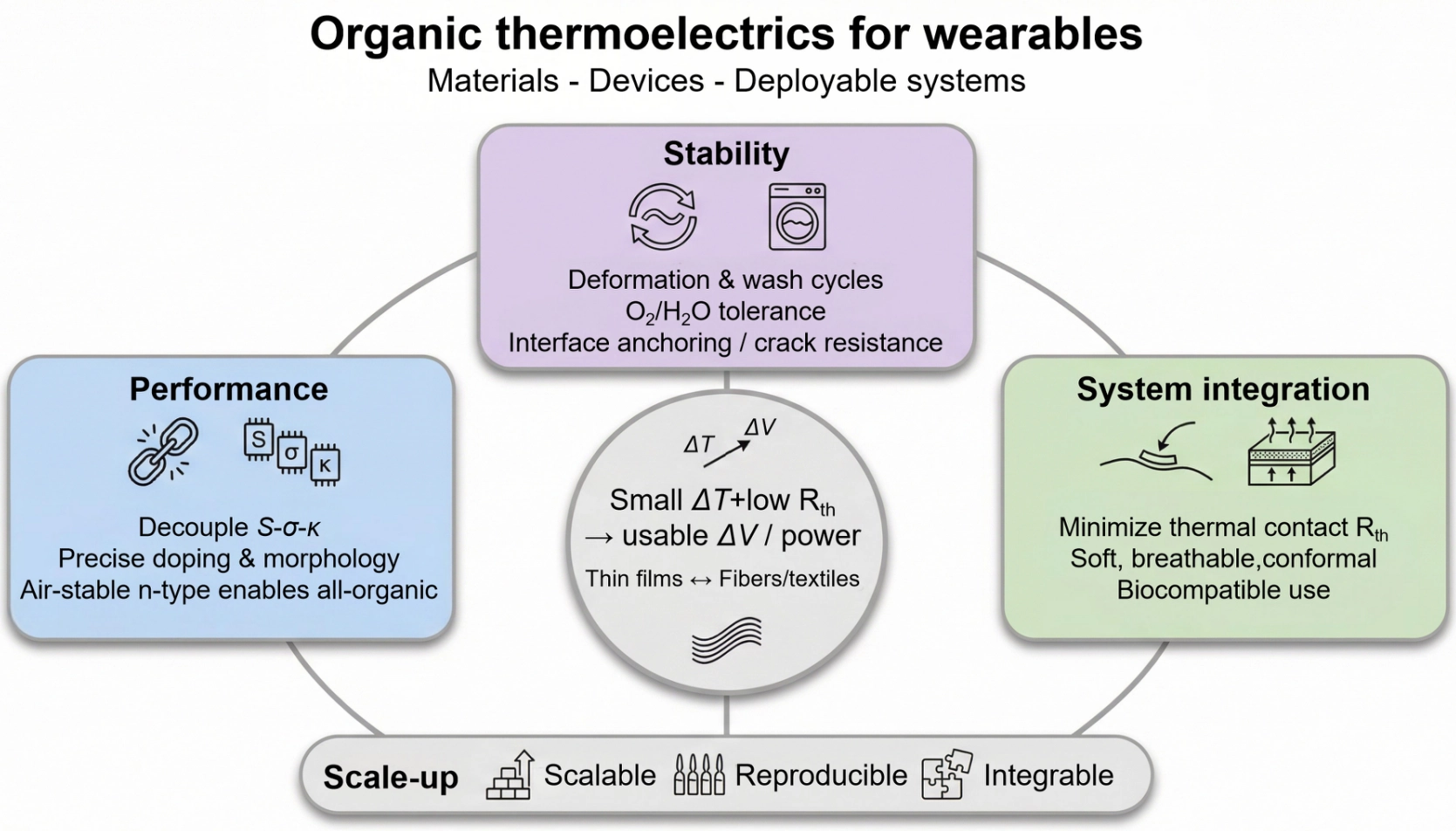
The past decade has brought steady progress through molecular design, more precise regulation of doping states, and microstructural engineering. These advances have gradually relaxed the long-standing coupling among the Seebeck coefficient, electrical conductivity, and thermal conductivity, and they have clarified how to translate chemistry into device relevant performance. Two device formats have emerged as particularly complementary. Flexible thin films support planar integration on soft substrates and allow straightforward patterning and module assembly. Fiber based systems enable textile level integration and substrate free, highly deformable configurations that better match how wearables are worn, washed, and mechanically loaded. In this context, the rise of air stable n type conjugated polymers is a genuine inflection point. It removes a major barrier to fully organic thermoelectric modules and makes mechanically compliant, all organic generators far more realistic. At the device level, architecture and integration have improved as well, reducing electrical and thermal contact resistance and strengthening conformal interfaces with soft, curved surfaces, which has broadened applications from energy harvesting to multifunctional self-powered sensing.
The remaining barriers are increasingly practical. Further decoupling of electronic and thermal transport is still required to move beyond current performance ceilings. Long term operational stability under repeated deformation and environmental exposure remains a persistent concern. Consequently, scalable and reproducible manufacturing must mature if laboratory demonstrations are to become deployable systems rather than isolated prototypes.
Looking ahead, wearable relevant evaluation will depend more on system level performance than on isolated material metrics. Effective utilization of small temperature differences, minimization of thermal contact resistance, mechanical softness, and biocompatibility are likely to decide real world utility. In this Review, we discuss how recent advances in materials chemistry, processing strategies, and device engineering are shaping this transition and outline the remaining challenges that define the next stage of organic thermoelectrics for wearables.
Acknowledgments
We utilized ChatGPT-4 to improve the readability and grammatical accuracy of the text. No AI tools were used to generate data, perform analysis, or formulate the core scientific arguments.
Authors contribution
Xiong W: Investigation, writing-original draft.
Wang J, Li B, Wang Y: Writing-review & editing
Cui Y, Huang L, He X: Supervision, writing-review & editing.
All authors read and approved the final manuscript.
Conflicts of interest
The author Xinyang He is a member of the Editorial Board of Smart Materials and Devices. The other authors declare no conflicts of interest.
Ethical approval
Not applicable.
Consent to participate
Not applicable.
Consent for publication
Not applicable.
Availability of data and materials
Not applicable.
Funding
None.
Copyright
© The Author(s) 2026.
References
-
1. Yang L, Chen X, Dutta A, Zhang H, Wang Z, Xin M, et al. Thermoelectric porous laser-induced graphene-based strain-temperature decoupling and self-powered sensing. Nat Commun. 2025;16:792.[DOI]
-
2. Luo P, Dong S, Liang L, Kuang F, Du C, Ye Z, et al. Highly sensitive thermoelectric fabric of PEDOT: PSS/SWCNT@PU composite fibers for body-temperature monitoring and fever alarming. Adv Mater. 2026;38(9):e18506.[DOI]
-
3. Chen ZG, Shi X, Zhao LD, Zou J. High-performance SnSe thermoelectric materials: Progress and future challenge. Prog Mater Sci. 2018;97:283-346.[DOI]
-
6. Liu QY, Shi XL, Cao TY, Chen WY, Li L, Chen ZG. Advances and challenges in inorganic bulk-based flexible thermoelectric devices. Prog Mater Sci. 2025;150:101420.[DOI]
-
8. Fu Y, Kang S, Gu H, Tan L, Gao C, Fang Z, et al. Superflexible inorganic Ag2Te0.6S0.4 fiber with high thermoelectric performance. Adv Sci. 2023;10(13):2207642.[DOI]
-
9. Tian Y, Wei W, Sun Z, Hu Y, Li K, Zhang Q, et al. High-performance p-n thermocells by interface optimization based on liquid metal for powering wearable devices. Adv Funct Mater. 2025;35(13):2417740.[DOI]
-
12. He CJ, Shi XL, Li NH, Li M, Pei J, Chen ZG. Ductile inorganic thermoelectrics: Advances, challenges, and perspectives. Adv Energy Mater. 2025;15(42):e03115.[DOI]
-
14. He X, Gu J, Hao Y, Zheng M, Wang L, Yu J, et al. Continuous manufacture of stretchable and integratable thermoelectric nanofiber yarn for human body energy harvesting and self-powered motion detection. Chem Eng J. 2022;450:137937.[DOI]
-
15. Cui Y, Chen Q, Bao W, Yao H, Huang Z, Ma R, et al. Dual-catalytic polymerization of high-performance PEDOT thermoelectric fabrics for self-powered sensing. Chem Eng J. 2025;523:168819.[DOI]
-
16. Ma H, Lu T, Shi XL, Li M, Huo S, Song P, et al. Advancements and challenges in printed thermoelectrics. Prog Mater Sci. 2026;158:101619.[DOI]
-
17. Wen N, Guan X, Zuo X, Guo Y, Chen Z, Li C, et al. Investigations of morphology and carrier transport characteristics in high-performance PEDOT: PSS/tellurium binary composite fibers produced via continuous wet-spinning. Adv Funct Mater. 2024;34(27):2315677.[DOI]
-
19. He X, Li B, Cai J, Zhang H, Li C, Li X, et al. A waterproof, environment-friendly, multifunctional, and stretchable thermoelectric fabric for continuous self-powered personal health signal collection at high humidity. SusMat. 2023;3(5):709-720.[DOI]
-
20. Liu L, Zhang D, Bai P, Fang Y, Guo J, Li Q, et al. Fatigue-resistant and super-tough thermocells. Nat Commun. 2025;16:1963.[DOI]
-
22. Wang L, He X, Hao Y, Zheng M, Wang R, Yu J, et al. Rational design of stretchable and highly aligned organic/inorganic hybrid nanofiber films for multidirectional strain sensors and solar-driven thermoelectrics. Sci China Mater. 2023;66(2):707-715.[DOI]
-
23. He X, Shi J, Hao Y, Wang L, Qin X, Yu J. PEDOT: PSS/CNT composites based ultra-stretchable thermoelectrics and their application as strain sensors. Compos Commun. 2021;27:100822.[DOI]
-
24. Xu Y, Sun W, Chen Z, Ouyang J. Pedot: Pss films with very high thermoelectric properties through water-swollen assisted reduction with a Tetrakis(dimethylamino)ethylene solution. Adv Funct Mater. 2024;34(52):2410929.[DOI]
-
25. Wen N, Fan Z, Yang S, Zhao Y, Cong T, Xu S, et al. Highly conductive, ultra-flexible and continuously processable PEDOT: PSS fibers with high thermoelectric properties for wearable energy harvesting. Nano Energy. 2020;78:105361.[DOI]
-
27. Ye Z, Zhang M, Deng J, Liang L, Du C, Chen G. An emerging liquid-crystalline conducting polymer thermoelectrics: Opportunities and challenges. Nano Micro Lett. 2025;18(1):82.[DOI]
-
28. Wu B, Guo Y, Hou C, Zhang Q, Li Y, Wang H. From carbon nanotubes to highly adaptive and flexible high-performance thermoelectric generators. Nano Energy. 2021;89:106487.[DOI]
-
32. Zhang D, Fang Y, Liu L, Zhou Y, Bai P, Li Q, et al. Boosting thermoelectric performance of thermogalvanic hydrogels by structure engineering induced by liquid nitrogen quenching. Adv Energy Mater. 2024;14(10):2303358.[DOI]
-
33. Wang L, Zhang Z, Geng L, Yuan T, Liu Y, Guo J, et al. Solution-printable fullerene/TiS2 organic/inorganic hybrids for high-performance flexible n-type thermoelectrics. Energy Environ Sci. 2018;11(5):1307-1317.
-
34. Chen Z, Wen Y, Hu Y, Wu C, Xu C, Zhang T, et al. An n-type polymer with high-performance thermoelectric properties by solvent-mediated oxidation. Adv Energy Mater. 2025;15(48):e02996.[DOI]
-
36. Zhang D, Mao Y, Ye F, Li Q, Bai P, He W, et al. Stretchable thermogalvanic hydrogel thermocell with record-high specific output power density enabled by ion-induced crystallization. Energy Environ Sci. 2022;15(7):2974-2982.[DOI]
-
37. Zhou M, Huang L, Wan Y, Jiang Q, Qu X, Mia MH, et al. Integrated temperature–NH3 multiplex sensing fibers enabled by programmable assembly of MXene@MoS2 heterojunction and p/n-type thermoelectric core for firefighting clothing. Adv Fiber Mater. 2025;7(6):2013-2031.[DOI]
-
40. Wu B, Wei W, Guo Y, Hou Yip W, Kang Tay B, Hou C, et al. Stretchable thermoelectric generators with enhanced output by infrared reflection for wearable application. Chem Eng J. 2023;453:139749.[DOI]
-
42. He X, Cai J, Liu M, Ni X, Liu W, Guo H, et al. Multifunctional, wearable, and wireless sensing system via thermoelectric fabrics. Engineering. 2024;35:158-167.[DOI]
-
43. He X, Zhang X, Zhang H, Li C, Luo Q, Li X, et al. Facile fabrication of stretchable and multifunctional thermoelectric composite fabrics with strain-enhanced self-powered sensing performance. Compos Commun. 2022;35:101275.[DOI]
-
44. He X, Shi J, Hao Y, He M, Cai J, Qin X, et al. Highly stretchable, durable, and breathable thermoelectric fabrics for human body energy harvesting and sensing. Carbon Energy. 2022;4(4):621-632.[DOI]
-
47. Hou B, Guo Y, Yang Q, Tang LC, Shi Y, Gao J, et al. Mechanism-guided thermoelectric strategies for smart fire prevention. Adv Mater. 2025;37(39):2508628.[DOI]
-
49. He X, Liu M, Cai J, Li Z, Teng Z, Hao Y, et al. Waste cotton-derived fiber-based thermoelectric aerogel for wearable and self-powered temperature–compression strain dual-parameter sensing. Engineering. 2024;39:235-243.[DOI]
-
50. Cui Y, He X, Liu W, Zhu S, Zhou M, Wang Q. Highly stretchable, sensitive, and multifunctional thermoelectric fabric for synergistic-sensing systems of human signal monitoring. Adv Fiber Mater. 2024;6(1):170-180.[DOI]
-
51. Sun Q, Du C, Huo B, Ding Z, Li W, Chen G. Radiation-modulated origami-based thermoelectric generator for continuous solar energy harvesting. Adv Funct Mater. 2026;36(13):e18493.[DOI]
-
52. Zhang L, Shi XL, Shang H, Gu H, Chen W, Li M, et al. High-performance Ag2Se-based thermoelectrics for wearable electronics. Nat Commun. 2025;16:5002.[DOI]
-
53. Li C, Zhang J, Tian G, Yang G, He X. The critical paradigm shifts for next-generation AI-empowered smart wearable devices. Smart Mater Devices. 2026;2(2):202602.[DOI]
-
54. Zhang Y, Zhang Y, Deng W, Li Q, Guo M, Chen G. Skin-like soft thermoelectric composites with a “J-shaped” stress–strain behavior for self-powered strain sensing. Adv Funct Mater. 2025;35(14):2420644.[DOI]
-
55. Zhang S, Wang H, Fu J, Chen G. Flexible films of poly(3, 4-ethylenedioxythiophene): Poly(styrenesulfonate)/single-walled carbon nanotube/MXene thermoelectric composites and their devices. Energy Mater Adv. 2025;6:0143.[DOI]
-
57. Chen C, Liu Z, Guo L, Huo B, Sun Q, Liang L, et al. High spatiotemporal resolution biomimetic thermoreceptors realizing by jointless p-n integration thermoelectric composites. Adv Funct Mater. 2024;34(49):2411490.[DOI]
-
58. Ding Z, Li G, Wang Y, Du C, Ye Z, Liang L, et al. Ultrafast response and threshold adjustable intelligent thermoelectric systems for next-generation self-powered remote IoT fire warning. Nano Micro Lett. 2024;16(1):242.[DOI]
-
61. Kroon R, Ryan JD, Kiefer D, Yu L, Hynynen J, Olsson E, et al. Bulk doping of millimeter-thick conjugated polymer foams for plastic thermoelectrics. Adv Funct Mater. 2017;27(47):1704183.[DOI]
-
62. Kim YS, Kim H, Yoon T, Kim MJ, Lee J, Lee H, et al. Latent and controllable doping of stimuli-activated molecular dopants for flexible and printable organic thermoelectric generators. Chem Eng J. 2023;470:144129.[DOI]
-
63. Du M, Wen Y, Chen Z, Xu Y, Qin J, Cheng H, et al. A polymer film with very high seebeck coefficient and overall thermoelectric properties by secondary doping, dedoping engineering and ionic energy filtering. Adv Funct Mater. 2025;35:2411815.[DOI]
-
64. Han J, Jiang Y, Tiernan E, Ganley C, Song Y, Lee T, et al. Blended conjugated host and unconjugated dopant polymers towards N-type all-polymer conductors and high-ZT thermoelectrics. Angew Chem Int Ed. 2023;62(23):e202219313.[DOI]
-
65. Wang D, Ding J, Dai X, Xiang L, Ye D, He Z, et al. Triggering ZT to 0.40 by engineering orientation in one polymeric semiconductor. Adv Mater. 2023;35(2):2208215.[DOI]
-
66. Ding Y, Qiu Y, Cai K, Yao Q, Chen S, Chen L, et al. High performance n-type Ag2Se film on nylon membrane for flexible thermoelectric power generator. Nat Commun. 2019;10:841.[DOI]
-
68. Saeidi-Javash M, Kuang W, Dun C, Zhang Y. 3D conformal printing and photonic sintering of high-performance flexible thermoelectric films using 2D nanoplates. Adv Funct Mater. 2019;29(35):1901930.[DOI]
-
70. Zhang Y, Deng L, Lv H, Chen G. Toward improved trade-off between thermoelectric and mechanical performances in polycarbonate/single-walled carbon nanotube composite films. npj Flex Electron. 2020;4:26.[DOI]
-
71. Chen Z, Wen Y, Xu Y, Li D, Le Q, Shin S, et al. A solid polymer film with giant thermoelectric properties by polar level splitting with an organic donor. Adv Funct Mater. 2025;35(33):2424378.[DOI]
-
73. Pataki NJ, Guchait S, Jismy B, Leclerc N, Kyndiah A, Brinkmann M, et al. A label-like monolithic organic thermoelectric generator enabled by local inkjet doping of aligned polymer films. Adv Energy Mater. 2025;15(15):2404656.[DOI]
-
74. Wang R, Zhang Z, Qin J, Meng Q, Du Y, Zhang F. Nano-/ micro-fiber engineering of vinylene-linked polymeric frameworks for flexible free-standing thermoelectric films. Adv Fiber Mater. 2025;7(1):219-226.[DOI]
-
75. Wu T, Shi XL, Deng YY, Liu YM, Zhu M, Liu WD, et al. Incorporating graphene quantum dots boosts thermoelectric performance of PEDOT: PSS films. Chem Eng J. 2025;506:160219.[DOI]
-
76. He X, Wu C, Zhang T, Chen Z, Wang L, Ouyang J. Ultrahigh thermoelectric properties of PEDOT: PSS films by dedoping and π-π overlapping with 4-(1,3-dimethyl-2,3-dihydro-1H-benzoimidazol-2-yl)phenyl)dimethylamine (N-DMBI). Adv Funct Mater. 2025;35(43):2506872.[DOI]
-
78. Ji H, Lee JG, Lee H, Kim D, Cho K. High-performance organic thermoelectric materials based on n-type conjugated polymers via chemical isomerization-induced charge transport modulation. Mater Horiz. 2025;12(21):9250-9261.[DOI]
-
79. Brunetti I, James Pataki N, Hinojosa DR, Hawkey A, Karakaya O, Rainer C, et al. A scalable fully printed organic thermoelectric generator for harsh environments enabled by a stable n-type polymer. Adv Mater Technol. 2025;10(4):2400968.[DOI]
-
80. Zhang L, Jin J, Huang S, Tan B, Luo J, Wang D, et al. Cross-conjugated spiro molecules and single-walled carbon nanotubes composite for high-performance organic thermoelectric materials and generators. Chem Eng J. 2021;426:131859.[DOI]
-
81. Li H, Zhang C, Li P, Liu S, Zhang H, He C. Recent development in flexible organic thermoelectric fibers for wearable devices. Mater Today Chem. 2023;34:101774.[DOI]
-
82. Liu L, Chen J, Liang L, Deng L, Chen G. A PEDOT: PSS thermoelectric fiber generator. Nano Energy. 2022;102:107678.[DOI]
-
83. Wu T, Shi XL, Liu WD, Li M, Yue F, Huang P, et al. High thermoelectric performance and flexibility in rationally treated PEDOT: PSS fiber bundles. Adv Fiber Mater. 2024;6(2):607-618.[DOI]
-
84. Liu Y, Liu P, Jiang Q, Jiang F, Liu J, Liu G, et al. Organic/inorganic hybrid for flexible thermoelectric fibers. Chem Eng J. 2021;405:126510.[DOI]
-
87. Sun T, Zhou B, Zheng Q, Wang L, Jiang W, Snyder GJ. Stretchable fabric generates electric power from woven thermoelectric fibers. Nat Commun. 2020;11:572.[DOI]
-
89. Wang L, Zhang Z, Liu Y, Wang B, Fang L, Qiu J, et al. Exceptional thermoelectric properties of flexible organic−inorganic hybrids with monodispersed and periodic nanophase. Nat Commun. 2018;9:3817.[DOI]
-
90. Li M, Chen H, Zhao J, Xia M, Qing X, Wang W, et al. Stretchable continuous p-n alternating thermoelectric fibers for energy harvesting and sensing devices. Adv Compos Hybrid Mater. 2024;7(4):106.[DOI]
-
91. Zhou X, Wu B, Cai Z, Li K, Hou C, Zhang Q, et al. Multifunctional carbon nanotube based thermoelectric yarn enabling fire warning and waste heat harvesting. Adv Funct Mater. 2026;36(17):e22298.[DOI]
-
92. Zhang C, Xiao R, Wu M, Wu T, Liu X, Gan F, et al. High-performance jointless all-organic Ohmic junction thermoelectric generators. Nano Energy. 2025;142:111188.[DOI]
-
93. Zhou Q, Li H, Du C, Ye Z, Liang L, Chen G. High-performance flexible thermoelectric generators with tunable in-plane and out-of-plane architectures. Nano Energy. 2023;118:109007.[DOI]
-
94. Liang L, Wang M, Wang X, Peng P, Liu Z, Chen G, et al. Initiating a stretchable, compressible, and wearable thermoelectric generator by a spiral architecture with ternary nanocomposites for efficient heat harvesting. Adv Funct Mater. 2022;32(15):2111435.[DOI]
-
95. Petsagkourakis I, Riera-Galindo S, Ruoko TP, Strakosas X, Pavlopoulou E, Liu X, et al. Improved performance of organic thermoelectric generators through interfacial energetics. Adv Sci. 2023;10(20):2206954.[DOI]
-
96. Li Y, Lou Q, Yang J, Cai K, Liu Y, Lu Y, et al. Exceptionally high power factor Ag2Se/Se/polypyrrole composite films for flexible thermoelectric generators. Adv Funct Mater. 2022;32(7):2106902.[DOI]
-
97. Liu W, Sun S, Zhu X. Organic photovoltaics integrated with thermoelectric generator achieving low critical temperature difference and efficient energy conversion. Adv Funct Mater. Mater Today. 2022;57:121-145.[DOI]
-
101. Liu W, Yuan C, Wang X. Hybrid flexible thermoelectric temperature sensors for early warning. Adv Funct Mater. 2026;36(12):e19209.[DOI]
-
102. Gao FL, Min P, Ma Q, Zhang T, Yu ZZ, Shang J, et al. Multifunctional thermoelectric temperature sensor for noncontact information transfer and tactile sensing in human-machine interaction. Adv Funct Mater. 2024;34:2309553.[DOI]
-
103. Li B, Wang Y, Mei J, He X. Wearable bioelectronics: Toward future personal health monitoring. BIO Integr. 2026.[DOI]
-
104. Han S, Jiao F, Khan ZU, Edberg J, Fabiano S, Crispin X. Thermoelectric polymer aerogels for pressure–temperature sensing applications. Adv Funct Mater. 2017;27(44):1703549.[DOI]
-
105. Li J, Chen S, Han Z, Qu X, Jin M, Deng L, et al. High performance bacterial cellulose organogel-based thermoelectrochemical cells by organic solvent-driven crystallization for body heat harvest and self-powered wearable strain sensors. Adv Funct Mater. 2023;33(46):2306509.[DOI]
-
106. Jia Y, Shen L, Liu J, Zhou W, Du Y, Xu J, et al. An efficient PEDOT-coated textile for wearable thermoelectric generators and strain sensors. J Mater Chem C. 2019;7(12):3496-3502.[DOI]
-
107. He X, Li C, Zhu S, Cai J, Yang G, Hao Y, et al. Layer-by-layer self-assembly of durable, breathable and enhanced performance thermoelectric fabrics for collaborative monitoring of human signal. Chem Eng J. 2024;490:151470.[DOI]
-
108. Liu W, Shi XL, He X, Zhu S, Li Z, Li C, et al. A waterproof and ultra-elastic thermoelectric foam for underwater human signal detection. Nat Commun. 2026;17:1294.[DOI]
Copyright
© The Author(s) 2026. This is an Open Access article licensed under a Creative Commons Attribution 4.0 International License (https://creativecommons.org/licenses/by/4.0/), which permits unrestricted use, sharing, adaptation, distribution and reproduction in any medium or format, for any purpose, even commercially, as long as you give appropriate credit to the original author(s) and the source, provide a link to the Creative Commons license, and indicate if changes were made.
Publisher’s Note
Science Exploration remains a neutral stance on jurisdictional claims in published
maps
and institutional affiliations. The views expressed in this article are solely those
of
the author(s) and do not reflect the opinions of the Editors or the publisher.
Share And Cite


Science Exploration Style
Xiong W, Wang J, Li B, Wang Y, Cui Y, Huang L, et al. Flexible organic thermoelectric materials and devices. Smart Mater Devices. 2026;2:202606. https://doi.org/10.70401/smd.2026.0030
Tips
Copy completed.
Submit a Manuscript
Author Instructions
Cite this Article
Article Metrics
0
View
0
Download
Cited
Article Updates

- Abstract
- Keywords
- 1. Introduction
- 2. Key Thermoelectric Parameters
- 3. Fabrication and Design of Organic Thermoelectric Materials
- 4. Advanced application of Organic Thermoelectric Device
- 5. Outlook
- Acknowledgments
- Authors contribution
- Conflicts of interest
- Ethical approval
- Consent to participate
- Consent for publication
- Availability of data and materials
- Funding
- References
- Copyright
 Get citation
Science Exploration Style

Xiong W, Wang J, Li B, Wang Y, Cui Y, Huang L, et al. Flexible organic thermoelectric materials and devices. Smart Mater Devices. 2026;2:202606. https://doi.org/10.70401/smd.2026.0030
copy
Share Link
copy
Subscribe