Unleashing high-flux evaporative cooling via 3D interconnected fiber membranes

Haosheng Lin
1,2,#

,
Fuxiang Li
1,2,#
,
Zengguang Sui
1,2,#
,
Wei Wu
1,2,*
*Correspondence to:
Wei Wu, School of Energy and Environment, City University of Hong Kong, Hong Kong, China; City University of Hong Kong Shenzhen Research Institute, Shenzhen 518058, Guangdong, China.
E-mail: weiwu53@cityu.edu.hk
Thermo-X. 2026;2:202604. 10.70401/tx.2026.0015
Received: January 19, 2026Accepted: March 04, 2026Published: March 12, 2026
Graphical Abstract
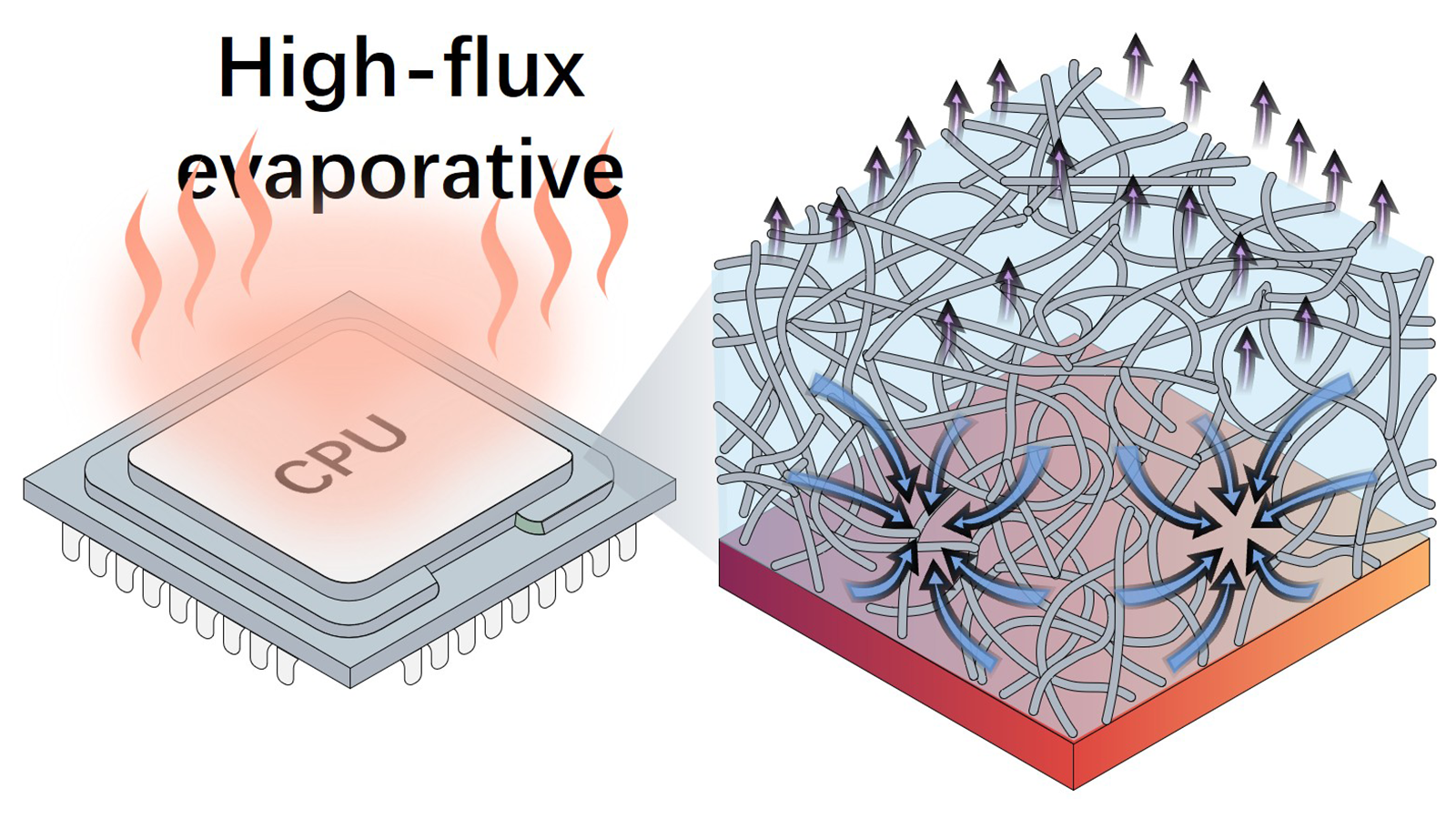
The continuous advancement of high-performance computing has increased the heat flux of chips, posing a challenge for conventional cooling methods. While the average heat flux of advanced chips is currently around 100 W/cm2, modern devices frequently exhibit severe localized “hot spots” that greatly exceed this average. Furthermore, driven by the rapid growth of artificial intelligence, the value of heat flux is expected to increase further as device integration advances[1,2]. However, conventional passive single-phase and two-phase (boiling) cooling technologies are commonly limited to a cooling power of 100 W/cm2[3,4]. Therefore, high-heat-flux evaporative cooling strategies, although popular, remain a challenge.
A recent Joule publication by Feng et al. represents significant progress by introducing a fiber membrane evaporator with 3D interconnected pores (Figure 1A)[5]. This evaporator achieves a passive critical heat flux (CHF) exceeding 800 W/cm2 on 0.5 cm2 and sustains this load for several hours without dryout, with an average of approximately 643 W/cm2 across samples, using water at atmospheric pressure. This performance greatly exceeds the approximately 100 W/cm2 typical of air or pumped liquid cooling and is even superior to previous two-phase wick devices, which generally achieve 100-500 W/cm2 on smaller areas[6,7]. Some previous two-phase wick devices can achieve maximum CHF values of over 1,000 W/cm2, but their performance is limited to very small heating areas (5.5 mm2)[8]. These results advance passive cooling technologies to a new level, surpassing previous performance records and suggesting the potential of future electronics cooling methods. While very promising, this cooling technology by Feng et al. faces practical challenges. Future work must lower the operating temperature (currently over 100 °C) by using different fluids or vacuum systems. Researchers also need to scale up the membrane for larger chips, improve bonding methods for real devices, and show its long-term reliability.
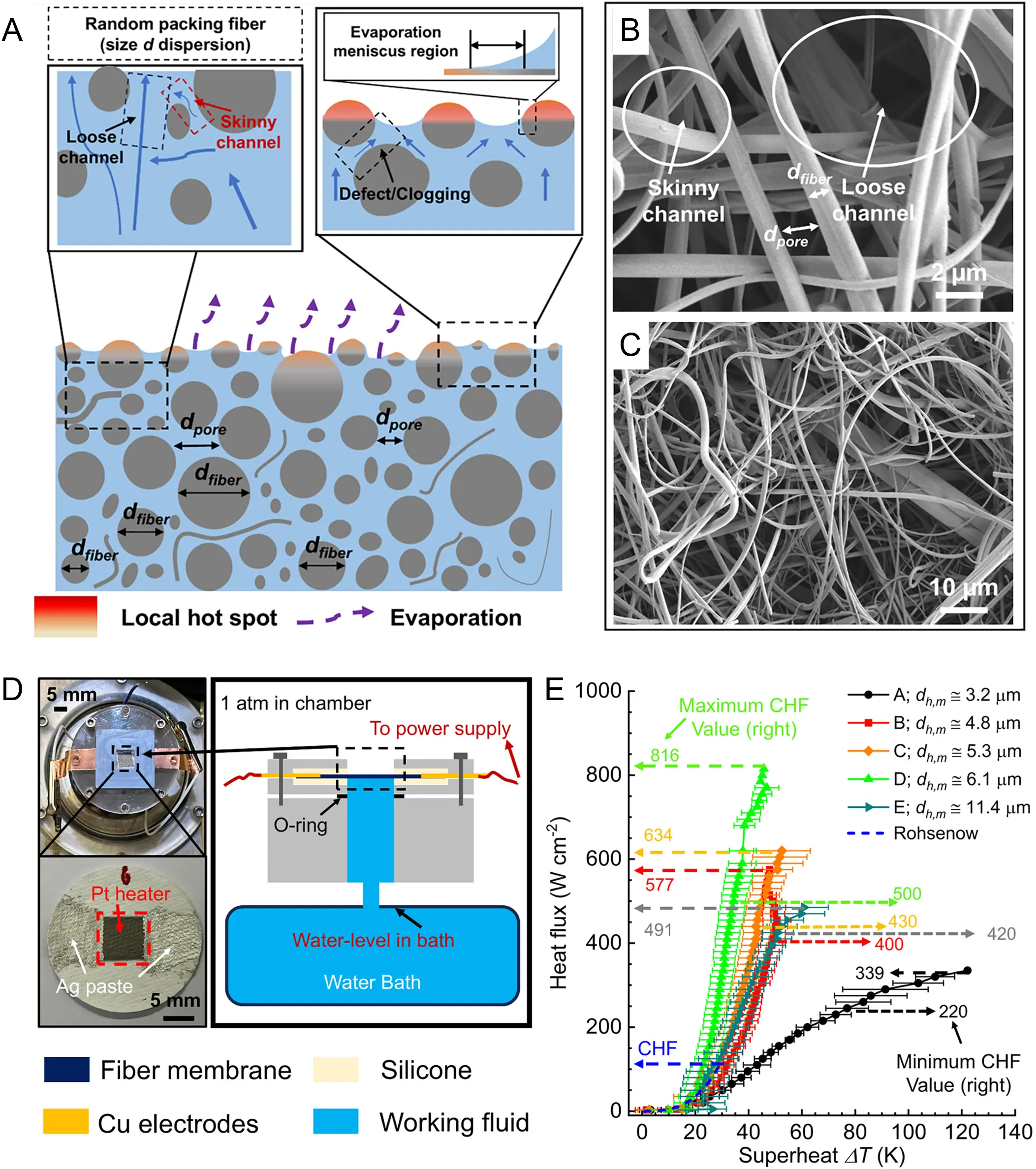
Figure 1. Structure and evaporation performance of interconnected fiber membranes. Republished with permission from[5]. (A) Schematic showing the 3D fiber network that ensures robust liquid transport, even under local blockage; (B-C) Representative SEM images displaying the porous architecture with a mean hydraulic pore size of 6.1 μm; (D) Overview of the evaporation measurement system, highlighting the fiber membrane test sample and electrode configuration; (E) Heat flux as a function of superheat for membranes with various pore sizes (3.2-11.4 μm); arrows mark the measured maximum and minimum CHF for each type, with error bars representing the sample average and variation. SEM: scanning electron microscopy; CHF: critical heat flux.
The central innovation of this advance is the design of the fiber membrane. The membrane consists of a nonwoven network of glass microfibers, forming a continuous 3D array of micron-scale pores (Figure 1B,C). Capillary action transports liquid rapidly and uniformly through these interconnected channels, ensuring that if a local region begins to dry, other pathways can quickly resupply it. This interconnected structure addresses a key failure mode of previous designs based on straight, isolated nanopores, where blockages and hot spots often led to rapid dryout. Previous nanoporous membranes, such as anodic alumina or silicon with straight, isolated nanopores, provided high surface area but exhibited poor liquid redistribution. By providing multiple pathways for both liquid and vapor, the membrane stabilizes thin-film evaporation and allows operation near the theoretical CHF limit.
In the experiments, as shown in Figure 1D, the authors used a commercially available glass fiber filter membrane, approximately 0.3 mm thick, which was treated to improve mechanical strength and coated with a 0.5 cm2 thin-film heater and thermometer to emulate the heat input of a chip. Water supplied from below was transported through the membrane solely by capillary action, without the need for pumps or external power. Smaller pores of the membrane increase the overall surface area and favor the evaporation kinetic limit, but they also raise flow resistance. Conversely, larger pores favor the capillary limit by reducing flow resistance, but they decrease the total evaporation area and facilitate undesirable bubble nucleation. Therefore, an optimal pore size is required to balance these factors. Notably, the optimal pore size of 6.1 μm achieved in this study is comparable to that of advanced copper inverse-opal wicks, which typically feature pores of 5-10 μm. While such inverse-opal structure designs have demonstrated the potential of capillarity for extreme heat fluxes (over 1,000 W/cm2) on very small heating areas (< 5.5 mm2)[7,8], they generally operate through thin-film boiling accompanied by vapor bubbles. These bubbles can block capillary pathways and hinder liquid resupply, ultimately triggering local dryout and thermal instability. In contrast, as shown in Figure 1E, the finer and interconnected pores of the fiber membrane enable evaporation-dominated heat transfer even at 800 W/cm2 in a larger area (0.5 cm2), thus avoiding the instabilities associated with bubble nucleation. In their study, this evaporation regime from nucleate boiling is clearly distinguished through high-speed imaging. While visible bubbles were observed at low heat fluxes due to surface flooding, these bubbles completely disappeared at higher heat fluxes as the liquid receded into the micro-pores, visually confirming the transition to pure thin-film evaporation.
Although these results are impressive, it is important to consider the challenges that may be encountered in future applications. The experiments used pure water at atmospheric pressure, resulting in an operating temperature higher than 100 °C, which is higher than what is typically desirable for most electronics. To broaden the application scope of this technology, future studies may explore alternative fluids or a sealed system that operates under partial vacuum for effective cooling at lower temperatures. The authors note that dielectric or low-boiling-point fluids could maintain high CHF at lower temperatures, although these options may bring new considerations in terms of safety and environmental impact.
Scalability is another point worthy of further exploration. The tested area of 0.5 cm2, although larger than in some previous demonstrations, remains modest compared to the typical area of high-power chips. Although the 3D pore network shows promise for enhancing lateral fluid distribution, it remains an open question whether similar CHF values can be maintained over larger areas, particularly under the nonuniform heat loads common in modern CPUs or GPUs. As the area increases, maintaining uniform liquid supply and vapor removal becomes more significant, facing a fundamental tradeoff between high wicking flow rate and low thermal resistance.
Integration into practical cooling modules also presents opportunities for further development. In established heat pipe or vapor chamber technologies, capillary structures are often fixed to substrates by sintering. Developing effective methods for joining the fiber membrane to device substrates, while preserving its thermal conductivity and structural integrity, will be a valuable direction for future work. Ensuring high-quality thermal interfaces and maintaining an optimal liquid film thickness can help avoid the onset of film boiling[9].
Despite these considerations, this study opens several promising directions for future research and development. The most immediate direction is to integrate the fiber membrane into a complete cooling module that includes both an evaporator and condenser and is suitable for direct attachment to chips. Future work should investigate operation with different fluids and under various pressures, aiming to achieve high heat flux removal at temperatures compatible with sensitive electronics. Expanding the membrane to larger areas, possibly by segmenting it or adding fluid distribution layers, will be essential for practical application. In addition, future researchers or engineers should adopt a new comprehensive metric to better evaluate and reflect the true cooling capability that accounts for both high intensity and large scale. Long-term endurance tests under realistic contamination and cycling conditions will help establish reliability. It is also worthwhile to explore applications beyond chip cooling, such as the thermal management of power electronics, batteries, or energy conversion devices. The ability of this passive and lightweight membrane to handle very high heat fluxes could be valuable in situations where active cooling is impractical or undesirable[10,11].
Overall, the work of Feng et al. sets a new standard for what can be achieved with passive capillary-driven cooling. It demonstrates that careful engineering of microstructures can overcome some of the main limitations that have restricted earlier wick-based or thin-film evaporators. If future studies can address practical challenges related to scale, durability, and integration, this technology may facilitate a transition to simpler, more reliable, and energy-efficient cooling architectures not only in data centers and consumer electronics but also in a variety of thermal management applications.
Acknowledgments
Deepseek R1 was used solely for language editing and polishing of the manuscript. The authors take full responsibility for the integrity, accuracy, and originality of the content.
Authors contribution
Lin H: Conceptualization, methodology, visualization, writing-original draft.
Li F, Sui Z: Methodology, writing-original draft.
Wu W: Conceptualization, writing-review & editing, supervision.
Conflicts of interest
The authors declare no conflicts of interest.
Ethical approval
Not applicable.
Consent to participate
Not applicable.
Consent for publication
Not applicable.
Availability of data and materials
Not applicable.
Funding
The work was supported by the National Natural Science Foundation of China (Grant No. 52322812 and No. 52476019), the Research Grants Council of Hong Kong (Grant No. CityU 11218922), and the Environment and Conservation Fund of Hong Kong (Grant No. 76/2022).
Copyright
© The Author(s) 2026.
References
-
1. Li Y, Chen H, Xiao S, Alibakhshi MA, Lo CW, Lu MC, et al. Ultrafast diameter-dependent water evaporation from nanopores. ACS Nano. 2019;13(3):3363-3372.[DOI]
-
2. Xiao R, Maroo SC, Wang EN. Negative pressures in nanoporous membranes for thin film evaporation. Appl Phys Lett. 2013;102(12):123103.[DOI]
-
3. Sohel Murshed SM, Nieto de Castro CA. A critical review of traditional and emerging techniques and fluids for electronics cooling. Renew Sustain Energy Rev. 2017;78:821-833.[DOI]
-
4. Liu X, Yang J, Zou Q, Hu Y, Li P, Tan L, et al. Enhancing liquid–vapor phase-change heat transfer with micro/nano-structured surfaces. ACS Nano. 2025;19(10):9513-9589.[DOI]
-
5. Feng T, Pei Y, Zhang H, Asai B, Dong G, Joshi A, et al. High-flux and stable thin-film evaporation from fiber membranes with interconnected pores. Joule. 2025;9(7):101975.[DOI]
-
6. Wen R, Xu S, Lee YC, Yang R. Capillary-driven liquid film boiling heat transfer on hybrid mesh wicking structures. Nano Energy. 2018;51:373-382.[DOI]
-
7. Kwon H, Wu Q, Kong D, Hazra S, Jiang K, Narumanchi S, et al. Capillary-enhanced two-phase micro-cooler using copper-inverse-opal wick with silicon microchannel manifold for high-heat-flux cooling application. Int Commun Heat Mass Transf. 2024;156:107592.[DOI]
-
8. Zhang C, Palko JW, Barako MT, Asheghi M, Goodson KE. Design and optimization of well-ordered microporous copper structure for high heat flux cooling applications. Int J Heat Mass Transf. 2021;173:121241.[DOI]
-
9. Li P, Liu X, Zou Q, Zhang X, Yang R. Heat transfer incipience of capillary-driven liquid film boiling. Mater Today Phys. 2023;38:101230.[DOI]
-
10. Li F, Sui Y, Lin H, Sui Z, Lee K, Xie S, et al. Self-adaptive interfacial evaporation for high-efficiency photovoltaic panel cooling. Device. 2025;3(2):100569.[DOI]
-
11. Sui Z, Sui Y, Ding Z, Lin H, Li F, Yang R, et al. Membrane-encapsulated, moisture-desorptive passive cooling for high-performance, ultra-low-cost, and long-duration electronics thermal management. Device. 2023;1(6):100121.[DOI]
Copyright
© The Author(s) 2026. This is an Open Access article licensed under a Creative Commons Attribution 4.0 International License (https://creativecommons.org/licenses/by/4.0/), which permits unrestricted use, sharing, adaptation, distribution and reproduction in any medium or format, for any purpose, even commercially, as long as you give appropriate credit to the original author(s) and the source, provide a link to the Creative Commons license, and indicate if changes were made.
Publisher’s Note
Science Exploration remains a neutral stance on jurisdictional claims in published
maps
and institutional affiliations. The views expressed in this article are solely those
of
the author(s) and do not reflect the opinions of the Editors or the publisher.
Share And Cite


Science Exploration Style
Lin H, Li F, Sui Z, Wu W. Unleashing high-flux evaporative cooling via 3D interconnected fiber membranes. Thermo-X. 2026;2:202604. https://doi.org/10.70401/tx.2026.0015
Tips
Copy completed.
Submit a Manuscript
Author Instructions
Cite this Article
Article Metrics
0
View
0
Download
Cited
Article Updates

 Get citation
Science Exploration Style

Lin H, Li F, Sui Z, Wu W. Unleashing high-flux evaporative cooling via 3D interconnected fiber membranes. Thermo-X. 2026;2:202604. https://doi.org/10.70401/tx.2026.0015
copy
Share Link
copy
Subscribe