Engineering junction contact states for selective Joule sintering and current distribution control in flexible silver nanowire electrodes

*Correspondence to:
Jian-Xin Tang, Jiangsu Key Laboratory for Carbon-Based Functional Materials & Devices, Institute of Functional Nano & Soft Materials (FUNSOM), Soochow University, Suzhou 215123, Jiangsu, China.
E-mail: jxtang@suda.edu.cn
Jing-De Chen, Jiangsu Key Laboratory for Carbon-Based Functional Materials & Devices, Institute of Functional Nano & Soft Materials (FUNSOM), Soochow University, Suzhou 215123, Jiangsu, China. E-mail: jdchen@suda.edu.cn
Yan-Qing Li, School of Physics, East China Normal University, Shanghai 200241, China. E-mail: yqli@phy.ecnu.edu.cn
Jing-De Chen, Jiangsu Key Laboratory for Carbon-Based Functional Materials & Devices, Institute of Functional Nano & Soft Materials (FUNSOM), Soochow University, Suzhou 215123, Jiangsu, China. E-mail: jdchen@suda.edu.cn
Yan-Qing Li, School of Physics, East China Normal University, Shanghai 200241, China. E-mail: yqli@phy.ecnu.edu.cn
Smart Mater Devices. 2026;2:SMD_202619. 10.70401/smd.2026.0036
Received: April 04, 2026Accepted: June 25, 2026Published: June 26, 2026
Abstract
Silver nanowire (AgNW) networks are promising electrode candidates for flexible organic solar cells (FOSCs) due to their outstanding optoelectronic properties and mechanical flexibility. However, their practical deployment remains hindered by high junction resistance and inherent surface irregularities, which lead to non-uniform current distribution and increased energy dissipation. Here, we report a hyaluronic acid (HA)-assisted Joule-heating strategy that enables spatially uniform yet junction-selective sintering within AgNWs. The HA treatment increases the density of effective inter-nanowire contacts and improves interfacial adhesion, thereby preconditioning the network for a more homogeneous current distribution. As a result, Joule heating is preferentially localized at electrically active junctions, leading to efficient welding without damaging the overall network. This synergistic regulation produces AgNW electrodes with reduced sheet resistance, improved surface smoothness, and enhanced mechanical robustness, while preserving high optical transparency. Based on the transition from localized current crowding to a homogenized transport regime, which contributes to reduced resistive losses and suppressed recombination, the FOSCs achieve a power conversion efficiency increased from 16.85% to 18.09%, which is the highest reported value of inverted FOSCs. This work establishes a general strategy for coupling network densification with electrically driven selective sintering, offering a scalable route toward high-performance transparent electrodes for next-generation flexible optoelectronics.
Keywords
Silver nanowires, Joule heating, flexible transparent electrodes, organic solar cells
1. Introduction
Flexible organic solar cells (FOSCs) have attracted widespread attention in the photovoltaic field because of their light weight, mechanical flexibility, and compatibility with large-area roll-to-roll manufacturing[1-5]. In recent years, the power conversion efficiency (PCE) of FOSCs has been significantly improved, benefiting from advances in active-layer materials, morphology control, and device engineering[2,3,6-10]. However, compared with well-developed rigid devices, flexible devices still show a clear performance gap, and the performance limitations of flexible transparent electrodes remain one of the key factors restricting further efficiency improvement and large-scale practical application[2,8,11-13]. An ideal flexible transparent electrode should simultaneously exhibit high transmittance, low sheet resistance, and excellent mechanical stability, while also preferably offering low-cost and solution-processable fabrication[14-17]. Among the available candidates, silver nanowire (AgNW) electrodes are widely regarded as one of the most promising options because of their high optical transmittance, good electrical conductivity, excellent flexibility, and solution-processability[3,12,18]. Their conductivity arises from percolated conductive pathways formed by overlapping nanowires, whereas their flexibility benefits from the ability of the nanoscale structure to effectively release stress during bending[3,19,20,21].
However, the practical application of AgNW electrodes in FOSCs is limited by several critical issues[8,19,22]. The high contact resistance of AgNWs, which originates from the insulating polyvinylpyrrolidone shell and the loose physical contact at the nanowire junctions, retards charge extraction in FOSCs, especially for large-area devices[22-25]. Besides, the random stacking of AgNWs leads to high junction heights and then induces current leakage and even electrical short circuits, resulting in reduced efficiency, low reproducibility, and poor operational stability[19,26]. In addition, weak adhesion between AgNWs and flexible substrates can further compromise the mechanical stability of the electrode during repeated bending[19,21,27]. Therefore, simultaneously reducing junction resistance, suppressing surface roughness, and improving interfacial adhesion have become crucial for the development of high-performance AgNWs-based FOSCs.
AgNWs sintering strategies, like thermal annealing, mechanical pressing, solvent or chemical treatments, and structural engineering approaches such as substrate embedding or composite electrode design, have been developed to improve the electrical and mechanical performance of AgNW electrodes[28-32]. These methods primarily aim to reduce junction resistance, improve interfacial adhesion, and suppress surface roughness, thereby enhancing device efficiency, mechanical robustness, and scalability. However, most of these approaches rely on global or non-selective processing, which can be inefficient in addressing the intrinsically localized nature of resistance in percolated nanowire networks. In particular, excessive or non-uniform treatment may compromise nanowire integrity or introduce additional variability, especially in large-area flexible devices where leakage current and short-circuiting remain critical concerns[33].
In this context, Joule heating has emerged as a particularly compelling strategy because it inherently couples energy dissipation to the high-resistance junctions that dominate network conductivity[23,34]. Electrical energy is preferentially converted into heat at poorly connected nanowire junctions due to high resistance, enabling localized ligand removal, junction welding, and reconstruction of conductive pathways[23,35]. This selective heating mechanism offers a distinct advantage over conventional approaches by directly targeting the electrical bottlenecks without the need for uniform processing of the entire electrode[23]. Nevertheless, this selectivity also imposes an intrinsic limitation that Joule heating only occurs at junctions where electrical pathways are already established. As a result, nanowire contacts that are physically adjacent but electrically disconnected cannot be effectively activated or sintered, in contrast to global treatments that can access all potential junctions regardless of their initial electrical state[36-38]. This contact-dependent nature of Joule heating may therefore lead to incomplete network optimization, limiting the achievable conductivity and uniformity of AgNW electrodes.
In this work, we address the contact-limited nature of Joule heating by introducing a hyaluronic acid (HA)-assisted strategy that enables spatially confined yet network-wide effective sintering of AgNW electrodes. HA induces a self-tightening effect within the nanowire network, promoting conformal contact between adjacent nanowires and effectively increasing the number of electrically addressable junctions. This structural reconfiguration allows Joule heating to extend beyond pre-existing conductive pathways, thereby enabling more uniform junction activation and fusion across the network. At the same time, the improved contact uniformity redistributes current flow, leading to a more homogeneous thermal profile during Joule heating and a more controllable sintering process. As a result, the optimized AgNW electrodes exhibit reduced sheet resistance, decreased surface roughness, and enhanced mechanical robustness, together with a well-defined processing window. When implemented in FOSCs, these electrodes lead to improved charge collection, reduced leakage current, and enhanced external quantum efficiency (EQE), yielding an increase in power conversion efficiency (PCE) from 16.85% to 18.09%.
2. Experimental Section
The AgNW dispersion was prepared by mixing AgNWs and isopropanol (IPA) at a volume ratio of 1:1.5, followed by sonication for 5 min. Then, 60 μL of the AgNW dispersion was spin-coated onto the cleaned polyethylene terephthalate (PET) substrate at 2,000 rpm for 40 s and annealed at 100 °C for 5 min. The HA solution was prepared by dissolving HA in deionized water with a concentration of 2.5 wt% and was filtered through a 0.45 μm filter. As shown in Figure 1, the filtered HA solution was then spin-coated onto the AgNW network at 2,000 rpm for 30 s, followed by drying at 60 °C for 10 min. Joule heating treatment was then carried out. The bias was applied to the patterned Ag films (3 cm in width and 3 cm in spacing), which were thermally evaporated onto the PET substrate to form the busbar (Figure 1). Unless otherwise specified, a direct current bias with a voltage of 10 V was applied to the AgNWs network for a duration of 60 s.
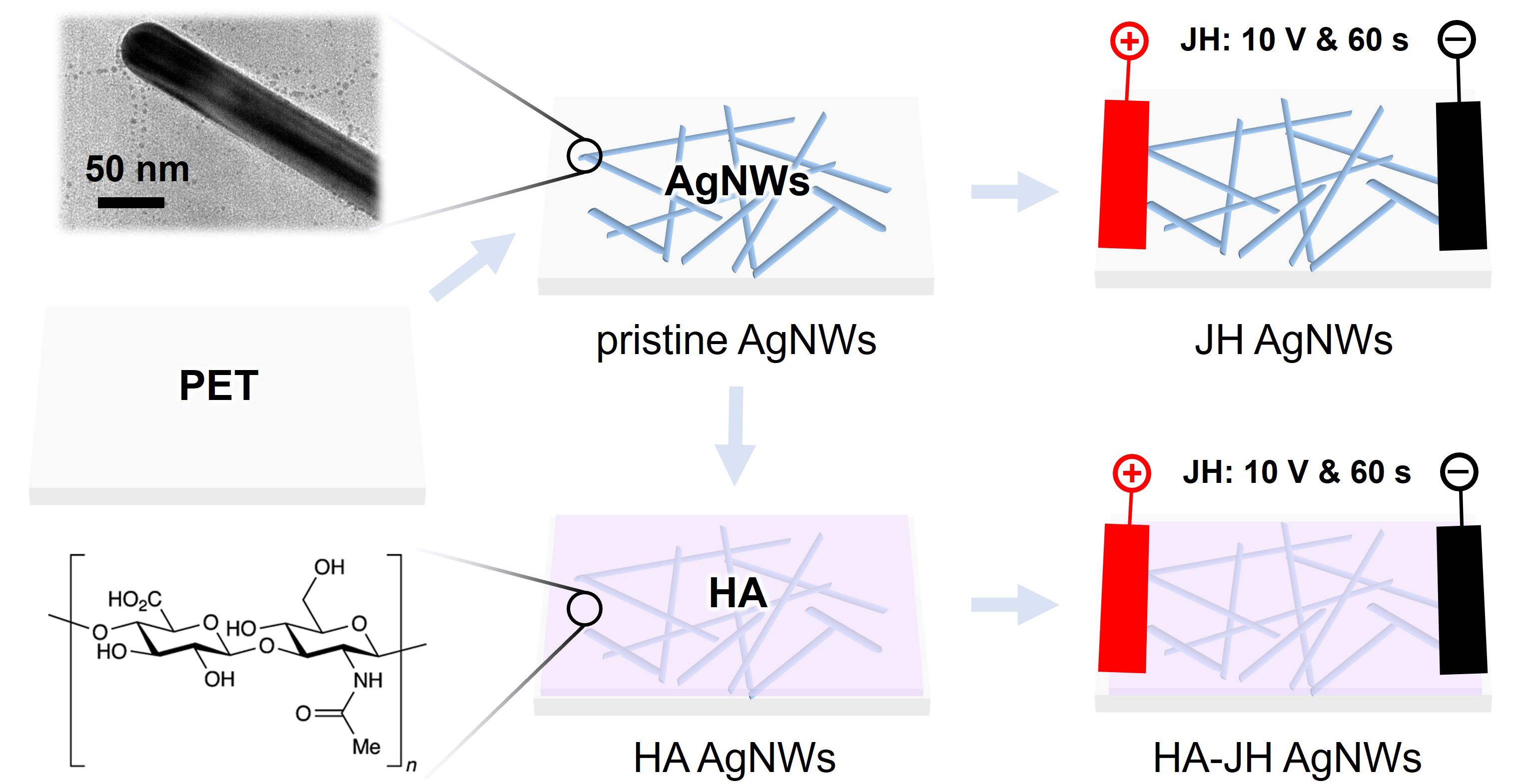
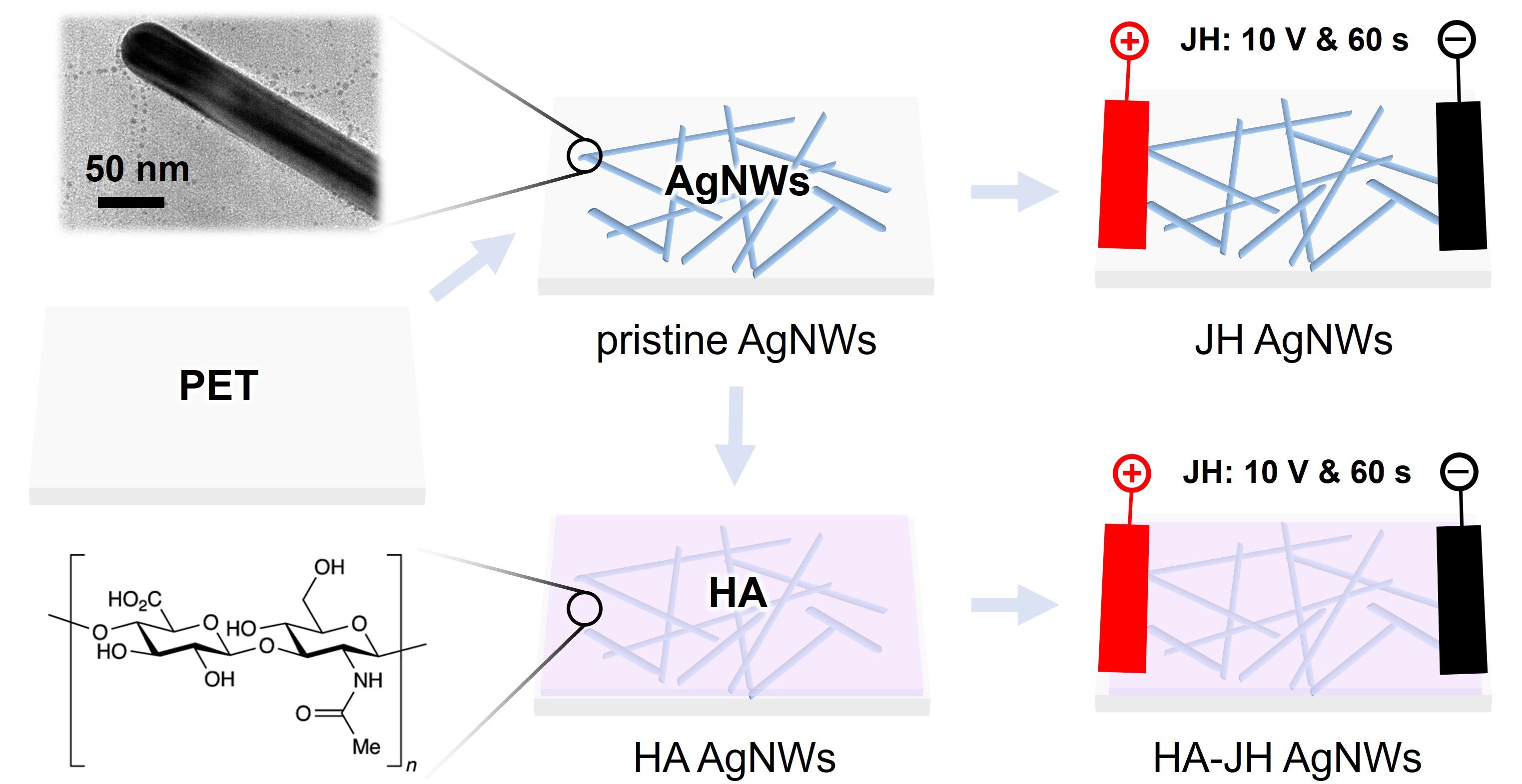
Figure 1. Schematic fabrication process of pristine, JH, HA, and HA-JH AgNWs electrode. The inserts are the transmission electron microscope of AgNW and molecular structure of HA. JH: Joule heating; HA: hyaluronic acid; AgNWs: silver nanowires; PET: polyethylene terephthalate
Poly(3,4-ethylenedioxythiophene)-poly(styrenesulfonate) (PEDOT:PSS) was spin-coated onto the optimized electrode at 4,000 rpm for 30 s and then annealed at 140 °C for 15 min to form the hole transport layer. The active layer was prepared from a D18-Cl:Y6:Y6-10 blend with a weight ratio of 1:1.12:0.48 and a total concentration of 13 mg mL-1 in chloroform. The active layer solution was spin-coated at 2,500 rpm for 30 s and annealed at 90 °C for 40 s in a carbon disulfide atmosphere. Subsequently, PDINO was dissolved in methanol at a concentration of 1 mg mL-1 and spin-coated at 3,000 rpm for 30 s as the electron transport layer. Finally, a 100 nm Ag electrode was deposited by thermal evaporation under vacuum.
The surface morphology of the electrodes was characterized by scanning electron microscopy (SEM, ZEISS G500) and atomic force microscopy (AFM, Veeco Dimension 3100) in tapping mode. Sheet resistance was measured using a four-point probe system (HPS2524, Helpass Electronic Technologies, Inc.) with a probe spacing of 1.5 mm. For each sample, measurements were taken at three different locations to get the average value. The transmittance spectra were measured using a UV-vis-NIR spectrometer (Perkin Elmer Lambda 950). The J-V characteristics of the devices were measured using a Keithley 2612 source meter under simulated AM 1.5G solar irradiation (100 mW cm-2) produced by an Oriel model 91160 solar simulator. The EQE spectra were measured using a photo-modulation spectroscopic setup (QE-R, Enli Technology Co. Ltd.)
3. Results and Discussion
3.1 Morphology evolution of AgNW electrodes
Figure 2 collectively reveals the morphology evolution of AgNW electrodes under different treatments, as evidenced by SEM (left), AFM (middle), and schematic illustrations (right). The pristine AgNW network exhibits a loosely stacked percolation structure with limited physical contacts between neighboring nanowires. This feature is reflected in the AFM topography by pronounced surface protrusions and a junction height fluctuation of 76.2 nm (Figure 2a). Such a structurally discontinuous network contains a large fraction of physically adjacent but electrically inactive junctions. After Joule heating alone (JH AgNWs), SEM reveals little change in the overall network morphology, while AFM shows that the maximum junction height decreases to 68.8 nm (Figure 2b). This modest topographical evolution is consistent with the selective nature of Joule sintering, which occurs predominantly at pre-existing electrically connected junctions. Consequently, only a limited fraction of nanowire intersections undergo welding, reducing local junction resistance without substantially altering the global network architecture. In contrast, HA treatment induces a more pronounced structural evolution of the AgNW network. Although the maximum junction height remains relatively high (62.3 nm), SEM analysis reveals a significantly denser packing structure with an increased number of inter-nanowire contacts. When HA treatment is combined with Joule heating (HA-JH AgNWs), the junction height is further reduced to 59.5 nm. Together with the increased junction density observed by SEM, these results suggest that HA first converts a larger fraction of physically adjacent nanowires into electrically accessible contacts, thereby enabling subsequent Joule heating to weld a substantially greater number of junctions. This synergistic effect simultaneously enhances network connectivity and lowers junction resistance, ultimately leading to the most efficient charge-transport network among all electrode configurations.
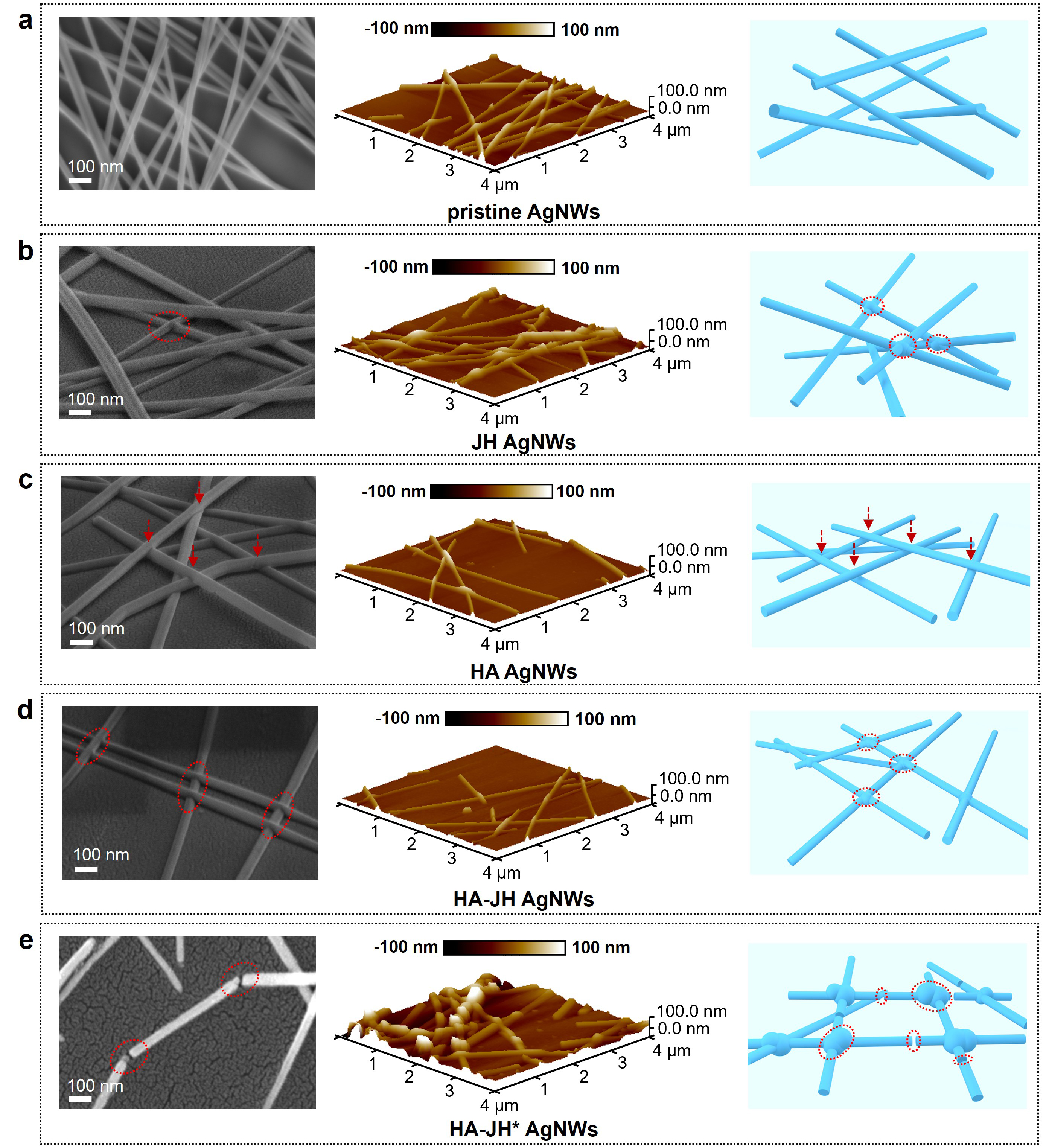
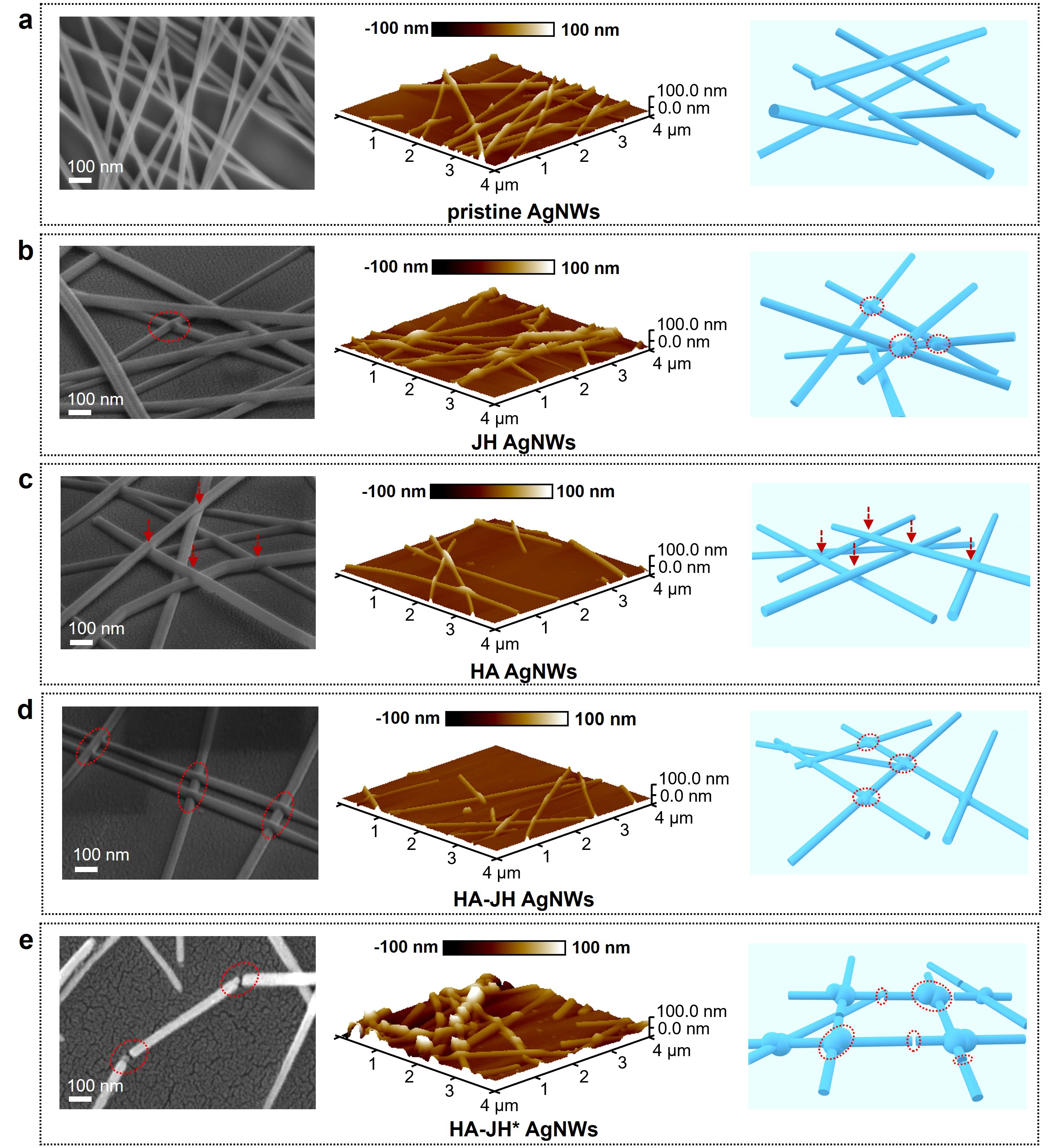
Figure 2. SEM images (left), AFM 3D images (middle), and corresponding schematic illustrations (right) of (a) Pristine; (b) JH; (c) HA; (d) HA-JH; (e) HA-JH* AgNWs networks. SEM: scanning electron microscopy; AFM: atomic force microscopy; JH: Joule heating; HA: hyaluronic acid; AgNWs: silver nanowires.
This densification originates from capillary-force-driven contraction during solvent evaporation, where the hygroscopic HA matrix induces a self-tightening effect that pulls nanowires closer to each other and toward the substrate. HA with an appropriate molecular weight possesses sufficient chain extension, chain entanglement, and water-retention capability to generate capillary contraction forces during drying, thereby promoting conformal nanowire-nanowire and nanowire-substrate contact. Excessively low molecular weight weakens the contraction effect and limits network rearrangement, whereas excessively high molecular weight increases solution viscosity and hinders uniform coating. Therefore, considering the processing feasibility, HA with an average molecular weight of 25,000 was adopted.
Furthermore, the low magnification SEM images demonstrate no obvious AgNWs loading difference between pristine AgNWs and HA-AgNWs, which have coverages of 16% and 18%, respectively (Figure S1). The AgNWs loading is supposed to be the same regardless of the HA-treatment. Despite the deviation induced by the small characterization area of SEM measurement, even if a small amount of AgNWs were lost during the HA treatment process, the significantly reduced sheet resistance would still indicate a marked improvement in the electrical property of the AgNW network. However, SEM and AFM images in Figure 2e reveal significant morphological degradation, including nanowire over-fusion, deformation, and increased surface roughness of the AgNWs treated with 240 s Joule heating (HA-JH* AgNWs). As illustrated schematically, excessive current concentration and thermal accumulation induce uncontrolled mass transport and structural instability, leading to junction coarsening and network fragmentation with the highest junction height of 87.4 nm. The over-sintering ultimately deteriorates the conductive pathways and compromises the optimized morphology.
Taken together, HA-induced network densification increases the population of electrically active junctions, which in turn enables more uniform and effective Joule-heating-induced sintering. This coupling between structural reconstruction and junction-selective heating simultaneously reduces surface roughness and enhances electrical connectivity, providing a favorable morphology for efficient charge collection and subsequent device integration. These results also highlight that precise control of Joule heating is essential to balance effective junction welding against thermally induced structural degradation.
Infrared thermography provides direct insight into the spatial distribution of Joule heating in AgNW electrodes, which reflects the underlying current transport pathways and resistance heterogeneity across the network. As shown in Figure 3a, for the pristine AgNW electrode, the temperature field is highly non-uniform, with pronounced hot spots preferentially located near the electrode edges. This behavior originates from the intrinsically inhomogeneous percolation network, where limited conductive pathways lead to severe current crowding at the injection regions. As the heating proceeds, the thermal distribution becomes slightly more homogeneous, indicating partial junction improvement. However, significant temperature gradients persist, suggesting that the network remains dominated by a small number of high-resistance pathways. After Joule heating, a distinct shift in the hot-spot location is observed, with the highest temperature appearing in the central region between the two electrodes rather than near the contacts (Figure 3b). This transition indicates that the dominant resistance no longer resides at the electrode interface but within the network itself. The initial Joule heating-induced junction welding partially improves interwire connectivity, redistributing current away from the injection points. As a result, current localization occurs at internal bottlenecks of the network, giving rise to centrally located hot spots.
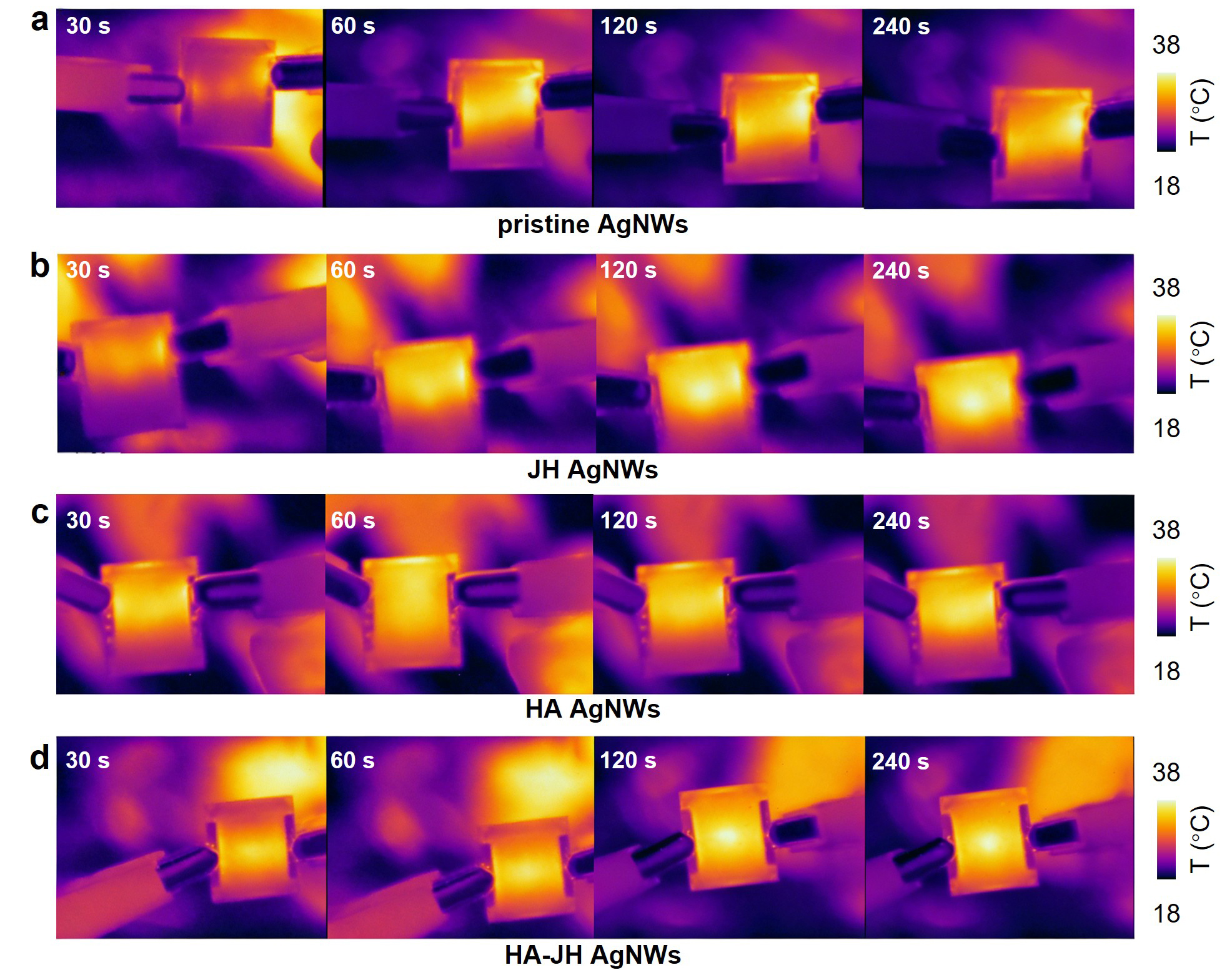
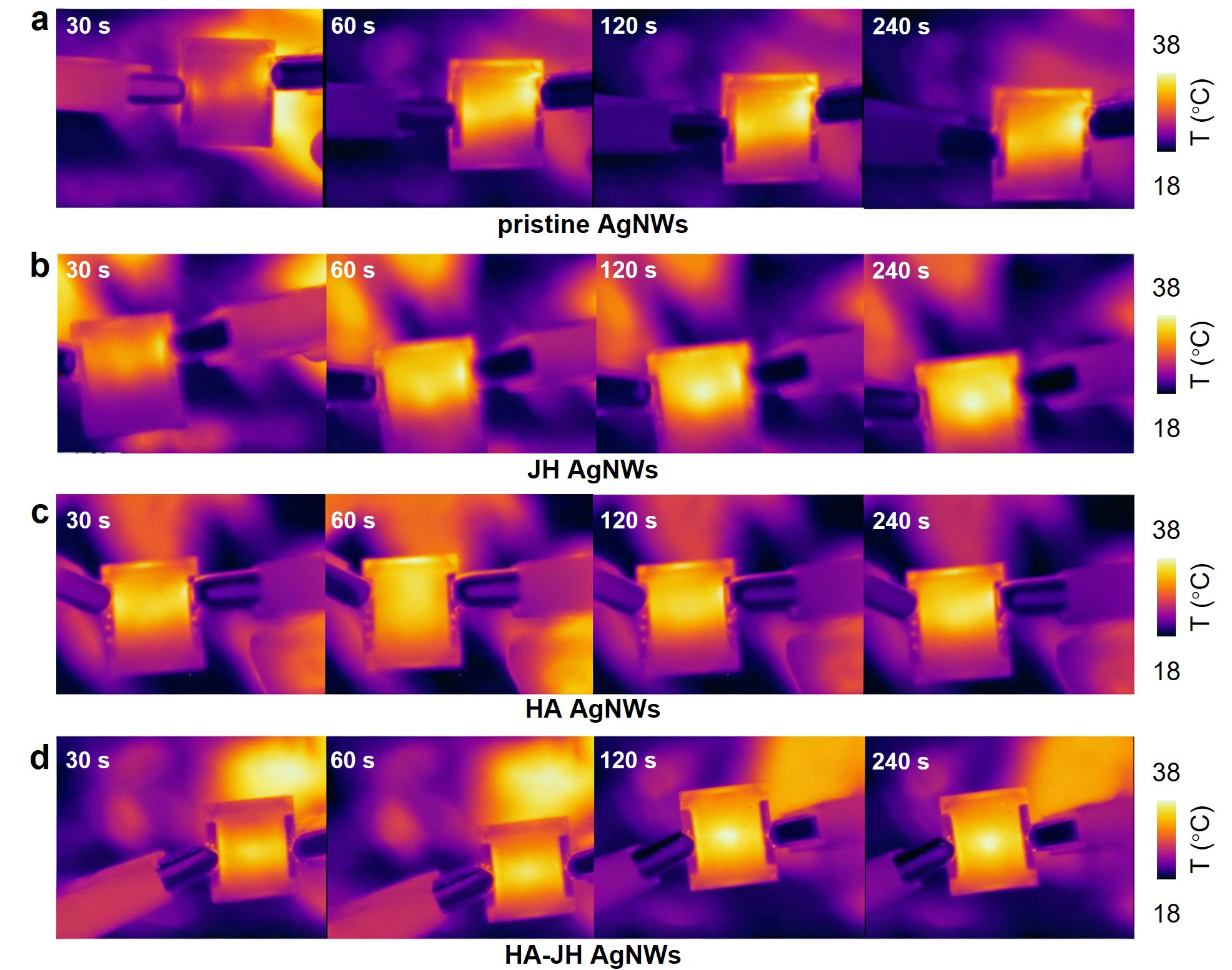
Figure 3. Infrared thermal images of (a) Pristine; (b) JH; (c) HA; (d) HA-JH AgNWs networks taken after 30, 60, 120, and 240 s of constant current injection. JH: Joule heating; HA: hyaluronic acid; AgNWs: silver nanowires.
In the HA AgNWs, the temperature distribution is noticeably more uniform from the early stage, while the hottest regions remain closer to the electrodes (Figure 3c). This behavior can be correlated with the HA-induced densification observed in SEM and AFM, where increased nanowire contact density enhances lateral charge transport and reduces resistance heterogeneity. Nevertheless, the persistence of electrode-adjacent hot spots suggests that the contact resistance at the injection interface still plays a non-negligible role. As indicated by Figure 3d, the HA-JH AgNWs exhibit the most homogeneous thermal distribution throughout the entire process, accompanied by a lower degree of local heat concentration. Notably, the hottest region shifts toward the center of the device, similar to the JH AgNWs, but with significantly reduced intensity. Combining SEM and AFM observations, this behavior can be attributed to the synergistic effect of HA-induced network densification and Joule-heating-induced junction welding. The increased population of electrically active junctions enables uniform current injection and suppresses current crowding, resulting in spatially distributed heat generation across the network. Overall, the evolution of the thermal field demonstrates a clear transition from injection-limited transport (pristine AgNWs), to network-limited transport (JH AgNWs), and finally to a homogenized transport regime (HA-JH AgNWs).
To provide more quantitative insight, we measured the temperature evolution of pristine, JH, HA, and HA-JH electrodes under a constant bias of 10 V (Figure S2). The pristine and JH electrodes exhibited rapid temperature rises, reaching peak temperatures of 39.8 °C and 39.5 °C at 360 s and 240 s, respectively, followed by a gradual decrease. Such behavior is indicative of thermally induced degradation of the AgNW network, where local nanowire failure progressively reduces the electrical power dissipation (Figure 2e). In contrast, the HA and HA-JH electrodes showed substantially slower temperature increases during the initial heating stage and reached relatively lower peak temperatures of 37.8 °C and 37.3 °C, respectively, after 600 s of processing. The suppressed heating rate and enhanced thermal stability suggest that HA treatment increases the density of effective inter-nanowire contacts, thereby promoting a more homogeneous current distribution across the network. Instead of concentrating current through a limited number of high-resistance junctions, the HA-regulated network distributes electrical current over a larger population of conductive pathways, reducing local current crowding and mitigating hotspot formation.
3.2 Optoelectrical and mechanical properties of AgNW electrodes
Figure 4a presents the transmittance spectra of the AgNW electrodes with moth-eye anti-reflective coating. All samples exhibit similar spectral profiles with a peak transmittance of 90% in the visible region. The variation among different samples is limited to 2%, indicating that neither HA treatment nor subsequent Joule heating introduces noticeable optical loss. A slight decrease in transmittance at 400 nm after HA treatment is observed, which may be attributed to the parasitic absorption of HA. The inset photographs of the HA-JH AgNW electrode further confirm its high optical transparency under both flat and bent states.
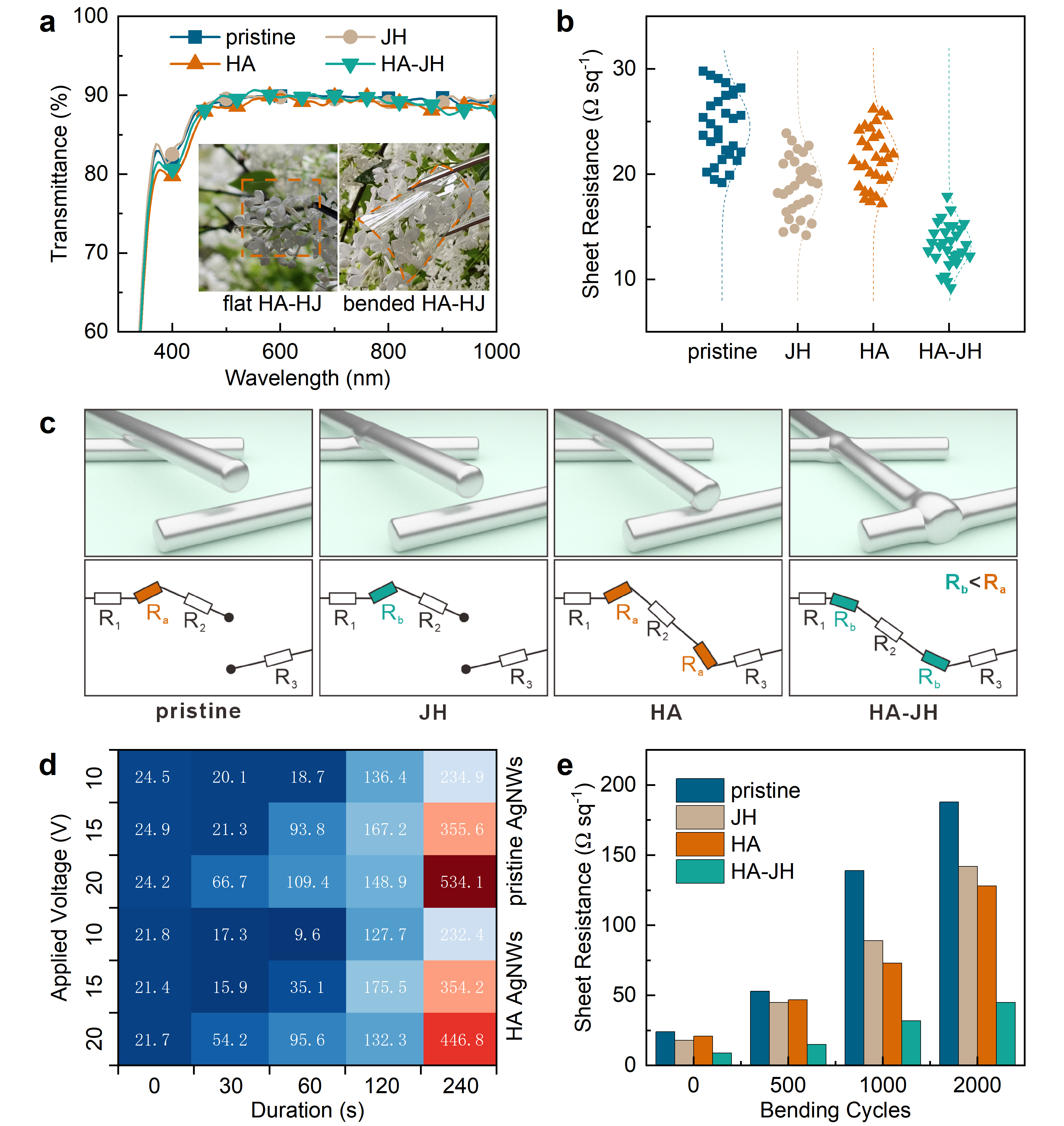
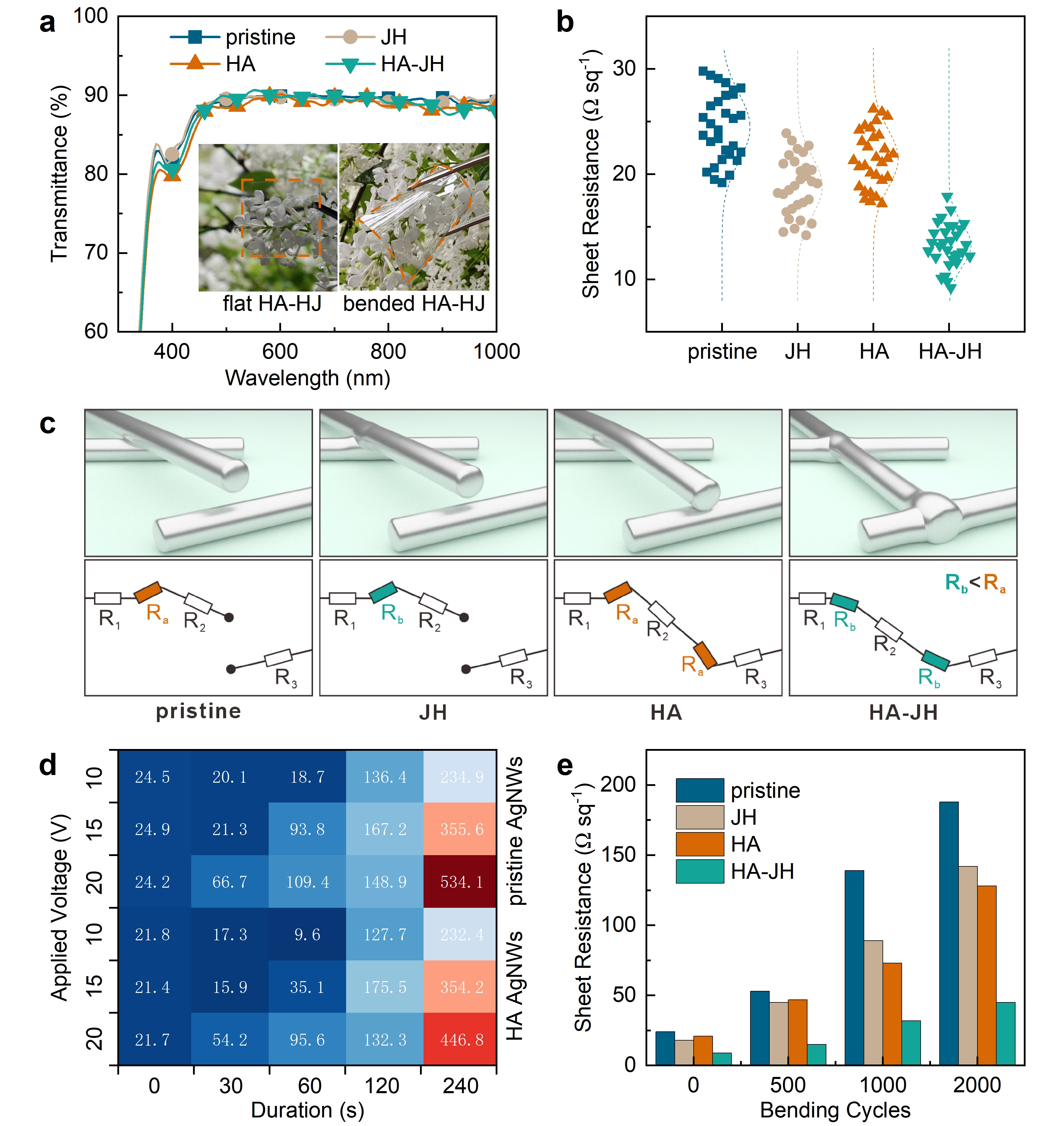
Figure 4. (a) Transmittance spectra, digital photographs; (b) Statistical sheet resistance distribution of AgNW electrodes; (c) Schematic AgNWs networks and corresponding resistor networks; (d) Sheet resistance of AgNW electrodes after Joule heating with different applied voltage and treatment duration; (e) Sheet resistance of the AgNW electrodes as a function of bending cycles. JH: Joule heating; HA: hyaluronic acid; AgNWs: silver nanowires.
In terms of electrical properties, Figure 4b shows the statistical distribution of sheet resistance collected from 30 devices. The pristine AgNW electrode exhibits an average sheet resistance of about 24.5 Ω sq-1. After Joule heating, this value decreases to 18.3 Ω sq-1, confirming that Joule heating-induced local sintering effectively reduces junction resistance. The HA-treated electrode shows a moderate reduction to 21.1 Ω sq-1, suggesting that enhanced nanowire contact density improves charge transport, but the junction resistance still dominates the overall performance of the AgNWs electrode. Notably, the HA-JH electrode achieves the lowest sheet resistance of 9.8 Ω sq-1, indicating a strong synergistic effect. This result is consistent with the infrared thermal analysis, where a more uniform current distribution was observed, as well as with morphology characterizations showing increased junction density and improved interwire contact. To further elucidate the role of HA, the electrical transport behavior was systematically investigated as a function of HA concentration (Figure S3). The sheet resistance decreases from 18.7 Ω sq-1 for pristine AgNWs to a minimum value of 9.9 Ω sq-1 at 2.5 wt% HA. However, further increasing the HA concentration leads to a sharp increase in sheet resistance, reaching 36.2 Ω sq-1 at 5 wt%. To distinguish whether this increase originates from deterioration of the AgNW network itself or from interfacial transport limitations, the lateral series resistance of AgNW electrodes was independently measured using two bottom electrodes with a width and spacing of 3 cm (Figure S4a). In contrast to the sheet-resistance trend, the lateral series resistance continuously decreases from 53.8 Ω for pristine AgNWs to 42.1 Ω at 2.5 wt% HA and remains nearly unchanged at higher concentrations (Figure S4b). The markedly different concentration dependences reveal distinct charge-transport mechanisms in the lateral and vertical directions. The lateral transport is governed primarily by the connectivity of the AgNW percolation network, which continues to improve with increasing HA content due to enhanced nanowire packing and junction formation. In contrast, the sheet-resistance measurement involves vertical charge injection from the probe tips into the AgNW network. At excessive HA concentrations, the increasingly thick HA coverage introduces an additional interfacial barrier between the probe and AgNWs, thereby increasing the contact resistance associated with vertical charge transport. Therefore, the rise in sheet resistance at high HA concentrations should not be interpreted as a deterioration of intrinsic network conductivity. Instead, it reflects the increasing contribution of vertical contact resistance, whereas the lateral conductivity of the AgNW network remains largely preserved.
To further elucidate the origin of resistance evolution in various electrodes, schematics of the nanowire junction configurations are illustrated in Figure 4c. In the pristine AgNW network, poor physical contact between nanowires leads to large junction resistance (Ra), which dominates the overall sheet resistance. After Joule heating, localized sintering occurs at pre-existing contact points, partially converting high-resistance junctions into lower-resistance pathways (Rb), while uncontacted regions remain electrically inactive. In contrast, HA treatment increases the density of effective contact points by promoting tighter nanowire packing, thereby reducing the number of high-resistance junctions. More importantly, when HA treatment is combined with Joule heating, the increased population of contacted junctions allows for more extensive and uniformly distributed junction welding. As a result, a larger fraction of the network is converted into low-resistance pathways, forming a highly interconnected conductive network with reduced resistance.
To gain further insight into Joule heating, the influence of applied voltage and treatment duration on the sheet resistance of pristine and HA electrodes was studied (Figure 4d). For all conditions, the sheet resistance initially decreases to a minimum value before increasing upon prolonged treatment. Under a 10 V bias, the sheet resistance of pristine AgNWs decreases from 24.5 Ω sq-1 to 18.7 Ω sq-1 after 60 s, but subsequently increases after 120 s of treatment, which reflects the competition between junction welding and network degradation. During the initial stage, localized Joule heating selectively lowers junction resistance through interwire fusion, thereby enhancing network conductivity. However, higher applied bias promotes electromigration, nanowire deformation, and eventual disruption of conductive pathways, leading to a rapid deterioration in electrical performance. In contrast, HA-treated electrodes reach a substantially lower minimum sheet resistance of 9.6 Ω sq-1 and exhibit a delayed onset of degradation, indicating a significantly expanded processing window. This improved process tolerance suggests that the HA-regulated network can sustain more extensive junction welding before thermally induced network deterioration becomes dominant.
The bending tests further demonstrate the advantage of the combined treatment (Figure 4e). The bending test was carried out at a bending radius of 5 mm, under outward bending, with a cyclic bending rate of 20 cycles min-1. With increasing bending cycles, the sheet resistance of all electrodes increases due to mechanical disruption of the conductive network. The pristine AgNW electrode shows the most severe degradation, with resistance rising from 24 Ω sq-1 to 188 Ω sq-1 after 2,000 cycles of bending. JH AgNWs exhibit improved stability, while HA-treated samples show a more moderate increase, reflecting enhanced network integrity. In contrast, the HA-JH electrode displays the smallest resistance change, increasing only from 9 Ω sq-1 to ~15, ~32, and ~45 Ω sq-1 after 500, 1,000, and 2,000 cycles, respectively. This improved mechanical robustness can be attributed to the increased junction density induced by HA, which provides redundant conductive pathways, and the strengthened interwire connections formed during Joule heating, which reduce the likelihood of junction failure under mechanical deformation. These observations are in good agreement with the more compact and smoother morphology. To clarify whether the hygroscopic nature of HA contributes directly to the electrical conductivity, the sheet resistance of JH-HA AgNW electrodes was measured inside a nitrogen-filled glove box with negligible moisture content. The average sheet resistance changed only slightly from 13.26 Ω sq-1 to 13.83 Ω sq-1 (Figure S5). This minor difference confirms that the conductivity enhancement cannot be attributed to moisture-induced ionic transport within HA. To evaluate the potential influence of the hygroscopic nature of HA, the stability of both AgNW electrodes and unencapsulated FOSCs was examined at 25 °C and ~50% relative humidity. As shown in Figure S6, the sheet resistance of all AgNW electrodes gradually increased during storage. After 120 h of storing, the normalized sheet resistance reached 1.46, 1.48, 1.55, and 1.50 for the pristine, JH, HA, and HA-JH electrodes, respectively. Importantly, despite the moisture sensitivity of HA, the HA-containing electrodes exhibited degradation rates comparable to those of the pristine and JH counterparts, indicating that the incorporation of HA does not introduce additional instability into the AgNW network.
3.3 Photovoltaic performance of FOSCs
To evaluate the practical applicability of the AgNW electrodes, FOSCs were fabricated with the structure of PET/AgNWs/PEDOT:PSS/D18-Cl:Y6:Y6-10/PDINO/Ag as illustrated in Figure 5a. The photovoltaic parameters of all device configurations are summarized in Figure 5, while the complete statistics are provided in Table 1. The reference device based on pristine AgNWs exhibits a PCE of 16.82%, with a VOC of 0.880 V, a JSC of 25.70 mA cm-2, and a fill factor (FF) of 74.37%. After Joule heating, the PCE increases to 17.34%. This improvement is mainly reflected in the enhanced JSC (26.05 mA cm-2) and FF (75.47%). The reduced sheet resistance resulting from junction welding lowers junction resistance and facilitates more efficient lateral charge transport within the electrode. Introducing HA without Joule heating increases the PCE to 17.72%, accompanied by simultaneous improvements in VOC (0.896 V), JSC (26.30 mA cm-2), and FF (75.20%). The increased density of effective nanowire contacts improves charge collection efficiency, while the reduced surface roughness mitigates bump-induced carrier recombination, contributing to the enhancement of all photovoltaic parameters. By combining HA treatment with Joule heating, the advantages of both approaches are integrated into a single electrode architecture. Consequently, the corresponding device achieves the best overall performance, with a PCE of 18.09%, a VOC of 0.898 V, a JSC of 26.69 mA cm-2, and an FF of 75.48%. The champion PCE is the highest reported value of FOSCs with an inverted configuration[18,39-41]. Compared with the pristine device, the simultaneous enhancement of VOC, JSC, and FF indicates that the HA-JH strategy not only minimizes resistive losses but also promotes more efficient carrier extraction and suppresses recombination losses throughout the device.
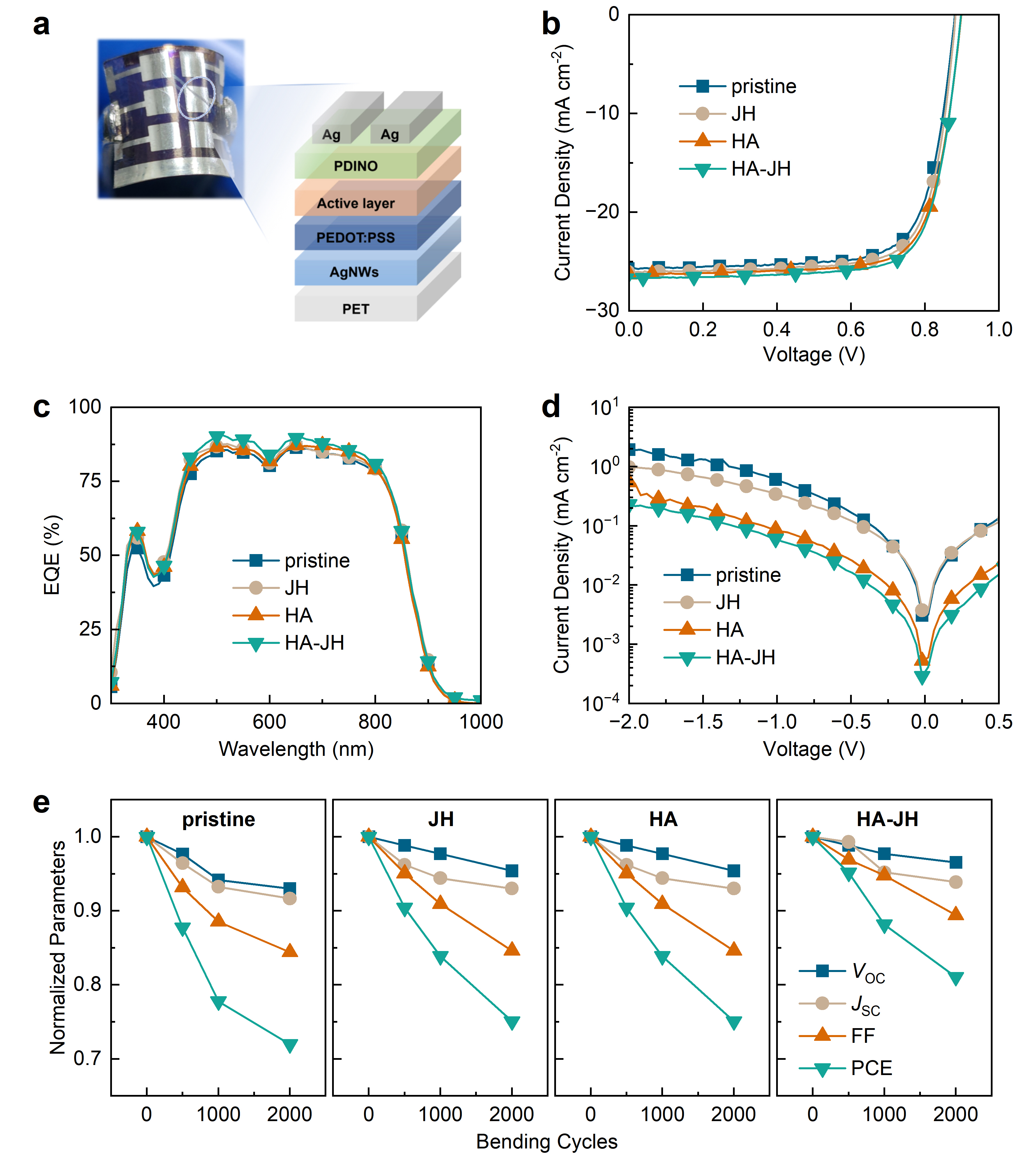
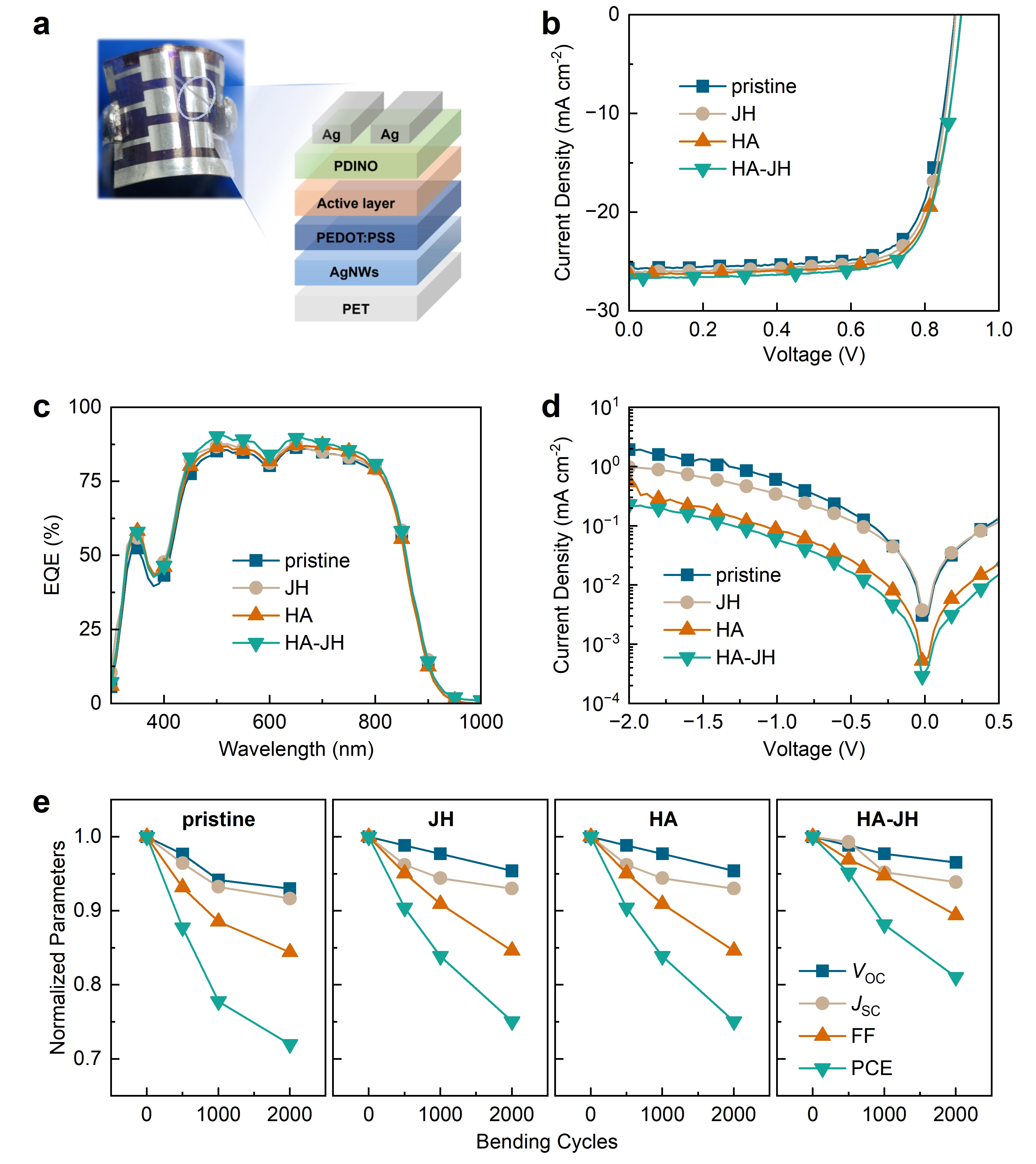
Figure 5. (a) Schematic device structure and photo of FOSCs; (b) J-V characteristics; (c) EQE spectra; (d) dark J-V characteristics of FOSCs; (e) Photovoltaic characteristics evolution of FOSCs against mechanical bending with radius of 5 mm. FOSCs: flexible organic solar cells; JH: Joule heating; HA: hyaluronic acid; AgNWs: silver nanowires; PCE: power conversion efficiency; PEDOT:PSS: poly(3,4-ethylenedioxythiophene)-poly(styrenesulfonate).
Table 1. Photovoltaic parameters of FOSCs measured under simulated AM 1.5G illumination (100 mW cm-2). Joule heating was carried out using direct current bias with voltage of 10 V and duration of 60 s.
| electrode | VOC (V) | JSC (mA cm-2) | FF (%) | PCE (%) |
| Pristine AgNWs | 0.880 | 25.70 | 74.37 | 16.82 |
| JH AgNWs | 0.882 | 26.05 | 75.47 | 17.34 |
| HA AgNWs | 0.896 | 26.30 | 75.20 | 17.72 |
| HA-JH AgNWs | 0.898 | 26.69 | 75.48 | 18.09 |
FOSCs: flexible organic solar cells; JH: Joule heating; HA: hyaluronic acid; AgNWs: silver nanowires; FF: fill factor; PCE: power conversion efficiency.
The EQE spectra (Figure 5c) exhibit similar spectral shapes for all devices, consistent with the identical active layer. However, the devices based on treated electrodes show slightly enhanced EQE values across the main photoresponse region, with the HA-JH device delivering the highest values. The integrated JSC values from EQE of pristine, HA, JH, and HA-JH-based devices are 24.90, 25.48, 25.30, and 26.07 mA cm-2, which are in good agreement with the J-V results, confirming the reliability of the measurements. The dark J-V characteristics (Figure 5d) further reveal the impact of electrode optimization on the diode behavior of FOSCs. Devices incorporating treated AgNW electrodes exhibit reduced leakage current and improved rectification behavior compared to the pristine device. This suggests suppressed shunt pathways and improved interfacial quality, which can be attributed to the smoother surface and more uniform network structure formed after HA-assisted Joule heating. The reduced dark current is directly correlated with the enhancement in VOC. According to the diode model, a lower dark saturation current density leads to an increased VOC. Therefore, the suppressed leakage current and reduced recombination in devices based on HA-JH electrodes contribute to the observed increase in VOC. This result indicates that the electrode optimization not only improves charge transport but also effectively modulates recombination dynamics within the device.
As shown in Figure S7, the normalized PCE of all unencapsulated FOSCs decreased gradually during storage, reaching 71.1%, 74.3%, 67.9%, and 70.1% of their initial values after 84 h of storage for the pristine, JH, HA, and HA-JH devices, respectively. Despite minor variations, no systematic acceleration of degradation was observed in the HA-containing devices. This result indicates that the incorporation of HA does not impose an additional stability penalty on device operation. The mechanical durability of the devices was evaluated under repeated bending (Figure 5e). All devices exhibit gradual degradation in photovoltaic parameters with increasing bending cycles. However, significant differences are observed among the devices. The pristine device shows the most severe performance decay with only 72% of its initial PCE after 2,000 cycles of bending. It is found that the decrease in FF contributes mostly to the device performance degradation, indicating imbalanced charge collection at opposite electrodes. The JH AgNWs-based device exhibits moderate improvement, indicating a limited improvement in mechanical stability as demonstrated in Figure 4d. The HA-treated device demonstrates further enhanced stability, retaining over 81% of its initial PCE after 2,000 cycles. Notably, the HA-JH device shows the best mechanical robustness, maintaining over 86% of its initial efficiency after 2,000 bending cycles. This superior stability originates from the synergistic effects of increased junction density and strengthened inter-nanowire connections, which effectively prevent network disconnection under mechanical deformation. These results are consistent with the improved mechanical and structural properties observed in the electrode characterization.
4. Conclusion
In summary, we developed a HA-assisted Joule heating strategy to synergistically regulate the structure and electrical performance of AgNW electrodes for FOSCs. The introduction of HA increases the density of effective nanowire junctions and enhances interfacial adhesion, thereby establishing a conductive network with improved connectivity prior to electrical treatment. This structural preconditioning enables a more uniform and controllable Joule heating process, in which selective sintering occurs predominantly at contacted nanowire junctions rather than across the entire network. As a result, the HA-JH process leads to a compact and well-connected AgNW network with reduced surface roughness and suppressed resistance heterogeneity. These structural and transport improvements collectively result in reduced sheet resistance, enhanced mechanical robustness, and preserved optical transparency. The optimized electrodes deliver simultaneously improved VOC, JSC, and FF, leading to a maximum PCE of 18.09%, along with enhanced bending stability. This study provides a simple yet scalable approach for fabricating high-performance transparent electrodes and offers general insights into the interplay between morphology, current distribution, and thermal response in disordered conductive networks.
Supplementary materials
The supplementary material for this article is available at: Supplementary materials.
Acknowledgements
The authors would like to acknowledge the experimental support provided by the Collaborative Innovation Center of Suzhou Nano Science & Technology.
The authors confirm that Gemini was used to assist the language polishing and grammar checking of this paper. The authors have reviewed and take full responsibility for all content of the final manuscript.
Authors contribution
Khan MS, Deng ZY, Zhang JL: Investigation, validation.
Wen C: Writing-original draft, formal analysis.
Chen JD, Li YQ, Tang JX: Conceptualization, supervision, writing-review & editing.
Ren H: Investigation.
Zhou SJ: Validation.
Conflicts of interest
Jing-De Chen serves as a Young Editor and Jian-Xin Tang serves as an Editorial Board Member of Smart Materials and Devices. The other authors declare no conflicts of interest.
Ethical approval
Not applicable.
Consent to participate
Not applicable.
Consent for publication
Not applicable.
Availability of data and materials
The data and materials supporting the findings of this study are available from the corresponding author upon reasonable request.
Funding
The authors acknowledge the financial support from the National Natural Science Foundation of China (Nos. U23A20371, T2425024, 62320106004, 62275181), the Science and Technology Development Fund (FDCT), Macau (No. 0008/2022/AMJ), the Bureau of Science and Technology of Suzhou Municipality (No. SYC2022144).
Copyright
© The Author(s) 2026.
References
-
1. Li Y, Xu G, Cui C, Li Y. Flexible and semitransparent organic solar cells. Adv Energy Mater. 2017;8(7):1701791.[DOI]
-
2. Yang F, Huang Y, Li Y, Li Y. Large-area flexible organic solar cells. npj Flex Electron. 2021;5:30.[DOI]
-
3. Zhu J, Xia J, Li Y, Li Y. Perspective on flexible organic solar cells for self-powered wearable applications. ACS Appl Mater Interfaces. 2025;17(4):5595-5608.[DOI]
-
4. Zhang Y, Xu B, Zhao F, Li H, Chen J, Wang H, et al. Inkjet printing for smart electrochromic devices. FlexMat. 2024;1(1):23-45.[DOI]
-
5. Huang L, Tang D, Yang Z. Flexible electronic materials and devices toward portable immunoassays. FlexMat. 2024;1(1):59-78.[DOI]
-
6. Chen JD, Ren H, Xie FM, Zhang JL, Li HZ, Ibupoto AS, et al. Harnessing plasmon-exciton energy exchange for flexible organic solar cells with efficiency of 19.5%. Nat Commun. 2025;16:3829.[DOI]
-
7. Chen JD, Li L, Qin CC, Ren H, Li YQ, Ou QD, et al. Hot-electron emission-driven energy recycling in transparent plasmonic electrode for organic solar cells. InfoMat. 2022;4(3):e12285.[DOI]
-
8. Qian F, Han Y, Chen Z, Wang Z, Zhang L, Ma CQ, et al. A semi-embedded AgNWstransparent electrode by hybrid top-down fabrication enabled high yield rate of flexible organic solar cells. Adv Funct Mater. 2025;35(44):2506783.[DOI]
-
9. Sun Y, Chang M, Meng L, Wan X, Gao H, Zhang Y, et al. Flexible organic photovoltaics based on water-processed silver nanowire electrodes. Nat Electron. 2019;2(11):513-520.[DOI]
-
10. Chen H, Liu B, Cao J, Ji L, Xie J, Shu Y, et al. Flexible UV photodetector based on copper tetraiodogallate (CuGaI4) film. FlexMat. 2024;1(1):54-58.[DOI]
-
11. Liu Y, Qin F, Wang Y, Lu X, Xiong Z, Xie C, et al. Large-area flexible organic photovoltaic modules on smoothened silver nanowire transparent electrodes with thick electron transporting layer. Adv Funct Mater. 2024;34(48):2408453.[DOI]
-
12. Song M, You DS, Lim K, Park S, Jung S, Kim CS, et al. Highly efficient and bendable organic solar cells with solution-processed silver nanowire electrodes. Adv Funct Mater. 2013;23(34):4177-4184.[DOI]
-
13. Li Y, Sha M, Huang S. A review on transparent electrodes for flexible organic solar cells. Coatings. 2024;14(8):1031.[DOI]
-
14. Cai R, Liang C, Duan Y, Zhao Z, Zhang X, He P, et al. Metallic nanoparticle inks for flexible printed electronics. FlexMat. 2025;2(2):225-283.[DOI]
-
15. Lu X, Zhang Y, Zheng Z. Metal-Based Flexible Transparent Electrodes: Challenges and Recent Advances. Adv Electron Mater. 2021;7(5):2001121.[DOI]
-
16. Li D, Lai WY, Zhang YZ, Huang W. Printable Transparent Conductive Films for Flexible Electronics. Adv Mater. 2018;30(10):1704738.[DOI]
-
17. Meng L, Wang W, Xu B, Qin J, Zhang K, Liu H. Solution-processed flexible transparent electrodes for printable electronics. ACS Nano. 2023;17(5):4180-4192.[DOI]
-
18. Zheng X, Wang Y, Chen T, Kong Y, Wu X, Zhou C, et al. Realizing record efficiencies for ultra-thin organic photovoltaics through step-by-step optimizations of silver nanowire transparent electrodes. FlexMat. 2024;1(3):221-233.[DOI]
-
19. Azani MR, Hassanpour A, Torres T. Benefits, problems, and solutions of silver nanowire transparent conductive electrodes in indium tin oxide (ITO)-free flexible solar cells. Adv Energy Mater. 2020;10(48):2002536.[DOI]
-
20. Seo Y, Ha H, Matteini P, Hwang B. A review on the deformation behavior of silver nanowire networks under many bending cycles. Appl Sci. 2021;11(10):4515.[DOI]
-
21. Hu L, Kim HS, Lee JY, Peumans P, Cui Y. Scalable coating and properties of transparent, flexible, silver nanowire electrodes. ACS Nano. 2010;4(5):2955-2963.[DOI]
-
22. Li J, Tao Y, Chen S, Li H, Chen P, Wei MZ, et al. A flexible plasma-treated silver-nanowire electrode for organic light-emitting devices. Sci Rep. 2017;7(1):16468.[DOI]
-
23. Song TB, Chen Y, Chung CH, Yang YM, Bob B, Duan HS, et al. Nanoscale Joule heating and electromigration enhanced ripening of silver nanowire contacts. ACS Nano. 2014;8(3):2804-2811.[DOI]
-
24. Kim A, Won Y, Woo K, Kim CH, Moon J. Highly transparent low resistance ZnO/Ag nanowire/ZnO composite electrode for thin film solar cells. ACS Nano. 2013;7(2):1081-1091.[DOI]
-
25. Song M, Park JH, Kim CS, Kim DH, Kang YC, Jin SH, et al. Highly flexible and transparent conducting silver nanowire/ZnO composite film for organic solar cells. Nano Res. 2014;7(9):1370-1379.[DOI]
-
26. Ok KH, Kim J, Park SR, Kim Y, Lee CJ, Hong SJ, et al. Ultra-thin and smooth transparent electrode for flexible and leakage-free organic light-emitting diodes. Sci Rep. 2015;5:9464.[DOI]
-
27. Yu H, Tian Y, Dirican M, Fang D, Yan C, Xie J, et al. Flexible, transparent and tough silver nanowire/nanocellulose electrodes for flexible touch screen panels. Carbohydr Polym. 2021;273:118539.[DOI]
-
28. Bellew AT, Manning HG, Gomes da Rocha C, Ferreira MS, Boland JJ. Resistance of single Ag nanowire junctions and their role in the conductivity of nanowire networks. ACS Nano. 2015;9(11):11422-11429.[DOI]
-
29. Duan X, Ding Y, Liu R. Stability enhancement of silver nanowire-based flexible transparent electrodes for organic solar cells. Mater Today Energy. 2023;37:101409.[DOI]
-
30. Seo JH, Hwang I, Um HD, Lee S, Lee K, Park J, et al. Cold isostatic-pressured silver nanowire electrodes for flexible organic solar cells via room-temperature processes. Adv Mater. 2017;29(30):1701479.[DOI]
-
31. Xie C, Liu Y, Wei W, Zhou Y. Large-area flexible organic solar cells with a robust silver nanowire-polymer composite as transparent top electrode. Adv Funct Mater. 2023;33(1):2210675.[DOI]
-
32. Guo F, Kubis P, Przybilla T, Spiecker E, Hollmann A, Langner S, et al. Nanowire interconnects for printed large-area semitransparent organic photovoltaic modules. Adv Energy Mater. 2015;5(12):1401779.[DOI]
-
33. Yang Y, Xu B, Hou J. Solution-processed silver nanowire as flexible transparent electrodes in organic solar cells. Chin J Chem. 2021;39(8):2315-2329.[DOI]
-
34. Ding Y, Cui Y, Liu X, Liu G, Shan F. Welded silver nanowire networks as high-performance transparent conductive electrodes: Welding techniques and device applications. Appl Mater Today. 2020;20:100634.[DOI]
-
35. Kwon J, Soh JY, Shin H, Lim S, Yoon SY, Kim WH, et al. Improving the conductivity and stability of silver nanowires through spontaneous ligand exchange for joule heating. Angew Chem Int Ed. 2025;64(48):e202518337.[DOI]
-
36. Khaligh HH, Xu L, Khosropour A, Madeira A, Romano M, Pradére C, et al. The Joule heating problem in silver nanowire transparent electrodes. Nanotechnology. 2017;28(42):425703.[DOI]
-
37. Sannicolo T, Charvin N, Flandin L, Kraus S, Papanastasiou DT, Celle C, et al. Electrical mapping of silver nanowire networks: A versatile tool for imaging network homogeneity and degradation dynamics during failure. ACS Nano. 2018;12(5):4648-4659.[DOI]
-
38. Grazioli D, Dadduzio AC, Roso M, Simone A. Quantitative electrical homogeneity assessment of nanowire transparent electrodes. Nanoscale. 2023;15(14):6770-6784.[DOI]
-
39. Tao J, Zhang C, Zhao Q, Tian C, Fang J, Tang A, et al. Narrow-bandgap acceptors with low energetic disorder achieve over 21% efficiency in organic solar cells. Nat Mater. 2026.[DOI]
-
40. Qian F, Han Y, Chen Z, Wang Z, Zhang L, Ma CQ, et al. A semi-embedded AgNWs transparent electrode by hybrid top-down fabrication enabled high yield rate of flexible organic solar cells. Adv Funct Mater. 2025;35(44):2506783.[DOI]
-
41. Liu X, Ji Y, Xia Z, Zhang D, Cheng Y, Liu X, et al. In-doped ZnO electron transport layer for high-efficiency ultrathin flexible organic solar cells. Adv Sci. 2024;11(37):2402158.[DOI]
Copyright
© The Author(s) 2026. This is an Open Access article licensed under a Creative Commons Attribution 4.0 International License (https://creativecommons.org/licenses/by/4.0/), which permits unrestricted use, sharing, adaptation, distribution and reproduction in any medium or format, for any purpose, even commercially, as long as you give appropriate credit to the original author(s) and the source, provide a link to the Creative Commons license, and indicate if changes were made.
Publisher’s Note
Science Exploration remains a neutral stance on jurisdictional claims in published
maps
and institutional affiliations. The views expressed in this article are solely those
of
the author(s) and do not reflect the opinions of the Editors or the publisher.
Share And Cite


Science Exploration Style
Khan MS, Wen C, Deng ZY, Zhang JL, Chen JD, Ren H, et al. Engineering junction contact states for selective Joule sintering and current distribution control in flexible silver nanowire electrodes. Smart Mater Devices. 2026;2:SMD_202619. https://doi.org/10.70401/smd.2026.0036
Tips
Copy completed.
Submit a Manuscript
Author Instructions
Cite this Article
Article Metrics
0
View
0
Download
Cited
Article Updates

- Abstract
- Keywords
- 1. Introduction
- 2. Experimental Section
- 3. Results and Discussion
- 4. Conclusion
- Supplementary materials
- Acknowledgements
- Authors contribution
- Conflicts of interest
- Ethical approval
- Consent to participate
- Consent for publication
- Availability of data and materials
- Funding
- References
- Copyright
 Get citation
Science Exploration Style

Khan MS, Wen C, Deng ZY, Zhang JL, Chen JD, Ren H, et al. Engineering junction contact states for selective Joule sintering and current distribution control in flexible silver nanowire electrodes. Smart Mater Devices. 2026;2:SMD_202619. https://doi.org/10.70401/smd.2026.0036
copy
Share Link
copy
Subscribe