Iron doping P2-Na2/3Li1/6Fe1/6Mn2/3O2 cathode with enhanced anionic redox and structural stability for sodium-ion batteries

*Correspondence to:
Qingmei Su, Materials Institute of Atomic and Molecular Science, School of Physics & Information Science, Shaanxi University of Science and Technology, Xi’an 710021, Shaanxi, China.
E-mail: suqingmei@sust.edu.cn
Gaohui Du, Materials Institute of Atomic and Molecular Science, School of Physics & Information Science, Shaanxi University of Science and Technology, Xi’an 710021, Shaanxi, China. E-mail: dugaohui@sust.edu.cn
Gaohui Du, Materials Institute of Atomic and Molecular Science, School of Physics & Information Science, Shaanxi University of Science and Technology, Xi’an 710021, Shaanxi, China. E-mail: dugaohui@sust.edu.cn
Smart Mater Devices. 2026;2:202626. 10.70401/smd.2026.0040
Received: May 13, 2026Accepted: July 30, 2026Published: July 30, 2026
Abstract
P2-type layered manganese-based oxides are promising cathode materials for sodium-ion batteries (SIBs) but suffer from structural instability and irreversible phase transitions. This study demonstrates that iron doping in P2-Na2/3Li1/6Fe1/6Mn2/3O2 (NLFM) effectively reconfigures the structural and redox chemistry. Structural and electrochemical analyses reveal that Fe3+ incorporation expands the Na+ interlayer spacing, enhances reversible cationic (Fe3+/Fe4+) and anionic redox activity, and promotes a dominant surface-controlled charge storage mechanism. Consequently, the NLFM cathode delivers a high initial capacity of 225 mAh·g-1 at 0.1 C, an impressive initial Coulombic efficiency of 110.21%, and superior cycling stability (73.6% capacity retention after 100 cycles at 1 C). Furthermore, Fe doping effectively mitigates the Jahn-Teller distortion and the reversible P2 to O2 phase transition at high voltages. This work highlights the multi-functional role of iron doping in stabilizing the structure and optimizing the redox chemistry of P2-type cathodes, providing an effective strategy for developing high-energy and durable SIBs cathodes.
Keywords
Sodium-ion batteries, layered cathode, iron doping, anionic redox, structural stability, Jahn-Teller distortion
1. Introduction
Lithium-ion batteries (LIBs) have greatly shaped modern energy storage systems, powering everything from portable electronics to grid-scale renewable energy integration[1-3]. However, the increasing concerns over lithium scarcity, cost volatility, and environmental impact have prompted the research for alternative battery chemistry, particularly for large-scale energy storage[4]. In this context, sodium-ion batteries (SIBs) have emerged as a promising candidate due to the natural abundance of sodium, low cost, and comparable intercalation chemistry to LIBs[5-7].
Among the components of SIBs, the cathode material is one of the key determinants of energy density and cost, though the anode also critically affects cycle life and safety[8-10]. A variety of cathode materials with good cycling stability, high multiplicity, and reversible capacity have been developed, which are mainly categorized into the following groups: layered transition metal oxides[11,12], tunneling transition metal oxides[13], polyanionic compounds[14,15], Prussian blue analogs[16], and organic compounds[17,18]. Among them, layered transition metal oxides are considered to be one of the most superior cathode materials due to their high theoretical capacity, facile synthesis, and structural diversity. In particular, manganese-based P2-type oxides, Na2/3MnO2, offer compelling advantages in terms of raw material cost and specific capacity[19]. Nevertheless, their practical implementation is hindered by severe intrinsic issues: Jahn-Teller distortion associated with Mn3+ ions leads to severe structural degradation during cycling, and charging beyond 4.2 V often triggers irreversible phase transitions (P2-O2) accompanied by oxygen loss, resulting in rapid capacity fading[20].
To address these challenges, lithium substitution in the transition metal (TM) layer has been explored as an effective strategy to activate anionic redox and improve structural stability[21,22]. For instance, Wang et al. designed a P2-type Na0.6[Li0.2Mn0.8]O2 cathode material, which delivered a discharge capacity of only 104.2 mAh·g-1. After obtaining an ordered Li/Mn superstructure through liquid nitrogen quenching, the discharge capacity increased to 153.7 mAh·g-1[23]. Despite such improvements, the low capacity remains an urgent issue to address. The low specific capacity is predominantly caused by the detrimental Jahn-Teller distortion of Mn3+ ions, which initiates irreversible phase transitions and particle microcracking, resulting in progressive structural degradation and rapid capacity decay during cycling. Moreover, when charged above 4.3 V, the material suffers from oxygen loss, which triggers irreversible anion redox reactions and thereby exacerbates interfacial side reactions, adversely affecting the overall electrochemical performance. Therefore, developing strategies to reversibly activate anionic redox while suppressing phase transitions is essential for achieving high-performance SIBs cathodes[24,25].
Introducing inexpensive and readily available TM ions into layered sodium oxide cathodes can enhance the economic viability and resource efficiency of cathode materials. Among these, Mn and Fe are particularly suitable for TM compositions due to their affordability and widespread availability[26]. The large ionic radius of Na+ allows stable incorporation of Fe into the TM layer at high temperatures, while its strong ionization tendency promotes the Fe3+/Fe4+ redox couple, contributing to additional capacity at high voltage[27,28]. Additionally, Fe doping has been shown to suppress the ordered arrangement of sodium ions and vacancies, improve air stability, and mitigate irreversible oxygen loss[29-32]. Therefore, iron-based layered oxide cathode materials represent an important future direction for achieving low-cost energy storage.
Lavela et al. studied compositions of Na0.67[Li0.07Fe0.3+xMn0.63-x]O2 (x = 0, 0.15, 0.25) with low Li content (Li = 0.07)[33], which delivered a reversible capacity of 40 mAh g-1 at 1 C at -15 °C. In Lavela’s system, the high Fe content induces the formation of P3/O3 impurity phases, which deteriorate the kinetic performance and structural stability. Yu et al. reported that Li-excess Mn oxides were expected to induce reversible oxygen redox at high voltages[21]. In this work, we propose a novel cathode material, P2-Na2/3Li1/6Fe1/6Mn2/3O2 (NLFM), by adjusting the Li/Fe ratio (1:1 substitution of Li in P2-Na2/3Li1/3Mn2/3O2 (NLM)) to achieve a pure P2 phase, reversible anionic redox, and superior structural stability. The introduction of Fe3+ (d5, high spin) counteracts the Jahn-Teller effect of Mn3+, stabilizes the crystal structure, and enhances the reversible capacity of anionic redox reactions. As a result, the NLFM cathode exhibits a high reversible capacity of 225 mAh·g-1 within 2.0-4.5 V, along with significantly improved cycling performance, with a capacity retention rate of 73.6% after 100 cycles. This study systematically investigates the role of Fe doping in modulating structural evolution, and electrochemical behavior, providing valuable insights for the design of advanced SIBs cathode materials.
2. Experimental Section
2.1 Synthesis of NLFM and NLM
The NLM and NLFM were synthesized using a solid-phase sintering method. Stoichiometric amounts of Na2CO3 (99.0%), Li2CO3 (99.0%), Fe2O3 (99.0%), and MnO2 (99.0%) were used as starting materials, with an additional 5.0 wt.% of sodium and lithium carbonates to compensate for volatilization losses during high-temperature treatment. The powder mixtures were homogenized by planetary ball milling at 400 rpm for 8 h in ethanol. After drying and grinding, the precursors were subjected to a two-step calcination process in a flowing O2 atmosphere: pre-sintered at 500 °C for 2 h and then calcined at 950 °C for 10 h. The final products, NLFM, obtained after natural cooling, were stored in an Ar-filled glove box to prevent moisture adsorption. The NLM sample was synthesized following the same procedure, without the addition of Fe2O3 and with the Li2CO3 amount adjusted accordingly to maintain the Li/Mn ratio. While the starting materials were of 99.0% purity with trace impurities (e.g., chlorides, sulfates, SiO2, Al2O3, etc.), these impurities are not expected to affect the main structural or electrochemical conclusions because no secondary phases were detected by X-ray diffraction (XRD).
2. 2. Electrochemical measurements
A cathode slurry was formulated by thoroughly mixing the active material, Super P, and poly(vinylidene fluoride) (PVDF) in a weight ratio of 7:2:1, using N-methyl-2-pyrrolidone (NMP) as the solvent. The homogeneous slurry was coated onto an aluminum foil current collector. The electrode was dried at 110 °C in a vacuum oven for 12 h and then punched into 10 mm diameter discs. Electrochemical cells (CR2025 coin-type) were assembled in an Ar-filled glove box. Sodium metal served as the counter electrode, glass fiber was used as the separator, and the electrolyte was 1 M NaClO4 dissolved in a solvent mixture of n-propyl carbonate (n-PC) and 5.0 wt.% fluoroethylene carbonate (FEC) additive. The as-prepared electrode discs (10 mm diameter) had an active material (NLFM or NLM) mass loading of approximately 2.5-3.0 mg cm-2. For half-cell tests, the loading was typically 2.8±0.2mg cm-2. For full-cell tests (NLFM||hard carbon), the NLFM loading was adjusted to 3.2±0.2 mg cm-2 to balance the anode capacity.
Galvanostatic charging-discharging tests were conducted within a voltage range of 2.0-4.5 V (vs. Na+/Na) using a Neware battery test system. All electrochemical measurements were performed on at least three independently fabricated coin cells. The reported capacities and efficiency values are averages, with standard deviations typically < 2.0 % for capacity and < 0.5 % for Coulombic efficiency. Cyclic voltammetry (CV) and electrochemical impedance spectroscopy (EIS) were performed using a CHI660E electrochemical workstation. The impedance spectra were fitted with equivalent circuits using ZSimpWin software. Furthermore, the galvanostatic intermittent titration technique (GITT) was employed to determine the sodium-ion diffusion coefficient. The GITT protocol consisted of a galvanostatic pulse at a current density of 0.1 C for 10 minutes, followed by a relaxation interval of 1 h to allow the potential to equilibrate.
2.3 Material characterizations
A comprehensive suite of characterization techniques was employed to analyze the structural and chemical properties. Phase identification and structural analysis were performed using XRD on a SmartLab 9 kW instrument equipped with Cu Kα radiation source (λ1 = 1.5406 Å, λ2 = 1.5444 Å). Scans were recorded in the 2θ range of 10-80° with an increment step of 0.02°. Subsequently, the XRD data were subjected to Rietveld refinement using the Rirtica software to precisely determine structural information, including Na+ occupancy and lattice parameters. These parameters were then correlated with key electrochemical properties, namely specific capacity and ionic conductivity.
To investigate structural evolution upon cycling, ex situ XRD was conducted on electrodes retrieved from disassembled cells, using aluminum foil as the X-ray window and current collector. Morphological characterization and elemental mapping were further investigated using scanning electron microscopy (SEM) and energy-dispersive X-ray spectroscopy (EDS) on a Hitachi S4800 model with a 5 keV electron beam. Surface chemical composition and valence states were analyzed using X-ray photoelectron spectroscopy (XPS). Additionally, atomic-resolution images were achieved using a JEM-ARM300F to reveal the morphology, lattice fringes, and atomic structure.
3. Results and Discussion
3.1 Materials structure analyses
NLFM and NLM were synthesized using a solid-phase method and characterized by XRD. Both materials exhibit highly similar structures and can be indexed to the P2 phase with space group P63/mmc. As shown in Figure 1a, a comparison of the XRD patterns reveals subtle structural differences between the two materials. The inset on the right shows the Bragg peaks corresponding to the 002 reflection. In comparison with NLM, the diffraction peaks of NLFM shift toward lower angles, indicating an expansion of the Na interlayer spacing. This shift can be attributed to the partial substitution of Mn4+ sites by Fe3+, which has a larger ionic radius, leading to a slight expansion of the transition metal (TM) layer. The resulting elongation of Fe-O bonds propagates through the edge- and corner-sharing MO6 octahedral network to the Na layers, indirectly pushing apart adjacent Na layers. This results in an expansion along the c-axis and an increase in interlayer spacing. Figure 1b and Figure S1 present the Rietveld refinement results, with detailed results summarized inTables S1, S2. Through structural optimization, the unit cell parameters of NLFM were determined as a = b = 2.8825 Å and c = 11.1361 Å. Compared with NLM, the diffraction peaks of NLFM are narrower and more symmetric. Quantitative Williamson-Hall analysis (Table S3) reveals that Fe doping increases the average crystallite size from 78 to 96 nm and reduces microstrain from 0.21% to 0.12%. The reduced microstrain likely originates from the alleviation of local lattice distortions caused by size mismatches among Li+ and Mn4+, as Fe3+ provides a more uniform bond length environment. Collectively, the improved peak shape reflects a more ordered and less strained crystalline microstructure induced by Fe doping.
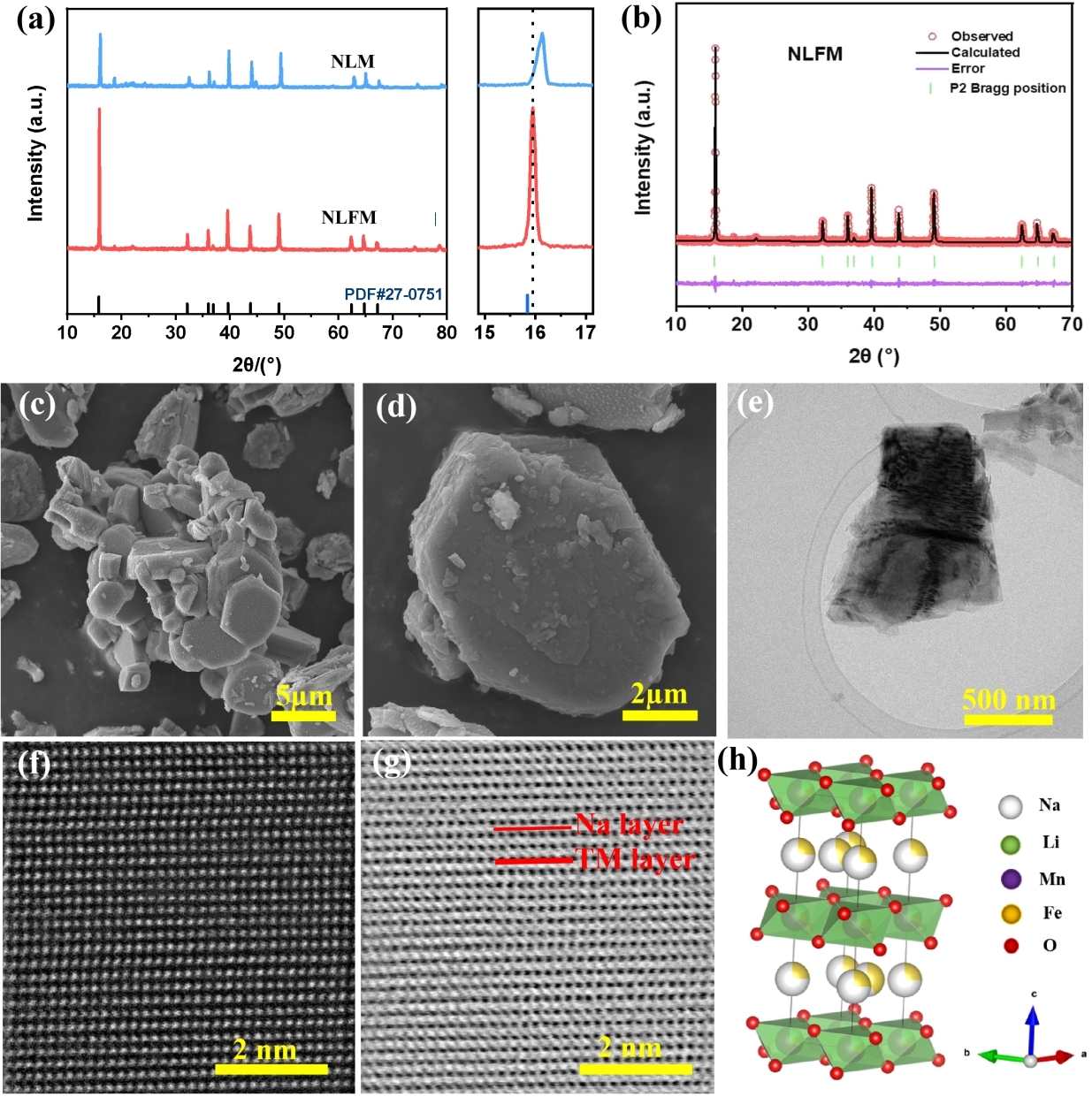
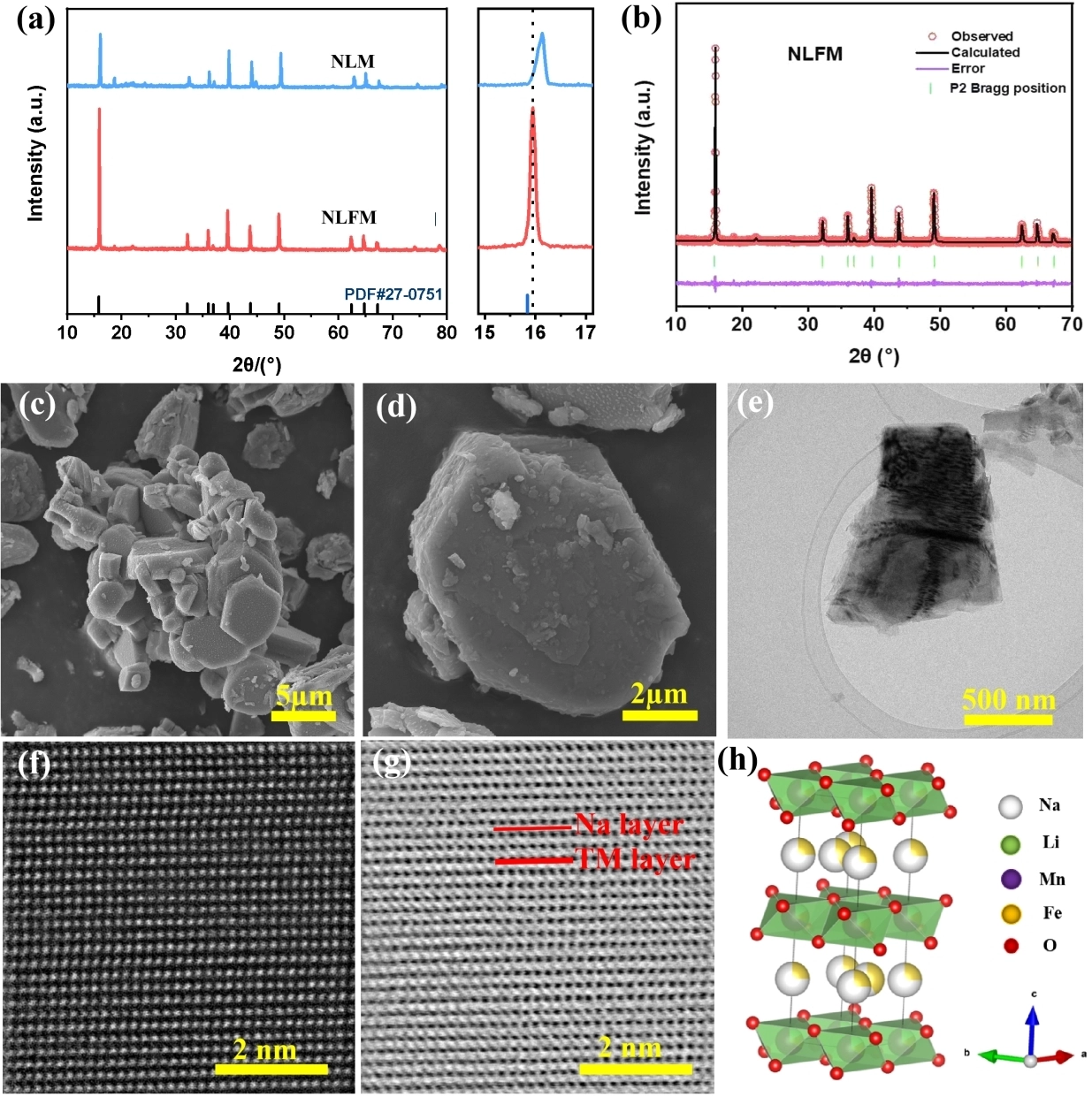
Figure 1. Crystal structure characterization of NLFM. (a) XRD patterns of NLM and NLFM; (b) XRD Rietveld refinement; (c, d) SEM images at different magnifications; (e) TEM image; (f, g) HAADF-STEM and ABF-STEM images; (h) Schematic diagram of the crystal structure. NLFM: P2-Na2/3Li1/6Fe1/6Mn2/3O2; XRD: X-ray diffraction; NLM: P2-Na2/3Li1/3Mn2/3O2; SEM: scanning electron microscopy; TEM: transmission electron microscopy; HAADF-STEM: high-angle annular dark-field scanning transmission electron microscopy; ABF-STEM: annular bright-field scanning transmission electron microscopy.
As shown in Figure 1c,d,e, the as-synthesized NLFM exhibits a typical hexagonal plate-like morphology, characteristic of P-type sodium layered oxide cathode materials. In contrast, the SEM images of NLM (Figure S2) reveal significant particle agglomeration with noticeable microcracks. The NLM particles are relatively smaller and exhibit mild agglomeration with sharp edges. The stable valence state of Fe3+ reduces surface defects, contributing to well-defined particle boundaries. EDS analysis was conducted to further investigate elemental composition and distribution, revealing an average Mn/Fe atomic ratio of approximately 4.1:1.0 (Table S4), consistent with the target. Although EDS is semi-quantitative for light elements, it is reliable for transition metal ratios. The results confirm a uniform distribution of all elements, verifying the success of the synthesis process and the structural stability of the material structure (Figure S3). Overall, the morphology, particle size, and elemental distribution of the synthesized material meet the expected performance criteria, demonstrating excellent uniformity and stability. Atomic-scale structure studies of NLFM were further conducted using high-angle annular dark-field (HAADF) and annular bright-field (ABF) scanning transmission electron microscopy (STEM) images (Figure 1f,g), further confirming the P2 structure of NLFM. A schematic of the NLFM crystal structure is presented in Figure 1h. The structure stacks along the c-axis in an ABBA sequence, where Na+ occupies prismatic positions to form the Na layer, while Mn, Li, and Fe occupy MO6 octahedral sites to form the TM layer.
3.2 Electrochemical performance
The electrochemical properties of the as-synthesized materials were evaluated using half-cells assembled with Na metal as the anode under constant temperature conditions of 30 °C. All tests were conducted within a voltage range of 2.0-4.5 V, with a nominal specific capacity set as 1 C = 120 mA·g-1. Figure 2a displays the first and second charge/discharge curves of NLFM and NLM electrodes at 0.1 C. While both samples exhibit similar voltage characteristics, NLFM shows a more extended voltage plateau, contributing to its enhanced specific capacity. Notably, NLFM demonstrates higher capacities than NLM in both charging and discharging processes, achieving a first-cycle discharge capacity of 225.0 mAh·g-1 and an initial coulombic efficiency of 110.2%. A distinct, prolonged voltage plateau above 4.2 V is observed for NLFM, which can be attributed to the activation of the oxygen ion redox reaction[21]. These results collectively demonstrate that NLFM outperforms the undoped NLM in terms of initial coulombic efficiency and capacity. Figure 2b and Figure S4 illustrate the cycling tests under different rates. At 0.5 C, NLFM retained 71.8% of its capacity after 100 cycles. When cycled at 1 C, it exhibited significantly improved reversibility with a capacity retention of 73.6% after 100 cycles, outperforming NLM’s of 67.2%, thus highlighting the superior structural stability of NLFM. Also, the additional cycling tests on the NLFM electrode with the upper cutoff voltage limited to 4.3 V (below the activation of the anionic redox peak) were performed. The results (Figure S5) show that the NLFM electrode delivered a lower initial capacity of 124.6 mAh·g-1 (due to the exclusion of anionic redox) but exhibited superior cycling stability with 84.1% capacity retention after 100 cycles at 1 C. This indicates that while oxygen redox provides a substantial capacity boost, it comes at the cost of slightly accelerated capacity decay, likely due to irreversible lattice oxygen loss or surface reconstruction. The Fe-doping partially mitigates these detrimental effects, as evidenced by the still-respectable 73.6% retention even when cycling up to 4.5 V. Rate performance was further investigated, as demonstrated in Figure 2c and Figure S6. The cells were cycled at progressively increasing rates from 0.1 C to 5 C for five cycles each. At 0.1, 0.2, 0.5, 1.0, 2.0, and 5.0 C, the reversible capacities of NLFM were 200.1, 159.1, 136.0, 124.8, 104.5, and 69.2 mAh·g-1, respectively, indicating relatively good rate performance. Additionally, when the current density was reset from 5.0 C to 0.1 C, NLFM recovered 94% of its initial capacity, demonstrating good reversibility across a broad current range. In contrast, NLM exhibited inferior rate performance. To benchmark the electrochemical performance of NLFM against recently reported layered oxide cathodes for SIBs, we compiled a comparison table (Table S5). NLFM exhibits a superior combination of high initial capacity (225.0 mAh·g-1), competitive cycling stability (73.6% retention at 1 C after 100 cycles), and good rate capability (69.0 mAh·g-1 at 5.0 C). This performance surpasses most Fe- and Li-substituted P2-type cathodes, highlighting the synergistic effect of Fe doping and anionic redox activation. Full cells (CR2032 coin-type) were also assembled using NLFM as the cathode, hard carbon (commercial hard carbon (HC), pre-sodiated electrochemically at 0.05 C for one cycle) as the anode, and 1 M NaClO4 in propylene carbonate (PC) with 5 vol% FEC as the electrolyte (Figure S7a). The anode capacity was adjusted to a N/P ratio of approximately 1.15. The cells were cycled at 0.1 and 1.0 C (based on cathode mass, 1 C = 120 mA g-1) for 100 cycles. The half-cell electrochemical curves for hard carbon and NLFM are shown in Figure S7b. The selected hard carbon anode exhibited a reversible capacity of 306.7 mAh·g-1 with an initial coulombic efficiency of 77.3%. As given in Figure S7c, this full cell achieved a reversible capacity of 181.8 mAh·g-1 at 0.1 C, with an initial coulombic efficiency of 81.3%. After 100 cycles at 1 C, the capacity retention was 60.8%, relative to the first cycle at 1 C (Figure S7d), confirming that the Fe-doped cathode maintains its structural stability even when paired with a practical anode.
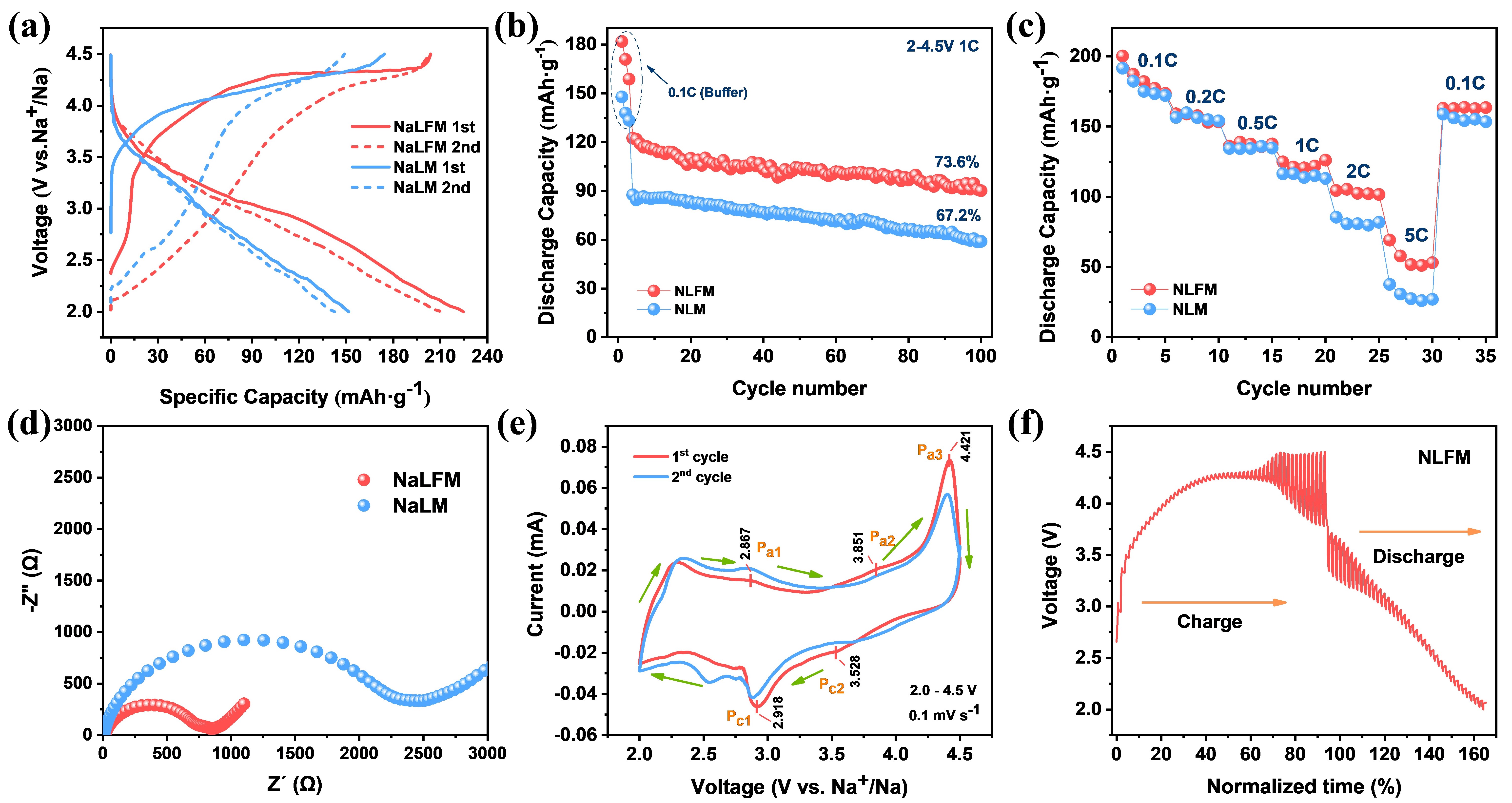
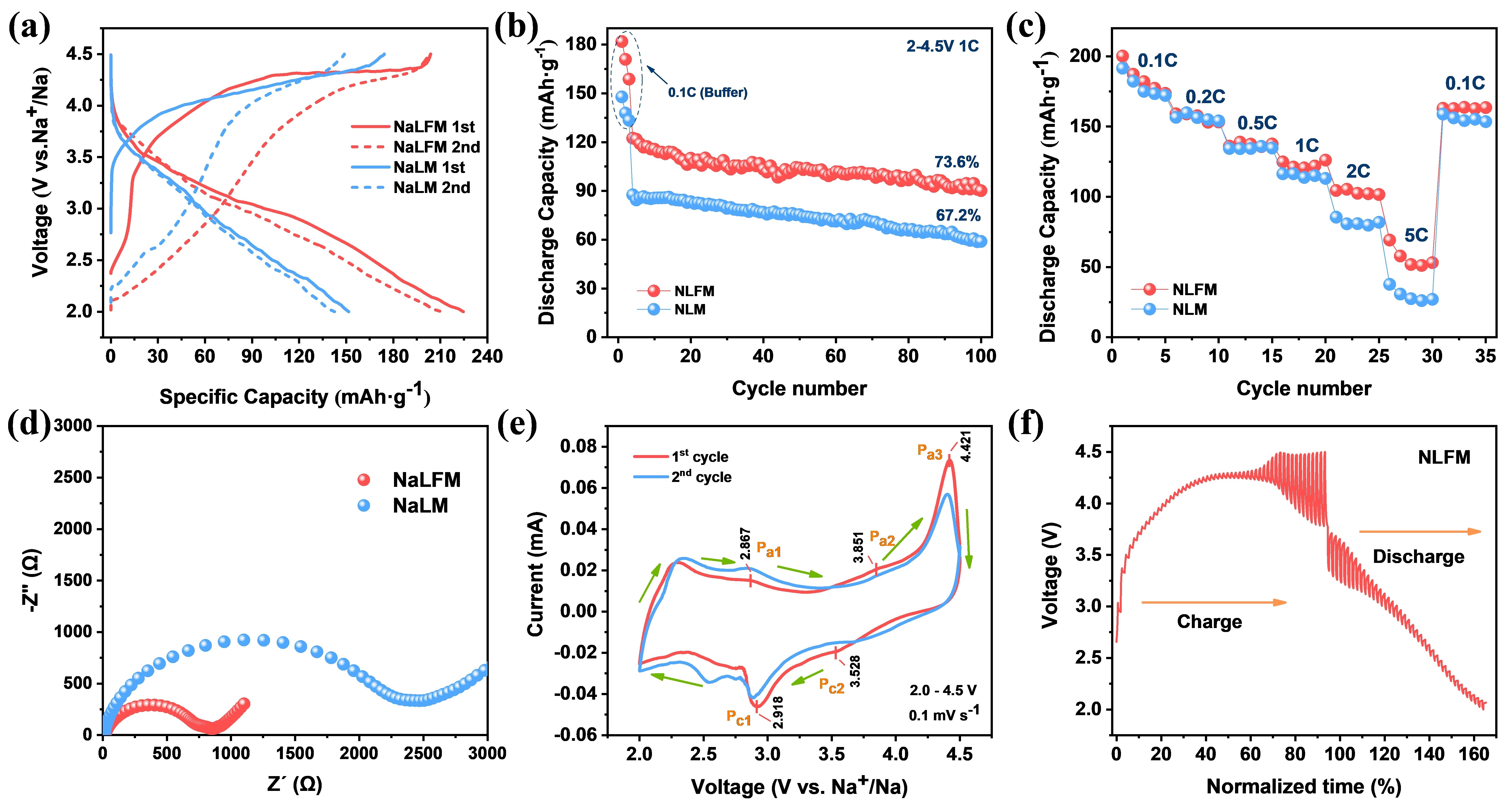
Figure 2. Electrochemical performance of NLM and NLFM electrodes. (a) The first two cycles of NLFM and NLM at 0.1 C; (b) Cycling performance over the first 100 cycles at 1 C; (c) Rate capability at 0.1, 0.2, 0.5, 1.0, 2.0, and 5.0 C; (d) EIS plots; (e) CV curves of NLFM at a scan rate of 0.1 mV s-1 over the first two cycles; (f) GITT curves of NLFM. NLM: P2-Na2/3Li1/3Mn2/3O2; NLFM: P2-Na2/3Li1/6Fe1/6Mn2/3O2; EIS: electrochemical impedance spectroscopy; CV: cyclic voltammetry.
EIS was employed to investigate the influence of Fe doping on sodium ion diffusion kinetics. In Figure 2d, the high-frequency region corresponds to charge transfer resistance, while the low-frequency region reflects Na+ diffusion behavior. A comparison between the two materials reveals that without doping, the sole reliance on the Mn3+/Mn4+ redox couple, combined with Jahn-Teller distortion, leads to increased polarization and capacity degradation. In contrast, Fe incorporation reduces the semicircle diameter in the high-frequency region, indicating lower charge transfer resistance (Rct). This can be attributed to the faster redox kinetics of the Fe3+/Fe4+ couple, which enhances electronic conduction and facilitates surface reactions. In the low-frequency region, the blocking effect of Li+ occupying Na+ sites is mitigated in NLFM due to the stabilized layered structure and expanded Na+ transport channels, thereby improving ion diffusion efficiency.
CV was also conducted within the voltage range of 2.0-4.5 V at a scan rate of 0.1 mV s-1. Figure 2e shows the first two cycles of NLFM. The redox pair Pa1/Pc1 corresponds to the redox reaction of the Mn3+/Mn4+ couple, with the oxidation peak near 2.8 V attributed to the partial oxidation of Mn3+ to Mn4+. The pair Pa2/Pc2 is assigned to the Fe3+/Fe4+ redox reaction. Slight polarization leads to a minor negative shift in peak positions, while the symmetric shape of the peaks indicates good reversibility. The irreversible oxidation peak Pa3 is associated with lattice oxygen redox[34]. The position and intensity of these peaks align well with the galvanostatic charge/discharge profiles. The majority of the capacity originates from oxygen redox reactivity, and the small potential separation between oxidation and reduction peaks suggests low polarization and favorable reaction kinetics. Compared to NLM (Figure S8), NLFM exhibits higher redox peak currents, implying enhanced anion redox reactivity and improved electrochemical activity, which facilitates greater capacity contribution. The stronger reduction peak further confirms superior reaction reversibility in NLFM.
The sodium ions diffusion coefficient is a critical parameter governing ion migration within the host structure during charging and discharging, significantly influencing the electrochemical kinetics and energy density of the material. To gain further insight, the Na+ diffusion coefficient during discharge was calculated using the GITT test[35], according to the following equation:
Where VM is the molar volume of the active substance (cm3·mol-1), mB is the mass of the active substance (g), MB is its molar mass (g·mol-1), S is the electrode/electrolyte contact area (cm2), and τ is the current pulse duration (s). For a sufficiently small current applied over a short time interval, Equation 1 can be simplified to Equation 2:
Here, ΔEs represents the steady-state voltage change in a single GITT step, and ΔEτ is the total voltage change during the current pulse. Figure 2f shows the GITT curve of NLFM, and Figure S9 shows the corresponding sodium ion diffusion coefficient of NLFM. The calculated diffusion coefficient of the material ranges from 8.40 × 10⁻¹⁰ to 1.01 × 10⁻⁵ cm2·s-1, indicating favorable Na+ diffusion kinetics. This improvement suggests that appropriate Fe doping effectively enhances the sodium ion diffusion rate, which can be attributed to the enlarged Na interlayer spacing in NLFM.
To further investigate the kinetic advantages conferred by Fe doping, CV measurements were conducted at different scan rates (Figure 3a). At low scan rates (e.g., as shown earlier in Figure 2e), where ion diffusion is sufficient, well-defined redox peaks corresponding primarily to the Fe3+/Fe4+ reaction were observed. As the scan rate increased, the peaks progressively broadened and the contribution from anion redox weakened. To distinguish the charge storage mechanisms in the obtained electrode materials, the relative contributions of surface-controlled and diffusion-controlled processes were quantitatively analyzed. The kinetic parameter b was first determined from the power-law relationship i = avb[36], where i is the peak current and v represents the scan rate of the CV curve. As illustrated in Figure 3b, the calculated b values for the anodic and cathodic processes in NLFM are 0.768 and 0.758, respectively, indicating that NLFM exhibits typical pseudocapacitive electrode behavior[37].
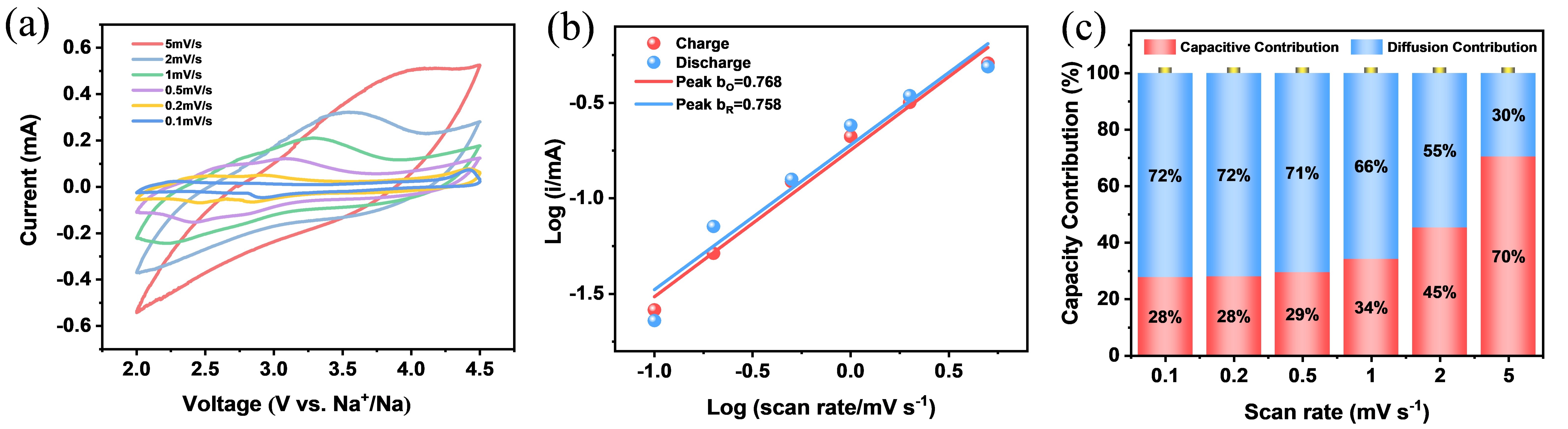
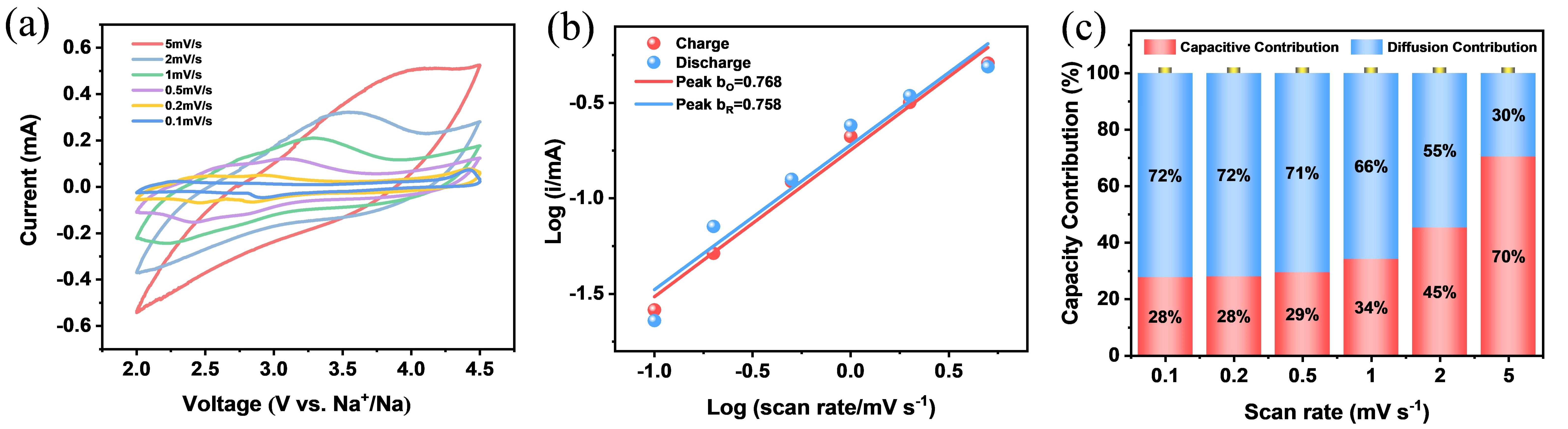
Figure 3. Electrochemical kinetic behavior of the NLFM cathode in the voltage range of 2.0-4.5 V. (a) CV curves at different scan rates; (b) Fitted Logi vs. logv plots at different scan rates; (c) Contribution ratios of capacitive-controlled and diffusion-controlled capacities at different scan rates. NLFM: P2-Na2/3Li1/6Fe1/6Mn2/3O2; CV: cyclic voltammetry.
To further quantify the contribution ratios, the current response i(V) at a given potential was separated using the following equations 3 and 4:
Here, k1v represents the current from surface-controlled processes and k2v1/2 corresponds to the diffusion-controlled contribution. Figure 3c shows the calculated contribution ratios of the two charge storage mechanisms at different scan rates. At low scan rates (0.1 mV s-1), the capacity is dominated by diffusion-controlled processes (72.0%), with surface-controlled processes accounting for only 28.0%, which is consistent with the distinct redox peaks observed at low scan rates. As the scan rate increases, the pseudocapacitive contribution rises significantly, reaching 70.0% at 5 mV s-1. Since surface-controlled processes are not limited by solid-state diffusion, the material maintains satisfactory capacity even at high scan rates, in agreement with the favorable rate performance shown in Figure 2c. The Fe3+/Fe4+ redox couple contributes substantially to pseudocapacitance via fast near-surface reactions. Fe active sites in the subsurface region allow shallow and rapid (de)intercalation of Na+ without requiring long-range ion diffusion. Additionally, the pseudocapacitive charge storage mechanism helps alleviate structural collapse induced by Jahn-Teller distortion, thereby contributing to the improved cycling performance of the material.
3.3 Charge compensation
To elucidate the evolution of transition metal oxidation states during charging, XPS analysis was performed on the cathode material, with the results presented in Figure 4. All binding energies of the samples were calibrated using the C 1s peak at 284.6 eV. The survey spectra (Figure 4a) confirm the presence of C 1s, O 1s, Na 1s, Mn 2p, and Fe 2p core levels[38]. The Fe 2p XPS spectrum (Figure 4b) displays two main peaks at 710.5 and 754.2 eV, attributed to Fe 2p3/2 and Fe 2p1/2, respectively, which are characteristic of Fe3+[39]. The presence of distinct satellite peaks at 722.2 and 731.6 eV further confirms the +3 oxidation state of iron. The Mn 2p spectrum (Figure 4c,d) was deconvoluted into two contributions for each spin-orbit component. The peaks at 642.1 and 653.7 eV are assigned to Mn4+ in the Mn 2p3/2 and Mn 2p1/2 states, respectively, while those at 641.6 and 652.6 eV correspond to Mn3+. A comparative analysis with the NLM sample reveals a significant compositional change induced by Fe doping. In the undoped NLM, the Mn3+ and Mn4+ fractions are 61.3% ± 0.5% and 38.7% ± 0.5%, respectively. In contrast, Mn in NLFM exists predominantly as Mn4+ (68.8% ± 0.5%), and the Mn3+ presence is 31.2% ± 0.5%. This shift can be attributed to the substitution of Li+ sites by Fe3+, which introduces additional Fe3+/Fe4+ redox activity. This pair participates preferentially in charge compensation during (de)sodiation, thereby suppressing the oxidation of Mn3+ to Mn4+ and mitigating the Jahn-Teller distortion associated with a high Mn3+ content, which is known to cause severe lattice distortion and capacity fading.
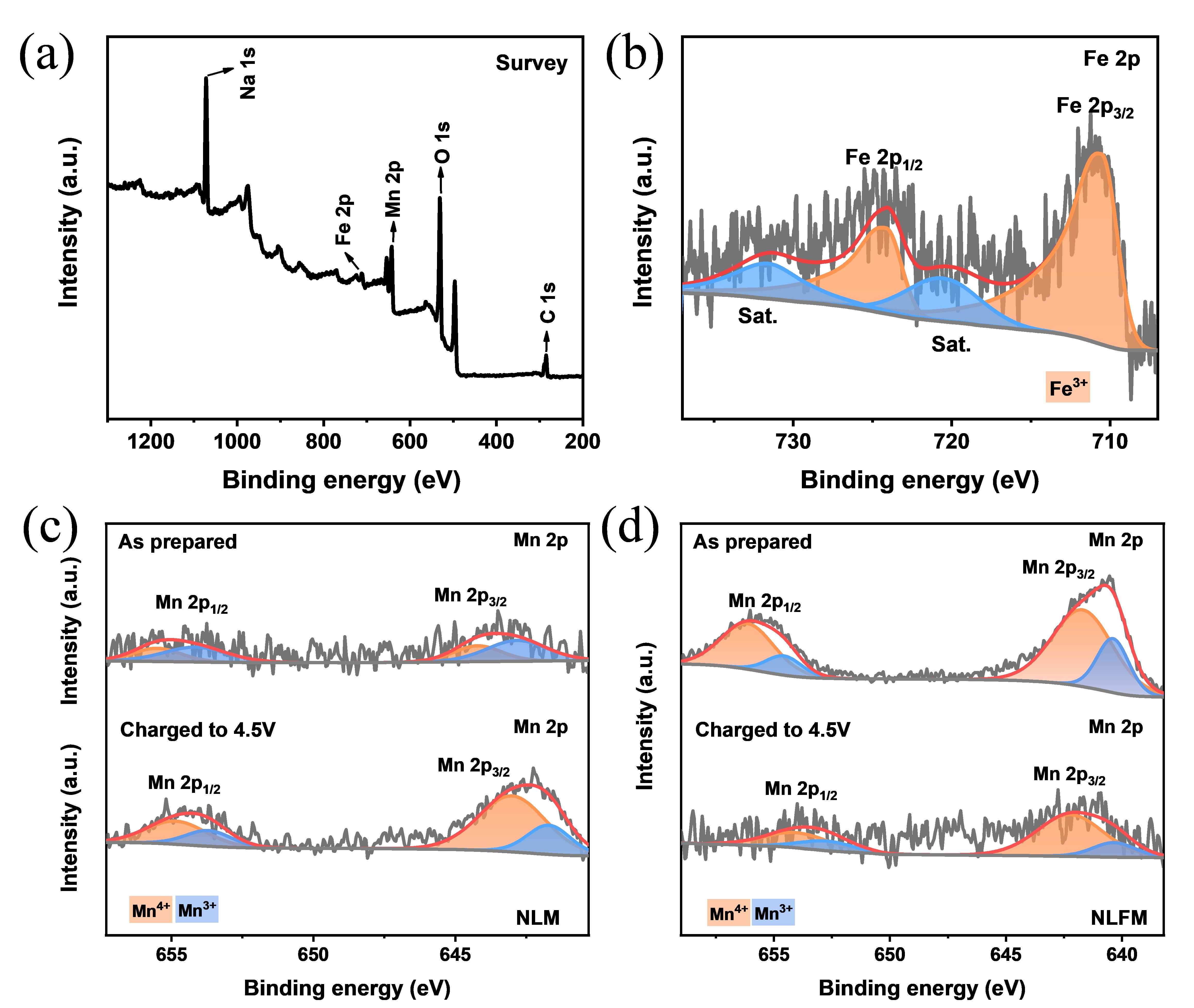
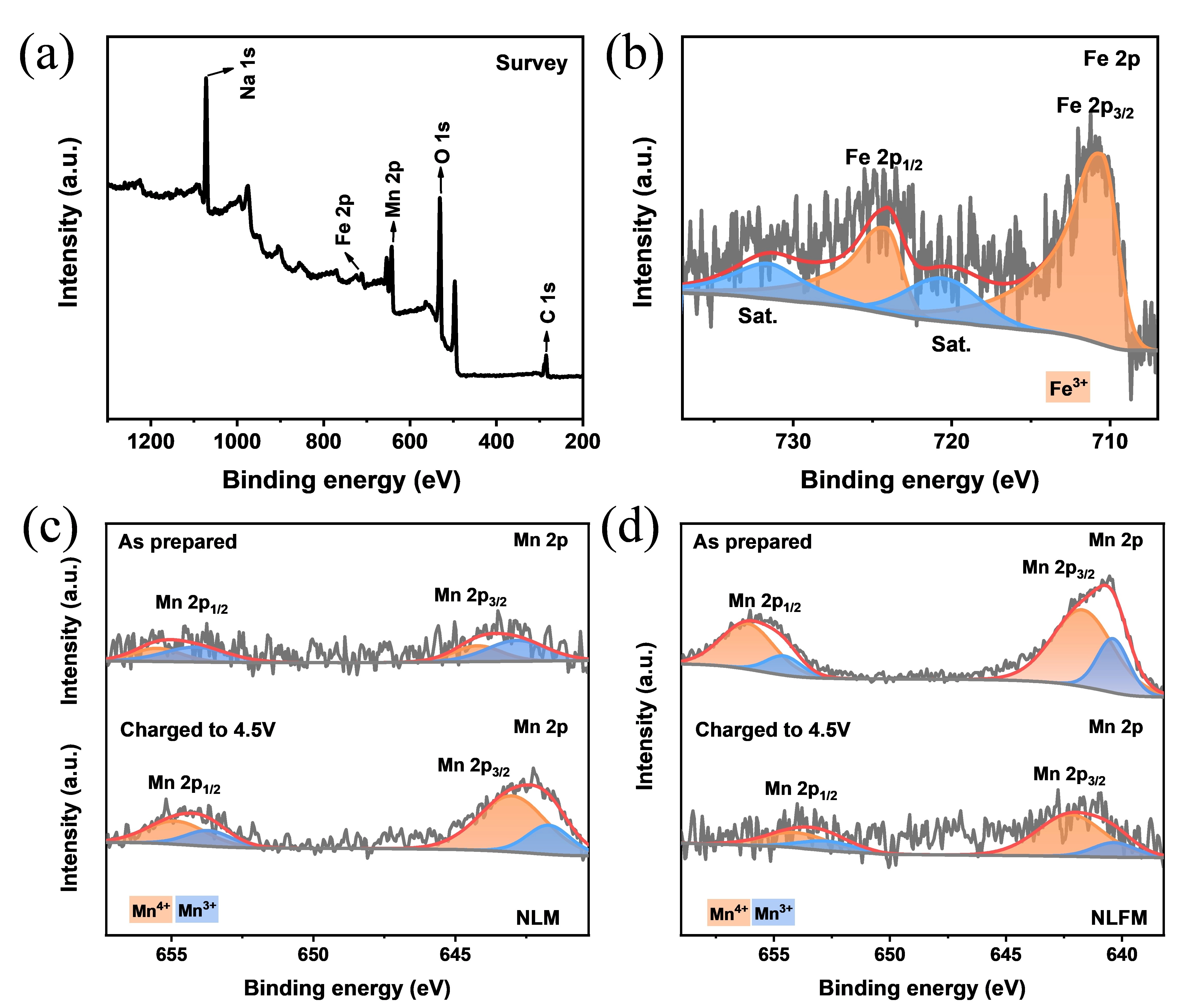
Figure 4. High-resolution XPS spectra of NLFM. (a) Full XPS measurement spectrum; (b) Fe 2p of NLFM, Mn 2p of NLM; (c) Mn 2p spectrum of NLM before and after charging to 4.5 V; (d) Mn 2p spectrum of NLFM before and after charging to 4.5 V. NLM: P2-Na2/3Li1/3Mn2/3O2; NLFM: P2-Na2/3Li1/6Fe1/6Mn2/3O2; XPS: X-ray photoelectron spectroscopy.
Further insights were gained by comparing the XPS spectra of the pristine material and the electrode charged to 4.5 V (Figure 4c,d). Upon charging, the main Fe 2p3/2 peak shifts by approximately 1.0 eV to a higher binding energy of 711.5 eV (Figure S10), consistent with the oxidation of Fe3+ to Fe4+. This shift reflects the involvement of the Fe3+/Fe4+ redox couple in charge compensation as Na+ is extracted from the structure. In contrast, the Mn 2p spectrum (Figure 4d) shows no significant shift in the main peak position after charging, though peak broadening is observed, indicating a partial reduction of a small fraction of Mn4+ to Mn3+, possibly due to surface side reactions with the electrode. To directly elucidate the effect of Fe doping on the Mn oxidation state and anionic redox behavior, we performed comparative XPS analysis on NLM and NLFM (Table S6). The Mn 2p spectrum of NLM reveals a high Mn3+ fraction of 61.3%, indicative of significant Jahn-Teller distortion. In sharp contrast, NLFM exhibits a much lower Mn3+ fraction of only 31.2%, confirming that Fe3+ incorporation effectively suppresses Mn3+ formation and thus mitigates structural degradation.
To move beyond the surface-sensitive limitation of XPS and provide bulk and spatially resolved evidence for valence state evolution, we performed electron energy loss spectroscopy (EELS) analysis on pristine, fully charged, and fully discharged NLFM samples (Figure S11). The bulk Mn valence determined by EELS (Mn4+ fraction > 90% after cycling) is consistent with the surface-sensitive XPS results, confirming that the suppression of Mn3+ is a genuine bulk effect rather than a surface artifact. The combination of surface-sensitive XPS and bulk-sensitive EELS provides a comprehensive understanding of valence state evolution and structural stability in NLFM. The O K-edge pre-peak (~528-532 eV), which corresponds to the unoccupied O 2p states hybridized with TM 3d orbitals, provides information on oxygen redox activity. The pristine NLFM exhibits a well-defined pre-peak feature. After cycling, the pre-peak intensity shows only a slight decrease, suggesting that the oxygen redox process is largely reversible and that Fe doping contributes to stabilizing the oxygen sublattice. In summary, Fe doping significantly optimizes the electronic structure of the layered oxides by regulating the active centers and enhancing metal-oxygen covalency. These modifications, as directly evidenced by the XPS data, underpin the improved electrochemical performance of the materials.
3.4 Structural evolution
To further evaluate the role of Fe doping in suppressing phase transformation and its impact on structural evolution during Na+ ion (de)intercalation in P2-type layered manganese-based cathode materials, ex situ XRD analysis was conducted within a voltage range of 2.0-4.5 V at a current density of 12 mA·g-1. Based on the galvanostatic charge-discharge curves shown in Figure 2a, specific electrochemical states were selected, and XRD patterns were collected on both NLM and NLFM (Figure 5 and Figure S12) at the corresponding charge/discharge cutoff voltages. As shown in Figure 5 and Figure S12, at the pristine state, the 002 peak of NLFM is at slightly lower 2θ (larger d-spacing) than NLM, confirming Fe3+-induced interlayer expansion. A new diffraction peak appeared near 17° in the NLM material; this characteristic peak corresponds to the O2 phase, indicating the coexistence of two phases in the electrode at this point. In contrast, after Fe doping (Figure 5a,b), during charging, in the low-voltage region (< 4.3 V), the 002 diffraction peak shifts toward lower angles, which can be attributed to Na+ extraction, leading to reduced interlayer electrostatic repulsion and consequent contraction along the c-axis. As the voltage increases above 4.3 V, the material begins to undergo a phase transition from the P2 phase to the O2 phase, characterized by a significant splitting of the 002 diffraction peak. At this stage, the structure adopts a mixed P2/O2 arrangement[40,41]. Notably, Fe doping effectively mitigates the complete transformation to the O2 phase. The strong covalent character of the Fe-O bond promotes continued c-axis contraction and stabilizes the P2 structure at high-voltage, thereby suppressing irreversible phase transition. During the discharge process, as Na+ is re-inserted into the lattice, the broad 002 peak of the O2 phase gradually shifts to lower angles. With increasing Na+ content, interlayer repulsion strengthens, resulting in c-axis expansion, and the diffraction peak eventually merges back into that of the P2 peak. This indicates a reversible transition from the mixed P2/O2 phase to a pure P2 phase. The presence of Fe3+ at Li+ sites further contributes to maintaining the coherence of the 002 diffraction peak, highlighting the structural stabilizing effect of Fe doping.
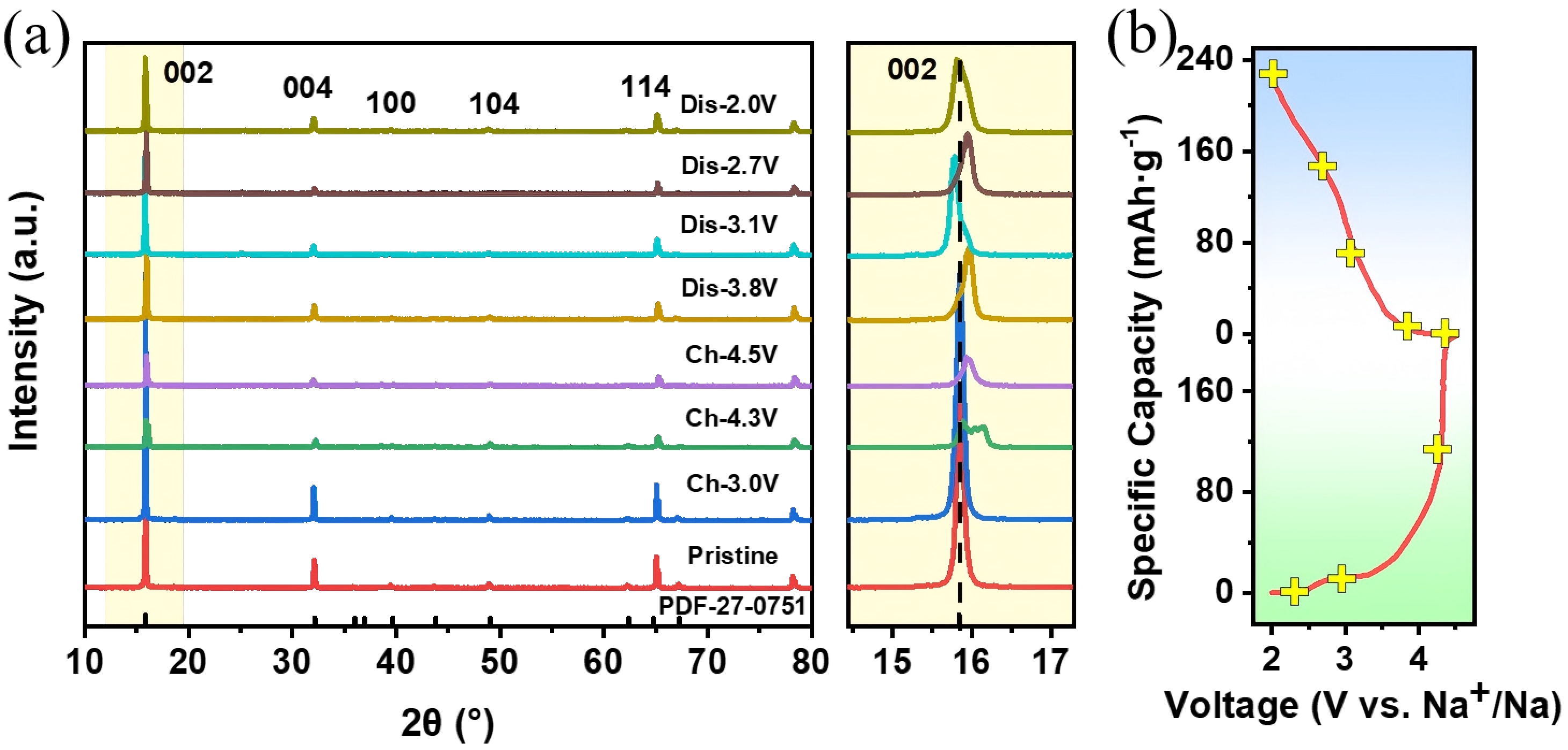
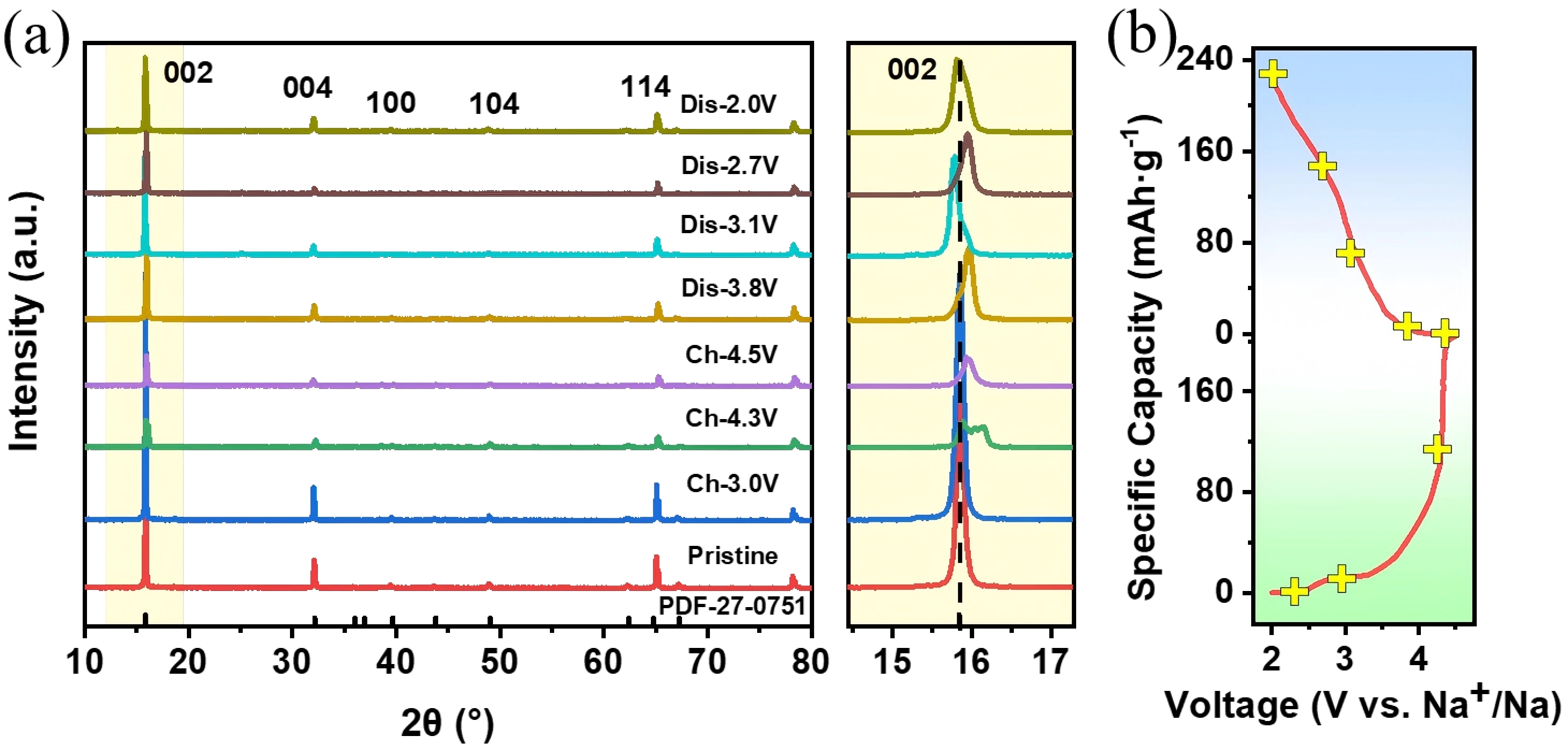
Figure 5. The first charge-discharge cycle of the NLFM electrode at 0.1 C, different cut-off voltages were selected, and ex-situ XRD patterns were collected. NLFM: P2-Na2/3Li1/6Fe1/6Mn2/3O2; XRD: X-ray diffraction.
To quantitatively distinguish the relative contributions of cationic and anionic redox to the total reversible capacity, we performed a detailed electron-counting analysis based on the nominal composition Na2/3Li1/6Fe1/6Mn2/3O2 and the valence states determined by XPS (Table S6). The molar mass of the compound is calculated as M = (23 × 2/3) + (7 × 1/6) + (56 × 1/6) + (55 × 2/3) + (16 × 2) ≈ 94.5 g mol-1. According to the high-resolution Mn 2p spectra, the pristine NLFM contains 68.8% Mn4+ and only 31.2% Mn3+ (Table S6). Within the operating voltage window of 2.0-4.5 V, the practically accessible cationic redox couples are therefore Fe3+/Fe4+ and Mn3+/Mn4+. Assuming that all Fe3+ (1/6 per formula unit) and Mn3+ (2/3*31.2% = 0.208 per formula unit) are oxidized to Fe4+ and Mn4+ upon charging to 4.5 V, the maximum theoretical capacity from cationic redox is calculated using Faraday’s law: Ccation = n × 26,800/ M, where n = 1/6 + 0.208 = 0.375 mol e- per mol of material. This yields Ccation = 0.375 × 26,800/94.5 = 106.3 mAh g-1. In contrast, the experimental first-discharge capacity of NLFM reaches 225.0 mAh g-1. Subtracting the maximum cationic contribution leaves approximately 118.7 mAh g-1, which must be attributed to anionic (oxygen) redox. This corresponds to an oxygen-redox contribution of > 53% of the total capacity. This quantitative analysis provides compelling indirect evidence that the exceptionally high capacity of NLFM is predominantly governed by reversible oxygen redox, while the Fe3+/Fe4+ couple serves as an important but minor cationic contributor and also plays a critical role in stabilizing the structure and suppressing the Jahn-Teller effect. The small surplus of discharge over charge capacity observed in the first cycle (initial Coulombic efficiency > 100%) further supports the activation of anionic redox, as the formation of oxygen vacancies and localized electron holes during the initial charge permits extra Na+ insertion on discharge, a phenomenon previously documented in Li-rich P2-type oxides[34]. Figure 6 illustrates the complete mechanism of Fe3+ action in NLFM: (i) expanding the Na+ interlayer spacing and reducing microstrain to accelerate Na+ diffusion; (ii) preferentially participating as Fe3+/Fe4+ redox to suppress Mn3+ and Jahn-Teller distortion; (iii) inhibiting the irreversible P2→O2 phase transition through strong Fe–O covalency; (iv) enhancing pseudocapacitive kinetics for high-rate performance; and (v) stabilizing lattice oxygen to enable reversible anionic redox. These synergistic effects collectively endow NLFM with a high reversible capacity (225.0 mAh·g-1) and superior cycling stability (73.6% retention after 100 cycles at 1.0 C), positioning it as a promising cathode material for advanced sodium-ion batteries.
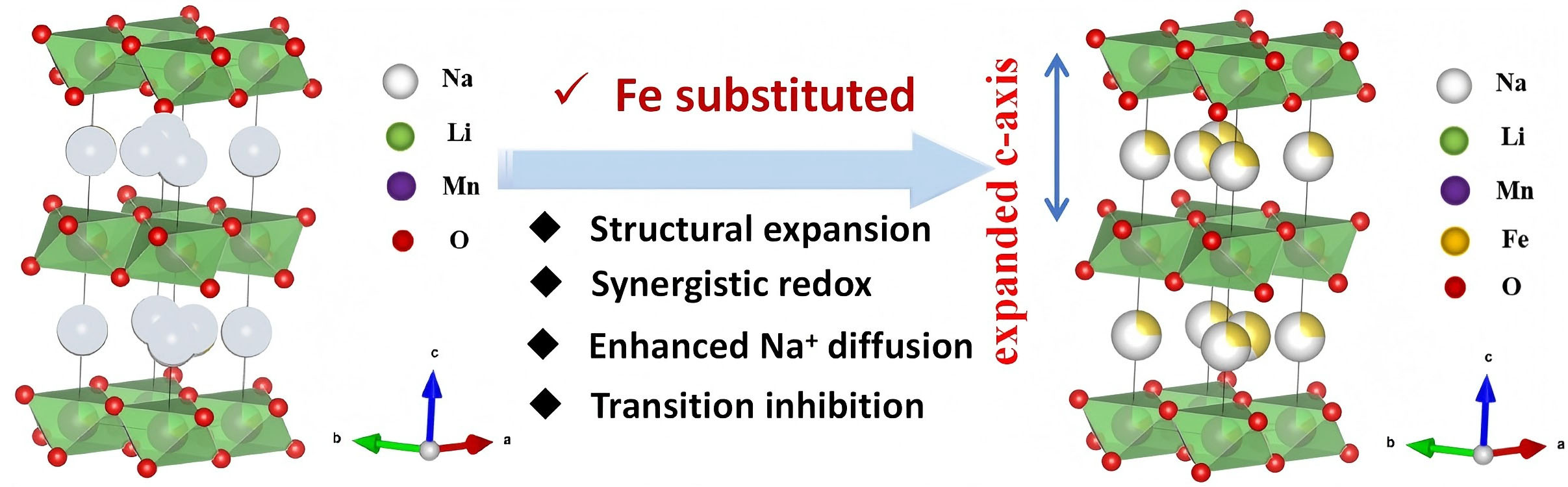
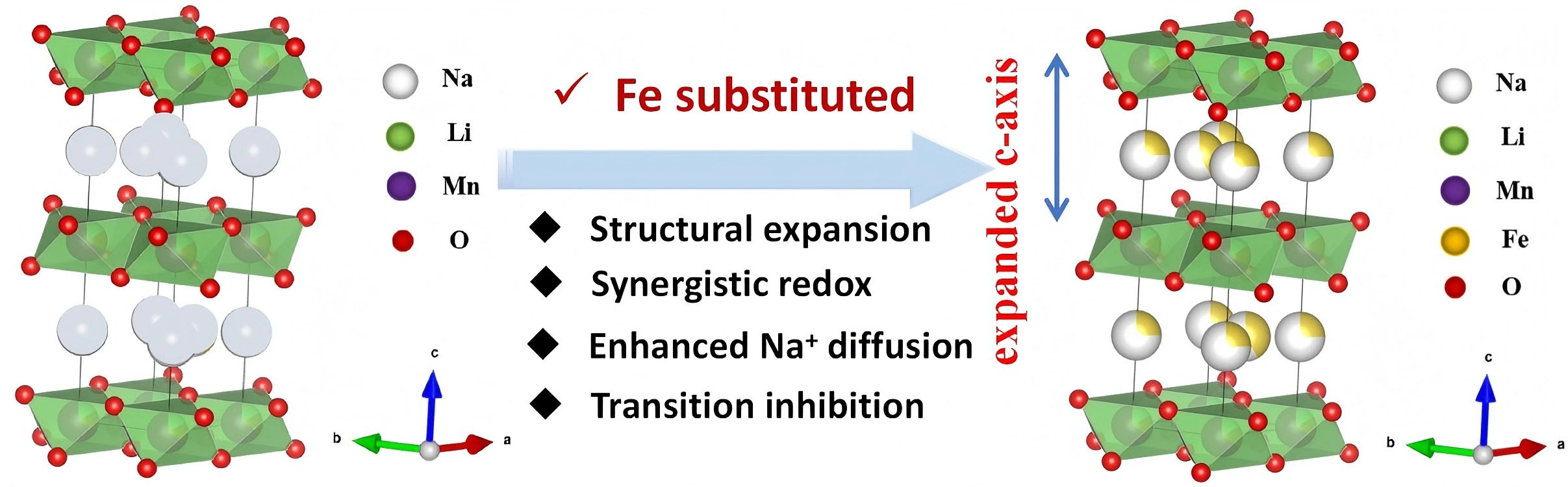
Figure 6. Schematic illustration of the Fe-doping strategy in NLFM. NLFM: P2-Na2/3Li1/6Fe1/6Mn2/3O2.
4. Conclusions
In this work, we have systematically investigated the role of iron doping in enhancing the electrochemical performance of P2-type Na2/3Li1/6Fe1/6Mn2/3O2 cathode materials. Successful Fe3+ incorporation into the transition metal layer leads to expanded interlayer spacing along the c-axis. This structural expansion facilitates faster Na+ diffusion kinetics, resulting in improved rate performance. The introduced Fe3+/Fe4+ redox couple participates preferentially in the charge/discharge process, which reduces the involvement of Mn3+/Mn4+ and effectively mitigates Jahn-Teller distortion. Combined with the activation of reversible oxygen redox, this approach delivers a high specific capacity. Furthermore, the strong Fe-O covalent bonding enhances the structural integrity, suppressing the irreversible P2 to O2 phase transition at high voltages and ensuring excellent cycling stability. In summary, iron doping serves as an effective strategy to synchronously regulate the crystal structure, stabilize the redox chemistry, and optimize the reaction kinetics of P2-type layered cathodes. The obtained NLFM demonstrates a high capacity of 225.0 mAh·g-1 at 0.1 C with an initial Coulombic efficiency of 110.2%, and excellent cycling stability after 100 cycles with capacity retention of 73.6%. The synergistic effects of expanded Na+ layers, suppressed phase transition, and enhanced capacitive storage make Fe-doped NLFM a highly competitive cathode material for advanced sodium-ion batteries. This study provides profound insights into the design of high-energy and long-life layered oxide cathodes through rational cation doping. Additionally, given the expanded Na+ interlayer spacing and mitigated Jahn-Teller distortion observed in NLFM, evaluating its low-temperature electrochemical performance represents a valuable future direction to fully exploit its potential in practical sodium-ion batteries across a wider temperature window.
Supplementary materials
The supplementary material for this article is available at: Supplementary materials.
Acknowledgments
During the preparation of this manuscript, AI-assisted tool (ChatGPT) was used only for language polishing and expression refinement. All research content, including study design, data analysis, interpretations, figures, and tables, is original and was not generated using AI tools. The authors take full responsibility for the integrity and originality of the work.
Authors contribution
Wang S: Methodology, writing-original draft, data curation.
Su Q: Project administration, formal analysis, writing-review & editing.
Wang L: Validation, formal analysis, resources, supervision.
Lai L: Investigation, methodology, data curation.
Shi WX: Project administration, funding acquisition, supervision.
Shi WH: Project administration, investigation, validation.
Du G: Funding acquisition, formal analysis, conceptualization.
All authors have reviewed and approved the final version of the manuscript.
Conflicts of interest
The authors declare no conflicts of interest.
Ethical approval
Not applicable.
Consent to participate
Not applicable.
Consent for publication
Not applicable.
Availability of data and materials
The data that support the findings of this study are available from the corresponding author upon reasonable request.
Funding
This work was supported by the National Natural Science Foundation of China (No. U2032131), and Shanxi-Zheda Institute of Advanced Materials and Chemical Engineering (Nos. 2022SX-TD012, 2022SX-TD003). This work was also support by Key Laboratory of Interface Science and Engineering in Advanced Materials, Ministry of Education (KLISEAM202202).
Copyright
© The Author(s) 2026.
References
-
3. Schmuch R, Wagner R, Hörpel G, Placke T, Winter M. Performance and cost of materials for lithium-based rechargeable automotive batteries. Nat Energy. 2018;3(4):267-278.[DOI]
-
4. Goodenough JB, Kim Y. Challenges for rechargeable Li batteries. Chem Mater. 2010;22(3):587-603.[DOI]
-
5. Liu T, Zhang Y, Jiang Z, Zeng X, Ji J, Li Z, et al. Exploring competitive features of stationary sodium ion batteries for electrochemical energy storage. Energy Environ Sci. 2019;12(5):1512-1533.[DOI]
-
6. Chen H, Wang YQ, Zhang DT, Zhao B, Li MP, Li CY, et al. Enhanced rate capability and cycle stability of Ti2C MXene for sodium storage through an aniline molecules welding strategy. Tungsten. 2025;7(1):161-171.[DOI]
-
7. Yang Y, Wang Z, Du C, Wang B, Li X, Wu S, et al. Decoupling the air sensitivity of Na-layered oxides. Science. 2024;385(6710):744-752.[DOI]
-
9. Wang T, Su D, Shanmukaraj D, Rojo T, Armand M, Wang G. Electrode materials for sodium-ion batteries: Considerations on crystal structures and sodium storage mechanisms. Electrochem Energy Rev. 2018;1(2):200-237.[DOI]
-
10. Ramesh A, Tripathi A, Balaya P. A mini review on cathode materials for sodium-ion batteries. Int J Appl Ceram Technol. 2022;19(2):913-923.[DOI]
-
11. Hwang JY, Yu TY, Sun YK. Simultaneous MgO coating and Mg doping of Na[Ni0.5 Mn0.5] O2 cathode: Facile and customizable approach to high-voltage sodium-ion batteries. J Mater Chem A. 2018;6(35):16854-16862.[DOI]
-
13. Chen J, Hou Z, Zhang L, Mao W, Zhang T, Zhang X, et al. An advanced medium-entropy substituted tunnel-type Na0.44MnO2 cathode for high-performance sodium-ion batteries. Inorg Chem Front. 2023;10(3):841-849.[DOI]
-
14. Liang K, Zhao H, Li J, Huang X, Jia S, Chen W, et al. Engineering crystal growth and surface modification of Na3V2(PO4)2F3 cathode for high-energy-density sodium-ion batteries. Small. 2023;19(19):2207562.[DOI]
-
16. Qian J, Wu C, Cao Y, Ma Z, Huang Y, Ai X, et al. Prussian blue cathode materials for sodium-ion batteries and other ion batteries. Adv Energy Mater. 2018;8(17):1702619.[DOI]
-
17. Zhang H, Gao Y, Liu XH, Yang Z, He XX, Li L, et al. Organic cathode materials for sodium-ion batteries: From fundamental research to potential commercial application. Adv Funct Mater. 2022;32(4):2107718.[DOI]
-
18. Luo W, Allen M, Raju V, Ji X. An organic pigment as a high-performance cathode for sodium-ion batteries. Adv Energy Mater. 2014;4(15):1400554.[DOI]
-
19. Billaud J, Singh G, Armstrong AR, Gonzalo E, Roddatis V, Armand M, et al. Na0.67Mn1–xMgxO2 (0 ≤ x ≤ 0.2): A high capacity cathode for sodium-ion batteries. Energy Environ Sci. 2014;7(4):1387-1391.[DOI]
-
20. Clément RJ, Bruce PG, Grey CP. Review: Manganese-based P2-type transition metal oxides as sodium-ion battery cathode materials. J Electrochem Soc. 2015;162(14):A2589-A2604.[DOI]
-
21. Yoon GH, Koo S, Park SJ, Lee J, Koo C, Song SH, et al. Enabling stable and nonhysteretic oxygen redox capacity in Li-excess Na layered oxides. Adv Energy Mater. 2022;12(11):2103384.[DOI]
-
22. Voronina N, Shin MY, Kim HJ, Yaqoob N, Guillon O, Song SH, et al. Hysteresis-suppressed reversible oxygen-redox cathodes for sodium-ion batteries. Adv Energy Mater. 2022;12(21):2103939.[DOI]
-
23. Wang L, Zhang C, Lin T, Chu H, Gao Y, Hu Z, et al. Anti-siting for stabilizing structure and modulating cationic/anionic redox reactions. Energy Storage Mater. 2024;70:103479.[DOI]
-
24. Zhang M, Kitchaev DA, Lebens-Higgins Z, Vinckeviciute J, Zuba M, Reeves PJ, et al. Pushing the limit of 3d transition metal-based layered oxides that use both cation and anion redox for energy storage. Nat Rev Mater. 2022;7(7):522-540.[DOI]
-
27. Yabuuchi N, Kajiyama M, Iwatate J, Nishikawa H, Hitomi S, Okuyama R, et al. P2-type Nax[Fe1/2Mn1/2]O2 made from earth-abundant elements for rechargeable Na batteries. Nat Mater. 2012;11(6):512-517.[DOI]
-
28. Li Y, Yang Z, Xu S, Mu L, Gu L, Hu YS, et al. Air-stable copper-based P2-Na7/9Cu2/9Fe1/9Mn2/3O2 as a new positive electrode material for sodium-ion batteries. Adv Sci. 2015;2(6):1500031.[DOI]
-
30. Yuan DD, Wang YX, Cao YL, Ai XP, Yang HX. Improved electrochemical performance of Fe-substituted NaNi0.5Mn0.5O2 cathode materials for sodium-ion batteries. ACS Appl Mater Interfaces. 2015;7(16):8585-8591.[DOI]
-
33. Lavela P, Leyva J, Castañeda A, Tirado JL, Aranda M. Structural effects of the iron/manganese ratio in Li-doped layered oxide cathodes for sodium-ion batteries. J Energy Storage. 2024;81:110451.[DOI]
-
34. Zou P, Yao L, Wang C, Lee SJ, Li T, Xin HL. Regulating cation interactions for zero-strain and high-voltage P2-type Na2/3Li1/6Co1/6Mn2/3O2 layered oxide cathodes of sodium-ion batteries. Angew Chem Int Ed. 2023;62(28):e202304628.[DOI]
-
37. Zhou Y, Jia Z, Zhao S, Chen P, Wang Y, Guo T, et al. Construction of triple-shelled hollow nanostructure by confining amorphous Ni-Co-S/crystalline MnS on/in hollow carbon nanospheres for all-solid-state hybrid supercapacitors. Chem Eng J. 2021;416:129500.[DOI]
-
38. Huang L, Zhu J, Liu JX, Wu H, Zhang GJ. High entropy stabilized O3-type NaNi0.3Fe0.2Mn0.2Ti0.15Sn0.15O2 cathode material for sodium-ion batteries. Chem Eng J. 2025;507:160309.[DOI]
-
39. Yamashita T, Hayes P. Analysis of XPS spectra of Fe2+ and Fe3+ ions in oxide materials. Appl Surf Sci. 2008;254(8):2441-2449.[DOI]
-
40. Wang PF, You Y, Yin YX, Wang YS, Wan LJ, Gu L, et al. Suppressing the P2–O2 phase transition of Na0.67Mn0.67Ni0.33O2 by magnesium substitution for improved sodium-ion batteries. Angew Chem Int Ed. 2016;55(26):7445-7449.[DOI]
-
41. Zhai J, Ji H, Ji W, Wang R, Huang Z, Yang T, et al. Suppressing the irreversible phase transition from P2 to O2 in sodium-layered cathode via integrating P2- and O3-type structures. Mater Today Energy. 2022;29:101106.[DOI]
Copyright
© The Author(s) 2026. This is an Open Access article licensed under a Creative Commons Attribution 4.0 International License (https://creativecommons.org/licenses/by/4.0/), which permits unrestricted use, sharing, adaptation, distribution and reproduction in any medium or format, for any purpose, even commercially, as long as you give appropriate credit to the original author(s) and the source, provide a link to the Creative Commons license, and indicate if changes were made.
Publisher’s Note
Science Exploration remains a neutral stance on jurisdictional claims in published
maps
and institutional affiliations. The views expressed in this article are solely those
of
the author(s) and do not reflect the opinions of the Editors or the publisher.
Share And Cite


Science Exploration Style
Wang S, Su Q, Wang L, Lai L, Shi W, Shi W, et al. Iron doping P2-Na2/3Li1/6Fe1/6Mn2/3O2 cathode with enhanced anionic redox and structural stability for sodium-ion batteries. Smart Mater Devices. 2026;2:202626. https://doi.org/10.70401/smd.2026.0040
Tips
Copy completed.
Submit a Manuscript
Author Instructions
Cite this Article
Article Metrics
0
View
0
Download
Cited
Article Updates

- Abstract
- Keywords
- 1. Introduction
- 2. Experimental Section
- 2. 2. Electrochemical measurements
- 3. Results and Discussion
- 4. Conclusions
- Supplementary materials
- Acknowledgments
- Authors contribution
- Conflicts of interest
- Ethical approval
- Consent to participate
- Consent for publication
- Availability of data and materials
- Funding
- References
- Copyright
 Get citation
Science Exploration Style

Wang S, Su Q, Wang L, Lai L, Shi W, Shi W, et al. Iron doping P2-Na2/3Li1/6Fe1/6Mn2/3O2 cathode with enhanced anionic redox and structural stability for sodium-ion batteries. Smart Mater Devices. 2026;2:202626. https://doi.org/10.70401/smd.2026.0040
copy
Share Link
copy