Zeolite materials: Synthesis strategies and emerging applications in biomedicine, energy storage, and intelligent sensing

Jing Zhao
1
,
Ping Yang
2
,
Jun Yu
1,*
,
Weili Dai
1,*

*Correspondence to:
Jun Yu, School of Materials Science and Engineering, Nankai University, Tianjin 300350, China.
E-mail: yujun@nankai.edu.cn
Weili Dai, School of Materials Science and Engineering, Nankai University, Tianjin 300350, China. E-mail: weilidai@nankai.edu.cn
Weili Dai, School of Materials Science and Engineering, Nankai University, Tianjin 300350, China. E-mail: weilidai@nankai.edu.cn
Smart Mater Devices. 2026;2:202651. 10.70401/smd.2026.0047
Received: August 07, 2026Accepted: September 11, 2026Published: September 11, 2026
This article belongs to the Special lssue Advanced Zeolite Materials for Energy and Environmental Catalysis
Abstract
Zeolite materials, featuring well-defined pore architectures, tunable framework structures, ion-exchange capability, and favorable thermal stability, have been widely utilized in catalysis, adsorption, and separation processes. Recent advances in synthetic strategies and functional modification have further extended their utility into a diverse range of emerging interdisciplinary fields. This review systematically surveys recent progress in zeolite synthesis and applications, with particular emphasis on elucidating the relationships among synthetic strategies, structural modulation, and resultant performance. Representative synthetic approaches, including hydrothermal, sonochemical, microwave-assisted, mechanochemical, dry-gel conversion, and molten-salt synthesis, are discussed in terms of their effects on crystal size, morphology, pore hierarchy, and framework composition. The emerging applications of zeolite materials in biomedicine, energy storage and conversion, and intelligent sensing are subsequently examined. In biomedical contexts, zeolite materials have shown promise in drug delivery, bone regeneration, diagnostic imaging, and wound hemostasis, attributable to their controllable loading behavior, favorable ion-release properties, and biocompatibility. As for energy-related applications, they have been employed in electrochemical energy storage, separator modification, hydrogen storage, and thermal energy storage, achieved through precise pore structure regulation and interface engineering. In the realm of intelligent sensing, zeolite materials have evolved from passive sieving media into active functional components with enhanced selectivity and signal responsiveness. This review provides a comprehensive overview of recent advances in the synthesis and functional applications of zeolites and discusses their prospects across a broad range of emerging interdisciplinary fields.
Keywords
Zeolite synthesis, emerging applications, biomedicine, energy storage, intelligent sensing
1. Introduction
Zeolites are a class of crystalline inorganic materials with well-defined pore frameworks, most commonly encountered as crystalline aluminosilicates or aluminophosphates. Constructed from corner-sharing TO4 tetrahedra (where T represents tetrahedrally coordinated Si, Al, P, or other framework elements), their structural diversity originates from the varied connectivity of these primary units, giving rise to over 250 distinct framework topologies identified to date[1,2]. The first synthetic zeolite, mordenite, was prepared by Barrer via hydrothermal synthesis in 1948, marking the beginning of modern zeolite science[3]. Since then, continuous advances in zeolite chemistry have led to the development of numerous framework types, including X (FAU type), Y (FAU type), Beta (BEA type), and ZSM-5 (MFI type)[4]. Owing to their uniform pore dimensions, high ion-exchange capacity, and excellent thermal and chemical stability, zeolites have become indispensable in petroleum refining[5,6], gas separation and purification[7,8], and wastewater treatment[9-11].
Recent advances in materials science have substantially expanded the technical routes for zeolite synthesis and modification[12]. Beyond conventional hydrothermal synthesis, an array of novel fabrication strategies has emerged, including microwave-assisted synthesis, dry-gel conversion, molten-salt synthesis, sonochemical synthesis, and mechanochemical synthesis. These methodologies enable precise modulation of zeolite framework composition, pore architecture, crystal morphology, and physicochemical properties[13-17]. This synthetic versatility not only enhances their performance in classical catalysis and adsorption but also lays a robust foundation for their incursion into increasingly diverse interdisciplinary arenas. In emerging research fields, the application scope of zeolite materials has expanded beyond conventional inorganic zeolites to encompass metal-organic frameworks with zeolitic topologies (e.g., zeolitic imidazolate frameworks (ZIFs)) and molecular sieve membranes[18,19]. These materials have attracted increasing research interest in biomedicine[20-22], energy storage and conversion[23-25], and intelligent sensing[26-28].
Although existing reviews have systematically summarized the structural characteristics, synthetic strategies, and traditional industrial applications of molecular sieves, comprehensive overviews of their research progress in these emerging fields remain relatively scarce. Accordingly, as illustrated in Figure 1, this present review focuses on the synthetic control and functional design of zeolite materials, with particular emphasis on recent breakthroughs in biomedicine, energy storage and conversion, and intelligent sensing. We systematically analyze the intrinsic structure-property relationships, critically evaluate current critical bottlenecks, and discuss prospective development trajectories. It is anticipated that this review will serve as a valuable reference for the rational design and interdisciplinary application of next-generation functional zeolite materials.
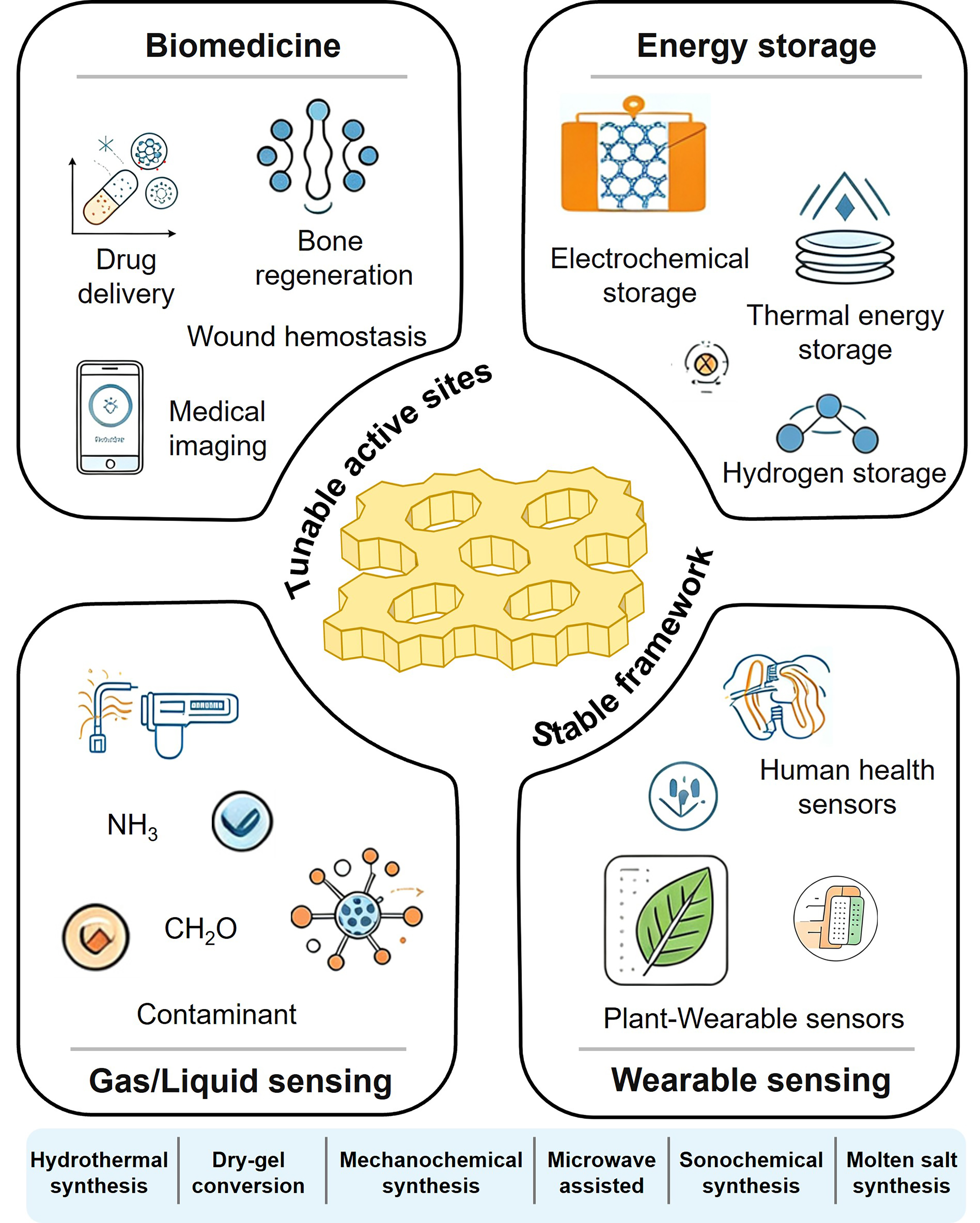
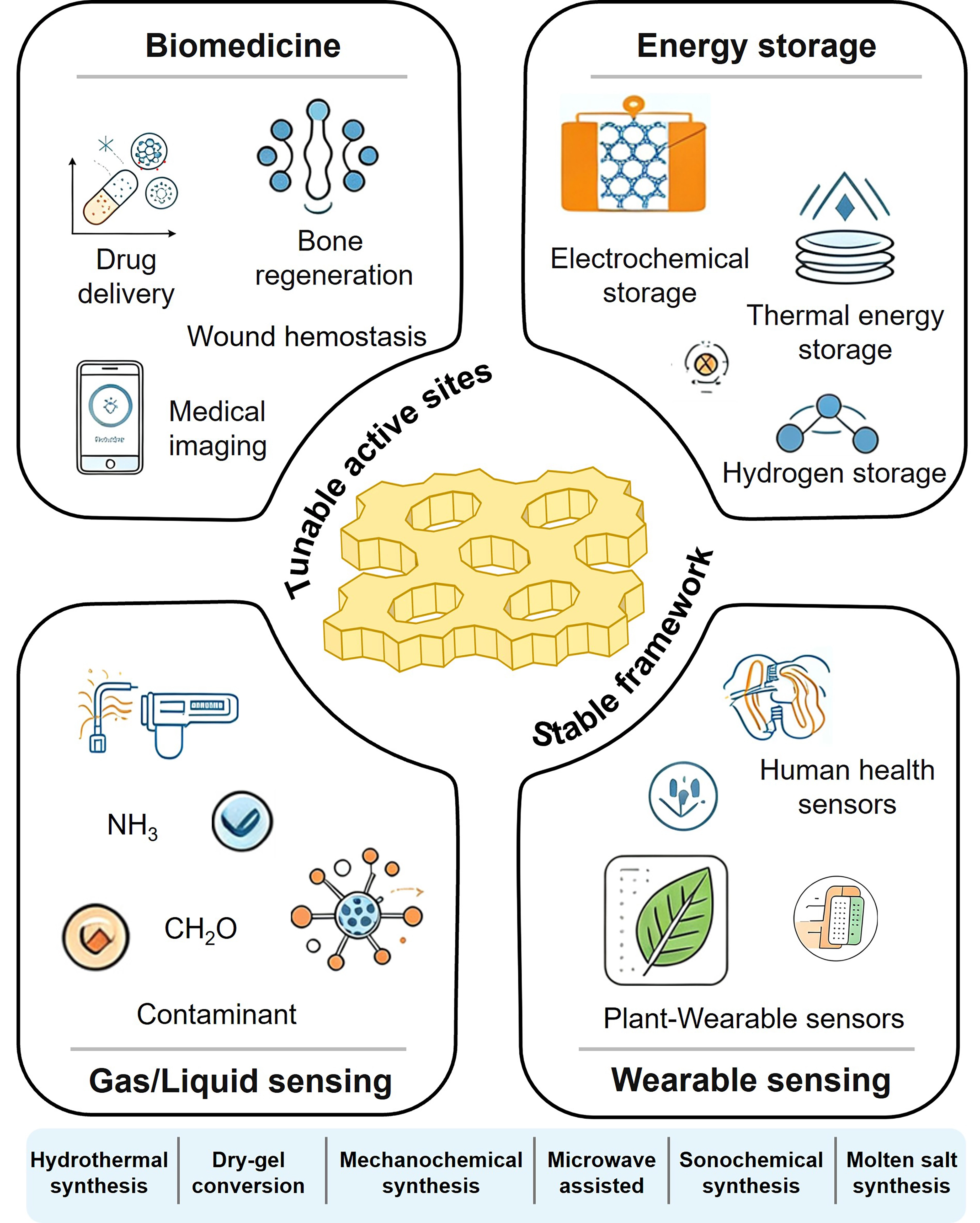
Figure 1. Schematic overview of the synthetic strategies and emerging interdisciplinary applications of zeolite materials.
2. Synthesis Strategies of Zeolites
The physicochemical properties of zeolites are closely governed by their crystal size, morphology, pore architecture, and framework composition. Therefore, the controlled synthesis of zeolites with tailored structures and functionalities has long been a central objective in the field. In response to the recent and significant expansion of zeolite applications, particularly into emerging interdisciplinary domains, new demands have arisen for the rational design and fabrication of these materials. To meet these requirements, a variety of synthetic strategies have been developed[29-32]. The following section provides an overview of several representative approaches for zeolite synthesis.
2.1 Hydrothermal synthesis
Hydrothermal synthesis is the earliest developed and most widely used classical route for zeolite preparation. During synthesis, parameters such as gel composition, aging time, and crystallization temperature can be tuned to achieve precise control of framework topology, crystal size, and morphology. With regard to the mechanism of hydrothermal synthesis, two long-standing and seemingly opposing viewpoints have been proposed[33-35]. The first is the liquid-phase transformation mechanism, wherein amorphous precursors dissolve into soluble species and subsequently crystallize from solution. The second is the solid-phase transformation mechanism, in which the amorphous gel undergoes in situ structural rearrangement and directly converts into zeolite crystals. Since the 1990s, advances in in situ characterization techniques, including small-angle scattering and high-resolution electron microscopy, have revealed that zeolite crystallization proceeds via the assembly of inorganic-organic composite precursor units, significantly deepening the microscopic insight into hydrothermal crystallization of zeolites[36-39].
Over decades of sustained development, hydrothermal synthesis has evolved into a well-established and technologically mature preparation route, supporting the full development of zeolite materials from fundamental structural research to large-scale industrial applications in petroleum refining, petrochemical processes, adsorption, and gas separation[40,41]. Nevertheless, this method still suffers from several limitations, including long crystallization periods, high consumption of organic structure-directing agents, and substantial wastewater generation.
2.2 Dry-gel conversion synthesis
The dry-gel conversion (DGC) method offers an efficient and distinct route for zeolite synthesis, in which the precursor is used as a solid dry gel while water or structure-directing agents required for crystallization are introduced into the system via vapor-phase diffusion, enabling crystallization within a confined, solid-state microenvironment[42,43]. In a typical process, the amorphous aluminosilicate gel is placed on a porous support above the liquid phase, thereby avoiding direct contact with the solution. Upon heating to crystallization temperatures in the range of 453-473 K, the organic amines and water co-evaporate to form a mixed vapor phase, which diffuses into the gel surface and drives the depolymerization, reorganization, and eventual crystallization of the aluminosilicate framework within a solid-state microenvironment[44]. Experimental results have demonstrated that this method yields phase-pure ZSM-5 zeolites with high crystallinity. To date, as illustrated in Figure 2a, the DGC method has been successfully applied to synthesize a diverse array of zeolites, including MFI, STT and CHA[45].
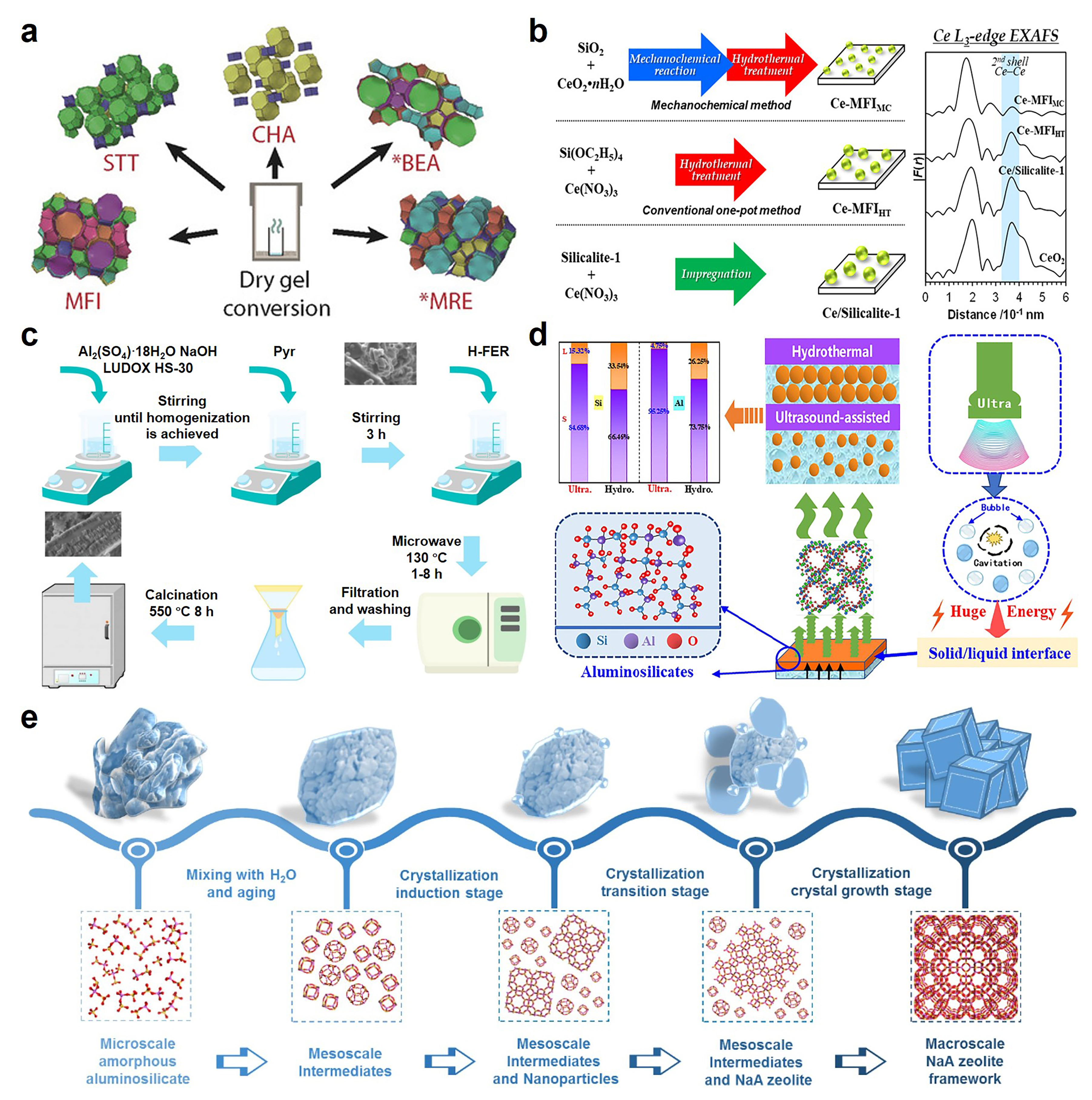
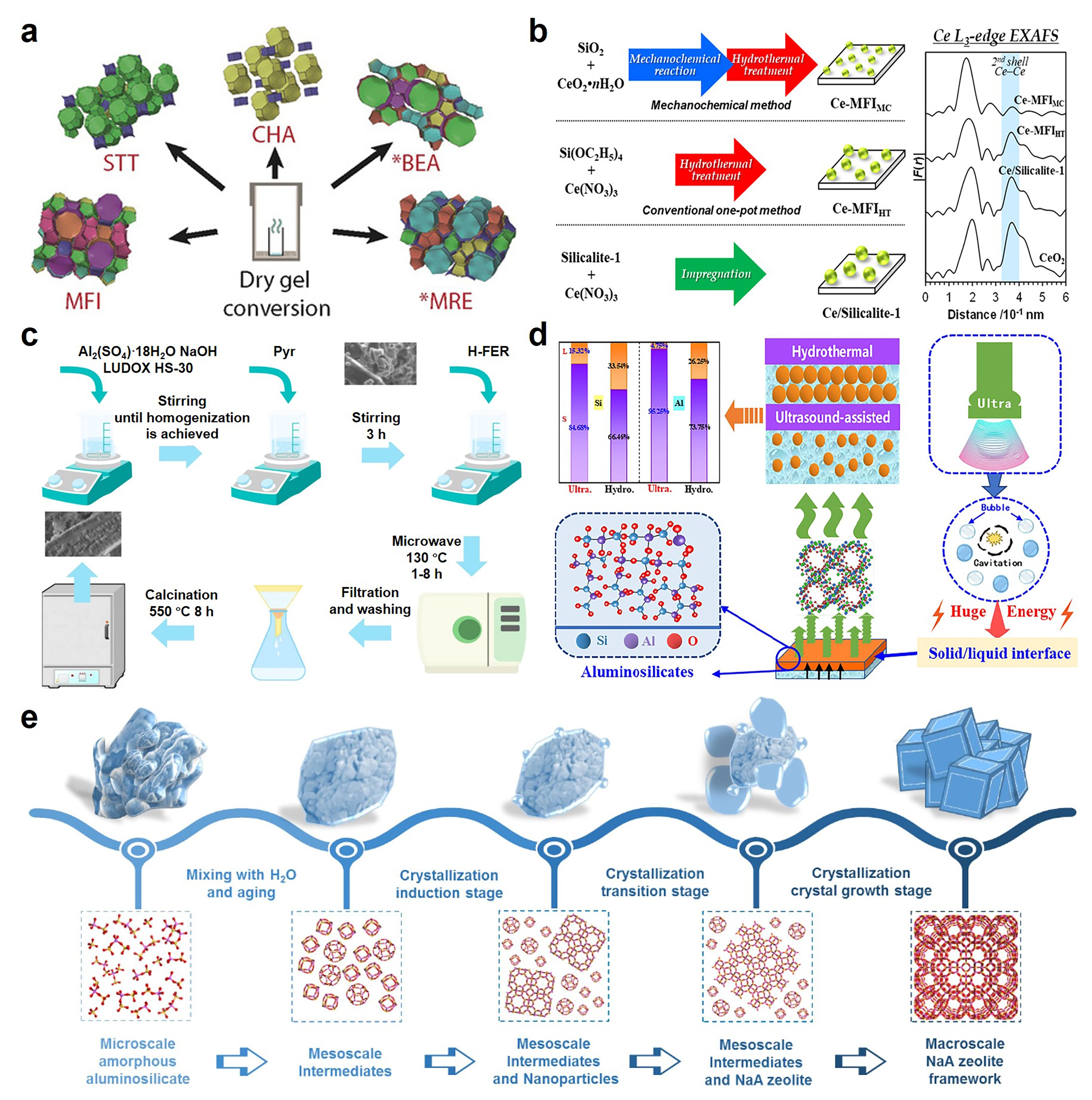
Figure 2. Major synthesis strategies of zeolite materials. (a) Schematic of DGC route for zeolite synthesis. Reproduced with permission from reference[45]. Copyright © 2018 Wiley-VCH Verlag GmbH & Co. KGaA, Weinheim; (b) Mechanochemical synthesis of MFI-type zeolites. Reproduced with permission from reference[46]. Copyright © 2021 American Chemical Society; (c) Microwave-assisted preparation of FER zeolites. Reproduced with permission from reference[47]. Copyright © 2024 Elsevier; (d) Ultrasonic-assisted hydrothermal route for the synthesis of NaP zeolites. Reproduced with permission from reference[48]. Copyright © 2022 Elsevier; (e) Molten-salt synthesis of NaA zeolite. Reproduced with permission from reference[49]. Copyright © 2023 Elsevier. DGC: dry-gel conversion.
The DGC method eliminates the need for large amounts of solvent, thereby improving raw material utilization efficiency and markedly reducing wastewater generation, which makes it an environmentally benign synthesis approach[50,51]. However, owing to the intrinsic limitations of the vapor-phase mass-transfer driving force, thick bulk samples may suffer from differential crystallization between the interior and exterior regions. In addition, batch-to-batch reproducibility remains challenging upon scale-up, which constrains its industrial applicability.
2.3 Mechanochemical synthesis
Mechanochemical synthesis is a synthetic strategy that employs mechanical force to activate precursor materials, enabling the crystallization of zeolites under low-solvent or even solvent-free solid-state conditions, and thus represents a promising green synthetic route[52,53]. Research on mechanochemical zeolite synthesis encompasses multiple aspects, including precursor activation, seed-assisted crystallization, framework heteroatom incorporation, and post-synthetic structural control[54]. Among these, mechanical pretreatment-assisted crystallization is currently the most mature route in mechanochemical synthesis. In zeolite synthesis from industrial solid wastes, mechanical grinding facilitates the exposure and activation of Si and Al species in the raw materials[55], while also improving the homogeneity of the precursor mixture to create more favorable conditions for subsequent zeolite crystallization. For instance, in the synthesis of LTA zeolite from waste windshield glass, mechanical milling significantly enhanced the efficiency of acid treatment, suppressed the formation of impurity phases, and increased the phase purity of the resulting zeolite[56]. Similarly, coal fly ash treated by alkali fusion could be converted into highly crystalline X zeolite at low temperatures after a short grinding process[57]. Prokof’ev et al. demonstrated that mechanically activated precursors could induce nucleation at ambient temperature, while subsequent calcination further enhanced the crystallinity of the resulting LTA-type zeolites[58]. In addition, Ce-containing MFI zeolites were synthesized through a two-step strategy, in which mechanical activation of SiO2 and CeO2 generated a homogeneous Si-Ce precursor before hydrothermal crystallization (Figure 2b). This approach improved the dispersion of Ce species relative to conventional hydrothermal synthesis and deposition methods[46]. After Pd incorporation, the highly dispersed Pd-Ce active sites exhibited enhanced catalytic activity for methane conversion, underscoring the potential of mechanochemistry to regulate metal species distribution and boost the performance of zeolite-based catalysts.
Mechanochemical synthesis also exhibits distinct advantages in the preparation of heteroatom-containing zeolites. The homogeneous solid-state mixing of precursor species effectively circumvents the mismatch in hydrolysis rates between heteroatom precursors and silicon sources that is commonly encountered in conventional hydrothermal systems[54]. This advantage enables the incorporation of highly dispersed framework Ti species into TS-1, and has been extended to a range of Sn-, Mn-, and Fe-substituted zeolites, substantially reducing precursor costs. In the area of post-synthetic modification, the ball milling-recrystallization strategy has emerged as a powerful post-synthetic tool, enabling crystallite size reduction while restoring framework crystallinity[52,59,60]. When combined with mesoporogen-assisted treatment, this approach can further lead to the formation of hierarchical pore architectures. Collectively, mechanochemical synthesis not only offers alternative preparative routes but also serves as a versatile platform for enhancing the performance and diversifying the functionality of existing zeolitic materials.
2.4 Microwave-assisted synthesis
Microwave-assisted synthesis is a representative process-intensification strategy for zeolite preparation. Its core principle lies in using dipolar relaxation of polar molecules and ionic conduction to achieve volumetric heating of the reaction system with high spatial uniformity, thereby effectively circumventing the thermal-conduction-dominated regime characteristic of conventional hydrothermal routes[61]. This approach offers distinct advantages in regulating crystallization efficiency as well as controlling crystal size and morphology, positioning it as a key route for zeolite synthesis.
Experimental studies have shown that microwave irradiation can induce the in situ generation of hydroxyl radicals (•OH) within the synthesis medium. These reactive species promote the depolymerization of aluminosilicate gels and the reorganization of Si-O-Si framework linkages, thereby overcoming the long-standing challenges associated with high-silica zeolite synthesis in conventional alkaline systems[62,63]. Accordingly, Beta zeolites with crystal sizes ranging from 25 to 100 nm have been successfully synthesized under fluoride-free and seedless conditions (Figure 2c). This strategy is also amenable to morphology-tailored zeolite synthesis. Using commercial H-FER as seeds for microwave-assisted epitaxial recrystallization, the growth of finned structures can be finely tuned by adjusting the irradiation time, yielding highly crystalline finned FER within 6 h under optimized conditions[47]. Microwave-assisted treatment also offers a viable alternative to conventional high-temperature alkali fusion for solid-waste pretreatment. This approach promotes the dissolution of silicon and aluminum species and reduces the energy demand of zeolite synthesis from industrial solid wastes. Recent studies have shown that lithium slag and coal fly ash can serve as feedstocks for the energy-efficient synthesis of X-type zeolite under microwave-assisted conditions[55], underscoring its considerable potential for advancing the sustainability of zeolite production. However, compared with conventional hydrothermal methods, the rapid microwave-induced heating may lead to decomposition of structure-directing agents (SDAs), necessitating tighter control over reaction parameters. Furthermore, microwave-assisted synthesis is generally associated with higher energy consumption and operational costs.
2.5 Sonochemical synthesis
Sonochemical synthesis has gained recognition as an efficient and environmentally benign strategy for materials fabrication, wherein ultrasonic energy initiates or accelerates chemical reactions with acoustic cavitation serving as the primary driving force[64]. In zeolite synthesis, sonochemical treatment can exert beneficial effects throughout multiple stages of the preparation process[65,66]. During the initial gel preparation stage, the mechanical action of ultrasound effectively disrupts particle agglomerates, promotes homogeneous dispersion of precursor species, and facilitates interfacial contact between reactants. During subsequent crystallization, the localized high-temperature, high-pressure, and radical-rich microenvironments generated by cavitation markedly shorten the induction period, accelerate nucleation, and reduce of the resulting crystal size.
For instance, Zhou et al. investigated the low-temperature (363 K) synthesis of ZSM-5 zeolite and found that ultrasonic pretreatment of the mother liquor did not significantly reduce the nucleation induction period. Instead, ultrasound fragmented the introduced seed crystals and primary nuclei into smaller particles while increasing the available seed surface area, thereby accelerating crystallization kinetics by approximately 40% and shortening the overall synthesis time from 7 to 5 days[67]. Using coal fly ash as the raw material, the ultrasonic-assisted hydrothermal strategy (Figure 2d) enabled a reduction in crystallization temperature for NaP zeolite from 120 °C to 90 °C and a shortening of crystallization time from 8 h to 4 h, while maintaining a relative crystallinity of 94.99%[48]. Subsequently, atomic Cu and Fe species were incorporated into the ultrasonically synthesized NaP zeolites (Cu-NaPultra and Fe-NaPultra), which were further applied as catalysts for the Fenton-like catalytic degradation of methylene blue (MB) and methyl violet 6B (MV-6B). Notably, Cu-NaPultra exhibited superior catalytic performance, achieving removal efficiencies of 93.22% and 98.71% for MB and MV-6B, respectively, under optimized reaction conditions (pH = 5.0, 30 min). These findings underscore the promise of ultrasonically synthesized metal-modified NaP zeolites for the Fenton-like degradation of organic contaminants. Sonochemical methods also offer distinctive advantages for post-synthetic modification. Under relatively mild conditions (65 °C, 30 min), zinc-containing nanoparticles, including ZnO, ZnO2, and Zn(OH)2, can be deposited onto LTA zeolite surface through a sono-assisted process without compromising the integrity of the zeolite framework[68]. While sonochemical synthesis affords significant advantages over conventional hydrothermal routes in terms of shorter duration, lower energy consumption, and reduced operating pressure, several challenges (eg., inhomogeneous acoustic cavitation in scaled-up reactors, sonotrode erosion and low long-term energy efficiency) remain to be addressed before its large-scale industrial implementation.
2.6 Molten-salt synthesis
Molten-salt synthesis is a versatile strategy for preparing functional materials, employing molten inorganic salts as the reaction medium and featuring a close coupling between the reaction environment and structural regulation[69]. In studies on the zeolitization of fly ash and other mineral wastes reported by Park and co-workers, this approach operates in a completely anhydrous reaction environment, effectively eliminating the low product yields and wastewater-disposal issues associated with the high liquid-to-solid ratios characteristic of conventional hydrothermal processes. Meanwhile, the crystalline phase of the products can be flexibly tailored by adjusting the salt composition (e.g., NaOH/NaNO3 and NaOH/KNO3), enabling the selective formation of sodalite and cancrinite[70]. In addition, the process requires only ambient-pressure thermal treatment at relatively low temperature (~ 350 °C), featuring operational simplicity and broad feedstock applicability, and can be directly applied to various solid wastes such as fly ash and kaolinite. Chen et al. reported that NaA zeolite can be directly synthesized from kaolin activated by submolten salt treatment without additional silicon or aluminum sources[49]. During the activation step, the original aluminosilicate framework undergoes depolymerization into reactive silicate and aluminate species, which subsequently reorganize into zeolite-related intermediates under alkaline conditions (Figure 2e). These intermediates serve as precursors for nucleation and gradually assemble into highly crystalline NaA zeolite particles. This work highlights the ability of molten salt methods to both regulate zeolite formation pathways and enable the sustainable utilization of natural mineral resources. Nevertheless, this method still faces several challenges, including irregular product morphology, which is typically manifested as aggregated particles, and the range of accessible crystalline phases remains relatively constrained. Collectively, the properties of the resulting materials are highly dependent on the rational combination of salt composition, thermal treatment conditions, and precursor formulation.
The selection of an appropriate synthetic route should be based on the specific structural and functional requirements of the target application. For example, when precise control over crystal morphology and particle size is required for shape-selective catalysis or size-dependent drug-release behavior, the hydrothermal method offers superior flexibility. For the preparation of nanocrystals commonly used in sensing and hydrogen storage, sonochemical and microwave-assisted approaches exhibit clear advantages. For heteroatom incorporation into the framework, such as Ti incorporation in TS-1, mechanochemical synthesis can circumvent the hydrolysis-rate mismatch encountered in conventional hydrothermal systems. When industrial solid wastes, such as coal fly ash, serve as feedstocks, the molten-salt route stands out for its feedstock adaptability and cost-effectiveness. In addition to controlling the topology, crystal size, and pore structure, different synthesis methods can also regulate the Si/Al ratio of zeolites. The Si/Al ratio affects their ion-exchange capacity, hydrophobicity, Brønsted acidity, and adsorption performance, which are important for their application in emerging fields[71,72]. These synthetic strategies differ fundamentally in their reaction media, energy input modes, and mass/heat transfer mechanisms. The development of diverse synthesis strategies provides powerful tools for tailoring the structural features and physicochemical properties of molecular sieves, thereby enabling their deployment across a broad spectrum of application domains.
3. Novel Applications of Zeolites
The advances in synthesis methods outlined above have endowed zeolites with precisely tunable topologies, crystal sizes, and framework compositions, providing a foundation for their functional applications across an expanding array of emerging domains. Owing to their well-defined microporous channels, exchangeable extra-framework cations, tunable acid-base properties, and excellent thermal stability, zeolites are finding increasing utility in fields ranging from biomedicine to energy storage and conversion[13]. In the following sections, we present a focused review of key research developments in these burgeoning areas over recent years.
3.1 Medicine and biotechnology
Zeolites have garnered increasing attention in biomedical research, owing to their well-defined pore structures, physicochemical stability, potential biofunctional properties, and favorable biocompatibility. These attributes have positioned them as promising candidates for diverse biomedical applications, including sustained drug delivery, bone regeneration, and medical imaging[73]. Meanwhile, biosafety evaluation, in vivo metabolic behavior, and clinical translation remain critical challenges that need to be addressed for their broader biomedical use.
3.1.1 Drug delivery systems
Drug delivery is one of the most extensively investigated biomedical applications of zeolites. In these systems, the porous framework, surface charge, and ion-exchange sites of zeolites collectively facilitate drug adsorption, encapsulation, or surface conjugation, while subsequent release can be triggered or regulated by diffusion, pH variations, or ion-exchange processes[74]. As drug carriers, zeolites offer distinct advantages, including prolonged local retention, suppressed burst release, and minimized systemic side effects. In recent years, nanotechnology-based drug delivery systems have attracted substantial attention, and a large number of zeolite-based materials with targeting and sustained-release capabilities have been developed[75].
Magnetic nanoparticles have emerged as particularly attractive targeted drug delivery platforms owing to their excellent magnetic responsiveness. Under the guidance of an external magnetic field, drug-loaded nanoparticles can preferentially accumulate at tumor or infection sites (Figure 3a), thereby enhancing local therapeutic efficacy while reducing off-target effects[76]. For instance, Fe3O4F@ZIF-8 nanocomposites enabled efficient magnetic targeting and accumulation of doxorubicin in a murine colon cancer model[79]. Similarly, vancomycin-loaded Van-IONPs@ZIF-8 nanocomposites were precisely delivered to prosthetic joint infection sites under magnetic field guidance[80]. This magnetic targeting capability endows these nanoplatforms with significant potential for precision medicine. In recent years, various zeolitic materials have been increasingly explored for applications in drug delivery systems. Mena-Silva et al. loaded the estrogen metabolite 2-methoxyestradiol (2-ME) into mordenite, achieving a drug loading capacity of 40%. Under physiological conditions (pH 7.4), the cumulative drug release reached 90% within seven days, significantly reducing the viability of LNCaP prostate cancer cells[81]. In a complementary study, Domke et al. employed X-type zeolite modified through ion exchange with divalent metal cations (Mg2+, Ca2+, Sr2+ and Zn2+) as a carrier for ciprofloxacin loading, demonstrating its potential as an integrated platform for drug loading, controlled release, and antibacterial therapy (Figure 3b). Experimental results revealed that the drug loading capacity followed the order SrX < CaX < ZnX < MgX. Notably, MgX exhibited a two-stage, long-term sustained release profile, characterized an initial rapid release within the first hour, followed by sustained release of the remaining drug over the subsequent 15 h, achieving a cumulative release rate of 72.12%[77]. The ion-exchanged zeolite system almost completely inhibited Escherichia coli proliferation and exhibited outstanding long-term antibacterial activity. Moreover, the zeolite carrier demonstrated favorable biocompatibility, and the released divalent metal ions could be metabolized while promoting osteoblast activity, positioning this system as an integrated drug delivery platform that combines osseointegration with long-lasting local antibacterial performance.
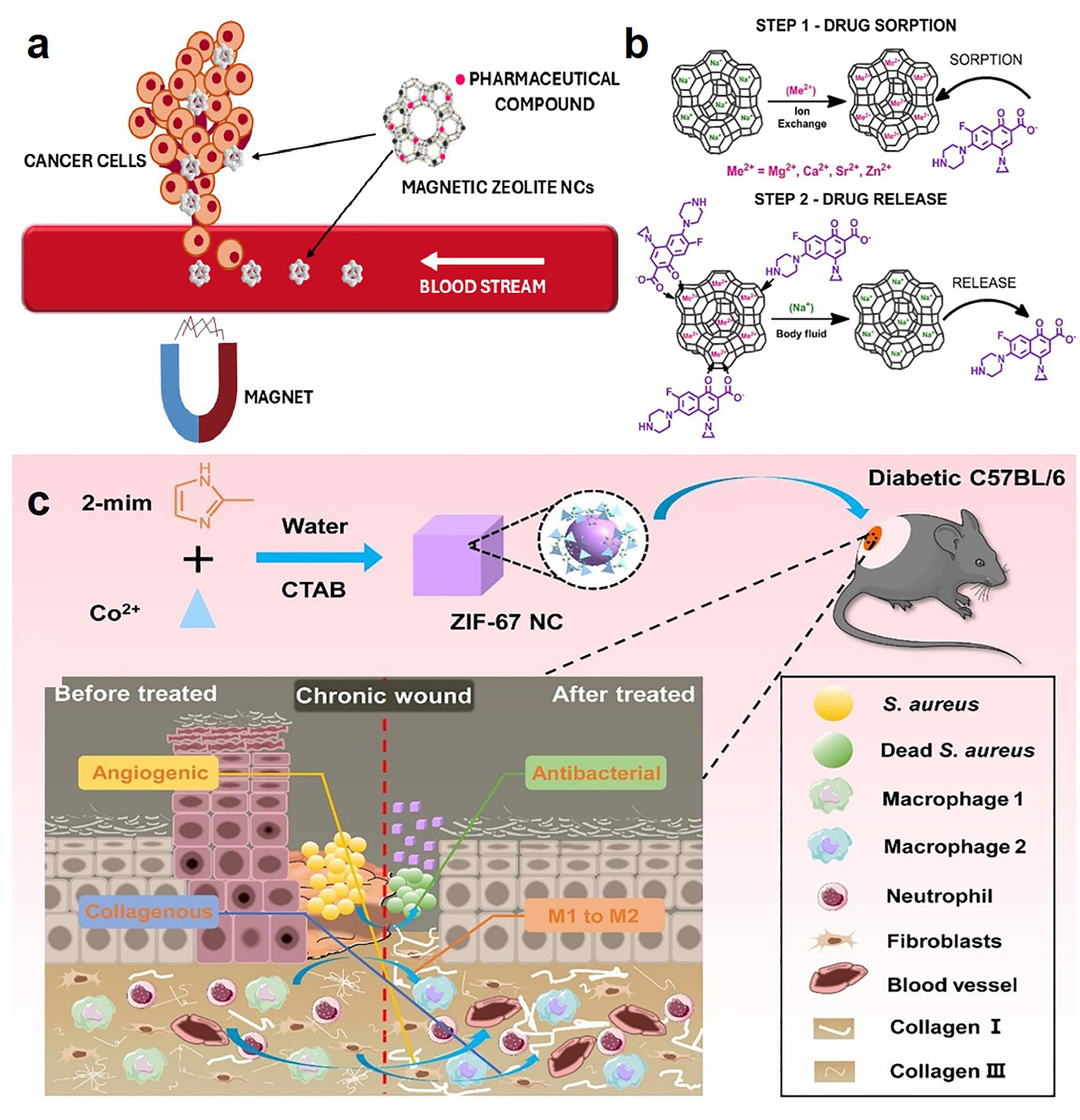
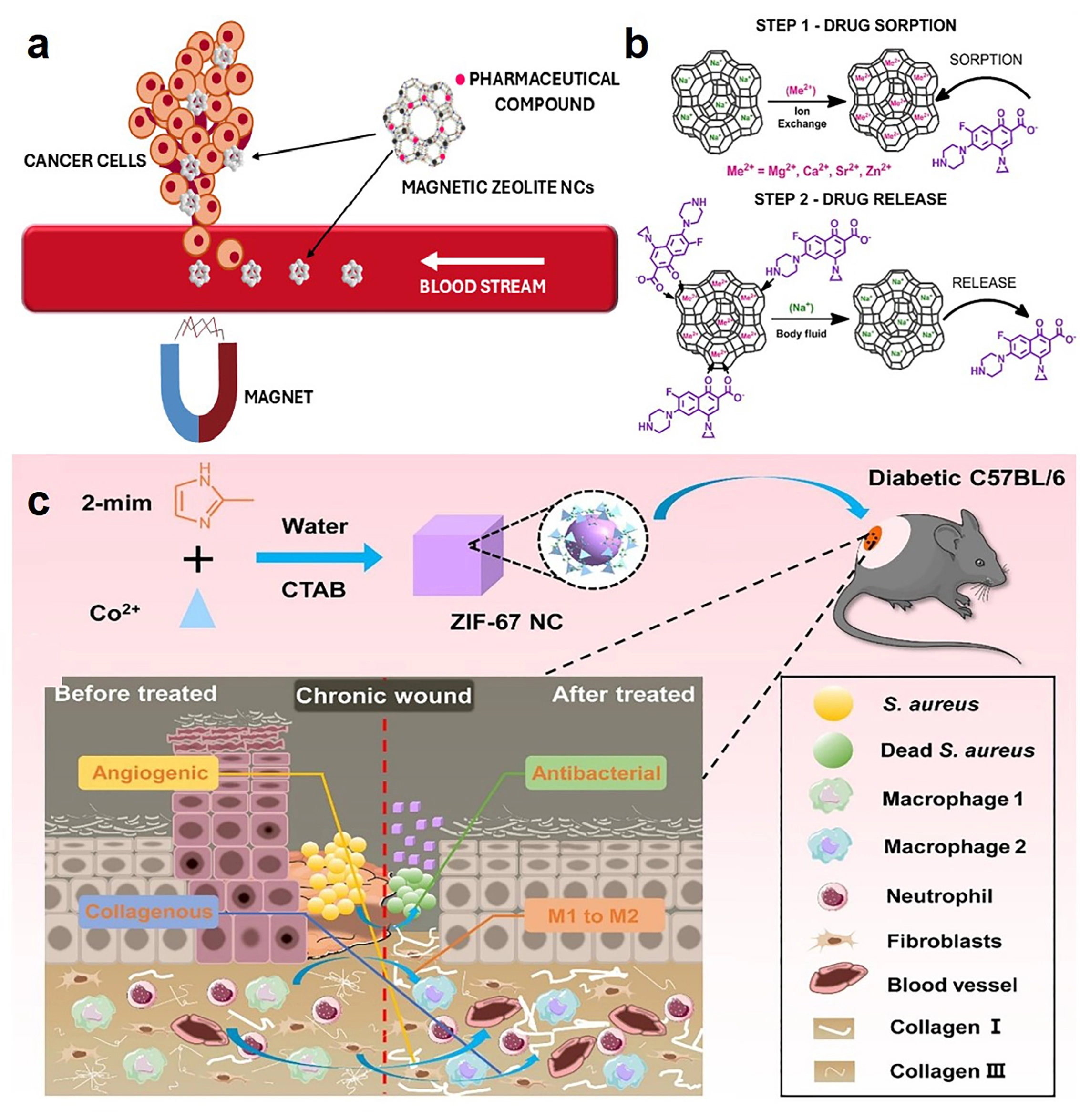
Figure 3. (a) Magnetic nanoparticle-mediated targeted drug delivery. Reproduced from reference[76]. CC BY 4.0; (b) X-type zeolite-mediated drug loading and controlled delivery. Reproduced with permission from reference[77]. Copyright © 2024 Elsevier; (c) Preparation and wound-healing applications of ZIF-67 through antibacterial activity, immunomodulation, and tissue regeneration. Reproduced with permission from reference[78]. Copyright © 2022 Elsevier. ZIF: zeolitic imidazolate framework.
Beyond ion-exchange systems, FAU-type zeolites have been employed as carriers for ibuprofen and indomethacin, enabling sustained and controlled drug release. This strategy helps mitigate the adverse effects associated with oral administration of nonsteroidal anti-inflammatory drugs while enhancing their therapeutic efficacy. As a representative zeolitic imidazolate framework, ZIF-67 can modulate the wound microenvironment and achieve synergistic therapeutic effects through the release of Co2+ and 2-methylimidazole ligands[78]. As shown in Figure 3c, during the treatment of infected diabetic chronic wounds, the released Co2+ and 2-methylimidazole disrupt bacterial membranes, resulting in intracellular leakage and effective elimination of Staphylococcus aureus. Furthermore, ZIF-67 promotes angiogenesis, induces macrophage polarization from the pro-inflammatory M1 phenotype toward the reparative M2 phenotype, alleviates local inflammation, and enhances collagen deposition, thereby providing structural support for tissue regeneration.
A large body of evidence has further confirmed that drug-release behavior is strongly influenced by the particle size, pore dimensions, morphology, and chemical composition of zeolites. For example, small-particle NaA and NaX zeolites exhibit slower hydroxychloroquine release and are thus more suitable as sustained-release platforms[82]. These findings indicate that the value of zeolites extends beyond their capacity to host drug molecules within their pores; they also offer the ability to optimize release behavior through tailored interactions between drug molecules and pore walls. It should be noted, however, that conventional microporous zeolites remain limited in their ability to load large biomolecules. Therefore, the construction of hierarchical pore architectures and the implementation of surface functionalization have become important strategies for improving drug-loading capacity and release efficiency.
3.1.2 Bone regeneration and repair
Zeolites are considered as ideal biomaterials for bone tissue engineering owing to their structural similarity to natural bone minerals, favorable biocompatibility, and their ability to release ions that promote bone growth. Zeolites have been demonstrated to enhance cell adhesion and proliferation, thereby inducing osteogenic differentiation. When applied as coatings, zeolites can minimize local inflammatory responses by restricting the release of harmful ions into the surrounding tissues[83]. Furthermore, zeolite-based materials can serve as cellular scaffolds for the in vitro fabrication of tissue-engineered bone grafts. Owing to their excellent osteogenic potential, zeolites have been extensively investigated for applications in bone regeneration and repair.
Torres et al. systematically evaluated the osteoinductive potential of nanosheet-like silicoaluminophosphate (SAPO) zeolites[84]. SAPO-34 and SAPO-5 zeolites modified with Ca2+ and Li+ ions were prepared via hydrothermal synthesis, with the introduced ions distributed across both the external surface and the internal pore network. Following immersion in simulated body fluid (SBF), the ion-exchanged SAPO zeolites exhibited rapid apatite mineralization within 14 days, indicating excellent bioactivity. Under physiological conditions, these materials underwent controlled degradation (5-22 wt.%), accompanied by the sustained release of Ca2+ and Li+ ions, thereby establishing a microenvironment conducive to osteoblast proliferation and differentiation (Figure 4a). Among the prepared materials, Ca/CaSAPO and Li/LiSAPO zeolites displayed the highest biocompatibility, sustaining osteoblast viability at concentrations up to 250 μg/mL. Navidi et al. developed a therapeutic biocomposite scaffold by incorporating SAPO-34 into chitosan (CS) along with biodegradable metals (Fe and Ca) to enhance the odontogenic and osteogenic differentiation of human dental pulp-derived mesenchymal stem cells (hDPSCs) for in vitro tissue regeneration[85]. Cell-based assays revealed that both Ca-SAPO-34/CS and Fe-Ca-SAPO-34/CS scaffolds significantly promoted the osteogenic differentiation of hDPSCs and facilitated dentin regeneration-related responses. Notably, the Fe-Ca-SAPO-34/CS scaffold exhibited excellent cytocompatibility, facilitating hDPSCs adhesion, spreading, and proliferation. These findings highlight the potential of SAPO zeolites as bioactive materials for bone regeneration and tissue repair. In addition to SAPO zeolites, MFI-type zeolites have also drawn considerable interest for bone repair and regeneration. Nanosized ZSM-5 zeolite was investigated as a bone repair material, and Ag-Nano-ZSM-5 was synthesized through a silver ion-exchange process. Compared with conventional micron-sized Ag-ZSM-5, Ag-Nano-ZSM-5 exhibited a higher specific surface area and a greater abundance of surface silanol groups, which facilitated hydroxyapatite nucleation and growth[87]. Furthermore, hydroxyapatite formation in SBF was observed exclusively in the silver-loaded zeolites. The synthesized zeolitic materials exhibited no cytotoxic effects toward RAW 264.7 murine macrophages or human Caco2 cells. Mechanical testing further demonstrated that the properties of Ag-Nano-ZSM-5 were comparable to those of various bone matrices, suggesting its potential suitability for bone implant applications.
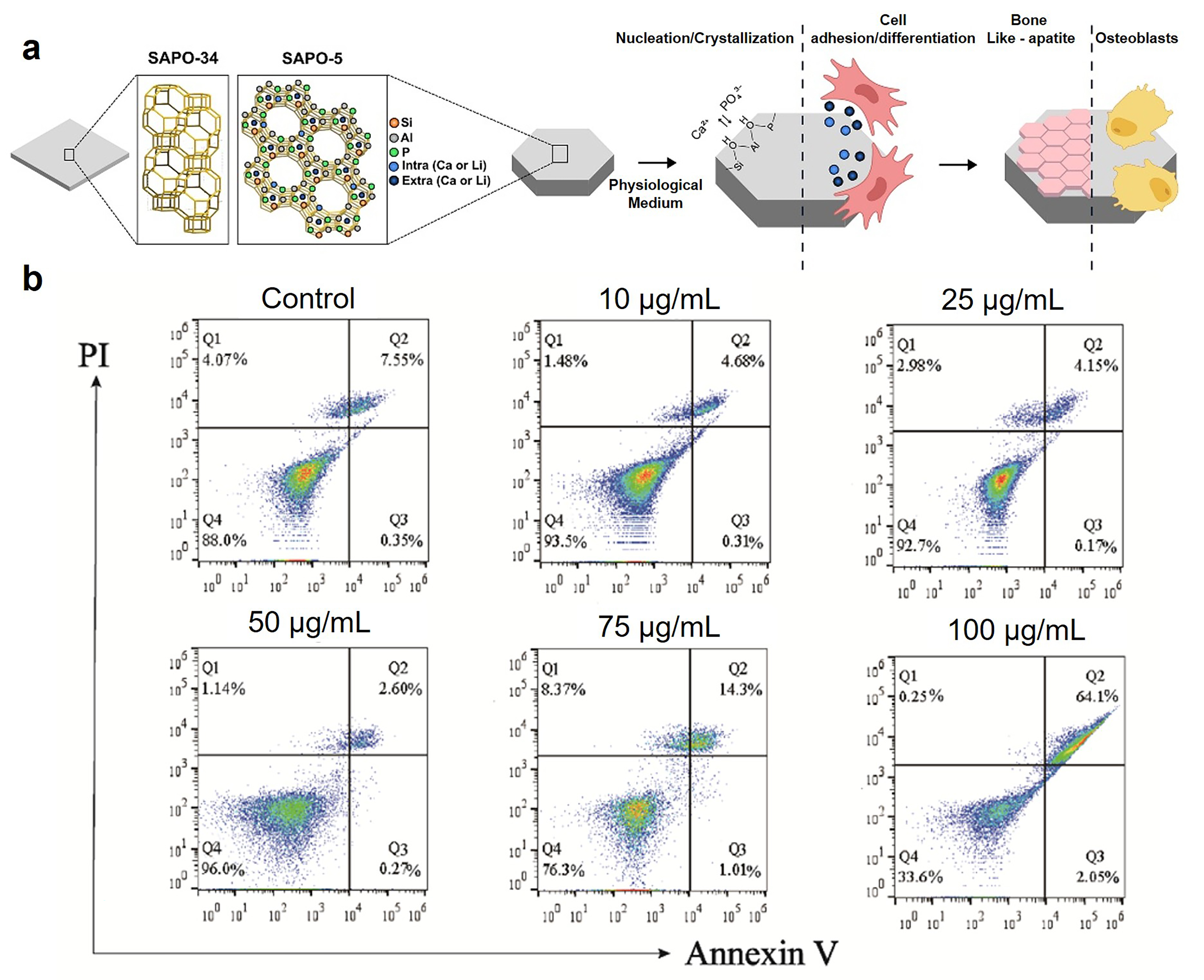
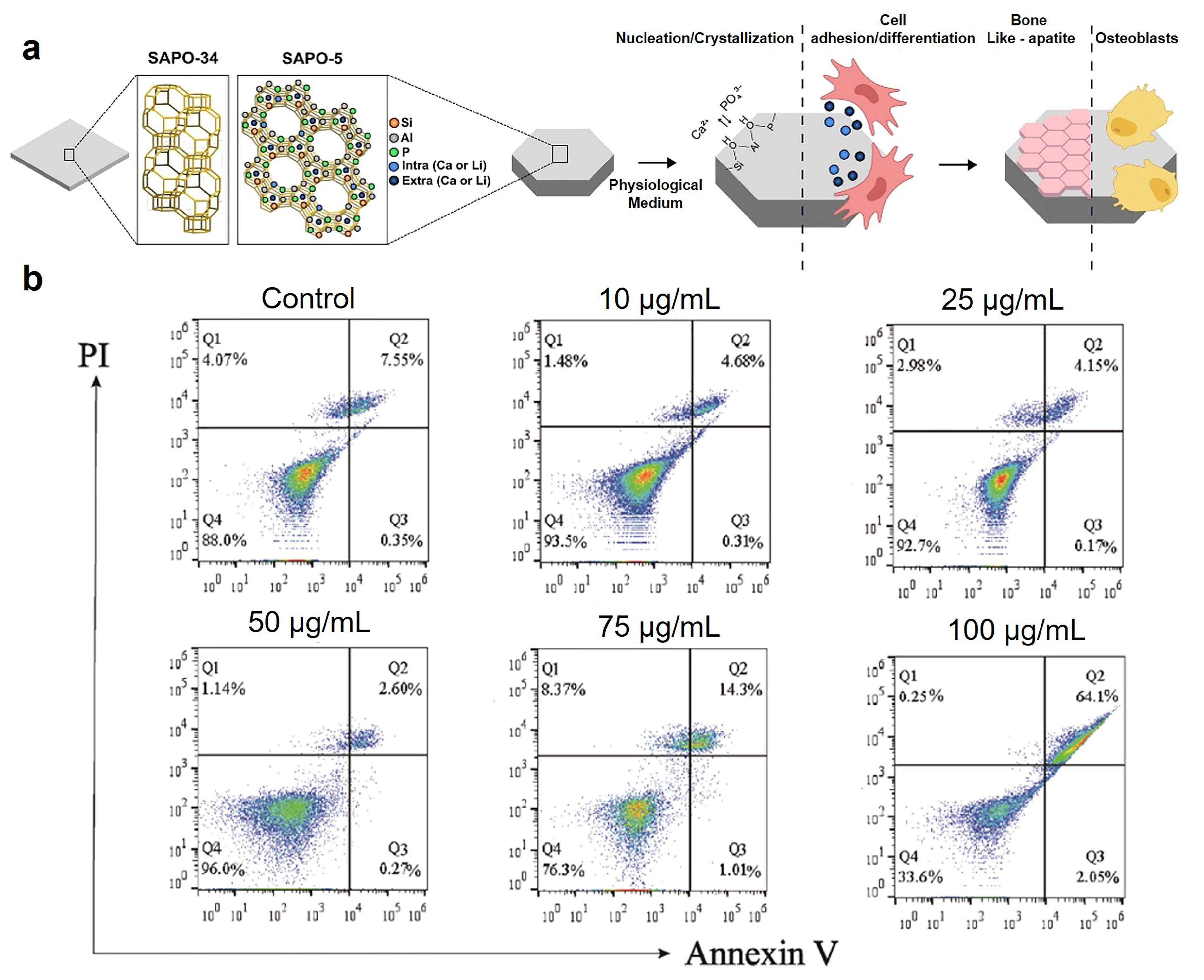
Figure 4. (a) Mechanism of SAPO-34 and SAPO-5 zeolites in bone regeneration. Reproduced with permission from reference[84]. Copyright © 2025 Elsevier; (b) Cell apoptosis analyzed using the annexin V/PI kit after exposure to nano ZIF-8 for 2 days. Reproduced with permission from reference[85]. Copyright © 2021 American Chemical Society. SAPO: silicoaluminophosphate; ZIF: zeolitic imidazolate framework.
MFI-type zeolites can also serve as coating materials to regulate the osteogenic microenvironment. Such coatings enhance the corrosion resistance of metallic substrates, thereby minimizing the release of potentially cytotoxic metal ions into surrounding tissues[88]. In parallel, their hydrophilic surfaces facilitate osteoblast adhesion and promote early-stage bone formation. In a representative study, Bedi et al. fabricated MFI-hydroxyapatite composite coatings on titanium implants for bone regeneration[89]. The incorporation of MFI zeolites improved surface hydrophilicity, while their interconnected porous architecture increased the specific surface area available for cell attachment and extracellular matrix organization, in turn facilitating bone healing. In vitro studies demonstrated that the coated implants exhibited an elastic modulus comparable to that of native bone and supported both cell proliferation and osteogenic differentiation. Furthermore, in vivo experiments confirmed their excellent biocompatibility along with enhanced osteoinductive and osteoconductive effects, ultimately promoting new bone formation and tissue ingrowth. However, zeolites are intrinsically non‑biodegradable. If the coating flakes off, small zeolite fragments could persist at the implant site; these fragments are difficult to metabolize and clear from the body and may potentially cause local inflammation. Beyond conventional zeolites, ZIF-8 has attracted increasing attention in bone regeneration research. As a metal-organic framework composed of Zn2+ ions and 2-methylimidazole linkers, ZIF-8 has been investigated as a promising biomaterial for addressing challenges associated with bone repair. Gao et al. demonstrated that nanoscale ZIF-8 promotes the osteogenic differentiation of rat bone marrow mesenchymal stem cells (rBMSCs) both in vitro and in vivo. In their study, nano-ZIF-8 was incorporated into sodium alginate and crosslinked via Ca2+-mediated ionic interactions to construct an injectable hydrogel, which was subsequently applied to critical-sized premaxillary bone defects in rats. After being released from the hydrogel matrix, nano-ZIF-8 particles were internalized by rBMSCs, triggering extracellular signal-regulated kinase phosphorylation and subsequent activation of the canonical mitogen-activated protein kinase signaling pathway, thereby enhancing osteogenic differentiation[85]. Apoptosis was evaluated using an Annexin V/PI assay after two-day exposure to nano-ZIF-8. At a concentration of 50 μg mL-1, the apoptotic rate remained as low as 2.89%. However, increasing the concentration to 75 or 100 μg mL-1 significantly increased apoptosis, with early and late apoptotic cell populations reaching approximately 15% and 66%, respectively (Figure 4b). These findings indicate that the concentration of nano-ZIF-8 should be maintained below 50 μg/mL to ensure cytocompatibility. In another study, Shi and co-workers incorporated ZIF-8 into fibrin gel to construct a composite scaffold (Z-FG). The Z20-FG formulation (20 μg mL-1 ZIF-8) showed the lowest cytotoxicity toward mesenchymal stem cells and delivered the most pronounced bone regeneration outcome, with significant improvements in new bone volume, bone mineral density, and trabecular thickness[90]. Zeolitic materials have demonstrated considerable potential for bone tissue engineering. Their integration into scaffolds, hydrogels, and implant coatings has further expanded their applications in bone repair. Nevertheless, future efforts should focus on optimizing their degradation behavior and comprehensively evaluating their long-term biological performance, both of which are essential prerequisites for successful clinical translation.
3.1.3 Medical imaging
In medical imaging, research on zeolitic materials has centered on two key fronts: exploiting their well-defined pore structures and ion-exchange sites for loading paramagnetic ions, fluorescent dyes, or radionuclides, and developing multifunctional platforms that integrate diagnostic imaging, drug delivery, and targeting functions[91]. Compared with conventional small-molecule contrast agents, zeolite-based systems facilitate the localized accumulation of imaging probes and can be readily functionalized for targeted imaging applications.
Gd-loaded zeolites have attracted particular attention as magnetic resonance imaging (MRI) contrast agents because confinement of Gd3+ within the zeolite framework reduces the toxicity associated with free Gd3+. Among various framework topologies, FAU-type zeolites are especially suitable hosts for Gd3+ because of their high ion-exchange capacity. Notably, nanosized Gd-loaded FAU (NaY) zeolites have been investigated as oral MRI contrast agents for gastrointestinal imaging[92]. Clinical studies revealed no detectable toxicity or measurable systemic absorption of Gd, as evidenced by the absence of Gd in blood and urine samples post-administration. Moreover, MRI efficacy scores and signal intensity correlated positively with suspension concentration and administered volume, confirming the safety and effectiveness of the oral suspension as a gastrointestinal MRI contrast agent. In another study, Gd3+-loaded FAU zeolites (phosphate-buffered saline (PBS)-Gd-FAU) were dispersed in PBS to form a stable suspension pre-saturated with an O2/CO2 gas mixture[93]. This suspension was intravenously administered to rats bearing U87-MG glioblastoma. Controlled release of O2 and CO2 from the zeolite framework triggered localized tumor vasodilation, while quantitative cerebral blood volume MRI enabled functional visualization of the hypoxic tumor microenvironment. The MRI signal within the tumor reached its peak approximately 90-100 s after injection, producing marked signal enhancement in tumor tissue with negligible signal changes in normal brain tissue (Figure 5a). Furthermore, no pathological abnormalities were observed in major organs, and no significant alterations in hematological parameters or body weight were detected following tail-vein injection, collectively confirming the excellent biocompatibility and injectability of PBS-Gd-FAU. These findings underscore the potential of PBS-Gd-FAU as a safe platform for longitudinal MRI tracking and functional assessment of tumor hypoxia.
Zeolites have also shown promise as carriers for hyperpolarized 129Xe, an attractive MRI probe owing to its exceptional biocompatibility and unique nuclear magnetic resonance (NMR) properties. Hyperpolarization dramatically boosts the sensitivity of the 129Xe MRI signal, enabling highly sensitive molecular imaging. In this context, Lerouge et al. employed ZSM-5-type silicalite-1 nanoparticles as hosts for hyperpolarized 129Xe and functionalized their surfaces with thrombus-targeting peptides and polyethylene glycol chains to enable targeted thrombus imaging[96]. When confined within the zeolite pores, 129Xe exhibited a characteristic chemical shift of 120-140 ppm, readily distinguishable from those of free and solvated xenon, while maintaining a longitudinal relaxation time T1 of ~ 30 s, which was sufficient for delivery and biosensing applications.
Beyond MRI, zeolites have also been explored as imaging platforms for positron emission tomography (PET) through the incorporation of positron-emitting radionuclides. Hélaine et al. reported 64Cu-exchanged FAU-type nano-zeolites for PET imaging in a preclinical glioblastoma model[94]. Following intravenous administration, the nanocrystals exhibited progressive accumulation in tumor tissue with negligible uptake in healthy brain tissue, demonstrating high tumor-targeting specificity (Figure 5b). As the first radiolabeling strategy reported for nano-zeolites, this work provided direct evidence of their biodistribution and highlighted their potential as multifunctional platforms for image-guided cancer diagnosis. Nevertheless, the high concentrations of competing cations (Na+, K+, and Ca2+) present in physiological environments may displace the 64Cu ions retained within the pores through ion exchange, thereby increasing the risk of radionuclide release. The liberated 64Cu ions may undergo nonspecific accumulation in the liver, potentially compromising the accuracy of PET imaging and causing additional radiation exposure to healthy organs. More recently, a carbon-doped nanozyme based on nanosized Beta zeolite (HSC-2) was reported as the first tunable dual-modal photoacoustic/fluorescence imaging platform operating in the second near-infrared (NIR-II) window[95]. As illustrated in Figure 5c, carbon was introduced into the Beta zeolite framework through ionic liquid adsorption followed by carbonization, converting the material from an indirect band-gap semiconductor into a direct band-gap semiconductor and endowing it with strong NIR-II fluorescence. By tuning the silicon-to-carbon ratio through hydrofluoric acid etching, HSC-2 achieved balanced photoacoustic and fluorescence imaging performance. In vivo studies demonstrated efficient tumor accumulation and high-resolution visualization of tumor morphology, underscoring the potential of zeolite-based nanoplatforms for NIR-II multimodal imaging and image-guided cancer theranostics.
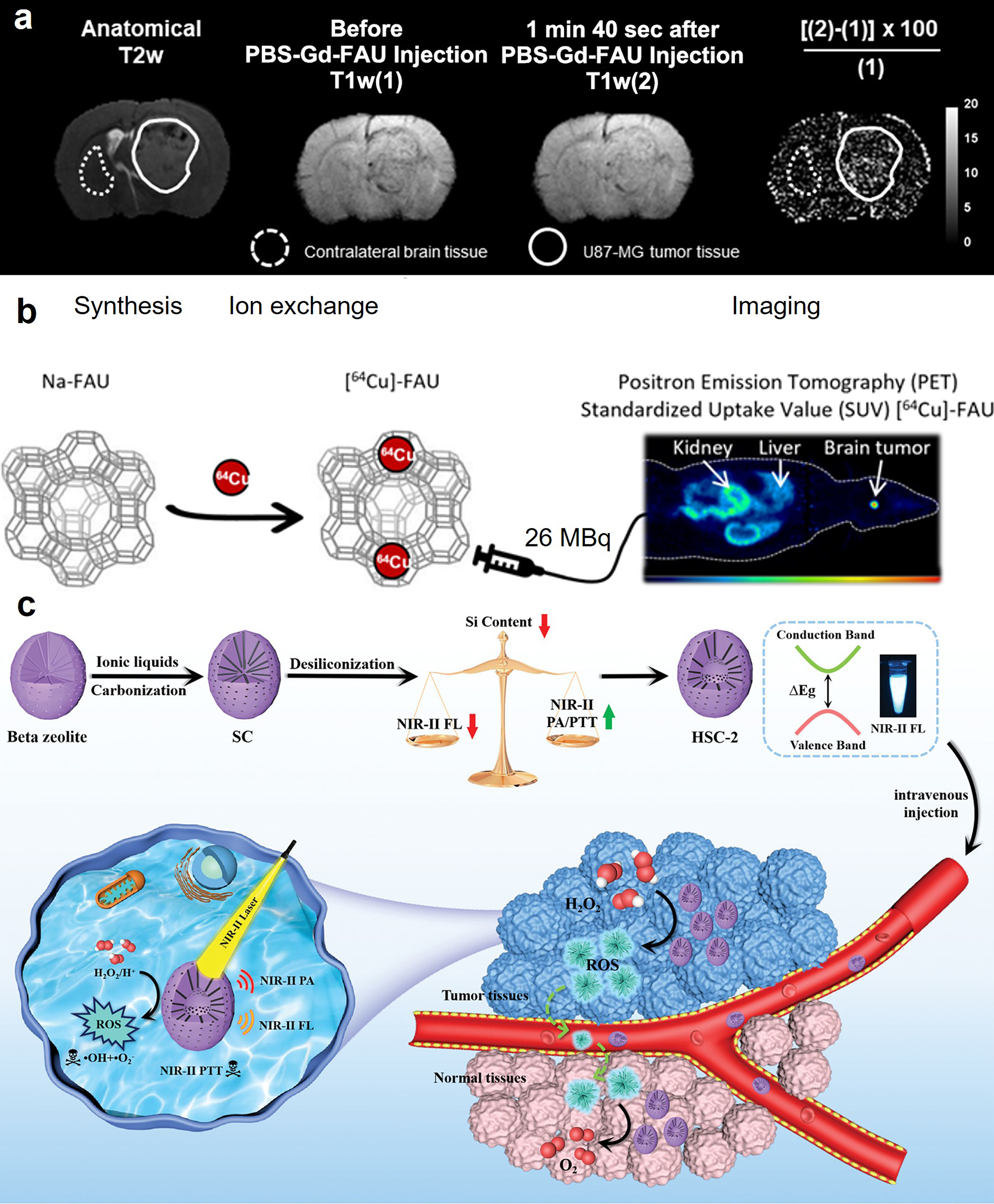
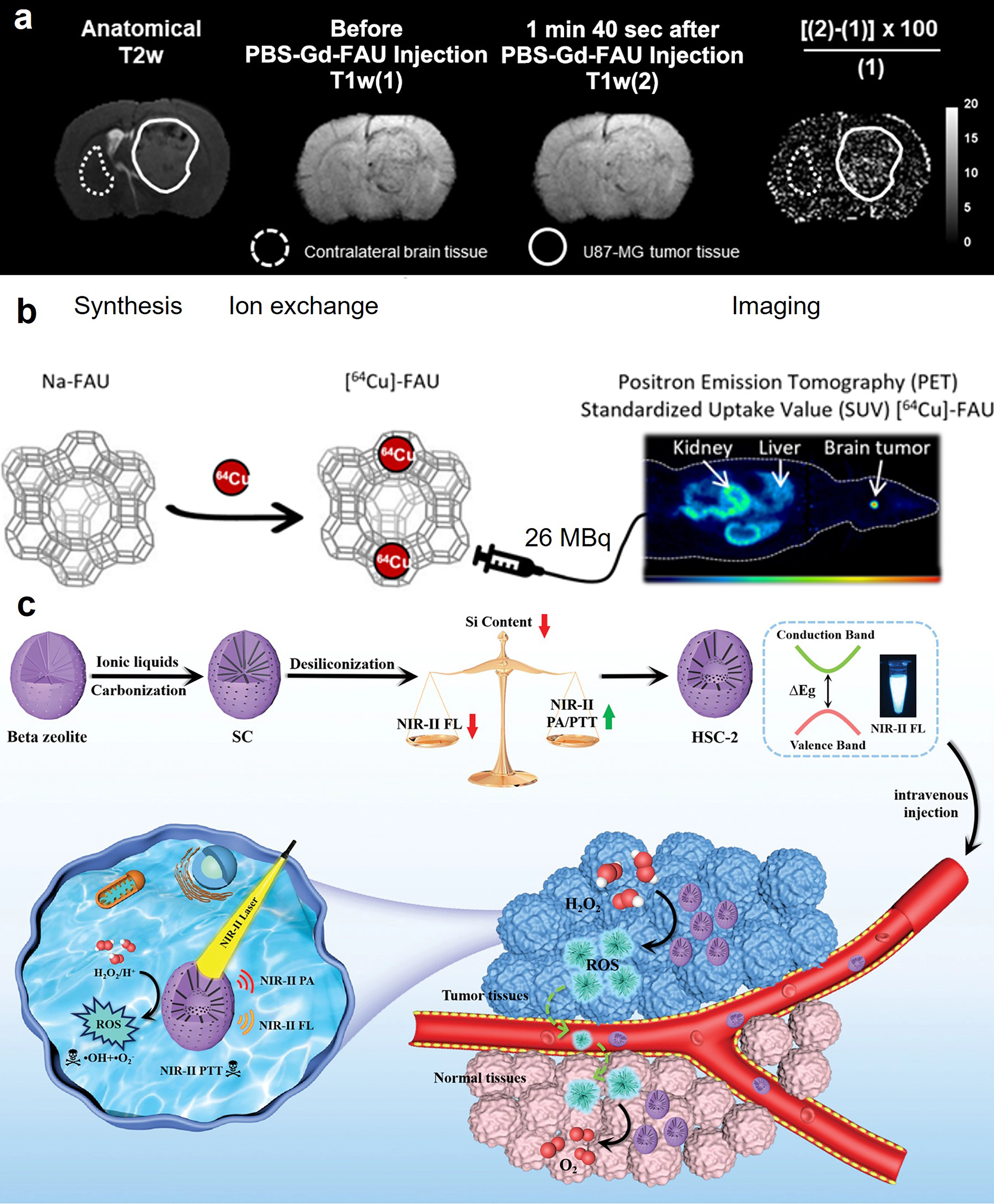
Figure 5. (a) Representative T2w (anatomical) and T1w MRI images of rat brain acquired before and after intravenous injection of PBS-Gd-FAU zeolite nanocrystals. Reproduced with permission from reference[93]. Copyright © 2025 American Chemical Society; (b) 64Cu-FAU zeolite nanocrystal-enhanced PET imaging of tumors. Reproduced from reference[94]. CC BY 4.0; (c) Workflow of adjustable photoacoustic/fluorescence imaging-guided photothermal/catalytic therapy in the NIR-II window. Reproduced with permission from reference[95]. Copyright © 2021 Wiley. PBS: phosphate-buffered saline; PET: positron emission tomography; NIR-II: near-infrared; NIR-II PA: NIR-II photoacoustic; NIR-II FL: NIR-II fluorescence; PTT: photothermal therapy; ROS: reactive oxygen species; SUV: standardized uptake value.
Overall, zeolitic materials have proven to be versatile imaging platforms by integrating diverse imaging probes with their unique structural attributes. The high loading capacity, flexible surface functionalization, and favorable biocompatibility enable applications spanning MRI, PET, and multimodal optical imaging. Further optimization of probe loading, targeting efficiency, and long-term biosafety will be critical for advancing the clinical translation of zeolite-based imaging systems.
3.1.4 Wound hemostasis
Excessive hemorrhage remains the leading cause of mortality following traumatic injury, underscoring the urgent need for rapid, safe, and portable hemostatic materials in both military and emergency medicine. The introduction of zeolite-based hemostats dates back to the 1980s. Although these early molecular sieve products enabled rapid coagulation, they also showed critical drawbacks, including incomplete removal from wound sites, substantial exothermic effects upon contact with water or blood that often caused severe tissue burns, and the risk of long-term inflammatory responses caused by retained zeolite particles[97,98]. To overcome these two major limitations, Yu and co-workers developed a flexible zeolite-cotton composite hemostat (mCHA-C), in which mesoporous CHA zeolite was firmly immobilized on cotton fibers through an in situ, template-free growth strategy[99]. This design preserved the strong procoagulant activity of zeolite while imparting excellent flexibility and processability, enabling fabrication into diverse formats such as hemostatic dressings and T-shirts, and avoiding the thrombosis risk caused by the detachment of particulate zeolite. In addition, the material limited the temperature rise of blood to within 8 °C, thereby effectively preventing heat-induced tissue damage. Building upon the improvements in hemostatic properties, the same group further investigated the procoagulant mechanism of zeolites. Proteomic analysis of the hard protein corona (HPC) formed on the calcium-exchanged zeolites (Ca-zeolites) confirmed significant enrichment of coagulation factors at this interface. Quantitative analysis of coagulation factors X and V, combined with dynamic monitoring of thrombin generation, demonstrated that zeolites can serve as a scaffold for the Ca2+-mediated assembly of these factors, facilitating in situ formation of the prothrombinase complex and efficient conversion of prothrombin into thrombin. This study proposed the concept of zeolites as “inorganic platelets” and delineated a three-stage coagulation process: activation and procoagulant complex assembly, thrombin burst, and fibrin clot formation (Figure 6). These findings provide both a theoretical and a practical foundation for the rational design of zeolite-based hemostatic materials[100].
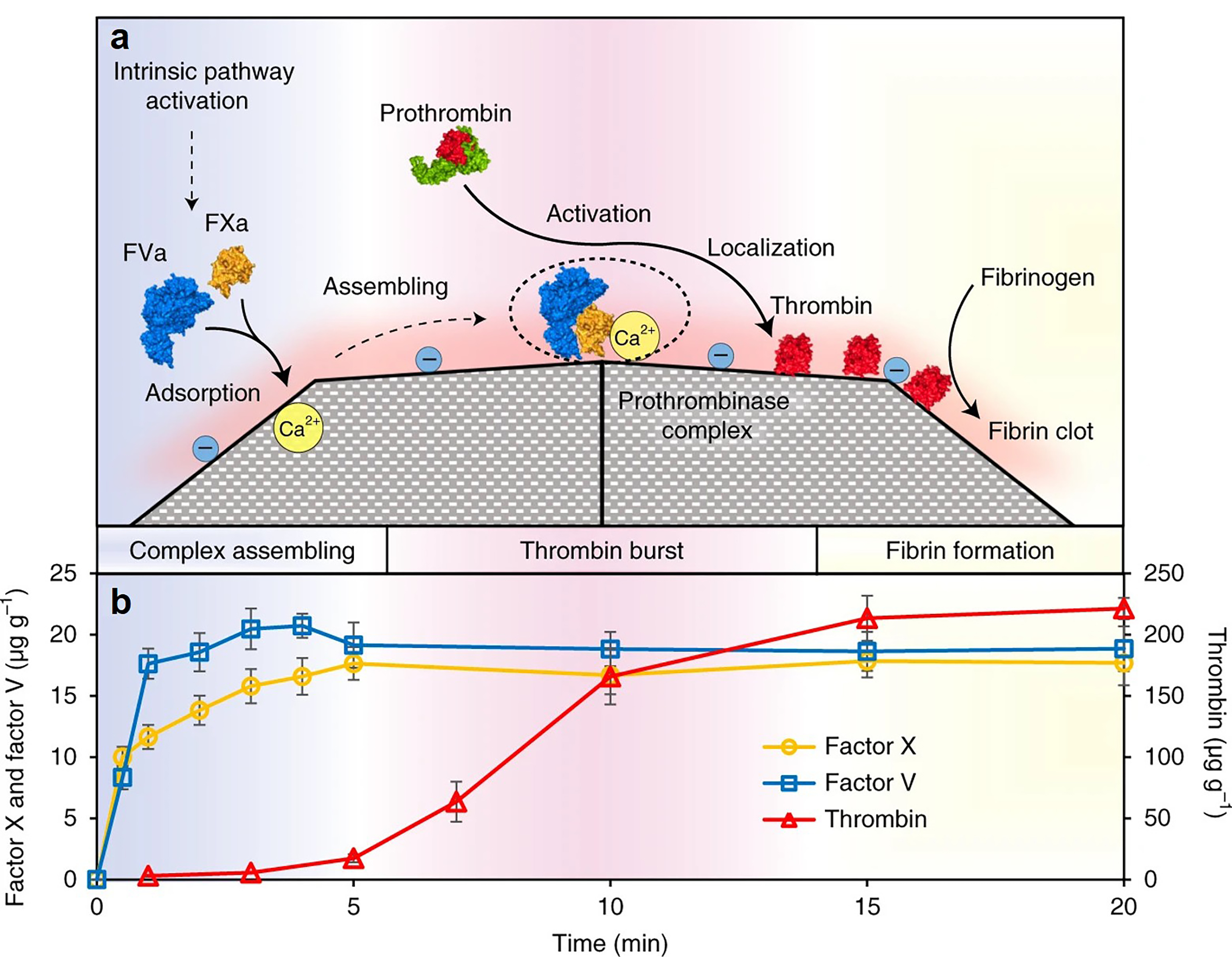
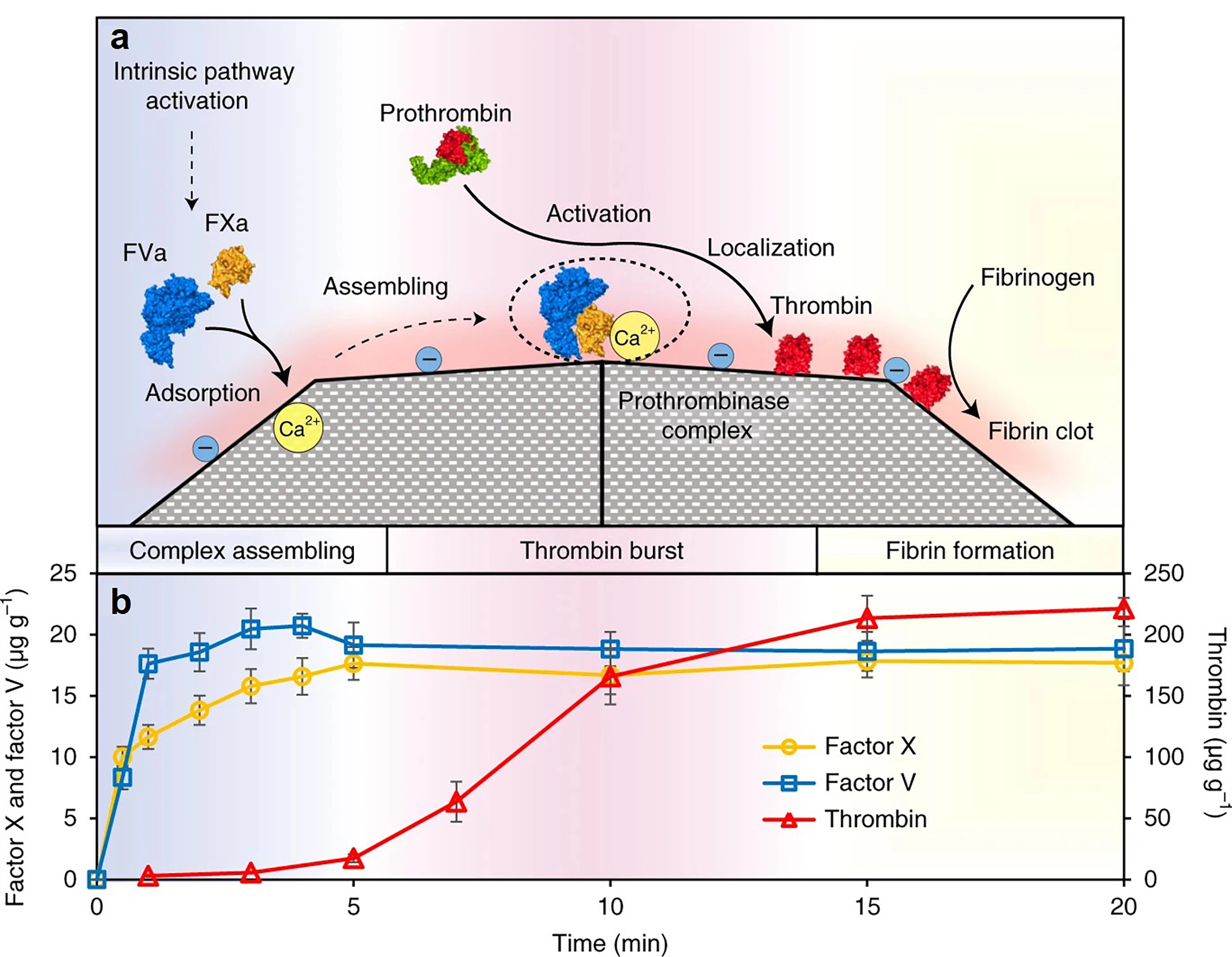
Figure 6. Dynamic process of prothrombinase complex (factors X and V) assembly on the zeolite surface. (a) Schematic of prothrombinase complex assembly and thrombin activation; (b) Quantitative monitoring of factor V, factor X, and thrombin over the course of the coagulation process on the zeolite. Data values correspond to mean ± s.d., n = 3 biologically independent samples. Reproduced with permission from reference[100]. Copyright © 2021 Springer Nature.
Recent years have witnessed the continued diversification of zeolite-based composite carrier systems. For instance, embedding zeolites within cellulose nanofiber aerogels achieves efficient hemostasis at an ultralow loading of only 2.89 wt.%[101]. Additionally, zeolite composites with silver-loaded ascorbate cotton fabrics have been developed as bifunctional dressings that combine hemostatic and antibacterial actions, helping to address the high risk of infection in open wounds[102]. Compressible zeolite/poly(vinyl alcohol) composite sponges have been prepared for effective hemostasis in narrow and deep wounds[103]. Despite this progress, current studies have mainly focused on acute arterial and visceral hemorrhage. Systematic investigations of diabetic ulcers, burn wounds, and chronic exudative wounds remain limited, and the hemostatic mechanisms of molecular sieve materials still require further elucidation.
3.2 Energy storage
Driven by the growing demand for sustainable energy technologies, the development of robust, high-performance energy storage and conversion systems has become a central pursuit in materials science. Zeolites, with their intrinsically tunable frameworks and versatile functionalities, have garnered substantial interest in applications ranging from the optimized utilization of conventional energy resources to emerging clean energy technologies. Looking forward, continued advances in the rational design and functionalization of these materials are poised to unlock new opportunities for sustainable energy applications[25].
3.2.1 Electrochemical energy
The applications of zeolites in electrochemical energy storage primarily involve electrolyte regulation, separator modification, and electrode/electrolyte interface engineering in secondary batteries. In electrolyte systems, zeolites can overcome several limitations of conventional liquid electrolytes, including low Li+ transference numbers and severe interfacial side reactions. The confinement effect of zeolite channels, combined with their surface Lewis acid-base sites, enables regulation of electrolyte solvation structures, thereby suppressing parasitic reactions and improving electrode/electrolyte interfacial stability[23]. For instance, mesoporous MCM-41, featuring ordered hexagonal nanochannels, promotes Li+ desolvation and accelerates Li+ transport. Experimental studies demonstrated that the incorporation of MCM-41 modified the Li+ solvation structure, weakened Li+-solvent interactions, and lowered the desolvation energy barrier (Figure 7)[104]. Similarly, 3A zeolites have been employed to regulate electrolyte solvation structures, thereby enhancing oxidative stability and stabilizing the cathode/electrolyte interface under high-voltage operating conditions[105].
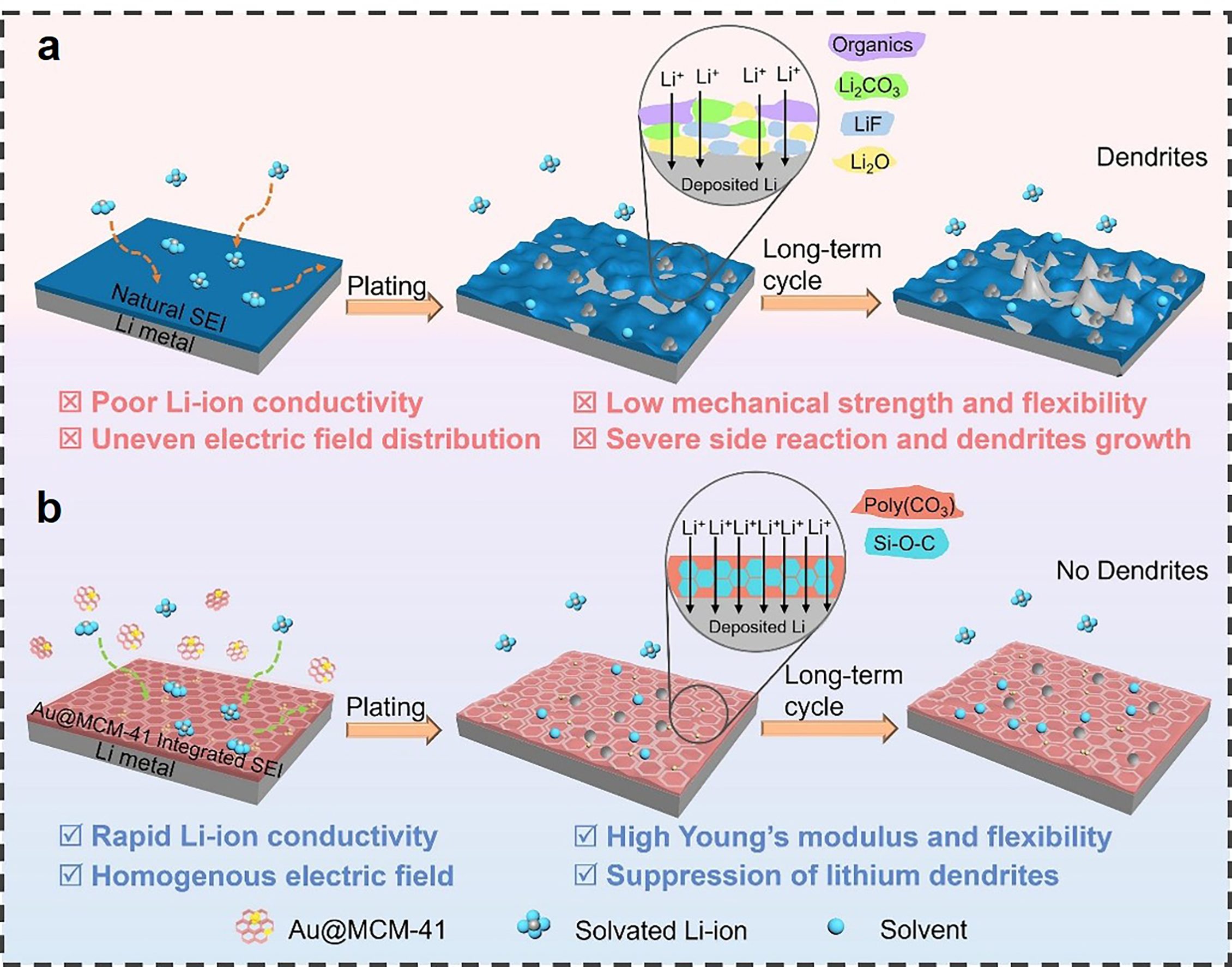
Figure 7. Illustration of the evolution behavior of the SEI on lithium metal anode with LiPF6 electrolyte and Au@MCM‑41‑modified LiPF6 electrolyte. (a) Brittle SEI and the dendrite protrusion behavior with LiPF6 electrolyte; (b) Robust organic/inorganic hybrid SEI and even lithium deposition with Au@MCM-41-modified LiPF6 electrolyte. Reproduced with permission from reference[104]. Copyright © 2024 Elsevier. SEI: solid electrolyte interphase.
To overcome the intrinsically low room-temperature ionic conductivity of solid polymer electrolytes, Luo et al. integrated a three-dimensional zeolite network into a poly(ethylene oxide) (PEO)/lithium bis(trifluoromethanesulfonyl)imide (LiTFSI) electrolyte[106]. Synergistic interactions among the zeolite framework, polymer matrix, and lithium salt promoted PEO amorphization and LiTFSI dissociation, thereby boosting Li+ transport. Consequently, the composite electrolyte delivered a room-temperature ionic conductivity of 1.62 × 10⁻⁴ S cm-1 and an electrochemical stability window up to 5.7 V. In addition, Li symmetric cells employing this electrolyte demonstrated stable cycling for more than 2,300 h, whereas the corresponding full cells retained 92% of their initial capacity after 500 cycles at 0.5C under ambient conditions.
Beyond improving thermal stability, zeolite incorporation can also regulate ion transport within separators and enhance overall electrochemical performance[107]. Phiri et al. reported a bikitaite (BKT) zeolite-filled cellulose-based separator for lithium-metal batteries. The incorporation of BKT with Li+ conductivity into the cellulose matrix created continuous Li+ transport pathways while maintaining excellent electrolyte wettability, thereby promoting uniform Li deposition and suppressing dendrite growth. In contrast to conventional polyethylene (PE) separators, the BKT-containing cellulose separator (CBT) exhibited a distinct composite architecture, with uniformly distributed BKT particles embedded within the polymer matrix (Figure 8a,b,c,d)[108]. Owing to the intrinsic thermal stability of BKT zeolite, the CBT separator showed negligible shrinkage and retained structural integrity at elevated temperatures up to 200 °C, whereas the PE separator underwent severe thermal contraction and pore collapse (Figure 8e,f). Thermal safety tests further revealed that the CBT-based cell maintained stable voltage retention under high-temperature conditions, in contrast to the rapid voltage decay observed in the PE-based cell, which resulted from internal short-circuiting induced by separator shrinkage (Figure 8g). Similarly, incorporating an ultra-stable Y-type zeolite into a polyimide nanofiber membrane enhances the thermal stability of the composite separator, highlighting the potential of zeolite-based separators for improving battery safety[110]. Mesoporous silica molecular sieve coatings also markedly improve the electrolyte wettability of separators. Hollow mesoporous silica nanospheres (mSiO2), which possess a high specific surface area and interconnected pore channels, facilitate electrolyte infiltration and promote uniform electrolyte distribution throughout the separator. As a separator coating, mSiO2 enhances electrolyte uptake and promotes Li+ transport, affording superior rate capability, cycling stability, and high-temperature safety[111]. Likewise, a 4A zeolite coating on a polypropylene separator decreases the electrolyte contact angle to nearly 0° and increases the electrolyte uptake to 270%[112]. Beyond separator modification, zeolites have been exploited for electrode/electrolyte interface engineering to improve ion transport and interfacial stability. Li-exchanged zeolite X (Li-X) incorporated into dry-processed cathodes reduces ionic transport tortuosity and shortens Li+ diffusion pathways, thereby enhancing the utilization of high-loading cathodes. In another study, a Cu2+-loaded zeolite coating regulated the Li+ solvation structure through its sub-nanometer channels and functional Cu2+ sites, inducing the formation of a dual-layered inorganic-rich solid electrolyte interphase (SEI). This interphase effectively stabilized Li plating/stripping behavior and enabled uniform dendrite-free lithium deposition. Consequently, the modified symmetric cells exhibited stable cycling for over 1,500 h at 1 mA cm-2 and 3 mAh cm-2, demonstrating the efficacy of zeolite-based interfacial engineering in improving long-term battery stability (Figure 8h,i)[109].
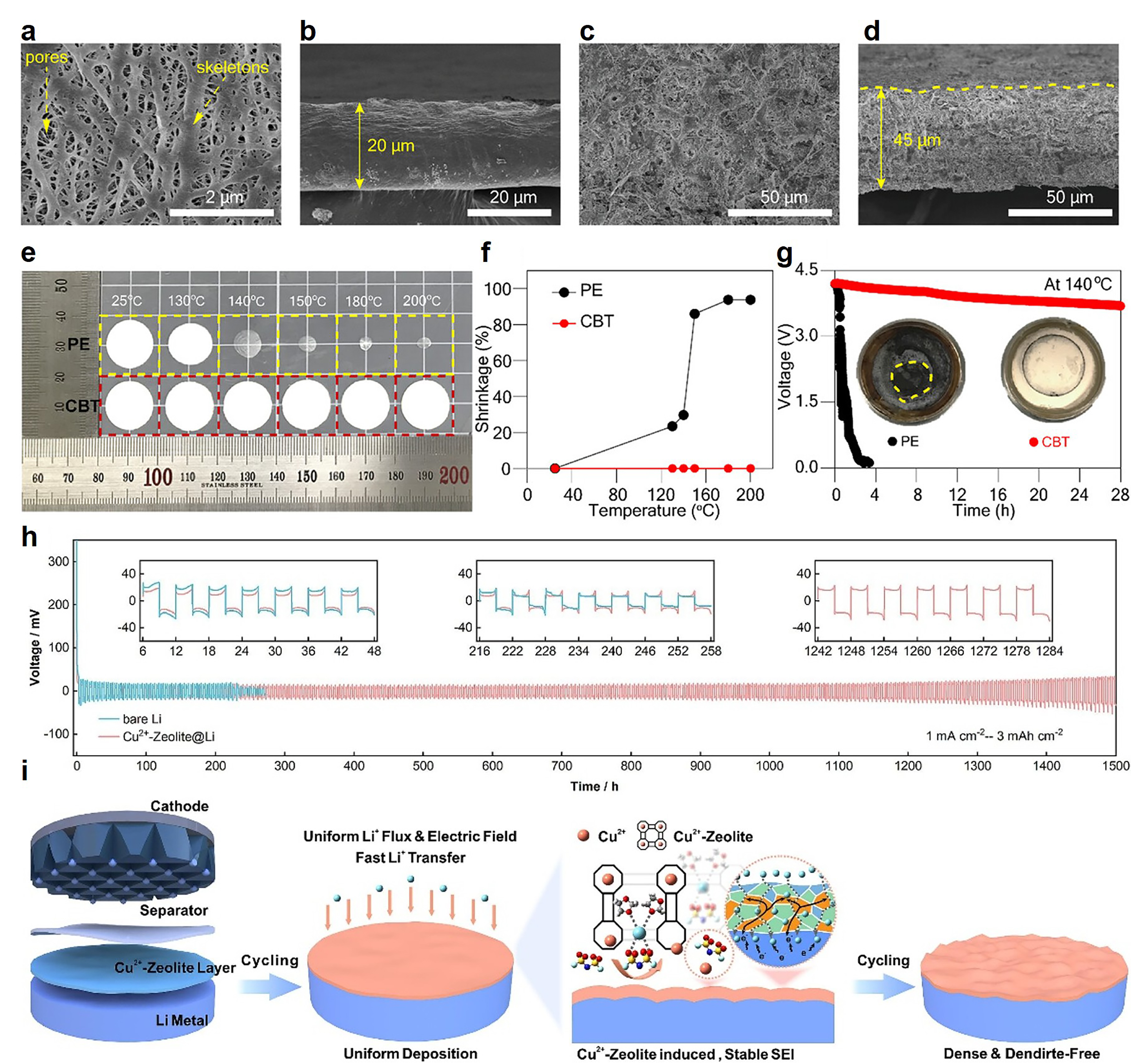
Figure 8. (a-d) Surface and cross-sectional SEM images of commercial PE and CBT separators; (e,f) Thermal shrinkage of PE and CBT separators measured from 25 to 200 °C (30 min holding at each temperature); (g) Comparison of thermal stability of batteries assembled with PE and CBT separators. Reproduced from reference[108]. CC BY 4.0; (h) The Li plating/stripping voltage curves of symmetric Li/Li cells with bare Li, Cu2+-Zeolite@Li at the current density of 1 mA cm-2 and 3 mAh cm-2; (i) Cu2+-Zeolite layer-induced dual-layer SEI formation for stabilized Li plating/stripping and dendrite-free lithium deposition. Reproduced with permission from reference[109]. Copyright © 2025 Elsevier. PE: polyethylene; CBT: BKT-containing cellulose separator; SEI: solid electrolyte interphase; SEM: scanning electron microscope.
Overall, zeolites have demonstrated considerable potential in electrochemical energy storage. Their well-defined pore structures, tunable surface chemistry, and excellent thermal stability enable improvements in ion transport, interfacial stability, and separator performance, providing an effective material platform for the development of secondary batteries with enhanced safety, prolonged cycle life, and improved electrochemical performance.
3.2.2 Hydrogen storage
Hydrogen is widely recognized as a promising clean energy carrier because of its high energy density and zero carbon emissions at the point of use. With the accelerating integration of renewable energy and the transition toward carbon-neutral energy systems, the development of safe and efficient hydrogen storage technologies has become a critical research priority. Various porous materials, including carbon-based materials, covalent organic frameworks (COFs), metal-organic frameworks (MOFs), and silica-based materials, have been explored for hydrogen storage; however, their practical applications remain constrained by limited storage capacity, inadequate structural stability, and challenges in scalability[113]. Zeolites have emerged as promising candidates for solid-state hydrogen storage owing to their well-defined pore architectures, exceptional thermal and chemical robustness, and reversible adsorption behavior.
The hydrogen storage properties of zeolites are intrinsically linked to their pore architectures. Given that the kinetic diameter of hydrogen molecules is approximately 0.289 nm, the narrow micropores of zeolites may restrict molecular diffusion and limit the accessibility of adsorption sites. Therefore, introducing hierarchical porosity, including mesopores (2-50 nm) and macropores (> 50 nm), has been an effective strategy to enhance hydrogen uptake by improving mass transport and providing additional adsorption sites. Masika et al. reported the synthesis of zeolite-templated carbon (ZTC) via a two-step chemical vapor deposition (CVD) process using furfuryl alcohol-impregnated 13X zeolite as a template[114]. The resulting ZTC possessed a highly developed porous structure and exhibited enhanced hydrogen adsorption performance, demonstrating its promise for hydrogen storage applications. Furthermore, FAU-type zeolite-derived carbon composites have been investigated for enhanced hydrogen storage. Erdogan et al. constructed FAU-type zeolite-based composites with activated carbon, graphene, and multi-walled carbon nanotubes; among these, the zeolite/activated carbon composite achieved a hydrogen uptake of 1.3 wt.%, significantly exceeding that of pristine activated carbon or zeolite alone[115]. Graphene and multi-walled carbon nanotube incorporation further boosted hydrogen adsorption performance. These studies suggest that pore engineering should not rely solely on increasing pore size, as excessive pore enlargement may weaken the interactions between hydrogen molecules and pore surfaces. Therefore, a balanced optimization of pore dimensions, surface area, and adsorption affinity is crucial for developing efficient zeolite-based hydrogen storage materials. In addition to pore structure engineering, surface modification offers an additional avenue to enhance the hydrogen storage capacity of zeolites. Cation exchange and the incorporation of transition metals or noble metals are among the most widely adopted approaches. For instance, the introduction of alkali or alkaline-earth metal cations, such as Li+ and Mg2+, modulates the local electrostatic environment within zeolite channels, thereby strengthening interactions between hydrogen molecules and the zeolite framework and ultimately enhancing hydrogen adsorption[116].
Metal confinement within zeolite frameworks to induce hydrogen spillover has proven to be an effective strategy for improving hydrogen storage, as it couples physisorption with spillover-assisted chemisorption. Confined Ru or Pd species within zeolite cages can readily dissociate hydrogen molecules into active hydrogen species, which subsequently migrate onto the zeolite surface through hydroxyl groups and acid sites, thereby augmenting hydrogen adsorption. For example, Qin et al. prepared a Ru@Beta catalyst by encapsulating 0.5 wt.% Ru species within Beta zeolite. The enhanced hydrogen spillover effect promoted the hydrogenation of N-ethylcarbazole, yielding a hydrogen storage capacity of 5.68 wt.% while sustaining stable performance over multiple cycles (Figure 9a)[117]. Similarly, silicalite-1 (S-1) zeolite has been employed as a multifunctional support for formic acid-based hydrogen storage systems, in which sub-nanometer PdMn bimetallic clusters are confined within the zeolite framework. The confined structure ensures high metal dispersion and facilitates hydrogen transfer during formic acid dehydrogenation, while maintaining stable catalytic performance over repeated cycles (Figure 9b)[118].
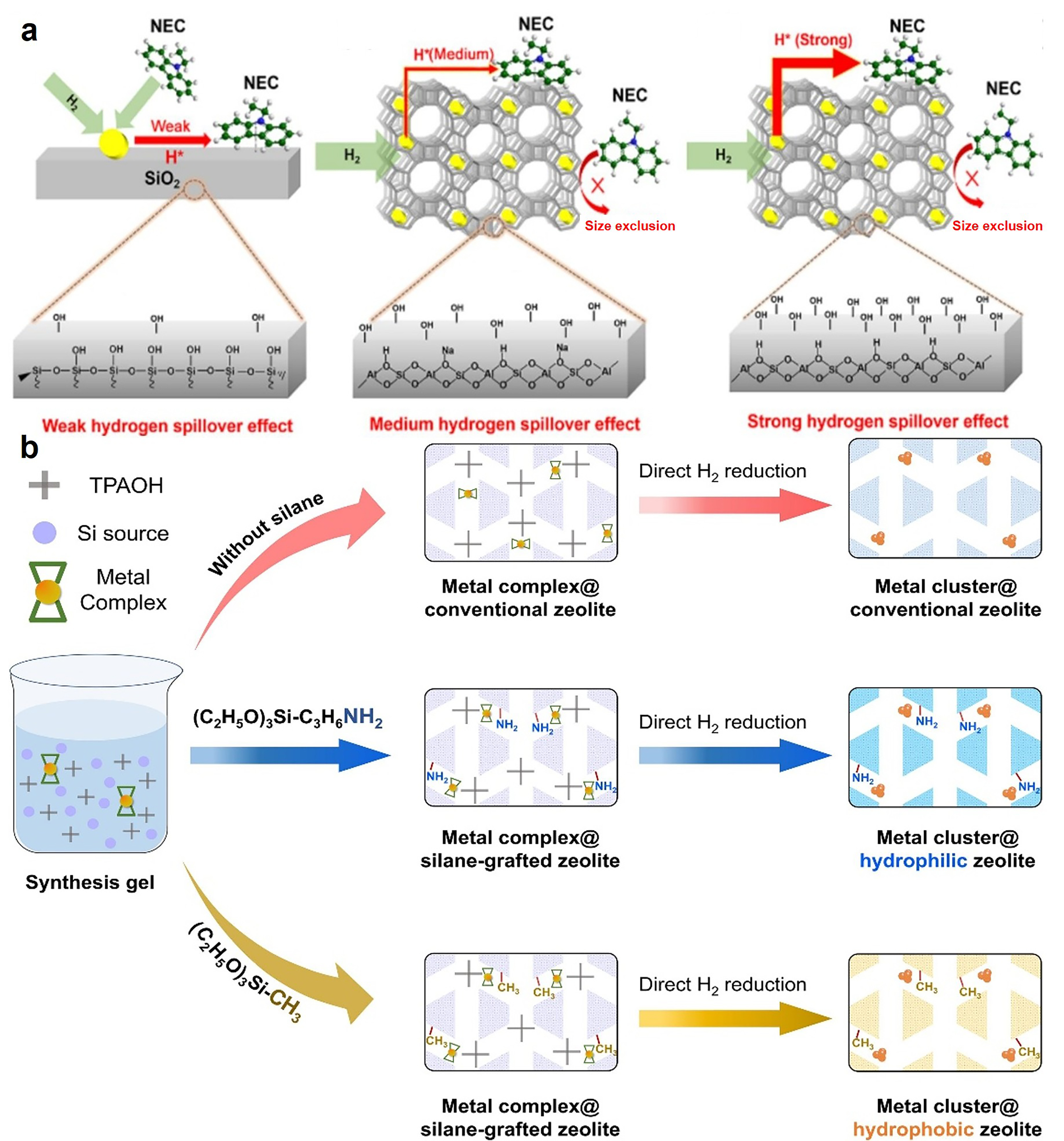
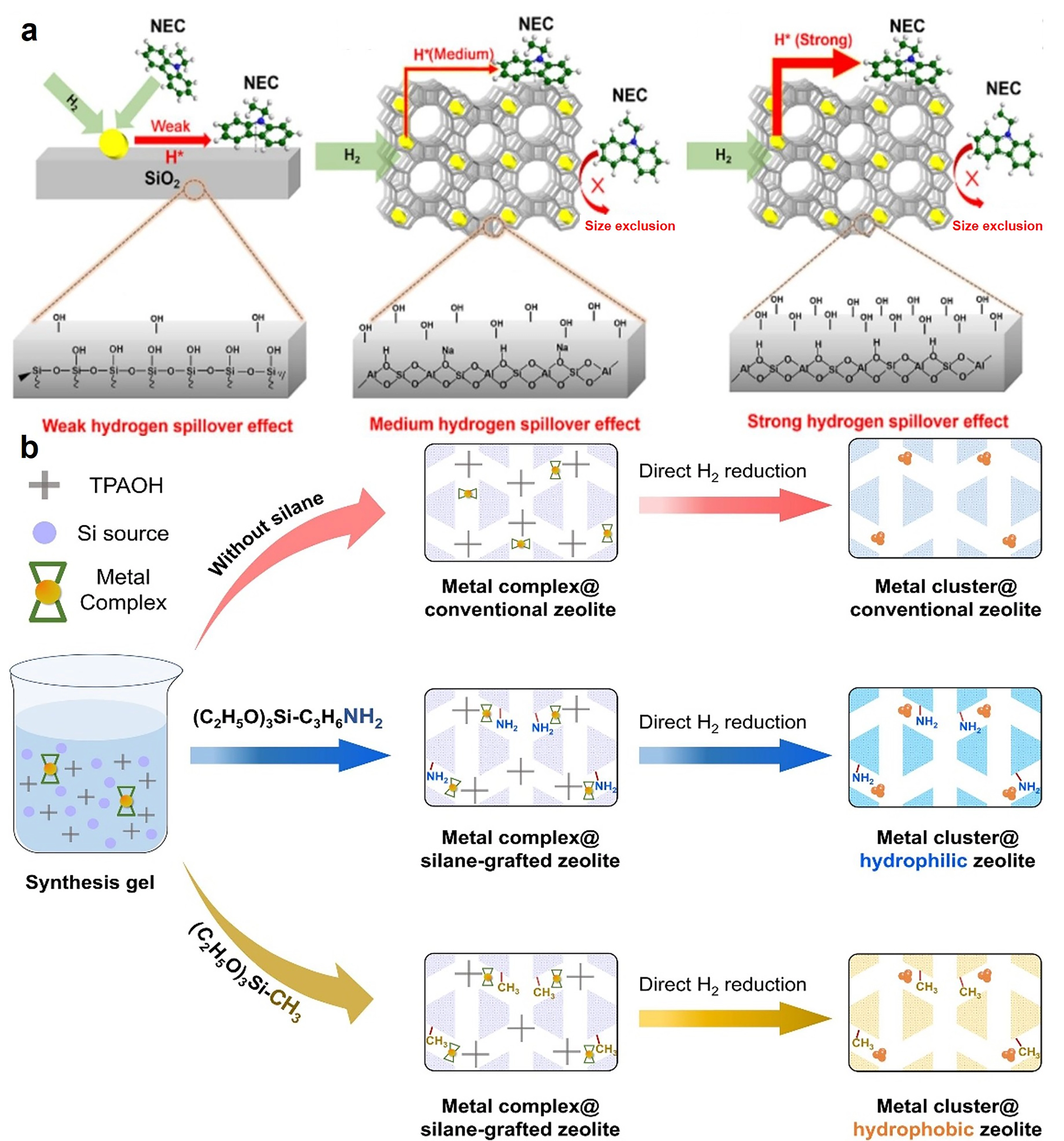
Figure 9. (a) Hydrogen spillover effect on the hydrogenation of NEC. Reproduced with permission from reference[117]. Copyright © 2025 Elsevier; (b) Synthesis of silane-grafted zeolite-encapsulated metal clusters by using a ligand-protected direct H2-reduction method. Reproduced with permission from reference[118]. Copyright © 2024 Elsevier. NEC: N-ethylcarbazole; TPAOH: tetrapropylammonium hydroxide solution.
Recent efforts have increasingly concentrated on developing composite zeolite-based hydrogen storage materials. Hybrid systems, including zeolite/carbon, zeolite/MOF, and zeolite/metal hydride composites, integrate the structural advantages of different components to provide enhanced hydrogen adsorption sites and improved robustness[115]. However, several challenges persist, including achieving high hydrogen uptake under ambient conditions, reducing the cost associated with metal incorporation, and ensuring long-term stability. Further advances in low-cost modification strategies, controlled synthesis of nanostructured zeolites, and precise metal confinement will be instrumental in accelerating the development of practical zeolite-based hydrogen storage systems.
3.2.3 Thermal energy storage
The use of zeolites in thermal energy storage can be broadly categorized into sorption thermal energy storage (STES) and thermochemical energy storage (TCES). Both approaches leverage the well-defined pore networks, high surface areas, and excellent thermal stability of zeolitic materials, yet their storage mechanisms differ substantially. STES relies on reversible adsorption-desorption cycles between zeolites and guest molecules, whereas TCES typically employs zeolites as host matrices for active components, such as salt hydrates, to enhance energy storage density through the coupling of physical adsorption and chemical reactions[119,120].
Among zeolite-based thermal energy storage technologies, STES is one of the most mature and extensively investigated approaches. Owing to their porous structures and strong adsorption capabilities, zeolites can interact with a variety of adsorbates, including water, ammonia, alcohols, and volatile organic compounds. The adsorption process releases heat, while regeneration is achieved via desorption driven by low-grade thermal energy or renewable heat sources, enabling reversible storage cycles. Conventional zeolites, such as 13X and 3A, generally exhibit Type I adsorption isotherms and strong hydrophilicity, making them suitable for water-based thermal storage. However, their strong affinity toward water often necessitates high regeneration temperatures, which constrains their compatibility with low-temperature heat sources[121,122]. Therefore, hierarchical and modified zeolitic materials with more tunable adsorption characteristics have been developed to improve overall thermal storage performance. For instance, ZIF molecular sieves were grown in situ on expanded vermiculite and converted into a hierarchical porous carbon support (EV@PC), which was subsequently incorporated with D-mannitol for phase-change thermal energy storage. The hierarchical pore structure of EV@PC facilitated heat transfer and provided abundant nucleation sites to reduce supercooling during phase transition[123]. At a D-mannitol loading of 80.6%, the composite exhibited melting and crystallization enthalpies of 200.6 and 166.5 J g-1, respectively. In addition, it achieved a photothermal conversion efficiency of 79.6% under 200 mW cm-2 irradiation and maintained stable performance over 100 cycles (Figure 10a,b).
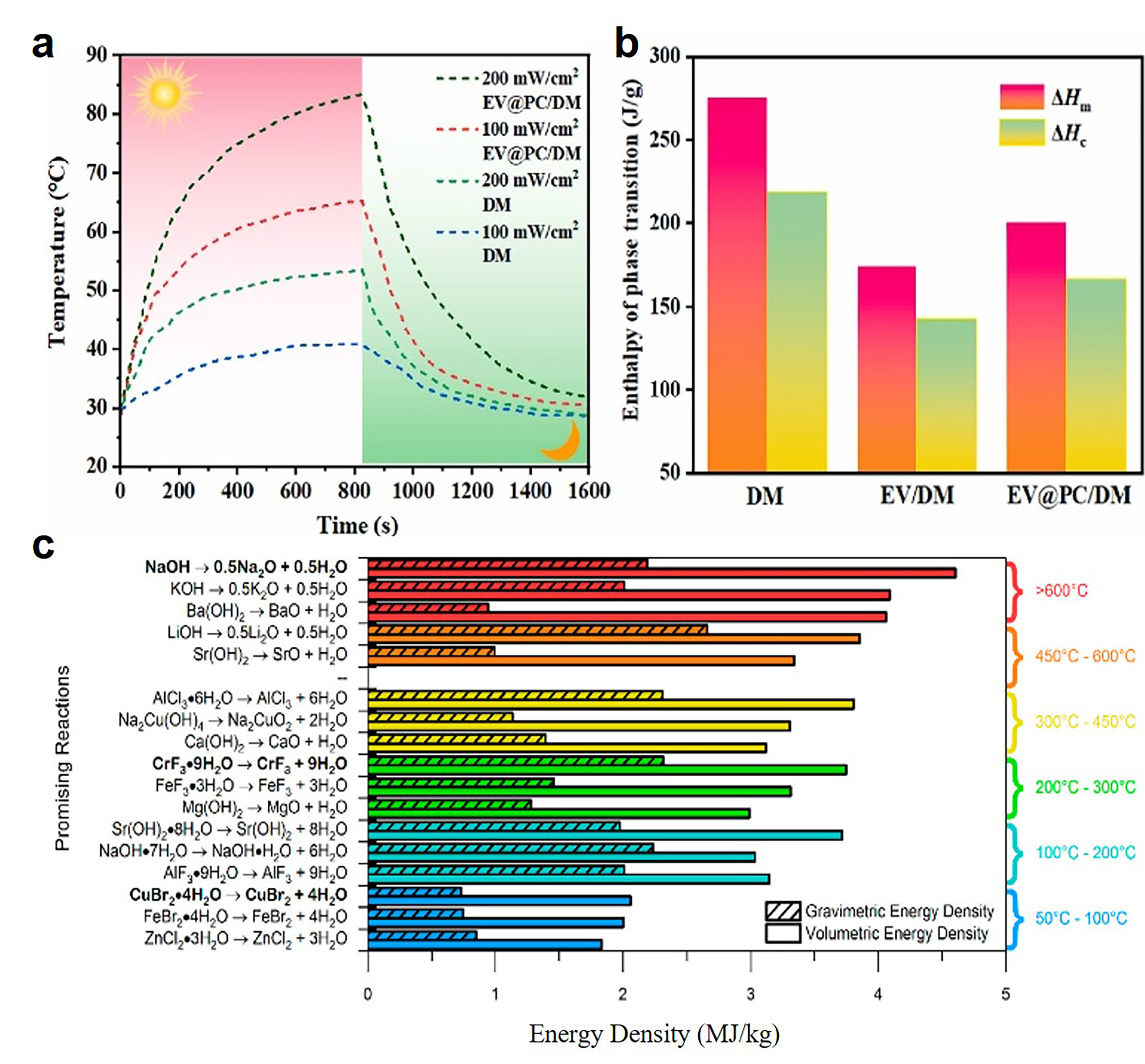
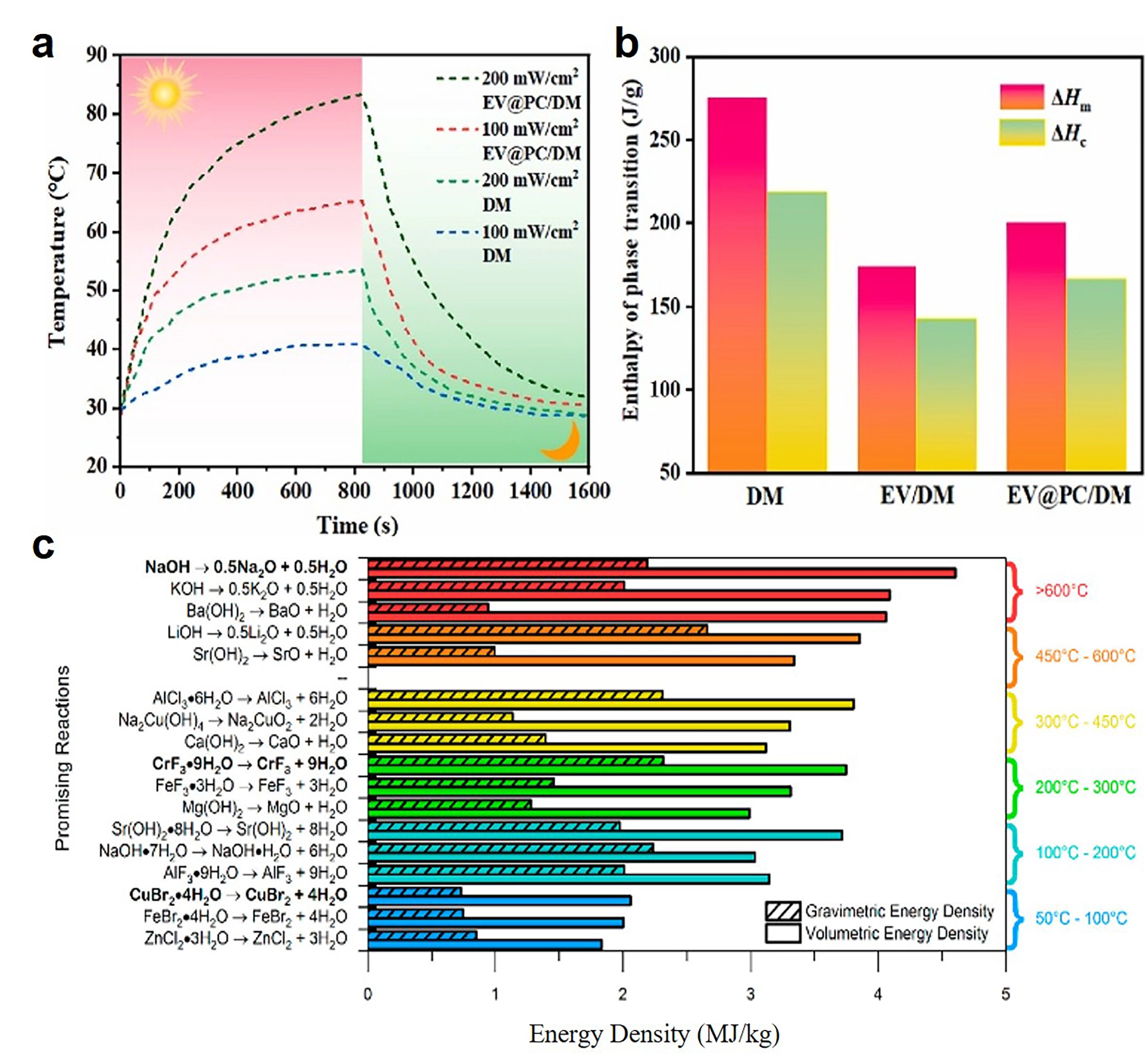
Figure 10. (a) Temperature profiles of DM and EV@PC/DM under different light intensities and de-illumination conditions; (b) Enthalpy of melting and crystallization of DM, EV/DM and EV@PC/DM. Reproduced with permission from reference[123]. Copyright © 2025 Elsevier; (c) Promising salt hydrate reaction selected by Kiyabu et al. for TCES. Reproduced from reference[124]. CC BY 4.0. DM: D-mannitol; EV: expanded vermiculite; EV@PC: expanded vermiculite and converted into a hierarchical porous carbon support.
In contrast to STES based on reversible adsorption processes, TCES aims to increase energy storage density through the incorporation of active materials, particularly hydrated salts[119]. In such composite systems, zeolites serve as porous hosts that provide abundant adsorption sites for salt dispersion, facilitate water vapor transport, and suppress salt agglomeration and leakage during repeated hydration-dehydration cycles. The efficacy of zeolite-supported salt hydrates has been demonstrated in numerous studies. For example, Xu et al. incorporated MgSO4 into 13X zeolite, achieving enhanced water uptake and dehydration enthalpy relative to pristine zeolite[125]. Similarly, MgCl2/CaCl2-loaded 13X zeolite exhibited improved energy storage density under humid conditions, highlighting the potential of hydrated salt-zeolite composites for thermochemical heat storage[126]. The performance enhancement of these composites originates from the reversible hydration-dehydration reactions of salt hydrates, while the zeolite framework provides structural stabilization during cycling. Various hydrated salts, including SrCl2, SrBr2, MgSO4, MgCl2, and CaCl2, have been integrated into zeolitic matrices to improve energy storage capacity beyond that of pure zeolites[124,126]. Figure 10c summarizes the energy-storage densities of representative hydrated salts, providing guidance for material selection. However, optimizing zeolite-based thermochemical storage materials requires a trade-off among storage capacity, mass-transfer efficiency, and long-term cycling stability rather than a singular focus on maximizing energy density.
3.3 Intelligent sensing
Recent advances in characterization techniques have substantially improved the understanding of the electrical properties of zeolites. As a result, zeolites have evolved from conventional sensitivity-enhancing additives to active functional materials capable of directly transducing chemical interactions into electrical signals[127,128]. In resistive gas sensing, Wang et al. demonstrated that Na-type ZSM-5 zeolites exhibited wide-band-gap semiconducting behavior with temperature-dependent electronic conductivity and ultraviolet photoresponse[127]. Based on these properties, they developed an electrically transduced NH3 sensor with a response of 51 toward 5 ppm NH3 at 300 °C, a detection limit of 77 ppb, and excellent humidity tolerance (Figure 11a). A combination of experimental and theoretical studies revealed that extra-framework Na+ cations act as Lewis acid sites for NH3 adsorption and facilitate charge transfer between adsorbed NH3 molecules and Na+ sites. This work highlights the intrinsic electronic functionality of zeolites and expands their application scope from passive adsorption materials to active platforms for chemical sensing and electronic devices. Further exploiting the electronic tunability of zeolites, Sun et al. modified ZSM-5 with Ag nanoparticles and integrated it with SnO2 to construct a SnO2/Ag@ZSM-5 heterostructured gas sensor. This composite sensor achieved a response of 29.4 toward 70 ppm formaldehyde, markedly outperforming pristine SnO2. Combined experimental and mechanistic analyses revealed that Ag modification narrowed the band gap of ZSM-5 from 4.51 to 3.61 eV, facilitating electronic sensitization and thereby improving the sensing response[128]. Meanwhile, the synergistic catalytic effects of Ag nanoparticles and zeolite promoted oxygen activation and spillover, generating abundant reactive oxygen species for enhanced formaldehyde oxidation (Figure 11b). The coupling of electronic and chemical sensitization significantly improved the resistance modulation of the sensing material, demonstrating the potential of band-gap engineering in zeolite-based gas sensing.
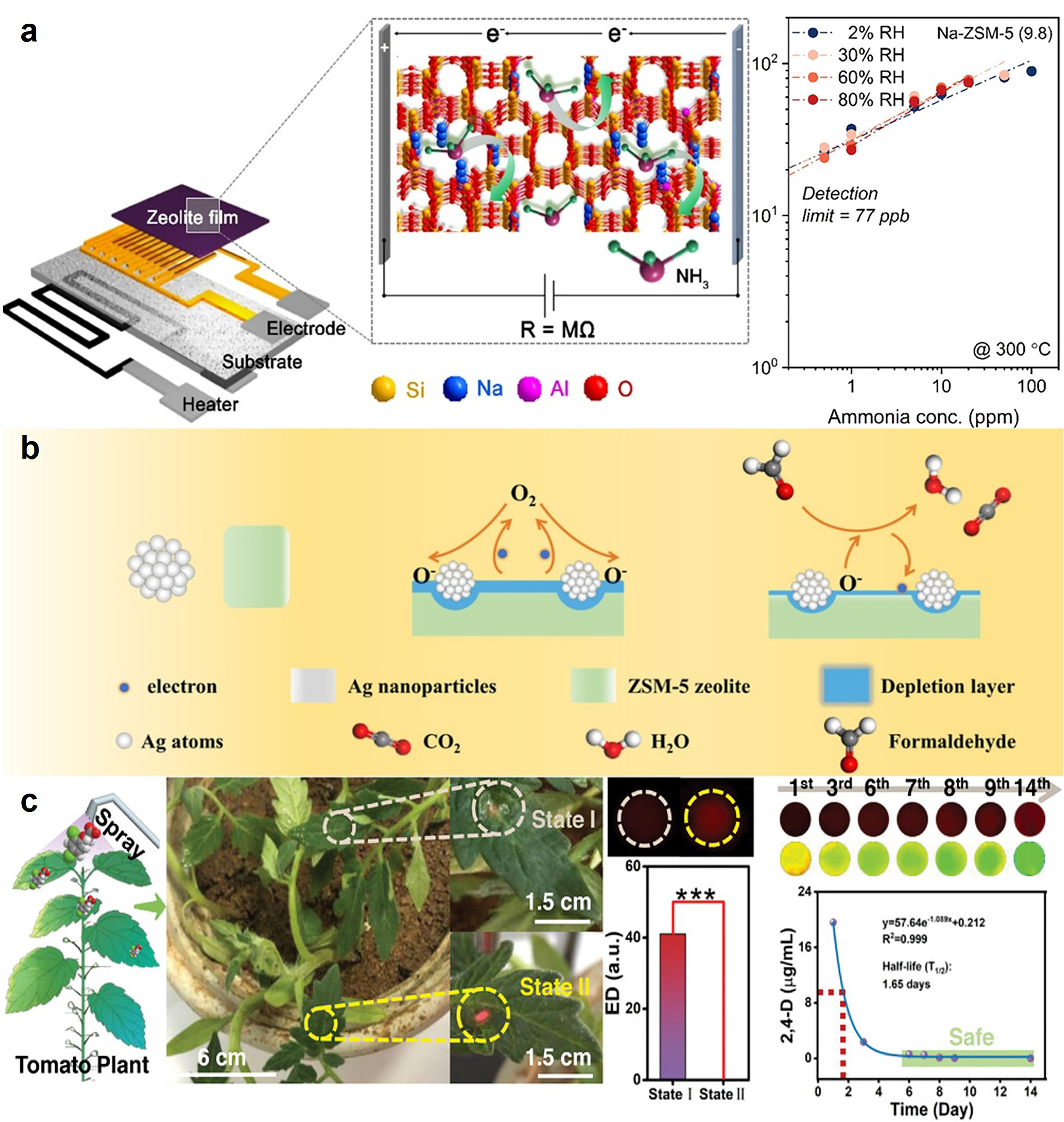
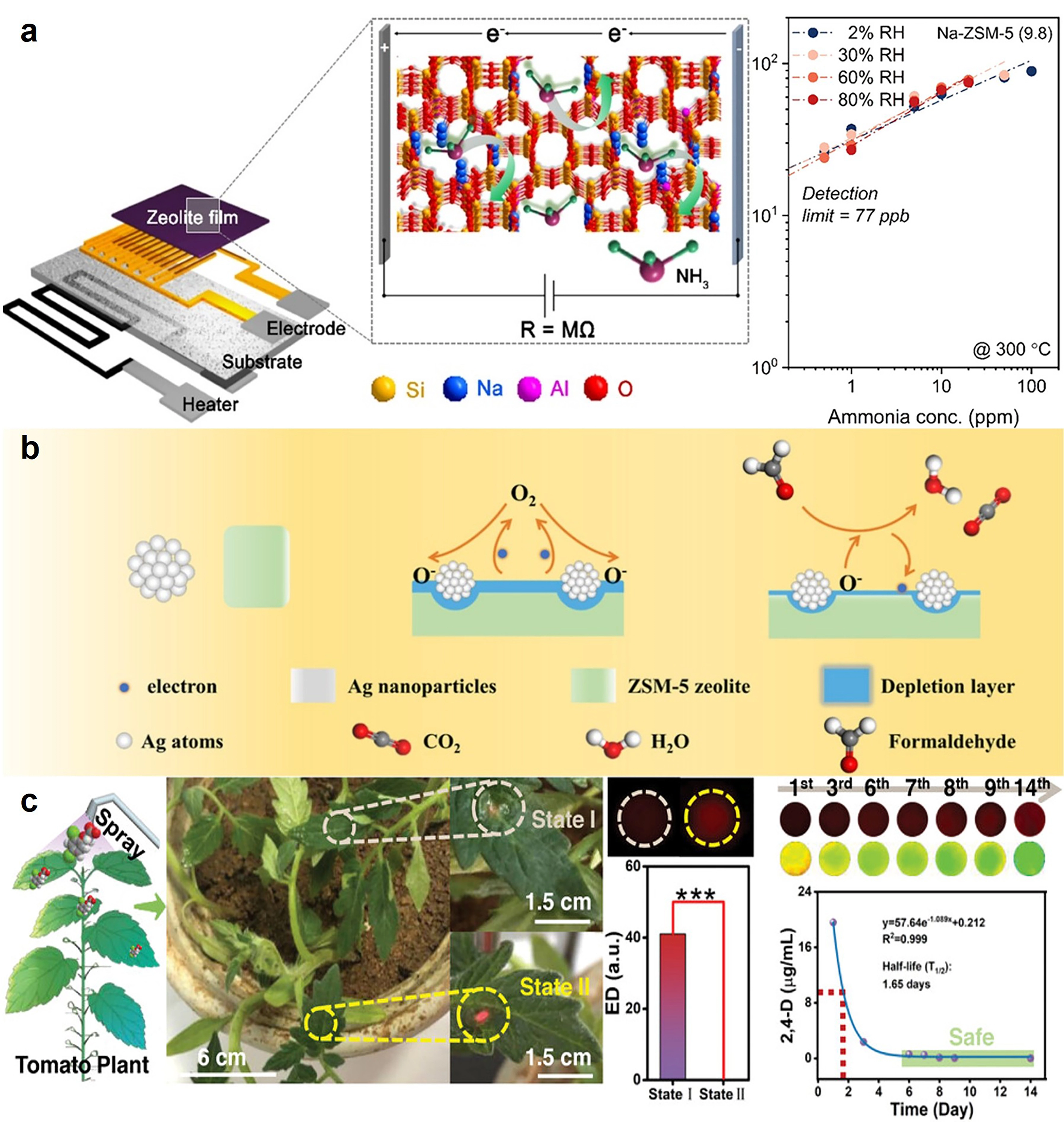
Figure 11. (a) The chemiresistive gas sensor based on zeolites, and efficient NH3 adsorption/diffusion over the zeolite film. Reproduced with permission from reference[127]. Copyright © 2023 American Chemical Society; (b) Gas-sensing mechanism of Ag@ZSM-5 in air and formaldehyde gas. Reproduced with permission from reference[128]. Copyright © 2023 American Chemical Society; (c) Hydrogel disc responses to 2,4-D on tomato plant leaves and its degradation over 14 days. Reproduced with permission from reference[129]. Copyright © 2024 Wiley-VCH GmbH.
Humidity interference remains a critical challenge for practical gas-sensing applications. Water vapor, typically present at concentrations far exceeding those of target gases, can compete for adsorption sites, perturb charge transport, and partially obstruct micropore diffusion, particularly in relatively hydrophilic zeolite frameworks. Consequently, the sensing response of some zeolite-containing devices deteriorates markedly with increasing relative humidity[130,131]. Notably, the susceptibility of zeolites to moisture is closely associated with their Si/Al ratio: zeolites with low Si/Al ratios are more hydrophilic and thus more susceptible to moisture-induced effects, whereas high-silica and all-silica zeolites generally exhibit enhanced moisture resistance owing to their intrinsically hydrophobic nature[132].
Zeolite-based materials also represent important functional components in electronic tongue (E-tongue) systems. In complex liquid matrices, selective transport layers can regulate the passage of taste-related ions and small molecules, thereby reducing interference from coexisting species and improving detection selectivity, signal-to-noise ratio, and operational stability[133]. For example, a pencil-drawn electronic tongue based on graphite and zeolite-modified pencil leads has been developed for water-quality monitoring. The sensor array exhibits distinct sensitivities to various inorganic ions and enables the quantification of total hardness, total alkalinity, and calcium content in surface-water samples[134]. The sensing mechanism is based on ion exchange between the zeolite and cations in the water sample, which alters the interfacial potential at the zeolite-solution interface and generates an electrical signal. Similar strategies have been demonstrated using polymeric molecular-sieving membranes such as Nafion. When integrated with MXene- or graphene-based sensing channels, Nafion coatings selectively permit the transport of small ions, including H+ and Na+, while restricting interfering macromolecules such as ascorbic acid and uric acid. These modified sensors enable accurate pH and salinity analysis in beverages and, when combined with principal component analysis (PCA), facilitate discrimination of different taste profiles. In dual-mode E-tongue systems, Nafion membranes further function as anti-interference layers to improve the accuracy of simultaneous multiparameter detection[135,136]. These studies highlight the pivotal role of molecular sieving interfaces in enhancing the selectivity and reliability of E-tongue platforms.
Flexible wearable sensing technology has emerged as an advanced analytical platform for diverse applications, including health monitoring and environmental analysis[137,138]. Zeolite materials can serve as either active sensing components or selective interfacial layers, improving the anti-interference capability, sensitivity, and environmental adaptability of flexible sensors. In the field of health monitoring, Zeng et al. developed a flexible electrochemical sensor based on layered copper-modified mordenite (Cu-MOR) for sweat uric acid detection. The integrated wearable system exhibited a wide linear detection range of 0.08-1,000 μM and a detection limit of 0.04 μM. Moreover, the sensor maintained stable performance under mechanical deformation, underscoring the promise of zeolite-based materials for wearable biochemical monitoring[139]. Plant-wearable sensing represents an emerging non-invasive strategy for real-time monitoring of agricultural chemicals. A hydrogel sensor incorporating ZIF-8 as a functional interlayer (UCNPs@ZIF@PDA) was developed for on-site detection of pesticide residues on plant surfaces (Figure 11c)[129]. The sensor exhibited a low detection limit of 20 ng mL-1 for 2,4-dichlorophenoxyacetic acid (2,4-D) and a broad linear detection range. In this system, ZIF-8 acted as both a host matrix for fluorescent probes and a mediator for polydopamine shell formation, thereby enhancing fluorescence signal modulation.
Despite these promising developments, zeolite-based sensing materials still face several challenges, including limited long-term stability in liquid environments, the trade-off between molecular sieving selectivity and mass-transfer efficiency, and difficulties in large-scale manufacturing[140,141]. Zeolite/polymer composites may overcome some of these limitations; however, further advances in pore-size regulation, structural flexibility, and functional modification are required to meet the demands of practical applications.
Authors contribution
Zhao J: Conceptualization, methodology, investigation, visualization, writing-original draft.
Yang P, Yu J, Dai W: Supervision, writing-review & editing.
Conflicts of interest
The authors declare no conflicts of interest.
Ethical approval
Not applicable.
Consent to participate
Not applicable.
Consent for publication
Not applicable.
Availability of data and materials
Not applicable.
Funding
This work was supported by National Energy R&D Center of Petroleum Refining Technology (RIPP, SINOPEC), the National Natural Science Foundation of China (Grant Nos. U25A20544, 22272083, and 22502088), and the Fundamental Research Funds for the Central Universities (Grant No. 023-63263164).
Copyright
© The Author(s) 2026.
References
-
1. Davis ME. Ordered porous materials for emerging applications. Nature. 2002;417(6891):813-821.[DOI]
-
2. Titiloye JO, Tschaufeser P, Parker SC. Recent advances in computational studies of zeolites. In: Davies JED, editor. Spectroscopic and computational studies of supramolecular systems. Dordrecht: Springer; 1992. p. 137-185.[DOI]
-
3. Barrer RM. 435. Syntheses and reactions of mordenite. J Chem Soc. 1948;151:2158-2163.[DOI]
-
5. Rodionova LI, Knyazeva EE, Konnov SV, Ivanova II. Application of nanosized zeolites in petroleum chemistry: Synthesis and catalytic properties (Review). Pet Chem. 2019;59(4):455-470.[DOI]
-
6. Ponomareva OA, Kasyanov IA, Knyazeva EE, Konnov SV, Ivanova II. Effect of the degree of zeolite recrystallization into micro-mesoporous materials on their catalytic properties in petroleum refining and petroleum chemistry processes. Pet Chem. 2016;56(9):819-826.[DOI]
-
7. Ma J, Wang J, Yuan J, Liu X, Yang Y, Yu F. The regulating strategy of hierarchical structure and acidity in zeolites and application of gas adsorption: A review. Chin Chem Lett. 2024;35(11):109693.[DOI]
-
8. Moliner M, Martínez C, Corma A. Synthesis strategies for preparing useful small pore zeolites and zeotypes for gas separations and catalysis. Chem Mater. 2014;26(1):246-258.[DOI]
-
9. Buzukashvili S, Sommerville R, Hu W, Brooks O, Kökkılıç O, Ouzilleau P, et al. Zeolite synthesis from coal fly ash and its application to heavy metals remediation from water contaminated with Pb, Cu, Zn and Ni ions. Miner Eng. 2024;209:108619.[DOI]
-
10. Radoor S, Karayil J, Kim H. Recent advances in ZSM-5 zeolite for multi-pollutant removal from water: A mini review. Microporous Mesoporous Mater. 2026;399:113841.[DOI]
-
11. de Jesús Ruíz-Baltazar Á. Advancements in nanoparticle-modified zeolites for sustainable water treatment: An interdisciplinary review. Sci Total Environ. 2024;946:174373.[DOI]
-
12. Dere Ozdemir O, Piskin S. A novel synthesis method of zeolite X from coal fly ash: Alkaline fusion followed by ultrasonic-assisted synthesis method. Waste Biomass Valor. 2019;10(1):143-154.[DOI]
-
13. Zaarour M, Dong B, Naydenova I, Retoux R, Mintova S. Progress in zeolite synthesis promotes advanced applications. Microporous Mesoporous Mater. 2014;189:11-21.[DOI]
-
14. Jusoh N, Yeong YF, Mohamad M, Lau KK, Shariff AM. Rapid-synthesis of zeolite T via sonochemical-assisted hydrothermal growth method. Ultrason Sonochem. 2017;34:273-280.[DOI]
-
15. Feng SA, Zhou J, Yang XY, Liu H, Huang JF, Bai JF, et al. Synthesis of pure-silica BETA zeolite by the method of seed-direct steam-assisted crystallization. J Inorg Mater. 2018;33(9):963. Chinese.[DOI]
-
17. Meng X, Xiao FS. Green routes for synthesis of zeolites. Chem Rev. 2014;114(2):1521-1543.[DOI]
-
18. Li Y, Yu J. Emerging applications of zeolites in catalysis, separation and host-guest assembly. Nat Rev Mater. 2021;6(12):1156-1174.[DOI]
-
20. Lutzweiler G, Bashirova K, Louis B. Tuning zeolite crystal composition and morphology for biomedical applications. Cryst Growth Des. 2025;25(12):4089-4099.[DOI]
-
22. Bacakova L, Vandrovcova M, Kopova I, Jirka I. Applications of zeolites in biotechnology and medicine-a review. Biomater Sci. 2018;6(5):974-989.[DOI]
-
23. Zhang K, Wu F, Li Y, Shi J, Feng X, Wu C, et al. Multifunctional zeolites in secondary batteries. Chem Rev. 2026;126(5):2929-3006.[DOI]
-
24. Zhen L, Meng G, Li H, Zhou B, Xie J, Yang D, et al. Pore structure modification of zeolite for efficient thermal energy storage. J Energy Storage. 2026;154:121299.[DOI]
-
29. Chen W, Xu L, Fu Z, Ma F, Jiang J. Zeolite, a new intrinsic Pickering emulsifier. Chem Res Chin Univ. 2026;42(1):33-42.[DOI]
-
30. Singh P, Panwar S, Dave PN. Advancing environmental remediation with metal-organic frameworks: Perspectives on green synthesis, scale-up strategies, techno-economic analysis, and life cycle assessment. Adv Mater Technol. 2026;11(3):e01309.[DOI]
-
31. Gao S, Peng H, Song B, Zhang J, Wu W, Vaughan J, et al. Synthesis of zeolites from low-cost feeds and its sustainable environmental applications. J Environ Chem Eng. 2023;11(1):108995.[DOI]
-
32. Liang Z, Liu Z, Yu L, Wang W. Fly ash-based zeolites: From waste to value-a comprehensive overview of synthesis, properties, and applications. Chem Eng Res Des. 2024;212:240-260.[DOI]
-
33. Xu Q, Yan A. Hydrothermal synthesis and crystallization of zeolites. Prog Cryst Growth Charact Mater. 1991;21(1-4):29-70.[DOI]
-
34. Weller MT, Dann SE. Hydrothermal synthesis of zeolites. Curr Opin Solid State Mater Sci. 1998;3(2):137-143.[DOI]
-
35. Cundy CS, Cox PA. The hydrothermal synthesis of zeolites: History and development from the earliest days to the present time. Chem Rev. 2003;103(3):663-702.[DOI]
-
36. Zhong X, Liu J, Gao L, Wang X, Zhang Y, Wu YA, et al. Time-resolved dynamic observation of solvent-free and organic template-free solid-phase synthesis process for Pt/ZSM-5 encapsulated structure. CCS Chem. 2025;7(10):3131-3145.[DOI]
-
37. Do MH, Wang T, Cheng DG, Chen F, Zhan X, Gong J. Zeolite growth by synergy between solution-mediated and solid-phase transformations. J Mater Chem A. 2014;2(35):14360-14370.[DOI]
-
38. Salahudeen N. A review on zeolite: Application, synthesis and effect of synthesis parameters on product properties. Chem Afr. 2022;5(6):1889-1906.[DOI]
-
39. Haouas M, Gérardin C, Taulelle F, Estournes C, Loiseau T, Ferey G. In situ NMR study of hydrothermal synthesis of a template-mediated microporous aluminophosphate material: AlPO4-CJ2. J Chim Phys. 1998;95(2):302-309.[DOI]
-
41. Beheshti MS, Ahmadpour J, Behzad M, Arabi H. Hydrothermal synthesis of H-ZSM-5 catalysts employing the mixed template method and their application in the conversion of methanol to light olefins. React Kinet Mech Catal. 2020;130(1):493-518.[DOI]
-
42. Su X, Wang Y, Bu L, Zhang X, Li Y, Sang J, et al. Fabrication of binder-free hierarchical ZSM-5 zeolite monoliths via steam-assisted crystallization. Chem Res Chin Univ. 2025;41(4):919-928.[DOI]
-
43. Jia Y, Wang J, Zhang K, Chen G, Yang Y, Liu S, et al. Hierarchical ZSM-5 zeolite synthesized via dry gel conversion-steam assisted crystallization process and its application in aromatization of methanol. Powder Technol. 2018;328:415-429.[DOI]
-
44. Xu W, Dong J, Li J, Li J, Wu F. A novel method for the preparation of zeolite ZSM-5. J Chem Soc, Chem Commun. 1990(10);755-756.[DOI]
-
46. Yabushita M, Yoshida M, Osuga R, Muto F, Iguchi S, Yasuda S, et al. Mechanochemical route for preparation of MFI-type zeolites containing highly dispersed and small Ce species and catalytic application to low-temperature oxidative coupling of methane. Ind Eng Chem Res. 2021;60(28):10101-10111.[DOI]
-
47. Ferreira Young A, Nothaft Romano P, Aurélio Suller Garcia M, Alexandre Gomes Aranda D, Monnerat Araújo Ribeiro de Almeida J. Microwave-enhanced preparation of finned-FER zeolites and their application in the skeletal isomerization of FAME. Fuel. 2024;373:132331.[DOI]
-
48. Zhang Y, Zhang Z, Han H, Zhang M, Wang H, Song H, et al. Effective removal of organic dyes using the ultrasonic-assisted hydrothermal synthesis of NaP zeolite doping Cu or Fe in Fenton-like oxidation systems. Sep Purif Technol. 2022;299:121767.[DOI]
-
49. Chen X, Wang Y, Wang C, Xu J, Li T, Yue Y, et al. Synthesis of NaA zeolite via the mesoscale reorganization of submolten salt depolymerized kaolin: A mechanistic study. Chem Eng J. 2023;454:140243.[DOI]
-
50. Wu P, Miyaji T, Liu Y, He M, Tatsumi T. Synthesis of Ti-MWW by a dry-gel conversion method. Catal Today. 2005;99(1-2):233-240.[DOI]
-
51. Li ZH, Li XF, Di CY, Dou T, Chen SL. A green and cost-effective synthesis of hierarchical SAPO-34 through dry gel conversion and its performance in a methanol-to-olefin reaction. Ind Eng Chem Res. 2021;60(43):15380-15390.[DOI]
-
53. Szczęśniak B, Borysiuk S, Choma J, Jaroniec M. Mechanochemical synthesis of highly porous materials. Mater Horiz. 2020;7(6):1457-1473.[DOI]
-
55. Liu P, Wu Q, Chen Z, Xiao FS. Recent advances in the synthesis of zeolites from solid wastes. Chem Res Chin Univ. 2024;40(4):646-656.[DOI]
-
56. Kim JC, Choi M, Song HJ, Park JE, Yoon JH, Park KS, et al. Synthesis of uniform-sized zeolite from windshield waste. Mater Chem Phys. 2015;166:20-25.[DOI]
-
57. Molina A, Poole C. A comparative study using two methods to produce zeolites from fly ash. Miner Eng. 2004;17(2):167-173.[DOI]
-
58. Prokof’ev VY, Gordina NE, Zhidkova AB, Efremov AM. Mechanochemical synthesis of granulated LTA zeolite from metakaolin. J Mater Sci. 2012;47(14):5385-5392.[DOI]
-
59. Majano G, Borchardt L, Mitchell S, Valtchev V, Pérez-Ramírez J. Rediscovering zeolite mechanochemistry-a pathway beyond current synthesis and modification boundaries. Microporous Mesoporous Mater. 2014;194:106-114.[DOI]
-
60. Guo W, Pang L, Zhang J, Sun H, Ding Y, Bai S, et al. Solvent-free synthesis of micron-sized silicalite-1 zeolite: Optimization, characterization and mechanism. J Solid State Chem. 2024;340:124979.[DOI]
-
61. Qie Z, Ji Z, Xiang H, Zhang X, Alhelali A, Lan L, et al. Microwave-assisted post treatment to make hydrophobic zeolite Beta for aromatics adsorption in aqueous systems. Sep Purif Technol. 2023;320:124148.[DOI]
-
62. Hu Y, Liu C, Zhang Y, Ren N, Tang Y. Microwave-assisted hydrothermal synthesis of nanozeolites with controllable size. Microporous Mesoporous Mater. 2009;119(1-3):306-314.[DOI]
-
65. Yin X, Long Z, Wang C, Li Z, Zhao M, Yang S. A time- and cost-effective synthesis of CHA zeolite with small size using ultrasonic-assisted method. Ultrason Sonochem. 2019;58:104679.[DOI]
-
69. Afanasiev P, Geantet C. Synthesis of solid materials in molten nitrates. Coord Chem Rev. 1998;178-180(Part 2):1725-1752.[DOI]
-
70. Park M, Choi CL, Lim WT, Kim MC, Choi J, Heo NH. Molten-salt method for the synthesis of zeolitic materials. Microporous Mesoporous Mater. 2000;37(1-2):81-89.[DOI]
-
72. Tang Z, Xu Q, Wu Y, Shi X, Zhu X, Liu X, et al. Engineering the Si/Al ratio of MWW zeolites for propylene/propane separation. Natl Sci Open. 2025;4(6):20250064.[DOI]
-
73. Matusiak J, Przekora A, Franus W. Zeolites and zeolite imidazolate frameworks on a quest to obtain the ideal biomaterial for biomedical applications: A review. Mater Today. 2023;67:495-517.[DOI]
-
74. Sahu T, Ratre YK, Chauhan S, Bhaskar LVKS, Nair MP, Verma HK. Nanotechnology based drug delivery system: Current strategies and emerging therapeutic potential for medical science. J Drug Deliv Sci Technol. 2021;63:102487.[DOI]
-
77. Domke A, Fischer M, Jakubowski M, Pacholak A, Ratajczak M, Voelkel A, et al. Experimental and computational study on the Ca2+, Mg2+, Zn2+ and Sr2+ exchanged zeolites as a drug delivery system for fluoroquinolone antibiotic-Ciprofloxacin. J Drug Deliv Sci Technol. 2024;99:105997.[DOI]
-
78. Chen J, Bao X, Meng T, Sun J, Yang X. Zeolitic imidazolate framework-67 accelerates infected diabetic chronic wound healing. Chem Eng J. 2022;430:133091.[DOI]
-
80. Wang Q, Wang L, Liu X, Chen H, Wang X, Wang P, et al. A pH-responsive magnetic-controlled nanocomposite for precise and efficient vancomycin delivery in treating prosthetic joint infections. Adv Compos Hybrid Mater. 2025;8(1):115.[DOI]
-
84. Torres C, Whitehead EC, Le Monnier BP, Peña D, Palomino-Calderón A, Neira M, et al. Silicoaluminophosphate (SAPO) zeolites with nanometric dimensions: Structural tuning for osteoinductive applications in bone regeneration. Materialia. 2025;40:102401.[DOI]
-
88. Bedi RS, Beving DE, Zanello LP, Yan Y. Biocompatibility of corrosion-resistant zeolite coatings for titanium alloy biomedical implants. Acta Biomater. 2009;5(8):3265-3271.[DOI]
-
89. Bedi RS, Chow G, Wang J, Zanello L, Yan YS. Bioactive materials for regenerative medicine: Zeolite-hydroxyapatite bone mimetic coatings. Adv Eng Mater. 2012;14(3):200-206.[DOI]
-
92. Young SW, Qing F, Rubin D, Balkus KJ, Engel JS, Lang J, et al. Gadolinium zeolite as an oral contrast agent for magnetic resonance imaging. J Magn Reson Imaging. 1995;5(5):499-508.[DOI]
-
95. Zheng Z, Jia Z, Qin Y, Dai R, Chen X, Ma Y, et al. All-in-one zeolite-carbon-based nanotheranostics with adjustable NIR-II window photoacoustic/fluorescence imaging performance for precise NIR-II photothermal-synergized catalytic antitumor therapy. Small. 2021;17(41):2103252.[DOI]
-
96. Lerouge F, Melnyk O, Durand JO, Raehm L, Berthault P, Huber G, et al. Towards thrombosis-targeted zeolite nanoparticles for laser-polarized 129Xe MRI. J Mater Chem. 2009;19(3):379-386.[DOI]
-
97. Rezvani Ghomi E, Niazi M, Ramakrishna S. The evolution of wound dressings: From traditional to smart dressings. Polym Adv Technol. 2023;34(2):520-530.[DOI]
-
98. Montazerian H, Davoodi E, Baidya A, Baghdasarian S, Sarikhani E, Meyer CE, et al. Engineered hemostatic biomaterials for sealing wounds. Chem Rev. 2022;122(15):12864-12903.[DOI]
-
100. Shang X, Chen H, Castagnola V, Liu K, Boselli L, Petseva V, et al. Unusual zymogen activation patterns in the protein corona of Ca-zeolites. Nat Catal. 2021;4(7):607-614.[DOI]
-
101. Chen L, Jin Z, Kamiya T, Liu X, Tian Y, Xia R, et al. Nanoporous zeolite anchored cellulose nanofiber aerogel for safe and efficient hemostasis. Small. 2025;21(21):2500696.[DOI]
-
104. Liu Y, Zhang Q, Dang C, Dong J, Kong L, Li M, et al. Au-embedded mesoporous molecular sieve enables robust organic/inorganic hybrid solid electrolyte interphase for high-performance lithium metal batteries. Chem Eng J. 2024;490:151616.[DOI]
-
106. Luo Z, Cui Y, Zhang Z, Li M, Yu J. A solid composite electrolyte based on three-dimensional structured zeolite networks for high-performance solid-state lithium metal batteries. Chem Sci. 2026;17(7):3533-3543.[DOI]
-
108. Phiri I, Ssendagire K, Ryou SY. Fast charge-discharge of LiNi0.9Co0.05Mn0.05 enabled by a bikitaite-infused separator for Li metal batteries. Adv Funct Mater. 2026;36(54):e75036.[DOI]
-
109. Su B, Chai L, Huo S, Wang Y, Wang X, Li M, et al. Cu/LiF-rich dual-layered solid electrolyte interphase enabling high ionic flux and uniform electric field for dendrite-free lithium metal anodes. Chem Eng J. 2025;513:162742.[DOI]
-
110. Zhou Y, Zhang Y, Hu J, Li X, Yang Y, Hou L, et al. Zeolite-armored polyimide Janus separator for dendrite-free lithium metal batteries. J Power Sources. 2026;666:239185.[DOI]
-
111. Gao Y, Zhang YY, Wu G, Wang XL, Wang YZ. Anions-trappable hollow mesoporous nanoparticle coating enables high-performance and safe lithium metal batteries. Adv Funct Mater. 2024;34(49):2411555.[DOI]
-
112. Shekarian E, Jafari Nasr MR, Mohammadi T, Bakhtiari O, Javanbakht M. Preparation of 4A zeolite coated polypropylene membrane for lithium-ion batteries separator. J Appl Polym Sci. 2019;136(32):47841.[DOI]
-
113. Abdulkadir BA, Mohd Zaki RSR, Abd Wahab AT, Miskan SN, Nguyen AT, Vo DN, et al. A concise review on surface and structural modification of porous zeolite scaffold for enhanced hydrogen storage. Chin J Chem Eng. 2024;70:33-53.[DOI]
-
114. Masika E, Mokaya R. Preparation of ultrahigh surface area porous carbons templated using zeolite 13X for enhanced hydrogen storage. Prog Nat Sci Mater Int. 2013;23(3):308-316.[DOI]
-
115. Erdogan FO, Celik C, Turkmen AC, Sadak AE, Cücü E. Hydrogen storage behavior of zeolite/graphene, zeolite/multiwalled carbon nanotube and zeolite/green plum stones-based activated carbon composites. J Energy Storage. 2023;72:108471.[DOI]
-
116. Erdoğan Alver B, Sakızcı M. Hydrogen (H2) adsorption on natural and cation-exchanged clinoptilolite, mordenite and chabazite. Int J Hydrogen Energy. 2019;44(13):6748-6755.[DOI]
-
117. Qin Y, Chen L, Ge L, Zhu Y, Li W, Cao X, et al. Role of hydrogen spillover on the hydrogenation of N-ethylcarbazole over in-situ encapsulation of Ru within zeolite for hydrogen storage. Chem Eng Sci. 2025;304:121001.[DOI]
-
118. Zhao Z, Zhang T, Feng Y, Wang N, Sun Q. Subnanometer palladium-manganese clusters in hydrophilic amino-functionalized zeolites for efficient formic acid dehydrogenation. Chem Eng J. 2024;496:154194.[DOI]
-
119. Kouchachvili L, Bardy DA, Djebbar R, Hogg LEW. Natural zeolites as host matrices for the development of low-cost and stable thermochemical energy storage materials. J Porous Mater. 2023;30(1):163-173.[DOI]
-
120. Feng C, E J, Han W, Deng Y, Zhang B, Zhao X, et al. Key technology and application analysis of zeolite adsorption for energy storage and heat-mass transfer process: A review. Renew Sustain Energy Rev. 2021;144:110954.[DOI]
-
121. Tabero P, Gabruś E. A study of the thermal regeneration of loaded hydrophobic and hydrophilic zeolites after adsorption in the liquid phase. Chem Process Eng: New Front. 2023;44(4):e38.[DOI]
-
122. Gabbrielli R, Buzzi FP, Di Paco F, Di Palo M, Arcieri G, Sabatelli V. Thermochemical energy storage with zeolite 13X: Results from a full-scale solar heat application. Appl Therm Eng. 2025;279:127608.[DOI]
-
123. Lv X, Li G, Fan C, Zhou X, Tan T, Cao H. In situ growth of zeolitic imidazolate framework on expanded vermiculite to regulate the phase transition of D-mannitol for thermal energy storage and solar energy conversion. Sol Energy Mater Sol Cells. 2025;283:113460.[DOI]
-
124. Kiyabu S, Lowe JS, Ahmed A, Siegel DJ. Computational screening of hydration reactions for thermal energy storage: New materials and design rules. Chem Mater. 2018;30(6):2006-2017.[DOI]
-
125. Xu SZ, Wang RZ, Wang LW, Zhu J. Performance characterizations and thermodynamic analysis of magnesium sulfate-impregnated zeolite 13X and activated alumina composite sorbents for thermal energy storage. Energy. 2019;167:889-901.[DOI]
-
126. Touloumet Q, Postole G, Massin L, Lorentz C, Auroux A. Investigation of the impact of zeolite shaping and salt deposition on the characteristics and performance of composite thermochemical heat storage systems. J Mater Chem A. 2023;11(6):2737-2753.[DOI]
-
131. Yu S, Jia X, Zhang J, Yang W, Song H. Recent advances in different materials for moisture resistance of metal oxide-based gas sensors: A review. Chem Eng J. 2025;505:159639.[DOI]
-
132. Resasco DE, Crossley SP, Wang B, White JL. Interaction of water with zeolites: A review. Catal Rev. 2021;63(2):302-362.[DOI]
-
133. Lee CW, Jun SE, Kim SJ, Lee TH, Lee SA, Yang JW, et al. Rationally designed graphene channels for real-time sodium ion detection for electronic tongue. InfoMat. 2023;5(7):e12427.[DOI]
-
135. Lee CW, Suh JM, Choi S, Jun SE, Lee TH, Yang JW, et al. Surface-tailored graphene channels. npj 2D Mater Appl. 2021;5:39.[DOI]
-
136. Kim HJ, Hyun JU, Jang HW. Electronic tongue: Active channels, molecular sieves, receptors and arrays. Sustainable Food Technol. 2025;3(6):1681-1704.[DOI]
-
138. Zhang Q, Yuan M, Chen J, Yang Y, Lu M, Cui C, et al. Zeolitic imidazolate framework enabled heat-resistant enzymatic biosensor for real-time and non-invasive detection of glucose. Chem Eng J. 2026;545:179591.[DOI]
-
139. Zeng X, Zhou P, Tang Y, Lin S, Zhang Z, Liu B. A wearable high-performance electrochemical sensor based on the lamellar Cu-MOR zeolite for real-time monitoring of uric acid. Sens Actuators B Chem. 2026;447:138776.[DOI]
-
140. Walcarius A. Recent advances in electrochemistry with zeolitic materials. Curr Opin Electrochem. 2026;56:101808.[DOI]
-
141. Stosic D, Zholobenko V. Application of zeolite-based materials for chemical sensing of VOCs. Sensors. 2025;25(5):1634.[DOI]
Copyright
© The Author(s) 2026. This is an Open Access article licensed under a Creative Commons Attribution 4.0 International License (https://creativecommons.org/licenses/by/4.0/), which permits unrestricted use, sharing, adaptation, distribution and reproduction in any medium or format, for any purpose, even commercially, as long as you give appropriate credit to the original author(s) and the source, provide a link to the Creative Commons license, and indicate if changes were made.
Publisher’s Note
Science Exploration remains a neutral stance on jurisdictional claims in published
maps
and institutional affiliations. The views expressed in this article are solely those
of
the author(s) and do not reflect the opinions of the Editors or the publisher.
Share And Cite


Science Exploration Style
Zhao J, Yang P, Yu J, Dai W. Zeolite materials: Synthesis strategies and emerging applications in biomedicine, energy storage, and intelligent sensing. Smart Mater Devices. 2026;2:202651. https://doi.org/10.70401/smd.2026.0047
Tips
Copy completed.
Submit a Manuscript
Author Instructions
Cite this Article
Article Metrics
0
View
0
Download
Cited
Article Updates

 Get citation
Science Exploration Style

Zhao J, Yang P, Yu J, Dai W. Zeolite materials: Synthesis strategies and emerging applications in biomedicine, energy storage, and intelligent sensing. Smart Mater Devices. 2026;2:202651. https://doi.org/10.70401/smd.2026.0047
copy
Share Link
copy