Luminescent metal-organic frameworks for odor sensing and bionic olfactory receptors: Mechanisms, design, and applications

Yuzhi Qin
Lihua Li
*

*Correspondence to:
Lihua Li, School of Optoelectronic Science and Engineering, Future Institute of Technology, South China Normal University, Guangzhou 510631, Guangdong, China.
E-mail: lihua361@126.com
Smart Mater Devices. 2027;3:202644. 10.70401/smd.2026.0063
Received: July 24, 2026Accepted: October 20, 2026Published: November 03, 2026
Abstract
Luminescent metal-organic frameworks (LMOFs) combine the multi-response informational properties of optics and the high porosity, and tunability properties of framework materials. They exhibit behavior similar to that of neuronal olfactory receptors (ORs) in terms of their structure and signal response properties, therefore making them a promising candidate materials for the construction of bionic olfactory systems. The sensitive and diverse responses of LMOFs to the composition and concentration of gaseous environments originate from their ordered porous structures, tunable and diverse luminescent sensing pathways, and host-guest interaction behaviors, enabling their widespread application in the construction of bionic olfactory systems for environmental and industrial monitoring, breath and biomarker detection, the food industry, and high-risk environments. This paper adopts a bottom-up perspective to systematically review design strategies for bionic ORs from the standpoint of functional group sensitivity in odor molecules. These strategies include methods for the preparation and modulation of LMOFs, signal transduction mechanisms, and luminescent sensing pathways, as well as the diverse design and material selection of ORs. This perspective not only offers new insights into the design and selection of odor-sensing materials but also provides a reference and basis for the design of bionic olfactory systems through the intrinsic connection between microscopic luminescent sensing mechanisms and signal transduction mechanisms. This paper provides a review and discusses the prospects for the design of bionic olfactory ORs, promoting the development of this field from basic research on sensor materials toward application-oriented bionic olfactory systems, and extending the transition from artificial intelligence to embodied intelligence to the field of olfaction.
Keywords
Luminescent metal-organic frameworks, gas sensor, bionic olfactory, fluorescence sensing, colorimetric sensing
1. Introduction
Currently, artificial intelligence agents are evolving from embodied intelligence, which focuses on processing passive input, toward embodied intelligence that directly interacts with the physical world[1]. Embodied agents emphasize autonomous learning and evolution through dynamic interaction between the body and the environment, with their essence lying in the deep integration of perception, action, and cognition. However, existing agents still rely on physical signal channels such as touch, vision, and sound for environmental perception, and lack the ability to perceive the chemical environment and true odors[2-4]. This prevents agents from detecting changes in the chemical atmosphere of the real world, thereby limiting their application in practical scenes involving complex chemical information, such as the daily chemical industry[5-9], environmental monitoring[10-12], explosives[13-16], flavor[17-20], food safety[21-23], medication[24,25] and medical diagnosis[26-30].
Olfaction is the primary method by which humans to receive chemical information from the external world. It identifies odor molecules through olfactory receptors (ORs) distributed on olfactory neurons and converts environmental chemical information into physiological signals that can be processed by the central nervous system via a series of neural cell combinations. Its essence lies in high-dimensional pattern recognition, rather than simple presence/absence detection or quantitative analysis. Specifically, a single odor can simultaneously activate multiple ORs, while a single OR can be activated by multiple odorants with similar structures, thereby establishing an odor-coding mechanism based on the combined response patterns of ORs. This strategy significantly expands the range of odors that can be detected by a limited number of receptors, enabling humans to distinguish among trillions of different odors[31-33].
The mechanisms of differentiation and multi-responsiveness in the ORs of the olfactory system are fundamental to constructing odor coding and true odor perception. Luminescent metal-organic frameworks (LMOFs) combine multi-responsive optical properties and the high-coordination characteristics of metal-organic frameworks (MOFs), making them suitable for applications in odor sensing and the bionic design of ORs[34-39]. From a functional perspective, LMOFs exhibit significant analogies with ORs in terms of structure and signal response characteristics: the porous structure of MOFs simulates ORs’ capture and enrichment of odor molecules, while their multi-emission centers or multi-signal output properties resemble the cross-response behavior of ORs. LMOFs generate combined responses through multiple mechanisms, including coordination, pore adsorption, energy transfer, and fluorescence changes, converting different odor molecules into characteristic spectral fingerprints, thereby mimicking the combinatorial coding function of biological olfactory receptors[36]. Many researchers have reviewed the design and selection of LMOFs materials in sensor arrays from a top-down perspective[39-43]; however, a systematic review focusing on the design and construction strategies of LMOFs-based sensors or arrays for multi-response bionic ORs remains lacking.
Therefore, this review adopts a bottom-up perspective, focusing on the design and current development of constituent sensing units in LMOFs-based bionic ORs arrays from the standpoint of the chemical structural characteristics of odors. First, the basic principles and operating procedures of LMOFs optical sensors are introduced. Subsequently, the sensing behavior and design strategies of LMOFs-based bionic ORs toward odors with different functional groups are comprehensively discussed. Furthermore, the applications of LMOFs-based bionic ORs in environmental and industrial odor monitoring, respiratory and biomarker odor monitoring, food odor monitoring, and high-risk odor monitoring are discussed. Finally, an in-depth analysis of the current limitations of LMOFs sensors and future research directions is provided in this review, as systematically illustrated in Figure 1. This work aims to provide theoretical guidance, a materials repository, and technical references for researchers engaged in gas monitoring or robotic bionic olfaction using LMOFs-based optical sensor arrays.
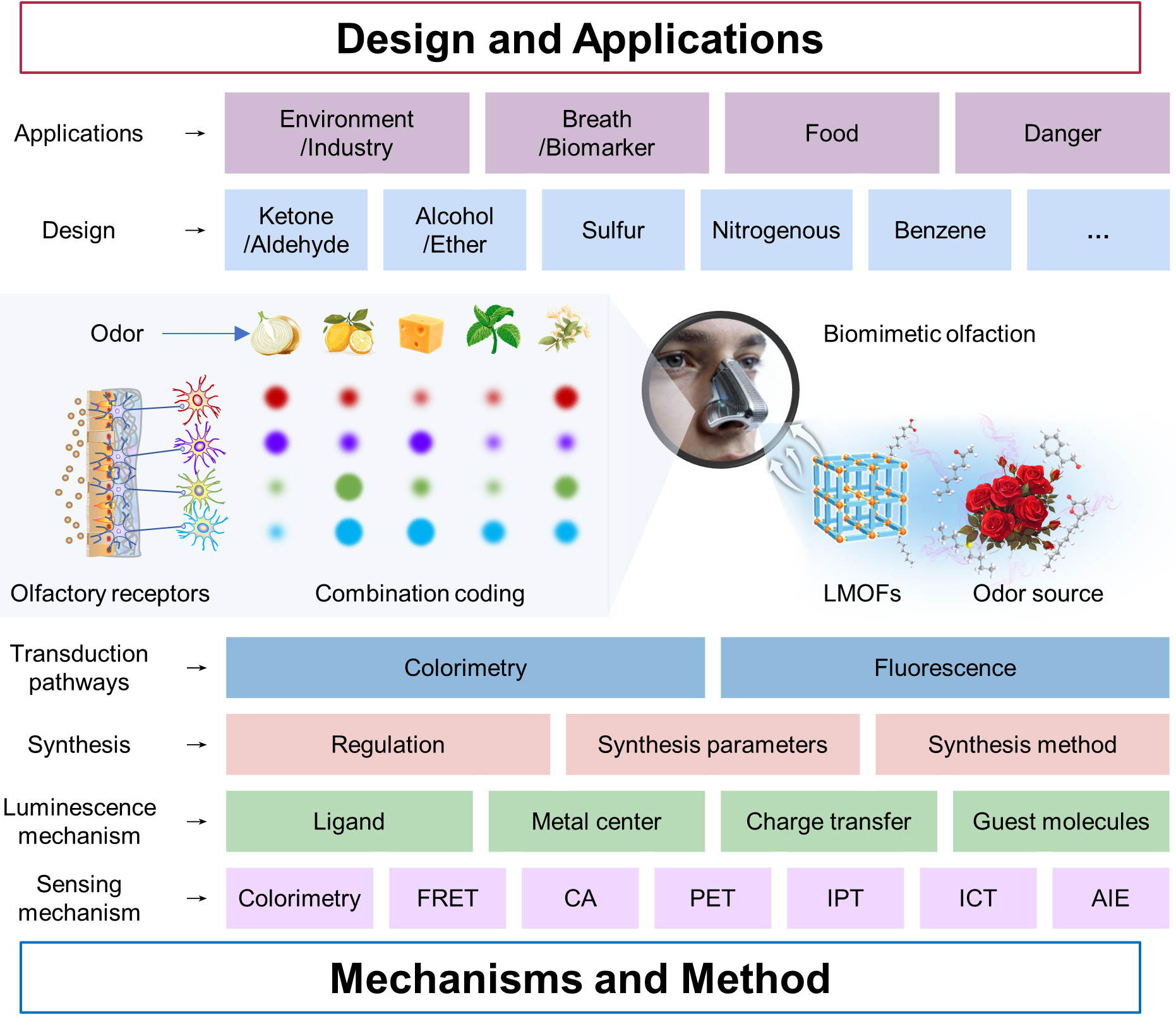
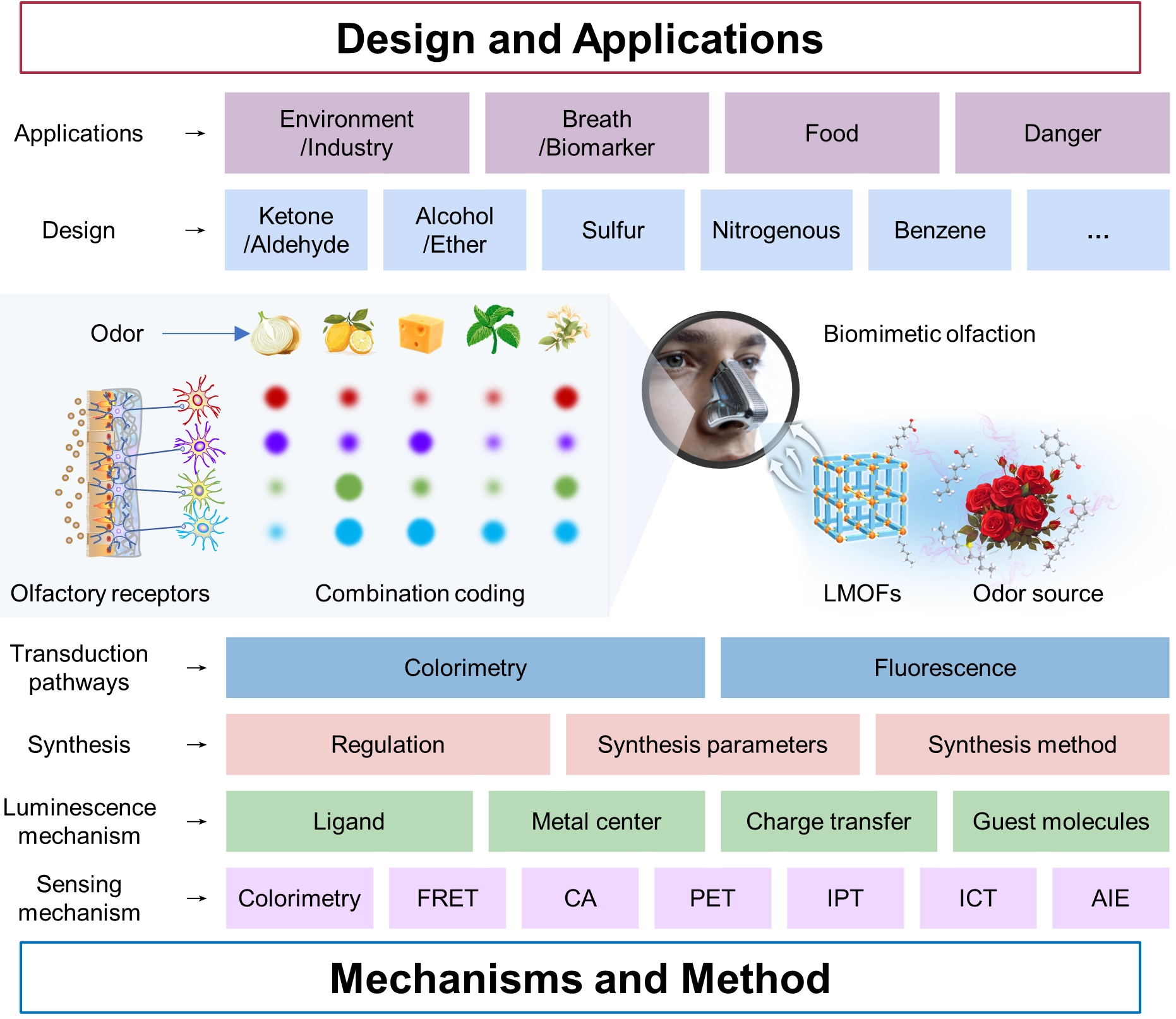
Figure 1. Schematic diagram of strategies for constructing embodied intelligent olfactory perception and its applications. It primarily encompasses four major applications: environmental and industrial odor monitoring, breath and biomarker odor monitoring, food odor monitoring, and high-risk gas monitoring. LMOFs are designed to target different types of odorous compounds, such as ketones/aldehydes, alcohols/ethers, sulfur-containing compounds, nitrogenous-containing compounds, and benzene compounds. The principles of bionic olfaction are interpreted through odor recognition and combinatorial coding by olfactory receptors, followed by molecular recognition using LMOFs. The primary photoconversion pathways include colorimetry and fluorescence, while sensing performance can be regulated through the synthetic parameters and methods of LMOFs. The underlying luminescence mechanisms involve ligand and metal-center emission, charge transfer, and guest-host interactions, while the sensing mechanisms involve FRET, CA, PET, IPT, ICT, and AIE. FRET: fluorescence resonance energy transfer; CA: competitive absorption; PET: photoinduced electron transfer; IPT: intramolecular proton transfer; ICT: intramolecular charge transfer; AIE: aggregation-induced emission; LMOFs: luminescent metal-organic frameworks.
2. Synthesis and Optical Sensing Principles of LMOFs
2.1 Structures of LMOFs
MOFs were first proposed in the late 1990s at the University of California, Berkeley, and became a star material following the 2025 Nobel Prize awarded to Yaghi O M, Robson R, and Susumu K for their pioneering work in the field of MOFs[44-46]. MOFs are primarily composed of metal centers and organic ligands, and the chemical structure directly determines the material’s properties and functions. The organic ligands are linked to the metal center via coordination bonds, forming the unique, ordered, network-like framework structures. By adjusting the concentrations of the components and the synthesis conditions, specific structures or phases can be obtained, thereby controlling their physicochemical properties, topological structure, and pore characteristics[47].
LMOFs are a class of MOFs that exhibit luminescent properties. Due to their high surface area, tunable pore and optical structures, compositional diversity, and abundance of open sites, LMOFs are particularly suited for constructing volatile organic compounds (VOCs) sensor arrays[34]. Their abundance of open metal sites enhances interfacial interactions in sensor devices, resulting in shorter response times[36]. The high-efficiency adsorption properties of large surface areas can significantly improve the signal-to-noise ratio of the response, enabling detection even when the analyte concentration is extremely low, particularly in gaseous environments[37]. The tunable pore structure, optical properties[38,39], and compositional diversity provide gas sensor arrays with a rich library of sensing materials which can be used to simulate the diversity of ORs in the bionic olfactory system[48-50].
2.2 Regulation and synthesis of LMOFs
The synthesis of LMOFs does not differ significantly from that of MOFs; the construction of the framework structure relies on the coordination bonds between metal centers and organic ligands. However, to obtain LMOFs with specific structures and properties[51,52], it is necessary to strictly control parameters such as the pH of the system[53-56], temperature[57-61], solvent and concentrations of each component[62-64]. At the same time, the choice of synthesis method also influences the final morphology and properties of the LMOFs[65-68]. Morphology control in the synthesis of LMOFs primarily involves coordination regulation, protonation/deprotonation regulation, and surfactant regulation. Coordination regulation is the most common method for controlling the morphology of MOFs. It involves introducing monodentate additives to influence the coordination equilibrium between metal ions and organic ligands, thereby regulating the nucleation and growth processes of crystals. This approach allows for simultaneous control of both crystal size and morphology, thereby achieving smaller, more uniformly distributed, and morphologically diverse nanoparticles (Figure 2a)[69-71]. Additives or modulators also determine the morphology of the final product by influencing the acid-base environment of the reaction system, specifically the protonation/deprotonation equilibrium. For example, basic modulators can promote ligand deprotonation, accelerate the crystal nucleation rate, and facilitate the formation of nanoscale structures (Figure 2b)[71]. Differences in the affinity of surfactants for different crystal faces lead to accelerated growth rates on some crystal faces and slowed others, thereby making the adsorption of reactants onto the crystal faces either easier or more difficult (Figure 2c)[72].
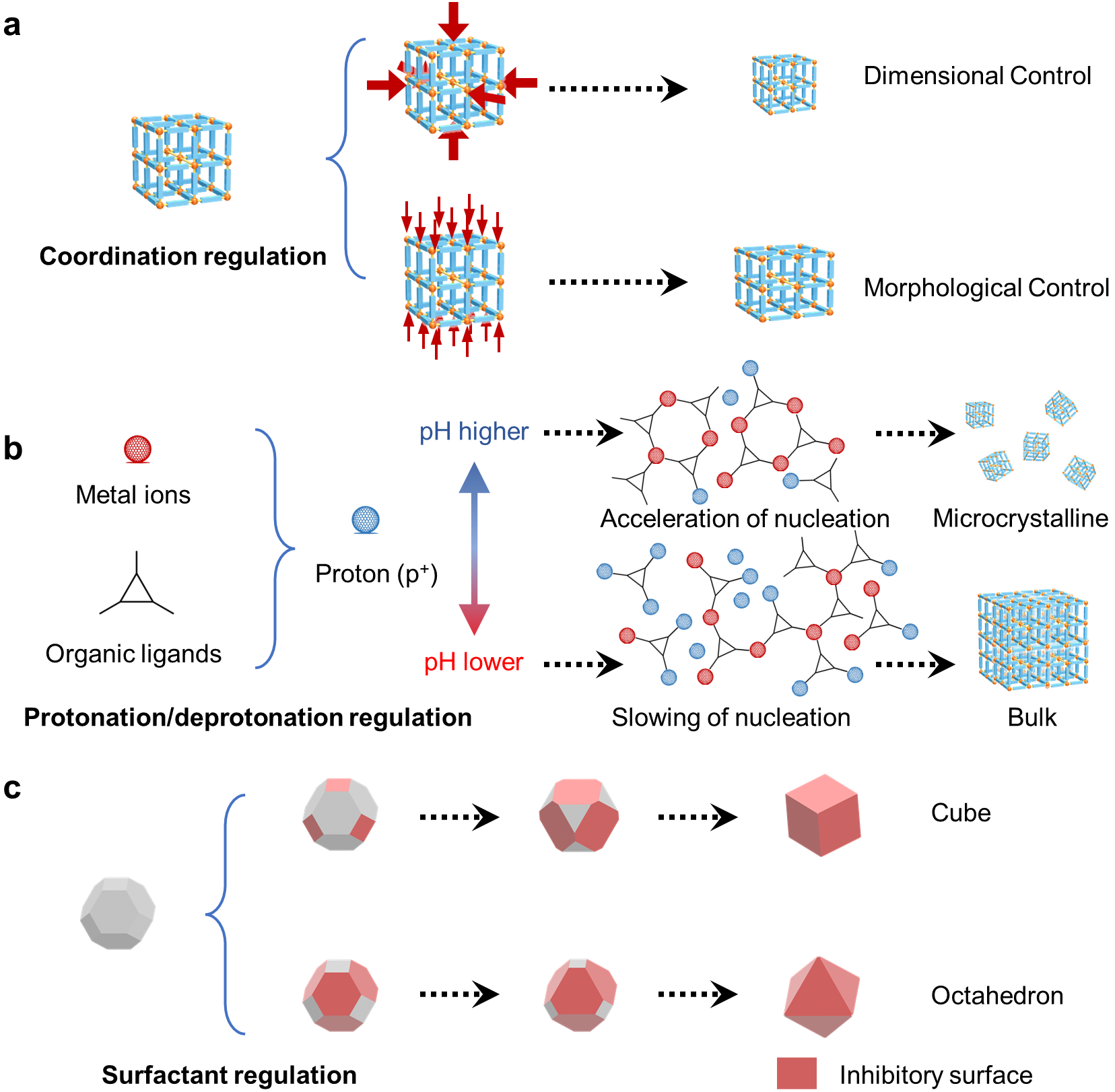
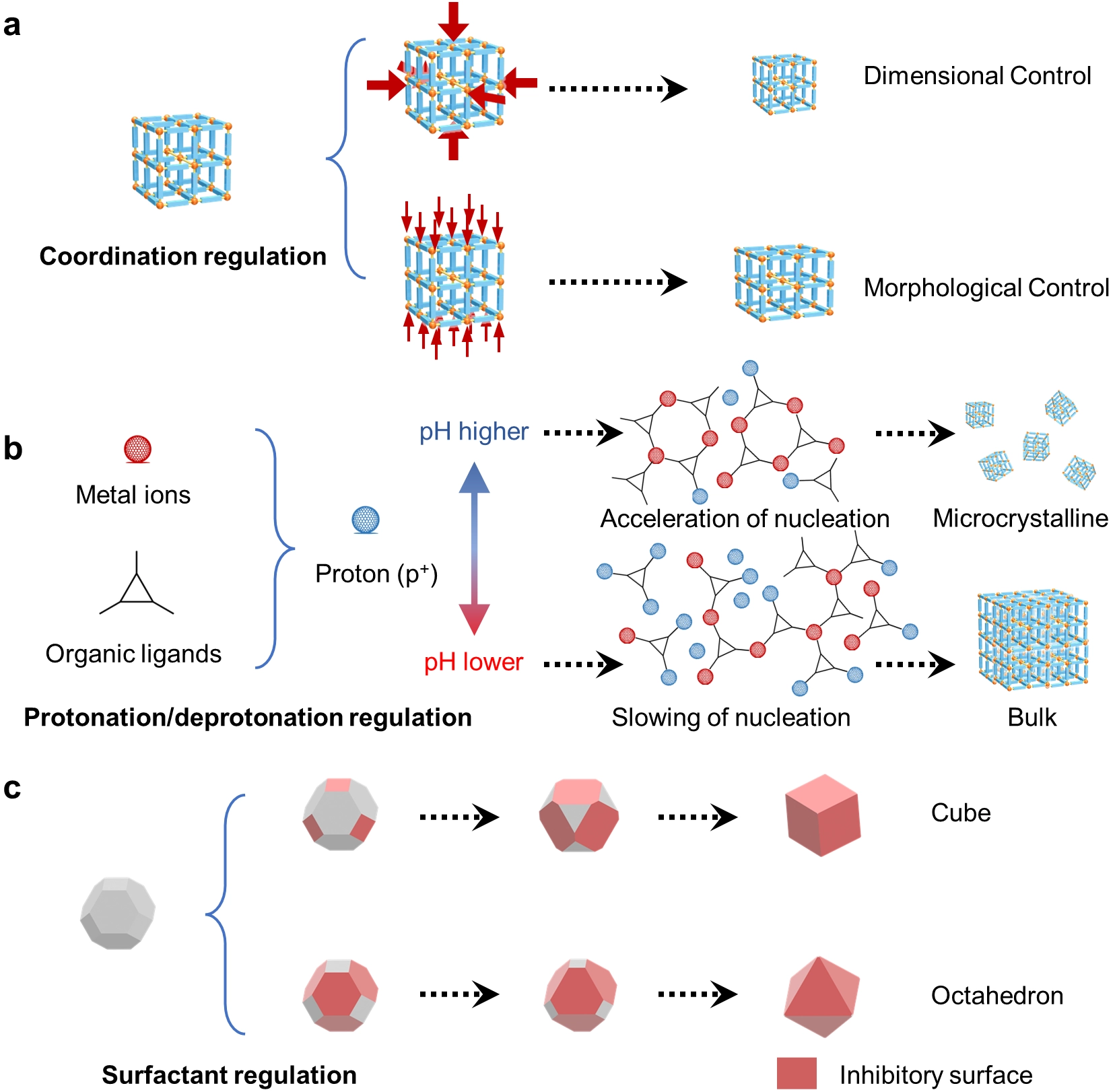
Figure 2. Mechanisms of morphology regulation in LMOFs synthesis. (a) Coordination regulation; (b) Protonation/deprotonation regulation; and (c) Surfactant regulation. LMOFs: luminescent metal-organic frameworks.
2.3 Optical sensing mechanism of LMOFs
2.3.1 Luminescence mechanism
LMOFs are a class of MOFs with photoluminescent properties, characterized by their tunable optical behavior while maintaining the structural order inherent to MOFs. LMOFs have emerged as a rising star in optical sensing and photophysics research due to the strong coupling between their structural design, porous properties, and optical functionality[37,41,72,73].
The luminescence of LMOFs can be primarily categorized based on its source: organic ligand emission (such as aggregation-induced emission (AIE)[74], which involves structures with highly conjugated ligands)[75,76], metal center emission[77-79], ligand-to-metal charge transfer (LMCT, commonly utilized in lanthanide elements via the antenna effect), metal-to-ligand charge transfer (MLCT)[80-83], and guest emission (such as the encapsulation of various fluorescent dyes within the channels of MOFs)[49,50,84-87].
2.3.2 Signal transduction pathways
The primary signal transduction pathways of LMOFs-based bionic ORs sensors include fluorescence and colorimetric signal transduction. The basic principle of fluorescence signal transduction involves detecting odors by utilizing the changes in photoluminescence (PL). Specifically, ultraviolet light is used as an excitation source to transfer photon energy to the LMOFs, thereby exciting the atoms or ions within the LMOFs to an excited state; sensing information is then obtained by detecting the spectra generated during the transition from the excited state to the ground state. When LMOFs contact or interact with odor analytes, sensing occurs by detecting spectroscopic changes in PL caused by alterations in the optical properties of LMOFs. Compared to colorimetric methods (which usually decompose color into only three RGB channels), LMOFs sensors based on spectral changes preserve richer sensing information. Another significant advantage is that powder materials can be used directly for detection without the preparation of thin films or additional processing (Figure 3a)[88].
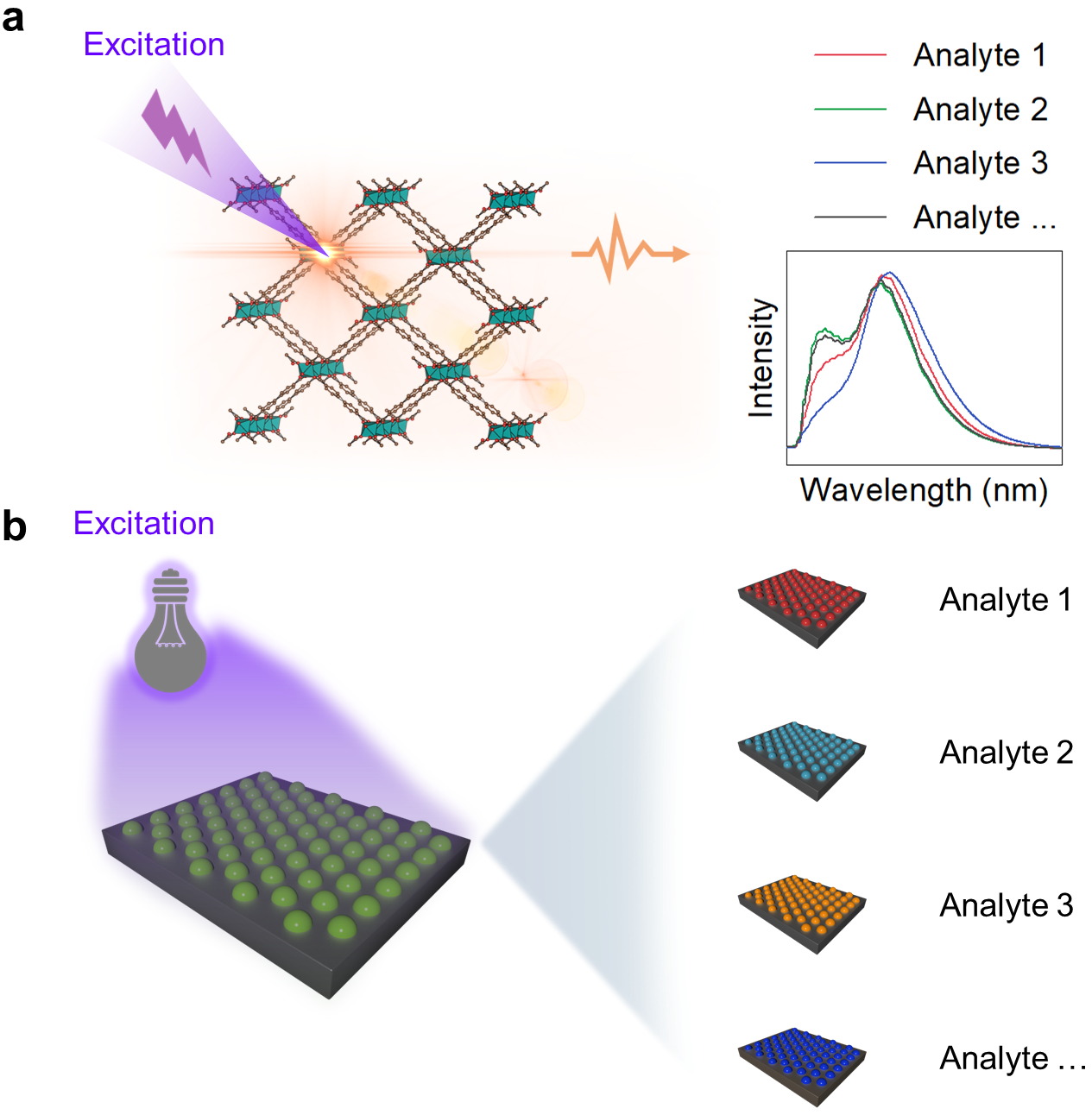
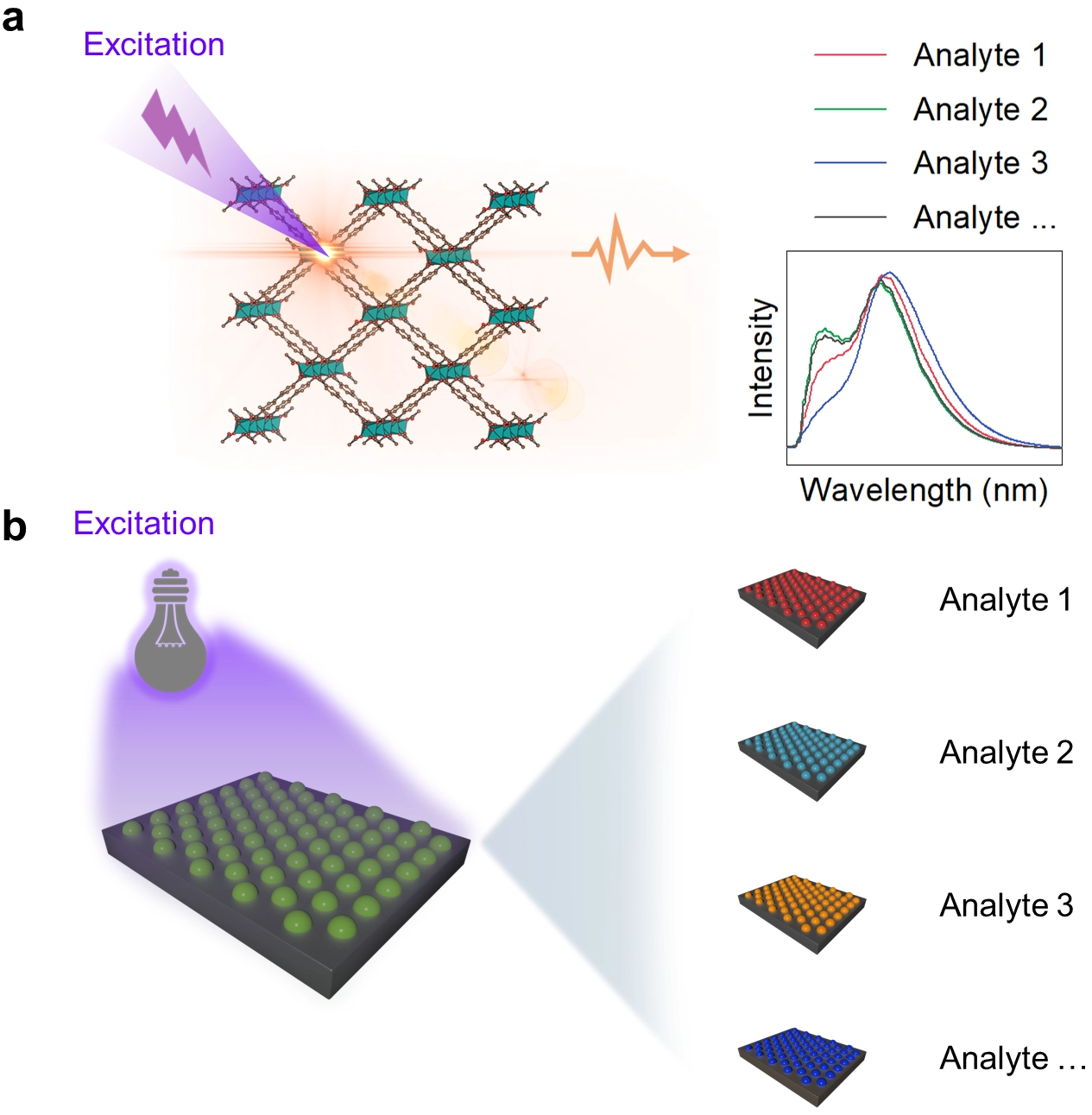
Figure 3. Schematic diagram of the signal transduction mechanisms of (a) Fluorescent and (b) Colorimetric signals.
Colorimetric signal transduction allows for real-time detection with the naked eye or a smartphone. These sensors convert sensing signals into visible changes in material color[89]. Generally, the absorption spectra of LMOFs materials exhibit significant shifts due to the adsorption of different target analytes. This process typically involves guest molecules as chromophores in LMOFs, and different colorimetric responses can be obtained by incorporating different dyes into MOFs[90]. Such sensors typically utilize two strategies: LMOFs with dual emission characteristics (emission can originate from metal centers and organic ligands, different metal centers, or different organic ligands) or LMOFs incorporating additional emission centers (such as dyes, CQDs, or luminescent complexes, Figure 3b)[91,92].
2.3.3 Sensing mechanism
The suitability of LMOFs for use in the biomimicry of ORs depends largely on their luminescence mechanisms. Energy or charge transfer occurs between LMOFs and target analytes, and the luminescence properties of LMOFs are highly sensitive to structural characterization, coordination environment, surface interactions, the state of open sites, host-guest interactions, and interactions with water molecules or hydrogen bonds. Therefore, when a target analyte interacts with LMOFs, any changes in the charge pathways within any of the luminescence mechanisms can potentially alter the light signal emitted by LMOFs, thus enabling the detection of the target analyte. The mechanisms of signal changes primarily include FRET, CA, PET, IPT, ICT, and AIE. These mechanisms can even occur simultaneously and interact with each other, particularly in mixed gas environments.
FRET is a process in which the energy from the excited fluorophore donor is transferred to another fluorophore acceptor via a non-radiative transition within the near-field region (1-10 nm). The efficiency of this energy transfer is typically closely related to the overlap between the donor emission spectrum and the acceptor excitation spectrum, as well as the interaction distance, as shown in Figure 4a. When the target analyte contacts LMOFs, FRET typically causes a sharp decrease in the intensity of one fluorescence peak and an increase in another (or no change if the acceptor is non-fluorescent), thereby enabling sensing[93].
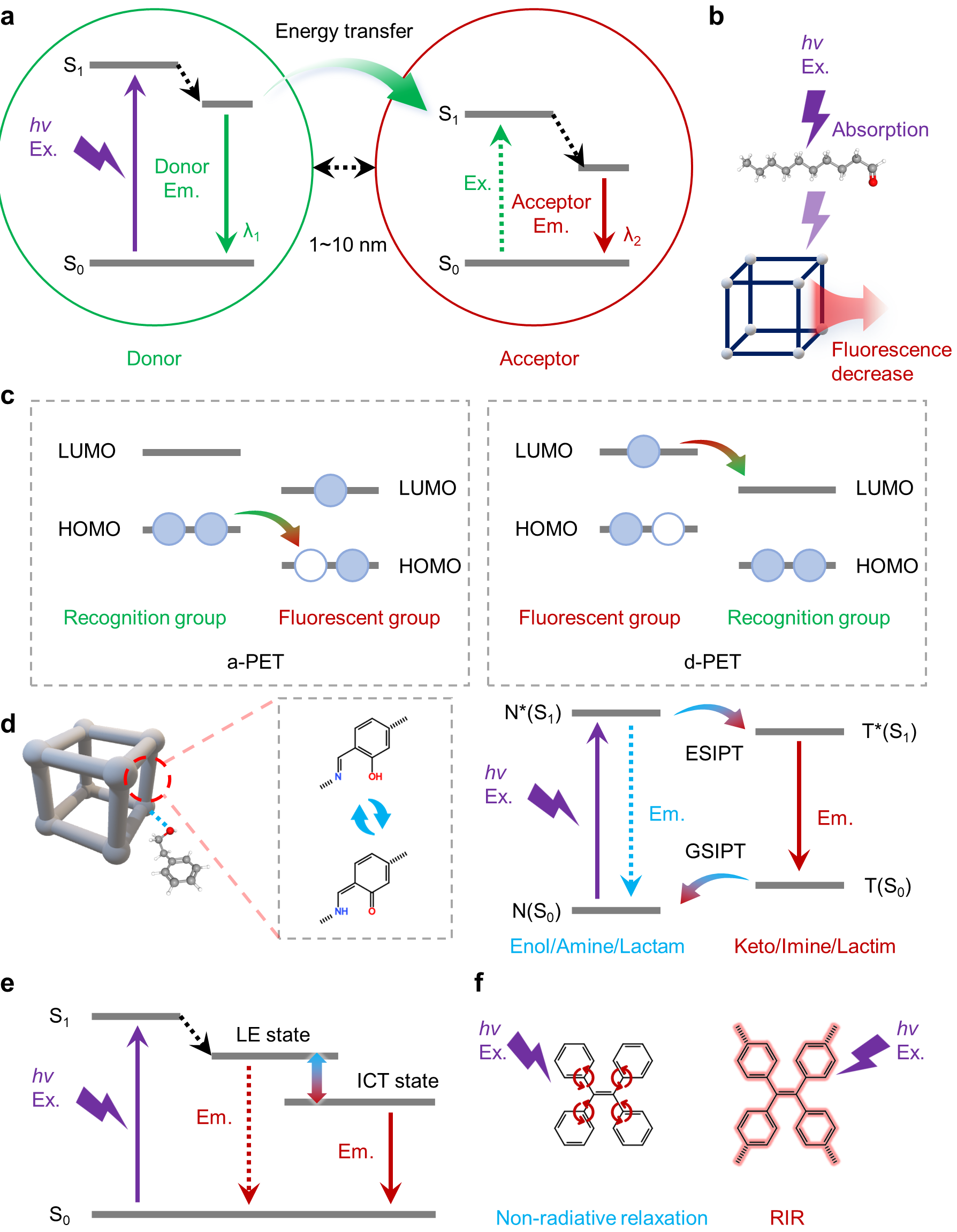
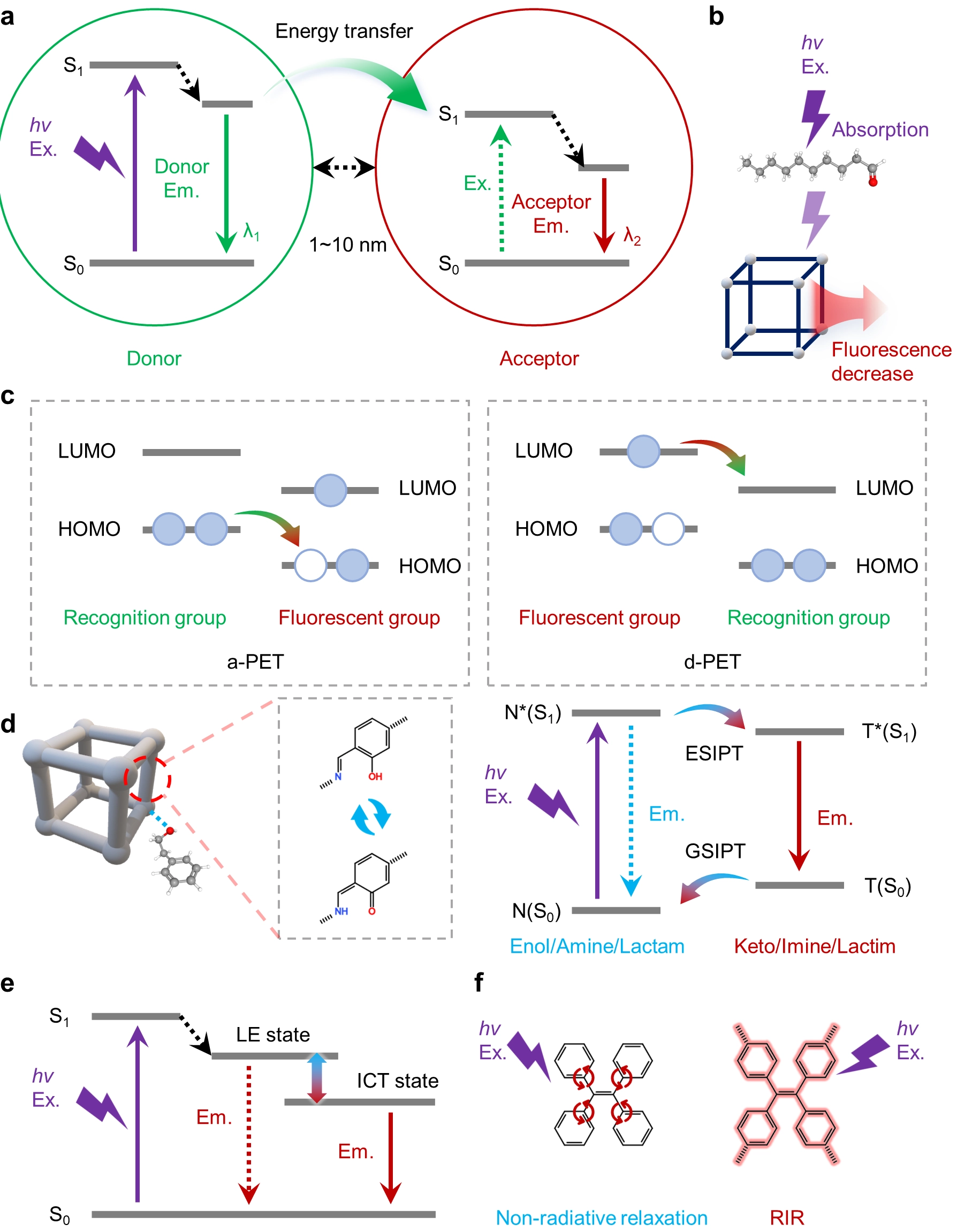
Figure 4. Sensing mechanisms in LMOFs. (a) FRET; (b) CA; (c) Two modes of PET; (d) IPT; (e) ICT; (f) AIE. FRET: fluorescence resonance energy transfer; CA: competitive absorption; PET: photoinduced electron transfer; IPT: intramolecular proton transfer; ICT: intramolecular charge transfer; AIE: aggregation-induced emission; LUMO: lowest unoccupied molecular orbital; HOMO: highest occupied molecular orbital; LMOFs: luminescent metal-organic frameworks.
The primary principle of the CA mechanism is that, after LMOFs adsorb the target analyte, the excitation light is absorbed by the analyte and thus cannot reach the LMOFs’ absorption groups, as shown in Figure 4b. This usually occurs when the absorption of the target analyte at the excitation wavelength is significantly higher than that of the LMOFs[94].
PET is also the primary mechanism responsible for spectral shifts in LMOFs. The main process occurs when both the electron donor and acceptor fluorophores are excited by photons, resulting in both groups existing in excited states. If the following condition is fulfilled: the acceptor has a lower energy level for its highest occupied molecular orbital (HOMO) or lowest unoccupied molecular orbital (LUMO) than the donor, the PET phenomenon will occur, as shown in Figure 4c. When the target analyte contacts LMOFs, the HOMO and LUMO of the system are altered, thereby changing the PET pathway to achieve sensing[36,95].
IPT usually involves the enol-ketone interconversion process, which is the proton transfer occurring between adjacent donor and acceptor groups within an excited molecule under light excitation. At this point, the functional group of the ketone or aldehyde undergoes interconversion with the enol functional group, resulting in a significant Stokes shift, as shown in Figure 4d. When LMOFs interact with target analytes, significant peak shifts often occur to achieve sensing[96].
In ICT, under light excitation, electrons in the system transfer between donors and acceptors via π-conjugated bridges connecting their functional groups. Figure 4e illustrates this process: when LMOFs interact with target analytes, differences in the analytes’ polarity induce alterations in the locally excited state (LE state) within the system, resulting in spectral shifts to achieve sensing behavior[97].
The AIE sensing mechanism differs significantly from conventional fluorescence sensing. Chromatic groups (including those inherent to LMOFs and those carried by target analytes) do not exhibit fluorescence responses in a dispersed state. However, when they aggregate into nanoclusters or solids, significant fluorescence enhancement occurs. A series of LMOFs exhibiting the AIE effect has been developed, with tetraphenylethylene (TPE) serving as a well-known representative among researchers across various fields. As shown in Figure 4f, TPE does not emit light in the dissolved/free gas state. This is because four or more benzene rings can rotate freely, leading to radiation-induced extinction, providing a non-radiative relaxation pathway for excited-state electrons. In the aggregated or solid state, however, restriction of intramolecular rotation (RIR) occurs, inhibiting the intramolecular rotation of these benzene rings and blocking the non-radiative relaxation pathway, thereby generating a strong PL effect. Consequently, the AIE effect is particularly suited for detecting target analytes with polycyclic structures or complex rings[98].
These mechanisms do not operate independently during the actual odor recognition process, but rather are coupled and interact synergistically, thus enabling LMOFs to generate multi-featured spectral responses to different odor molecules. These response behaviors largely depend on the chemical structural properties of the odor molecules, particularly the types of functional groups they contain.
3. Design Strategies of LMOFs for Odors with Different Functional Groups
The recognition of odor molecules essentially stems from their molecular structures and functional group features. Differences in polarity, chemical structure, and intermolecular interactions among odor molecules with different functional groups directly determine their interaction patterns and optical response behaviors with LMOFs. Therefore, establishing the response rules of LMOFs-based bionic ORs based on the chemical structures of odor molecules is crucial for achieving predictable and designable odor-sensing arrays. These design strategies are summarized in Table 1.
Table 1. Design strategy of LMOFs for odors.
| Metal center | Ligand | Guest molecule | Sensing medium | Target odors | Sensing mechanisms | Detection Limit | Response time | Ref. | |
| Ketone or aldehyde odors ORs | Ln3+ | H3BTC | N/A | Luminescence | Glutaraldehyde; Formaldehyde | CA | 0.27 ppm 0.22 ppm | Not provided | [99] |
| La3+ | H2hisp | Ln3+ | Luminescence | Acetaldehyde | CA | 5.8 ppm | 1 min | [100] | |
| Zr4+ | H4btec | Ag+ Eu3+ | Luminescence | Formaldehyde | Energy transfer | 51 ppb | Not provided | [101] | |
| Zn2+ | H2ofdc, bpyH2hfdc, bpy | N/A | Luminescence | Ketones | PETPorosity | 4.98 μM | ~10 s | [102] | |
| Zn2+ | 2-methylimidazole | NPC | Reflectometer | Acetone | Refractive index | 5.5 ppm | 250 s | [103] | |
| Al3+; Co2+; Zn2+; Zr4+ | 2,6-naphthalenedicarboxylic acid | N/A | Gas chromatography | Hexanal; Heptanal; Octanal; Decanal; Nonanal | Pore structure | 0.056-0.138 μg L-1 | Not provided | [104] | |
| Alcohol or ether odors ORs | Eu3+ Tb3+ | 2,6-dihydroxyterephthalic acid | N/A | Luminescence | Ethanol | Energy transfer | 9.76 mg L-1 | Not provided | [105] |
| Eu9 cluster | H₄TCPE | N/A | AIELuminescence | Ether rings | AIE | 17.33 Pa | < 1 s | [106] | |
| Zn2+ | H2BDC | Y3+ | Catalytic luminescence | Isobutanol | Catalysis | 3.7 mg L-1 | < 15 s | [107] | |
| Eu3+ | 2,6-di(2’,5’-dicarboxylpenyl)pyridine | N/A | Luminescence | Methanol; Diethyl ether | Open metal sites Host-guest | 10-6 M | Not provided | [108] | |
| Zn2+ | 2-methylimidazole | N/A | Interference spectrum | Ethanol | Interference | 30 ppm | 17 s | [109] | |
| Sulfur compounds odors ORs | In3+ | H3BTC | N/A | Luminescence | 1,2-ethanedithiol; 1-butanethiol | Host-guest | Not provided | < 20 s | [110] |
| Eu3+ | H2BDC-NH2 | N/A | Luminescence | SO2 | Electronic transfer | 0.65ppm | 6 s | [111] | |
| Zr4+ | H4btec | Eu3+ Cu2+ | Luminescence | Sulfides | Energy transfer | 5.45 μM | < 30 s | [112] | |
| Zr4+ | H4btec | Eu3+ Au2+ | Luminescence | H2S | Energy transfer | 23.53 μM | < 30 s | [113] | |
| Zn2+ Nb5+ | NDI | N/A | Light intensity | H2S SO2 | Proton transfer Refractive index | 0.69 ppb | < 2 s | [114] | |
| Ag+ | H2BDC | N/A | Luminescence | H2S | Framework collapse | 0.085 ppm | Not provided | [115] | |
| Nitrogenous compounds odors ORs | Zr4+ | H2BPDC, H2BDC | RhB | Luminescence | NH3 | ICT | 0.2 ppm | Not provided | [116] |
| Ga3+ | H2bpydc | Eu3+ | Luminescence | NH3 Urea | ICT Energy level matching | 2.4 ppm | 30 s | [117] | |
| Zn2+ | H2BDC-NH2 | Eu3+ | Luminescence | Organic amines | Energy level matching | Not provided | 5 min | [118] | |
| Zr4+ | H2bpydc | Ln3+ | Luminescence | NH3 | Energy transfer | 9 ppm | 5 min | [119] | |
| Tb3+ | H3BTC | N/A | Luminescence | NO2 | Multiple sites | 4.0 ppm | 5 min | [120] | |
| Zn2+ | 2,5-dihydroxyterephthalic acid | CQD | Transmission | NH3 | Transient field Refractive index variation | 1 ppm | 3.97 s | [121] | |
| Benzene compounds odors ORs | Zn2+ | DPEB | N/A | AIE luminescence | Benzene compounds | AIE | Not provided | Not provided | [122] |
| Eu3+ Tb3+ | H3TCM | N/A | Luminescence | Benzene isomers, homologues, and halogenated benzenes | Host-guest Energy transfer | Not provided | Not provided | [123] | |
| Eu3+ Tb3+ | CTP-COOH | N/A | Luminescence | Benzene compounds | PET | Not provided | < 4 min | [124] | |
| In3+ | H2bpydc | Eu3+ | Luminescence | Benzene compounds | Unknown | Not provided | Not provided | [125] | |
| Ln3+ | H3BTC | N/A | Luminescence | Acetophenone | CA | 0.02 vol% | Not provided | [126] | |
| Other odors ORs | Tb3+ | H3BTC | N/A | Luminescence | Seven odors | ICT | 4.497 ppm | 3.9 s | [36] |
| Cd2+; Zn2+; Co2+ | Designed | N/A | Luminescence | Amines; Aldehydes | CA | Not provided | Not provided | [127] | |
| Cu2+ | H2DHTP | N/A | Luminescence | H2S; NO2 | Coordination competition Charge transfer | 7 ppm | Not provided | [128] | |
| Ce3+ | 1H-imidazole | N/A | Luminescence | Methanol; Acetone; Pyridine; Dichloromethane; Acetonitrile | Framework collapse | Not provided | Not provided | [129] | |
| Cu2+ | H3BTC | N/A | Interference spectrum | Ethanol Benzene | Interferometer | 3.903 ppm | 8 min | [130] | |
| Zr4+ | 2,5-Bis(trifluoromethyl) terephthalic acid | TiO2 | Reflectometer | Acetic acid | Synergistic electron transfer | 4.29 ppm | 315s | [131] | |
| Zr4+ | H4TPPE | N/A | Luminescence | CH2Cl2 Acetic acid | AIE | 755.45 ppm 7.13 ppm | Not provided | [132] | |
| Eu3+ | H2bpydb | N/A | Luminescence | Acetone Fatty alcohols: homologs and isomers TNP | CA Host-guest Spatial hindrance Electron transfer | Not provided | Not provided | [16] | |
| Zn2+ | DHBDC; TPB; TPP; TPT; TPA | N/A | Luminescence | TNP | PETCA | 0.322 ppm 0.71 ppm 0.6 ppm 0.69 ppm 0.017 ppm | 5 min | [133] | |
| Zn2+ | 2-methylimidazole | CeO2 | Catalytic luminescence | Propane | Catalysis | 0.2 μg/mL | 0.7 s | [134] |
LMOFs: luminescent metal-organic frameworks; NPC: nitrogen-doped porous carbon; ICT: intramolecular charge transfer; AIE: aggregation-induced emission; PET: photoinduced electron transfer.
3.1 Ketone/aldehyde and alcohol/ether odors ORs
Among the many VOCs, ketones and aldehydes usually exhibit high volatility and distinct olfactory characteristics. Their molecular structures contain carbonyl functional groups with highly reactive oxygen, resulting in fresh, fruity, or sharp chemical odors. These compounds play crucial roles in human olfactory perception, and often impart flavor to food, characteristic odors to plants, or metabolic odors to the human body. The carbonyl functional group can enter the pores of LMOFs through Lewis acid-base interactions with uncoordinated metal sites or via hydrogen bonding, thereby influencing the electronic structure and energy transfer processes of the system. Alcohols and ethers also constitute important types of odor molecules in the human olfactory system, typically exhibiting high volatility, with their odor profiles varying significantly depending on molecular structure. Lower molecular weight alcohols usually exhibit stimulating or refreshing odors, while as the carbon chain length increases, their odor characteristics gradually shift toward sweet or buttery aromas. Ether compounds, on the other hand, typically exhibit mild, slightly sweet or stimulating odors, commonly found in the fragrance industry or used in industrial solvents.
For example, Sheng J reported a Ln-MOF sensor (SP-LnMOF) grown in situ in a sodium alginate (SA) and polyvinyl alcohol (PVA) hydrogel matrix. This composite hydrogel sensor exhibits highly selective recognition of glutaraldehyde and gaseous formaldehyde at room temperature. The absorption peaks of the aldehydes overlap significantly with the fluorescence excitation peaks of SP-LnMOF. Consequently, the CA mechanism reduces the total energy of SP-LnMOF, leading to a decrease in the number of excited states and resulting in fluorescence decay (Figure 5a)[99]. A similar phenomenon was observed in the Tb@La-MOF reported by Min J, which is a fluorescent probe effectively utilized for acetaldehyde detection via the CA mechanism and can also specifically distinguish acetaldehyde from a range of other organic molecules[100].
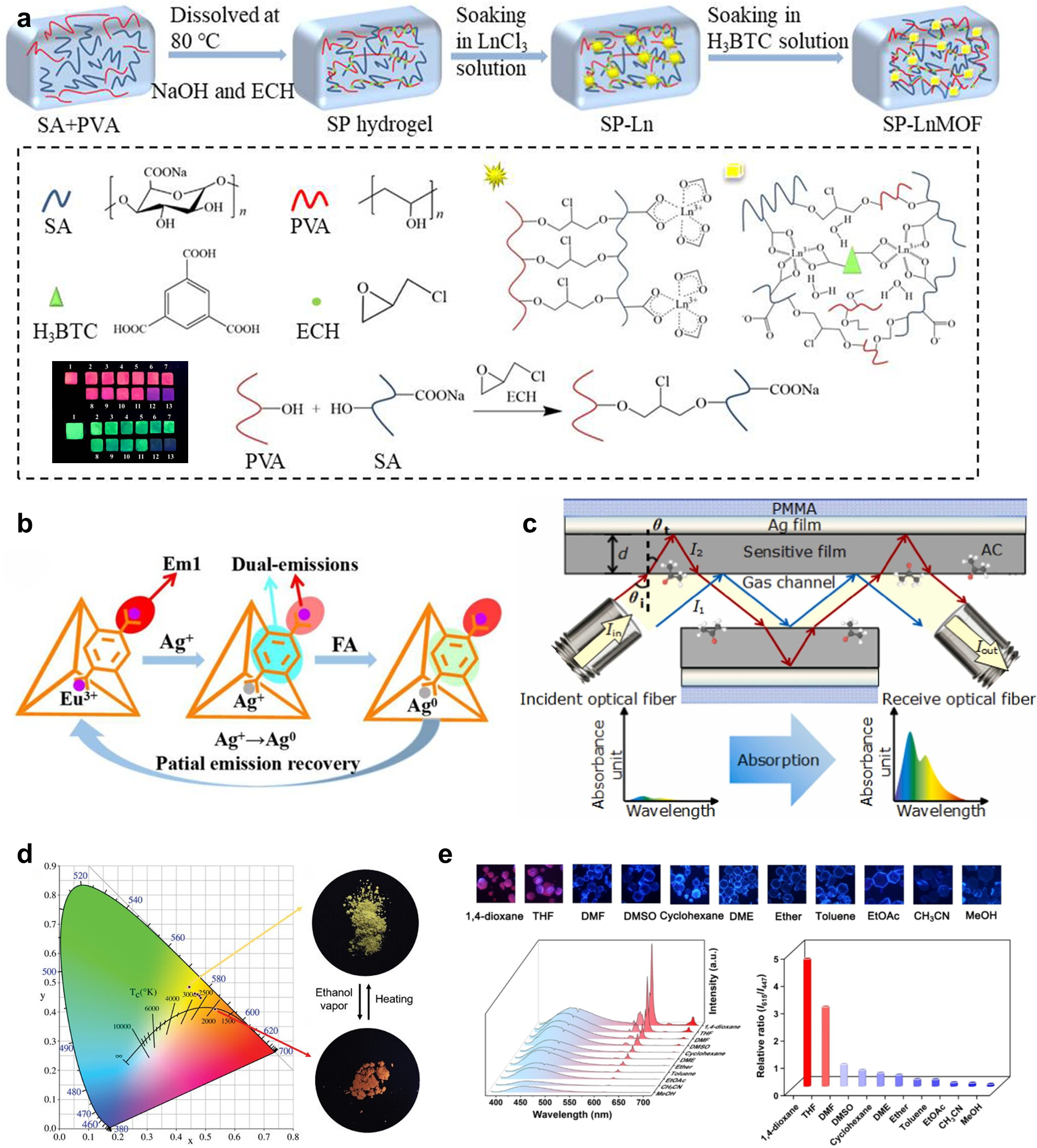
Figure 5. ORs of ketone/aldehyde and alcohol/ether odors. (a) The construction process and luminescent behavior of SP-LnMOF[99]. Reproduced with permission from reference[99]. Copyright © 2025 Elsevier; (b) The schematic illustration of the mechanism of formaldehyde sensing by Ag(I)-Eu(III)-LMOFs[101]. Reproduced with permission from reference[101]. Copyright © 2016 Royal Society of Chemistry; (c) Operating principle of the ZIF-8/NPC reflective fiber-optic sensor[103]. Reproduced with permission from reference[103]. Copyright © 2026 Elsevier; (d) Changes in the CIE chromaticity coordinates and PL images of LMOFs as the ethanol concentration increases[105]. Reproduced with permission from reference[105]. Copyright © 2024 John Wiley and Sons; (e) Fluorescence microscopy images, emission spectra, and intensity ratios of LMOFs for the selective detection of 11 VOCs[106]. Reproduced with permission from reference[106]. Copyright © 2022 John Wiley and Sons. MOF: metal-organic framework; LMOFs: luminescent metal-organic frameworks; ZIF-8: zeolite imidazole framework-8; NPC: nitrogen-doped porous carbon; PL: photoluminescence; VOCs: volatile organic compounds; SA: sodium alginate; PVA: polyvinyl alcohol.
Hao J employed a co-doping strategy, preparing functionalized LMOFs modified with Ag+ to achieve dual-emission and applying them to the detection of formaldehyde in indoor environments. The functionalization with Ag+ alters the electronic structure of the organic ligands and influences the energy transfer process from the ligands to Eu3+, thereby modulating the dual-emission properties of the material. Formaldehyde tends to interact with the Ag+ within the system, thereby affecting the electronic structure and energy transfer processes of the LMOFs to enable sensing behavior (Figure 5b)[101].
Hu Z adopted a multi-mechanism sensing approach. The researchers reported two new members of the LMOFs family and named these as LMOF-201 and LMOF-202. Density of states (DOS) calculations demonstrated that LMOF-201 and LMOF-202 not only influence their PL towards ketone vapors via charge transfer between ligands (PET mechanism), but also achieve differential recognition of ketone vapors by adjusting the differing porosity of LMOF-201 and LMOF-202[102].
Some researchers have also employed other sensing mechanisms to detect ketone vapors. For example, Zhao W developed a reflective optical fiber sensor coated with zeolite imidazole framework-8/nitrogen-doped porous carbon (ZIF-8/NPC). This sensor unit was constructed on a polymethyl methacrylate (PMMA) substrate featuring linear grooves. The inner walls of the grooves were sequentially coated with an Ag film and a ZIF-8/NPC composite layer, thereby forming a light transmission channel. Acetone adsorption causes an increase in the refractive index of the film, thereby enhancing light absorption at 256 nm and achieving selective and precise detection of acetone (Figure 5c)[103]. Shi X synthesized four MOFs with different pore sizes (DUT-4, DUT-8, IRMOF-8, and MIL-140B). By employing differences in surface area and pore size, they achieved differentiated responses to five exhaled aldehyde biomarkers of varying molecular sizes (hexanal, heptanal, octanal, decanal, and nonanal) in lung cancer patients[104].
Sun Y synthesized a dual-emitting LMOFs with co-doped lanthanide elements, investigating their sensing performance and response mechanism. The Eu0.1/Tb0.9 co-doped LMOFs exhibited a highly selective response to alcohol vapors. The interaction between ethanol molecules and the LMOFs enhanced the energy transfer efficiency between Tb3+ and Eu3+, resulting in an enhancement of the characteristic emission of Eu3+ and a reduction in that of Tb3+. Crystal structure analysis further revealed that ethanol molecules bind to ligands and DMF molecules via multiple weak hydrogen bonds. This mechanism facilitates the activation of the material and enables repeatable detection (Figure 5d)[105].
Pang J employed a dual-emission mechanism involving ligands and metal centers. The researchers reported a dual-emission LMOFs composed of an unsaturated Eu9 cluster and tetra(4-carboxyphenyl)ethylene (H4TCPE) as the ligand, which contains abundant open metal sites to facilitate the enrichment and recognition of VOCs. The luminescence enhancement of this LMOFs may result from multiple mechanisms, including ligand-based AIE effects and intrinsic luminescence responses of Eu3+. Eu3+ can coordinate with cyclic ethers such as THF and 1,4-dioxane, causing a shielding effect against quenching groups in the Eu3+ coordination sphere. Furthermore, through additional interactions with free molecules, a more constrained spatial structure is formed, and neighboring Eu3+ clusters are linked into a cohesive unit. This further inhibits the vibrational modes of the Eu3+ coordination environment, resulting in significant Eu3+ luminescence enhancement, which forms a ratio fluorescence-colorimetric combination with the ligand fluorescence. This enables the LMOFs to selectively detect 1,4-dioxane and tetrahydrofuran among 11 gases (Figure 5e)[106].
Wan X designed a yttrium (Y)-doped MOF-5 based on the catalytic luminescence mechanism. It was demonstrated that the size and shape of the MOFs’ pores, as well as the different interactions between the analytes and the pore surfaces, are the primary factors enabling this material to selectively detect isobutanol via catalytic luminescence[107].
A differentiated response sensor for methanol and diethyl ether developed by Yang Y exhibits significant luminescence enhancement for methanol and significant luminescence decay for diethyl ether, which is attributed to binding interactions between open metal sites and guest molecules[108].
Salehifar N employed an optical interference model to grow a 10 μm-thick layer of ZIF-8 on one side of a single-mode fiber. This sensor demonstrated significant sensitivity to ethanol: as the ethanol concentration increased, the interference fringe troughs exhibited a significant red shift[109].
Although significant progress has been made in the detection of these oxygen-containing compounds, most currently reported studies on LMOFs remain limited to the detection of small molecules such as acetone, ethanol, and acetaldehyde. Research on the detection and classification of the vast number of complex molecules found in nature and the human environment remains insufficient, as these compounds often share similar electronic structures within their respective classes, making them difficult to distinguish effectively. Dual-emission ratio detection systems enhance signal reliability by providing internal calibration. However, such systems typically require more complex synthetic designs and remain susceptible to signal fluctuations caused by humidity[135]. Therefore, future olfactory sensors should focus on multi-response mechanisms and array designs rather than simply pursuing lower detection limits.
3.2 Sulfur and nitrogenous compounds odors ORs
Sulfur compounds, such as thiols, sulfides, and H2S, typically have a very low olfactory threshold and a strong or even unpleasant odor. They are usually associated with decay, irritation, or warning signals, and have played a role in signaling danger and providing environmental warnings during biological evolution. Nitrogen-containing VOCs are a type of odor molecule with high recognition in the olfactory system, typically including amines, heterocyclic nitrogen-containing compounds, and derivatives of nitrogen-containing functional groups. These compounds are widely present in biological metabolic processes, food decay products, flammable and explosive gases, explosives, and industrial emissions, usually exhibiting strong stimulative or even unpleasant odors[136,137].
For example, Dou Z prepared an In-based MOFs film on a Pt nanoparticle-modified silicon wafer. The film achieved luminescent sensing through host-guest interactions. Post-functionalization of the film with Eu3+ enabled rapid detection of volatile thiols such as 1,2-ethanedithiol and 1-butanethiol[110].
Zhang J synthesized UiO-66-NH2 films on glass as seeds and developed an Eu-BDC-NH2 film via in situ secondary growth. The luminescence of Eu-BDC-NH2 can be rapidly and significantly quenched by SO2 gas because electron-withdrawing molecules such as SO2 cause electrons to transfer from the ligands to these molecules, resulting in the dissipation of the energy utilized for Eu3+ luminescence (Figure 6a)[111].
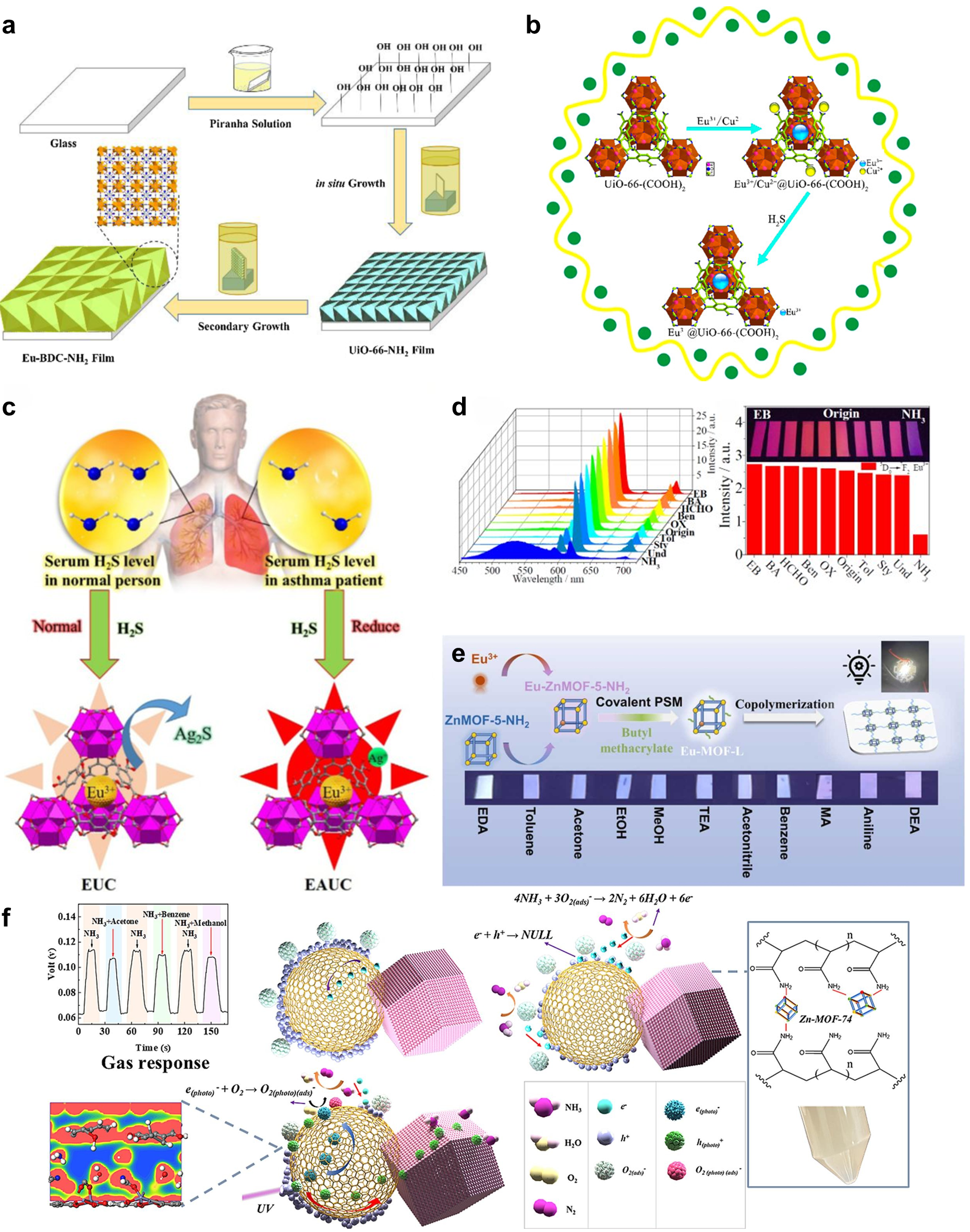
Figure 6. ORs of sulfur- and nitrogenous-containing compounds odors. (a) The in situ secondary growth routine of Eu-BDC-NH2 film on glass[111]. Reproduced with permission from reference[111]. Copyright © 2018 Elsevier; (b) Synthesis mechanism and fluorescent logic gate properties of Eu3+/Cu2+@UiO-66-(COOH)2[112]. Reproduced with permission from reference[112]. Copyright © 2016 American Chemical Society; (c) The principle of the initial diagnosis of asthma[113]. Reproduced with permission from reference[113]. Copyright © 2019 Elsevier; (d) PL spectra, photographs, and relative emission intensities at 614 nm of LMOFs films exposed to various indoor air pollutants[117]. Reproduced with permission from reference[117]. Copyright © 2015 Royal Society of Chemistry; (e) The operating mechanism of ZnMOF-5-NH2 and its photographs under various gas environments[118]. Reproduced with permission from reference[118]. Copyright © 2022 Elsevier; (f) Composition and time-domain response of PAM/MOF-CQDs(-COOH)[121]. Reproduced with permission from reference[121]. Copyright © 2025 Elsevier. PL: photoluminescence; LMOFs: luminescent metal-organic frameworks; PAM/MOF-CQDs(-COOH): polyacrylamide/MOF-carboxylated carbon quantum dots.
Xin Z developed LMOFs with excellent fluorescent properties and logic gate properties: Eu3+/Cu2+@UiO-66-(COOH)2, and applied them for H2S detection. Eu3+/Cu2+@UiO-66-(COOH)2 exhibits both the narrow-band emission feature of Eu3+ and the broad-band emission of the ligand center. The logic gate properties are achieved by modulating the energy transfer process from the ligand to Eu3+ and Cu2+: the unsaturated 3d9 electronic structure of Cu2+ facilitates synergistic interaction with the Lewis-basic carboxylate oxygen sites in UiO-66-(COOH)2, and this bonding reduces the antenna effect of the ligand on Eu3+. While Cu2+ is also a soft acid, it readily interacts with sulfides (soft bases) to form highly stable compounds with the targets. In the presence of sulfides, the suppression of the antenna effect by Cu2+ in Eu3+/Cu2+@UiO-66-(COOH)2 is reduced, resulting in enhanced Eu3+ emission and weakened ligand emission (Figure 6b)[112]. Furthermore, the researchers proposed the potential of Eu3+/Au2+@UiO-66-(COOH)2 as a diagnostic platform for the preliminary diagnosis of asthma through the detection of the biomarker H2S. Eu3+/Au2+@UiO-66-(COOH)2 exhibits good selectivity, extremely high sensitivity, real-time in situ detection, low cytotoxicity, and good biocompatibility. This provides a potential logical platform for the clinical application of MOFs in the preliminary diagnosis of asthma (Figure 6c)[113].
By employing ligand design, Nizamidin P enhanced the gas adsorption selectivity of MOFs by combining the organic ligand 1,4,5,8-naphthalenetetracarboxylic diimide (NDI) with the dual-metal center of Zn/Nb. The prepared Zn/Nb-NDI-BMOF films exhibited unique response properties to both H2S and SO2, which can be attributed to the large pore size of the NDI ligand and its electronic defect characteristics: under UV irradiation, NDI readily forms negatively charged NDI-, which can interact simultaneously with proton donors (H2S) and electron-rich gases (SO2), involving proton transfer and an increase in refractive index[114].
Bhatti S utilized a method involving H2S-induced ordered collapse of the silver ion in LMOFs frameworks. This process affects the LMCT mechanism of LMOFs to enable sensing behavior. Based on this, the researchers developed a silver-based LMOFs-coated optical fiber sensor probe for high-sensitivity and real-time H2S gas detection[115].
Chen S designed a dual-ligand UiO-67 and encapsulated rhodamine B (RhB) within its pores. This is an LMOFs exhibiting both static and dynamic fluorescence quenching mechanisms: NH3 diffuses through the pores into the UiO-67 framework, stably coordinates with the Zr4+ metal center to form a ground-state non-fluorescent complex, thus inducing static quenching; simultaneously, the energy level matching between the ligand and NH3 promotes intermolecular charge transfer, accelerating the non-radiative dissipation of excited-state energy[116]. Hao J also reported a similar phenomenon: post-functionalized Ga(OH)bpydc with Eu3+ accelerates the dissipation of excited-state energy through energy-level matching between the ligand and odor molecules when detecting NH3. However, the energy levels are even better matched when detecting urea, resulting in enhanced fluorescence (Figure 6d)[117]. A similar fluorescence enhancement mechanism was demonstrated by Zhang Z, who introduced Eu3+ into ZnMOF-5-NH2 to detect organic amine vapors (Figure 6e)[118]. Ma W introduced Eu into UiO-67 and, utilizing the energy transfer promotion effect of the complex between NH3 and LMOFs on Eu3+, designed and prepared a sensor film based on a fluorescence enhancement mechanism, demonstrating that this effect is due to the elevation of the ligand’s triplet energy level[119].
Moscoso F G. demonstrated that Tb-BTC exhibits dual-site sensing behavior and multi-mode responses when detecting NO2, indicating the presence of at least two distinct binding sites in the system, each with a different quenching constant[120].
Wang Y combined the optical evanescent field with the refractive index changes of MOFs, and proposed an optical fiber NH3 sensor operating at room temperature. The core of this sensor is a polyacrylamide/MOF-carboxylated carbon quantum dots (PAM/MOF-CQDs(-COOH)) gas-sensitive film, and the mechanism of enhanced sensing performance under UV irradiation was investigated. When the sensor material is exposed to NH3, NH3 reacts with O2- and transfers a large number of electrons to the MOF-CQDs(-COOH). The recombination of electrons and holes causes an increase in material resistance and a change in refractive index. This process is further enhanced under UV irradiation. Furthermore, by utilizing the evanescent field generated at the interface between the designed fiber structure and the gas-sensitive film, when the sensor is in an NH3 environment, NH3 forms hydrogen bonds with the MOF-CQDs(-COOH) and affects their internal electron distribution, leading to a change in the refractive index of the gas-sensitive film and enabling the output of a light signal response (Figure 6f)[121].
These analytes represent a unique class of odorants because they exhibit strong coordinating ability, significant electron-donating/accepting properties, or acid-base activity. Consequently, sulfur- and nitrogen-containing odorants often pose significant challenges to the reversibility of LMOFs through specific coordination or framework disruption. The sensing mechanism primarily relied upon in early studies, fluorescence quenching caused by direct analyte coordination, is no longer suitable for olfactory sensing, whereas recent research has increasingly addressed this challenge by designing and improving highly stable LMOFs sensors. This suggests that future LMOFs olfactory sensors should be designed to support stable cyclic operation.
3.3 Benzene compounds odors ORs
Benzene compounds generally refer to a series of aromatic VOCs with a benzene ring as their core structure. Typical examples include benzene, toluene, ethylbenzene, and xylene. These compounds are widely found in petrochemical products, fuel volatiles, and indoor air pollutants. Benzene compounds usually exhibit aromatic, sweet, or stimulating odors, and their odor characteristics are closely related to other functional groups in their molecules.
Benzene compounds are usually associated with AIE systems. For example, Zhang M reported a two-dimensional layered LMOFs with a wide bandgap, NUS-1. Its activated form, NUS-1a, consists of Zn4O and a tetraphenyl-based ligand (1,2-diphenyl-1,2-bis(4-carboxybenzyl)ethylene). The peak locations of its response spectrum shift with changes in the benzene ring conformation of surrounding benzene compounds, and the spectral intensity is also influenced by its quantum yield (Figure 7a)[122].
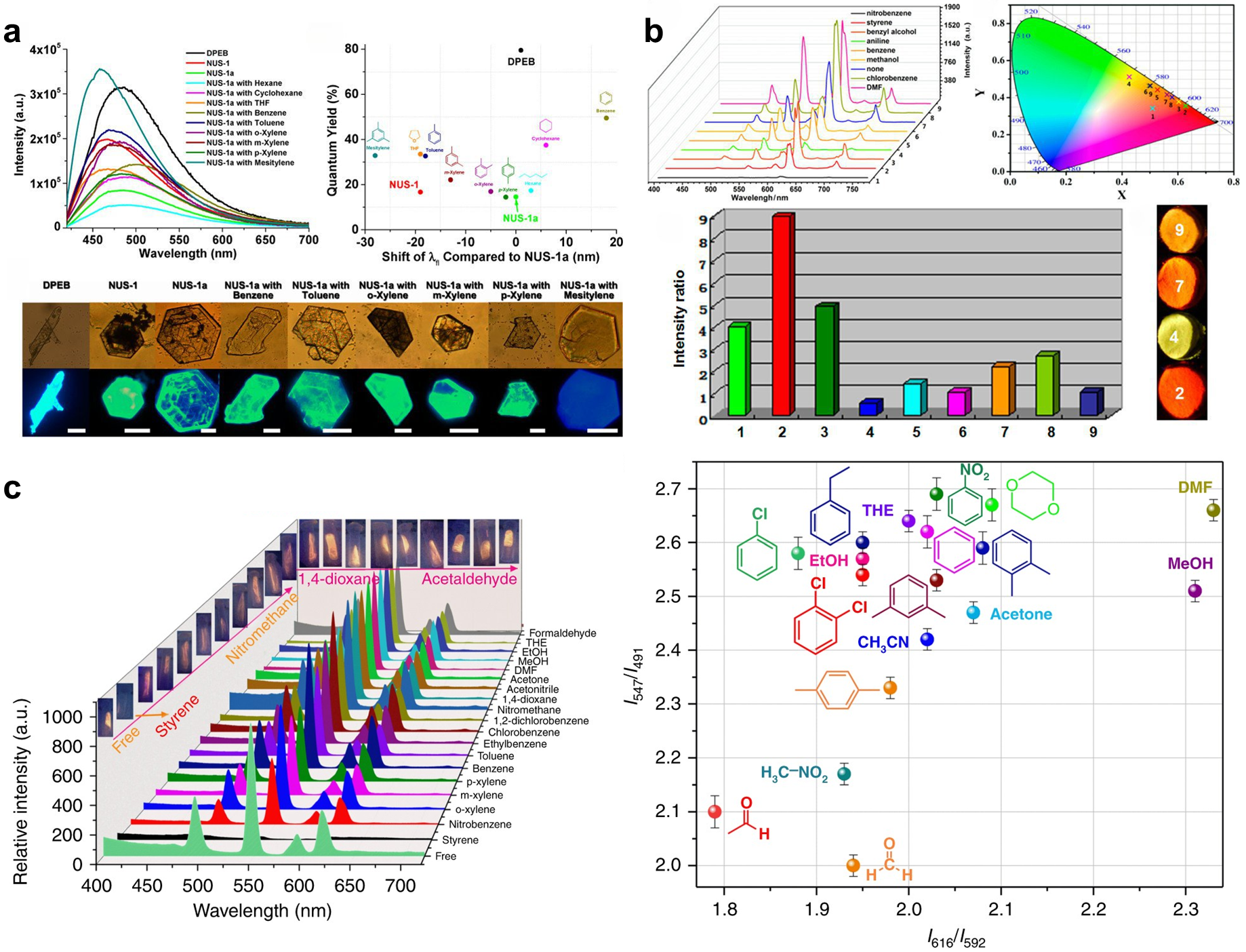
Figure 7. ORs of benzene compounds odors. (a) Fluorescence emission spectrum, relationship between quantum yield and peak shift, and fluorescence microscopy images of NUS-1a[122]. Reproduced with permission from reference[122]. Copyright © 2014 American Chemical Society; (b) Emission spectra, CIE chromaticity coordinates, emission intensity ratios, and optical photographs of Ln-TCM[123]. Reproduced with permission from reference[123]. Copyright © 2014 American Chemical Society; (c) Emission spectra of Eu3+/Tb3+-CTP-COOH, and a two-dimensional decoded map of VOCs based on the emission intensity ratio[124]. Reproduced from reference[124]. CC BY 4.0. ORs: olfactory receptors; VOCs: volatile organic compounds.
Many researchers have also employed ratio fluorescence methods to detect benzene compounds. For example, Zhan C constructed microporous Ln-TCM with dual-metal emission centers, where H3TCM was utilized as the Ln ion coordination site. Ln-TCM demonstrates tunable porosity to accommodate different host-guest interactions, thereby regulating energy transfer efficiency and the energy distribution between Eu3+ and Tb3+ in the luminescence spectrum. This enables the detection of various VOCs, such as isomers represented by o-xylene, m-xylene, and p-xylene; homologs represented by benzene, toluene, and ethylbenzene; and halogenated benzenes represented by fluorobenzene, chlorobenzene, bromobenzene, and iodobenzene (Figure 7b)[123]. Su Y conducted similar work, developing Ln-MOFs based on the versatile ligands Eu3+/Tb3+ and CTP-COOH, which enabled the effective detection of various benzene-based VOCs, such as styrene (Figure 7c)[124]. A ratio fluorescence method based on the ligand and metal center was reported by Wu J. The researchers synthesized a hybrid In-MOF encapsulating Eu3+ and using H2bpydc as the ligand. This MOFs can serve as a fluorescence probe for benzene compounds in both solution and vapor phases[125].
Regarding design strategies for CA mechanisms, Lian X synthesized a series of nano-MOF-76(Ln) structures isomorphous to MOF-76. Among these, MOF-76(Eu) and MOF-76(Tb) were selected for the fluorescence sensing of monoaromatics and served as detection platforms for acetophenone[126].
Aromatic VOCs represent a class of gases with similar molecular structures but different substituents, resulting in highly overlapping physicochemical properties and odor characteristics. The discrimination of these odors relies primarily on minute differences in π-π interactions, pore confinement, and molecular polarity[36]. This characteristic makes aromatic VOCs an ideal model for evaluating the response patterns of LMOFs and their ability to distinguish subtle structural differences. Current research indicates the limitations of simply increasing fluorescence sensitivity to improve molecular discrimination capabilities[138]. Instead, generating more distinctive spectral fingerprints has emerged as a more effective strategy for identifying benzene homologs, isomers, and substituted benzene compounds.
3.4 Emerging design strategies for biomimetic ORs
Unlike sensors designed for a single VOC, practical olfactory systems must simultaneously recognize chemically diverse odors that often produce overlapping physicochemical responses. Consequently, recent research on LMOFs has gradually shifted its focus from developing probes targeting specific analytes to constructing cross-reactive artificial ORs capable of generating multidimensional response patterns. This transition represents a fundamental change in sensing philosophy: instead of maximizing selectivity toward individual analytes, LMOFs increasingly exploit multiple response mechanisms to encode odor information, thereby more closely resembling the combinatorial coding strategy of biological olfactory systems. Some MOFs can distinguish multiple types of odor gases through multi-mechanism responses. For example, Qin Y proposed Tb-based LMOFs olfactory sensors capable of detecting and classifying seven odors, including floral, oily, sour, malodorous, peach-like, grassy, and orange scents. Density functional theory (DFT) calculations indicate that the hydroxyl groups in the selected floral molecules reduce the adsorption energy and bandgap of the system, promoting the ICT effect and thereby triggering a fluorescence turn-on effect. This demonstrates significant potential for constructing artificial intelligence optical olfactory systems for industrial fragrance detection (Figure 8a)[36]. Zhang H designed a novel chair-conformation cup-aromatic octacarboxylic acid ligand and synthesized four functional MOFs; all these MOFs exhibit turn-off sensing properties for amine and aldehyde vapors via the CA effect (Figure 8b)[127]. Shingole M proposed a copper-based MOFs (Cu-MOF-74) and demonstrated its potential as a fluorescence-enhanced probe for H2S gas, while NO2 gas caused a decrease in fluorescence intensity[128]. Meyer L synthesized a cerium (Ce)-based imidazole salt MOFs. This MOFs exhibits a fluorescence quenching effect in other protic or polar solvents such as methanol, acetone, or pyridine, whereas polar non-protic molecules, such as dichloromethane and acetonitrile, exhibit a fluorescence enhancement effect. This is because these polar non-protic molecules can serve as additional sensitizers for Ce3+ emission[129]. Mumtaz F employed fiber-optic technology and the HKUST-1 miniature Fabry-Pérot Interferometer (FPI) to achieve highly sensitive detection of ethanol and benzene (Figure 8c)[130].
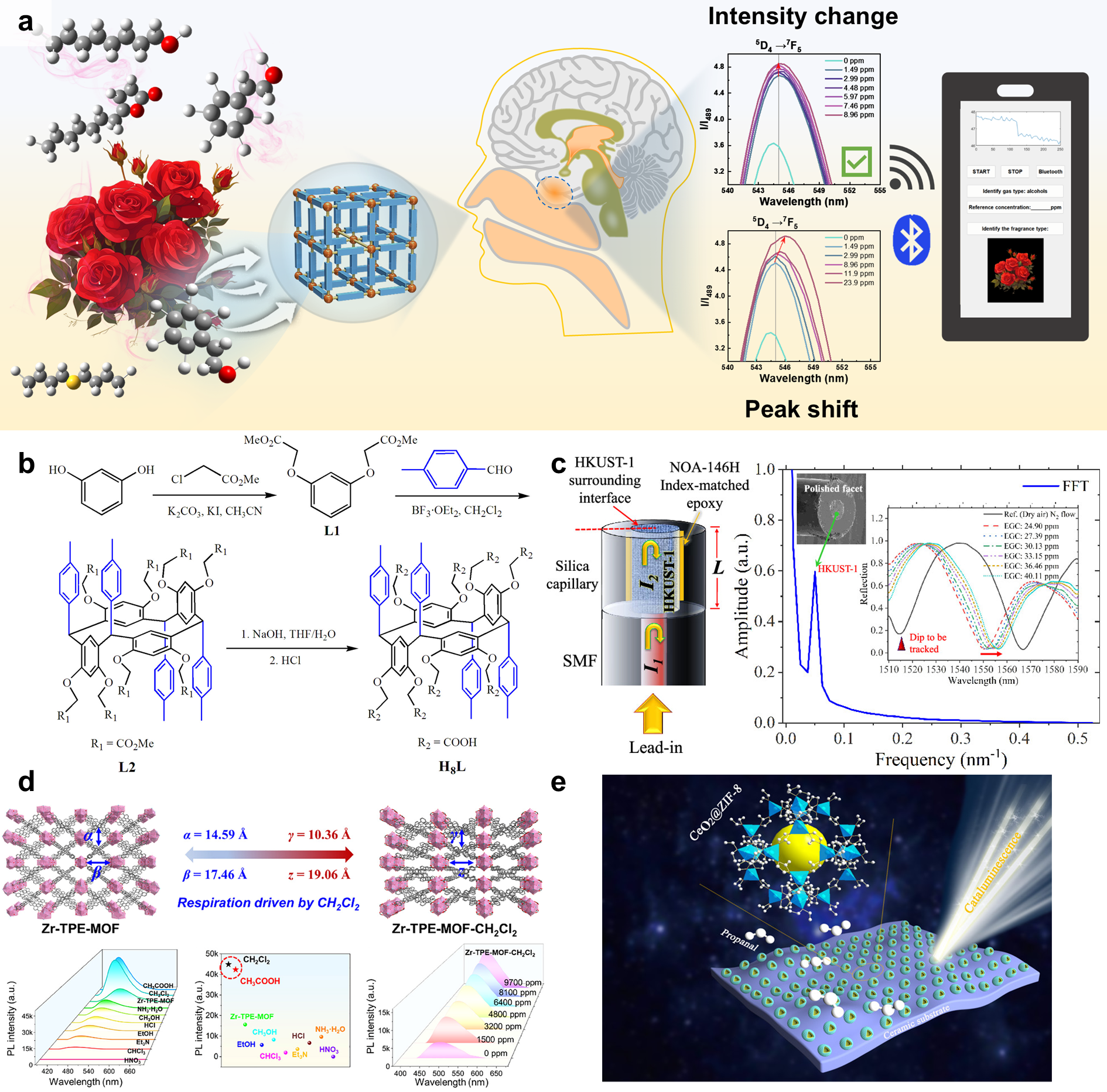
Figure 8. Design strategies for ORs with multi-response mechanisms. (a) A Tb-based LMOFs olfactory sensor for detecting and classifying seven odors, including floral, oily, sour, malodorous, peach-like, grassy, and orange scents[36]. Reproduced with permission from reference[36]. Copyright © 2025 John Wiley and Sons; (b) A novel designed chair-conformation cup-aromatic octacarboxylic acid ligand that detects amine and aldehyde vapors via the CA effect[127]. Reproduced with permission from reference[127]. Copyright © 2016 American Chemical Society; (c) Fiber-optic technology and the HKUST-1-based micro-FPI sensor enable highly sensitive detection of alcohol and benzene[130]. Reproduced with permission from reference[130]. Copyright © 2024 American Chemical Society; (d) Smart LMOFs with vapor-driven respiratory behavior based on AIE molecular ligand design recognize CH2Cl2 or acetic acid[132]. Reproduced from reference[132]. CC BY 4.0; (e) Design of catalytic luminescence in multilayer composites enables the detection of propane[134]. Reproduced with permission from reference[134]. Copyright © 2021 American Chemical Society. ORs: olfactory receptors; LMOFs: luminescent metal-organic frameworks; FPI: Fabry-Pérot Interferometer.
In terms of stability improvements, when exposed to highly irritating or corrosive odors, Xiao Z developed a reflective optical fiber gas sensor for real-time, high-precision detection of acetic acid vapor concentrations. The sensor consists of a light-transmitting channel coated with a thin Ag film, with a TiO2/UiO-66-2CF3 composite film further deposited on its surface. The refractive index increases when acetic acid gas is adsorbed, resulting in enhanced light absorption and reduced reflectance[131]. Li Y utilized AIE molecules as ligands to construct flexible smart LMOFs with octahedral Zr6O4(OH)8(H2O)4 clusters as the secondary structural units, creating the first smart luminescent MOFs exhibiting breathing behavior driven by CH2Cl2 or acetic acid vapor. Through this breathing mechanism, the material adsorbs trace amounts of CH2Cl2 or acetic acid vapor into its pores, resulting in a blue shift in the emission wavelength and an increase in luminescence intensity (Figure 8d)[132]. Some LMOFs can be used to construct ORs for detecting hazardous odors. For example, Song X synthesized an LMOFs sensor by using Eu3+ and the ligand H2bpydb. It is the first MOF-based sensor with multi-response optical sensing features. Moreover, it is the first material reported to be able to distinguish between fatty alcohol homologs and isomers, as well as detect highly explosive TNP gas in the gas environment[16]. Similar work has emerged in recent years. Tuo M developed a series of MOFs (SNNU-290-SNNU-293) using a pore-space partitioning strategy, achieving highly specific and efficient detection of TNP and multiple nitroaromatic explosives[133]. Huang X employed a novel liquid-phase concentration-controlled nucleation strategy to induce the direct assembly of ZIF-8 layers on the surface of CeO2 nanospheres. The synthesized CeO2@ZIF-8 nanocomposite exhibited excellent analytical performance in luminescence-based sensing of propane (Figure 8e)[134].
In summary, these studies reveal the major evolutionary trends in the design of LMOFs-based ORs. On the one hand, sensing strategies are shifting from analyte-specific recognition toward cross-reactive sensing, that is, unique response patterns generated by the interaction of multiple response mechanisms. On the other hand, research on the framework stability of LMOFs sensors is gradually shifting from metric-driven studies to reliability studies based on chemical analysis, bringing LMOFs closer to practical artificial olfactory systems.
4. Application of LMOFs Optical Sensors
4.1 Environmental and industrial odor monitoring
Recently, to address environmental degradation and industrial pollution, human society has increasingly focused on environmental pollutants and ecosystems, sparking a surge in research and development of innovative materials for monitoring various types of pollutants. Compared with laboratory demonstrations targeting single analytes, environmental and industrial odor monitoring presents substantially greater challenges because sensing materials must operate under fluctuating humidity, complex gas mixtures, and long-term continuous exposure[139,140].
In the agricultural realm, Jaishi L R developed a highly sensitive and selective (E)-2-hexenal sensor that integrates a bimetallic Zn-Co/ZIF-8 structure with a microquartz tuning fork transducer to achieve dual-mode detection: a resonance frequency shift triggered by chemical adsorption and a visible color change. This work can be used for real-time in situ monitoring of stress signals caused by pathogen infection or herbivore browsing, thus optimizing crop management and supporting sustainable agricultural development (Figure 9a)[141]. Sankhla L developed a nickel-benzo-1,4-dicarboxylic acid MOFs (Ni-BDC-MOF) for detecting organophosphorus pesticides in complex matrices such as wastewater, offering a promising new approach for agricultural environmental monitoring[146].
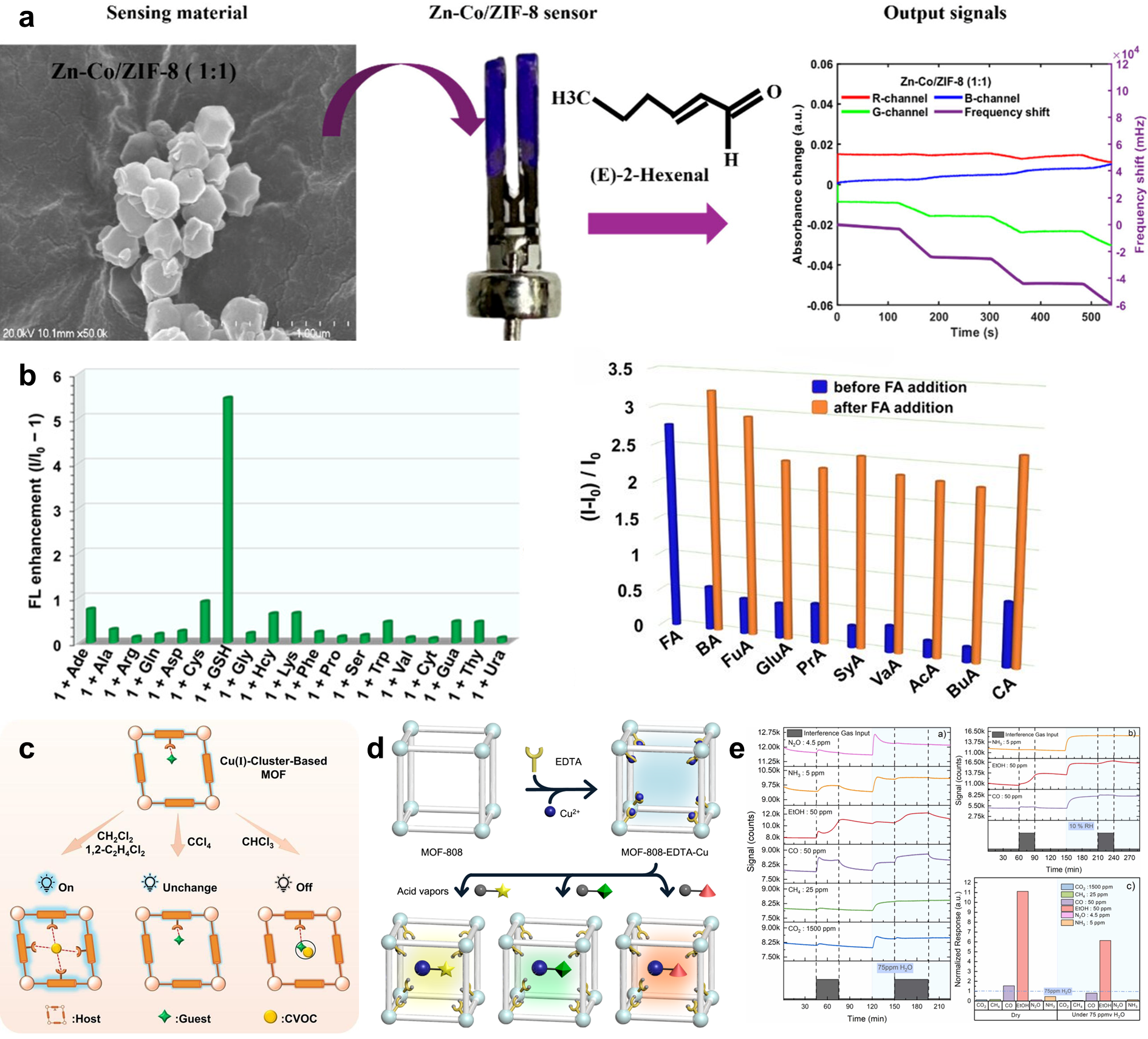
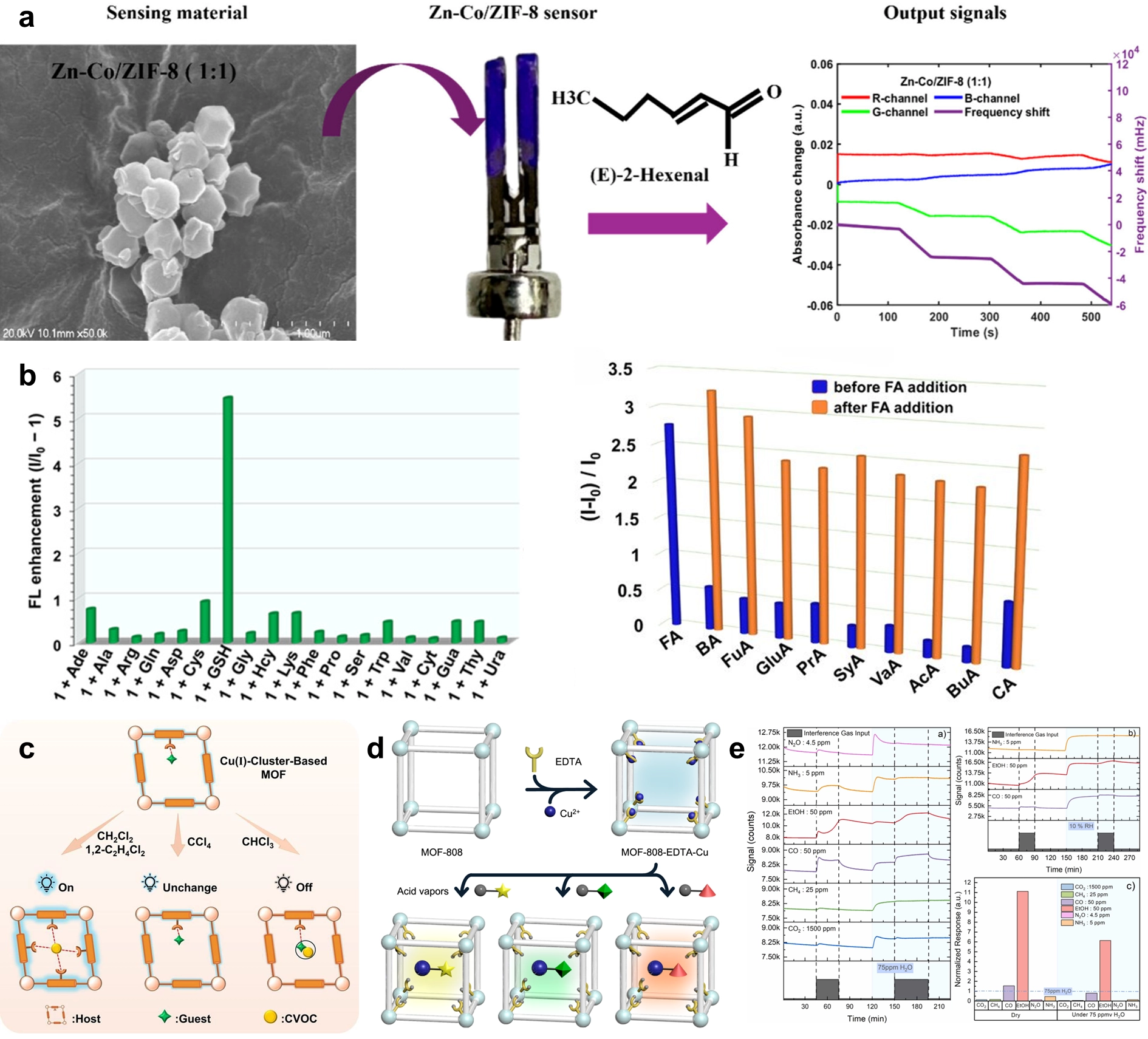
Figure 9. LMOFs used for environmental and industrial odor monitoring. (a) (E)-2-hexenal sensors for real-time in situ monitoring of stress signals[141]. Reproduced with permission from reference[141]. Copyright © 2025 American Chemical Society; (b) Co-based LMOFs can be used for the detection of tumor biomarkers and industrial pollutants[142]. Reproduced with permission from reference[142]. Copyright © 2025 John Wiley and Sons; (c) Cu(I)-cluster-based LMOFs enable real-time trace-level monitoring of various chlorinated VOCs[143]. Reproduced with permission from reference[143]. Copyright © 2025 Elsevier; (d) MOF-808-EDTA-Cu is used for on-site monitoring of various acidic vapors[144]. Reproduced from reference[144]. CC BY 4.0; (e) HKUST-1 can monitor a wide range of environmental humidity based on color changes and is resistant to interference from NH₃, CO, and ethanol[145]. Reproduced from reference[145]. CC BY 4.0. LMOFs: luminescent metal-organic frameworks; VOCs: volatile organic compounds; ZIF-8: zeolite imidazole framework-8.
In the field of environmental monitoring, Mondal U reported a Co-based LMOFs for the low-LoD, rapid, and turn-on detection of the tumor biomarker glutathione and the industrial pollutant formaldehyde. Examples include glutathione in complex biological samples such as fish and meat, as well as formaldehyde in wastewater samples (Figure 9b)[142]. Liu Y reported a lanthanide-doped MOFs-ZnO nanostructure. The researchers achieved a highly sensitive response to n-butanol at 230 °C, providing a solution for the precise detection of n-butanol in public health and environmental safety[147]. Zhao Y reported a Cu(I)-cluster-based LMOFs exhibiting blue fluorescence, which originates from charge transfer from the mixed metal and iodide to the ligand. This material enables real-time trace-level monitoring of various chlorinated VOCs (CH2Cl2, CHCl3, and CCl4), providing a novel strategy for the rapid and sensitive detection of chlorinated hazardous VOCs in soil, water, and air (Figure 9c)[143].
In the industrial field, Jang W developed the MOF-808-EDTA-Cu for on-site monitoring of acidic vapors, achieving accurate identification of hazardous gaseous acidic chemicals. As a proton-triggered colorimetric decoder, MOF-808-EDTA-Cu converts the anionic components in corrosive acids into visual color signals, enabling intuitive differentiation of various acidic vapors (HCl, HF, HBr, and HI) through distinct color responses. By incorporating flexible polymers, MOF-808-EDTA-Cu was successfully fabricated into a portable, miniature acid sensor. Its color changes can be easily detected by the naked eye or a camera, providing experimental validation of its utility as a practical sensor capable of round-the-clock on-site monitoring in real-world environments (Figure 9d)[144]. María G G explored the potential of the MOFs material HKUST-1 as a colorimetric sensor, which can monitor environmental humidity over a wide range based on color changes, and its sensing behavior is minimally affected by interfering compounds. The advantages of low cost, high sensitivity, and ease of fabrication inherent to HKUST-1 offer a highly promising alternative for humidity monitoring in numerous industries, such as microelectronics, petroleum, and chemical engineering (Figure 9e)[145].
Compared with metal-oxide-semiconductor (MOS) and electrochemical sensors, LMOFs offer advantages of tunable pore environments, selective molecular recognition, and low-power optical readout. However, humidity sensitivity and long-term drift remain pressing challenges, highlighting the necessity of developing array-based, robust odor fingerprinting technologies. These studies indicate that the applications of LMOFs have expanded from laboratory-scale fluorescence sensing to practical environmental, agricultural, and industrial monitoring. More importantly, the design objectives have shifted from maximizing analytical sensitivity to enhancing operational robustness, portability, and the ability to collect multidimensional information. This evolution parallels the development of biological olfactory systems. In natural olfaction, adaptation to the environment depends not only on receptor sensitivity but also on continuous information processing in a dynamically changing environment.
4.2 Breath and biomarker odor monitoring
Exhaled breath analysis has become a highly promising noninvasive diagnostic strategy because exhaled breath contains hundreds of volatile metabolites that reflect physiological and pathological processes. However, the detection of clinically significant biomarkers is highly susceptible to the effects of humidity, diet, metabolism, and environmental exposure. Gas-sensitive LMOFs offer new solutions for wearable breath monitoring and the detection of gases associated with physiological or pathological processes, serving applications in health monitoring, personalized medicine, fitness tracking, and environmental health. By utilizing the unique properties of MOFs, wearable devices can detect key biomarkers and environmental indicators in real time[148-150].
In the medical field, Ma C reported a two-dimensional Cu-BDC-N2H3 nanosheet that has been applied to non-invasive diagnosis and point-of-care detection of lung cancer. The researchers employed the pyridine groups in the ligand molecules to react with formaldehyde via a Schuffel reaction to enhance the inherent fluorescence of Cu-BDC-N2H3. By identifying specific biomarkers in the exhaled breath of lung cancer patients with an accuracy of 97.45%, it significantly improved the feasibility and offered a viable alternative for early-stage lung cancer screening (Figure 10a)[151]. Similarly, Cao R developed a dual-emission fluorescent probe material, Tb-UiO-67(8:1), for the detection of volatile biomarkers (cyclohexanone and isoprene) in exhaled breath for the early diagnosis of lung cancer. The researchers integrated the sensing film into a portable smartphone-based sensing device, achieving visual detection of cyclohexanone and isopentadiene vapors. Furthermore, Tb-UiO-67(8:1) exhibited low cytotoxicity and good biocompatibility in living cells, providing a sensitive and reliable solution for visual detection in the early diagnosis of lung cancer (Figure 10b)[152].
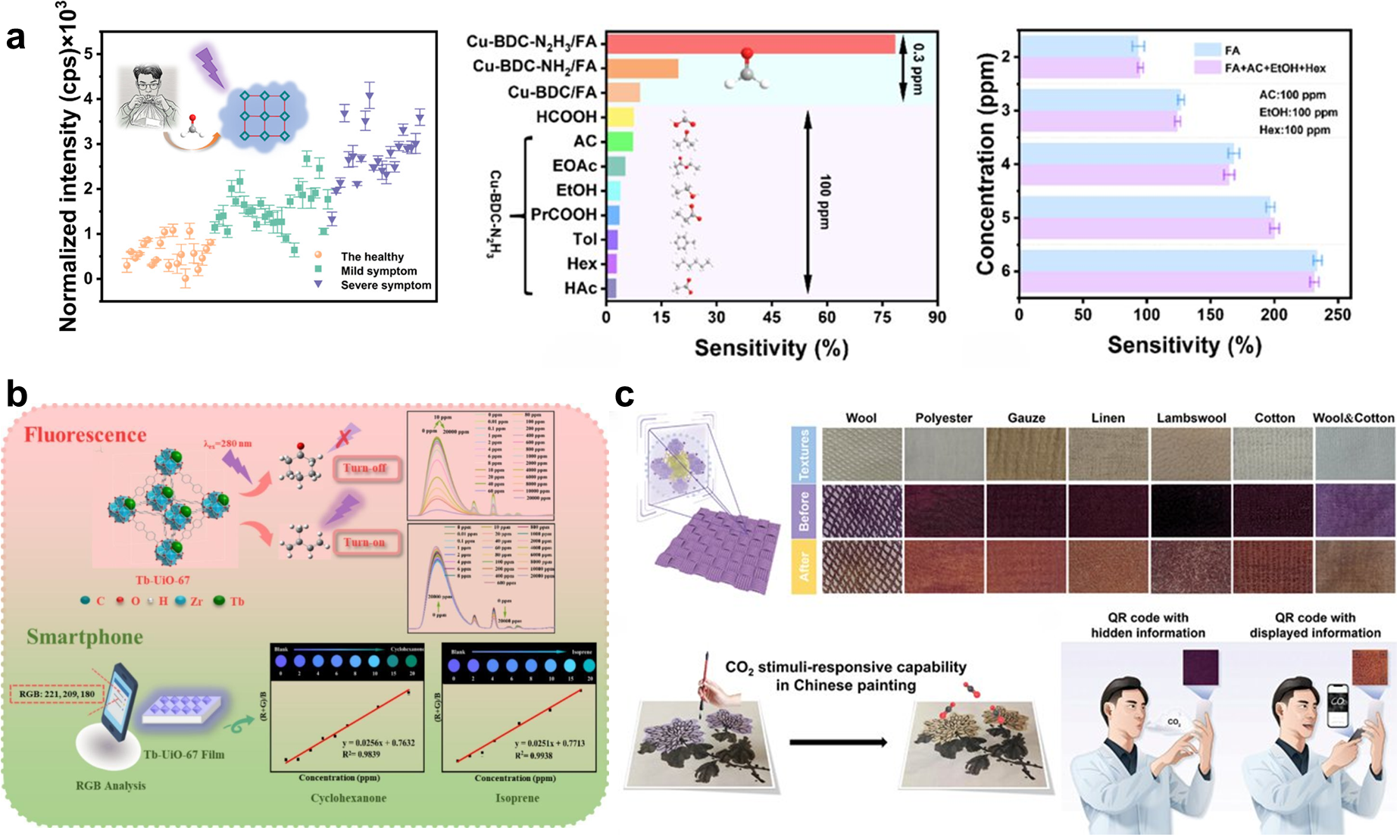
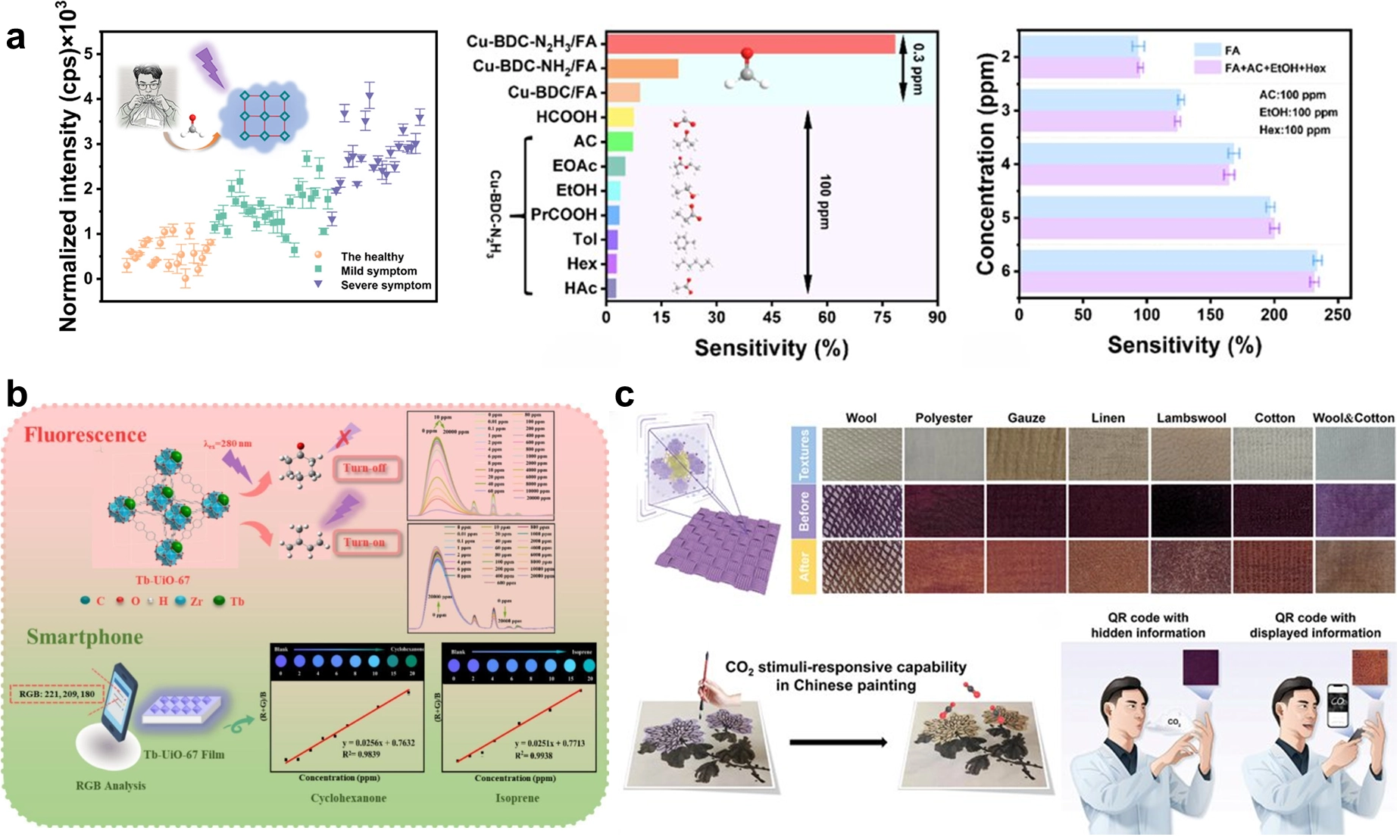
Figure 10. LMOFs used for breath and biomarker monitoring. (a) Cu-BDC-N2H3 nanosheets are used for the detection of formaldehyde, a biomarker of early-stage lung cancer[151]. Reproduced with permission from reference[151]. Copyright © 2025 American Chemical Society; (b) Tb-UiO-67(8:1) is used to detect cyclohexanone and isoprene in exhaled breath for the early diagnosis of lung cancer[152]. Reproduced with permission from reference[152]. Copyright © 2024 Elsevier; (c) Photos of mCP/MOF-804 applications on various substrates and CO2 detection in multiple scenarios[153]. Reproduced with permission from reference[153]. Copyright © 2025 John Wiley and Sons. mCP: m-cresol purple; MOF: metal-organic framework.
The inherent chemical inertness of CO2 molecules poses a significant challenge for sensors, despite CO2 being crucial for medical diagnostics and environmental protection in respiratory monitoring. To address this, Xu X developed a CO2 sensor based on MOF-804 co-functionalized with an ionic liquid and m-cresol purple (mCP). This sensor achieved industry-leading sensitivity and an ultra-wide detection range, while maintaining excellent stability even at relative humidities exceeding 80%. This research has opened new pathways for dynamic CO2 detection, health management, and military encryption (Figure 10c)[153]. Estefanía F B reported an Eu-based LMOFs named INM-EF-1, which is constructed from tetrahedral carboxylic acid ligands (H4TBCM). INM-EF-1 exhibited permanent porosity, exceptional stability, and unique PL modulation properties during CO2 interaction. It possessed a distinctive physical adsorption-driven mechanism: CO2 enhanced the LMCT efficiency without disrupting the framework structure. The researchers embedded activated INM-EF-1 into a PDMS matrix to prepare a sensor film, achieving enhanced sensitivity and durability for CO2 monitoring[154].
Collectively, recent studies indicate that the development of LMOFs-based breath sensors is shifting from proof-of-concept biomarker detection toward clinically applicable diagnostic platforms. Early research primarily validated the feasibility of detecting individual biomarkers under controlled laboratory conditions, while recent studies have increasingly focused on portable devices, wearable sensors, visual readouts, and biocompatible materials. Despite these encouraging advances, several challenges remain before LMOFs-based breath sensors can be translated into clinical applications. First, many reported evaluations of sensor performance have used single-component model gases, whereas human breath typically contains hundreds of VOCs. Second, the extremely high humidity in exhaled breath may significantly alter adsorption behavior and fluorescence response. Third, the clinical specificity of individual VOCs biomarkers remains controversial, as many compounds are associated with multiple diseases rather than a single pathological condition. LMOFs enable selective enrichment and optical detection of trace breath VOCs, offering advantages for portable and wearable devices over conventional methods. However, high humidity, complex breath matrices, and limited biomarker specificity remain major barriers to clinical translation.
4.3 Food odor monitoring
Food safety is crucial to human life, and freshness monitoring is central to food safety and quality control. Food spoilage is not determined by a single volatile biomarker but rather by an evolving mixture of amines, aldehydes, sulfur compounds, ketones, and organic acids. Therefore, practical freshness assessment relies more on the identification of dynamic odor fingerprints than on the sensitive detection of individual analytes. Traditional methods for assessing the freshness of meat products suffer from a lack of sensitivity and real-time performance, failing to satisfy the demands of today’s food industry. LMOFs demonstrate significant potential in the field of biosensors due to their highly ordered pore structures and unique optical and physicochemical properties. The tunable optical properties and high sensitivity to environmental changes of LMOFs provide an effective solution for monitoring meat freshness[155].
Food freshness is a critical indicator of food safety. Xie H developed three UiO-66 derivatives as histamine-sensing probes. By introducing varying numbers of hydroxyl groups to alter the material’s energy levels and replacing a portion of the Zr4+ with Tb3+ to introduce additional luminescent centers, the researchers developed visual histamine sensing probes capable of serving as a visual indicator of food freshness (Figure 11a)[156]. Hu Y developed a smart film based on cellulose acetate-curcumin-loaded cyclodextrin MOFs (CA-Cur@CD-MOF) to achieve precise monitoring of food freshness. CA-Cur@CD-MOF can be used for real-time monitoring of shrimp freshness at different stages of decay, demonstrating broad application prospects for real-time monitoring of the freshness of other high-protein foods (Figure 11b)[157]. García C M reported similar work, in which researchers developed a portable sensing device based on color sensors and nanostructured MOFs for in situ detection of freshness loss in fresh shrimp samples. This research provided a highly sensitive, highly selective, and easy-to-operate solution for food contaminant detection (Figure 11c)[158].
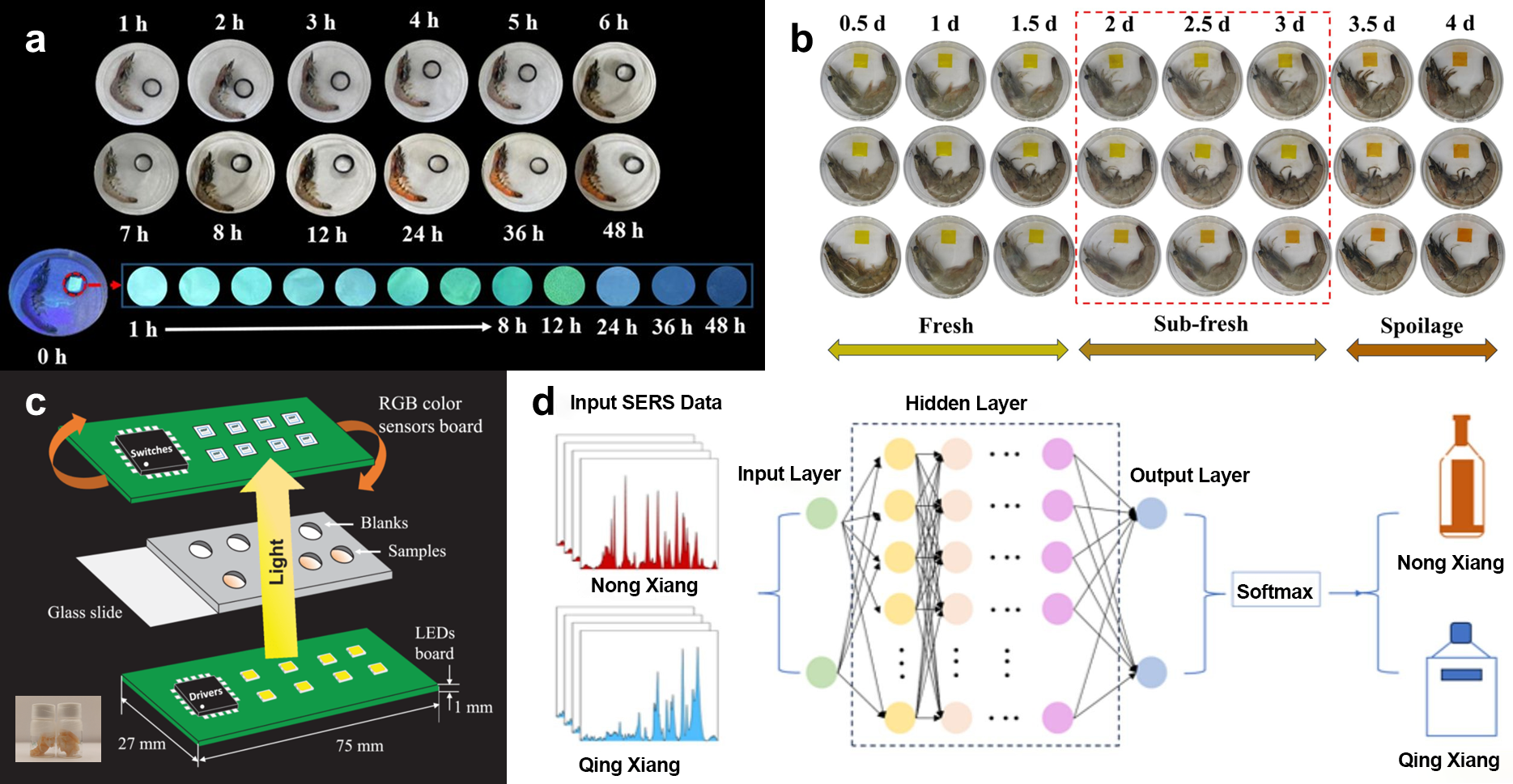
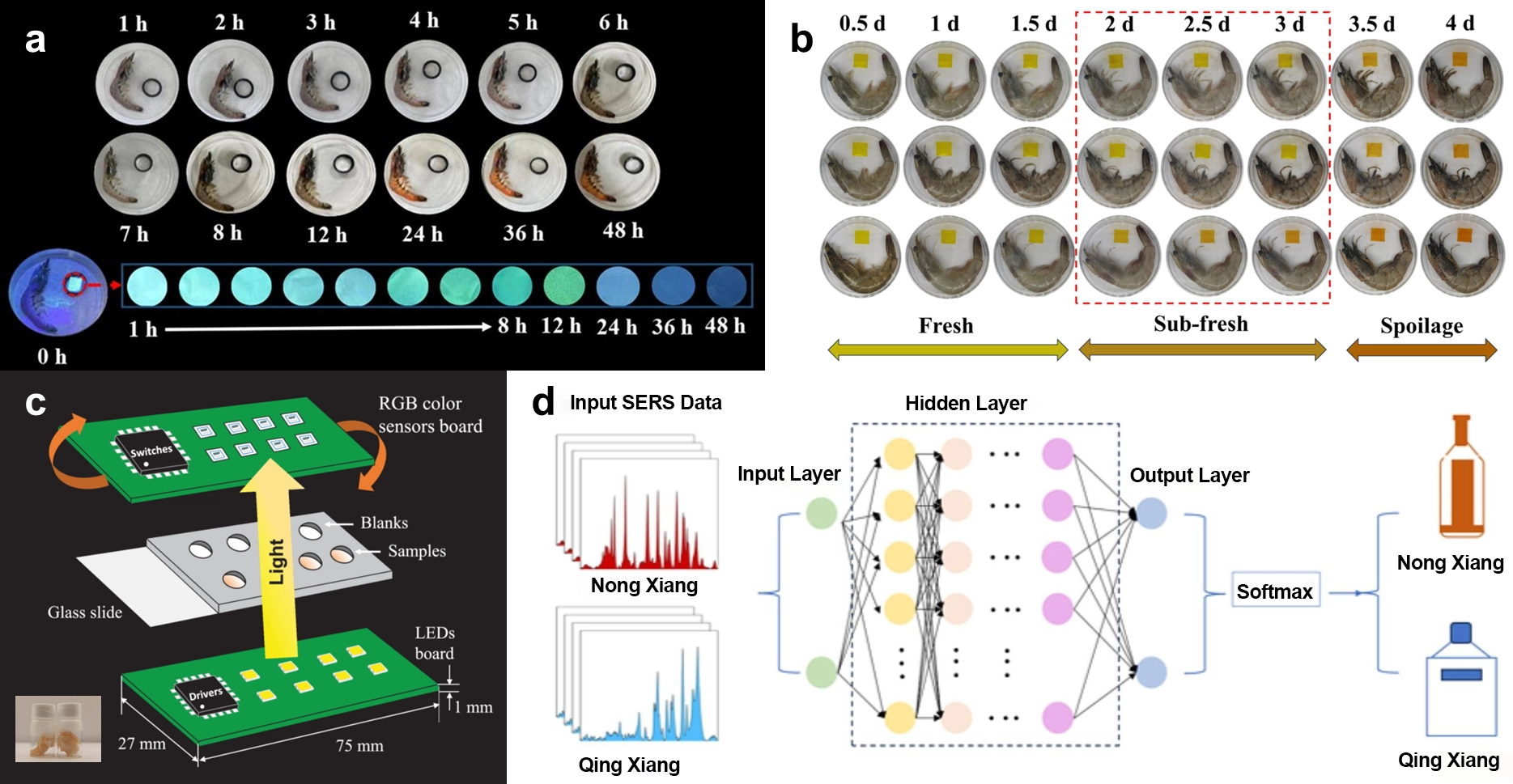
Figure 11. LMOFs are used for food odor monitoring. (a) UiO-66 derivatives are used as histamine detection probes to monitor food freshness[156]. Reproduced with permission from reference[156]. Copyright © 2024 Elsevier; (b) CA-Cur@CD-MOF smart film is used for real-time monitoring of shrimp freshness at different stages of decay[157]. Reproduced with permission from reference[157]. Copyright © 2025 Elsevier; (c) A portable sensing device based on color sensors and MOFs[158]. Reproduced from reference[158]. CC BY 4.0; (d) AgNWs@MOFs films effectively detect the flavor of baijiu and identify networks[159]. Reproduced with permission from reference[159]. Copyright © 2025 Elsevier. MOF: metal-organic framework; SERS: surface-enhanced Raman spectroscopy.
In the field of food flavor technology, Marta O A integrated lanthanide single-ion magnets (SIMs) into MOFs to develop a novel luminescent spin quantum sensor (Ln SIM-MOFs). Ln SIM-MOFs demonstrated dual luminescent and magnetic vapor-switch properties, opening new pathways for designing multifunctional, multi-responsive molecular materials that can be used to detect VOCs generated by industrial processes or food degradation, particularly biogenic amines[160]. Yan H introduced semi-encapsulated silver nanowires (AgNWs@MOFs) into MOFs to fabricate films, combined with silica microspheres to achieve gas adsorption and surface-enhanced Raman spectroscopy (SERS) enhancement effects for the effective detection of baijiu flavor. Additionally, an artificial neural network (ANN) algorithm was developed for baijiu flavor and brand identification, achieving an identification accuracy of nearly 90%. This technology demonstrates broad application prospects in fields such as food safety and environmental health (Figure 11d)[159].
Despite the rapid progress, current LMOFs-based food sensors still exhibit several important limitations. First, many sensing systems focus on single volatile indicators, whereas food spoilage involves dynamic interactions among numerous VOCs generated through complex biochemical pathways. Second, the influence of packaging atmosphere, humidity, and storage conditions on sensing accuracy is rarely evaluated systematically. Third, food freshness lacks universally accepted optical thresholds, making quantitative comparison between different sensing platforms difficult. Unlike laboratory-intensive gas chromatography-mass spectrometry (GC-MS), LMOFs enable portable, real-time optical monitoring through selective adsorption and visual responses. However, food spoilage involves complex VOCs mixtures, making sensor arrays and odor-pattern recognition more suitable than single-analyte detection.
4.4 Monitoring of high-risk gases
High-risk gases, such as chemical warfare agents, exhibit extreme biological toxicity and pose a serious threat to the environment and human health. Unlike conventional environmental VOCs monitoring, the detection of high-risk gases places much stricter demands on sensing materials. Besides ultralow detection limits, practical sensors must provide rapid response, high selectivity, low false-alarm rates, and reliable operation under complex environmental conditions. Consequently, recent LMOF research has shifted from simply improving fluorescence sensitivity toward constructing integrated sensing platforms capable of rapid classification and real-time decision-making. There is an urgent necessity to develop gas sensors capable of detecting trace amounts of radionuclides and chemical warfare agents with ultrafast response times to ensure human health and environmental safety[161-163].
Wang Y proposed a three-dimensional photonic crystal optical gas sensor based on MOFs for detecting trace amounts of chemical warfare agent simulants under varying atmospheric humidity conditions. The sensor exhibits ultra-high sensitivity and ultra-fast response, attributed to the ordered superstructure of the three-dimensional photonic crystals and their complete photonic bandgap properties. An optical gas sensor array constructed based on this design achieved an average classification accuracy of 98.6% (Figure 12a)[164]. In the author’s subsequent research, a three-dimensional photonic crystal (3D PC) array optical nose based on MOFs was developed, successfully identifying the optical fingerprints of 13 types of hazardous gases. This demonstrates the feasibility of this approach for the quantitative detection of unknown concentrations of hazardous gases (Figure 12b)[165]. Xu W developed a highly sensitive and selective composite fluorescent sensor, UiO-66-Tpy@SiO2, integrating UiO-66-Tpy with silicon dioxide in a photonic crystal structure for the efficient detection of nerve toxin simulants. This hybrid film exhibits a 15-fold fluorescence enhancement effect, with a detection limit (LoD) of 1.1 ppm and a response time of < 10 s, while demonstrating excellent selectivity, reversibility, and stability. It provides a viable strategy for gas detection in complex environments and exhibits broad prospects in the fields of environmental monitoring and biomedical safety[167]. Ju Y reported two porous thorium-based LMOFs (Th-BITD-1 and Th-BITD-2) capable of sequentially treating and detecting radioactive iodine, a radioactive fission product released during nuclear fuel reprocessing. Among these, Th-BITD-1 demonstrated superior iodine adsorption capabilities compared to Th-BITD-2 via both solution and vapor diffusion methods and can serve as a highly sensitive iodate luminescent sensor. This indicates that actinide-based LMOFs have potential applications in the field of radiochemistry, such as the separation and detection of radionuclides (Figure 12c)[166]. This study is an example of the detection of high-risk chemicals that belong to the non-odor category.
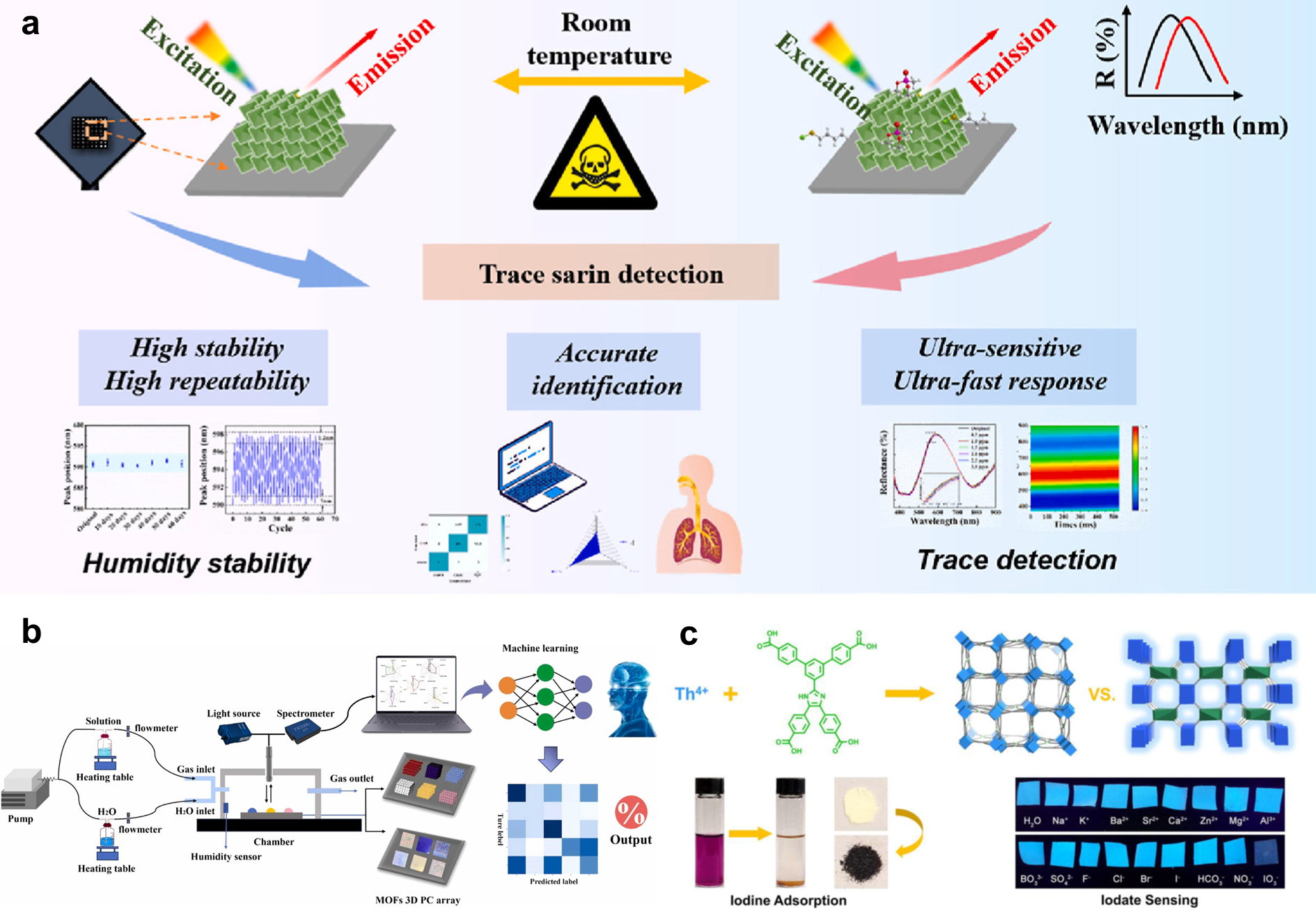
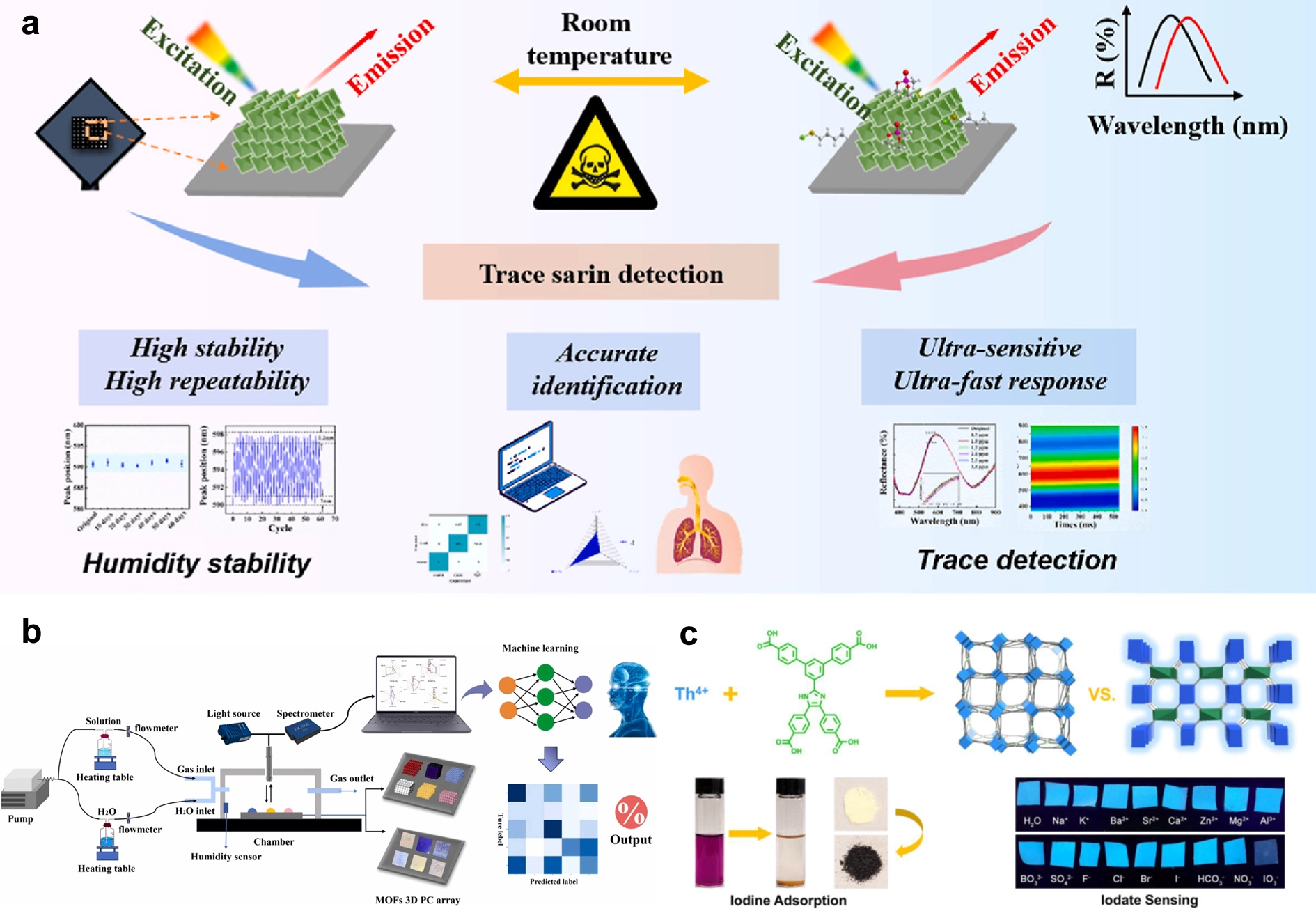
Figure 12. LMOFs are used for high-risk gas monitoring. (a) A MOF-based three-dimensional photonic crystal sensor is used for the detection of trace chemical warfare agent simulants[164]. Reproduced with permission from reference[164]. Copyright © 2024 Elsevier; (b) A 3D PC array optical nose based on MOFs[165]. Reproduced with permission from reference[165]. Copyright © 2025 Elsevier; (c) Th-BITD-1 and Th-BITD-2 are used to process and detect radioactive iodine[166]. Reproduced with permission from reference[166]. Copyright © 2023 John Wiley and Sons. MOF: metal-organic framework; 3D PC: three-dimensional photonic crystal.
Recent studies demonstrate that the design philosophy of LMOFs for high-risk gas monitoring has evolved from single-analyte fluorescence sensing toward integrated hazard recognition systems. Research is increasingly focusing on multidimensional optical encoding, sensor array architectures, photonic crystal enhancement, and intelligent classification algorithms. This trend indicates that emergency response relies not only on the detection of hazardous gases but also on the rapid identification of their chemical composition under complex environmental conditions. However, several key challenges remain. First, most sensor performance has been evaluated under ideal laboratory conditions, whereas battlefield or industrial accident scenarios involve rapidly changing gas concentrations, various interferents, aerosols, and extreme humidity. Second, the robustness of sensors after long-term storage and repeated exposure to toxic gases has not yet been fully characterized. Finally, current machine learning models rely on relatively small training datasets, and there remains a lack of research on their generalization capabilities and reliability when the system encounters hazardous gases it has not previously experienced. LMOFs offer selective molecular recognition and multidimensional optical encoding for rapid hazardous-gas identification, complementing conventional sensors. However, humidity, aging, false alarms, and limited validation under realistic conditions remain critical challenges for deployment.
5. Conclusions and Perspectives
5.1 Conclusion
By combining the optical multi-response properties of optical materials with the high porosity, high coordinative capacity, and host-guest interactions of MOFs, LMOFs have demonstrated significant advantages in sensing applications involving multiple components and complex gas environments. Due to their properties being highly compatible with ORs in biological olfactory systems, LMOFs have become strong candidates for constructing ORs in bionic olfactory systems. To comprehensively review and analyze current research progress on LMOFs and facilitate the strategic design of ORs for bionic olfactory systems, this paper first introduces the synthetic strategies and structural regulation mechanisms of LMOFs, analyzes their luminescence principles and sensing mechanisms, and focuses on how these mechanisms operate in interaction with odor sources containing different functional groups. Finally, this paper summarizes the applications of LMOFs in environmental and industrial monitoring, breath and biomarker detection, the food industry, and high-risk environments, as well as provides prospects for future development.
For synthesis strategies and structural regulation mechanisms, the mechanisms of coordination regulation, protonation/deprotonation regulation, and surfactant regulation were investigated. The influence of reaction environment parameters (pH, temperature, and reaction solvent/reactant concentration) on the size and morphology of LMOFs through these mechanisms was summarized, which facilitates the comprehension and design of LMOFs’ synthesis routes and formulation parameters. Secondly, a brief overview of the rapidly evolving methods for LMOFs preparation was provided. These preparation techniques demonstrated the advantages of LMOFs at different stages of development or on different substrate materials, offering technical references for the systematic industrial design and production of LMOFs.
Regarding luminescence principles and sensing mechanisms, the multi-mechanism optical properties of LMOFs stem from their unique structural designability. By designing and selecting metal luminescent centers, ligand structures, or introducing additional luminescent guest molecules, it is possible to modulate energy or electron flow, thereby achieving multi-mechanism luminescent properties. Furthermore, the choice of transduction mechanisms also influences the design of bionic olfactory systems. This paper introduces sensing transduction mechanisms and their luminescent behaviors based on colorimetry and spectroscopy. Finally, the intrinsic connections and synergistic effects between these luminescent and sensing mechanisms were analyzed, which aids comprehension of the microscopic mechanisms underlying these signal changes, thus advancing the design of multi-sensing mechanisms for ORs.
Regarding the multi-mechanism sensing of odor sources with different functional groups by LMOFs, this paper focuses on the design of selective ORs for ketones/aldehydes, alcohols/ethers, nitrogen compounds, sulfur compounds, aromatic compounds, and emerging design strategies for biomimetic ORs, providing a basis and reference for bionic olfactory researchers in the development of sensing materials across various application fields. These paper also discusses the application areas and future directions for the design of these ORs, these application fields include, but are not limited to, the environment and industry, breath and biomarker detection, the food industry, and high-risk environments.
Based on the above research, this paper adopts a bottom-up perspective, focusing on the synthesis and structural regulation of LMOFs, luminescence and sensing mechanisms, and the design of ORs classified by analytes’ functional groups, demonstrating the potential of LMOFs in various odor environments and multiple fields, and offering feasible solutions for bionic olfaction applications in these fields.
5.2 Critical review and future challenges
Although LMOFs show promising applications in odor sensing and the construction of bionic ORs, the field currently faces several key challenges that still need to be addressed in the future.
First, LMOFs face long-term stability challenges in material stability. Although most reported LMOFs can achieve sensing under high temperatures, wide humidity ranges, and corrosive environments, these investigations still need to be validated through long-term studies. This is because chemical reactions involving temperature, humidity, and corrosive environments often proceed slowly, leading to structural degradation or even collapse of the LMOFs during sustained exposure. Additionally, the long-term stability and recovery behavior of LMOFs should be systematically investigated under actual sensing conditions. The framework stability is not only related to temperature and humidity but also to the preservation of the pore structure, coordination bonds, luminescent centers, and sensing sites during repeated adsorption-desorption cycles. In particular, irreversible or slow adsorption of odor molecules may result in incomplete recovery, pore occupancy, or structural alteration. Therefore, future research should establish standardized recovery protocols, evaluating key parameters such as recovery time, recovery efficiency, signal retention rate, and performance after multiple sensing cycles. Feasible strategies include optimizing metal-ligand coordination strength and the pore environment, introducing hydrophobic or protective functional groups, controlling pore size and surface interactions, and developing appropriate thermal, vacuum, pressure, or solvent-assisted regeneration methods. Water molecules compete with odor molecules for adsorption sites or interact with metal centers or functional groups. Such interactions can cause changes in the luminescence baseline and sensing response. Therefore, the water stability of LMOFs and their humidity-influenced sensing behavior should be systematically investigated, rather than relying merely on partial research under dry conditions. Furthermore, LMOFs also face baseline drift challenges in reproducibility. Currently, the repeatability of most LMOFs sensors still falls short of practical application standards. This is primarily reflected in baseline drift of the spectrum caused by reactivation following the adsorption of odor molecules, a fundamental contradiction and balance between the multi-reactive activity and stability of LMOFs. In LMOFs sensors, this balance manifests as reactional activity, whereas in electrical sensors, such as oxide resistive sensors, it manifests as stability. Therefore, finding a way to resolve this contradiction or employing new processing methods to completely release adsorbed odor molecules from the framework structure to restore the sensor’s luminescence baseline remains a critical direction for future research.
At the level of sensory bionics construction, the current application of LMOFs must overcome challenges such as real-world ecological and environmental monitoring, agricultural and industrial monitoring, extreme environments, and clinical feasibility. This involves analyzing the pattern response, dynamic response performance, resistance to temperature and humidity, and resistance to interference for a wide range of gas types in bionic olfaction. Furthermore, future LMOF-based bionic olfactory systems should place greater emphasis on cross-reactive sensor arrays and combinatorial coding, which are fundamental features of biological olfaction. Rather than relying on a single highly selective LMOF receptor, arrays composed of LMOFs with different pore structures, functional groups, or luminescence mechanisms can generate distinct response patterns toward the same or different odorants. These multidimensional response fingerprints can then be combined with pattern recognition and machine learning algorithms for odor identification and discrimination, particularly for complex multicomponent gases.
At the system construction layer, current sensing systems face the critical challenge of insufficient integration, a problem stemming from the fact that optical sensors and optical integrated systems are still in their infancy. This severely limits the integration of olfactory chips onto robotic platforms. Consequently, the lack of research papers on integrating LMOFs powders into systems capable of signal readout undoubtedly constitutes a barrier to progress in this field. Furthermore, interactions between the sensor substrate/surface functionalization materials and the LMOFs lead to additional signal baseline shifts. These critical challenges urgently require resolution through future research focused on sensor miniaturization and integration, particularly photonics chip technology.
Beyond the system layer, the rapid development of machine learning and artificial intelligence technologies has brought new opportunities to the traditional sensor field. At the design level, artificial intelligence can provide new approaches for the design of ORs for bionic olfaction. Its data-driven design strategies can accelerate material screening and even lead to the design and synthesis of novel functionalized LMOFs. At the data level, machine learning and artificial intelligence are fundamental to building bionic olfactory systems, which urgently require extensive sensor databases and neural network algorithms for standardized training of bionic olfactory models. In practical applications, since sensors in the environment are almost always exposed to multi-component gases, technologies such as pattern recognition, the superposition of nonlinear responses, and the precise identification of complex gases require urgent research.
At the standardization level, there is an urgency to establish standards for evaluating bionic olfactory systems, such as (i) cross-responsive olfactory systems, in which a single sensing unit generates different response patterns to multiple odor compounds; (ii) Combinatorial-coding olfactory systems, in which a group of sensing units can generate characteristic odor fingerprints for different odors and classify these odors; and (iii) Intelligent bionic olfactory systems, which evolve from classification toward autonomous perception and decision-making, including the integration of machine learning or artificial intelligence algorithms to autonomously perceive, identify, and analyze the complex, multi-component, and dynamic odor environment, and further provide effective chemical information for environmental interaction or decision-making.
In summary, for future ORs designed for bionic olfaction, although LMOFs have demonstrated their competitive advantages, the academic community still anticipates research focusing on LMOFs’ stability and reproducibility, system miniaturization and integration, as well as AI-enabled design and application algorithms. These studies will serve as crucial support for promoting LMOFs toward bionic olfaction and embodied intelligence.
Authors contribution
Qin Y: Writing-original draft, writing-review & editing.
Li L: Supervision, project administration.
Conflicts of interest
The authors declare no conflicts of interest.
Ethical approval
Not applicable.
Consent to participate
Not applicable.
Consent for publication
Not applicable.
Availability of data and materials
Not applicable.
Funding
We acknowledge support from Brain Science and Brain-like Intelligence Technology-National Science and Technology Major Project (Grant No. 2026ZD0222604), National Natural Science Foundation of China Major Instrument Project (Grant No. 62527816), and Guangdong Basic and Applied Basic Research Foundation (Grant No. 2025B1515120064).
Copyright
© The Author(s) 2026.
References
-
3. Robinson N, Tidd B, Campbell D, Kulić D, Corke P. Robotic vision for human-robot interaction and collaboration: A survey and systematic review. ACM Trans Hum Robot Interact. 2023;12(1):1-66.[DOI]
-
6. Rahman S, Usmani T, Saeed SH. Review of electronic nose and applications. Int J Comput Corp Res. 2013;3(2):1-9. Available from: http://ijccr.com/March2013/2.pdf
-
7. Branca A, Simonian P, Ferrante M, Novas E, Negri RM. Electronic nose based discrimination of a perfumery compound in a fragrance. Sens Actuators B Chem. 2003;92(1-2):222-227.[DOI]
-
8. Cao M, Ling X. Quantitative comparison of tree ensemble learning methods for perfume identification using a portable electronic nose. Appl Sci. 2022;12(19):9716.[DOI]
-
9. Cao M. Using a light-weight CNN for perfume identification with an integrated handheld electronic nose. Electronics. 2023;12(4):1041.[DOI]
-
10. Zhang L, Tian F, Peng X, Yin X, Li G, Dang L. Concentration estimation of formaldehyde using metal oxide semiconductor gas sensor array-based e-noses. Sens Rev. 2014;34(3):284-290.[DOI]
-
11. Davey A. Metal-organic framework-based colorimetric gas sensors toward an improved indoor air quality monitoring [dissertation]. Berkeley: University of California; 2023. Available from: https://escholarship.org/content/qt8s53w0tp/qt8s53w0tp_noSplash_4c42db748b5c79c2e3156a71742863f6.pdf
-
12. Noh HW, Jang Y, Park HD, Kim D, Choi JH, Ahn CG. A selective feature optimized multi-sensor based e-nose system detecting illegal drugs validated in diverse laboratory conditions. Sens Actuators B Chem. 2023;390:133965.[DOI]
-
15. Chaudhari AK, Nagarkar SS, Joarder B, Ghosh SK. A continuous π-stacked starfish array of two-dimensional luminescent MOF for detection of nitro explosives. Cryst Growth Des. 2013;13(8):3716-3721.[DOI]
-
16. Song XZ, Song SY, Zhao SN, Hao ZM, Zhu M, Meng X, et al. Single-crystal-to-single-crystal transformation of a europium(III) metal-organic framework producing a multi-responsive luminescent sensor. Adv Funct Mater. 2014;24(26):4034-4041.[DOI]
-
17. Wei G, Dan M, Zhao G, Wang D. Recent advances in chromatography-mass spectrometry and electronic nose technology in food flavor analysis and detection. Food Chem. 2023;405:134814.[DOI]
-
18. Sanyal B, Ahn JJ, Maeng JH, Kyung HK, Lim HK, Sharma A, et al. An improved approach to identify irradiated spices using electronic nose, FTIR, and EPR spectroscopy. J Food Sci. 2014;79(9):C1656-C1664.[DOI]
-
19. Banerjee(Roy) R, Chattopadhyay P, Tudu B, Bhattacharyya N, Bandyopadhyay R. Artificial flavor perception of black tea using fusion of electronic nose and tongue response: A Bayesian statistical approach. J Food Eng. 2014;142:87-93.[DOI]
-
20. Kim C, Kim SJ, Lee Y, Nguyen TM, Lee JM, Moon JS, et al. A phage- and colorimetric sensor-based artificial nose model for banana ripening analysis. Sens Actuators B Chem. 2022;362:131763.[DOI]
-
21. Ghasemi-Varnamkhasti M, Mohtasebi SS, Siadat M, Balasubramanian S. Meat quality assessment by electronic nose (machine olfaction technology). Sensors. 2009;9(8):6058-6083.[DOI]
-
22. Wang J, Li D, Ye Y, Qiu Y, Liu J, Huang L, et al. A fluorescent metal-organic framework for food real-time visual monitoring. Adv Mater. 2021;33(15):2008020.[DOI]
-
24. Haddi Z, Amari A, Alami H, El Bari N, Llobet E, Bouchikhi B. A portable electronic nose system for the identification of cannabis-based drugs. Sens Actuators B Chem. 2011;155(2):456-463.[DOI]
-
25. Wasilewski T, Migoń D, Gębicki J, Kamysz W. Critical review of electronic nose and tongue instruments prospects in pharmaceutical analysis. Anal Chim Acta. 2019;1077:14-29.[DOI]
-
28. Shanmugasundaram A, Manorama SV, Kim DS, Jeong YJ, Lee DW. Toward Point-of-Care chronic disease Management: Biomarker detection in exhaled breath using an E-Nose sensor based on rGO/SnO2 superstructures. Chem Eng J. 2022;448:137736.[DOI]
-
29. Smulko J, Chludziński T, Majchrzak T, Kwiatkowski A, Borys S, Jaimes-Mogollón AL, et al. Analysis of exhaled breath for dengue disease detection by low-cost electronic nose system. Measurement. 2022;190:110733.[DOI]
-
30. Hou J, Liu X, Hou C, Huo D, Li J. A PVDF-based colorimetric sensor array for noninvasive detection of multiple disease-related volatile organic compounds. Anal Bioanal Chem. 2023;415(27):6647-6661.[DOI]
-
33. Sicard G, Holley A. Receptor cell responses to odorants: Similarities and differences among odorants. Brain Res. 1984;292(2):283-296.[DOI]
-
34. Li N, Zhang JB, Wöll C, Gu ZG, Zhang J. Breathable biomimetic chiral porous MOF thin films for multiple enantiomers sensing. Adv Funct Mater. 2025;35(26):2422860.[DOI]
-
35. Gong D, Li X, Chen Y, Jiao T. Recent progress in MOF-based flexible sensors: A review. Sustain Mater Technol. 2025;44:e01429.[DOI]
-
36. Qin Y, Guo Q, Han W, Hu T, Zhou X, Yin B, et al. Photonic olfactory sensors enabling efficient recognition of volatile industrial fragrances. Adv Opt Mater. 2025;13(26):e01205.[DOI]
-
37. Zhang X, Cui Y, Qian G. Metal-Organic frameworks for optical sensor arrays. Prog Mater Sci. 2025;154:101507.[DOI]
-
38. Hernik A, Smets J, Wang Z, Semenova Y, Tan JC, Ameloot R, et al. Optical detection of volatile organic compounds: A review of methods and functionalized sensing materials. Adv Opt Mater. 2025;13(27):e00369.[DOI]
-
39. Dong R, Shen Z, Li H, Cheng J, Fu Y. Research progress in fluorescent gas sensors based on MOFs. J Mater Chem C. 2024;12(33):12692-12707.[DOI]
-
40. Rahman MS, Helal E, Demarquette NR. Recent advances in metal-organic framework-integrated nanocomposite hydrogels for sensors and sensing systems. SmartMat. 2026;7:e70061.[DOI]
-
41. Yuan Z, Chai H, Huang Y, Zhang Z, Tan W, Sun Y, et al. Porphyrin-engineered metal-organic frameworks for photo/electrochemical sensing: Preparation and mechanisms. Coord Chem Rev. 2025;527:216385.[DOI]
-
42. Hajivand P, Jansen JC, Pardo E, Armentano D, Mastropietro TF, Azadmehr A. Application of metal-organic frameworks for sensing of VOCs and other volatile biomarkers. Coord Chem Rev. 2024;501:215558.[DOI]
-
43. Chen J, Zhang R, Guo S, Pan Y, Nezamzadeh-Ejhieh A, Lan Q. Metal-organic frameworks (MOFs): A review of volatile organic compounds (VOCs) detection. Talanta. 2025;286:127498.[DOI]
-
45. Hoskins BF, Robson R. Infinite polymeric frameworks consisting of three dimensionally linked rod-like segments. J Am Chem Soc. 1989;111(15):5962-5964.[DOI]
-
48. Gao L, Kou D, Lin R, Ma W, Zhang S. Visual recognition of volatile organic compounds by photonic nose integrated with multiple metal-organic frameworks. Small. 2024;20(27):2308641.[DOI]
-
50. Chen H, You Z, Wang X, Qiu Q, Ying Y, Wang Y. An artificial olfactory sensor based on flexible metal-organic frameworks for sensing VOCs. Chem Eng J. 2022;446:137098.[DOI]
-
51. Jin ZB, Liang Y, Tian W, Gu ZG, Zhang J. Pressure-inducing topochemical polymerization on metal-organic frameworks. Sci China Chem. 2025;68(12):6465-6473.[DOI]
-
52. Zhai R, Zhu Y, Chang L, Gu Z, Zhang J. Layer-by-layer grafting dye on chiral MOF thin films for circularly polarized luminescence. Chin J Struct Chem. 2022;41(9):2209074-2209079.[DOI]
-
53. Wang F, Guo H, Chai Y, Li Y, Liu C. The controlled regulation of morphology and size of HKUST-1 by “coordination modulation method”. Microporous Mesoporous Mater. 2013;173:181-188.[DOI]
-
55. Pham MH, Vuong GT, Fontaine FG, Do TO. Rational synthesis of metal-organic framework nanocubes and nanosheets using selective modulators and their morphology-dependent gas-sorption properties. Cryst Growth Des. 2012;12(6):3091-3095.[DOI]
-
56. Lv Y, Wang S, Zhang R, Zhang D, Yu H, Lu G. pH-modulated formation of uniform MOF-5 sheets. Inorg Chem Commun. 2018;97:30-33.[DOI]
-
57. Jajko G, Gutiérrez-Sevillano JJ, Sławek A, Szufla M, Kozyra P, Matoga D, et al. Water adsorption in ideal and defective UiO-66 structures. Microporous Mesoporous Mater. 2022;330:111555.[DOI]
-
58. Jajko G, Gryta P, Kozyra P, Szufla M, Matoga D, Majda D, et al. Effect of synthesis temperature on water adsorption in UiO-66 derivatives: Experiment, DFT+D modeling, and Monte Carlo simulations. J Phys Chem C. 2022;126(21):9185-9194.[DOI]
-
60. Rodenas T, Luz I, Prieto G, Seoane B, Miro H, Corma A, et al. Metal-organic framework nanosheets in polymer composite materials for gas separation. Nat Mater. 2015;14(1):48-55.[DOI]
-
62. Yakovenko AA, Wei Z, Wriedt M, Li JR, Halder GJ, Zhou HC. Study of guest molecules in metal-organic frameworks by powder X-ray diffraction: Analysis of difference envelope density. Cryst Growth Des. 2014;14(11):5397-5407.[DOI]
-
63. Qadir NU, Said SAM, Bahaidarah HM. Structural stability of metal organic frameworks in aqueous media-controlling factors and methods to improve hydrostability and hydrothermal cyclic stability. Microporous Mesoporous Mater. 2015;201:61-90.[DOI]
-
64. Gascon J, Aguado S, Kapteijn F. Manufacture of dense coatings of Cu3(BTC)2 (HKUST-1) on α-alumina. Microporous Mesoporous Mater. 2008;113(1-3):132-138.[DOI]
-
65. Patra K, Pal H. Lanthanide-based metal-organic frameworks (Ln-MOFs): Synthesis, properties and applications. RSC Sustain. 2025;3(2):629-660.[DOI]
-
66. Brunckova H, Mudra E, Shepa I. Recent advances in lanthanide metal-organic framework thin films based on Eu, Tb, Gd: Preparation and application as luminescent sensors and light-emitting devices. Inorganics. 2023;11(10):376.[DOI]
-
69. Tsuruoka T, Furukawa S, Takashima Y, Yoshida K, Isoda S, Kitagawa S. Nanoporous nanorods fabricated by coordination modulation and oriented attachment growth. Angew Chem. 2009;121(26):4833-4837.[DOI]
-
70. Guo H, Zhu Y, Wang S, Su S, Zhou L, Zhang H. Combining coordination modulation with acid-base adjustment for the control over size of metal-organic frameworks. Chem Mater. 2012;24(3):444-450.[DOI]
-
72. Pacheco Hernandez H, Hecht S, Wenzel W, Heinke L, Kozlowska M. Photoswitching conduction in framework materials. Adv Funct Mater. 2026;36(43):e12262.[DOI]
-
73. Lone IA, Rohit JV. Unveiling the potential of luminescent metal-organic frameworks as optical sensors for the detection of food contaminants. Inorganica Chim Acta. 2025;587:122830.[DOI]
-
74. Zhang S, Chen H, Xu C, Ren J, Li Y, Xiao K, et al. AIE-active tetrazolyl tetraphenylethylene-based metal-organic framework as highly selective chemosensor for nitro explosives. Inorg Chem. 2026;65(5):2920-2928.[DOI]
-
75. Karmakar A, Samanta P, Dutta S, Ghosh SK. Fluorescent “turn-on” sensing based on metal-organic frameworks (MOFs). Chem Asian J. 2019;14(24):4506-4519.[DOI]
-
78. Cui Y, Yue Y, Qian G, Chen B. Luminescent functional metal-organic frameworks. Chem Rev. 2012;112(2):1126-1162.[DOI]
-
80. Zhang R, Zhu L, Yue B. Luminescent properties and recent progress in applications of lanthanide metal-organic frameworks. Chin Chem Lett. 2023;34(2):108009.[DOI]
-
81. Zou JP, Peng Q, Wen Z, Zeng GS, Xing QJ, Guo GC. Two novel metal-organic frameworks (MOFs) with (3,6)-connected net topologies: Syntheses, crystal structures, third-order nonlinear optical and luminescent properties. Cryst Growth Des. 2010;10(6):2613-2619.[DOI]
-
82. Wang GH, Li ZG, Jia HQ, Hu NH, Xu JW. Metal-organic frameworks based on the pyridine-2,3-dicarboxylate and a flexible bispyridyl ligand: Syntheses, structures, and photoluminescence. CrystEngComm. 2009;11(2):292-297.[DOI]
-
83. Wang XW, Chen JZ, Liu JH. Photoluminescent Zn(II) metal-organic frameworks built from tetrazole ligand: 2D four-connected regular honeycomb (4363)-net. Cryst Growth Des. 2007;7(7):1227-1229.[DOI]
-
85. Zhang Y, Yuan S, Day G, Wang X, Yang X, Zhou HC. Luminescent sensors based on metal-organic frameworks. Coord Chem Rev. 2018;354:28-45.[DOI]
-
86. Wang S, Bian W, Xiang H, Wang X, Pan J, Wang X, et al. Lanthanide metal-organic frameworks encapsulated carbon quantum dots triggered triple fluorescent centers for heavy metal ions detection. Chem Eng J. 2026;528:172531.[DOI]
-
89. Lee S, Yoo H, Kim JY. Recent advances on MOF-based colorimetric sensors. Bull Korean Chem Soc. 2025;46(10):918-939.[DOI]
-
90. Jin K, Moon D, Chen YP, Park J. Comprehensive qualitative and quantitative colorimetric sensing of volatile organic compounds using monolayered metal-organic framework films. Adv Mater. 2024;36(8):2309570.[DOI]
-
93. Shen Y, Nie C, Wei Y, Zheng Z, Xu ZL, Xiang P. FRET-based innovative assays for precise detection of the residual heavy metals in food and agriculture-related matrices. Coord Chem Rev. 2022;469:214676.[DOI]
-
96. Maiti A, Mahato B, Ghoshal D. Excited-state intramolecular proton transfer (ESIPT) based metal-organic frameworks for smart sensing and stimuli-responsive applications. Chem Commun. 2026;62(4):1070-1086.[DOI]
-
97. Wei Y, Dong H, Wei C, Zhang W, Yan Y, Zhao YS. Wavelength-tunable microlasers based on the encapsulation of organic dye in metal-organic frameworks. Adv Mater. 2016;28(34):7424-7429.[DOI]
-
99. Sheng J, Liu X, Liu F, Xu Q, Zhu A, Zhang X. In-situ preparation of lanthanide luminescent MOF hydrogel for aldehyde detection. J Rare Earths. 2025;43(11):2375-2384.[DOI]
-
100. Min J, Qu XL, Yan B. Tb post-functionalized La (III) metal organic framework hybrid probe for simple and highly sensitive detection of acetaldehyde. Sens Actuators B Chem. 2019;300:126985.[DOI]
-
102. Hu Z, Tan K, Lustig WP, Wang H, Zhao Y, Zheng C, et al. Effective sensing of RDX via instant and selective detection of ketone vapors. Chem Sci. 2014;5(12):4873-4877.[DOI]
-
103. Zhao W, Xiao Z, Liu X, He Y, Zhong N. Optical fiber acetone sensor functionalized with a zinc-based metal-organic framework. Sens Actuators B Chem. 2026;453:139486.[DOI]
-
104. Shi XY, Liu SJ, Yu LQ, Li LF, Lv YK. MOFs with 2,6-Naphthalene dicarboxylic acid as organic ligand for solid phase microextraction of aldehyde biomarkers in the exhalation of lung cancer patients. Talanta Open. 2024;9:100286.[DOI]
-
105. Sun Y, Wang X, Liu S, Yang X, Ren X, Liu W, et al. Functional construction of a novel lanthanide MOF for efficient ratio luminescence detection of ethanol vapor. Adv Opt Mater. 2024;12(22):2400692.[DOI]
-
107. Wan X, Song H, Zhao D, Zhang L, Lv Y. A Y-doped metal-organic framework-based cataluminescence gas sensor for isobutanol. Sens Actuators B Chem. 2014;201:413-419.[DOI]
-
108. Yang Y, Chen L, Jiang F, Wan X, Yu M, Cao Z, et al. Fabricating a super stable luminescent chemosensor with multi-stimuli-response to metal ions and small organic molecules through turn-on and turn-off effects. J Mater Chem C. 2017;5(18):4511-4519.[DOI]
-
109. Salehifar N, Gerald RE, Huang J. Fabrication and analysis of a gas sensor utilizing a Fabry-Perot interferometer with varied thicknesses of ZIF-8 coating on end-faced single-mode optical fiber. IEEE Sens J. 2024;24(8):12347-12357.[DOI]
-
110. Dou Z, Yu J, Xu H, Cui Y, Yang Y, Qian G. Preparation and thiols sensing of luminescent metal-organic framework films functionalized with lanthanide ions. Microporous Mesoporous Mater. 2013;179:198-204.[DOI]
-
111. Zhang J, Xia T, Zhao D, Cui Y, Yang Y, Qian G. In situ secondary growth of Eu(III)-organic framework film for fluorescence sensing of sulfur dioxide. Sens Actuators B Chem. 2018;260:63-69.[DOI]
-
113. Zhang X, Fang L, Jiang K, He H, Yang Y, Cui Y, et al. Nanoscale fluorescent metal-organic framework composites as a logic platform for potential diagnosis of asthma. Biosens Bioelectron. 2019;130:65-72.[DOI]
-
115. Bhatti S, Kumar S, Kaman S, Kumar P, Pal SS, Mohanta GC. Luminescent metal-organic framework-based dosimeter for H2S gas detection. Mater Chem Phys. 2025;340:130815.[DOI]
-
116. Chen S, Wang P, Begeno TA, Nazir A, Du Z, Qu S. Dual-emission RhB@UIO-67-0.2: A platform for ultra-low LOD ammonia detection and on-site visual recognition. Microporous Mesoporous Mater. 2026;405:114057.[DOI]
-
118. Zhang Z, Ma W, Yan B. Multi-step tandem functionalization assembly of MOFs-based hybrid polymeric films for color tuning luminescence and responsive sensing on organic vapors. Colloids Surf A Physicochem Eng Asp. 2022;648:129416.[DOI]
-
120. Moscoso FG, Almeida J, Sousaraei A, Lopes-Costa T, Silva AMG, Cabanillas-Gonzalez J, et al. Luminescent MOF crystals embedded in PMMA/PDMS transparent films as effective NO2 gas sensors. Mol Syst Des Eng. 2020;5(6):1048-1056.[DOI]
-
121. Wang YN, Li J, Zhang Q, Gao X, Yuan Z, Meng F. Ultraviolet-sensitized room temperature fiber optic evanescent field ammonia sensor with polyacrylamide/metal organic framework-carbon quantum dots(-COOH) gas-sensitive film. J Colloid Interface Sci. 2025;692:137513.[DOI]
-
124. Su Y, Yu J, Li Y, Phua SFZ, Liu G, Lim WQ, et al. Versatile bimetallic lanthanide metal-organic frameworks for tunable emission and efficient fluorescence sensing. Commun Chem. 2018;1:12.[DOI]
-
126. Lian X, Yan B. A lanthanide metal-organic framework (MOF-76) for adsorbing dyes and fluorescence detecting aromatic pollutants. RSC Adv. 2016;6(14):11570-11576.[DOI]
-
127. Zhang H, Yang J, Liu YY, Song S, Ma JF. A family of metal-organic frameworks with a new chair-conformation resorcin[4]arene-based ligand: Selective luminescent sensing of amine and aldehyde vapors, and solvent-mediated structural transformations. Cryst Growth Des. 2016;16(6):3244-3255.[DOI]
-
128. Shingole M, Banerjee S, Modak B, Kolay S, Mohanty J, Sudarsan V. Cu-MOF-74 as fluorescent probe: Selective optical sensor for H2S gas. ChemPhotoChem. 2025;9(4):e202400300.[DOI]
-
130. Mumtaz F, Zhang B, Subramaniyam N, Roman M, Holtmann P, Hungund AP, et al. Miniature optical fiber Fabry-Perot interferometer based on a single-crystal metal-organic framework for the detection and quantification of benzene and ethanol at low concentrations in nitrogen gas. ACS Appl Mater Interfaces. 2024;16(10):13071-13081.
-
131. Xiao Z, Liu X, Zhao W, Liu Y, Xie Q, Wang Z, et al. A reflective optical fiber sensor for detecting acetic acid concentration using a zirconium-based metal-organic framework UiO-66. Sens Actuators B Chem. 2026;453:139487.[DOI]
-
132. Li YL, Wang HL, Ai JF, Zhang GH, Zou HH, Liang FP, et al. Respiration drives dynamic metal-organic framework for smart photoresponse to volatile toxic vapors and their photodynamic sterilization. Adv Sci. 2025;12(27):2501824.[DOI]
-
138. Shen Y, Tissot A, Serre C. Recent progress on MOF-based optical sensors for VOC sensing. Chem Sci. 2022;13(47):13978-14007.[DOI]
-
139. Lone IA, Rohit JV. Carbon dots encapsulated metal-organic frameworks: An emerging optical sensors for monitoring of environmental pollutants. Inorg Chem Commun. 2025;180:114918.[DOI]
-
142. Mondal U, Pal R, Goswami B, Banerjee P. Amine-templated N, O-linked Co(II)-MOF with hxl topology for “turn-on” detection of tumor biomarker GSH and industrial toxicant HCHO: A dual-target approach. Anal Sens. 2025;5(5):e2400116.[DOI]
-
143. Zhao Y, Ye Y, Wu Z, Jiang J, Li Z, Lei H, et al. Manipulating weak interactions between host/guest and analytes in Cu(I)-cluster-based MOF for fluorescent gas sensing towards chlorinated volatile organic compounds. Chem Eng J. 2025;506:159923.[DOI]
-
145. González-Gómez M, Medina EM, Kovač J, Casals O, López MM, Xuriguera-Martín E, et al. A low-cost colorimetric HKUST-1 sensor for ppm-level humidity detection. Sens Actuators B Chem. 2025;441:137973.[DOI]
-
146. Sankhla L, Patel R, Kushwaha HS. Development of an optical sensor for the detection of 2,2-dichloro vinyl dimethyl phosphate (DDVP) using nickel-benzene-1,4 dicarboxylic acid metal-organic framework (Ni-BDC-MOF). ACS Sustain Resour Manag. 2024;1(7):1605-1611.[DOI]
-
147. Liu Y, Yang X, Guo Y, Wang L, Wei X, Wang Q, et al. Augmented MOF-ZnO nanostructure gas sensing capabilities for ppb-level n-butanol detection by RE (Ce, Eu, Er) incorporation and UV irradiation. J Rare Earths. 2026;44(6):1868-1880.[DOI]
-
148. Rabiee N. Wearable MOF biosensors: A new frontier in real-time health monitoring. TrAC Trends Anal Chem. 2025;184:118156.[DOI]
-
150. Zhou X, Chen X, Yang B, Luo S, Guo M, An N, et al. Advancements in functionalizable metal-organic frameworks for flexible sensing electronics. Adv Funct Mater. 2025;35(32):2501683.[DOI]
-
152. Cao R, Shi W, Li X, Fan L, Li J, Tang H, et al. Smartphone-based recognition of breath volatile biomarkers of lung cancer by Tb(III)-integrated UiO-67 probe. Microchem J. 2025;214:114028.[DOI]
-
153. Xu X, Zhou T, Bing Y, Wang X, Jiang H, Song Z, et al. Visual and gravimetric CO2 sensing at high humidity levels enabled by MOF-804 cofunctionalized with ionic liquid and m-cresol purple. Adv Funct Mater. 2025;35(4):2414141.[DOI]
-
154. Fernández-Bartolomé E, Sangrador-Pérez J, Urieta-Mora J, Martínez-Martínez A, Utrera-Melero R, Turo-Cortés R, et al. Room-temperature solid-state luminescence switching via CO2 weak interaction in a stable europium metal-organic framework. Adv Funct Mater. 2025;35(46):e12487.[DOI]
-
155. Yang L, Xie J, Ding Z. Recent studies of metal-organic frameworks as meat freshness sensors. Microchem J. 2025;212:113184.[DOI]
-
156. Xie HH, Han L, Tang SF. Terbium doping and energy level modification of zirconium organic frameworks as probes for the improved determination of histamine and visual inspection of food freshness. Food Chem. 2024;433:137314.[DOI]
-
157. Hu Y, Tan Z. Enhanced ammonia-sensitive intelligent films based on a metal-organic framework for accurate shrimp freshness monitoring. Food Chem. 2025;471:142805.[DOI]
-
158. García CM, Cabezuelo AS, Martín FF, Llopis MV, Ortíz-Gómez I, Costa-Fernández JM. An affordable IoAT colorimetric sensor based on NanoMOFs for on-site food safety detection. IEEE Trans Instrum Meas. 2025;74:9506610.[DOI]
-
159. Yan H, He X, Xiong H, Liu A, Shi H, Wang L, et al. Optoplasmonic MOF film for SERS-AI detection of flavor from Baijiu. Microchem J. 2025;214:114049.[DOI]
-
160. Orts-Arroyo M, Sanchis-Perucho A, León-Barcenas P, Pacheco M, Moliner N, Tubau À, et al. Vaporesponsive lanthanide metal-organic frameworks as selective luminescent spin quantum sensors for biogenic amines. Inorg Chem. 2025;64(40):20111-20121.[DOI]
-
162. Wang H, Lustig WP, Li J. Sensing and capture of toxic and hazardous gases and vapors by metal-organic frameworks. Chem Soc Rev. 2018;47(13):4729-4756.[DOI]
-
163. Balasubramanian S, Kulandaisamy AJ, Babu KJ, Das A, Rayappan JBB. Metal organic framework functionalized textiles as protective clothing for the detection and detoxification of chemical warfare agents—a review. Ind Eng Chem Res. 2021;60(11):4218-4239.[DOI]
-
164. Wang Y, Wang Z, Gao Y, Yan J, Chen Y, Yang L. Three-dimensional photonic crystal optical gas sensor for trace detection and ultrafast response of chemical warfare agent in atmospheric humidity. Talanta. 2024;277:126383.[DOI]
-
165. Wang Y, Li R, Xin S, Wang Z, Yan J, Yong X, et al. An artificial optical nose integrated by metal-organic frameworks three-dimensional photonic crystal array for identification of trace hazardous gases through machine learning integration. J Environ Chem Eng. 2025;13(3):117043.[DOI]
-
166. Ju Y, Li ZJ, Wang X, Qiu J, Chan Y, Zhang ZH, et al. Synthetic control of thorium metal-organic frameworks for sequencing and sensing of radioiodine species. Chin J Chem. 2024;42(1):20-28.[DOI]
-
167. Xu W, Han J, Cheng J, Fu Y. Highly sensitive and selective photonic crystal-MOF composite fluorescent sensor for neurotoxin detection. In: 2025 23rd International Conference on Solid-State Sensors, Actuators and Microsystems (Transducers); Orlando, FL, USA. Piscataway: IEEE; 2025. p. 1014-1017.[DOI]
Copyright
© The Author(s) 2026. This is an Open Access article licensed under a Creative Commons Attribution 4.0 International License (https://creativecommons.org/licenses/by/4.0/), which permits unrestricted use, sharing, adaptation, distribution and reproduction in any medium or format, for any purpose, even commercially, as long as you give appropriate credit to the original author(s) and the source, provide a link to the Creative Commons license, and indicate if changes were made.
Publisher’s Note
Science Exploration remains a neutral stance on jurisdictional claims in published
maps
and institutional affiliations. The views expressed in this article are solely those
of
the author(s) and do not reflect the opinions of the Editors or the publisher.
Share And Cite


Science Exploration Style
Qin Y, Li L. Luminescent metal-organic frameworks for odor sensing and bionic olfactory receptors: Mechanisms, design, and applications. Smart Mater Devices. 2027;3:202644. https://doi.org/10.70401/smd.2026.0063
Tips
Copy completed.
Submit a Manuscript
Author Instructions
Cite this Article
Article Metrics
0
View
0
Download
Cited
Article Updates

- Abstract
- Keywords
- 1. Introduction
- 2. Synthesis and Optical Sensing Principles of LMOFs
- 3. Design Strategies of LMOFs for Odors with Different Functional Groups
- 4. Application of LMOFs Optical Sensors
- 5. Conclusions and Perspectives
- Authors contribution
- Conflicts of interest
- Ethical approval
- Consent to participate
- Consent for publication
- Availability of data and materials
- Funding
- References
- Copyright
 Get citation
Science Exploration Style

Qin Y, Li L. Luminescent metal-organic frameworks for odor sensing and bionic olfactory receptors: Mechanisms, design, and applications. Smart Mater Devices. 2027;3:202644. https://doi.org/10.70401/smd.2026.0063
copy
Share Link
copy