Flexible lead zirconate titanate sensors for dynamic mechanical perception: From electromechanical transduction mechanisms to applications

Jinghui Ling
1,2

,
Jinyu Pan
1,2
,
Yanchen Zhu
1,2
,
Kan Li
1,2,*
*Correspondence to:
Kan Li, State Key Laboratory of Intelligent Manufacturing Equipment and Technology, School of Mechanical Science and Engineering, Huazhong University of Science and Technology, Wuhan 430074, Hubei, China.
E-mail: kanli@hust.edu.cn
Smart Mater Devices. 2027;3:202655. 10.70401/smd.2026.0065
Received: August 10, 2026Accepted: November 06, 2026Published: November 06, 2026
This article belongs to the Special lssue Intelligent Soft and Organic Matter: Fundamentals, Electrochemistry, and Sensing
Abstract
Flexible lead zirconate titanate (PZT) piezoelectric sensing technology combines high electromechanical coupling with mechanical conformability, enabling high-sensitivity perception of dynamic mechanical stimuli across broad frequency ranges. By integrating high-performance PZT materials with flexible substrates and high-density sensor arrays, this technology supports wearable physiological monitoring, tactile and structural sensing, acoustic detection, ultrasonic imaging and multimodal perception. The central challenge lies in simultaneously optimizing piezoelectric response, signal fidelity, long-term reliability and integration feasibility. A key tension arises from the need to reconcile the intrinsically high piezoelectric coefficients and strong electromechanical coupling of PZT with the mechanical compliance and low-temperature processability required by flexible substrates. This trade-off ultimately governs device sensitivity, conformability and manufacturing scalability. Recent advances in material modification, interfacial engineering, strain-transfer enhancement and signal conditioning are improving sensing sensitivity, bandwidth, spatial resolution and dynamic-event recognition. This review systematically examines the electromechanical transduction mechanisms, flexible fabrication strategies, performance-enhancement approaches and cross-frequency-domain applications of flexible PZT sensors. Rather than focusing primarily on material properties or individual sensors, it further highlights co-optimization strategies involving materials, mechanical coupling and signal conditioning, providing a system-level roadmap for developing stable, broadband and intelligent flexible PZT sensing systems for complex dynamic environments.
Keywords
Flexible electronics, flexible PZT sensor, dynamic mechanical perception
1. Introduction
Flexible electronics, as a key component of next-generation technology, is advancing wearable health monitoring[1,2], bioinspired robotics[3,4], advanced equipment[5,6], and other fields. In these applications, the detection and perception of dynamic stimuli are of critical importance, as they contribute to providing essential tools for real-time status judgement, such as pulse waves[7,8], tactile contact[9,10], impact[11,12], acoustic waves[13,14], and ultrasound[15,16]. Accordingly, flexible sensors require not only excellent bendability and conformability[17,18], but also the ability to capture characteristics of dynamic stimuli rapidly and accurately, including amplitude, frequency, phase, waveform, and transient peak[19-21].
Lead zirconate titanate (PZT) shows great potential in dynamic perception due to its high piezoelectric coefficients, electromechanical coupling coefficients and excellent thermal stability. These advantages have supported its extensive use in ultrasonic transducers[22-24], vibration sensors[25,26], and energy harvesters[27,28]. For dynamic sensing applications involving curved or deformable surfaces, these intrinsic material advantages must be combined with mechanical conformability to facilitate effective strain transfer and reliable signal acquisition. Accordingly, the development of flexible PZT sensors aims to preserve the strong electromechanical transduction capability of PZT while accommodating bending and mechanical deformation. However, conventional PZT suffers from a high elastic modulus (70-120 GPa), intrinsic brittleness, and poor mechanical adaptability, which makes it susceptible to fracture under deformation[29]. In addition, high-performance PZT films usually require crystallization at 650-700 ℃, whereas flexible polymer substrates such as polyimide (PI) and polydimethylsiloxane (PDMS) generally tolerate temperatures below 400 ℃. This thermal incompatibility creates a major challenge in achieving high piezoelectric properties and flexibility[30].
To overcome the above limitations, substantial progress has been made in flexible integration and performance optimization. Direct growth of PZT films on bendable, thermally stable substrates enables crystallinity and flexibility[27,31]. Transfer techniques allow high-quality PZT films to be released from rigid growth substrates[32-34]. Incorporating PZT powders or fibers into polymer matrices can mitigate ceramic brittleness and improve bending durability[35-37]. Furthermore, stretchable structure design and process optimization (e.g., low-temperature crystallization on polymer[38]) have also been employed to balance piezoelectric performance and flexibility.
Previous reviews have focused on flexible PZT fabrication, performance optimization, and wearable applications[29,30,39], as well as broader advances in ferroelectric materials, self-powered sensing, and flexible piezoelectric devices[40-43]. Collectively, these reviews provide valuable insights into material development, fabrication strategies, and device functionalities. Nevertheless, a more integrated understanding of the factors governing dynamic sensing performance remains essential. The performance of flexible PZT sensors is not determined only by intrinsic piezoelectric coefficients (e.g., d33 or g33); it is also affected by mechanical strain transfer, interfacial coupling, device structure, and encapsulation design[44]. In addition, charge amplification, signal filtering and synchronized multichannel acquisition influence the bandwidth and signal-to-noise ratio (SNR) of the measured dynamic response[21,45], especially under multi-physical field coupling[46-48]. Flexible PZT sensors should therefore be regarded as full-chain dynamic electromechanical transduction systems that are composed of piezoelectric materials, device structures, and signal conditioning, rather than a flexible piezoelectric film alone.
This review is distinguished from previous studies by emphasizing full-chain system optimization (Figure 1). Rather than treating material development, mechanical design, and signal readout as isolated topics, we integrate them within a unified framework for flexible PZT dynamic mechanical perception. The framework follows the complete transduction pathway from mechanical excitation and stress transfer to piezoelectric conversion, signal acquisition, and data processing. By linking these stages to sensing sensitivity, bandwidth, and signal fidelity, the proposed framework provides a basis for identifying performance trade-offs and guiding the coordinated optimization of flexible PZT sensing systems. This system-level perspective further emphasizes that the performance of flexible PZT sensors arises from coordinated optimization across material, mechanical, and signal conditioning domains, rather than from maximizing any individual component.
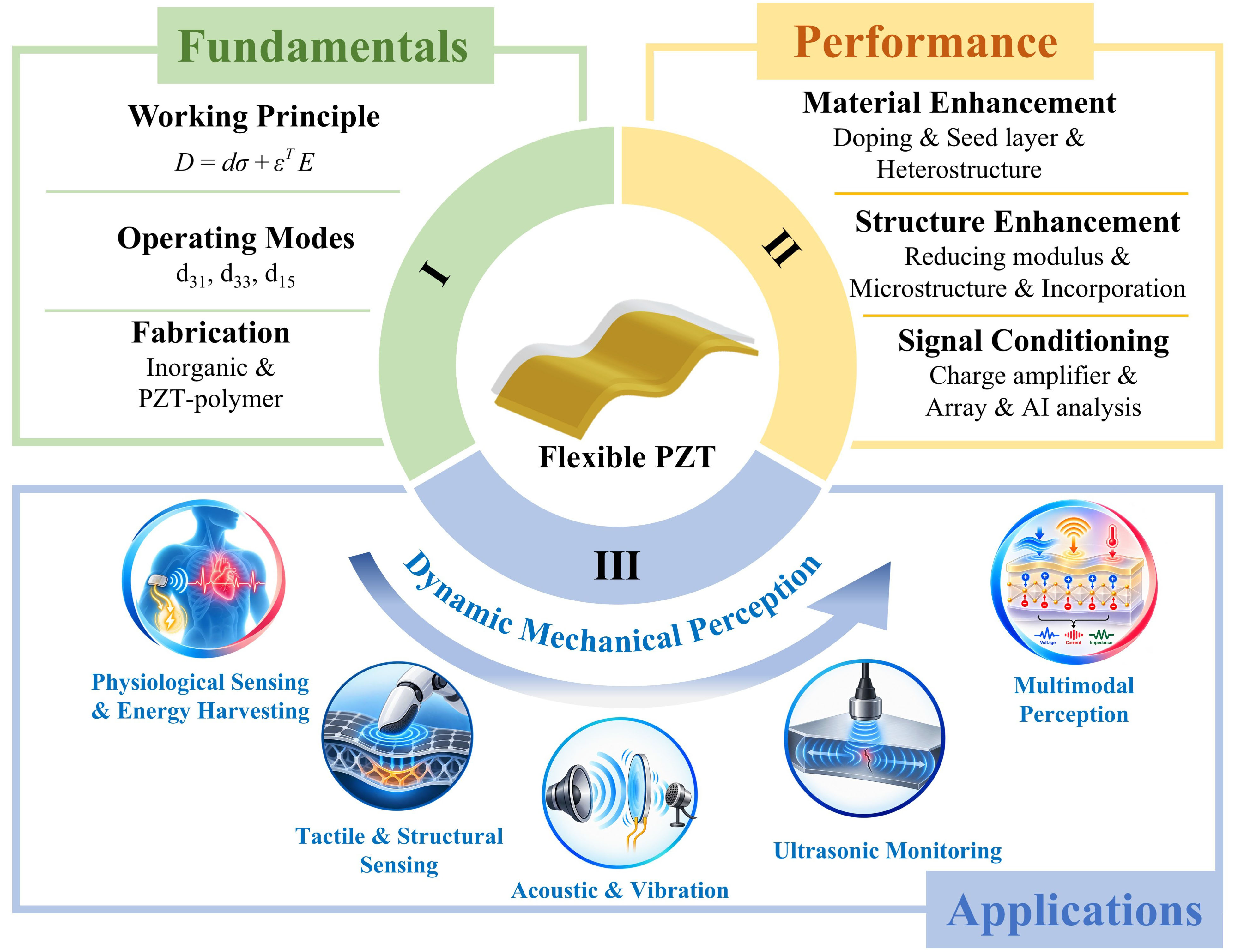
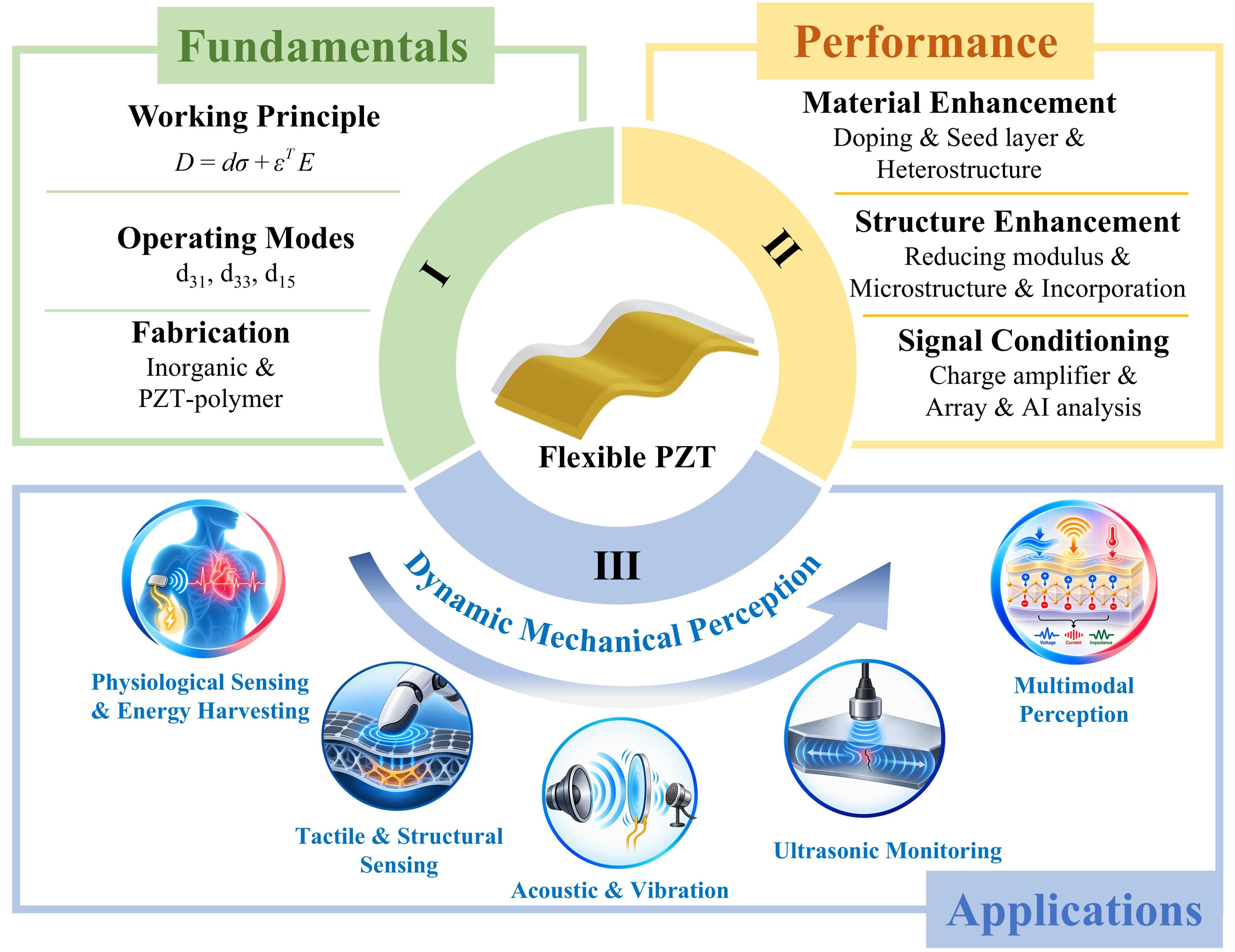
Figure 1. Full-chain system optimization framework for flexible PZT piezoelectric sensors in dynamic mechanical perception: (I) Fundamentals; (II) Performance enhancement; (III) Representative applications. PZT: lead zirconate titanate.
In addition, this review organizes flexible PZT applications from a cross-frequency perspective, rather than solely according to application category. The discussion spans low-frequency physiological sensing and energy harvesting, intermediate-frequency tactile and structural sensing, acoustic and vibration sensing, high-frequency ultrasonic detection and multimodal dynamic perception. This frequency-oriented framework reveals that different dynamic regimes impose distinct requirements on materials, mechanical coupling, and signal conditioning. It therefore provides a direct connection between performance optimization and application-specific frequency characteristics.
Accordingly, this review summarizes flexible PZT sensors from three closely connected aspects: flexible integration, performance enhancement, and dynamic applications. We first introduce the fundamental electromechanical transduction mechanisms, working modes, and fabrication strategies, which are the foundation of flexible PZT sensing. We then discuss performance-enhancement approaches from the perspectives of material engineering, mechanical coupling, and signal conditioning, with particular emphasis on their interactions at the system level. Finally, we summarize recent advances in dynamic perception and classify representative applications according to their characteristic frequency regimes. Together, these perspectives aim to establish a system-level understanding of how flexible PZT sensors can be designed and optimized for dynamic mechanical perception across diverse operating conditions.
2. Fundamentals of Flexible PZT Sensors
2.1 Working principle
Piezoelectric materials convert mechanical loads into charge through the piezoelectric effect. Output is determined by three coupled parameters: the effective piezoelectric coefficient (deff), the capacitance (Cp), and loading rate (dF/dt). These parameters are used here within a lumped-element approximation under small-signal, linear piezoelectric conditions, assuming a specified loading mode and approximately constant effective piezoelectric coefficient and capacitance.
Piezoelectric output current and voltage can be expressed as:
where Q is the output charge. Accordingly, compared with resistive and capacitive sensors, PZT sensors are more sensitive to changes in loading and have an advantage for self-powered sensing and energy harvesting owing to their high piezoelectric coefficient.
Equations (1) and (2) represent the ideal short-circuit current and open-circuit voltage, respectively, under linear operating conditions and sufficiently far from pronounced mechanical resonances. In practical measurements, the recorded electrical response is further influenced by the impedance of the external readout circuit. Finite input resistance introduces low-frequency attenuation, whereas cable and input capacitances increase the effective capacitance and reduce the measured voltage. Alternatively, charge-amplifier readout converts the generated charge into a voltage primarily determined by the feedback capacitance, although its effective bandwidth and noise characteristics remain dependent on circuit design, as further discussed in Section 3.3.
Traditional PZT sensors experience strong mechanical constraint from their rigid substrates (e.g., Si). Such constraints can alter the effective piezoelectric response of thin films. The relationship between substrate clamping and piezoelectric response can be described as[49]:
where the first term on the right represents the intrinsic longitudinal piezoelectric coefficient (d33) without constraint and the second term is due to the mechanical constraint imposed by the substrate. E denotes the applied electric field to measure the piezo response, and the
where χ0 is the distribution function, and v is Poisson’s ratio. ɛeff denotes the in-plane strain corresponding to the clamping stress, which is related to the transverse piezoelectric coefficient(d31):
Equations (3)-(5) provide a simplified description of the effective converse piezoelectric response under linear constitutive behavior and idealized in-plane mechanical constraints. Accordingly, the resulting effective coefficient (d33,eff) depends on the mechanical boundary conditions and should not be directly equated with the effective charge coefficient governing dynamic sensing under different loading configurations.
Transferring PZT thin films from rigid substrates to compliant substrates modifies the mechanical boundary conditions and can alleviate substrate-induced clamping without altering the intrinsic Young’s modulus of PZT. However, enhanced mechanical flexibility does not necessarily translate into improved piezoelectric output. Although film thinning reduces bending stiffness, the electrical response also depends on the effective piezoelectric coefficient, device capacitance, and strain-transfer efficiency. For an ideal thickness-mode device under a fixed force, reducing film thickness increases capacitance and may lower the open-circuit voltage, whereas reduced substrate clamping may enhance the effective piezoelectric response. These competing effects highlight the need to balance mechanical compliance and electromechanical performance in flexible PZT sensor design.
2.2 Operating modes
The operating modes of PZT sensors are determined by the relative orientations of polarization and applied mechanical stress. The most common modes include d33, d31, and d15 (Figure 2).
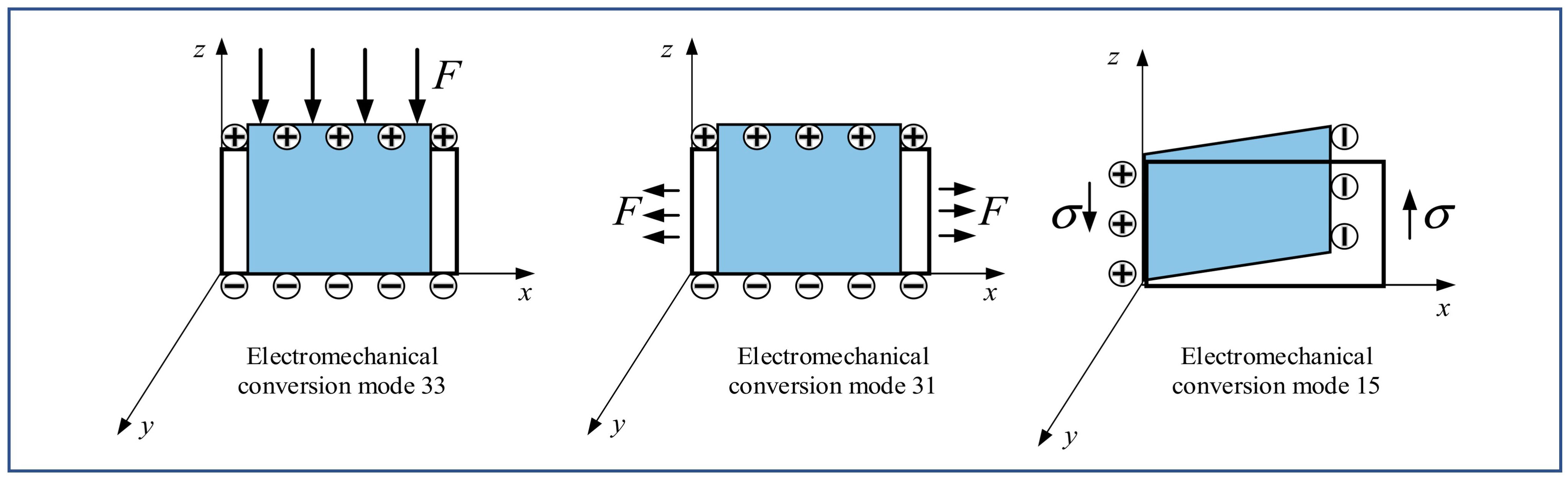
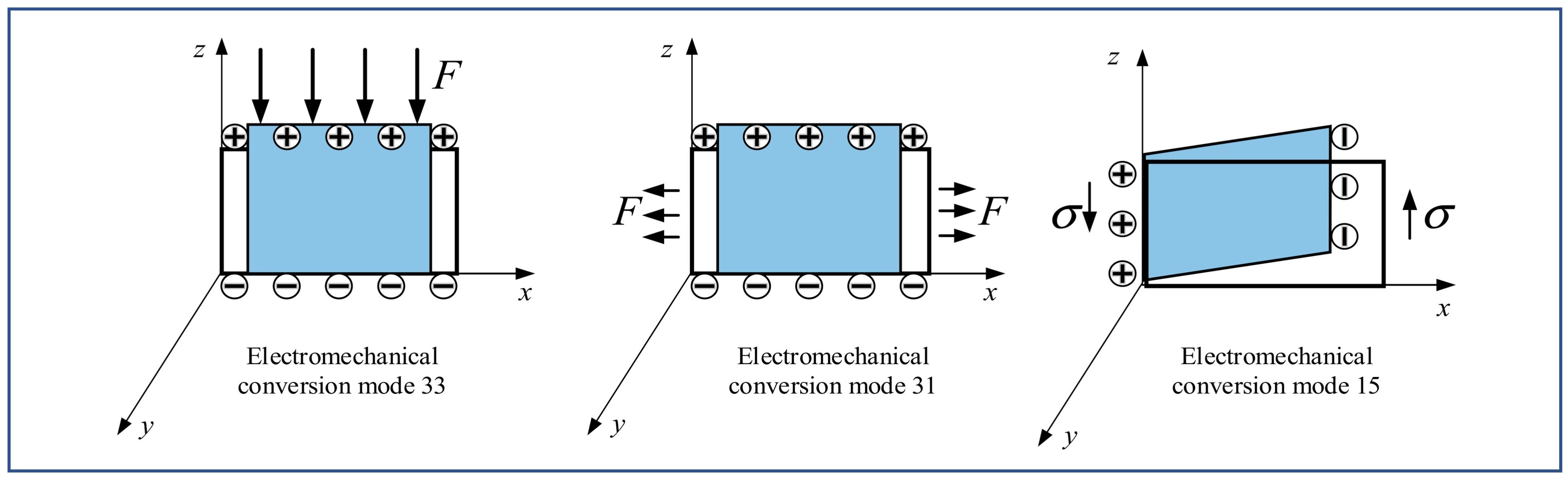
Figure 2. Illustration of three typical operating modes of PZT sensors: d33, d31, and d15. Reproduced from reference[50]. CC BY 4.0. PZT: lead zirconate titanate.
In d33 mode, the applied stress is parallel to the polarization direction, and the induced charge is collected along the same direction. In the d31 mode, the stress is applied perpendicular to the polarization direction, while the charge is still collected along the polarization direction. In d15 shear mode, the applied load induces shear stress and generates a transverse charge response which is perpendicular to the polarization direction. The characteristics and sensing advantages of these three piezoelectric operating modes are summarized in Table 1.
Table 1. Comparison of operating modes of PZT sensors.
| Mode | characteristics | Advantages |
| d33 | Stress and polarization are aligned | Sensitive to pressure and impact |
| d31 | Stress and polarization are perpendicular | Sensitive to bending strain |
| d15 | Shear stress induces electrical displacement | Sensitive to shear deformation |
PZT: lead zirconate titanate.
The three piezoelectric modes offer distinct advantages for dynamic mechanical sensing. The d33 mode generally provides a high charge output and is well suited to pressure, impact, and other out-of-plane stimuli. In flexible PZT devices, interdigitated electrodes can enable in-plane polarization and d33-mode operation when the applied mechanical stress is aligned with the polarization direction[51,52]. The d31 mode responds strongly to tensile and compressive strains induced by bending. It therefore suits cantilever devices and structural health systems for vibration, acceleration, and deformation detection[53]. The d15 mode is sensitive to shear deformation, making it suitable for slip recognition, friction-state identification, tangential-force detection in robotic tactile systems, and shear-wave sensing[54]. In summary, the selection of an appropriate operating mode should consider the direction of mechanical excitation, polarization configuration, and device structure to optimize the electromechanical response of flexible PZT sensors[55].
2.3 Fabrication strategies
Although the fabrication process of PZT films is relatively proven, their applications in flexible electronic devices still face many challenges. To address the above issues, researchers have made advances in three aspects: flexible inorganic PZT films, PZT-polymer composites and deformable structural architectures.
To achieve flexible inorganic PZT films, the first approach is to directly in-situ deposit PZT films on flexible substrates which tolerate high temperature (Figure 3a). It reduces the risk of interfacial defects by avoiding the release and transfer process, while thermally stable substrates support the crystallization of the films. Liu et al.[56] directly fabricated a flexible PZT film on a two-dimensional mica substrate through a modified sol-gel process, which incorporated PZT powder into precursor sol. A single spin-coating and annealing cycle produced an approximately 2 μm-thick film with favorable piezoelectric performance and mechanical stability. The direct growth approach is particularly suitable for sensing in high-temperature or harsh environments. However, it is limited by the mechanical compliance of substrates. The other approach employs transfer techniques (e.g., laser lift-off[57,58], sacrificial-layer wet etching[59-61]) to release PZT films from rigid substrates to flexible ones (Figure 3b). This process mainly involves two steps: thin film growth and transfer. Ren et al.[59] used this approach to fabricate a high-performance, flexible, single-crystalline PZT thin film. A (111)-oriented PZT film approximately 250 nm thick was epitaxially deposited by pulsed laser deposition on a water-soluble Sr3Al2O6 sacrificial layer supported by rigid SrTiO3. With support from PDMS, they gained a large-area, crack-free, freestanding flexible PZT film by dissolving the sacrificial layer in water. The film exhibited an effective piezoelectric coefficient of approximately 585 pm·V-1 and withstood bending strains above 3.4%. This approach can simultaneously achieve high piezoelectric performance and excellent flexibility. It is therefore suitable for applications requiring ultrathin devices, conformal contact, and high piezoelectric response. However, the fabrication process remains relatively complex and technically demanding.
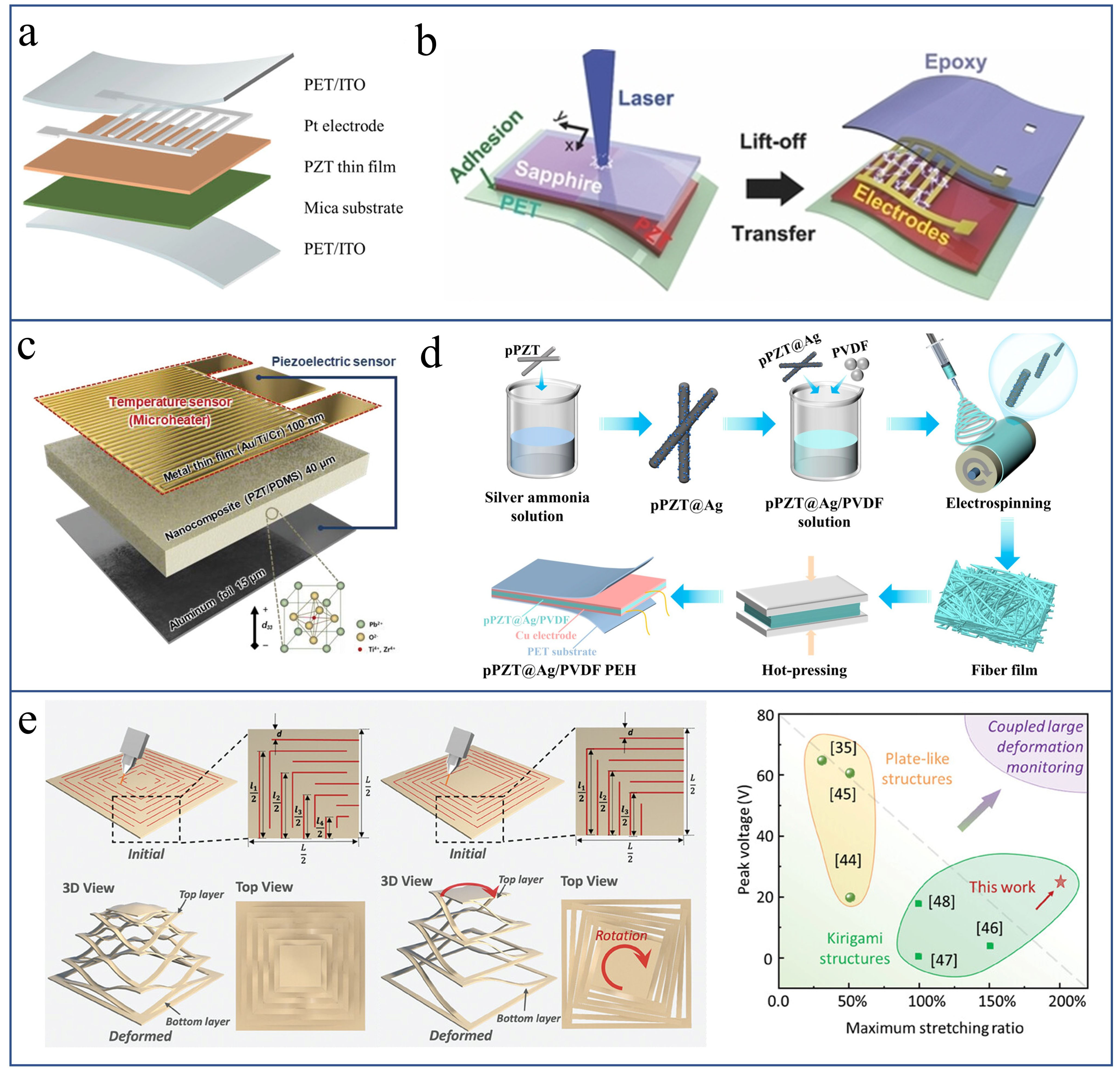
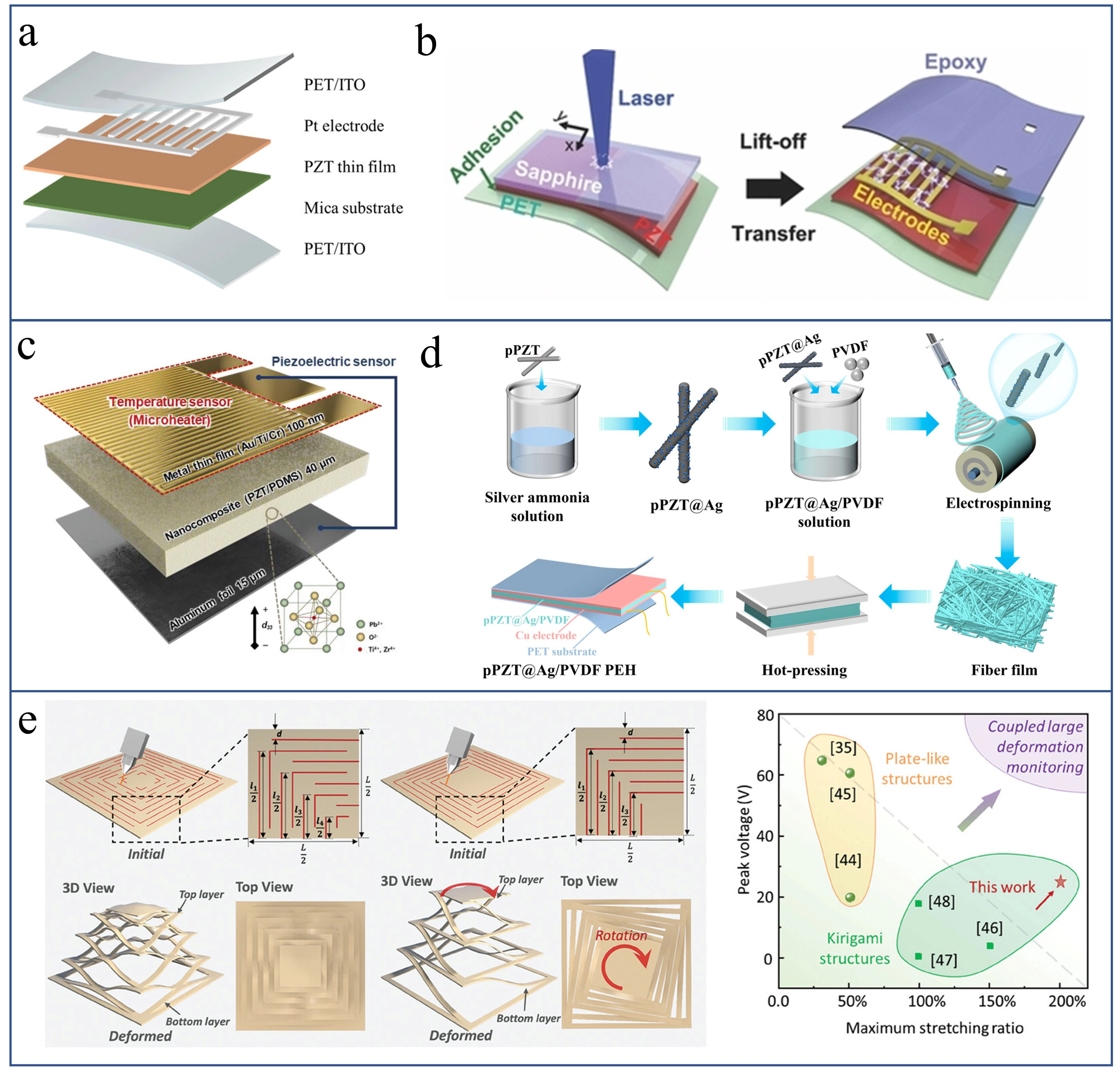
Figure 3. Fabrication strategies of flexible PZT films: (a) Direct growth of inorganic PZT. Reproduced from reference[62]. CC BY 4.0; (b) Transfer of inorganic PZT film from rigid substrates to flexible substrates. Reproduced with permission from reference[58]. Copyright © 2014 John Wiley & Sons; (c) Particle-based PZT-polymer composites. Reproduced from reference[63]. CC BY-NC-ND 4.0; (d) Fiber-based PZT-polymer composites. Reproduced from reference[64]. CC BY 4.0; (e) Deformable structural architectures. Reproduced from reference[65]. CC BY 4.0. PZT: lead zirconate titanate; PVDF: polyvinylidene fluoride; PET: polyethylene terephthalate; ITO: indium tin oxide; PEH: piezoelectric energy harvester; pPZT@Ag: silver-modified polydopamine-coated PZT nanofibers.
The key to PZT-polymer composites is using a low-modulus polymer phase to impart flexibility to rigid PZT ceramics (Figure 3c,d). Flexible and large-area PZT devices can be fabricated by incorporating PZT particles, nanofibers or porous frameworks into polymer matrices[64,66-68]. Kim et al.[63] incorporated 30 wt% modified PZT particles into PDMS to fabricate flexible PZT/PDMS composite films with a thickness of approximately 40 μm. PDMS provided high mechanical compliance, while the interfacial modification improved particle dispersion and suppressed PZT agglomeration, resulting in a stretchability of 190.81%. The sensor exhibited a pressure sensitivity of 72 mV·kPa-1 over the range of 0.5-10 kPa and maintained stable output over 5,000 loading cycles, enabling the reliable detection of subtle dynamic signals. This approach provides excellent bendability, compatibility and cyclic stability. However, viscoelastic damping of the PZT-polymer composites may attenuate high-frequency response.
Developing deformable mechanical architectures (e.g., PZT thinning[69], piezoelectric metamaterials[65]) is a new method to achieve flexibility. This strategy largely preserves the intrinsic composition of the piezoelectric material (Figure 3e). Hong et al.[65] developed an ultra-stretchable PZT piezoelectric metamaterial through structural engineering. A PZT/silicone-rubber composite film was patterned into centrosymmetric and rotationally symmetric kirigami architectures. The device consequently sustained tensile strains up to approximately 200% while maintaining stable piezoelectric sensing. However, engineered structures may exhibit stress concentrations, reduced active area, electrode-interconnect failure, and resonances. Geometric parameters must therefore balance deformability, electromechanical output, dynamic response, and long-term reliability.
Film thickness plays an important role in determining the mechanical flexibility of inorganic PZT films. Reducing the thickness substantially decreases flexural rigidity, thereby improving bendability and mechanical compliance. Representative studies have demonstrated flexible PZT films with thicknesses ranging from approximately 250 nm for released crystalline membranes[59] to 2 μm for films directly grown on flexible mica substrates[56]. However, these values do not define a universal thickness threshold, as the overall flexibility of PZT devices also depends on substrate properties, structural design, and interfacial integrity. In addition, polymer composites and engineered architectures offer alternative approaches to enhancing mechanical compliance without relying exclusively on film thinning[63,65]. Therefore, flexibility should be assessed in terms of bending radius, strain tolerance, and cyclic durability rather than film thickness alone. Beyond film thickness, the principal fabrication routes differ in piezoelectric performance, mechanical compliance, interfacial stability, thermal processing requirements, and scalability, as summarized in Table 2.
Table 2. Comparison of different fabrication strategies.
| Fabrication strategy | Piezoelectric performance | Flexibility | Interfacial stability | Processing temperature | Scalability |
| In-situ growth | Crystallinity- and clamping-dependent | Substrate-limited | thermal mismatch | High-temperature growth | Substrate-limited |
| Film transfer | High crystalline quality | High conformability | Potential transfer damage | High-temperature growth; low-temperature transfer | Transfer complexity |
| PZT-polymer composites | Dependent on ceramic loading, connectivity | High compliance | Filler-matrix adhesion | Low-temperature processing | Coating/printing compatible |
| Deformable architectures | Preserved local activity | Geometry enabled | Stress concentration | Process-dependent | Patterning complexity |
PZT: lead zirconate titanate.
The comparison highlights an important trade-off between electromechanical performance and mechanical reliability. Crystalline PZT films can support strong piezoelectric transduction but require careful control of residual stress, cracking, and interfacial delamination under cyclic deformation. In contrast, polymer composites and architected structures offer enhanced mechanical compliance, potentially at the expense of effective ceramic connectivity or active-area utilization. Accordingly, fabrication strategies should be evaluated not only by their initial electrical output but also by output retention under repeated loading, interfacial integrity, and manufacturing scalability.
3. Performance Enhancement
Flexible PZT sensors should be viewed as a closed-loop system integrating piezoelectric material, device-level mechanical coupling, and signal conditioning. Herein, we discuss the performance enhancement through those three aspects.
3.1 Material engineering
From the material perspective, enhancing the dynamic response of PZT piezoelectric sensors requires the synergistic optimization of intrinsic piezoelectric properties. The principal strategies include compositional doping, seed/buffer layer engineering, and heterostructure integration.
PZT doping is primarily employed to enhance the intrinsic piezoelectric properties of the material. The incorporation of dopants such as La, Sm, Nb, and Mn[70-74] can modulate lattice distortion, domain-wall mobility, and self-polarization, thereby improving the piezoelectric coefficient and electromechanical coupling coefficient. Jung et al.[72] enhanced the piezoelectric performance of flexible PZT through Nb doping (Figure 4a). Donor doping with Nb5+ reduced the concentration of oxygen vacancies and promoted domain-wall motion and polarization switching. Consequently, the optimized PZT film containing 4% Nb exhibited the highest dielectric permittivity and piezoelectric coefficients, together with an approximately 4 dBV improvement in acoustic sensing sensitivity compared with undoped PZT and an extended effective speech-detection bandwidth up to 8 kHz. Doping provides the most direct improvement in the piezoelectric and electromechanical coupling coefficients. However, excessive doping may lead to secondary-phase formation, increased dielectric loss, or domain-wall pinning.
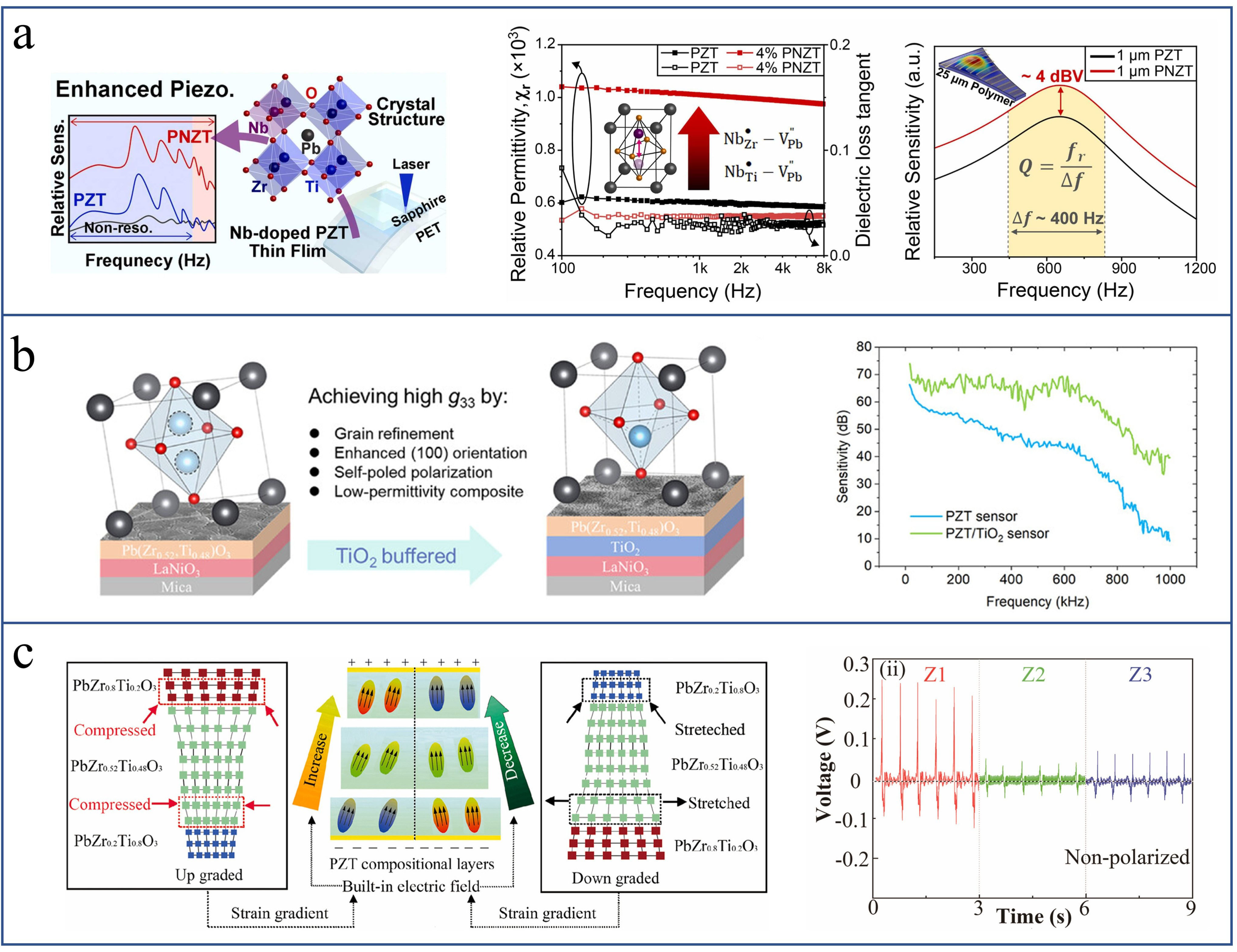
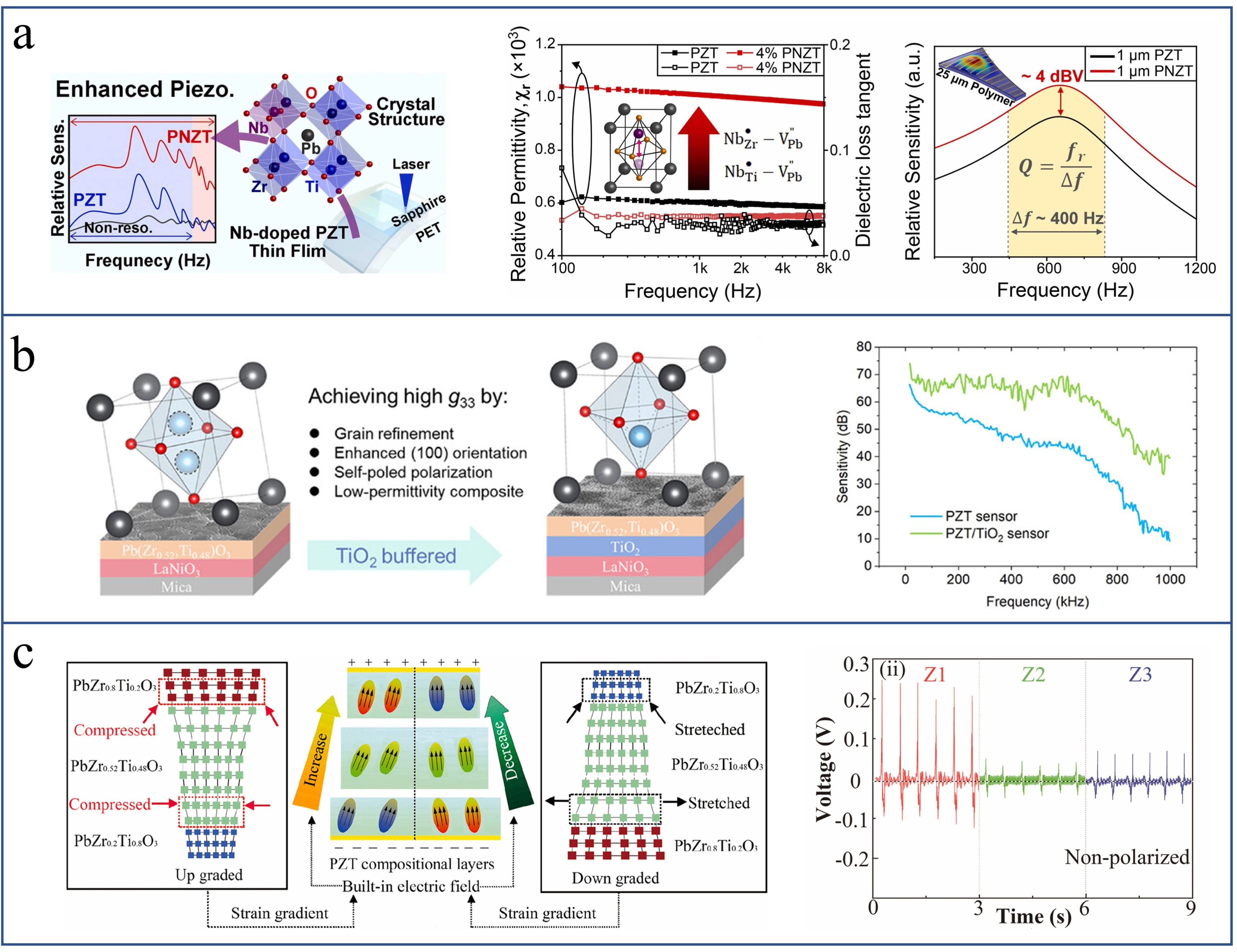
Figure 4. Performance enhancement from the material perspective: (a) Element doping for enhancing the intrinsic piezoelectric properties. Reproduced with permission from reference[72]. Copyright © 2022 Elsevier; (b) Seed/buffer layers for improving nucleation. Reproduced with permission from reference[80]. Copyright © 2025 John Wiley & Sons; (c) Heterostructure integration to optimize stress transfer in piezoelectric layers. Reproduced with permission from reference[81]. Copyright © 2021 Elsevier. PZT: lead zirconate titanate; PET: polyethylene terephthalate; PNZT: niobium-doped lead zirconate titanate.
Seed/buffer layers are mainly used to improve nucleation. Materials such as PbTiO3, LaNiO3, SrRuO3, TiO2, and ZrO2[75-79] have been shown to promote perovskite-phase formation, induce preferred orientation, reduce interfacial defects and residual stress, thereby enhancing the piezoelectric output and cyclic reliability of PZT films. Wu et al.[80] introduced a TiO₂ buffer layer into a PZT/LaNiO3/mica structure, which promoted grain refinement, (100) preferred orientation, and self-poling, while reducing the dielectric constant and leakage current (Figure 4b). This interfacial engineering increased the d33 value from approximately 45 to 160 pm·V-1 and enhanced the piezoelectric voltage coefficient by about 15 times. Without changing the chemical composition of PZT, seed/buffer layers directly regulate film nucleation, growth, and stress states. Therefore, it is suited to in-situ growth of PZT on flexible substrates.
Heterostructure integration creates interfacial coupling between PZT and conductive oxides, two-dimensional materials, or other functional layers[81-85]. Zou et al.[81] developed a compositionally graded PZT heterostructure in which the Zr/Ti ratio varied along the film thickness (Figure 4c). The resulting strain gradient and built-in electric field enhanced spontaneous polarization and domain-wall motion. Under bending, the optimized PZT film with an upward composition gradient generated an output voltage of 2 V and a current density of 10 μA·cm-2, markedly outperforming the reverse-gradient structure. Such coupling improves piezoelectric properties and enhances stress transfer. However, heterostructure design and interface fabrication are generally more complex.
Overall, improving PZT performance at the material level requires the coordinated optimization of intrinsic piezoelectric activity, thin-film quality, and interfacial coupling, rather than the independent enhancement of a single parameter. Therefore, material engineering for dynamic mechanical perception should move beyond the sole pursuit of a high piezoelectric coefficient and instead balance piezoelectric performance, dielectric loss, interfacial stability, and durability under dynamic loading. Such an integrated approach provides the material basis for flexible PZT sensors with high sensitivity, high signal fidelity, and long-term stability.
3.2 Mechanical coupling engineering
From the electromechanical coupling perspective, improving the dynamic response of flexible PZT sensors mainly depends on the efficient transfer of external mechanical stimuli to the piezoelectric active layer. Mechanical strain transfer can therefore be improved by reducing the Young’s modulus of the substrate, introducing micro-structured designs, and through specific PZT-polymer incorporation. These strategies can enhance dynamic signal output, sensitivity, and cyclic reliability.
Reducing the Young’s modulus of the substrate can effectively weaken substrate clamping[86,87] and improve the transfer of external dynamic strain to the PZT layer. Similar modulus-dependent electromechanical coupling has also been discussed in flexible polymer-based piezoelectric devices[88]. Xu et al.[86] transferred a PZT film from a high-modulus mica substrate to a low-modulus PET substrate, reducing the substrate Young’s modulus from approximately 35.9 GPa to 3.56 GPa (Figure 5a). This change significantly reduced the clamping effect and improved strain transfer. As a result, the effective piezoelectric coefficient d33,eff increased from 331.5 to 474.2 pm·V-1, while the bending and pressure sensitivities increased by approximately 9.2 and 26 times, respectively. Compared with high-modulus substrates, low-modulus flexible substrates deform more easily and allow the PZT layer to experience greater effective strain, thereby enhancing piezoelectric output and dynamic response. Flexible substrates also improve conformal contact with complex surfaces, making them more suitable for dynamic sensing applications.
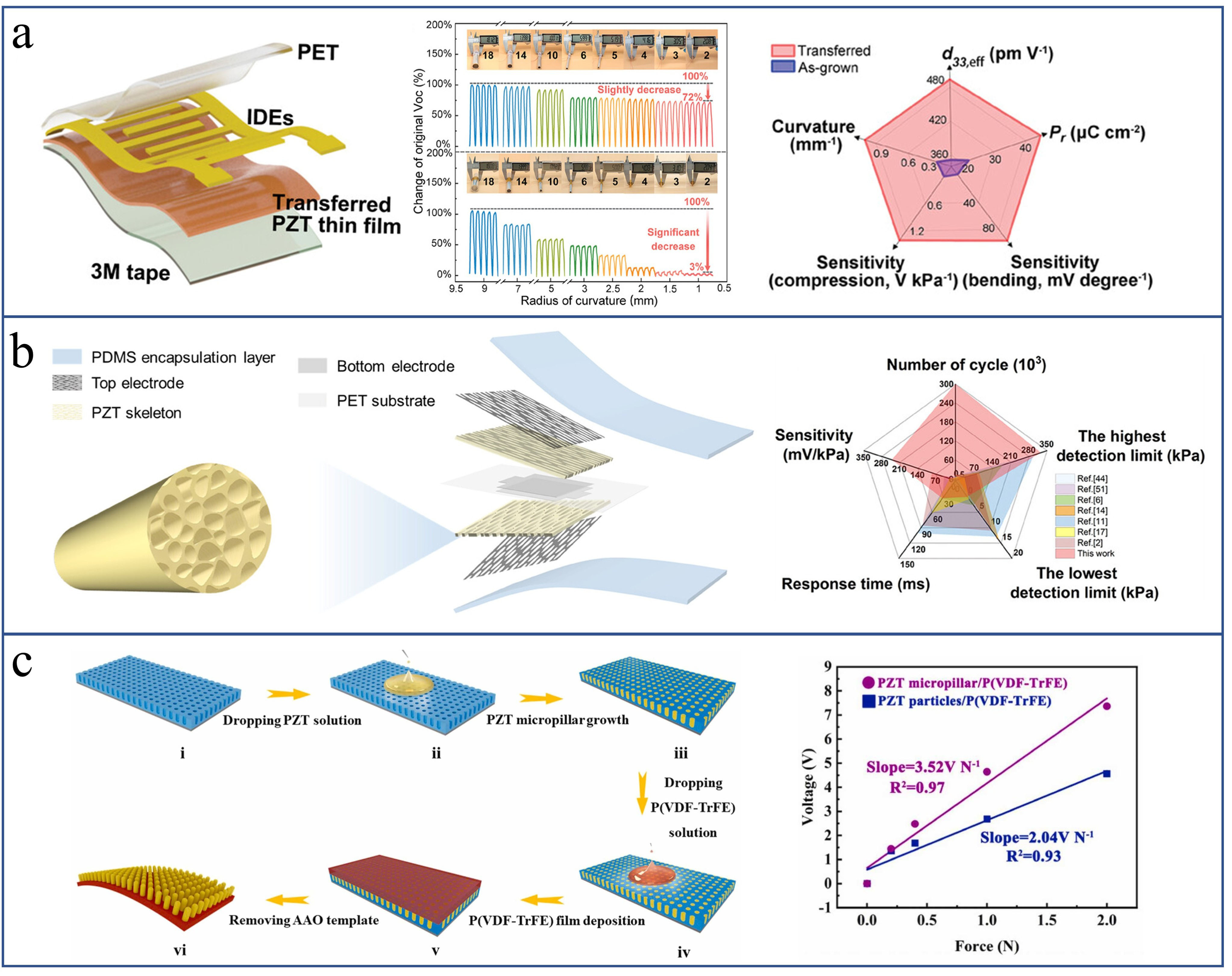
Figure 5. Performance enhancement from the device-level mechanical coupling perspective: (a) Reducing the Young’s modulus of the substrate. Reproduced with permission from reference[86]. Copyright © 2024 John Wiley & Sons; (b) Microstructural design of PZT. Reproduced with permission from reference[92]. Copyright © 2025 John Wiley & Sons; (c) Specific PZT-polymer incorporation. Reproduced with permission from reference[93]. Copyright © 2025 Elsevier. PZT: lead zirconate titanate; PET: polyethylene terephthalate; PDMS: polydimethylsiloxane; P(VDF-TrFE): poly(vinylidene fluoride-co-trifluoroethylene); IDEs: interdigitated electrodes.
Microstructural design[89-92] can further enhance local electromechanical coupling through stress concentration. Jiang et al.[92] used a biomimetic loofah-fiber template to construct a multiscale, interconnected, and anisotropic porous PZT framework (Figure 5b). The three-dimensional interconnected pores enhanced stress concentration and transfer, while the macroscopically aligned network improved stretchability and directional sensing. The resulting sensor achieved a detection limit of 0.2 kPa, a sensitivity of 241.12 mV·kPa-1, and stable operation over more than 300,000 cycles. Microstructures can convert weak external stimuli into larger local strains, thereby improving the detection of dynamic signals. However, microstructures exhibit frequency-selective behavior. Their geometry should be designed according to the target loading frequency range to balance sensitivity and bandwidth.
Specific PZT-polymer incorporation mainly improves stress transfer, effective polarization, and device flexibility by controlling the orientation and connectivity of the PZT phase and the ceramic-polymer interface in PZT/polymer composites[93-95]. Zhan et al.[93] developed a composite consisting of vertically aligned PZT micropillar arrays embedded in a poly(vinylidene fluoride-co-trifluoroethylene) (P(VDF-TrFE)) film (Figure 5c). The regularly arranged micropillars enhanced local strain and stress transfer, enabling an output voltage of 2.7 V and a force sensitivity of 3.52 V·N-1, significantly higher than those of composites containing randomly distributed PZT particles. For dynamic sensing applications, polymer incorporation can greatly improve mechanical compliance and long-term stability. A balance must therefore be achieved among flexibility, mechanical coupling efficiency, and frequency response.
Overall, mechanical coupling optimization in flexible PZT sensors is essentially based on the systematic control of the transfer path of external mechanical stimuli. These factors above should be optimized together to achieve a balance among sensitivity, bandwidth, and mechanical reliability, especially for dynamic signals in different frequency ranges.
3.3 Signal conditioning
From the signal conditioning perspective, the dynamic performance of flexible PZT sensors depends not only on material and mechanical coupling, but also on signal acquisition and processing. Signal conditioning mainly involves low-noise and accurate readout, multichannel acquisition using sensor arrays, and AI-assisted analysis. These approaches improve signal fidelity, spatial resolution, and the recognition of dynamic events.
Improving the performance of PZT sensors depends on whether their high-impedance signals can be acquired with low noise and high accuracy[96-98]. A piezoelectric sensor is commonly modeled as a current or charge source connected with its internal capacitance. Its output is sensitive to the parasitic capacitance and environmental noise. Amplifier input noise, dielectric-loss-related fluctuations, and electromagnetic interference can further limit weak-signal detection. Their contributions should therefore be evaluated over the target bandwidth and mitigated through shielding, grounding, and low-noise circuit design. Chen et al.[96] used a low-noise charge amplifier to convert the weak, high-impedance charge generated by PZT into a voltage signal and amplify it by approximately 21.3 times, while reducing the low-frequency cutoff to 3.4 Hz (Figure 6a). Combined with structural amplification, the sensor achieved a sensitivity of 9.2 V·g-1 below 1 kHz and detected weak cardiopulmonary sounds with a high SNR. Compared with direct voltage readout, a charge amplifier provides a more accurate and stable measurement due to its high input impedance. Its charge-to-voltage gain is mainly determined by the feedback capacitance, whereas the low-frequency cutoff is set by the feedback resistance and capacitance, thereby avoiding disturbance in environments.
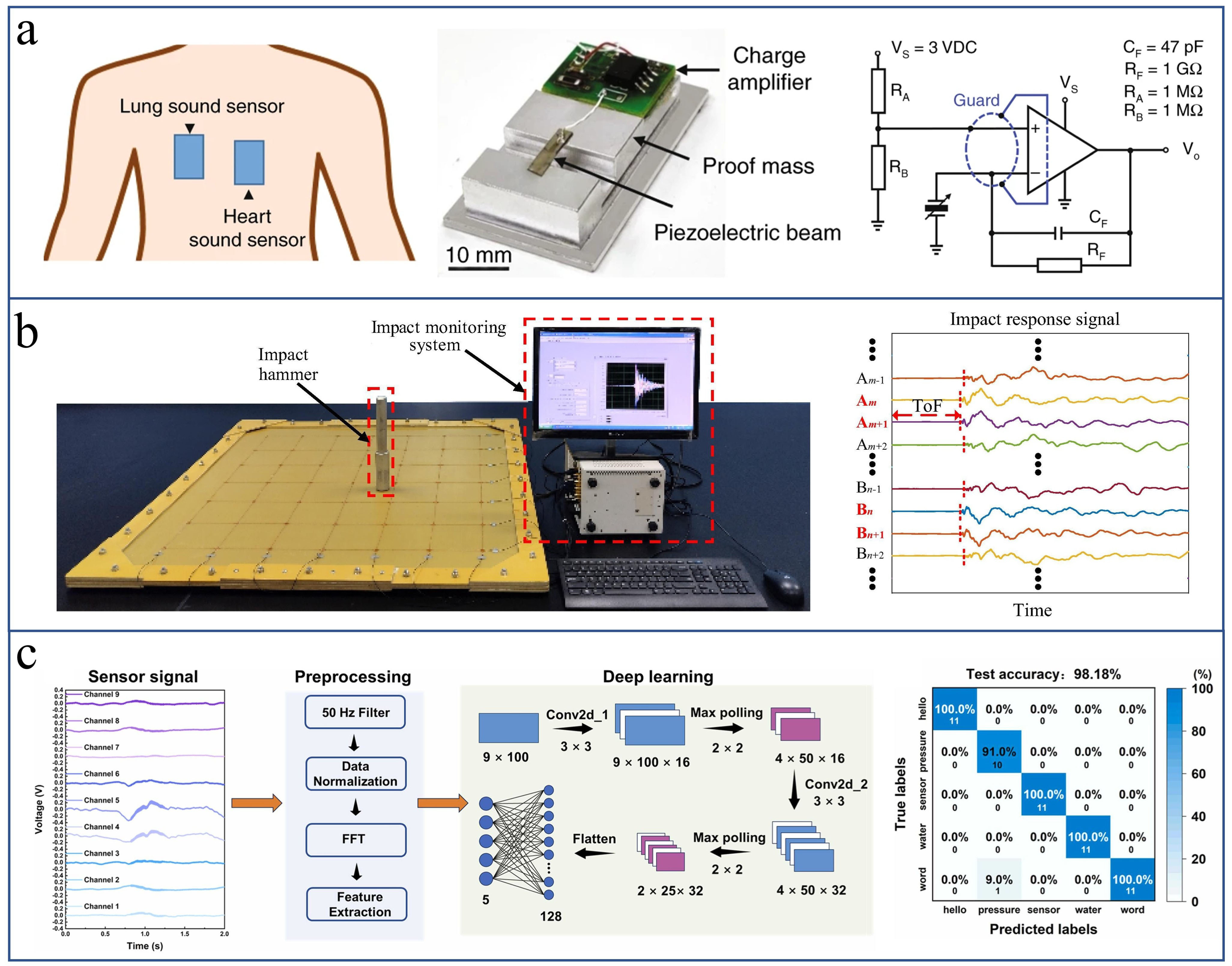
Figure 6. Performance enhancement from the signal conditioning perspective: (a) Charge amplifier for accurate and stable data acquisition. Reproduced from reference[96]. CC BY 4.0; (b) Array design for extending dimensionality. Reproduced with permission from reference[99]. Copyright © 2020 Elsevier; (c) AI-assisted analysis for intelligent recognition. Reproduced with permission from reference[69]. Copyright © 2024 Elsevier. FFT: fast Fourier transform.
Array design can extend the response of a single piezoelectric sensing unit into spatially resolved, multichannel sensing. It greatly improves dynamic sensing performance[99-101]. Wang et al.[99] developed a 7 × 7 flexible PZT array that enabled extraction of the impact-signal arrival times and comparison of guided-wave damage features (Figure 6b). The array was able to locate both impact events and damaged regions, achieving an impact-localization accuracy of 95.6%. Shared row and column wiring also reduced the number of connections required for an M × N array from M × N to M + N, significantly lowering system complexity. However, electrical coupling through shared interconnects and unintended mechanical coupling between adjacent sensing arrays may introduce inter-channel crosstalk, compromising spatial resolution and localization accuracy. Optimized electrode routing, mechanical isolation, and channel-level calibration are therefore important for reliable array operation. For flexible PZT sensors, array integration not only improves spatial resolution but also reduces the effects of random errors through multichannel comparison and signal redundancy.
AI-assisted analysis can further extract complex dynamic information from piezoelectric sensing signals, extending performance enhancement from signal enhancement to intelligent recognition[102-104]. Zhen et al.[69] combined a convolutional neural network with a flexible PZT array (Figure 6c). By extracting the spatiotemporal and frequency-domain features of multichannel dynamic signals, the system automatically recognized complex speech-induced vibration with a test accuracy of 98.18%, significantly improving the classification and decoding capabilities of PZT sensors. Signals acquired by PZT piezoelectric sensors often contain multidimensional information, including amplitude, frequency, and spatial distribution. Neural networks extract these complex features, enabling quantitative prediction, spatial localization, state recognition, and stimulus classification.
Overall, signal conditioning for flexible PZT sensors requires the coordinated optimization of low-noise readout, array-based acquisition, and intelligent analysis. Charge amplifiers regulate signal gain, sensor arrays improve spatial resolution, and neural networks enable the recognition and classification of complex dynamic signals. Together, these functions support the closed-loop design and robustness of flexible PZT sensing systems.
3.4 System-level coordination optimization
From a system-level perspective, clear performance trade-offs exist among material engineering, mechanical coupling, and signal conditioning. High intrinsic piezoelectric activity can translate into improved device performance only when mechanical stress is efficiently transferred to the PZT layer and the generated signal is effectively recovered by low-noise readout electronics. Mechanical compliance and stress-concentrating structures can enhance deformation and sensitivity under low-frequency dynamic loading. However, excessive compliance may become unfavorable at high frequencies. Soft polymer substrates or encapsulation layers often exhibit appreciable viscoelastic losses, which can dissipate mechanical energy and reduce strain-transfer efficiency. For a lightly damped system dominated by a single vibration mode, the reduced effective stiffness of a compliant structure can also shift its resonance toward lower frequencies, approximately following:
where fr is the resonant frequency, keff is the effective stiffness, and meff is the effective mass of the flexible PZT system. The efficiency of interfacial strain transfer can be characterized by a frequency-dependent strain-transfer factor:
where εPZT and εsub represent the complex amplitudes of the same strain component in the PZT layer and the reference substrate region, respectively. This factor depends on interfacial integrity, bonding-layer properties, and excitation frequency, thereby influencing the effective mechanical excitation of the piezoelectric layer.
Mechanical resonance and viscoelastic damping further govern the sensitivity-bandwidth trade-off. For an isolated, lightly damped resonance, the mechanical quality factor can be approximately expressed as:
where Qm is the mechanical quality factor and Δf3dB denotes the half-power bandwidth of the resonant response. A higher Qm generally enhances peak sensitivity but narrows the resonant bandwidth, whereas increased viscoelastic damping suppresses resonant amplification and introduces frequency-dependent attenuation and phase lag. As a result, high-frequency acoustic and ultrasonic signals may be attenuated before they are effectively coupled into the piezoelectric layer.
Likewise, high-gain signal conditioning can improve weak-signal detection, but often at the expense of bandwidth, noise performance, and power consumption. For a simplified voltage-mode readout, the effective input resistance and the combined sensor-parasitic capacitance introduce an electrical time constant that determines the low-frequency cutoff:
where Req is the equivalent parallel resistance, while Cp and Cpar denote the sensor and parasitic capacitances, respectively. Consequently, the measurable frequency range is constrained not only by mechanical coupling and damping but also by electrical loading and the finite bandwidth of the readout electronics.
Cross-study comparisons require caution because reported sensitivities are expressed in different units and depend on excitation frequency, loading configuration, and signal-conditioning circuitry. These differences preclude direct numerical ranking across sensing modalities. Device-level performance is bounded by the least optimized stage of the chain rather than by the piezoelectric coefficient in isolation.
To facilitate more meaningful comparisons, Table 3 summarizes representative flexible PZT sensors across different applications, including their reported performance metrics, detection capabilities, frequency characteristics, testing conditions, and durability. The original measurement units are retained, and missing parameters are explicitly indicated to avoid misleading comparisons across different sensing modalities.
Table 3. Quantitative benchmark of representative flexible PZT dynamic sensors. (values as reported in the cited works; “-” indicates not reported)
| Device configuration | Performance(Range) | Durability | Response bandwidth | Testing conditions | Application | Ref. |
| Freestanding PZT membrane | Peak: 63.5 mW·cm-3 | > 60,000 cycles | - | Bending; fatigue: 2.62% strain at 1 Hz | Energy harvesting | [59] |
| PZT-PDMS 0-3 composite | 72 mV·kPa-1 (0.5-10 kPa) | ~5,000 cycles | - | Dynamic pressure; fatigue: 4 kPa at 2 Hz | Physiological Sensing | [63] |
| PZT/TiO2/mica | Average sensitivity: 65dB | - | up to 600 kHz | 110 kV cable (PD) | Acoustic | [80] |
| Transferred PZT film/IDEs | 110 mV·degree-1 (15-90°) 1.8 V·kPa-1 (0.32-1.6 kPa) | ~10,000 cycles | - | Bending; Dynamic pressure | Motion sensing | [86] |
| 3D PZT skeleton composite | 241.12 mV·kPa-1 (0.2-325.6 kPa) | ~300,000 cycles | - | Compression; bending deformation | Tactile sensing | [92] |
| PZT/P(VDF-TrFE) micropillars | 3.52 V·N-1, power: 4.4 μW | ~2,000 cycles | - | Bending; pressing | Energy harvesting | [93] |
| Amplified PZT cantilever | 9.2 V·g-1 | - | <1 kHz | Shaker excitation; charge-amplifier readout | Physiological Sensing | [96] |
| PZT/silicone membrane | ≈55 μV at ≈15 nm vibration | - | 0-1,600 Hz | Sound-induced membrane vibration | Acoustic | [105] |
| Freestanding PZT film | 45.21 mV·Pa-1·mm-3 SNR: 63 dBV | 100 min @ 600 Hz | 100-3,600 Hz | 94 dB SPL; stability: 600 Hz, 94 dB SPL | Acoustic | [106] |
| Nb-PZT/PI cantilever | Sensitivity: 3.69 V·(mm·s-1)-1, SNR:81 dB | 8 h @ 1,000 Hz | 1 kHz | Acoustic particle-velocity excitation | Acoustic | [107] |
| Ultrathin PZT sensor array | 464.03 mV·N-1 (0-0.7 N) 218.71 mV·N-1 (0-3.07 N) crosstalk <2% | - | 0.5 ms response time | Pressure | Acoustic | [108] |
| 1-3 piezocomposite array | - | 1,000 cycles | Central frequency: 3 MHz | Wearable cardiac imaging | Ultrasound detection | [109] |
| PZT/mica with IDEs | Lamb-wave monitoring | 100,000 cycles | - | Radiation: 1015 p·cm-2 Temperature: 175 ℃ | Guided-wave detection | [110] |
PZT: lead zirconate titanate; PDMS: polydimethylsiloxane; IDEs: interdigitated electrodes; SNR: signal-to-noise ratio; P(VDF-TrFE): poly(vinylidene fluoride-co-trifluoroethylene); PI: polyimide.
For each sensing application, performance should be interpreted in conjunction with the excitation range, frequency response, and measurement configuration. Consequently, quantitative comparisons are most meaningful under comparable loading and readout conditions rather than across different sensitivity units.
4. Typical Dynamic Applications
For dynamic mechanical perception, flexible PZT sensing applications are classified according to the characteristic frequency content of the target stimuli rather than strictly defined frequency boundaries. The ranges in Table 4 are representative and may overlap because practical mechanical excitations often contain multiple frequency components.
Table 4. Representative frequency regimes and corresponding design considerations for flexible PZT sensing applications.
| Applications | Representative frequency range (Hz) | Device structure and coupling | Signal processing |
| Physiological Sensing and Energy Harvesting | 10-2~101 | Conformal films; low-frequency strain transfer | Low-noise readout |
| Tactile and Structural Sensing | 100~103 | Patterned arrays; localized strain coupling | Transient analysis |
| Acoustic and Vibration Sensing | 102~105 | Membranes/cantilevers; vibration coupling | Spectral analysis |
| Ultrasonic Monitoring | 105~107 | Piezoelectric arrays; wave coupling | beamforming |
| Multimodal Dynamic Perception | 10-2~107 | Integrated arrays; multimode coupling | feature fusion |
PZT: lead zirconate titanate.
Low-frequency dynamic signals are commonly associated with physiological activity and human motion monitoring[111]. Low- and medium-frequency signals mainly arise from tactile contact, tapping, and related state detection[112]. The acoustic frequency range includes dynamic information from speech and vibration[106], whereas higher-frequency ultrasound is widely used in structural health monitoring and medical imaging[113,114]. Accordingly, this classification links the characteristic frequencies of mechanical stimuli to the corresponding device structures, electromechanical coupling mechanisms, and signal processing requirements, rather than imposing rigid boundaries between sensing applications.
4.1 Physiological sensing and energy harvesting
Flexible PZT piezoelectric sensors target low-frequency, weak, and periodic biomechanical signals for physiological sensing and energy harvesting. The key requirement in this field is the sensitive detection, stable readout, and long-term monitoring of weak low-frequency dynamic signals[115,116]. In addition, these signals are continuous and repeatable, and they can also serve as stable mechanical energy sources for energy harvesting[117-119].
Flexible PZT sensors can conformally attach to the skin for continuous monitoring of weak physiological signals. Dagdeviren et al.[120] integrated an ultrathin PZT array with a flexible transistor-based amplification circuit on a flexible substrate (Figure 7a). The device enabled highly sensitive detection of weak, low-frequency pressure changes on the skin and was used to continuously monitor radial artery pulse waves and throat motion, with a pressure resolution of approximately 0.005 Pa.
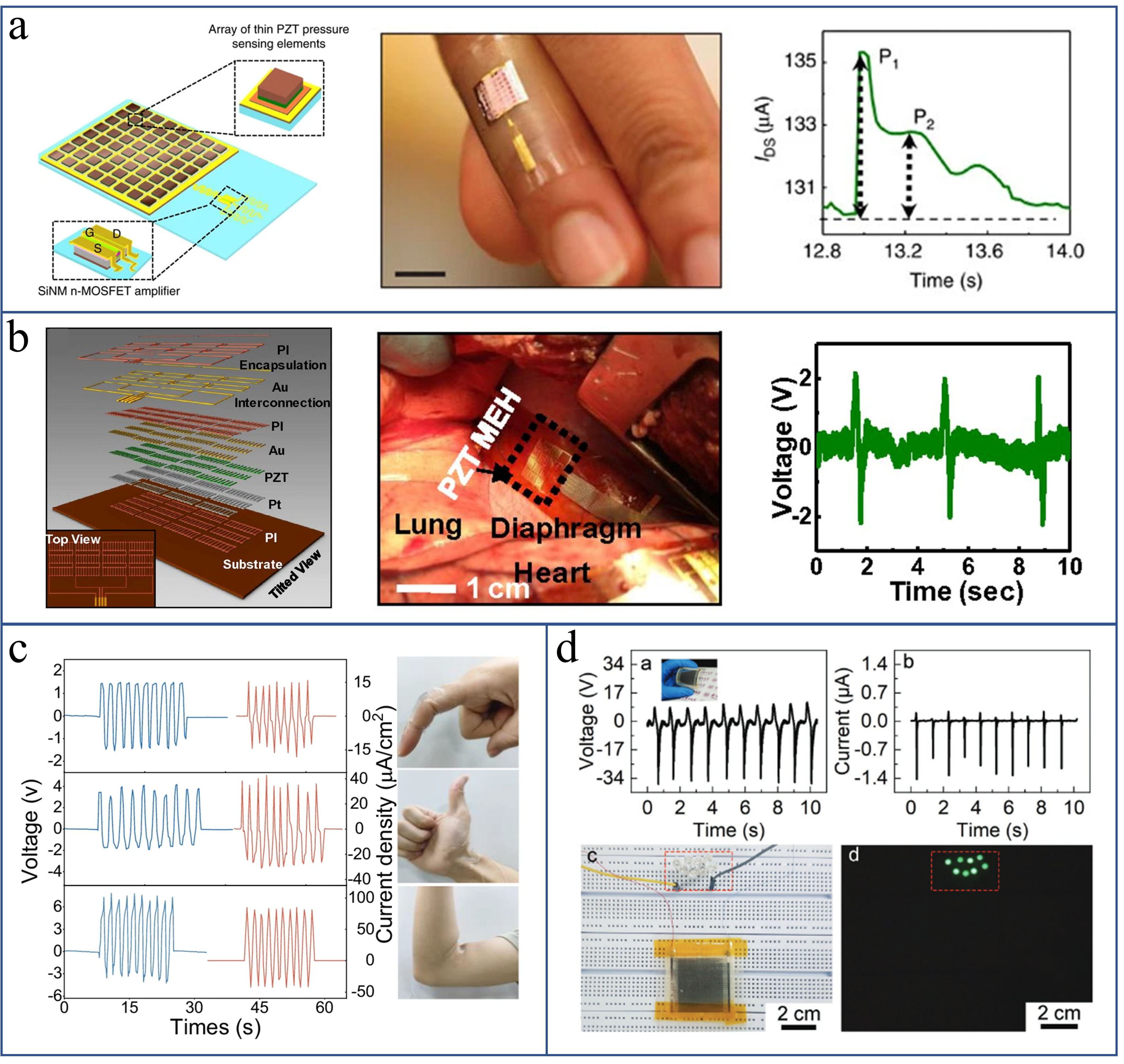
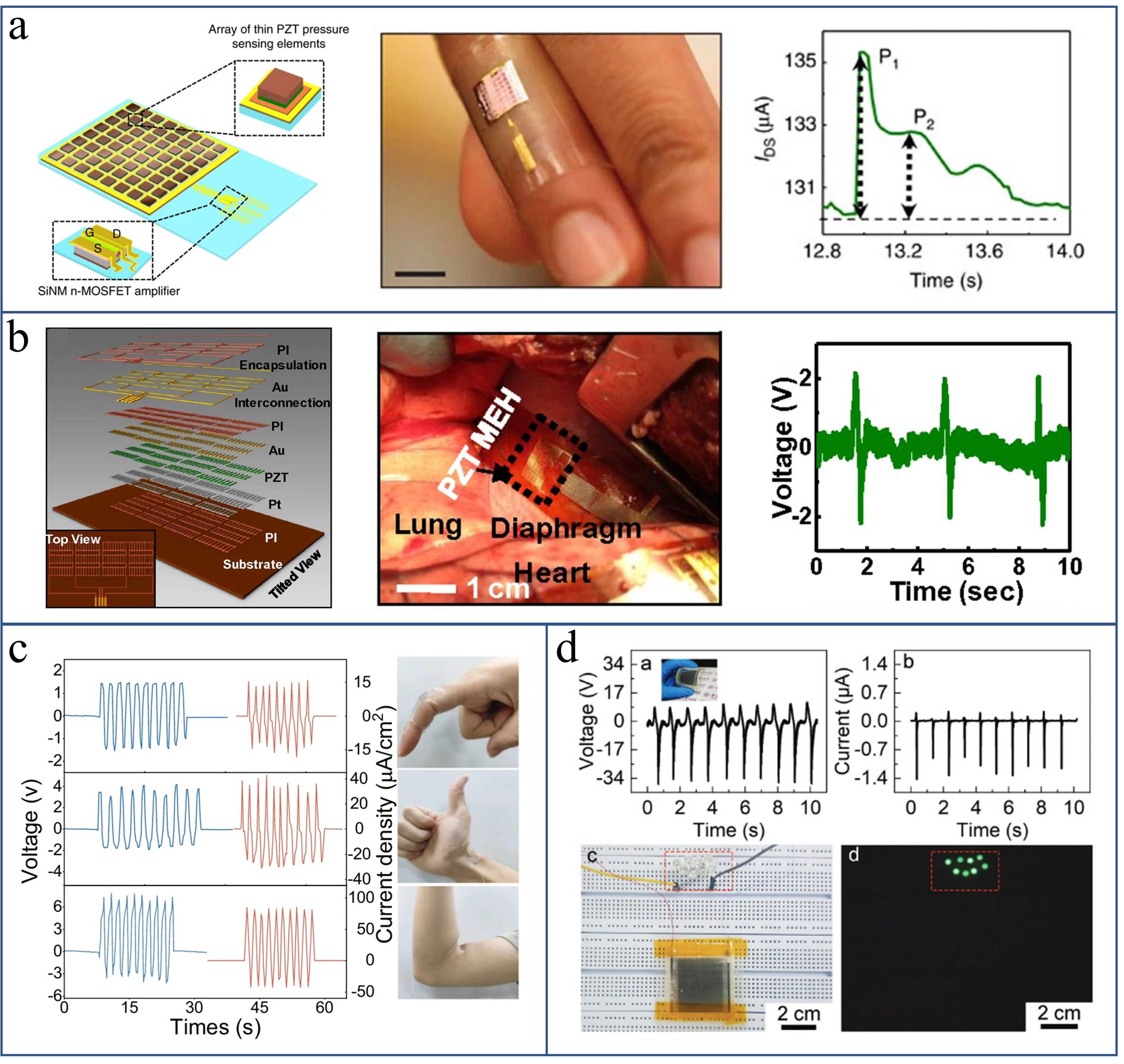
Figure 7. Applications of physiological sensing and energy harvesting based on flexible PZT sensors: (a) Monitoring weak physiological signals on human skin. Reproduced from reference[120]. CC BY 4.0; (b) Harvesting low-frequency mechanical energy from human internal organs. Reproduced with permission from reference[121]. Copyright © 2014 National Academy of Sciences; (c) Motion monitoring. Reproduced from reference[59]. CC BY-NC-ND 4.0; (d) Converting low-frequency motions into electrical energy. Reproduced with permission from reference[122]. Copyright © 2022 John Wiley & Sons. PZT: lead zirconate titanate; PI: polyimide; MEH: mechanical energy harvester.
Flexible PZT devices can be directly attached to the surfaces of internal organs to harvest low-frequency mechanical energy. Dagdeviren et al.[121] developed a flexible PZT energy-harvesting system that could conformally attach to the heart, lungs, and diaphragm (Figure 7b). The system converted and stored the low-frequency mechanical energy generated by periodic organ contraction and relaxation, achieving an energy-conversion efficiency of approximately 2%. Its output was sufficient to support implantable devices such as cardiac pacemakers.
Flexible PZT sensors can convert movements into distinguishable electrical signals for motion monitoring and recognition. Ren et al.[59] developed a PDMS-encapsulated PZT nanogenerator, which enhanced the response to low-frequency motion (Figure 7c). The device was attached to the finger, wrist, and elbow to evaluate its response. Reproducible open-circuit voltage and current signals were obtained during repeated bending at all three body sites. The open-circuit voltage (from 1.4 to 8.5 V) and short-circuit current density (from 15 to 85 μA/cm2) increased due to larger movements.
PZT energy harvesters can efficiently convert low-frequency motions into electrical energy. Liu et al.[122] directly fabricated a PZT energy harvester on a flexible zirconia ceramic tape (Figure 7d). The device effectively harvested low-frequency mechanical energy from movements such as joint bending, producing an open-circuit voltage of approximately 105 V and a short-circuit current of 0.58 μA.
The main advantage of flexible PZT sensors in this field is that dynamic stimuli enable them to generate prominent electrical signals under small deformations and weak dynamic stimuli. Meanwhile, they work without a continuous external power supply, allowing both self-powered sensing and energy harvesting. Nevertheless, the presence of lead in PZT poses potential challenges to its biocompatibility and long-term biosafety, particularly in implantable biomedical applications. Although protective encapsulation can mitigate direct exposure to lead-containing constituents, the inherent non-biodegradability of PZT remains a critical constraint on its integration into fully bioresorbable electronic systems[123].
4.2 Tactile and structural sensing
Flexible PZT piezoelectric sensors target dynamic mechanical signals between low-frequency physiological activities and acoustic signals for tactile and structural sensing. Tactile contact, slip, impact, and tapping usually involve faster temporal changes and contain clear transient peaks, sharp rising edges, damped oscillations, and distinct frequency components[124-126]. Therefore, research in this field generally focuses less on the quantitative measurement, and more on the high-accuracy detection of dynamic state and their spatial and temporal distributions.
Flexible PZT sensors can convert tactile information into characteristic electrical signals. Zeng et al.[90] developed a flexible PZT sensor with a grid structure (Figure 8a). Its highly sensitive dynamic response converted weak vibrations caused by surface sliding into distinguishable electrical signals, enabling the identification of surface roughness ranging from 0.4 to 12.5 μm. This capability provides a basis for fine tactile perception in robotic systems.
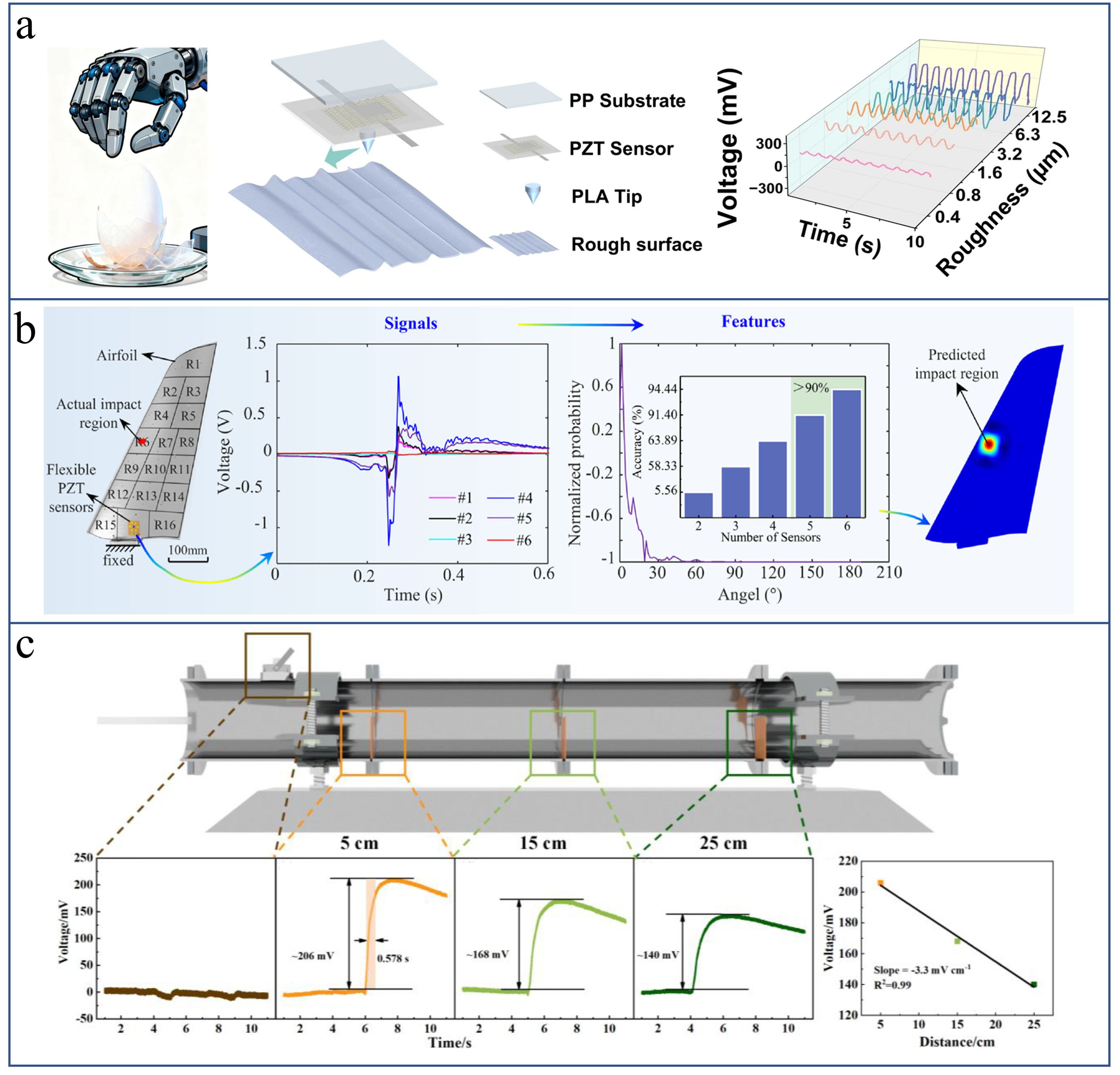
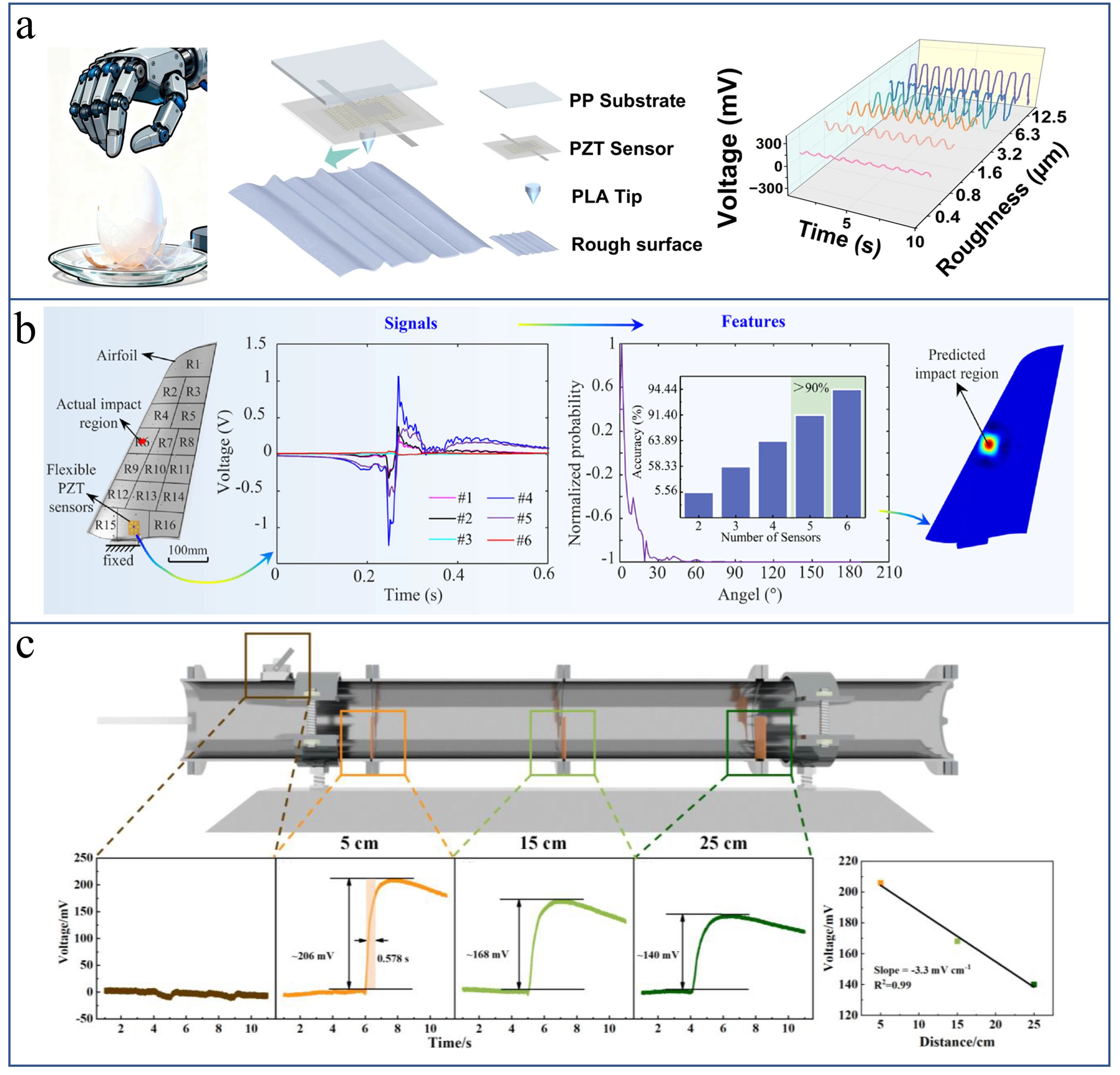
Figure 8. Applications of tactile and structural sensing based on flexible PZT sensors: (a) Converting tactile information into electrical signals. Reproduced from reference[90]. CC BY 4.0; (b) Locating impacts on structural parts. Reproduced with permission from reference[127]. Copyright © 2023 Sage Publications; (c) Condition monitoring of airflow disturbances. Reproduced from reference[128]. CC BY 4.0. PZT: lead zirconate titanate; PLA: polylactic acid; PP: polypropylene.
PZT arrays can enable impact localization. Zhu et al.[127] combined an ultrathin flexible PZT array with a neural network assisted by the Multiple Signal Classification (MUSIC) algorithm (Figure 8b). By extracting the spatial phase features of impact signals, the system achieved impact localization over an area more than 7,500% larger than the sensor itself, with an overall recognition accuracy above 90%.
Flexible PZT sensors can be attached to structural surfaces for condition monitoring. Jia et al.[128] used a mica-based flexible PZT sensor to detect transient airflow disturbances caused by pipeline leakage (Figure 8c). The sensor showed a response time of only 0.578 s, and its output voltage changed systematically with the distance from the leakage point, enabling leakage warning and localization.
The main advantage of flexible PZT sensors in this field is dynamic state detection rather than simple quantitative measurement. They enable surface condition recognition, impact localization, and warning of structural faults. For structural health monitoring, flexible PZT and piezoelectric polymers exhibit distinct advantages in electromechanical performance and mechanical adaptability. PZT generally provides higher piezoelectric charge coefficients and stronger electromechanical coupling, whereas piezoelectric polymers, such as polyvinylidene fluoride (PVDF) and P(VDF-TrFE), offer greater mechanical compliance and conformability to complex structural surfaces. These complementary characteristics highlight the need to balance piezoelectric response, strain-transfer efficiency, and long-term reliability when selecting materials for structural health monitoring applications[129].
4.3 Acoustic and vibration sensing
Flexible PZT piezoelectric sensors target rapidly varying dynamic mechanical signals in the frequency range from several hundred hertz to kilohertz for acoustic and vibration sensing. Acoustic sensing places greater emphasis on capturing rapidly changing sound-pressure waves and vibrations[106,130,131]. Therefore, research in this field generally focuses on frequency spectrum analysis; bandwidth and sensitivity are key factors that determine acoustic sensing performance[132,133].
Biomimetic resonant structures can efficiently convert weak acoustic vibrations into electrical signals. Lee et al.[105] developed a biomimetic artificial hair-cell acoustic sensor based on a flexible PZT film integrated with a trapezoidal silicone membrane (Figure 9a). Resonant vibrations at different positions enabled spatial frequency selection over 100-1,600 Hz. The device converted vibrations of approximately 15 nm into electrical signals of about 55 μV, demonstrating highly sensitive acoustic-vibration sensing. Wang et al.[134] integrated a PZT film with an ultrathin polymer substrate whose speech frequency range covered 100 Hz-4 kHz (Figure 9b). Its low-quality-factor structure broadened the resonance bandwidth, resulting in a sound-pressure sensitivity of 52 mV·Pa-1. Combined with machine learning, the sensor achieved a speaker-recognition accuracy of 90%.
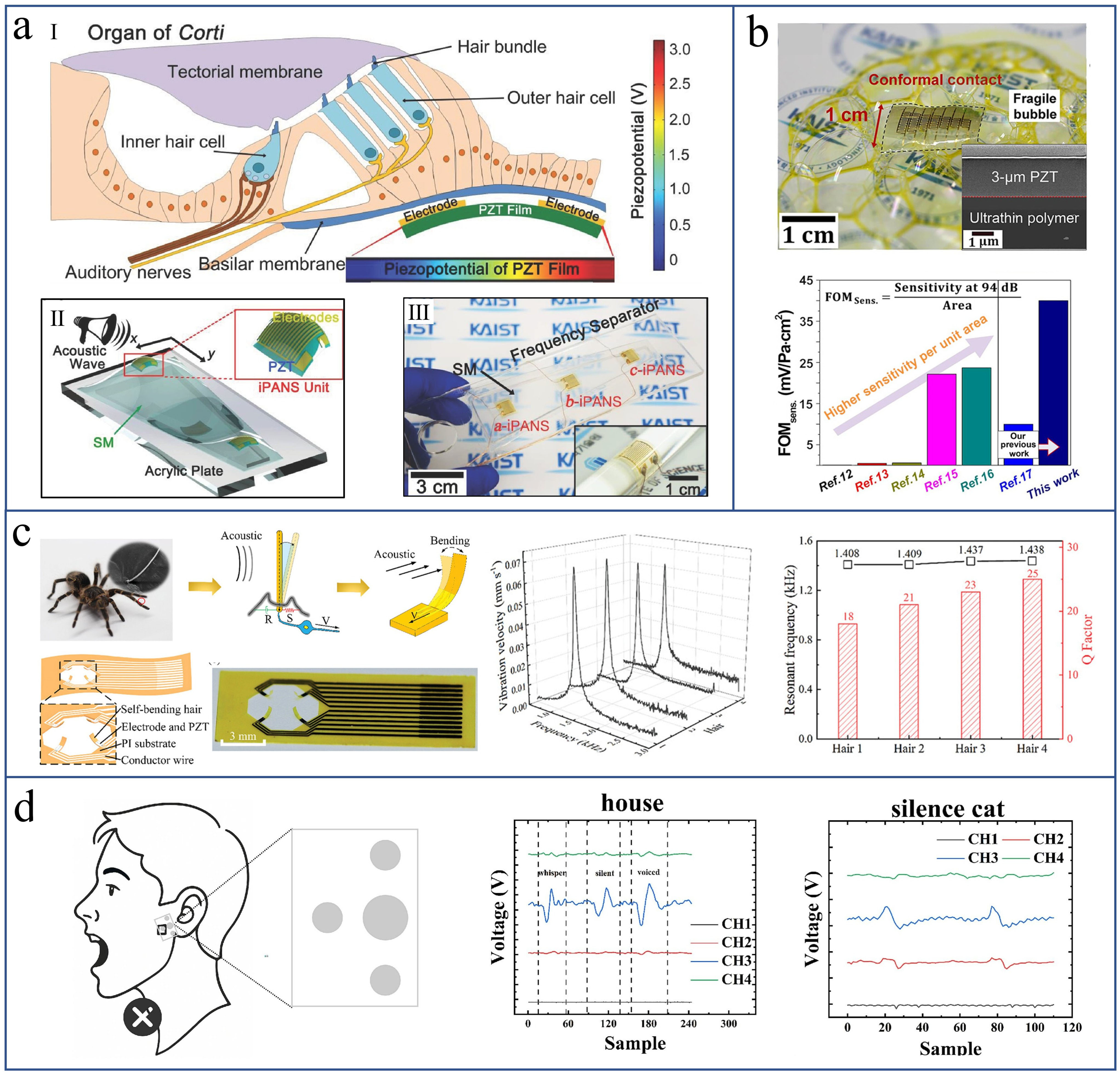
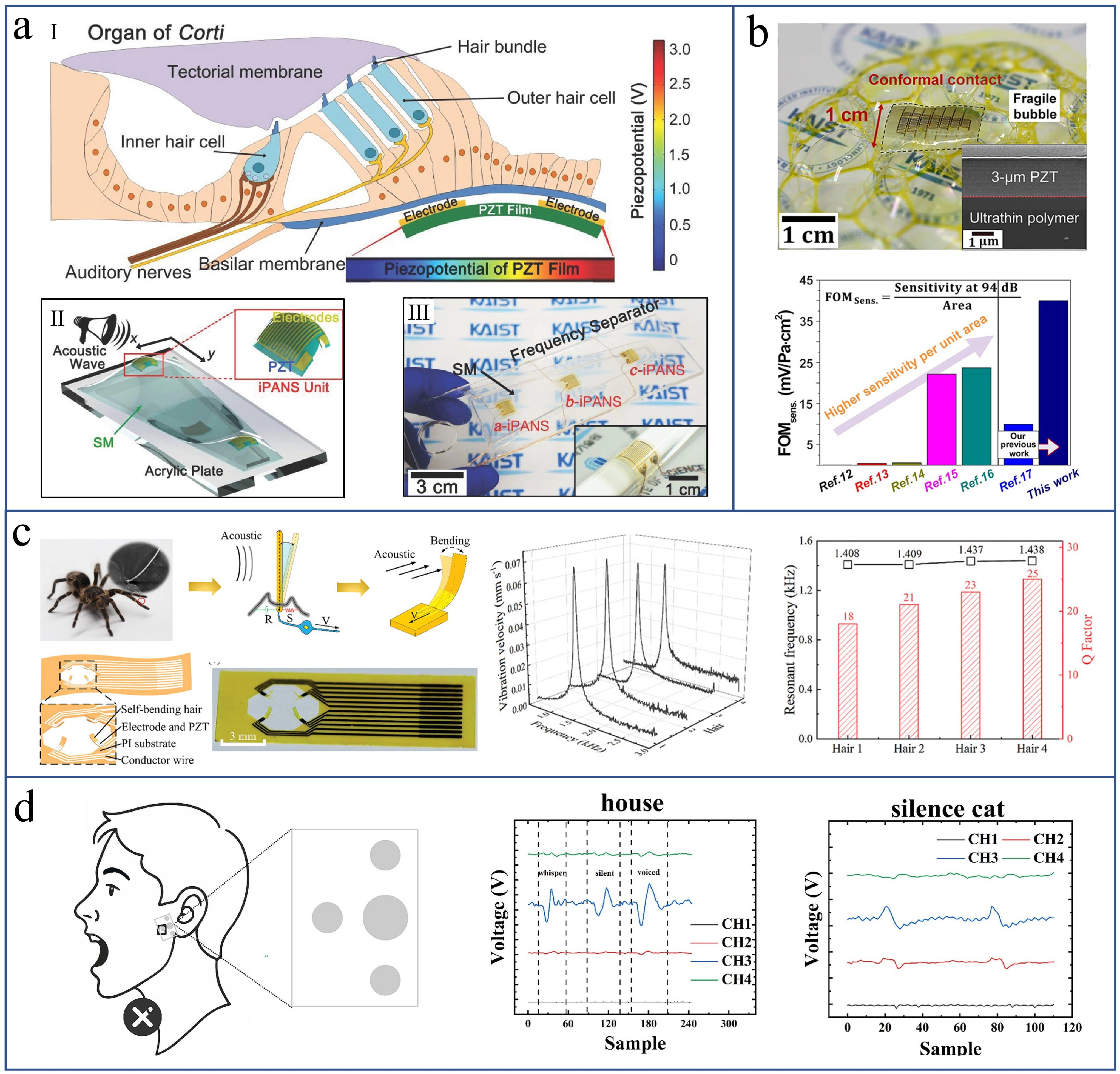
Figure 9. Applications of acoustic and vibration sensing based on flexible PZT sensors: (a, b) Biomimetic resonant structures for converting weak acoustic vibrations. Reproduced with permission from reference[105]. Copyright © 2014 John Wiley & Sons. Reproduced from reference[134]. CC BY-NC 4.0; (c) Cantilever structures for amplifying airborne particle motion. Reproduced with permission from reference[107]. Copyright © 2025 John Wiley & Sons; (d) Multichannel sensing and decoding. Reproduced with permission from reference[108]. Copyright © 2025 Elsevier. PZT: lead zirconate titanate; PI: polyimide; SM: silicone-based membrane; FOM: figure of merit; iPANS: inorganic piezoelectric acoustic nanosensor.
Cantilever structures can amplify airborne particle motion, enabling highly sensitive and directional acoustic particle-velocity sensing. Jin et al.[107] designed a hair-like acoustic particle-velocity sensor consisting of a self-bent PI cantilever and an Nb-doped PZT film (Figure 9c). Resonance amplified the root strain induced by air vibration, producing a sensitivity of 3.69 V·(mm·s-1)-1 and a signal-to-noise ratio of 81 dB. The device also achieved a speaker-recognition accuracy of 95.3%.
Multichannel sensing and decoding can be used for conformally capturing mechanical vibrations. Yu et al.[108] attached an ultrathin flexible PZT array to the temporomandibular joint region to detect weak mechanical vibrations generated by bone conduction, muscle motion, and jaw displacement during speech (Figure 9d). The system exhibited a sensitivity of 464.03 mV·N-1, a response time of 0.5 ms, and channel crosstalk below 2%. It achieved recognition accuracies of 98.57% for voiced speech and 98% for silent speech.
Beyond acoustic sensing, sound-induced vibrations can also be utilized for piezoelectric energy harvesting. Incident acoustic waves excite mechanical deformation in compliant structures, such as diaphragms and cantilevers, generating strain within the piezoelectric layer that is subsequently converted into electrical energy. The relatively low energy density of ambient sound makes the harvesting performance strongly dependent on acoustic-mechanical coupling, resonance characteristics, mechanical damping, and electrical impedance matching. Although resonant amplification can enhance power generation near the designed frequency, it may also restrict the effective operating bandwidth. Duan et al.[135] demonstrated a bioinspired PVDF-based acoustic energy harvester, achieving an output power of 8.45 μW at 200 Hz under a sound pressure level of 100 dB. This result highlights the role of structural optimization in sound-to-electricity conversion. Therefore, the performance of acoustic energy harvesters should be evaluated in terms of extractable electrical power under specified acoustic excitation and loading conditions, rather than solely relying on open-circuit voltage[136].
The main advantage of flexible PZT sensors in this field is high sensitivity and SNR, which can be further enhanced through biomimetic structural design. More importantly, frequency-domain characteristics are generally more critical than time-domain features for acoustic and vibration sensing. Beyond signal detection, the coordinated optimization of piezoelectric transduction, mechanical resonance, and electrical energy extraction further extends the potential of flexible piezoelectric devices toward acoustic energy harvesting.
4.4 Ultrasonic detection
Flexible PZT piezoelectric sensors target high-frequency dynamic signals ranging from tens of kilohertz to several megahertz for ultrasound. PZT sensors generate and detect ultrasonic waves or guided waves within structures, enabling damage detection, localization, and evaluation[137-139]. Their excellent conformability and structural adaptability make flexible PZT sensors particularly suitable for large-area and multichannel ultrasonic structural health monitoring.
Flexible PZT ultrasonic arrays can conform closely to the body surface, enabling continuous imaging of deep tissues and dynamic physiological monitoring. Hu et al.[109] developed a stretchable ultrasonic imaging patch based on a 1-3 piezocomposite array (Figure 10a). Operating at a center frequency of approximately 3 MHz, the device enabled continuous imaging of deep cardiac tissues. Combined with wide-beam compound imaging and deep-learning analysis, it extracted left ventricular volume, ejection fraction, and cardiac output in real time during body movement, enabling wearable monitoring of dynamic cardiac function.
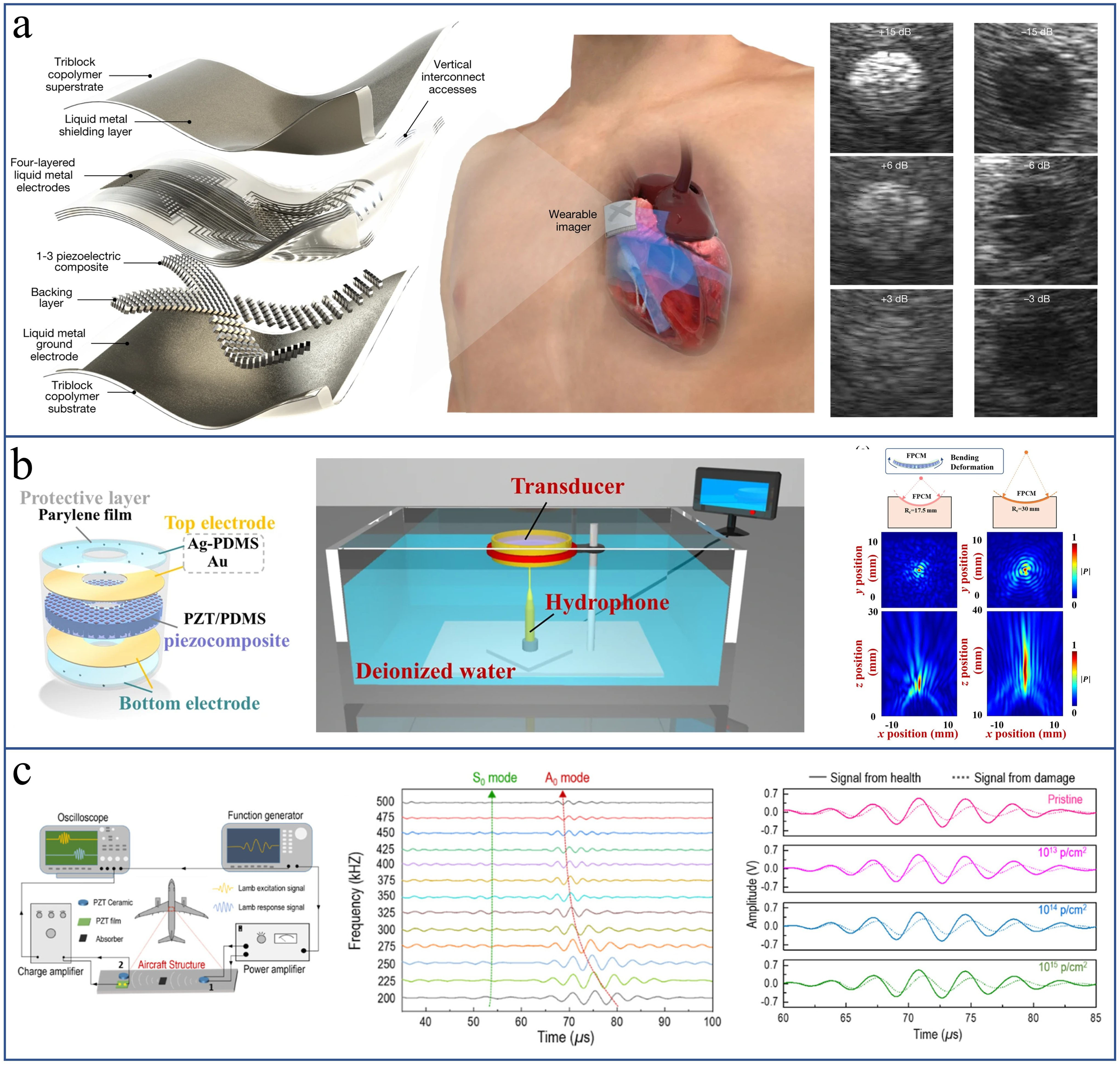
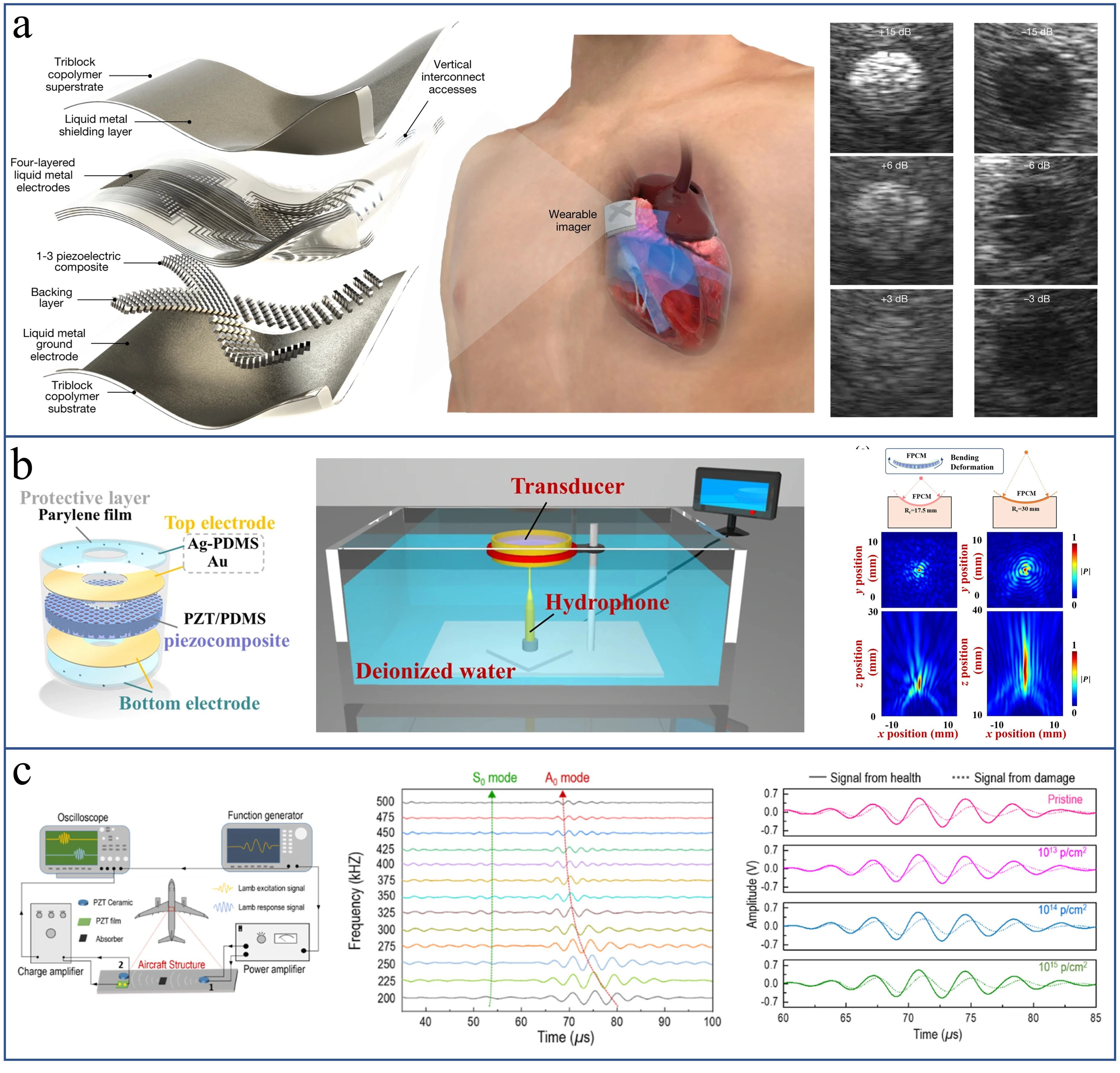
Figure 10. Applications of ultrasonic detection based on flexible PZT sensors: (a) Medical imaging of deep tissues. Reproduced from reference[109]. CC BY 4.0; (b) High-resolution underwater ultrasonic imaging. Reproduced from reference[140]. CC BY 4.0; (c) Active damage monitoring on complex curved structures by guided-wave. Reproduced with permission from reference[110]. Copyright © 2023 American Chemical Society. PZT: lead zirconate titanate; PDMS: polydimethylsiloxane; FPCM: flexible piezoelectric composite material.
Flexible PZT ultrasonic transducers can also generate complex acoustic fields by controlling their shape and curvature, thereby improving the spatial adaptability of ultrasonic imaging and nondestructive testing. Hou et al.[140] fabricated a flexible ultrasonic transducer with a center frequency of approximately 1.5 MHz using a 1-3 PZT-8/PDMS composite (Figure 10b). By adjusting the device curvature and geometry, the transducer could dynamically generate variable focal points and high-order acoustic vortex fields. It also achieved high-resolution underwater ultrasonic imaging over a wide spatial range.
Flexible PZT ultrasound sensors can function as both guided-wave actuators and receivers, enabling active damage monitoring on complex curved structures. Liu et al.[110] fabricated lightweight PZT thin-film sensors on flexible mica substrates (Figure 10c). By actively exciting and receiving Lamb waves and comparing the waveforms before and after damage, the sensors enabled damage monitoring on both flat and curved aluminum structures. They maintained stable monitoring sensitivity after proton irradiation, exposure to 175 ℃, and 105 bending cycles, demonstrating their potential for aerospace structural health monitoring under harsh conditions.
The main advantage of flexible PZT sensors in this field is combining active wave excitation with high-frequency signal reception. By analyzing the propagation and scattering of elastic waves, they enable noninvasive evaluation of internal materials, rather than merely detecting mechanical stimuli at the surface.
4.5 Multimodal Dynamic Perception
The core value of flexible PZT piezoelectric sensors in multimodal dynamic perception lies not only in extending the frequency-response range, but also in enabling the coordinated sensing of different physical quantities[141-143]. Multimodal perception helps distinguish useful signals from interference, supporting the recognition of complex events[144,145].
PZT units can be integrated with temperature-sensitive sensors to simultaneously detect thermal stimuli as well. Zhu et al.[57] used a transfer-free laser lift-off process to integrate PZT and resistive temperature sensors on opposite sides of a flexible substrate (Figure 11a). The device could simultaneously measure distributed dynamic pressure and temperature variations, providing a highly integrated platform for multi-physics sensing in electronic skin and smart-skin systems.
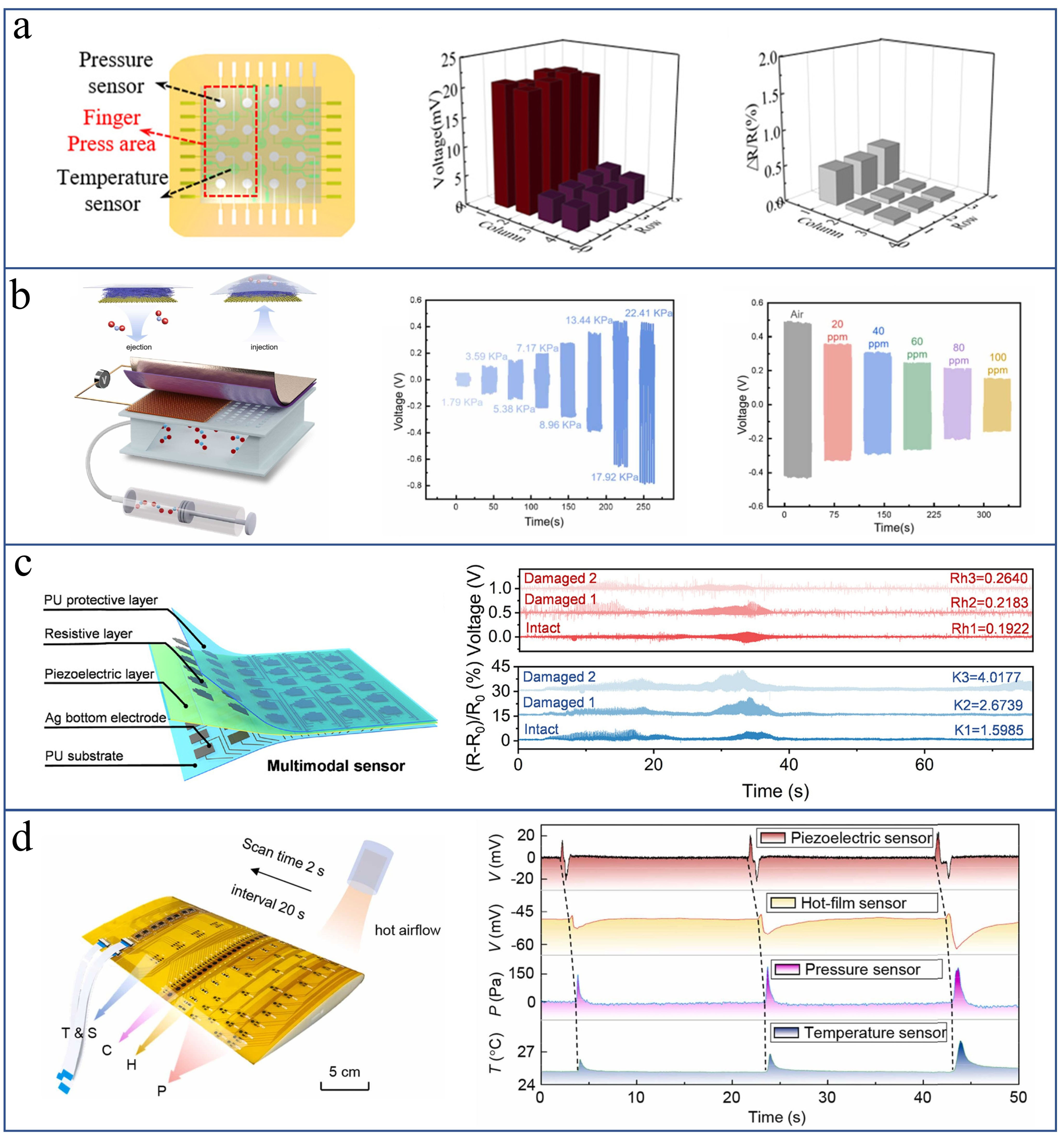
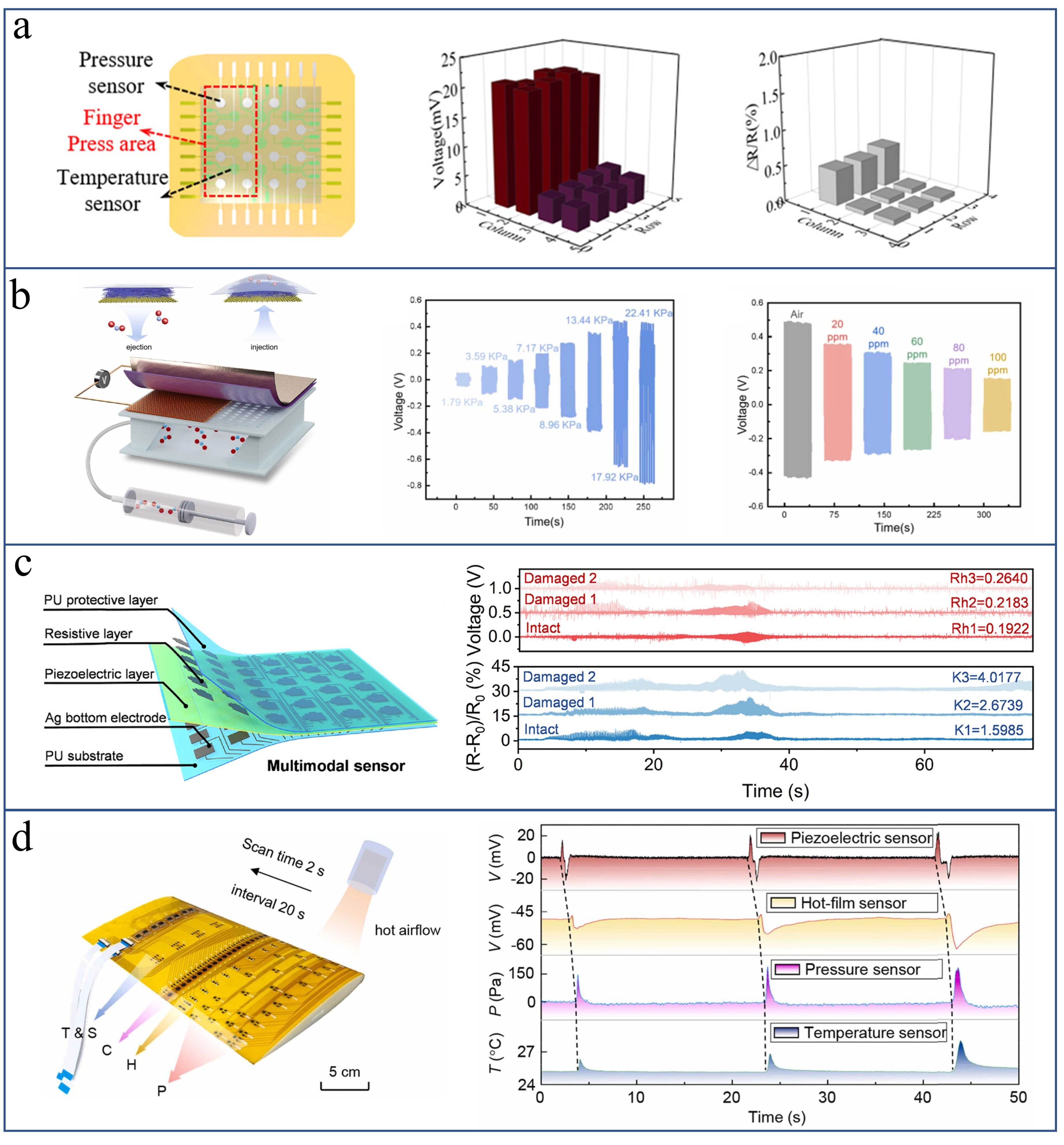
Figure 11. Applications of multimodal dynamic perception based on flexible PZT sensors: (a) Integrated with temperature-sensitive sensors. Reproduced with permission from reference[57]. Copyright © 2020 American Chemical Society; (b) Integrated with chemically sensitive materials. Reproduced with permission from reference[146]. Copyright © 2023 Elsevier; (c) Integrated with strain sensors and decoupling. Reproduced with permission from reference[147]. Copyright © 2026 John Wiley & Sons; (d) Integrated with multiple sensing arrays and data-fusion algorithms. Reproduced with permission from reference[148]. Copyright © 2021 Elsevier. PZT: lead zirconate titanate; PU: polyurethane.
Flexible PZT sensors can also be integrated with chemically sensitive materials to achieve the monitoring of environmental gases. Chen et al.[146] fabricated a core-shell fibrous textile by coaxial electrospinning, consisting of a PZT/PVDF piezoelectric core and a polyaniline/polyvinyl pyrrolidone (PANI/PVP) gas-sensitive shell (Figure 11b). The structure integrated the piezoelectric response to mechanical pressure with the resistance change caused by NO2 adsorption within a single fiber, enabling simultaneous and self-powered monitoring of gas concentration and dynamic airflow pressure.
Flexible PZT sensors can further complement other sensing mechanisms to characterize complex deformation processes across different temporal and mechanical dimensions. Yin et al.[147] developed an integrated piezoelectric-piezoresistive flexible array and used the impedance difference between the two sensing channels to achieve intrinsic signal decoupling (Figure 11c). The piezoresistive units measured strain amplitude, whereas the piezoelectric units detected strain rate, deformation, and direction. This design enabled the combined sensing of static and dynamic strain within a single device and the differentiation of degrees of structural damage through multimodal feature fusion.
Flexible PZT arrays can also be integrated with multiple sensing units and data-fusion algorithms to achieve system-level multimodal dynamic perception in complex environments. Xiong et al.[148] integrated a flexible PZT array with pressure, temperature, strain, and wall-shear-stress sensors to form a biomimetic smart skin (Figure 11d). The system simultaneously captured dynamic pressure, flutter, impact, shear stress, and temperature signals on an aircraft surface. Multi-sensor data fusion was then used to identify impact locations, flow separation, and stall conditions.
The main advantage of flexible PZT sensors in this field is excellent compatibility with heterogeneous integration. However, concurrent thermal, mechanical, and chemical stimuli can introduce cross-sensitivity through temperature-dependent signal drift and coupled deformation. Combining complementary sensing mechanisms with channel-specific calibration and multimodal data fusion can improve signal decoupling and measurement reliability.
5. Conclusion
This review treats flexible PZT sensors not as thin films that happen to bend, but as dynamic electromechanical transduction systems in which the piezoelectric layer, the compliant mechanical structure, and the signal-conditioning chain jointly determine what can be sensed. Conventional reviews assess fabrication route, mechanical flexibility, and piezoelectric coefficient as separate figures of merit; here they are treated as coupled constraints, since a gain secured at one stage can be limited by conditions imposed at another. Applications are correspondingly grouped by the dynamic regime they address, spanning low-frequency physiological sensing and energy harvesting, tactile and structural sensing, acoustic and vibration sensing, high-frequency ultrasonic detection, and multimodal dynamic perception. Reading the field along this axis exposes which requirement dominates in each regime, from sensitivity to quasi-static motion at one end to bandwidth and spatial resolution at the other, and therefore which part of the transduction chain must be optimized first.
Read this way, the literature resolves into four functional roles rather than a list of techniques. Composite fabrication (e.g., direct growth and transfer processes) makes PZT flexible in the first place. Doping, seed/buffer layers, and heterostructure integration raise the intrinsic response and crystalline quality. Low-modulus substrates, microstructural design, and polymer composites govern how much of the incoming mechanical energy reaches the active layer. Signal acquisition, array design, and intelligent signal processing determine how much of the generated charge survives as usable information. These roles are not interchangeable, and the application-oriented performance comparison in Section 3.4 highlights the importance of interpreting device-level performance in relation to sensing applications and measurement conditions. Device-level performance is therefore bounded by the least optimized stage of the chain, not by the piezoelectric coefficient in isolation.
Two consequences follow for how the field should report and compare devices. First, a co-optimization strategy spanning materials, mechanical coupling, and signal conditioning is more likely to yield usable gains than an isolated improvement at any single stage, and system-level metrics should therefore be reported alongside material coefficients. Second, cross-study comparison remains weakly constrained, because reported performance rests on mutually incompatible metrics acquired under excitation and mounting conditions that are not standardized, so rankings drawn from the present literature should be read with caution. The specific obstacles that this synthesis leaves open, together with the standardization required to remove that caveat, are set out in the following section.
6. Challenges and Outlook
Although flexible PZT sensors have shown broad potential for dynamic mechanical perception, several key challenges remain. First, the incompatibility between high-temperature processing and flexible substrates remains a challenge, and the fabrication strategies need further improvement. Second, a single device and readout circuit can rarely maintain high sensitivity and signal fidelity across the broad frequency range. Third, multi-physical interference and inter-channel crosstalk can compromise measurement accuracy, while repeated mechanical deformation may progressively degrade operational stability. Fatigue-induced cracking, electrode degradation, and interfacial delamination should therefore be assessed through cyclic loading, signal-retention measurements, and environmental aging tests.
In addition, the use of lead-containing PZT raises persistent concerns about biocompatibility and environmental safety. For long-term wearable and implantable applications, encapsulation integrity and potential lead release under mechanical fatigue and environmental exposure require careful evaluation. The intrinsic non-biodegradability of PZT further limits its applicability in fully bioresorbable electronic systems. In this context, bio-based and biodegradable piezoelectric polymers, such as poly(3-hydroxybutyrate-co-3-hydroxyvalerate) (PHBV), have emerged as promising alternatives for sustainable and transient electronic applications[149]. Nevertheless, their relatively limited piezoelectric performance highlights the need to balance electromechanical properties, biocompatibility, and biodegradability according to specific application requirements.
Looking ahead, we should focus on the fabrication of high-quality PZT, low-damage transfer processes, flexible heterogeneous integration, and the development of lead-free piezoelectric alternatives and biodegradable materials for applications requiring enhanced biosafety and environmental sustainability. Multiphysics decoupling should also be developed to improve measurement accuracy under complex environmental conditions. In addition, the integration of flexible PZT arrays with signal-conditioning circuits and machine-learning algorithms will be essential for developing multimodal and intelligent dynamic sensing systems that operate across different frequency ranges. Overall, the next stage in the development of flexible PZT piezoelectric sensors should move beyond simply demonstrating that PZT can be made flexible with high piezoelectric coefficients. The focus should shift toward multimodal stable integration, high-fidelity sensing, and system-level applications in complex environments.
Acknowledgements
The authors acknowledge the use of AI-assisted tools (OpenAI ChatGPT (GPT-6)) for language polishing. All scientific content and data accuracy remain the responsibility of the authors.
Authors contribution
Ling J: Investigation, conceptualization, writing-original draft.
Pan J, Zhu Y: Data curation.
Li K: Investigation, methodology, supervision, writing-review & editing.
All authors have given approval to the final version of the manuscript.
Conflicts of interest
The authors have no conflicts of interest to declare.
Ethical approval
Not applicable.
Consent to participate
Not applicable.
Consent for publication
Not applicable.
Availability of data and materials
Not applicable.
Funding
K.L. acknowledges support from National Natural Science Foundation of China (Grant No. 52375566), the Ministry of Education of China (Grant No. SRICSPYF-ZY2025030).
Copyright
© The Author(s) 2026.
References
-
2. Ye Z, Zhao G, Yang M, Xu Y, Ren Y, Chen Z, et al. A highly sensitive and multiplexed wireless sensing system with skin-like compliance and stretchability for wearable applications. Sci Adv. 2025;11(44):eadt4923.[DOI]
-
4. Zhou J, Li J, Jia H, Yao K, Jia S, Li J, et al. Mormyroidea-inspired electronic skin for active non-contact three-dimensional tracking and sensing. Nat Commun. 2024;15:9875.[DOI]
-
5. Wang J, Wei X, Shi J, Bai N, Wan X, Li B, et al. High-resolution flexible iontronic skins for both negative and positive pressure measurement in room temperature wind tunnel applications. Nat Commun. 2024;15:7094.[DOI]
-
6. Li Q, Tan T, Wang B, Yan Z. Avian-inspired embodied perception in biohybrid flapping-wing robotics. Nat Commun. 2024;15:9099.[DOI]
-
7. Zhao Y, Sun Q, Mei S, Gao L, Zhang X, Yang Z, et al. Wearable multichannel-active pressurized pulse sensing platform. Microsyst Nanoeng. 2024;10:77.[DOI]
-
8. Deng M, Du C, Fang J, Xu C, Guo C, Huang J, et al. Flexible adaptive sensing tonometry for medical-grade multi-parametric hemodynamic monitoring. npj Flex Electron. 2024;8:45.[DOI]
-
10. Ma C, Ye H, Shi X, Chen Y, Liu Y, Qin L, et al. Contact-dominated localized electric-displacement-field-enhanced pressure sensing. Nat Commun. 2025;16:8034.[DOI]
-
11. Guo S, Qi J, Wang Y, Liu Z, Li J. A flexible impact sensor of interpenetrating-phase composite architecture with high mechanical stability and energy-absorbing capability. Adv Funct Mater. 2025;35(20):2419882.[DOI]
-
12. Miao Y, Kurkin A, Wang P, Ye L, Zhang X. Flexible carbon fiber composite with enhanced durable impact-resistance and sensing capability based on polyborosiloxane network. Adv Funct Mater. 2025;35(24):2503952.[DOI]
-
13. Liu T, Zhang M, Li Z, Dou H, Zhang W, Yang J, et al. Machine learning-assisted wearable sensing systems for speech recognition and interaction. Nat Commun. 2025;16:2363.[DOI]
-
15. van Neer PLMJ, Peters LCJM, Verbeek RGFA, Peeters B, de Haas G, Hörchens L, et al. Flexible large-area ultrasound arrays for medical applications made using embossed polymer structures. Nat Commun. 2024;15:2802.[DOI]
-
16. Oh C, Kim YM, Lee T, Lee SM, Jung J, Bae HM, et al. Patch-type capacitive micromachined ultrasonic transducer for ultrasonic power and data transfer. Microsyst Nanoeng. 2025;11:124.[DOI]
-
19. Dang TB, Nguyen CC, Heo SY, Nguyen TV, Tong N, Ruppert MG, et al. Wearable, broadband auscultation patch with cantilever pressure transducer for remote healthcare monitoring. Nat Commun. 2026;17:4918.[DOI]
-
20. Zeng H, Li W, Wang J, Yu H, Xiong T, He J, et al. Simultaneous strain, strain rate and temperature sensing based on a single active layer of Te nanowires. Nat Commun. 2025;16:10771.[DOI]
-
21. Li C, Wang H, Song Z, Zhang W, Pan Y, Zhao Z, et al. Wireless, wearable elastography via mechano-acoustic wave sensing for ambulatory monitoring of tissue stiffness. Sci Adv. 2025;11(36):eady0534.[DOI]
-
23. Wang H, Yang H, Chen Z, Zheng Q, Jiang H, Feng PXL, et al. Development of dual-frequency PMUT arrays based on thin ceramic PZT for endoscopic photoacoustic imaging. J Microelectromech Syst. 2021;30(5):770-782.[DOI]
-
25. Yamashita T, Takamatsu S, Okada H, Itoh T, Kobayashi T. Ultra-thin piezoelectric strain sensor array integrated on a flexible printed circuit involving transfer printing methods. IEEE Sens J. 2016;16(24):8840-8846.[DOI]
-
26. Jin L, Song J, Liu L, Jia Y. PZT-based flexible piezoelectric sensors for real-time condition monitoring. AIP Adv. 2024;14(2):025213.[DOI]
-
27. Won SS, Seo H, Kawahara M, Glinsek S, Lee J, Kim Y, et al. Flexible vibrational energy harvesting devices using strain-engineered perovskite piezoelectric thin films. Nano Energy. 2019;55:182-192.[DOI]
-
28. Le Scornec J, Guiffard B, Seveno R, Le Cam V, Ginestar S. Self-powered communicating wireless sensor with flexible aero-piezoelectric energy harvester. Renew Energy. 2022;184:551-563.[DOI]
-
29. Liu X, Yin Z, Yang X, Han Z. Preparation, performance optimization and application progress of flexible lead zirconate titanate films. J Mater Chem C. 2026;14(5):1708-1746.[DOI]
-
30. Song L, Glinsek S, Defay E. Toward low-temperature processing of lead zirconate titanate thin films: Advances, strategies, and applications. Appl Phys Rev. 2021;8(4):041315.[DOI]
-
32. Noh MS, Kim S, Hwang DK, Kang CY. Self-powered flexible touch sensors based on PZT thin films using laser lift-off. Sens Actuators A Phys. 2017;261:288-294.[DOI]
-
36. Hou L, Huan Y, Zheng M, Liu Y, Wang C, Wang X, et al. 3D vertically aligned microchannel structure to enhance piezoelectric energy harvesting performance of PZT/PVDF&CNTs piezoelectric composites. J Materiomics. 2024;10(5):1063-1070.[DOI]
-
38. Kang MG, Noh MS, Pyeon JJ, Jung WS, Moon HG, Baek SH, et al. Direct growth of ferroelectric oxide thin films on polymers through laser-induced low-temperature liquid-phase crystallization. Chem Mater. 2020;32(15):6483-6493.[DOI]
-
39. Xiang W, Yin Z, Yang X. Study and application of PZT in the field of wearable devices. Adv Mater Technol. 2025;10(14):2401692.[DOI]
-
41. Cao X, Xiong Y, Sun J, Zhu X, Sun Q, Wang ZL. Piezoelectric nanogenerators derived self-powered sensors for multifunctional applications and artificial intelligence. Adv Funct Mater. 2021;31(33):2102983.[DOI]
-
42. Jia X, Guo R, Tay BK, Yan X. Flexible ferroelectric devices: Status and applications. Adv Funct Mater. 2022;32(45):2205933.[DOI]
-
43. Chen B, Feng Z, Yao FZ, Zhang MH, Wang K, Wei Y, et al. Flexible piezoelectrics: Integration of sensing, actuating and energy harvesting. npj Flex Electron. 2025;9:58.[DOI]
-
44. Li M, Aoyama J, Inayoshi K, Zhang H. Wearable PZT piezoelectric sensor device for accurate arterial pressure pulse waveform measurement. Adv Electron Mater. 2025;11(9):2400852.[DOI]
-
45. Jiang S, Shen Y, Wang S, Jiang W, Liu Y, Wu Q. Flexible piezoelectric composite sensor for impact monitoring of curved structures. Sens Actuators A Phys. 2023;362:114655.[DOI]
-
46. Lin Z, Duan S, Liu M, Dang C, Qian S, Zhang L, et al. Insights into materials, physics, and applications in flexible and wearable acoustic sensing technology. Adv Mater. 2024;36(9):2306880.[DOI]
-
50. Zhou W, Du D, Cui Q, Lu C, Wang Y, He Q. Recent research progress in piezoelectric vibration energy harvesting technology. Energies. 2022;15(3):947.[DOI]
-
51. Cho H, Park J, Park JY. Micro-fabricated flexible PZT cantilever using d33 mode for energy harvesting. Micro Nano Syst Lett. 2017;5(1):20.[DOI]
-
52. Wang D, Yuan G, Hao G, Wang Y. All-inorganic flexible piezoelectric energy harvester enabled by two-dimensional mica. Nano Energy. 2018;43:351-358.[DOI]
-
53. Zhen L, Liu Z, Liu Z, Wang Q, Liu J, Yao Z, et al. High-density flexible piezoelectric sensor array with double working modes. IEEE Sens J. 2023;23(5):5270-5277.[DOI]
-
54. Xiao Y, Karnaoukh S, Wu N. Design and analysis of a d15 mode piezoelectric energy generator using friction-induced vibration. Smart Mater Struct. 2023;32(3):035040.[DOI]
-
58. Park KI, Son JH, Hwang GT, Jeong CK, Ryu J, Koo M, et al. Highly-efficient, flexible piezoelectric PZT thin film nanogenerator on plastic substrates. Adv Mater. 2014;26(16):2514-2520.[DOI]
-
61. Dai L, Xie Y, Wang B, Long J, Shen H, Jiang P, et al. Flexible freestanding PbZr0.2Ti0.8O3 ferroelectric thin films with stable and tunable domain configuration. Mater Today Commun. 2025;48:113625.[DOI]
-
62. Wu M, Yan Y, Xiao Y, Liu Y, Li H, Zhong L, et al. Flexible Pb(Zr0.52, Ti0.48)O3 thin film acoustic emission sensor for monitoring partial discharge in power cable. AIP Adv. 2023;13(3):035009.[DOI]
-
63. Kim M, Joe DJ, Doh I, Cho YH. Piezoelectric nanocomposite-based multifunctional wearable bioelectronics for mental stress analysis utilizing physiological signals. Adv Mater Technol. 2024;9(5):2301610.[DOI]
-
66. Li C, Li C, Wang Y, Zhao Y, Yang F, Dong G, et al. Flexible piezoelectric 0-3 PZT@C/PDMS composite films for pressure sensor and limb motion monitoring. Coatings. 2024;14(10):1269.[DOI]
-
67. Kim M, Doh I, Oh E, Cho YH. Flexible piezoelectric pressure sensors fabricated from nanocomposites with enhanced dispersion and vapor permeability for precision pulse wave monitoring. ACS Appl Nano Mater. 2023;6(23):22025-22035.[DOI]
-
68. Sappati KK, Bhadra S. Flexible piezoelectric 0-3 PZT-PDMS thin film for tactile sensing. IEEE Sens J. 2020;20(9):4610-4617.[DOI]
-
69. Zhen L, Cui M, Bai X, Jiang J, Ma X, Wang M, et al. Thin, flexible hybrid-structured piezoelectric sensor array with enhanced resolution and sensitivity. Nano Energy. 2024;131:110188.[DOI]
-
70. O’Malley CJ, Tang X, Koval V, Chen K, Wu Z, Banerjee K, et al. Unveiling the mechanism of substitution-induced high piezoelectric performance in PLZT ceramics. J Adv Ceram. 2025;14(7):9221097.[DOI]
-
71. Ma Z, Cao W. Sm doped PYN-PZ-PT piezoelectric ceramics with large piezoelectricity and excellent temperature stability. Ceram Int. 2025;51(19):28700-28709.[DOI]
-
72. Jung YH, Pham TX, Issa D, Wang HS, Lee JH, Chung M, et al. Deep learning-based noise robust flexible piezoelectric acoustic sensors for speech processing. Nano Energy. 2022;101:107610.[DOI]
-
73. Chen Z, Hao Y, Huang J, Zhou Z, Li Y, Liang R. Poling above the Curie temperature driven large enhancement in piezoelectric performance of Mn doped PZT-based piezoceramics. Nano Energy. 2023;113:108546.[DOI]
-
75. Haining L, Kijima T, Yamahara H, Tabata H, Seki M. Epitaxial single-crystalline PZT thin films on ZrO2-buffered Si wafers fabricated using spin-coating for mass-produced memristor devices. Adv Electron Mater. 2025;11(2):2400280.[DOI]
-
76. Hou Y, Zhao K, Tian H, Duo Z, Guo M, Zhang W, et al. Boosting PZT ferroelectric and optoelectronic properties for intelligent recognition via strain relaxation control through buffer layer thickness optimization. Nano Res. 2026;19(3):94908289.[DOI]
-
77. Lin B, Wei Q, Hua H, Qi D, Zhang H, Wang S, et al. High-performance PZT piezoelectric films on glass with LaNiO3 buffer layer. Ceram Int. 2025;51(16):21441-21447.[DOI]
-
78. Jeyaseelan A, Vishwanath SK, Yoon S, Kim J. Improving the thermal stability of 180° domain switching by engineering the ferroelectric/electrode interface. J Alloys Compd. 2025;1010:178038.[DOI]
-
80. Wu M, Zhao Y, Ren Z, Ci H, Cui Y, Li L, et al. Enhancing sensitivity of flexible piezoelectric thin-film acoustic sensors via buffer layer engineering for insulation health monitoring of power cables. Adv Funct Mater. 2026;36(21):e18639.[DOI]
-
81. Zou D, Liu S, Zhang C, Hong Y, Zhang G, Yang Z. Flexible and translucent PZT films enhanced by the compositionally graded heterostructure for human body monitoring. Nano Energy. 2021;85:105984.[DOI]
-
84. Kweon SH, Kasatani K, Kanno I. Layer configuration-driven phase engineering of Sol-Gel epitaxial Pb(Zr, Ti)O3 thin films for high piezoelectricity on silicon substrate. Acta Mater. 2026;311:122162.[DOI]
-
85. Govinden V, Rijal S, Zhang Q, Sando D, Prokhorenko S, Nahas Y, et al. Controlling topological defect transitions in nanoscale lead zirconate titanate heterostructures. Phys Rev Materials. 2021;5(12):124205.[DOI]
-
86. Xu Q, Jia M, Zhou P, Zhang Y, Guo W, Zhao S, et al. High-performance ultrasensitive flexible piezoelectric thin film sensors via a cost-effective transfer strategy. Adv Funct Mater. 2025;35(4):2414211.[DOI]
-
87. Liu S, Liao J, Huang X, Zhang Z, Wang W, Wang X, et al. Green fabrication of freestanding piezoceramic films for energy harvesting and virus detection. Nanomicro Lett. 2023;15(1):131.[DOI]
-
88. Faudou J, Benwadih M, Gabas A, Kadura L, Le MQ, Grinberg D, et al. Screen-printed flexible piezoelectric force sensor array with electromagnetic interference shielding. Adv Eng Mater. 2026;28(4):e202502361.[DOI]
-
90. Zeng L, Jiang C, Li Y, Yin H, Li Q, Liu H, et al. Mesh-architected structurally flexible Pb(Zr0.52Ti0.48)O3 framework enables highly sensitive and stretchable piezoelectric sensors. Nanomicro Lett. 2026;18(1):295.[DOI]
-
91. Chang SM, Hur S, Park J, Lee DG, Shin J, Kim HS, et al. Optimization of piezoelectric polymer composites and 3D printing parameters for flexible tactile sensors. Addit Manuf. 2023;67:103470.[DOI]
-
92. Jiang C, Li Y, Yin H, Li Y, Bao Y, Li Q, et al. Multiscale interconnected and anisotropic morphology genetic piezoceramic skeleton based flexible self-powered 3D force sensor. Adv Funct Mater. 2025;35(38):2503120.[DOI]
-
93. Zhan H, Lv P, Zhang S, Xin L, Wang J, Li R, et al. High-performance piezoelectric composite combined with PZT micropillars and P(VDF-TrFE) membrane for energy harvesting and sensing. J Alloys Compd. 2025;1019:179227.[DOI]
-
94. Tang T, Shen Z, Wang J, Xu S, Jiang J, Chang J, et al. Stretchable polymer composites with ultrahigh piezoelectric performance. Natl Sci Rev. 2023;10(8):nwad177.[DOI]
-
95. Lin X, Zhang X, Fei X, Wang C, Liu H, Huang S. Flexible three-dimensional interconnected PZT skeleton based piezoelectric nanogenerator for energy harvesting. Ceram Int. 2023;49(16):27526-27534.[DOI]
-
99. Wang Y, Qiu L, Luo Y, Ding R, Jiang F. A piezoelectric sensor network with shared signal transmission wires for structural health monitoring of aircraft smart skin. Mech Syst Signal Process. 2020;141:106730.[DOI]
-
101. Wang Y, Wang C, Pu W, Qiu L. A lightweight and fully-expandable piezoelectric sensor network with shared signal transmission wires for aircraft smart skin. Mech Syst Signal Process. 2025;241:113530.[DOI]
-
102. Banerjee P, Ojha S, Kalimullah NMM, Shelke A, Habib A. Ultrasonic wave field image augmentation in PZT sensors using generative machine learning and coulomb coupling. Acta Acust. 2025;9:15.[DOI]
-
103. Lomazzi L, Giglio M, Cadini F. Towards a deep learning-based unified approach for structural damage detection, localisation and quantification. Eng Appl Artif Intell. 2023;121:106003.[DOI]
-
105. Lee HS, Chung J, Hwang GT, Jeong CK, Jung Y, Kwak JH, et al. Flexible inorganic piezoelectric acoustic nanosensors for biomimetic artificial hair cells. Adv Funct Mater. 2014;24(44):6914-6921.[DOI]
-
106. Liu Y, Zhang X, Zhang Z, Wang S, Wang J, Liu L, et al. Freestanding ferroelectric membranes via ionic unlocking van der Waals interface. Nat Commun. 2026;17:8104.[DOI]
-
107. Jin B, Cao H, Sheng T, Gong Z, Dong Z, Gai Y, et al. Flexible hair-like piezoelectric acoustic particle velocity sensor with enhanced sensitivity for speaker recognition. Adv Funct Mater. 2025;35(11):2417164.[DOI]
-
108. Yu L, Zhen L, Cui M, Chen X, Bai X, Shao Y, et al. An ultralow-crosstalk wearable piezoelectric sensing system for voiced and silent speech decoding. Chem Eng J. 2025;522:168111.[DOI]
-
109. Hu H, Huang H, Li M, Gao X, Yin L, Qi R, et al. A wearable cardiac ultrasound imager. Nature. 2023;613(7945):667-675.[DOI]
-
113. Cheng D, Yue Q, Hang H, Li J, Zhou Z, Liang R. The development of a flexible linear array transducer with high bandwidth based on piezoelectric composite. Sens Actuators A Phys. 2023;363:114749.[DOI]
-
114. Guerra-Bravo E, Baltazar A, Kim JY. On the SH0 directivity of an array with flexible PZT transducers for beam steering control. Phys Scr. 2024;99(10):105022.[DOI]
-
116. Guan Y, Bai M, Wang Q, Liu L, Yu S, Kong B, et al. A self-powered wearable piezoelectric nanogenerator for physiological monitoring based on lead zirconate titanate/microfibrillated cellulose@polyvinyl alcohol (PZT/MFC@PVA) composition. Chem Eng J. 2023;460:141598.[DOI]
-
118. Liao H, Wu T, Gao G, Wu X, Gao F. Shape optimization of a non-uniform piezoelectric bending beam for human knee energy harvester. Smart Mater Struct. 2024;33(10):105026.[DOI]
-
119. Liao H, Wang Y, Ren Z, Wu X, Gao F. Piezoelectric-based sole energy harvester for capturing energy from human walking. Smart Mater Struct. 2025;34(7):075004.[DOI]
-
120. Dagdeviren C, Su Y, Joe P, Yona R, Liu Y, Kim YS, et al. Conformable amplified lead zirconate titanate sensors with enhanced piezoelectric response for cutaneous pressure monitoring. Nat Commun. 2014;5:4496.[DOI]
-
122. Liu Y, Ding L, Dai L, Gao X, Wu H, Wang S, et al. All-ceramic flexible piezoelectric energy harvester. Adv Funct Mater. 2022;32(52):2209297.[DOI]
-
123. Chorsi MT, Curry EJ, Chorsi HT, Das R, Baroody J, Purohit PK, et al. Piezoelectric biomaterials for sensors and actuators. Adv Mater. 2019;31:1802084.[DOI]
-
124. Lu M, Zeng L, Jiang C, Li Q, Guo Y. Highly sensitive and omnidirectional anisotropic piezoelectric sensors based on oriented PbZr0.52Ti0.48O3 fibers with intrinsic flexibility. J Alloys Compd. 2025;1022:179905.[DOI]
-
125. Zhang M, Li X, Shen N, Zhong C, Zhang Y, Zhou S, et al. A self-powered portable spherical grip sensor based on flexible PZT piezoelectric composites for rehabilitation self-monitoring. Nano Energy. 2025;138:110906.[DOI]
-
126. Yin H, Li Y, Tian Z, Li Q, Jiang C, Liang E, et al. Ultra-high sensitivity anisotropic piezoelectric sensors for structural health monitoring and robotic perception. Nanomicro Lett. 2024;17(1):42.[DOI]
-
127. Zhu C, Xu Z, Hou C, Lv X, Jiang S, Ye D, et al. Flexible, monolithic piezoelectric sensors for large-area structural impact monitoring via MUSIC-assisted machine learning. Struct Health Monit. 2024;23(1):121-136.[DOI]
-
128. Jia M, Xu Q, Zhai D, Yan M, Jiang S, Tang M, et al. Flexible mica-based PZT sensor for real-time monitoring of the airflow. Crystals. 2023;13(6):855.[DOI]
-
129. Mokhtari F, Symes RW, Simon Ž, Dharmasiri B, Henderson LC, Joosten MW, et al. An energy efficient and sustainable approach to structural health monitoring in carbon fiber composites: Harnessing sound-induced vibration with Ti3C2Tx MXene/AgNPs modified P(VDF-TrFE) sensors. J Mater Chem A. 2025;13(9):6482-6492.[DOI]
-
131. Zhen L, Yu L, Chen X, Cui M, Bai X, Liu J, et al. Tunable bioinspired spiral-structured piezoelectric vibration sensor for voice biometrics. Chem Eng J. 2025;517:164513.[DOI]
-
132. Jung YH, An J, Hyeon DY, Wang HS, Kim I, Jeong CK, et al. Theoretical basis of biomimetic flexible piezoelectric acoustic sensors for future customized auditory systems. Adv Funct Mater. 2024;34(10):2309316.[DOI]
-
133. Uluşan H, Yüksel MB, Topçu Ö, Yiğit HA, Yılmaz AM, Doğan M, et al. A full-custom fully implantable cochlear implant system validated in vivo with an animal model. Commun Eng. 2024;3(1):132.[DOI]
-
135. Duan B, Wu K, Chen X, Ni J, Ma X, Meng W, et al. Bioinspired PVDF piezoelectric generator for harvesting multi-frequency sound energy. Adv Electron Mater. 2023;9(8):2300348.[DOI]
-
136. Jean F, Khan MU, Alazzam A, Mohammad B. Advancement in piezoelectric nanogenerators for acoustic energy harvesting. Microsyst Nanoeng. 2024;10:197.[DOI]
-
137. Wang H, Wu Y, Guo K, Liu W, Sun C, Si S, et al. PZT-based flexible ultrasonic sensor arrays for nondestructive testing applications. Sens Actuators A Phys. 2026;408:117995.[DOI]
-
138. Hao S, Zhong C, Zhang Y, Chen Y, Wang L, Qin L. Flexible 1-3 piezoelectric composites with soft embedded conductive interconnects for underwater acoustic transducers. ACS Appl Electron Mater. 2023;5(5):2686-2695.[DOI]
-
140. Hou C, Li Z, Fei C, Li Y, Wang Y, Zhao T, et al. Active acoustic field modulation of ultrasonic transducers with flexible composites. Commun Phys. 2023;6:252.[DOI]
-
141. Lu M, Wang B, Li Q, Guo Y. Flexible dual-mode pressure sensor for simultaneous dynamic-static sensing with wide-range detection and ultra-fast response speed. J Alloys Compd. 2024;1004:175829.[DOI]
-
142. Luo X, Zhang X, Ji S, Wu C, Cheng L, Guo D, et al. Fully self-healing dual-mode tactile sensing strategy for object’s dimension and surface morphology recognition. Nano Energy. 2025;136:110757.[DOI]
-
143. Kong K, Wang L, Wu H, Le Z, Zhang Y, Wang Z, et al. Skin-inspired multimodal tactile sensor aiming at smart space extravehicular multi-finger operations. Chem Eng J. 2024;498:154870.[DOI]
-
144. Jin H, Zheng Z, Cui Z, Jiang Y, Chen G, Li W, et al. A flexible optoacoustic blood ‘stethoscope’ for noninvasive multiparametric cardiovascular monitoring. Nat Commun. 2023;14:4692.[DOI]
-
146. Chen C, Xie G, Dai J, Li W, Cai Y, Li J, et al. Integrated core-shell structured smart textiles for active NO2 concentration and pressure monitoring. Nano Energy. 2023;116:108788.[DOI]
-
148. Xiong W, Zhu C, Guo D, Hou C, Yang Z, Xu Z, et al. Bio-inspired, intelligent flexible sensing skin for multifunctional flying perception. Nano Energy. 2021;90:106550.[DOI]
-
149. Mokhtari F, Bergamini A, Ferraris E, Bloemen V, Hallez H, Mignon A, et al. Effect of thermal annealing on crystallinity and piezoelectric performance of poly(3-hydroxybutyrate-co-3-hydroxyvalerate) (PHBV) nanofibers at high frequency. Mater Adv. 2026;7(18):9202-9213.[DOI]
Copyright
© The Author(s) 2026. This is an Open Access article licensed under a Creative Commons Attribution 4.0 International License (https://creativecommons.org/licenses/by/4.0/), which permits unrestricted use, sharing, adaptation, distribution and reproduction in any medium or format, for any purpose, even commercially, as long as you give appropriate credit to the original author(s) and the source, provide a link to the Creative Commons license, and indicate if changes were made.
Publisher’s Note
Science Exploration remains a neutral stance on jurisdictional claims in published
maps
and institutional affiliations. The views expressed in this article are solely those
of
the author(s) and do not reflect the opinions of the Editors or the publisher.
Share And Cite


Science Exploration Style
Ling J, Pan J, Zhu Y, Li K. Flexible lead zirconate titanate sensors for dynamic mechanical perception: From electromechanical transduction mechanisms to applications. Smart Mater Devices. 2027;3:202655. https://doi.org/10.70401/smd.2026.0065
Tips
Copy completed.
Submit a Manuscript
Author Instructions
Cite this Article
Article Metrics
0
View
0
Download
Cited
Article Updates

- Abstract
- Keywords
- 1. Introduction
- 2. Fundamentals of Flexible PZT Sensors
- 3. Performance Enhancement
- 4. Typical Dynamic Applications
- 5. Conclusion
- 6. Challenges and Outlook
- Acknowledgements
- Authors contribution
- Conflicts of interest
- Ethical approval
- Consent to participate
- Consent for publication
- Availability of data and materials
- Funding
- References
- Copyright
 Get citation
Science Exploration Style

Ling J, Pan J, Zhu Y, Li K. Flexible lead zirconate titanate sensors for dynamic mechanical perception: From electromechanical transduction mechanisms to applications. Smart Mater Devices. 2027;3:202655. https://doi.org/10.70401/smd.2026.0065
copy
Share Link
copy