
Table of Contents
Engineering junction contact states for selective Joule sintering and current distribution control in flexible silver nanowire electrodes
Silver nanowire (AgNW) networks are promising electrode candidates for flexible organic solar cells (FOSCs) due to their outstanding optoelectronic properties and mechanical flexibility. However, their practical deployment remains hindered by high ...
More.Silver nanowire (AgNW) networks are promising electrode candidates for flexible organic solar cells (FOSCs) due to their outstanding optoelectronic properties and mechanical flexibility. However, their practical deployment remains hindered by high junction resistance and inherent surface irregularities, which lead to non-uniform current distribution and increased energy dissipation. Here, we report a hyaluronic acid (HA)-assisted Joule-heating strategy that enables spatially uniform yet junction-selective sintering within AgNWs. The HA treatment increases the density of effective inter-nanowire contacts and improves interfacial adhesion, thereby preconditioning the network for a more homogeneous current distribution. As a result, Joule heating is preferentially localized at electrically active junctions, leading to efficient welding without damaging the overall network. This synergistic regulation produces AgNW electrodes with reduced sheet resistance, improved surface smoothness, and enhanced mechanical robustness, while preserving high optical transparency. Based on the transition from localized current crowding to a homogenized transport regime, which contributes to reduced resistive losses and suppressed recombination, the FOSCs achieve a power conversion efficiency increased from 16.85% to 18.09%, which is the highest reported value of inverted FOSCs. This work establishes a general strategy for coupling network densification with electrically driven selective sintering, offering a scalable route toward high-performance transparent electrodes for next-generation flexible optoelectronics.
Less.Mahar Sheeraz Khan, ... Jian-Xin Tang
DOI:https://doi.org/10.70401/smd.2026.0036 - June 26, 2026
Portable electrochemical systems for on-site detection of heavy metal ions: Principles, hardware architectures, and field applications
Heavy metal ions (HMIs) pose persistent risks to ecosystems and human health owing to their toxicity, environmental persistence, and bioaccumulation. Conventional laboratory techniques provide high sensitivity and accuracy, but their dependence on bulky ...
More.Heavy metal ions (HMIs) pose persistent risks to ecosystems and human health owing to their toxicity, environmental persistence, and bioaccumulation. Conventional laboratory techniques provide high sensitivity and accuracy, but their dependence on bulky instruments, skilled operators, and complex pretreatment restricts rapid on-site screening. Portable electrochemical systems offer a complementary strategy by integrating sensing electrodes, potentiostatic control, weak-current readout, and software-based signal processing to convert interfacial redox reactions into measurable electrical signals. This review examines portable electrochemical HMI detection from three perspectives: detection principles, hardware architectures, and field applications. It summarizes redox and stripping mechanisms, baseline correction, limit-of-detection (LOD) estimation, potentiostat evolution, and single- and multi-metal detection in complex matrices. Key bottlenecks include matrix-induced peak drift and fouling, coexisting-ion interference, limitations in weak-current readout, and insufficient field standardization. Future progress will require co-optimized sensing interfaces, low-noise electronics, multichannel and flow-cell formats, field calibration, and data-driven peak analysis.
Less.Yujie Zheng, ... Xiwei Huang
DOI:https://doi.org/10.70401/smd.2026.0035 - June 08, 2026
Advances in conductive microneedles: From fabrications to applications
Conductive microneedles (CMNs) combine the minimally invasive characteristics of microneedles with the electrical functionality required for sensing, recording, stimulation, and controlled drug delivery. By penetrating the stratum corneum with reduced ...
More.Conductive microneedles (CMNs) combine the minimally invasive characteristics of microneedles with the electrical functionality required for sensing, recording, stimulation, and controlled drug delivery. By penetrating the stratum corneum with reduced pain and tissue damage, they provide efficient access to the skin microenvironment and have shown strong potential in wearable healthcare, precision diagnostics, and intelligent therapeutics. Despite these advantages, challenges remain in balancing mechanical robustness with electrical functionality, improving fabrication precision and reproducibility, maintaining interfacial stability, and achieving scalable manufacturing. In this review, the major fabrication routes for CMNs are summarized and compared in terms of forming principles, material compatibility, and conductivity-introduction strategies. Secondly, research on the key performances of CMNs is discussed. After that, the applications of CMNs in electrochemical sensing, bioelectrical signal acquisition, electrostimulation therapy, and drug delivery are overviewed, followed by a brief discussion of current challenges and future perspectives.
Less.Qi Zhang, ... Qingtian Zhang
DOI:https://doi.org/10.70401/smd.2026.0034 - May 29, 2026
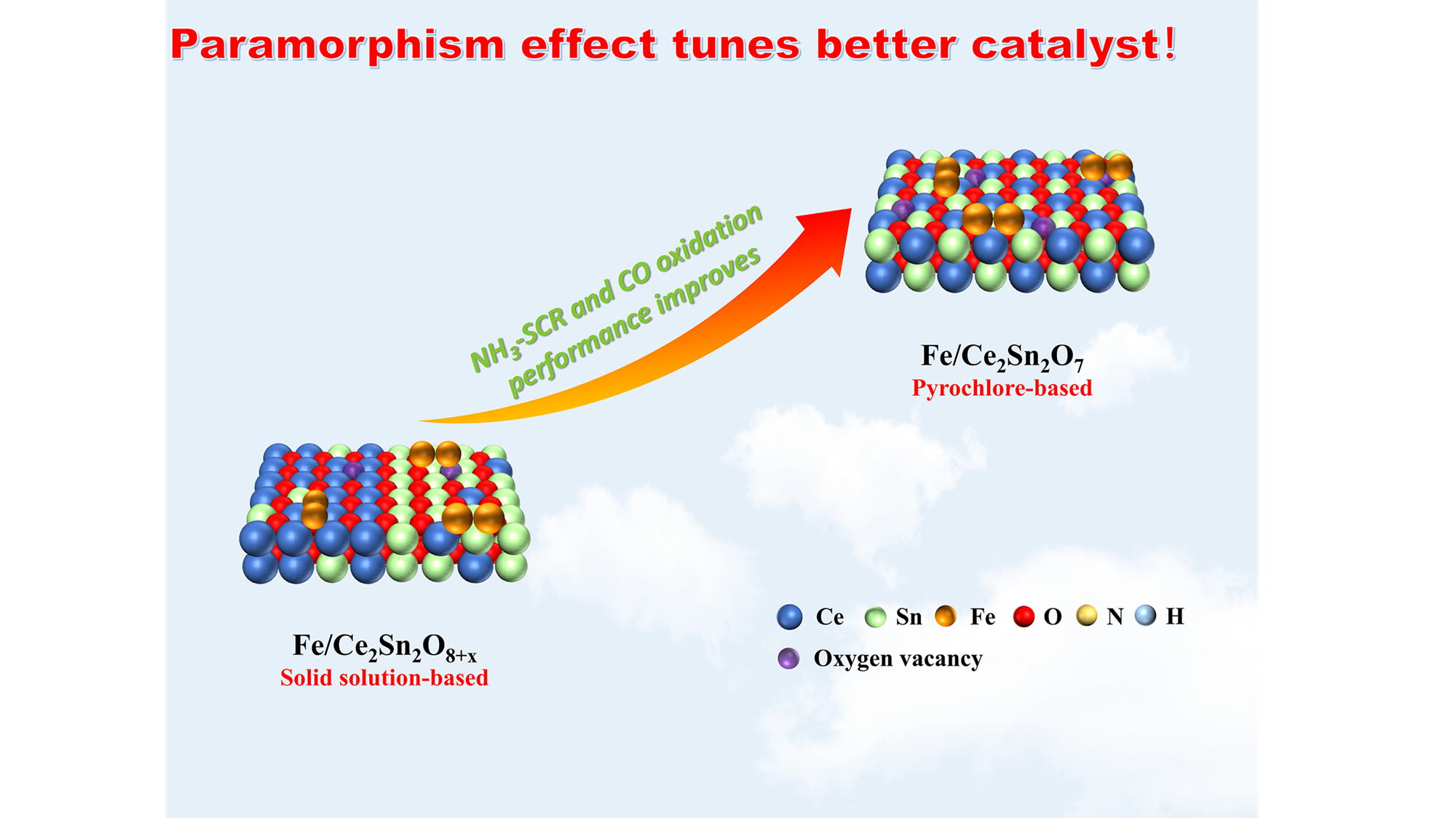
Synthesis of Ce2Sn2O7 pyrochlore and Ce2Sn2O8+x solid solution to support FeOx for simultaneous NH3-SCR and CO oxidation: Study on the paramorphism effect
Paramorphism effect could be an effective strategy to design efficient catalysts, but has been rarely explored. In this study, to achieve efficient catalysts for elimination of NO and CO together, Ce2Sn2O7 pyrochlore ...
More.Paramorphism effect could be an effective strategy to design efficient catalysts, but has been rarely explored. In this study, to achieve efficient catalysts for elimination of NO and CO together, Ce2Sn2O7 pyrochlore and Ce2Sn2O8+x solid solution paramorphs were purposely synthesized to support FeOx. It is found that Fe/Ce2Sn2O7 displays better reaction performance than Fe/Ce2Sn2O8+x. H2-TPR results have demonstrated that the dispersed FeOx has differed interaction with the two types of supports. Electron paramagnetic resonance (EPR) and density functional theory (DFT) calculation have testified that it is easier to generate surface vacancies on Fe/Ce2Sn2O7 than on Fe/Ce2Sn2O8+x, thus forming more abundant active oxygen sites. Furthermore, the total number of Lewis and Brønsted sites on Fe/Ce2Sn2O7 is larger. In addition, reactive NH4+ linked to Brønsted acidic sites and bridge nitrite are uniquely formed on Fe/Ce2Sn2O7, thus leading to its much better performance than on Fe/Ce2Sn2O8+x. Notably, Fe/Ce2Sn2O7 also exhibits better sulfur and water tolerance. On both catalysts, the NH3-selective catalytic reduction (NH3-SCR) reaction obeys a Langmuir-Hinshelwood pathway, while the CO oxidation follows a Mars-van Krevelen mechanism. In summary, a paramorphism effect is obviously observed, which could give people some new thoughts to design high-performance catalysts.
Less.Yufeng Yang, ... Xiang Wang
DOI:https://doi.org/10.70401/smd.2026.0033 - May 12, 2026
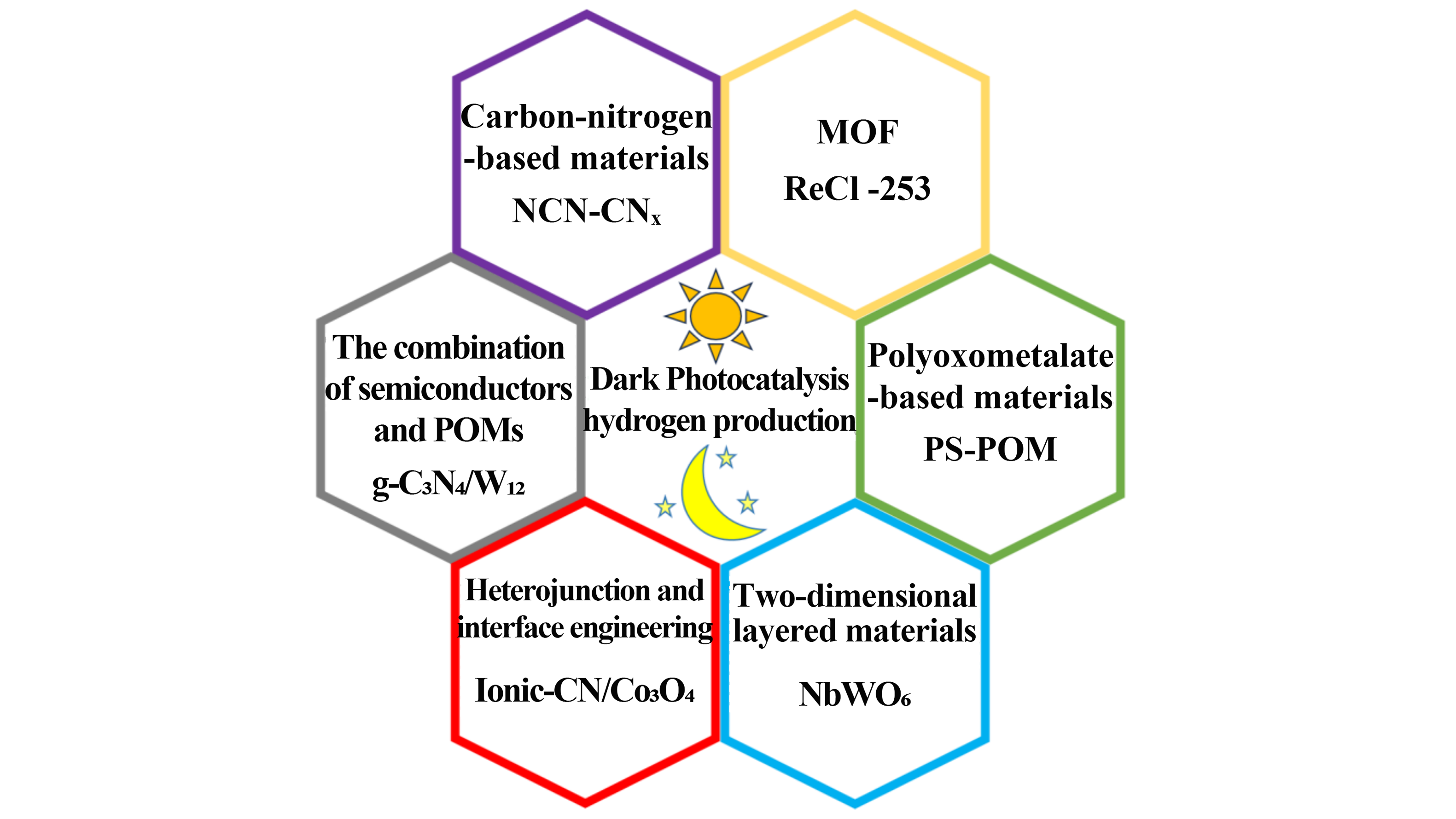
Recent developments in dark photocatalytic hydrogen production over smart catalysts
Widespread application of solar-driven hydrogen production is hampered by two major challenges: the safety risks associated with high-pressure H2 storage and transport, and the intermittent nature of solar energy. Inspired by the natural spatial ...
More.Widespread application of solar-driven hydrogen production is hampered by two major challenges: the safety risks associated with high-pressure H2 storage and transport, and the intermittent nature of solar energy. Inspired by the natural spatial and temporal separation of light and dark reactions in photosynthesis, the emerging strategy of dark photocatalysis aims to separate the collection and conversion of solar energy. In the past few years, encouraging progress has been made in the dark photocatalytic production of hydrogen. Therefore, we summarize the advances in this field over the past few years. This review first discusses various charge storage mechanisms in depth. Then, a comprehensive review of key material systems is conducted, covering carbon-nitrogen-based materials, metal–organic frameworks, polyoxometalate-based materials, two-dimensional layered materials, as well as heterojunction/interface engineering and the combination of semiconductors with polyoxometalates. Furthermore, the performance of photo-charging and dark hydrogen evolution is analyzed in detail. Finally, we look forward to the future development direction of this field. This review aims to offer valuable insights and guidance for the design of efficient and stable dark photocatalytic materials.
Less.Xiaoyu Dong, ... Yong Ding
DOI:https://doi.org/10.70401/smd.2026.0032 - April 22, 2026
A self-sensing friction damper with energy dissipation and sensing characteristics
Friction dampers dissipate seismic energy through sliding but lack self-sensing capability. This study integrates friction dampers with triboelectric nanogenerators (TENGs), which convert mechanical energy into electrical signals, creating a self-sensing ...
More.Friction dampers dissipate seismic energy through sliding but lack self-sensing capability. This study integrates friction dampers with triboelectric nanogenerators (TENGs), which convert mechanical energy into electrical signals, creating a self-sensing damper. Using friction pairs with large triboelectric differences, the system simultaneously achieves energy dissipation and sensing. During sliding, mechanical energy is partially converted into heat (dissipation) and electricity (sensing). Theoretical models link displacement and velocity to voltage and current, validated through cyclic loading tests varying velocity, displacement, and friction force. Results show stable energy dissipation (300-770 J/cycle) comparable to conventional dampers. Sensing performance is strong: voltage correlates linearly with displacement (0.00526 V/mm, R2 = 0.94), and current with velocity (0.01914 μA/(mm/s), R2 > 0.99). Unlike conventional TENGs, high friction alters triboelectric behavior via wear and heating, producing a unique voltage-velocity relationship. Scanning electron microscopy analysis confirms maximum wear at 34.2 kN, aligning with inflection points in electrical response. An empirical Q-V-f formula for high-friction conditions enriches triboelectric theory and guides damper design, emphasizing friction optimization for balanced dissipation and sensing stability.
Less.Ning Ma, ... Xufeng Dong
DOI:https://doi.org/10.70401/smd.2026.0031 - April 03, 2026