Atomic-level engineering thermal transport anisotropy in C24 monolayers for directional heat spreading

Qikun Tian
1,#

,
Ruyi Li
1,#
,
Hongkai Zhang
1
,
Enbo Zhang
1
,
Xiong Zheng
1
,
Huimin Wang
2
,
Zhenzhen Qin
3
,
Guangzhao Qin
1,4,5,*
*Correspondence to:
Guangzhao Qin, State Key Laboratory of Advanced Design and Manufacturing Technology for Vehicle, College of Mechanical and Vehicle Engineering, Hunan University, Changsha 410082, Hunan, China; Greater Bay Area Institute for Innovation, Hunan University, Guangzhou 511300, Guangdong, China; State Key Laboratory of Materials for Integrated Circuits, Shanghai Institute of Microsystem and Information Technology, Chinese Academy of Sciences, Shanghai 200050, China.
E-mail: gzqin@hnu.edu.cn
Thermo-X. 2027;3:202626. 10.70401/tx.2026.0032
Received: June 01, 2026Accepted: August 31, 2026Published: August 31, 2026
Abstract
Directional heat spreading enabled by intrinsic thermal conductivity (κ) anisotropy offers a promising route to address thermal bottlenecks in integrated circuits. Here, we demonstrate atomic-level engineering of anisotropic thermal transport in C24 monolayers through atomic spatial arrangement. Based on the high-accuracy neuroevolution potential (NEP)-empowered multiscale simulations, we systematically investigate the lattice thermal transport properties of quasi-tetragonal phase (qTP) and quasi-hexagonal phase (qHP) C24 monolayers with distinct atomic arrangements. The results show that qTP C24 exhibits relatively higher and nearly isotropic κ. In contrast, the qHP C24 displays pronounced in-plane κ anisotropy, with a room-temperature anisotropy ratio of κy/κx ≈ 1.7. In-depth phonon transport analysis shows that direction-dependent acoustic transport and the substantial participation of low-frequency optical modes are responsible for the intrinsic κ anisotropy. Furthermore, orbital-projected electronic structures reveal a distinct px and py orbital splitting in qHP C24, indicating anisotropic orbital hybridization, which fundamentally underlies its intrinsic κ anisotropy. Device-level finite-element simulations further confirm that atomic-spatial-arrangement induced anisotropic thermal transport enables directional heat spreading and thermal crosstalk regulation. The findings in this study establish atomic-level design as an external-field-free strategy for engineering anisotropic thermal transport.
Keywords
Thermal transport anisotropy, machine-learned potential, C24 monolayer, directional heat spreading
1. Introduction
The relentless miniaturization and increasing integration density of electronic devices are leading to continuously rising power densities, exacerbating challenges in thermal management[1-4]. Accordingly, tailoring thermal transport and improving heat-dissipation capability have become important design strategies for advanced thermal-management materials[5-9]. Consequently, materials exhibiting intrinsic anisotropic thermal conductivity (κ) have emerged as a focus of research, given their ability to conduct heat efficiently along one crystallographic direction while acting as a thermal insulator in the perpendicular direction[10,11]. This capability to directionally channel heat flow presents a viable approach to mitigating localized hotspots and enhancing the efficacy of thermal management systems in modern electronics. Although these applications are promising, significant gaps persist in the systematic understanding of thermal transport anisotropy and the underlying physical mechanisms. Concerted efforts to deepen the exploration of these materials and develop effective strategies for modulating their thermal properties are essential, as such advances could yield critical insights for tackling thermal management challenges in next-generation electronics.
Capitalizing on versatile bonding configurations, carbon materials give rise to diverse 2D allotropes. The successful exfoliation of graphene facilitated the first experimental investigation of thermal transport properties in strictly two-dimensional crystals[12]. Measurements revealed that its thermal conductivity exceeds the graphite bulk limit[13,14], sparking significant interest in both the thermal properties of graphene and heat conduction in low-dimensional carbon materials[15]. 2D polymeric fullerenes exhibit remarkable stability[16-18], suitable bandgaps, and abundant surface-active sites, endowing them with excellent electronic and optical properties[19-21]. These characteristics make them promising candidates for applications such as hydrogen storage[22-26] and photocatalytic water splitting[16,19,27,28]. However, a significant research gap exists in the exploration of anisotropic thermal conductivity in 2D carbon materials, primarily due to the historical focus on graphene, known for its isotropic heat transport. This gap is particularly critical given the urgent requirement for materials capable of directional heat dissipation in next-generation electronic devices.
Notably, the neuroevolution potential (NEP), a leading machine learning potential (MLP) developed by Fan et al.[29], is central to anisotropic thermal transport research. It merges the precision of first-principles methods with the speed of classical potentials, leading to its widespread application[30]. This capability enables the rational design of novel 2D carbon materials through atomic-level engineering, allowing for the accurate simulation and optimization of their thermal transport processes, thereby opening a new pathway for developing high-performance thermal management materials.
Atomic-scale manufacturing, a technology that enables precise manipulation and construction of material structures at the atomic level, has become a cornerstone of modern nanotechnology. The mainstream techniques for achieving atomic-scale precision control in thin-film fabrication are molecular beam epitaxy (MBE)[31], atomic layer deposition (ALD)[32], and chemical vapor deposition (CVD)[33]. Their fundamental distinctions arise from unique growth mechanisms. These atomic-scale manufacturing techniques have transcended the limitations of conventional methods, enabling the precise construction of materials at the atomic level. Despite the extreme technical complexity involved, they are driving revolutionary advancements in cutting-edge fields such as semiconductor chips, quantum computers, and high-efficiency energy devices. Recent studies have successfully synthesized multiple covalently bonded monolayer[21], few-layer[34,35] and quasi-tetragonal phase (qTP) and quasi-hexagonal phase (qHP) fullerene networks[21] in 2D systems. Among fullerene clusters, the C24 cage represents one of the smallest stable closed-cage clusters[27,36].
Previous studies have revealed distinctive structural and electronic characteristics of C24, including its electron-affinity behavior[37,38], and its pronounced curvature and low symmetry may favor anisotropic thermal transport. These unique properties open new possibilities for applications in quantum devices and directional thermal management systems. Notably, Li et al. recently investigated the elastic and thermal transport properties of qTP and qHP C24 monolayers using a NEP-based molecular dynamics framework[39], demonstrating nearly isotropic thermal transport in qTP C24 and pronounced in-plane anisotropy in qHP C24 and relating these behaviors primarily to their distinct bonding topologies, phonon group velocities, and mean free paths. Building on this foundation, several important aspects remain to be clarified. In particular, an independent first-principles validation of the thermal-transport trends, a more comprehensive understanding of the roles of phonon anharmonicity, mode localization, acoustic-optical coupling, and electronic orbital hybridization, and the translation of the intrinsic thermal anisotropy into device-level directional heat spreading have not yet been systematically established. Here, we address these issues by combining density functional theory-Boltzmann transport equation (DFT-BTE) and NEP-homogeneous nonequilibrium molecular dynamics (HNEMD) calculations, mode-resolved phonon and electronic-structure analyses, and finite-element device simulations, thereby establishing a multiscale relationship from atomic spatial arrangement to directional thermal-management performance.
In this study, we systematically explore the thermal transport behaviors of the qTP C24 and qHP C24 monolayers by integrating high-accuracy NEP with first-principles calculations. The research focuses on key parameters such as atomic structural features, phonon dispersion relations, lattice thermal conductivity, and spectral thermal conductivity distribution, elucidating the modulation mechanisms of different atomic arrangements on phonon group velocities, relaxation times, and scattering processes. Through detailed phonon transport analysis and mechanical property characterization, the intrinsic relationship between crystalline structural differences and anisotropic thermal conductivity is revealed. Furthermore, orbital-projected electronic structures and electron localization functions are examined to clarify the relationship between orbital hybridization and phonon transport. Finally, finite-element simulations are performed to assess the device-level heat-spreading capability of C24 monolayers. This combined atomistic-to-device investigation provides a comprehensive understanding of how atomic spatial arrangement governs intrinsic thermal anisotropy and offers guidance for designing carbon-based materials for directional thermal management.
2. Methods
2.1 First-principles calculations
The first-principles calculations were carried out employing density functional theory (DFT) as implemented in the Vienna ab initio Simulation Package (VASP)[40,41]. The PBEsol[42] under the generalized gradient approximation (GGA)[43] framework was utilized to describe exchange-correlation interactions, combined with the projector augmented-wave (PAW) method[44]. An energy cutoff of 800 eV was set for the plane-wave basis set. Geometry optimizations were performed until the total energy difference between consecutive steps fell below 10-6 eV in total energy and the maximum residual force on any atom was less than 10-2 eV Å-1. For Brillouin-zone integrations, Γ-centered k-point grids of 5 × 5 × 1 and 3 × 5 × 1 were employed for the structural relaxation and electronic structure calculations of the qTP and qHP C24 monolayers, respectively. Phonon thermal transport properties were assessed by solving the phonon Boltzmann transport equation with the Phonopy package[45] and ShengBTE code[46]. Both second- and third-order interatomic force constants (IFCs) were derived via supercell calculations, where the adopted 2 × 2 × 1 cells correspond to 96-atom and 192-atom configurations for the qTP and qHP C24 monolayer structures, respectively. Comprehensive convergence tests were conducted for both nearest neighbor interactions and Q-grid mesh to guarantee the reliability of the predicted lattice thermal conductivity values. Based on the convergence results shown in Figure S2, the interatomic interactions up to the eighth nearest neighbor and a 27 × 27 × 1 Q-grid were ultimately selected for subsequent calculations. To further characterize the chemical-bonding interactions, crystal orbital Hamilton population (COHP) and integrated crystal orbital Hamilton population (ICOHP) analyses were performed using the Local Orbital Basis Suite Towards Electronic-Structure Reconstruction (LOBSTER) code[47,48].
The effective thickness was defined as the vertical distance between the outermost carbon atoms plus twice the van der Waals radius of carbon, following a commonly adopted treatment for buckled two-dimensional materials[49,50]. This definition gives effective thicknesses of approximately 0.6 nm for qTP C24 and 0.8 nm for qHP C24. The same thicknesses were consistently employed throughout the DFT-BTE, NEP-HNEMD, and finite element method (FEM) calculations. Therefore, the thermal-conductivity anisotropy and the comparison between different calculation methods remain unaffected.
2.2 Machine-learned potential
For the accurate characterization of interatomic interactions, the state-of-the-art NEP methodology was adopted in our work[29,51-53]. This framework, which falls into the category of MLP, is constructed based on a standalone neural network (NN) and trained using the separable natural evolution strategy (SNES) optimization algorithm[54]. In this approach, the local potential energy associated with a specific atom i is formulated as a functional mapping of a descriptor vector comprising Ndes elements, denoted as
In this expression, ω(0), ω(1), b(0), and b(1) correspond to the weight matrices and bias vectors that are iteratively refined during model training.
The primary dataset was constructed through ab initio molecular-dynamics (AIMD) simulations and structural distortions of crystalline unit cells. For every carbon allotropic form, AIMD runs were carried out in the canonical ensemble (NVT), implementing a linear temperature ramp from 100 K to 1,000 K across a 200-ps simulation span. Configurations were extracted at 1 ps intervals, producing 200 snapshots per phase. Each system was further augmented with 200 structurally perturbed configurations, generated by imposing randomized lattice deformations (5% magnitude) and atomic displacements (0.1 Å), culminating in a combined dataset of 800 configurations for both qTP and qHP C24 monolayers. A test subset comprising 100 configurations (50 from AIMD and 50 from perturbed structures) was randomly drawn for each allotrope, leaving the remaining 600 configurations for training the NEP potential. The radial and angular cutoff radii were set to 7 and 4 Å, respectively, while 10 radial and 8 angular descriptor basis functions were employed to represent the local atomic environments. The feedforward neural network contained a single hidden layer with 30 neurons. The complete set of NEP training hyperparameters is provided in Table S2.
The evaluation of anisotropic lattice thermal conductivities for qTP and qHP C24 monolayers was conducted using the highly efficient HNEMD methodology. This approach introduces a minimal external perturbative force Fe to drive the system out of thermal equilibrium, thus allowing for the calculation of the thermal conductivity based on[55]:
where t is the simulation time, V denotes the simulation box volume, T is the system temperature (300 K), and
The finite-temperature phonon dispersions and linewidths were extracted from the spectral energy density (SED) obtained by projecting the atomic velocity trajectories into reciprocal space and Fourier transforming them in time, where the SED peak positions and linewidths characterize the phonon frequencies and spectral broadening, respectively[56,57].
2.3 FEM simulations
Finite-element simulations were carried out using the Heat Transfer in Solids module in COMSOL Multiphysics 6.4. A three-dimensional steady-state thermal model was constructed to evaluate the heat-spreading performance of qTP and qHP C24 monolayers at the device level. The model consists of a substrate with dimensions of 100 μm × 100 μm × 10 μm, a central silicon processor core with dimensions of 26 μm × 30 μm × 2 μm, and six silicon memory blocks with dimensions of 10 μm × 10 μm × 2 μm. The silicon regions were placed on the top surface of the substrate. The C24 monolayers were modeled using the thin-layer approximation as thermal-spreading coatings on the top surfaces of the silicon core and memory blocks. Notably, the C24 thin layer was assumed to be in ideal thermal contact with the underlying silicon surface, and no interfacial thermal resistance was introduced. This ideal-contact approximation was adopted to isolate the influence of the intrinsic in-plane thermal conductivity and thermal anisotropy of the C24 monolayers on device-level heat spreading. Consistent with the DFT-BTE and NEP-HNEMD calculations, an effective thickness of 0.6 nm was adopted for the isotropic qTP C24 monolayer, and the in-plane thermal conductivity was set to kx = ky = 234 W m-1 K-1. For the anisotropic qHP C24 monolayer, an effective thickness of 0.8 nm was adopted, with kx = 130 W m-1 K-1 and ky = 216 W m-1 K-1. These thermal conductivity values were obtained from NEP-based molecular dynamics calculations. A heat rate of 1 mW was applied to the processor core, while the memory regions were assigned a heat-rate setting of 0.1 mW. The bottom surface of the substrate was fixed at 293.15 K, and the remaining outer boundaries were treated as thermally insulated. Three steady-state studies were performed: the first without the C24 monolayer, the second with the qTP C24 monolayer, and the third with the qHP C24 monolayer. The temperature distribution was solved using a swept mesh with quadratic temperature elements. The temperature profile was extracted along the central line across the device, while the average temperatures of the processor core and memory blocks were monitored using domain-averaged temperature probes.
3. Results and Discussion
Both the qTP and qHP C24 monolayers crystallize in orthorhombic lattices, as shown in Figure 1a, with the optimized lattice parameters listed in Table S1. The qTP phase exhibits nearly square in-plane symmetry with a = b = 6.105 Å, whereas the qHP phase has strongly unequal lattice constants of a = 11.479 Å and b = 6.178 Å, consistent with previous results[27]. In qTP C24, periodically arranged molecular units are connected by three non-coplanar intercluster bonds, forming a relatively balanced two-dimensional covalent network analogous to C60-derived carbon frameworks. By contrast, qHP C24 features a quasi-one-dimensional chain-like topology: C24 units are strongly connected along the b-direction by three non-coplanar bonds, while adjacent chains are coupled along the a-direction through weaker diagonal single bonds. This spatially asymmetric bonding arrangement may give rise to thermal anisotropy of qHP C24.
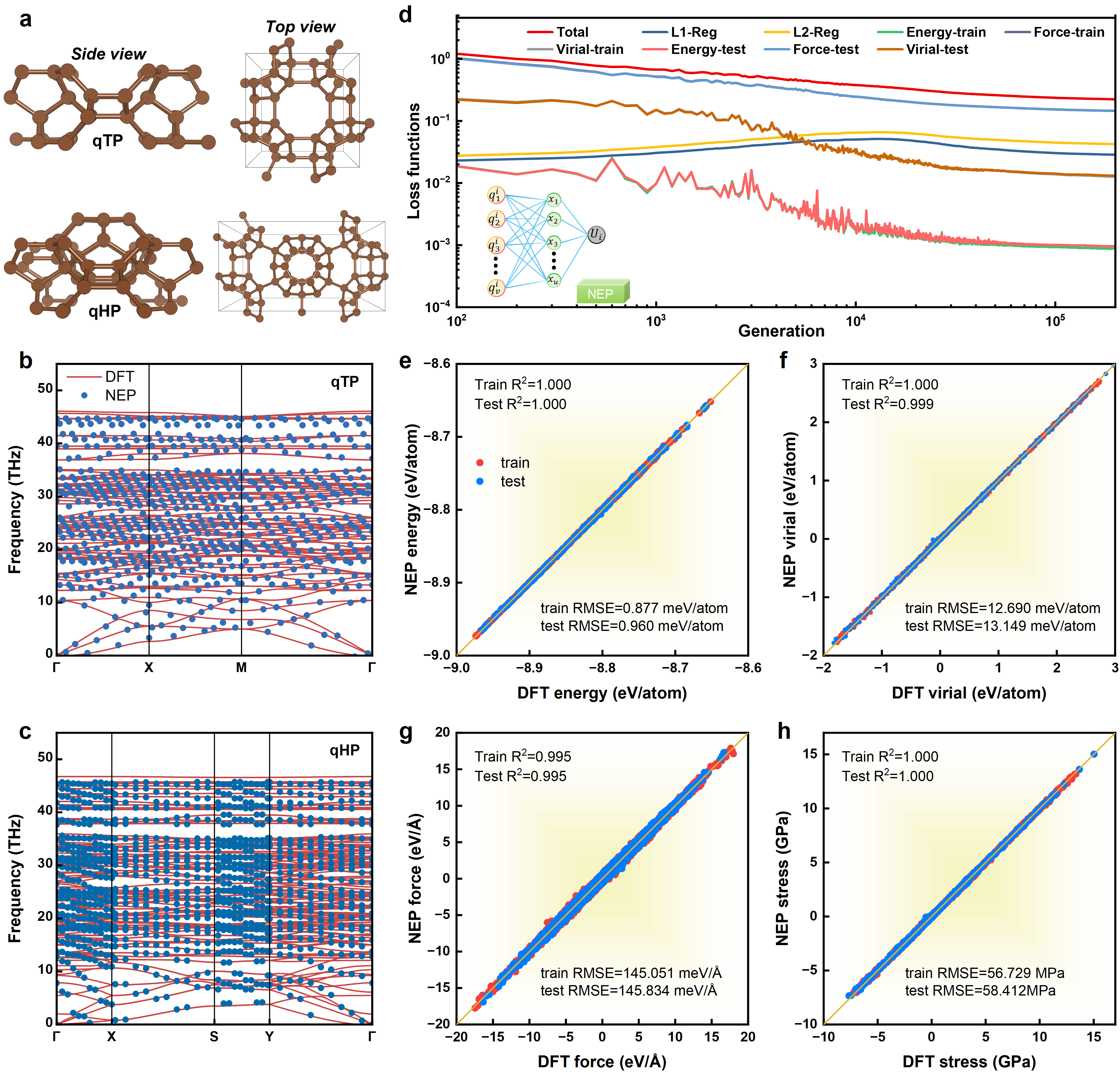
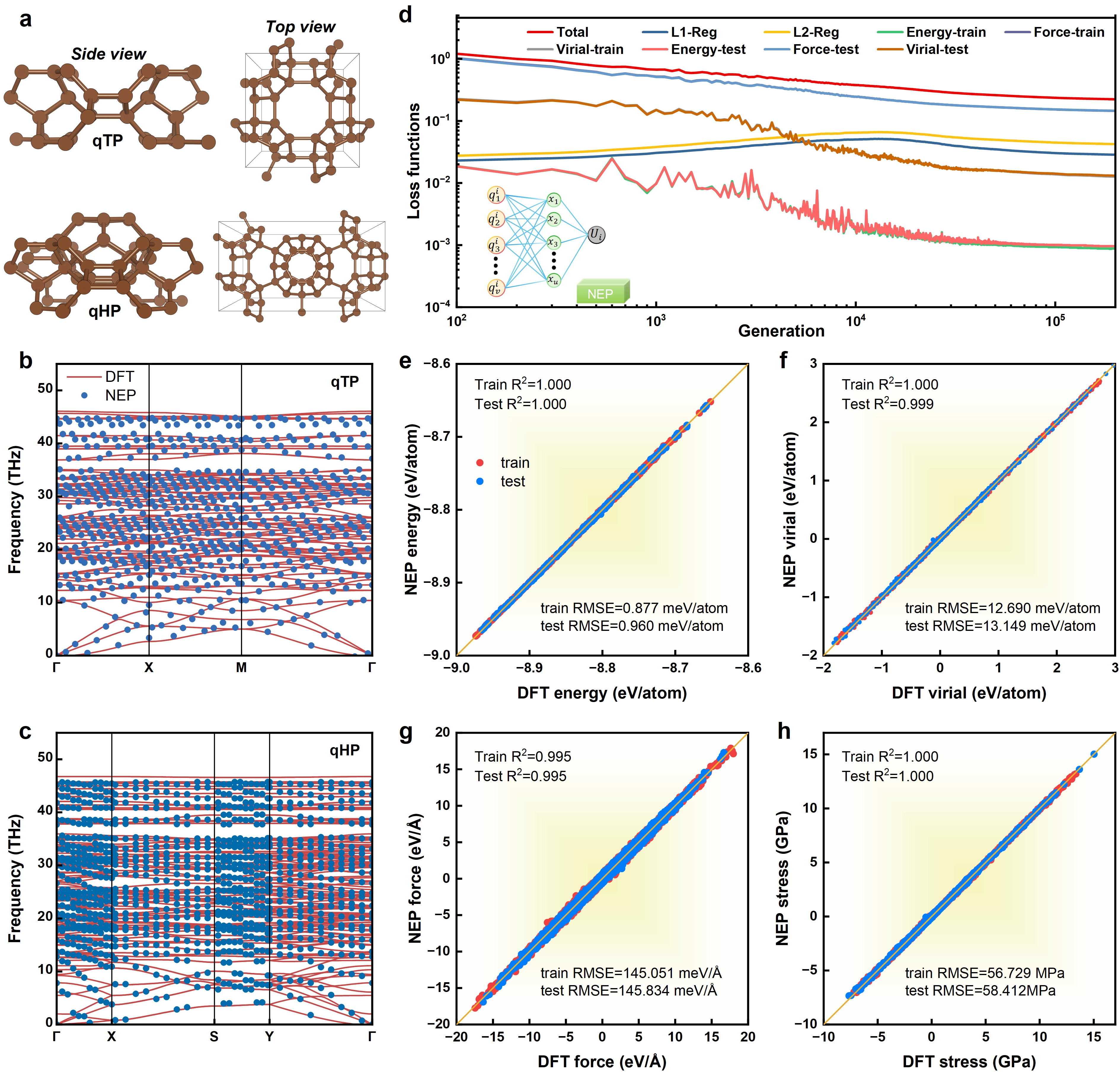
Figure 1. The crystal structures, NEP model validation, and lattice-dynamical properties of qTP and qHP C24 monolayers. (a) Side and top views of the optimized atomic structures of qTP and qHP C24 monolayers; (b,c) Phonon dispersion relations of (b) qTP and (c) qHP C24 monolayers calculated using the NEP potential, compared with DFT benchmark results; (d) Evolution of the total loss function and individual loss components during NEP training, including energy, force, virial, and regularization terms; (e-h) Parity plots comparing NEP-predicted and DFT-calculated (e) energy; (f) virial; (g) force; (h) stress for the training and testing datasets. qTP: quasi-tetragonal; qHP: quasi-hexagonal; NEP: neuroevolution potentials; DFT: density functional theory.
Then, a NEP model was developed for the qTP and qHP C24 monolayers to enable reliable large-scale atomistic simulations. The dynamical stability of the two monolayers was first examined through phonon dispersion calculations. As shown in Figure 1b,c, no imaginary phonon modes appear throughout the investigated Brillouin-zone paths, confirming the dynamical stability of both qTP and qHP C24. The thermal stability was further assessed by AIMD simulations at 300, 500, and 700 K, as presented in Figure S1. The total energy fluctuations remain bounded without any apparent structural reconstruction or bond breaking throughout the simulations, indicating that both qTP and qHP C24 monolayers maintain good thermal stability up to 700 K. These results collectively demonstrate that both C24 phases are dynamically and thermally stable under ambient conditions.
The training behavior of the developed NEP model is shown in Figure 1d, where the total loss and the individual energy, force, virial, and stress losses decrease steadily and approach convergence after 105 generations, indicating stable and balanced model training. The trained NEP was then benchmarked against DFT reference data, as shown in Figure 1e,f,g,h. The test-set RMSEs are 0.960 meV/atom for energy, 13.149 meV/atom for virial, 145.834 meV/Å for force, and 58.412 MPa for stress, closely matching the corresponding training errors of 0.877 meV/atom, 12.690 meV/atom, 145.051 meV/Å, and 56.729 MPa. Together with the nearly ideal parity correlations, these results demonstrate that the NEP model achieves high accuracy without evident overfitting and possesses strong generalization capability for unseen configurations. Moreover, the NEP-calculated phonon spectra closely reproduce the DFT benchmarks over the entire frequency range, further validating the ability of the NEP model.
Notably, the phonon dispersion shows that the acoustic branches display relatively steep slopes in qTP C24, particularly along the Γ-X direction, implying large phonon group velocities and efficient phonon propagation. By contrast, qHP C24 exhibits a more pronounced directional dependence in its acoustic phonon dispersion. The acoustic branches along the Γ-Y direction are evidently steeper than those along Γ-X, indicating higher phonon group velocities along the y-direction. Since the lattice thermal conductivity is strongly governed by phonon group velocity, this anisotropic dispersion suggests more efficient heat transport along y- than along x-direction in qHP C24.
To quantitatively evaluate the in-plane thermal transport properties of qTP and qHP C24 monolayers, their lattice thermal conductivities were calculated using the trained NEP potential combined with the HNEMD method, with DFT-BTE calculations performed for comparison. To ensure statistical reliability, four independent HNEMD simulations were carried out for each crystallographic direction at 300 K, as shown in Figure 2a,b, and the final thermal conductivities were obtained by averaging the converged values. For the DFT-BTE calculations, convergence tests with respect to the nearest-neighbor cutoff and Q-grid density were carefully performed, as shown in Figure S2.
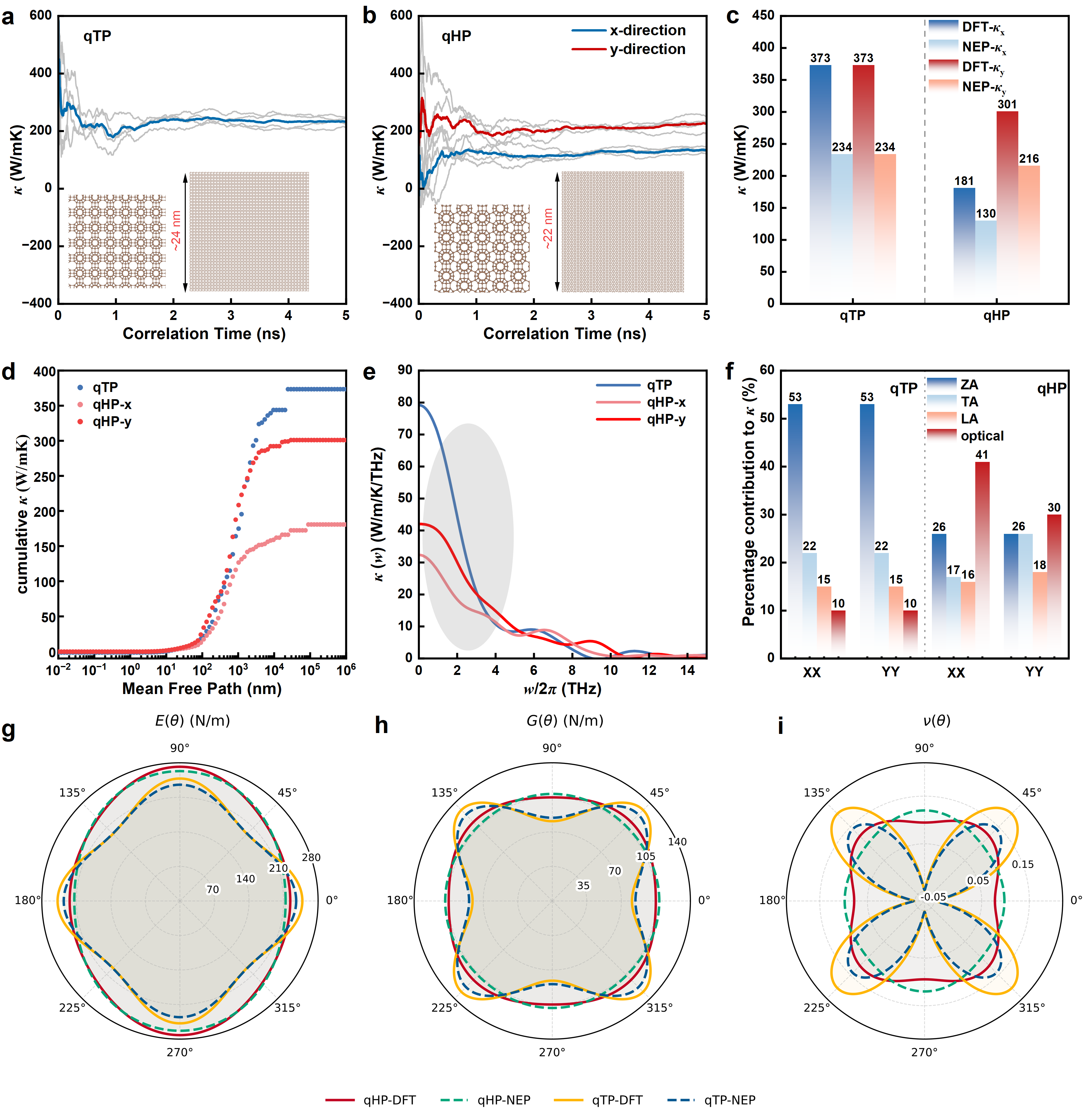
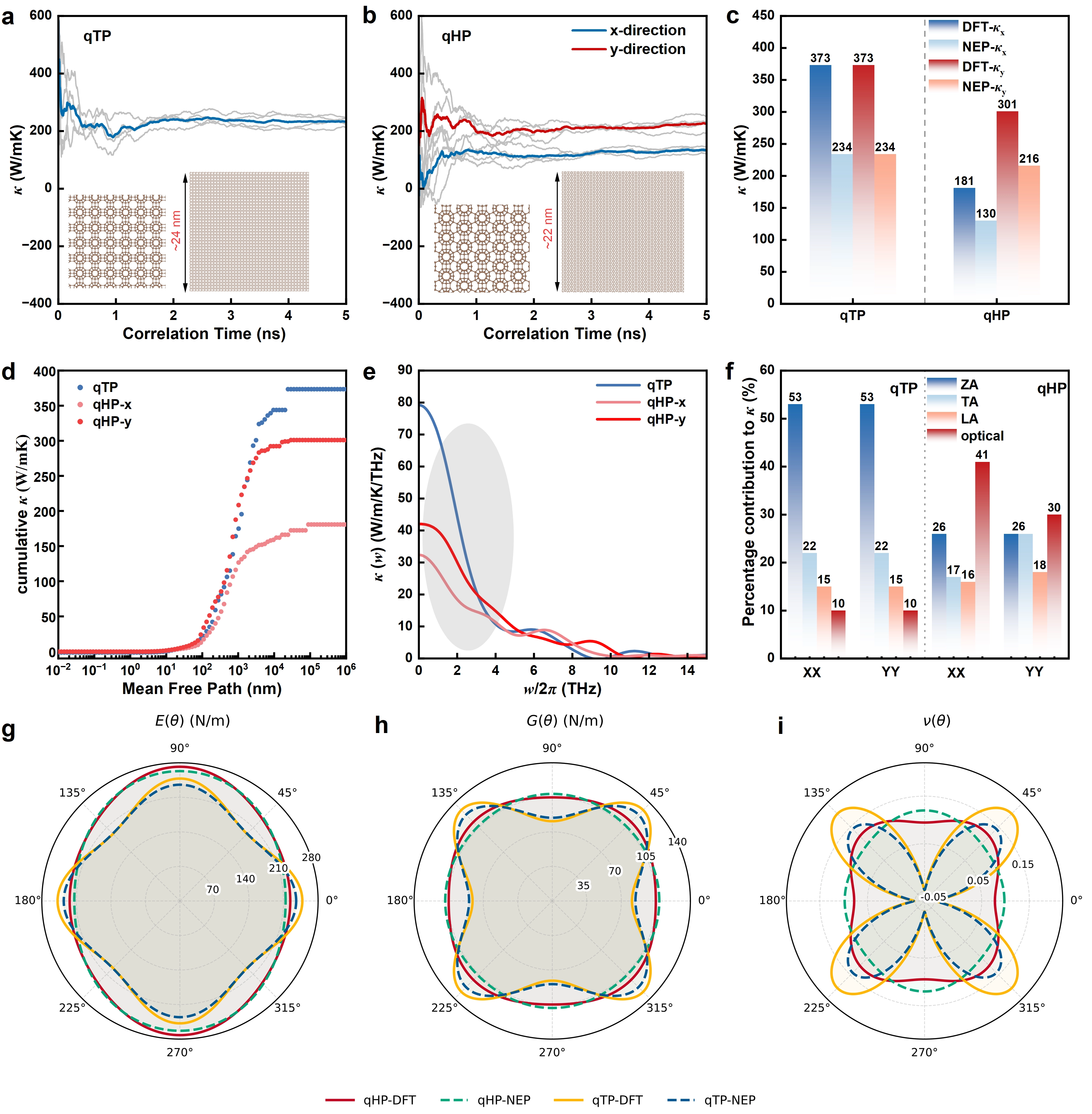
Figure 2. The anisotropy analysis of the thermal transport properties and the elastic properties of qTP and qHP C24 monolayers. The time-dependent thermal conductivity of (a) qTP and (b) qHP C24 monolayers in x- and y-directions at 300 K, calculated using the HNEMD method with the NEP potential; (c) Comparison of converged thermal conductivities obtained from DFT calculations and the NEP model; (d) Cumulative lattice thermal conductivity with respect to the phonon MFP; (e) Spectral thermal conductivity versus vibrational frequency of qTP and qHP C24 monolayers; (f) The percentage contribution to κ from different branches including the acoustic phonon branches (ZA, TA, LA) and optical phonon branches; Orientation-dependent (g) Young’s modulus E(θ); (h) Shear modulus G(θ); (i) Poisson’s ratio ν(θ) of monolayer qHP and qTP C24 from DFT and NEP calculations, where the dashed lines represent NEP results and the solid lines represent DFT results. DFT: density functional theory; NEP: neuroevolution potentials; qTP: quasi-tetragonal; qHP: quasi-hexagonal; HNEMD: homogeneous nonequilibrium molecular dynamics; MFP: phonon mean free path; ZA: out-of-plane acoustic; TA: transverse acoustic; LA: longitudinal acoustic.
After establishing the computational reliability of the NEP-HNEMD and DFT-BTE approaches, the obtained thermal conductivities were further compared to clarify the intrinsic differences in heat transport between qTP and qHP C24 monolayers, as summarized in Figure 2c. The qTP C24 monolayer exhibits nearly identical thermal conductivities along the x- and y-directions, with DFT-BTE and NEP-HNEMD values of 373 and 234 W m-1 K-1, respectively, indicating essentially isotropic in-plane heat transport. In contrast, qHP C24 displays a lower overall thermal conductivity and a pronounced in-plane anisotropy. The DFT-BTE calculations yield κx = 181 W m-1 K-1 and κy = 301 W m-1 K-1, while the corresponding NEP-HNEMD values are κx = 130 W m-1 K-1 and κy = 216 W m-1 K-1. Both methods give a consistent anisotropy ratio of κy/κx ≈ 1.7, demonstrating preferential thermal transport along the y-direction. This directional preference agrees well with the steeper acoustic phonon dispersion along Γ-Y than along Γ-X, as discussed in Figure 1. By contrast, the nearly isotropic thermal transport in qTP C24 originates from its higher structural symmetry and more spatially uniform bonding network. It is worth noting that the NEP-HNEMD thermal conductivities of qTP and qHP C24 monolayers are systematically lower than those obtained from DFT-BTE calculations, with reductions ranging from approximately 28% to 37%. This difference should not be attributed to a single mechanism without a direct mode-resolved decomposition. Unlike conventional DFT-BTE calculations based primarily on three-phonon scattering, molecular dynamics samples the anharmonic potential-energy surface directly and therefore naturally incorporates higher-order anharmonic interactions. Previous MLP-MD studies have demonstrated that such higher-order phonon scattering can substantially reduce the thermal conductivity relative to three-phonon BTE predictions in strongly anharmonic or high-κ materials[58]. In addition, systematic investigations have shown that residual force errors in MLPs, including NEP, can introduce additional low-frequency phonon scattering and consequently lead to an underestimation of lattice thermal conductivity in materials such as Si, GaAs, graphene, PbTe, and BAs[59,60]. Therefore, the lower NEP-HNEMD values observed in qTP and qHP C24 are consistent with these established methodological effects. Despite the difference in absolute values, both approaches predict the same relative trends, namely isotropic thermal transport in qTP C24 and y-preferred anisotropic thermal transport in qHP C24. It should be noted that the NEP-HNEMD thermal conductivities obtained in this work differ from those reported by Li et al.[39]. Li et al. reported approximately 272 W m-1 K-1 for qTP C24 and 233 and 341 W m-1 K-1 for qHP C24 along the x- and y-directions, respectively, whereas the corresponding values in the present work are 234, 130, and 216 W m-1 K-1. Nevertheless, both studies consistently predict nearly isotropic heat transport in qTP C24 and preferential transport along the y-direction in qHP C24. The difference in absolute values can be partly attributed to the distinct first-principles reference descriptions used to construct the NEP models. Li et al. employed the Perdew−Burke−Ernzerhof functional (PBE)-based reference calculations, whereas the present work uses the Perdew−Burke−Ernzerhof functional revised for solids (PBEsol) reference data, consistent with the original first-principles characterization of the qTP and qHP C24 structures[27]. Since a machine-learning potential reproduces the potential-energy surface defined by its reference data, different exchange-correlation functionals can modify interatomic forces, phonon anharmonicity, and phonon lifetimes and consequently lead to appreciable differences in thermal conductivity. Such functional sensitivity has also been demonstrated in other two-dimensional materials. For example, PBE and PBEsol predict substantially different thermal conductivities for phosphorene[61], while exchange-correlation-dependent variations in phonon lifetimes and Grüneisen parameters have been reported for graphene[62]. In addition, Li et al. adopted effective thicknesses of 0.568 and 0.629 nm for qTP and qHP C24, respectively, compared with 0.6 and 0.8 nm used in our calculations, which were determined from the out-of-plane geometrical extent of each C24 monolayer, defined as the vertical distance between the outermost carbon atoms plus twice the van der Waals radius of carbon. Such a definition has been commonly adopted for other two-dimensional materials[49,50]. These methodological differences explain why independently trained NEP models can yield different absolute values while maintaining consistent thermal-transport trends.
Beyond the methodological comparison discussed above, qHP C24 was further compared with other anisotropic two-dimensional materials, as summarized in Table S3. Compared with the previously reported qHP C60 monolayer[30], qHP C24 exhibits a higher thermal conductivity in both crystallographic directions while maintaining a comparable anisotropy ratio (κy/κx ≈ 1.7 for qHP C24 and ≈1.3 for qHP C60). In comparison with black phosphorus[61], qHP C24 possesses thermal conductivities that are more than one order of magnitude higher while exhibiting a similarly pronounced in-plane anisotropic thermal transport. These results demonstrate that the C24 monolayer combines relatively high thermal conductivity with significant in-plane anisotropy, making it a promising candidate for directional thermal management applications.
To further elucidate the microscopic origin of the different thermal conductivities, the cumulative thermal conductivity as a function of phonon mean free path (MFP) and the frequency-resolved spectral thermal conductivity were analyzed, as shown in Figure 2d. For both qTP and qHP C24 monolayers, the cumulative thermal conductivity gradually approaches the saturated value as the phonon mean free path increases, where qTP C24 maintains the largest cumulative thermal conductivity over nearly the entire MFP range. For qHP C24, the cumulative contribution along the y-direction is consistently larger than that along the x-direction, further confirming its anisotropic thermal transport. The frequency-resolved spectral thermal conductivity κ(ω), shown in Figure 2e, provides further insight into the microscopic phonon transport mechanism. The dominant contribution to lattice thermal conductivity arises from phonons below approximately 10 THz, indicating that low-frequency phonons govern thermal transport in both phases. qTP C24 exhibits a larger spectral weight in the low-frequency region than qHP C24, consistent with its higher overall thermal conductivity. For qHP C24, the integrated spectral contribution along the y-direction is larger than that along the x-direction, again confirming the preferential thermal transport along the y-direction.
Because the total thermal conductivity is determined by the collective contribution of different phonon modes, the branch-resolved thermal conductivity was further examined to identify the dominant heat carriers in qTP and qHP C24 monolayers, as presented in Figure 2f. For qTP C24, the x- and y-directions show almost identical modal distributions, with acoustic phonons dominating the thermal conductivity and optical phonons contributing only about 10%. In contrast, qHP C24 exhibits pronounced direction-dependent modal contributions. Optical phonons contribute as much as 41% to κx and 30% to κy, indicating that optical modes become important heat carriers and play a key role in shaping the anisotropic thermal transport of qHP C24. The enhanced optical contribution in qHP C24 can be attributed to its complex molecular framework and anisotropic bonding topology, which induce strong acoustic-optical phonon hybridization in the low-frequency region, as evidenced by the phonon dispersion. Such hybridization allows low-lying optical modes to acquire appreciable group velocities and participate effectively in thermal transport. Therefore, the thermal anisotropy of qHP C24 arises from the interplay between direction-dependent optical-phonon participation and anisotropic acoustic phonon transport. This behavior differs from conventional crystals, where thermal transport is usually governed almost exclusively by acoustic phonons, and highlights the important role of low-frequency optical modes in complex carbon monolayers.
Since phonon transport is closely related to lattice stiffness and bonding characteristics, the elastic properties of qTP and qHP C24 monolayers were further investigated. The mechanical behaviors of fullerene-based carbon networks have attracted increasing attention, with previous studies revealing anisotropic fracture characteristics in monolayer fullerene networks[63] and interfacial friction behaviors in fullerene-network/graphene systems[64]. These studies highlight the critical role of network topology and bonding configurations in determining mechanical responses and provide a broader mechanical context for understanding the stiffness and bonding characteristics of C24 monolayers. The four independent elastic constants obtained from NEP and DFT calculations, together with previously reported values[39], are listed in Table S4. For qTP C24, the constants C11, C22, C12, and C66 are 248.6, 248.6, -11.9, and 80.8 N/m from DFT, which closely match the NEP values of 236.1, 236.1, -11.1, and 84.3 N/m. For qHP C24, the DFT (NEP) values of C11, C22, C12, and C66 are 225.2 (216.7), 274 (266.2), 21.3 (26.0), and 105.0 (108.5) N/m, respectively. The good agreement between the present results and literature data confirms the reliability of our calculations, while the consistency between NEP and DFT further validates the capability of the constructed NEP model to describe the elastic response of both phases. Based on these elastic constants, the orientation-dependent Young’s modulus E(θ), shear modulus G(θ), and Poisson’s ratio ν(θ) were calculated using established analytical expressions[65,66], as shown in Figure 2g,h,i. qHP C24 exhibits clear elastic anisotropy, with E(θ) increasing from the x-direction toward the y-direction. This behavior is consistent with its bonding topology: compared with the relatively weak diagonal interchain single bonds along the x-direction, the three non-coplanar bonds along the y-direction provide stronger mechanical connectivity. In contrast, owing to the structural symmetry and balanced bonding network of qTP C24, its in-plane elastic response is essentially isotropic.
To further clarify the microscopic origin of the thermal transport trends observed in Figure 2, we analyzed the phonon group velocity, participation ratio, relaxation time, Grüneisen parameter, three-phonon scattering phase space, and spectral energy density (SED), as summarized in Figure 3. Figure 3a,b show the frequency-dependent phonon group velocities. In qTP C24, large phonon group velocities are mainly concentrated in the low-frequency region, which is also the dominant frequency window for lattice thermal transport. For qHP C24, a clear directional difference is observed: phonons propagating along the y-direction possess higher phonon group velocities than those along the x-direction, particularly below approximately 10 THz. This feature directly supports the thermal conductivity results in Figure 2, where qHP C24 exhibits κy > κx. Therefore, the directional thermal transport in qHP C24 is strongly governed by anisotropic phonon group velocities, which originate from its chain-like bonding framework and stronger connectivity along the y-direction.
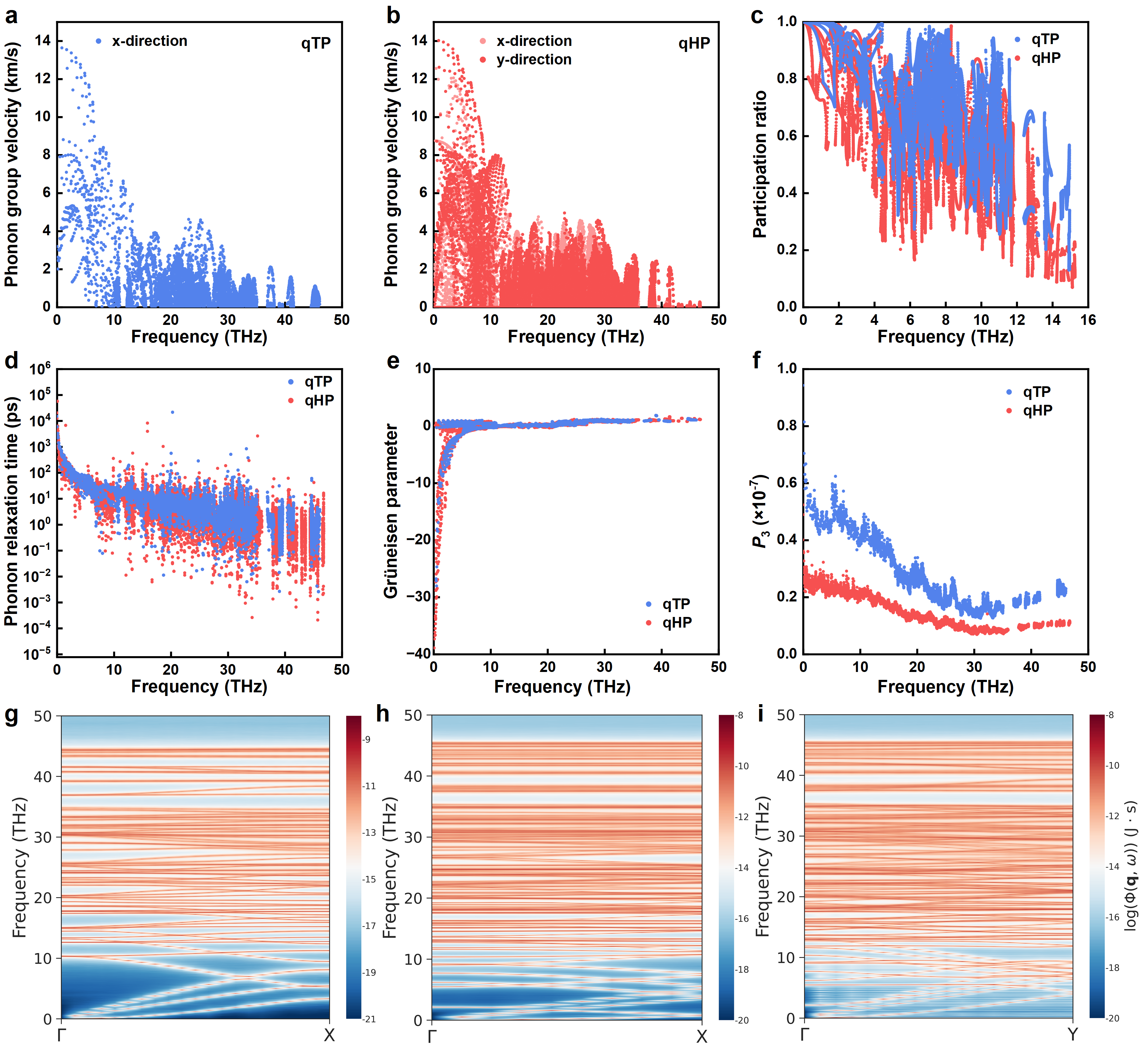
Figure 3. The phonon transport mechanism underlying the thermal conductivity difference and anisotropy of C24 monolayers. The phonon group velocity as a function of frequency for (a) qTP C24 monolayer along the x direction and (b) qHP C24 monolayer along the x and y directions at 300 K; (c) Frequency-dependent phonon participation ratio of qTP and qHP C24 monolayers; The comparison of (d) phonon relaxation time; (e) Grüneisen parameter; (f) phonon scattering phase space as a function of frequency. SED of (g) qTP C24 along Γ-X; (h) qHP C24 along Γ-X; (i) qHP C24 along Γ-Y at 300 K. The color scale denotes the logarithmic magnitude of the spectral energy density for each phonon mode. qTP: quasi-tetragonal; qHP: quasi-hexagonal; SED: spectral energy density.
However, solely by phonon group velocity analysis, the difference in the thermal conductivity anisotropy between qTP and qHP C24 cannot be explained. Although qHP C24 along the y-direction contains phonons with relatively high group velocities, its thermal conductivity remains lower than that of qTP C24. This indicates that phonon scattering and lifetime play a decisive role in determining the overall magnitude of κ.
As shown in Figure 3c, qTP C24 generally exhibits higher participation ratios than qHP C24 in the low- and intermediate-frequency regions, indicating more delocalized phonon modes. In contrast, the reduced participation ratios in qHP C24 suggest stronger phonon localization, which is associated with its lower structural symmetry and anisotropic molecular arrangement. Such localized vibrational modes are less effective in transporting heat and are more susceptible to scattering, thereby suppressing the lattice thermal conductivity of qHP C24. Moreover, the phonon relaxation time distribution in Figure 3d shows that qTP C24 possesses overall longer phonon relaxation times than qHP C24, indicating weaker phonon scattering and more persistent phonon propagation in qTP C24. Since lattice thermal conductivity is positively correlated with phonon relaxation time, the longer-lived phonons in qTP C24 contribute substantially to its higher κ. The origin of this phonon relaxation time difference can be further understood from the Grüneisen parameter and scattering phase space. As shown in Figure 3e, qHP C24 exhibits much larger absolute Grüneisen parameters, especially in the low-frequency region, indicating stronger intrinsic anharmonicity and enhanced phonon-phonon interactions. By contrast, qTP C24 shows smaller Grüneisen parameters over most of the frequency range, implying weaker anharmonic scattering. Strong anharmonicity has also been shown to play a critical role in regulating phonon transport and thermoelectric performance in low-dimensional materials[67]. Interestingly, Figure 3f shows that qTP C24 possesses a larger three-phonon scattering phase space than qHP C24. This result indicates a competition between the number of allowed scattering channels and the scattering strength of each channel. In qTP C24, although more scattering channels are available, the weaker anharmonicity reduces the effective scattering strength, leading to longer phonon relaxation time and higher thermal conductivity. In qHP C24, the smaller scattering phase space is outweighed by much stronger anharmonicity and stronger phonon localization, resulting in shorter phonon relaxation time and lower κ.
To further identify which optical modes are responsible for the unusually large optical contribution in qHP C24, the mode- and frequency-resolved thermal conductivities were further decomposed, as shown in Figure S3. For qTP C24, acoustic, low-frequency optical, and mid-to-high-frequency optical modes contribute 90.2%, 7.8%, and 2.0% of the total κ, respectively. In contrast, the corresponding contributions are 59.5%, 38.4%, and 2.1% for qHP C24 along the x-direction and 69.3%, 29.0%, and 1.7% along the y-direction. Therefore, the enhanced optical contribution in qHP C24 originates almost entirely from low-frequency optical modes below approximately 10 THz, whereas the mid-to-high-frequency optical branches make only a minor contribution. These low-lying optical branches overlap spectrally with the dominant acoustic heat-carrying modes and exhibit pronounced acoustic-optical hybridization, which allows some optical modes to acquire appreciable dispersive character and participate effectively in heat transport[68]. Notably, the larger relative optical contribution along the x-direction does not imply a larger total κx; instead, it reflects the stronger suppression of the acoustic channel along x due to the weaker interchain connectivity. Along the y-direction, the stronger bonding connectivity produces larger acoustic phonon group velocities and a larger acoustic contribution, resulting in κy > κx. Moreover, although the participation-ratio analysis indicates stronger overall phonon localization in qHP C24, localization and optical-mode transport represent competing effects rather than mutually exclusive behaviors. Stronger localization suppresses the overall thermal conductivity of qHP C24, whereas a subset of numerous low-frequency optical modes can still acquire finite group velocities and lifetimes through acoustic-optical hybridization and collectively contribute substantially to κ. Similar large contributions from low-frequency optical phonons have previously been reported in 2H-MoS2 and monolayer Ga2O3[69,70]. These results demonstrate that the anisotropic thermal transport of qHP C24 arises from the combined effects of direction-dependent acoustic transport, low-frequency acoustic-optical hybridization, and phonon localization.
The SED maps in Figure 3g,h,i further verify the phonon transport mechanism. The phonon branches extracted from the SED spectra agree well with the harmonic phonon dispersions, confirming the reliability of the calculated lattice dynamics. For qTP C24, the low-frequency acoustic branches along Γ-X exhibit relatively steep slopes and narrow linewidths, indicating large phonon group velocities, weak scattering, and long phonon lifetimes, which contribute to its high thermal conductivity. In qHP C24, the Γ-Y direction shows steeper acoustic branches and narrower spectral linewidths than Γ-X, suggesting faster phonon propagation and weaker scattering along the y-direction. This directional difference is consistent with the higher κy than κx in qHP C24. In addition, the dense low-frequency optical branches and their interaction with acoustic modes in qHP C24 further reveal acoustic-optical phonon coupling, which modifies the phonon scattering channels and contributes to its anisotropic thermal transport. Therefore, the SED results demonstrate that the anisotropic heat transport in qHP C24 originates from the combined effects of direction-dependent phonon group velocity and scattering strength.
Notably, the electronic structure properties are closely correlated with the physical properties of materials[71-74]. To elucidate the electronic origin of the distinct in-plane thermal-transport behavior of qTP and qHP C24 monolayers, the orbital-projected electronic band structures, projected density of states (pDOS), and electron localization function (ELF) distributions were calculated, as shown in Figure 4. Both qTP and qHP C24 exhibit semiconducting characteristics, with band gaps of 2.02 and 1.67 eV, respectively. For qTP C24, the valence band maximum (VBM) and conduction band minimum (CBM) are mainly located around the M point, indicating a nearly direct band-gap feature. In contrast, qHP C24 possesses a smaller band gap, with both the VBM and CBM primarily appearing near the Γ point. The reduced band gap of qHP C24 suggests stronger orbital hybridization and a more pronounced anisotropic electronic response compared with qTP C24.
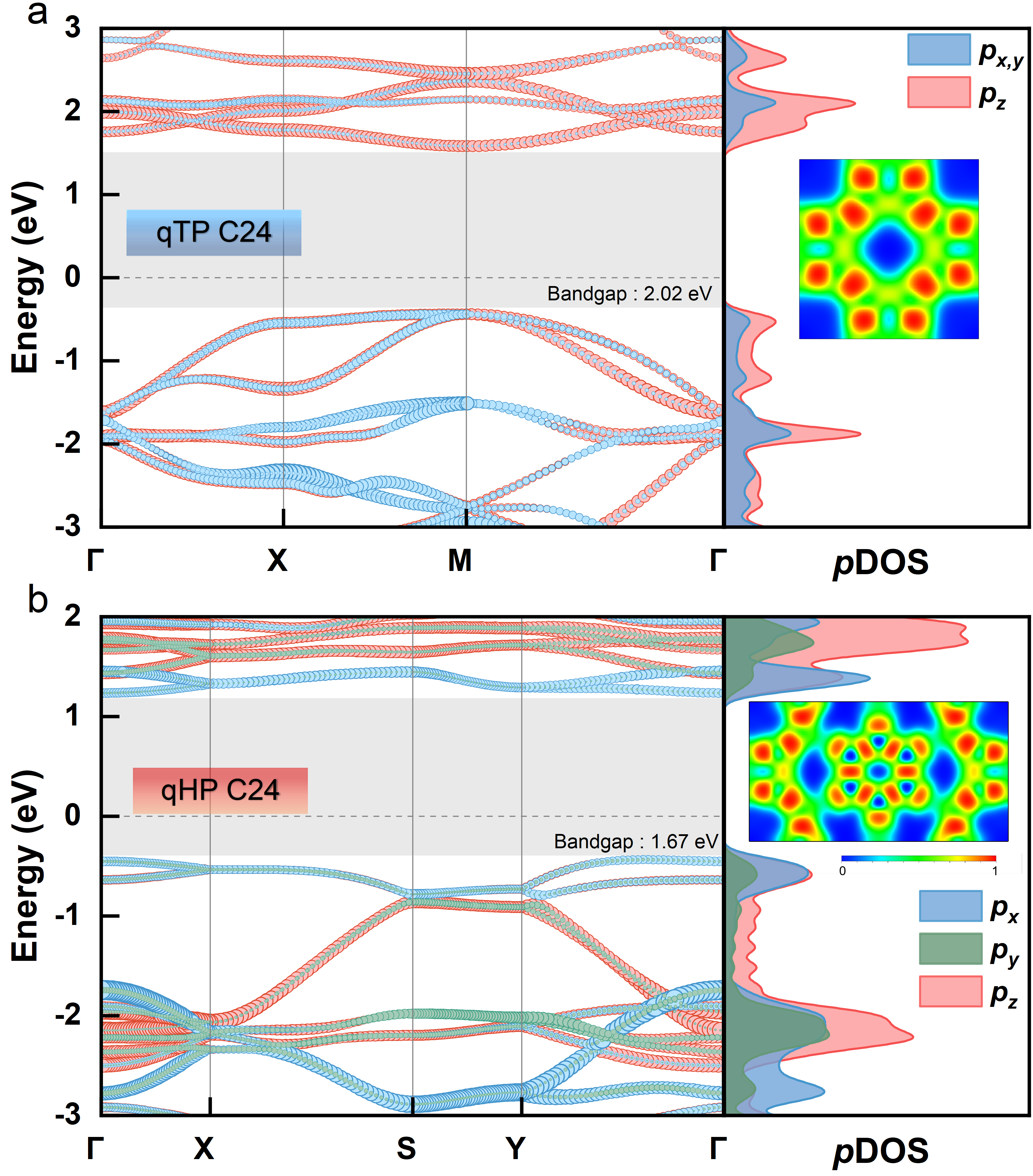
Figure 4. Orbital-projected band structures and pDOS of (a) qTP and (b) qHP C24 monolayers. The inset shows the ELF viewed from the top for qTP and qHP C24 monolayers. qTP: quasi-tetragonal; qHP: quasi-hexagonal; pDOS: partial density of states; ELF: electron localization function.
For qTP C24, the px and py orbitals are nearly degenerate and therefore presented as px,y, reflecting the high in-plane structural symmetry of this phase. Around the VBM, the electronic states are mainly contributed by C-px,y and C-pz orbitals, while the CBM also shows mixed px,y/pz orbital character. The pDOS further confirms the comparable contribution of the in-plane px and py orbitals, suggesting that the electronic states along different in-plane directions are nearly equivalent. Consistently, the ELF map displays a highly symmetric and spatially uniform electron localization pattern around the carbon framework. Such symmetric orbital hybridization and electron localization indicate nearly equivalent C-C bonding strengths and bond stiffnesses along different in-plane crystallographic directions, which is responsible for the relatively isotropic phonon transport and thermal conductivity of qTP C24. In contrast, qHP C24 shows a clear separation among the px, py, and pz orbital contributions. The orbital-projected band structure reveals that the VBM near the Γ point is dominated by strongly hybridized C-px, C-py, and C-pz states, whereas the CBM also contains evident pz contribution together with unequal in-plane px and py components. The pDOS shows that the px and py states are no longer degenerate and contribute differently over a wide energy range, demonstrating the inequivalence of electronic states along different in-plane directions. Moreover, unlike the highly symmetric ELF pattern of qTP C24, qHP C24 exhibits an elongated and spatially nonuniform electron localization feature, implying direction-dependent C-C bonding characteristics. This anisotropic electronic localization leads to different bond strengths along different crystallographic directions. Therefore, from the electronic-structure perspective, the intrinsic thermal anisotropy of qHP C24 originates from its reduced lattice symmetry, inequivalent px/py orbital contributions, and direction-dependent pz-related orbital hybridization. In contrast, the nearly degenerate px/py orbitals and symmetric electron localization in qTP C24 produce a more uniform bonding network, thereby explaining its weakly anisotropic or nearly isotropic thermal-transport behavior.
To quantitatively examine how the orbital anisotropy is reflected in the C-C bonding network, COHP and ICOHP analyses were further performed, as shown in Figure S4. Because of the complex fullerene-based bonding topology, representative inter-cage C-C bonds along different crystallographic directions were selected for comparison. In qTP C24, the ICOHP values of the x-short and y-short bonds are -7.886 and -7.881 eV, respectively, while those of the x-long and y-long bonds are -6.860 and -6.864 eV. The nearly identical values of the corresponding x- and y-direction bonds quantitatively confirm an approximately isotropic bonding environment, consistent with the nearly degenerate (px/py) orbitals, symmetric ELF distribution, elastic constants, and isotropic thermal transport. In contrast, qHP C24 exhibits markedly inequivalent bonding configurations, with ICOHP values of -7.548, -9.024, -7.909, and -6.457 eV for the representative x-short, x-diagonal, y-short, and y-long bonds, respectively. This broad distribution demonstrates that the (px/py) orbital inequivalence is translated into a heterogeneous and direction-dependent C-C bonding network. Since the macroscopic stiffness is collectively determined by bond strength, orientation, connectivity, and network topology, rather than by a single bond, this bonding heterogeneity is consistent with the larger C22 relative to C11 and the higher low-frequency phonon group velocities along the y-direction. Together, these results establish a consistent microscopic relationship from anisotropic orbital hybridization and bonding topology to elastic anisotropy, direction-dependent phonon propagation, and ultimately the observed thermal-conductivity anisotropy.
To evaluate the chip-level thermal management potential of C24 monolayers, steady-state simulations based on the finite-element method (FEM) were performed using a simplified processor-memory device model, as shown in Figure 5a. The model consists of a central processor core region surrounded by six memory blocks on a substrate, where the C24 monolayer was applied as an ultrathin thermal-spreading coating on the top surfaces of the heat-generating silicon regions. Three cases were considered: the device without a C24 monolayer, the device coated with an isotropic qTP C24 monolayer, and the device coated with an anisotropic qHP C24 monolayer. The temperature profiles extracted along the central line, shown in Figure 5b, indicate that both C24 coatings effectively suppress the temperature rise in the processor core region and neighboring memory blocks. Without the C24 monolayer, the processor core region exhibits the highest temperature, with an average temperature of 120.46 °C, while the average temperature of the memory blocks reaches 95.72 °C. After introducing the isotropic qTP C24 monolayer, these values decrease to 112.70 °C and 92.17 °C, respectively. The anisotropic qHP C24 monolayer further reduces the average temperatures to 112.39 °C for the processor core region and 91.19 °C for the memory blocks. Compared with the bare device, the isotropic qTP C24 monolayer lowers the average temperatures of the processor core region and memory blocks by 7.76 and 3.55 °C, respectively, whereas the anisotropic qHP C24 monolayer achieves slightly larger reductions of 8.07 and 4.53 °C.
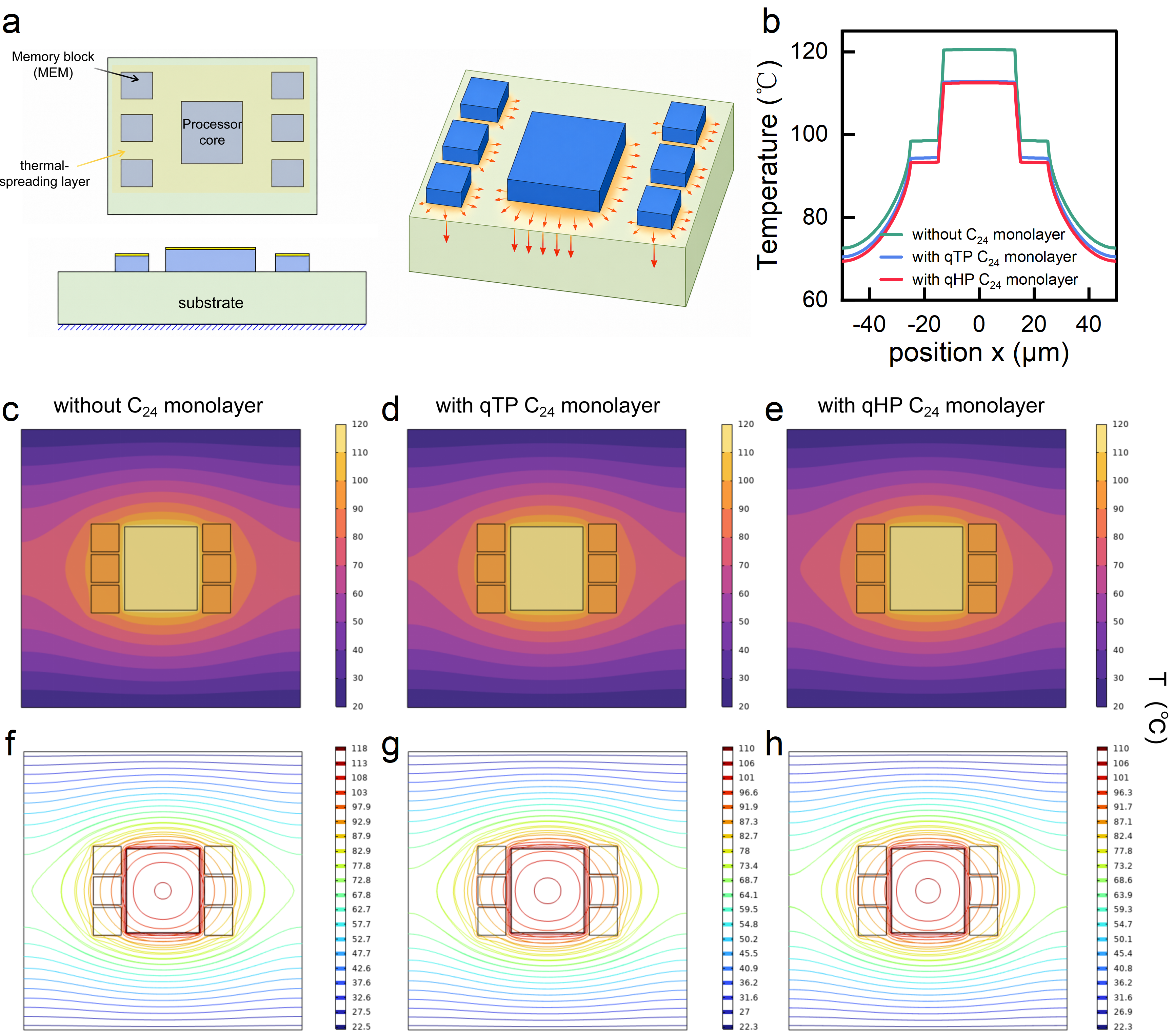
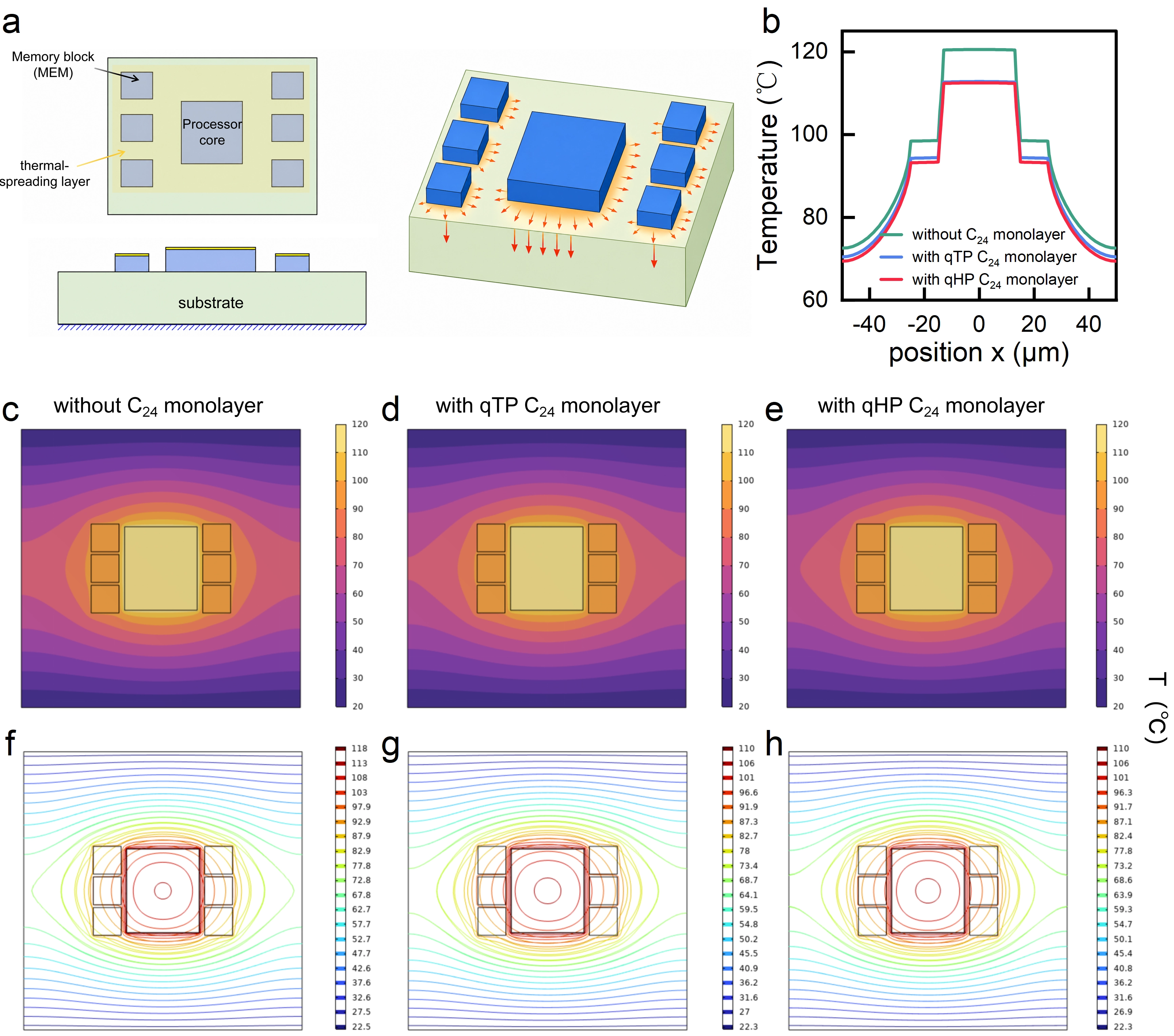
Figure 5. Device-level finite-element simulations of heat dissipation regulated by C24 monolayer thermal-spreading coatings. (a) Schematic of the processor-memory device model, where a thermal-spreading layer is coated on the top surfaces of the heat-generating silicon regions; (b) Temperature profiles along the central x-direction for devices without a C24 monolayer, with isotropic qTP C24, and with anisotropic qHP C24; (c-e) Surface temperature distributions for (c) the bare device; (d) the qTP C24-coated device; (e) the qHP C24-coated device; (f-h) Corresponding isothermal contour plots. qTP: quasi-tetragonal; qHP: quasi-hexagonal.
The temperature maps in Figure 5c,d,e and the corresponding isothermal contour plots in Figure 5f,g,h further confirm the heat-spreading effect of the C24 monolayers. In the absence of a thermal-spreading coating, heat is strongly localized around the processor core region, resulting in a broader high-temperature region. In contrast, both the isotropic qTP C24 and anisotropic qHP C24 coatings redistribute heat more effectively over the chip surface and alleviate thermal accumulation near the heat source. Although the qTP C24 monolayer exhibits isotropic and higher in-plane thermal conductivity, the qHP C24 monolayer provides an additional degree of freedom for directional heat-flow regulation owing to its anisotropic thermal transport, which enables directional heat spreading and more effective regulation of thermal crosstalk. The slightly lower average temperatures obtained with the qHP C24 monolayer suggest that, when the high-thermal-conductivity direction is aligned with the dominant heat-spreading pathway, anisotropic heat transport can be advantageous for hotspot mitigation and thermal crosstalk suppression in integrated electronic devices.
Before closing, it should be noted that the present FEM simulations assume ideal thermal contact between the C24 monolayer and the underlying silicon regions and therefore represent an idealized assessment of its heat-spreading capability. In experimentally integrated two-dimensional material/substrate systems, finite thermal boundary resistance is generally present. For example, room-temperature thermal boundary conductances of approximately 50 MW m-2 K-1 for graphene/SiO2 and approximately 25 MW m-2 K-1 for Au/Ti/graphene/SiO2 interfaces have been experimentally reported[75,76], and interfacial thermal conductance has been shown to affect hotspot temperatures in graphene-based electronic devices[77]. For a practical C24-coated device, such an interfacial resistance would restrict heat transfer from the silicon regions into the C24 spreading layer and consequently reduce the predicted temperature decrease relative to the ideal-contact case. The actual magnitude of this effect would depend on the interfacial bonding, conformity, cleanliness, and fabrication process.
From a practical perspective, although monolayer quasi-hexagonal polymeric C60 networks have been experimentally synthesized through an interlayer-bond-cleavage strategy[21], the qTP and qHP C24 monolayers considered here remain theoretically predicted structures[27], and their experimental synthesis and integration with device substrates have yet to be demonstrated. Moreover, integrating an atomically thin C24 network with a semiconductor device surface while preserving both its intrinsic structure and efficient interfacial heat transfer remains challenging. Experimental studies of other two-dimensional materials provide encouraging precedents: monolayer graphene can be transferred onto various target substrates[78]. Nevertheless, transfer-induced residues and interfacial contamination have been observed in graphene/substrate systems[79], illustrating the sensitivity of atomically thin materials to fabrication and interface quality. Practical implementation of C24 as a thermal-spreading coating would therefore require controlled synthesis or transfer processes that preserve the fullerene-cage network while achieving clean, conformal, and mechanically stable contact with the underlying device layer. Imperfect adhesion, interfacial contamination, or structural perturbation could increase the thermal boundary resistance and diminish the heat-spreading advantage predicted under idealized conditions. These issues represent important subjects for future experimental validation and C24/substrate interface engineering.
4. Conclusion
In summary, we have demonstrated that atomic-level structural design provides an effective route to engineering thermal anisotropy in C24 monolayers. By combining first-principles calculations, NEP, phonon transport analysis, electronic-structure characterization, and finite-element simulations, we systematically investigated the structural origin, microscopic mechanism, and device-level implication of heat conduction in qTP and qHP C24 monolayers. The two phases exhibit distinct in-plane thermal transport behaviors. qTP C24 possesses a nearly square lattice and a balanced covalent bonding network, resulting in nearly isotropic and high thermal conductivity. In contrast, qHP C24 features a chain-like bonding framework, where stronger non-coplanar bonds along the y-direction and weaker diagonal interchain bonds along the x-direction give rise to pronounced anisotropic thermal transport. Both DFT-BTE and NEP-HNEMD calculations consistently reveal preferential thermal transport along the y-direction in qHP C24, with an anisotropy ratio of approximately 1.7. Further phonon analysis shows that this anisotropy originates from direction-dependent phonon group velocities, scattering strengths, and acoustic-optical phonon coupling, whereas the lower overall thermal conductivity of qHP relative to qTP is mainly associated with stronger phonon localization, enhanced anharmonicity, and shorter phonon relaxation times. Electronic structure analyses further link the anisotropic thermal response to direction-dependent orbital hybridization and nonuniform electron localization in qHP C24. Finally, finite-element simulations demonstrate that C24 monolayers can serve as ultrathin thermal-spreading coatings for chip-level heat dissipation. In particular, anisotropic qHP C24 offers an additional degree of freedom for directing heat flow and suppressing thermal crosstalk, highlighting C24 monolayers as promising platforms for directional thermal management in next-generation high-power electronics.
More importantly, this work demonstrates that atomic-scale spatial arrangement regulation provides an intrinsic strategy for tailoring thermal transport without relying on external perturbations such as strain engineering or defect introduction. As a complementary approach to these conventional modulation strategies, atomic-scale structural regulation enables deterministic tuning of thermal conductivity anisotropy through intrinsic structural design, providing a general framework for the rational design of high-performance two-dimensional thermal management materials.
Supplementary materials
The supplementary material for this article is available at: Supplementary materials.
Acknowledgements
The numerical calculations in this paper have been done on the supercomputing system of the E.T. Cluster and the National Supercomputing Center in Changsha and Zhengzhou. The authors declare that ChatGPT (OpenAI) was used solely for language polishing during the manuscript preparation process. All scientific content, including study design, numerical calculations, data generation and analysis, figures and tables, interpretation of results, and conclusions, was independently conducted and prepared by the authors and was not generated using AI tools. The authors reviewed and approved the final manuscript and take full responsibility for its content.
This work is dedicated to the memory of Mr. Zhang Xuefeng, a 2003 alumnus majoring in water supply and drainage engineering at Zhengzhou University, in tribute to his sincere dedication to supporting and empowering young students.
Authors contribution
Tian Q, Li R: Investigation, writing-original draft, writing-review & editing.
Zhang H, Zhang E: Formal analysis, writing-review & editing.
Zheng X, Wang H, Qin Z: Writing-review & editing.
Qin G: Conceptualization, supervision, writing-review & editing.
Conflicts of interest
The authors declare no conflicts of interest.
Ethical approval
Not applicable.
Consent to participate
Not applicable.
Consent for publication
Not applicable.
Availability of data and materials
The data that support the findings of this study are available from the corresponding author upon reasonable request.
Funding
This work is supported by the Postgraduate Research and Innovation Project of Hunan Province (Grant No. CX20250532), the National Natural Science Foundation of China (Grant No. 52006057), the National Key R&D Program of China (Grant No. 2023YFB2408100), the Fundamental Research Funds for the Central Universities (Grant No. 531119200237), the Guangdong Basic and Applied Basic Research Foundation (Grant No. 2025A1515012237), the State Key Laboratory of Robotics and Systems at Harbin Institute of Technology (Grant No. SKLRS-2025-KF-10),the National Major Science and Technology Project of China (Grant No. 2025ZD0717301), the State Key Laboratory of Advanced Design and Manufacturing Technology for Vehicle (Grant No.72675007), the Open Research Fund of State Key Laboratory of Materials for Integrated Circuits (Grant No. SKLJC-K2026-04), and the Open Project of Shaanxi Key Laboratory of Gear Transmission (Grant No. SKLGT-2024-005).
Copyright
© The Author(s) 2026.
References
-
1. Cui Y, Li M, Hu Y. Emerging interface materials for electronics thermal management: Experiments, modeling, and new opportunities. J Mater Chem C. 2020;8(31):10568-10586.[DOI]
-
2. Pop E. Energy dissipation and transport in nanoscale devices. Nano Res. 2010;3(3):147-169.[DOI]
-
3. Tian Q, Yang Q, Huang A, Peng B, Zhang J, Zheng X, et al. Asymmetric electron distribution induced intrinsically strong anisotropy of thermal transport in bulk CrOCl. J Mater Chem A. 2025;13(41):35230-35241.[DOI]
-
4. Tian Q, Chen A, Qin H, Li R, Zhang Y, Jiang Y, et al. Atomic-level engineering anisotropic thermal transport for directional heat dissipation in silicon electronics. Mater Today Phys. 2026;62:102049.[DOI]
-
5. Qu YP, Wu HK, Xie PT, Zeng N, Chen YL, Gong X, et al. Carbon nanotube-carbon black/CaCu3Ti4O12 ternary metacomposites with tunable negative permittivity and thermal conductivity fabricated by spark plasma sintering. Rare Met. 2023;42(12):4201-4211.[DOI]
-
6. Niu HT, Zhang Y, Xiao G, He XH, Yao YG. Preparation of quasi-isotropic thermal conductive composites by interconnecting spherical alumina and 2D boron nitride flakes. Rare Met. 2023;42(4):1283-1293.[DOI]
-
7. Ren WJ, Lu S, Yu CQ, He J, Chen J. Carbon honeycomb structure with high axial thermal transport and strong robustness. Rare Met. 2023;42(8):2679-2687.[DOI]
-
8. Qian X, Guo HR, Lyu JX, Ding BF, San XY, Zhang X, et al. Enhancing thermoelectric performance of p-type SnTe through manipulating energy band structures and decreasing electronic thermal conductivity. Rare Met. 2024;43(7):3232-3241.[DOI]
-
9. Xie ZX, Zhang Y, Zhang LF, Fan DY. Effect of topological line defects on electron-derived thermal transport in zigzag graphene nanoribbons. Carbon. 2017;113:292-298.[DOI]
-
10. Chung DDL, Takizawa Y. Performance of isotropic and anisotropic heat spreaders. J Electron Mater. 2012;41(9):2580-2587.[DOI]
-
11. Kim SE, Mujid F, Rai A, Eriksson F, Suh J, Poddar P, et al. Extremely anisotropic van der Waals thermal conductors. Nature. 2021;597(7878):660-665.[DOI]
-
12. Novoselov KS, Geim AK, Morozov SV, Jiang D, Zhang Y, Dubonos SV, et al. Electric field effect in atomically thin carbon films. Science. 2004;306(5696):666-669.[DOI]
-
13. Balandin AA, Ghosh S, Bao W, Calizo I, Teweldebrhan D, Miao F, et al. Superior thermal conductivity of single-layer graphene. Nano Lett. 2008;8(3):902-907.[DOI]
-
14. Balandin AA, Ghosh S, Teweldebrhan D, Calizo I, Bao W, Miao F, et al. Extremely high thermal conductivity of graphene: Prospects for thermal management applications in silicon nanoelectronics. In: 2008 IEEE Silicon Nanoelectronics Workshop (SNW); 2008 Jun 15-16; Honolulu, USA. Piscataway: IEEE; 2008. p. 1-2.[DOI]
-
15. Xie ZX, Chen XK, Yu X, Zhang Y, Wang HB, Zhang LF. Reduction of phonon thermal conduction in isotopic graphene nanoribbon superlattices. Sci China Phys Mech Astron. 2017;60(10):107821.[DOI]
-
17. Peng B. Stability and strength of monolayer polymeric C60. Nano Lett. 2023;23(2):652-658.[DOI]
-
18. Ribeiro LA, Pereira ML, Giozza WF, Tromer RM, Galvão DS. Thermal stability and fracture patterns of a recently synthesized monolayer fullerene network: A reactive molecular dynamics study. Chem Phys Lett. 2022;807:140075.[DOI]
-
19. Tromer RM, Ribeiro LA, Galvão DS. A DFT study of the electronic, optical, and mechanical properties of a recently synthesized monolayer fullerene network. Chem Phys Lett. 2022;804:139925.[DOI]
-
21. Hou L, Cui X, Guan B, Wang S, Li R, Liu Y, et al. Synthesis of a monolayer fullerene network. Nature. 2022;606(7914):507-510.[DOI]
-
22. Durbin DJ, Allan NL, Malardier-Jugroot C. Molecular hydrogen storage in fullerenes-A dispersion-corrected density functional theory study. Int J Hydrogen Energy. 2016;41(30):13116-13130.[DOI]
-
25. Zhao Y, Kim YH, Dillon AC, Heben MJ, Zhang SB. Hydrogen storage in novel organometallic buckyballs. Phys Rev Lett. 2005;94(15):155504.[DOI]
-
26. Wang Q, Sun Q, Jena P, Kawazoe Y. Theoretical study of hydrogen storage in Ca-coated fullerenes. J Chem Theory Comput. 2009;5(2):374-379.[DOI]
-
29. Fan Z, Zeng Z, Zhang C, Wang Y, Song K, Dong H, et al. Neuroevolution machine learning potentials: Combining high accuracy and low cost in atomistic simulations and application to heat transport. Phys Rev B. 2021;104(10):104309.[DOI]
-
30. Dong H, Cao C, Ying P, Fan Z, Qian P, Su Y. Anisotropic and high thermal conductivity in monolayer quasi-hexagonal fullerene: A comparative study against bulk phase fullerene. Int J Heat Mass Transf. 2023;206:123943.[DOI]
-
31. Foxon CT. Three decades of molecular beam epitaxy. J Cryst Growth. 2003;251(1-4):1-8.[DOI]
-
32. Lim BS, Rahtu A, Gordon RG. Atomic layer deposition of transition metals. Nature Mater. 2003;2(11):749-754.[DOI]
-
34. Meirzadeh E, Evans AM, Rezaee M, Milich M, Dionne CJ, Darlington TP, et al. A few-layer covalent network of fullerenes. Nature. 2023;613(7942):71-76.[DOI]
-
36. Kroto HW. The stability of the fullerenes Cn, with n = 24, 28, 32, 36, 50, 60 and 70. Nature. 1987;329(6139):529-531.[DOI]
-
37. Chang YF, Zhang JP, Sun H, Hong B, An Z, Wang RS. Geometry and stability of fullerene cages: C24 to C70. Int J Quantum Chem. 2005;105(2):142-147.[DOI]
-
38. An W, Shao N, Bulusu S, Zeng XC. Ab initio calculation of carbon clusters. II. J Chem Phys. 2008;128(8):084301.[DOI]
-
39. Li Q, Dong H, Ying P, Fan Z. Anisotropic and isotropic elasticity and thermal transport in monolayer C24 networks from machine-learning molecular dynamics. Int J Heat Mass Transf. 2026;260:128505.[DOI]
-
40. Kresse G, Furthmüller J. Efficient iterative schemes for ab initio total-energy calculations using a plane-wave basis set. Phys Rev B. 1996;54(16):11169-11186.[DOI]
-
41. Kresse G, Joubert D. From ultrasoft pseudopotentials to the projector augmented-wave method. Phys Rev B. 1999;59(3):1758-1775.[DOI]
-
42. Perdew JP, Ruzsinszky A, Csonka GI, Vydrov OA, Scuseria GE, Constantin LA, et al. Restoring the density-gradient expansion for exchange in solids and surfaces. Phys Rev Lett. 2008;100(13):136406.[DOI]
-
43. Perdew JP, Burke K, Ernzerhof M. Generalized gradient approximation made simple. Phys Rev Lett. 1996;77(18):3865-3868.[DOI]
-
44. Blöchl PE. Projector augmented-wave method. Phys Rev B. 1994;50(24):17953-17979.[DOI]
-
45. Togo A, Tanaka I. First principles phonon calculations in materials science. Scr Mater. 2015;108:1-5.[DOI]
-
46. Li W, Carrete J, A Katcho N, Mingo N. ShengBTE: A solver of the Boltzmann transport equation for phonons. Comput Phys Commun. 2014;185(6):1747-1758.[DOI]
-
48. Maintz S, Deringer VL, Tchougréeff AL, Dronskowski R. LOBSTER: A tool to extract chemical bonding from plane-wave based DFT. J Comput Chem. 2016;37(11):1030-1035.[DOI]
-
49. Xu W, Zhang G, Li B. Thermal conductivity of penta-graphene from molecular dynamics study. J Chem Phys. 2015;143(15):154703.[DOI]
-
50. Liu G, Gao Z, Li GL, Wang H. Abnormally low thermal conductivity of 2D selenene: An ab initio study. J Appl Phys. 2020;127(6):065103.[DOI]
-
52. Fan Z, Wang Y, Ying P, Song K, Wang J, Wang Y, et al. GPUMD: A package for constructing accurate machine-learned potentials and performing highly efficient atomistic simulations. J Chem Phys. 2022;157(11):114801.[DOI]
-
53. Xu K, Bu H, Pan S, Lindgren E, Wu Y, Wang Y, et al. GPUMD 4.0: A high-performance molecular dynamics package for versatile materials simulations with machine-learned potentials. Mat Gen Eng Adv. 2025;3(3):e70028.[DOI]
-
54. Schaul T, Glasmachers T, Schmidhuber J. High dimensions and heavy tails for natural evolution strategies. In: Proceedings of the 13th annual conference on genetic and evolutionary computation; 2011 Jul 12-16; Dublin, Ireland. New York: Association for Computing Machinery; 2011. p. 845-852.[DOI]
-
55. Fan Z, Dong H, Harju A, Ala-Nissila T. Homogeneous nonequilibrium molecular dynamics method for heat transport and spectral decomposition with many-body potentials. Phys Rev B. 2019;99(6):064308.[DOI]
-
56. Thomas JA, Turney JE, Iutzi RM, Amon CH, McGaughey AJH. Predicting phonon dispersion relations and lifetimes from the spectral energy density. Phys Rev B. 2010;81(8):081411.[DOI]
-
57. Liang T, Jiang W, Xu K, Bu H, Fan Z, Ouyang W, et al. PYSED: A tool for extracting kinetic-energy-weighted phonon dispersion and lifetime from molecular dynamics simulations. J Appl Phys. 2025;138(7):075101.[DOI]
-
58. Ouyang Y, Yu C, He J, Jiang P, Ren W, Chen J. Accurate description of high-order phonon anharmonicity and lattice thermal conductivity from molecular dynamics simulations with machine learning potential. Phys Rev B. 2022;105(11):115202.[DOI]
-
59. Wu X, Zhou W, Dong H, Ying P, Wang Y, Song B, et al. Correcting force error-induced underestimation of lattice thermal conductivity in machine learning molecular dynamics. J Chem Phys. 2024;161:014103.[DOI]
-
60. Zhou W, Liang N, Wu X, Xiong S, Fan Z, Song B. Insight into the effect of force error on the thermal conductivity from machine-learned potentials. Mater Today Phys. 2025;50:101638.[DOI]
-
61. Zhang F, Zheng X, Wang H, Ding L, Qin G. Anisotropy of thermal transport in phosphorene: A comparative first-principles study using different exchange-correlation functionals. Mater Adv. 2022;3(12):5108-5117.[DOI]
-
62. Taheri A, Da Silva C, Amon CH. First-principles phonon thermal transport in graphene: Effects of exchange-correlation and type of pseudopotential. J Appl Phys. 2018;123(21):215105.[DOI]
-
63. Ying P, Dong H, Liang T, Fan Z, Zhong Z, Zhang J. Atomistic insights into the mechanical anisotropy and fragility of monolayer fullerene networks using quantum mechanical calculations and machine-learning molecular dynamics simulations. Extreme Mech Lett. 2023;58:101929.[DOI]
-
64. Ying P, Hod O, Urbakh M. Superlubric graphullerene. Nano Lett. 2024;24(34):10599-10604.[DOI]
-
65. Ying P, Li X, Qiang X, Du Y, Zhang J, Chen L, et al. Tension-induced phase transformation and anomalous Poisson effect in violet phosphorene. Mater Today Phys. 2022;27:100755.[DOI]
-
66. Jasiukiewicz C, Paszkiewicz T, Wolski S. Auxetic properties and anisotropy of elastic material constants of 2D crystalline media. Phys Status Solidi B. 2008;245(3):562-569.[DOI]
-
67. Jia PZ, Xie ZX, Deng YX, Zhang Y, Tang LM, Zhou WX, et al. High thermoelectric performance induced by strong anharmonic effects in monolayer (PbX)2 (X = S, Se, Te). Appl Phys Lett. 2022;121(4):043901.[DOI]
-
68. Wu L, Carrete J, Madsen GKH, Mingo N. Influence of the optical-acoustic phonon hybridization on phonon scattering and thermal conductivity. Phys Rev B. 2016;93(20):205203.[DOI]
-
69. Dong ZY, Zhou Y, Chen XQ, Li WJ, Cao ZY, Luo C, et al. Effect of low-frequency optical phonons on the thermal conductivity of 2H molybdenum disulfide. Phys Rev B. 2022;105(18):184301.[DOI]
-
70. Liu G, Zhang Z, Wang H, Li GL, Wang JS, Gao Z. Large contribution of quasi-acoustic shear phonon modes to thermal conductivity in novel monolayer Ga2O3. J Appl Phys. 2021;130(10):105106.[DOI]
-
71. Tian Q, Li P, Wei J, Xing Z, Qin G, Qin Z. Inverse Janus design of two-dimensional Rashba semiconductors. Phys Rev B. 2023;108(11):115130.[DOI]
-
72. Wei J, Tian Q, Xu X, Qin G, Zuo X, Qin Z. Two-dimensional Rashba semiconductors and inversion-asymmetric topological insulators in monolayer Janus MAA’ZxZ’(4-x) family. Appl Phys Lett. 2025;126(16):163104.[DOI]
-
73. Xing Z, Tian Q, Wei J, Wu H, Qin G, Qin Z. Rashba effect in 2D Janus group-III chalcogenides: Control via atomic-scale structural engineering. Appl Phys Lett. 2025;127(13):132402.[DOI]
-
75. Mak KF, Lui CH, Heinz TF. Measurement of the thermal conductance of the graphene/SiO2 interface. Appl Phys Lett. 2010;97(22):221904.[DOI]
-
76. Koh YK, Bae MH, Cahill DG, Pop E. Heat conduction across monolayer and few-layer graphenes. Nano Lett. 2010;10(11):4363-4368.[DOI]
-
77. Choi D, Poudel N, Cronin SB, Li S. Effects of basal-plane thermal conductivity and interface thermal conductance on the hot spot temperature in graphene electronic devices. Appl Phys Lett. 2017;110(7):073104.[DOI]
-
78. Suk JW, Kitt A, Magnuson CW, Hao Y, Ahmed S, An J, et al. Transfer of CVD-grown monolayer graphene onto arbitrary substrates. ACS Nano. 2011;5(9):6916-6924.[DOI]
-
79. Pirkle A, Chan J, Venugopal A, Hinojos D, Magnuson CW, McDonnell S, et al. The effect of chemical residues on the physical and electrical properties of chemical vapor deposited graphene transferred to SiO2. Appl Phys Lett. 2011;99(12):122108.[DOI]
Copyright
© The Author(s) 2027. This is an Open Access article licensed under a Creative Commons Attribution 4.0 International License (https://creativecommons.org/licenses/by/4.0/), which permits unrestricted use, sharing, adaptation, distribution and reproduction in any medium or format, for any purpose, even commercially, as long as you give appropriate credit to the original author(s) and the source, provide a link to the Creative Commons license, and indicate if changes were made.
Publisher’s Note
Science Exploration remains a neutral stance on jurisdictional claims in published
maps
and institutional affiliations. The views expressed in this article are solely those
of
the author(s) and do not reflect the opinions of the Editors or the publisher.
Share And Cite


Science Exploration Style
Tian Q, Li R, Zhang H, Zhang E, Zheng X, Wang H, et al. Atomic-level engineering thermal transport anisotropy in C24 monolayers for directional heat spreading. Thermo-X. 2027;3:202626. https://doi.org/10.70401/tx.2026.0032
Tips
Copy completed.
Submit a Manuscript
Author Instructions
Cite this Article
Article Metrics
0
View
0
Download
Cited
Article Updates

 Get citation
Science Exploration Style

Tian Q, Li R, Zhang H, Zhang E, Zheng X, Wang H, et al. Atomic-level engineering thermal transport anisotropy in C24 monolayers for directional heat spreading. Thermo-X. 2027;3:202626. https://doi.org/10.70401/tx.2026.0032
copy
Share Link
copy