Table of Contents
Multimodal thermal control: Architectural design of synergistic heat transfer for sustainable energy
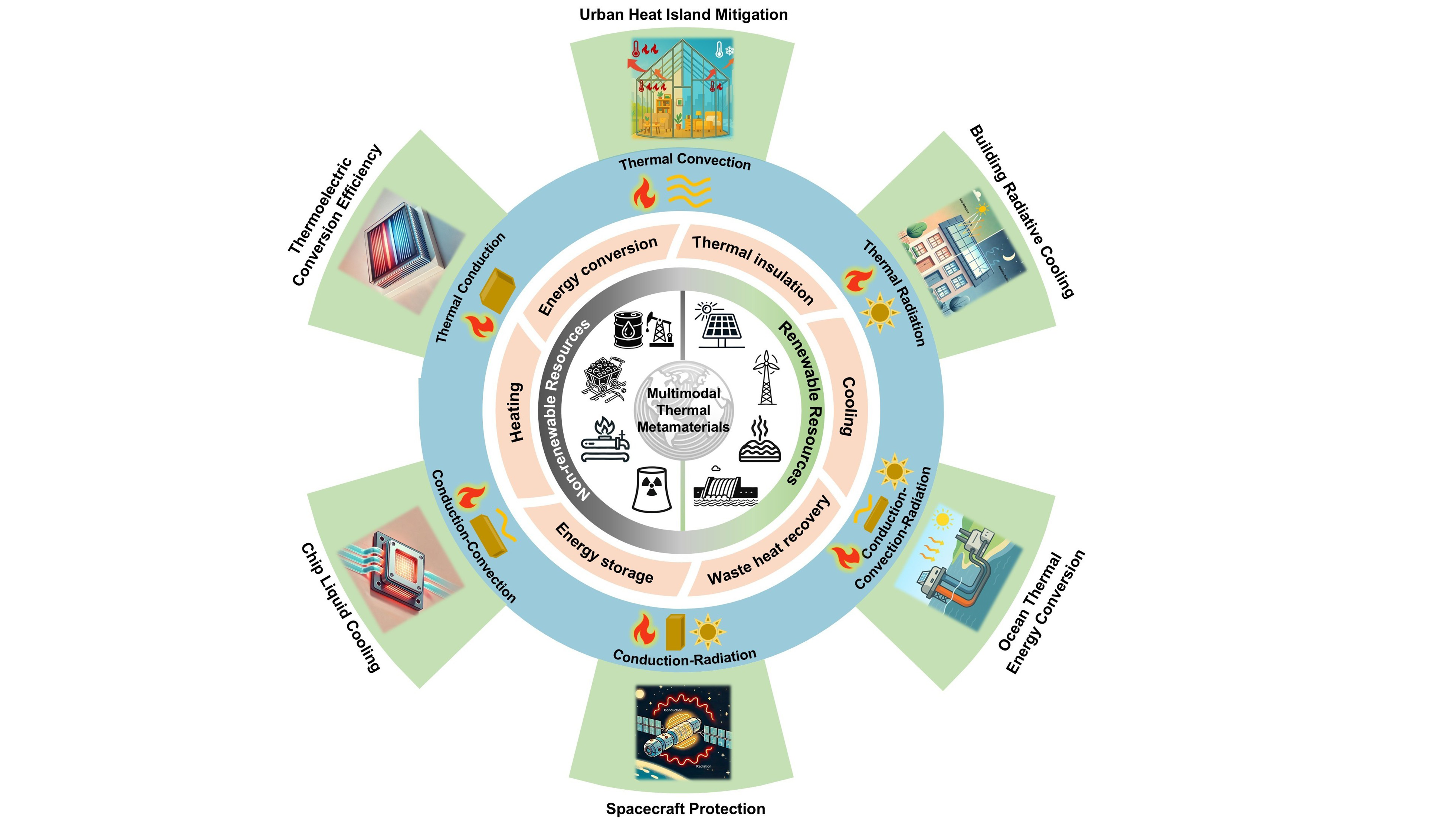
Effective thermal management is crucial for global sustainability, yet it faces a fundamental challenge: traditional materials cannot dynamically regulate the three coupled heat transfer modes, namely conduction, convection, and radiation, in complex, ...
More.Effective thermal management is crucial for global sustainability, yet it faces a fundamental challenge: traditional materials cannot dynamically regulate the three coupled heat transfer modes, namely conduction, convection, and radiation, in complex, real-world environments. To overcome this, we present a paradigm shift from material selection to the architectural design of synergistic heat transfer. This perspective explores how multimodal thermal metamaterials, through engineered microstructures and topology, enable programmable control over coupled thermal flows. We highlight how this approach yields advanced functionalities, including directional guidance, adaptive cooling, and waste-heat recovery, across scales ranging from microelectronics to buildings and marine systems. This architectural design framework transcends intrinsic material limits, establishing a foundational pathway toward intelligent, high-efficiency, and sustainable thermal technologies essential for energy sustainability.
Less.Huolei Feng, ... Jiping Huang
DOI:https://doi.org/10.70401/tx.2026.0012 - February 24, 2026
Poly(ionic liquid) thermal gels enabling compliant and adhesive interfaces for chip-scale thermal management
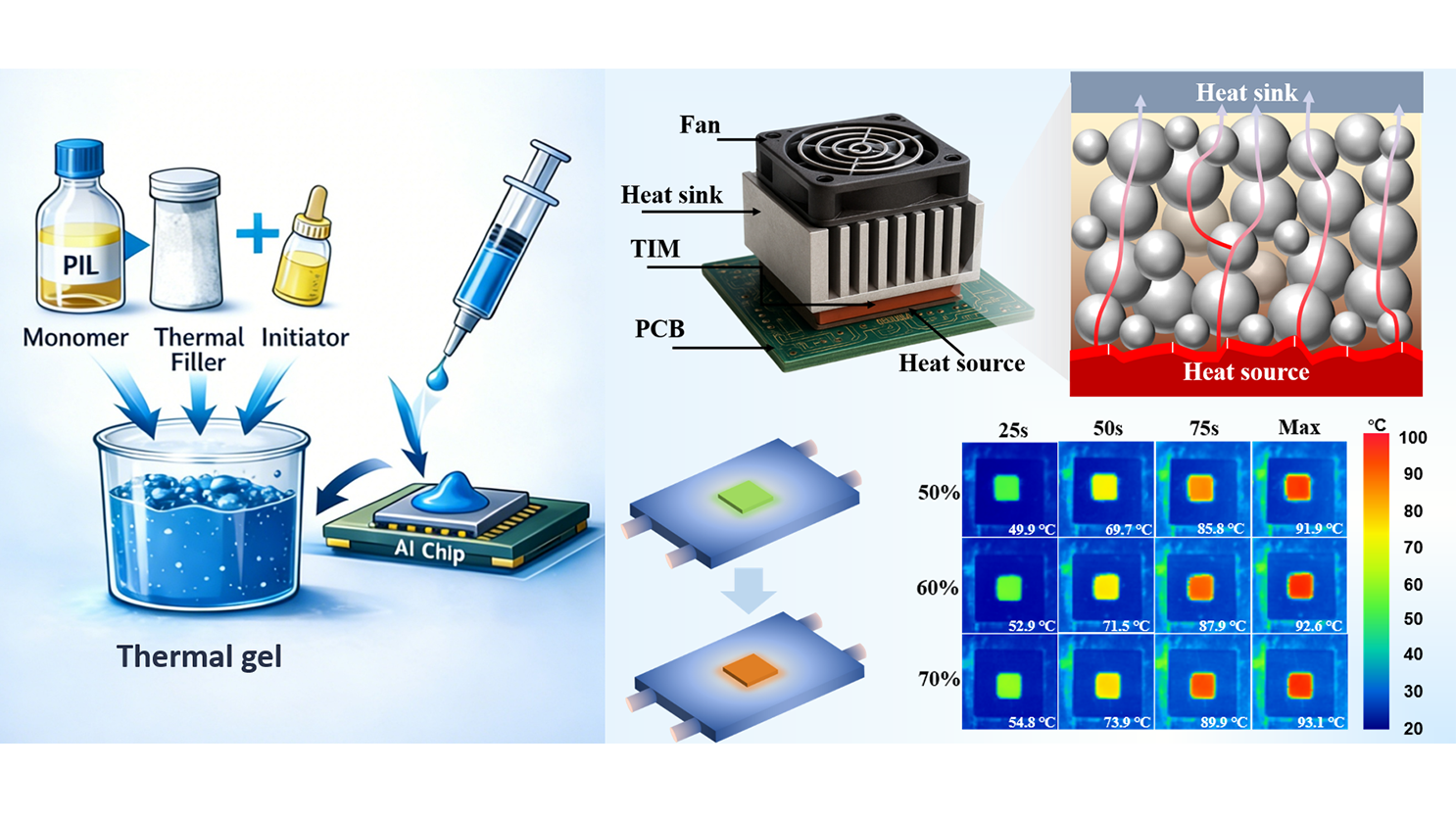
The increasing die size, package dimensions and operating heat flux of AI chips impose stringent requirements on the mechanical compliance and reliability of chip-level thermal interface materials (TIMs). Polymer-based TIMs, particularly silicone gels, ...
More.The increasing die size, package dimensions and operating heat flux of AI chips impose stringent requirements on the mechanical compliance and reliability of chip-level thermal interface materials (TIMs). Polymer-based TIMs, particularly silicone gels, offer advantages such as mechanical flexibility, automated dispensability, and warpage accommodation in large packages; however, their application is limited by weak interfacial adhesion and siloxane volatilization. Therefore, it is essential to develop advanced non-silicone thermal gels. This study reports a poly(ionic liquid) (PIL)-based thermally gel TIM. The TIM was fabricated by dispensing a mixture of ionic liquid monomer, Al2O3 thermal filler, and initiator, followed by thermal curing, making it compatible with FCBGA dispensing processes (the viscosity before curing was 225 Pa·s). With 70 vol% Al2O3 filler, the PIL-based TIM exhibited a low storage modulus of 255 kPa and high interfacial adhesion strengths of 0.95 MPa to Cu and 0.91 MPa to Si. The intrinsic thermal resistance reached 2.4 × 10⁻⁵ m2·K/W, comparable to that of conventional silicone systems. Notably, the interfacial contact thermal resistance with Si (Rc = 1.95 ± 0.87 × 10⁻⁷ m2·K/W) was an order of magnitude lower than that of silicone-based TIMs. Reliability tests showed > 98% coverage after three accelerated aging tests, with no leakage or volatilization. The proof-of-concept study validates the feasibility of PIL-based TIMs and highlights their significant potential for further optimization in next-generation AI thermal management.
Less.Jianhui Zeng, ... Yimin Yao
DOI:https://doi.org/10.70401/tx.2026.0011 - February 23, 2026
A review of thermal switches and diodes for energy and information technologies
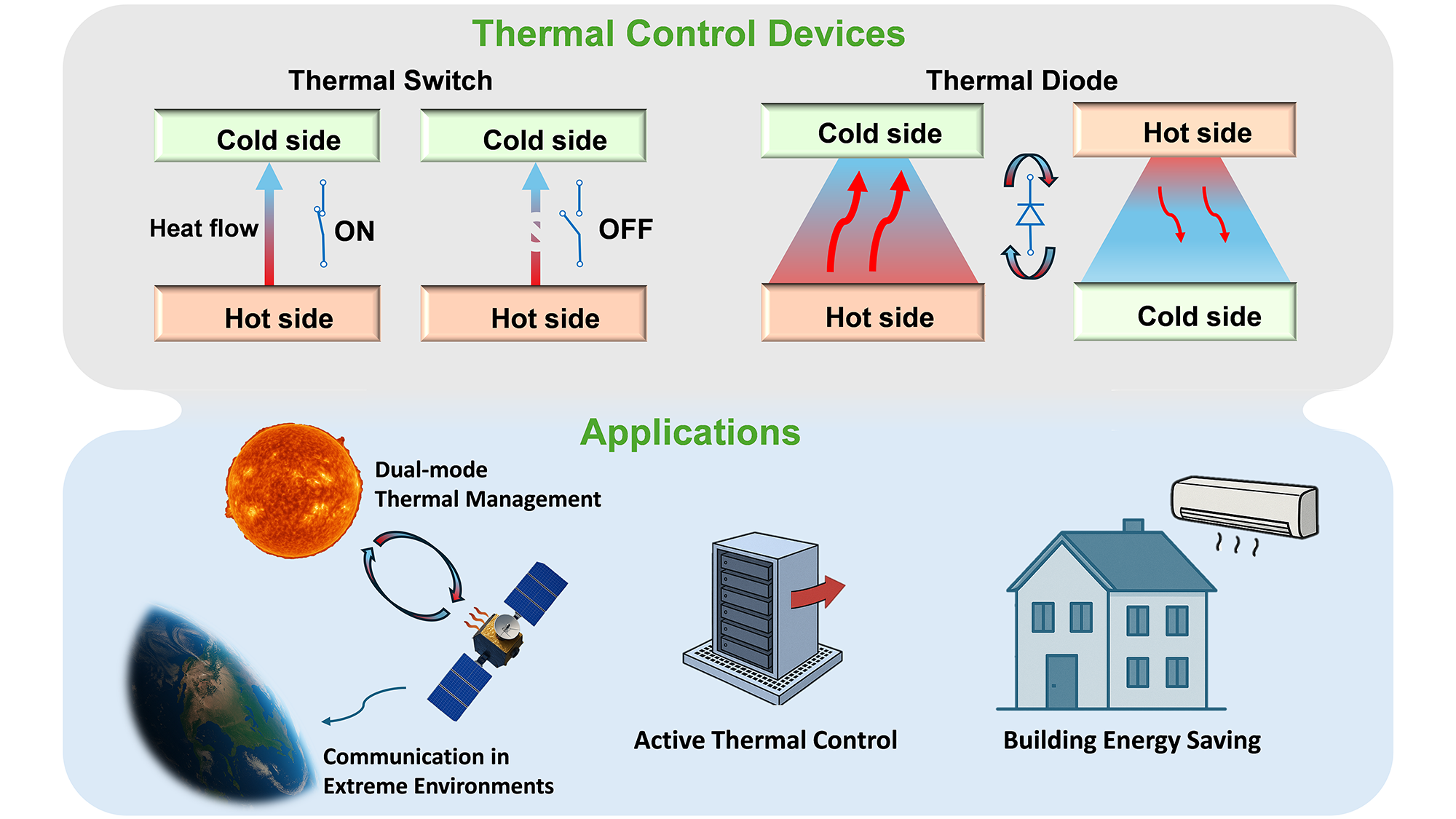
The high integration density of modern energy and information devices often results in high power density and intense heat flux. Depending on the operating and optimal temperature range of the device, heat must be either effectively dissipated or retained. ...
More.The high integration density of modern energy and information devices often results in high power density and intense heat flux. Depending on the operating and optimal temperature range of the device, heat must be either effectively dissipated or retained. Precise regulation of heat flow is essential for the advancement of next-generation energy and information technologies. Dynamic heat flow control and nonlinear thermal transport open new avenues for developing smart battery thermal management systems, solid-state refrigeration devices, and thermal logic elements analogous to electronic circuits. Due to their unique capability to actively modulate heat transfer and exhibit thermal rectification behavior, thermal switches and thermal diodes have shown great potential in managing heat and/or maintaining thermal stability beyond the limits of conventional passive thermal materials and devices. Here, we review recent progress in the design principles, fundamental mechanisms, and applications of thermal switches and thermal diodes for energy and information technologies, and evaluate their potential for practical deployment. Furthermore, we discuss the emerging demands in these sectors and provide future perspectives to inspire applied research toward solving real engineering challenges.
Less.Zhuo Chen, ... Yuqiang Zeng
DOI:https://doi.org/10.70401/tx.2026.0010 - January 20, 2026
Rattling effects on four-phonon scattering and wave-particle duality in phonon transport
We investigate how metallic rattling modes in Sr2HgSn simultaneously suppress particle-like (κp) and enhance wave-like (κc) thermal conductivity via a combined first-principles, ...
More.We investigate how metallic rattling modes in Sr2HgSn simultaneously suppress particle-like (κp) and enhance wave-like (κc) thermal conductivity via a combined first-principles, force-constant modulation, and Wigner transport analysis. Weak Hg-Sn bonds generate flat phonon bands that relax momentum conservation, intensifying both three- and four-phonon scattering and shortening phonon lifetimes. This dual scattering-coherence mechanism reveals a frequency-selective κp - κc crossover, leading to a weak temperature-dependent κL. Our work establishes rattling as a tunable design strategy for controlling phonon transport in thermoelectrics.
Less.Yu Wu, ... Chenhan Liu
DOI:https://doi.org/10.70401/tx.2026.0009 - January 16, 2026
Phonon hydrodynamics: Theory and experiments
Phonon hydrodynamics is a theoretical framework for predicting nondiffusive heat transport processes in solids at the nanoscale or under high-frequency excitations. This article presents the microscopic and thermodynamic foundations of the theory and ...
More.Phonon hydrodynamics is a theoretical framework for predicting nondiffusive heat transport processes in solids at the nanoscale or under high-frequency excitations. This article presents the microscopic and thermodynamic foundations of the theory and reviews its applications. First, we discuss historical and modern derivations of hydrodynamic heat transport equations from the phonon Boltzmann transport equation (BTE), and highlight advanced methods to predict hydrodynamic effects from direct solutions of the BTE beyond the Relaxation Time Approximation. Then, we review the main experiments that uncovered nondiffusive heat transport effects and their interpretation from the hydrodynamic perspective. Overall, the developments summarized in this work establish phonon hydrodynamics as a vital tool for understanding and engineering thermal transport at the nanoscale in data-processing and energy-conversion devices.
Less.Albert Beardo, ... F. Xavier Alvarez
DOI:https://doi.org/10.70401/tx.2026.0008 - January 14, 2026
Out-of-equilibrium ultrafast electron and phonon energy transfer dynamics in metals: The role of non-thermal effect
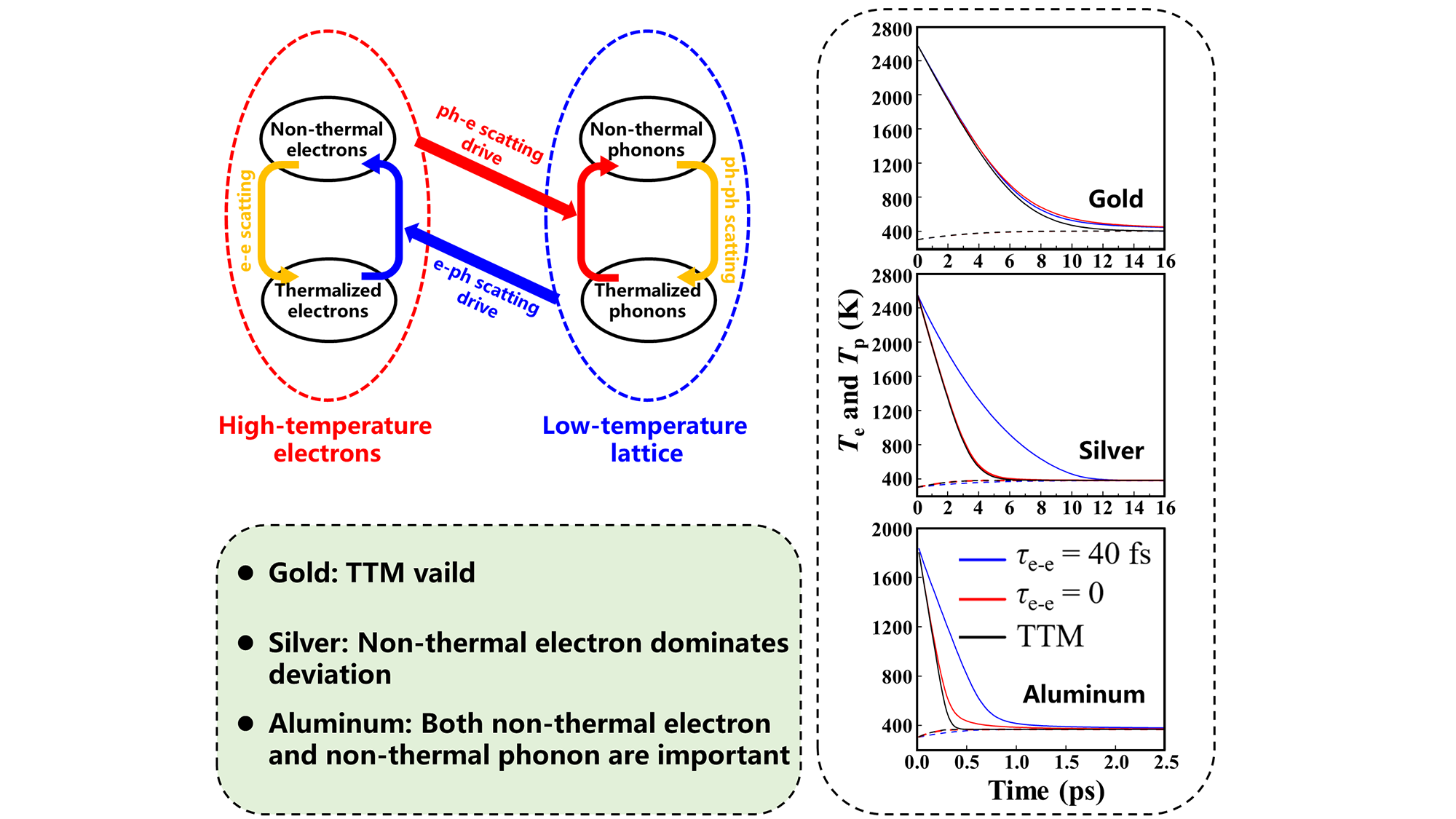
The two-temperature model (TTM) has been widely employed in describing ultrafast relaxation dynamics, providing a simple yet powerful framework to study energy relaxation in photoexcited systems. Recently, the time-dependent Boltzmann equation (TDBE) ...
More.The two-temperature model (TTM) has been widely employed in describing ultrafast relaxation dynamics, providing a simple yet powerful framework to study energy relaxation in photoexcited systems. Recently, the time-dependent Boltzmann equation (TDBE) has revealed the limitations of TTM. However, current implementations of the TDBE assume instantaneous electronic thermalization. In this work, we employ first-principles Boltzmann transport simulations to explicitly examine the impact of non-thermal electronic distributions on relaxation processes. By comparing gold, silver, and aluminum as representative cases, we show that while phonons can indeed remain far from equilibrium, the neglect of non-thermal electrons is far more consequential. For gold, the absence of strongly coupled scattering channels makes the influence of non-thermal electrons negligible, rendering the TTM valid. For silver, deviations from the TTM stem mainly from non-thermal electronic effects, and for aluminum, both non-thermal electrons and phonons lead to substantial discrepancies. These findings demonstrate that non-thermalized electrons play a decisive role in out-of-equilibrium ultrafast energy transfer between electrons and phonons, offering a new perspective on the limitations of the TTM.
Less.Gui-Lin Zhu, Jing-Tao Lü
DOI:https://doi.org/10.70401/tx.2025.0007 - December 26, 2025