
Table of Contents
Senescence-associated transcriptional reprogramming in the tumor immune microenvironment: Mechanistic layers and therapeutic opportunities
The tumor immune microenvironment (TIME) is a principal determinant of tumor progression, metastatic dissemination, and therapeutic response. Cellular senescence, primarily through the senescence-associated secretory phenotype (SASP), progressively ...
More.The tumor immune microenvironment (TIME) is a principal determinant of tumor progression, metastatic dissemination, and therapeutic response. Cellular senescence, primarily through the senescence-associated secretory phenotype (SASP), progressively reshapes the TIME toward immunosuppressive and therapy-resistant states. Here, we propose an integrative framework of “senescence-associated transcriptional reprogramming” comprising three mechanistic layers: endogenous inflammation-driven signaling centered on the cGAS-STING-NF-κB-IFN hub; lineage-specific epigenetic lock-in in immune cells; and metabolic-epigenetic coupling. We further discuss mechanism-guided, temporally optimized senolytic and senomorphic strategies, particularly relevant to elderly cancer patients, to rationally reverse senescence-driven tumor immune tolerance and enhance current immunotherapies.
Less.Xiao Yu, ... Qiang Shan
DOI:https://doi.org/10.70401/acrt.2026.0040 - September 15, 2026
Organoid and organ-on-a-chip models for the tumor immune microenvironment: A call to incorporate immunosenescence
The tumor immune microenvironment (TIME) is a central determinant of cancer progression and therapeutic response. Although organoid and organ-on-a-chip technologies have substantially advanced the modeling of tumor-immune interactions, most current ...
More.The tumor immune microenvironment (TIME) is a central determinant of cancer progression and therapeutic response. Although organoid and organ-on-a-chip technologies have substantially advanced the modeling of tumor-immune interactions, most current platforms overlook a critical dimension of clinical reality: immunosenescence. This process profoundly reshapes immune cell composition, functional capacity, and tumor-immune crosstalk, yet it remains largely absent from existing in vitro systems. In this review, we provide a conceptual and methodological overview of organoid- and microfluidic-based models for reconstructing the TIME. We highlight their respective strengths in capturing tumor heterogeneity and dynamic immune processes, while critically evaluating their limitations in modeling long-term immune evolution and age-associated dysfunction. Importantly, we propose immunosenescence as a missing but essential modeling axis and argue that it should be treated as a controllable experimental variable rather than a background condition. By integrating aging-associated immune features into advanced 3D and microfluidic platforms, next-generation models are poised to better recapitulate patient heterogeneity and improve the prediction of immunotherapy outcomes. This perspective underscores a shift toward age-aware, physiologically relevant tumor models and provides a framework for advancing precision immuno-oncology in an aging population.
Less.Yining Feng, ... Bo Ma
DOI:https://doi.org/10.70401/acrt.2026.0039 - September 03, 2026
Navigating the aging brain: The interplay between brain malignancy and the aging microenvironment
The rising incidence of age-related brain pathologies, including brain malignancy, underscores an urgent need to understand the mechanistic interplay between aging and tumorigenesis. Historically viewed as distinct entities, brain tumors and neurodegenerative ...
More.The rising incidence of age-related brain pathologies, including brain malignancy, underscores an urgent need to understand the mechanistic interplay between aging and tumorigenesis. Historically viewed as distinct entities, brain tumors and neurodegenerative disorders are now recognized to share key biological processes, such as cellular senescence, chronic inflammation, and metabolic dysregulation. In this review, we deconstruct the existing knowledge at the intersection of cancer neuroscience and aging biology, and propose that age-related alterations in neuronal function, such as the accumulation of senescent cells, ion channel dysregulation, and neurotransmitter imbalance, are not inert background features but as active mediators of tumor progression and treatment resistance. We summarize the aged neural microenvironment, marked by a proinflammatory senescence-associated secretory phenotype (SASP) and blood-brain barrier dysfunction, underlies a permissive soil for malignancy. Moreover, we highlight the emerging concept that tumors can induce a pathological aging phenotype in surrounding neurons, which in turn potentiates the observed cognitive deterioration. By framing brain tumors as products of a dysfunctional aging ecosystem, we propose therapeutic strategies that target convergent aging mechanisms through senolysis, metabolic reprogramming, and neurotransmitter modulation may simultaneously achieve tumor control and preserve cognitive function. This integrated perspective opens new avenues for repurposing neuroactive drugs and designing interventions that address the sophisticated biology of the aging brain and malignancy.
Less.Qianquan Li, ... Xin Chen
DOI:https://doi.org/10.70401/acrt.2026.0038 - August 31, 2026
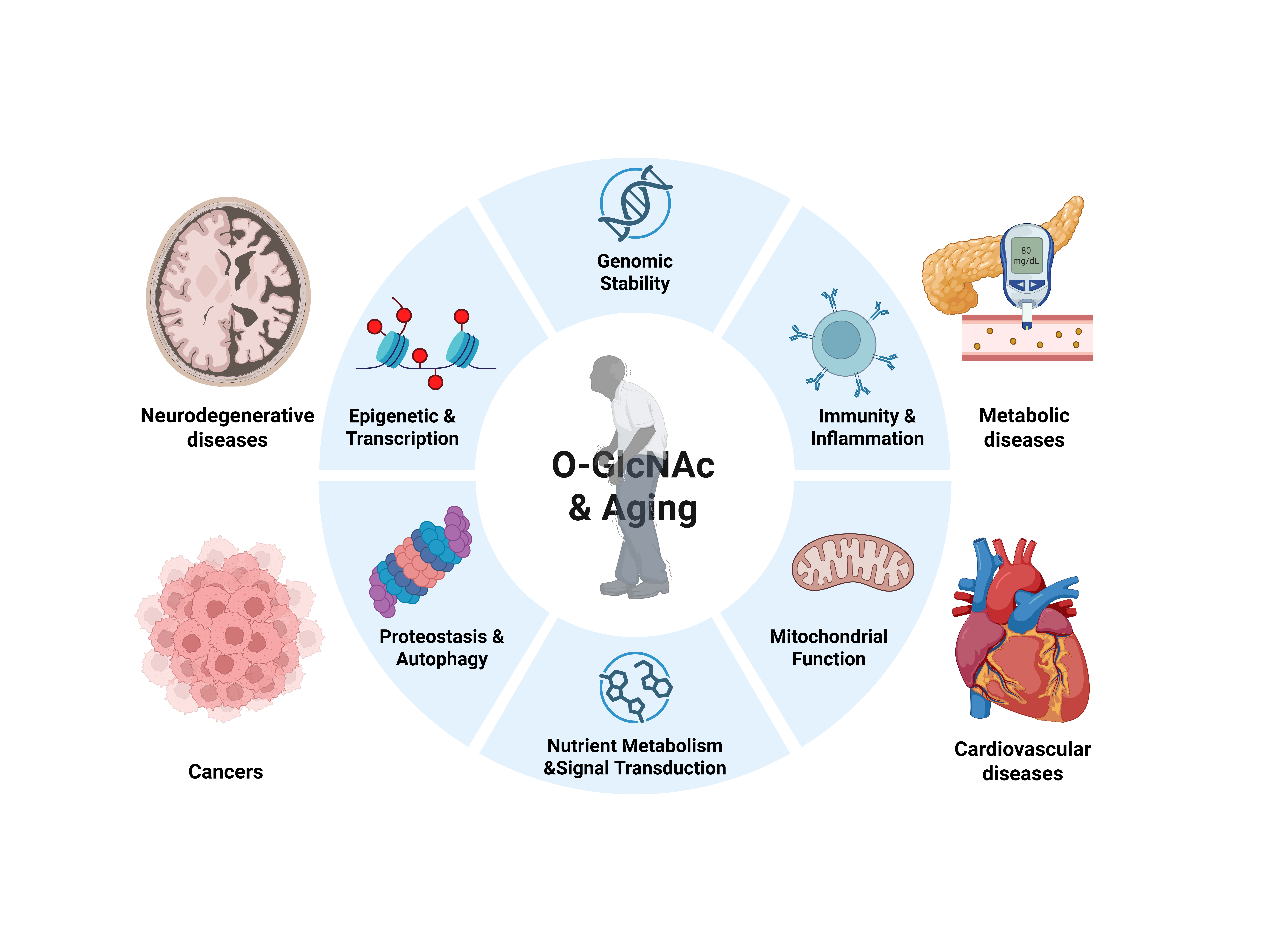
O-GlcNAcylation in aging and age-related diseases: From molecular mechanisms to therapeutic potential
O-GlcNAcylation, a dynamic and nutrient-sensitive post-translational modification, has emerged as a key regulator of aging processes. In this review, we summarize the biological basis of O-GlcNAcylation and explore its emerging roles in aging and age-related ...
More.O-GlcNAcylation, a dynamic and nutrient-sensitive post-translational modification, has emerged as a key regulator of aging processes. In this review, we summarize the biological basis of O-GlcNAcylation and explore its emerging roles in aging and age-related diseases. Then we focus on the molecular mechanisms of O-GlcNAcylation in the context of key hallmarks of aging, including genomic stability, epigenetic regulation, proteostasis, autophagy, nutrient metabolism, mitochondrial function, and immunity. Finally, we discuss the therapeutic potential of targeting O-GlcNAcylation to alleviate aging-related decline and treat age-associated diseases.
Less.Dongjie Liu, ... Xiaoqian Liu
DOI:https://doi.org/10.70401/acrt.2026.0036 - August 27, 2026
Targeting NK cell immunosenescence in cancer: Mechanisms, impact, and therapeutic opportunities
Aging remains the primary risk factor for malignancy, driven primarily by the progressive decline of the immune system known as immunosenescence. Natural killer (NK) cells serve as the critical effectors of tumor immunosurveillance, yet their anti-tumor ...
More.Aging remains the primary risk factor for malignancy, driven primarily by the progressive decline of the immune system known as immunosenescence. Natural killer (NK) cells serve as the critical effectors of tumor immunosurveillance, yet their anti-tumor efficacy is compromised during biological aging. This review delineates the multifaceted mechanisms of NK cell immunosenescence including phenotypic subset redistribution, receptor signaling dysregulation, and metabolic biogenesis failure driven by mitochondrial impairment alongside telomere attrition and p16 p21 mediated cell cycle arrest. These cell intrinsic defects interact with the suppressive aging microenvironment to create a self-reinforcing vicious cycle that facilitates tumor escape in the elderly population. Breaking this cycle necessitates a multi-dimensional therapeutic framework that integrates cellular rejuvenation via induced pluripotent stem cell (iPSC) derived chimeric antigen receptor (CAR) NK cells with niche remodeling using senolytics or bone marrow rejuvenation. Ultimately targeting the biological hallmarks of NK cell immunosenescence represents a significant frontier in geriatric oncology offering the potential to resuscitate anti-tumor immunity for the burgeoning elderly population.
Less.Yang Gao, Yang Yu
DOI:https://doi.org/10.70401/acrt.2026.0037 - August 27, 2026
RAD51 in homologous recombination-mediated DNA damage repair and genome stability: Mechanisms, regulation and implications for disease
Homologous recombination (HR) is a high-fidelity DNA repair pathway that preserves genome stability through the accurate repair of DNA double-strand breaks. RAD51 is the central recombinase of HR and catalyzes the key processes of homology search and strand ...
More.Homologous recombination (HR) is a high-fidelity DNA repair pathway that preserves genome stability through the accurate repair of DNA double-strand breaks. RAD51 is the central recombinase of HR and catalyzes the key processes of homology search and strand invasion through the formation of nucleoprotein filaments on single-stranded DNA. The assembly, stability, and disassembly of RAD51 filaments are tightly regulated by a complex network of mediators, cofactors, and anti-recombinases, ensuring efficient DNA repair while preventing aberrant recombination. Beyond its canonical role in HR, RAD51 also contributes to replication fork protection and replication stress responses. Dysregulation of RAD51 activity can lead to genome instability, cancer development, hereditary disorders, and cellular senescence. Conversely, elevated RAD51 expression frequently promotes therapeutic resistance in tumors. In this review, we summarize the molecular mechanisms of RAD51-mediated HR repair, discuss the regulatory pathways that control RAD51 activity and dynamics, examine its roles in genome stability and human disease, and highlight recent advances in therapeutic strategies targeting RAD51 and the HR pathway. Understanding the multifaceted functions of RAD51 will facilitate the development of more effective DNA repair-directed cancer therapies.
Less.Tao Zhou, ... Weibin Wang
DOI:https://doi.org/10.70401/acrt.2026.0035 - August 25, 2026