From digital blueprints to virtual brains: Evolutionary trajectory and process logic in circular construction

Kaiyi Li
1

,
Dongmei Huangfu
2
,
Jingtong Chen
3,4
,
Yunxia Ran
5
,
Yonghong Chen
6,*
*Correspondence to:
Yonghong Chen, Kunming University of Science and Technology, Kunming 650500, Yunnan, China.
E-mail: yhling77@163.com
J Build Des Environ. 2026;4:2025137. 10.70401/jbde.2026.0030
Received: December 17, 2025Accepted: February 13, 2026Published: March 02, 2026
This article belongs to the Special lssue Resouce Sustainability and Circular Economy in Construction
Abstract
While digitalization is fundamentally reshaping circular construction, the specific evolutionary trajectory from static building information modeling (BIM) toward dynamic Digital Twins (DT) remains unclear. To unpack this complexity, a PRISMA-guided systematic review and scientometric mapping of 271 publications (2019-2025) was performed using VOSviewer and CiteSpace. The analysis identifies a four-phase pathway: (i) strategic foundations focused on circular frameworks and material reuse; (ii) design integration emphasizing tool implementation and BIM workflows; (iii) dynamic integration toward digital twins enabling lifecycle data continuity; and (iv) systemic management and lifecycle assessment for real-time control and compliance. Critical turning points in this journey are marked by burst terms such as “framework” (2021), “integration” (2022), and the current emphasis on “management” (2023-2025). Crucially, the review synthesizes conflicting paradigms to identify three fundamental gaps hindering the BIM-to-DT shift: the ontological schism in data sufficiency, the agency gap between digital shadows and twins, and the logistical gap in stochastic reverse flows. To bridge these divides, a three-layer architecture is proposed in which BIM serves as the static product backbone, process information modelling as the essential logic bridge, and DT as the operational decision core. This constructs a time-indexed evolution model that quantifies the shift from process optimization to systemic value creation and provides an adoption roadmap prioritizing interoperability to support policy instruments.
Keywords
Circular construction, building information modeling, digital twins, industry 4.0, digital Transformation
1. Introduction
As a strategic pillar of global economic expansion, the construction industry currently faces intertwined crises of resource exhaustion and environmental decay. As a primary consumer of approximately 40% of global raw materials[1] and a generator of over half of the world’s waste[2], its linear take-make-waste model is fundamentally unsustainable[3]. In response, the circular economy (CE) has emerged as a critical paradigm shift, advocating for a systemic shift toward regenerative models that maintain material value for the maximum possible duration[4].
The transition to a circular built environment depends heavily on digital transformation[5]. This evolution began with building information modeling (BIM), a process that involves the generation and management of digital representations of a building’s physical and functional characteristics[6]. As a data-rich, three-dimensional, static blueprint, BIM has established itself as a foundational technology in the construction industry. It enables significant improvements in design optimization and interdisciplinary clash detection. Specifically, in the CE[7] transition, BIM is widely used for pre-construction quantification and planning of construction and demolition waste (CDW)[8]. It provides a structured database of materials and components, a crucial first step for end-of-life (EoL) planning. However, the inherent limitation of BIM lies in its static nature[9]; it represents the as-designed or as-built state but lacks a connection to the asset’s real-time operational reality.
More recently, the advent of Industry 4.0 has introduced a new suite of interconnected technologies to overcome this limitation[10], with the digital twin (DT) emerging as the central paradigm. A DT is a dynamic, virtual representation of a physical asset, system, or process, continuously updated with real-world data from sensors and the internet of things (IoT)[11]. Unlike the static BIM model, a DT functions as an intelligent brain, capable of mirroring the asset’s real-time state and simulating its performance under various conditions. It can be used to predict future behavior (e.g., component failure) and optimize operation throughout its entire lifecycle. This technological shift from static models to dynamic, intelligent systems that learn and adapt holds the key to unlocking the full potential of the CE in construction.
The foundational role of BIM is now well established, with a substantial body of literature demonstrating its application in CDW management[12]. Extensive research has already demonstrated how BIM can be utilized in CDW management, from early-stage estimation and design optimization to clash detection and the planning of deconstruction sequences[13-15]. Under the influence of Industry 4.0, research is moving beyond BIM alone[16]. Increasingly, scholars are investigating how a wider range of digital technologies can support more dynamic and integrated CE practices. This includes IoT for real-time material tracking[17], blockchain for enhancing the traceability of secondary materials[18], and DT for simulating lifecycle performance and EoL scenarios[19].
Despite these advances, some key issues remain. Specifically, the relationship between BIM and DT is still unclear. In many studies, these two are either confused or treated as separate, parallel tools, which overlooks the fact that they actually belong to different technical levels[20]. A major practical problem is that BIM provides static product data, while DT requires dynamic control. Existing frameworks usually fail to capture the logistical details needed for deconstruction and recycling. To address this, we propose process information modelling (PIM) to define the specific timing and steps involved in lifecycle activities[21]. Second, existing reviews typically offer a static overview of the field[21,22], failing to capture how research hotspots and theoretical foundations have evolved over time[23]. Finally, the evolution of the underlying value proposition of these digital tools, shifting from a focus on process optimization (characteristic of BIM)[24-26] to systemic value creation (the promise of DT)[27,28], has yet to be systematically mapped and analyzed.
To delineate the scope and contribution, the review focuses on circular construction in the built environment and considers peer-reviewed literature published from 2019 to 2025, indexed in leading scholarly databases. In contrast to existing bibliometric reviews on BIM–DT integration, which primarily catalogue integration routes and application domains, this review advances a time-indexed capability perspective that traces the shift from static information management to operations-oriented value propositions, substantiated by burst-term detection, time-slice co-word evolution, and cluster migration signals. In comparison with industry 4.0 × CE frameworks positioned at the level of net-zero pathways and policy alignment, the analysis operationalizes data continuity and governance within circular construction scenarios by anchoring them in a BIM–DT stack and corroborating this positioning with scientometric evidence. Complementing reverse-logistics and secondary-market studies that report operational cases, the findings embed these practices within a layered architecture in which BIM serves as the static product backbone, process information modelling as the essential logic bridge, and DT as the operational decision core.
The paper is organized as follows. Section 2 establishes the conceptual foundations by clarifying BIM, PIM, and DTs and articulating their layered roles in circular construction. Section 3 details the systematic methodology for data collection, screening, and analysis. Section 4 presents the results of the scientometric analysis. Section 5 discusses the findings. Finally, Section 6 concludes by summarizing key contributions, acknowledging limitations, and outlining directions for future research.
2. Conceptual Foundations: A Layered Digital Architecture for Circular Construction
Digitalization underpins the transition from linear take–make–waste practices to CE strategies in the built environment[16]. However, realizing this systemic shift requires a cohesive digital architecture rather than isolated technologies. This section clarifies the conceptual foundations of this architecture, structured as a three-layer framework: (i) BIM as the static product backbone; (ii) PIM as the dynamic logical bridge; and (iii) DT as the operational decision brain. Building on this, it articulates how Industry 4.0 serves as the connective infrastructure, providing the sensing and data pipelines that integrates these layers to enable circular design, traceable operations, and optimized EoL decision-making.
2.1 Building information modeling as the information backbone for circularity
The BIM refers to the creation and management of digital models that store a building’s geometric and functional data. These object-oriented representations integrate key project attributes such as geometry, semantics, and parameters to support decision-making throughout the asset’s lifecycle[29]. In the context of the CE, BIM functions as an information backbone that renders materials and components visible, queryable, and analyzable at multiple levels of aggregation, thereby enabling material-centric planning and decision-making[30]. In the design phase, BIM acts as a detailed material inventory. It systematically records material categories, quantities, specifications, and assembly relationships[31]. These inventories enable early estimates of CDW and help identify high-value materials for reuse. Beyond simple counting, BIM can store EoL data such as connection types and ease of separation, which is critical for design-for-deconstruction strategies[32]. When these attributes are parameterized within BIM objects, practitioners can conduct disassembly sequencing analyses, evaluate selective dismantling strategies, and estimate recoverability under different scenarios with higher fidelity than traditional drawings allow. During pre-construction planning, BIM-based estimation workflows enable integration of waste quantification with environmental performance assessment, allowing evaluation of projected waste generation, sorting strategies, logistics requirements, and carbon impacts before work begins[33]. Despite these advantages, standard BIM remains relatively static. It is designed to represent the as-designed or as-built status of a building but lacks a direct connection to real-time operational data[34,35]. These limitations make it difficult for BIM to manage circular processes that require real-time updates. Without integrating external sensors and data tools, it cannot effectively support activities such as adaptive reuse, dynamic reverse logistics, or resource optimization across multiple projects[36].
2.2 Process information modelling as the dynamic process logic bridge
While BIM provides the static product structure, bridging the gap to dynamic operations requires a dedicated layer to govern the process structure, specifically the logic of construction, deconstruction, and logistics. PIM functions as this essential logical bridge. Unlike BIM, which describes the physical asset (geometry and materials), PIM formalizes how lifecycle activities are executed by capturing the timing and procedures necessary for circular economy practices[21].
In the context of the CE, PIM transforms the static material inventory into an actionable recovery plan. It encodes the specific CDW management sequences, distinguishing between theoretical separability (defined in BIM) and practical dismantling workflows constrained by site conditions, machinery availability, and safety regulations[33]. For example, where BIM might identify a precast concrete panel, PIM defines its lifting points, the prerequisite removal of adjacent connections, and the specific reverse logistics route required to transport it to a recycling facility rather than a landfill.
2.3 Digital twins as the operational and decision-making core of circular practices
A DT acts as a virtual counterpart that synchronizes with its physical asset through continuous, two-way data exchange. By integrating multi-source data with analytical models, it enables real-time tracking, performance forecasting, and operational optimization[36,37]. In construction, DTs integrate BIM semantics with live telemetry and decision analytics to provide a persistent, up-to-date view of both condition and context[38]. For CE, this capability translates into several distinctive roles. DTs support lifecycle-aware optimization by coordinating design, construction, operation, and EoL decisions through a common, continuously refreshed state representation. They enable condition-based pathways for reuse, refurbishment, and remanufacturing by fusing sensor measurements with historical records to infer component-level degradation, remaining service life, and safety margins. They operationalize reverse logistics by surfacing inventories of recoverable components, forecasting availability windows, simulating disassembly impacts on schedules and costs, and aligning collection, sorting, and reintroduction flows with market demand for secondary materials[39]. They also provide embedded analytical pipelines for environmental and circularity assessment, including lifecycle assessment, carbon accounting, and circularity indicators, so that performance can be monitored, attributed, and reported in near real time at the asset and portfolio scales[39]. Through these functions, DTs transform circularity from a set of episodic interventions into a managed, data-driven operating model.
2.4 Industry 4.0 as the connectivity and data layer enabling operational circularity
Industry 4.0 refers to a convergence of cyber-physical and data technologies, including IoTs, sensor networks, edge and cloud computing, data platforms, advanced analytics, and distributed ledger infrastructures, that instrument physical assets and transform isolated datasets into continuous, trustworthy data flows[40,41]. In the built environment, this integrated framework provides a dynamic data layer that extends static BIM models by incorporating real-time sensor data, operational records, and cloud-based services[42]. The digital integration supports CE in two primary ways. First, sensor-based tracking provides a clear record of material provenance from fabrication to deconstruction. These records are essential for verifying material quality and managing liabilities during reuse[43]. Second, linking operational data with existing BIM models ensures information continuity, preventing data loss throughout the building’s lifecycle[41]. This continuity is essential for coordinating reverse logistics, aligning supply and demand in secondary markets, closing feedback loops between design assumptions and actual performance, and implementing incentive mechanisms grounded in verified events[44]. Where appropriate, distributed ledgers and related trust technologies can provide tamper-evident registries for material passports, custody records, and compliance statements, improving market confidence in secondary materials and enabling policy instruments, such as extended producer responsibility, to be operationalized at scale. In sum, Industry 4.0 reframes digitalization from “data at rest” to “data in motion”, establishing the conditions for circular strategies to be executed and governed during operations rather than only appraised at design time.
2.5 Bridging the gap: The process-oriented backbone from BIM to digital twins
The integration of digital technologies into circular construction requires a cumulative architecture that transcends the capabilities of standalone paradigms[5]. While BIM serves as the foundational information backbone, existing scholarship highlights its inherent limitations in managing the complex, dynamic flows of the CE. As noted by Boton et al.[45], current BIM practices are often activity-based rather than information-centric, lacking the product structure necessary to manage information flows across the entire production and lifecycle line effectively. BIM excels at representing a product’s static attributes, encoding what exists and what it is made of, but often fails to explicitly capture the how-to logic required for deconstruction, reverse logistics, and material recovery[15]. To bridge the gap between the static digital blueprint of BIM and the dynamic digital brain of the DT, establishing a dedicated process-oriented layer is essential.
This intermediate layer, conceptualized as PIM, acts as the logical syntax for circularity. Pan et al.[21] articulate that while BIM offers a database of object-oriented information, it requires a supplementary process-oriented database to manage complex tasks such as robotic interaction, scheduling, and logistics sequences. As illustrated in Figure 1, the architecture consists of three layers. BIM (Layer 1) manages the physical product data, while PIM (Layer 2) defines the underlying process logic and execution sequences. This aligns with the knowledge-based frameworks proposed by Aram et al.[46], which demonstrate that critical construction knowledge, such as connection details or installation sequences, is often absent from explicit design models and must be inferred through rule-based reasoning to support accurate estimation and planning[33]. By embedding this process logic, the architecture transitions from merely documenting material banks to actively planning their recovery routes[16].
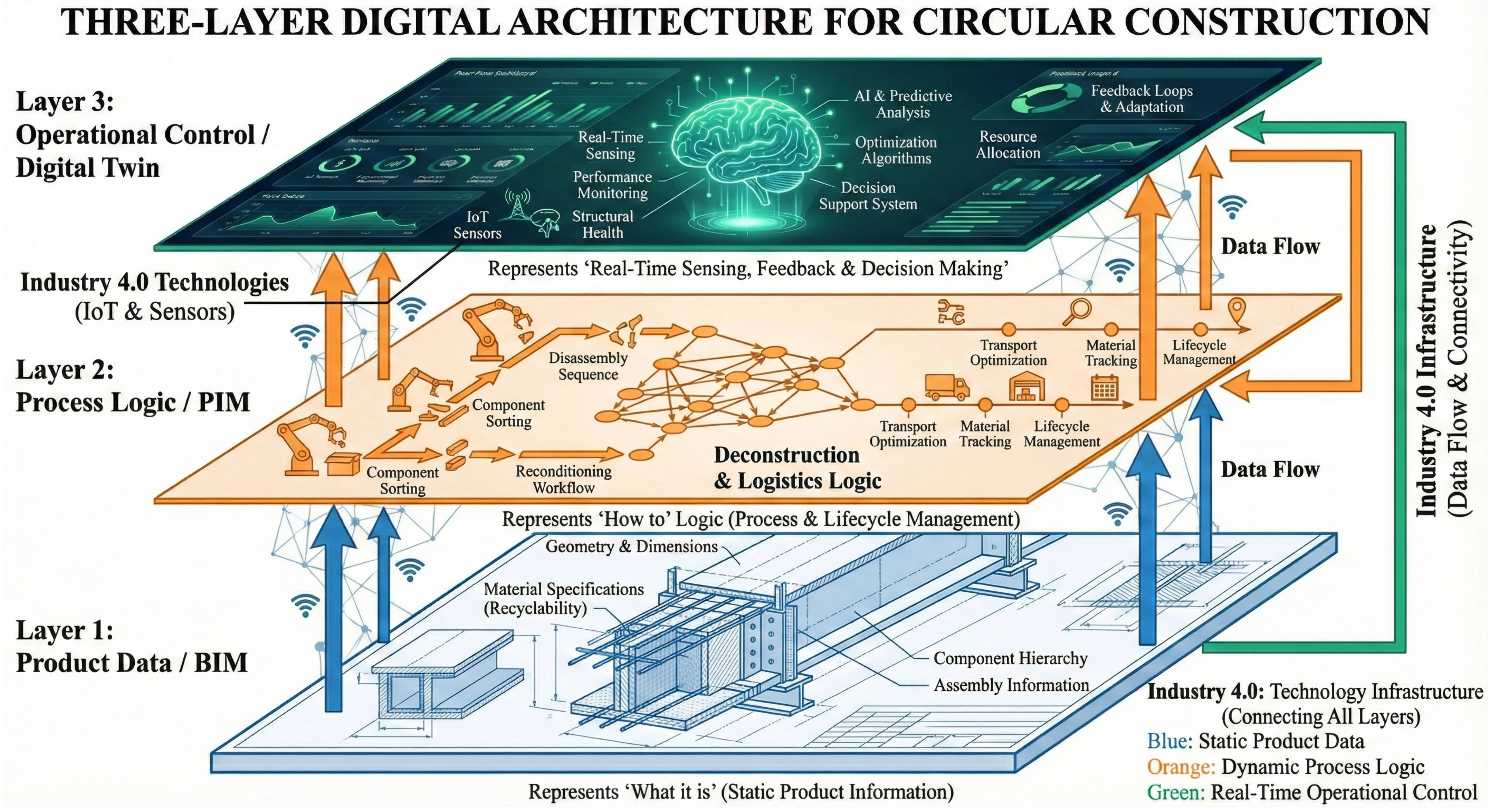
Figure 1. The three-layer digital architecture for circular construction. Layer 1 (BIM) serves as the static product repository; Layer 2 (PIM) functions as the process backbone managing deconstruction and logistics logic[21]; and Layer 3 (DT) acts as the operational brain for real-time control, enabled by Industry 4.0 connectivity. BIM: building information modeling; PIM: process information modelling; DT: digital twin.
Industry 4.0 technologies serve as the vital connective infrastructure that enables this layered architecture to operate in real time[47]. Rather than functioning as a separate silo, Industry 4.0 provides the sensing, connectivity, and trust mechanisms that convert the static hypotheses of Layer 1 and the procedural plans of Layer 2 into continuous data flows[40,41]. For instance, while the PIM layer might dictate an optimal disassembly sequence, Industry 4.0-enabled sensors and IoT devices verify the physical execution of these tasks[48], ensuring that the digital status mirrors physical reality. This connectivity ensures data continuity from the design phase through to the EoL recovery, overcoming the fragmentation that typically characterizes construction data management.
The apex of this architecture is the DT (Layer 3), which serves as the operational decision brain. By integrating the product semantics from BIM and the process logic from PIM with live telemetry from Industry 4.0, the DT shifts the value proposition from passive documentation to active control. As illustrated in Figure 1, the flow of information is bidirectional and cyclical. The DT not only monitors performance but also utilizes the underlying PIM logic to re-optimize reverse logistics and component sorting in response to changing field conditions. This integration creates a closed-loop system where deconstruction planning, selective dismantling, and material trading are no longer episodic interventions but are managed, data-driven operations. Consequently, the realization of circular construction relies not on a single technology but on a structured alignment in which BIM provides the resource inventory, PIM provides the recovery logic, and the DT ensures operational optimization.
3. Methodology
To achieve the research objectives, this study conducts a Systematic Literature Review (SLR) that integrates scientometric analysis with content analysis. The methodological framework is guided by the principles of the Preferred Reporting Items for Systematic Reviews and Meta-Analyses (PRISMA) statement to ensure transparency and rigor. The process is structured into two main phases: (1) data collection and selection, and (2) analysis methods and tools.
3.1 Data collection and selection
To ensure a comprehensive and rigorous representation of the intellectual landscape, the dataset for this review was sourced systematically from the Web of Science (WoS) and Scopus. These two databases were selected as the primary sources due to their recognition as the most authoritative indexing bodies for high-impact scientific literature in engineering and construction management, and for providing consistent metadata required for accurate scientometric mapping.
The literature search was conducted in August, 2025, based on a structured search query developed from three core conceptual pillars: (1) key digital technologies (e.g., BIM, DTs), (2) the application domain (e.g., Construction, Built Environment), and (3) core CE principles (e.g., Deconstruction, Material Banks). The final search string was applied to the Topic field in WoS and the “Title-Abstract-Keyword” field in Scopus, as detailed in Figure 2.
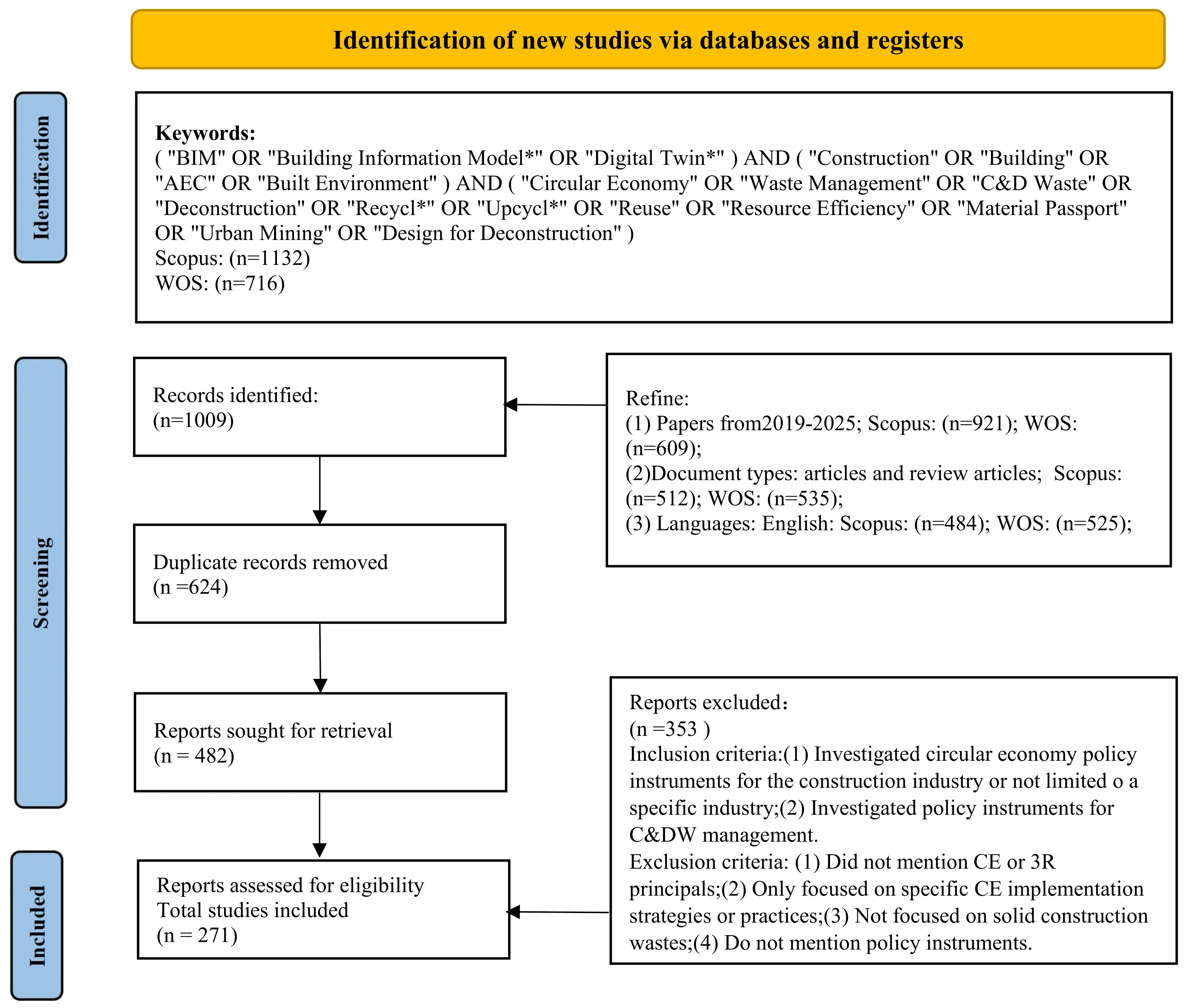
The systematic refinement of the dataset followed the PRISMA guidelines. Crucially, the temporal window was strategically limited to the period between January 2019 and August 2025. This period reflects the evolution of BIM research beyond its established modeling functions. It marks a transition from static material quantification toward dynamic system integration and the adoption of DTs. As noted by Boje et al.[49] and Sacks et al.[50], while pre-2019 research predominantly focused on using BIM as a static repository for design documentation, the period post-2019 witnessed a paradigm shift driven by the proliferation of IoT and Industry 4.0 standards (such as ISO 19650), making this window most relevant for analyzing the transition from passive models to active cyber-physical systems.
The initial search yielded a comprehensive set of raw records, which were then systematically refined within each database prior to merging. First, restricting the publication year to 2019-2025 yielded 609 records from WoS and 921 from Scopus. Second, the document type was limited to peer-reviewed articles and review articles to ensure quality, further narrowing the counts to 535 and 512, respectively. Finally, a language filter was applied to retain only English-language publications, yielding a pre-merging dataset of 525 records from WoS and 484 from Scopus. These refined datasets were merged, and after duplicates were removed using a custom Python script, a total of 482 unique records were retained for the subsequent screening phase.
To ensure the dataset’s high relevance, a rigorous two-stage screening process was implemented. The inclusion criteria stipulated that a study’s primary focus must be on the application of BIM and/or DTs within the explicit context of the CE in the construction industry or CDW management. Conversely, studies were excluded if digital tools were not the primary focus or if the application domain was outside the construction sector (e.g., manufacturing). This screening process resulted in a final sample of 271 publications for analysis.
3.2 Analysis methods and tools
The final dataset was analyzed using a combination of scientometric tools and techniques to systematically address the research questions. VOSviewer (version 1.6.18) was primarily utilized for its superior network visualization capabilities, while CiteSpace (version 6.2.R4) was employed for its strengths in dynamic and temporal analysis. The analysis commenced with a performance and collaboration analysis to understand overall publication trends and identify key research players, in which co-authorship networks were constructed among countries, institutions, and authors. Subsequently, to map the domain’s intellectual structure, a thematic structure analysis was conducted using keyword co-occurrence, which served as the basis for identifying the main research clusters. Finally, to reveal the dynamic evolution of research hotspots, a two-pronged evolutionary path analysis was performed, combining an overlay visualization in VOSviewer to map the average publication year of keywords with keyword burst detection in CiteSpace to quantitatively identify keywords that experienced a surge in attention during specific periods.
4. Results and Analysis
The bibliometric results reveal a clear shift in circular construction research, moving from static design-phase modeling toward dynamic, data-driven decision-making. Collaboration networks identify the leading regions and research groups in the field, while keyword clustering illustrates the theoretical foundations of this transition. Furthermore, temporal analysis highlights key turning points in research priorities. Together, these findings demonstrate an evolution from BIM-based waste estimation toward DT frameworks that support lifecycle management and policy compliance.
4.1 Research landscape and collaboration networks
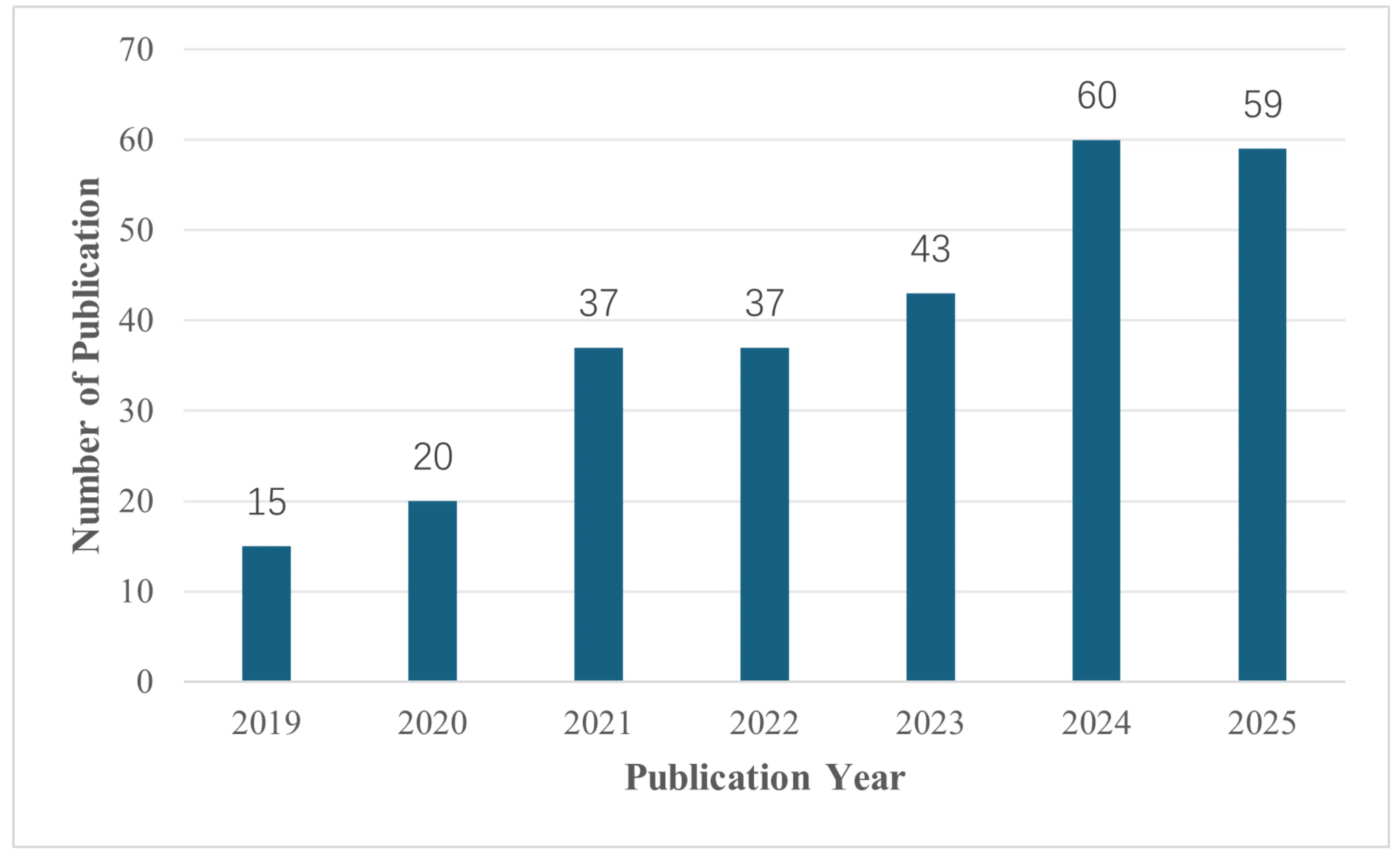
Figure 3 illustrates the annual publication trends from 2019 to 2025. Following a period of limited output in the early years, research activity increased significantly and has sustained growth in recent years. This upward trend suggests that the topic has gained substantial attention and is becoming more established within the academic community.
To further map the research landscape, Figure 4 visualizes the geographical distribution and collaborative patterns using a temporal overlay. The network exhibits a clear core-periphery structure, with England acting as the central intermediary between different research clusters. England’s high degree of centrality and diverse connections links established research hubs, such as the USA, Australia, and France, with emerging regions. Similarly, Australia serves as a critical bridge, facilitating collaboration between China and the Anglo-centric research cluster.
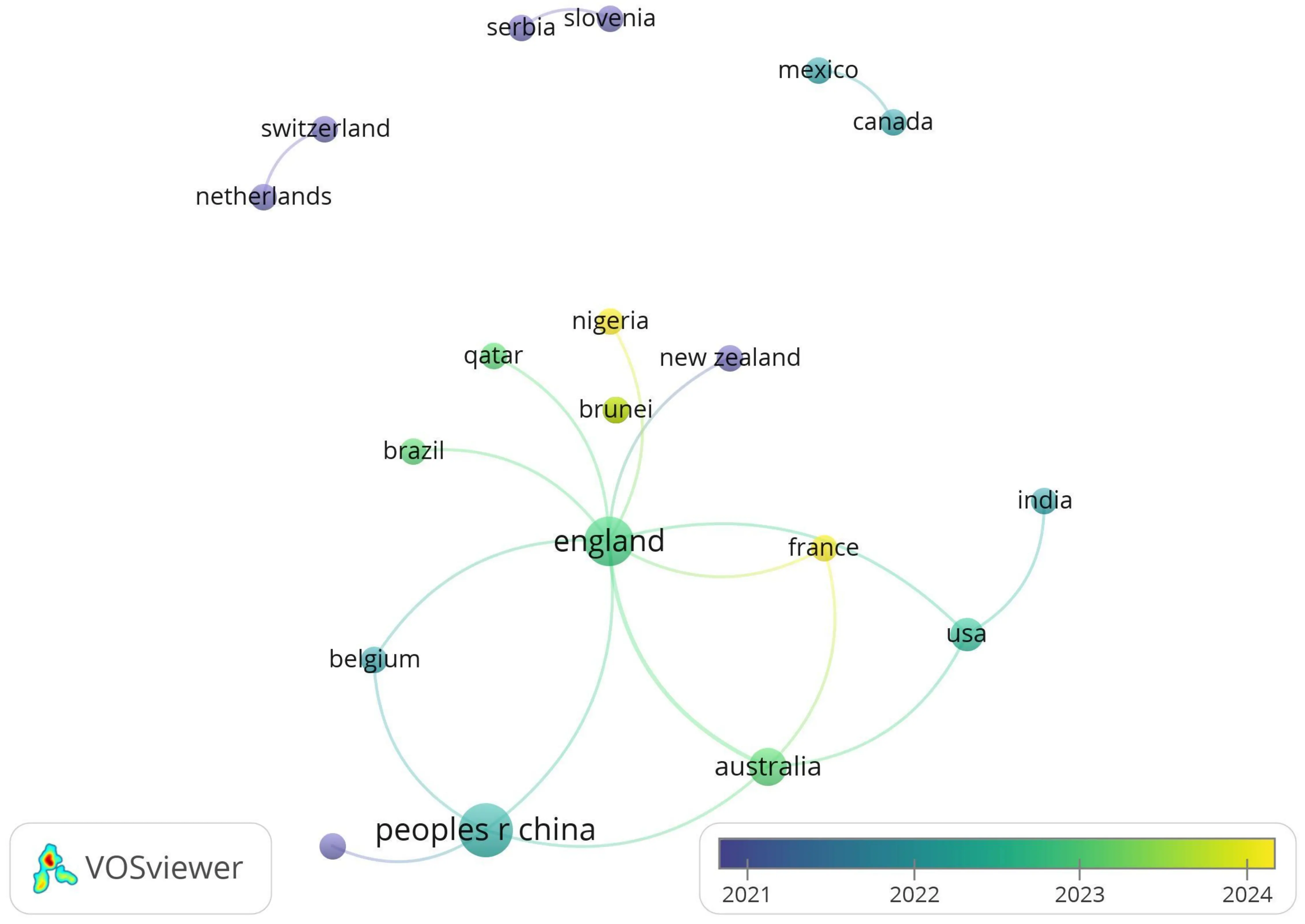
A clear chronological trend is evident in the research network. Established contributors, such as China, Belgium, and the Netherlands, represent the foundational phase of the domain. In contrast, research activity since 2023 has increasingly shifted toward emerging economies, including Nigeria, India, Qatar, and Brunei. This suggests a global diffusion of circular construction expertise from traditional European and Chinese hubs toward rapidly urbanizing regions in the Global South.
Structurally, fragmentation persists in specific regions. The Mexico-Canada dyad and European pairs like Switzerland-Netherlands and Serbia-Slovenia remain structurally detached from the main cluster. Interpreted against the publication trend, this architecture suggests that while agenda-setting on interoperability and governance is concentrated in the UK-China-Australia nexus, the recent surge in the Global South indicates a shifting focus toward applying these technologies in developing contexts, likely driven by urgent urbanization and waste management challenges.
Following the macro-level analysis of countries and institutions, an author-coauthorship network analysis was conducted to identify the most influential scholars and collaborative communities within this research domain. Figure 5 presents the resulting network, where nodes represent individual authors and links indicate co-authorship relationships.
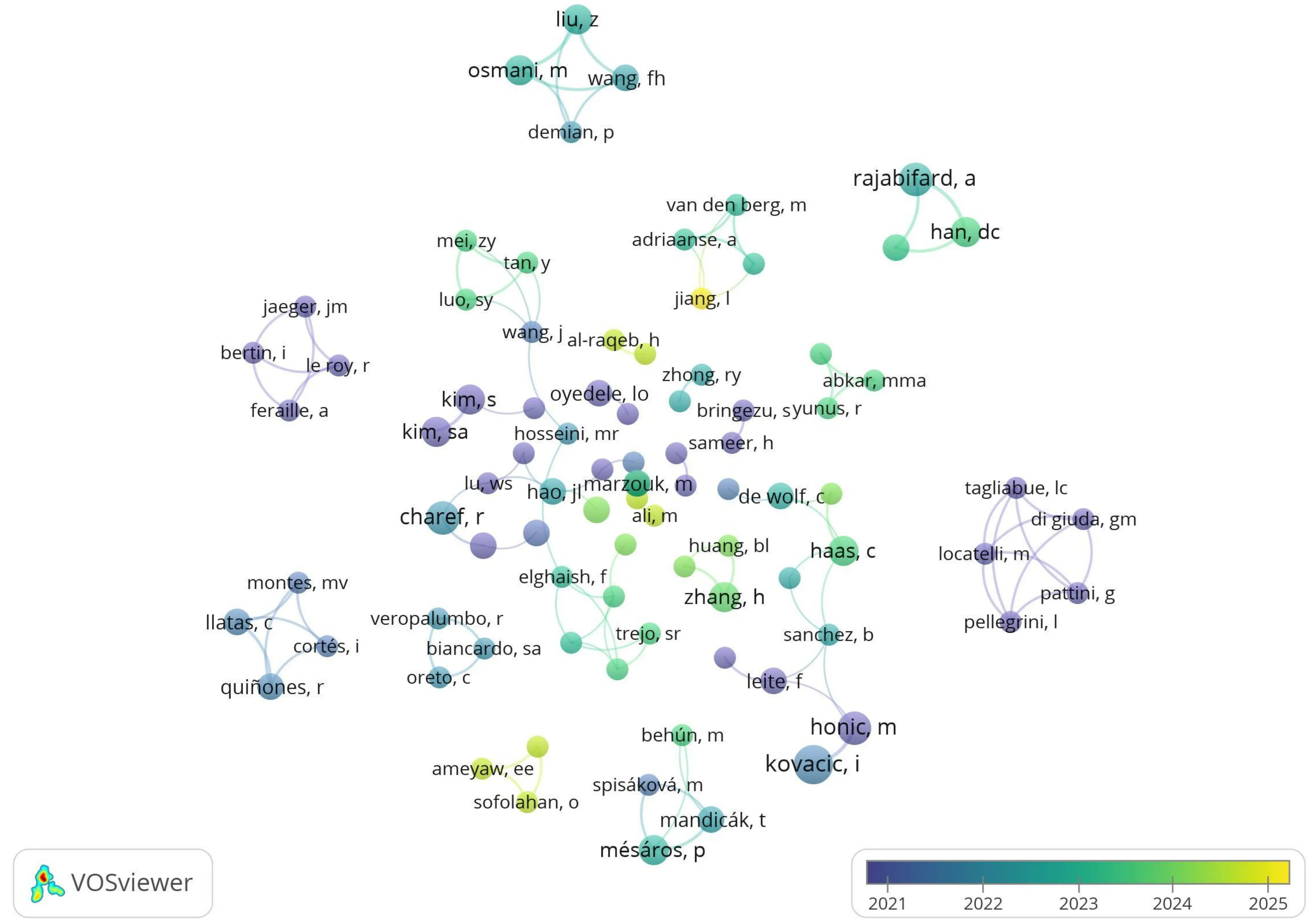
The visualization of collaboration networks (Figure 4 and Figure 5) reveals a landscape that is geographically clustered but structurally fragmented. Unlike the consolidated research landscape in manufacturing, which is driven by integrated product lifecycle management systems, the circular construction domain exhibits distinctive fragmentation. As noted by Sacks et al.[50], the construction industry is characterized by one-off projects and temporary supply chains, leading to research outputs that are often siloed within specific project phases. This bibliometric fragmentation mirrors the industry’s project-based nature, distinguishing it from the product-based continuity seen in other industrial sectors.
4.2 Knowledge structure of core research themes
Figure 6 presents the keyword co-occurrence network, while Table 1 details the specific composition of the identified clusters. Read together, these pieces of visual and tabular evidence reveal a knowledge architecture that empirically mirrors the three-layer framework proposed in Section 2. The topology is organized around three distinct but tightly interlaced clusters, signifying the field’s trajectory from static product definition (Blue) through methodological integration (Green) to systemic operational management (Red).
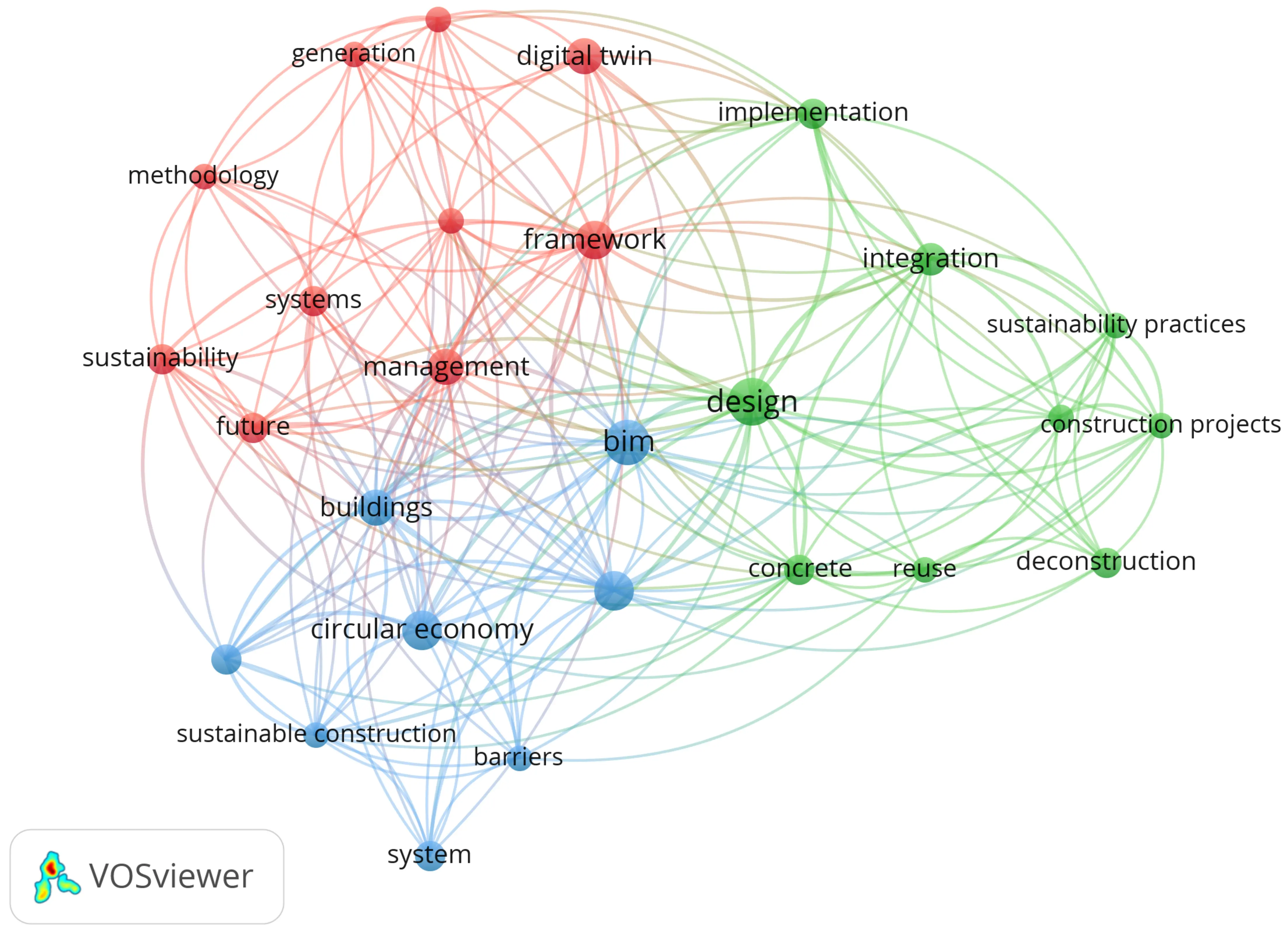
Table 1. Thematic clusters and core keywords.
| Cluster ID | Cluster Label | Core Keywords(ordered by frequency) |
| 1 | Strategic Management & Digital Twin Ecosystems | Construction-industry, digital twin, framework, future, generation, management, methodology, sustainability, systems |
| 2 | Design Integration & Process Implementation | Concrete, construction projects, deconstruction, design, implementation, integration, reuse, sustainability practices |
| 3 | Product Foundations & Circular Economy Context | Barriers, BIM, buildings, built environment, circular economy, construction, sustainable construction, system |
Cluster 3 (Blue: Product Foundations & Circular Economy Context) forms the foundational nucleus. Anchored by high-frequency terms such as “BIM”, “buildings”, and “circular economy” (Table 1), this cluster represents the static product backbone and aligns perfectly with Layer 1 (BIM). It confirms that the digitalization of circular construction begins with establishing robust geometric representations. Research within this cluster substantiates this role; for instance, Naghibalsadati et al.[51] demonstrated how the initial focus on reuse and recycling solidified the conceptual boundaries of this domain. Similarly, Amudjie et al.[52] showed that establishing these robust digital representations yields direct environmental benefits, like carbon emission reduction. However, the boundaries of this bedrock are also defined by limitations, as Liao et al.[53] and Datta et al.[54] note that “barriers” primarily manifest as a lack of expertise, hindering implementation even when the advantages are clear. Thus, this cluster establishes the mandatory static data foundation.
Cluster 2 (Green: Design Integration & Process Implementation) bridges the foundational and operational domains. By grouping “design” and “integration” with execution-oriented terms like “deconstruction” and “reuse”, this cluster captures the industry’s current efforts to operationalize circular strategies. Empirical studies here focus on integrating BIM with dynamic workflows, such as Porwal et al.[55] using simulation to reduce waste by 25%, and Gourabpasi and Nik-Bakht[56] utilizing BIM for automated fault diagnostics. However, a critical structural inconsistency observed in Figure 6 validates our theoretical hypothesis regarding the process gap. Terms strictly related to the construction process—specifically ‘deconstruction’ and ‘reuse’—are integrated within this ‘Design’ cluster rather than forming a distinct ‘logistics’ or ‘process’ nucleus (Layer 2). This spatial arrangement reveals a fundamental theoretical gap: the academic community currently conflates execution logic with design integration, effectively attempting to solve dynamic construction problems using static design thinking. The absence of a dedicated ‘Process Information Modeling’ cluster confirms that the logical bridge remains fragmented, strongly corroborating the necessity of isolating ‘Process Logic’ (Layer 2) to orchestrate these physical workflows.
Cluster 1 (Red: Strategic Management & Digital Twin Ecosystems) represents the strategic and operational apex, corresponding to the operational control of Layer 3 (DT). Dominated by terms like “Digital Twin”, “Management”, and “Systems”, this cluster reflects the shift toward systemic governance and real-time optimization. Research here pushes for dynamic control loops; for example, Ghorbani et al.[57] utilized advanced machine learning algorithms to achieve over 98% precision in waste estimation, while Akanbi et al.[58] formulated analytics systems to quantify reuse potential. Furthermore, Ding et al.[59] proposed BIM-integrated decision-making systems to optimize transportation and demolition plans. By anchoring circular operations in these integrated digital stacks, this cluster enables the lifecycle data continuity required for a regenerative built environment.
In summary, the convergence of these clusters clarifies why the transition beyond static BIM is necessary. The field is reorganizing around a layered platform capability—where Cluster 3 provides the resource inventory (Layer 1), Cluster 2 attempts to enact circular decisions (Layer 2), and Cluster 1 ensures systemic value creation (Layer 3). This data-driven narrative underscores that moving from isolated models to an integrated ecosystem requires explicitly addressing the process logic currently hidden within design integration.
4.3 Evolutionary trajectories of research hotspots
As shown in the timeline overlay (Figure 7), the evolutionary trajectory exhibits a distinct shift in priorities. The early period (purple nodes) is characterized by foundational and strategic terms such as “framework”, “reuse”, and “sustainable practices”. This indicates that the domain’s initial focus was on establishing theoretical frameworks and defining strategies for material circularity (e.g., concrete reuse). This establishes the methodological bedrock, substantiated by seminal studies that standardized circular data structures to overcome documentation barriers, such as the material passport frameworks developed by Honic et al.[60] and the strategy normalization efforts by Charef and Emmitt[29].
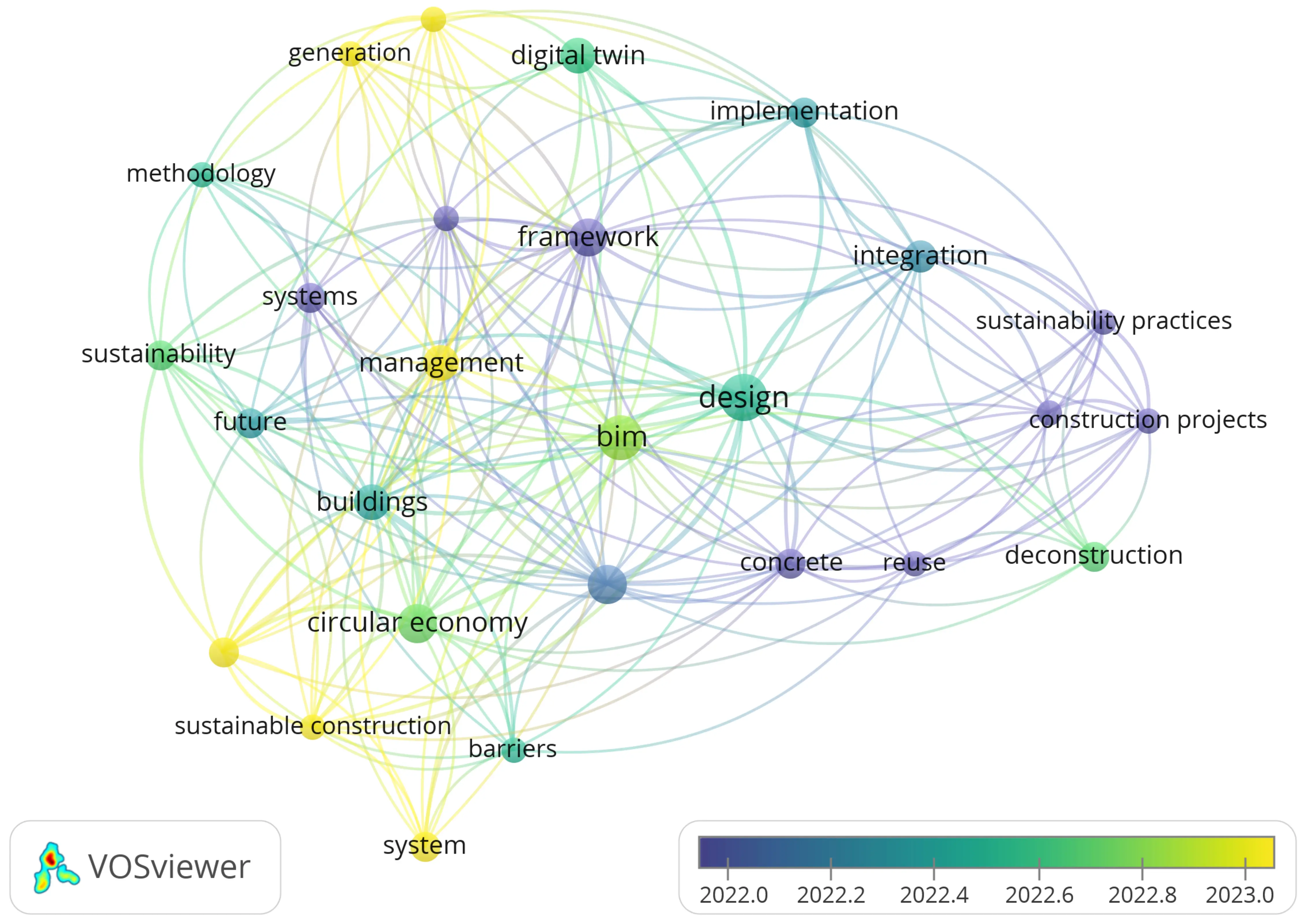
Subsequently, the transitional period (teal/green nodes) witnesses the prominence of “design”, “BIM”, and “integration”. This signals a pivot from theoretical strategies to methodological implementation, where digital tools are integrated into design-stage workflows. This shift is marked by the proliferation of BIM-based deconstruction planning and waste estimation tools, exemplified by the work of Akanbi et al.[58] and Ding et al.[59], who re-engineered lifecycle connectivity for traceable reverse logistics.
Most recently (yellow nodes, terms like “management”, “lifecycle assessment (LCA)”, and “system” have become salient. This reflects the field’s current maturation toward operational control, holistic performance assessment, and systemic governance of the built environment. Representative of this phase is the operational deployment of systemic management platforms and real-time LCA monitoring, as demonstrated in the net-zero pathways by Flores et al.[41] and the Digital Twin connectivity infrastructure proposed by Askar et al.[42].
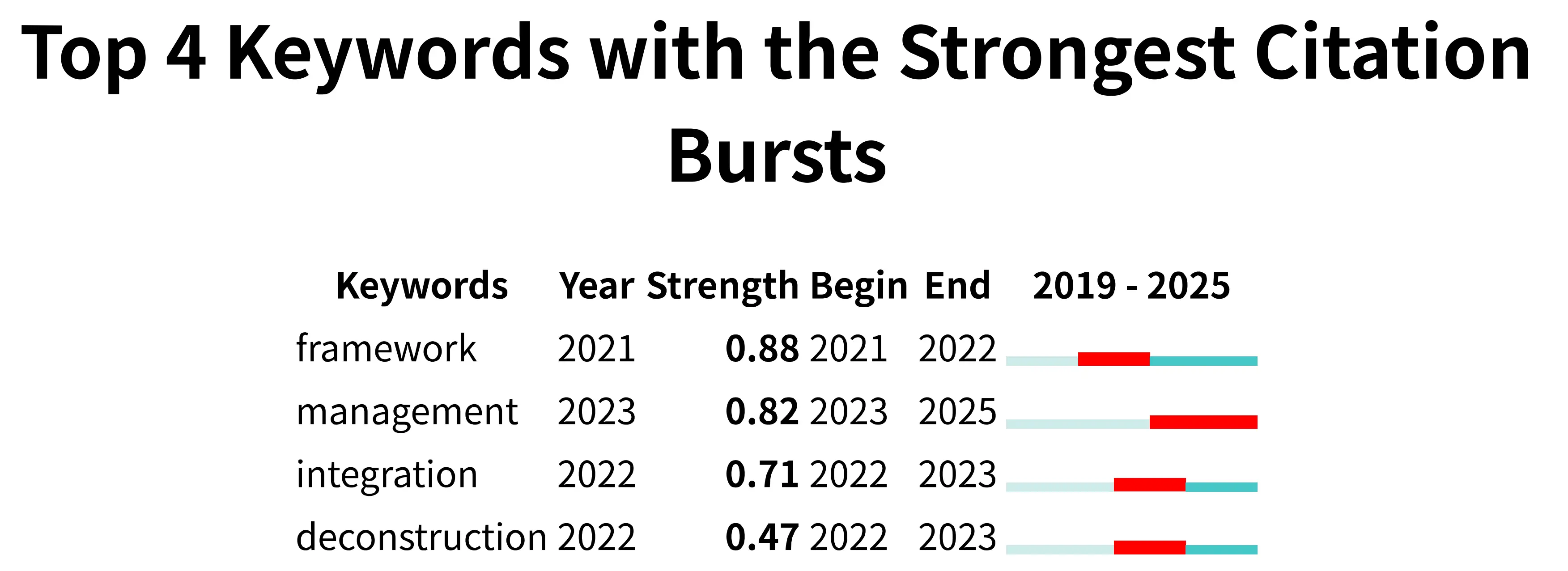
Figure 8 (burst terms) corroborates the turning points implied by the timeline. The pronounced burst of “framework” around 2021 marks method consolidation under a BIM-centric paradigm and the normalization of structured workflows for circular practices at the design stage. The onset of “integration” and “deconstruction” bursts in 2022 captures the re-engineering of lifecycle connectivity and end-of-life processes for traceable reuse and reverse logistics, aligning with the timeline’s emergence of digital-twin linkages. Crucially, the simultaneous surge of ‘deconstruction’—a fundamentally process-centric activity—alongside ‘integration’ suggests a latent demand for modeling the procedures of circularity, not just the physical assets. This period represents an implicit attempt to bridge the static-dynamic gap, effectively serving as a precursor to the formalization of process logic. The sustained prominence of “management” during 2023-2025 reflects the operationalization of these capabilities, as continuous monitoring, embedded LCA pipelines, and carbon accounting transform circularity from periodic evaluation to ongoing control. The temporal concurrence across Figure 6 and Figure 7 provides a robust evidentiary chain from topical emergence to thematic consolidation and operational deployment.
5. Discussion
This study conducted a scientometric review to map the intellectual landscape and evolutionary trajectory of digital technologies, specifically the transition from BIM to DT, in the context of the CE transition for the construction industry. The results reveal a straightforward, data-driven narrative of intellectual maturation. This discussion elaborates on these findings by proposing a four-phase evolution model, integrating shifting value propositions, synthesizing conflicting digital paradigms, and outlining future agendas.
5.1 The evolutionary trajectory and shifting value propositions
The analysis reveals that the application of digital technologies in circular construction has followed a structured four-phase evolutionary path (Table 2). This technological evolution from BIM to DT mirrors a profound expansion in the underlying value proposition of digitalization for the CE. The analysis provides a shift from a singular focus on strategic formulation to a layered proposition encompassing value preservation and systemic value creation.
Table 2. Four-phase evolution of capabilities in digital circular construction research.
| Phase | Timeframe (indicative) | Core capability focus | Key enablers and mechanisms | Dominant terms | Typical evidence and manifestations |
| I. Strategic Foundations & Material Reuse | 2019-2020 | Establishing theoretical frameworks and strategies for component reuse | Circular frameworks, material reuse protocols, sustainable practices | framework; reuse; sustainable practices; concrete; methodology | Prevalence of studies defining strategic frameworks and evaluating the reuse potential of materials (e.g., concrete). |
| II. Design Integration & Tool Implementation | 2020-2021 | Design-stage digitalization and methodological integration of tools | BIM-based design; integration workflows; project implementation | design; BIM; integration; construction projects; implementation | Shift from theory to practice: incorporating circular principles into BIM-based design workflows and integration strategies. |
| III. Dynamic Integration toward Digital Twins | 2022-2024 | Lifecycle connectivity and data continuity across phases | IoT sensing; semantic ontologies; digital twin prototyping | digital twin; deconstruction; future; buildings | Pilot DTs connecting live data to BIM; prototyping operational models for future circular scenarios. |
| IV. Systemic Management & Lifecycle Assessment | 2024-2025 | System-level optimization and holistic environmental assessment | Systemic management platforms; advanced LCA; real-time control | management; system; LCA; generation | Operational deployment of management systems; real-time LCA monitoring; systemic optimization of the built environment. |
BIM: building information modeling; LCA: life-cycle assessment; DT: digital twin; IoT: internet of things.
In the initial eras (2019-2021), Phases I & II (Strategic Foundations and Design Integration) represent the baseline observed at the beginning of our data collection period. As shown in the timeline (Figure 7), the dominance of purple nodes such as “framework”, “reuse”, and “sustainable practices” indicates that the field began by establishing the theoretical rules and evaluating the reuse potential of core materials (e.g., concrete). During this period, the domain was focused on method consolidation. As corroborated by the burst analysis of terms like “framework” (Figure 8), early research clusters defined value primarily through Strategic Optimization: leveraging static information to improve design efficiency and standardize protocols. Seminal studies such as Honic et al.[60] and Charef and Emmitt[29] exemplify this phase, focusing on standardizing data structures to overcome barriers to material documentation and establishing the metrics required for circularity.
However, the emergence of “integration”, “design”, and “deconstruction” themes (Figure 7) introduces a transitional value proposition of value preservation. This aligns with the PIM backbone identified in the conceptual framework. Here, value is realized not just by designing efficiently, but by explicitly modeling the processes of disassembly and recovery. Without this procedural logic, materials, however well-documented in BIM, remain locked in the asset. PIM unlocks this value by defining the “how-to” of retrieval, ensuring that physical materials can be retained at their highest utility. This confirms the need to move beyond static product models to dynamic process models. Furthermore, the absence of a dominant ‘PIM’ cluster in the scientometric data validates our theoretical observation: the industry lacks a consolidated process backbone, leading to the fragmented clusters of ‘deconstruction’ and ‘implementation’ we observed.
Finally, the emerging clusters (2023-2025) unlock systemic value creation in Phases III & IV. The prominence of yellow nodes such as “management”, “system”, and “lifecycle assessment” marks the field’s maturation. By leveraging BIM data and PIM logic in real time, DTs enable fundamentally new circular business models. For instance, reverse logistics becomes a dynamic marketplace for secondary materials, and “Building-as-a-Service” models become viable. In this phase, digitalization no longer supports construction; it actively generates new economic and environmental value streams by orchestrating the entire ecosystem. Recent studies validate this, illustrating how DTs extend beyond single-asset management to city-level circularity.
To further elucidate this trajectory, the analysis suggests that the transition from BIM to DT is essentially a progression along the project lifecycle, revealing a critical structural bottleneck. In the Design Phase, despite the imperative for lifecycle thinking, current research remains heavily BIM-dominant and focused on static quantification, such as material passports. A critical gap exists here because these static designs rarely explicitly account for the dynamic disassembly process. Consequently, the Construction and Deconstruction Phase emerges as a blind spot in the current literature. This is precisely where the proposed process logic (PIM) is critical; without explicitly modeling the dynamic scheduling and logistics during this intermediate phase, the connection between design and reality breaks down. Ultimately, while the Operation Phase targets real-time management via DTs, these systems require data continuity. Without the dynamic process data from PIM during the construction phase, the DT lacks the operational context needed to make accurate, data-driven EoL decisions.
5.2 Comparative synthesis of conflicting digital paradigms
A critical synthesis of the reviewed literature reveals that the transition from BIM to DT is not a uniform progression but a theoretical landscape defined by fundamental divergences. A review of the current literature reveals a fundamental debate over data sufficiency. While traditional BIM research suggests that high levels of development (LOD) are enough for managing material stocks, this static perspective is increasingly challenged by studies that emphasize the need for semantic connectivity and dynamic data integration. Boje et al.[49] explicitly argue that geometric precision alone is insufficient without semantic interoperability, labeling standard BIM as merely “Generation 1” digital twins. This critique is further extended by Copeland and Bilec[61], who demonstrate that static Material Passports often fail to capture material degradation over time and argue instead for dynamic, sensor-updated conceptualizations that reflect the changing reality of the built asset.
This ontological schism is paralleled by a divergence in the agency of control, revealing a widespread misclassification within current research. Although many studies label any sensor-enabled 3D visualization as a digital twin, Kritzinger et al.[62] establish a strict demarcation based on the control loop, classifying one-way data flows as “Digital Shadows” while reserving the term “Digital Twin” exclusively for systems capable of bi-directional control. When this distinction is synthesized with Bilal et al.’s findings[3], which identify technological complexity as a primary barrier, it becomes evident that the majority of circular construction practices are stuck at the “Digital Shadow” stage. Consequently, the industry has yet to achieve the automated actuation and feedback mechanisms required for actual systemic efficiency.
Finally, a profound gap persists in logistical modeling, where the dominant paradigm frequently relies on forward logistics logic—operating under the assumption that deconstruction is simply construction reversed. In sharp contrast, specialized literature on deconstruction planning exposes the inconsistency of this assumption. Akanbi et al.[58] and Ding et al.[59] explicitly highlight the unpredictable nature of demolition, arguing that the high uncertainty of EoL recovery requires distinct algorithms for sorting and reverse logistics that are absent in standard construction planning. Furthermore, Shojaei et al.[48] introduce blockchain as a necessary architectural layer to address trust issues inherent in secondary material markets, a dimension completely absent in traditional forward logistics models. These divergences collectively underscore the need for a dedicated, process-oriented backbone to bridge the gap between idealized digital representations and complex physical realities.
5.3 Future agenda and managerial implications
Despite the evolutionary progress outlined in this study, significant research gaps remain that require urgent scholarly attention. A critical reverse logistics gap persists; as highlighted by Ding et al.[59], there is a marked scarcity of studies addressing the complex stochasticity of recovering EoL materials compared to the deterministic nature of forward supply chains. Future research must therefore prioritize the development of digital platforms tailored explicitly to these reverse flows. Concurrently, to bridge the semantic gap identified by Boje et al.[49], inquiry must transcend geometric modeling to embrace semantic web technologies, which are essential for enabling the proposed PIM layer across fragmented supply chains. Furthermore, recognizing that technological maturity alone is insufficient, future work should investigate how DTs can generate the verification data necessary to mitigate the market trust issues and regulatory uncertainties identified by Bilal et al.[3].
Translating these academic findings into practice, the proposed four-phase evolution model serves as a strategic roadmap for technology adoption within construction firms. Managers should use this roadmap to benchmark their current maturity, aiming to progress from the static integration of Phase II toward the systemic capabilities of Phases III and IV. However, to successfully traverse this trajectory, firms may adopt the Three-Layer Architecture as their implementation guide. While a robust BIM implementation (Phase II / Layer 1) is an undisputed prerequisite, the leap to the functional DTs characteristic of Phase IV (Layer 3) cannot be achieved by skipping the intermediate foundation: the formalization of process logic, or Layer 2 (PIM). Consequently, firms should prioritize investments in defining standardized digital workflows for deconstruction sequencing alongside physical asset models—effectively mastering Layer 2 integration as the critical bridge to unlock the real-time simulation capabilities of the later evolutionary phases.
Beyond the individual firm, these findings hold broader implications for the software ecosystem and policy landscape. The identification of interoperability as a critical research hotspot sends a clear signal to software developers to shift focus from optimizing siloed tools to facilitating seamless data flows across the entire asset lifecycle—from design to deconstruction. Finally, policymakers can leverage the evidentiary value of this study to develop data governance frameworks that incentivize the adoption of DTs for circularity reporting. By aligning regulatory instruments with digital maturity models, policymakers can effectively accelerate the industry’s transition toward a regenerative built environment.
6. Conclusion
By mapping the evolutionary trajectory of digital technologies in the CE transition within the construction sector, this systematic review does more than catalog bibliometric shifts. Instead, it uncovers a profound structural pivot: the transition from the static blueprint characteristic of BIM to the intelligent brain promised by DTs. The core value of this research lies in developing a four-stage maturation model that traces the field’s progression from foundational strategic frameworks to sophisticated, policy-aligned management systems.
Crucially, this review moves beyond a simple adoption model to reveal the theoretical backbone needed for systemic circularity in the construction industry. A comparative synthesis of the literature highlights three critical divergences hindering the current transition to DTs: the ontological gap between geometric data and semantic connectivity, the agency gap between passive digital shadows and active DTs, and the logistical gap between forward assembly and reverse recovery. The findings suggest that bridging these divides requires more than cumulative technological adoption; it demands the formalization of PIM. This process-oriented logic functions as the essential intermediate link, effectively coupling the static product data of BIM with the real-time control capabilities of DTs to enable actual circular operations.
For industry stakeholders, these findings redefine the strategic implementation roadmap. The analysis cautions against the premature deployment of complex DT systems without the antecedent establishment of necessary process data standards. Consequently, managerial strategies are advised to prioritize the digitization of deconstruction workflows and the implementation of reverse logistics logic as prerequisites for achieving the systemic value creation promised by Industry 4.0.
While this study offers a comprehensive evolutionary mapping, several limitations should be acknowledged to contextualize the findings. First, the data collection was restricted to peer-reviewed English journal articles. Consequently, this may exclude relevant insights from non-English publications documenting local circular practices. Second, the scientometric analysis relies primarily on keyword co-occurrence. Although effective for identifying macro-trends, this method may overlook semantic nuances or emerging concepts that have not yet been formalized in standardized terminology. Finally, the proposed Three-Layer Architecture is a theoretical framework synthesized from identified literature gaps. While it provides a logical roadmap, its practical efficacy requires further validation through real-world case studies and empirical implementation in diverse construction projects.
Acknowledging these boundaries, future research must shift toward three specific frontiers. First, addressing the logistical gap requires developing digital platforms specifically designed to manage the unpredictable nature of reverse logistics and material recovery. Second, closing the semantic gap requires investigating semantic web technologies to enable interoperability across fragmented supply chains, moving beyond geometry toward knowledge graphs. Finally, research should explore how DTs can provide the verification data needed to validate trust, thereby overcoming market resistance and regulatory uncertainty in secondary material trading. Addressing these frontiers will allow the industry to transition from isolated digital pilots to a cohesive, data-driven circular ecosystem.
Acknowledgements
The authors declare that generative AI tools were used solely for linguistic refinement of the text and for the high-fidelity rendering of conceptual visualizations in Figure 1. Importantly, the conceptual logic, hierarchical structure, and technical annotations within the figures remain the original intellectual work of the authors. All AI-assisted visual elements were manually verified for scientific accuracy and revised to ensure they faithfully represent the proposed research framework.
Authors contribution
Li K: Conceptualization, methodology, software, formal analysis, investigation, writing-original draft, visualization.
Huangfu D: Data curation, investigation.
Ran Y: Formal analysis, validation.
Chen J: Methodology, technical support.
Chen Y: Supervision, project administration, funding acquisition,, resources.
Conflicts of interest
Jingtong Chen is affiliated with Yunnan Airport Construction and Development Co., Ltd. The other authors declare that they have no conflict of interest.
Ethical approval
Not applicable.
Consent to participate
Not applicable.
Consent for publication
Not applicable.
Availability of data and materials
The datasets generated and/or analyzed during the current study are not publicly available due to licensing restrictions from the data providers (Web of Science and Scopus) but are available from the corresponding author on reasonable request.
Funding
This work was supported by the National Natural Science Foundation of China (grant number 72461017 and 72061019), and the Kunming University of Science and Technology’s Smart Driven Sustainable Urban Renewal Innovation Team (grant number KGZSCXTD2025003).
Copyright
© The Author(s) 2026.
References
-
1. Backes JG, Traverso M. Application of life cycle sustainability assessment in the construction sector: A systematic literature review. Processes. 2021;9(7):1248.[DOI]
-
2. Sivashanmugam S, Rodriguez S, Rahimian F, Dawood N. Maximising the construction waste reduction potential–barriers and catalysts. Proc Inst Civ Eng Civ Eng. 2023;176(6):6-14.[DOI]
-
3. Bilal M, Ahmad Khan KI, Thaheem MJ, Nasir AR. Current state and barriers to the circular economy in the building sector: Towards a mitigation framework. J Clean Prod. 2020;276:123250.[DOI]
-
4. Halog A, Anieke S. A review of circular economy studies in developed countries and its potential adoption in developing countries. Circ Econ Sustain. 2021;1(1):209-230.[DOI]
-
5. Banihashemi S, Meskin S, Sheikhkhoshkar M, Mohandes SR, Hajirasouli A, LeNguyen K. Circular economy in construction: The digital transformation perspective. Clean Eng Technol. 2024;18:100715.[DOI]
-
6. Saad Alotaibi B, Waqar A, Radu D, Khan AM, Dodo Y, Althoey F, et al. Building information modeling (BIM) adoption for enhanced legal and contractual management in construction projects. Ain Shams Eng J. 2024;15(7):102822.[DOI]
-
7. Abuhussain MA, Waqar A, Khan AM, Othman I, Alotaibi BS, Althoey F, et al. Integrating Building Information Modeling (BIM) for optimal lifecycle management of complex structures. Structures. 2024;60:105831.[DOI]
-
8. Eze EC, Aghimien DO, Aigbavboa CO, Sofolahan O. Building information modelling adoption for construction waste reduction in the construction industry of a developing country. Eng Constr Archit Manag. 2024;31(6):2205-2223.[DOI]
-
9. Mannino A, Dejaco MC, Re Cecconi F. Building information modelling and Internet of Things integration for facility management: Literature review and future needs. Appl Sci. 2021;11(7):3062.[DOI]
-
10. Balasubramanian S, Shukla V, Islam N, Manghat S. Construction industry 4.0 and sustainability: An enabling framework. IEEE Trans Eng Manage. 2024;71:1-19.[DOI]
-
11. Mihai S, Yaqoob M, Hung DV, Davis W, Towakel P, Raza M, et al. Digital twins: A survey on enabling technologies, challenges, trends and future prospects. IEEE Commun Surv Tutorials. 2022;24(4):2255-2291.[DOI]
-
12. Su S, Li S, Ju J, Wang Q, Xu Z. A building information modeling-based tool for estimating building demolition waste and evaluating its environmental impacts. Waste Manag. 2021;134:159-169.[DOI]
-
13. Zhuang D, Zhang X, Lu Y, Wang C, Jin X, Zhou X, et al. A performance data integrated BIM framework for building life-cycle energy efficiency and environmental optimization design. Autom Constr. 2021;127:103712.[DOI]
-
14. Luo S, Yao J, Wang S, Wang Y, Lu G. A sustainable BIM-based multidisciplinary framework for underground pipeline clash detection and analysis. J Clean Prod. 2022;374:133900.[DOI]
-
15. Aziminezhad M, Taherkhani R. BIM for deconstruction: A review and bibliometric analysis. J Build Eng. 2023;73:106683.[DOI]
-
16. Talla A, McIlwaine S. Industry 4.0 and the circular economy: Using design-stage digital technology to reduce construction waste. Smart Sustain Built Environ. 2024;13(1):179-198.[DOI]
-
17. Xia Z, Zhang S, Tian X, Liu Y. Understanding waste sorting behavior and key influencing factors through Internet of Things: Evidence from college student community. Resour Conserv Recycl. 2021;174:105775.[DOI]
-
18. Lin YH, Wang J, Niu D, Tao X. Blockchain-driven framework for construction waste recycling and reuse. J Build Eng. 2024;89:109355.[DOI]
-
19. Barkokebas B, Al-Hussein M, Hamzeh F. Assessment of digital twins to reassign multiskilled workers in offsite construction based on lean thinking. J Constr Eng Manage. 2023;149:04022143.[DOI]
-
20. Iyiola CO, Shakantu W, Daniel EI. Digital technologies for promoting construction and demolition waste management: A systematic review. Buildings. 2024;14(10):3234.[DOI]
-
21. Pan W, Ilhan B, Bock T. Process information modelling (PIM) for public housing construction project in Hong Kong. In: Skibniewski MJ, Hajdu M, editors. Proceedings of the Creative Construction Conference 2018. Jun 30-Jul 3 2018; Ljubljana, Slovenia. Budapest: Diamond Congress Ltd.; 2018. p. 74-81.[DOI]
-
22. Badenko V, Bolshakov N, Celani A, Puglisi V. Principles for sustainable integration of BIM and digital twin technologies in industrial infrastructure. Sustainability. 2024;16(22):9885.[DOI]
-
23. Sepasgozar S, Khan A, Smith K, Romero J, Shen X, Shirowzhan S, et al. BIM and digital twin for developing convergence technologies as future of digital construction. Buildings. 2023;13(2):441.[DOI]
-
24. Kim T, Yoon Y, Lee B, Ham N, Kim JJ. Cost–benefit analysis of scan-vs-BIM-based quality management. Buildings. 2022;12(12):2052.[DOI]
-
25. Li X, Wang C, Alashwal A. Case study on BIM and value engineering integration for construction cost control. Adv Civ Eng. 2021;2021:8849303.[DOI]
-
26. Sepasgozar SME, Costin AM, Karimi R, Shirowzhan S, Abbasian E, Li J. BIM and digital tools for state-of-the-art construction cost management. Buildings. 2022;12(4):396.[DOI]
-
27. Mousavi Y, Gharineiat Z, Karimi AA, McDougall K, Rossi A, Gonizzi Barsanti S. Digital twin technology in built environment: A review of applications, capabilities and challenges. Smart Cities. 2024;7(5):2594-2615.[DOI]
-
28. Su S, Zhong RY, Jiang Y. Digital twin and its applications in the construction industry: A state-of-art systematic review. Digit Twin. 2025;2:2501499.[DOI]
-
29. Charef R, Emmitt S. Uses of building information modelling for overcoming barriers to a circular economy. J Clean Prod. 2021;285:124854.[DOI]
-
30. Gupta S, Jha KN, Vyas G. Proposing building information modeling-based theoretical framework for construction and demolition waste management: Strategies and tools. Int J Constr Manag. 2022;22(12):2345-2355.[DOI]
-
31. Quiñones R, Llatas C, Montes MV, Cortés I. Quantification of construction waste in early design stages using bim-based tool. Recycling. 2022;7(5):63.[DOI]
-
32. Lins EJM, Palha RP, do Carmo Martins Sobral M, de Araújo AG, Marques ÉAT. Application of building information modelling in construction and demolition waste management: Systematic review and future trends supported by a conceptual framework. Sustainability. 2024;16(21):9425.[DOI]
-
33. Mohammed A, Ghannam M, Elmasoudi I. Design for steel structures deconstruction: An analytics system for construction waste minimization in a circular economy through BIM technology. Innov Infrastruct Solut. 2024;9(11):409.[DOI]
-
34. Ammar A, Nassereddine H, AbdulBaky N, AbouKansour A, Tannoury J, Urban H, et al. Digital twins in the construction industry: A perspective of practitioners and building authority. Front Built Environ. 2022;8:834671.[DOI]
-
35. Revolti A, Gualtieri L, Pauwels P, Dallasega P. From building information modeling to construction digital twin: A conceptual framework. Prod Manuf Res. 2024;12:2387679.[DOI]
-
36. Tuhaise VV, Tah JHM, Abanda FH. Technologies for digital twin applications in construction. Autom Constr. 2023;152:104931.[DOI]
-
37. Dihan MS, Akash AI, Tasneem Z, Das P, Das SK, Islam MR, et al. Digital twin: Data exploration, architecture, implementation and future. Heliyon. 2024;10(5):e26503.[DOI]
-
38. Nguyen TD, Adhikari S. The role of BIM in integrating digital twin in building construction: A literature review. Sustainability. 2023;15(13):10462.[DOI]
-
39. Bakhshi S, Ghaffarianhoseini A, Ghaffarianhoseini A, Najafi M, Rahimian F, Park C, et al. Digital twin applications for overcoming construction supply chain challenges. Autom Constr. 2024;167:105679.[DOI]
-
40. Ciano MP, Peron M, Panza L, Pozzi R. Industry 4.0 technologies in support of circular Economy: A 10R-based integration framework. Comput Ind Eng. 2025;201:110867.[DOI]
-
41. Flores Lara JC, El-Fadel M, Rauf A, Ali Khalfan MM. Pathways toward Net-zero emissions in the construction industry: A framework integrating circular economy and industry 4.0 innovations. Build Environ. 2025;285:113652.[DOI]
-
42. Askar R, Karaca F, Salles A, Lukyanenko A, Cervantes Puma GC, Tavares V, et al. Driving the built environment twin transition: Synergising circular economy and digital tools. In: Bragança L, Griffiths P, Askar R, Salles A, Ungureanu V, Tsikaloudaki K, Bajare D, Zsembinszki G, Cvetkovska M, editors. Circular economy design and management in the built environment: A critical review of the state of the art. Cham: Springer; 2025. p. 459-505.[DOI]
-
43. De Wolf C, Byers BS, Raghu D, Gordon M, Schwarzkopf V, Triantafyllidis E. D5 digital circular workflow: Five digital steps towards matchmaking for material reuse in construction. npj Mater Sustain. 2024;2:36.[DOI]
-
44. Wu L, Lu W, Peng Z, Webster C. A blockchain non-fungible token-enabled ‘passport’ for construction waste material cross-jurisdictional trading. Autom Constr. 2023;149:104783.[DOI]
-
45. Boton C, Rivest L, Forgues D, Jupp J. Comparing PLM and BIM from the product structure standpoint. In: Harik R, Rivest L, Bernard A, Eynard B, Bouras A, editors. Product lifecycle management for digital transformation of industries. Cham: Springer; 2016. p. 443-453.[DOI]
-
46. Aram S, Eastman C, Sacks R. A knowledge-based framework for quantity takeoff and cost estimation in the AEC industry using BIM. In: Proceedings of the 31st International Symposium on Automation and Robotics in Construction; Sydney, Australia. Berlin: IAARC; 2014.[DOI]
-
47. Javaid M, Haleem A, Singh RP, Suman R, Gonzalez ES. Understanding the adoption of Industry 4.0 technologies in improving environmental sustainability. Sustain Oper Comput. 2022;3:203-217.[DOI]
-
48. Shojaei A, Wang J, Fenner A. Blockchain technology as an enabler of smart and circular construction. Built Environ Proj Asset Manag. 2020;10(2):284-301.[DOI]
-
49. Boje C, Guerriero A, Kubicki S, Rezgui Y. Towards a semantic Construction Digital Twin: Directions for future research. Autom Constr. 2020;114:103179.[DOI]
-
50. Sacks R, Brilakis I, Pikas E, Xie HS, Girolami M. Construction with digital twin information systems. Data Centric Eng. 2020;1:e14.[DOI]
-
51. Naghibalsadati F, Gitifar A, Ray S, Richter A, Ng KTW. Temporal evolution and thematic shifts in sustainable construction and demolition waste management through building information modeling technologies: A text-mining analysis. J Environ Manag. 2024;369:122293.[DOI]
-
52. Amudjie J, Chan APC, Darko A, Debrah C, Agyekum K. CircularBIM: Future needs at the convergence of building information modelling and the circular economy. Autom Constr. 2025;176:106250.[DOI]
-
53. Liao L, Zhou K, Fan C, Ma Y. Evaluation of complexity issues in building information modeling diffusion research. Sustainability. 2022;14(5):3005.[DOI]
-
54. Datta SD, Tayeh BA, Hakeem IY, Abu Aisheh YI. Benefits and barriers of implementing building information modeling techniques for sustainable practices in the construction industry: A comprehensive review. Sustainability. 2023;15(16):12466.[DOI]
-
55. Porwal A, Parsamehr M, Szostopal D, Ruparathna R, Hewage K. The integration of building information modeling (BIM) and system dynamic modeling to minimize construction waste generation from change orders. Int J Constr Manag. 2023;23(1):156-166.[DOI]
-
56. Hosseini Gourabpasi A, Nik-Bakht M. BIM-based automated fault detection and diagnostics of HVAC systems in commercial buildings. J Build Eng. 2024;87:109022.[DOI]
-
57. Ghorbani S, Ghorbany S, Noorzai E. Development of a data-driven framework to predict waste generation and evaluate influential factors: Machine learning innovations in construction waste management. Clean Waste Syst. 2025;11:100299.[DOI]
-
58. Akanbi LA, Oyedele LO, Akinade OO, Ajayi AO, Davila Delgado M, Bilal M, et al. Salvaging building materials in a circular economy: A BIM-based whole-life performance estimator. Resour Conserv Recycl. 2018;129:175-186.[DOI]
-
59. Ding L, Wang T, Chan PW. Forward and reverse logistics for circular economy in construction: A systematic literature review. J Clean Prod. 2023;388:135981.[DOI]
-
60. Honic M, Kovacic I, Rechberger H. BIM-based material passports for the end-of-life stage of buildings. Proc Inst Civ Eng Eng Sustain. 2019;172(5):233-242.[DOI]
-
61. Copeland S, Bilec M. Buildings as material banks using RFID and building information modeling in a circular economy. Procedia CIRP. 2020;90:143-147.[DOI]
-
62. Kritzinger W, Karner M, Traar G, Henjes J, Sihn W. Digital Twin in manufacturing: A categorical literature review and classification. IFAC PapersOnLine. 2018;51(11):1016-1022.[DOI]
Copyright
© The Author(s) 2026. This is an Open Access article licensed under a Creative Commons Attribution 4.0 International License (https://creativecommons.org/licenses/by/4.0/), which permits unrestricted use, sharing, adaptation, distribution and reproduction in any medium or format, for any purpose, even commercially, as long as you give appropriate credit to the original author(s) and the source, provide a link to the Creative Commons license, and indicate if changes were made.
Publisher’s Note
Science Exploration remains a neutral stance on jurisdictional claims in published
maps
and institutional affiliations. The views expressed in this article are solely those
of
the author(s) and do not reflect the opinions of the Editors or the publisher.
Share And Cite


Science Exploration Style
Li K, Huangfu D, Chen J, Ran Y, Chen Y. From digital blueprints to virtual brains: Evolutionary trajectory and process logic in circular construction. J Build Des Environ. 2026;4:2025137. https://doi.org/10.70401/jbde.2026.0030
Tips
Copy completed.
Submit a Manuscript
Author Instructions
Cite this Article
Article Metrics
0
View
0
Download
Cited
Article Updates

- Abstract
- Keywords
- 1. Introduction
- 2. Conceptual Foundations: A Layered Digital Architecture for Circular Construction
- 3. Methodology
- 4. Results and Analysis
- 5. Discussion
- 6. Conclusion
- Acknowledgements
- Authors contribution
- Conflicts of interest
- Ethical approval
- Consent to participate
- Consent for publication
- Availability of data and materials
- Funding
- References
- Copyright
 Get citation
Science Exploration Style

Li K, Huangfu D, Chen J, Ran Y, Chen Y. From digital blueprints to virtual brains: Evolutionary trajectory and process logic in circular construction. J Build Des Environ. 2026;4:2025137. https://doi.org/10.70401/jbde.2026.0030
copy
Share Link
copy
Subscribe