Mannich reaction-enabled construction of nitrogen-containing macrocyclic arenes

Wanhua Wu
*

,
Cheng Yang
*
*Correspondence to:
Wanhua Wu, Key Laboratory of Green Chemistry & Technology of Ministry of Education College of Chemistry, Sichuan University, Chengdu 610064, Sichuan, China.
E-mail: wuwanhua@scu.edu.cn
Cheng Yang, Key Laboratory of Green Chemistry & Technology of Ministry of Education College of Chemistry, Sichuan University, Chengdu 610064, Sichuan, China. E-mail: yangchengyc@scu.edu.cn
Cheng Yang, Key Laboratory of Green Chemistry & Technology of Ministry of Education College of Chemistry, Sichuan University, Chengdu 610064, Sichuan, China. E-mail: yangchengyc@scu.edu.cn
Chiral Chem. 2027;3:202629. 10.70401/cc.2026.0035
Received: June 23, 2026Accepted: August 03, 2026Published: August 06, 2026
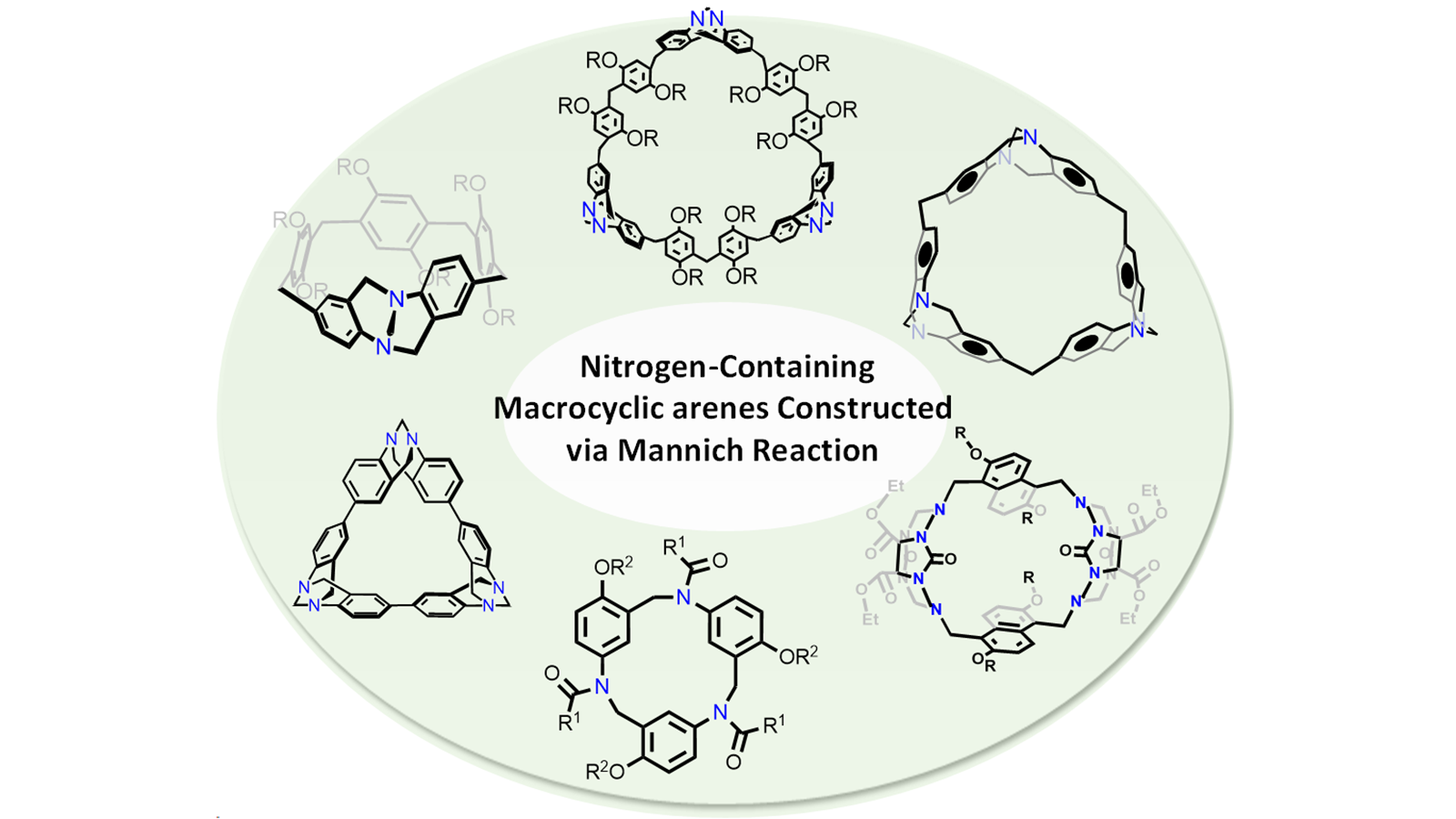
Graphical Abstract
1. Introduction
Macrocyclic arenes, constructed from electron-rich aromatic rings linked by methylene or methenyl bridges, have garnered increasing interest in recent years owing to their unique structures, facile functionalization, and broad range of applications[1-3]. A growing number of macrocyclic arenes composed of diverse aromatic units have been synthesized worldwide, including calixarenes[4,5], pillararenes[6,7], prismarenes[8,9], and others[10-13]. These macrocycles are typically constructed from alkoxy-activated arenes, such as phenol derivatives, via Friedel–Crafts alkylation. In addition, aromatic amines, which are also π-electron-rich arenes, represent excellent building blocks for macrocyclic arenes. The unique electronic properties and hydrogen-bonding capability of nitrogen atoms endow nitrogen-containing macrocyclic arenes with distinctive host–guest properties. Moreover, the nitrogen centers offer versatile sites for post-synthetic modification. These features render nitrogen-containing macrocyclic arenes highly attractive as functional materials for molecular sensing[14,15], iodine adsorption[16,17], and luminescence[18].
Conventionally, nitrogen-containing macrocyclic arenes have been constructed from tertiary aromatic amines via Friedel–Crafts alkylation[16-20]. However, this approach is often limited when primary or secondary amines are employed, as their N–H protons tend to deactivate Lewis acid catalysts (e.g., AlCl3, FeCl3) through coordination or proton transfer. Moreover, the labile N–H bonds themselves can act as competing nucleophilic sites, leading to undesired side reactions. Among these competing pathways, the Mannich condensation is one of the most typical. This process involves the dehydration of the amine N–H with paraformaldehyde to generate highly reactive iminium electrophiles, which subsequently attack the aromatic ring, introducing methylene bridges and forming an NAr–CH2–CAr linkage[21]. In early work, the one-pot Mannich condensation of resorcinarenes with piperazine and an excess of formaldehyde under high-dilution conditions afforded a helical cage, a covalently linked dimer of two resorcinarene units connected via four piperazine bridges. This cage was shown to encapsulate guests through size-dependent adjustment of its helical pitch, a clear manifestation of shape-adaptive host–guest behavior[22].
More recently, Mannich condensation has emerged as a powerful and versatile tool for the construction of a new generation of nitrogen-containing macrocyclic arenes. Unlike the conventional Friedel–Crafts route to form a CAr–CH2–CAr linkage, this strategy usually introduces a novel NAm–CH2–CAr macrocyclization pathway, with nitrogen atoms as integral parts of the macrocyclic ring. These nitrogen centers impart unique electronic properties, hydrogen-bonding capabilities, and sites for post-synthetic functionalization, enabling the design of macrocycles with well-defined cavities, chiral features, and tunable host–guest properties. This highlight summarizes these recent advances, with a focus on synthetic strategies, structural diversity, and emerging applications.
2. Nitrogen Containing Macrocyclic Aenes Constructed by the Mannich Reaction
The condensation of primary aromatic amines with paraformaldehyde via a Mannich reaction affords a distinctive Tröger’s base (TB) structure. First reported by Julius Tröger in 1887, TB features a rigid V-shaped framework and possesses two nitrogen-centered stereogenic centers. The methylene bridges connecting the two nitrogen atoms lock the molecule into an irreversible rigid geometry, which also renders the two chiral centers configurationally stable (non-racemizable under ordinary conditions)[23-25]. Consequently, the incorporation of TB moieties into macrocyclic arenes not only imparts a rigid conformational scaffold but also introduces an inherent source of chirality. This unique combination endows the macrocycles with distinctive photophysical properties, including circularly polarized luminescence (CPL) and thermally activated delayed fluorescence (TADF)[26,27], highlighting their potential for chiral sensing and recognition. Currently, most TB containing macroarenes have been obtained through multi step synthetic strategies, which first involved the synthesis of TB fragments bearing different substituents via the Mannich reaction, followed by macrocyclization using Friedel–Crafts alkylation, cross coupling reactions, etc. Wu et al., synthesized brominated TB derivatives and subsequently prepared a highly rigid macrocycle (RTB3, Figure 1) via Ni catalyzed Yamamoto coupling[28]. Their study demonstrated excellent chiral self-sorting ability in this reaction. Using racemic TB derivatives for macrocyclization gave exclusively a pair of heterochiral enantiomers (S,R,R-RTB3 and R,S,S-RTB3). This outcome arises because the highly rigid geometry formed by the connection of two homochiral fragments restricts the third unit to participating in the cyclization in a heterochiral manner only. The highly rigid TB macrocycle RTB3 was further used to construct two-dimensional planar supramolecular organic frameworks. In 2024, Wang et al., connected TB compounds with alkoxybenzene moieties and then cyclized them with 1,4 dialkoxybenzene monomers via Friedel–Crafts reaction, yielding a series of pillar[5]-like macrocycles (PTB1, Figure 1)[29]. In these structures, the alkoxybenzene units retain the ability to alter their planar chirality through flipping. Unlike common macrocycles that are either fully configurationally fixed or fully flippable in terms of chirality, these macrocycles, which possess both fixed and flippable chiral elements, provide additional dimensions of variation for chiral supramolecular macrocycles. The TB monomer bearing an alkoxybenzene group can also be directly cyclized to form a macrocycle PTB3, which exhibits excellent iodine vapor adsorption capability[30]. The methoxy derived analogue showed an iodine uptake capacity as high as 4.02 g/g. Furthermore, introducing alkyl bromide or hydroxy groups onto the TB unit enables the construction of TB based macrocycles via the Williamson reaction[31-33].
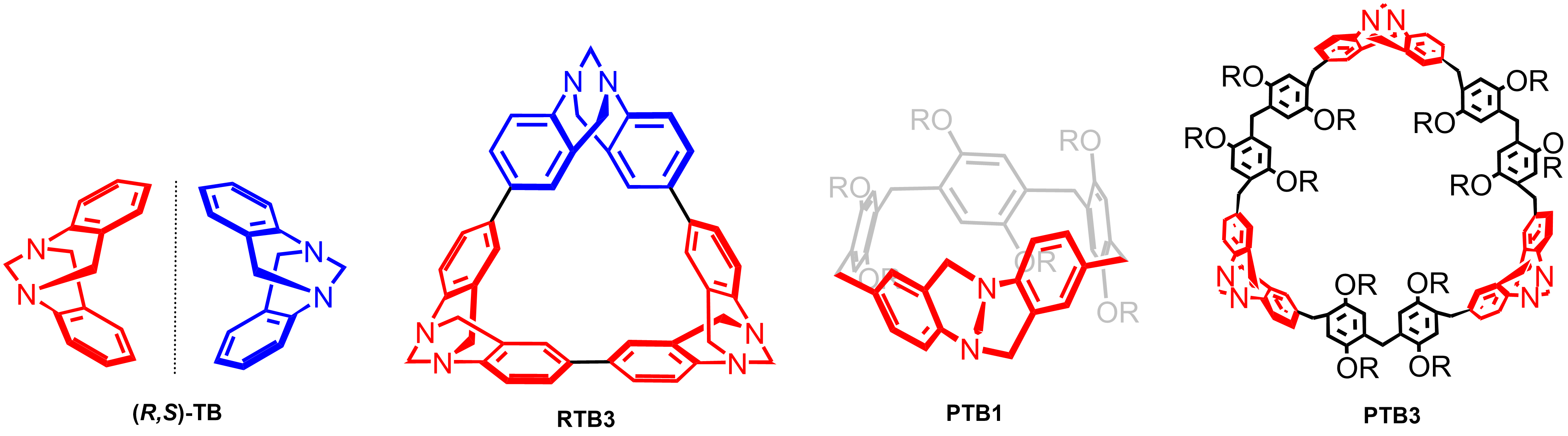
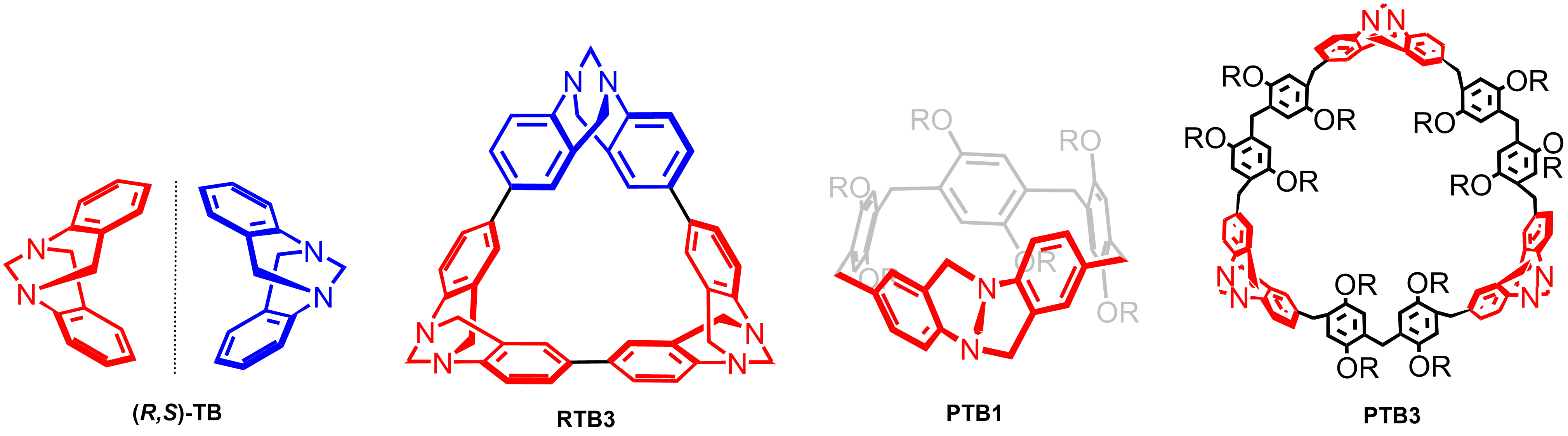
Figure 1. The chemical structures of compound (R, S)-TB, and the typical TB‑bearing macrocyclic arenes constructed from TB derivatives. RTB3 is a highly rigid TB-macrocycle, PTB1 and PTB3 are pillar-like structures possessing both fixed and flippable chiral elements. TB: Tröger’s base.
More recently, one-step cyclization via Mannich reactions employing polyamines as substrates achieved new advances. Wang, et al., employed diphenylamine linked by different ethylene glycol chains as substrates. A series of TB macrocycles was obtained in a single step[34]. It was found that for the structure containing a short ethylene glycol chain (n = 1), only the homochiral isomers were obtained, indicating that this macrocycle exhibits excellent chiral self-sorting behavior. When the chain length was increased to diethylene glycol (n = 2), both homochiral and heterochiral isomers coexisted in the crystal. For the longer triethylene glycol chain (n = 3), only the meso isomer was observed in the crystal. This systematic investigation demonstrated that the length of the bridging chain plays a decisive role in the chiral self-sorting behavior of TB compound, providing important insights for rationally controlling the stereoconfiguration of TB macrocycles. In 2025, our group chose bis(4-aminophenyl)amine as the substrate and synthesized two types of cyclic compounds, TB2 and TB3, in a single step through the Mannich reaction to construct the TB framework (Figure 2a)[35]. In both compounds, the TB units are directly linked by methylene bridges. Macrocyclization gave only the racemic homochiral isomers: R4N/S4N for TB2 and R6N/S6N for TB3, once again confirming that the Mannich reaction for constructing TB compounds possesses excellent chiral self-sorting characteristics. More importantly, we further oxidized the enantiomerically pure TB macrocycles with m-chloroperoxybenzoic acid (m-CPBA) to afford the corresponding N-oxides, TB2NO and TB3NO (Figure 2b,c). Owing to the high polarity of the N–O bonds, these N-oxides exhibit good solubility in water while retaining excellent structural stability. In aqueous solution, the rigid framework of TB3NO shows outstanding chiral recognition ability toward a series of chiral guests, achieving an enantioselectivity as high as 41.0, which sets a new record for chiral recognition by synthetic receptors in water. Notably, conventional strategies for constructing water-soluble macrocycles typically require the installation of ionic salt moieties on the molecular periphery[15,36]. However, ion exchange often interferes with host–guest complexation. In contrast, the N-oxidation strategy here resulted in good water solubility through intramolecular polarization without introducing additional ionic groups, thereby significantly reducing the interference from ionic groups during recognition.
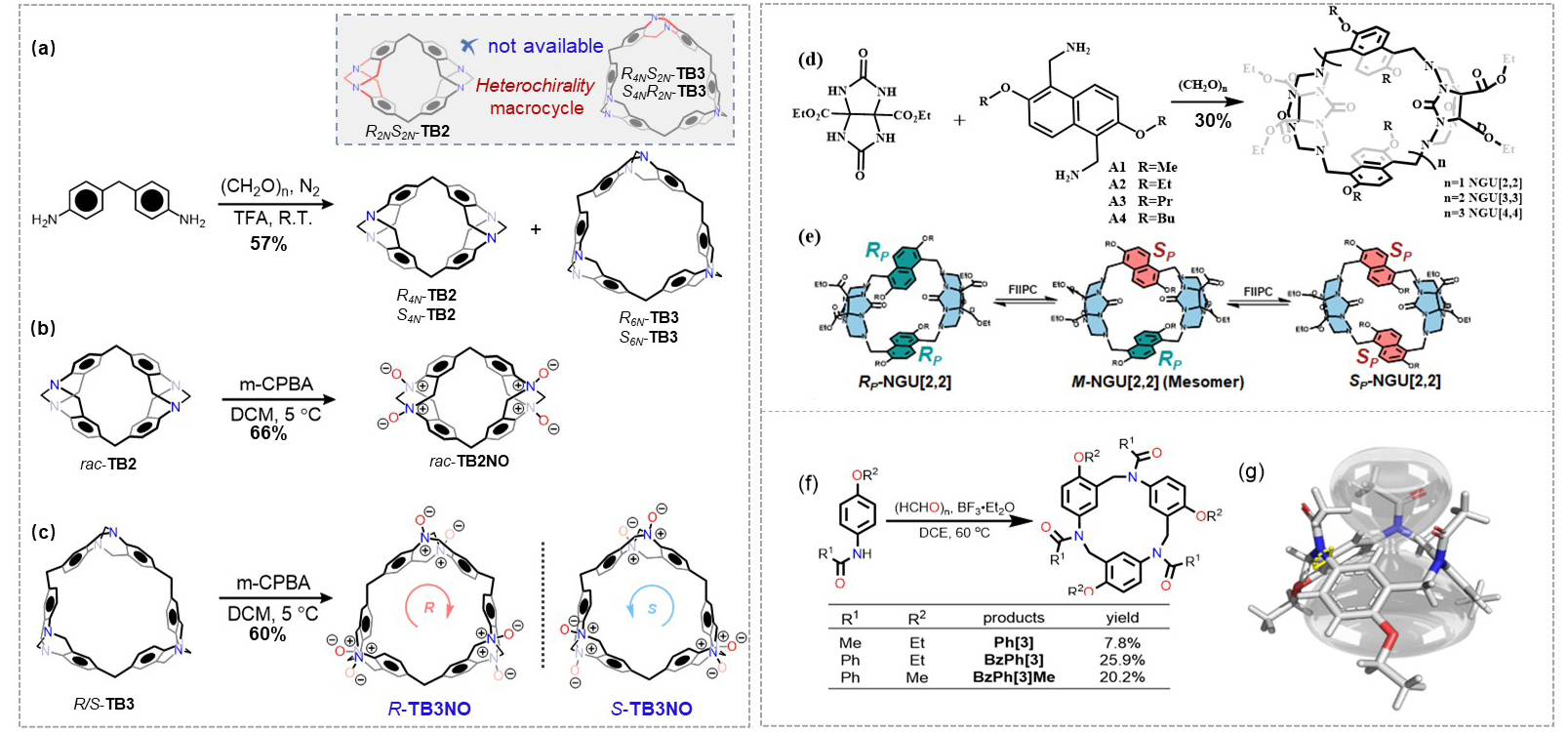
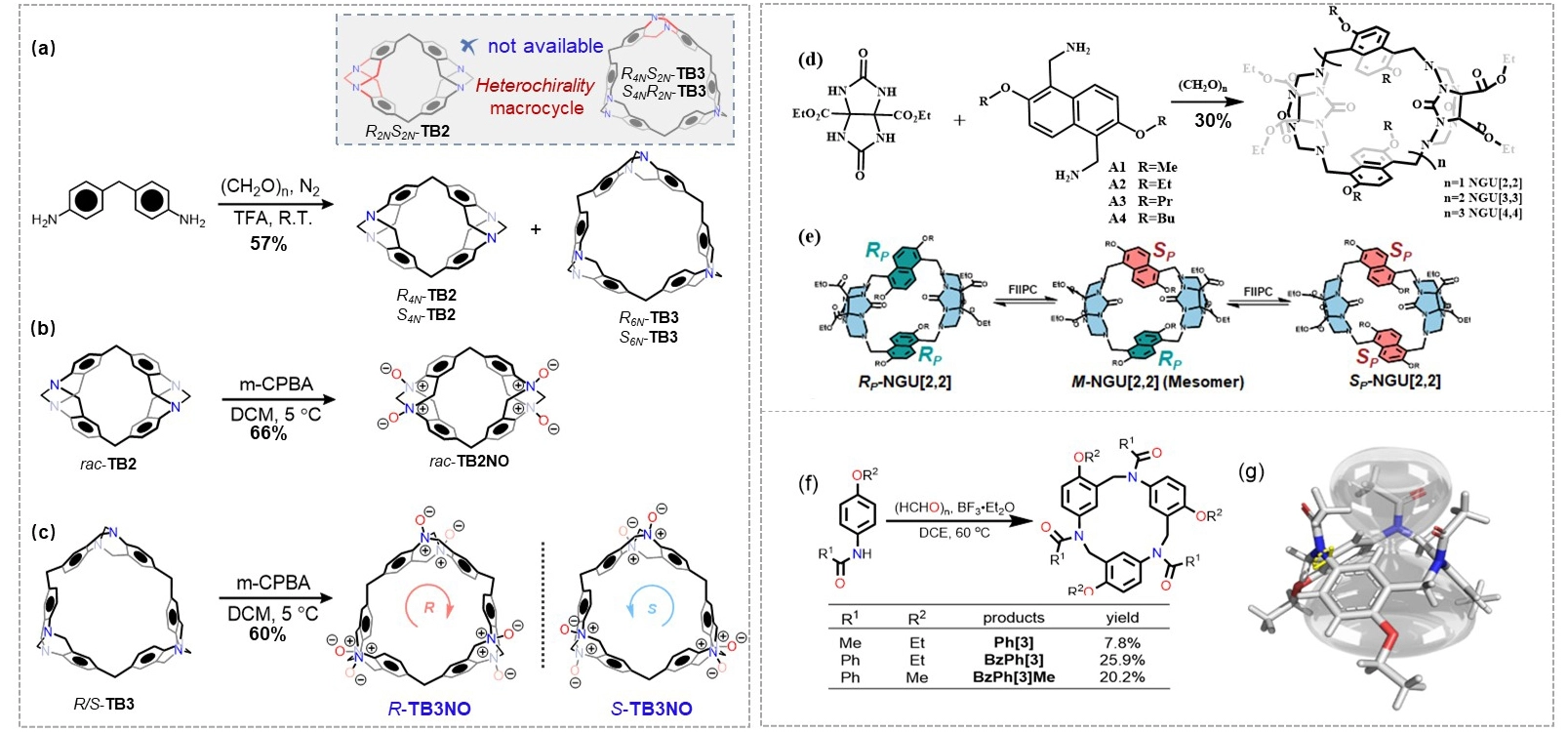
Figure 2. Synthetic route of (a) TBn. Adapted with permission from reference[35]. Copyright © 2025 Wiley-VCH; (b) Water-soluble TB2NO. Adapted with permission from reference[35]. Copyright © 2025 Wiley-VCH; (c) The enantiomeric water-soluble TB3NO. Adapted with permission from reference[35]. Copyright © 2025 Wiley-VCH; (d) Glycoluril hybrid macrocycles NGU[n,n]. Adapted with permission from reference[37]. Copyright © 2025 Wiley-VCH; (e) Schematic illustration of the conformational inversion of NGU[2,2]. Reproduced with permission from reference[37]. Copyright © 2025 Wiley-VCH; (f) Synthetic route of phenacetin[3]arenes Ph[3], BzPh[3] and BzPh[3]Me. Adapted with permission from reference[21]. Copyright © 2025 Wiley-VCH; Schematic illustration of the “hourglass”-shaped Ph[3]. Reproduced with permission from reference[21]. Copyright © 2025 Wiley-VCH.
In the Mannich reaction, the electrophilic addition partner for the imine intermediate can be not only an aromatic ring but also a hydrogen atom on an amide nitrogen bearing strong electron withdrawing groups. We found that when two strong electron withdrawing groups are attached to the waist of a glycoluril molecule, the resulting compound can serve as a suitable substrate for the Mannich reaction[37]. By employing three components, including diethyl glycoluril-2,5-dicarboxylate, 1,5-naphthalenedimethanamine, and paraformaldehyde as substrates in a one-pot condensation, we efficiently constructed naphthalene–glycoluril hybrid macrocycles (NGU[n,n], Figure 2d) featuring an alternating backbone and a well-defined cavity. This particular linkage of methylene groups with non-aromatic five-membered rings introduced crucial flexibility into the macrocyclic framework. Owing to this conformational flexibility, NGU[2,2] contained three conformations (RP, SP, and meso-) which are energetically similar and interconvertible via a “flip induced inversion of planar chirality” (FIIPC) process (Figure 2e)[38]. More intriguingly, the conformational equilibrium can be disrupted by guest binding. Addition of chiral guests such as L-tryptophan and L-tyrosine to the host induces a rare example of host–guest chiral allosteric modulation. At low guest concentrations, the 1:1 complex favored the RP conformation of the host. Upon increasing the guest concentration, however, the system shifts toward the 1:2 complex, triggering a conformational flip that ultimately leaves the SP conformation as the dominant species.
In addition to the construction of TB compounds using primary amines and paraformaldehyde for cyclization, we have discovered that amides can also undergo one-step cyclization via the Mannich reaction. Using phenacetin and its derivatives as cyclization units, we successfully synthesized a series of phenacetin[3]arenes (Ph[3], BzPh[3], BzPh[3]Me, Figure 2f) under acidic conditions[21]. The reaction can be performed at relatively high concentrations on a gram scale with a yield of 25.9%, demonstrating high synthetic value. The macrocycle is composed of three phenacetin units connected by methylene bridges, forming a 15-atom azacyclic framework. The single-crystal structure of Ph[3] reveals a unique “hourglass”-shaped spatial conformation: the cavity is divided into upper and lower openings, with the upper rim consisting of three amide groups and the lower rim comprised of alkoxybenzene rings (Figure 2g). Interestingly, Ph[3] binds organic ammonium guests in a stepwise manner, transitioning from predominantly 1:1 to 1:2 host–guest complexation and also exhibiting intriguing allosteric behavior. The 1:1 complex is primarily stabilized by hydrogen bonds between the three carbonyl groups of Ph[3] and the three NH groups of the guest. For the 1:2 complex, Ph[3] undergoes a conformational change from a C3 conformer to an F conformer, and the complex is stabilized through synergistic hydrogen bonding and NH···π interactions. Moreover, the distinct functional groups on the two rims facilitate diverse chemical modifications, including reduction, deprotection, and condensation, providing synthetic flexibility for post-synthetic functionalization.
3. Conclusion
In conclusion, this highlight specifically focuses on nitrogen-containing macrocyclic arenes constructed via the Mannich reaction, which significantly diverges from the traditional CAr–CH2–CAr linkages prevalent in macrocyclic arenes, emphasizing its unique advantages in synthetic methodology, as well as the structural and functional features of the resulting macrocycles. This strategy includes two approaches: first, constructing TB fragments bearing various substituents via the Mannich reaction, followed by cyclization of these TB fragments through Friedel–Crafts or coupling reactions; second, a one-pot Mannich reaction directly using aromatic amines and paraformaldehyde to form macrocyclic arenes. Notably, the one-pot cyclization approach holds promise for scaling up macrocycle synthesis to gram-scale preparations. Benefiting from the unique structure of TB units constructed via multiple Mannich condensations of primary amines, the resulting macrocyclic arenes exhibit rigid characteristics, which endow them with excellent potential in host–guest recognition, chiral sensing, and the construction of two-dimensional materials. Meanwhile, nitrogen-containing macrocycles such as glycoluril–naphthalene hybrids and phenacetin[3]arene not only exhibit unique allosteric behaviors induced by host–guest complexation but also enable diverse chemical modifications, including reduction, deprotection, and condensation, providing synthetic flexibility for post-synthetic modifications. With the continued expansion of the substrate scope of this novel macrocyclization, we hope that an increasing number of complex molecular architectures will be constructed, displaying rich functional applications.
Authors contribution
Wu W: Formal analysis, writing-original draft, project administration, funding acquisition.
Yang C: Writing-review & editing, project administration, funding acquisition.
Conflicts of interest
The authors declare no conflicts of interest.
Ethical approval
Not applicable.
Consent to participate
Not applicable.
Consent for publication
Not applicable.
Availability of data and materials
Not applicable.
Funding
We acknowledge the support of this work by the National Natural Science Foundation of China (Nos. 22422108, 22171194, 22471182, 22271201, U25A20592), and the Science & Technology Department of Sichuan Province (Nos. 2025JDRC0015, 2025ZNSFSC0125).
Copyright
© The Author(s) 2026.
References
-
2. Han Y, Han XN, Long YJ, Tong S, Li B, Liu A, et al. New macrocyclic arenes and beyond: Synthesis, properties and applications. Sci China Chem. 2026;69(3):1064-1106.[DOI]
-
4. Sun Y, Jiang L, Liu L, Chen Y, Xu WW, Niu J, et al. Two calix[3] phenothiazine-based amorphous pure organic room-temperature phosphorescent supramolecules mediated by guest. Adv Opt Mater. 2023;11(10):2300326.[DOI]
-
5. Schmidt M, Hermann M, Otteny F, Esser B. Calix[n] phenothiazines: Optoelectronic and structural properties and host–guest chemistry. Org Mater. 2020;2(3):235-239.[DOI]
-
10. Li J, Zhou HY, Han Y, Chen CF. Saucer[n] arenes: Synthesis, structure, complexation, and guest-induced circularly polarized luminescence property. Angew Chem Int Ed. 2021;60(40):21927-21933.[DOI]
-
13. Li B, Wang B, Huang X, Dai L, Cui L, Li J, et al. Terphen[n] arenes and quaterphen[n] arenes (n=3–6): One-pot synthesis, self-assembly into supramolecular gels, and iodine capture. Angew Chem Int Ed. 2019;58(12):3885-3889.[DOI]
-
15. Yang X, Jiang W. Enantioselective recognition of functional organic molecules in water by biomimetic macrocyclic hosts. J Am Chem Soc. 2024;146(6):3900-3909.[DOI]
-
16. Yu X, Wu W, Zhou D, Su D, Zhong Z, Yang C. Bisindole[3] arenes: Indolyl macrocyclic arenes having significant iodine capture capacity. CCS Chem. 2022;4(5):1806-1814.[DOI]
-
17. Jin P, Liang W, Rong Y, Wu W, Gou M, Tang Y, et al. Remarkable iodine uptake by aniline-based macrocyclic arenes through a reverse dissolution mechanism. J Mater Chem A. 2023;11(21):11126-11132.[DOI]
-
19. Hu J, Wu W, Yang C, recent advances in the synthesis and applications of nitrogen-containing macrocyclic arenes. Molecules. 2025;30(17):3646.[DOI]
-
23. Sergeyev S. Recent developments in synthetic chemistry, chiral separations, and applications of Tröger’s base analogues. Helv Chim Acta. 2009;92(3):415-444.[DOI]
-
24. Rúnarsson ÖV, Artacho J, Wärnmark K. The 125th anniversary of the tröger’s base molecule: Synthesis and applications of Tröger’s base analogues. Eur J Org Chem. 2012;2012(36):7015-7041.[DOI]
-
26. Song Z, Ma Y, Han H, Li D, Fu R, Zhao Q, et al. Enantiopure macrocycles based on Tröger‘s base and diphenyl maleimide exhibiting strong chiral emission and host‐guest properties. Chem Eur J. 2025;31:e202403271.[DOI]
-
27. Wang Y, Liu K, Zheng Z, Shang Y, Li B, He H, et al. Inclusion co-crystals based on Tröger’s base molecular box for thermally activated delayed fluorescence. HYPERLINK "https://www.nature.com/ncomms" Nat Commun. 2026.[DOI]
-
28. Jiang B, Han Y, Wu S, Li Z, Wu J. Tröger’s base based triangular macrocycles with a nanoscale cavity for chirality-dependent packing in single crystals. ACS Appl Nano Mater. 2022;5(10):14027-14030.[DOI]
-
29. Shi C, Li H, Xie W, Wang R, Wang X, Lu X, et al. Tröger’s base-embedded Pillararenes─Macrocycles with both fixed and conformational chirality. Org Lett. 2024;26(32):6910-6914.[DOI]
-
33. Kazem-Rostami M. A nitrogen-based chiral catenane for enantioenriching photocatalytic aerobic oxidation. New J Chem. 2022;46(45):21898-21905.[DOI]
-
34. Feng H, Chen Y, Wang R, Niu P, Shi C, Yang Z, et al. Chiral selection of Tröger’s base-based macrocycles with different ethylene glycol chains length in crystallization. Chin Chem Lett. 2023;34(7):108038.[DOI]
Copyright
© The Author(s) 2027. This is an Open Access article licensed under a Creative Commons Attribution 4.0 International License (https://creativecommons.org/licenses/by/4.0/), which permits unrestricted use, sharing, adaptation, distribution and reproduction in any medium or format, for any purpose, even commercially, as long as you give appropriate credit to the original author(s) and the source, provide a link to the Creative Commons license, and indicate if changes were made.
Publisher’s Note
Science Exploration remains a neutral stance on jurisdictional claims in published
maps
and institutional affiliations. The views expressed in this article are solely those
of
the author(s) and do not reflect the opinions of the Editors or the publisher.
Share And Cite


Science Exploration Style
Wu W, Yang C. Mannich reaction-enabled construction of nitrogen-containing macrocyclic arenes. Chiral Chem. 2027;3:202629. https://doi.org/10.70401/cc.2026.0035
Tips
Copy completed.
Submit a Manuscript
Author Instructions
Cite this Article
Article Metrics
0
View
0
Download
Cited
Article Updates

 Get citation
Science Exploration Style

Wu W, Yang C. Mannich reaction-enabled construction of nitrogen-containing macrocyclic arenes. Chiral Chem. 2027;3:202629. https://doi.org/10.70401/cc.2026.0035
copy
Share Link
copy