Catalytic asymmetric dearomative [4+2] photocycloadditions of quinolines with alkenes

Liuzhen Hou
1

,
Weidi Cao
2,*
*Correspondence to:
Weidi Cao, Key Laboratory of Green Chemistry & Technology, Ministry of Education, College of Chemistry, Sichuan University, Chengdu 610064, Sichuan, China.
E-mail: wdcao@scu.edu.cn
Chiral Chem. 2027;3:202637. 10.70401/cc.2026.0040
Received: August 03, 2026Accepted: September 17, 2026Published: September 18, 2026
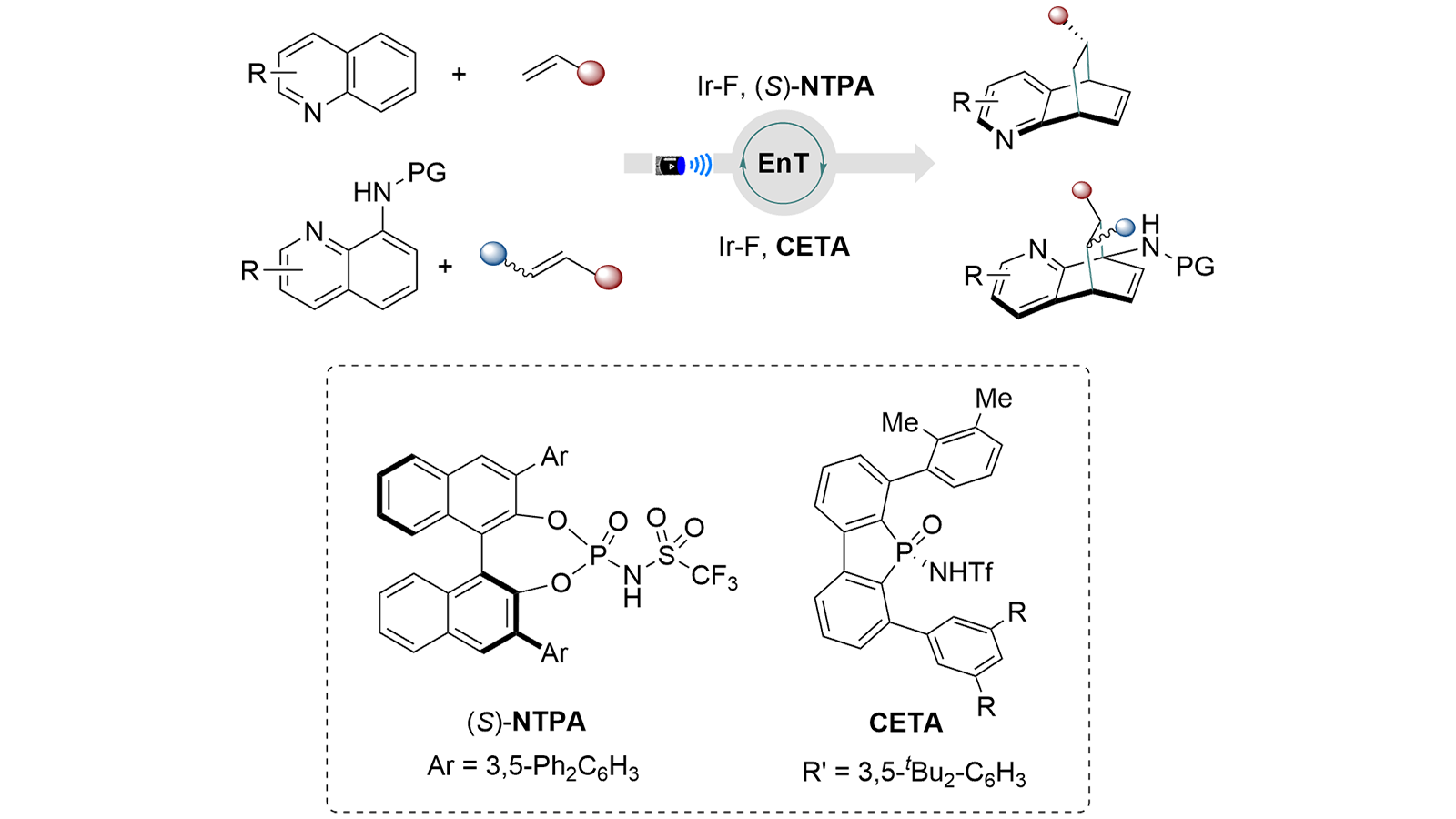
Graphical Abstract
1. Introduction
In modern medicinal chemistry, the “escape from flatland” design principle has become an indispensable guideline for developing novel drug candidates. Compared with planar aromatic compounds, sp3-carbon-rich three-dimensional cyclic frameworks deliver superior drug-likeness metrics[1]. As an inexpensive, easily accessible bicyclic azaarene, quinoline can be dearomatized to furnish tetrahydroquinoline scaffolds that permeate numerous bioactive natural products and marketed pharmaceutical agents, making quinoline dearomatization a research hotspot in synthetic medicinal chemistry. Nevertheless, quinoline’s rigid, fully conjugated planar aromatic architecture bears substantial aromatic stabilization energy, which leads to a formidable thermodynamic barrier that severely impedes stereoselective construction of complex polycyclic skeletons[2]. Visible-light-triggered dearomative cycloaddition (DAC) has emerged as a transformative strategy to bypass the unfavorable thermodynamic energy barrier, enabling facile construction of intricate chiral nitrogen-bridged 3D polycyclic backbones with mild illumination as the sole energy input[3,4,5].
Despite this remarkable advantage, dearomative cycloaddition of quinolines with alkenes suffers from intrinsic synthetic bottlenecks that limit its widespread synthetic utility. For one thing, quinoline incorporates two electronically distinct aromatic moieties, the pyridine ring and the benzene ring, creating multiple competitive reactive sites and rendering precise chemoselectivity control extremely challenging. For another, two divergent cycloaddition manifolds, namely [4+2] and [2+2] cycloadditions, compete fiercely under photochemical conditions, bringing about intractable regioselectivity issues (Figure 1)[4,5].


Figure 1. Selectivity challenges for DAC reactions of quinolines with alkenes. DAC: dearomative cycloaddition.
To date, a suite of pioneering works on visible-light-mediated dearomative [4+2] cycloadditions of quinolines have been achieved[6,7,8], unequivocally demonstrating that triplet energy transfer (EnT) catalysis can surmount quinoline’s inherent aromatic stabilization barrier and enable facile construction of polycyclic aza-scaffolds. However, the established systems generally require stoichiometric amounts of strong Lewis or Brønsted acids to activate quinoline substrates, failing to deliver chiral induction and narrow functional group tolerance. The development of catalytic asymmetric photocycloadditions between quinolines and alkenes that concurrently grant excellent regio-, diastereo-, and enantioselectivity represents a long-standing unresolved bottleneck in this field. To address this critical limitation, two landmark examples on asymmetric dearomative [4+2] photocycloadditions of quinolines with alkenes via energy transfer catalysis by Tan[9] and Liu[10] groups have recently been disclosed.
Tan and co-workers[9] developed a novel relay triplet energy transfer catalytic system based on rationally designed chiral energy-transfer Brønsted acid (CETA) catalysts, which enables catalytic asymmetric dearomative [4+2] cycloaddition between quinolines and alkenes without stoichiometric acid promoters. In conventional dual photoredox/chiral catalysis, the chiral catalyst spatially separates the photosensitizer from the substrate, creating an energy barrier that severely compromises reaction efficiency. The authors integrated an energy carrier into the chiral catalyst to capture, store, and relay triplet energy from the photosensitizer to the substrate to overcome the fundamental limitation of Dexter-type energy transfer. The designed CETA catalysts feature a fluorene scaffold with high triplet energy, a phosphoramide catalytic core, and freely tunable chiral side arms, with frontier orbitals partially localized on the substrate-proximal moiety to facilitate efficient energy transfer (Figure 2a).
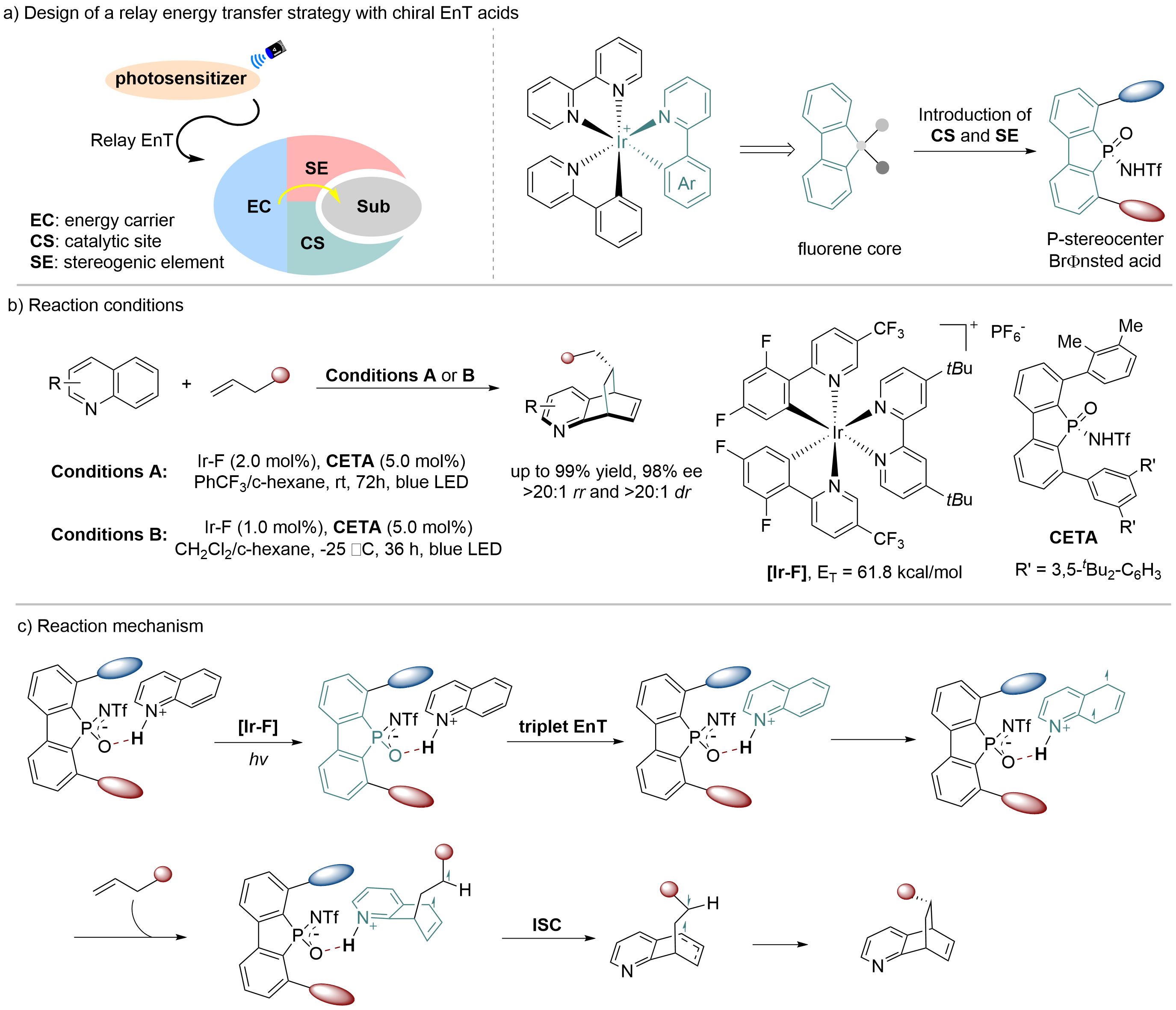
Figure 2. Asymmetric dearomative [4+2] photocycloadditions of quinolines with alkenes enabled by relay energy transfer paradigm[9]. a) Design of a relay energy transfer strategy with chiral EnT acids; b) Reaction conditions; c) Reaction mechanism. EnT: energy transfer; CETA: chiral energy-transfer Brønsted acid; LED: light-emitting diode; ISC: intersystem crossing.
This relay triplet energy transfer strategy displays exceptional substrate generality. Quinolines bearing alkyl or halogen substituents at diverse positions, as well as aliphatic, electron-rich and electron-deficient alkenes, all afforded the polycyclic products in favorable yield, regioselectivity, diastereoselectivity and enantioselectivity (Figure 2b). Moreover, CETA proved highly tolerant of a broad spectrum of functional groups, including alkyl, halide, cyano, hydroxyl, aryl, carboxyl and ester moieties. Mechanistic studies based on transient absorption spectra and Stern-Volmer quenching analyses confirmed that the CETA-enabled relay EnT strategy enhances the triplet energy transfer efficiency and extends quinoline triplet lifetimes via reversible energy exchange. They proposed the reaction mechanism: The chiral N-triflylphosphoramide organocatalyst first assembles a hydrogen-bonded complex with quinoline substrates which then accepts triplet energy from the photoexcited Ir-F photosensitizer, bypassing inefficient direct energy transfer and markedly prolonging the triplet-state lifetime of quinoline. The alkene substrate preferentially attacks the sterically accessible face of the triplet quinoline species to forge a biradical intermediate. Upon dissociation from the CETA catalyst, this biradical undergoes an intersystem crossing process; the ensuing radical recombination affords the major stereodefined cycloadduct (Figure 2c).
During the same period, Liu and co-workers[10] reported a cooperative dual catalytic platform that unites visible-light triplet energy transfer photosensitization with catalytic chiral N-triflylphosphoramide Brønsted acid organocatalysis to achieve highly regio-, diastereo-, and enantioselective dearomative [4+2] photocycloaddition of 8-aminoquinolines with alkenes, delivering enantioenriched bridged polycyclic tetrahydroquinolines bearing multiple contiguous stereocenters in up to 89% yield with > 20:1 regioisomeric ratio (rr), > 20:1 diastereomeric ratio (dr) and up to 95% enantiomeric excess (ee) under mild conditions (Figure 3). Notably, the bifunctional chiral catalyst operates at merely 2 mol% loading to resolve the longstanding limitation of stoichiometric acid catalysts by forming a confined hydrogen-bonded chiral pocket that modulates triplet quinoline diradical intermediates. The reaction features broad substrate compatibility covering functionalized styrenes, heteroaryl alkenes, and alkene building blocks derived from natural products and pharmaceuticals. Besides, the cycloadducts can undergo diverse synthetic transformations to furnish valuable saturated chiral nitrogen-containing scaffolds and potential catalytic ligands.
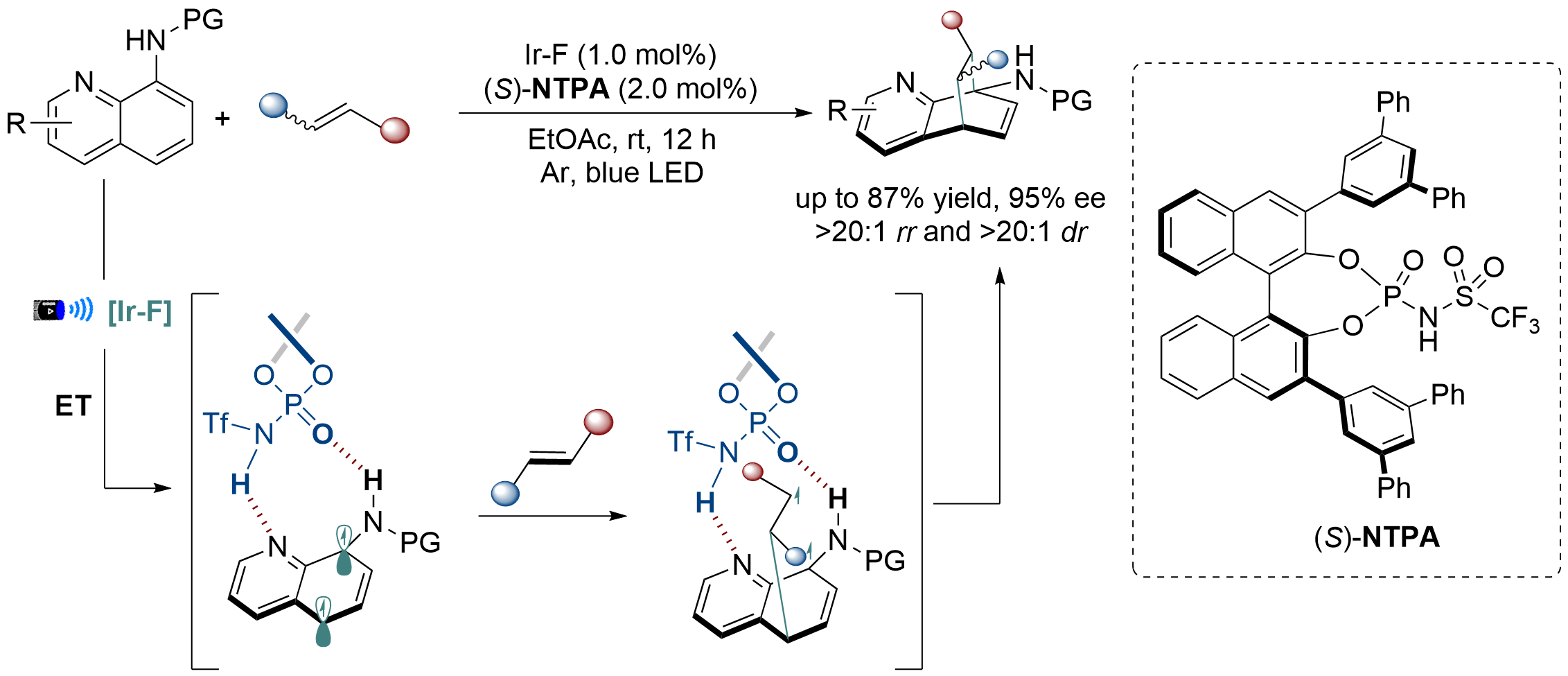
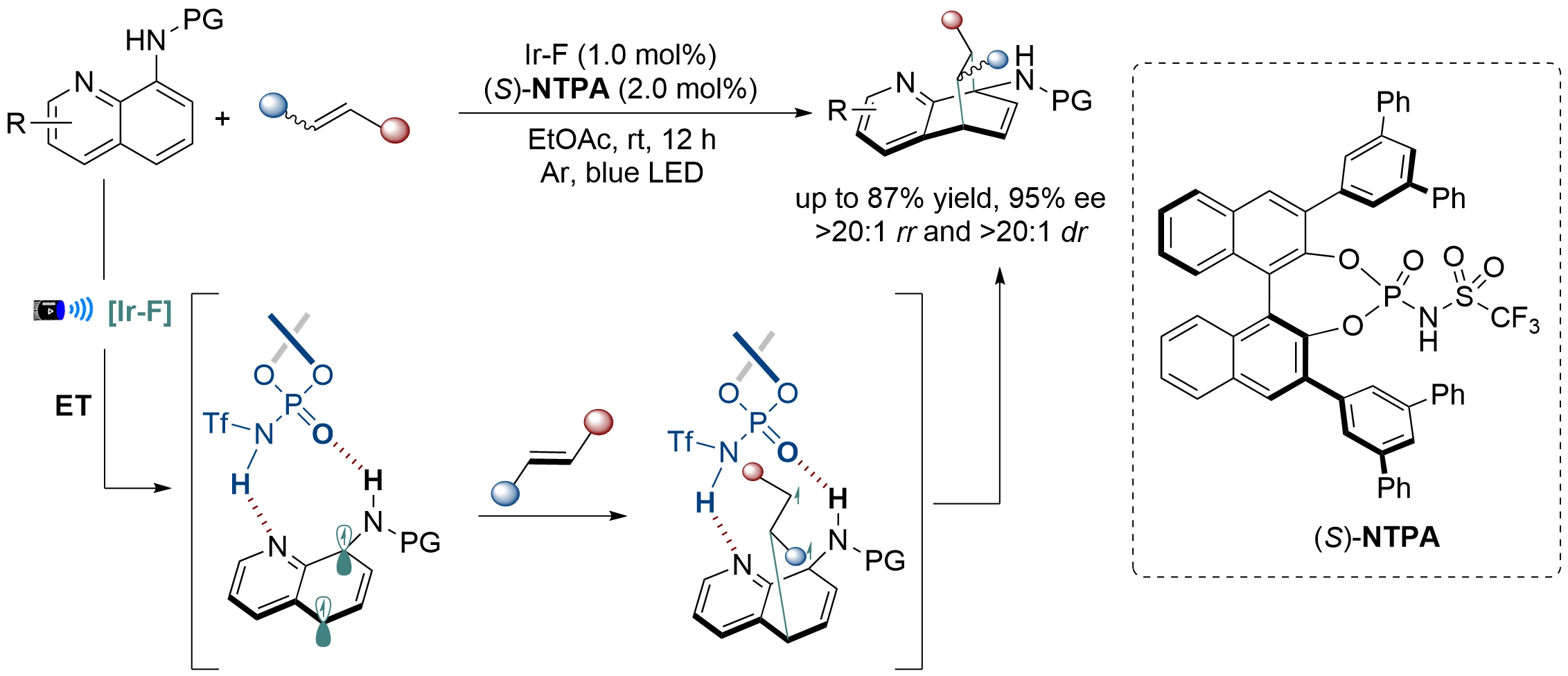
Figure 3. Asymmetric dearomative [4+2] photocycloadditions of quinolines with alkenes enabled by organocatalytic activation[10]. PG: protecting group; EtOAc: ethyl acetate; ET: energy transfer; rt: room-temperature; rr: regioisomeric ratio; dr: diastereomeric ratio; ee: enantiomeric excess; LED: light-emitting diode.
Furthermore, density functional theory (DFT) calculations unveil the multifaceted origins of reaction selectivity. Regioselectivity arises from the dominant spin density centered at the C5 position of quinoline’s benzene moiety. High enantioselectivity is conferred by energetically favorable Re-face transition state stabilized by π-π stacking interaction. London dispersion forces lock in outstanding endo diastereoselectivity (>20:1 dr). Besides, the inherent thermodynamic favorability of the [4+2] cycloadduct over its [2+2] analogue drives complete chemoselectivity toward the [4+2] cycloaddition manifold. The catalytic cycle is ultimately terminated by intersystem crossing of the triplet biradical intermediate, followed by radical recombination to furnish the bridged polycyclic tetrahydroquinoline framework.
2. Conclusion and Outlook
The two landmark studies respectively developed two distinct chiral Brønsted acid catalytic systems for the asymmetric dearomative [4+2] photocycloaddition of quinolines with alkenes: Tan’s team proposed an innovative relay energy transfer paradigm realized via rationally engineered CETA catalysts, while Liu’s group leveraged chiral N-triflylphosphoramide organocatalysis paired with triplet energy transfer photosensitization, both of which successfully circumvent the reliance on stoichiometric acid additives and deliver excellent regio-, diastereo-, and enantioselectivity to forge enantioenriched bridged polycyclic tetrahydroquinoline frameworks. Despite these remarkable advances, the current reaction systems still suffer from evident limitations. Firstly, the cycloaddition partners are largely restricted to quinoline derivatives and simple alkenes. Expanding the scope of heteroaromatic substrates and coupling olefin partners remains a critical unmet goal. Secondly, while sp3-enriched three-dimensional chiral tetrahydroquinolines represent promising bioisosteres of planar aminoquinoline pharmacophores, the established systems have yet been applied to the formal synthesis of intact pharmaceutical molecules, limiting their practical utility for direct late-stage elaboration of drug scaffolds and rapid construction of drug-relevant chiral nitrogen heterocycles. Thirdly, the above stereocontrolled [4+2] photocycloaddition protocols rely on chiral Brønsted acid organocatalysts. Further exploration of alternative chiral catalytic platforms, such as chiral Lewis acids, transition-metal chiral complexes, and chiral photosensitizers integrated with energy transfer functions will broaden the synthetic toolbox for asymmetric energy transfer photocatalysis. Future efforts might focus on broadening the substrate generality, exploring practical applications in medicinal synthesis, and developing novel chiral catalytic modes beyond chiral Brønsted acid frameworks to extend the boundaries of asymmetric dearomative photocyclization.
Acknowledgements
The authors declare that deepseek was used solely for language polishing during the manuscript preparation process. All research content, including study design, data analysis, interpretations, figures, and tables, is original and was not generated using AI tools. The authors reviewed, revised, and approved the final manuscript and take full responsibility for its content.
Authors contribution
Hou L: Investigation, visualization, writing-original draft.
Cao W: Conceptualization, project administration, funding acquisition, resources, supervision, writing-review & editing.
Conflicts of interest
The authors declare no conflicts of interest.
Ethical approval
Not applicable.
Consent to participate
Not applicable.
Consent for publication
Not applicable.
Availability of data and materials
Not applicable.
Funding
This work was supported by the National Natural Science Foundation of China (Grant No. 22471179).
Copyright
© The Author(s) 2026.
References
-
5. Shimose A, Nagashima Y. Photoinduced dearomative multiple functionalization of quinolines to construct highly substituted 3D frameworks. Synlett. 2025;36(9):1111-1122.[DOI]
-
7. Morofuji T, Nagai S, Chitose Y, Abe M, Kano N. Protonation-enhanced reactivity of triplet state in dearomative photocycloaddition of quinolines to olefins. Org Lett. 2021;23(16):6257-6261.[DOI]
-
10. Zhou J, Zhang Z, Zhu M, Yang H, Cai X, Feng X, et al. Asymmetric dearomative [4 + 2] photocycloadditions of quinolines with alkenes enabled by organocatalytic activation. J Am Chem Soc. 2026;148(24):25062-25074.[DOI]
Copyright
© The Author(s) 2027. This is an Open Access article licensed under a Creative Commons Attribution 4.0 International License (https://creativecommons.org/licenses/by/4.0/), which permits unrestricted use, sharing, adaptation, distribution and reproduction in any medium or format, for any purpose, even commercially, as long as you give appropriate credit to the original author(s) and the source, provide a link to the Creative Commons license, and indicate if changes were made.
Publisher’s Note
Science Exploration remains a neutral stance on jurisdictional claims in published
maps
and institutional affiliations. The views expressed in this article are solely those
of
the author(s) and do not reflect the opinions of the Editors or the publisher.
Share And Cite


Science Exploration Style
Hou L, Cao W. Catalytic asymmetric dearomative [4+2] photocycloadditions of quinolines with alkenes. Chiral Chem. 2027;3:202637. https://doi.org/10.70401/cc.2026.0040
Tips
Copy completed.
Submit a Manuscript
Author Instructions
Cite this Article
Article Metrics
0
View
0
Download
Cited
Article Updates

 Get citation
Science Exploration Style

Hou L, Cao W. Catalytic asymmetric dearomative [4+2] photocycloadditions of quinolines with alkenes. Chiral Chem. 2027;3:202637. https://doi.org/10.70401/cc.2026.0040
copy
Share Link
copy