Conference Collaborations

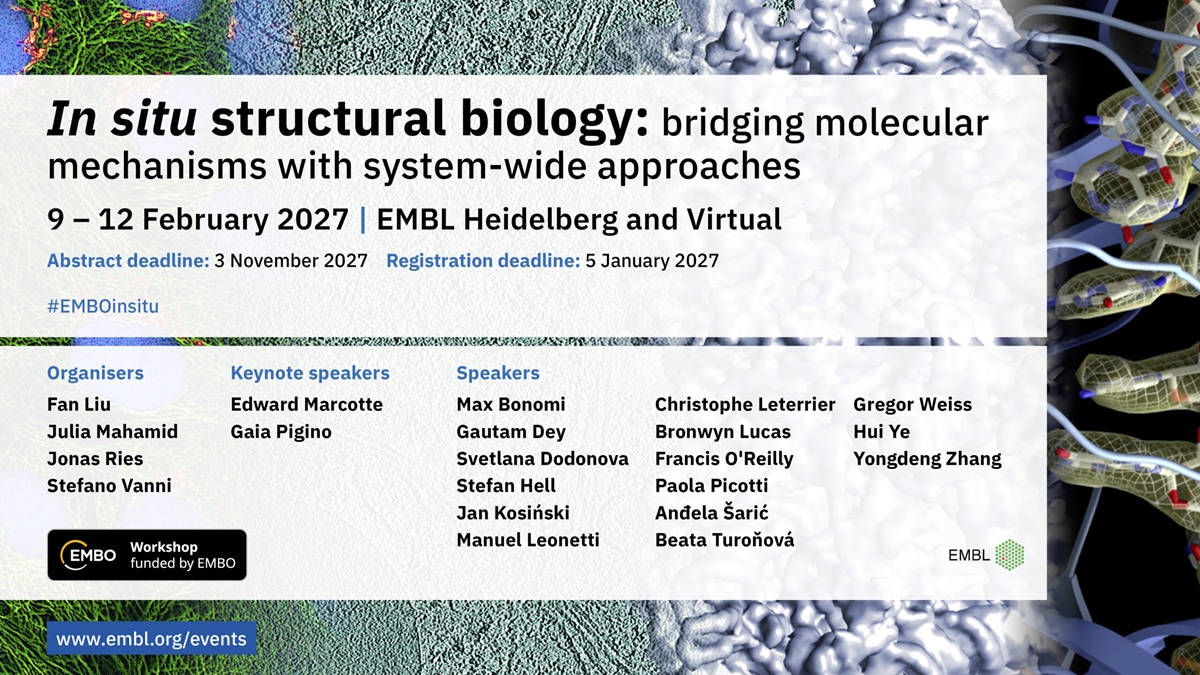
EMBO Workshop - In situ structural biology: bridging molecular mechanisms with system-wide approaches

Date: February 9-12, 2027 | Venue: EMBL Heidelberg and Virtual

This event will bring together experts from cryo-electron and fluorescence microscopy, mass spectrometry and computational modeling to focus on data integration across different methods towards understanding protein structures and interactions in situ.
In situ structural biology is a rapidly advancing field focused on understanding the structure and function of macromolecular complexes within intact cells and tissues.
Recent technological developments have pushed forward the ability to study proteins in their native context. Yet, a comprehensive understanding of molecular functions in situ requires systematic integration of complementary methods and data types.
This edition will have additional focus on system-wide approaches, showcasing recent technological and methodological advances and promoting their integration with other methodologies as powerful tools for cell biology across multiple scales.
Website:

https://www.embl.org/about/info/course-and-conference-office/events/ISS27-01/?utm_source=scieExpress&utm_medium=mpreferral&utm_id=ISS27-01

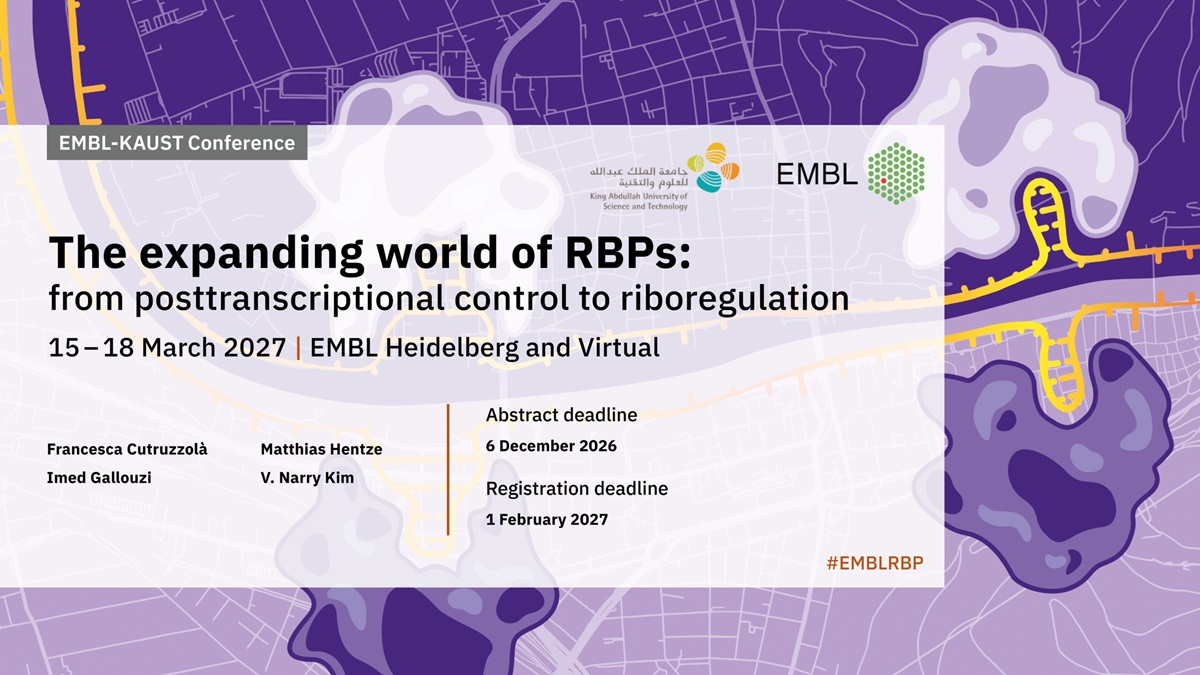
EMBL-KAUST Conference - The expanding world of RBPs: from posttranscriptional control to riboregulation

Date: March 15-18, 2027 | Venue: EMBL Heidelberg and Virtual

This meeting brings together leaders in RNA-binding proteins (RBPs) to explore their biological functions, from posttranscriptional regulation of RNA expression to the riboregulation of protein functions.
Methodological advances have expanded the repertoire of known RBPs, revealing new classes and RNA-interaction modes, and highlighting the need to understand how RNA binding shapes biological functions.
Building on the first edition, this second meeting will expand knowledge of classical and newly discovered RBPs, highlighting advances enabled by emerging experimental and data-analysis tools. It will also explore the dynamic cellular processes involving RBPs and the role of RNA structural plasticity in shaping interactions with canonical and non-canonical RBPs.

Website:

https://www.embl.org/about/info/course-and-conference-office/events/RBP27-01/?utm_source=scieExpress&utm_medium=mpreferral&utm_id=RBP27-01

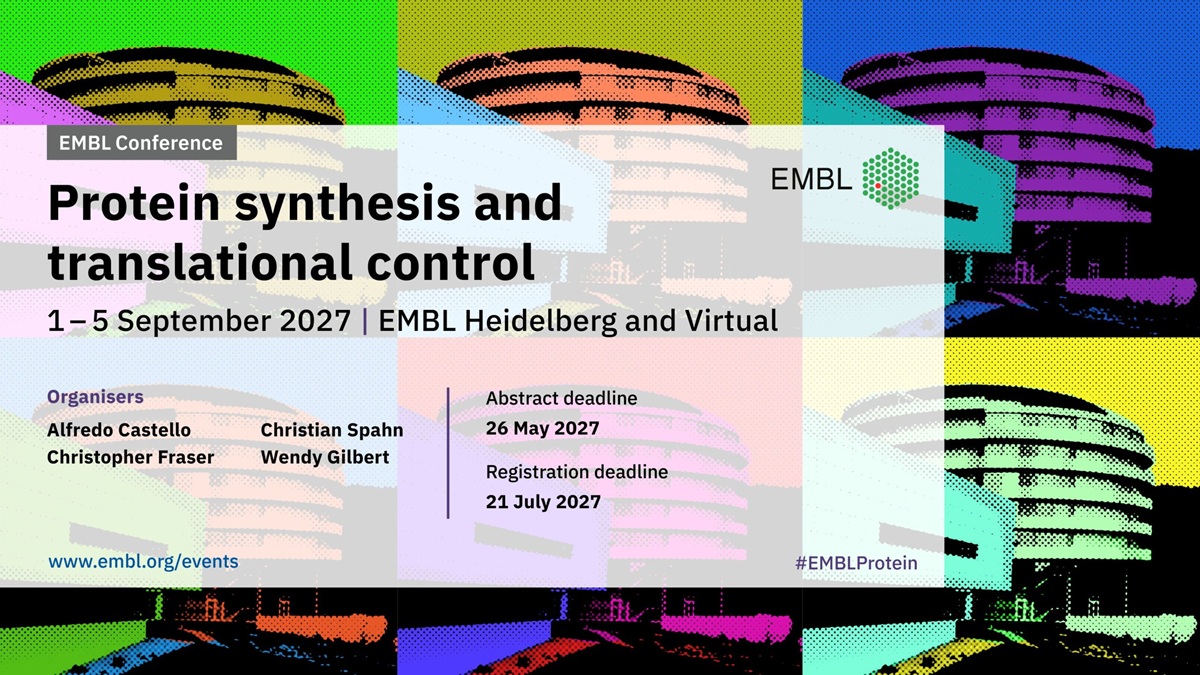
EMBL Conference - Protein synthesis and translational control

Date: September 1-5, 2027 | Venue: EMBL Heidelberg and Virtual

Mechanisms that shape cellular proteomes are critical for life. This conference focuses on the process of protein synthesis, from the molecular and structural understanding of the translational machinery to its regulation, its implications in cell and organismal biology, and its alteration in disease.
The regulation of mRNA translation is critical to maintaining cell homeostasis and mediates cellular responses to environmental, physiological, and pathological cues. Given the central importance of protein synthesis, it is unsurprising that dysregulation or defects in mRNA translation are widely linked to disease, including cancer, neurological or metabolic disorders, and viral infection. In recent years, technical advances have challenged hitherto established dogmas, uncovered new quality control mechanisms, expanded the breadth of translation regulators, enhanced our understanding of the dynamics of translation in living cells, and revealed unexpected interconnections with other cellular processes such as metabolism. Advances in these aspects of mRNA translation will be featured, as well as new insights into translation regulation in physiology and disease.

Website:

https://www.embl.org/about/info/course-and-conference-office/events/TRC27-01/?utm_source=scieExpress&utm_medium=mpreferral&utm_id=TRC27-01

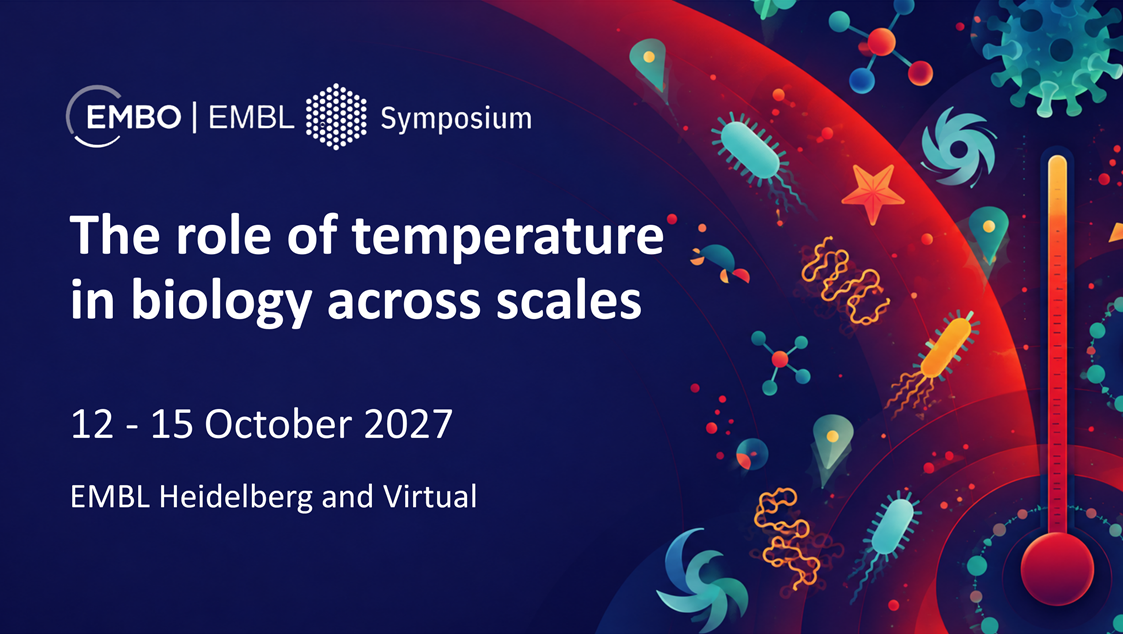
EMBO | EMBL Symposium - The role of temperature in biology across scales

Date: October 12-15, 2027 | Venue: EMBL Heidelberg and Virtual

A temperature increase by a few degrees is only a percent effect on the absolute scale, but can have dramatic consequences for biological systems, for example in the context of fever or climate change. The crucial role of temperature for biological systems is evidenced also by the evolution of adaptation responses, e.g. the heat shock response and temperature compensation in circadian clocks. Temperature changes diffusion constants, accelerates or slows reaction rates, alters macromolecular stability, influences proteostasis and metabolism, changes mechanical properties of the cytoskeleton and membranes, and shifts the pace of developmental and physiological processes. The sensitivities of these internal processes determine how biological function depends on temperature, yet they are typically examined in isolation across molecular, cellular, and organismal research fields.
This symposium will bring together researchers from diverse areas to map the landscape of temperature’s effects on biological systems and to connect theoretical and experimental perspectives across scales. The goal is to build the foundations for a unified mechanistic understanding of how temperature acts through biochemical networks and physical processes such as diffusion, polymerization and mechanical stability. With new tools for high-resolution imaging, high-throughput measurements and advances in data-driven modelling, this is a uniquely timely moment for researchers working at molecular, cellular and organismal levels to exchange ideas and identify the common principles that shape biological responses to temperature variation. On this mechanistic basis, the symposium will also address the fundamental question, how biological systems have evolved in the face of past temperature changes and fluctuations, and how evolutionary adaptations to temperature on the molecular and cellular scales will continue to shape the future of life on earth.

Website:

https://www.embl.org/about/info/course-and-conference-office/events/EES27-04/?utm_source=scieExpress&utm_medium=mpreferral&utm_id=EES27-04

EMBO | EMBL Symposium - Cell biology of the nucleus

Date: November 16-19, 2027 | Venue: EMBL Heidelberg and Virtual

The nucleus in eukaryotic cells is not only a passive envelope for the cell’s genome but plays an essential role in all cellular processes.
The goal of this conference is to discuss the cell biological mechanisms that define the nucleus as an organelle.
Over the past decade, advances in modern genomics have provided important insights into the three-dimensional organization of the genome and the regulation of transcription. However, the underlying cell biology of the nucleus, including its interactions with intra- and extracellular mechanical and biochemical networks, remains poorly understood. In particular, how these interactions integrate and encode information within the cell to regulate nuclear function remains an open question.
For the second edition of this meeting in 2027, we look forward to bringing together researchers from different fields and at different stages of their careers to discuss how cell biology impacts our understanding of the nucleus in eukaryotic cells. Topics include the dynamics and mechanics of the nucleus as well as the organisation of the nucleus into subcompartments.

Website:

https://www.embl.org/about/info/course-and-conference-office/events/ees27-11/