
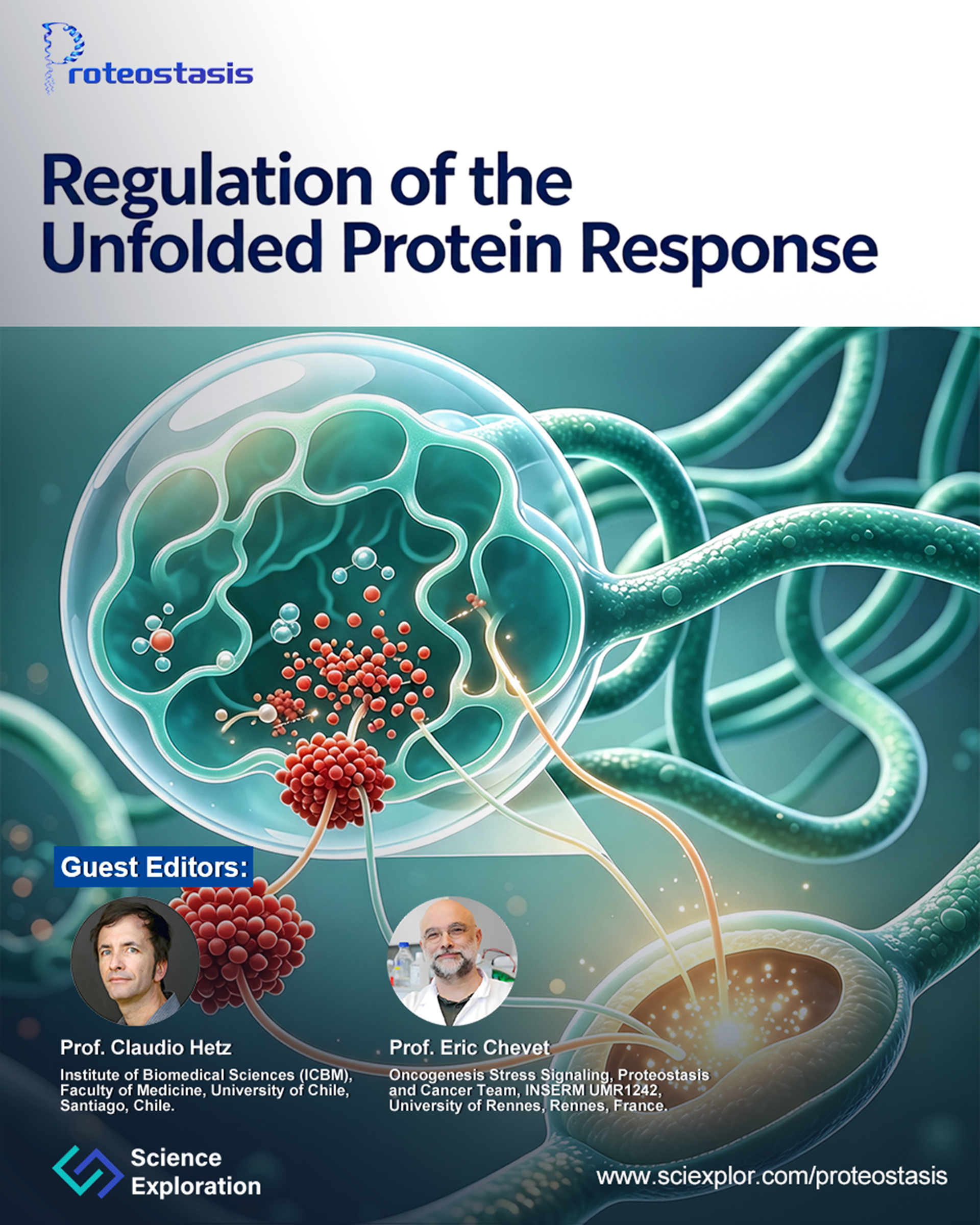
Guest Editor(s)
Institute of Biomedical Sciences (ICBM), Faculty of Medicine, University of Chile, Santiago, Chile. The Buck Institute for Research in Aging, Novato, CA, USA.
Special Issue Information
The unfolded protein response (UPR) is a conserved intracellular signaling network that safeguards proteostasis within the endoplasmic reticulum (ER). Triggered by accumulation of misfolded proteins, the UPR is transduced through three ER-resident sensors - IRE1α, PERK, and ATF6 - that detect proteotoxic stress and relay this information to the cytosol and nucleus. Under unstressed conditions, the chaperone BiP binds these sensors and prevents their activation; BiP dissociation upon protein accumulation permits their oligomerization and activation. Once activated, these arms restore ER homeostasis by attenuating translation, upregulating chaperones, and enhancing degradation of misfolded proteins. UPR dysfunction is implicated in a wide range of human diseases, including cancer, diabetes, and neurodegeneration, underscoring its biomedical relevance.
While the core architecture of the UPR is well established, growing evidence shows its regulation is more nuanced than appreciated. Recent work shows that all three sensors are modulated by additional factors controlling their dimerization, oligomerization, and post-translational modification, shaping the amplitude and kinetics of signaling. Beyond protein-based regulation, ER membrane composition itself modulates sensor activation, with changes in lipid saturation directly affecting it. Among the sensors, IRE1α is the most evolutionarily conserved, acting through kinase and endoribonuclease activities driving XBP1 mRNA splicing and regulated IRE1-dependent decay (RIDD); numerous protein–protein interactions regulate these outputs and other noncanonical functions. This complexity is consequential in cancer, where high IRE1α activity is associated with poorer prognoses, positioning it as a promising pharmacological target.
Given this expanding relevance, we are pleased to launch this Special Issue on the Regulation of the UPR, bringing together current perspectives on the mechanisms governing UPR signaling, from sensor activation to the consequences of its dysregulation. By assembling contributions spanning structural biology, systems-level analysis, and disease-specific applications, we hope to offer an integrated view of how cells calibrate this critical stress response.
Contact Us
Journal Editorial Office Email: editorial_office@proteostasisjournal.com
For Author Instructions, please refer to: https://www.sciexplor.com/proteostasis/author_instructions
For Online Submission, please login at: https://www.intellimanus.com/#/login?journalPath=proteostasis