Wide-gamut dynamic color modulation via combined localized surface plasmon resonance and electrochromism

Siyang Gao
1,2
,
Peipei Shao
1
,
Jiawei Sun
1
,
Zekun Huang
1
,
Rongji Jiao
1
,
Er Gao
1
,
Menghan Yin
1
,
Rui-Tao Wen
1,3,*

*Correspondence to:
Rui-Tao Wen, State Key Laboratory of Quantum Functional Materials, Department of Materials Science and Engineering, Southern University of Science and Technology (SUSTech), Shenzhen 518055, Guangdong, China.
E-mail: wenrt@sustech.edu.cn
Smart Mater Devices. 2026;2:202645. 10.70401/smd.2026.0048
Received: July 29, 2026Accepted: September 14, 2026Published: September 14, 2026
This article belongs to the Special lssue Smart Windows with Stimuli-Responsive Properties
Abstract
Electrochromic devices (ECDs), featuring passive optical modulation, backlight-free operation, and bistable low-power characteristics, are promising candidates for energy-efficient display applications. However, wide-gamut color modulation in electrochromic displays is hampered by both the narrow spectral tunability of conventional materials and the fabrication complexity of existing wide‑gamut devices. Herein, we develop an approach to achieving reversible wide-gamut color switching by depositing ellipsoidal metallic nanoparticles and an electrochromic WO3 layer in series. Specifically, the dielectric environment surrounding the metallic nanoparticles is dynamically altered by electrochemically modulating the refractive index of the WO3 layer, enabling precise tuning of the localized surface plasmon resonance absorption peak. As a result, a broad collective color gamut spanning the visible spectrum is achieved through Ag NP dimension engineering. In addition, the Ag nanoparticles (NPs)/WO3 working electrode exhibits a low electrode-level average coloration power density of 4 W m-2. We believe the results demonstrated in this work provide a new strategy for electrochromic display devices.
Keywords
Electrochromic device, multicolor, LSPR, structural colors
1. Introduction
Energy conservation is a critical strategy for promoting global sustainable development. As an indispensable information carrier in the digital era, display technology has become one of the major sources of energy consumption in consumer electronics and commercial display systems[1,2]. Current mainstream emissive display technologies rely on backlight units or self-emissive pixels for image generation, resulting in continuous power consumption even during static image display[3,4], thereby imposing substantial pressure on global energy resources and environmental sustainability. Therefore, the development of energy-efficient display technologies capable of reducing power consumption while maintaining excellent optical performance has attracted increasing attention[2,5]. Among various emerging approaches, electrochromic devices (ECDs) are considered promising candidates for next-generation low-power display applications[6-8]. ECDs are passive optical modulation systems with advantages including backlight-free operation, bistable image retention with low static power demand, and low driving voltage[9]. Nevertheless, conventional electrochromic materials and devices still face limitations in optical-control freedom, durability, and ion-transport behavior[10-13]. In addition, restricted color diversity and limited color-gamut coverage remain important challenges for achieving full-color electrochromic displays[14-16].
To address these challenges, extensive efforts have been devoted to broadening the color-gamut tunability of ECDs. Early studies mainly focused on molecular design and doping engineering of organic electrochromic materials to realize multicolor switching through band-structure modulation[6,17]. However, the obtained color gamut within a single device remained insufficient for full-color display requirements. Currently, several representative strategies have been explored to achieve full-color electrochromic displays, including multilayer or optical-cavity architectures for color mixing[18-23] and RGB subpixel or pixelated architectures for direct color reproduction[24]. Nevertheless, multilayer stacked configurations inevitably increase fabrication complexity and production cost, while color-filter-based red, green, or blue (RGB) subpixel architectures suffer from reduced optical efficiency because a large fraction of incident light outside the target red, green or blue spectral band is absorbed or blocked by the corresponding color filters.
Recently, ECDs based on the localized surface plasmon resonance (LSPR) effect of metallic nanoparticles (NPs) have emerged as a promising strategy for achieving wide-gamut color modulation[25-31]. By exploiting the strong dependence of LSPR on NP geometry and the surrounding dielectric matrix, vivid structural colors can be generated within ultrathin optical architectures. Despite these advantages, most reported LSPR-based electrochromic systems still rely on multilayer optical cavities, sophisticated nanostructures, or stepwise voltage-controlled switching processes to realize multicolor operation. Moreover, simultaneously achieving wide-gamut color modulation, low driving voltage, long-term bistability, excellent cycling stability, and a simplified device architecture remains highly challenging. Therefore, structurally simple ECDs capable of reversible full-visible-spectrum color modulation are still highly desirable, yet to be achieved.
Herein, based on the Gans-modified Mie scattering theory for ellipsoidal metallic NPs, we developed ECDs based on Ag NPs. By combining dimension engineering of Ag NPs with electrochemically induced refractive-index variation of WO3 films, the LSPR absorption peak of the NPs can be precisely regulated. Benefiting from the ultrathin three-layer indium tin oxide (ITO)/Ag NPs/WO3 architecture, a broad collective structural-color gamut spanning orange, yellow, green, blue, and violet is achieved by engineering the dimensions of Ag NPs, while reversible color modulation is demonstrated for individual devices. The device simultaneously exhibits excellent electrochromic performance, including an operating voltage window of ±2.0 V, outstanding bistability, and an electrode-level average coloration power density of 4 W m-2. Furthermore, the Ag NPs/WO3 electrode demonstrates stable electrochemical reversibility, with only a ~9% decrease in optical modulation after 300 cycles. In addition, the device-level demonstration further verifies the practical wide-gamut color-tuning capability of the proposed plasmonic electrochromic architecture. This work establishes a simplified platform that integrates nanoparticle-dimension engineering with electrochromically tunable dielectric environments, enabling dynamic structural-color generation within a device architecture. The proposed strategy provides new insights into the design of low-power, wide-gamut, and highly integrated electrochromic display systems, offering a pathway towards next-generation sustainable display technologies.
2. Experimental Section
2.1 Materials
To fabricate the Ag NPs, ITO/glass were used as substrates (coated by 185-nm-thick In2O3:SnO2), cut into 10 mm × 40 mm rectangles. All specimens were cleaned by sonication in acetone and rinsed with deionized water for 2 min. Finally, they were dried with nitrogen gas. The Ag NPs, tungsten-doped vanadium dioxide (WVO) and WO3 thin films were deposited as follows:
i) Ag NPs were deposited on ITO glasses by radio frequency (RF) magnetron sputtering (Yujie Ltd.) at room temperature to form a layer of Ag NPs with the following parameters: 60 W, 5.0 Pa for 6 min.
ii) Preparation of amorphous WO3 films: Amorphous WO3 films were deposited onto the Ag NPs layer or 185 nm-thick ITO films at room temperature by direct current (DC) magnetron sputtering. WO3 films with a thickness of approximately 140 nm were prepared under the following sputtering conditions: a DC power of 60 W, a working pressure of 0.8 Pa, and a deposition time of 10 min.
iii) Preparation of the WVO film: At room temperature, WVO films were deposited onto ITO or Ag/ITO by DC magnetron co-sputtering using W and V targets. The films, with a thickness of approximately 250 nm, were prepared under the following sputtering conditions: a DC power of 25 W for the W target, a DC power of 170 W for the V target, a working pressure of 1 Pa, and a deposition time of 150 min.
iv) Preparation of reflective samples for spectroscopic ellipsometry: To facilitate spectroscopic ellipsometry measurements, reflective samples were prepared on single-side-polished Si (001) wafers. A titanium layer with a thickness of approximately 200 nm was first deposited by DC magnetron sputtering using a DC power of 150 W, a working pressure of 0.3 Pa, and a deposition time of 10 min. Subsequently, an approximately 140-nm-thick WO3 film was deposited onto the Ti-coated substrate using the same sputtering conditions described above.
2.2 Characterization-spectroscopic characterization
i) In situ spectrum transmittance measurements were performed with fiber instruments from Ocean Optics (QEpro, Ocean Optics, USA). The spectrum was in the range of 400-2,200 nm, and transmittance data were recorded simultaneously with the electrochemical operations, such as galvanostatic and cyclic voltammetry (CV) measurements. The sample was positioned in a quartz electrochemical cell between a tungsten halogen lamp and the detector.
ii) Visible (VIS) transmission and reflection measurements were performed with a Perkin Elmer Lambda 950 ultraviolet-visible-near-infrared (UV-vis-NIR) spectrometer equipped with an integrating sphere. The UV-vis-NIR spectra of Ag NPs at different NP sizes were recorded ex situ within 250-2,200 nm.
iii) The optical constants were measured and analyzed by an ellipsometer (J.A. Woollam, M-2000). Amorphous WO3 films electrochemically switched between 2.0 and 4.0 V (vs. Li/Li+) were prepared at 0.2 V intervals, resulting in a total of 11 electrochemical states for spectroscopic ellipsometry measurements. Psi and Delta of LixWO3 in the VIS and NIR regions were directly obtained by J.A. Woollam, M-2000. The software CompleteEASE was used for the fitting test of Psi and Delta. K-K (Kramers-Kronig) mode was used in the fitting to maintain the consistency between the real and imaginary parts of the permittivity (ε1, ε2). The ε1 spectrum was calculated from the ε2 via Kramers-Kronig transformation. After ε2 was obtained, the absorption properties of the thin film were described by identifying the characteristic absorption position of the reflection spectrum of the sample and adding a Gaussian oscillator to the corresponding position. The above ε1, ε2 were transformed into n, k. Finally, the optical constant model was obtained. The thickness of the films was also obtained from this model.
2.3 Colorimetric analysis
The International Commission on Illumination (CIE) 1931 chromaticity coordinates of the Ag NP films were calculated from the measured transmission spectra using the CIE 1931 2° standard colorimetric observer under the D65 standard illuminant. The measured transmission spectrum was weighted by the D65 spectral power distribution and the corresponding CIE 1931 color-matching functions to obtain the tristimulus values X, Y, and Z. The chromaticity coordinates were then calculated as x = X/(X + Y + Z) and y = Y/(X + Y + Z). The resulting coordinates were plotted on the CIE 1931 chromaticity diagram.
2.4 Characterization-structural characterization
The morphologies of Ag NPs with different dimensions were characterized by scanning electron microscopy (SEM, HITACHI, 8320U). Particle dimensions were statistically analyzed using ImageJ. The analysis was performed three times, with approximately 150 Ag NPs measured in total from the SEM images. Optical simulation and Ag NP dimension retrieval: The dimensions of Ag NPs were retrieved by combining the Gans-modified Mie scattering theory with a numerical optimization approach. The extinction spectra of ellipsoidal Ag NPs were calculated based on their geometrical parameters, and a Python-based grid-search algorithm was developed to determine the particle dimensions. Specifically, the long-axis length (a) and short-axis length (b) were scanned within the ranges of 20-40 nm and 7-14 nm, respectively, with a step size of 0.2 nm. For each combination of (a, b), the calculated extinction spectrum was compared with the experimentally measured absorption spectrum, and the particle dimensions corresponding to the minimum spectral deviation were selected as the optimized Ag NP parameters.
2.5 Electrochromic performance
The electrochromic measurements were carried out in an argon-filled glove box, using a custom-made spectro-electrochemical cell in a three-electrode configuration. Ag NPs/WO3 films acted as working electrodes, and Li metal foils were used as the counter electrode and reference electrode, in LiClO4 in propylene carbonate (PC) electrolyte (1 mol L-1). The voltage was in the range between 4.0 and 2.0 V versus Li/Li+ using an electrochemical workstation (Ivium, model n-STAT). The sweep rate was 10 mV s-1. For the estimation of coloration energy, the instantaneous electrical power was calculated from the potential and current recorded in the CV profile. The electrical energy consumed during the coloration process was obtained by integrating the instantaneous power over the corresponding coloration period, and the coloration energy density was obtained by normalizing the integrated energy by the active electrode area (~2.4 cm2). The average coloration power density was then calculated as the coloration energy density divided by the coloration time. Because the energy was estimated from the Ag NPs/WO3 working electrode in a three-electrode configuration, the resulting value represents electrode-level coloration energy and does not include the energy consumption of the complete assembled device or external driving and control electronics.
2.6 Device assembly and measurements
The full devices present a six-layer configuration. The Ag NPs, Ag, WO3, and WVO layers were deposited on the ITO-coated glass substrate by sputtering as described above. The thickness of both WVO and WO3 films was ~150 nm. The electrochromic devices were assembled using Ag NPs/WO3 films and WVO-based electrodes as two electrodes, separated by a LiClO4-PC electrolyte. The transmissive device employed a WVO/ITO glass electrode, while the reflective device used a WVO/Ag electrode as the complementary ion-storage electrode. Firstly, a colloidal electrolyte was prepared, and 1 mol L-1 LiClO4-PC solution was mixed with Zigoo UV curing adhesive at a volume ratio of 2:1. The beaker was completely covered with aluminum foil to prevent solution evaporation. The mixed solution was stirred for 1 h at room temperature to obtain a clear solution. Finally, the electrodes were fixed in parallel using a silicone rubber sheet, and a solution containing LiClO4-PC electrolyte was injected between the two electrodes. The assembled device was then placed flat under the UV lamp, and the solid-state electrochromic device was obtained by UV light irradiation for 30 min. Electrochemical tests were conducted by the Ivium electrochemical workstation, and associated in situ transmission spectra were recorded with a fiber optical instrument. Optical images of the device were taken using a Huawei mobile phone.
3. Results and Discussion
3.1 Design principle of the Ag NPs based plasmon
As shown in Figure 1, an Ag NPs layer is deposited on the ITO film as the LSPR plasmonic unit and subsequently coated with a WO3 layer. Dynamic LSPR modulation is achieved through reversible Li+ and electron insertion/extraction in the WO3 layer by varying the dielectric environment of the Ag NPs. To achieve dynamic wide-gamut modulation in the proposed ECD, LSPR absorption dynamics of single-layer Ag NPs were first investigated. Based on the Gans-modified Mie scattering theory[32,33] applicable to metallic ellipsoidal NPs, the extinction cross-sections of ellipsoidal Ag NPs with different particle dimensions deposited on glass were calculated. In this calculation, the surrounding medium of the single-layer Ag NP films was treated as an effective air/glass dielectric environment. The calculated extinction spectra correspond to the resonance peak positions associated with the depolarization-factor direction of the ellipsoidal NPs. The extinction cross-section can be expressed as follows[34]:
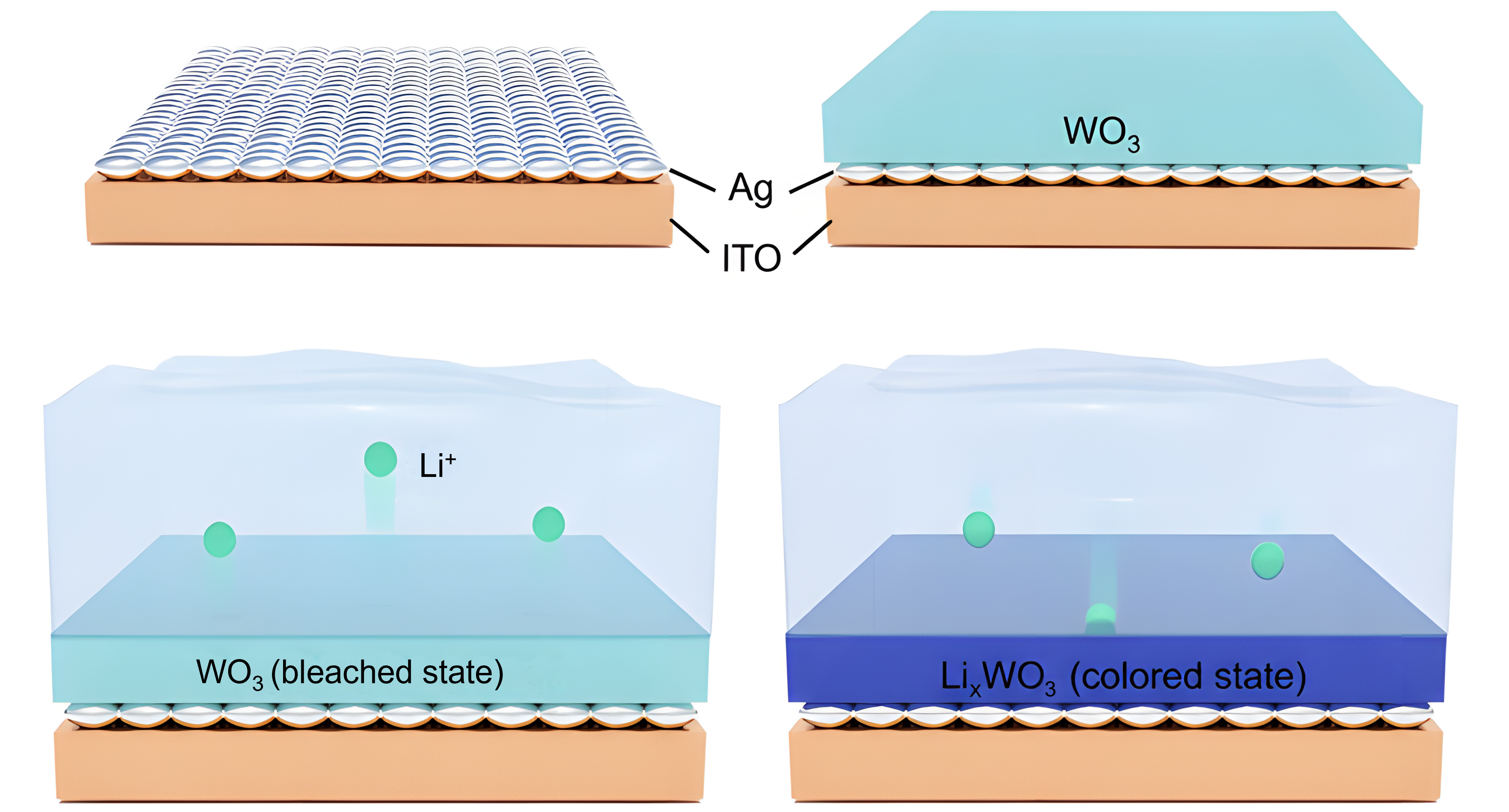
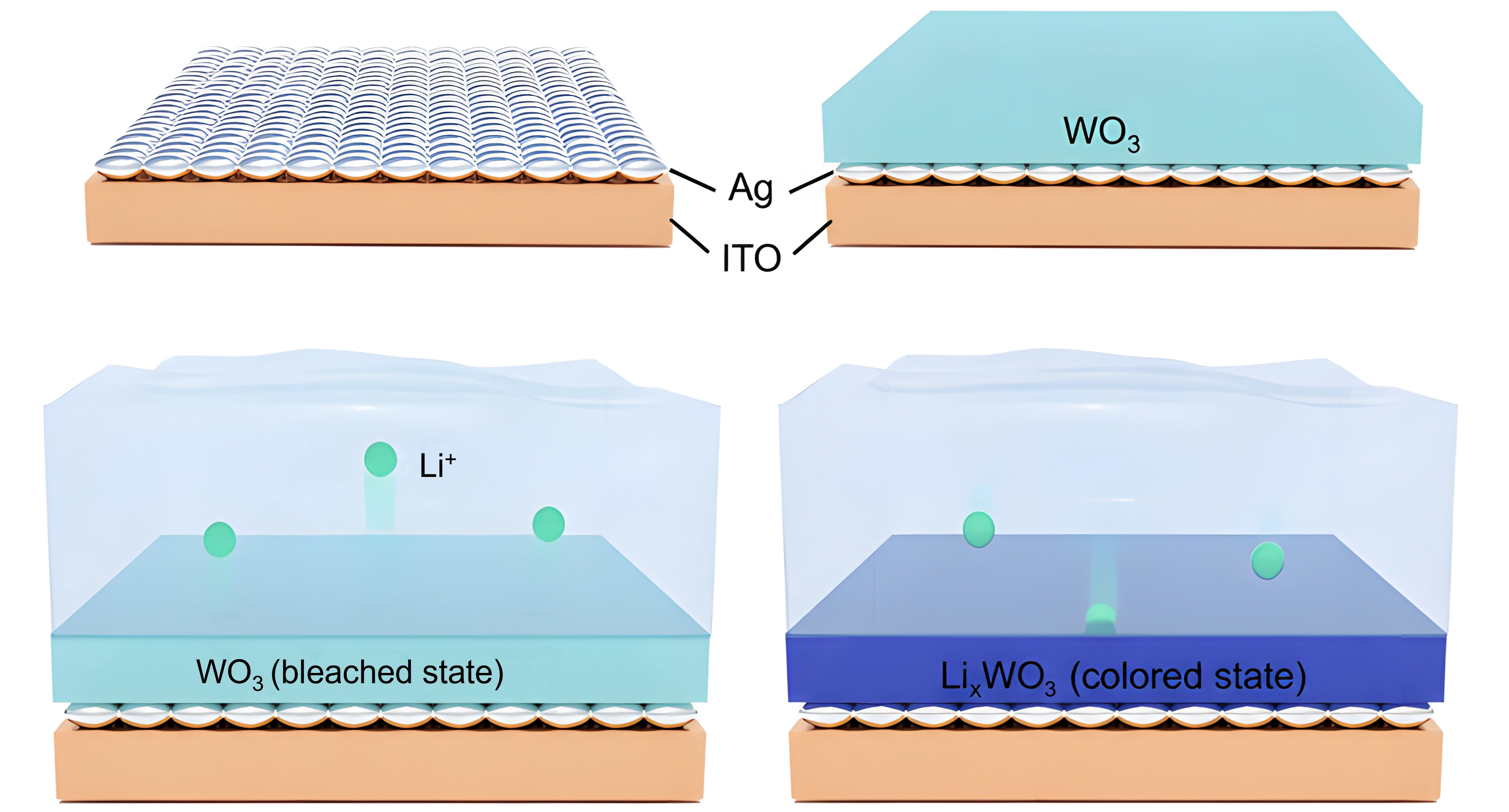
Figure 1. Schematic illustration of the wide-gamut tunable electrochromic architecture. ITO: indium tin oxide.
where Pj represents the depolarization factor along the j direction, εm is the dielectric constant of the surrounding medium, and εr and εi denote the real and imaginary parts of the dielectric constant of Ag NPs, respectively. For an ellipsoidal NP with radii a and b along the long-axis and short-axis, the depolarization factor can be described by:
The eccentricity e of the ellipsoidal NP is expressed as:
The morphology and dimensions of the deposited Ag NPs were first investigated to establish the correlation between NP geometry and plasmonic response. As shown in Figure 2a, the Ag NPs deposited on glass substrates exhibit an ellipsoidal morphology of the monolayer with uniform distribution, indicating that the magnetron sputtering process enables the formation of isolated plasmonic NPs. Additional SEM images of Ag NPs deposited under different Ar sputtering pressures are provided in Figures S1A,S1B, further confirming the morphology evolution of Ag NPs with varying deposition conditions.
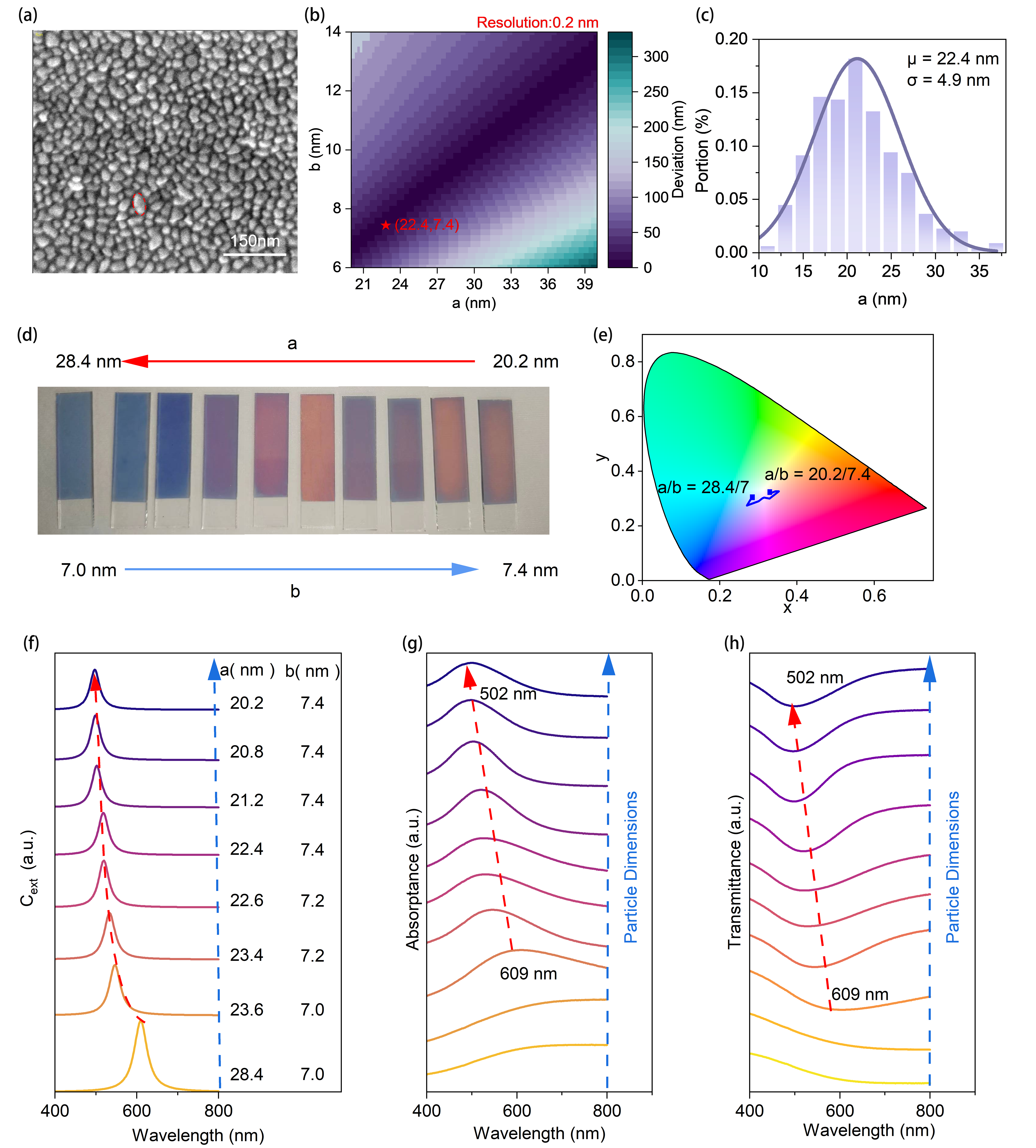
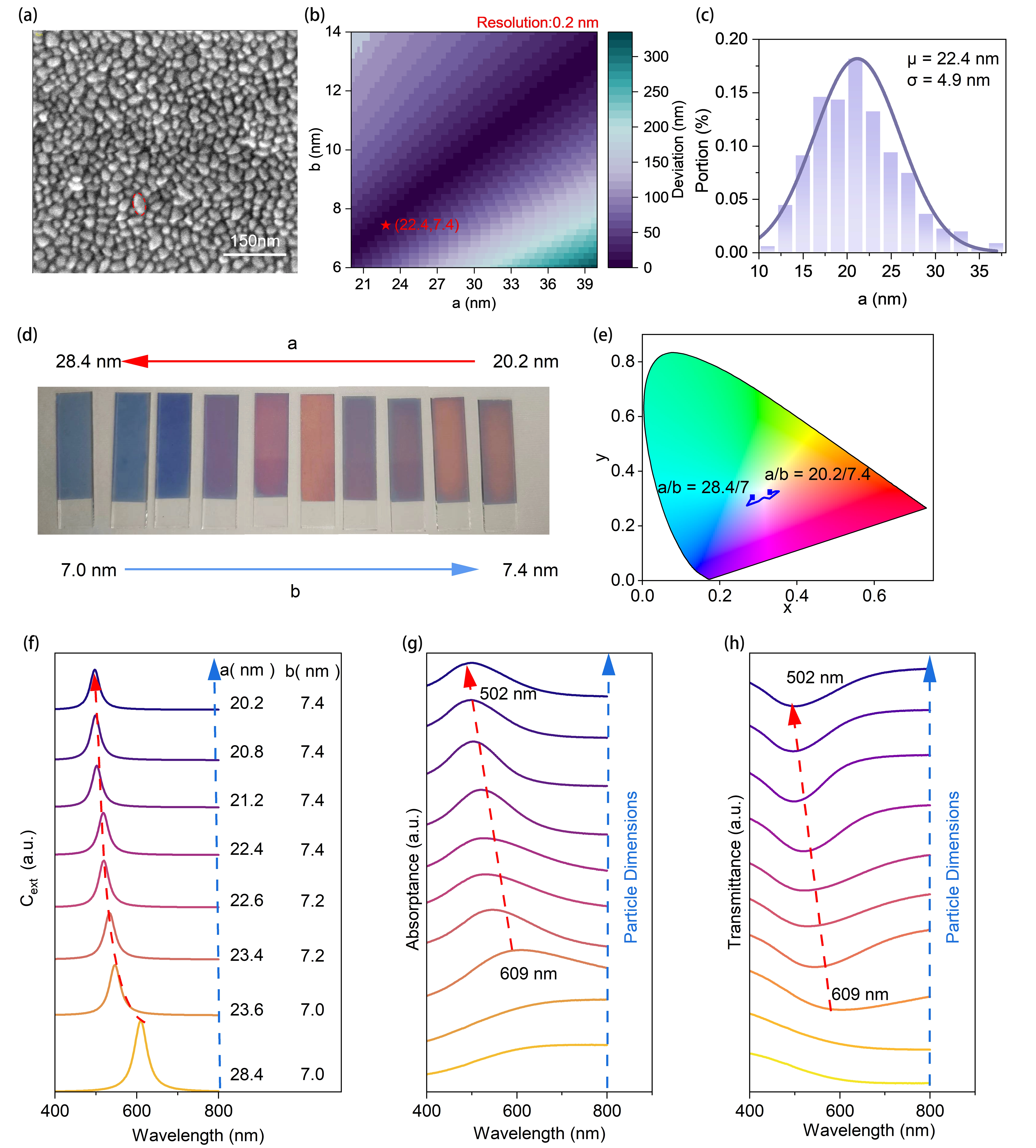
Figure 2. Morphology characterization and dimension-dependent optical properties of Ag NPs films. (a) SEM image of ellipsoidal Ag NPs deposited on glass substrates by RF magnetron sputtering under an Ar working pressure of 7.0 Pa; (b) Optimized a and b axes of Ag NPs; (c) Statistical analysis of the long-axis (a) length distribution of Ag NPs from SEM images using ImageJ; (d) Optical photographs of single-layer Ag NPs films deposited under different Ar pressures (from 1 to 10 Pa, left to right), exhibiting distinct structural colors on glass substrates; (e) Color coordination of Ag NPs films in the CIE 1931 color space; (f) Single-layer Ag NP films with different a and b and their corresponding extinction cross-sections; (g) Absorption spectra of single-layer Ag NPs films under different sputtering pressures; (h) Transmission spectra of single-layer Ag NPs films under different sputtering pressures. NPs: nanoparticles; CIE: International Commission on Illumination; SEM: scanning electron microscopy; RF: radio frequency.
To quantitatively determine the dimensions of the ellipsoidal Ag NPs, an optical retrieval method based on the Gans-modified Mie scattering theory was used. The extinction cross-sections of Ag NPs with different geometrical parameters were calculated according to Eqs (1)-(4). A grid-search strategy was employed within the parameter space of long-axis length (a = 20-40 nm) and short-axis length (b = 6-14 nm) with a grid resolution of 0.2 nm. For each combination of (a, b), the calculated extinction spectrum was compared with the experimentally measured absorption spectrum, and the particle dimensions corresponding to the minimum spectral deviation were selected as the optimized parameters (Figure 2b). The retrieval results for Ag NPs deposited under different sputtering pressures are further provided in Figures S2A,S2B, demonstrating the applicability of this grid-search-based optical retrieval method for different fabrication conditions. Furthermore, ImageJ software was used to statistically analyze the long-axis length distribution of Ag NPs from SEM images. The obtained particle distribution exhibits good Gaussian characteristics. The mean diameter is 22.4 nm with a standard deviation of 4.9 nm, and the experimentally measured long-axis dimensions agree well with the values obtained from optical retrieval, confirming the reliability of the grid-search-based optical retrieval method (Figure 2c). With this correlation, a series of monolayer Ag NPs films with varied particle dimensions were fabricated by adjusting the sputtering pressure. The resulting Ag NPs films exhibited distinct structural colors, including blue, violet, green, and orange-red, by increasing the sputtering pressure (Figure 2d).
To further evaluate the color modulation capability, the transmission spectra of Ag NPs films were converted into chromaticity coordinates and mapped onto the CIE 1931 chromaticity diagram. As shown in Figure 2e, the Ag NPs films with different particle dimensions exhibit distinct chromaticity coordinates, demonstrating that particle-dimension engineering enables effective regulation of structural colors across a broad visible spectral range. The calculated extinction spectra of Ag NPs films with different long-axis (a) and short-axis (b) dimensions are presented in Figure 2f. As a/b decreases, the eccentricity of ellipsoidal NPs decreases, resulting in variations in the depolarization factor. Consequently, the LSPR absorption peak gradually shifts towards shorter wavelengths, indicating that the optical response of Ag NPs can be effectively tuned through particle-dimension engineering. The contribution from free-electron density modulation in the Ag NPs on LSPR absorption is minor and thus can be neglected.
The measured absorption and transmission spectra of Ag NPs films prepared under different sputtering pressures are shown in Figure 2g,h, respectively. With increasing sputtering pressure, the absorption peak continuously shifts from 609 to 502 nm, corresponding to a total blueshift of 107 nm. This spectral evolution agrees well with the theoretical predictions obtained from the Gans-modified Mie scattering model, confirming that sputtering-pressure-controlled particle-dimension engineering provides an effective strategy for regulating the plasmonic optical properties of Ag NPs films.
3.2 Dynamic wide-gamut structural color modulation
Notably, the above results demonstrate that the particle size of Ag NPs can be effectively regulated, thereby enabling monolayer Ag NPs films with relatively sharp LSPR absorption peaks. Figure S3 provides direct evidence of the characteristic LSPR feature in the Ag NPs/WO3 electrode, which is absent in the WO3-only electrode. Meanwhile, the intrinsic electrochromism of WO3 also contributes to the voltage-dependent optical response through changes in its absorption and optical constants. As demonstrated by the agreement between the calculated and experimentally measured LSPR peak positions in Figure 3a, the voltage-dependent variation of the WO3 optical constants plays an important role in modulating the LSPR response of the Ag NPs. Nevertheless, because the electrochromic response of WO3 and the LSPR modulation occur simultaneously in the Ag NPs/WO3 electrode, their individual contributions to the overall optical modulation cannot be quantitatively separated based on the present measurements. After confirming the controllable fabrication of Ag NPs monolayers and their size-dependent optical characteristics, a dynamically tunable structural-color multilayer architecture was further constructed, and its electrochromic performance was systematically investigated. The wide-gamut structural-color device adopts a typical sandwich configuration (Figure 1) consisting of ITO/Ag NPs/WO3/electrolyte, serving as the working electrode. Unlike conventional electrochromic optical structures, this architecture exploits the Mie scattering and LSPR effects of Ag NPs, with dynamic color modulation achieved through electrochemical regulation of the optical constants and dielectric function of the WO3 layer. As illustrated in Figure 1 above, during the coloration process, Li+ insertion into WO3 is accompanied by electron injection, leading to the formation of LixWO3 and consequently modifying the electronic structure and optical constants (n and k) of WO3[35]. Consequently, the extinction cross-section wavelength governed by Mie scattering is modulated, leading to dynamic tuning of the absorption peak of the electrochromic electrode. In this structural-color electrode, the pre-deposited Ag NPs layer serves as the plasmonic scattering unit, while the WO3 layer simultaneously functions as both the electrochromic medium and the dynamic dielectric environment for LSPR modulation.
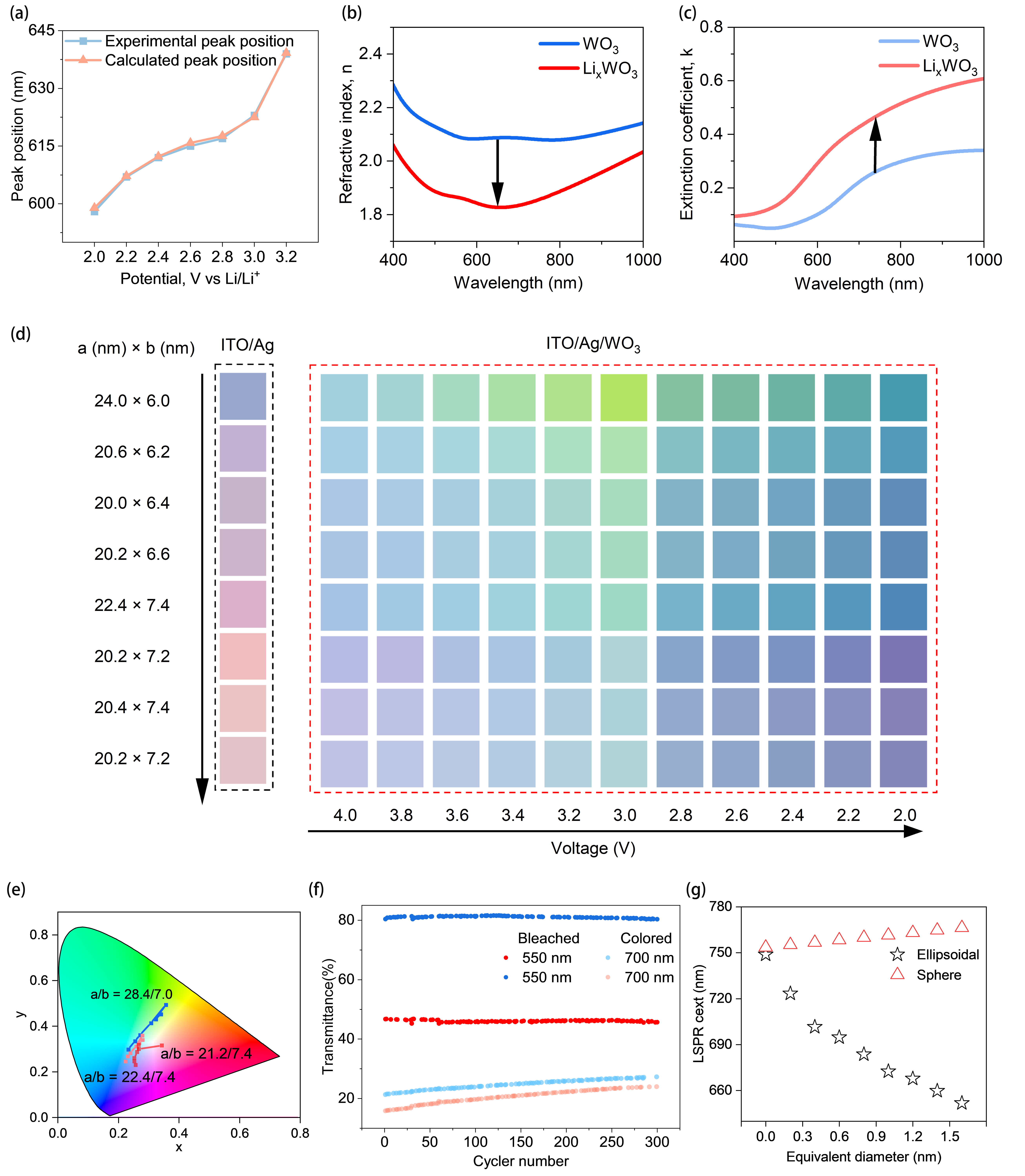
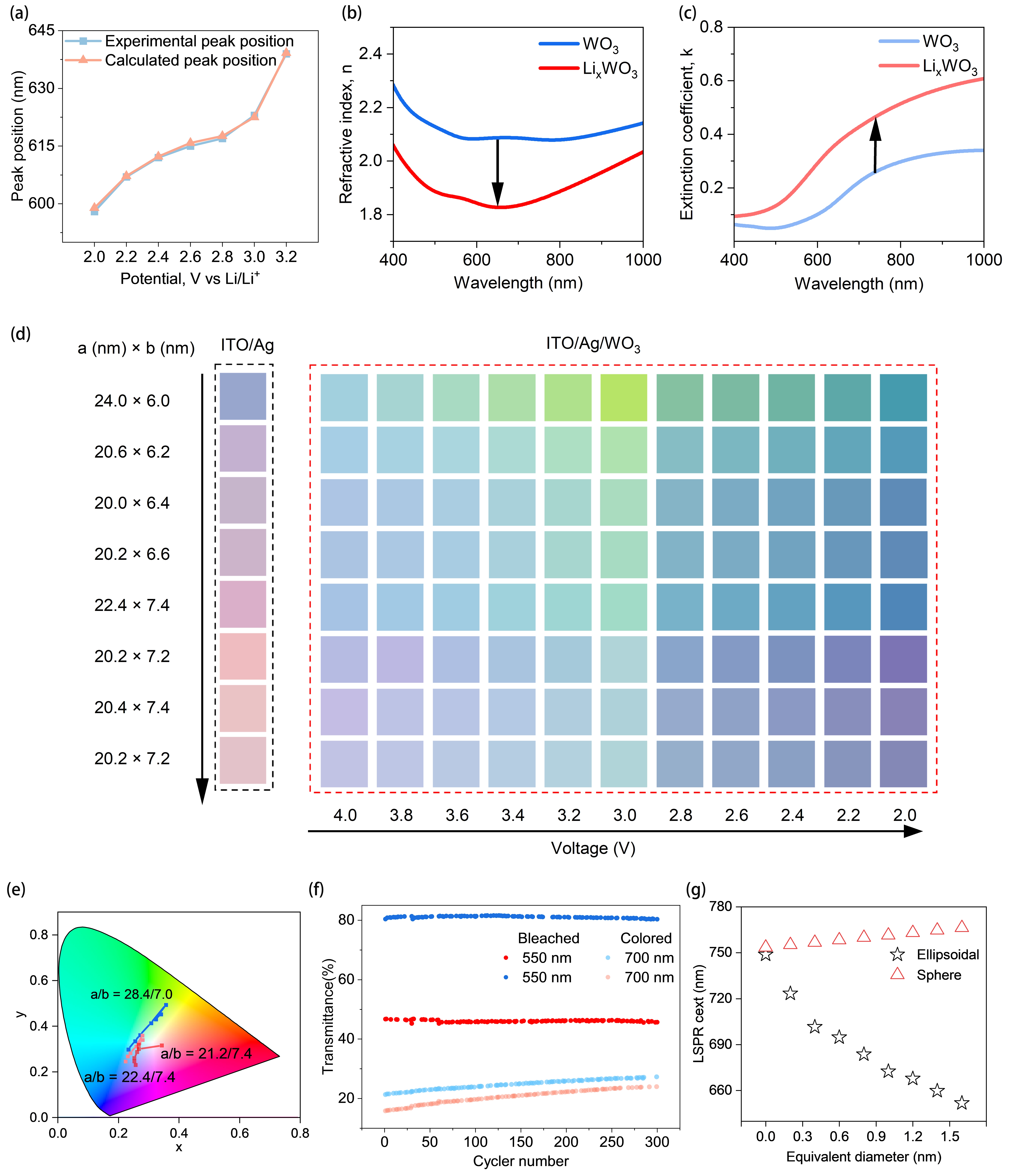
Figure 3. Wide-gamut tunability of the electrochromic structural colors. (a) Comparison of experimentally measured and theoretically calculated LSPR peak positions under different electrochemical states; (b,c) n and k evolution of WO3 during the coloration process; (d) Demonstration of wide-gamut modulation in ITO/Ag NPs/ WO3 structures with different Ag NP dimensions; (e) Simulated color gamut of Ag NP/WO₃ electrodes with different Ag NP dimensions on the CIE 1931 chromaticity diagram; (f) Evolution of the transmittance at 550 and 700 nm in the colored and bleached states during 300 electrochemical cycles of Ag NPs/WO3; (g) Comparison of the calculated LSPR peak shifts of spherical and ellipsoidal Ag NPs under identical dimensional variation. LSPR: localized surface plasmon resonance; NPs: nanoparticles; CIE: International Commission on Illumination; ITO: indium tin oxide.
The refractive indices (n) and extinction coefficients (k) of LixWO3 at different electrochemical potentials measured by spectroscopic ellipsometry were incorporated into the LSPR calculation to obtain the theoretical peak positions. As shown in Figure 3a, the calculated LSPR peak positions agree well with the experimentally measured values, demonstrating that the experimentally observed spectral variations can be quantitatively explained by the LSPR shifts induced by the dielectric environment modulation in the Ag NP/WO3 structure. Within the applied voltage range of 4.0 to 2.0 V versus Li/Li+, reversible Li+ insertion/extraction accompanied by electron insertion/extraction continuously modulates the optical constants of the WO3 layer (Figure 3b). Specifically, the refractive index (n) of WO3 decreases from 2.1 to 1.8, while the extinction coefficient (k) increases from 0.2 to 0.5 during the coloration process (Figure 3c). According to Eqn. (1), modulation of n changes the dielectric environment surrounding the Ag NPs. For the ITO/Ag NPs/WO3 electrode, the dielectric environment surrounding the Ag NPs is dominated by the adjacent WO3 layer. Therefore, the voltage-dependent n of WO3 was considered in the analysis of dynamic LSPR modulation. Based on the Gans-modified Mie scattering theory, such dynamic tuning of the surrounding n enables continuous and reversible regulation of the LSPR absorption peak of Ag NPs, thereby allowing the multilayer configuration to exhibit diverse structural-color switching across a wide color gamut. Upon application of a reverse bias, the n of WO3 recovers to 2.1, resulting in restoration of the initial optical state.
The Gans-theory calculations further confirm the critical roles of both the Ag NPs dimensions and n of WO3 in determining the initial optical states and subsequent color evolution. As shown in Figure 3d, the structural-color electrode containing Ag NPs with different particle dimensions (24 nm × 6 nm, 20.6 nm × 6.2 nm, 20 nm × 6.4 nm, 20.2 nm × 6.6 nm, 22.4 nm × 7.4 nm, 20.2 nm × 7.2 nm, and 20.4 nm × 7.4 nm) exhibits distinct initial colors and continuous color evolution during electrochemical switching. Specifically, coloration was performed at 2.0 V, while bleaching was conducted at 4.0 V. The ITO/Ag NPs/WO3 electrodes display markedly different optical responses depending on the Ag NPs dimensions. Figure 3e. shows the voltage-dependent color coordinates for selected a/b values of 28.4/7.0, 22.4/7.4 and 21.2/7.4. Such a direct view of the color coordinates well verifies the wide-gamut of this design.
For Ag NPs with relatively larger a-axis and smaller b-axis, broader absorption peaks are generated, leading to higher color saturation during dynamic color evolution. For example, electrodes containing 24 nm × 6 nm Ag NPs exhibit highly saturated blue, yellow, and yellow-green colors. In contrast, when the a-axis decreases and the b-axis increases, the absorption peak becomes narrower, resulting in colors with relatively lower saturation and a comparatively cooler color tone during continuous modulation. Therefore, the initial particle dimensions of Ag NPs can be deliberately engineered to satisfy different practical application requirements. By adjusting the sputtering pressure to tailor the particle dimensions of Ag NPs and applying external bias, the LSPR of the ITO/Ag NPs/WO3 structure can be readily modulated, thereby enabling continuously tunable full-gamut structural colors. Such continuously variable color modulation is highly desirable for conventional multilayer optical electrochromic systems.
The cycling stability of the Ag/WO3 electrode was first examined by repeatedly switching between the colored and bleached states while monitoring the optical transmittance at 550 nm and 700 nm, corresponding to the characteristic plasmonic modulation wavelength. As shown in Figure 3f, reversible optical modulation was maintained throughout the cycling process. After 300 cycles, the device retained approximately 91% of its initial optical modulation. During 300 electrochemical cycles, the bleached-state transmittance remained nearly constant, whereas only a slight increase of the colored state was observed at 550 nm, resulting in a small reduction of the entire optical modulation. Meanwhile, the transmittance at 700 nm exhibited negligible variation throughout the cycling. These results demonstrate that the plasmonic modulation of the Ag NPs layer is well maintained during repeated Li+ insertion/extraction processes. These results demonstrate that the plasmonic modulation of the Ag NPs layer is well maintained during repeated Li+ insertion/extraction processes, indicating that WO3 covered Ag NPs effectively prevents the damage of Ag NPs from electrolyte. However, direct characterization of Ag NP stability remains insufficient and merits further investigation. The slight decrease in optical modulation during cycling is likely due to the gradual ion accumulation within the WO3 layer. During repeated Li+ insertion and extraction, ion trapping degrades the WO3 matrix, leading to reduced coloration efficiency and a gradual degradation of transmittance modulation[11,13]. Nevertheless, the relatively small attenuation demonstrates that the electrochromic modulation of the WO3 layer remains highly reversible, while the Ag NPs layer preserves its plasmonic characteristics throughout repeated operation.
Furthermore, the negligible variation in the spectral profile during repeated coloration/bleaching cycles indicates that the plasmonic response of the Ag NPs layer remains stable during electrochemical switching. These results demonstrate that the synergistic combination of electrochromically tunable WO3 and plasmonic Ag NPs not only enables dynamic wide-gamut color modulation but also provides excellent cycling durability and color-retention capability, highlighting the potential of the proposed architecture for practical electrochromic display applications. However, it has to be pointed out that an electrochromic device possesses multiple layers with different compositions, a deficiency of any layer or interface may lead to device degradation. For practical commercialization, systematic optimization is highly desired in the future.
To clarify the advantage of employing ellipsoidal Ag NPs, the LSPR peak shifts of spherical and ellipsoidal NPs were theoretically compared by applying identical absolute changes to their respective characteristic dimensions. Specifically, the diameter of the spherical NPs and the long-axis lengths (a) of the ellipsoidal NPs were varied by the same amount. As shown in Figure 3g, ellipsoidal NPs exhibit a substantially larger resonance shift than spherical NPs under identical geometrical changes. Specifically, the resonance peak of ellipsoidal Ag NPs shifts by more than 100 nm, whereas that of spherical NPs changes by only about 13 nm. This pronounced enhancement originates from the anisotropic geometry of ellipsoidal NPs, which significantly increases the sensitivity of the depolarization factor to dimensional variation. Consequently, ellipsoidal Ag NPs provide a much broader tunable spectral range, making them more suitable for achieving wide-gamut electrochromic color modulation than conventional spherical NPs.
It should be emphasized that the electrochromic (EC) device constructed based on the LSPR exhibits excellent bistability, enabling stable color retention without the need for continuous external power input. Such characteristics are particularly advantageous for low-refresh-rate display applications, such as highway information displays, advertising panels, and supermarket electronic labels. Consequently, this technology is highly promising for energy-saving display systems and carbon-emission reduction strategies. Compared with conventional displays requiring continuous power consumption, the structural colors generated through the LSPR effect remain highly stable under open-circuit conditions.
3.3 Device stability and display performance
To evaluate the practical applicability of the proposed plasmonic ECD, its electrochemical cycling stability was systematically investigated using the Ag NPs film with dimensions of 22.4 nm × 7.4 nm. To further clarify the origin of the voltage-dependent LSPR modulation, we qualitatively compared the possible contributions from carrier-density modulation in the Ag NPs and dielectric-function variation in WO3. Because Ag possesses a high intrinsic free-electron concentration, interfacial charge accumulation is expected to produce only a small fractional change in its carrier density. In contrast, electrochemical Li+ insertion induces a pronounced variation in the optical constants of WO3, thereby substantially modifying the dielectric environment surrounding the Ag NPs. Therefore, the observed LSPR shift is primarily attributed to the voltage-dependent dielectric modulation of WO3, while the contribution from carrier-density modulation in the Ag NPs is expected to be comparatively minor.
Besides reversible color switching, the device also exhibits excellent color retention under open-circuit conditions, which is attributed to the bistable electrochromic behavior of the WO3 layer.
To demonstrate the practical applicability of the proposed plasmonic electrochromic architecture, transmissive and reflective electrochromic devices were fabricated based on the structural-color electrode. As illustrated in Figure 4a, the transmissive device adopts a sandwich configuration of ITO/Ag NPs/WO3/LiClO4-PC/WVO/ITO, whereas the reflective device has a configuration of ITO/Ag NPs/WO3/LiClO4-PC/WVO/Ag, in which the Ag layer serves as a reflective backing layer to enhance optical reflection. WVO was selected as the complementary electrode material because of its suitable electrochemical reversibility and high optical transparency. The CV curves of the WVO film measured within a potential window of 2.0-4.0 V (vs. Li/Li+) are presented in Figure S4A. As shown in Figure S4B, the WVO film maintains a transmittance above 80% in both the bleached and colored states, thereby minimizing its optical interference with the structural-color modulation of the Ag NPs/WO3 electrode.
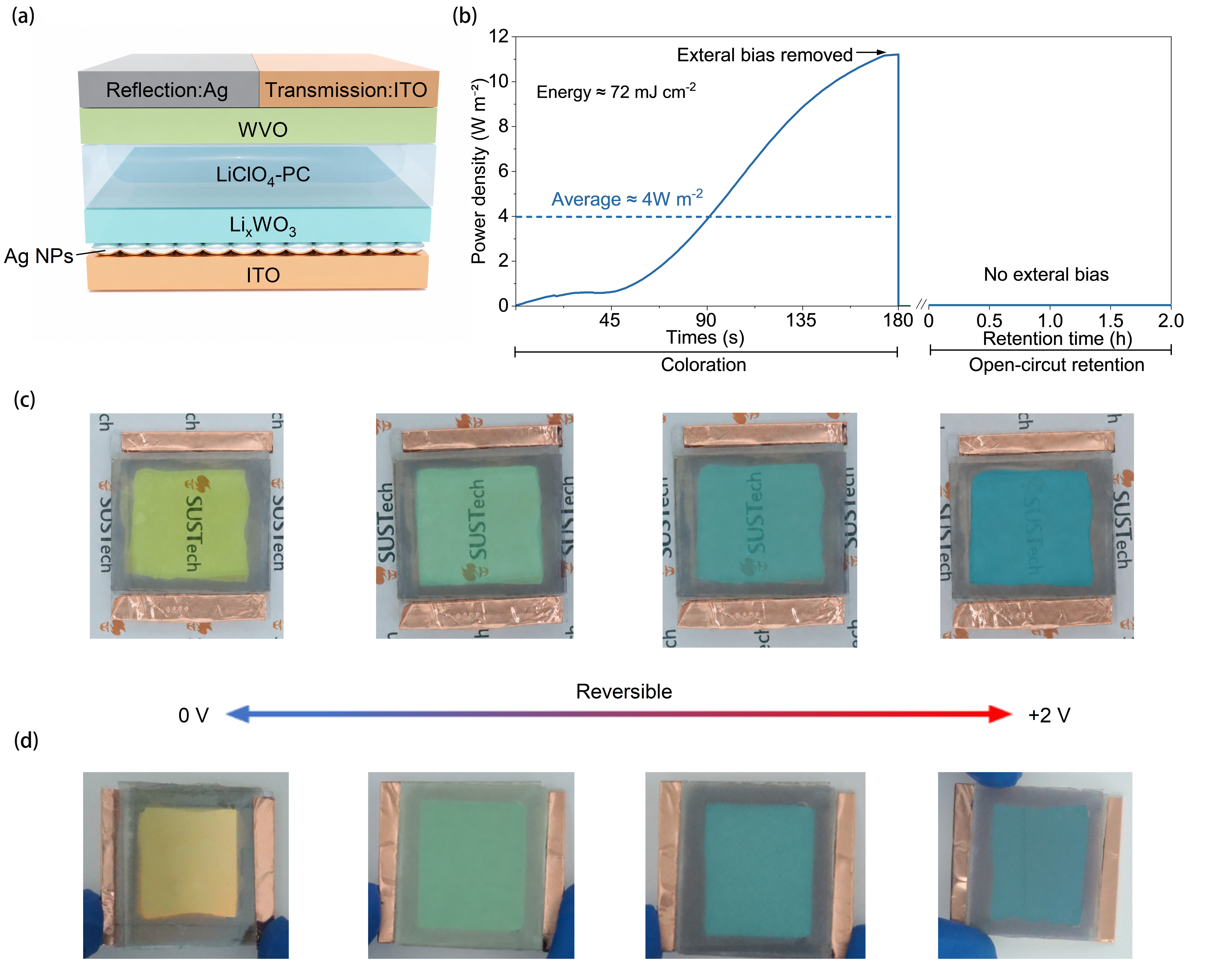
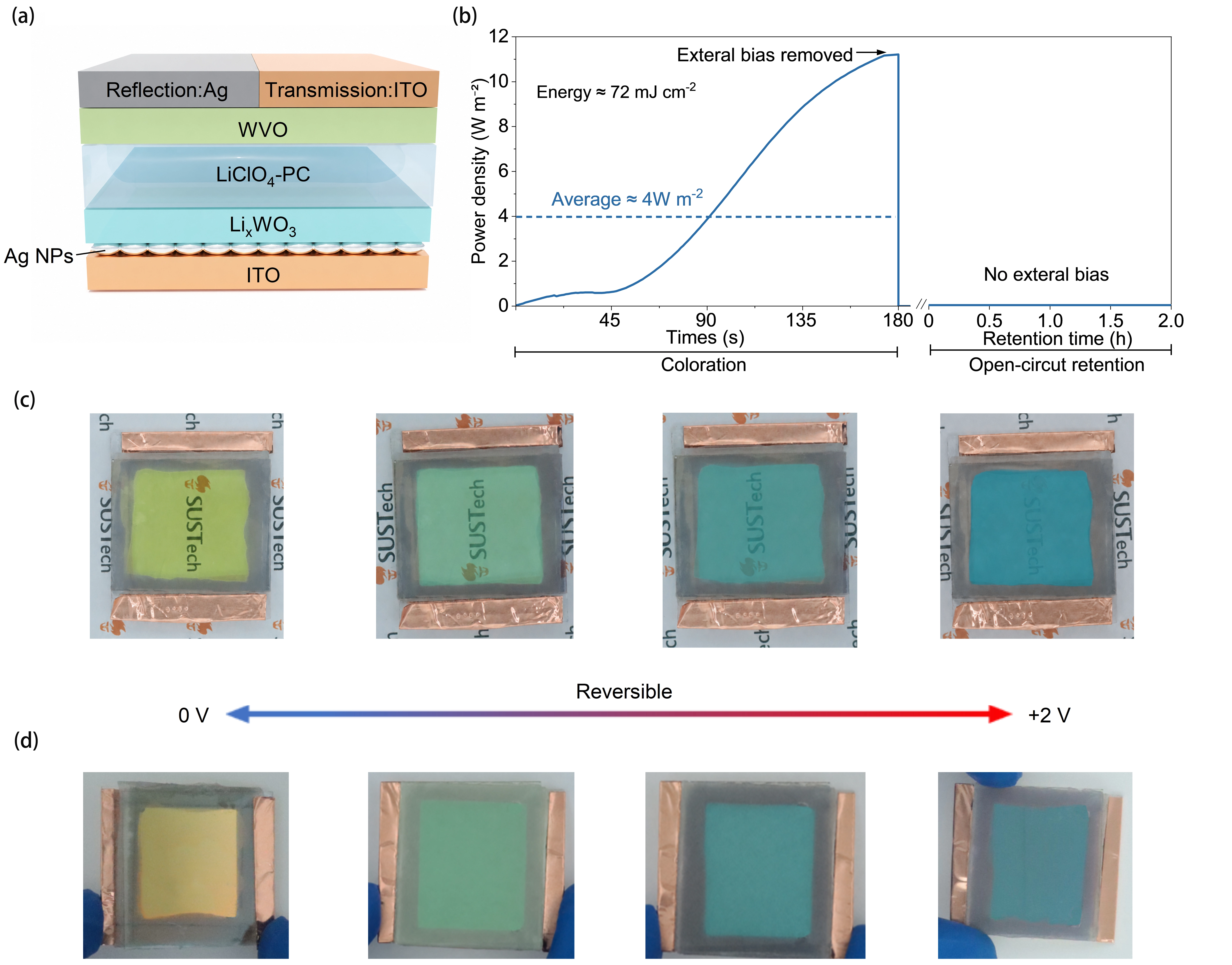
Figure 4. Electrochromic performance and display demonstrations of the wide-gamut plasmonic ECD. (a) Schematic illustrations of the transmissive and reflective electrochromic device architectures; (b) Electrode-level instantaneous power density during the coloration process and the subsequent open-circuit retention period of the Ag NPs/WO3 electrode; (c) Reversible color transition of the device between yellow-green and blue states; (d) Photograph of the reflection-type electrochromic device with a reflective background, demonstrating reversible structural-color modulation. ECD: electrochromic device; NPs: nanoparticles; ITO: indium tin oxide; PC: propylene carbonate; WVO: tungsten-doped vanadium dioxide.
The energy demand during coloration was estimated from the CV profile of the Ag NPs/WO3 electrode shown in Figure S5 by integrating the instantaneous electrical power over the coloration process. As shown in Figure 4b, the calculated coloration energy density is approximately 72 mJ cm-2 over a coloration time of approximately 180 s, corresponding to an average coloration power density of approximately 0.4 mW cm-2 (4 W m-2). This value represents the electrode-level power demand of the Ag NPs/WO3 working electrode during electrochemical coloration and does not include the complete device or external driving and control electronics. After coloration, the device can maintain its optical state under open-circuit conditions without continuous external voltage application owing to its bistable electrochromic behavior.
As shown in Figure 4c, the electrochromic device exhibits a reversible color transition between the initial yellow-green state and the blue state under alternating biases of +2 and 0 V. Specifically, at an applied device voltage of +2 V, the device is in the colored state (i.e., the blue state), with the Ag NPs/WO3 electrode connected to the negative terminal and the complementary WVO-based electrode connected to the positive terminal. This reversible color switching originates from the voltage-dependent modulation of the WO3 optical constants and the resulting shift in the LSPR response of the Ag NPs. The reflection-type electrochromic device further exhibits uniform and reversible structural-color modulation over a large active area of 4 cm × 4 cm, as demonstrated in Figure 4d. The reflective backing layer enhances the visibility of the structural color, highlighting the feasibility of the proposed architecture for reflective display applications.
In addition, the structural colors exhibit excellent retention under open-circuit conditions. Following coloration, the inserted electrons and Li+ ions are retained within the WO3 matrix, maintaining the reduced LixWO3 state and its associated optical properties over extended periods, for example, 2 hours in our case (Figure S6). Consequently, the dielectric environment surrounding the Ag NPs remains stable, thereby preserving the LSPR condition and the corresponding structural color. No external bias was applied during the measured open-circuit retention period; therefore, the electrode-level holding power was negligible under these test conditions. These results demonstrate that the proposed LSPR-based electrochromic architecture combines wide-gamut color modulation with low electrode-level coloration power demand and bistable optical operation, highlighting its potential for low-power reflective display applications.
The demonstrated 4 cm2 × 4 cm2 reflective device provides a proof of concept for scaling the proposed architecture toward large-area applications. Because the Ag NPs, WO3, and WVO layers are deposited by magnetron sputtering, the fabrication process is potentially compatible with large-area and continuous manufacturing. Further scale-up, however, will require precise control of Ag NP dimensions and spatial uniformity, consistent WO3 optical properties, and homogeneous electrochemical switching across large-area electrodes. Roll-to-roll is another approach for scale-up when liquid electrolyte is employed, which could be more attractive considering the cost and manufacturing yield since the solid/solid interface among cathode/electrolyte/anode is absent. These considerations provide clear directions for further optimization toward scalable low-power reflective display technologies.
4. Conclusion
In summary, this work demonstrates a simplified plasmonic electrochromic strategy for dynamic wide-gamut color modulation by integrating a single-layer Ag NPs film with WO3-based dielectric modulation. The LSPR absorption peak can be dynamically tuned by the synergistic effects of ellipsoidal Ag NPs dimension engineering and the reversible refractive-index modulation of WO3. Engineering the Ag NPs dimensions enables a broad collective color gamut, whereas each individual device achieves reversible color switching within its corresponding spectral range. Consequently, the device exhibits excellent electrochromic performance, including a low operating voltage, outstanding bistability, and a low electrode-level average coloration power density. The proposed device combines a simplified architecture with enhanced color tunability and bistable optical operation, highlighting its potential for next-generation low-refresh-rate reflective displays, such as smart outdoor signage and electronic shelf labels.
Supplementary materials
The supplementary material for this article is available at: Supplementary materials.
Authors contribution
Gao S: Methodology, investigation, formal analysis, writing-original draft, writing-review & editing.
Shao P, Sun J, Huang Z, Jiao R, Gao E, Yin M: Investigation, writing-review & editing.
Wen RT: Conceptualization, supervision, writing-original draft, writing-review & editing.
All authors discussed the results and commented on the manuscript.
Conflicts of interest
The authors declare no conflicts of interest.
Ethical approval
Not applicable.
Consent to participate
Not applicable.
Consent for publication
Not applicable.
Availability of data and materials
The data that support the findings of this study are available in the supplementary materials of this article.
Funding
This work was supported by the National Natural Science Foundation of China (Grant No. 52172294).
Copyright
© The Author(s) 2026.
References
-
1. Rao T, Zhou Y, Jiang J, Yang P, Liao W. Low dimensional transition metal oxide towards advanced electrochromic devices. Nano Energy. 2022;100:107479.[DOI]
-
2. Santosa ASS, Chang YW, Dahlin AB, Österlund L, Volpe G, Xiong K. Video‐rate tunable colour electronic paper with human resolution. Nature. 2025;646(8087):1089-1095.[DOI]
-
3. Choi Y, Ha R, Cha H. Fully automated OLED display power modeling for mobile devices. Pervasive Mob Comput. 2018;50:41-55.[DOI]
-
4. Li J, Zhuang Y, Chen J, Li B, Wang L, Liu S, et al. Two-dimensional materials for electrochromic applications. EnergyChem. 2021;3(5):100060.[DOI]
-
7. Li Y, Sun P, Chen J, Zha X, Tang X, Chen Z, et al. Colorful electrochromic displays with high visual quality based on porous metamaterials. Adv Mater. 2023;35(23):e2300116.[DOI]
-
10. Gao E, Duan Z, Sun J, Yin M, Sun H, Wen RT. Charge-balance design in complementary electrochromic devices enabled by a diffusion-controlled electrochromic anode. Adv Funct Mater. 2026;36(56):e76604.[DOI]
-
11. Zhou Q, Shao P, Zhang R, Huang S, Zhang Y, Zhu Y, et al. Photo-electrochemical synergistically induced ion detrapping for electrochromic device rejuvenation. Matter. 2025;8(1):101877.[DOI]
-
12. Huang Q, Shao P, Hou M, Lei Y, Ou Z, Hu J, et al. TT-Nb2O5 with dual-band modulation and exceptional performance retention for fast-responsive electrochromics. Natl Sci Rev. 2025;12(6):nwaf154.[DOI]
-
13. Zhou Q, Tian X, Shao P, Yin M, Zhang C, Wen RT. In operando ultraviolet illumination enables self-healing electrochromic response. Adv Funct Mater. 2026;36(54):e75708.[DOI]
-
14. Mu L, Zhou L, Pang J, Xu M, Chen Z, Zhou Y, et al. Color reproduction of reflective display based on conjugated electrochromic polymer. Org Electron. 2020;85:105850.[DOI]
-
15. Zhang W, Li H, Elezzabi AY. Electrochromic displays having two-dimensional CIE color space tunability. Adv Funct Mater. 2022;32(7):2108341.[DOI]
-
17. Huang L, Cao S, Liang Y, Chen J, Yang T, Zhao J, et al. Advances in multicolor electrochromic devices based on inorganic materials. J Mater Chem C. 2023;11(30):10107-10120.[DOI]
-
18. Zhang T, Dai Y, Li Y, Tang X, Hu Y, Chen Z, et al. Colorful transmissive all-solid-state electrochromic devices empowered by optical resonant cavities. Chem Eng J. 2025;516:164254.[DOI]
-
19. Tang X, Hu Z, Wang Z, Chen J, Mu X, Song G, et al. ITO/Cu multilayer electrodes for high-brightness electrochromic displays. eScience. 2022;2(6):632-638.[DOI]
-
20. Chen J, Song G, Cong S, Zhao Z. Resonant-cavity-enhanced electrochromic materials and devices. Adv Mater. 2023;35(47):e2300179.[DOI]
-
22. Guo J, Jia H, Jin P, Huang A, Li Z, Shao Z, et al. Transparent-to-reflective multicolor all-solid-state electrochromic devices for next-generation intelligent display windows. Adv Mater. 2025;37(41):e00350.[DOI]
-
23. Xiao L, Lv Y, Lin J, Hu Y, Dong W, Guo X, et al. WO3-based electrochromic distributed Bragg reflector: Toward electrically tunable microcavity luminescent device. Adv Opt Mater. 2018;6:1700791.[DOI]
-
24. Kim KS, Eom SY, Yang SH, Jo JW, Sun F, Lee R, et al. Intrinsically stretchable large-area pixelated electrochromic displays via direct photopatterning. Nat Commun. 2026;17:6371.[DOI]
-
25. Daqiqeh Rezaei S, Dong Z, You En Chan J, Trisno J, Ng RJH, Ruan Q, et al. Nanophotonic structural colors. ACS Photonics. 2021;8(1):18-33.[DOI]
-
26. Zhao Y, Jiang Q, Wu X, Gao D, Zhu P, Li Y, et al. Multicolor electrochromic metamaterials based on Mie scatterer nanospheres. Adv Opt Mater. 2024;12(24):2400838.[DOI]
-
29. Uji S, Kimura S, Nakamura K, Kobayashi N. Analysis for coloration mechanism of reversible silver deposition-based electrochromic device by in situ observation of plasmonic nanoparticles with dark-field microscopy. Sol Energy Mater Sol Cells. 2023;251:112119.[DOI]
-
30. Tsuboi A, Nakamura K, Kobayashi N. Multicolor electrochromism showing three primary color states (cyan–magenta–yellow) based on size- and shape-controlled silver nanoparticles. Chem Mater. 2014;26(22):6477-6485.[DOI]
-
31. Tsuboi A, Nakamura K, Kobayashi N. A localized surface plasmon resonance-based multicolor electrochromic device with electrochemically size-controlled silver nanoparticles. Adv Mater. 2013;25(23):3197-3201.[DOI]
-
32. Bohren CF, Huffman DR. Absorption and scattering of light by small particles. 1st ed. New York: John Wiley & Sons; 1998.[DOI]
-
33. Gans R. Über die form ultramikroskopischer goldteilchen. Ann Phys. 1912;342(5):881-900.[DOI]
-
35. Yin M, Ou Z, Huang Q, Feng W, Shao P, Wen RT. Evolution of polaron hopping in amorphous electrochromic trioxides. Matter. 2026;9(4):102636.[DOI]
Copyright
© The Author(s) 2026. This is an Open Access article licensed under a Creative Commons Attribution 4.0 International License (https://creativecommons.org/licenses/by/4.0/), which permits unrestricted use, sharing, adaptation, distribution and reproduction in any medium or format, for any purpose, even commercially, as long as you give appropriate credit to the original author(s) and the source, provide a link to the Creative Commons license, and indicate if changes were made.
Publisher’s Note
Science Exploration remains a neutral stance on jurisdictional claims in published
maps
and institutional affiliations. The views expressed in this article are solely those
of
the author(s) and do not reflect the opinions of the Editors or the publisher.
Share And Cite


Science Exploration Style
Gao S, Shao P, Sun J, Huang Z, Jiao R, Gao E, et al. Wide-gamut dynamic color modulation via combined localized surface plasmon resonance and electrochromism. Smart Mater Devices. 2026;2:202645. https://doi.org/10.70401/smd.2026.0048
Tips
Copy completed.
Submit a Manuscript
Author Instructions
Cite this Article
Article Metrics
0
View
0
Download
Cited
Article Updates

 Get citation
Science Exploration Style

Gao S, Shao P, Sun J, Huang Z, Jiao R, Gao E, et al. Wide-gamut dynamic color modulation via combined localized surface plasmon resonance and electrochromism. Smart Mater Devices. 2026;2:202645. https://doi.org/10.70401/smd.2026.0048
copy
Share Link
copy