From ultralow transmittance to low-reflection light management: Future directions for next-generation reversible electrodeposition smart windows

Zhiyan Zhang
1,2
,
Xun Cao
1,2,*

*Correspondence to:
Xun Cao, State Key Laboratory of Functional Crystals and Devices, Shanghai Institute of Ceramics, Chinese Academy of Sciences, Shanghai 200050, China.
E-mail: cxun@mail.sic.ac.cn
Smart Mater Devices. 2027;3:202661. 10.70401/smd.2026.0060
Received: August 24, 2026Accepted: October 20, 2026Published: November 02, 2026
This article belongs to the Special lssue Smart Windows with Stimuli-Responsive Properties
Abstract
Reversible electrodeposition (RED) electrochromic technology offers a promising approach to achieving deep privacy states with visible-light transmittance below 0.1% by electrically controlling the reversible formation and dissolution of electrodeposited layers. However, when dark-state transmittance approaches zero, dense and continuous metallic layers may reflect part of the blocked visible light back into the external environment because of their strong specular reflection, potentially leading to glare and light pollution. Therefore, the future development of RED smart windows should shift from simply minimizing dark-state transmittance toward coordinated management of transmission, reflection, and absorption, with particular emphasis on suppressing specular reflection while maintaining deep light blocking. In this Perspective, we discuss future directions for low-reflection light management in next-generation RED smart windows. Three possible strategies are proposed: controlling deposit morphology through morphology engineering and deposition kinetics to enhance light absorption and scattering while maintaining high surface coverage; introducing absorbing electrodeposition materials and multicomponent synergy to strengthen optical absorption; and using multilayer structures to spatially distribute optical functions along the light-propagation direction. These strategies are expected to enable ultralow transmittance while reducing specular reflection, thereby improving glare control in RED smart windows.
Keywords
reversible electrodeposition, electrochromic smart windows, ultralow transmittance, glare control, light management
1. Introduction
As global energy consumption continues to rise and environmental challenges such as global warming become increasingly prominent, reducing building energy use while maintaining a comfortable indoor environment has become an important research objective. As one of the primary pathways through which solar radiation enters indoor spaces, windows affect both the indoor visual and thermal conditions. Visible light provides natural daylighting, but excessive transmission may reduce visual comfort and compromise privacy; near-infrared radiation contributes substantially to solar heat gain, raising indoor temperatures and cooling energy demand. Unlike conventional static windows, smart windows can actively regulate visible and near-infrared transmission in response to changing weather, seasons, and user needs. This dynamic regulation helps balance daylighting, privacy, and thermal comfort while reducing energy consumption for artificial lighting, heating, and cooling.
Electrochromic (EC) smart windows modulate optical transmittance through reversible redox reactions driven by an applied voltage. Such optical modulation can reduce the indoor demand for lighting, heating, and cooling, thereby lowering electricity consumption and associated carbon emissions[1-3]. EC materials, including metal oxides[4,5], organic small molecules and conducting polymers[6-8], generally regulate light through ion intercalation, charge transfer, and redox-induced changes in electronic structure[9]. However, achieving a privacy state with near-zero transmittance remains challenging. Reversible electrodeposition (RED) provides an alternative route by using an external electric field to deposit metals, alloys, semiconductors, or polymers on an electrode surface[10]. The strong optical modulation produced by the electrodeposited layer enables access to substantially darker states[11]. Compared with conventional electrochromic devices, RED devices also offer advantages such as simpler device configurations and greater cost-effectiveness[11,12]. Since 2021, RED has increasingly been extended to large-area EC devices, primarily for the development of dynamic smart windows[13].
Specifically, RED devices rely on the reversible deposition and dissolution of electroactive species under an applied potential. Taking metal deposition as an example, when the applied voltage reaches the deposition potential, metal ions migrate toward the cathode, where they receive electrons and are reduced to metal, resulting in coloration. After the applied voltage is removed, the deposited metal can undergo spontaneous dissolution in a suitable electrolyte. A modest reverse potential can further accelerate metal-ion migration and dissolution, eventually restoring the transparent state[11]. Because metallic electrodeposited layers provide strong optical attenuation and reflection, deposition can reduce device transmittance to nearly zero and produce a highly opaque dark state.
Previous reviews and Perspectives on RED electrochromic devices have extensively discussed device mechanisms, electrolyte and interface engineering, deposition regulation, optical modulation, operational stability, and multifunctional applications[11,12]. These studies have provided comprehensive insights into improving optical contrast, cycling durability, large-area uniformity, and spectral regulation. However, as RED devices continue to advance toward ultralow transmittance and deep-privacy applications, the redistribution of blocked optical energy in the dark state emerges as an increasingly important consideration. Due to the specular reflection of deposited metals, blocked light may be reflected back into the external environment, potentially leading to reflected-light pollution (Figure 1)[14]. Intense reflected light may cause glare and visual discomfort, thereby interfering with the vision of pedestrians and drivers and posing potential traffic-safety risks[15,16]. In addition, localized concentration of reflected sunlight under certain façade geometries may also pose potential fire risks[17]. Therefore, future design and evaluation of RED smart windows should move beyond simply minimizing dark-state transmittance toward coordinated management of transmission, reflection, and absorption.
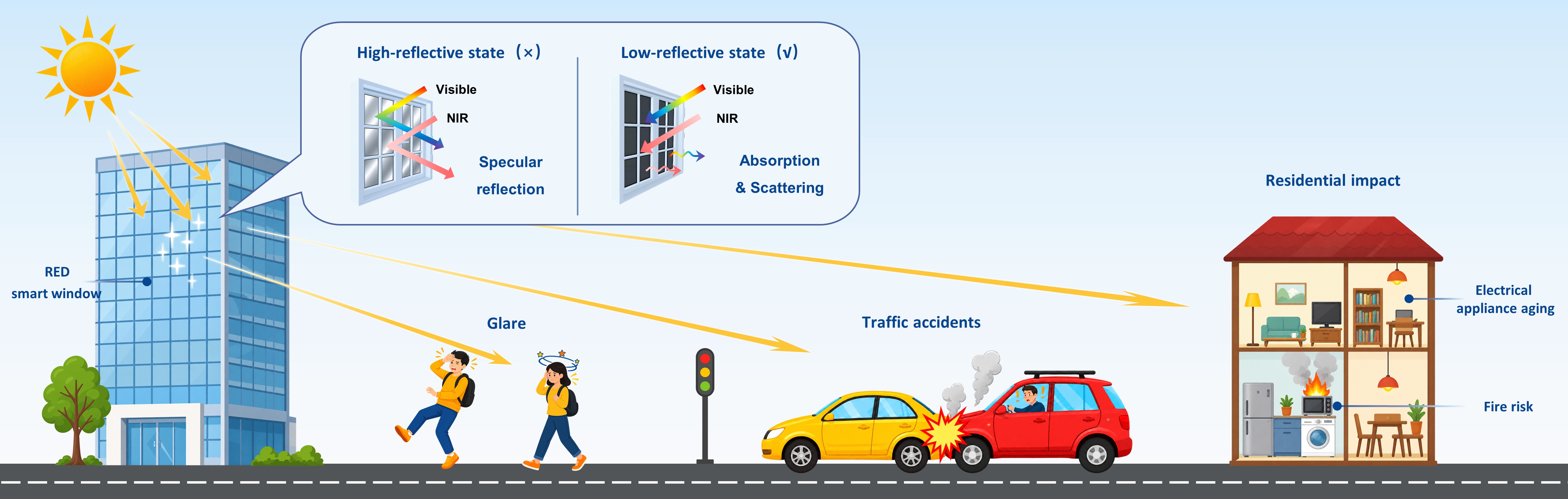
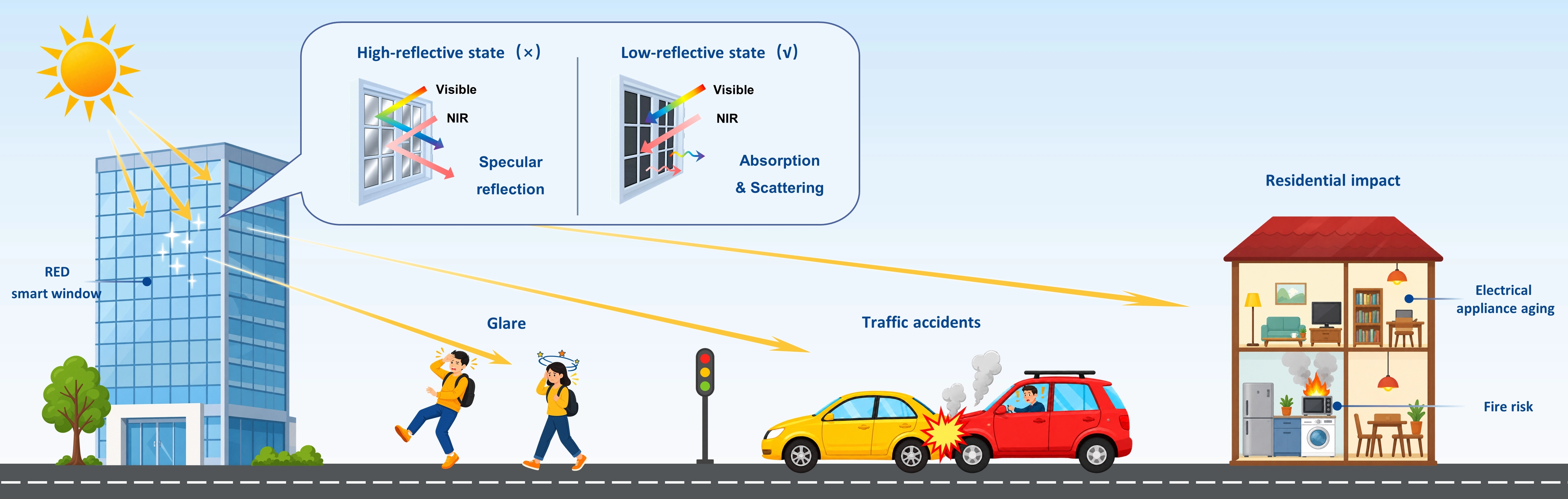
Figure 1. Schematic illustrating the optical behavior and potential environmental impacts of RED smart windows in the privacy state. RED: reversible electrodeposition; NIR: near-infrared.
2. Current Progress and Challenges
Different levels of visible-light transmittance in the dark state correspond to different functional requirements in smart window applications. Commercial EC windows commonly use a visible-light transmittance of approximately 1% as a glare-control state to reduce occupant discomfort and eye strain. For residential applications, deeper coloration may be required to provide better privacy and sleep shading, for which visible-light transmittance needs to be reduced to 0.1%[18]. Conventional EC technologies often struggle to reach this level. One approach is to stack two dynamic glazings together, but this configuration increases device cost and reduces the initial transmittance of the transparent state[18]. In contrast, metals have relatively high extinction coefficients. A uniform metallic film with a thickness of 20-30 nm can become opaque, whereas conventional EC materials generally require thicknesses of 100-1,000 nm to achieve comparable light blocking[19-21]. Reversible metal electrodeposition therefore provides a more direct materials route toward privacy states with visible-light transmittance below 0.1%.
In single-metal electrodeposition systems, Islam et al.[22] used a nearly neutral Zn-based electrolyte, reducing the transmittance of a 100 cm2 device from approximately 80% to below 0.1% at 600 nm. Bhoumik et al.[23] developed a Zn-dimethyl sulfoxide nonaqueous electrolyte, which improved deposition stability while maintaining dark-state transmittance below 0.1% over 10,000 cycles. Building on these advances, bimetallic codeposition has been used to regulate the composition, morphology, and electrochemical stability of electrodeposited layers. Yeang et al.[18] combined Cu-Bi codeposition with a transparent metal-mesh counter electrode, achieving dark-state transmittance below 0.1%. Wang et al.[24] used Gd3+ to regulate Cu-Ni codeposition, further reducing transmittance at 550 nm to below 0.001%.
However, the continued reduction of dark-state transmittance does not necessarily mean better optical performance. According to the law of conservation of energy, optical energy is redistributed mainly between reflection and absorption when transmittance approaches zero[9]. Ultralow transmittance is commonly achieved by forming a dense and continuous metallic layer, but such a morphology tends to enhance specular reflection. For example, the Cu-Ni device exhibited reflectance above 34% across the visible and near-infrared (NIR) regions, whereas a continuous Ag layer deposited on a flat electrode showed reflectance approaching 100%[24,25]. Although highly reflective metallic layers can help reduce solar heat input, they may also reflect intense visible light back to the exterior of the building. Such reflected light may cause glare and visual discomfort for pedestrians and contribute to light pollution in the surrounding environment, limiting the use of these devices on building facades[25,26]. Taken together, these considerations indicate that the next stage of RED smart-window development should move beyond minimizing transmittance alone toward coordinated management of transmission, reflection, and absorption. The key objective is to preserve ultralow transmittance while controlling the partitioning of blocked optical energy so that strong specular reflection is suppressed without sacrificing deep light blocking, thereby achieving deep-privacy dark states with reduced glare.
3. Future Perspectives
3.1 Morphology engineering and deposition-kinetics control
During metal electrodeposition, metal ions undergo liquid-phase mass transfer, interfacial charge transfer, surface migration, and finally nucleation and growth. The relative rates of these coupled and partly overlapping kinetic processes determine the number and distribution of nuclei, particle growth and coalescence, thereby influencing the final morphology of the deposited layer[27]. Smooth and continuous metallic layers behave as bulk-like films and are generally dominated by specular reflection[25,28]. In contrast, spatially separated or incompletely connected particles can disrupt planar reflection and redistribute incident light through multiple scattering. Their localized surface plasmon resonance (LSPR) provides absorption pathways through localized-field enhancement and nonradiative dissipation[29,30]. Therefore, regulating deposition kinetics can tailor deposit morphology and thereby control how the resulting layer absorbs, scatters, and reflects incident light.
The design of the substrate and deposition interface primarily regulates where nucleation and growth occur. The surface chemistry, crystallographic orientation, defect distribution, and topography of a transparent electrode can change the nucleation barrier, local charge-transfer rate, and current-density distribution, thereby determining particle spacing and connectivity[27]. For example, the crystallographic texture of indium tin oxide (ITO) was shown to change the density of electrodeposited Ag islands by two to three orders of magnitude[31]. More directly, Ag deposited on smooth ITO formed a flat, interconnected layer with nearly 100% reflectance at 500-700 nm, whereas particle-modified rough ITO produced coarse, incompletely connected aggregates and a nonreflective black state (Figure 2a)[25]. A three-dimensional branched ITO electrode further spatially separated Ag nanoparticles, decreasing the average black-state reflectance from 56.23% on planar ITO to 8.78% through suppressed film formation, multiple scattering, and LSPR absorption[29].
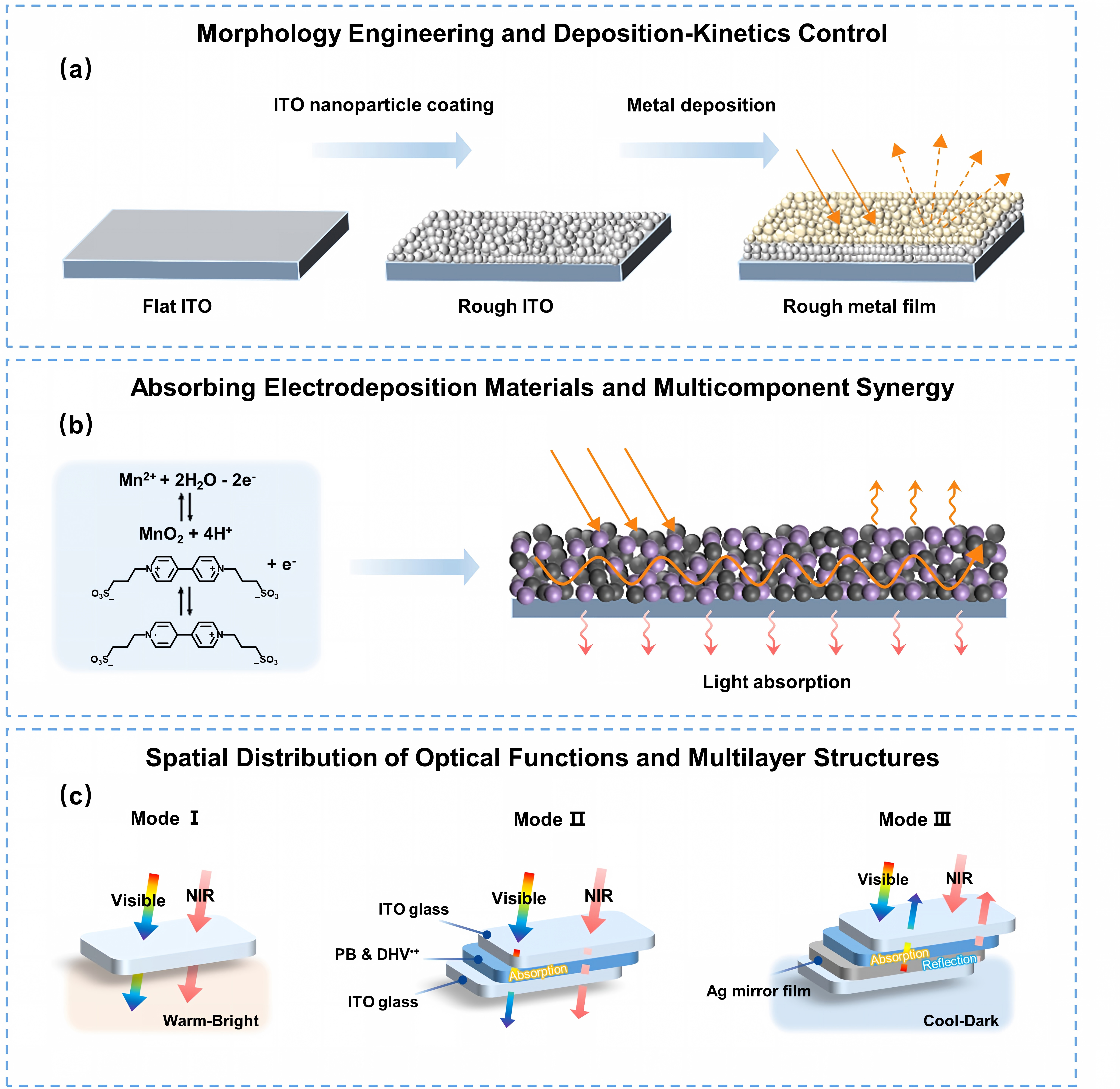
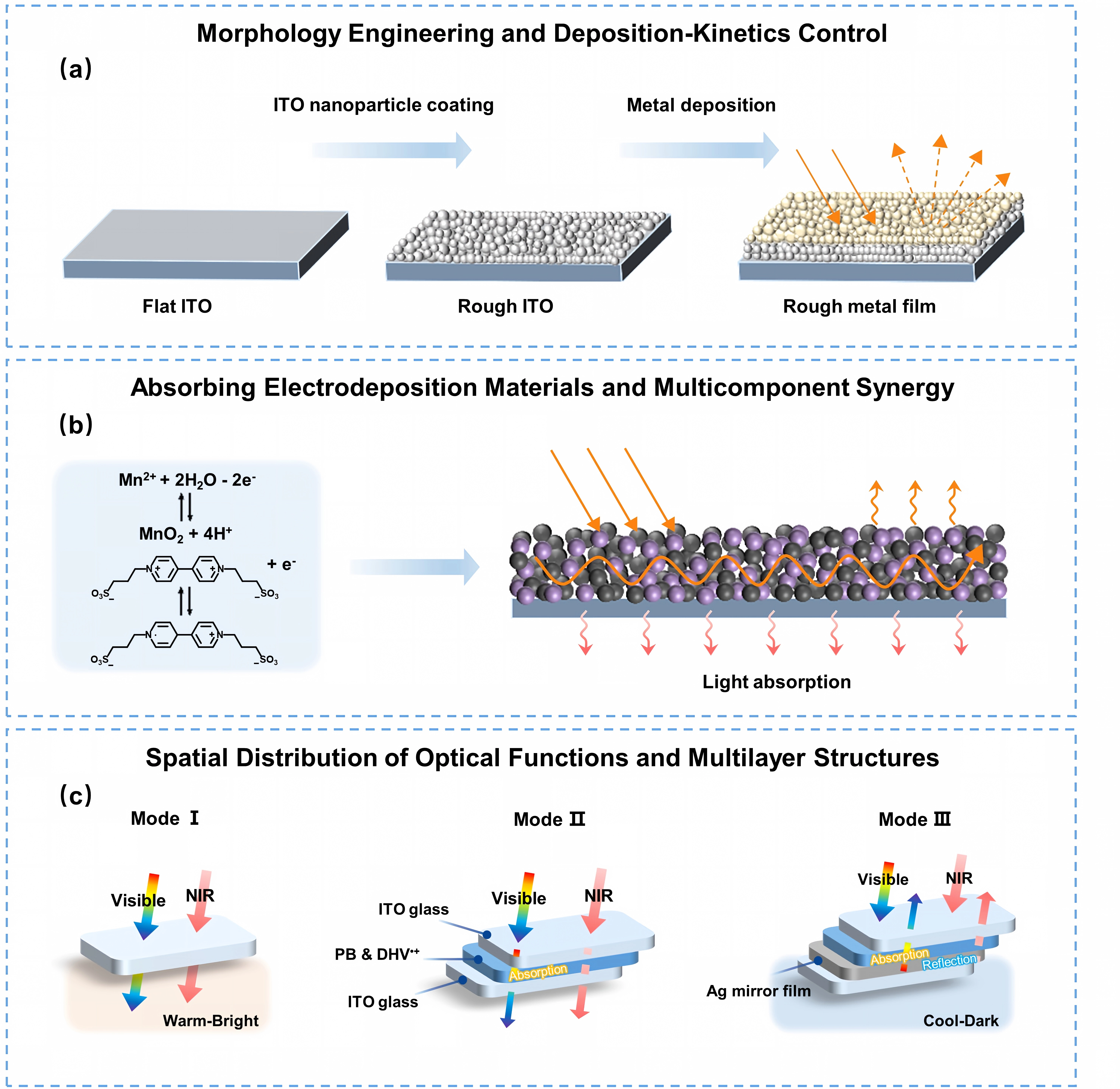
Figure 2. Future perspectives for low-reflection light management in RED smart windows. (a) Morphology engineering and deposition-kinetics control for regulating metal-deposit morphology and enhancing light scattering. Reproduced with permission from reference[25]. Copyright © 2012 Wiley; (b) Absorbing electrodeposition materials and multicomponent synergy for strengthening optical absorption. Reproduced with permission from reference[32]. Copyright © 2026 Wiley; (c) Spatial distribution of optical functions and multilayer structures for sequential absorption, reflection, and secondary absorption of incident light. Reproduced with permission from reference[26]. Copyright © 2025 American Chemical Society. ITO: indium tin oxide; NIR: near-infrared; RECM: reversible electrodeposition and electrochromic mirror; DHV·+: one-electron-reduced radical cation of DHV2+; DHV2+: 1,1'-diheptyl-4,4'-bipyridinium dibromide; PB: Prussian blue; RED: reversible electrodeposition.
Deposition conditions provide another route for controlling nucleation and subsequent particle growth. Deposition potential changes the driving force for nucleation and growth: in Ag electrodeposition, increasing the nucleation-pulse overpotential increased island density until diffusion-zone overlap caused mass-transfer-limited saturation[31]. Metal-ion concentration and its interfacial gradient govern ion supply; in Zn deposition, increasing concentration polarization shifted growth from thermodynamic to kinetic control and drove morphological evolution from two-dimensional sheets to whiskers and three-dimensional deposits[33]. Complexation changes the electroactive metal species and deposition rate; Ag-Br complexes slowed Ag deposition and promoted a flat, interconnected reflective layer, whereas deposition without Br- produced rough aggregates[25]. Deposition time determines the stage reached during the continuous evolution from nucleation to particle growth and coalescence[27]. In a voltage-step Ag device, two successive voltages controlled Ag nanoparticle growth, while the growth duration determined particle size and shifted the LSPR absorption band[12,34]. Together, these examples demonstrate that deposition conditions can be used to tailor electrodeposit morphology, thereby offering a potential strategy for designing deposited layers with reduced specular reflection.
It should be noted that simply increasing surface roughness or reducing deposition continuity may weaken the light-blocking ability, allowing incident light to easily pass through intergranular gaps or uncovered areas, making it difficult to maintain extremely low transmittance. Therefore, while maintaining high deposition coverage, it is necessary to rationally control particle size, spacing, connectivity, and surface undulations to achieve synergistic regulation of ultralow transmittance and low specular reflection.
3.2 Absorbing electrodeposition materials and multicomponent synergy
RED materials with visible-light absorption provide a material basis for constructing low-reflection dark states. Extending the deposited phase from metals to transition-metal oxides with visible-light absorption can dissipate incident light and thereby reduce specular reflection[32]. Among oxide electrodeposition materials, the visible-light absorption of MnO2 is closely related to its Mn-O electronic structure. In the octahedral crystal field of MnO6 units, the Mn(3d) orbitals split into lower-energy t2g and higher-energy eg levels. When the photon energy matches the energy separation between them, electrons are excited from t2g to eg, absorbing the corresponding photon energy and giving rise to d-d absorption in the visible region[35,36]. From a band-structure perspective, the valence band of MnO2 is dominated by O(2p) states, whereas the conduction band is dominated by Mn(3d) states. When the photon energy exceeds the band gap, electrons can be excited from the O(2p)-dominated valence band to the Mn(3d)-dominated conduction band, corresponding primarily to a ligand-to-metal charge-transfer (LMCT) transition and optical absorption[37,38]. Structural defects can further regulate this absorption. Mn vacancies can distort the local MnO6 structure and introduce electronic states near the band edges, thereby narrowing the band gap[39]. In birnessite-type MnO2, vacancies and edge defects can also favor a direct band gap, making light absorption more efficient[38].
Recent reversible MnO2 deposition/dissolution studies have demonstrated large optical modulation and transparent-to-brown switching, including modulation amplitudes of 93.2% and 93.6% at 400 and 550 nm, respectively[40,41]. Despite these advances, MnO2 alone does not provide uniform absorption across the visible spectrum. Its optical modulation is concentrated primarily at 400-600 nm, whereas its light-blocking capability is weaker at longer visible wavelengths. Multicomponent synergy can compensate for these weakly absorbing spectral regions by introducing another coloring material, while retaining an absorption-dominated optical-energy dissipation pathway and further reducing dark-state transmittance. This potential has recently been demonstrated by coupling oxidative MnO2 deposition with the reductive coloration of viologen. The complementary absorption of the inorganic and organic components produced more complete broadband light blocking. The viologen-MnO2 system achieved an average dark-state transmittance of about 0.1% for visible light while maintaining visible-light reflectance below 8% (Figure 2b)[32].
Beyond absorbing metal oxides, reversible non-metal electrodeposition provides another route to dark-state light attenuation. Ji et al.[42] summarized that reversible iodine electrodeposition devices based on I-/I2 or I-/polyiodide conversion exhibit broadband optical absorption by iodine species and may offer a potential design route. However, whether this approach can simultaneously achieve ultralow transmittance (< 0.1%) and low dark-state reflectance remains to be experimentally verified. This strategy centers on absorbing electrodeposition materials and uses multicomponent synergy to compensate for gaps in their absorption spectra. It offers a potential route toward ultralow-transmittance and low-reflection dark states without relying on highly reflective metal deposits. Different coloring components can also be selected and optimized according to the target spectral range.
3.3 Spatial distribution of optical functions and multilayer structures
Beyond microscale morphology and material composition, the spatial distribution of optical functions along the light-propagation direction also influences how optical energy is distributed in the dark state. Through multilayer structural design, specific optical functions can be assigned to different depths or interfaces within the device, enabling incident light to undergo absorption, scattering, and reflection in a controlled sequence.
An effective design is to place the absorption layer on the incident-light side and a metallic layer with high surface coverage behind it. Incident light is first absorbed by the outer coloring component, while the remaining light reaches the inner metallic layer and is reflected or blocked. Before leaving the device, the reflected light must pass through the absorbing layer again and undergo secondary absorption. A representative example is the multilayer electrochromic device combining Prussian blue, viologen, and reversible Ag electrodeposition. In the dark state, the absorbing components attenuate incident light before it reaches the Ag layer, while light reflected by the Ag layer passes through the absorbing region again and undergoes secondary absorption. This sequential light-management pathway suppresses outward specular reflection while maintaining strong light blocking. At 600 nm, the exterior reflectance was reduced to below 10%, approximately 33% lower than that of the corresponding device without viologen (Figure 2c)[26].
This example also highlights the thermal implications of absorption-based light management. Shifting blocked light from reflection to absorption can increase the thermal load of the glazing. Jo et al.[26] showed that partial near-infrared absorption by colored Prussian blue and viologen raised the device surface temperature by about 10 °C relative to normal glass, while a rear Ag mirror reflected the remaining near-infrared light and suppressed indoor heating. Excessive absorption may also increase glazing and electrolyte heating, affecting heat transfer, thermal stress, and long-term stability. Future low-reflection designs should therefore balance glare control and thermal management by regulating the partitioning of blocked optical energy among reflection, scattering, and absorption.
4. Conclusions and Outlook
This Perspective focuses on the current status and future directions of reversible electrodeposition in electrochromic smart windows. The low cost of the required materials, simple device fabrication, and strong optical attenuation of electrodeposited layers enable nearly black dark states, providing an effective route to transmittance below 0.1%. However, further advances are needed for large-scale deployment in energy-efficient buildings. The key question is how to suppress specular reflection while maintaining ultralow dark-state transmittance by regulating the partitioning of blocked optical energy among reflection, absorption, and scattering. Accordingly, three complementary routes are highlighted: regulating deposit morphology through deposition kinetics and interface control; introducing absorbing electrodeposition materials with multicomponent synergy; and spatially distributing optical functions through multilayer architectures. Beyond maintaining dark-state transmittance below 0.1%, future evaluation should incorporate a more comprehensive glare-control framework, including photopically weighted reflectance, specular and diffuse reflectance, and, where appropriate, haze or a bidirectional reflectance distribution function (BRDF). Low-reflection performance should also be balanced with clear-state transmittance, switching speed, cycling stability, energy consumption, and thermal management. Future RED development should therefore pursue multi-objective optimization.
Authors contribution
Zhang Z: Investigation, data curation, writing-original draft.
Cao X: Conceptualization, writing-review & editing.
All authors have read and approved the final version of the manuscript.
Conflicts of interest
The authors declare no competing interests.
Ethical approval
Not applicable.
Consent to participate
Not applicable.
Consent for publication
Not applicable.
Availability of data and materials
Not applicable.
Funding
This study was financially supported by the National Key Research and Development Program of China (Grant No. 2021YFA0718900); National Natural Science Foundation of China (Grant Nos. 62575296 and U24A2061); Shanghai Science and Technology Funds (Grant No. 25ZR1401373); the open research fund of Suzhou Laboratory (Grant No. SZLAB-1508-2025-TS032).
Copyright
© The Author(s) 2026.
References
-
1. Huang Y, Wu S, Zhao S, Guo Z, Zhao Z, Wu X, et al. A novel liquid flow electrochromic smart window for all-year-round dynamic photothermal regulation. Energy Environ Sci. 2025;18(4):1824-1834.[DOI]
-
2. Shao Z, Huang A, Cao C, Ji X, Hu W, Luo H, et al. Tri-band electrochromic smart window for energy savings in buildings. Nat Sustain. 2024;7(6):796-803.[DOI]
-
3. Zhou Y, Lv Y, Guo X, Wang X, Liu Z, Wang J, et al. Electrochromic smart windows with on-demand photothermal regulation for energy-saving buildings. Adv Mater. 2025;37(29):2502706.[DOI]
-
4. Krishna VSG, Ganesha MK, Sarthi J C, Hakkeem H, Singh AK, Kulkarni GU. Ultrathin sputtered NiO films for enhanced electrochromic performance in smart windows. J Mater Chem A. 2024;12(30):19378-19391.[DOI]
-
5. Sun J, Chen Z, Zhang R, Yin M, Zhu Y, Hu J, et al. Electrochromic smart windows with co-intercalation of cations and anions for multi-band regulations. Nat Commun. 2025;16(1):6993.[DOI]
-
7. Huang R, Cao N, Gu G, Jia X, Chao D. A bifunctional electrochromic/electrofluorochromic ionic liquid enables displayable smart windows with high energy efficiency. Adv Funct Mater. 2025;35(50):e11224.[DOI]
-
8. Li R, Lan F, Tang L, Huang Y, Zhao S, Wang B, et al. A local-dissociation solid-state polymer electrolyte with enhanced Li+ transport for high-performance dual-band electrochromic smart windows. Adv Funct Mater. 2025;35(15):2419357.[DOI]
-
10. Tovar-Oliva MS, Tudela I. Electrodeposition of nano- and micro-materials: Advancements in electrocatalysts for electrochemical applications. Results Eng. 2024;24:103285.[DOI]
-
11. Lee GH, An CJ, Lee HI, Kim JS, Jo MS, Ha TH, et al. Recent advances in reversible metal electrodeposition-based smart windows. Electron Mater Lett. 2024;20(6):657-683.[DOI]
-
12. Tao X, Liu D, Yu J, Cheng H. Reversible metal electrodeposition devices: An emerging approach to effective light modulation and thermal management. Adv Opt Mater. 2021;9(8):2001847.[DOI]
-
13. Strand MT, Hernandez TS, Danner MG, Yeang AL, Jarvey N, Barile CJ, et al. Polymer inhibitors enable > 900 cm2 dynamic windows based on reversible metal electrodeposition with high solar modulation. Nat Energy. 2021;6(5):546-554.[DOI]
-
14. Peng R, Zhang J, Han Y. Numerical modelling and dynamic evaluation of building glass curtain wall-reflected glare pollution for road vehicle drivers. Sustainability. 2025;17(9):3823.[DOI]
-
15. Suk JY, Schiler M, Kensek K. Reflectivity and specularity of building envelopes: How materiality in architecture affects human visual comfort. Archit Sci Rev. 2017;60(4):256-265.[DOI]
-
16. Lee S, Lee JS. Assessing urban solar glare from glass curtain walls: Effects of street orientation and building form on sustainable design and public safety. Sustain Cities Soc. 2025;135:106984.[DOI]
-
17. Zhu J, Jahn W, Rein G. Computer simulation of sunlight concentration due to façade shape: Application to the 2013 Death Ray at Fenchurch Street, London. J Build Perform Simul. 2019;12(4):378-387.[DOI]
-
18. Yeang AL, Hernandez TS, Strand MT, Slotcavage DJ, Abraham E, Smalyukh II, et al. Transparent, high-charge capacity metal mesh electrode for reversible metal electrodeposition dynamic windows with dark-state transmission < 0.1%. Adv Energy Mater. 2022;12(32):2200854.[DOI]
-
19. Heavens OS. Optical properties of thin solid films. 1st ed. London: Butterworths Scientific Publications; 1955. Available from: https://books.google.je/books?id=gRsZytsSnkQC&printsec=frontcover#v=onepage&q&f=false
-
20. Niklasson GA, Granqvist CG. Electrochromics for smart windows: Thin films of tungsten oxide and nickel oxide, and devices based on these. J Mater Chem. 2007;17(2):127-156.[DOI]
-
21. Barile CJ, Slotcavage DJ, McGehee MD. Polymer–nanoparticle electrochromic materials that selectively modulate visible and near-infrared light. Chem Mater. 2016;28(5):1439-1445.[DOI]
-
22. Islam SM, Barile CJ. Dynamic windows using reversible zinc electrodeposition in neutral electrolytes with high opacity and excellent resting stability. Adv Energy Mater. 2021;11(22):2100417.[DOI]
-
23. Bhoumik NC, Madu DC, Moon CW, Arvisu LS, McGehee MD, Barile CJ. Nonaqueous electrolytes for reversible zinc electrodeposition for dynamic windows with excellent optical contrast and durability. Joule. 2024;8(4):1036-1049.[DOI]
-
24. Wang W, Wang L, Liu G, Yang L, Liu T, Cui Y, et al. Competitive ion driven reversible Cu and Ni electrodeposition for smart windows with synergistic optical and thermal regulation. Chem Eng J. 2025;521:166647.[DOI]
-
25. Araki S, Nakamura K, Kobayashi K, Tsuboi A, Kobayashi N. Electrochemical optical-modulation device with reversible transformation between transparent, mirror, and black. Adv Mater. 2012;24(23):OP122-OP126.[DOI]
-
26. Jo HJ, Jang YJ, Kim HD, Kim KS, Moon HC. Glare-free, energy-efficient smart windows: A pedestrian-friendly system with dynamically tunable light and heat regulation. ACS Energy Lett. 2025;10(6):2997-3004.[DOI]
-
27. Zhou Y, Jiao H, Lu X, Sun D, Li S, Song J, et al. Formation mechanisms and regulation strategies for metal electrodeposition morphology under multiple coupling effects. Adv Funct Mater. 2026;36(31):e27876.[DOI]
-
28. Wang W, Wang L, Jin S, Wang L, Liu G, Zhang H, et al. Dynamic spectral modulation devices based on reversible metal electrodeposition: Principles, modification strategies, and applications. Prog Mater Sci. 2026;159:101664.[DOI]
-
29. Jeong KR, Lee I, Park JY, Choi CS, Cho SH, Lee JL. Enhanced black state induced by spatial silver nanoparticles in an electrochromic device. NPG Asia Mater. 2017;9(3):e362.[DOI]
-
30. Moon CW, Bhoumik NC, Mondol P, Park SH, Jang HW, Barile CJ. Origin of high optical contrast in zinc-zinc oxide electrodeposits for dynamic windows. Nano Energy. 2023;114:108666.[DOI]
-
32. Ma B, Li C, Li Z, Han Z, Huang A, Luo H, et al. A redox-mediated stepwise reversible electrodeposition smart window. Adv Mater. 2026;38(12):e20939.[DOI]
-
34. Tsuboi A, Nakamura K, Kobayashi N. A localized surface plasmon resonance-based multicolor electrochromic device with electrochemically size-controlled silver nanoparticles. Adv Mater. 2013;25(23):3197-3201.[DOI]
-
36. Nakayama M, Kashiwa Y, Suzuki K. Electrochromic properties of MnO2-based layered polymer nanocomposite. J Electrochem Soc. 2009;156(4):D125-D130.[DOI]
-
37. Sherman DM. Electronic structures of iron(III) and manganese(IV) (hydr)oxide minerals: Thermodynamics of photochemical reductive dissolution in aquatic environments. Geochim Cosmochim Acta. 2005;69(13):3249-3255.[DOI]
-
39. Kwon KD, Refson K, Sposito G. On the role of Mn(IV) vacancies in the photoreductive dissolution of hexagonal birnessite. Geochim Cosmochim Acta. 2009;73(14):4142-4150.[DOI]
-
40. Liu X, Wang H, Zhong J, Li M, Zhang R, You D, et al. Visible light electrochromism based on reversible dissolution/deposition of MnO2. Nanophotonics. 2024;13(5):679-686.[DOI]
-
42. Ji Y, Xu Q, Liu S, Xu B, Chen J. Smart electrochromic devices based on reversible (non-)metal electrodeposition. Smart Mater Devices. 2026;2(4):202637.[DOI]
Copyright
© The Author(s) 2026. This is an Open Access article licensed under a Creative Commons Attribution 4.0 International License (https://creativecommons.org/licenses/by/4.0/), which permits unrestricted use, sharing, adaptation, distribution and reproduction in any medium or format, for any purpose, even commercially, as long as you give appropriate credit to the original author(s) and the source, provide a link to the Creative Commons license, and indicate if changes were made.
Publisher’s Note
Science Exploration remains a neutral stance on jurisdictional claims in published
maps
and institutional affiliations. The views expressed in this article are solely those
of
the author(s) and do not reflect the opinions of the Editors or the publisher.
Share And Cite


Science Exploration Style
Zhang Z, Cao X. From ultralow transmittance to low-reflection light management: Future directions for next-generation reversible electrodeposition smart windows. Smart Mater Devices. 2027;3:202661. https://doi.org/10.70401/smd.2026.0060
Tips
Copy completed.
Submit a Manuscript
Author Instructions
Cite this Article
Article Metrics
0
View
0
Download
Cited
Article Updates

 Get citation
Science Exploration Style

Zhang Z, Cao X. From ultralow transmittance to low-reflection light management: Future directions for next-generation reversible electrodeposition smart windows. Smart Mater Devices. 2027;3:202661. https://doi.org/10.70401/smd.2026.0060
copy
Share Link
copy