Table of Contents
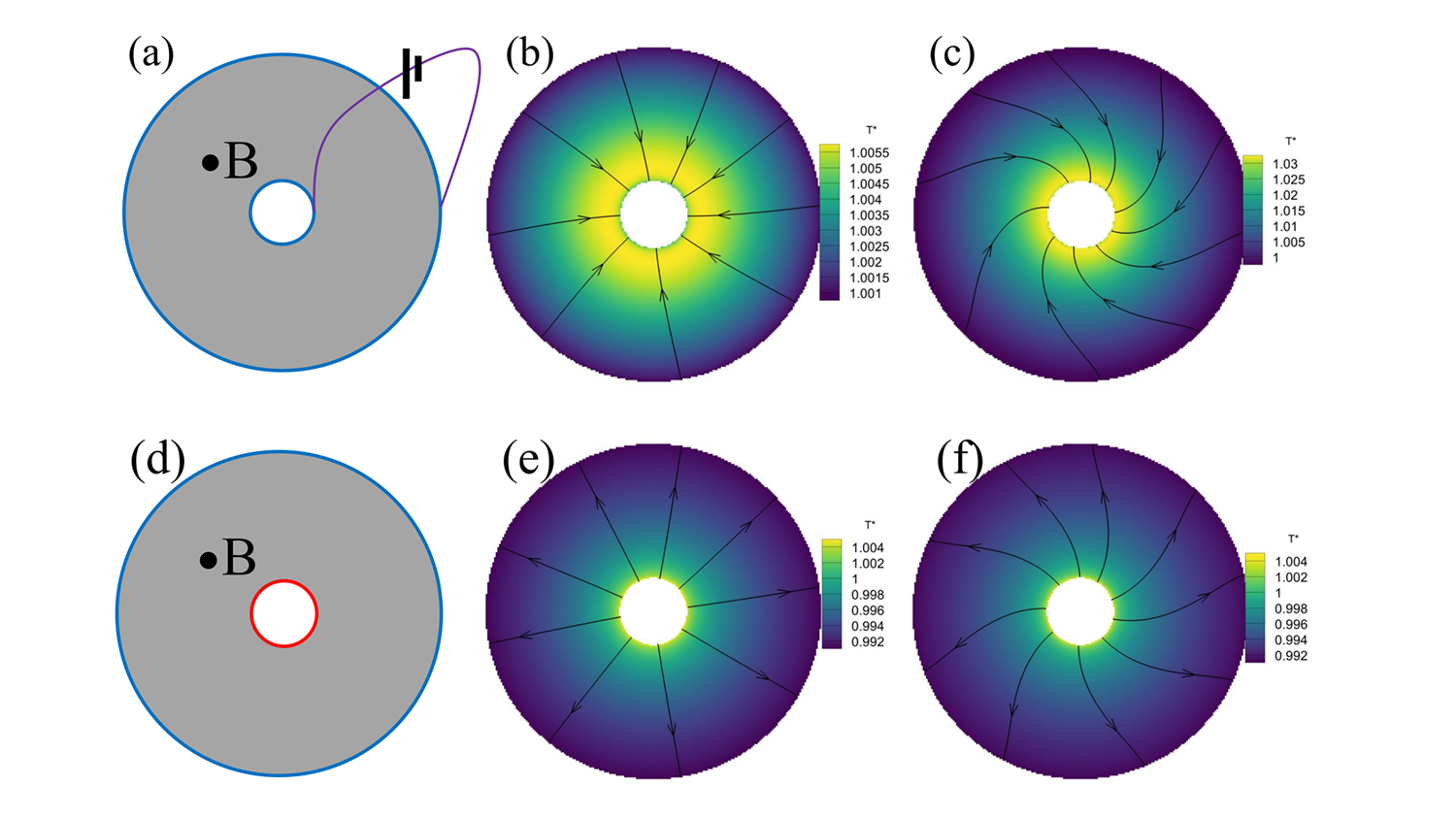
Kinetic simulation of magnetic-field-tuned hydro-dynamic electron transport in a graphene Corbino disk
Hydrodynamic electron transport, in which electrical transport in solids resembles fluid hydrodynamics when momentum-conserving electron-electron scattering dominates, has attracted much attention over the past decade. However, its thermal aspects ...
More.Hydrodynamic electron transport, in which electrical transport in solids resembles fluid hydrodynamics when momentum-conserving electron-electron scattering dominates, has attracted much attention over the past decade. However, its thermal aspects have received considerably less attention. In this paper, we systematically simulate electron transport in a graphene Corbino disk by solving the steady-state Boltzmann transport equation with a dual relaxation-time Callaway model, in which momentum-conserving and momentum-relaxing scatterings are explicitly distinguished. By varying the magnetic field strength and scattering rates, we compare the charge and heat flux responses across the diffusive-to-hydrodynamic crossover under both electric field and temperature-gradient driving. We show that magnetic-field-induced deflection of both fluxes is strongly enhanced in the hydrodynamic regime but nearly suppressed in the diffusive regime. Under electric-field driving, a pronounced temperature rise is observed in the hydrodynamic regime du to reduced dissipation, while the diffusive regime remains nearly isothermal. Under temperature-gradient driving, the deflection exhibits the opposite chirality to that in the electric-field case. These findings establish that thermal transport can provide a sensitive and independent diagnostic of electro hydrodynamics, and identify the magnetic field as an effective discriminator between collective and dissipative conduction.
Less.Chuang Zhang, ... Jing-Tao Lü
DOI:https://doi.org/10.70401/tx.2026.0028 - August 07, 2026
A cumulative model for thermoelectric cooling with temperature dependent material properties
The precise evaluation of real-world thermoelectric cooling (TEC) performance is vital for both the development of TEC devices and the rational design of TEC materials. Due to the relatively limited temperature difference (ΔT) that a single-stage ...
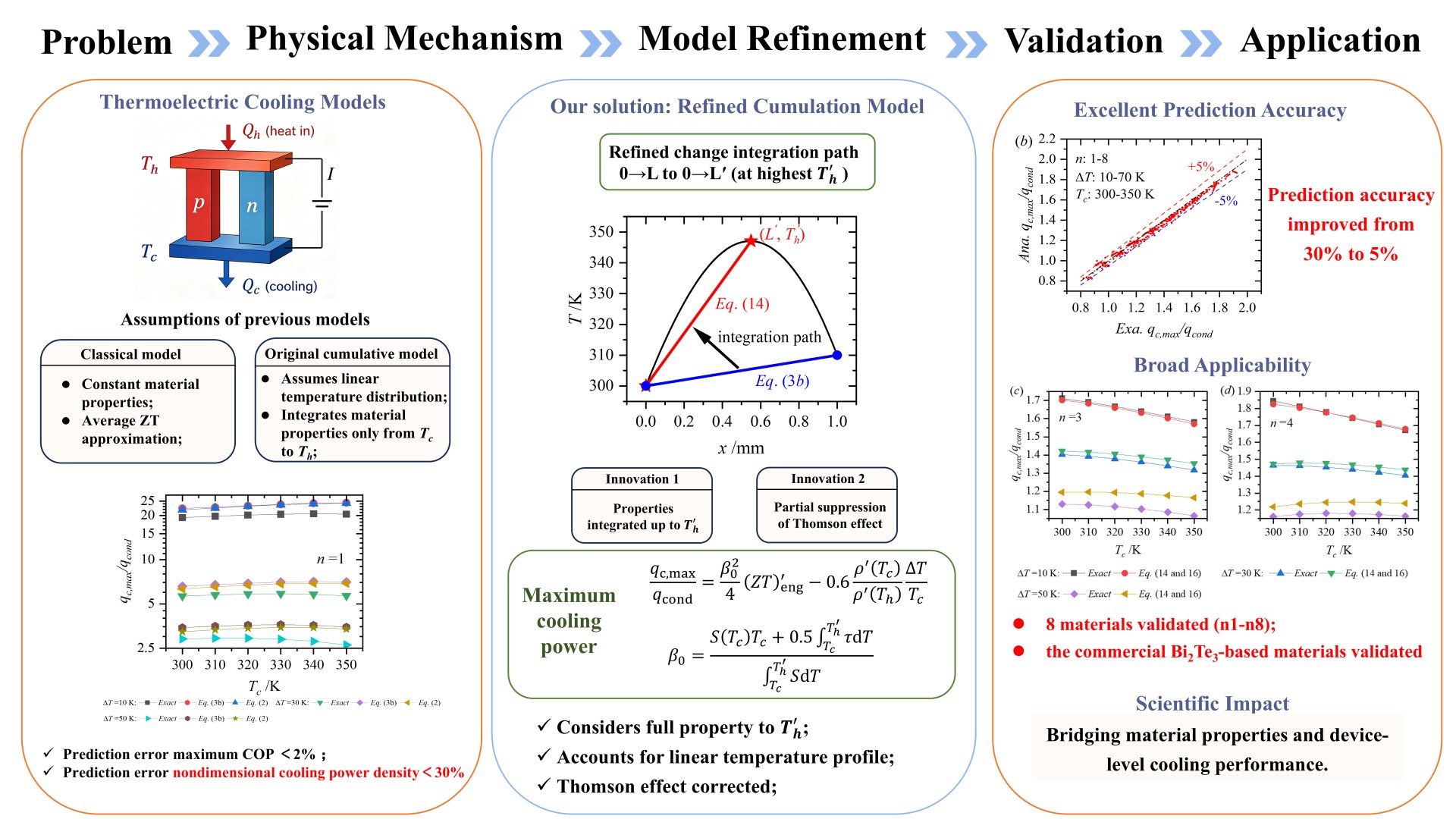
More.The precise evaluation of real-world thermoelectric cooling (TEC) performance is vital for both the development of TEC devices and the rational design of TEC materials. Due to the relatively limited temperature difference (ΔT) that a single-stage TEC can achieve, the classical analytical formulae for thermoelectric cooling are commonly used with averaged material properties in the cooling performance evaluation. Nevertheless, this could cause remarkable errors in evaluations of the cooling power, even under a ΔT as low as 10 K. In this work, a cumulative model for thermoelectric cooling is proposed to evaluate the maximum coefficient of performance (COP) as well as the maximum cooling power of a TEC device under finite temperature differences, with the temperature dependence of material properties being fully considered. The inherent deficiencies in predicting the maximum cooling power by both the classical formulae and the original cumulative model are identified, and effective refinements are implemented to reduce the prediction error. Eight thermoelectric materials with state-of-the-art ZT values near room temperature are assessed for electronics cooling scenarios within a cold side temperature (Tc) range of 300-350 K. In comparison to the classical formulae, the proposed model predicts the maximum COP with comparably satisfying accuracies (±2%), while significantly improves the prediction accuracy of the maximum cooling power from approximately ±30% to within ±5% over a ΔT range of 10-70 K. This work fills the gap between thermoelectric material properties and device-level cooling performance, and is beneficial to the development and application of thermoelectric conversion technology for cooling purposes.
Less.Kang Zhu, ... Weishu Liu
DOI:https://doi.org/10.70401/tx.2026.0027 - July 31, 2026
Twist engineering of nanoscale thermal transport
Thermal transport at the nanoscale is fundamentally important and crucially impacts a range of applications from electronic chip cooling to advanced energy technology. Inspired by the rise of twistronics, twist engineering has recently emerged as a powerful ...
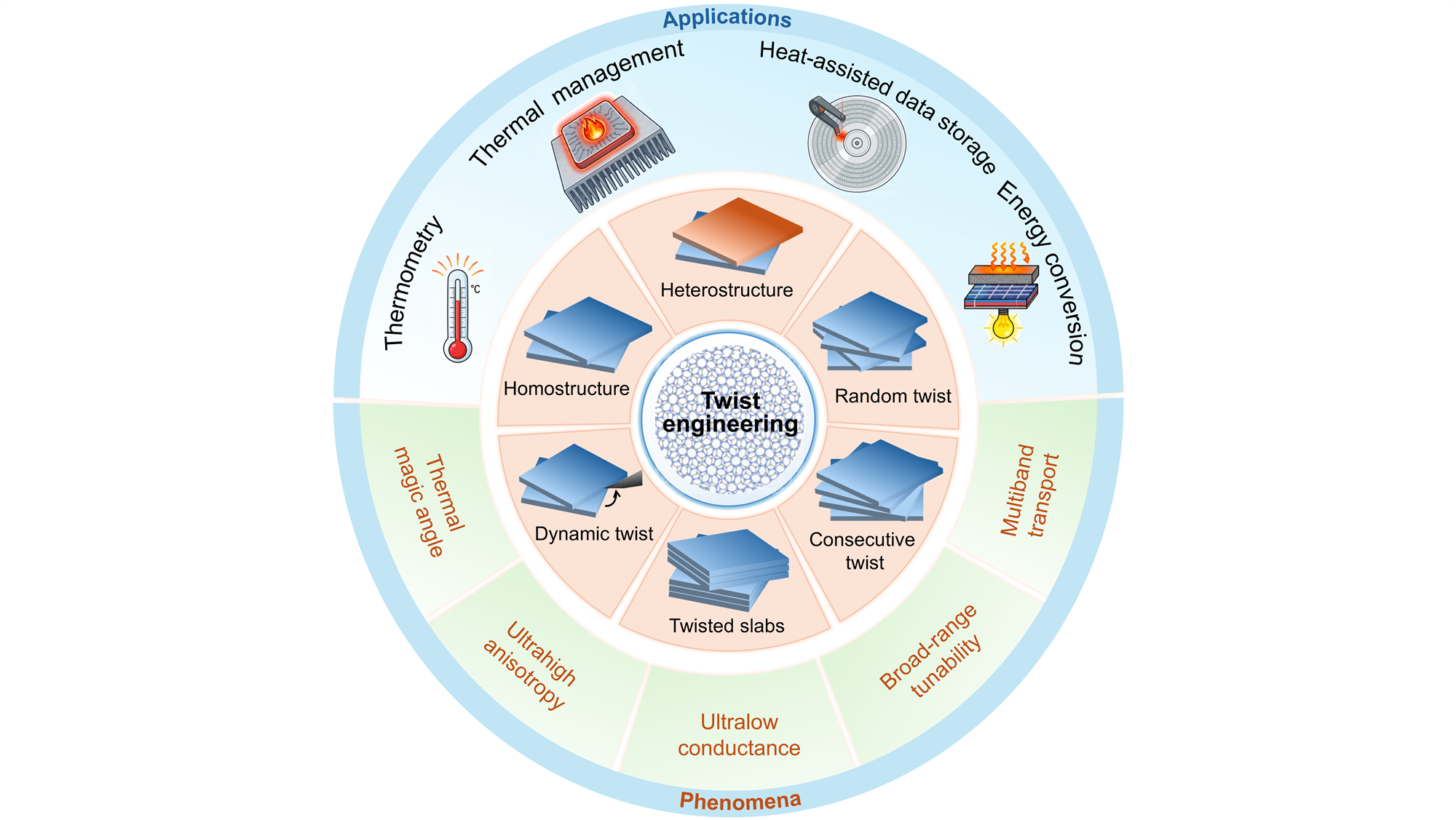
More.Thermal transport at the nanoscale is fundamentally important and crucially impacts a range of applications from electronic chip cooling to advanced energy technology. Inspired by the rise of twistronics, twist engineering has recently emerged as a powerful approach to control nanoscale heat flow, which leverages interlayer rotation in van der Waals materials as a new degree of freedom. Here, we first briefly introduce the basic principles of twist engineering. Subsequently, we discuss various experimental techniques and computational approaches for investigating phonon-mediated heat conduction, together with key results and physical mechanisms for the active manipulation of both out-of-plane and in-plane transport. Furthermore, we review advances in the twist-induced modulation of photon-mediated thermal radiation, distinguishing strategies that tune intrinsic optical responses from those utilizing extrinsic couplings. We conclude with remarks on the opportunities and challenges for future exploration of twist-engineered thermal management and energy conversion.
Less.Wenjiang Zhou, ... Bai Song
DOI:https://doi.org/10.70401/tx.2026.0026 - July 30, 2026