Table of Contents
Atomic-level engineering thermal transport anisotropy in C24 monolayers for directional heat spreading
Directional heat spreading enabled by intrinsic thermal conductivity (κ) anisotropy offers a promising route to address thermal bottlenecks in integrated circuits. Here, we demonstrate atomic-level engineering of anisotropic thermal transport ...
More.Directional heat spreading enabled by intrinsic thermal conductivity (κ) anisotropy offers a promising route to address thermal bottlenecks in integrated circuits. Here, we demonstrate atomic-level engineering of anisotropic thermal transport in C24 monolayers through atomic spatial arrangement. Based on the high-accuracy neuroevolution potential (NEP)-empowered multiscale simulations, we systematically investigate the lattice thermal transport properties of quasi-tetragonal phase (qTP) and quasi-hexagonal phase (qHP) C24 monolayers with distinct atomic arrangements. The results show that qTP C24 exhibits relatively higher and nearly isotropic κ. In contrast, the qHP C24 displays pronounced in-plane κ anisotropy, with a room-temperature anisotropy ratio of κy/κx ≈ 1.7. In-depth phonon transport analysis shows that direction-dependent acoustic transport and the substantial participation of low-frequency optical modes are responsible for the intrinsic κ anisotropy. Furthermore, orbital-projected electronic structures reveal a distinct px and py orbital splitting in qHP C24, indicating anisotropic orbital hybridization, which fundamentally underlies its intrinsic κ anisotropy. Device-level finite-element simulations further confirm that atomic-spatial-arrangement induced anisotropic thermal transport enables directional heat spreading and thermal crosstalk regulation. The findings in this study establish atomic-level design as an external-field-free strategy for engineering anisotropic thermal transport.
Less.Qikun Tian, ... Guangzhao Qin
DOI:https://doi.org/10.70401/tx.2026.0032 - August 31, 2026
Revealing the origin of strongly temperature-dependent lattice thermal conductivity in Cu2SnSe3
Cu2SnSe3 exhibits exceptionally low lattice thermal conductivity (κL) and a nonclassical temperature dependence among ternary copper-based diamondoid compounds, yet the microscopic origins of these phonon ...
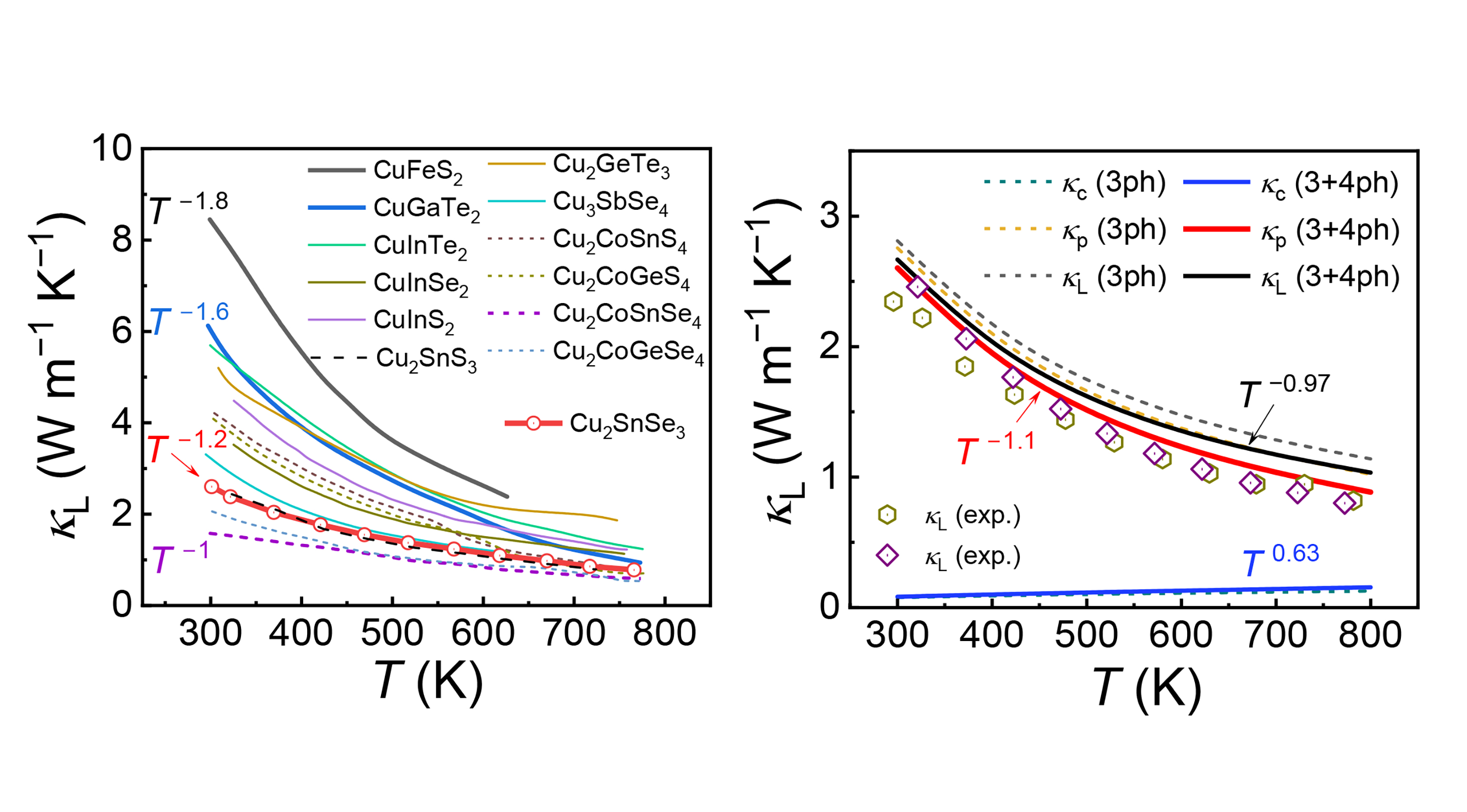
More.Cu2SnSe3 exhibits exceptionally low lattice thermal conductivity (κL) and a nonclassical temperature dependence among ternary copper-based diamondoid compounds, yet the microscopic origins of these phonon behaviors remain poorly understood. In this work, we theoretically investigate the intrinsic phonon transport in Cu2SnSe3 by employing a two-channel thermal transport model that separates particle-like (κp) and coherent contributions (κc), while fully incorporating both three-phonon (3ph) and four-phonon (4ph) scattering processes. Our calculations show that κc is negligible at 300 K but becomes progressively more significant at elevated temperatures, while κp remains the dominant contributor to κL over the entire temperature range. 4ph scattering is identified as the primary factor driving the deviation from the classical T-1 dependence, yielding a temperature scaling of T-1.1 that closely matches the experimental T-1.2 behavior. This strong 4ph scattering originates from flat optical phonon modes in the 1.2-2.2 THz range, which provide an exceptionally large scattering phase space. The low κL (e.g., ~ 0.8 W m-1 K-1 at 773 K) of Cu2SnSe3 relative to other ternary copper-based diamondoid compounds is attributed to the asymmetric potential energy of Cu atoms, which induces large atomic displacement parameters and pronounced anharmonicity in the Cu-related low-frequency optical branches. Furthermore, qualitative analyses of cation disorder and anion substitution show that disorder leads to significant phonon broadening, while replacing Se with S hardens the acoustic branches and markedly shifts the optical modes upward. Our findings not only clarify the origins of the nonclassical temperature dependence and low κL in Cu2SnSe3, but also provide a general guideline for designing diamondoid thermoelectrics with intrinsically suppressed κL.
Less.Hongwei Ming, ... Zhigang Zou
DOI:https://doi.org/10.70401/tx.2026.0033 - August 31, 2026