Surface engineering of Ga-based liquid metals for biomedical applications: Challenges and perspectives

Yifan Gu
1,2

,
Mingyang Guan
1,2
,
Guozhen Liu
1,2,*
*Correspondence to:
Guozhen Liu, Integrated Devices and Intelligent Diagnosis (ID2) Laboratory, School of Medicine, The Chinese University of Hong Kong, Shenzhen 518172, Guangdong, China; Guangdong Basic Research Center of Excellence for Aggregate Science, School of Science and Engineering, Shenzhen Institute of Aggregate Science and Technology, The Chinese University of Hong Kong, Shenzhen 518172, Guangdong, China.
E-mail: liuguozhen@cuhk.edu.cn
BME Horiz. 2027;5:202629. 10.70401/bmeh.2026.0036
Received: June 23, 2026Accepted: September 09, 2026Published: September 09, 2026
Abstract
Ga-based liquid metal (LM), particularly gallium-based alloys, uniquely combines metallic conductivity with fluidic flexibility, offering attractive opportunities for biomedical technologies that are difficult to achieve with conventional solid-state metals. This review first summarizes the expanding applications of LM in microfluidics, flexible electronics, biosensing, drug delivery, and thermal therapy, highlighting the functional advantages arising from its fluidity, deformability, and electrical conductivity. However, the limitations that hinder broader biomedical implementation remain: although the native gallium oxide layer can stabilize LM structures, it also introduces challenges in oxidation control, wettability, interfacial adhesion, conductivity, and long-term reliability. Against this background, surface engineering is presented as a central strategy for addressing these limitations. We systematically review surface modification approaches based on small molecules, polymers, biological coatings, and related interfacial strategies for improving stability, biocompatibility, and functionality. We further discuss fabrication approaches for integrating surface-engineered LM into wearable platforms, including 3D printing and hydrogel-based architectures. Finally, persistent challenges involving surface tension, adhesion, nanoparticle aggregation, conductivity loss, electrochemical corrosion, mechanical mismatch, biocompatibility, and sterilization are critically evaluated together with corresponding solutions. This application-surface-engineering framework provides a roadmap for designing multifunctional, surface-engineered LM-based systems, while outlining future directions for translating these materials from laboratory studies to clinical and practical biomedical applications.
Keywords
Liquid metal nanoparticles, surface modification, wearable devices, stability, biomedical applications
1. Introduction
Liquid metal (LM) is a metal or alloy that exhibits liquid-phase behavior below 100 °C. Its atomic bonding retains metallic characteristics such as free electrons, high electrical and thermal conductivity while maintaining fluidity due to weak interatomic forces in the liquid state. Mercury (Hg) is the most well-known LM, but its toxicity limits its application. In the periodic table of elements, only three other pure metals (cesium (Cs), francium (Fr) and gallium (Ga)) melt below 30 °C[1]. Cs, as a typical alkali metal, reacts violently with water and can explode due to the extremely unstable electrons in its outermost shell[2]. Fr is both rare and radioactive[3]. Therefore, Ga is the most suitable choice among safe, low-melting-point metals. Ga is unusual: its stable α-phase consists of Ga2 dimers held by strong covalent bonds, but the dimers interact weakly with each other. This mixture of covalent and metallic character gives Ga a low melting point[4,5]. Yet breaking the Ga-Ga bond during evaporation requires high energy, so Ga boils at 2,403 °C, far above room temperature (RT). Thus, Ga is nearly non-volatile and not easily inhaled. Furthermore, Ga3+ ions bind much more weakly to biomolecules than Hg2+, making Ga far safer for biological applications[2]. By alloying Ga with other metals such as indium (In) and tin (Sn), low melting point LMs eutectic gallium indium (EGaIn) can be obtained. This is because the alloying process disrupts the regular arrangement of Ga2 covalent dimers in Ga’s stable α-phase. The introduction of In and Sn atoms increases the proportion of metallic bonding between atoms, thereby weakening the original strong covalent network and making the crystal structure more prone to dissociation at lower temperatures[6]. Accordingly, this review primarily focuses on Ga-based LMs, particularly EGaIn. Unless otherwise specified, the term ‘LM’ refers to EGaIn throughout this review.
The fluidic nature of LM allows it to flow, stretch, reconfigure, and self-heal, making it highly attractive for a broad spectrum of biomedical applications, including soft bioelectronics, wearable sensors, drug delivery systems, microfluidic devices, and soft electronics[7]. Despite these advantages, a critical challenge arises from the spontaneous formation of a native gallium oxide (Ga2O3) skin on the surface of LM droplets or channels when exposed to ambient oxygen or moisture[8]. This thin, passivating oxide layer can substantially degrade electrical and thermal conductivity, particularly at interfaces or within confined microstructures, and can also hinder the alloy’s flow behavior, limiting its processability[9]. To overcome this limitation, researchers have increasingly adopted surface engineering as a powerful and versatile strategy to control, modify, or replace the native oxide layer[10]. By introducing appropriate ligands, surfactants, polymers, or biological coatings, the surface chemistry of LM can be tailored to inhibit excessive oxidation, tune wettability, enhance biocompatibility, impart stimuli-responsiveness, and facilitate integration with hydrogels, elastomers, or microfluidic chips[11]. Surface engineering not only preserves the intrinsic metallic conductivity but also expands the functional repertoire of LM. This pretreatment ensures uniform wetting, controlled rheology, and robust electrical performance, thereby unlocking the full potential of LM in next-generation biointegrated devices[12]. Despite rapid progress, several challenges persist. High surface tension, poor adhesion to common substrates, nanoparticles (NPs) aggregation, loss of conductivity under strain, electrochemical corrosion, mechanical mismatch with soft tissues, and unresolved long-term biocompatibility remain as active barriers to clinical translation[13]. Addressing these issues requires a systematic integration of surface modification chemistry, advanced manufacturing techniques (e.g., three-dimensional (3D) printing, microcontact printing, and hydrodynamic focusing), and rigorous biological validation[14].
Several recent reviews have examined Ga-based LMs from complementary perspectives[15-19]: Deng et al. summarized stretchable LM-based biomedical devices for disease treatment and human function augmentation[15]; Chung et al. focused on LM as soft, stretchable, and biocompatible electrodes for biological stimulation and signal recording in bioelectronics[16]; and Han et al. framed LM as dynamically reconfigurable multifunctional platforms spanning biomedicine, energy, sensing, and thermal management[17]. More closely related to the present topic, Yang et al. reviewed the preparation and surface functionalization of Ga- and Bi-based LMs together with their applications in cancer therapy, antibacterial treatment, and biomedical devices[18], whereas Kwon et al. emphasized the fundamental mechanisms of Ga-based LM interface modification, including oxide manipulation, particle coating, ligand binding, and electrochemical control, with particular attention to soft sensors and actuators[19]. Building on these foundations, this review (Figure 1) shifts from cataloging application examples or individual interfacial mechanisms toward an integrated, decision-oriented framework that connects surface chemistry with fabrication compatibility, device performance, and biomedical translation: We firstly analyze the dual role of the native oxide layer, stabilizing LM structures while simultaneously complicating fabrication and integration. Subsequently, we systematically survey surface engineering strategies employing small molecules, polymers, and biological coatings to enhance stability, biocompatibility, and functionality. Key fabrication methods for wearable devices, including 3D printing and hydrogel integration, are subsequently evaluated in relation to material and interfacial requirements. Finally, we present an expanded discussion of persistent fabrication challenges, such as high surface tension, poor adhesion, NPs aggregation, conductivity loss, electrochemical corrosion, mechanical mismatch, and biocompatibility concerns, alongside corresponding solutions derived from surface modification and advanced manufacturing. By integrating surface chemistry, fabrication selection, quantitative device comparison, and translational constraints, this review provides a practical roadmap for the rational design of next-generation surface-engineered LM biomedical platforms.
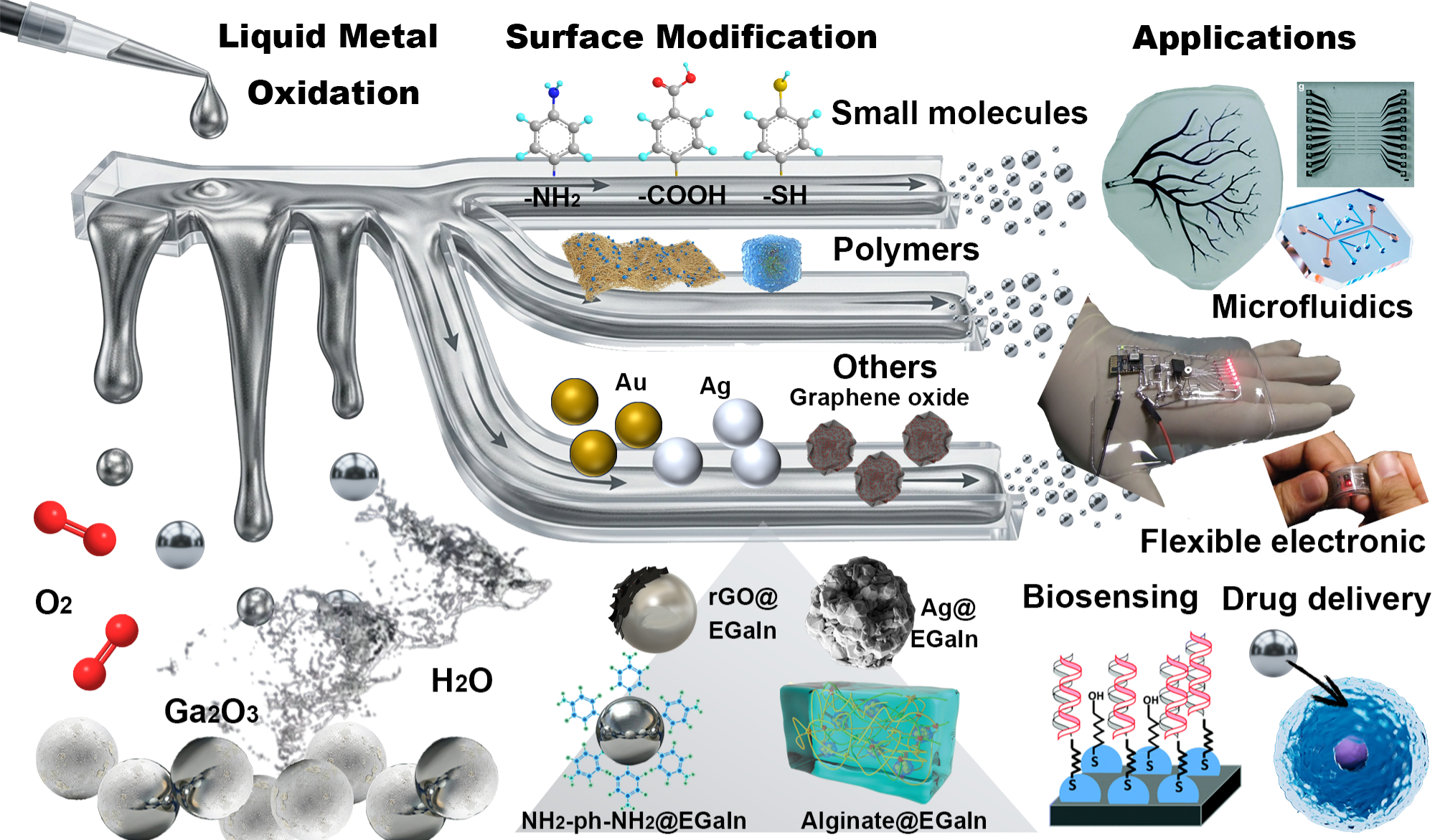
Figure 1. Graphic overview of LM oxidation, surface modification and their applications. (Some surface modification strategies and applications are adapted from references[20-26]: Microfluidics are adapted with permission from reference[20]. Copyright © 2017 Royal Society of Chemistry. Flexible electronics are adapted with permission from reference[21], Copyright © 2015 WILEY-VCH Verlag GmbH & Co. KGaA, Weinheim; and with permission from reference[22]. Copyright © 2017 American Chemical Society. LM-rGO is adapted with permission from reference[24]. Copyright © 2021 American Chemical Society. P-LM/GO hydrogel is adapted with permission from reference[26]. Copyright © 2021 John Wiley and Sons.) LM: liquid metal.
2. Applications of Liquid Metals
LM, which combines metallic conductivity with fluidic flexibility, has overcome the rigidity limitations of traditional solid-state metals, leading to extensive research and diverse applications. In this section, we review recent advances in LM-based technologies for microfluidics, flexible electronics, biosensors, drug delivery and thermal therapy.
2.1 Microfluidics
In microfluidic applications, LM offers a simple route for fabricating metallic components such as valves, pumps, heaters, electrodes, antennas, and sensors due to its injectability. For instance, integrating a pair of LM pumps into a miniaturized chamber can induce highly controlled vortices to generate customized spatiotemporal temperature gradients (Figure 2a)[27]. Jinsol et al. fabricated LM microheaters by infusing LM into polydimethylsiloxane (PDMS) microfluidic chips bonded with silicon or PDMS substrates, guided by finite element simulations. The silicon-based LM microheaters demonstrated superior temperature uniformity compared to their PDMS-based counterparts. However, the PDMS-based devices exhibited inherent flexibility and deformability, enabling their application for heating non-planar objects. This dual-platform approach highlights the adaptability of LM systems, where substrate selection can be tailored to prioritize either thermal precision (silicon) or mechanical compliance (PDMS) based on specific application requirements[31]. Furthermore, the soft and fluidic nature of LM enables active reconfiguration (e.g., for valving or pumping). A representative example is an electrostatic microvalve designed for gas flow control. This device comprises two orthogonally stacked channels: a gas channel at the bottom and an LM alloy channel at the top. In the absence of gas pressure, the PDMS membrane beneath the LM channel deforms under the weight of the LM, blocking the gas flow. When sufficient gas pressure is applied, the PDMS membrane expands upward to open the gas channel. Additionally, applying a voltage between electrodes generates electrostatic forces to deform the PDMS membrane, gradually closing the gas channel and enabling precise flow regulation. These examples highlight the unique potential of LM in creating adaptive, reconfigurable microfluidic systems[32].
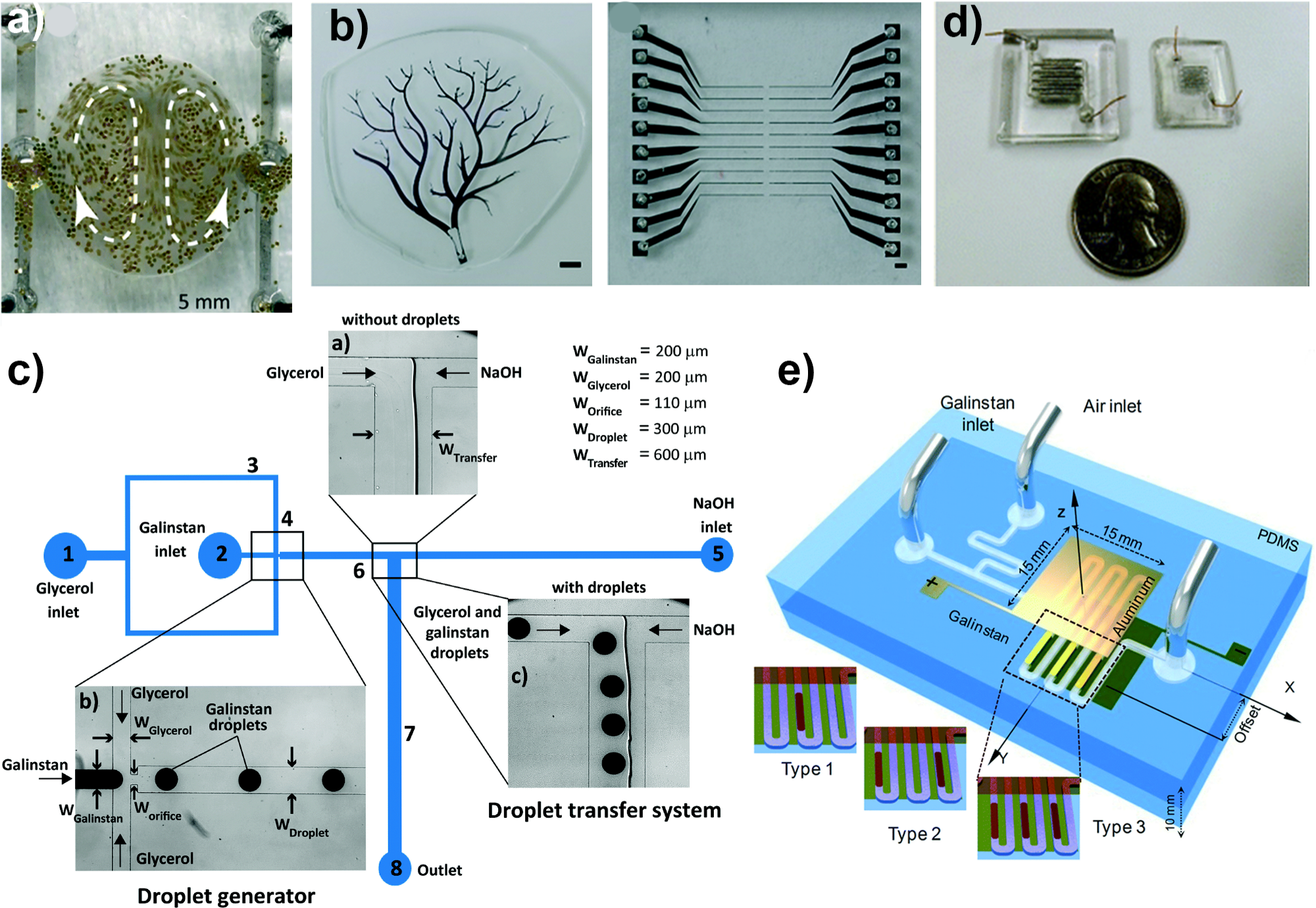
Figure 2. LM applications toward microfluidics. a) LM pumps into a miniaturized chamber can induce highly controllable vortices to generate customized spatiotemporal temperature gradients. Adapted with permission from reference[27]. Copyright © 2017 Royal Society of Chemistry; b) A vacuum-assisted method for LM filling of complex microchannels. Adapted with permission from reference[20]. Copyright © 2017 Royal Society of Chemistry; c) A microfluidic chip capable of continuously producing uniform microscale LM droplets in glycerol. Adapted with permission from reference[28]. Copyright © 2015 Royal Society of Chemistry; d, e) LM patterns enabling the tailored design of soft electronic components such as resistors, tunable capacitors and electronic filters. Panel d adapted with permission from reference[29]. Copyright © 2013 Royal Society of Chemistry. Panel e adapted with permission from reference[30]. Copyright © 2015 Royal Society of Chemistry. LM: liquid metal; PDMS: polydimethylsiloxane.
Infusing LM into elastomeric microchannels further creates soft, stretchable metallic structures that maintain electrical continuity during deformation. As illustrated in Figure 2b, a vacuum-assisted method simplifies LM filling of complex microchannels: placing the entire structure in a vacuum chamber removes air from the channels and surrounding elastomer. Restoring atmospheric pressure generates a pressure gradient that drives LM into the channels. This approach fills dead-end features as small as a few micrometers and branched architectures within seconds, without requiring outlets, and can even fill serpentine channels spanning meters in length[20]. LM also enables continuous infusion as fluids for applications such as LM flow, jetting, and microdroplet generation. Berrak et al. developed a microfluidic chip capable of continuously producing uniform microscale LM droplets in glycerol, followed by their hydrodynamic transport in sodium hydroxide (NaOH) solutions. This system demonstrated the ability to generate size-controlled LM droplets with tunable diameters on demand (Figure 2c)[28]. Microfluidic architectures also facilitate the creation of customized LM patterns[31], enabling the tailored design of soft electronic components such as wires, resistors[33], capacitors (Figure 2d)[29], inductors, and functional circuits or antennas[29]. For example, LM-based microfluidic platforms have achieved tunable capacitors and electronic filters (Figure 2e)[30]. Overall, the use of LM as electrical interconnects allows seamless integration of diverse electronic elements into microfluidic systems. This capability not only replaces traditional rigid circuit boards but also advances the flexible manufacturing of hybrid devices that combine microfluidics and integrated electronics, unlocking new possibilities for adaptive and reconfigurable soft systems.
2.2 Flexible electronics
Stretchable soft electronic systems are fabricated by embedding electronic components within elastic thin films and interconnecting them via LM patterned networks. The elasticity of the film, coupled with the LM network’s ability to retain high conductivity under severe deformation and its self-healing capability due to fluidic mobility (enabling recovery after film rupture), makes such systems ideal for operation in harsh environments and emerging fields like wearable or implantable devices[34]. As discussed earlier, injecting LM into flexible microfluidic channels enables the fabrication of electronic components, including resistors and tunable capacitors.
Beyond microfluidic injection, alternative fabrication methods include nebulizing LM (using nitrogen gas as a carrier) onto semi-cured PDMS surfaces with adhesive tape masks, followed by encapsulation with uncured PDMS to create stretchable wireless power transfer devices (Figure 3a)[35]. Selective LM electroplating has also been demonstrated: hydrochloric acid (HCl) treated LM exhibits contrasting wettability on Au/Cr-patterned PDMS substrates (superhydrophilic on metal patterns vs. superhydrophobic on bare PDMS), enabling high-resolution LM patterning for stretchable pulse sensors (Figure 3b)[36]. Additionally, Wang et al. proposed a dual-transfer printing method for rapid LM-based flexible electronics fabrication. This approach leverages LM’s freezing phase transition and temperature controlled adhesion modulation between substrates, effectively addressing the challenge of poor wetting of LM on elastic substrates, thereby simplifying precise LM printing and proposing a wearable temperature sensor (Figure 3c)[21]. Similarly, Lu et al. developed a deformable pulse oximeter by ablating LM films on soft printed circuit board (PCB) substrates using an ultraviolet laser micromachining system, showcasing the versatility of LM in advanced flexible electronics manufacturing (Figure 3d)[22]. These innovations highlight the adaptability of LM-based techniques in overcoming traditional limitations, paving the way for next-generation soft, stretchable, and self-healing electronic systems.
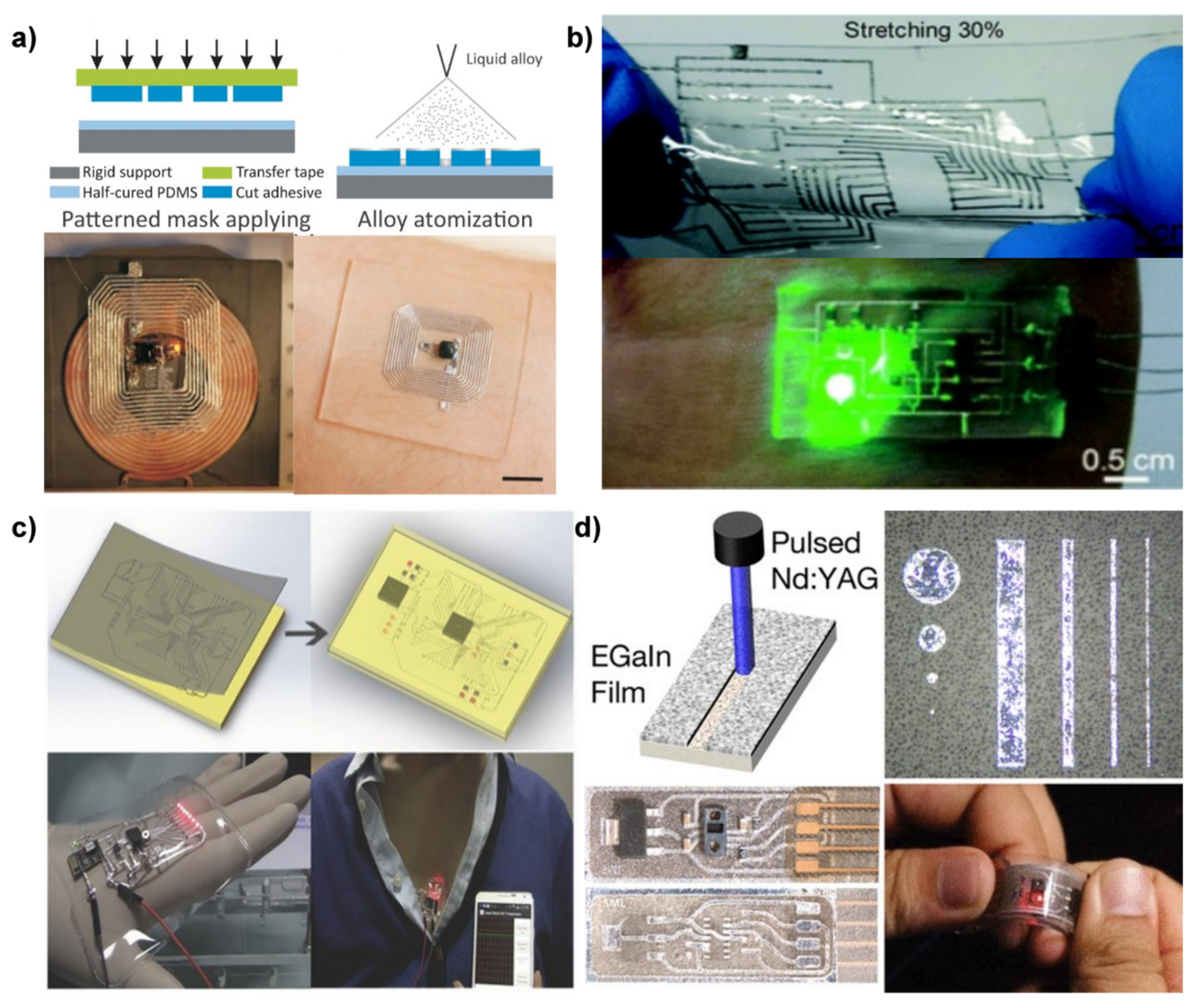
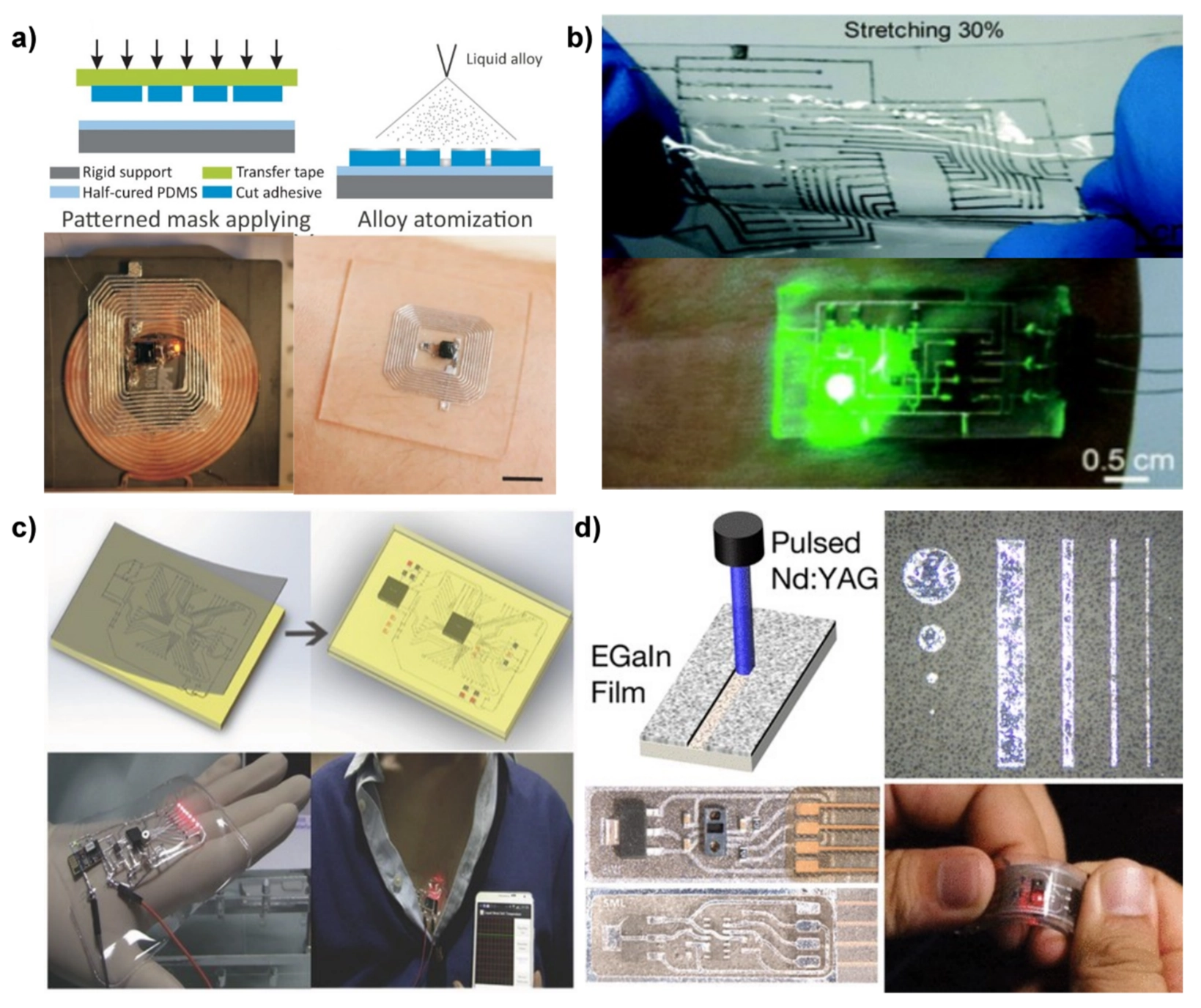
Figure 3. LM in flexible electronics. a) A method nebulizing LM onto semi-cured PDMS surfaces with adhesive tape masks to fabricate stretchable wireless power transfer device[35]. Reproduced from reference[35]. CC BY 4.0; b) High-resolution LM patterning for stretchable pulse sensors by Selective LM electroplating. Adapted with permission from reference[36]. Copyright © 2017 Royal Society of Chemistry; c) A dual-transfer printing method for rapid LM-based wearable temperature sensor fabrication. Adapted with permission from reference[21]. Copyright © 2015 WILEY-VCH Verlag GmbH & Co. KGaA, Weinheim; d) A deformable pulse oximeter by ablating LM films on soft PCB substrates using an ultraviolet laser micromachining system. Adapted with permission from reference[22]. Copyright © 2017 American Chemical Society. LM: liquid metal; PDMS: polydimethylsiloxane; PCB: printed circuit board; Nd:YAG: yttrium aluminum garnet doped with neodymium.
2.3 Biosensing
LM has been extensively studied in non-biological sensing applications. A traditional example involves the development of electrodes sensitive to heavy metal ions: by applying a specific bias to a reference electrode, heavy metals such as lead and cadmium can be reduced and alloyed into the LM interface. Reversing the bias enables the stripping of alloyed elements from the LM at characteristic potentials, forming the basis of anodic stripping voltammetry, a widely utilized electrochemical sensing technique. The selective detection of heavy metals is achieved as each ion is absorbed and released at distinct bias voltages[34,37]. Sensitivity enhancements have been observed using micro- or NP-coated LM marbles, which form metal-semiconductor-metal junctions, significantly improving electrochemical detection limits for heavy metal ion concentrations (Figure 4a)[37]. LMs also serve as effective mechanical sensors due to their strain tolerance. For instance, LM encapsulated in flexible tubes undergoes significant deformation, modulating conductor diameter or electrode spacing, thereby altering resistivity or capacitance. These changes enable applications in curvature and strain sensing, with functionality preserved even under large tensile stresses[40]. Arrays of such strain sensors can be integrated into soft tactile sensors. Frank et al. improved sensitivity by optimizing microfluidic channel geometry and placement to enhance resistance changes under mechanical compression[41]. With tailored processing, LMs can also function in biosensing, shifting focus from physical signals to biomarker concentration detection. Biosensors convert the presence of biomolecules into measurable signals, typically through the incorporation of bio-specific ligands or biorecognition elements at the sensor interface[42]. Signals generated by biorecognition events are transduced via mechanisms such as fluorescence[43], colorimetry[44], electrical responses[45], size-based detection[46], or surface plasmon resonance[47], then transferred and amplified for signal output[48]. In LM-based biosensors, LM acts as transducer, converting molecular interactions into electrical, magnetic, or optical signals. Prior reviews have comprehensively summarized the applications and performance of LM biosensors, including key metrics and design strategies[42]. LM-based gas sensing holds significant potential for detecting disease-related volatile organic compounds (VOCs). The native oxide layer of LMs enables gas detection by altering electrical conductivity or resistance when gas molecules adsorb onto the oxide surface, generating a measurable resistive response through thin electrodes[49]. By controlling the size, morphology, and functional coatings on LM layers, the gas-sensitive interfaces can be tailored to detect diverse gases[50,51]. Nitric oxide (NO), a noninvasive biomarker for diseases such as allergic purpura, asthma, and myocarditis, exemplifies this capability[52,53]. Huang et al. developed a flexible LM-based electrode integrated with SnS2 nanomaterials (Figure 4b), which exhibits strong affinity for NO. The SnS2 layer undergoes molecular deformation during NO adsorption, enabling precise detection (Figure 4c,d). This wearable gas sensor incorporates Bluetooth technology for remote respiratory monitoring and diagnostics[38]. Further advancements include a fully soft, battery-free wireless chemical microsystem for VOC detection (e.g., methanol and ethanol). Fabricated using soft lithography and LM micro-patterning, this system embeds LM electrodes within microfluidic channels as interdigitated capacitors. The absorption of VOCs into the silicone dielectric between the electrodes induces capacitance changes, detectable in both liquid and gaseous phases. Such sensors show promise for applications like alcohol breath testing, combining high sensitivity with wireless operation[39]. These innovations underscore the versatility of LM-based platforms in bridging advanced sensing mechanisms with practical diagnostic tools (Figure 4e)[39]. LM-based sensors have also demonstrated promising applications in DNA and microRNA (miRNA) detection. For instance, a sensing platform is fabricated by depositing LMNPs on a silicon substrate, followed by functionalizing the LMNP surfaces with 5’-end hexamethyldithiol-modified DNA capture probes, which hybridize with target DNA sequences. The hybridization event is detected through energy shifts in the pseudo-dielectric function caused by changes in the medium surrounding the LMNPs under reversal of polarization handedness conditions. This method achieves high sensitivity and selectivity for target DNA detection (Figure 4f)[23].
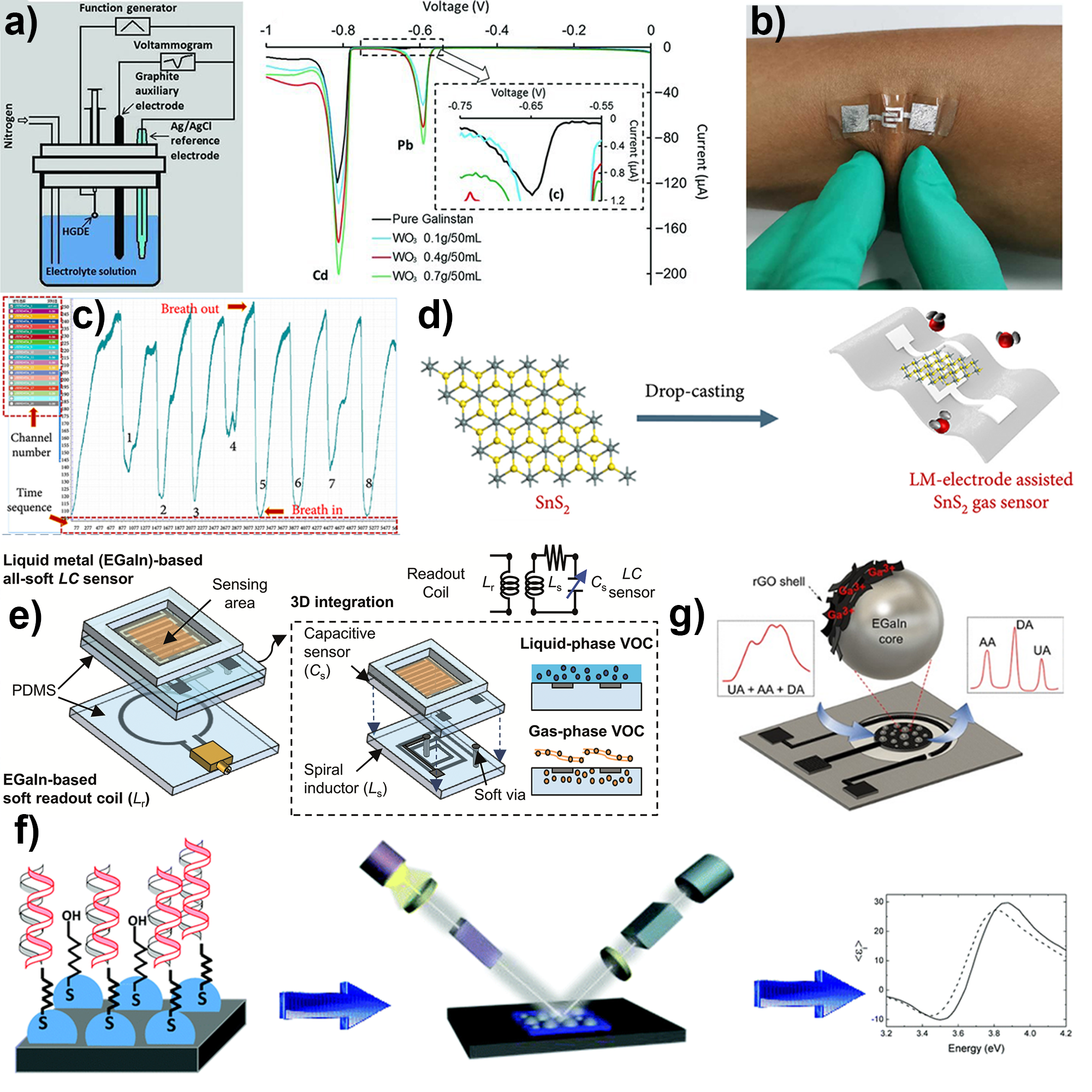
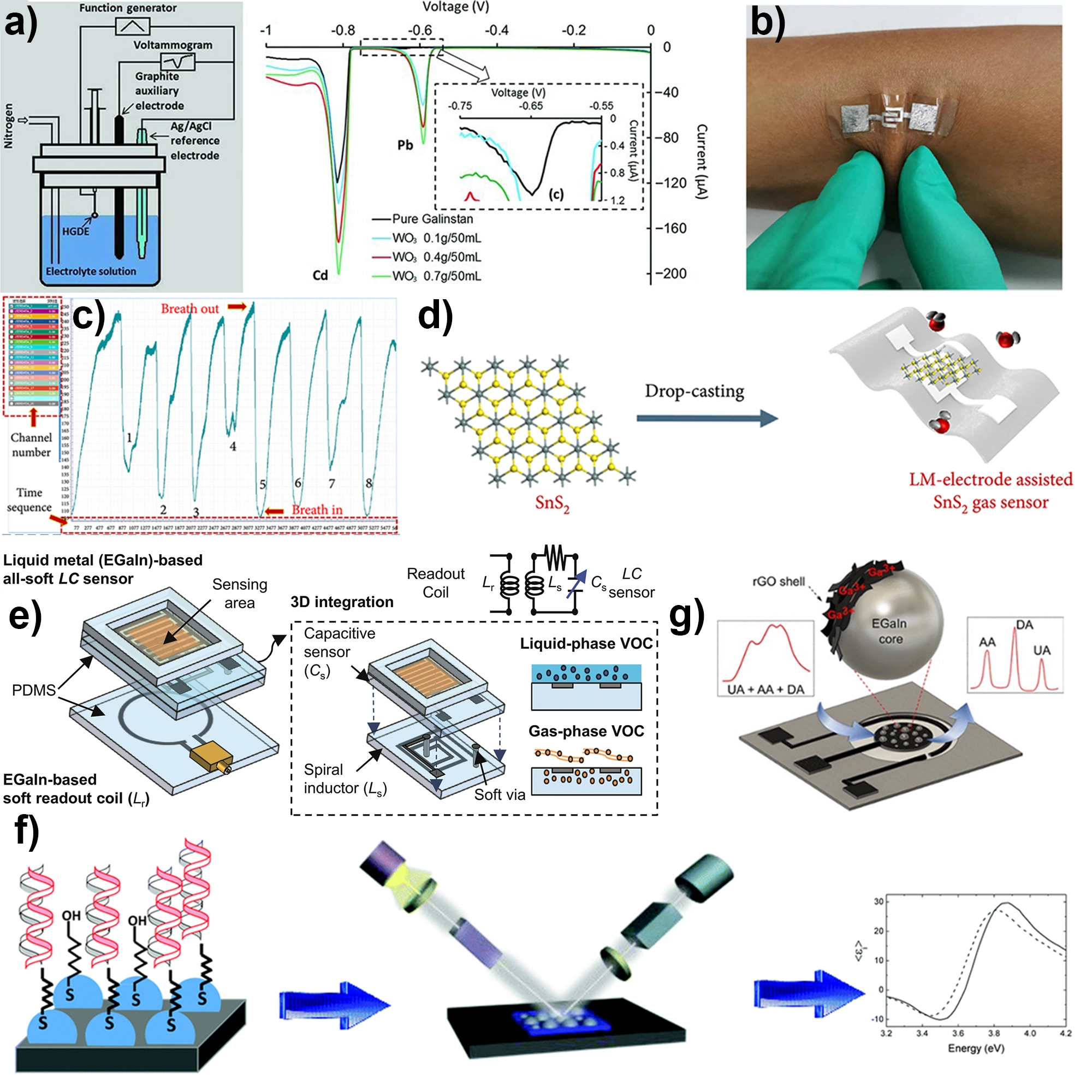
Figure 4. LM in biosensing. a) A method for detecting the concentration of heavy metal ions by electrolysis of liquid metals. Adapted with permission from reference[37]. Copyright © 2013 John Wiley and Sons; b, c, d) Flexible LM-based electrode, used for threshold detection of NO and respiratory rate monitoring[38]. Reproduced from reference[38]. CC BY 4.0; e) A fully soft, battery-free wireless chemical microsystem for VOC detection. Adapted with permission from reference[39]. Copyright © 2017 Royal Society of Chemistry; f) Functionalizing the LMNPs surface for DNA detection[23]. Reproduced from reference[23]. CC BY 4.0; g) LM-rGO in electrochemical interface for selective dopamine sensing. Adapted with permission from reference[24]. Copyright © 2021 American Chemical Society. 3D: three-dimensional; VOC: volatile organic compound; rGO: reduced graphene oxide; LM: liquid metal.
LM-integrated neural electrodes enable the development of flexible probes that mitigate mechanical mismatch between rigid probes and soft neural tissues. For example, LM implantable probes have been engineered to transit from solid to liquid at body temperature, enabling temperature dependent stiffness modulation spanning over five orders of magnitude. Upon metal melting, the probe becomes ultrasoft, flexible, and stretchable in all directions. Additionally, the probe incorporates multilayered deformable microfluidic channels for localized chemical delivery, while LM wiring provides electrical interconnects and supports high-performance electrochemical glutamate sensing[54]. LM-based biosensors have also been leveraged for detecting biomarkers in complex sample matrices. For instance, Baharfar et al. developed a composite material composed of reduced graphene oxide (rGO) flakes assembled on LM microdroplets (LM-rGO). The LM component facilitates Ga3+ coordination within the rGO assembly, modifying the electrochemical interface for selective dopamine sensing by isolating peaks from interfering biomolecules. The LM-rGO composite demonstrated enhanced performance as an electroactive modifier, reducing charge transfer resistance and amplifying sensing capabilities (Figure 4g)[24]. Lei et al. reported a wireless epidermal patch based on LM-polymer conductors (LMPCs). The LMPCs were fabricated by casting and peeling polymers from patterned LM particles. The patch integrates antennas and circuits for analyzing sweat metabolites (glucose), electrolytes (Na+, K+), and urea. When a portable reader approaches the patch, it wirelessly powers the device via the LMPC antenna, enabling noninvasive and comprehensive health monitoring[55]. In addition, other than Ga-based LM, Bi-based LM systems further enable rapid glucose detection. A wireless electrochemical glucose detection platform was developed using Bi-In-Sn alloy as electrode ink for fast printing. Glucose concentrations in the range of 5-50 mM were quantified via cyclic voltammetry, with data transmitted via Bluetooth to smartphones for real-time analysis, making the system suitable for point-of-care (POC) testing[56]. These innovations underscore the adaptability of LM technologies in bridging high-sensitivity detection with user-friendly, portable diagnostics.
2.4 Drug delivery and thermal therapy
In addition to the oxide layer, the surfaces of LM and LMNPs inherently lack functional groups. Consequently, synthesized LMNPs rapidly precipitate in aqueous solutions without the assistance of surfactants, typically thiol-containing molecules[57]. The modification of LMNPs with surfactants serves a dual purpose: imparting surface charges to stabilize the nanoemulsion and providing abundant functional groups as binding sites for drug-loading applications[57,58]. Currently, thiol-LM interactions have been widely exploited for surface functionalization of LMNPs. Briefly, an emulsion-like ligand-mediated procedure is implemented through room temperature ultrasonication. As bulk LM is ultrasonically fragmented, multifunctional thiolated ligands can be covalently conjugated to the LMNPs surfaces[59]. Building on this strategy, Lu et al. employed thiolated (2-hydroxypropyl)-β-cyclodextrin (CD) and thiolated hyaluronic acid (HA) as drug loading matrices and active targeting moieties, respectively (Figure 5a)[60]. Notably, this formulation exhibited transformability, enabling NPs fusion under the mildly acidic endosomal/lysosomal microenvironment to facilitate drug release. During in vivo evaluation, the nanoplatform demonstrated superior tumor growth suppression compared to free drugs, potentially attributable to the HA functionalization. As a major component of the tumor extracellular matrix, HA can bind to overexpressed CD44 receptors on solid tumors[65]. Moreover, LM particles exhibit photothermal effects by absorbing light to induce localized heating[66,67], while LM wires can generate heat via Joule heating. This thermal capability serves as a versatile tool in biomedical contexts, enabling LM to locally deliver heat and photo-responsive reactive species (e.g., reactive oxygen species (ROS)), which play an important role in tumor ablation[68]. The combined effects of heat and ROS can induce oxidation of LMNPs, leading to the formation of rod-shaped gallium oxide hydroxide (GaOOH) structures[69]. For instance, Yan, Sun, and colleagues demonstrated that LMNPs engineered into rod-like morphologies exhibit significantly enhanced photothermal conversion efficiency compared to their spherical counterparts (Figure 5b)[69,61]. Furthermore, near-infrared (NIR) light-triggered shape transformation of LMNPs has been shown to disrupt endosomal membranes, accelerating endosomal escape of therapeutic payloads, which is a critical feature for spatiotemporally controlled and efficient drug delivery. Zhang et al. further developed tumor cell membrane-coated LMNPs as a proof-of-concept nanovaccination platform. Under 808 nm irradiation, the photothermal conversion of LMNPs induces mild local inflammation, which actively recruits antigen-presenting cells (APCs) and enhances cellular uptake of tumor-associated antigens. Subsequently, the LMNPs/cell membrane nanovaccine promotes maturation and activation of APCs, eliciting robust antitumor immune responses (Figure 5c)[62]. Combining drug delivery with thermal properties has enabled further multifunctional strategies. Lu et al. equipped LMNPs with photosensitizer-grafted graphene quantum dots (GQD), enabling remote-triggered mechanical disruption of cellular structures (Figure 5d)[63]. Under light irradiation, the zero-dimensional nanospheres underwent a morphological transition to one-dimensional nanorods, accompanied by a dramatic increase in the aspect ratio and volume of the metallic architecture. The transformation from spherical to hollow rod-like nanostructures, with significant alterations in aspect ratio, physically disrupted endosomal membranes to enhance endosomal escape of payloads. The researchers loaded both therapeutic agents and rhodamine-labeled BSA onto LMNPs via π-π stacking and thiol-metal interactions, respectively. Fluorescence quantification and co-localization assays confirmed enhanced endosomal escape of dual payloads under NIR light irradiation. Concurrently, Chechetka et al. demonstrated the potential of shape-transformable LMNPs as drug delivery vehicles. In their work, carmofur was encapsulated within LM nanocapsules via ultrasonication. After 30 min of NIR laser irradiation, the LM nanocapsule structure was completely disrupted, releasing a cumulative carmofur concentration of 38 μg mL-1 (Figure 5e)[64]. These examples collectively highlight that LM nanotransformers represent a novel modality for spatiotemporally controlled intracellular drug delivery.
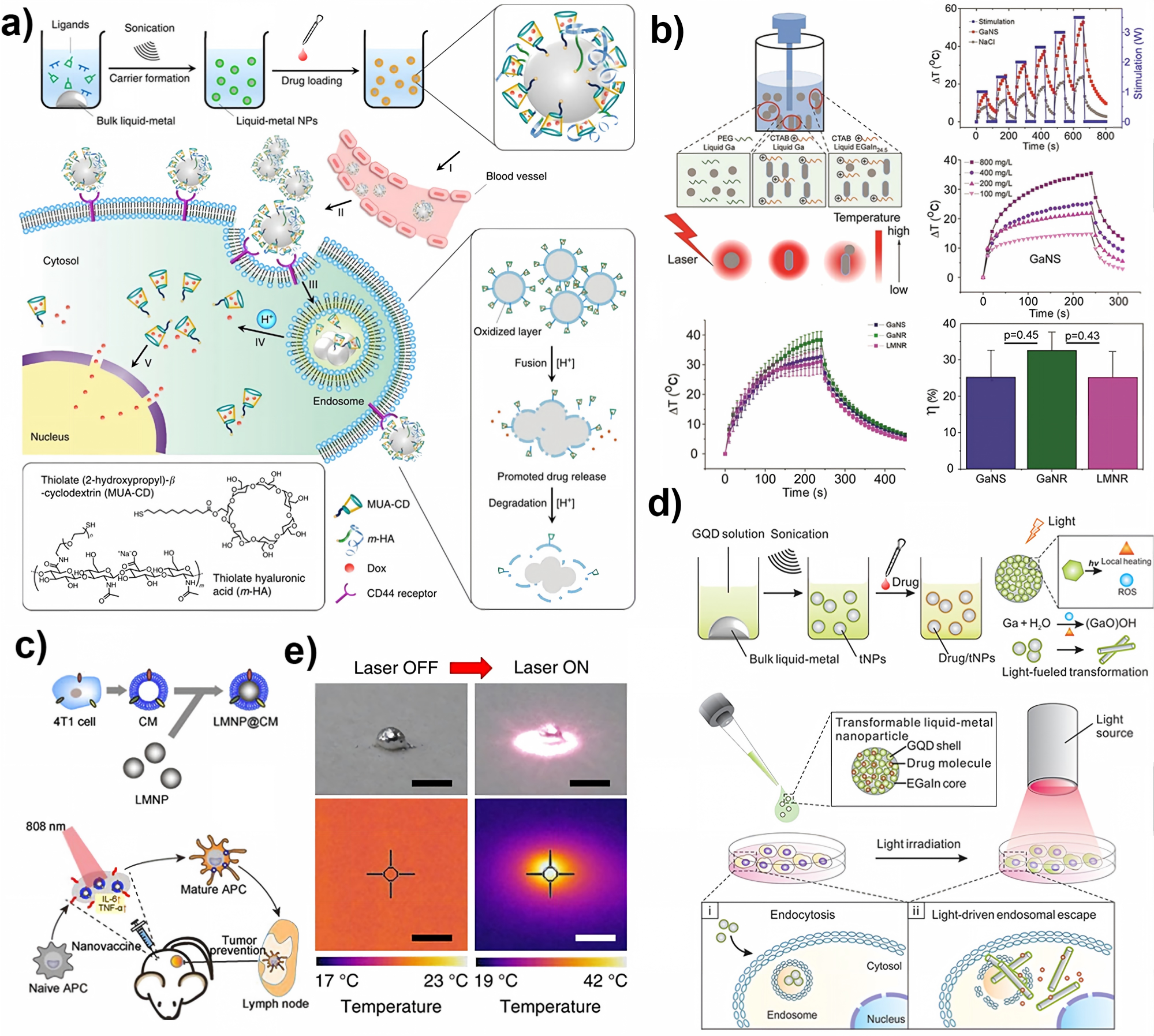
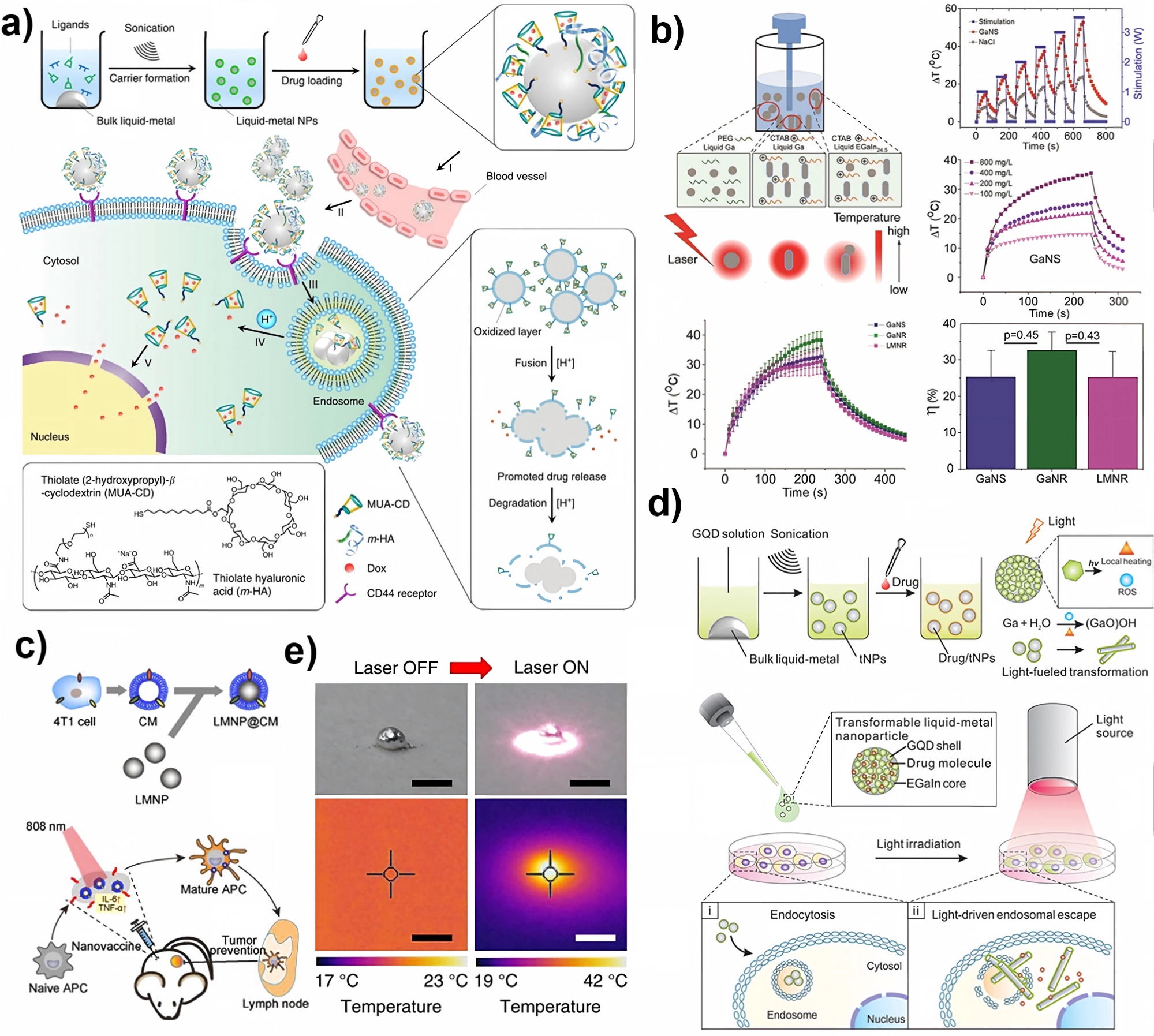
Figure 5. LM in drug delivery and photothermal therapy. a) Schematic design of the transformable LMNPs delivery system[60]. Reproduced from reference[60]. CC BY 4.0; b) The scheme of the fabrication process and photothermal effects of three different types of LMNPs. Adapted with permission from reference[61]. Copyright © 2019 Royal Society of Chemistry; c) The synthesis of LMNPs@CM, and the vaccination of LMNPs@CM and subsequent immune responses. Adapted with permission from reference[62]. Copyright © 2020 John Wiley and Sons; d) Preparation of GQDs-coated LMNPs. Adapted with permission from reference[63]. Copyright © 2017 American Chemical Society; e) Visible light and thermographic images of a representative LM droplet (1 mg) before and after irradiation with a 785 nm NIR laser at 1 W (~ 80 mW mm-2) for 5 min. Scale bars, 2 mm[64]. Reproduced from reference[64]. CC BY 4.0. LM: liquid metal; NPs: nanoparticles; CD: cyclodextrin; GQD: graphene quantum dots; ROS: reactive oxygen species; APC: antigen-presenting cells; NIR: near-infrared.
3. Surface Modification Strategies to Address Limitations
Despite their unique advantages, LM presents potential challenges in biomedical and wearable applications. LM develops a native oxide layer that stabilizes LM droplets but remains susceptible to oxidation-related instability under physiological conditions. While bulk LM exhibits negligible cytotoxicity due to natural dissolution, the ultrahigh surface area of NPs significantly increases ion release: for example, LMNPs release Ga3+ and In3+ ions at concentrations of ~ 120 μM and ~ 240 μM, respectively, leading to a marked reduction in metabolic activity across all tested cell types (HeLa cells, adipose-derived stem cells (ADSCs), and neonatal dermal fibroblasts (NDFs))[70]. These findings, together with broader assessments of LM biocompatibility[71,72], underscore the importance of defining a concentration safety threshold, beyond which Ga3+ accumulation may exceed biocompatibility limits (Figure 6a)[70,71]. Furthermore, Ga3+ can interfere with iron dependent biological processes through its competition with Fe3+ in biological systems[79]. In an acute animal study, a single intraperitoneal administration of gallium sulfate (12.5-200 mg Ga/kg) to rats caused dose dependent inhibition of δ-aminolevulinic acid dehydratase activity in the liver, kidneys, and erythrocytes 24 h after exposure[80]. Further, the high surface tension of LM (624 mN m-1)[81,82] arises from a thin solid oxide layer (2-10 nm thick under ambient conditions) that encapsulates the metal[83,84]. Although this oxide layer stabilizes LM droplets, it complicates the fabrication and modification of LM components (e.g., wires) and hinders stable integration with soft biological tissues, often causing interfacial delamination or mechanical mismatch. Removing the oxide layer reduces surface tension to ~ 435 mN m-1, enabling easier manipulation of LM (Figure 6b)[73,84,85]. However, oxide removal typically requires corrosive aqueous environments, limiting practical applicability. Consequently, a major research challenge lies in managing LM oxide layers to achieve reliable and precise circuitry[73]. In electrochemical biosensing, surface oxidation degrades signal stability, impairing long-term reliability for continuous monitoring[76]. To overcome these challenges, surface engineering strategies have been developed to tailor LM interfaces for enhanced stability, biocompatibility, and functionality[18,86]. Small-molecule ligands (e.g., thiols, amines) and polymeric ligands (e.g., polyethylene glycol (PEG); polyvinylpyrrolidone (PVP)) are widely employed for LM surface modification. For specific, surface functionalization with small molecules, polymers, biological components, and galvanic replacement are extensively reviewed.
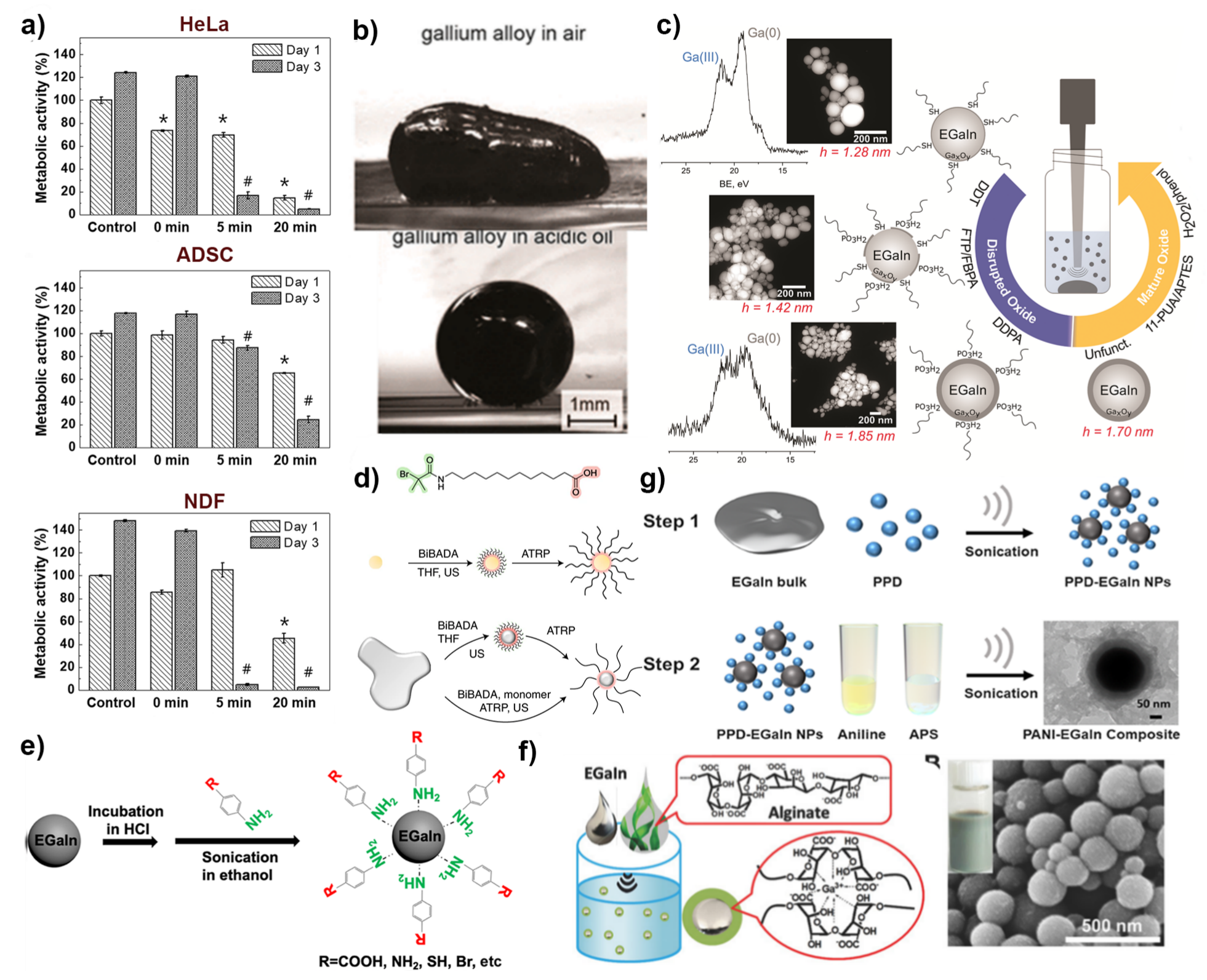
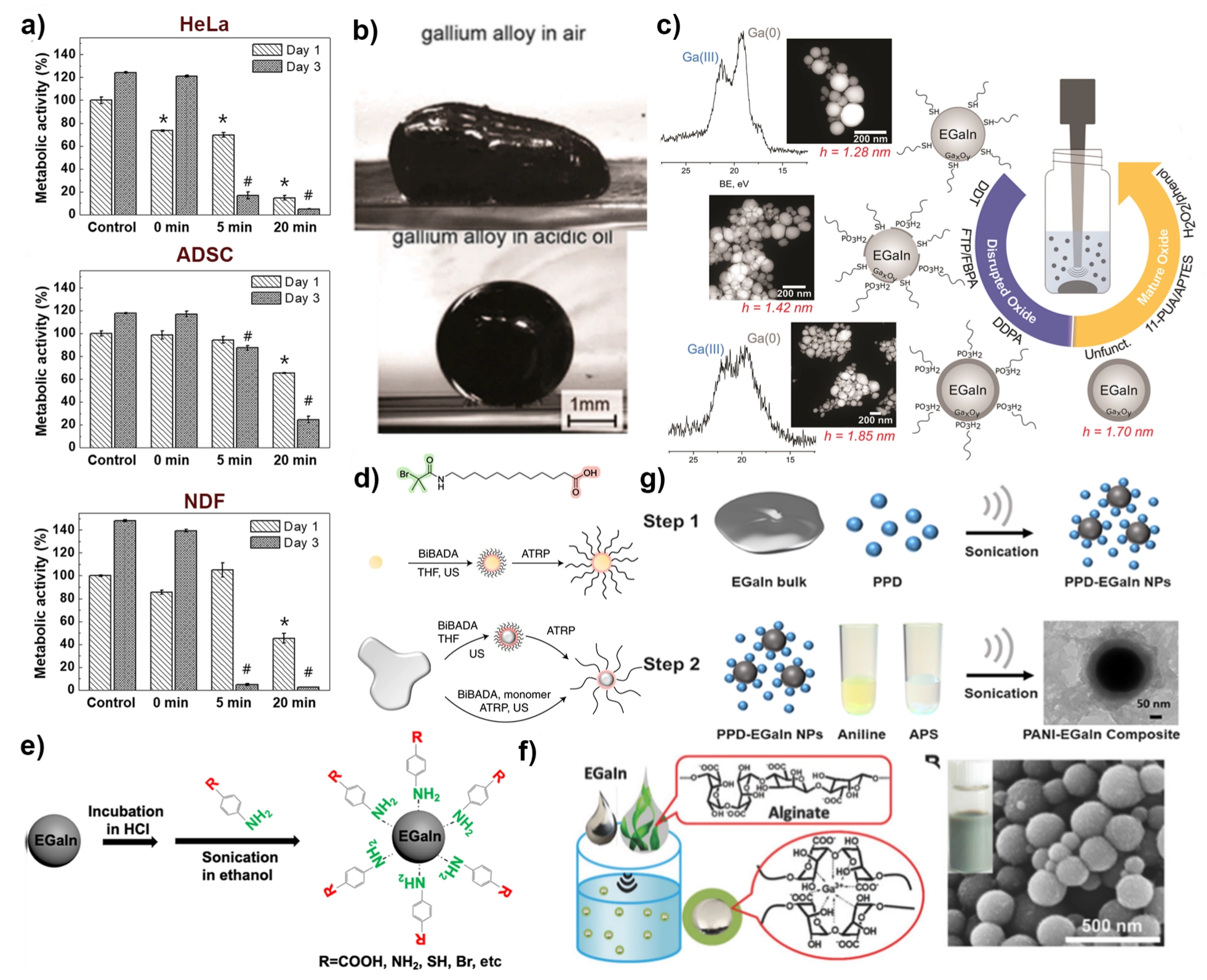
Figure 6. LM modification by small molecules and polymers. a) Metabolic activity of HeLa cells, ADSCs, and NDFs exposure to LM releasates at different sonication times. Adapted with permission from reference[70]. Copyright © 2018 American Chemical Society; b) Effects of the surface oxide layer on the shape of a LM droplet in air (left) where the droplet is deformed and when the oxide layer is removed through the use of HCl (right) the droplet is spherical. Adapted with permission from reference[73]. Copyright © 2021 John Wiley and Sons; c) Schematic of the chemical modifications used to synthesize varied oxide shell thickness (h) with associated STEM images and XPS spectra of the Ga 3d transition region. Adapted with permission from reference[74]. Copyright © 2019 Royal Society of Chemistry; d) Schematic illustration of the carboxylic group functionalized LMNPs[75]. Adapted with permission from reference[75]. Copyright © 2019 Springer Nature Limited; e) Schematic process for the preparation of LM modified with p-aniline derivatives toward bioapplications. Adapted with permission from reference[76]. Copyright © 2022 American Chemical Society; f) Schematic illustration of sonicating LM in alginate solution and LM droplets shelled in alginate microgel. The right panel shows typical SEM images of LM droplets. The inset shows visual observation of its stable colloid. Adapted with permission from reference[77]. Copyright © 2018 John Wiley and Sons; g) Strategies to synthesize PANI-LM hybrid nanocomposites. Adapted with permission from reference[78]. Copyright © 2020 American Chemical Society. ADSC: adipose-derived stem cell; NDF: neonatal dermal fibroblast; LM: liquid metal; NPs: nanoparticles; SEM: scanning electron microscopy; PANI: polyaniline; EGaIn: eutectic gallium-indium; DDT: 1-dodecanethiol; FTP: 2,3,4,5,6-pentafluorothiophenol; FBPA: 4-fluorobenzylphosphonic acid; DDPA: dodecylphosphonic acid; PPD: p-phenylenediamine; APS: ammonium persulfate; PANI: polyaniline; STEM: scanning transmission electron microscopy; XPS: X-ray photoelectron spectroscopy.
3.1 Small molecules
The surface of LM can be functionalized through interactions between ligands and the LM (or more commonly, its oxide layer)[19]. Mechanical agitation or sonication of LM in liquid media (e.g., water or ethanol) generates LMNPs; however, pure LMNPs rapidly oxidize in solution, forming a Ga2O3 surface with near-zero surface charge, resulting in poor colloidal dispersion stability. Thiol (-SH) ligands form self-assembled monolayers (SAMs) on the LM oxide layer via Ga-S covalent bonds, enhancing oxidation resistance and reducing ion leakage[74,87]. Surface silanization further enables precise tuning of oxide layer thickness (1.28-4.46 nm), elastic modulus (0.37-1.38 GPa), and stiffness (0.05 ± 0.03 to 2.90 ± 0.51 N m-1, Figure 6c)[74]. Ligand functionalization also narrows the size distribution of sonicated LMNPs compared to unmodified counterparts[88-90]. Inspired by stabilization strategies for metal oxide NPs, strongly binding ligands such as organophosphates or carboxylates are utilized to prevent LMNP aggregation. These ligands chemisorb to the Ga2O3 surface via phosphate or carboxylate groups during sonication of bulk LMs in ligand-containing solvents (Figure 6d)[91-93]. Additionally, Huang et al. developed a universal method to functionalize LM surfaces with aniline derivatives, introducing monolayers bearing multifunctional groups (e.g., NH2 and SH) (Figure 6e)[76]. This approach not only passivates LMNPs against oxidation but also significantly enhances their electrical conductivity compared to oxidized particles[76]. This research reveals the antioxidant effect of LMNPs modified with aniline derivatives with multifunctional functional groups in the biological environment, opening a door for the application of small molecular-modified LM in the biomedical field.
3.2 Polymers
Recent advances in LM encapsulation have focused on polymeric materials due to their high molecular weight and robust intra-/intermolecular interactions[18,74,94]. Common strategies include direct sonochemical assembly and surface polymerization initiated by pre-adsorbed monomers or initiators on LM surfaces. For instance, alginate (a polysaccharide) forms dense coatings around LMNPs by chelating surface Ga3+ ions, creating a microgel network that stabilizes LMNPs (Figure 6f)[77]. By adjusting alginate concentration, both particle size (50-500 nm) and shell thickness (10-100 nm) can be precisely controlled. Furthermore, crosslinked alginate hydrogel shells delay the generation and release of Ga3+ ions, enabling tailored ion-release kinetics for applications such as controlled drug delivery. Polymeric and phospholipid-based surface layers can also improve the aqueous dispersibility and biocompatibility of LMNPs. For example, Chechetka et al. prepared LM nanocapsules by pulse-sonicating LM with DSPE-PEG2000-NH2 and the photopolymerizable phospholipid 1,2-bis(10,12-tricosadiynoyl)-sn-glycero-3-phosphocholine [DC(8,9)PC] in water, followed by irradiation at 254 nm to crosslink the butadiyne moieties of DC(8,9)PC[64]. The resulting polymeric core-shell nanocapsules exhibited high water dispersibility, with a hydrodynamic diameter of approximately 150 nm that remained stable for at least 3 days at 20 °C. Alternatively, pre-adsorbed monomers on LMNPs can be crosslinked via chemical initiators. For example, a conductive LM-polymer nanocomposite was fabricated by growing PANI nanofiber networks on LMNPs (Figure 6g)[78]. During LMNP synthesis, p-phenylenediamine (PPD) was incorporated to promote surface adhesion. The resulting PPD-LMNPs were then mixed with aniline monomers and polymerized ultrasonically using ammonium persulfate as an initiator, yielding LM@PANI. Although the integration of Ga2O3 and LMNPs enhanced thermal stability and strain sensitivity, the nanocomposite’s conductivity was decreased, attributed to the insulating Ga2O3 surface and disordered polymer matrix.
3.3 Biological components and galvanic replacement
Bioengineering strategies based on biological cell membranes have garnered significant attention due to their fascinating functionalities, including homotypic binding and immune evasion capabilities[18,95-97]. Recently, cell membrane-coated LMNPs were engineered for on-demand active immune recruitment and in situ activation[62]. These NPs were synthesized from LM stabilized with mPEG5000-SH, followed by tumor cell membrane coating via liposome extrusion. The resulting core-shell structured biomimetic NPs exhibit substantial promise for targeted tumor therapy. Additionally, enzyme coating has emerged as a bioengineering approach to confer high biocompatibility and catalytic functionality to NPs[98-100]. For instance, urease and cefixime trihydrate were co-loaded onto polydopamine-modified LMNPs to create enzyme-coated LM nanohybrids, serving as therapeutic nanosystems for biomedical applications (Figure 7a)[101]. More recently, biological recognition molecules had been incorporated into LM interfaces to impart active targeting and immunological functions: Qi et al. developed LM nanostimulants incorporating immunomodulatory components and further functionalized the particles with anti-PD-L1 antibodies, enabling specific recognition of PD-L1-expressing tumor cells while integrating photothermal therapy with immune activation[104]. Another research group employed bioactive bacterial components as biomimetic LM coatings: Sang et al. functionalized LMNPs with Lactococcus derived components through one-step sonication. The resulting Lacto/LM nanocomposites exhibited substantially improved aqueous dispersibility and colloidal stability, together with enhanced cellular uptake and tumor accumulation. In addition to stabilizing the LM interface, the bacterial constituents acted as intrinsic immune adjuvants, demonstrating how biological coatings can simultaneously improve physicochemical stability and introduce therapeutic functionality[105].
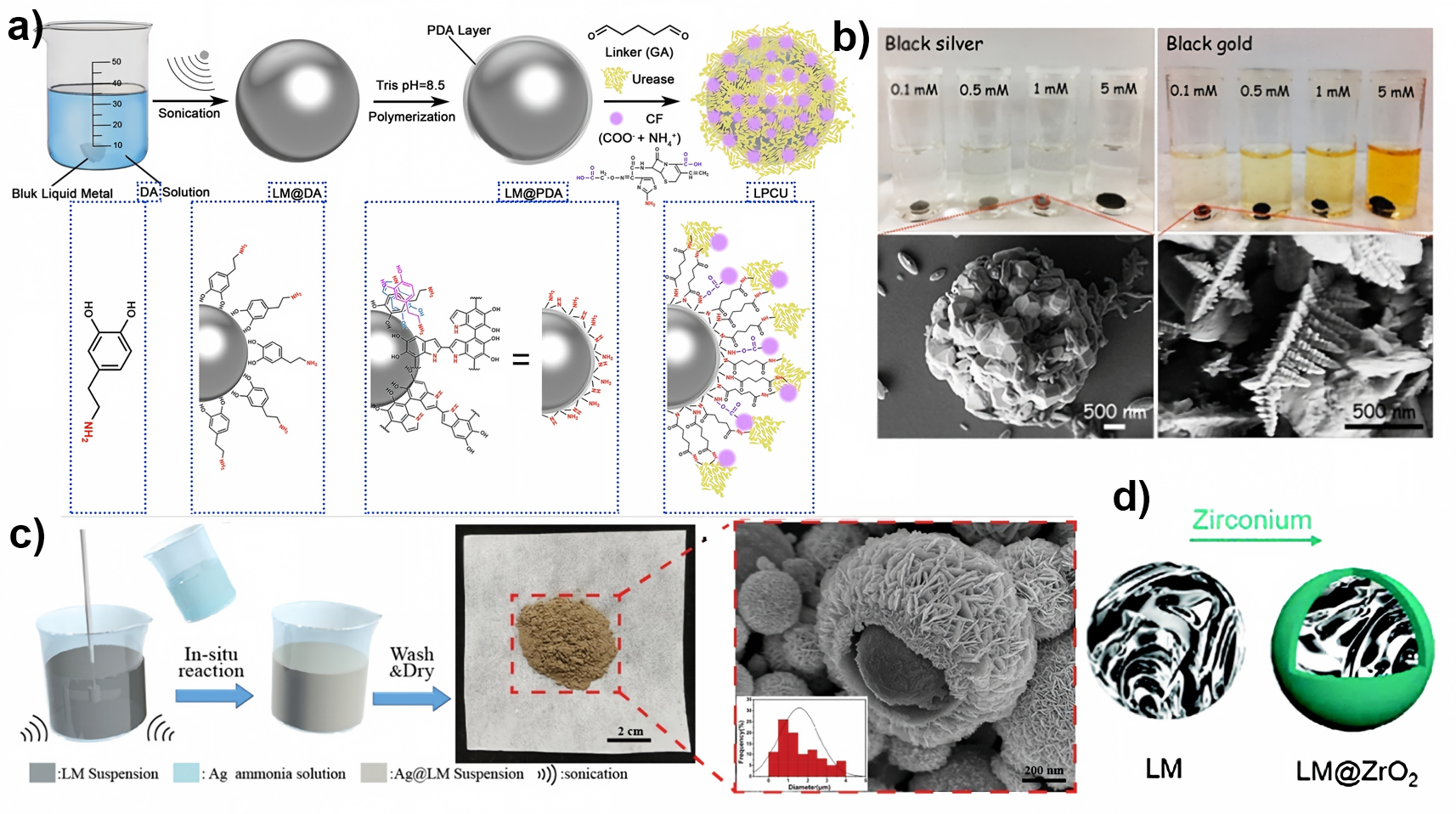
Figure 7. Other methods to modify LMNPs. a) Schematic of the fabrication process of CF-loaded enzymatic LM nanobots (LPCU MNBs). Adapted with permission from reference[101]. Copyright © 2021 American Chemical Society; b) Galvanic replacement of the LM[25]. Adapted with permission from reference[25]. Copyright © 2017 American Chemical Society; c) schematic of the preparation of Ag@LMNPs, corresponding to sample digital photos and relative SEM image of Ag@LMNPs and the inset is diameter distribution of Ag@LMNPs. Adapted with permission from reference[102]. Copyright © 2020 John Wiley and Sons; d) Preparation of core-shell LM@ZrO2 NPs by hydrolysis of zirconium n-propoxide. Adapted with permission from reference[103]. Copyright © 2019 Royal Society of Chemistry. LM: liquid metal; NPs: nanoparticles; CF: cefixime trihydrate; PDA: polydopamine; SEM: scanning electron microscopy.
In addition, galvanic replacement represents a straightforward and versatile strategy for fabricating multifunctional materials[18,106]. By simply immersing LMNPs in salt solutions containing precursor metal ions (e.g., AuBr4-, Ag+, Cu2+), galvanic replacement occurs, driven by electrochemical potential differences between metal/metal ion pairs (Figure 7b)[25]. For bulk LM droplets, the outer surface transforms into an Au- or Ag-rich solid shell while retaining a liquid core (Figure 7c)[102]. This approach can be extended to other metals (e.g., Pt, Au, Ag, Cu), enabling the synthesis of core-shell LM@metal NPs at nano-to-micro scales for multifunctional biomedical applications[107]. Moreover, post-synthetic strategies, such as wet-chemical deposition using pre-synthesized LMNPs as seeds, facilitate the formation of metal/metal oxide shells[102]. For example, zirconium(IV) propoxide, which hydrolyzes to ZrO2 in dilute ammonia solutions, was employed to fabricate LM@ZrO2 NPs (Figure 7d), yielding stable core-shell structures for long-term stabilization[103]. Core-shell interactions can be modulated by adjusting the ligand-to-metal ion ratio[108], allowing controlled synthesis to enhance properties such as thermal stability, molecular sieving capability, and drug-loading capacity. Galvanic replacement is not limited to noble metal deposition and can also generate functional metal oxide interfaces. For example, Xu et al. constructed VOx@LM-PEG core-shell nanohybrids through ultrasonication assisted galvanic replacement, followed by PEG modification. The resulting LM-based nanozyme exhibited peroxidase mimicking activity, illustrating that galvanic replacement can simultaneously engineer the LM surface composition and introduce catalytic functionality for biomedical applications[109]. Galvanic replacement can also be exploited to directly overcome the electrically insulating nature of the native oxide shell: Hajalilou et al. employed an ultrasound assisted galvanic replacement reaction to replace the Ga2O3/GaOOH-rich shell of LM particles with conductive Ag. The resulting Ag coated particles exhibited improved electrical performance and were subsequently incorporated into printable and highly stretchable composites, demonstrating the potential of galvanic surface engineering for wearable and soft electronic systems[110].
In summary, LM surface modifications include small molecules, polymers, and other approaches. Polymer coatings (e.g., alginate, PEG) enable precise size/shell control, enhanced biocompatibility, and tunable ion release, yet thick layers (> 50 nm) drastically reduce conductivity; cell membrane/enzyme coatings provide targeting/catalytic functions, while galvanic replacement and wet-chemical deposition construct multifunctional core-shell structures, albeit with higher process complexity. Most notably, small molecule modifications (thiol/amine ligands form self-assembled monolayers via covalent bonds) boost oxidation resistance and colloidal stability; crucially, aniline derivatives with multifunctional groups not only passivate oxidation but also dramatically enhance electrical conductivity, unlocking new possibilities for biomedical applications. A comprehensive and quantitative comparison of the three major LM surface modification strategies is summarized in Table 1.
Table 1. Comparison of various surface modification on LM (the first line is bare LM for control).
| Surface Modification | Modification Material | Electrical Performance | Oxidation/Stability | Biocompatibility | Processing difficulty | Ref. |
| Baseline | Bare EGaIn | / | Aggregated after 24 h in PBS | ~ 50% cell death in ADSCs/fibroblasts | / | [70,76] |
| Small molecule | p-Aniline derivatives (PPD, PABA, PATI, etc.) | Rct ≈ 41.45% of bare GC; | retained ~ 300 nm particle size after 24 h in PBS | / | Simple (sonication) | [76] |
| DDT, DDPA, FTP/FBPA, 11-PUA/APTES | / | Oxide-shell thickness from 1.28 to 4.46 nm; particle stiffness 0.05 ± 0.03 = 2.90 ± 0.51 N m-1; and shell modulus 0.37-1.38 GPa | / | / | [74] | |
| Alkoxysilane | Maintained resistance to 400% strain; Larger-particle network showed ~ 2 × resistance at 400% | Enhanced dispersibility & colloidal stability | / | Simple (one-step silanization) | [87] | |
| Thiolate SAMs (1-dodecanethiol, 1ATC9) | / | Rapid thiolate self-assembly protects LM against oxidation | / | Simple (sonication) | [88] | |
| Thiol/Ga2O3 | Coalesced LM line ≈ 49 Ω | Mechanical rupture converts initially nonconductive particle networks into conductive LM pathways; irreversible after coalescence | / | Simple (RT mechanical activation) | [89] | |
| Decylphosphonic acid | / | Stronger oxide-surface binding prevents sedimentation | / | Medium (sonication + reflux at 70 °C) | [91] | |
| Polymer | PMMA, PBMA, PDMAEMA, PBA-b-PMMA brushes | / | Remained dispersed in THF for ≥ 1 week | / | High (overnight sonication, polymerization and centrifugation) | [75] |
| Polymerized LM networks | ≈ 2,500 S cm-1 at 0% strain; > 20,000 S cm-1 at > 700% strain | Constant resistance during large deformation; Resistance stable over 10,000 cycles of 0-100% strain | / | Simple (facile fabrication) | [92] | |
| Cellulose, silk-fibroin or amyloid nanofibrils | 8.9 × 10⁵ S m-1; Remained conductive to 200% strain | Stable for days; hundreds of bending cycles without conductivity decay | Biocompatible & degradable | Simple (evaporation-induced sintering) | [93] | |
| Alginate microgel shell | Initially < 2 × 10⁻³ S m-1; 4.8 × 10⁵ S m-1 after mechanical sintering | Stable > 7 d in air and > 60 d under N2; ~ 20 nm alginate shell retards oxidation | Negligible cytotoxicity; Ga3+ release retarded, but release rate not quantified | Simple (sonication) | [77] | |
| PANI nanofibers grown on PPD-modified LM | Resistance remained stable during repeated thermal cycling | Improved thermal/electrical-response stability; Native oxide still influences conductivity | / | Simple (sonication, polymerization) | [78] | |
| PVP coating | / | Prevented rapid oxidation formation; stable 30 d in water and 60 d in ethanol; > 95% capacity retention after > 700 battery cycles | / | Simple (sonication) | [94] | |
| DSPE-PEG2000-Amine + photopolymerized phospholipid | / | ~ 150 nm size maintained for ≥ 3 d at 20 °C; Precipitated material could be redispersed | > 90% HeLa viability after 24 h; 320 mg mL-1 caused no evident mouse viability effect over 19 d | Simple (sonication, UV crosslinking) | [64] | |
| Biological components | PDA shell + urease + cefixime | / | Improved aqueous dispersion; Suppressed rapid LM-water reaction | / | Medium (Sonication, polymerization, grafting with linker) | [101] |
| Anti-PD-L1 + PEG/IMIQ | / | Size maintained for ≥ 10 d in water | Low intrinsic toxicity in 24 h cell tests; Activates T cells and dendritic cells; | Simple (sonication) | [104] | |
| Lactococcus-derived components | / | ~ 160 nm size stable ≥ 7 d | Negligible cytotoxicity to TIG103 and Colon26 cells at 24 h. | Simple (sonication) | [105] | |
| Galvanic replacement/Metal shell | Ag- or Au-coating | / | LM core retained beneath solid Ag/Au-rich shell | / | Simple (direct galvanic replacement) | [25] |
| Ag | 8.0 Ω sq-1 | Self-repair within 200 ms; R/R0 < 1.65 after 10,000 bending cycles | / | Simple (screen-printed) | [102] | |
| Pt/Au/Ag/Cu; PEGylated LM@Pt | / | Retained morphology and superior photothermal stability through 5 laser on/off cycles; Particles stable in PBS, RPMI and FBS for > 24 h | Negligible HUVEC cytotoxicity after 24 h | Simple (in situ reduction) | [107] | |
| ZrO2 shell + PEG | / | Remained dispersed and morphologically unchanged for 3 d in water | 70-88% HepG2 viability at 24 h | Simple (hydrolysis coating, PEGylation) | [103] | |
| PVP/ZIF-8-coating | / | Particles were uniform PDI 0.082; ZIF-8 provides additional protection | / | High (sonication, size selection, crystallization) | [108] | |
| VOx@LM-PEG | / | > 80% catalytic activity after 14 d in water at 25 °C; 78.91% activity after 7 reuse cycles; regenerated material retained > 75% activity after 7 regeneration cycles | / | High (sonication, centrifugation, freeze-drying, regeneration) | [109] | |
| Ag/Ga intermetallic shell + SIS composite | ≈ 20 Ω | Suppressed Ga2O3/GaOOH formation; Conductive under 30-100% strain testing; EMI shielding > 75 dB even at 200% strain | / | High (sonication, digital printing) | [110] |
PPD: p-phenylenediamine; PABA: p-aminobenzoic acid; PATI: p-aminothiophenol (4-aminothiophenol); DDT: 1-dodecanethiol; DDPA: dodecylphosphonic acid; FTP: 2,3,4,5,6-pentafluorothiophenol; FBPA: 4-fluorobenzylphosphonic acid; 11-PUA: 11-phosphonoundecanoic acid; APTES: (3-aminopropyl)triethoxysilane; 1ATC9: 3-mercapto-N-nonylpropionamide; PMMA: poly(methyl methacrylate); PBMA: poly(n-butyl acrylate); PDMAEMA: poly[2-(dimethylamino)ethyl methacrylate]; PBA-b-PMMA: poly(n-butyl acrylate)-block-poly(methyl methacrylate); DSPE-PEG2000: 1,2-distearoyl-sn-glycero-3-phosphoethanolamine-poly(ethylene glycol) 2000; PDA: polydopamine; IMIQ: imiquimod; VOX: vanadium oxide; ADSCs: adipose-derived stem cells; SAMs: self-assembled monolayers; LM: liquid metal; RT: room temperature; PANI: polyaniline; PVP: polyvinylpyrrolidone.
4. Current Methods for Fabricating Wearable LM Devices
To address challenges in oxidation control, interfacial adhesion, and mechanical stability, advanced fabrication strategies have been developed and discussed in the last section. Following the discussion of surface engineering strategies, this section focuses on fabrication approaches for translating modified LM into wearable devices. Microfluidic encapsulation represents a foundational integration strategy, in which LM is confined or injected into compliant microchannels to form deformable conductive pathways. Since its working principles, representative architectures, and applications have already been systematically discussed in Section 2.1, these contents are not repeated here to avoid unnecessary redundancy. Instead, this section focuses in detail on two complementary integration strategies that have not been previously elaborated: 3D printing and hydrogel integration. The connection with microfluidic encapsulation is retained where relevant, particularly for LM-filled microchannels embedded within hydrogel matrices.
4.1 3D printing
3D printing-based manufacturing techniques for flexible electronics include material extrusion-based 3D printing, jetting-based 3D printing, physics field-assisted 3D printing, and externally assisted 3D printing[111]. Direct ink writing (DIW) is a 3D printing technique that constructs 3D patterns by continuously shearing or depositing ink droplets through a nozzle onto a substrate[112]. These printing methods eliminate the need for prefabricated templates, microchannels, or stamps, enabling the reproducible creation of complex geometric features while reducing system complexity and facilitating rapid design iteration[113-115]. Unlike typical polymer materials (e.g., hydrogels and silicones) used in DIW, pure LMs tend to coalesce into spherical droplets during printing due to their inherently high surface tension and low viscosity. Furthermore, in ambient air, LM rapidly oxidizes, forming a surface Ga2O3 layer several nanometers thick, which significantly impedes their flowability. Consequently, the morphology of directly printed LM often appears discontinuous, as illustrated in Figure 8a[111,121,122]. Alexander et al. investigated the influence of various printing parameters on the printability of LM alloys in open atmosphere (Figure 8b)[113]. Successful extrusion requires sufficient pressure to disrupt the oxide layer and enable continuous LM flow. Thus, LM printing inherently involves the cyclical removal and reformation of the oxide skin. Two primary strategies mitigate the impact of the LM oxide layer: 1) leveraging mechanical forces generated by the print head to strip the oxide film and facilitate LM patterning on substrates, and 2) incorporating additives into pure LM systems to modify their rheological behavior, thereby simulating extrusion printing dynamics[111]. Both approaches necessitate precise tuning of printing parameters. In contrast to direct DIW, coaxial printing employs a core-shell additive manufacturing approach, encapsulating liquid conductive functional material within a flexible sheath material using a coaxial nozzle assembly. This method leverages the motion of a 3D printing platform to fabricate functional electronic structures in a single step, as depicted in Figure 8c[111,123]. It offers simplified processing and supports the fabrication of diverse functional electronic systems[124,125]. Typically, LM and silicones serve as the conductive core and flexible cladding material, respectively. Optimal extrusion speeds are critical; slower speeds cause internal channel discontinuities and wire breakage, while excessive speeds lead to inconsistent sheath thickness[126,127]. Crucially, coaxial printing effectively circumvents the oxidation challenges inherent to direct LM DIW.
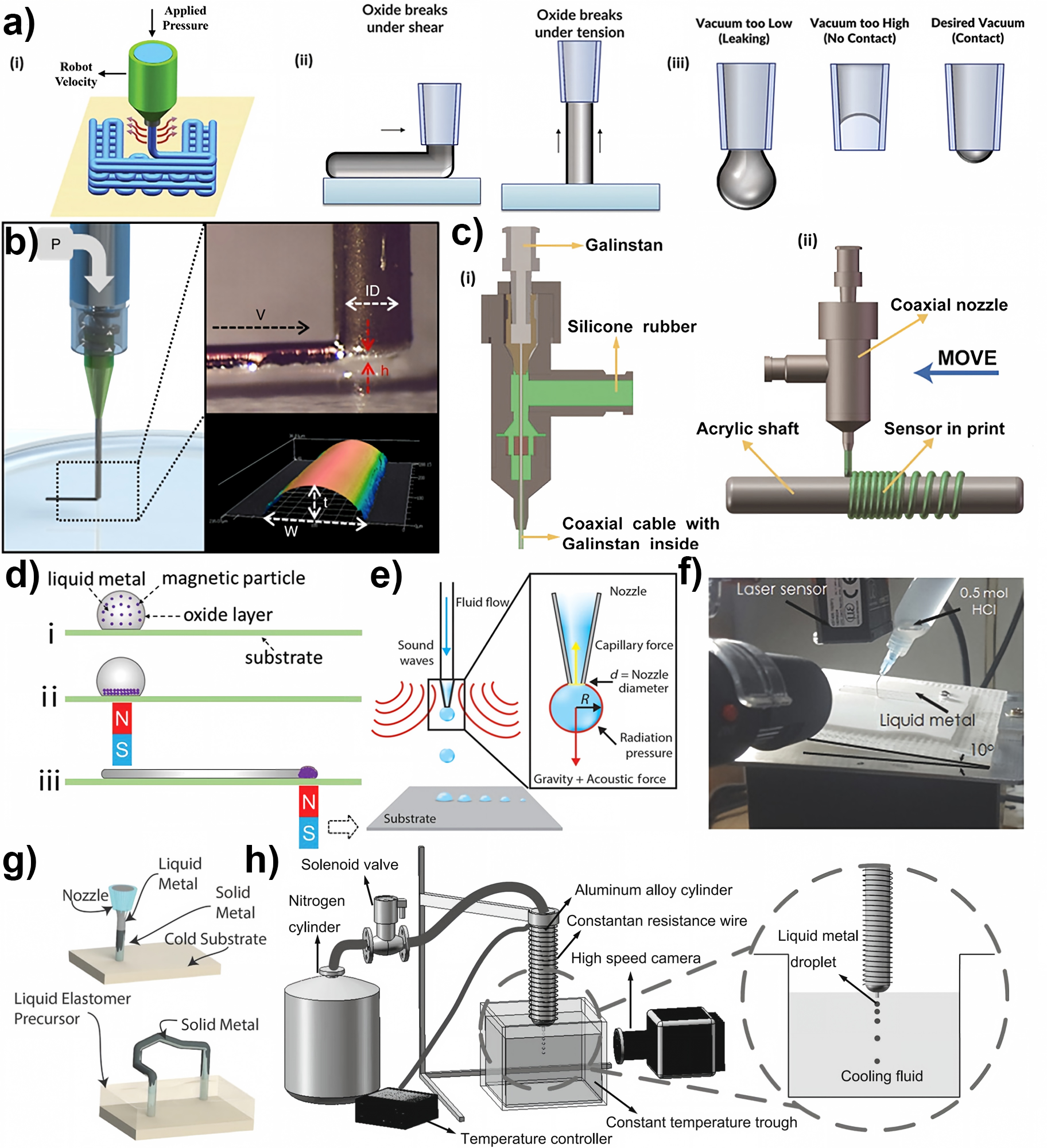
Figure 8. 3D printing of LM. a) Schematic illustration of DIW. Adapted with permission from reference[111]. Copyright © 2023 John Wiley and Sons; b) Schematic diagram of the print apparatus and key parameters of the shear-driven printing process and image of a printing tip direct-writing LM. Adapted with permission from reference[113]. Copyright © 2019 John Wiley and Sons; c) Coaxial printing. Adapted with permission from reference[111]. Copyright © 2023 John Wiley and Sons; d) Magnetic field-assisted printing. Adapted with permission from reference[116]. Copyright © 2019 John Wiley and Sons; e) Acoustophoretic printing[117]. Reproduced from reference[117]. CC BY 4.0; f) Laser-induced printing. Adapted with permission from reference[118]. Copyright © 2018 John Wiley and Sons; g) Freeze-assisted printing. Adapted with permission from reference[119]. Copyright © 2016 John Wiley and Sons. h) Liquid phase 3D printing. Adapted with permission from reference[120]. Copyright © 2014 Springer Nature.
Recent advancements include various field-assisted 3D Printing techniques. Electric field-assisted printing (EHD) achieves resolutions surpassing conventional DIW (sub-millimeter scale[128]), enabling the generation of ultra-fine droplets or jets smaller than the nozzle diameter via electric field induction. Structures as small as 50 μm can be printed, with applied voltage and printing speed significantly influencing resolution and formability. EHD-printed metal conductors exhibit excellent stretchability, self-healing capability, and high precision[129,130]. Further, magnetic field-assisted printing effectively addresses challenges associated with high surface tension and poor wettability in magnetic pastes[131]. Ma et al. proposed a magnetic field-assisted patterning method by incorporating nickel NPs into LMs to enhance printability, utilizing the motion of permanent magnets for direct writing of LM inks (Figure 8d)[116]. Acoustophoretic printing represents a drop-on-demand method suitable for various soft materials[117]. This technique exploits the nonlinear acoustic properties of a Fabry-Pérot resonator to generate and eject material droplets in air. It enables the fabrication of freestanding 3D LM structures and the direct printing of conductive LM electrodes onto elastic textiles, as demonstrated in Figure 8e[117]. Laser induced printing serves as another refinement of DIW. Enhanced setups incorporate laser distance sensors and linear translation stages[118], allowing precise vertical adjustment of the dispensing needle relative to the substrate while maintaining a constant tip-to-surface distance, thereby improving DIW resolution (Figure 8f)[118]. Gozen et al. introduced a cryogenic printing strategy for fabricating 3D conductive flexible network structures. In this approach, LM alloy extruded from the nozzle deposits onto a cryogenically cooled substrate (Figure 8g)[119]. The spontaneously formed oxide skin initially helps maintain the printed LM’s cylindrical shape. Crucially, the advancing freezing front generated during continuous deposition significantly enhances structural stability beyond the effect of the oxide layer alone[119]. Compared to prior methods, cryogenic-assisted printing enables the creation of non-vertical and freeform suspended structures without requiring support materials. Liquid-phase 3D printing enhances cooling efficiency during LM deposition. This concept involves forming and depositing LMs within a liquid-phase electrolyte bath containing water, 100% ethanol, acids, or bases. This method facilitates the rapid fabrication of LM structures across all dimensions (0D to 3D) while successfully preventing and minimizing LM oxidation (Figure 8h)[119,120,132]. More recently, suspension printing has emerged as an effective strategy for constructing complex 3D LM architectures. For example, Wu et al. directly printed LM into an H2O2-containing acrylamide/nanoclay yield stress support bath, achieving continuous suspended LM filaments with a resolution of ~150 μm. After photocuring, the resulting LM-hydrogel electronics remained conductive at strains up to 500% and were demonstrated as flexible strain and wireless resonant sensors[133]. At the device level, Kim and Bae combined DIW of LM with multilayer lamination and sacrificial printing to fabricate a stretchable wearable thermoelectric device. Precise LM deposition reduced the device thickness, while the multilayer architecture allowed about 150% tensile strain and multidirectional twisting, together with a maximum cooling of ~14 °C at room temperature[134]. In addition, Song et al. developed an integrated multimaterial 3D printing strategy that alternately deposits elastomer and nickel particle modified LM, enabling one-step fabrication of elastomer embedded multilayer conductive coils without manual bonding or post-processing, leading to the conductivity of 1.15 × 10⁶ S/m at 0% strain and 1.85 × 10⁶ S/m at 200% strain. This strategy enabled integrated soft electromagnetic actuators, self-sensing devices, and sensor integrated soft robotic systems, highlighting the progression of LM additive manufacturing toward highly integrated, multifunctional soft and wearable electronic platforms[135]. These emerging approaches highlight the transition of LM additive manufacturing from simple planar patterning toward complex 3D and fully integrated wearable electronic systems.
4.2 Hydrogel integration
LM, with its outstanding electromechanical properties, electrochemical and thermal conductivity, and self-healing properties, is an ideal candidate for a wide range of soft electronic applications. Integrating LMs into hydrogels can enhance electrical conductivity and mechanical properties, while addressing the challenges brought by rigid fillers, such as mismatch with hydrogel matrices. For example, the continuous-pathways method involves creating predefined microchannels within the hydrogel structure and injecting LM into them to form interconnected conductive networks. The microfluidic approach allows precise control over the LM pathways, resulting in composites with excellent electrical conductivity and mechanical stability[136]. However, designing and fabricating these channels can be complex, potentially limiting large-scale production. For instance, researchers embedded helical spring microchannels into PAA-alginate hydrogels and filled them with LM, creating stretchable circuits that maintained functionality even at 150% strain for wearable force sensors (Figure 9a)[136,137]. Similarly, LM-filled microchannels in PAM-PAA hydrogels served as highly effective electrocardiography (ECG) electrodes, achieving low electrical impedance and an impressive signal-to-noise ratio of 102.6 (Figure 9b)[137]. Another method is the droplet dispersion method: LM is fragmented into micro/nano-droplets via sonication and stabilized within hydrogel matrices. The oxide layer (e.g., Ga2O3) on LM droplets interacts with polar groups (-OH, -COOH) of polymers, enhancing dispersion and mechanical properties[136]. This method mitigates stress concentration but risks aggregation at high LM concentrations. For example, ultrasonication-triggered radical polymerization enables LM droplets to initiate acrylamide crosslinking into PAAm hydrogels without chemical initiators (Figure 9c)[138]. It was also found that LM/GO nanocomposites where GO encapsulates LM droplets via Ga3+ coordination, reinforcing PAM-SA hydrogels with exceptional toughness (Figure 9d)[26]. As an extension of the above methods, 3D printing enables spatial patterning of LM-hydrogel composites. For continuous pathways, LM inks are directly printed onto hydrogel substrates (e.g., glycerol-modified surfaces for improved adhesion). For dispersed systems, LM droplets are blended into printable bioinks. Noteworthy cases involve: 1) digital printing of LM-styrene-isoprene biphasic ink on photodegradable alginate-PAAm hydrogels to fabricate circuits (Figure 9e)[139]; 2) Extrusion-based printing of LM-gelatin/gellan gum hybrid scaffolds for antibacterial wound dressings[140]. Interfacial engineering addresses poor LM-hydrogel adhesion by modifying surface chemistry or using support baths. Plasma treatment or chemical functionalization promotes LM spreading on hydrogels, enabling high-resolution patterning. For example, stencil printing of LM-based ink on glycerol-hydrogel substrates, where GaOOH crystallites enhance binding (Figure 9e)[139]. A comprehensive comparison for LM-based wearable devices is summarized in Table 2. LM-based wearable devices exhibit substantial advantages in mechanical compliance, with several systems sustaining 400-600% deformation and thousands of loading cycles. However, standardized reporting of electrophysiological signal-to-noise ratios and continuous on-body wear durability remains relatively limited compared with conventional clinical Ag/AgCl electrodes, highlighting an important requirement for future translational studies.
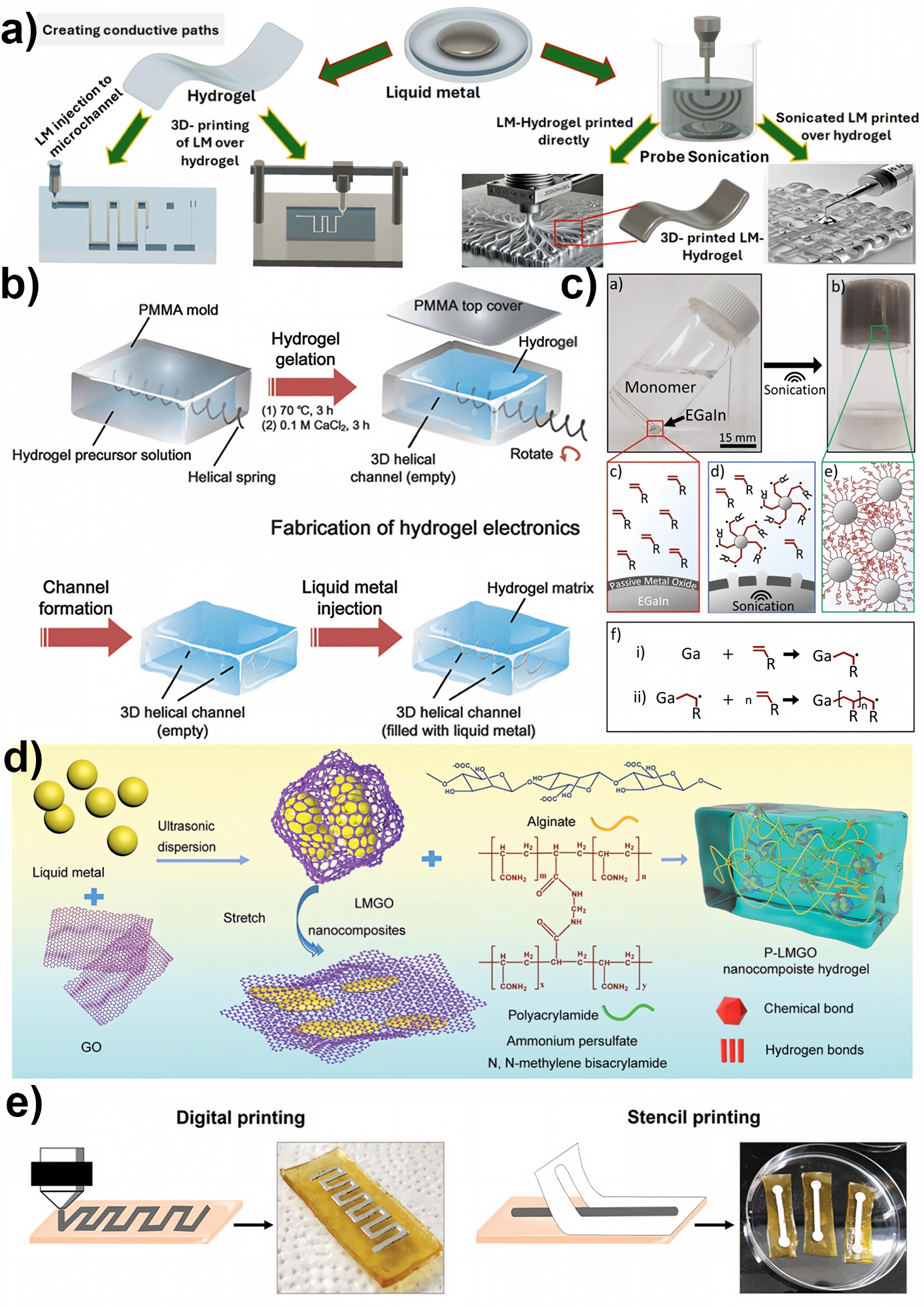
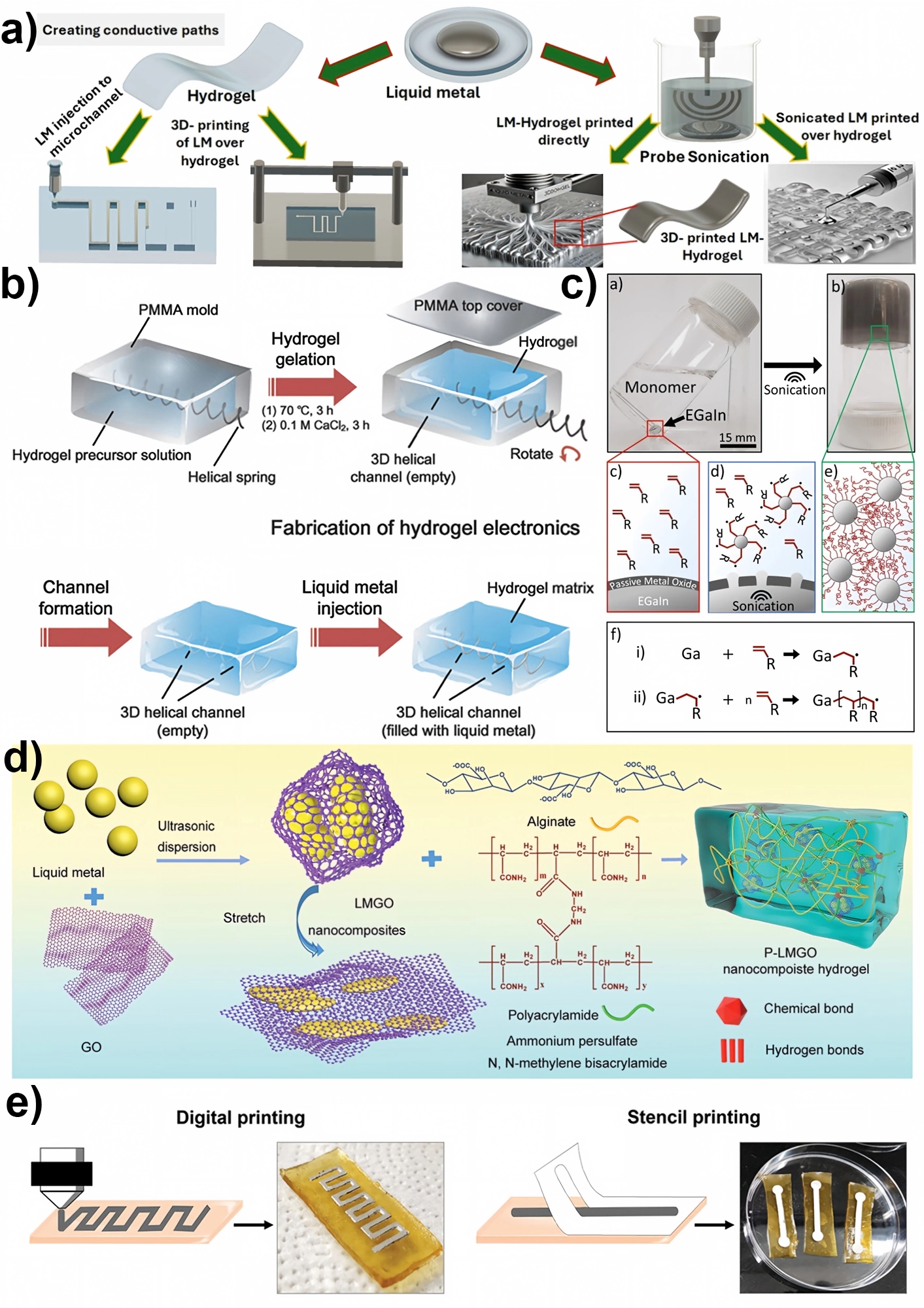
Figure 9. LM-based hydrogel. a) Schematic representation of the LM-hydrogel fabrication process, forming conductive paths[136]. Reproduced from reference[136]. CC BY 4.0; b) Schematic illustration of the fabrication process of hydrogel electronics. Adapted with permission from reference[137]. Copyright © 2018 John Wiley and Sons; c) LMNPs initiate free radical polymerization without conventional initiators; (a) Sonication breaks the oxide-coated metal into smaller particles, exposing the metal to trigger polymerization; (b) This forms a physically crosslinked polyacrylamide (PAAm) hydrogel; (c-f) Schematics illustrate the process. The panel c) with internal panel (a) to (f) are adapted with permission from reference[138]. Copyright © 2019 American Chemical Society. d) Schematic showing the fabrication process of P-LM/GO hydrogel with LM/GO nanocomposite fillers. Adapted with permission from reference[26]. Copyright © 2021 John Wiley and Sons; e) digital and stencil printing of the LM-based ink over hydrogel substrate, where (i), and (ii) show the digital printing, and stencil printing of the composite ink over hydrogel. Adapted with permission from reference[139]. Copyright © 2023 John Wiley and Sons.
Table 2. Comprehensive comparison of LM-based wearable devices to commercially available electrodes (*Reported duration represents material/device stability rather than uninterrupted on-body wear unless specifically stated).
| LM Devices | Signal Readout | Signal/Analyte | Sensitivity | Fabrication Methods | Stretch Stability | Long-term Wear Durability | Ref. |
| Commercial Ag/AgCl electrode | Potential | ECG | / | Commercially available | / | Short-term use; Adhesive/gel-related discomfort and potential skin reactions | [141] |
| Dual-trans printed wearable module | Resistive | Temperature | / | Dual-transfer printing | 100 cycles at 130% axial; 110% radial original length | / | [21] |
| Wristband | Optical | Pulse | / | UV-laser micropatterning | ~ 125% strain | / | [22] |
| Pulse sensor | Optical | Pulse | / | SLMP | Stable through bending, twisting and stretching | / | [36] |
| Epidermal breath sensor | Chemiresistive | Exhaled NO | 1,092% ppm-1; LOD 1.32 ppb | Sonication, laser patterning | Stable through 0-180° bending | / | [38] |
| VOC sensor | Capacitive | MeOH | 3.37 × 10⁻⁵% ppm-1 | Soft lithography | Bendable and twistable | / | [39] |
| EtOH | 5.14 × 10⁻⁵% ppm-1 | ||||||
| i-PrOH | 6.59 × 10⁻⁵% ppm-1 | ||||||
| Sweat patch | Potential, colorimetric | Na+ | 19.6 mV/log₂C | Casting, ion-selective electrodes screen-printing | ~ 500% strain | / | [55] |
| K+ | 14.6 mV/log2C | ||||||
| pH | 55.50 ± 6.31 mV Ph-1 | ||||||
| Glucose | 15.1 mV/log2C | ||||||
| Wireless EM sensor | Electromagnetic | Strain | / | Mold casting | ~ 600% strain; 2,000 cycles | / | [122] |
| Inductive sensor | Inductive | Tension | / | 3D printing | ~ 500% strain; 500 cycles | 72 h continuous and 7 d intermittent operation* | [123] |
| Fiber sensor | Resistive, capacitive | Strain | GF = 3.1 and 11.6 | Wet spinning | ~ 373% strain; 5,000 cycles | / | [124] |
| E-textile | Resistive | Strain | GF = 1.55 | Wet spinning | ~ 600% strain; 10,000 cycles | / | [125] |
| Spring-type sensor | Inductive | Strain | 0.408 kPa-1 (0-140 Pa); 0.345 kPa-1 (140-250 Pa) | 3D printing | ~ 400% strain; 1,000 cycles | / | [126] |
| Pulse sensor | Resistive | Pulse | 0.37 kPa-1 (120-480 Pa) | 3D printing | ~ 400% strain; 2,000 cycles | / | [116] |
| Strain sensor | Resistive | Strain | / | Direct printing | 500 cycles | / | [118] |
| Strain sensor | Resistive | Strain | GF = 1.20 | 3D printing | ~ 100% strain; 250 cycles | Hydrogel dehydration limits prolonged operation | [133] |
| Strain sensor | Resistive | Strain | ~ 100 Pa | Microfluidic | ~ 300% strain; 300 cycles | Conductivity maintained up to 5 weeks in air; 5 months vacuum-packed* | [137] |
| Body motion sensor | Resistive | Strain | / | 3D printing | 30%, 50%, 100% strain for 100 cycles | Hydrogel drying stability demonstrated for 30 d* | [139] |
| Strain sensor | Resistive | Strain | / | Laser patterning | ~ 600% strain; 1,000 cycles | / | [142] |
| Fiber electrode | Potential | ECG, EMG | / | Solution deposition | ~ 100% strain; 1,000 cycles | Stable after 2 d PBS immersion* | [143] |
| Skin bioelectronics | Potential, Impedance | ECG, ICG | / | Laser patterning | ~ 500% strain; 1,000 cycles | 3 d skin wear with negligible LM smearing; Separate 24 h volunteer wear evaluation | [144] |
LM: liquid metal; ECG: electrocardiography; SLMP: selective LM plating; VOC: volatile organic compound; EMG: electromyography; EEG: electroencephalogram; ICG: impedance cardiography; MeOH: methanol; EtOH: ethanol; i-PrOH: isopropanol; GF: gauge factor.
5. Challenge and Solutions in Fabricating LM-Based Wearable Devices
While the previous sections have highlighted the remarkable properties and fabrication advances of LMs, translating these materials into reliable wearable devices faces several interconnected challenges. Below we systematically analyze each major fabrication hurdle and present corresponding solutions, many of which draw directly from the surface modification strategies and manufacturing methods.
5.1 High surface tension and oxide layer formation
LM spontaneously forms a thin, solid Ga2O3 oxide layer (2-10 nm) in ambient air[83,84]. This layer increases surface tension (624 mN m-1 vs. 435 mN m-1 for oxide-free LM), causing the LM to bead up rather than wet or spread on most substrates[81,82]. In microchannels, the oxide can jam narrow features, and during printing it disrupts continuous flow, leading to discontinuous or spherical deposits (Figure 8a)[111]. The oxide also hinders stable adhesion to soft polymers like PDMS and hydrogels, causing interfacial delamination under strain. To address this issue, several surface and process engineering strategies have been proposed: 1) chemical removal of oxide: treating LM with dilute HCl or NaOH temporarily removes the oxide, lowering surface tension and improving wettability. However, this is corrosive and requires immediate use[142]; 2) additive-assisted printing: incorporating rheology modifiers (e.g., Ni microparticles, silica NPs, or polymers) into LM inks increases viscosity and imparts shear-thinning behavior, enabling DIW without oxide clogging[145]; 3) coaxial printing (core-sheath): encapsulating LM within a flexible polymer sheath (e.g., silicone) prevents oxide exposure and allows printing of continuous, uniform LM wires (Figure 8c)[111]; 4) liquid-phase printing: performing LM deposition in a liquid bath (water, ethanol, acid, or base) eliminates air exposure, preventing oxide growth during printing and enabling complex 3D structures[132]; 5) surface functionalization with various molecules: Grafting thiols, amines, or aniline derivatives onto the LM oxide layer modifies surface energy[146], improving wettability on various substrates while also passivating further oxidation (Figure 6g)[76,78]. Forming the Ga-C covalent bond by aryldiazonium salt chemistry is another way to slow down the oxidation process[10].
5.2 Poor adhesion to soft substrates (hydrogels, elastomers)
LM does not readily bond with low-surface-energy polymers (e.g., PDMS, polyurethane) or hydrophilic hydrogels (e.g., PAAm, alginate). Under mechanical deformation (stretching, bending, twisting), LM patterns often delaminate or shift, breaking electrical connections. The oxide layer itself is brittle and can crack, further reducing adhesion. Interfacial engineering provides an effective strategy to strengthen LM-substrate bonding: 1) interfacial engineering of substrates: plasma treatment or chemical functionalization (e.g., silanization) of elastomer surfaces introduces polar groups (-OH, -COOH) that interact with the LM oxide layer, enhancing adhesion[147]. Oxygen plasma treatment can introduce hydrophilic -OH groups onto PDMS surfaces and facilitate LM adhesion when combined with appropriate interfacial media. For example, Li et al. employed oxygen plasma treated PDMS together with a hydrogel assisted patterning strategy, where hydrogen bonding interactions among surface -OH groups, interfacial water, and the Ga2O3 shell promoted stable adhesion of LM to the microstructured PDMS surface[148]; 2) stencil printing with glycerol-modified hydrogels: as shown in Figure 9e, printing LM ink onto glycerol-treated hydrogel substrates induces formation of GaOOH crystallites at the interface, which act as anchoring points[139]; 3) embedding LM in microchannels (microfluidic encapsulation): instead of direct adhesion, LM is injected into preformed channels within the substrate. The channel walls physically confine the LM, eliminating delamination (Figure 9a,b)[136,137]; 4) droplet dispersion in hydrogel matrices: ultrasonication creates LM micro-/nanodroplets that become physically entrapped within the crosslinked polymer network. The oxide layer interacts with polar groups of the hydrogel (e.g., -OH, -COOH) via hydrogen bonding or Ga3+ coordination, creating stable composites without interfacial failure (Figure 9c,d)[26,138]; 5) reactive surface functionalization: thiol, phosphonic acid, and silane-based functionalization can stabilize LMNPs and introduce tunable surface functionalities[74,87]. Reactive surface groups can subsequently enable chemical coupling with compatible polymer matrices. For example, Lee et al. functionalized LMNPs with amine-containing polymeric layers and demonstrated surface-initiated epoxy curing through epoxide-amine ring opening reactions[149].
5.3 Aggregation and poor colloidal stability of LMNPs
When LM is fragmented into micro- or NPs via sonication, the high surface energy and van der Waals forces cause rapid aggregation. Moreover, the Ga2O3 surface has near-zero charge in aqueous media, leading to flocculation and precipitation. Aggregated particles cannot form uniform conductive networks in composites and may clog printing nozzles. Several stabilization strategies have been developed to suppress aggregation and improve processing reliability. 1) ligand-assisted sonication: Adding thiols (e.g., 1-dodecanethiol), phosphonic acids, or aniline derivatives to the sonication medium results in covalent grafting onto the LM oxide surface. The ligands provide steric and electrostatic stabilization, yielding colloidally stable LMNPs with narrow size distribution[59]; 2) polymer encapsulation: sonication in the presence of alginate, PEG, or PVP produces polymer-coated LMNPs[77,136]. For example, alginate chelates surface Ga3+ ions, forming a microgel shell that prevents aggregation (Figure 6f)[77]; 3) core-shell structures via galvanic replacement: depositing a noble metal shell (Au, Ag) on LMNPs not only stabilizes them but also adds functionality (e.g., plasmonic properties, enhanced conductivity) (Figure 7b,c)[25,102,107]; 4) GO encapsulation: ultrasonicating LM with GO results in GO sheets wrapping around LM droplets via Ga3+ coordination. The negatively charged GO provides electrostatic repulsion, and subsequent reduction to rGO creates a conductive network[24].
5.4 Loss of conductivity after surface modification
Many surface modification strategies (e.g., thick polymer coatings, oxide layers) electrically insulate LMNPs. For example, polymeric or oxide-rich surface layers may introduce resistive barriers and compromise electrical transport if the conductive pathways between LM domains are disrupted. In LM@PANI nanocomposites, decreased conductivity has been attributed to the insulating Ga2O3 surface and the disordered polymer matrix[78]. In wearable devices, this compromises signal strength and sensitivity. Maintaining electrical pathways requires careful control over coating thickness and interfacial conductivity: 1) conductive small molecule modifiers: Aniline derivatives like PPD not only passivate oxidation but also enhance conductivity due to their conjugated π-electron system. PPD-modified LMNPs exhibit significantly lower charge transfer resistance than PABA-modified ones[76]; 2) gold NPs (AuNPs) decoration: as demonstrated by Huang et al. and further in the research objectives, reducing chloroauric acid onto LM-PPD surfaces creates LM-PPD@Au NPs[146]. The AuNPs bridge gaps between LMNPs, dramatically improving electrical conductivity while maintaining stability; 3) conductive polymer interfaces: conductive polymers such as PEDOT:PSS can provide electrically active interfacial layers with favorable charge transfer and impedance characteristics, though the coating thickness and morphology should be optimized for each specific LM-polymer system to balance conductivity and interfacial stability[150]; 4) partial reduction of GO coatings: GO is initially insulating, but controlled reduction (e.g., by LM itself during sonication) yields rGO, which restores conductivity[24].
5.5 Electrochemical corrosion and signal drift
In physiological or aqueous environments (e.g., sweat, interstitial fluid), Ga3+ ions leach from LM surfaces, causing corrosion of electrodes and drift in electrochemical signals. For continuous monitoring (e.g., glucose, ions), this degrades long-term reliability. This challenge can be partially overcome by isolating the LM phase from the surrounding aqueous or biological environment: 1) protective surface coatings: for example, coating LMNPs with ZrO2 through hydrolysis of zirconium n-propoxide produced stable core-shell structures. Unlike uncoated LMNPs that settled within 1 h in water, LM@ZrO2 NPs remained dispersed and morphologically stable for at least 3 days (Figure 7d)[103]; 2) self-healing oxide management: the native oxide naturally reforms after mechanical disruption, but this does not prevent corrosion. Encapsulating LM in a hydrogel or elastomer matrix physically isolates it from the biological environment[143]; 3) alloy selection: alloy composition can influence the oxidation and ion release behavior of Ga-based LM. For example, Kim et al. showed that mechanical agitation increased Ga and In ion release from LM[70]. LM composition should be selected together with application specific evaluation of ion release under the relevant aqueous, mechanical, and exposure conditions, since the oxidation and interfacial chemistry of Ga-based LM are strongly composition dependent[151-153]; 4) ion-chelating ligands: surface-grafted ligands (e.g., thiols, carboxylates) can bind leached Ga3+ at the interface, retarding further corrosion. Alginate microgel shells also delay ion release by chelating Ga3+ (Figure 6f)[76,77,136].
5.6 Mechanical mismatch and fatigue under repeated deformation
Wearable devices undergo thousands of stretching, bending, and twisting cycles. The brittle Ga2O3 oxide layer cracks under strain, leading to resistance fluctuations. Repeated cracking can also cause LM leakage from microchannels. Additionally, rigid LM-polymer interfaces concentrate stress, accelerating delamination. Mechanical reliability can be enhanced by using architectures that accommodate strain and redistribute stress: 1) fluidic self-healing: when cracks form in the oxide, underlying fluid LM flows to fill the gap, re-establishing electrical continuity. This intrinsic property makes LM-based conductors exceptionally fatigue-resistant compared to solid metals[154]; 2) embedding LM in microchannels with curved geometries: 3D helical channels can accommodate tensile deformation by redistributing strain along the conductive pathway. In a specific experimental system, Liu et al. embedded LM within a templated 3D helical microchannel in a PAA-alginate hydrogel, and the resulting hydrogel electronic circuit remained functional during uniaxial tensile stretching to a reported strain of 150%[137]; 3) droplet-dispersed hydrogels: discrete LM droplets within a hydrogel matrix do not form a continuous rigid network; instead, the soft hydrogel bears the mechanical load, while droplets deform and reconnect under strain. This results in nearly strain-insensitive conductivity[155].
5.7 Biocompatibility and sterilization
Ga3+ ions released from LMNPs can be cytotoxic above certain thresholds (e.g., ~ 120 μM Ga3+ for LMNPs) and prolonged exposure disrupts iron metabolism and heme synthesis[71,72,79,80]. Moreover, standard sterilization methods (autoclaving, ethylene oxide, UV) may degrade LM coatings or alter surface chemistry. For practical translation, sterilization and post-processing methods should be selected to avoid damaging the LM surface chemistry or soft device structure: 1) polymer-based surface stabilization: alginate microgel shells can retard the generation and diffusion of Ga3+ from LM[77]. Separately, PEG nanocapsules showed concentration dependent cytocompatibility, with no detectable cytotoxicity toward rat bone marrow derived mesenchymal stem cells at concentrations below 0.75 g/L after 24 h exposure, whereas higher concentrations reduced cell viability[156]; 2) biologically functional interfaces: biological surface engineering can modulate LM-immune interactions, but the outcome is application dependent rather than universally immunosuppressive. For example, an LM-based autologous cancer vaccine platform enhanced antigen capture and transport into dendritic cells and promoted dendritic cell activation to augment antitumor immunity[157]; 3) degradable and recyclable device materials: incorporating LM into degradable polymer networks can facilitate material recovery and reduce persistent electronic waste after device use. For example, LM-polymer composites have been designed to combine high stretchability and conductivity with controlled degradation and recycling of the conductive components[158,159]; 4) sterilization compatibility: low-temperature approaches, such as UV-ozone or ethanol treatment for compatible device surfaces and sterile filtration for filterable LM inks or suspensions, may be considered as potential options. However, their effects on LM oxidation, surface chemistry, coating integrity, and device performance require system specific validation before use.
6. Conclusion and Outlook
LM, particularly Ga-based alloys, offers a remarkable combination of metallic conductivity and fluidic flexibility, driving innovation in microfluidics, flexible electronics, and biomedical applications. However, the native oxide layer, while stabilizing LM structures, simultaneously complicates fabrication and limits long-term reliability. Taken together, the review provides a practical material-process-application framework for LM biomedical systems. For surface engineering, small-molecule ligands are particularly suitable when oxidation resistance and electrical conductivity must be retained, whereas polymer coatings are preferable when colloidal stability, ion release control, and biocompatibility are prioritized. Biological coatings provide targeting, immunoregulatory, or catalytic functions, while galvanic replacement offers a versatile route to conductive and multifunctional metal or metal oxide interfaces. Fabrication methods should likewise be selected according to material characteristics and device requirements: DIW accommodates pure or rheologically modified LM for rapid patterning; coaxial printing is particularly suited to LM cores combined with silicone or elastomer sheaths; magnetic field-assisted printing requires magnetically responsive LM composites such as Ni-modified LM; and suspension or extrusion printing is advantageous for LM-hydrogel systems requiring freestanding, highly deformable, or tissue compatible architectures. Cryogenic and liquid-phase printing further provide effective routes when structural retention and oxidation suppression are dominant considerations. Despite substantial progress, simultaneous control of oxidation, conductivity, adhesion, ion release, manufacturing reproducibility, sterilization, and long-term biological/device stability remains unresolved. By connecting surface chemistry with fabrication selection and quantitative device performance, this review provides a design framework for advancing LM systems from material level modification toward reliable, clinically relevant wearable and biomedical platforms.
Looking ahead, several key issues must be addressed to accelerate practical translation: 1) developing universal, scalable surface modification strategies that simultaneously maintain high conductivity, prevent oxidation, and ensure long-term biocompatibility; 2) investigating the synergistic effects of hybrid coatings (e.g., small molecules plus conductive polymers) to balance stability, conductivity, and functionality; 3) optimizing fabrication parameters for 3D printing and hydrogel integration to achieve high-resolution, defect-free, and mechanically robust LM structures; 4) conducting comprehensive in vivo studies to establish safety thresholds for Ga3+ ion release and assess long-term degradation pathways; 5) translating LM-based wearable sensors from proof-of-concept to clinical and commercial applications, including integration with wireless, battery-free, and AI-assisted data analysis platforms. Ultimately, surface-engineered LMNPs (particularly those modified with conductive small molecules like PPD and further functionalized with AuNPs and GO bridges) hold significant promise for next-generation multifunctional wearable devices, enabling real-time physical, chemical, and therapeutic monitoring within a single, stretchable platform.
Authors contribution
Gu Y: Investigation, visualization, writing-review & editing.
Guan M: Data collection, writing-review & editing.
Liu G: Conception, supervision, funding acquisition, writing review & editing.
Conflicts of interest
Guozhen Liu is an Editorial Board member of BME Horizon. The other authors declare no conflicts of interest.
Ethical approval
Not applicable.
Consent to participate
Not applicable.
Consent for publication
Not applicable.
Availability of data and materials
Not applicable.
Funding
The work was financially supported by the National Natural Science Foundation of China (22174121, 22211530067, T2250710180, and 62671539), 2022 Natural Science Foundation of Guangdong Provincial Basic and Applied Basic Research Fund (Guangdong Hybribio 2021), Guangdong Pearl River Talent Program (2021CX02Y066), Shenzhen Bay Open Laboratory Fund (2021), CUHKSZ-Boyalife Joint Laboratory Fund (2023), the University Development Fund (UDF01002012), 1+1+1 CUHK-CUHK(SZ)-GDSTC Joint Collaboration Fund (2025), and Guangdong Basic Research Center of Excellence for Aggregate Science Fund (2024).
Copyright
© The Author(s) 2026.
References
-
1. Chen S, Wang HZ, Zhao RQ, Rao W, Liu J. Liquid metal composites. Matter. 2020;2(6):1446-1480.[DOI]
-
2. Lide DR. CRC handbook of chemistry and physics: a ready-reference book of chemical and physical data. Boca Raton: CRC Press; 1995.
-
3. Uusitalo J, Leino M, Enqvist T, Eskola K, Grahn T, Greenlees PT, et al. α decay studies of very neutron-deficient francium and radium isotopes. Phys Rev C. 2005;71(2):024306.[DOI]
-
5. Gong XG, Chiarotti GL, Parrinello M, Tosatti E. Coexistence of monatomic and diatomic molecular fluid character in liquid gallium. Europhys Lett. 1993;21(4):469-475.[DOI]
-
6. Chen X, Sun J, Liang J, Xing R, Kong J. Surface and interface engineering in gallium-based liquid metals. Adv Funct Mater. 2026;36(19):e19697.[DOI]
-
11. Jiao B, Wang W, Feng Y, Zhou D, Wang X, Zhou Y, et al. High-strength liquid metal composite-hydrogel interfaces enable robust stretchable electronics. Nat Commun. 2026;17:5322.[DOI]
-
12. Krack M, Purnal L, Sewlikar PV, Cuyvers S, Geurts G, Sangma RN, et al. Overcoming printing and interfacial challenges in liquid metal direct writing for integrated stretchable electronics. Adv Mater Technol. 2026;11(15):e02023.[DOI]
-
13. Oh S, Lee S, Kim SW, Ahn Y, Min D, Kim S, et al. Liquid metals for reconfigurable bioelectronics. Adv Mater. 2026;38(38):e21174.[DOI]
-
14. Huang X, Zhang L, Nasar NKA, Liu L, Gu X, Lin Y, et al. Vat photopolymerization of liquid metal nanoparticle-integrated hydrogels. Adv Funct Mater. 2026;36(26):e23767.[DOI]
-
15. Deng Y, Bu F, Wang Y, Chee PS, Liu X, Guan C. Stretchable liquid metal based biomedical devices. npj Flex Electron. 2024;8:12.[DOI]
-
16. Chung WG, Kim E, Kwon YW, Lee J, Lee S, Jeong I, et al. Ga-based liquid metals: Versatile and biocompatible solutions for next-generation bioelectronics. Adv Funct Mater. 2024;34(31):307990.[DOI]
-
17. Han S, Chen L, Sun Y, Guo Y, Bao L, Gao M, et al. Gallium-based liquid metals as an engineered multifunctional platform: From biomedical innovations to energy and material systems. Adv Funct Mater. 2026;36(15):e00810.[DOI]
-
18. Yang N, Gong F, Zhou Y, Yu Q, Cheng L. Liquid metals: Preparation, surface engineering, and biomedical applications. Coord Chem Rev. 2022;471:214731.[DOI]
-
19. Kwon KY, Truong VK, Krisnadi F, Im S, Ma J, Mehrabian N, et al. Surface modification of gallium-based liquid metals: Mechanisms and applications in biomedical sensors and soft actuators. Adv Intell Syst. 2021;3(3):2000159.[DOI]
-
25. Hoshyargar F, Crawford J, O’Mullane AP. Galvanic replacement of the liquid metal galinstan. J Am Chem Soc. 2017;139(4):1464-1471.[DOI]
-
26. Hu Y, Zhuo H, Zhang Y, Lai H, Yi J, Chen Z, et al. Graphene oxide encapsulating liquid metal to toughen hydrogel. Adv Funct Mater. 2021;31(51):2106761.[DOI]
-
31. Je J, Lee J. Design, fabrication, and characterization of liquid metal microheaters. J Microelectromech Syst. 2014;23(5):1156-1163.[DOI]
-
32. Pekas N, Zhang Q, Juncker D. Electrostatic actuator with liquid metal-elastomer compliant electrodes used for on-chip microvalving. J Micromech Microeng. 2012;22(9):097001.[DOI]
-
33. Cumby BL, Hayes GJ, Dickey MD, Justice RS, Tabor CE, Heikenfeld JC. Reconfigurable liquid metal circuits by Laplace pressure shaping. Appl Phys Lett. 2012;101(17):174102.[DOI]
-
37. Sivan V, Tang SY, O’Mullane AP, Petersen P, Eshtiaghi N, Kalantar-zadeh K, et al. Liquid metal marbles. Adv Funct Mater. 2013;23(2):144-152.[DOI]
-
38. Huang Y, Yang F, Liu S, Wang R, Guo J, Ma X. Liquid metal-based epidermal flexible sensor for wireless breath monitoring and diagnosis enabled by highly sensitive SnS2 nanosheets. Research. 2021;2021:9847285.[DOI]
-
40. Majidi C, Kramer R, Wood RJ. A non-differential elastomer curvature sensor for softer-than-skin electronics. Smart Mater Struct. 2011;20(10):105017.[DOI]
-
41. Hammond FL, Kramer RK, Wan Q, Howe RD, Wood RJ. Soft tactile sensor arrays for force feedback in micromanipulation. IEEE Sens J. 2014;14(5):1443-1452.[DOI]
-
42. Jamalzadegan S, Kim S, Mohammad N, Koduri H, Hetzler Z, Lee G, et al. Liquid metal-based biosensors: Fundamentals and applications. Adv Funct Mater. 2024;34(31):2308173.[DOI]
-
47. Jin X, Liu C, Xu T, Su L, Zhang X. Artificial intelligence biosensors: Challenges and prospects. Biosens Bioelectron. 2020;165:112412.[DOI]
-
49. Ogita M, Higo K, Nakanishi Y, Hatanaka Y. Ga2O3 thin film for oxygen sensor at high temperature. Appl Surf Sci. 2001;175-176:721-725.[DOI]
-
53. Gu Y, Liu G. Wearable breath gas sensors for chronic disease management: Challenges and perspectives. Adv Mater Technol. 2026;11(14):e70999.[DOI]
-
55. Mou L, Xia Y, Jiang X. Liquid metal-polymer conductor-based wireless, battery-free epidermal patch. Biosens Bioelectron. 2022;197:113765.[DOI]
-
56. Yi L, Li J, Guo C, Li L, Liu J. Liquid metal ink enabled rapid prototyping of electrochemical sensor for wireless glucose detection on the platform of mobile phone. J Med Devices. 2015;9(4):044507.[DOI]
-
57. Wang D, Xu W, Liu Y, Chen L, He T, Tan H, et al. Liquid metal gallium pharmaceuticals. Theranostics. 2025;15(17):8795-8821.[DOI]
-
62. Zhang Y, Liu MD, Li CX, Li B, Zhang XZ. Tumor cell membrane-coated liquid metal nanovaccine for tumor preventionǂ. Chin J Chem. 2020;38(6):595-600.[DOI]
-
66. Wang S, Zhao X, Luo J, Zhuang L, Zou D. Liquid metal (LM) and its composites in thermal management. Compos Part A Appl Sci Manuf. 2022;163:107216.[DOI]
-
67. Heinzel A, Hering W, Konys J, Marocco L, Litfin K, Müller G, et al. Liquid metals as efficient high-temperature heat-transport fluids. Energy Tech. 2017;5(7):1026-1036.[DOI]
-
68. Xie W, Allioux FM, Ou JZ, Miyako E, Tang SY, Kalantar-Zadeh K. Gallium-based liquid metal particles for therapeutics. Trends Biotechnol. 2021;39(6):624-640.[DOI]
-
72. Chen S, Zhao R, Sun X, Wang H, Li L, Liu J. Toxicity and biocompatibility of liquid metals. Adv Healthc Mater. 2023;12(3):2201924.[DOI]
-
73. Bury E, Chun S, Koh AS. Recent advances in deformable circuit components with liquid metal. Adv Electron Mater. 2021;7(4):2001006.[DOI]
-
77. Li X, Li M, Zong L, Wu X, You J, Du P, et al. Liquid metal droplets wrapped with polysaccharide microgel as biocompatible aqueous ink for flexible conductive devices. Adv Funct Mater. 2018;28(39):1804197.[DOI]
-
78. Zhang C, Allioux FM, Rahim MA, Han J, Tang J, Ghasemian MB, et al. Nucleation and growth of polyaniline nanofibers onto liquid metal nanoparticles. Chem Mater. 2020;32(11):4808-4819.[DOI]
-
81. Koh A, Mrozek R, Slipher G. Characterization and manipulation of interfacial activity for aqueous galinstan dispersions. Adv Mater Interfaces. 2018;5(5):1701240.[DOI]
-
82. Koh A, Sietins J, Slipher G, Mrozek R. Deformable liquid metal polymer composites with tunable electronic and mechanical properties. J Mater Res. 2018;33(17):2443-2453.[DOI]
-
83. Dickey MD. Stretchable and soft electronics using liquid metals. Adv Mater. 2017;29(27):1606425.[DOI]
-
87. Farrell ZJ, Thrasher CJ, Flynn AE, Tabor CE. Silanized liquid-metal nanoparticles for responsive electronics. ACS Appl Nano Mater. 2020;3(7):6297-6303.[DOI]
-
89. Boley JW, White EL, Kramer RK. Mechanically sintered gallium-indium nanoparticles. Adv Mater. 2015;27(14):2355-2360.[DOI]
-
91. Farrell ZJ, Reger N, Anderson I, Gawalt E, Tabor C. Route to universally tailorable room-temperature liquid metal colloids via phosphonic acid functionalization. J Phys Chem C. 2018;122(46):26393-26400.[DOI]
-
92. Thrasher CJ, Farrell ZJ, Morris NJ, Willey CL, Tabor CE. Mechanoresponsive polymerized liquid metal networks. Adv Mater. 2019;31(40):1903864.[DOI]
-
102. Zheng R, Peng Z, Fu Y, Deng Z, Liu S, Xing S, et al. A novel conductive core-shell particle based on liquid metal for fabricating real-time self-repairing flexible circuits. Adv Funct Mater. 2020;30(15):1910524.[DOI]
-
104. Qi Y, Miyahara M, Iwata S, Miyako E. Light-activatable liquid metal immunostimulants for cancer nanotheranostics. Adv Funct Mater. 2024;34(31):2305886.[DOI]
-
105. Sang N, Iwata S, Qi Y, Miyako E. Bacterial-adjuvant liquid metal nanocomposites for synergistic photothermal immunotherapy. Adv Compos Hybrid Mater. 2025;8(5):353.[DOI]
-
106. Oh MH, Yu T, Yu SH, Lim B, Ko KT, Willinger MG, et al. Galvanic replacement reactions in metal oxide nanocrystals. Science. 2013;340(6135):964-968.[DOI]
-
110. Hajalilou A, Parvini E, Morgado TA, Alhais Lopes P, Melo Jorge ME, Freitas M, et al. Replacing the gallium oxide shell with conductive Ag: Toward a printable and recyclable composite for highly stretchable electronics, electromagnetic shielding, and thermal interfaces. ACS Appl Mater Interfaces. 2024;16(44):61157-61168.
-
111. Zou Z, Chen Y, Yuan S, Luo N, Li J, He Y. 3D printing of liquid metals: Recent advancements and challenges. Adv Funct Mater. 2023;33(10):2213312.[DOI]
-
112. Jiang Y, Su S, Peng H, Sing Kwok H, Zhou X, Chen S. Selective wetting/dewetting for controllable patterning of liquid metal electrodes for all-printed device application. J Mater Chem C. 2017;5(47):12378-12383.[DOI]
-
113. Cook A, Parekh DP, Ladd C, Kotwal G, Panich L, Durstock M, et al. Shear-driven direct-write printing of room-temperature gallium-based liquid metal alloys. Adv Eng Mater. 2019;21(11):1900400.[DOI]
-
114. Rahim MA, Centurion F, Han J, Abbasi R, Mayyas M, Sun J, et al. Polyphenol-induced adhesive liquid metal inks for substrate-independent direct pen writing. Adv Funct Mater. 2021;31(10):2007336.[DOI]
-
115. Boley JW, White EL, Chiu GTC, Kramer RK. Direct writing of gallium-indium alloy for stretchable electronics. Adv Funct Mater. 2014;24(23):3501-3507.[DOI]
-
116. Ma B, Xu C, Chi J, Chen J, Zhao C, Liu H. A versatile approach for direct patterning of liquid metal using magnetic field. Adv Funct Mater. 2019;29(28):1901370.[DOI]
-
118. Kim D, Yoon Y, Kauh SK, Lee J. Towards sub-microscale liquid metal patterns: Cascade phase change mediated pick-n-place transfer of liquid metals printed and stretched over a flexible substrate. Adv Funct Mater. 2018;28(28):1800380.[DOI]
-
119. Gannarapu A, Gozen BA. Freeze-printing of liquid metal alloys for manufacturing of 3D, conductive, and flexible networks. Adv Mater Technol. 2016;1(4):1600047.[DOI]
-
120. Wang L, Liu J. Liquid phase 3D printing for quickly manufacturing conductive metal objects with low melting point alloy ink. Sci China Technol Sci. 2014;57(9):1721-1728.[DOI]
-
121. Wang H, Chen S, Zhu X, Yuan B, Sun X, Zhang J, et al. Phase transition science and engineering of gallium-based liquid metal. Matter. 2022;5(7):2054-2085.[DOI]
-
122. Zhu R, Li Z, Deng G, Yu Y, Shui J, Yu R, et al. Anisotropic magnetic liquid metal film for wearable wireless electromagnetic sensing and smart electromagnetic interference shielding. Nano Energy. 2022;92:106700.[DOI]
-
124. Yu X, Fan W, Liu Y, Dong K, Wang S, Chen W, et al. A one-step fabricated sheath-core stretchable fiber based on liquid metal with superior electric conductivity for wearable sensors and heaters. Adv Mater Technol. 2022;7(7):2101618.[DOI]
-
125. Qi X, Zhao H, Wang L, Sun F, Ye X, Zhang X, et al. Underwater sensing and warming E-textiles with reversible liquid metal electronics. Chem Eng J. 2022;437:135382.[DOI]
-
126. Okutani C, Yokota T, Miyazako H, Someya T. 3D printed spring-type electronics with liquid metals for highly stretchable conductors and inductive strain/pressure sensors. Adv Mater Technol. 2022;7(7):2101657.[DOI]
-
127. Wang Z, Ren J, Liu R, Sun X, Huang D, Xu W, et al. Three dimensional core-shell structured liquid metal/elastomer composite via coaxial direct ink writing for electromagnetic interference shielding. Compos Part A Appl Sci Manuf. 2020;136:105957.[DOI]
-
129. Galliker P, Schneider J, Eghlidi H, Kress S, Sandoghdar V, Poulikakos D. Direct printing of nanostructures by electrostatic autofocussing of ink nanodroplets. Nat Commun. 2012;3:890.[DOI]
-
130. Park JU, Hardy M, Kang SJ, Barton K, Adair K, Mukhopadhyay DK, et al. High-resolution electrohydrodynamic jet printing. Nat Mater. 2007;6(10):782-789.[DOI]
-
132. Sun X, Yuan B, Sheng L, Rao W, Liu J. Liquid metal enabled injectable biomedical technologies and applications. Appl Mater Today. 2020;20:100722.[DOI]
-
133. Wu Q, Zhu F, Wu Z, Xie Y, Qian J, Yin J, et al. Suspension printing of liquid metal in yield-stress fluid for resilient 3D constructs with electromagnetic functions. npj Flex Electron. 2022;6:50.[DOI]
-
134. Kim H, Bae J. A stretchable thermoelectric device based on direct ink writing of liquid metal and multi-layer lamination. Adv Mater Technol. 2024;9(14):2301171.[DOI]
-
139. Fonseca RG, Hajalilou A, Freitas M, Kuster A, Parvini E, Serra AC, et al. Photodegradable non-drying hydrogel substrates for liquid metal based sustainable soft-matter electronics. Adv Mater Technol. 2023;8(19):2301007.[DOI]
-
140. Li J, Wang Y, Fan L, Wang X, Shang L, Zhang H, et al. Liquid metal hybrid antibacterial hydrogel scaffolds from 3D printing for wound healing. Chem Eng J. 2024;496:153805.[DOI]
-
143. Yin J, Zhu J, Wang S, Yuan J, Li C, Margolis S, et al. Scalable and stretchable 1D multifunctional fibers for multimodal sensing and stimulation. Nat Commun. 2026;17:2496.[DOI]
-
145. Lu Q, Fang T, Ye C, Li Y, Wu M, Sun Y, et al. Highly conductive liquid metal emulsion gels for three-dimensionally printed stretchable electronics. Adv Sci. 2025;12(36):e03449.[DOI]
-
146. Huang Z, Guan M, Bao Z, Dong F, Cui X, Liu G. Ligand mediation for tunable and oxide suppressed surface gold-decorated liquid metal nanoparticles. Small. 2024;20(7):2306652.[DOI]
-
149. Lee Y, Oh S, Song YJ, Jang JU, Lee JH, Won S, et al. Liquid metal particles enabled ultrahigh isotropic thermal conductivity in soft thermal interface materials for biochips packaging. Chem Eng J. 2026;541:177400.[DOI]
-
150. Sunwoo SH, Kim HJ, Kim JH, Kim DC, Kim DH. Intrinsically soft electronics using conducting nanomaterials and liquid metals. NPG Asia Mater. 2025;17:40.[DOI]
-
152. Wang D, Wang X, Rao W. Precise regulation of Ga-based liquid metal oxidation. Acc Mater Res. 2021;2(11):1093-1103.[DOI]
-
153. Ding Y, Zeng M, Fu L. Surface chemistry of gallium-based liquid metals. Matter. 2020;3(5):1477-1506.[DOI]
-
155. Lin Z, Qiu X, Cai Z, Li J, Zhao Y, Lin X, et al. High internal phase emulsions gel ink for direct-ink-writing 3D printing of liquid metal. Nat Commun. 2024;15:4806.[DOI]
-
158. Zhong D, Shi S, Yang X, Handschuh-Wang S, Zhang Y, Gan T, et al. Highly stretchable yet degradable and recyclable conductive composites with liquid metal nanodroplets as physical crosslinks. Adv Funct Mater. 2024;34(31):2308032.[DOI]
-
159. Zou S, Li J, Yu Y, Ou Y, Zhang Z, Liu G. A bioelectronic interface for continuous neuroinflammation monitoring and neuromodulation in Parkinson’s disease model. Biosensors and Bioelectronics. 2026;313:119137.
Copyright
© The Author(s) 2027. This is an Open Access article licensed under a Creative Commons Attribution 4.0 International License (https://creativecommons.org/licenses/by/4.0/), which permits unrestricted use, sharing, adaptation, distribution and reproduction in any medium or format, for any purpose, even commercially, as long as you give appropriate credit to the original author(s) and the source, provide a link to the Creative Commons license, and indicate if changes were made.
Publisher’s Note
Science Exploration remains a neutral stance on jurisdictional claims in published
maps
and institutional affiliations. The views expressed in this article are solely those
of
the author(s) and do not reflect the opinions of the Editors or the publisher.
Share And Cite


Science Exploration Style
Gu Y, Guan M, Liu G. Surface engineering of Ga-based liquid metals for biomedical applications: Challenges and perspectives. BME Horiz. 2027;5:202629. https://doi.org/10.70401/bmeh.2026.0036
Tips
Copy completed.
Submit a Manuscript
Author Instructions
Cite this Article
Article Metrics
0
View
0
Download
Cited
Article Updates

- Abstract
- Keywords
- 1. Introduction
- 2. Applications of Liquid Metals
- 3. Surface Modification Strategies to Address Limitations
- 4. Current Methods for Fabricating Wearable LM Devices
- 5. Challenge and Solutions in Fabricating LM-Based Wearable Devices
- 6. Conclusion and Outlook
- Authors contribution
- Conflicts of interest
- Ethical approval
- Consent to participate
- Consent for publication
- Availability of data and materials
- Funding
- References
- Copyright
 Get citation
Science Exploration Style

Gu Y, Guan M, Liu G. Surface engineering of Ga-based liquid metals for biomedical applications: Challenges and perspectives. BME Horiz. 2027;5:202629. https://doi.org/10.70401/bmeh.2026.0036
copy
Share Link
copy