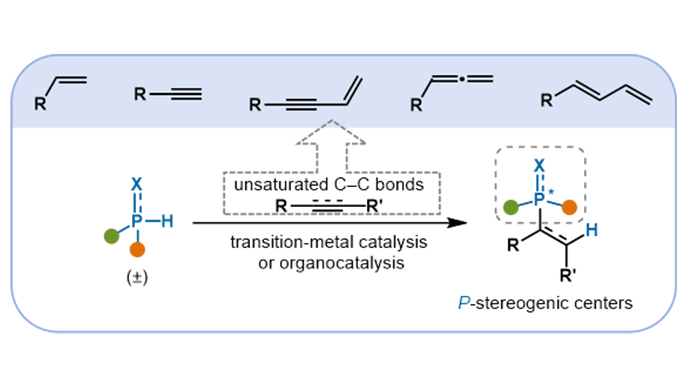
P-Stereogenic centers are important structural motifs prevalent in natural products, bioactive molecules, and high-performance ligands. Their presence confers significant value across medicinal chemistry, materials science, and asymmetric ...
More.
P-Stereogenic centers are important structural motifs prevalent in natural products, bioactive molecules, and high-performance ligands. Their presence confers significant value across medicinal chemistry, materials science, and asymmetric catalysis. In recent years, catalytic asymmetric hydrophosphination has emerged as a powerful and efficient strategy for constructing such P-stereogenic compounds. Distinguished by high atom economy, broad substrate compatibility, and excellent stereocontrol under mild conditions, these transformations align closely with the principles of sustainable and green synthesis. This review summarizes recent advances in the catalytic asymmetric hydrophosphination of unsaturated C–C bonds for the synthesis of P-stereogenic centers. It covers substrates including alkenes bearing electron-withdrawing groups, alkynes, as well as specialized systems such as enynes, allenes, and conjugated dienes. Emphasis is placed on the design of catalytic systems, encompassing transition-metal catalysts (e.g., Pd, Ni, Cu, Co, Mn) and organocatalysts, along with their mechanisms. Current challenges, such as the low reactivity of unactivated or sterically hindered substrates and difficulties in achieving stereochemical differentiation between phosphorus substituents, are also discussed. This review aims to provide a reference for further innovation and methodological development in the synthesis of P-stereogenic molecules.
Less.
Bing-Lin Wang, ... Xiao-Hui Yang