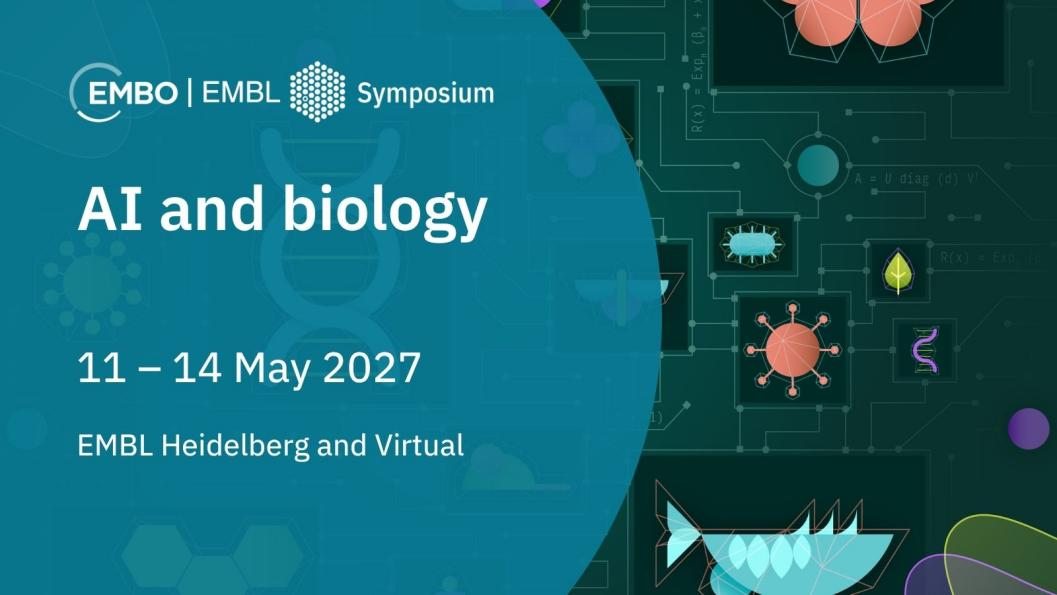
Date: May 11-14, 2027 | Venue: EMBL Heidelberg and Virtual
Artificial intelligence (AI) is transforming virtually all areas of science, and the life sciences are no exception. Stepping up the pace following the 2024 and 2026 meetings, this symposium already returns for the third time in 2027, maintaining the momentum amongst this engaged community of researchers to discuss the latest developments in the field both in person and online.
AI-based methods are pushing the limits of what is possible in experimental design, data analysis, simulation, and modelling. The aim of this symposium is to catalyse synergistic interactions between AI researchers in different subfields of biology and biomedicine by exploring shared theoretical approaches, cross-domain experiments, foundation models, and data integration, as well as shared topics in dissemination of tools, agent-based workflows and collaboration with experimental labs. Furthermore, we will look into the future and discuss how the concerted actions of AI and life science communities can enable both fields to exploit the full potential of the ongoing data deluge and find new application areas ripe for disruption by AI.
AI-based analytics is subject to active research in at least three major application areas: sequencing, imaging and structural biology. While all three domains are experiencing very fast growth, the developments are largely happening independently. The aim of our symposium is to convene these communities to discuss topics of mutual interest to make progress, including on the theoretical/methodological side and on the more strategic issues of identifying the next areas of high potential.
The onsite meeting will take a new, multi-track direction for the first day with selected workshops and tutorials. Days 2, 3 and 4 follow the hybrid symposium format, packed as before with invited and selected speakers and poster sessions.
Website:
https://www.embl.org/about/info/course-and-conference-office/events/EES27-12/?utm_source=scieExpress&utm_medium=mpreferral&utm_id=EES27-12#vf-tabs__section-overview