
Table of Contents
Flexible organic thermoelectric materials and devices
The rapid expansion of wearable electronics and distributed sensing is sharpening the demand for sustainable, maintenance free power sources that can operate quietly over long periods. Thermoelectric conversion is attractive here because it can harvest ...
More.The rapid expansion of wearable electronics and distributed sensing is sharpening the demand for sustainable, maintenance free power sources that can operate quietly over long periods. Thermoelectric conversion is attractive here because it can harvest low grade heat, especially body heat, and translate small temperature differences into usable electrical power. Organic thermoelectric materials have therefore drawn sustained interest. They combine mechanical flexibility, low density, solution processability, and generally favorable biocompatibility, which aligns naturally with soft, skin interfaced devices. Their intrinsically low thermal conductivity, together with charge transport tunability enabled by molecular design and doping control, supports efficient operation under modest temperature gradients and conformal integration with compliant substrates. Recent progress in molecular engineering, secondary doping, microstructural regulation, and flexible device architectures has pushed performance forward, with reported power factors exceeding 1,000 μW m-1 K-2 and figure of merit values approaching unity at room temperature in selected systems. However, turning these advances into practical wearable generators remains nontrivial. Key bottlenecks include incomplete decoupling of electrical and thermal transport, limited long term stability under mechanical deformation and environmental exposure, and the persistent gap between laboratory scale demonstrations and scalable fabrication. This review summarizes recent developments in organic thermoelectric materials and wearable devices, and distills design principles aimed at enabling robust, manufacturable, and truly self-powered wearable systems.
Less.Wei Xiong, ... Xinyang He
DOI:https://doi.org/10.70401/smd.2026.0030 - April 01, 2026
Regulating oxygen defects over CeO2 via rare earth oxide doping for Pt-catalyzed oxidative dehydrogenation of propane with carbon dioxide
The efficient activation of CO2 molecules is imperative for the development of a high-performance catalyst for the oxidative dehydrogenation of propane with carbon dioxide (CO2-ODP). To enhance the activation of CO2 ...
More.The efficient activation of CO2 molecules is imperative for the development of a high-performance catalyst for the oxidative dehydrogenation of propane with carbon dioxide (CO2-ODP). To enhance the activation of CO2 over ceria, in this work, rare earth doped ceria (RE-CeO2, RE=La, Pr, Nd, and Sm) is comparatively studied as a support for PtSn for CO2-ODP. Compared with PtSn/CeO2, Ce1-xRExO2 solid solution is formed for the RE-doped PtSn/CeO2 catalysts, which increases the oxygen defect content, promotes the dispersion of Pt, and strengthens the ability of CO2 to supplement lattice oxygen in the catalyst, thereby enhancing the catalytic performance for CO2-ODP. Among the investigated catalysts, PtSn/ Nd-CeO2 shows the best CO2-ODP performance, with an initial propane conversion and propylene selectivity of 52.7% and 86.1%, respectively. Moreover, the Pt electron density and oxygen-defect content over PtSn/RE-CeO2 catalysts, which can be regulated to relatively large extents by doping ceria with different RE metals, are key factors in determining the activity of CO2-ODP. These findings regarding the CeO2-based binary RE solid solutions with adjustable oxygen defects and the derived impacts on supported Pt provide important references for advancing the design of oxygen-defect involved supported metal catalysts, including Pt-based catalysts, for the oxidative dehydrogenation of light alkanes with carbon dioxide.
Less.Chao Peng, ... Zhong-Wen Liu
DOI:https://doi.org/10.70401/smd.2026.0029 - March 17, 2026
The critical paradigm shifts for next-generation AI-empowered smart wearable devices
Despite rapid progress in health monitoring, many smart wearable devices still function primarily as passive sensing-and-logging platforms. Their performance is constrained by fixed hardware configurations and cloud-centric analytics pipelines. As ...
More.Despite rapid progress in health monitoring, many smart wearable devices still function primarily as passive sensing-and-logging platforms. Their performance is constrained by fixed hardware configurations and cloud-centric analytics pipelines. As a result, they often fail to deliver real-time responses to user intent and rarely support closed-loop physical intervention. This perspective argues that enabling embodied intelligence in wearables requires three paradigm shifts. First, wearables should transition from closed, integrated hardware to open, modular computing architectures that can accommodate evolving on-device artificial intelligence (AI) demands. Second, cloud-dependent inference should be replaced, where appropriate, by ultra-low-latency edge intelligence to support millisecond-scale prediction and control. Third, devices should evolve from passive information feedback to active physical intervention supported by human-in-the-loop optimization. Together, these shifts may reshape the human–machine relationship by moving wearables from external tools toward digital partners that operate under explicit user intent and safety constraints.
Less.Chengzu Li, ... Xinyang He
DOI:https://doi.org/10.70401/smd.2026.0027 - March 02, 2026
Recent progress and mechanisms of radiative thermal management smart windows: A review
Radiative thermal management (RTM) smart windows represent an emerging class of adaptive building-envelope technologies that combine dynamic spectral regulation with passive heat dissipation through the atmospheric window. By simultaneously modulating ...
More.Radiative thermal management (RTM) smart windows represent an emerging class of adaptive building-envelope technologies that combine dynamic spectral regulation with passive heat dissipation through the atmospheric window. By simultaneously modulating visible light (VIS), near-infrared solar radiation (NIR), and mid-infrared thermal emission (MIR), these systems enable year-round thermal regulation with reduced building energy consumption. This review systematically summarizes recent progress and mechanisms of RTM smart windows. Compared with existing reviews that mainly focus on static radiative cooling materials or single-mode smart windows, this review emphasizes integrated RTM smart windows featuring tri-band (VIS/NIR/MIR) spectral regulation and dual-responsive mechanisms. Firstly, the fundamental principles of radiative thermal management and intelligent response mechanisms are introduced, followed by an overview of key performance. Secondly, the latest progress in electrochromic, thermochromic, and photochromic RTM smart windows is comprehensively reviewed. Particular attention is devoted to dual-responsive mechanism RTM smart windows, which integrate passive and active control to achieve synergistic performance. In summary, this review presents an overview of recent advances and underlying mechanisms in intelligent windows for radiative heat management.
Less.Yuhong Xia, ... Rujun Ma
DOI:https://doi.org/10.70401/smd.2026.0026 - February 11, 2026
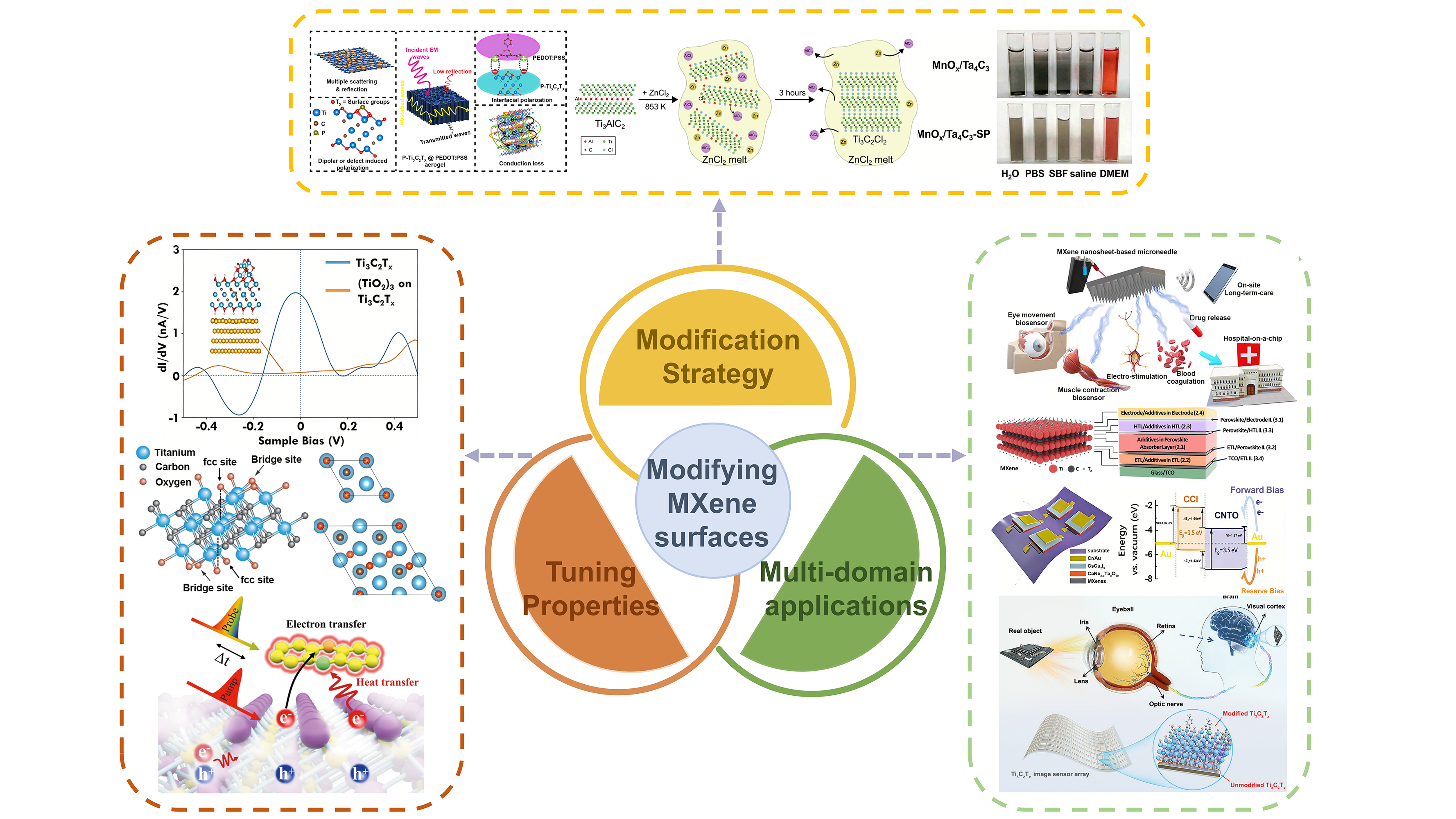
Advances in surface-modification-driven functional MXenes for multidisciplinary applications
MXenes, as emerging two-dimensional transition metal carbides/nitrides, have shown considerable potential in multiple fields due to their high electrical conductivity, tunable surface functional groups, and excellent interfacial properties. However, ...
More.MXenes, as emerging two-dimensional transition metal carbides/nitrides, have shown considerable potential in multiple fields due to their high electrical conductivity, tunable surface functional groups, and excellent interfacial properties. However, inherent limitations, such as limited band structure modulation, single terminal functionality, and susceptibility to oxidation, hinder their further development in complex application scenarios. Surface modification engineering, which regulates the chemical termination and interfacial microenvironment of MXenes, has become a key strategy to break through these performance boundaries and impart multifunctionality. This review systematically summarizes the latest research advances in surface-modification-driven functionalization of MXenes. It focuses on modification strategies and structural tuning, with particular emphasis on the effects of surface functional group modulation on their electronic structure, interfacial charge distribution, and ion transport behavior. Furthermore, the innovative applications of functionalized MXenes in fields such as optoelectronic detection, electrocatalysis, energy storage, and biomedicine are summarized. Finally, the challenges faced by surface modification are outlined, and prospects for future development toward atomic-level precision control and multifunctional integration are discussed, providing theoretical support and technical guidance for the transition of MXenes from basic research to practical applications.
Less.Chuqiao Hu, ... Jianqiao Liu
DOI:https://doi.org/10.70401/smd.2026.0024 - February 11, 2026