
Table of Contents
Iatrogenic aging caused by long-term glucocorticoid medication: A perspective on the role of ACBP/DBI
Long-term glucocorticoid medication is indispensable for controlling inflammatory, autoimmune, allergic, neurologic and oncologic diseases, yet its cumulative toxicity resembles accelerated biological aging. We develop the concept that systemic ...
More.Long-term glucocorticoid medication is indispensable for controlling inflammatory, autoimmune, allergic, neurologic and oncologic diseases, yet its cumulative toxicity resembles accelerated biological aging. We develop the concept that systemic glucocorticoids can cause iatrogenic aging by activating the acyl-CoA binding protein/diazepam-binding inhibitor (ACBP/DBI)-gamma-aminobutyric acid type A (GABAA) receptor axis. ACBP/DBI has emerged as a circulating biomarker of biological aging and age-related diseases in human cohorts, and as a driver of pathological aging in rodent models. Extracellular ACBP/DBI acts on a subset of GABAA receptors containing the gamma-2 subunit, overlapping with the benzodiazepine-sensitive receptor system. Epidemiological associations between chronic benzodiazepine exposure and dementia, cancer, cardiovascular events, infections and immune dysfunction therefore provide a pharmacological parallel to persistent ACBP/DBI signaling. Among endocrine stimuli, glucocorticoids are the strongest inducers of ACBP/DBI expression and secretion. Glucocorticoid receptor activation stimulates hepatocyte-derived ACBP/DBI release, converting endocrine stress into ACBP/DBI-mediated systemic autophagy inhibition, metabolic dysfunction and immunosuppression. In mice, genetic deletion, antibody-mediated neutralization or receptor-level interruption of ACBP/DBI signaling attenuates multiple features of glucocorticoid excess, including obesity, diabetes, dyslipidemia, sarcopenia, osteoporosis and impaired anticancer immunity. In sharp contrast, ACBP/DBI neutralization does not interfere with the anti-inflammatory action of glucocorticoids. Clinically, chronic endogenous or exogenous glucocorticoid exposure is associated with metabolic syndrome, unfavorable body-composition changes, osteoporosis, sarcopenia, cardiovascular disease, neurocognitive decline and infection susceptibility. In this Perspective, we propose that protracted systemic glucocorticoid therapy represents a paradigmatic form of iatrogenic aging that activates a stress-endocrine ACBP/DBI-GABAA receptor program. In practice, we strongly recommend avoiding chronic, high-dose glucocorticoid medications, whenever possible.
Less.Isabelle Martins, ... Guido Kroemer
DOI:https://doi.org/10.70401/Geromedicine.2026.0047 - November 11, 2026
Nuclear condensates in aging-related diseases: The roles and diagnostic potential
Aging is a major risk factor for chronic diseases, and reliable biomarkers are urgently needed to improve healthspan. Nuclear condensates (NCs), membraneless organelles formed via liquid-liquid phase separation (LLPS), regulate essential nuclear functions ...
More.Aging is a major risk factor for chronic diseases, and reliable biomarkers are urgently needed to improve healthspan. Nuclear condensates (NCs), membraneless organelles formed via liquid-liquid phase separation (LLPS), regulate essential nuclear functions including transcription, DNA repair, and RNA processing. This review summarizes recent advances in NC biology, focusing on their dynamic changes during cellular senescence and their dysregulation in major aging-related diseases, including neurodegeneration, cancer, progeroid syndromes, and cardiovascular diseases. Canonical NCs such as nucleoli, Cajal bodies, PML-NBs, nuclear speckles, paraspeckles, and heterochromatin domains undergo structural and functional remodeling with aging, and their dysregulation, manifested as morphological alterations, aberrant phase transitions, or mislocalization of components, contributes to disease pathogenesis. We also discuss the emerging, though still largely exploratory, potential of NCs as diagnostic biomarkers, highlighting both imaging and molecular strategies for clinical translation as well as the substantial challenges that remain. Finally, we outline key unanswered questions and future directions, with an emphasis on the need for standardized methodologies, causal mechanistic studies, and validated clinical assays. Collectively, this review suggests that NCs may offer new conceptual and therapeutic angles on aging-related diseases.
Less.Ruofei Li, ... Feng Liu
DOI:https://doi.org/10.70401/Geromedicine.2026.0046 - November 09, 2026
Old worms, new tricks: Dynamical instability explains late-life rejuvenation in C. elegans
How is it possible to double the lifespan of an organism already close to death? Many biological theories of aging fail to explain this phenomenon. At the Physics of Aging workshop, we used late-life lifespan extension in Caenorhabditis elegans to illustrate ...
More.How is it possible to double the lifespan of an organism already close to death? Many biological theories of aging fail to explain this phenomenon. At the Physics of Aging workshop, we used late-life lifespan extension in Caenorhabditis elegans to illustrate how a simple stochastic dynamical-systems model can naturally account for dramatic geriatric interventions. We build on a Langevin-type framework in which aging can occur in stable or unstable dynamical regimes, depending on whether slow, lifespan-determining modes are initially restoring or non-restoring. We argue that C. elegans operates in the unstable regime, a view supported independently by temporal scaling of survival curves, late-life mortality deceleration, and persistent lifespan effects following transient interventions. In the unstable regime, stochastic fluctuations are amplified over time until a failure threshold is reached as a first-passage event. The instability rate α sets the speed of this divergence, while the nonlinear feedback strength g, together with α, sets the failure boundary zmax = α/g. Auxin-induced degradation of DAF-2 in very old animals is interpreted as a late shift in dynamical parameters, and the model naturally accounts for the resulting lifespan extension without requiring reversal of accumulated structural damage. This reconciles persistent senescent pathologies with restored proteostasis and stress resilience, and suggests that altering regulatory instability, rather than reversing damage, can strongly reshape survival trajectories. More broadly, this work illustrates how low-dimensional, physics-inspired stochastic models can capture key features of aging and motivate new collaborations on late-life interventions.
Less.Djakim Latumalea, ... Jan Gruber
DOI:https://doi.org/10.70401/Geromedicine.2026.0044 - November 05, 2026
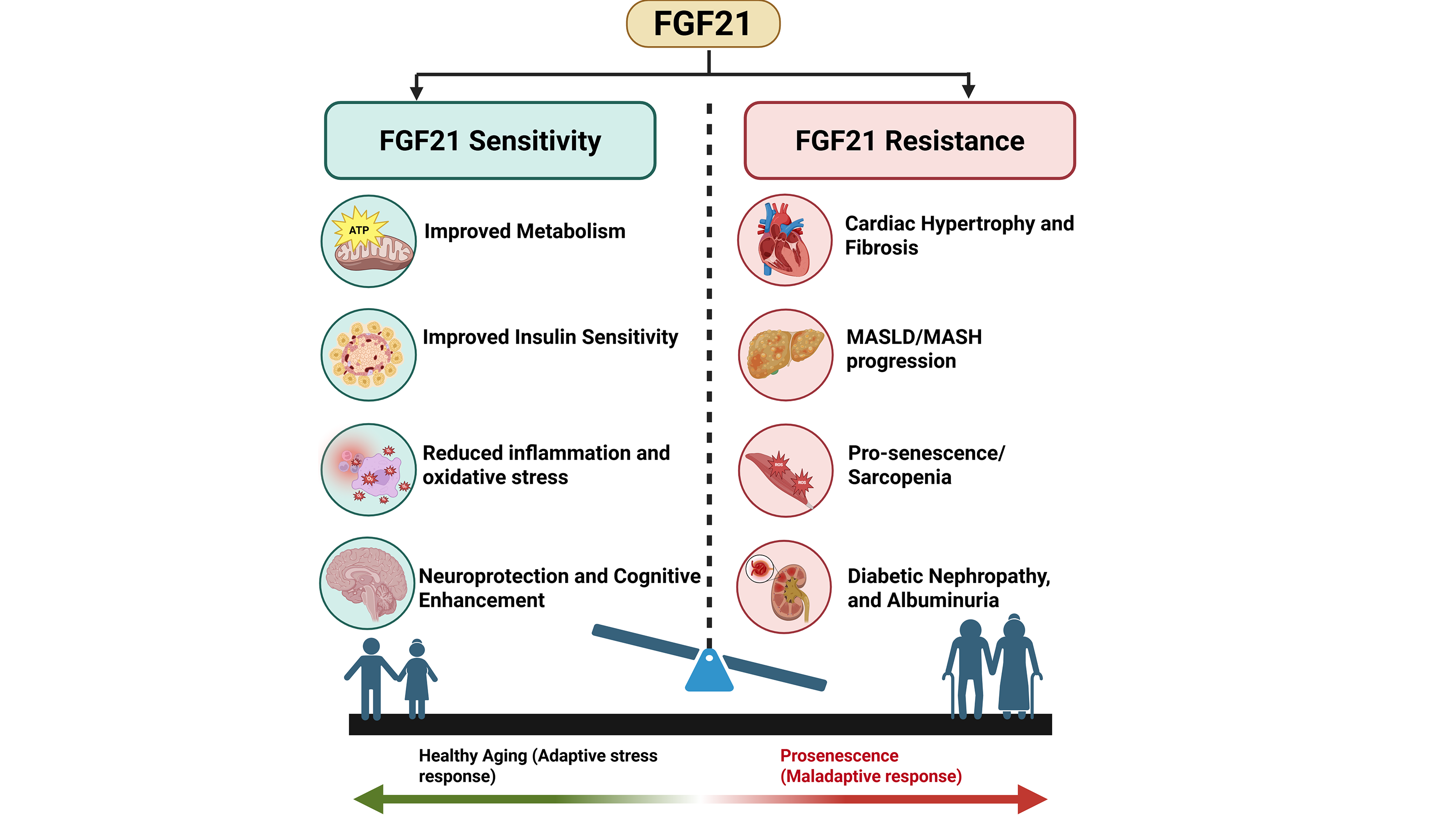
Fibroblast growth factor 21 (FGF21) in healthy aging and aging-related diseases
The global human population is aging rapidly, and the prevalence of aging-related diseases is increasing. Thus, understanding the molecular pathways involved in the hallmarks of aging is essential for the development of therapies that promote healthy aging ...
More.The global human population is aging rapidly, and the prevalence of aging-related diseases is increasing. Thus, understanding the molecular pathways involved in the hallmarks of aging is essential for the development of therapies that promote healthy aging and extend lifespan. Fibroblast growth factor 21 (FGF21) has emerged as a promising therapeutic candidate due to its pleiotropic beneficial roles in metabolism, stress response, and tissue repair through pathways that regulate oxidative stress and cellular senescence. Preclinical studies have associated FGF21 with beneficial effects against metabolic syndrome, liver steatosis, kidney injury, and neurodegenerative disorders that occur in aged individuals. Conversely, FGF21 has also been linked to skeletal muscle loss and concentric cardiac hypertrophy. This review summarizes current evidence on FGF21 signaling and its effects on either healthy aging or aging-related diseases, highlighting its tissue-, time-, origin-, and stress-dependent effects.
Less.Angeliki Vakka, ... Konstantinos Drosatos
DOI:https://doi.org/10.70401/Geromedicine.2026.0045 - October 26, 2026
Regulation of miR-29 family by resistance training: Implications for muscular and cognitive aging
During aging, modifiable lifestyle factors, such as physical activity, play an increasingly important role. Specifically, it is known that physical fitness declines relatively predictably with age and that resistance training can be a highly effective ...
More.During aging, modifiable lifestyle factors, such as physical activity, play an increasingly important role. Specifically, it is known that physical fitness declines relatively predictably with age and that resistance training can be a highly effective strategy for preventing this decline, both at muscular and cognitive levels. Several studies have described that one of the mechanisms mediating some of the beneficial effects of physical exercise during aging is the regulation of miRNAs, and in particular, the miR-29 family appears to play a relevant role. In this review, we analyse, firstly, the relevance of the miR-29 family in aging and, secondly, the protective effects of resistance exercise in delaying age-related dysfunction through the regulation of miR-29.
Less.Paola Pinto-Hernandez, ... Eduardo Iglesias-Gutierrez
DOI:https://doi.org/10.70401/Geromedicine.2026.0043 - October 13, 2026
Exploring mortality-linked proteins: Understanding their association with biological aging, disease phenotypes, signaling pathways, and their implications for longevity
Aims: To identify plasma proteins associated with all-cause mortality and determine their relationships with chronic disease burden and biological aging at both the organismal and organ-specific levels, thereby providing insights into the biological ...
More.Aims: To identify plasma proteins associated with all-cause mortality and determine their relationships with chronic disease burden and biological aging at both the organismal and organ-specific levels, thereby providing insights into the biological mechanisms underlying healthy aging and longevity.
Methods: We conducted a prospective cohort study of 1,025 older adults from the LonGenity study, analyzing 4,265 plasma proteins. Associations between protein levels and all-cause mortality were evaluated using Cox proportional hazards regression over a mean follow-up of 8.05 years. Mortality-associated proteins were further examined for their relationships with chronic disease burden and proteome-derived measures of organismal and organ-specific biological aging. Findings were independently validated in 1,124 participants from the Baltimore Longitudinal Study of Aging (BLSA).
Results: Seventeen plasma proteins were significantly associated with all-cause mortality. Higher levels of epidermal growth factor receptor (ERBB1) and anthrax toxin receptor 2 (ANTXR2) were associated with lower mortality risk and younger biological age across multiple organ systems. Conversely, higher levels of macrophage inhibitory cytokine 1 (MIC-1) (growth differentiation factor 15 (GDF15)), human epididymis protein 4 (HE4), and insulin-like growth factor-binding protein 2 (IGFBP-2) were associated with increased mortality and older biological age across multiple organ systems. Specifically, elevated MIC-1 was associated with older organismal biological age, whereas ERBB1 was associated with younger liver biological age. These associations were independently replicated in the BLSA cohort.
Conclusion: Mortality-associated plasma proteins reflect key biological pathways involved in biological aging, physiological homeostasis, and systemic stress. These biomarkers may have potential utility for identifying individuals at increased mortality risk and advancing the development of biomarkers for healthy aging and longevity.
Less.Nicholas Garvey, ... Nir Barzilai
DOI:https://doi.org/10.70401/Geromedicine.2026.0042 - October 09, 2026
Hibernation: An underexplored natural model of biological maintenance for advancing geroscience
Hibernation is one of nature’s most remarkable examples of reversible physiological adaptation, yet its potential to inform geroscience remains underexplored. Lifespan patterns in hibernators are not fully explained by allometric scaling, as hibernators ...
More.Hibernation is one of nature’s most remarkable examples of reversible physiological adaptation, yet its potential to inform geroscience remains underexplored. Lifespan patterns in hibernators are not fully explained by allometric scaling, as hibernators can outlive non-hibernating species of comparable body size. Hibernation is further characterized by the preservation of tissue function and integrity despite marked calorie restriction, inactivity, and hypometabolism. In this review, we examine the hibernation phenotype as a naturally evolved program of biological maintenance that may limit the accumulation of age-related molecular and cellular damage. We first discuss the relationship between hibernation, longevity, and life-history evolution before reviewing evidence that hibernation modulates multiple hallmarks of ageing through integrated regulation of metabolism, mitochondrial maintenance, proteostasis, nutrient sensing, endocrine signaling, immune function, and epigenetic remodeling. We further highlight emerging observations associating hibernation with telomere maintenance and slower epigenetic ageing, while emphasizing the key knowledge gaps that remain regarding the causal relationship between the phenotype of hibernation and slower ageing, cellular senescence, genome maintenance, and age-dependent changes in hibernation expression. Finally, we discuss how comparative biology, multi-omics approaches, and functional biomarkers of ageing throughout the different phases of hibernation (before torpor, at its onset, during torpor, and after torpor) may help identify evolutionarily conserved protective mechanisms that can be translated into novel strategies to promote healthy human ageing from a bioinspired perspective. This Review was developed following discussions initiated during the September 2025 National Science Foundation (NSF) Quantitative Approaches and Understudied Questions in the Biology of Ageing Workshop (Paris, France).
Less.Sylvain Giroud, ... Fabrice Bertile
DOI:https://doi.org/10.70401/Geromedicine.2026.0041 - October 08, 2026
Precision geromedicine conference 2026 - Unlock Healthy Longevity nutraceuticals and repurposed drugs: Conference report
There is a growing demand from society for gerotherapeutic interventions that can extend healthspan. Yet the increasing commercialization of insufficiently validated gerotherapeutics threatens to undermine the public confidence and the responsible ...
More.There is a growing demand from society for gerotherapeutic interventions that can extend healthspan. Yet the increasing commercialization of insufficiently validated gerotherapeutics threatens to undermine the public confidence and the responsible translation of healthy longevity research into practice. The Unlock Healthy Longevity Conference 2026 convened international experts in Singapore to exchange scientific advances in precision geromedicine, with a particular focus on nutraceuticals and repurposed drugs. Precision geromedicine is increasingly being translated into clinical settings; however, standardized frameworks for clinical evaluation, implementation, quality assurance, and oversight remain insufficiently established. This emerging paradigm emphasises the need for collaboration across multiple stakeholders to support the development of a robust, safe, scalable, and equitable ecosystem. A central theme across the sessions was the need to advance clinical human validation, translation, and the development of standards and clinical guidelines. Panel discussions converged on the importance of developing robust clinical and data infrastructures to generate reproducible evidence capable of informing real-world clinical practice and enable equitable access to healthy longevity. Presentations addressed emerging clinical biomarkers of ageing and data-driven approaches to guide gerotherapeutics, including changes in DNA methylation and skin and gut as organ-level readouts of biological ageing. Several potential candidate gerotherapeutics were discussed, including the nutraceutical compounds urolithin A and ergothioneine, and repurposed drugs such as glucagon-like peptide-1 receptor agonists and sodium-glucose cotransporter 2 inhibitors. Additional sessions explored the clinical implementation of gerotherapeutics taking into account ethical, safety, and regulatory considerations. This report summarises the key messages and research priorities presented at the conference.
Less.Duarte Barros, ... Andrea B. Maier
DOI:https://doi.org/10.70401/Geromedicine.2026.0040 - October 08, 2026