
Human Factors, Empathy, and the Future of XR
Published On: 07 Jul 2026
Views: 464
Subscribe
Speaker(s)

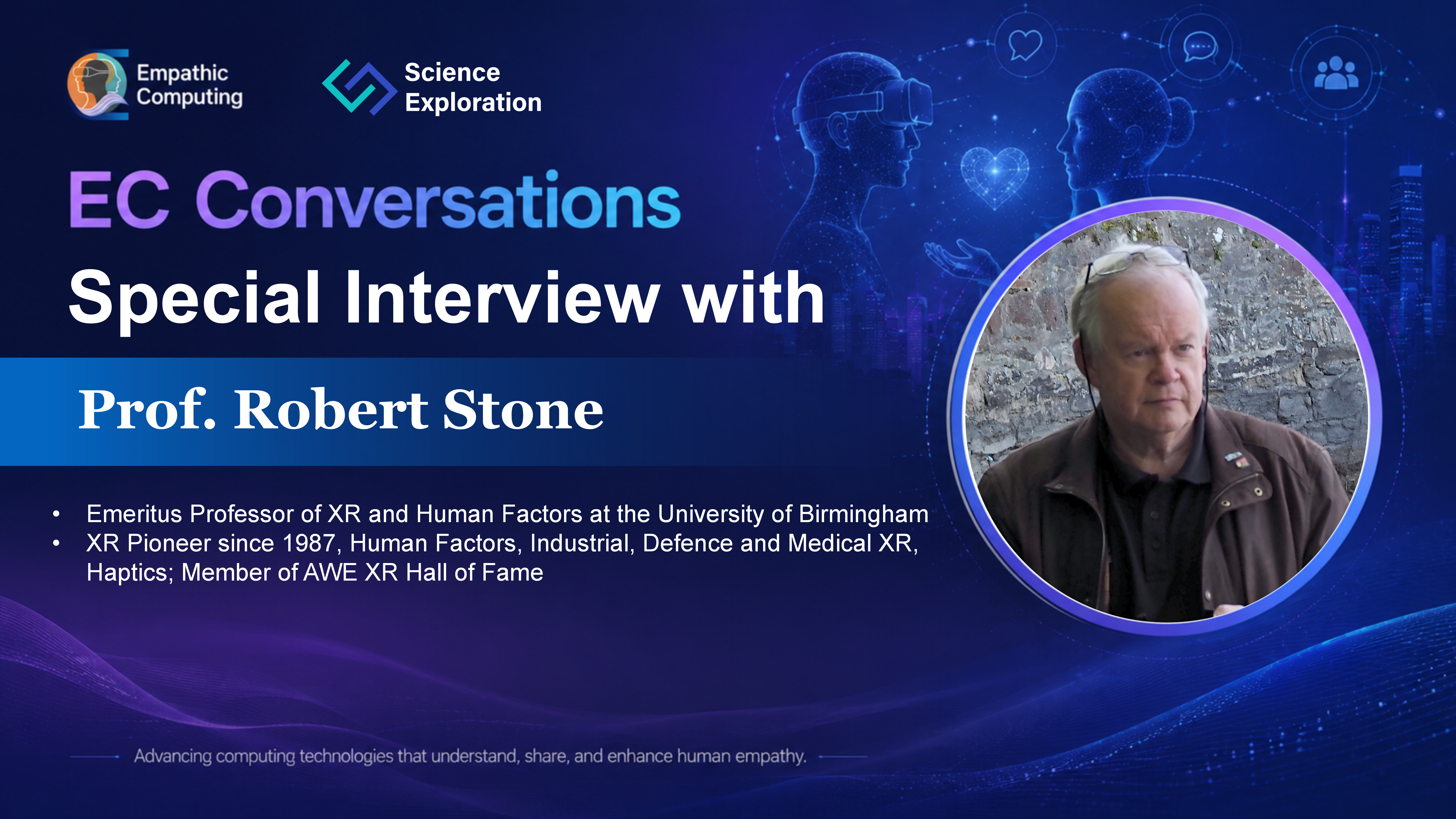
Prof. Robert Stone
Emeritus Professor (XR and Human Factors), University of Birmingham, Birmingham, UK.
Introduction
This interview explores the evolution of virtual reality through the lens of human factors, empathy, and human-centred design. Drawing on nearly four decades of experience across aerospace, healthcare, defence, and heritage applications, the discussion highlights how immersive technologies can create meaningful real-world impact when designed around human needs rather than technological novelty. From surgical training and rehabilitation to heritage-based experiences that support well-being and memory recall, the conversation demonstrates the importance of understanding users, involving them throughout the design process, and balancing innovation with practical value. The interview also offers valuable advice for emerging researchers, emphasizing critical thinking, evidence-based research, and the need to keep people at the centre of technological development.
Full Transcript
Speaker 1 Editorial Office
So looking back over nearly 40 years of your extraordinary career from your early defense human factor research at British Aerospace, your 1987 visit to NASA amps to test the original VR workstation for European Space Telerobotics, setting up your VR research team in 1989, pioneering industrial VR commercialization to leading the worldclass human- centered VR research at the University of Birmingham. So that's quite impressive. So what would you name the most significant milestones throughout your career as an XR pioneer?
Speaker 2 Prof. Robert Stone
There are far too many milestones to cover!
I think the first point you mentioned-the human factors element-is particularly important. Looking back, the best decision I ever made, and one that was not directly related to XR, was moving from an undergraduate degree in Psychology to a Master's degree in ergonomics. Ergonomics is the study of the relationship between people and their working or living environments. Pursuing that degree led to an early position at British Aerospace, and if I had the opportunity to do it all again, I would not change that decision.
Although I was involved in a number of defence-related projects at British Aerospace, my career soon took a slightly different direction. The company received contracts from the UK Department of Energy to investigate underwater telerobotics in support of offshore oil and gas exploration. As a result, I became involved in human factors research focused on remotely operated vehicles (ROVs). That work eventually led to an extraordinary opportunity to extend our research into the space sector through projects with the European Space Agency. We began studying telerobotics in low-Earth orbit, exploring issues such as communication delays, the limitations of force-feedback systems, and the challenges of remotely controlling robots in space. That was where everything changed.
I was fortunate enough to attend a conference in Maryland, where I met Dr. Steve Ellis, who continues to be active in the field today. Steve invited me to visit NASA. At the time, I was rather naïve and had no idea how far it was from the east coast to the west coast of the United States! During that visit, I experienced one of the earliest virtual reality systems. They placed this extraordinary headset on me-it looked like two small televisions mounted in front of my eyes-along with a head tracker and fibre optic glove. The graphics were very simple, but the experience itself was remarkable. That moment changed my career. I would consider that the first major milestone.
The second milestone came in 1990 at the Teleoperators and Virtual Environments Conference held at the Sheraton Hotel in Santa Barbara. Everyone who would later become a major figure in virtual reality seemed to be there. It was an incredible gathering of researchers and pioneers. At that conference, we announced the launch of our Teletact haptic feedback Glove project. In fact, I still have the original prototype hanging in my office today. The project itself was not particularly successful, and haptic feedback technologies did not develop as rapidly as many of us expected at the time. Nevertheless, the conference was an extraordinary experience. It was also where the journal Presence was launched in 1990.
You also mentioned the industrial side of my career. In 1993, following a reasonably extensive feature on BBC News in the UK, we launched a programme called VRS-Virtual Reality Simulation. What made VRS unique was that it was entirely funded by industry. There was no academic funding involved whatsoever. For three years, we developed proof-of-concept demonstrations for industrial partners, including companies such as British Aerospace, Rolls-Royce, British Nuclear Fuels, and others. The objective was simple: to demonstrate that virtual reality had practical and commercial value and a genuine future beyond laboratory research.
Another important milestone was the MIST project-the Minimally Invasive Surgical Trainer-which ran from the mid-1990s into the early 2000s. The project originated from human factors research I conducted in operating theatres at Manchester Royal Infirmary. Working closely with surgeons, we designed and developed a virtual reality trainer for keyhole surgery. To make a long story short, the system became the de facto surgical skills trainer across Europe for approximately ten years. For me, that project reinforced a fundamental lesson: if virtual reality is going to succeed, the human user must always come first.
The next major milestone occurred in the early 2000s. Virtual reality experienced a significant decline during the late 1990s, largely because the technology had become overhyped. However, the gaming industry subsequently transformed the landscape by introducing affordable graphics hardware and powerful software tools. For the first time, we could run sophisticated virtual reality applications on standard personal computers equipped with powerful graphics cards. In the early 1990s, achieving the same capabilities would have required expensive Silicon Graphics workstations costing hundreds of thousands of pounds. This technological shift dramatically expanded what researchers could do. It enabled us to conduct far more experiments, build more sophisticated prototypes, and explore entirely new applications.
The final milestone I would highlight took place between 2003 and 2012, when the UK government launched its Defence Technology Centre programme. I was involved in one of these centres, known as the Human Factors Integration Defence Technology Centre. During those nine years, we developed simulation systems for unmanned aerial vehicles, healthcare applications, military vehicle prototyping, weapon system development, and numerous other areas. We built an extensive portfolio of projects and research activities. Perhaps most importantly, this work enabled us to re-enter the healthcare sector. We worked with injured soldiers and aircrew returning from overseas conflicts, supporting rehabilitation, recovery, and mental restoration programmes. Those nine years were immensely important. They helped re-establish both my own research programme and a strong virtual reality presence within the UK.
Speaker 1
Thank you. professor. That's truly impressive. And your career path is truly incredible. And it sounds like the journey is more like a series of paradigm shifts with a lot of progresses not only just the technology but also shifts in the perceptions. I'd like to move on to my next question focusing on human factors and empathy which is also the focus of our journal. So you have mentioned that human factors and empathy go hand in hand since both focus on understanding users needs and limitations. So in practice how does this structured engineering approach allows you to generally respond to the real experience of users?
Speaker 2
That is a very good question. Human factors provides a strong foundation, not only at the beginning of a project but throughout its entire lifecycle. Most importantly, it forces us to consider the human user and to place that user at the centre of the design process. Even today, we see many demonstrations and products that talk about user interfaces (UI) and user experience (UX). However, if you look more closely, these terms are often used simply to convince people that the designers understand their users when, in reality, they may not.
Some people view human factors negatively. They argue that it is merely "icing on the cake," that it costs too much, or that it takes too much time. In my experience, that is simply not true. One of the strengths of the human factors discipline is that it provides us with practical tools and techniques. It enables us to observe users, interview and debrief them, and understand how they perform tasks in real-world contexts. Human factors also allows us to conduct task analyses, which have played a major role throughout my own career. It enables us to assess workload, evaluate stress, perform cognitive walkthroughs, and identify the mental and physical capabilities and limitations of the people who will ultimately use the technology.
That understanding is absolutely fundamental. Importantly, human factors is not only concerned with individuals; it is also concerned with teams. One lesson I learned while conducting the human factors evaluation of the keyhole surgery trainer was that the focus should not be solely on the surgeon. It must encompass the entire surgical team. In a surgical environment, there are multiple participants involved, including surgeon support specialists, nursing staff, anesthetists, and others. All of these individuals operate within a highly constrained environment and interact continuously with one another.
That broader perspective is precisely what human factors provides. By incorporating these considerations into virtual reality systems, we can determine the appropriate level of fidelity and the appropriate degree of detail required to achieve a particular objective. There is a common myth that, for virtual reality to succeed, it must achieve the highest possible fidelity and replicate the real world as closely as possible. However, that is not true. VR must provide psychological fidelity as well as engineering fidelity. Psychological fidelity enables us to truly understand the user and ensure that any technology we provide matches both their capabilities and their expectations. Otherwise, we risk losing the user's trust and confidence. If we fail to do this, we may even compromise their performance and safety, and through no fault of their own.
This point becomes particularly important when we return to the subject of empathy. When we introduce technology into care homes and hospices, which we will discuss in more detail later, we encounter applications designed for senior citizens, people with mental or physical disabilities, and individuals who may be approaching the end of their lives. As we have found on numerous occasions, we need to be genuinely empathetic in the way we interact with these users, in the way we listen to them, and in the way we tailor our technology to ensure they receive the best possible experience.
The connection between human factors and empathy is therefore absolutely crucial, in my opinion.
Speaker 1
Thank you professor. This sounds very meaningful and it's very structured way of thinking of empathy which is very different from how it's usually discussed in a more psychological sense. Let's move on to the next question about the healthcare from heritage projects which is particularly unique. Your team has developed immersive 3D VR reconstructions including the Spitfire combat flat flies and digital scans of HMS courageous. So these historical experiences have been delivered directly to the elder adults living in the residential care homes and the patients receiving end of life palace care. So can you walk us through the original stories of this projects and in what way this heritage based immersive experiences bring the memory recall comfort to the elders and the patients.
Speaker 2
Heritage has always been my passion in virtual reality. The idea that we can use VR to recreate events, places, and people from the past, bring them into the future, and make what I call "the invisible visible" is incredibly powerful. For us, this journey began back in 2006. We partnered with the UK's National Marine Aquarium in Plymouth, where I was born, and together we recreated a three-dimensional virtual reality model of an old Royal Navy ship that had been deliberately sunk off the coast of southwest England to serve as an artificial reef.
The idea was to allow people to fly a simulated robot around the reef while incorporating educational challenges. One of my colleagues did a fantastic job of simulating three ecosystems on the ship's aft deck. We could then experiment with them and observe how changes in sea temperature affected their behavior, which species would survive, and which would struggle. This proved particularly engaging for schoolchildren. As a result of that project, we began exploring how what we call "green and blue environments"-green referring to rural landscapes and blue to marine environments-could support mental and physical well-being. There was considerable public interest in the shipwreck because it was located very close to where people lived, yet they could not actually see it. Virtual reality brought that hidden environment into their lives.
We subsequently undertook several related projects. One of the most important involved one of my PhD students. I took him to Wembury Bay in southwest England. It was the first time he had ever seen the sea, and his reaction was remarkable. He went on to build a complete virtual reality topographical model of Wembury Bay. We incorporated plants, animals, environmental sounds, sunsets, sunrises, a nighttime sky, and even a distant lighthouse flashing its beacon. We then introduced this experience into hospitals, particularly for military veterans and civilian patients.
Over a period of approximately four years, we worked closely with the local Queen Elizabeth Hospital to investigate whether virtual scenes of nature could help patients recover more effectively, particularly those in critical care. The results were quite encouraging. While conducting this study, people began approaching us to ask what we were doing. When we demonstrated the technology, they became excited and started sharing stories. Many of these individuals were older residents who told us about buildings that once stood in the area and historical events that had long been forgotten.
For example, they told us that in 1909 Wembury Bay had been considered as a potential location for what might have become the largest ship dock in the United Kingdom-larger than Liverpool, London, or Southampton. Fortunately, it never happened. Through these conversations, we collected a remarkable range of local stories and memories. This experience has been repeated wherever we have worked, whether using drones, underwater vehicles, or other technologies.
One of my favorite examples involved a small village on Dartmoor. After I gave a presentation there, a wonderful lady named Mavis sent me an old photograph of a nearby reservoir. In the image, there were two tiny unexplained marks. Curious about what they might be, we conducted an autonomous surface robot survey of the reservoir. While we identified several interesting features on the lakebed, we also detected unusual sonar signatures. We converted these data into a virtual reality environment so that we could investigate them more closely.
To make a long story short, we eventually deployed a remotely operated underwater vehicle and discovered that the mysterious objects were World War II anti-torpedo nets. We had effectively rediscovered them, and nobody knew they were there. It was an absolutely fantastic experience. This idea of "heritage on my doorstep" has become extremely important to me.
You also mentioned the Spitfire Flight project. That was tremendous fun. In fact, it was a very generous anniversary gift from my wife, who arranged for me to fly in a Spitfire aircraft. During the flight, I mounted a 360-degree camera in the cockpit, allowing viewers to look around freely during the experience. The resulting video is available on my YouTube channel, and it has always been particularly popular in care homes.
People often claim that older adults do not engage with virtual reality. In my experience, that is simply not true. When we place them in a simple 360-degree experience using, for example, a Vive Flow headset, they become completely immersed. We often have difficulty persuading them to finish the session because they enjoy it so much.
Another example is HMS Courageous. This project involved creating a digital reconstruction of a Cold War nuclear submarine using Matterport 3D scanning technology. When we brought this experience into care homes, former naval personnel were fascinated by the opportunity to revisit the submarine. Many veterans who had once served aboard the vessel were no longer physically able to enter the real submarine, but through VR they could walk through it once again. The impact was extraordinary.
Similarly, we have worked with heritage railways in southwest England. By mounting a 360-degree camera on the front of a train, we recorded journeys and then presented them through VR headsets. The experience makes users feel as though they are sitting at the very front of the locomotive, watching the tracks disappear beneath them. Older adults particularly love these experiences because they reconnect them with memories from earlier stages of their lives. As you mentioned, the technology helps trigger recollections and conversations. What we observed was fascinating. Instead of simply sitting quietly together, residents began talking to one another. They shared stories and experiences that even healthcare assistants had never heard before.
For us, the reward has never been financial. The real reward comes from seeing how these experiences brighten people's lives, particularly patients in hospitals, care homes, and end-of-life care settings. We see how heritage-based virtual environments help people reconnect with their memories and share them with family members and caregivers.
That is the essence of Healthcare from Heritage. Again, that was probably a rather long answer, but I believe it is an extremely important and often underrated area of research. Ultimately, it comes back to empathy. You listen to people, observe how they interact with the world, and then recreate experiences that are meaningful and recognizable to them.
Speaker 1
Thank you. These are fascinating stories, and you have described them in a very vivid and engaging way. They clearly demonstrate how human factors and empathy can be translated into practice, and they highlight the meaningful impact of these projects. Your examples raise an additional question for me. Combat-related virtual reality experiences can sometimes trigger PTSD or other traumatic memories among veterans.
How do you balance historical authenticity with psychological safety when designing these experiences from a human-centered perspective?
Speaker 2
That is an excellent question. I am certainly not denying that PTSD exists, and it is something we must take very seriously. In many of our projects, particularly those conducted in collaboration with the Royal Centre for Defence Medicine, one of the key questions has always been: how far should we take the simulation? How much fidelity should we include before it becomes too much?
This is especially important when working with young paramedics who are deployed in helicopters to save the lives of injured military personnel on the battlefield. Some of the casualties they encounter are horrendously injured. Some of the situations I have seen have been truly heartbreaking. When simulating these environments, we must carefully consider how much realism is appropriate.
In the MERT project-the Medical Emergency Response Team training programme-we used mixed reality and again worked closely with personnel from the Royal Centre for Defence Medicine throughout the development process. Our goal was to ensure that we did not introduce an excessive level of fidelity that could negatively affect trainees. The training system incorporated a physical mannequin, allowing participants to interact with a real object while inside a virtual helicopter environment. Certain injuries needed to be represented realistically. For example, the clinicians told us that we had to simulate the fact that a casualty might have lost a leg in an explosion. The mannequin could therefore be adjusted to represent different types of injuries.
Interestingly, some of the factors that triggered the strongest stress responses were not necessarily the visual elements. We observed that sound could be particularly powerful. Examples included the low-frequency beating of helicopter rotors, the sound of small-arms fire directed at the aircraft, and other environmental audio cues. We also experimented with smell. Initially, we assumed that the smell of traumatic injuries would be highly disturbing and therefore decided not to include such elements. However, we discovered something unexpected. What many of these young medics remembered most vividly was not the injuries themselves, but the smell of aviation fuel.
It is a distinctive smell-similar to what you notice when walking across an airport tarmac toward an aircraft. That smell remains with them. It stays on their clothes, on their skin, and in their memories. It became clear that sensory triggers can be far more complex than we initially anticipated. With regard to PTSD, it is therefore essential to work closely with subject-matter experts throughout the design process. They help ensure that the experience remains authentic while avoiding unnecessary psychological harm to the end user.
As you suggested, balancing historical or operational realism with psychological safety is a very delicate process. Achieving that balance correctly is one of the greatest challenges in human-centred immersive design.
Speaker 1
I see. There are clearly many factors that must be taken into consideration when designing this type of therapeutic experience. Your approach is both thoughtful and highly practical. Thank you for sharing these remarkable case studies.
I would now like to move to my final question.
Having worked for many years across both industry and academia, you have witnessed multiple waves of technological innovation and changing research trends. Today, we are experiencing another period of rapid technological advancement, with breakthroughs emerging across AI, XR, robotics, and many other fields.
What advice would you give to the next generation of researchers? In particular, how can they remain grounded and ensure that human factors and human-centred design stay at the heart of their work as technology continues to evolve?
Speaker 2
Over the years, I have supervised many students in the School of Engineering, many of whom had no prior experience with 3D graphics, virtual reality, or immersive technologies. Some chose to leave the field, but many others went on to produce outstanding projects and successful careers.
One student, for example, created a 360-degree representation of an Alpine mountain environment, narrated by Sir David Attenborough. Others developed equally impressive projects and subsequently entered the XR industry. One of the first things I tell my students is: do not believe everything you see online. Question everything. People who know me often refer to me as the "grumpy old man of LinkedIn." I try not to be grumpy-I simply try to be realistic.
Over the years, we have seen many cycles of enthusiasm surrounding virtual reality. I estimate that a new wave appears roughly every seven years. Having experienced several of these cycles, I encourage students to critically evaluate everything they read and conduct thorough research. Importantly, they should avoid reinventing work that has already been done. We see this happening frequently today. In some cases, researchers publish highly visible claims with little technical evidence to support them, often because they have not adequately reviewed previous work.
When I talk about research, I do not mean marketing brochures or online advertisements. I mean high-quality, peer-reviewed papers, peer-reviewed books, and rigorous scientific literature. Researchers should not rely on the exaggerated claims that sometimes accompany emerging technologies. I also tell students not to enter virtual reality expecting to become millionaires. During the 1990s, many people assured me that VR would make me wealthy. They were wrong. Here I am today, semi-retired and certainly not a millionaire!
There were many unrealistic promises made about virtual reality over the years. However, what VR can provide is something far more valuable: the opportunity to make a meaningful difference in people's lives. The personal satisfaction that comes from creating technologies that genuinely help others is immense.
For young researchers entering the field, I would recommend gaining practical experience with one or two VR development platforms. Unity is an excellent example and remains highly accessible to newcomers, with a wealth of tutorials and educational resources available. Blender is another outstanding tool. It was once considered a secondary platform within the VR community, but that is no longer the case. Most importantly, involve users from the very beginning of a project and keep them involved throughout the entire development process. Human-centred design should not be an afterthought.
There are many excellent human factors resources available. If anyone wishes to contact me after this interview, I would be happy to suggest useful references and guidance materials. If you can demonstrate that your project has genuinely considered human needs, limitations, expectations, and capabilities, you will distinguish yourself from others in the field. Simply presenting an impressive technical demonstration is no longer enough. I would also encourage young researchers to build a portfolio, volunteer, and collaborate with local organisations. Work with healthcare providers, veterinarians, care homes, museums, community groups, or other organisations that could benefit from immersive technologies. The experience and personal rewards gained from these collaborations can be extraordinary.
Finally, people often assume that virtual reality is entirely about 3D modelling. While 3D content is important, there is far more to immersive technology than building detailed models. Technologies such as 3D scanning, Gaussian splatting, 360-degree photography, and immersive filmmaking are becoming increasingly powerful. In many cases, these approaches can be more effective than constructing complex virtual environments from scratch.
One piece of advice I frequently give my students is this: do not spend all your time building models. There are already excellent libraries of affordable and freely available 3D assets online. Instead, focus on telling a story. Narrative is more important than the complexity of the virtual world. If your experience tells a meaningful story with a clear purpose, beginning, and end, it will have far greater impact than a technically impressive environment with no narrative value.
Ultimately, that is where the real contribution lies. The journey can be challenging. My own career has spanned almost forty years, and there have been many successes, setbacks, frustrations, and difficult moments along the way. Nevertheless, I have always tried to keep moving forward. The rewards, both professionally and personally, have been extraordinary.
Share


Subscribe
