
Table of Contents
Unveiling the effect of nickel clusters in ammonium-ion energy storage
Ammonium-ion (NH4+) supercapacitors are attractive for safe, low-cost energy storage, yet their progress is limited by modest rate capability and an incomplete picture of hydrogen-bond-mediated charge storage. Here, we report ...
More.Ammonium-ion (NH4+) supercapacitors are attractive for safe, low-cost energy storage, yet their progress is limited by modest rate capability and an incomplete picture of hydrogen-bond-mediated charge storage. Here, we report a carbon derived from zeolitic imidazolate framework-8 (ZIF-8) hosting ultrasmall Ni clusters (ZnC@Ni) that overcomes both hurdles. Relative to the corresponding Ni-free carbon (ZnC), ZnC@Ni exhibits a ~98.0% increase in specific capacitance, ~16.0% improvement in rate capability, and 93.4% capacitance retention after 10,000 cycles in a three-electrode configuration. Symmetric devices assembled from ZnC@Ni deliver 81.9 Wh kg-1 at 922.5 W kg-1 and retain 92.7% of their initial capacitance after 10,000 cycles. Electrochemical comparisons support improved charge-transfer behavior following Ni incorporation, while ab initio calculations suggest more favorable NH4+ adsorption on the modeled ZnC@Ni surface. The calculated NH4+-water association also suggests that its affinity for water may favor hydration-shell recovery following desorption into the electrolyte. These findings establish Ni-cluster-carbon architectures as an effective route to activate hydrogen-bond-assisted charge storage in NH4+ supercapacitors and provide a mechanistic framework for designing high-rate, durable aqueous supercapacitors.
Less.Juguo Daia, ... Andreu Cabot
DOI:https://doi.org/10.70401/smd.2026.0068 - November 12, 2026
Electrospun piezoelectric nanofibers: Materials, structural regulation, performance enhancement, and emerging applications
Electrospun piezoelectric nanofibers offer flexibility and structural tunability for sensing and energy harvesting. This review links molecular, fiber, and network structures to the mechanisms governing device-level mechanoelectrical performance. ...
More.Electrospun piezoelectric nanofibers offer flexibility and structural tunability for sensing and energy harvesting. This review links molecular, fiber, and network structures to the mechanisms governing device-level mechanoelectrical performance. It examines how crystalline phase and molecular conformation, fiber geometry and alignment, and interfacial coupling regulate polarization, stress transfer, and charge transport. Device architecture, charge collection, measurement conditions, and performance metrics are assessed to clarify the relationship between material properties and reported outputs and support meaningful comparison across studies. Applications in energy harvesting, wearable health monitoring, and human-machine interfaces illustrate progress from individual sensing elements toward intelligent systems. Challenges in scalable fabrication, standardized evaluation, long-term reliability, and system integration are discussed. The resulting analysis guides material selection, fiber-network design, and device evaluation for specific applications.
Less.Tongda Lei, ... Tong Lin
DOI:https://doi.org/10.70401/smd.2026.0067 - November 11, 2026
Towards human-like behavior for robots: Recent progress in bionic shoulder joint design technologies
Current humanoid robots face persistent mechanical challenges in combining load-bearing capacity, dexterity, and compliance within compact structures, limiting their ability to perform versatile tasks and interact safely with humans. As the foundation ...
More.Current humanoid robots face persistent mechanical challenges in combining load-bearing capacity, dexterity, and compliance within compact structures, limiting their ability to perform versatile tasks and interact safely with humans. As the foundation of upper limb movement, the shoulder joint is critical to humanoid robots to perform manipulation, human-robot interaction, and other complex tasks. In this review, we outline the biological principle of human shoulder joints and critically review the research progress of robotic shoulder joints, with particular attention to their flexibility and stability. Based on the system architecture, we propose a clear taxonomy classifying robotic shoulder joints into drive-transmission integrated and drive-transmission separated systems, analyzing the benefits and drawbacks of different architectures. By comparing current robotic shoulder joints against the biological human shoulder joint, we ultimately identify core challenges and potential design trends for next-generation bionic shoulder joints intended for humanoid robots.
Less.Fei Mo, ... Tianqi Yue
DOI:https://doi.org/10.70401/smd.2026.0066 - November 09, 2026
Flexible lead zirconate titanate sensors for dynamic mechanical perception: From electromechanical transduction mechanisms to applications
Flexible lead zirconate titanate (PZT) piezoelectric sensing technology combines high electromechanical coupling with mechanical conformability, enabling high-sensitivity perception of dynamic mechanical stimuli across broad frequency ranges. ...
More.Flexible lead zirconate titanate (PZT) piezoelectric sensing technology combines high electromechanical coupling with mechanical conformability, enabling high-sensitivity perception of dynamic mechanical stimuli across broad frequency ranges. By integrating high-performance PZT materials with flexible substrates and high-density sensor arrays, this technology supports wearable physiological monitoring, tactile and structural sensing, acoustic detection, ultrasonic imaging and multimodal perception. The central challenge lies in simultaneously optimizing piezoelectric response, signal fidelity, long-term reliability and integration feasibility. A key tension arises from the need to reconcile the intrinsically high piezoelectric coefficients and strong electromechanical coupling of PZT with the mechanical compliance and low-temperature processability required by flexible substrates. This trade-off ultimately governs device sensitivity, conformability and manufacturing scalability. Recent advances in material modification, interfacial engineering, strain-transfer enhancement and signal conditioning are improving sensing sensitivity, bandwidth, spatial resolution and dynamic-event recognition. This review systematically examines the electromechanical transduction mechanisms, flexible fabrication strategies, performance-enhancement approaches and cross-frequency-domain applications of flexible PZT sensors. Rather than focusing primarily on material properties or individual sensors, it further highlights co-optimization strategies involving materials, mechanical coupling and signal conditioning, providing a system-level roadmap for developing stable, broadband and intelligent flexible PZT sensing systems for complex dynamic environments.
Less.Jinghui Ling, ... Kan Li
DOI:https://doi.org/10.70401/smd.2026.0065 - November 06, 2026
Commercializing multiband-regulating electrochromic smart windows through a chemical product engineering strategy
Multiband-regulating electrochromic smart windows (MRESWs) extend electrochromic control across the visible, near-infrared, and mid-infrared regions, enabling coordinated control of daylight, solar heat gain, and thermal radiation. Recent advances ...
More.Multiband-regulating electrochromic smart windows (MRESWs) extend electrochromic control across the visible, near-infrared, and mid-infrared regions, enabling coordinated control of daylight, solar heat gain, and thermal radiation. Recent advances in materials, device architectures, and spectral regulation have demonstrated their considerable potential for building energy management. However, translating these laboratory achievements into practical window products remains challenging, particularly in material and device design, large-area manufacturing, long-term reliability, and building-level economic viability. This perspective discusses these key barriers and proposes a chemical product engineering strategy for the future development of MRESWs. In this framework, building requirements are first translated into product specifications, which subsequently guide material selection, device architecture, manufacturing, and reliability design, while building performance and economic evaluation provide feedback for further optimization. Integrating these considerations throughout the development process may accelerate the transition of MRESWs from advanced spectral regulation toward scalable and practical building products.
Less.Ya Huang, ... Rufan Zhang
DOI:https://doi.org/10.70401/smd.2026.0064 - November 04, 2026
Luminescent metal-organic frameworks for odor sensing and bionic olfactory receptors: Mechanisms, design, and applications
Luminescent metal-organic frameworks (LMOFs) combine the multi-response informational properties of optics and the high porosity, and tunability properties of framework materials. They exhibit behavior similar to that of neuronal olfactory receptors ...
More.Luminescent metal-organic frameworks (LMOFs) combine the multi-response informational properties of optics and the high porosity, and tunability properties of framework materials. They exhibit behavior similar to that of neuronal olfactory receptors (ORs) in terms of their structure and signal response properties, therefore making them a promising candidate materials for the construction of bionic olfactory systems. The sensitive and diverse responses of LMOFs to the composition and concentration of gaseous environments originate from their ordered porous structures, tunable and diverse luminescent sensing pathways, and host-guest interaction behaviors, enabling their widespread application in the construction of bionic olfactory systems for environmental and industrial monitoring, breath and biomarker detection, the food industry, and high-risk environments. This paper adopts a bottom-up perspective to systematically review design strategies for bionic ORs from the standpoint of functional group sensitivity in odor molecules. These strategies include methods for the preparation and modulation of LMOFs, signal transduction mechanisms, and luminescent sensing pathways, as well as the diverse design and material selection of ORs. This perspective not only offers new insights into the design and selection of odor-sensing materials but also provides a reference and basis for the design of bionic olfactory systems through the intrinsic connection between microscopic luminescent sensing mechanisms and signal transduction mechanisms. This paper provides a review and discusses the prospects for the design of bionic olfactory ORs, promoting the development of this field from basic research on sensor materials toward application-oriented bionic olfactory systems, and extending the transition from artificial intelligence to embodied intelligence to the field of olfaction.
Less.Yuzhi Qin, Lihua Li
DOI:https://doi.org/10.70401/smd.2026.0063 - November 03, 2026
Recent advances in photonic integrated chips for quantum key distribution: Protocol requirements and system deployment
Quantum key distribution (QKD) is moving from laboratory demonstrations toward network deployment, and integrated photonic chips provide a hardware route for compact, stable and scalable systems. This review summarizes progress in integrated photonic ...
More.Quantum key distribution (QKD) is moving from laboratory demonstrations toward network deployment, and integrated photonic chips provide a hardware route for compact, stable and scalable systems. This review summarizes progress in integrated photonic chips for QKD from protocol requirements to deployable systems. It first examines how decoy-state BB84, measurement-device-independent QKD (MDI-QKD), twin-field QKD (TF-QKD), continuous-variable QKD (CV-QKD) and device-independent QKD (DI-QKD) constrain chip metrics such as loss, modulation accuracy, state indistinguishability, phase stability, synchronization and security monitoring. It then compares planar lightwave circuit (PLC), silicon photonics, silicon nitride, thin-film lithium niobate, indium phosphide (InP) and heterogeneous platforms in terms of routing loss, modulation speed, stable interference, source integration and detector interfaces. Transmitter and receiver architectures, coherent detection, single-photon detection interfaces and on-chip monitoring are discussed as system-level building blocks. The review further analyses phase stability, packaging coupling, thermal management, polarization control, network coexistence and reliability, emphasizing that deployable QKD chips must remain calibratable and compatible with security models under realistic operation. Finally, system demonstrations, network deployment and practical security are discussed within a unified evaluation framework. Throughout, we argue that integration benefits QKD only when compact routing, stable interference, calibration access and manufacturable packaging jointly keep the device inside the assumptions of its security proof; accordingly, chip performance should be judged by mapped, calibratable security parameters rather than by integration density alone.
Less.Jin You, ... Junming An
DOI:https://doi.org/10.70401/smd.2026.0062 - November 03, 2026
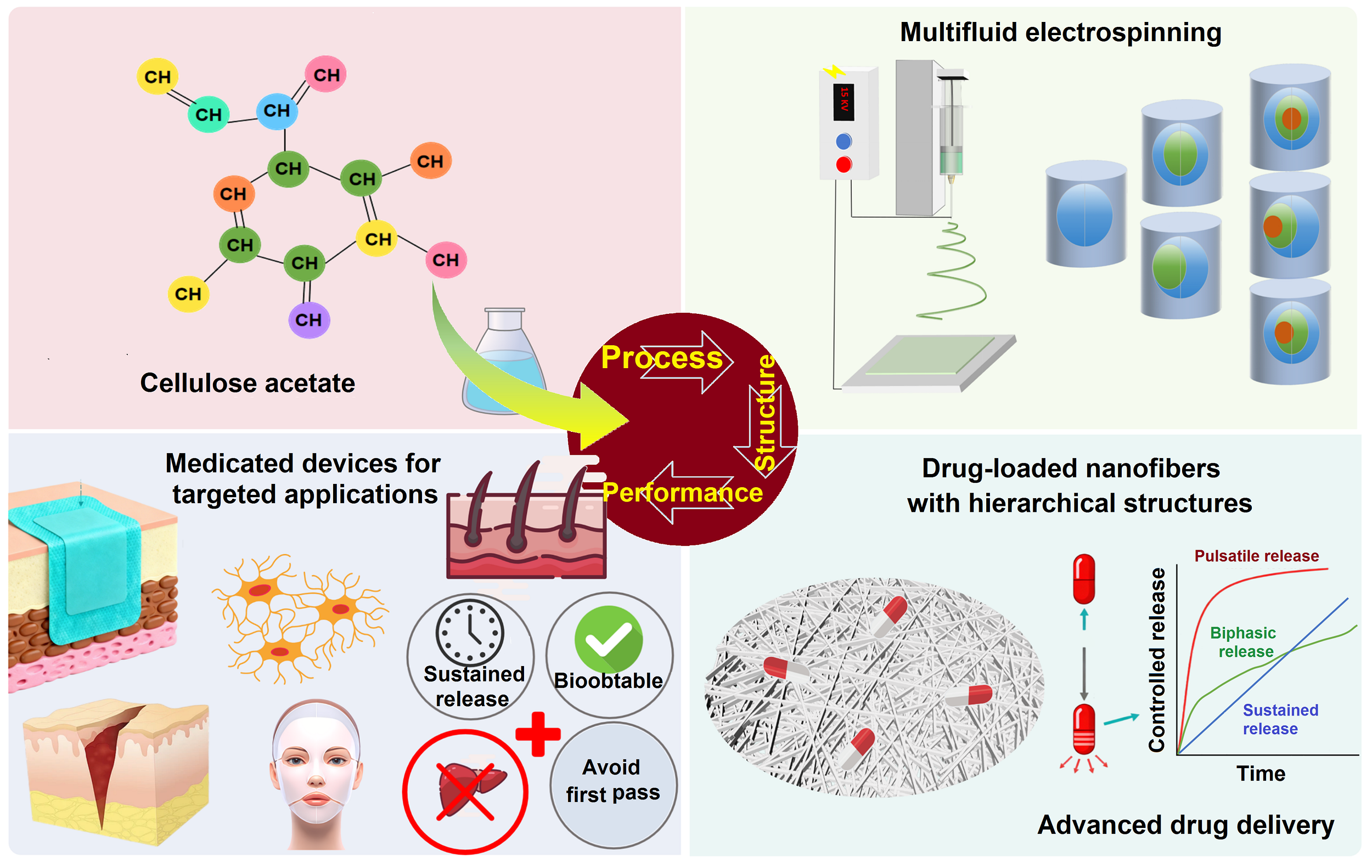
Electrospun medicated cellulose acetate nanofibers: Architectures, controlled release and transdermal drug delivery applications
Electrospun cellulose acetate (CA) nanofibers have emerged as structurally programmable platforms for smart material systems and devices because of their tunable porosity, controllable fiber morphology, biocompatibility, compatibility, and processability ...
More.Electrospun cellulose acetate (CA) nanofibers have emerged as structurally programmable platforms for smart material systems and devices because of their tunable porosity, controllable fiber morphology, biocompatibility, compatibility, and processability using single-fluid, coaxial, side-by-side, and multifluid electrospinning. Unlike conventional drug-loaded fibrous mats, recent CA-based systems have been endowed with the ability to regulate payload distribution, diffusion pathways, interfacial wettability, and stimulus-responsive release through rational structural designs. This review summarizes the process-structure-function relationships of electrospun CA nanofibers, with emphasis on solvent engineering, fiber architecture, multiscale morphology control, and programmable release profiles. Particular attention is given to core-sheath, Janus, and trilayer core-sheath nanofibers that enable sustained, biphasic, pulsatile, and near-zero-order release profiles. The potential of these fibrous systems as skin-interfaced smart platforms for transdermal delivery, wound management, and wearable therapeutic interfaces is discussed. Finally, future directions involving green manufacturing, AI-assisted formulation design, sensing-feedback-release integration, and clinical translation are proposed.
Less.Jiaqi Zhu, ... Yuanjie Zhu
DOI:https://doi.org/10.70401/smd.2026.0059 - November 02, 2026
Innovating materials design for smart cryomesh with enhanced cryopreservation performance
Cryopreservation technologies have important applications in healthcare, biodiversity, and food sustainability, but post-rewarming viability in preserved biosystems is limited by ice-induced damage and cryoprotective agent toxicity. Vitrification, ...
More.Cryopreservation technologies have important applications in healthcare, biodiversity, and food sustainability, but post-rewarming viability in preserved biosystems is limited by ice-induced damage and cryoprotective agent toxicity. Vitrification, also known as ‘ice-free’ cryopreservation, suppresses ice formation and offers significant promise, but typically requires rapid heat transfer, high cryoprotective agent concentrations, or both. Recent success using a “cryomesh” approach can cryopreserve both organisms and organoids in a vitrified state through improved heat transfer. This perspective presents a materials-centered framework for designing next-generation cryomesh to further improve cryopreservation efficacy. Building on established mechanisms, cryomesh performance and post-rewarming viability could be further improved through material selection, hierarchical microstructures, and surface engineering. Proposed strategies include thermally conductive materials, wettable coatings, and stimuli-responsive materials for controlled, automated sample recovery. We emphasize the critical importance of device-level validation under relevant conditions rather than evaluation by thermal conductivity or function alone. By integrating heat transfer, interfacial phenomena, and sample handling, this perspective outlines design priorities for scalable, high-throughput cryopreservation.
Less.Haopu Liang, ... Yadong Yin
DOI:https://doi.org/10.70401/smd.2026.0061 - November 02, 2026
From ultralow transmittance to low-reflection light management: Future directions for next-generation reversible electrodeposition smart windows
Reversible electrodeposition (RED) electrochromic technology offers a promising approach to achieving deep privacy states with visible-light transmittance below 0.1% by electrically controlling the reversible formation and dissolution of electrodeposited ...
More.Reversible electrodeposition (RED) electrochromic technology offers a promising approach to achieving deep privacy states with visible-light transmittance below 0.1% by electrically controlling the reversible formation and dissolution of electrodeposited layers. However, when dark-state transmittance approaches zero, dense and continuous metallic layers may reflect part of the blocked visible light back into the external environment because of their strong specular reflection, potentially leading to glare and light pollution. Therefore, the future development of RED smart windows should shift from simply minimizing dark-state transmittance toward coordinated management of transmission, reflection, and absorption, with particular emphasis on suppressing specular reflection while maintaining deep light blocking. In this Perspective, we discuss future directions for low-reflection light management in next-generation RED smart windows. Three possible strategies are proposed: controlling deposit morphology through morphology engineering and deposition kinetics to enhance light absorption and scattering while maintaining high surface coverage; introducing absorbing electrodeposition materials and multicomponent synergy to strengthen optical absorption; and using multilayer structures to spatially distribute optical functions along the light-propagation direction. These strategies are expected to enable ultralow transmittance while reducing specular reflection, thereby improving glare control in RED smart windows.
Less.Zhiyan Zhang, Xun Cao
DOI:https://doi.org/10.70401/smd.2026.0060 - November 02, 2026